Symmetry Class 7 Notes Maths Chapter 14

Symmetry Class 7 NotesOn this page, you will find Symmetry Class 7 Notes Maths Chapter 14 Pdf free download. CBSE NCERT Class 7 Maths Notes Chapter 14 Symmetry will seemingly help them to revise the important concepts in less time.

CBSE Class 7 Maths Chapter 14 Notes Symmetry

Symmetry Class 7 Notes Conceptual Facts

Symmetry; If a paper is folded in half and the two halves of the paper exactly cover each other, then the shape of the paper is symmetric.
For example:
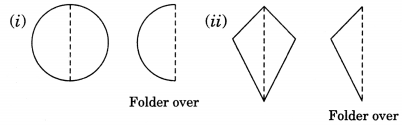
Symmetry Class 7 Notes Maths Chapter 14 .1
Axis of symmetry: When a figure is folded in half then the line of fold is called axis of symmetry.
For example:
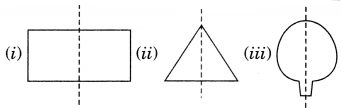
Symmetry Class 7 Notes Maths Chapter 14 .2

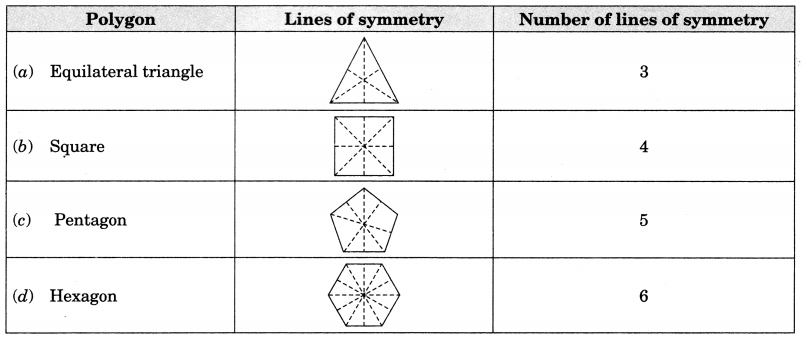
Symmetry of regular polygons:
Symmetry Class 7 Notes Maths Chapter 14 .3

Note: Each regular polygon has a many lines of symmetry as it has sides.

Mirror reflection symmetry: The symmetry in which one half of the shape is the image of the other.
For example:
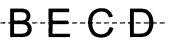
Symmetry Class 7 Notes Maths Chapter 14 .4

Rotational symmetry: When an object rotate clockwise or anticlockwise about a fixed point and when it looks after some rotation by a partial turn then it is called rotational symmetry. This fixed point is known as centre of rotation.
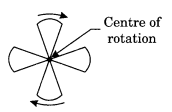
Symmetry Class 7 Notes Maths Chapter 14 .5

Axis of rotation: The line of symmetry about of which an object rotates is called the axis of rotation.
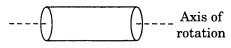
Symmetry Class 7 Notes Maths Chapter 14 .6

Angle of rotation: The angle through which an object rotates is called angle of rotations.

  • A half-turn means rotation by 180°.
  • A quarter-turn means rotations by 90°.
  • A complete-turn means rotation by 360°.

Order of rotational symmetry: If x° be the smallest angle through which a figure can rotate and still looks the same, then the order of rotational symmetry \(=\left(\frac{360}{x}\right)\)
For example:
(i) Order of square \( =\frac{360}{90}=4\)
(ii) Order of equilateral triangle \( =\frac{360}{90}=6\)
 

Exponents and Powers Class 7 Notes Maths Chapter 13

Exponents and Powers Class 7 NotesOn this page, you will find Exponents and Powers Class 7 Notes Maths Chapter 13 Pdf free download. CBSE NCERT Class 7 Maths Notes Chapter 13 Exponents and Powers will seemingly help them to revise the important concepts in less time.
CBSE Class 7 Maths Chapter 9 Notes Exponents and Powers

Exponents and Powers Class 7 Notes Conceptual Facts

1. Exponents are used to express the large numbers in shorter form to make them easier to read, compare the understand.

2. When a number is multiplied by itself several times, it can be expressed in short form as under

x x x x x x x x x = x5 which is called exponential expression.
x is called base and 5 is exponent or power or index.

3. In general an = a x a x a x a x … n times = an

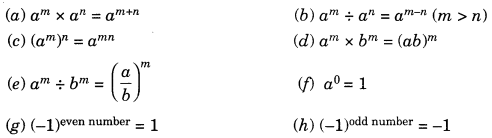
4. Properties of exponents:

5. Any number raised to power 1 gives the same number.

6. For example: 51 = 5, 1001 = 100

7. A negative number raised to an odd positive integer is always negative.
For example: (-4)3 = (-4) x (-4) x (-4) = -64

8. A negative number raised to an even positive integer is always positive.
For example: (-3)4 = (-3) x (-3) x (-3) x (-3) = 81

9. A positive number raised to an even or odd integer is always positive.
For example:
24 = 2 x 2 x 2 x 2 = 16
= 33 x 3 x 3 = 27

10. Any number raised to power zero, it gives 1.
For example: (-5)° = 1, (1000)°= 1

11. Power 2 is also called square of.

12. Power 3 is also called cube of.

13. Laws of exponents: For any non-zero integers a and b and whole numbers m and
Exponents and Powers Class 7 Notes Maths Chapter 13


Algebraic Expressions Class 7 Notes Maths Chapter 12

Algebraic Expressions Class 7 NotesOn this page, you will find Algebraic Expressions Class 7 Notes Maths Chapter 12 Pdf free download. CBSE NCERT Class 7 Maths Notes Chapter 12 Algebraic Expressions will seemingly help them to revise the important concepts in less time.
CBSE Class 7 Maths Chapter 12 Notes Algebraic Expressions

Algebraic Expressions Class 7 Notes Conceptual Facts

1. Algebraic expressions are formed by using variables and constants.
For example: the expression 2x + 3y + 1 is formed by the variables x and y the constants 2, 3 and 1.

2. Expressions are made up terms.
For example: we get an expression if the terms 3xy + 2z, and 3 are added, i.e. 3xy + 22 + 3.

3. Coefficient is the numerical factor in a terms.
For example: In the term 5xy, 5 is the coefficient of xy.

4. Algebraic expressions obey the rules of operations of addition, subtraction, multiplication and division.

5. Like and unlike terms: The terms which have same variable factors are called like terms and the terms which have different variable factors are called unlike terms.
For example:

  • 6ab, \(\frac{3}{2}\) ab, 5ab, – ab are all like terms.
  • 3x2y, 5xy, \(\frac{3}{2}\)xy2 are all unlike terms.

Type of Algebraic expressions:

(i) Monomial: An algebraic expression having only one term is called monomial.
For example: 3x, 5y, 6xy, 3x2 are all monomials.

(ii) Binomial: An algebraic expression having two terms is called binomial.
For example: x + y, 3x – y2 , 6x + 5 are all binomials.

(iii) Trinomials: An algebraic expression having three terms is called trinomial.
For example: a2 + b2 + c2 , 2x + 3y – 5, 4x2 + x + y2 are all trinomials.

(iv) Polynomials: An algebraic expression having one or more terms is called polynomial.
For example: a + bx + cx2 + dx3 + … is called a polynomial.


Perimeter and Area Class 7 Notes Maths Chapter 11

Perimeter and Area Class 7 NotesOn this page, you will find Perimeter and Area Class 7 Notes Maths Chapter 11 Pdf free download. CBSE NCERT Class 7 Maths Notes Chapter 11 Perimeter and Area will seemingly help them to revise the important concepts in less time.
CBSE Class 7 Maths Chapter 11 Notes Perimeter and Area

Perimeter and Area Class 7 Notes Conceptual Facts

1. Perimeter is the actual distance around a closed figure.

2. Perimeter of a regular polygon = Number of sides x Length of one side

3. Perimeter of a square = 4 x side

Perimeter and Area Class 7 Notes Maths Chapter 11

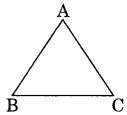
4. Perimeter of a triangle = AB + BC + CA (Sum of all sides of triangle)

Perimeter and Area Class 7 Notes Maths Chapter 11.1

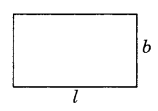
5. Perimeter of a rectangle = 2 [length + breadth]
= 2(l+ b)

Perimeter and Area Class 7 Notes Maths Chapter 11.2

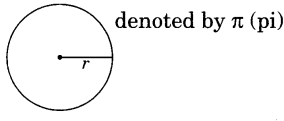
6. Circumference of a circle is the actual distance around it.

7. Ratio of the circumference and the diameter of a circle is a constant

8. The numerical value of π is taken as \(\frac{22}{7}\) or 3.14. (approximate)

Perimeter and Area Class 7 Notes Maths Chapter 11.3
9. Circumference of a circle = 2πr, where r is the radius of the circle.

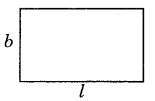
10. Area of a rectangle = length x breadth = l x b

Perimeter and Area Class 7 Notes Maths Chapter 11.4

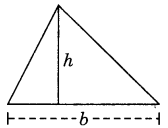
11. Area of a triangle = \(\frac{1}{2}\) x base x height = \(\frac{1}{2}\) x b x h

Perimeter and Area Class 7 Notes Maths Chapter 11.5

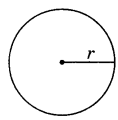
12. Area of circle = πr2, where r is the radius of the circle.

Perimeter and Area Class 7 Notes Maths Chapter 11.6

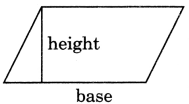
13. Area of a parallelogram = base x height

Perimeter and Area Class 7 Notes Maths Chapter 11.7

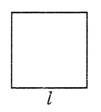
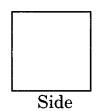
14. Area of a square = (Side)2 = l2

Perimeter and Area Class 7 Notes Maths Chapter 11.8

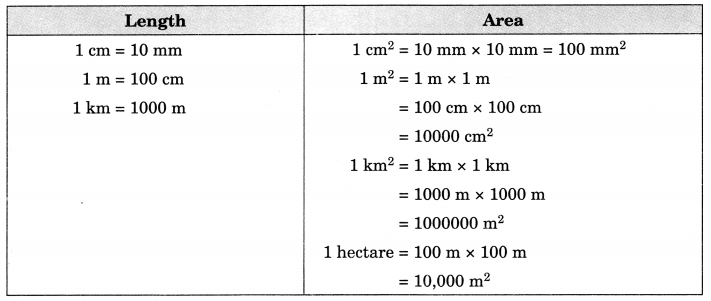
Conversion of units

Perimeter and Area Class 7 Notes Maths Chapter 11.9

Rational Numbers Class 7 Notes Maths Chapter 9

Rational Numbers Class 7 NotesOn this page, you will find Rational Numbers Class 7 Notes Maths Chapter 9 Pdf free download. CBSE NCERT Class 7 Maths Notes Chapter 9 Rational Numbers will seemingly help them to revise the important concepts in less time.

CBSE Class 7 Maths Chapter 9 Notes Rational Numbers

Rational Numbers Class 7 Notes Conceptual Facts

1. Rational numbers: The number which are in the form of \(\frac{p}{q}\) where p and q are co-prime and
q ≠ 0 are called rational numbers.

2. All integers and fractions are rational numbers.

3. When we compare two integers, we need rational numbers.
e.g. 2 : 3 = \(\frac{2}{3}\) a rational number.

4. 0 is a rational number.

5. A rational number is said to positive if both of the numerator and denominator are either positive or negative.
\(\text { e.g. } \frac{5}{6}, \frac{-2}{-3}, \frac{0}{2} \text { etc }\)

6. A rational number is said to be negative if one of the numerator or denominator is negative.
\(\text { e.g. } \frac{-1}{2}, \frac{3}{-5}, \frac{0}{-1} \text { etc. }\)

7. Every integer is a rational number but every rational number need not to be an integer.

Properties of rational numbers:
(i) Equivalence of rational numbers: If \(\frac{p}{q}\) is a rational number and m is a not zero integer, then
Rational Numbers Class 7 Notes Maths Chapter 9

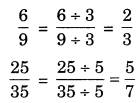
(ii) Reducting a rational number to its simplest form: a rational number and m is a common p+m r divisor top and q then \(\frac{p}{q}\), where H.C.F. of r and s is 1.
Rational Numbers Class 7 Notes Maths Chapter 9.1

Standard form of a rational number: A rational number is said to be in standard form if its denominator
Rational Numbers Class 7 Notes Maths Chapter 9.2

Rational numbers between two rational numbers:
There are unlimited rational numbers between two rational numbers.

Rational numbers on a number line.

  • Mark a point O on a straight line already marked with arrows at its end points.
  • Mark points on the line at unit length interval from each other on both sides like 1, 2, 3, … on right side of 0 and -3,-2, 1 on its left side.
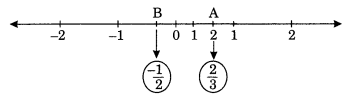
  • To represent rational number \(\frac{2}{3} \text { and }-\frac{1}{2}\) on a number line.
    Rational Numbers Class 7 Notes Maths Chapter 9.4

Since \(\frac{2}{3}\) < 1
∴ Divide the first unit into three equal parts and mark division 2 by A which represent a rational 2
number \(\frac{2}{3}\). Similarly, divide the first unit on the left into two equal parts. Mark the middle one
3 1 by B which represents a rational number –\(\frac{2}{3}\).

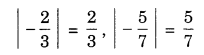
Absolute value of a rational number: The absolute value of a rational number |a| is written as which shows its numerical value only regardless of its sign.
eg,…
Rational Numbers Class 7 Notes Maths Chapter 9.5