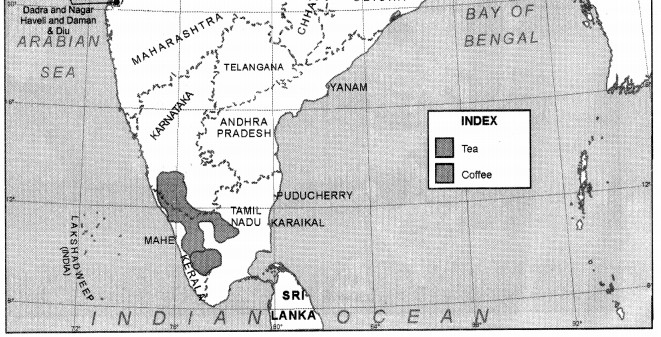
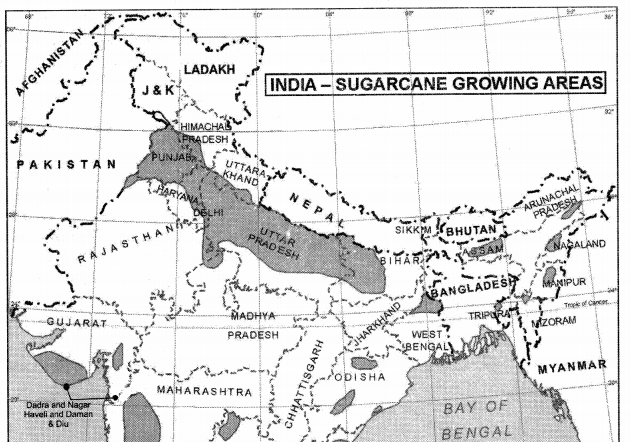
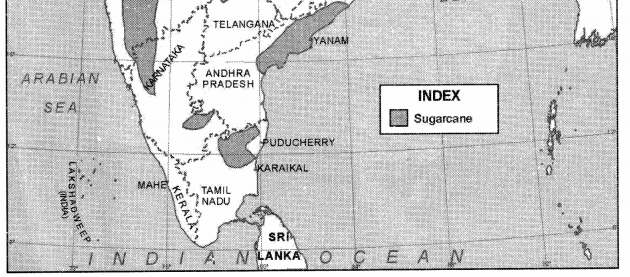
Manufacturing Industries Class 12 Important Extra Questions Geography Chapter 8

Here we are providing Class 12 Geography Important Extra Questions and Answers Chapter 8 Manufacturing Industries. Geography Class 12 Important Questions are the best resource for students which helps in class 12 board exams.

Class 12 Geography Chapter 8 Important Extra Questions Manufacturing Industries

Manufacturing Industries Important Extra Questions Very Short Answer Type

Question 1.
When was TISCO at Jamshedpur established ?
Answer:
In 1907.

Question 2.
Classify industries on the basis of ownership.
Answer:
Public Sector, Private Sector and Cooperative Sector.

Question 3.
What is the total production of steel in India ?
Answer:
76.7 million tonnes.

Question 4.
When and where was the first modern cotton textile mill setup ?
Answer:
In 1854 in Mumbai.

Question 5.
State the number of total sugar mills in India.
Answer:
526.

Question 6.
What is the total production of sugar in India (2012) ?
Answer:
339 million tonnes.

Question 7.
Name the largest centre of electronic industry in India.
Answer:
Bengaluru.

Question 8.
Name two industrial centres of Chotta Nagpur region.
Answer:
Ranchi and Bokaro.

Question 9.
Classify industries on the basis of raw materials.
Answer:
Agro-based, Forest-based and Mineral-based industries.

Question 10.
On what factors does the Cotton textiles depend ?
Answer:

  • Raw materials
  • Fuel
  • Chemical
  • Machinery
  • Labour
  • Transport
  • Market.

Question 11.
Name the five main points of Pentagon formed by major centres of cotton textiles.
Answer:
Ahmedabad, Mumbai, Solapur, Nagpur, Indore, Ujjain.

Question 12.
Which state has the highest number of cotton textile mills ?
Answer:
Tamil Nadu—439 mills.

Question 13.
Give one example each of Ferrous and non-Ferrous industries. (Sample Paper 1)
Answer:
Ferrous—iron and steel, non-Ferrous-Copper.

Question 14.
Name any two sub-sections of cotton textile industry in the world. (C.B.S.E. 2009)
Answer:
(i) Handloom
(ii) Mill Sector.

Question 15.
Name the two rivers that provide water to Tata Iron and Steel Company (TISCO). (C.B.S.E. 2013)
Answer:
Khorkai and Subarnarekha.

Manufacturing Industries Important Extra Questions Short Answer Type

Question 1.
Name the industries classified on the basis of raw materials.
Answer:

  • Agro-based industries
  • Forest-based industries
  • Mineral-based industries
  • Assembling industries.

Question 2.
Name the industries classified on the basis of entrepreneurship.
Answer:
(i) Public Sector Industries
(ii) Private Sector
(iii) Co-operative Sector.

Question 3.
Describe five features of distribution of cotton textile industry in India.
Answer:
(i) Cotton Textile is widely distributed in India.
(ii) It is concentrated in Mumbai, Ahmedabad.
(iii) It is an agro-based industry
(iv) Cloth is produced in three sectors

  • Mills
  • Power-looms
  • Handlooms

(v) It is the largest industry in India.

Question 4.
What do you mean by “manufacturing” ?
Answer:
Manufacturing is the process of conversion of raw materials into useful finished products with the help of machines. It is a secondary occupation of man. Manufacturing has a major role in utilisation of resources as these transform resources into more valuable goods. For example, wood pulp and paper are manufactured from wood, yarn and cloth from cotton, steel and machine tools from iron ore.

Question 5.
What is heavy industry ?
Answer:
The industries using minerals for manufacturing bulky products are known as heavy industries. Thus, heavy industries are mineral-based. The products are manufactured in modern mills. These form the basis of industrialisation of a country. Iron and steel, Machine tools, Engineering industries are included in this category.

Question 6.
In what different ways, can industries be classified ?
Answer:
The industries can be classified on the following basis:
(i) On the basis of size of the industries, the industries can be classified into two categories:

  • Large-scale industries.
  • Small-scale industries.

(ii) On the basis of development of the industries, the industries are of two types:

  • Cottage industries.
  • Mill industries.

(iii) On the basis of ownership, the industries fall into three groups:

  • Public sector.
  • Private sector.
  • Cooperative sector.

(iv) On the basis of raw materials, industries are mainly of two types :

  • Agro-based industries.
  • Mineral-based industries.

(v) On the basis of manufactured goods, the industries are of two types :

  • Heavy industries.
  • Light industries.

(vi) Similarly different types of industries are grouped as handicrafts, village industries, household industries, key industries and consumer industries.

Question 7.
Name the five iron and steel towns of India.
Answer:
Iron and steel plants are established in the following towns which are known as steel towns of India.

  • Jamshedpur (Jharkhand)
  • Bokaro (Jharkhand)
  • Bhilai (Chhattisgarh)
  • Rourkela (Odisha)
  • Durgapur (W. Bengal)

Question 8.
State the different sectors on ‘the basis of structure of industries. (C.B.S.E. 2013)
Answer:
On the basis of ownership, the industries are grouped into three sectors:
(i) Public Sector. These are managed by the state. These are basic and heavy industries. For example, Bhilai steel plant, Nangal fertiliser factory.

(ii) Private Sector. These industries run under the private management of individuals such as Jamshedpur TISCO steel plant.

(iii) Joint or Cooperative Sector. These industries are managed by a group of persons or a co-operative society. For example, sugar industries.

Question 9.
What are the problems of cotton textiles?
Answer:
Cotton textiles is the largest organised industry, but it has some problems.

  • The production of long staple cotton is not large. India has to import long staple cotton
  • The machinery is old and obsolete. Its productivity is low and cost is high
  • Capital is required for modernisation of machinery particularly automatic machines
  • Competition from China and Japan is hard.

Question 10.
Why have the textile industries moved from Mumbai towards Ahmedabad ? Explain with the help of suitable examples.
Answer:
The first modern cotton textile mill was established in Mumbai in 1854. Location of the Port, humid coastal climate, development of chemical industry, availability of capital and easy import of machinery were some of the advantages. Raw cotton was imported from other states. After some time, the dispersal of cotton textile industry started.

With the result, cotton mills were established at Ahmedabad, in the heart of cotton growing belt. At Ahmedabad, level land as well as capital was available. Ahmedabad has no problems of strikes, high wages. Therefore Ahmedabad became the ‘Manchester of India’ (the largest textile centre of India).

Question 11.
Why is iron and steel industry located only in Peninsular India ?
Answer:
Iron and Steel is a heavy industry using very bulky raw materials. Therefore, its location is governed by close proximity to raw materials and good transport system. The north eastern and southern parts of Peninsular India are rich in minerals which is suitable for the location of Iron and Steel industries.

Question 12.
Classify industries on the basis of manufactured products.
Answer:
Classification of industries is based on the nature of the manufactured products. Seven classes of industries, thus, identified are:

  • Metallurgical Industries
  • Mechanical Engineering Industries,
  • Electrical Engineering
  • Chemical and Allied Industries
  • Textile Industries
  • Food Industries, and
  • Electricity Generation.

Electronics industries have emerged as the 8th group of industries.

Question 13.
Explain any three major objectives of New Industrial Policy of India, which was announced in 1991. (C.B.S.E. 2011)
Or
Mention any four major objectives of the New Industrial Policy, 1991 of India. Describe the role of globalisation in achieving these objectives. (C.B.S.E. Outside Delhi 2017)
Answer:
Industrial Policy. The new industrial policy was announced in 1991. The major objectives of this policy were:

  • To build on the gains already made.
  • To correct the distortions or weaknesses that have crept in.
  • To maintain a sustained growth in productivity and gainful employment.
  • To attain international competitiveness.

Question 14.
Describe the steps taken during Liberalisation Policy.
Answer:
New Industrial Policy of 1991 announced several liberalisation measures and private sector was destined to play an important role in industrial activities during the Eighth Five Year Plan (1992-1997).

  • Major liberalisation measures removed entry barriers to investment
  • opened trade
  • provided free access to foreign technology in some sectors
  • opened up foreign direct investment and
  • removed barriers inhibiting access to capital markets.

Question 15.
Name the major industrial regions, minor industrial regions and industrial districts.
Answer:
Industrial Regions and Districts
Major Industrial Regions.

  • Mumbai-Pune Region
  • Hugli Region
  • Bengaluru-Tamil Nadu Region
  • Gujarat Region
  • Chottanagpur Region
  • Vishakhapatnam-Guntur Region
  • Gurgaon- Delhi-Meerut Region, and
  • Kollam-Thiruvan- thapuram Region.

Minor Industrial Regions.

  • Ambala-Amritsar,
  • Saharanpur-Muzaffarnagar-Bijnaur
  • Indore- Dewas-Ujjain
  • Jaipur-Ajmer
  • Kolhapur-South Kannad
  • Northern Malabar
  • Middle Malabar
  • Adilbad-Nizamabad
  • Allahabad-Varanasi-Mirzapur,
  • Bhojpur-Munger
  • Durg-Raipur
  • Bilaspur- Korba, and
  • Brahmaputra valley.

Industrial Districts

  • Kanpur
  •  Hyderabad
  • Agra
  • Nagpur
  • Gwalior
  • Bhopal
  • Lucknow
  • Jalpaiguri
  • Cuttack
  • Gorakhpur
  • Aligarh
  • Kota
  • Purnia
  • Jabalpur, and
  • Bareilly.

Question 16.
List tha factors which favour the location of steel plant at Jamshedpur.
Answer:
Jamshedpur is ideally situated with respect to raw materials and market for the location of iron and steel industry. The plant has the following favourable facilities:

Geographical factors for location

  • Availability of iron ore from Singhbhum region.
  • Coking coal from Jharia and Raniganj.
  • Limestone, Manganese and Quartz are available nearby.
  • Damodar, Subamrekha, Kharkai rivers provide water and sand.
  • Cheap labour from densely populated state of Bihar and West Bengal.
  • Facilities of cheap transport and port of Kolkata.
  • Water power is available from D.V.C.

Question 17.
Account for the concentration of cotton textiles at Mumbai and Ahmedabad.
Or
Mention any two factors responsible for the establishment of cotton textile mills in Mumbai. (CBSE2018)
Answer:
The first cotton textile mill in India was established in 1854 in Mumbai. A large home market, manufacturing of textile machinery and abundant supply of raw cotton has favoured the growth of this industry in India. There are 1050 mills scattered over 80 towns of India. India is the world’s largest cotton textile producer.

Mumbai is the oldest centre of cotton textile industry in India. Mumbai is known as ‘Cotton Polis of India’. The following factors have led to the concentration of this industry at Mumbai:

  • Early start.
  • Warm and humid marine climate.
  • Nearness to cotton producing areas of Maharashtra.
  • Easy import of machinery, chemicals, long staple cotton from the port of Mumbai.
  • Cheap skilled labour.
  • Water power from Tata Hydro Electric Works.
  • Large ready market.
  • Facilities of trade, banking and transport.

Ahmedabad (Gujarat) is the largest producer of cotton textiles in India. It is known as the ‘Manchester of India’. Ahmedabad is situated in the heart of cotton growing areas of Gujarat. Cheap land, water power and skilled labour is available. The combination of these factors have led to the growth of cotton textiles in Ahmedabad.

Question 18.
Describe any five characteristics of ‘Gujarat Industrial Region’. (C.B.S.E. 2009)
Or
Explain any five factors responsible for the development of “Gujarat Industrial Region.” (C.B.S.E. Delhi 2017)
Answer:
Gujarat Industrial Region.
This is the third largest industrial region of India. It is an inland industrial region and has the following favourable factors:

  • It is located near the raw cotton producing area. It is close to the marketing centres of Ganga- Sutlej plains.
  • Cheap skilled labour as well as cheap land is available.
  • The discovery of oil in the Gulf of Cambay region has led to establishment of an industrial complex of petro-chemical industries.
  • The development of new port of Kandla has provided the facilities of import-exports.
  • Ahmedabad is the major centre of cotton textiles and is known as the Manchester of India’.

Question 19.
Why are sugar mills con¬centrated within the sugarcane producing areas in India ? Explain citing five reasons. (C.B.S.E. 2009) (Sample paper 2017)
Answer:
Maharashtra, Uttar Pradesh and Tamil Nadu are the major sugarcane producing states. Most of sugar factories are located in the above mentioned states. This is due to following reasons :

  • Sugarcane is a weight loosing crop. Therefore sugar mills are located near sugarcane producing areas.
  • It should be used immediately after harvesting otherwise its sucrose content begins to dry.
  • Sugarcane must be crushed within 24 hours of harvesting to get better recovery of sugar.
  • Transportation cost is avoided if it is transported to a short distance.
  • Sugar mills are located in areas where sucrose content is very high.

Question 20.
Explain with examples the factors that helped in the development of Hoogli Industrial region.(Delhi 2019)
Or
Explain any five factors responsible for the development of Hoogli Industrial region. (C.B.S.E. Delhi 2017)
Answer:
Hoogli region is located along the Hoogli river to a distance of 100 kms. The following factors favour the development of the Hoogli region.

  • Opening of coal fields of Damodar Valley.
  • Opening of rich port of Kolkata along the Hoogli river.
  • Location of petroleum refinery at Haldia.
  • Roads and railways provides subsequante lines to the great benefit of the region.

Question 21.
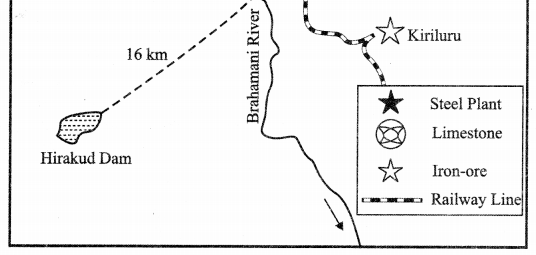
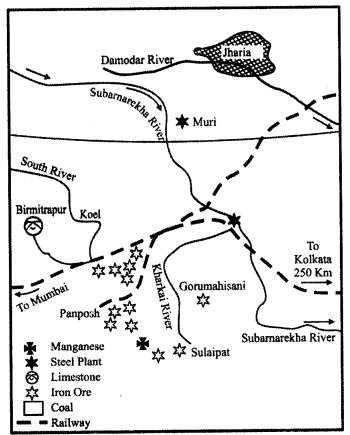
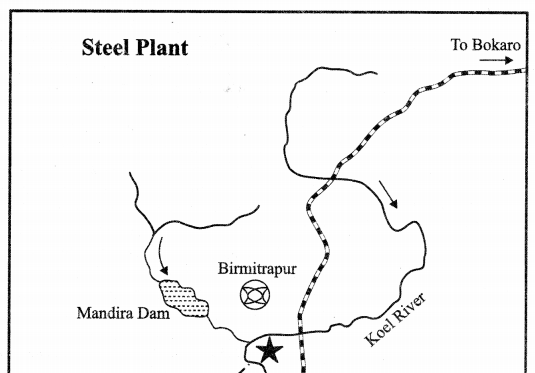
Study the following diagram and answer the questions that follow: (CBSE 2010)
(10.1) Identify and name the steel plant shown in this diagram.
(10.2) Name the mining fields which supply coal and limestone to this plant.
(10.3) Mention the source of water for this plant.
Geography Class 12 Important Questions Chapter 8 Manufacturing Industries 1
Answer:
(10.1) Jamshedpur steel plant
(10.2) Coal from Jharia, limestone from Birmitrapur
(10.3) Water from rivers Subarnarekha and Kharkai

Manufacturing Industries Important Extra Questions Long Answer Type

Question 1.
Explain the locational factors of Industries with the help of suitable examples. (C.B.S.E. 2013)
Or
Explain five main geographical factors influencing location of industries giving suitable examples from Indian industries.
Or
Why do large scale industries choose different location? Explain any four factors which influence the industrial location. (C.B.S.E. Delhi 2017)
Answer:
Manufacturing. Manufacturing is a secondary process of transforming raw materials into finished products. The raw materials of agriculture, forests, minerals are changed into new products. For example, clay is changed into pottery, timber is changed into furniture, etc.

These manufactured goods are more useful and valuable than the raw material. The location of manufacturing industries depends on a number of physical and socio-economic factors. These factors are called the basis of industries. No single factor decides the location of industries.

Geographical Factors

(1) Nearness to raw materials. Large quantities of raw materials are needed for industries. Therefore, industries are located near the source of raw materials. The industries are located near mines, forests, farms and seas. It saves the cost of transportation. Sugar mills are located in the areas where sugarcane is produced. Iron and steel industry uses bulky raw materials.

Steel centres are developed where coal and iron are easily available. Industries producing perishable goods (meat, fish and dairy products) are located near the areas of their production. Example. Jute mills in West Bengal and Cotton Textile mills in Maharashtra are located due to the availability of the raw materials.

(2) Power resources. Coal, oil and water-power are the main sources of power. Most of the industries are located around coal-fields. The industrial regions of Damodar Valley (India), Ruhr Valley (West Germany) depends upon coal. Some industries use large amount of electricity.

Such industries like Chemical Industries, Aluminium Industries and Paper Industry are located near hydro-electric stations. Petro-chemical Industries use large quantities of Petroleum. Example. Iron and Steel centres in India are located near Jharia and Raniganj coal fields. Chemical fertiliser plant is located at Nangal where cheap water power is available from Bhakra Project.

(3) Means of Transportation. Modern industries need cheap, developed and quick means of transportation. Water-transport is the cheapest means of transport. Cheap means of transportation are required for the movement of workers, raw materials and machinery to the factories. Manufactured goods should be sent to the market at low cost. Example. Delhi is the nodal point of transport and industries concentrated around it.

(4) Climate. Stimulating climate increases the efficiency of the labourers. Certain industries require special type of climate. Cotton Textile industry requires humid climate, Film industry needs good weather with clear blue sky. Areas with favourable climate become huge markets.

Example. Mumbai is the leading centre of Cotton Textile due to wet coastal climate. Dry climate has led to the location of Aircraft Industry at Bengaluru (India) and California (U.S.A.).

Non-Geographical factors

(5) Cheap land. Heavy industries need cheap level land. Steel industry at Jamshedpur is located in a broad river-valley.

(6) Capital. Large amount of capital is invested in many industries. Many industries have been located in big cities like Delhi, Mumbai, Kolkata. Many banks and companies provide capital in these areas.

(7) Skilled labour. Cheap and skilled labour is essential for the location of the industries. Areas of dense population provide cheap and large labour force. Engineering industries need skilled labour. Cotton Textile industry in Lancashire, Glass industry in Ferozabad, Sports goods industry in Jalandhar are located due to the availability of the skilled labour. The Swiss are known for watch making, the British for specialised cotton textiles, the Japanese for electronic goods and Varanasi is known for Silk embroidery.

(8) Government policies. Most of the industries are located with government aid. Government policies may encourage or discourage the industries in an area. Government may offer cheap land, reduce taxes, help in providing machinery and transport. Bhilai and Rourkela tea plants were set up to develop tribal area.

(9) Nearness to market. Industries are located near the market for their manufactured goods. Urban and industrial centres with dense population provide a large market. Market is based on demand and the purchasing power of the people. Countries of Asia do not make a huge market because the people cannot afford to buy goods. Dairy Industry is located near the ready markets of towns. Light Engineering industries are located near the big factories which require these goods.

(10) Early start. Momentum of an early start leads to the location of an industry such as cotton textile in Mumbai.

(11) Defence. Some industries are located with a military motive such as Aircraft industry at Bengaluru.

(12) Historical Factors. Historical accident may bring an industry to a new location such as Automobile Industry at Detriot in U.S.A., Lock Industry at Aligarh.

(13) Other Factors. Some secondary factors also help in the location of industries such as availability of water, technical knowledge, political factors, etc. The location of industries keep on changing. A good location, today may become a bad location tomorrow.

Question 2.
Describe the location and development of Iron and Steel Industry in India. (C.B.S.E. Outside Delhi 2017)
Answer:
Iron and steel industry is the basis of modern industrialisation. It is the foundation of modern machines, tools, transportation (rail, road, water, air). It is used in making super structures, bridges, tanks, agricultural implements and many products of daily use. It has great strength, toughness, elasticity and low cost of production. The production and consumption of steel is the index of the nconomic development of country.

Ours is truly an ‘Age of Steel.’
Factors for the location of Iron and Steel industry.

  • Raw Materials. Iron and steel industry needs the bulky raw materials of manganese, limestone and scrap iron.
  • Coking coal. Coking coal or charcoal is required for smelting of iron ore.
  • Cheap land. Modern steel plants, furnaces require cheap level land.
  • Market. The products of iron and steel industry demand a big consumer market.
  • Capital. Iron and steel industry requires huge capital. Lack of capital is a main obstacle to this industry in the developing countries.
  • Other Factors. Iron and steel industry needs cheap transport, skilled labour and modern techniques.

The first modern steel plant was established in 1907 at Sakchi (Jamshedpur) in Jharkhand, by Jamshedji Tata. India produces the cheapest steel in the world. India has large reserves of high grade iron- ore, coking coal and limestone. These raw materials are found close to each other. India produces 340 lakh tons of steel. With the establishment of new steel plants, it is expected to reach 500 lakh tons of steel.

Iron steel industry

Centres of Production.

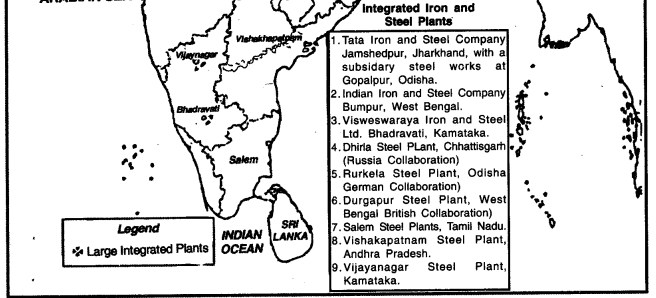
I. Damodar Valley. This region has TISCO (Tata Iron and Steel Company) steel plant at Jamshedpur and IISCO (India Iron and Steel Company) steel plant at Kulti-Burnpur.

Geographical Factors for location.

  • Availability of iron ore from Singhbhum region.
  • Coking coal from Jharia and Raniganj.
  • Limestone, Manganese and Quartz are available nearby.
  • Damodar, Subamrekha, Kharkai provide water and sand.
  • Cheap labour from densely populated states of Bihar and West Bengal.
  • Facilities of cheap transport and port of Kolkata.

II. Visvesvaraya Iron and Steel Limited. This steel plant is located at Bhadravati (Karnataka). It produces alloy and special steel. Iron ore is obtained from Babaudan Hills, charcoal from Kadur forests, water power from Jog Falls, limestone from Bhandigudda mines.

III. Steel Centres in Public Sector. Four steel plants have been developed in the public sector, under HSL (Hindustan Steel Limited) with the collaboration of some foreign countries.
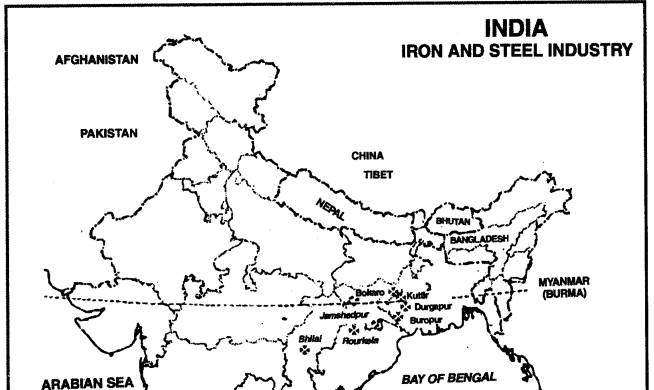
Geography Class 12 Important Questions Chapter 8 Manufacturing Industries 2
Geography Class 12 Important Questions Chapter 8 Manufacturing Industries 3

Bhilai (Chhattisgarh)—with the help of Russia.

  • Vishakhapatnam (Andhra Pradesh)
  • Salem (Tamil Rourkela (Odisha)—By German Firm Krupps- Demag.
  • Durgapur (West Bengal)—With British aid.
  • Bokaro (Jharkhand)—With Russian help.

Geographical factors for location:

  • Bhilai gets iron ore from Dhalli Rajhara hills; coal from Korba and Jharia coal fields; manganese from Balaghat ranges and limestone from Nandani mines.
  • Durgapur gets iron ore from Singbhum; coal from Raniganj; lime stone from Gangpur and water from D.V.C.
  • Rourkela gets iron from Bonai; coal from Jharia and Raniganj, limestone from Birmittrapur.
  • Bokaro, an ore based steel plant gets coal from Jharia; iron from Keonjhar and water power from D.V.C.

IV. New Steel Plants. The Govt, has set up new steel plants at:

(i) Vishakhapatnam (Andhra Pradesh)
(ii) Salem (Tamil Nadu)
(iii) Vijayanagar (Near Hospet, Karnataka)
The capacity of the different steel plants is being expanded. The production of pig iron and steel is being increased by setting up new mini plants based on scrap iron. At present there are 169 mini steel plants in India. India exports about 20 lakh tonnes of steel every year earning a foreign exchange of ₹ 2000 crores. In 1973, SAIL (Steel Authority of India Limited) has been established for the better management of these steel plants.

Question 3.
Describe the location and development of Cotton Textile Industry in India.
Answer:
Cotton Textile Industry
Cotton textile industry is one of the oldest industries in India. Spinning and weaving were the earliest crafts of primitive man. The industry owes its rapid development due to Industrial revolution, Many spinning and weaving machines were invented, These inventions changed this industry from a household to mill industry.

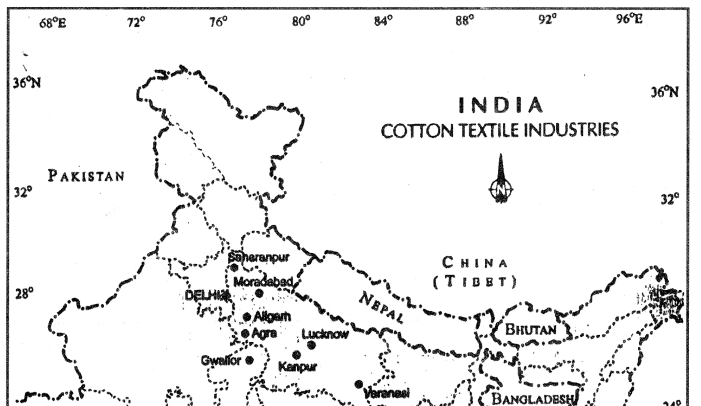
India has a glorious part of cotton textile industry. The first cotton mill was established in 1854 in Mumbai. A large home market, manufacturing of textile machinery and abundant supply of cotton have led to the growth of this industry in India. There are
Geography Class 12 Important Questions Chapter 8 Manufacturing Industries 12
Geography Class 12 Important Questions Chapter 8 Manufacturing Industries 5
about 1824 textile mills scattered over 80 towns and the annual production of cloth is about 3000 crore metres. India is the second largest producer of cotton textile in the world.

Distribution of Cotton Textile Industry :

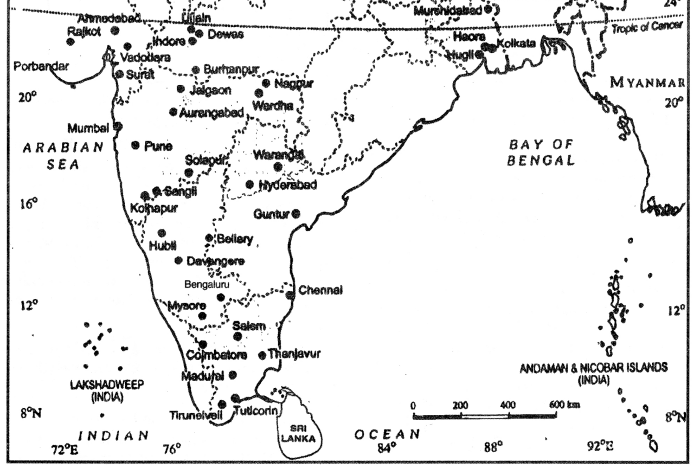
(i) Maharashtra. Mumbai is the oldest centre of cotton textile industry in India. Mumbai is known as “Cotton Polis of India.” Nagpur, Pune, Sholapur, Amaravati are other centres. The following factors have led to the concentration of this industry at Mumbai:

  • Early start
  • Large amount of capital
  • Long staple cotton from Gujarat and Maharashtra
  • Facilities of Mumbai as a port
  • Easy import of machinery
  • Humid climate
  • Cheap labour
  • Water power from Tata Hydro-electric works
  • Large ready market
  • Opening of Suez Canal route.

(ii) Gujarat. Ahmedabad is the largest producer of cotton textiles in India. It is known as the ‘Manchester of India’. Ahmedabad is situated in the heart of cotton growing area. Cheap land is also available.

(iii) Tamil Nadu. The development of hydro-electricity in the South and cul tivation of long staple cotton led to the location of this industry in Southern India. Madurai, Coimbatore, Salem and Chennai are the main centres.

(iv) West Bengal. Most of the mills are located at Kolkata in the Hugh basin.

(v) Uttar Pradesh. Kanpur is the main centre and is called ‘The Manchester of Northern India’.

(vi) The dispersal of this industry has led to the growth of new centres like Bhopal, Gwalior, Bengaluru, Phagwara, Bhiv/ani, Delhi and Kota.

Importance

  • Cotton Textiles is the oldest and the biggest industry in India.
  • About 10 lakh workers are engaged in this industry
  • It has the largest amount of capital (X 1300 crores) invested
  • It earns about a sum of X 8000 crores as foreign exchange by export of manufactured goods.

(v) Many industries such as dyes, chemicals, etc., depend on cotton products.

Question 4.
Describe the importance, location and distribution of Sugar industry in India.
Answer:
Sugar Industry. Sugar is an important article of food. It has a universal demand. Sugar is obtained from two major sources:
(a) Sugarcane
(b) Sugar beet.
Geography Class 12 Important Questions Chapter 8 Manufacturing Industries 6
Geography Class 12 Important Questions Chapter 8 Manufacturing Industries 7

India is regarded as the birth-place of sugarcane and sugar. The tropical areas have the sugarcane industry, while the temperate regions have the sugar beet industry.

Importance:

  • India is the largest producer of sugar in the world.
  • It is the second largest industry of India with a capital of ₹ 1000 crores.
  • About 3 lakh workers are engaged in this industry
  • About two crore farmers depend upon this industry.
  • India exports about 5 lakh tonnes of Sugar every year.
  • Many industries such as alcohol, paper, wax, fertiliser, cattle feed are based on its by-products.

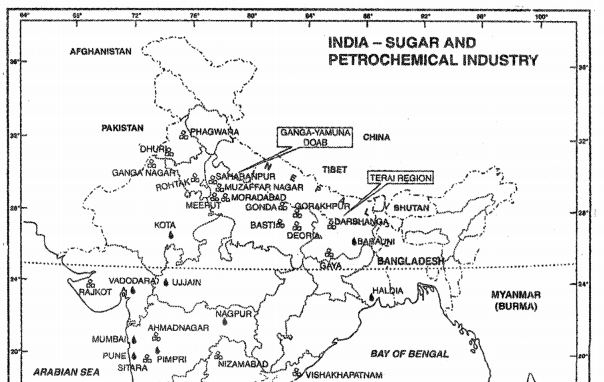
India is one of the oldest producers of sugarcane in the world. The home industry was granted protection in 1932. Since then, the industry has rapidly developed. There are about 506 sugar mills producing about 160 lakh metric tons of sugar. North India (U.P. and Bihar) produces about 60% of sugar in India.

Factors of Growth :

  • Availability of sugarcane in Northern India
  • Cheap and skilled labour
  • Large demand
  • Availability of coal
  • Cheap transport.

Main Centres:

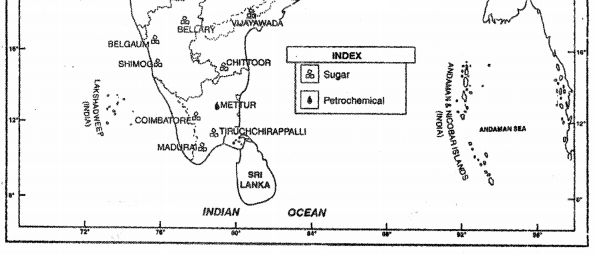
  • Uttar Pradesh. Saharanpur, Muzaffarnagar, Meerut, Gorakhpur, Sitapur, Bareilly.
  • Bihar. Champaran, Patna.
  • Maharashtra. Ahmednagar, Sholapur.
  • Andhra Pradesh. Hyderabad.
  • Punjab. Amritsar, Bhogpur, Phagwara, Batala, Nawanshahar, Nakodar, Mukerian and Zira.
  • Ratlam. (M.P.), Rohtak (Haryana), Madurai (Tamil Nadu).

Problems. Sugar Industry is facing some problems. Yield of sugarcane and sugar content is low. It is a seasonal industry and there is absence of industries consuming the by-products of sugarcane. Moreover, the cost of sugar is also high.

Question 5.
Write a note on Petro-chemical industries of India: under the following heads:—
(i) Petro-chemicals
(ii) Polymers
(iii) Synthetic fibres.
Answer:
(i) Petro-chemical Industries. This group of industries is growing very fast in India. A variety of products come under this category of industries. At the same time, petroleum refining industry expanded rapidly. Many things are derived from crude petroleum, which provide raw materials to several new industries; these are collectively known as petro-chemical industries. Mumbai is the hub of petro-chemical industries. Cracker units are also located in Auraiya (Uttar Pradesh), Jamnagar, Nagothane, Gandhar, Haldia, Hazira (Gujarat) and Vishakhapatanam.

Three organisations are working in the petro-chemical sector under the administrative control of the Department of Chemicals and Petro-chemicals.

  • First is the Indian Petro-chemical Corporation Limited (IPCL), a public sector undertaking.
  • Second is the Petrofils Cooperative Limited (PCL)
  • Third is the Central Institute of Plastics Engineering and Technology (CIPET), involved in imparting training.

(ii) Polymers. Polymers are made from ethylene and propylene. These materials are obtained in the process of refining crude oil. Polymers are used as raw material in the plastic industry. Among polymers, polyethylene is widely used thermoplastics. Plastic is first converted into sheets, powder, resin and pellets, then these are used for manufacturing plastic products.

Plastic products are preferred because of their strength, flexibility, water and chemical resistance and low prices. The National Organic Chemical Industries Limited, instituted by the Mafatlal Group in 1961, started the first naphtha-based chemical industry at Mumbai. Mumbai, Barauni, Mettur, Pimpri, and Risra are major producers of plastic materials. Production of polymers was 3441 thousand tonnes in 2000-01. There are about 19,000 units, consuming about 3500 thousand tonnes of virgin polymers.

(iii) Synthetic fibres are wudely used in manufacturing of fabrics because of their inherent strength, durability, washability and resistance to shrinkage. These fabrics are equally popular in urban and rural areas. Units of manufacturing nylon filament and polyester filament yarns are at Kota, Pimpri, Mumbai, Modinagar, Pune, Ujjain, Nagpur and Udhna. Acrylic staple fibre is manufactured at Kota and Vadodara. Plants of polyester staple fibre are at Thane, Ghaziabad, Manali, Kota and Vadodara. Production of synthetic fibres was 2.4 billion tonnes in 2012.

Question 6.
Describe the knowledge based industries of India.
Answer:
Knowledge-Based Industries
The advancement in information technology (IT) has a profound impact on country’s economy and people’s lifestyle. The IT revolution has opened up new possibilities of economic and social trans- formation. The Indian software industry has emerged as one of the fastest growing sectors in the econony. The total turnover of this industry increased from ₹ 3.45 billion in 1989-90 to ₹ 377.50 billion during 2000-01.

These industries include Telephone, Cellular Phones, Computers, Space crafts, equipment for weather forecasting, Hardware and Software. Bengaluru is the electronic capital of India. Science cities and Technology parks have been set up at 18 centres like Hyderabad, Delhi, Mumbai, Chennai, Kanpur, Kolkata, Lucknow, Coimbatore, etc.

The IT software and services industry accounts for almost 2 per cent of India’s GDP and export from this industry amounted to 14 per cent of India’s total exports during 2000-01. The Indian software exports rose from ₹ 2.50 billion in 1990-91 to ₹ 283.50 billion in 2000-01. A large number of Indian software companies have acquired international quality certification. Moreover, majority of the multinational companies operating in the area of Information Technology has either Software Development Centre or Research Development Centre in India.

Question 7.
Discuss the formation of industrial clusters in India. Classify them and account for their existence.
Or
Analyse the factors that favoured the concentration of iron and steel industries in Chhota Nagpur region in India. (Sample paper 2018-19)
Answer:
The concentration of industries has led to the formation of industrial clusters in different regions of India. These clusters are not as large as found in Europe and North America. Manufacturing industries are located closer to each other.

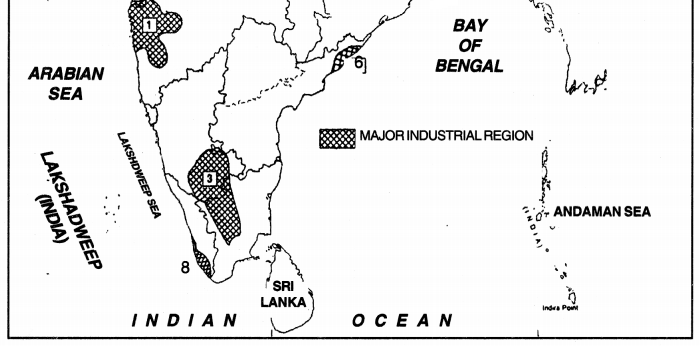
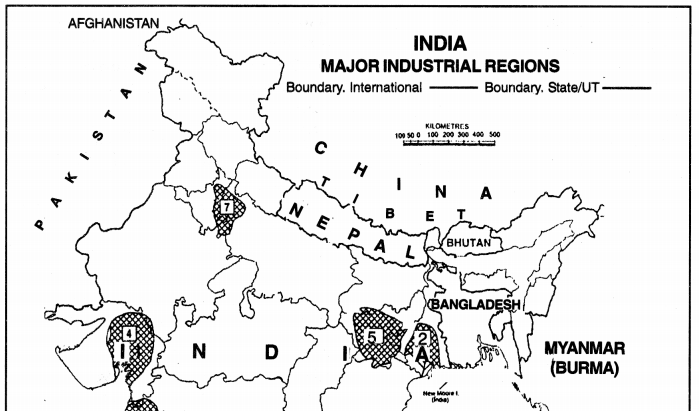
Eight major Industrial regions have been developed in India:
1. Hugli Industrial Region. This is the most prominent industrial region of India. It has developed along the banks of Hugli river upto 97 km. inland from the sea. This region has developed due to the following favourable factors:

  • The port of Kolkata has the benefits of imports and exports.
  • Coal and iron are available from Damodar Valley.
  • It is well connected by a network of railways and road with the rich hinterland of Ganga and Brahmaputra plains.
  • The Tea plantation of Assam and cultivation of Jute in West Bengal has led to the development of this industrial region.
  • Kolkata is a commercial town.

Cheap labour is available from densely populated areas of Bihar and Odisha. The construction of Farakka Barrage on the Ganga and the development of new port of Haldia will provide additional advantages. Iron and Steel, Jute, paper manufactured goods and other industries have been developed in this region. (Delhi 2019)

2. Mumbai-Pune Region. This is the second largest industrial region of India. It has developed due to the growth of cotton textiles in this region. This region has developed in Mumbai, Thane, Kalyan and Pune region. The following factors have favoured the development of this region :

  • The opening of first railway track between Mumbai and Thane in 1853.
  • The development of Mumbai as a port with facilities of imports and exports.
  • The opening of Suez Canal route.
  • Water Power from Western Ghats.
  • Availability of raw cotton from Maharashtra and Gujarat.
  • Cheap and skilled labour from rich hinterland.
  • The opening of Bhor Ghat and Thai Ghat connected this region by rail and road routes with the hinterland.
  • Cotton textiles, oil refineries, chemical industries and Engineering industries have developed in this region.

3. Ahmedabad-Vadodara Region. This is the third largest industrial region of India. It is an inland industrial region. It has the following favourable factors:

  • It is located near the raw cotton producing area.
  • It is close to the marketing centres of Ganga- Sutlej plains.
  • Cheap skilled labour is available.
  • Cheap land is available.
  • The discovery of oil in the Gulf of Cambay region has led to the establishment of an industrial complex of petro-chemical industries.
  • The development of new port of Kandla has provided the facilities of import-exports.
  • Ahmedabad is the major centre of cotton textiles and is known as the ‘Manchester of India’.
Geography Class 12 Important Questions Chapter 8 Manufacturing Industries 8
Geography Class 12 Important Questions Chapter 8 Manufacturing Industries 9

4. Madurai-Coimbatore-Bengaluru Region. This is the largest industrial region in Southern India. Many industries have developed at Chennai, Coimbatore, Madurai, Bengaluru and Mysore. This region has the following favourable factors:

  • Cheap water power from Mettur, Pykara and Shivsamudram works.
  • Cheap skilled labour is available.
  • A huge local market.
  • Favourable climate.
  • Favourable climate.
  • Raw cotton is available.
  • Coimbatore has many industries like cotton textiles, coffee mills, leather tanneries and cement factories.

Bengaluru has Hindustan Aeronautics (Aircraft industry), Hindustan Machine Tools, Indian Telephone Industry, Bharat Electronics, etc. In other centres, Cotton textiles, Woollen textiles, Silk, Chemicals, Automobiles and Leather industries have developed.

5. Chottanagpur Plateau Region. This region has developed in Jharkhand-Odisha mineral region of Damodar valley. Many steel plants have been located in this region such as Jamshedpur, Bokaro, Durgapur, etc. This region is called ‘The Ruhr of India’. A number of factors have favoured the industrial development in this region:

  • Coal from Jharia-Ramganj coalfields.
  • Iron from Bihar-Odisha region.
  • The facilities of port of Kolkata,
  • Water power and thermal power from Damodar valley project.
  • Many heavy industries and engineering industries have developed at Ranchi, Sindri, Chittranjan, Jamshedpur, Hazaribagh, etc.

6. Gurgaon-Deihi-Meerut Region. A number of industrial clusters have assumed importance after independence.
(1) These industries have developed in area adjoining to Delhi. One such industrial region has emerged between Agra-Mathura-Meerut and Saharanpur in U.P.

(2) Another parallel belt extends between Faridabad- Gurgaon-Ambala in Haryana. Both these belts merge in an agglomeration in the vicinity of Delhi.

(3) The hydro-electricity from Bhakra Nangal and thermal power from Harduaganj and Faridabad have very positively contributed to the industrial development of this region.

(4) Majority of the industrial units are agro-based, particularly sugar and textile mills.

(5) Glass, chemicals, engineering, paper, electronics and cycle are other important industries of the region.

(6) Main industries. Agra has glass industry, Mathura has an oil refinery with its petro-chemical complex. Gurgaon has a car factory as well as a unit of the IDPL. Faridabad has a number of engineering and electronics industries. Ghaziabad is a large centre of agro-industries. Saharanpur and Yamunanagar have paper mills. Modinagar, Sonipat, Panipat and Ballabhgarh are other important industrial nodes of this region.

7. Vishakhapatnam-Guntur Region. This industrial region extends from Vishakhapatnam district to Kurnool and Prakasam districts in the south. Industrial development of this region hinges upon Vishakhapatnam, and Machilipatnam ports and developed agriculture and rich reserves of minerals in their hinterlands. Coalfields of the Godavari basin provide power and energy.

Ship building industry was started at Vishakhapatnam in 1941. Petroleum refinery based on imported petroleum facilitated the growth of several petro-chemical industries. Sugar, textile, jute, paper, fertiliser, cement, aluminium and light engineering are principal industries of this region. One lead-zinc smelter is functioning in Guntur district. Iron and steel plant at Vishakhapatnam uses the ore from Bailadila.Vishakhapatnam, Vijayavada, Vijayanagar, Rajahumundry, Guntur, Eluru and Kurnool are important industrial centres.

8. Kollam-Thiruvananthapuram Region. This industrial region is spread over Thiruvananthapuram, Kollam, Alwaye, Ernakulam and Allappuzha districts. Plantation agriculture and hydropower provide industrial base to this region. Located far away from the mineral belt of the country, agricultural products processing and market oriented light industries predominate the region.

Among them, cotton textile, sugar, rubber, matchbox, glass, chemical fertiliser and fish-based industries are important. Food processing, paper, coconut coir products, aluminium and cement industries are important. Petroleum Refinery at Kochi is also useful. Kollam, Alluva, Kochi, Vishakhapatnam uses the Bailadila iron ore. Punalus is another important centre.

Manufacturing Industries Important Extra Questions HOTS

Question 1.
Account for the shifting of sugar industry towards southern India.
Answer:
Uttar Pradesh is the largest producer of sugar in India despite the fact that ideal conditions for sugarcane are found in southern India. But recently, the industry is shifting towards the states of Maharashtra, Tamil Nadu and Andhra Pradesh in Peninsular India.

  • The yield per hectare of sugarcane is high in southern India
  • The sucrose content in sugarcane is high in southern India as compared to that in(Solved))— northern India
  • The southern states have installed new mills, where productivity is high and cost of productions is low.
  • Climatic conditions are ideal in southern states

The co-operative movement has helped to install new mills in these areas.
Geography Class 12 Important Questions Chapter 8 Manufacturing Industries 10
Geography Class 12 Important Questions Chapter 8 Manufacturing Industries 11

Question 2.
Study the diagram given below and answer the questions that follow:
(1) Name the State in which this iron and steel plant is located.
Answer:
Rourkela (Odisha).

(2) Name the sources of coal and iron-ore for this plant.
Answer:
Coal from Jharia and iron-ore from-Odisha.

(3) Explain the principle on which this plant was set up.
Answer:
This plant provided machinery and consultancy to the plant among others.
Mineral and Energy Class 12 Important Extra Questions Geography Chapter 7

Here we are providing Class 12 Geography Important Extra Questions and Answers Chapter 7 Mineral and Energy. Geography Class 12 Important Questions are the best resource for students which helps in class 12 board exams.

Class 12 Geography Chapter 7 Important Extra Questions Mineral and Energy

Mineral and Energy Resources Important Extra Questions Very Short Answer Type

Question 1.
What was the total value of minerals mined in 2012 ?
Answer:
₹ 2.3 crore

Question 2.
What are the total Coal reserves in India in 2012 ?
Answer:
285.38 billion tonnes.

Question 3.
Name two groups of coal Helds.
Answer:
Gondwana and Tertiary.

Question 4.
Where is Mumbai High located ?
Answer:
176 km away from Mumbai in Arabian Sea.

Question 5.
What is the total production of Petroleum in India ?
Answer:
320 lakh tonnes.

Question 6.
Which is the largest Oil refinery in India ?
Answer:
Jamnagar (Gujarat).

Question 7.
What is the total production of Iron ore in India in 2013-13 ?
Answer:
136 million tonnes.

Question 8.
Where was the first Atomic station set up in India ?
Answer:
In 1969 at Tarapur near Mumbai.

Question 9.
Name two sources of non-conventional energy.
Answer:
Biomass and Solar energy.

Question 10.
Name three mineral belts of India.
Answer:
N.E. plateau, S.W. plateau and N.W. Region.

Question 11.
Which state is the largest producer of Coal in India ?
Answer:
Jharkhand.

Question 12.
Which is the largest oil producing area in India ?
Answer:
Mumbai High.

Question 13.
Where was first Electric power house set up ?
Answer:
In 1897 in Darjeeling.

Question 14.
Name any two ferrous (C.B.S.E. 2011)
Answer:
Manganese, Nickle.

Question 15.
What are sustainable energy resources ?
Answer:
Renewable energy resources like Solar energy, Wind, Hydro, geothermal and Bio mass.

Question 16.
Give two advantages of wind energy. Mention four states of India having favourable conditions for the development of wind-energy. (C.B.S.E. 2013)
Answer:
(i) Wind energy is pollution free.
(ii) It is an inexhaustible source of energy. Favourable conditions for wind energy are found in states of Rajasthan, Gujarat, Maharashtra and Karnataka.

Question 17.
Explain any three social and economic values which encourage us to use more and more non-conventional sources of energy. (C.B.S.E. 2014)
Answer:
(i) Planned and judicious use of natural resources.
(ii) Conservation of environment.
(iii) Harmony with nature.
(iv) Sustainable development.

Question 18.
When and where the first successful attempt to tap the underground heat was made?
Answer:
In 1890 in city of Boise, Idaho (USA)

Mineral and Energy Resources Important Extra Questions Short Answer Type

Question 1.
“The non conventional sources of energy will provide more sustained, eco-friendly and cheaper energy, if the initial cost is taken care of.” Examine the statement. (CBSE 2018)
Answer:
Today non conventional sources of energy include wind, tides, geo-thermal heat, biogas, farm and animal waste including human excreta. All these sources are renewable and inexhaustible. They are inexpensive in nature. These are pollution free. These help in decentralisation of industries. Energy can be developed in rural area. These can be developed and maintained at low costs.

Due to acute shortage of conventional sources of energy, it has become necessary to explore the possibilities of using non-conventional sources of energy. These resources are more equitably distributed and environmental-friendly. These will provide more sustainable, eco-friendly and cheaper energies.

Question 2.
What is meant by ‘Mumbai High’ and ‘Sagar Samrat’ ?
Answer:
Mumbai High. Rich oil fields have been discovered in offshore region in gulf of Cambay, along the coast of Mumbai. Oil struck below the sea beds at a distance of 115 kms. from the shore on 19th February, 1974. The drilling was done with the help of Sagar Samrat (A drilling platform). This has become the richest oil field in India and is known as ‘Mumbai High’. It has been connected with the coast by a sub-marine pipeline.

Question 3.
Name the different Nuclear power stations in India.
Answer:
Uranium and Thorium are used as raw materials for generating atomic power. These minerals are found in Bihar, Rajasthan, Tamil Nadu and Kerala. The Atomic Energy Commission was established in 1947 in India. There are four atomic power stations in India.

  • Tarapur (Maharashtra)
  • Rana Pratap Sagar (Kota)
  • Kalpakkam (Chennai)
  • Narora (Uttar Pradesh).

Two atomic stations at Kakarpara (Gujarat) and Kaiga (Karnataka) are at planning stage.

Question 4.
What is bio-energy ? State four advantages of bio-energy. (C.B.S.E. 2013
Answer:
Bio-energy refers to energy derived from biological products which includes agricultural residues, along with municipal, industrial and other works,

Advantages:
(i) It is a potential source of energy conversion.
(ii) It can be converted into electrial energy, heat energy or gas for cooking.
(iii) It can process waste to produce energy.
(iv) It reduces environmental pollution.

Question 5.
Give two advantages of copper. Mention four main copper mining areas of India. (C.B.S.E. 2013)
Answer:
Copper is an indispensable metal in the electrical industry for making wires, electrical motors, transformers and generators. It is also mixed with gold to provide strength to jewellery. Copper deposits are found in:

  • Singhbhum district in Jharkhand
  • Balaghat in Madhya Pradesh
  • Jhunjhuna in Rajasthan
  • Alwar in Rajasthan

Question 6.
Describe the regions producing Natural gas in India. Describe H.B.J. pipeline.
Answer:
Natural gas has emerged as a dynamic source of energy. The total production of Natural gas is 40.674 billion cubic metres in India (2012). Cambay basin, Kaveri coast, Jaisalmer and Mumbai High are the main producers of Natural gas. H.B.J. gas pipeline has been constructed for transporting gas running between Hazira, Bijapur and Jagdishpur.

It is 1700 km. long and runs through the states of Gujarat, Madhya Pradesh, Rajasthan and Uttar Pradesh. This pipeline will supply gas to Bijapur, Sawai Madhopur, Jagdishpur, Shahjahanpur, Amla, Babrala fertiliser plants.
In India, Gas Authority of India Ltd. (GAIL), Oil and Natural Gas Commission (ONGC), Indian Oil Corporation (IOC) and Hindustan Petroleum Corporation (HPC) are exploring and managing gas resources.

Question 7.
Describe the ‘Iron ore belt of India’.
Answer:
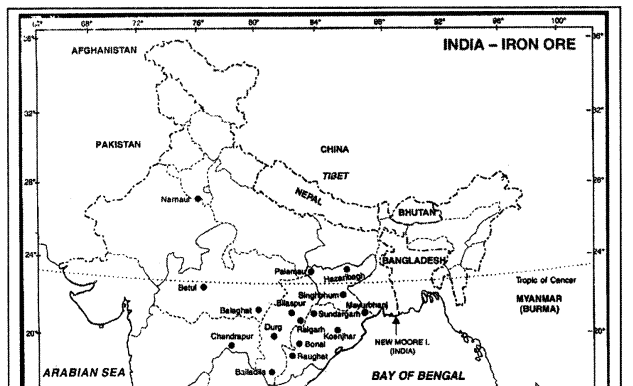
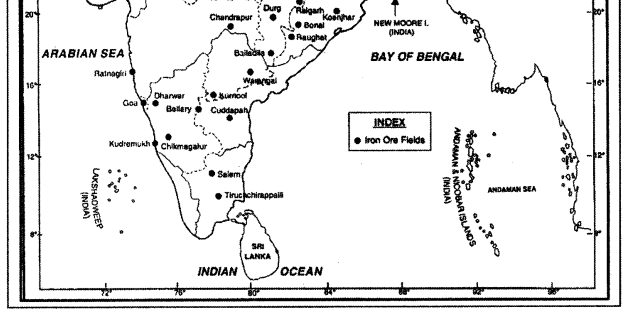
The total reserves of iron ore in the country were about 28.52 billion tonnes in the year 2012. About 95 per cent of total reserves of iron ore is located in the States of Odisha, Jharkhand, Chhattisgarh, Karnataka, Goa, Andhra Pradesh and Tamil Nadu. (1) In Odisha, iron ore occurs in a series of hill ranges in Sundergarh, Mayurbhanj and Keonjhar. The important mines are Gurumahisani, Sulaipet, Badampahar (Mayurbhanj), Kiruburu (Kendujhar) and Bonai (Sundergarh).

(2) Similar hill ranges such as Jharkhand have some of the oldest iron ore mines and most of the iron and steel plants are located around them. Most of the important mines such as Noamandi and Gua are located in Poorbi and Pashchimi Singhbhum districts.

(3) This belt further extends to Durg, Dantewara and Bailadila. Dalli, and Rajhara in Durg are the important mines of iron ore in the country.

(4) In Karnataka, iron ore deposits occur in Sandur-Hospet area of Bellary district, Baba Budan hills and Kudremukh in Chikmangalur district and parts of Shimoga, Chitradurg and Tumkur districts.

(5) The districts of Chandrapur, Bhandara and Ratnagiri in Maharashtra.

(6) Karimnagar, Warangal, Kurnool, Cuddapah and Anantapur districts of Andhra Pradesh.

(7) Salem and Nilgiris districts of Tamil Nadu are other iron mining regions.

(8) Goa has also emerged as an important producer of iron ore.

Question 8.
Distinguish between Ferrous and Non- ferrous minerals.
Answer:

Ferrous MineralsNon-Ferrous Minerals
1. The metallic minerals which contain iron content are called ferrous minerals (Fe).

2. Iron, Manganese. Chromite, Cobalt, etc., are ferrous minerals.

3. These are used in Iron and Steel industry. Some minerals are used as alloys in making different types of steel.

1. The minerals which do not contain iron (ferrous) content are called non- ferrous minerals.

2. Copper. Lead, Zinc. Aluminium are non- ferrous minerals.

3. Each mineral has its particular utility. Some minerals are valuable according to their uses.

Question 9.
Distinguish between Metallic and Non- metallic minerals
Or
Classify minerals on the basis of chemical and physical properties. (C.B.S.E. Outside Delhi 2017)
Answer:

Metallic MineralsNon-Metallic Minerals
1. Metallic minerals are those minerals which can be melted to obtain new products.

2. Iron, Copper, Bauxite, Tin, Manganese are some examples.

3. These are generally associated with Sedi­mentary and Igneous rocks.

4. These can be reused after melting.

1. Non-metallic minerals are those which do not yield new products on melting.

2. Coal, Salt, Clay. Marble are some examples.

3. These are generally associated with rocks.

4. These cannot be used after melting.

Question 10.
Distinguish between Rock and Mineral ore.
Answer:

RockMineral Ore
1.  A rock is a natural solid material forming the earth crust.

2. A rock is an aggregate of minerals such as granite, marble, etc.

3. A rock does not have a definite chemical com­position.

4. Rocks are mainly of three types—Igneous, Sedimentary  and Metamorphic.

1.A mineral is, a natural inorganic compound found in the rocks.

2. Some rocks contain only one mineral and are called mineral ores such as iron ore.

3. It has definite chemi­cal composition.

4. There are about 2000 types of minerals.

Mineral and Energy Resources Important Extra Questions Long Answer Type

Question 1.
Describe the production and distribution of Iron ore in India.
Answer:
Iron Ore. Iron is the most useful of all metals. It has strength, hardness and magnetic properties. Iron has become the basis of modern industrialisations. It has revolutionised modern means of land, air, and water transportation. India is rich both in quality and quantity of iron ore deposits. India ranks seventh in the world with 5% production of iron ore. The iron ore deposits mainly consist of hematite and magnetite deposits with an iron content of 60 to 70%.

Production and reserves: India has iron ore reserves (about 7% of the world) about 28.82 million tonnes. Most of these deposits are in Jharkhand and Odisha state. These deposits are the world’s richest and largest deposits.

Distribution of Iron Deposits: Jharkhand and Odisha produce about 75% of total production of iron ore in India. This is called ‘iron ore belt of India’. Major steel plants of India are located in this region.

  • Jharkhand: Noamandi and Gua mines in Singhbhum district and Hazaribagh district of Jharkhand state.
  • Odisha: Keonjhar, Mayurbhanj, Bonai districts.
  • Chhattisgarh: Dhali-Rajhara hills (Durg) and Bailadila (Bastar) in Chhattisgarh state.
  • Tamil Nadu: Salem and Madurai.
  • Other areas: Baba Budan Hills and Kudremukh in Karnataka, Kurnool in Andhra Pradesh, Lohara, Ratnagiri and Pipalgaon in Maharashtra,

Salem and Tiruchirapalli in Tamil Nadu and Goa.India exports iron ore to Japan and some other countries. The total value of iron ore exports in 2011¬12 was ₹ 33911.7 crores. The port of Mormugao, Vishakhapatnam, Paradip and Mangalore handle these exports.

Question 2.
Describe the production and distribution of coal in India.
Answer:
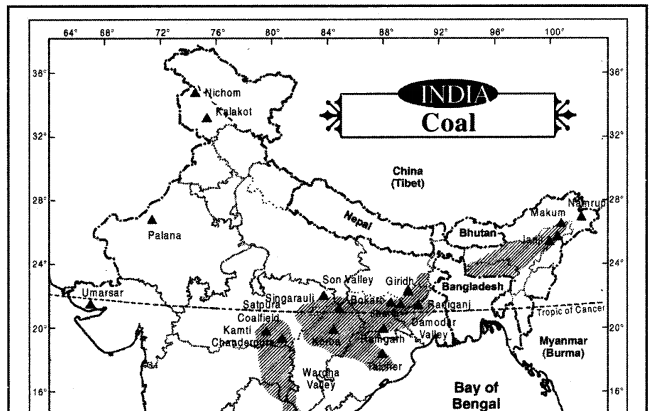
COAL. Coal is the prime source of energy. It is often called the ‘Mother of Industries’ or ‘Black gold’. It has been the basis of the Industrial Revolution. Coal is used as a raw material in iron and steel, chemical industries. Coal is the main source to produce thermal power.

India ranks seventh in the world as regards of the coal reserves. The total proven coal reserves are nearly 2,93,496.5 million tonnes. These reserves will not last long. The major states known for coal reserves are Jharkhand, Odisha, West Bengal, Madhya Pradesh, Andhra Pradesh and Maharashtra.
Geography Class 12 Important Questions Chapter 7 Mineral and Energy Resources 1
Geography Class 12 Important Questions Chapter 7 Mineral and Energy Resources 2

Production. Coal production started in 1774 in Raniganj coal field (West Bengal). After independence, production of coal increased 6 times.
The per capita consumption of coal has increased from 135 kg to nearly 400 kg.

Distribution. India has two types of coal fields:
(a) Gondwana coal fields (98%)
(b) Tertiary coal fields (2%)

(a) Gondwana coal fields. These belong to the period of Gondwana age. Nearly 3/4th of coal deposits are found in Damodar valley (Damuda series). Godavari, Mahanadi, Son and Wardha valley also have coal deposits.

(i) West Bengal. West Bengal has the oldest coal field of India at Raniganj. It covers an area of 1267 sq. km and the total reserves is 30616 million tonnes.

(ii) Bihar and Jharkhand State. This region produces 50% coal of India. The major coal fields of Jharia, Bokaro, Karanpura, Daltonganj are found in

Damodar valley. Coking coal from this coal-field is supplied to steel centres of Jamshedpur, Asansol, Durgapur production of coal increased 6 times.

The per capita consumption of coal has increased from 135 kg to nearly 400 kg.
Distribution. India has two types of coal fields:
(a) Gondwana coal fields (98%)
(b) Tertiary coal fields (2%)

(a) Gondwana coal fields. These belong to the period of Gondwana age. Nearly 3/4th of coal deposits are found in Damodar valley (Damuda series). Godavari, Mahanadi, Son and Wardha valley also have coal deposits.
(i) West Bengal. West Bengal has the oldest coal field of India at Raniganj. It covers an area of 1267 sq. km and the total reserves is 30616 million tonnes.

(ii) Bihar and Jharkhand State. This region produces 50% coal of India. The major coal fields of Jharia, Bokaro, Karanpura, Daltonganj are found in

Damodar valley. Coking coal from this coal-field is supplied to steel centres of Jamshedpur, Asansol, Durgapur and Bokaro. Bihar contributes only 160 million tonnes, where as Jharkhand contributes 80356 million tonnes of coal to india (2012).

(iii) Madhya Pradesh. Madhya Pradesh has Son valley, coal-fields of Suhagpur, Korba, (Chhattisgarh), Rampur, Tatapani, Singrauli. Total reserves in 24376 million tonnes.

(iv) Other areas. Singareni in Andhra (22154.8 m.t.) Talchar in Mahanadi valley, Chanda-Wardha coal¬fields of Maharashtra (10882 m.t.).

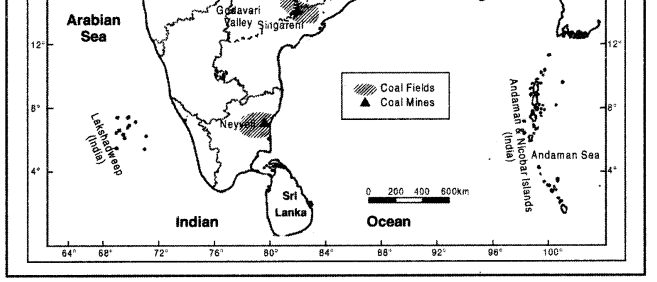
(b) Tertiary coal Helds. This includes lignite deposits called brown coal of low quality. These include Neyveli deposits (3300 million tonnes) in Tamil Nadu, producing 600 MW of thermal power. Other areas are Makum (Assam) producing 510.5 million tonnes, Bikaner (Rajasthan), Garo Khasi Hills (576.5 m.t.), Riasi in Jammu and Kashmir
Geography Class 12 Important Questions Chapter 7 Mineral and Energy Resources 3
Geography Class 12 Important Questions Chapter 7 Mineral and Energy Resources 4

Question 3.
Describe the production and potential areas of production of Petroleum in India.
Or
Why is petroleum referred to as liquid gold? State two important uses of petroleum and name two oil fields each in Assam and Gujarat.
Ans.
Petroleum. Petroleum is the most important source of power in the present age. Many by-products such as kerosene, fuel, lubricating oils, grease, coke and asphalt are obtained from petroleum. Petrochemical products have become very useful. Petroleum is used in agriculture, industry, transport, paints, perfumes, cosmetics, etc.

It is the source of foreign exchange for many oil exporting countries. So it is rightly called the ‘liquid gold’.
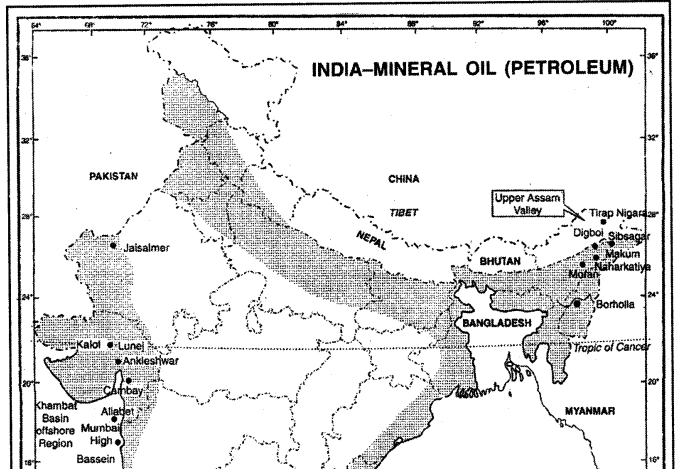
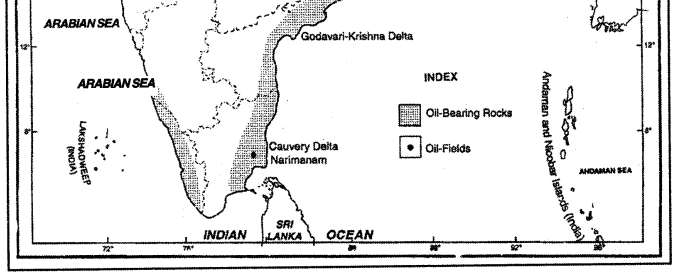
Production. In about 10 lakh sq. km. oil bearing rocks are found in India. The oil reserves in India are estimated to be 759.6 million tonnes. The first oil field in India was discovered in 1867 at Makum in Assam. At present, the

production is as under:

  • Assam. In Assam, oil is produced in Digboi, Moran, Naharkatiya and Sibsagar regions. It contributes 22.71% of total reserves.
  • Gujarat. In Gujarat, oil is produced in Gulf of Cambay region at Kalol, Ankleshwar, Lunej, etc.
  • Maharashtra. Oil has struck in the off-shore region at Mumbai High along the coast of Mumbai. It is the leading producer of crude oil in India. North Bassien and South Bassien are the important oil fields.

The production of oil in India is increasing everywhere under the organization of Oil and Natural Gas Commission (ONGC). The production of oil in India rose from 37.862 million metric tonnes in 2012. India meets about 40% of our demands by home production. We import crude oil from foreign countries and other petroleum products also. There are at present 17 oil refineries in India. These refineries are expanded to meet the increasing requirements of the country. It will help in saving a large amount of foreign exchange.
Geography Class 12 Important Questions Chapter 7 Mineral and Energy Resources 5
Geography Class 12 Important Questions Chapter 7 Mineral and Energy Resources 6

Oil-Refineries. There are already 17 refineries in the country. These refineries include
(i) Barauni (Bihar)
(ii) Mumbai (Maharashtra)
(iii) Kochi (Kerala)
(iv) Digboi (Assam)
(v) Guwahati (Assam)
(vi) Haldia (West Bengal)
(vii) Vishkhapatnam (Andhra Pradesh)
(viii) Koyali (Gujarat)
(ix) Chennai (Tamil Nadu)
(x) Mathura (U.P.)
(xi) Panipat (Haryana)
(xii) Bongaigaon and Numaligarh (Assam)
(xiii) Jamnagar (Gujarat)
(xiv) Mangalore (Karnataka)
(xv) Nagapattinam (Tamil Nadu)
(xvi) Bina (Madhya Pradesh)
(xvii) Bhatinda (Punjab).
These refineries also supply cooking gas or Liquefied Petroleum Gas (L.P.G.) as domestic fuel. It has succeeded in reducing demand on our shrinking forests.

Natural Gas. Natural gas is obtained from the oil fields. It is a prime source of energy for cooking in domestic field. It is called L.P.G. and is supplied through pipelines. Reserves of Natural gas are located in Tripura, Rajasthan, Gujarat, Tamil Nadu, Andhra Pradesh and Odisha .

The production is about 40.8 billion cubic metres. A gas pipeline, from Hazira, (Gujarat) Bijapur to Jagdishpur (U.P.)-1700 km long has been constructed to produce fertilisers at different plants at Bijapur, Sawai Madhopur, Jagdishpur, Shahjahanpur, Anwala and Barbala.

Question 4.
Describe the development of Nuclear energy in India.
Answer:
Nuclear Energy. Nuclear energy is generated by splitting atomic minerals. The process is called atomic fission. Uranium, Monazite, Thorium, Placer deposits, Cheralite, Graphite and Zirconium are used for generation of nuclear power of atomic energy. India is rich in these minerals.

The Bhabha Atomic Research Centre has been set up at Trombay (Maharashtra) for research in Nuclear Science. The first underground Nuclear Test was conducted on May 18,1974 at Pokhran (Rajasthan). Recently five underground Nuclear Tests were conducted at Pokhran, on 11th May, 1998. Thus, India became a nuclear power country.

Uranium and Thorium are used as raw materials for generating atomic power. These minerals are found in Bihar, Rajasthan, Tamil Nadu and Kerala. The Atomic Energy Commission was established in 1947 in India. There are 7 atomic power stations in India with an installed capacity of 5780 million KW:

  • Tarapur (Maharashtra).
  • Rana Pratap Sagar or Rawat Bhata (Kota, Rajasthan).
  • Kalpakkam (Chennai, Tamil Nadu).
  • Narora near Bulandshahar (Uttar Pradesh).
  • Kaiga (Karnataka)
  • Kakrapar (Gujarat)
  • Kundankulam (Tamil Nadu)

Two atomic power stations at Kakarpara (Gujarat) and Kaiga (Karnataka) are at planning stage.

Nuclear Energy-Hope of the Future. The use of atomic energy is increasing in the field of medicine and agriculture. It is being used to improve the quality of seeds. It can be used for exploring the mineral wealth of India. Atomic energy is being used in India for many peaceful purposes like development of man-made lakes, diversion of rivers, and use in medical science. India is rich in atomic minerals like Uranium and Thorium.

Therefore, this energy can be generated easily and will last for a long period. There is shortage of coal, petroleum and water power in India. In such areas, Nuclear Energy plays a complementary role in the development of Industries. Conventional sources of energy will not last long. Nuclear power should be used to save the resources. These power stations though expensive can be easily set up. We can say ‘Nuclear energy is the hope of the future in India.’

Question 5.
Write a note on the development of non-conventional sources of energy in India.
Or
Explain the importance of five non. conventinal sources of energy with suitable examples. (CJS.S.E Outside Delhi 2017)
Answer:
Non-Conventional Sources of Energy. Today non-conventional sources of energy include wind, tides, geo-thermal heat, bio-gas, farm and animal waste including human excreta. All these sources are renewable or inexhaustible. They are inexpensive and pollution free. These help in decentralisation of Industries. Energy can be developed in rural areas and maintained at low costs.

Due to acute shortage of conventional sources of energy, it has become necessary to explore the possibilities of using non-conventional sources of energy. A Ministry of Non-Conventional Energy Sources (MNES) has been created in 1992 for this purpose. Its achievements so far are as under:

S.No.SourcePotentialAchievement
1.Wind-power49130 MW2980 MW
2.Biomass power17538 MW1693 MW
3.Solar power20 MW/ Sq. km.941.24 MW
4.Power from urban wastes1700 MW4.75 MW
5.Water Heating systems …………….4,20.000
6.Solar Cookers …………….4,57.000
7.Biogas plants12 million2.5 million
8.Improved Chullahas120 million23.7 million

Wind energy. It can be used for pumping water, irrigating farms and generating electricity. The states of Gujarat, Tamil Nadu, Maharashtra and Odisha are better placed in regard to this energy. Wind mills are established in areas of high speed winds. India has a potential of 49130 MW of

power generation. The first wind farm was set up at Mandavi (Gujarat) in 1986. The Turbines of wind mills are rotated with the force of wind velocity. At present wind farms of capacity of 970 MW have been installed. India is the third country in the world to develop wind power on a large scale. There are about 3000 wind mills installed in various states in India.

2. Tidal energy. The Gulfs of Kachchh and Cambay are ideally suited to develop electricity from the energy produced by high tides entering into narrow creeks. A 900 MW tidal power station is being set up in Gulf of Kachchh. It is an inexhaustible and inexpensive source of energy.

3. Geo-thermal energy. Efforts are on to utilise natural energy of the hot springs at Manikaran in Himachal Pradesh, Puga, Parvati valley, Tattapani are other sites. Hot water is converted into steam to drive the turbines. Hot springs are used for heating purposes. India has a potential of 10600 MW of power from it.

4. Energy from urban waste. Sewage in cities is used for generating gas and electricity. Various wastes are treated such as sewage waste, vegetable waste, waste from leather, sugar, paper industries. A 4 MW energy plant at Delhi, 2.76 MW energy plant using husk in Andhra, 1MW plant at Faizabad Distillery, have been established. About 145 million tonnes of agricultural waste can generate 14000 MW power. Energy from plantations and bagasse is also developed.

5. Bio-gas based power plants. Bagasse, farm wastes, rice husk are being used to produce electricity. The National Project on Biogas was set up in 1981-82. It provides a clean and cheap source of energy in rural areas. Upto now 25 lakh Biogas plants have been installed, saving 75 lakh tonnes of fuel wood per year valued at ? 375 crore. Besides these plants generate 360 lakh tonpes of enriched manure. Smokeless chullahas (28 million) remove smoke, pollution and check deforestation and save 115 lakh tonnes of fuel wood.

6. Farm animal and human wastes (Urja Gram). By using biomass, animal, poultry wastes and human excreta, gobar gas plants are being set up in villages. The power so produced is used for cooking, lighting homes and streets and meeting irrigation needs of the village. A pilot plant (4 MW) has been set up in Delhi for the conversion of urban waste into energy.

7. Solar Energy. It is the most abundant, cheapest and inexhaustible source of energy produced from sunlight. Solar cookers are used in cooking food. Solar power is being used for cooking, water heating, water desalination, space heating, crop drying. Solar energy is used for solar lanterns, street lights, railway signals, traffic signals (as in Delhi), rural telephones, TV, radios, etc. In remote areas of Coimbatore, two projects of 25 KW provide energy. The Sagar island in West Bengal is completely solarised.

Solar cells convert the solar energy to electricity. Solar energy is the future energy in India because India receives abundant sunshine almost throughout the year to develop it.

Question 6.
Describe the distribution of mineral belts of India.
Answer:
The following three major mineral belts can be demarcated within the peninsular plateaus.
1. The North-Eastern Plateaus. It encompasses the Chotanagpur plateau, Odisha plateau and eastern Andhra Plateau.

This belt contains rich deposits of a variety of minerals used in metallurgical industries. Among them, reserves of iron ore, manganese, mica, bauxite, limestone and dolomite are large and widely distributed. This region also has copper, thorium, uranium, chromium, sillimanite and phosphate.

Along with them, coal deposits of the Damodar valley and Chhattisgarh which have facilitated the development of heavy industries are within this belt. Majority of the integrated iron and steel plants are located in this belt. Aluminium plants are also located here.

2. South-Western Plateaus. This belt extends over the Karnataka plateau and adjoining Tamil Nadu plateau and is rich in metallic minerals, particularly in iron ore, manganese and bauxite and in some non- metallic minerals. But the lack of power resource particularly coal has been an obstacle in the way of the development of heavy industries in this region. All the three gold fields of the country are located in this belt.

3. North-Western Region. This belt extends from the Gulf of Khambhat in Gujarat to the Aravalli range in Rajasthan. Petroleum and Natural gas are principal resources of this belt. Deposits of other minerals are small and scattered. However, it is known for reserves and production of several non-ferrous metals particularly copper, silver, lead and zinc.

4. Other Regions. Outside of these mineral belts, Upper Brahmaputra valley is a significant petroleum producing area. Kerala possesses enormous concentration of heavy mineral sands. Mineral deposits are also found in other parts of the country but they are scattered and reserves are inconsistent.

Mineral and Energy Resources Important Extra Questions HOTS

Question 1.
Why is the conservation of minerals necessary ? Explain any two methods of conserving minerals. (C.B.S.E. 2011)
Answer:
Minerals are a valuable natural resource. Minerals are exhaustible and limited resources. These are non-renewable resources. Once these are used, these are gone forever. Conservation of minerals means a careful and rational utilization so that these can also be used for future generation.

For conservation of minerals, their substitutes should be used such as Aluminium is used in place of copper. Scientific methods of mining should be used to avoid wastage of minerals.

Question 2.
Give two advantages of I manganese. Mention four main I manganese producing states of India. (C.B.S.E. 2013)
Answer:
Manganese is an important raw material for smelting of iron ore. It is also used for the manufacturing of ferro-alloys.
Production:

  • Odisha is the leading producer of manganese.
  • Karnataka is also major producer of manganese.
  • Maharashtra
  • Andhra Pradesh
  • Madhya Pradesh


Mahatma Gandhi and the Nationalist Movement Class 12 Important Extra Questions History Chapter 13

Here we are providing Class 12 History Important Extra Questions and Answers Chapter 13 Mahatma Gandhi and the Nationalist Movement: Civil Disobedience and Beyond. Class 12 History Important Questions are the best resource for students which helps in class 12 board exams.

Class 12 History Chapter 13 Important Extra Questions Mahatma Gandhi and the Nationalist Movement: Civil Disobedience and Beyond Movement

Mahatma Gandhi and the Nationalist Movement Important Extra Questions Very Short Answer Type

Question 1.
When and from where Mahatma Gandhi came back to India?
Answer:
Mahatma Gandhi came back to India from South Africa in 1915 A.D.

Question 2.
When was the Swadeshi movement started in India and who started it?
Answer:
During 1905-1907 by Bal Gangadhar Tilak, Lala Lajpat Rai and Bipin Chandra Pal.

Question 3.
Who was the political mentor of Mahatma Gandhi?
Answer:
Gopal Krishna Gokhale.

Question 4.
Where was Mahatma Gandhi’s first public appearance when he came back from South Africa?
Answer:
At the opening of the Banaras Hindu University in Feb. 1916.

Question 5.
Which three movements Gandhi started before joining active politics?
Answer:
Champaran, Kheda, and Ahmedabad.

Question 6.
Which Satyagraha Gandhi announced after the passing of the Rowlatt Act?
Answer:
Rowlett Satyagraha.

Question 7.
When was Non-Cooperation started?
Answer:
In January 1921.

Question 8.
Why did Mahatma Gandhi withdraw Non-Cooperation movement?
Answer:
Due to violence occurred at Chauri Chaura in U.P.

Question 9.
When and why was Mahatma Gandhi arrested after the withdrawal of the Non-Cooperation movement?
Answer:
In March 1922 on the charges of sedition.

Question 10.
Which symbols Mahatma Gandhi used during the freedom struggle?
Answer:
Dhoti and Charkha.

Question 11.
When and where was the revolution of Poorna Swaraj adopted?
Answer:
At Lahore session of Congress in 1929 A.D.

Question 12.
When was Dandi March started?
Answer:
On 12th March 1930.

Question 13.
When was the Quit India movement launched?
Answer:
In August 1942 A.D.

Question 14.
Distinguish between the policies of moderates and Assertive Nationalists.
Answer:
The moderates were peace-loving who preferred a gradual and persuasive approach towards the British. On the other hand, the assertive nationalists advocated strong opposition to the British Rule in India and wanted to oust the foreign rule by all means.

Question 15.
On what two things did the Satyagraha emphasize?
Answer:

  1. Belief in the power of truth.
  2. Search for truth and non-violent protest.

Question 16.
At which three places Gandhiji initiated his Satyagraha after his return from South Africa? When were these movements launched?
Answer:

  1. In the Champaran region of Bihar (1916)
  2. In Kheda District of Gujarat (1917)
  3. In Ahmedabad of Gujarat (1918).

Question 17.
Why did Mahatma Gandhi want to adopt the policy of Non-Cooperation against the British in India?
Answer:
Gandhiji believed that the British rule in India depended on the cooperation of the local people. He felt that the foreign rule still existed due to the cooperation of a few natives. Mahatma Gandhi launched the policy of Non-Cooperation so that he may end the foreign rule and introduce self-rule.

Question 18.
When and where was the Policy of Non-Cooperation approved?
Answer:
The Indian National Congress approved the program of Non-Cooperation in 1920 at its Nagpur Session.

Question 19.
Name any two moderate leaders. How were they associated with Gandhiji?
Answer:
Gopal Krishna Gokhale and Mohammad Ali Jinnah were two prominent moderate leaders. Gopal Krishna Gokhale was the acknowledged political mentor of Gandhiji and Mohammad Ali Jinnah and was a lawyer, like Gandhiji, in Gujarat.

Question 20.
Which events marked out Gandhiji as a nationalist and a true national leader?
Answer:

  1. His initiatives at Champaran, Ahmedabad, and Kheda marked him out as a nationalist who had great sympathy for the poor.
  2. Rowlatt Satyagraha made him a true national leader.

Question 21.
Write the importance of the Non¬Cooperation movement from two aspects.
Answer:

  1. This movement was training for self-rule.
  2. For the first time, since 1857, the foundation of British rule was shaken.

Question 22.
When and where was ‘Poorna Swaraj’ formally proclaimed?
Answer:
The demand for Poorna Swaraj was formally proclaimed by Indian National Congress at its Lahore Session in December 1929. This session was presided over by Pt. Jawaharlal Nehru.

Question 23.
What important decision was taken about ‘Poorna Swaraj’ in the Lahore Session of the Indian National Congress held in December 1929?
Answer:
In the session of the Indian National Congress held in December 1929 at Lahore, it was decided to celebrate 26 January 1930 as Independence Day. On that day, all the people were to take an oath for the complete independence of the country.

Question 24.
With which motive had Gandhiji started his Sabarmati Ashram?
Answer:
Gandhiji established his Sabarmati Ashram in 1916. He wanted to teach his pupils the path of truth and non-violence. He also taught them to behave in a truthful and non-violent manner and practiced his ideology of truth and non-violence in this Ashram.

Question 25.
Why and when did the Simon Commission come to India?
Answer:
The Simon Commission visited India in 1928 to enquire about the conditions that prevailed in India.

Question 26.
Why was the Simon Commission opposed?
Answer:
The Simon Commission was opposed as it had all members from the white community and had no members from India which was quite insulting to the Indians. So, all the people of India opposed the Simon Commission.

Question 27.
What steps were taken by the government to control the Civil Disobedience Movement?
Answer:

  1. The government put all the important leaders behind the bars. They included Sardar Patel, Dr. Rajinder Prasad, and Subhash Chander Bose.
  2. The Indian National Congress was declared as an illegal organization.

Question 28.
What do you mean by Movement for Praja Mandals?
Answer:
Mahatma Gandhi wanted to broaden the basis of nationalism in India. So Indian National Congress started a series of Praja Mandals. It promoted the nationalist movement in the princely states and led nationalism to the farthest corners of the country.

Question 29.
When did the communal politics start?
Answer:
The communal politics started in 1906 C.E. when the Muslim League was established. The British adopted the policy of Divide and Rule to increase the hatred between the Hindus and the Muslims.

Question 30.
Name any four leaders who associated themselves with Gandhiji between 1917 and 1922.
Answer:

  1. Sarojini Naidu
  2. Vallabh Bhai Patel
  3. Jawaharlal Nehru
  4. Subhash Chandra Bose

Question 31.
What was the attitude of the Indian National Congress towards the Second World War?
Answer:
The Indian National Congress was critical of both Hitler and the Nazis. So it decided to help the British Government during the Second World War on the condition that India would be granted freedom after the end of this war. When the British government refused this demand, all the Congress ministers resigned.

Question 32.
What did Gandhiji seek to obtain for the security of the peasants of Champaran in 1917? C.B.S.E. 2011 (D))
Answer:
Gandhiji went on a fast to provide security to peasants of Champaran in 1917. As a result, peasants got the freedom to grow crops of their choice.

Question 33.
Why was Salt March notable? Mention two reasons. (C.B.S.E. 2011 (O.D.))
Answer:
Salt March was notable because of the given below reasons:

  1. It was this event that first brought Mahatma Gandhi to world attention. March was widely covered by the European and American press.
  2. It was the first nationalist activity in which women participated in large numbers.

Mahatma Gandhi and the Nationalist Movement Important Extra Questions Short Answer Type

Question 1.
What was the significance of the campaigns initiated by Gandhiji in Champaran, Ahmedabad and Kheda?
Answer:
In 1917, Mahatma Gandhi spent most of his time in Champaran. He sought the security of tenure for the peasants. He also wanted that the peasants should be free to cultivate the crops of their choice.

1. In 1918, Mahatma Gandhi went to Ahmedabad. He intervened in a labor dispute and demanded better working conditions for the workers of the textile mills.

2. In 1918, Mahatma Gandhi was again involved in another campaign at Kheda in Gujarat. He supported the cause of peasants and sought the remission of taxes from the state as the harvest of crops had failed.

Thus, Gandhiji carried out various campaigns in Champaran, Ahmedabad, and Kheda. These campaigns had made him a true nationalist. They also showed the sympathetic attitude of Gandhiji toward the poor.

Question 2.
What methods were adopted to oppose the British rule during the Non-Cooperation Movement?
Answer:
The Non-Cooperation Movement was launched by Mahatma Gandhi in 1920. It had a definite program for the people to follow. It included the following methods to oppose British rule:

  1. The students were asked not to attend their schools and colleges.
  2. The lawyers were asked not to attend law-courts.
  3. The ordinary people were asked to renounce voluntary association with the British Government.
  4. There were strikes by the working class in many towns and cities. There were 396 strikes in different cities in 1921. It involved six lakh workers which caused a loss of seven million workdays.
  5. The Hill-tribes in the Northern part of Andhra Pradesh violated the forest laws.
  6. The farmers did not pay taxes in Awadh. They refused to carry loads for colonial officials in Kumaun.

Though the aforesaid methods were laid down for all the protestors, yet, many of them adopted the methods which better suited their interests.

Question 3.
Find out similarities between Salt Satyagraha (Civil Disobedience Movement) and Non-Cooperation Movement. Give any five points.
Answer:
The similarities between the Civil Disobedience Movement and Non-Cooperation movement were as follows:

  1. In both the movements, the peasants had participated whole-heartedly. Most of the peasants hated the colonial forest laws as they and their cattle could not enter the forest.
  2. At many places, the factory workers went on strike.
  3. The lawyers boycotted the British courts.
  4. The students did not attend their classes in the government-run educational institutions.
  5. All the ordinary people participated in both of these movements in one way or the other. They in their own way expressed their discontent with the British rule.
  6. Many people even left their government jobs and joined the freedom struggle.
  7. Some people even refused to pay the taxes.

Question 4.
The Salt March of Gandhiji was notable for at least three reasons. What were they?
Answer:
The Salt March (Dandi March) of Gandhiji was notable because of the following three reasons:

  1. By leading the Salt March. Mahatma Gandhi became very popular in the world. He got world attention as his march was widely covered by the European and American Press.
  2. This Salt March was the first nationalist activity in which women had participated enthusiastically. They joined the march in large numbers. In fact, Gandhiji had allowed the women to participate in his Dandi March on the persuasion of Kamaladevi Chattopadhyay, a socialist activist.
  3. The Salt March made the British realize for the first time that their rule in India would not last forever. They had understood that they would have to decentralize their power by involving Indians in the administration.

Question 5.
Describe the events that led to the Non-Cooperation Movement.
Answer:
Gandhiji started the Non-Cooperation Movement in 1920 because of the following reasons:

1. Rowlatt Act: After the First World War, the Rowlatt Act was passed in 1919. In accordance with this law, the government could imprison anyone without a trial. Gandhiji was not content with this Act and launched the Non-Cooperation Movement.

2. Jallianwala Bagh Massacre: A meeting was held in Jallianwala Bagh at Amritsar to protest against the Rowlatt Act. General Dyer appeared on the scene and started shooting bullets on the gathered people. Gandhiji was moved at this bloody climax of the meeting in which more than four hundred people were killed and therefore started the Non-Cooperation Movement against the British rule.

3. Khilafat Movement: The Sultan of Turkey was known as the Caliph of all the Muslims. But the British had snatched his empire. The Indian Muslims could not bear this insult and joined hands with Gandhiji and started Non-Cooperation Movement.

Question 6.
When was Civil Disobedience Movement launched? What were its reasons?
Answer:
Mahatma Gandhi started his Civil Disobedience Movement in 1930 because of the following reasons:

1. Arrival of the Simon Commission: In 1928, the Simon Commission visited India under the leadership of Sir John Simon. All the members of this Commission were English men. No member from India was included in this Commission. So the Indians opposed it everywhere. They raised the slogans “Simon: Go Back.” Even then, this commission published its report. So, Gandhiji was compelled to start the Civil Disobedience Movement.

2. Nehru Report: In August 1928, Nehru Committee submitted its report highlighting the demands of the Indian British Government refused to accept this report. Feeling depressed, Gandhiji started the Civil Disobedience Movement.

3. Atrocities on Revolutionaries: The British Government had hanged Bhagat Singh, Raj Guru, and Sukhdev till death. It generated discontentment among the Indians.

4. Impact of the Bardoli Movement: A peasant Satyagraha was organized at Bardoli under the leadership of Sardar Vallabh Bhai Patel. The success of these peasants had emboldened Gandhiji to start Civil Disobedience Movement.

Question 7.
What do you mean by Non-Cooperation Movement?
Answer:
The Non-Cooperation Movement was started by Mahatma Gandhi in 1920. It was against the British Government. It meant not to have any association with the British Government. The Declaration for this movement was made by Congress at its Nagpur Session. Gandhiji made an appeal to the people not to cooperate with the British Government in any way. He also chalked out its detailed program. Under this movement, many people gave up their jobs and titles. The students stopped going to their classes in the government educational institutions.

The foreign goods were also discarded. The people started using goods manufactured in their own country. It was necessary for all the participants in this movement to adhere to truth and non-violence. It was carried out very effectively and made the people aware of the misdeeds of the colonial rulers. According to Louis Fischer, “Non-Cooperation became the name of an epoch in the life of India and of Gandhiji. Non-Cooperation was negative enough to be peaceful but positive enough to be effective. It entailed denial, renunciation, and self¬discipline. It was training for self-rule.”

Question 8.
What is the importance of the opening ceremony of Banaras Hindu University in the Indian National Movement?
Or
State the significance of Gandhiji’s speech at Benaras Hindu University. (C.B.S.E. 2008 (O.D.))
Or
Explain the ideas expressed by Gandhiji in his address at the time of the opening of Benaras Hindu University in February 1916. Did he put his precepts into practice? Give examples. (C.B.S.E. 2010 (O.D.))
Answer:
The first important public appearance of Gandhiji was at the opening of the Banaras Hindu University in February 1916. Before this, Indian National Movement was confined only to the rich or elite class. But through his speech over here, Gandhiji advocated making a national movement a mass movement. He said that the establishment of Banaras Hindu University was certainly the most gorgeous show. But he showed his worry about the presence of rich bedecked noblemen and the absence of millions of poor Indians.

To these privileged invitees, Gandhiji told that salvation of India is not possible unless they strip themselves of jewelry and keep it in trust for their countrymen in India. He said that there is no meaning of self-rule until laborers or peasants could not be given full profit of their produce. Our salvation is possible only through the farmers. Neither the doctors, lawyers, or the rich landlords can secure it.

Taking percepts into Practice: In the same year, in December, Gandhiji got the chance to bring his precepts into practice. This year, Congress’s annual session was held at Lucknow. Here, one peasant of Champaran told him about the exploitation of Indigo planters by the Britishers. So, most parts of 1917 were spent by Gandhiji in helping the peasants of Champaran.

Next year, Gandhiji remained busy in two campaigns in Gujarat. First of all, he demanded better working conditions for workers of Ahmedabad’s mill. After that, he joined peasants in Kheda in asking the state for the remission of taxes due to the failure of their harvest.

Question 9.
“Gandhiji was as much a social reformer as he was a politician.” Clarify the statement.
Answer:
There is no denying the fact that the Gandhiji was as much a social reformer as he was a politician. As a politician, he transformed Indian National Movement into a broad mass movement. He was arrested in 1922 and was released from jail in February 1924. He then devoted his attention to encourage the homespun cloth (Khadi) and to eradicate untouchability from society.

Gandhiji believed that Indians need to remove social evils like child marriage and untouchability in order to be worthy of freedom. He was of the view that we must prepare an atmosphere of harmony among different religious communities. That is why he stressed on Hindu-Muslim harmony. He also believed that Indians had to learn to become self-reliant on the economic front. That is why he stressed using Khadi instead of cloth imported from overseas.

Question 10.
What was Khilafat Movement? Describe briefly.
Answer:
The British had fought against the Sultan of Turkey in the First World War. They had also sought the cooperation of the Indian Muslims in this war. The Muslims of India had cooperated with the British on the condition that the Sultan of Turkey would be given fair treatment by the British after the war is over. But after the end of the war, the British maltreated the Sultan who was considered as the Caliph (religious leader). So they felt annoyed and started a vehement movement against colonial rule. This movement was known as the Khilafat Movement. The Muslims carried on this movement with the cooperation of Gandhiji.

Question 11.
Why did the Simon Commission visit India? Why was it opposed in India?
Answer:
In 1927, the Government of England appointed a Commission which was headed by Sir John Simon. That is why it was called the Simon Commission. This Commission came to India in 1928 with the objective of examining the results of the reforms of 1919. It was an all-white Commission having no Indian member. So people in India opposed it wherever it went. It was welcomed with black flags. Everywhere slogans like “Simon: Go Back” were raised. But the British Government adopted all repressive measures to crush this peaceful protest.

In Lahore, the protestors were Lathi-charged by the police in which Lala Lajpat Rai was wounded. He suffered a blow of Lathi on his forehead which proved fatal and died a few days afterward. All the political parties of the country severely criticized these repressive measures of the British Government. Gandhi himself did not participate in the protests against the Simon Commission but however, had blessed all the peaceful protestors.

Question 12.
Explain the Civil Disobedience Movement. What was its effect on our struggle for freedom?
Answer:
The Civil Disobedience Movement was started by Mahatma Gandhi in 1930. He wanted to oppose colonial rule by breaking the laws framed by it. This movement started with the Salt Satyagraha (Dandi March) organized by Mahatma Gandhi. He began walking on 12 March 1930 from his Sabarmati Ashram. He was accompanied by thousands of people on his way. He reached his destination, that is, Dandi at the sea-coast within twenty-four days. He made a fistful of salt to break the salt laws.

He intentionally made himself a criminal in the eyes of the law. The British Government took all stringent measures to crush this Civil Disobedience Movement. Thousands of patriots were put behind bars all over the country. Gandhiji was arrested but even after his arrest, the Movement went on as before. Therefore, the Civil Disobedience Movement left a deep impact on our national struggle for freedom.

Question 13. Discuss the Quit India Movement.
Or
In what way did Gandhiji’s ‘Quit India Movement’ transform the nature of the national movement? Explain. (C.B.S.E. 2013 (O.D.))
Or
“Quit India Movement genuinely a movement bringing into its ambit hundreds of thousands of ordinary Indian.” Analyze the statement. (CBSE2019)
Answer:
When the Cripps Mission had failed, Mahatma Gandhi gave a call for Quit India Movement, his third major movement against British Rule. It started in 1942 under the leadership of Mahatma Gandhi. The Congress had passed a resolution for this movement on 9 August 1942 and challenged the British to Quit India. Soon this movement too became a mass movement. In many districts like Satara and Medinipur, independent governments were proclaimed.

The whole country resonated with the slogans “Englishmen: Quit India”. The British responded with force to crush this movement. Most of the leaders of the Indian National Congress were arrested. It enraged the people who then started plundering government offices, post offices, and railway stations. The government became adamant and put thousands of people behind bars. The whole country was, in fact, turned into a jail. At last, the Quit India Movement shook the foundation of British rule in India.

Question 14.
Discuss the formation and role of the Azad Hind Fauj.
Answer:
The Azad Hind Fauj was organized by Subash Chandra Bose. He had set up this army with the help of Japan and Germany. The objective of this army was to get India freed from the clutches of the British. Subash Chandra Bose had instilled national spirit among all his soldiers. As a result, this army witnessed a few successes at different places in the country. But as Japan and Germany were defeated in the Second World War, this army lost its ground. The British arrested a few prominent leaders of this army and charged them with treason and rebellion. But owing to the pressure of the people, they were released later on.

Question 15.
What were the main recommendations of the Cripps Mission?
Answer:
The Cripps Mission was sent to India by the British Government under the leadership of Sir Stafford Cripps in 1942. It made the following recommendations:

  1. It recommended making India a dominion state after the end of the Second World War.
  2. To frame the Constitution for India, a Constituent Assembly would be established consisting of all elected members.
  3. The provinces which did not agree to the Constitution would retain their present position.
  4. In the new Constitution, there would also be a provision to enable the princely states to participate. However, these states would not be bound by the new Constitution.
  5. After the formation of the Constitution, there would be a treaty between Britain and India to chalk- out a framework for the transfer of political power.
  6. The British also ensured the protection of the minorities in the new system.

Question 16.
Discuss the attitude of the Indian National Congress towards the Second World War. Also, discuss the failure of the Cripps Mission and its consequences.
Answer:
England was losing ground in the Second World War. So it needed cooperation from the people of India. But the people of India were inimical towards the British due to their wrong and harmful policies. They were not willing to extend any cooperation to the British. To resolve this tangle, the British Government had sent the Cripps Mission in 1942 under the leadership of Sir Stafford Cripps.

It put forward its plan before the leaders of different political parties in India. It stated that India would be declared a dominion state if its people extended their cooperation to the British in the Second World War. Gandhiji compared this plan to a post-dated cheque drawn on the bank that was doomed to fail in the coming days. In this way, all the leaders of India rejected the recommendations of the Cripps Mission. Feeling distressed, the Cripps Mission went back.

Question 17.
Discuss the significance of the Quit India Movement launched by Mahatma Gandhi.
Answer:
The Quit India Movement was the third major movement launched by Mahatma Gandhi in 1942. It was genuinely a mass-movement in which almost all sections of society participated. Strikes and acts of sabotage were organized all over the country. The rebellion against the British was so intense that it took nearly a year to suppress this movement. This movement was very significant as it made the British realize that there was widespread discontent all over the country against their rule. They also came to know that Indian people wanted salvation and freedom from colonial rule. Consequently, they had to free India just after five years from the beginning of this movement.

Question 18.
Write a critical note on the Rowlatt Act.
Answer:
The Rowlatt Act was passed in 1919. It was also called the Black Law passed to crush a national movement. Due to the First World War, the British Government in India faced many hardships. At this time, the spread of the freedom movement against British rule could be detrimental to the colonial interests. So the Government decided to crush the national upsurge for freedom.

Under this Act, the magistrates were empowered to send any revolutionary behind the bars even without trials. Such a law had snatched the freedom of the Indian. The Rowlatt Act was passed on 18 March 1919. This Act also clarified that any evidence given before a policeman would not be valid in the court. So the Rowlatt Act denied the freedom to the IndianThey could be arrested any time. So it was natural for them to oppose this Act with tooth and nail.

Question 19.
Write a note on the resolution on ‘the rights of minorities’ passed by Congress.
Answer:
Congress passed a resolution on ‘the rights of minorities’ which was initiated by Gandhiji and Nehru. Congress never accepted the ‘two-nation theory’. When it had to accept the division of the country against its will; it still believed that “India is a country of many religions and races and must remain so.” Whatever the situation in Pakistan, India would be a “democratic and secular country where all citizens will get full rights and are equally entitled to the protection of the state, irrespective of the religion to which they belong.” Congress also assured that the human rights of the minorities will be protected in every possible manner.

Question 20.
What did Gandhiji do after his release from prison in 1924? (C.B.S.E. 2011 (D))
Answer:
Mahatma Gandhi was arrested in 1922 and was released from prison in 1924. Now he devoted his attention to encouraging the homespun cloth (Khadi) and eradicating untouchability from society. He believed that Indians need to remove social evils like child marriage and untouchability in order to be worthy of freedom. He wanted to prepare an atmosphere of harmony among different religious communities. He also believed that Indians had to learn to become self-reliant on the economic front. That is why he emphasized using Khadi instead of cloth imported from overseas.

Question 21.
“Many historians still remain skeptical of oral history.” Examine the statement. (C.B.S.E. 2012 (O.D.))
Answer:
Many historians still remain skeptical of oral history. They dismiss it because oral data at times lacks correctness and the chronology they yield may be imprecise. Historians argue that the uniqueness of personal experience makes generalization difficult. A large picture cannot be built from such micro evidence and one witness is no witness. They also think that oral accounts are related to tangential issues and that the small individual experiences which remain in memory are irrelevant for the unfolding of a larger process of history.

Question 22.
Describe how Gandhiji knitted Non-Cooperation Movement as a popular movement. (C.B.S.E. 2013 (O.D.))
Answer:
To widely spread the program of the Non¬Cooperation Movement, Mahatma Gandhi visited many parts of the country along with the Muslim leaders like Dr. Ansari, Maulana Abul Kalam Azad, and Ali brothers. As a result, this movement shook the foundations of the British Raj for the first time since the Revolt of 1857. The students did not attend their classes in the educational institutions run by the British Government. The foreign garments were burnt at the crossroads.

Rabindranath Tagore had relinquished his title of ‘Sir’. Similarly, Mahatma Gandhi surrendered his title of ‘Kesri Hind. But in February 1922, a group of peasants attacked a police station and set it on fire at Chauri Chaura, a village in Uttar Pradesh. As several constables were burnt alive in this fire, Gandhiji was shocked at this violent incident and therefore called off his Non-Cooperation Movement.

Mahatma Gandhi and the Nationalist Movement Important Extra Questions Long Answer Type

Question 1.
What were the reasons for the beginning of the Khilafat Movement? What was the contribution of this movement to the freedom struggle of India?
Answer:
Khilafat is associated with the Caliphate who was the religious head of all the Muslims. The Sultan of Turkey was accepted as the head of the Muslim world. After the war, the Indian Muslims were unhappy with the British because they had ill-treated the Sultan of Turkey and even divided the Ottoman Empire and snatched Three, a part of Turkey. This was all contrary to the War Declaration made by Lloyd George, the then British Prime Minister.

He had openly declared that the British had no intention to devoid Turkey of Asia Minor and Three. The main population of these areas was of Turkish origin. The Muslims wanted that the Sultan of Turkey should not be shown a bit of insult in any way. When the white rulers acted contrary to their avowed statements, the Muslims started a severe struggle against the British.

Contribution to National Movement For Independence: The Khilafat Movement had strengthened the national struggle for freedom. Due to the Lucknow Pact of 1916, the unity between the Hindus and the Muslims strengthened. Due to the Khilafat Movement, many other nationalist leaders had plunged into the freedom struggle. It is clear from the following points:

1. A Khilafat committee was constituted to start a nation-wide struggle against British rule.

2. An All India Khilafat Conference was held in Delhi in November 1919. A resolution was passed in the conference which exhorted the British to accept the demands of the Muslims, failing which a struggle against the foreign rule would be launched.

3. The Muslim League supported every movement started by the Indian National Congress.

4. The Congress supported the Khilafat Movement. This action of the Congress strengthened the Hindu-Muslim unity. It also inspired the Muslims for the national struggle to attain freedom from the alien rule.

5. Gandhiji went to the extent of declaring that the issue raised by the Khilafat Movement was much more important than the issue of social reforms initiated by him.

6. Gandhiji expressed his desire to start the Non-Cooperation Movement if the British failed to satisfy the Muslims of India. It enabled Gandhiji to emerge as a great leader of India.

7. The Khilafat Movement accelerated the pace of the national struggle for freedom. Mahatma Gandhi soon started his Non-Cooperation Movement. It was the first step towards the end of British rule in India.

Question 2.
What was the Rowlatt Act? What steps were taken by the British to repress to Satyagraha started by Gandhiji?
Answer:
Rowlatt Act was passed by the British Government in March 1919 in the Central Legislative Council. It was passed to repress the nationalists.

The Rowlatt Act had such provisions that annoyed all the nationalists. It empowered the British Government in the detention of revolutionaries without trial. It was not necessary to present the concerned person in the court. In brief, it was such a law that had no argument, no lawyer, and no appeal. So the nationalists considered it a black law as it was a strong blow on individual liberty.

Satyagraha against Rowlatt Act: Gandhiji, like other nationalist leaders, was shocked to hear about the Rowlatt Act. So he laid down the foundation of a Satyagraha Committee in February 1919. All the members of the committee pledged not to adhere to this Act. They offered their arrests and went to jails. It was a new kind of struggle. Till then, the British had seen movement where big assemblies were held and processions were taken out. In such national movements, the people often refused to cooperate with the government.

There was a boycott of foreign goods and government schools. But Satyagraha gave new but elevated stature to the national movement. It provided all nationalists a chance to show their might to the alien rulers.

In March 1919, there was an unprecedented national upsurge in India. Almost every Indian was filled up with new vigor and strength. There were strikes, bandhs, campaigns, processions, and demonstrations. The slogans of Hindu-Muslim unity also rented the air. The people of India were no longer ready to face humiliation and insult.

Repression of the Satyagraha: The Government wanted to crush the Satyagraha. It lathi-charged the unarmed protestors in Bombay, Ahmedabad, Calcutta, Delhi, and a few other cities. The bullets were also hurled at them. So Gandhiji gave a nation-wide call for strike on 6 April 1919. The people followed the directive of Gandhiji with verve and vigor. In Punjab, a large number of people gathered at Jallianwala Bagh at Amritsar on 13 April 1919.

Their intention was to oppose the repressive measures adopted by the British Government. They were also against the Rowlatt Act. But General Dyer reached on the spot with his soldiers who started shooting at the protestors. Hundreds of men, women, and children were killed in this massacre.

Question 3.
Discuss the nature of the Civil Disobedience Movement. Discuss its spread in all parts of the country along with its failures. (C.B.S.E. 2008 (O.D.))
Or
Write an essay on Civil Disobedience Movement started by Mahatma Gandhi.
Or
Examine why did Gandhiji start the Salt Sathyagraha. Why was Salt Satyagraha a rotatable event? (C.B.S.E. 2017 (D.))
Or
The Salt Satyagraha was one of the most successful campaigns in Gandhiji’s non-violent struggle against Britishers.” Analyze the statement. (C.B.S.E. 2019 (D))
Answer:
The Civil Disobedience Movement was started by Mahatma Gandhi in 1930. It was a mass movement based on truth and non-violence. It was the first important step taken towards complete independence from British rule after the Revolt of 1857. We can discuss its various aspects as under Causes:

1. The Simon Commission visited India in 1928. It was an all-white commission. In other words, it had no member from India. So the people opposed Simon Commission wherever it went. They raised the slogans of “Simon: Go Back” before the Simon Commission. In spite of this, the report of the commission was published. It spread discontent among the people.

2. The British Government did not accept the recommendations of the Nehru Report.

3. The Peasants Movement of Bardoli had succeeded which inspired Gandhiji to start a national movement against British rule.

4. Gandhiji put forward a few conditions before the British Government but the Viceroy did not accept any of them. Under these circumstances, Gandhiji had no option other than to start a Civil Disobedience Movement against British rule.

The Progress of Movement: The Civil Disobedience Movement started with Dandi March. Mahatma Gandhi started his journey from Sabarmati Ashram on 12 March 1930 and reached Dandi, a place near sea-coast on 6 April 1930. He made a fistful of salt from the seawater and broke the salt laws. From there, this movement spread to each nook and corner of the country. In many places, the people defied the government laws.

To crush this movement, the British adopted repressive measures. Many people along with Gandhiji were put behind the bars. But it did not dampen the vigor of the people and the pace of the movement. However, a compromise was reached between Gandhiji and the Viceroy. According to this agreement, Gandhiji accepted to suspend the Civil Disobedience Movement and take part in the Second Round Table Conference. In this way, the Civil Disobedience Movement came to a halt for some time.

End of the Movement: The Second Round Table Conference was organized in London in 1931. Gandhiji participated in it on behalf of the Congress. But even at this conference, no solution could be found for the redressal of Indian problems. Gandhiji felt depressed and returned to India. He again started the Civil Disobedience Movement. On the other hand, the British Government also initiated repressive measures to control this movement. Because of the atrocities of the government, the movement lost a bit of its momentum. In 1933, Congress officially suspended this movement. It was at last withdrawn in May 1934.

Causes for Failure: The following reasons were responsible for the failure of the Civil Disobedience Movement.

  1. Some scholars felt that this movement could not utilize the enthusiasm of the common people. It was suspended in between which dampened its pace.
  2. Congress did not put forward any social and economic programs. As a result, a new party emerged which was named as Congress Socialist Party.
  3. This movement did not benefit the farmers in any way.
  4. Some scholars felt that the leadership of this movement was in the hands of the rich. Besides, it had limited objectives.

Significance: In spite of a few short-comings, the Civil Disobedience Movement yielded some good results:

  1. Because of the boycott of foreign cloth, the import of such cloth declined.
  2. Because of picketing at wine shops, the collection of government revenue was reduced.
  3. The Indians were permitted to make salt near the sea-coast.
  4. An awakening was seen among the farmers, laborers, tribal people, and women. All these people had become an inseparable part of the national movement.
  5. Because of the atrocities committed by the British, the people were determined to attain freedom.
  6. The British Empire got a severe jolt.

Question 4.
Briefly describe the progress (events) of the Indian National Movement from March 1940 till 1945.
Answer:

1. Demand of Pakistan: In March 1940, the Muslim League passed a resolution for the creation of a separate nation called ‘Pakistan’ and declared it as its objective. The political situation of the country was now complicated. Now, this struggle was no longer between Indians and the British. Instead, now it had become a three-way struggle, i.e., between the Congress, the Muslim League, and the British. Britain, at this time, had an all party government, and the Labour party was part of it. Members of the Labour Party had- sympathetic views about Indian aspirations. But Prime Minister, Winston Churchill, was a diehard imperialist and was of the view that he was not appointed by the king to preside over the liquidation of the British Empire.

2. Cripps Mission: In 1942, Churchill sent one of his ministers, Sir Stafford Cripps, to India to find a way regarding the resumption of talks with Congress. While negotiating with Cripps, Congress stressed the fact that if the British wanted its support in the war then first of all the Viceroy should appoint any Indian as the Defence Member in his Executive Council. But talks broke down on this issue.

3. Quit India Movement: After the failure of the Cripps Mission, Mahatma Gandhi decided to launch his third major movement against British rule. This movement was launched in August 1942 which was given the name of ‘Quit India Movement’. Although Gandhiji was arrested at once, even then young activists organized strikes all over the country. Socialist members of Congress like Jayaprakash Narayan played a great role in it.

In many districts like Medinipur in the east and Satara in the West, Independent governments proclaimed. British adopted a very strict attitude towards this movement. Even then it took the government more than a year to suppress the rebellion.

Quit India Movement was a mass movement which was participated by hundreds of thousands of IndianThis movement attracted a large number of young people. They left their colleges and took the path of jail.

4. Efforts of the Muslim League to expand its Influence: When Congress leaders were in jail, Jinnah and other members of the Muslim League were busy expanding their influence. During these years, the League got a chance to make a mark in Punjab and Sindh where it had no or very little presence at all.

In June 1944, World War was on the verge of an end, Gandhiji was released from prison. In June 1944, Gandhiji talked many times with Jinnah to bridge the gap between the Congress and the Mulsim League.

5. Government of Labour Party in Britain: In June 1945, elections were held in Britain and the Labour party came to power. This government was in favor of giving independence to India. Meanwhile, in India, Lord Wavell held a number of meetings with representatives of Congress and the Muslim League.

Question 5.
Discuss the contribution of Mahatma Gandhi in the freedom struggle of India.
Or
Discuss the political life and works of Mahatma Gandhi.
Answer:
Mahatma Gandhi attained a supreme place in the history of modern India. Under his leadership, the national movement got such a way that led directly to the independence of India in 1947. He challenged the authority of British rule with the weapons of truth and non-violence. He forced the Englishmen to quit India. We can discuss the contribution of Mahatma Gandhi in the freedom struggle as given below:

Political Life: The political life of Mahatma Gandhi started in South Africa. When he came back from England, he started practicing as a lawyer in India. But then he went to South Africa.

Life in South Africa: When Gandhiji reached South Africa, the condition of Indians there was pitiable due to maltreatment by the white government. Gandhiji could not bear this insult and started his Satyagraha against the white government of South Africa. He helped the people in getting their rights.

Life in India: Gandhiji returned to India from South Africa in 1916. The First World War had already started. The British Government was fighting this war against the Axis Powers. So it needed both men and money. Therefore Gandhiji appealed to the people to cooperate with the British. He wanted to win the hearts of the white men by helping them. He was convinced that the British would free India after the end of the war. But when the First World War ended, the British did not do anything concrete to free India. Contrary to the expectations of the people, it passed the Rowlatt Act. Gandhiji was shocked to see this drastic law and made up his mind to start the Non-Cooperation Movement against British rule.

Non-Cooperation Movement: Gandhiji started this movement in 1920. The people fully supported this movement and whole-heartedly participated in it. However, Gandhiji called off this movement when violent incidents took place at Chauri Chaura in Uttar Pradesh.

Civil Disobedience Movement: This movement was launched by Gandhiji in 1930. He took out his Dandi March and symbolically broke the Salt Laws by making a fistful of salt from the sea-water. The government was taken aback by this action of Gandhiji. At last, it allowed the Indians to make salt near the coast. An important Act was also passed in 1935.

Quit India Movement: Gandhiji wanted to seek freedom for the country. So in 1942, he started the Quit India Movement. Lakhs of followers joined the movement of Gandhiji. The British felt shocked at such a mass movement and made up their mind to free India. At last, India was set free on 15 August 1947. The credit for Indian independence obviously goes to Mahatma Gandhi.

Other Works: Gandhiji did a lot of work to enhance the prestige of the Indian remove poverty of the Indians, he exhorted all the people to wear Khadi. For the upliftment of the untouchable, Gandhiji called them ‘Harijans’. Similarly, he preached fraternity to get the people rid of communal riots.

Death: Gandhiji was shot dead on 30 January 1948 by Nathu Ram Godse, a youth. He recited thrice “Hey Ram” and died. His death was mourned all over the country. The Indians cannot forget Gandhiji and still remember him as the ‘Father of the Nation’.

Question 6.
Explain how the coming of Mahatma Gandhi broadened the base of the Indian National Movement. (C.B.S.E. Sample Paper 2011)
Answer:
Mahatma Gandhi broadened the base of the national movement of India in the following way:

1. Under the leadership of Mahatma Gandhi, the national movement did not merely remain a movement of intellectuals and professionals. Thousands of farmers, laborers, and artisans started participating in it.

2. Gandhiji lived a simple life that was liked by the common people. He wore clothes like a poor farmer or a worker. His way of living was also like a common man.

3. Gandhiji himself worked on the spinning wheel. He also inspired others to operate the spinning-wheel. The job of spinning cotton helped Gandhiji to break the wall of distinction between mental and physical labor prevalent in the traditional caste system.

4. Gandhiji tried to mitigate the sufferings of the farmers and other poor people.

5. The rumors that spread about the miracles of Gandhiji made him very popular. He had become a household name due to which most of the people jumped in the struggle for freedom and whole-heartedly participated in the national movement for freedom.

6. Under the leadership of Gandhiji, many branches of the Indian National Congress were opened in different cities. He established panchayats and Praja Mandals to instill nationalist feelings in the royal rulers.

7. Gandhiji emphasized the spread of the nationalist message in the mother tongue of the people and not in English.

8. Gandhiji emphasized the Hindu-Muslim unity to strengthen the base of the national movement of India.

9. Because of the impact of Gandhiji’s majestic personality, many leaders from different sections and regions of the country, had become an inseparable part of the freedom struggle.

10. He emphasized the fact that the defective society was essential to seek freedom.

Question 7.
Explain three different kinds of sources through which we can know about Gandhiji. Give any two problems faced while interpreting them. (C.B.S.E. 2008 (D))
Or
How do autobiographies Government records and newspapers help us knowing about Gandhiji? Explain. (C.B.S.E. 2010 (O.D.))
Or
Explain the source from which we can reconstruct the political career of Mahatma Gandhi and the history of the National Movement of India. (C.B.S.E. 2011 (O.D. 2012, 2014 CD))
Or
Historians have used different kinds of sources in reconstructing the political career of Gandhiji and the history of social and nationalist movements. Substantiate the statement with examples. (C.B.S.E. 2019 (D))
Answer:

1. Autobiographies: Autobiographies give us a peep in the rich and illustrious past. But we must remember how do we study the autobiographies and how do we comprehend and explain them. After reading an autobiography, we come to know what the writer remembered and what things were important from his point of view. We also become aware of the facts that the writer intended to remember.

In fact, writing an autobiography is a means of leaving the impact of one’s personality on the minds of others. Consequently, while reading an autobiography, we must try to find out the unrevealed truth. There are many things that the author does not want to share with its readers.

2. Government Records: The colonial rulers always kept a strict vigilance on issues that they considered against them. So the Government records are also an important source of information. At that time, the reports penned down by policemen and other officials were confidential. But now these documents are available in the museums where anybody can see and study them. In the 20th century, many fortnightly reports were written. Such reports were prepared after every two weeks.

They were based on the information received from policemen and other officials. They reflected what the officials intended to see and what not to see. Keeping the possibility of revolt and treason in mind, these rulers tried to give the impression that these reports were baseless. If you look at the reports prepared during the Dandi March where Mahatma Gandhi broke the Salt Law, you will come to know that the home ministry was not ready to acknowledge that Gandhiji enjoyed mass-support.

These reports termed the Dandi March a drama that was aimed to get support from unwilling and luxury-loving people against British rule. There are many other sources by which we can know a lot about the political life of Gandhiji and the national freedom struggle.

3. Public Voice and Personal Writings: There were many who were in favor of Gandhiji. There were also many who opposed him for one thing or the other. The speeches depict the objective on the basis of which they were written. For example, we can hear the public views of the speaker in his speech. But his personal letters reflect his personal and private views. These letters make us acquainted with the anger and anguish, restlessness and dissatisfaction, hopes and frustration of the writer.

Many of the things cannot be made public by them. But many times there is no gap between private and public views. Many letters are written to individuals. It is possible that they may sometimes be got published. For the fear of being published someday, sometimes the writer hesitates to pen down any letter freely. Mahatma Gandhi used to publish the letters that he got from the people in his newspaper entitled ‘Harijan’. Nehru prepared a compilation of letters addressed to Mahatma Gandhi during the freedom struggle. He got them published under the head ‘A Bunch of Old Letters’.

Question 8.
Why was the state monopoly in the manufacture and sale of salt un-popular among the masses? Also, explain how the Salt March of Mahatma Gandhi was notable. (C.B.S.E. 2009 (O.D.))
Answer:
During the British rule, the salt laws had given the state a monopoly to manufacture and sell salt. Most of the Indians abhorred these laws as salt was indispensable in every Indian household. The British had forbidden the people from making salt even for domestic use. They compelled all the people to buy salt from shops at high rates. The people could not do anything as the State enjoyed a monopoly over the manufacturing and sale of the salt.

Gandhiji had keen practical wisdom. He understood that the people disliked the salt law. So he targeted this law. As the people were discontent against the British rule, they gathered around Mahatma Gandhi who mobilized their strength and energy to give a boost to his struggle for complete independence of the country. So the salt law had become an important issue in the freedom struggle of India.

1. The Salt March (Dandi March) of Gandhi became very popular in the world. He got world attention when his march was widely covered by the European and American Press.

2. This Salt March was the first nationalist activity in which women had participated enthusiastically. They joined the march in large numbers. In fact, Gandhiji had allowed the women to participate in his Dandi March on the persuasion of Kamaladevi Chattopadhyay, socialist activities.

3. The Salt March made the British realize for the first time that their rule in India would not last forever. They had understood well that they would have to decentralize their power by involving Indians in the administration.

Question 9.
Assess the significance of Salt March in India’s Freedom Struggle. How did the British Government react to it? (C.B.S.E. 2011 (D))
Or
“The Salt March of 1930 was the statement that brought Mahatma Gandhi to world attention.” Explain the significance of this movement for Swaraj. (C.B.S.E. 2015 (O.D.))
Answer:
The Salt March. On March 12, 1930, Mahatma Gandhi started his historic Salt March from the Sabarmati Ashram with 78 other members to break the Salt Law. Mahatma Gandhi selected the Salt Law knowing fully that salt tax affected all sections of the society, especially the poor. Dandi was a small village on the sea-coast in Gujarat about 375 km from Sabarmati Ashram. It took 24 days to complete this march. Thousands of villagers cheered and garlanded Gandhiji on his way. Gandhiji addressed many meetings all along his march to Dandi and told the people about the objectives of the Movement.

The triumphant Salt March reached Dandi at sunset on April 5. The next morning i.e., on 6th April 1930, Gandhiji, after his morning prayer broke the Salt Law by collecting salt from the beach. It was a signal for the whole country to start the Civil Disobedience Movement.

Salt Law was one of the most widely hated laws in British India. It gave the British Government a monopoly in the manufacture and sale of salt. Therefore, Gandhiji’s picking on the salt monopoly was another illustration of his tactical wisdom. Salt was obligatorily used in every Indian household. Yet the people were forbidden from making salt even for domestic use. Thus, the Indians were compelled to buy salt from shops at a high price. The salt tax affected all sections of society, especially the poor. It caused great resentment among them against the British rule. Therefore, by making salt his target, Gandhiji hoped to mobilize a wider discontent against the British rule.

Importance of Salt March:

  1. It was the event that first brought Mahatma Gandhi to world attention. The march was widely covered by the European and American press.
  2. It was the first nationalist activity in which women participated in large numbers.
  3. It was the Salt March which forced upon the British the realization that their Raj would not last forever.
    Civil Disobedience Movement: This movement started with the Salt March undertaken by Gandhiji.

Progress of the Movement:

  • Peasants in a large part of the country broke the repressive colonial laws because of which they were not allowed to take their cattle to forests.
  • Factory workers in certain towns went on strike.
  • Lawyers boycotted the British courts.
  • Students refused to study in government educational institutions.

In fact, during the movement, Gandhiji appealed to everyone to organize and join the movement.

The reaction of the British Government: To end this, the British government convened a series of Round Table Conferences in London. The first meeting was held in November 1930 but without the pre-eminent political leader of India.

The Second Round Table Conference was held in London in the latter part of 1931. Here Gandhiji represented the Congress. However, his claims that his party represented all of India came under challenge from other parties. This conference was inconclusive, so Gandhiji returned to India and resumed the Civil Disobedience Movement.

Mahatma Gandhi and the Nationalist Movement Important Extra Questions HOTS

Question 1.
South Africa made Gandhiji a ‘Mahatma’. Give arguments in favor of this statement.
Answer:
Mahatma Gandhi went to South Africa as a lawyer and came back to India as a Mahatma. According to Chandran Devanesan, a historian, South Africa was “the making of the Mahatma”. This statement is corroborated with the following arguments:

  1. In South Africa, Mahatma Gandhi adopted a distinctive technique of non-violent protest. It was called as the Satyagraha.
  2. Mahatma Gandhi promoted harmony among people belonging to different religions. He exhorted the upper-caste Indians not to look down upon the lower castes and women.

Question 2.
Who was Lal-Bal-Pal?
Answer:
Lal-Bal-Pal were the prominent leaders of the Swadeshi Movement. They were Bal Gangadhar Tilak of Maharashtra, Bipin Chandra Pal of Bengal, and Lala Lajpat Rai of Punjab. They advocated militant opposition to colonial rule.

Question 3.
Who was invoked as the ‘Father of the Nation’ and why?
Answer:
Mahatma Gandhi was invoked as the Father of the Nation. It was so because he was the most influential and revered leader of all those leaders who participated in the freedom struggle.

Question 4.
Who gave the slogan ‘Do or Die’? Why was it given?
Answer:
The slogan ‘Do or Die’ was given by Mahatma Gandhi during the Quit India Movement which began in August 1942. At that time, the Second World War was in full swing. It was a sensitive situation for England. Gandhiji realized that the time was ripe for compelling the British to quit India and so he gave the slogan of‘Do or Die’ and to the people.

Question 5.
What was the Direct Action Day?
Answer:
When the talks of the Congress and the Muslim League had failed with the Cabinet Mission, Mohammad Ali Jinnah gave a call for ‘Direct Action Day’ to emphasize his demand for the creation of Pakistan. He fixed 16 August 1946 as the Direct Action Day. But on the designated day, bloody riots broke out in Calcutta. This violence, later on, engulfed Bengal, Bihar, United Provinces, and Punjab. In some places, the Hindus suffered the agony. At other places, the Muslims faced heavy casualties and losses. In other words, it increased the differences between the Hindus and the Muslims.

Question 6.
What did Gandhiji tell the upper castes of a village to do, during his Salt March, if they wanted to get Swaraj? (C.B.S.E. 2011 (O.D.))
Answer:
Gandhiji told the upper castes, “if you want Swaraj, then you must serve lower caste people. You won’t get Swaraj only by the repeal of the salt taxes or other taxes. For Swaraj, you must amend for the wrongs which you did to the lower castes.”

Question 7.
How did Gandhiji succeed in strengthening the basis of nationalism in India?
Answer:
Gandhiji had brought a great transformation in the Indian nationalism. He’ gave it a mass base. When Gandhiji came to India from South Africa, nationalism in India was a movement of professionals and intellectuals. But Gandhiji ensured the involvement and participation of peasants, workers, and artisans. Rather than standing aloof from the common people, Mahatma Gandhi identified himself with them. He lived like the common people; dressed and ate like them, and also spoke the language which the common people spoke. He wore a simple dhoti or loin-cloth and worked on a Charkha (spinning wheel). He also encouraged other nationalists to do the same. He did all these things to strengthen the nationalist movement in India.

Mahatma Gandhi had a mass appeal. He broadened the basis of nationalism in Indian politics. For this, he took up the following steps:

  1. He suggested the Indian National Congress set up its new branches in various parts of the country.
  2. He suggested the establishment of a series of Praja Mandals to promote the nationalist creed in the princely states.
  3. He did not use the language of the rulers. He conveyed his message in the mother tongue.
    Thus, Gandhiji took nationalism to distant corners of the country. He broadened its base to include all social groups. He also strengthened it so that it could be the path to achieve complete independence from the colonial rule

Question 8.
“The India that Mahatma Gandhi came back to in 1915 was rather different from the one that he had left.” Give five reasons in favor of the comment.
Answer:

1. Although India was still a British colony now it was more active from a political point of view. Now, most of the Indian towns and cities had branches of the Indian National Congress.

2. Through the Swadeshi Movement of 1905-07, Congress had broadened its base among the middle class.

3. Swadeshi Movement had thrown up some great leaders which included Bal Gangadhar Tilak of Maharashtra, Bipin Chandra Pal of Bengal, and Lala Lajpat Rai of Punjab. These three leaders were also known as ‘Lai, Bal, and Pal’. Collection of all these three was a symbol of all—Indian character of their struggle because basically, they belonged to far off places.

4. These leaders advocated the militant opposition of colonial rule but on the other hand, there was a group of moderates that was completely in favor of a gradual and persuasive approach.

5. These moderate leaders included Gopal Krishna Gokhale, who was the acknowledged political mentor of Gandhiji and Mohammad Ali Jinnah.

Question 9.
Give a brief description of the struggle done by Gandhiji for communal harmony after few months of independence.
Answer:
The freedom, for which Gandhiji struggled so long, came at an unacceptable price, i.e., division of the country. The nation was divided and Hindus and Muslims wanted to cut the throats of each other. Gandhiji appealed to Hindus, Muslims, and Sikhs of riot-hit areas that they should forget the past and extend their hands of fellowship to each other and to determine to live in peace.

After working for bringing peace to Bengal, Gandhiji came back to Delhi. He then wanted to move on to the riot-hit districts of Punjab. But his meetings in the capital were disrupted by refugees. How could he go to Punjab when he was unable to promise the Muslims of Delhi about their protection? The end result of this struggle of Gandhiji came on 30th January 1930 when he was shot dead by a young man. It was a great sacrifice for the country.

Question 10.
Discuss the progress of the Quit India Movement. What was its importance in the history of the national movement for independence in India?
Or
How was Quit India Movement genuinely a Mass Movement? Explain. (C.B.S.E. 2009 (D))
Or
Examine why Quit India Movement was started and how do you think the Quit India Movement was genuinely a mass movement. (C.B.S.E. 2017 (D))
Answer:
The Quit India Movement started on 9 August 1942. The main reason for its beginning was that during the Second World War, Japan had occupied Burma. It was feared that Japan might attack India to harm the British interests. At this time, Congress passed a resolution to start the Quit India Movement under the leadership of Mahatma Gandhi. This resolution was passed as many leaders of the Congress felt that Japan would not attack India if the British left it. Besides the resolution for Quit India Movement, the Congress also resolved not to accept anything less than complete independence for India.

Beginning and Progress of the Movement: The Civil Disobedience Movement was started on 9 August 1942 under the leadership of Mahatma Gandhi. He challenged the British to quit India. Soon after there were slogans of ‘Quit India’ all over the country. The British put their full might to repress this movement. Most of the political leaders were arrested. It infuriated the people who started plundering government offices, railway stations, and post offices.

The British became more adamant and put innumerable people behind the bars. The whole country was turned into a prison. Till February 1943, the Quit India continued with success. But after that, it lost its momentum because of the repressive policy of the government. It came to an end slowly and steadily.

Significance: Quit India was a mass movement that had the participation of lakhs of ordinary people. The British officials had also realized how wide was the discontent among the people against them and their rule. They came to know that the ultimate goal of all the Indians was complete independence from British rule. No doubt the British crushed the movement but it failed to crush the spirit for freedom inherent in the hearts of the common people. The impact of this movement was so intense that the British had to free India within three years from the end of this historic movement.

Question 11.
Explain how Gandhiji’s mass appeal was undoubtedly genuine in the context of Indian politics and how it contributed to his success in broadening the basis of nationalism. (C.B.S.E. 2009 (O.D.))
Answer:
Gandhiji had brought a great transformation in the Indian nationalism. He gave it a mass base. When Gandhiji came to India from South Africa, nationalism in India was a movement of professionals and intellectuals. But Gandhiji ensured the involvement and participation of peasants, workers, and artisans rather than standing aloof from the common people, Mahatma Gandhi identified himself with them. He lived like the common people. He wore a simple dhoti or lion-cloth and also worked on a Charkha (spinning- wheel). He also encouraged other nationalists to do the same. He did all these things to strengthen the nationalist movement in India.

Mahatma Gandhi had a mass appeal. He broadened the basis of nationalism in Indian politics. For this, he took up the following steps:

  1. He suggested the Indian National Congress set up its new branches in various parts of the country.
  2. He suggested the establishment of a series of Praja Mandals to promote the nationalist creed in the princely states.
  3. He did not use the language of the rulers and conveyed his message in the mother tongue.

Thus, Gandhiji took nationalism to the distant corners of the country. He broadened its base to include all social groups. He also strengthened it so that it could be the path to achieve complete independence from the colonial rule.

Mahatma Gandhi and the Nationalist Movement Important Extra Questions Source-Based

Read the following passages and answer the questions that follow:

Question 1. Charkha

Mahatma Gandhi was profoundly critical of the modern age in which machines enslaved humans and displaced labor. He saw the charkha as a symbol of human society that would not glorify machines and technology. The spinning wheel, moreover, could provide the poor with supplementary income and make them self-reliant.

What I object to, is the craze for machinery as such. The craze is for what they call labour¬saving machinery. Men go on “saving labor”, till thousands are without work and thrown on the open streets to die of starvation. I want to save time and labor, not for a fraction of mankind, but for all; I want the concentration of wealth, not in the hands of few, but in the hands of all. Young India, 13 November 1924 Khaddar does not seek to destroy all machinery but it does regulate its cause and check its weedy growth. It uses machinery for the service of the poorest in their own cottages. The wheel is itself an exquisite piece of machinery.

Young India, 17 March 1927
(i) Why was Mahatma Gandhi critical of machines?
Answer:
Mahatma Gandhi was critical of the machines because they enslaved human-beings and displaced labor.

(ii) Why did Mahatma Gandhi give so much importance to Charkha (spinning wheel)?
Answer:
Mahatma Gandhi gave much importance to Charkha (spinning wheel). He considered Charkha as a symbol of a self-reliant society. According to Gandhiji, Charkha diminished the glory of machines and technology. It signified manual labor. It also provided the poor with supplementary income.

(iii) In the views of Gandhiji, what would be the impact on the poor if the machines saved labor? How it will benefit the rich (capitalist)? Why was this solution not acceptable to Gandhiji?
Answer:
Gandhiji was against the craze for machinery. He did not consider machines justified on the plea that they saved labor. He was critical of machines because they left thousands of people without work. They made many people die of starvation. Not only this, the machines will lead to the concentration of wealth in the hands of a few capitalists. In fact, Gandhi wanted that wealth should go into the hands of all. So the introduction of machines and technology was not acceptable to Gandhiji.

(iv) According to Gandhiji, what is the relation between Khaddar and machinery.
Answer:
According to Gandhiji, Khaddar does not destroy any machinery. On the other hand, it regulates the use of machinery. It checks the weedy growth of machines. It encourages cottage industry. In other words, Gandhiji considered Charkha as a beautiful piece of machinery.

Question 2.
Ambedkar on Separate Electorates

In response to Mahatma Gandhi’s opposition to the demand for separate electorates for the Depressed Classes, Ambedkar wrote:

Here is a class that is undoubtedly not in a position to sustain itself in the struggle for existence. The religion, to which they are tied; instead of providing them an honorable place, brands them as lepers, not fit for ordinary intercourse. Economically, it is a class entirely dependent upon the high-caste Hindus for earning its daily bread with no independent way of living open to it. Nor are all ways closed by reason of the social prejudices of the Hindus but there is a definite attempt all through our Hindu Society to bolt every possible door so as not to allow the Depressed Classes any opportunity to rise in the scale of life.

In these circumstances, it would be granted by all fair-minded persons that as the only path for a community so handicapped to succeed in the struggle for life against organized tyranny, some share of political power in order that it may protect itself is a paramount necessity…
(i) What were the arguments of Mahatma Gandhi against the Separate Electorates? Give any two arguments.
Answer:
(a) Mahatma Gandhi stated that the provision of a Separate Electorate would permanently segregate the depressed classes from the mainstream of the society.
(b) Being a fragmented society, there would be a threat to national unity.

(ii) How has Dr. B.R. Ambedkar described the social and economic condition of the Dalits?
Answer:
According to Dr. B.R. Ambedkar, the depressed classes were not in a position to sustain themselves. They do not have an honorable place in society. They are hated like lepers. They are dependent on the upper castes to earn their daily bread. They have no independent way of living. In other words, Dr. B.R. Ambedkar considered the depressed classes as handicapped both socially as well as economically.

(iii) What did he want for the protection of the Dalits? For it, what did he propose?
Answer:
He sought some share in the political power for the depressed classes. It would help them get protection. So he moved a resolution in Constituent Assembly seeking separate electorates for the depressed people of India.

Question 3.
The Problem with Separate Electorates

At the Round Table Conference Mahatma Gandhi stated his arguments against separate electorates for the Depressed Classes:

Separate electorates to the “Untouchables” will ensure them bondage in perpetuity …..

Do you want the “Untouchables” to remain “Untouchables” forever? Well, the separate electorates would perpetuate the stigma. What is needed is the destruction of “Untouchability”, and when you have done it, the bar sinister, which has been imposed by an insolent “superior” class will be destroyed. When you have destroyed the bar sinister to whom will you give the separate electorates?
(i) Where and why were the Round Table Conferences held?
Answer:
The Round Table Conferences were held in London because the British had realized that their rule in India could not last long.

(ii) Why was Gandhi against separate electorates for the untouchables?
Answer:
Mahatma Gandhi felt that separate electorates to the untouchables would enslave them forever. So they would perpetuate the stigma of untouchability.

(iii) What alternative did he want and why?
Answer:
Gandhiji suggested destroying untouchability. There should be no sinister bar of the superior class on the inferior one.

(iv) Name any one leader who demanded separate electorates for the untouchables and the depressed classes.
Answer:
Dr. B.R. Ambedkar demanded separate electorates for the untouchables.

Question 4.
“Tomorrow we shall break the salt tax law”

On 5 April 1930, Mahatma Gandhi spoke at Dandi:

When I left Sabarmati with my companions for this seaside hamlet of Dandi, I was not certain in my mind that we would be allowed to reach this place. Even while I was at Sabarmati there was a rumor that I might be arrested. I had thought that the Government might perhaps let my party come as far as Dandi, but not me certainly. If someone says that this betrays imperfect faith on my part, I shall not deny the charge. That I have reached here is in no small measure due to the power of peace and non-violence: that power is universally felt.

The Government may, if it wishes, congratulate itself on acting as it has done, for it could have arrested every one of us. In saying that it did not have the courage to arrest this army of peace, we praise it. It felt ashamed to arrest such an army. He is a civilized man who feels ashamed to do anything which his neighbors would disapprove of. The Government deserves to be congratulated on not arresting us, even if it desisted only from fear of world opinion.

Tomorrow we shall break the salt tax law. Whether the Government will tolerate that is a different question. It may not tolerate it, but it deserves congratulations on the patience and forbearance it has displayed in regard to this party …
What if I and all the eminent leaders in Gujarat and in the rest of the country are arrested? This movement is based on the faith that when a whole nation is roused and on the march no leader is necessary.
(i) Where and how did Gandhiji break the Salt Law?
Answer:
Gandhi broke the Salt Law at Dandi on the coast of the sea. He made a fistful of salt from seawater.

(ii) What was the mental condition of Gandhiji before the Dandi March? Was he proved right?
Answer:
Gandhiji felt uncertain if he would be allowed to reach Dandi. There was a rumor that he might be arrested.

(iii) Why did Gandhiji praise the British Government?
Answer:
Gandhiji praised the British Government because it was refined and civilized. It did not have the courage to arrest Gandhi’s army of peace. Therefore, Gandhiji compared the British Government to a civilized gentleman who felt ashamed to do anything that his neighbors did not approve of.

(iv) According to Gandhiji, on what principle was the Salt Movement-based?
Answer:
According to Gandhiji, his movement was based on the faith that when a whole nation is roused against injustice, no leader is necessary.

Question 5.
Why the Salt Satyagraha?

Why was salt the symbol of protest? This is what Mahatma Gandhi wrote:

The volume of information being gained daily shows how wickedly the salt tax has been designed. In order to prevent the use of salt that has not paid the tax which is at times even fourteen times its value, the Government destroys the salt it cannot sell profitably. Thus it taxes the nation’s vital necessity; it prevents the public from manufacturing it and destroys what nature manufactures without effort.

No adjective is strong enough for characterizing this wicked dog-in-the-manger policy. From various sources, I hear tales of such wanton destruction of the nation’s property in all parts of India. Maunds if not tons of salt are said to be destroyed on the Konkan coast. The same tale comes from Dandi. Wherever there is the likelihood of natural salt being taken away by the people living in the neighborhood of such areas for their personal use, salt officers are posted for the sole purpose of carrying on destruction. Thus valuable national property is destroyed at the national expense and salt is taken out of the mouths of the people.

The salt monopoly is thus a fourfold curse. It deprives the people of a valuable easy village industry, involves wanton destruction of property that nature produces in abundance, the destruction itself means more national expenditure, and fourthly, to crown this folly, an unheard-of tax or more than 1,000 percent is exacted from a starving people.

This tax has remained so long because of the apathy of the general public. Now that it is sufficiently roused, the tax has to go. How soon it will be abolished depends upon the strength of the people.
(i) Why did the British Government destroy salt?
Answer:
The tax on salt was fourteen times its real value. So the British Government destroyed that salt which it could not sell profitably. So it prevented the people from manufacturing salt. On the other hand, it destroyed that salt that nature had manufactured without any effort.

(ii) Why did Gandhiji consider it as an unjust policy?
Answer:
According to Gandhiji, salt was the gift of nature to man. But the British Government did not allow people to manufacture salt. As salt was indispensable for domestic use, the people were compelled to buy it from shops at a high price. It was an unjust policy.

(iii) By which four arguments, Gandhiji proved that the salt monopoly was a four¬fold curse?
Answer:
According to Gandhiji, the salt monopoly was a four-fold curse because of the following:
(a) It would lead to an extinction of village industry in India.
(b) It destroyed what nature produced without any effort.
(c) It would incur more national expenditure.
(d) It imposed a 1000% tax on the starving people.


Water Resources Class 12 Important Extra Questions Geography Chapter 6

Here we are providing Class 12 Geography Important Extra Questions and Answers Chapter 6 Water Resources. Geography Class 12 Important Questions are the best resource for students which helps in class 12 board exams.

Class 12 Geography Chapter 6 Important Extra Questions Water Resources

Water Resources Important Extra Questions Very Short Answer Type

Question 1.
State three reasons for scarcity of water and declining availability of water.
Answer:
(i) Increasing demand
(ii) Over-utilisation
(iii) Pollution.

Question 2.
Name four sources of surface water.
Answer:
Rivers, Lakes, Tanks, Ponds.

Question 3.
What is the total number of rivers in India (with a length more than 1.6 km) ?
Answer:
10360.

Question 4.
State three states with high use of groundwater.
Answer:
Punjab, Haryana, Tamil Nadu.

Question 5.
Mention any two sources of water pollution by human beings in India. (Sample Paper 2018-19)
Answer:
(1) Urban sources—-sewage, municipal and domestic garbage.
(2) The disposal of industrial effluents into water.

Question 6.
Which element has concentrated in water in Maharashtra ?
Ans:
Fluoride.

Question 7.
What do you mean by clean water ?
Answer:
When water is without unwanted foreign substances.

Question 8.
Which three programmes have been started under Watershed Management ?
Answer:
Haryali, Neeru-Meeru, Arvary Pani Sansad.

Question 9.
When was Water Prevention Act passed ?
Answer:
In 1974.

Question 10.
Name any two water conservation techniques adopted in India. (Sample Paper 2018-19)
Answer:
Rainwater harvesting arid Watershed management.

Question 11.
How can you help in improving the quality of water in your locality ?
Answer:
We can improve the quality of water in our locality.
(i) Disposal of Garbages and Municipal Sewages in proper place not directly into the rivers, lakes or ponds.
(ii) Recycle the industrial effluents before its entering in the river.

Water Resources Important Extra Questions Short Answer Type

Question 1.
Describe the ground water resources in India.
Answer:
Groundwater Resources. The total replenishable groundwater resources in the country are about 432 cubic km. The Ganga and the Brahmaputra basins have about 46 percent of the total replenishable groundwater resources. The level of groundwater utilisation is relatively high in the river basins lying in north-western region and parts of south India.

Question 2.
‘What are positive effects of irrigation ?
Answer:

  • Provision of irrigation makes multiple cropping possible.
  • It has also been found that irrigated lands have higher agricultural productivity than unirrigated land.
  • The high yielding varieties of crops need regular moisture supply, which is made possible only by developed irrigation systems.
  • This is why that green revolution strategy of agriculture development in the country has largely been successful in Punjab, Haryana and Western Uttar Pradesh.

Question 3.
How do human beings pollute the water through industrial and agricultural activities? Explain. (Outside Delhi 2019)
Answer:
Industries produce several undesirable products which pollute water bodies. Major water polluting industries are leather, pulp and paper, textiles and chemicals. Industrial wastes, polluted waste water, poisonous gases, chemicals, metals dust are disposed off in running water. The poisonous elements reach the rivers and water bodies which pollute the bio system of these waters.

India has traditionally been an agrarian economy and about two-third of its population has been dependent on agriculture. Irrigation is needed because of spatio-temporal variability in rainfall in the country and pollute water. Some pollutants also seep into earth and pollute the groundwater.

Question 4.
Punjab and Haryana states have adequate water resources, but groundwater table has gone lower. Why ?
Answer:
In Punjab, Haryana and Western Uttar Pradesh more than 85 percent of their net sown area is under irrigation. Wheat and rice are grown mainly with the help of irrigation in these states. Of the total net irrigated area 76.1 percent in Punjab and 51.3 percent in Haryana are irrigated through wells and tube wells. This shows that these states utilise large proportion of their groundwater potential which has resulted in groundwater depletion in these states.

Question 5.
“Indiscriminate use of water by- increasing population and industrial expansion has led to degradation of the water quality considerably in India.” Explain the values that can help in maintaining the quality of water. (CBSE2018)
Answer:
Water quality refers to purity of water quality of water suffers from its large scale pollution almost throughout the country, it has been estimated that three fourths of the surface water in India is polluted water. Following steps are necessary for conservation of water resources.

  • Developing water-saving technology and methods.
  • Preventing pollution of water.
  • Encouraging watershed development, rainwater harvesting, water recycling and reuse and conjunctive use of water for sustaining water supply in long run.

Question 6.
Why is conservation of water necessary ? State its two methods. (C.B.S.E. 2011)
Or
Why is conservation of water essential in India? Explain any three different methods of water conservation with examples. (Outside Delhi 2019)
Answer:
Water Conservation and Management. Since there is a declining availability of fresh water and increasing demand, the need has arisen to conserve and effectively manage this precious life giving resource for sustainable development. Given that water availability from sea/ocean, due to high cost of desalinisation, is considered negligible.

India has to take quick steps and make effective policies and laws, and adopt effective measures for its conservation. Besides developing water saving technologies and methods, attempts are also to be made to prevent the pollution. There is a need to encourage watershed development, rainwater harvesting, water recycling and reuse, and conjunctive use of water for sustaining water supply in long run.

Question 7.
Name the low cost techniques to recharge groundwater.
Answer:

  • Roof water-harvesting.
  • Refilling of dug wells.
  • Recharging of hand pumps.
  • Construction of percolation pits.
  • Trenches around fields.
  • Bundhs and stop dams on rivulets.

Question  8.
What are the objectives of Rainwater-harvesting ?
Answer:

  • Soil conservation.
  • Conservation of water.
  • Conservation of arable land.
  • Development of horticulture.
  • Development of forestry and silvi-culture.
  • Conservation of environment.
  • Increase in agricultural output.
  • Checking environmental degradation.

Question 9.
What are the aims of Rainwater harvesting ?
Or
Examine the importance of ‘rain water harvesting*. (Delhi 2019)
Answer:
Rainwater Harvesting. It is a technique of increasing the recharge of groundwater by capturing and storing rainwater locally in subsurface water reservoirs to meet the household needs. Objectives of the rainwater-harvesting are to:

  • Meet the ever increasing demand for water.
  • Reduce the run-off which chokes drains.
  • Avoid the flooding of roads.
  • Augment the groundwater storage and raise the water table.
  • Reduce groundwater pollution.
  • Improve the quality of groundwater.
  • Reduce the soil erosion
  • Supplement domestic water requirement during summer and drought.

Question 10.
Describe the Water Resources of India.
Answer:
Water Resources of India.
(1) India accounts for about 2.45per cent of world’s surface area, 4 percent of the world’s water resources and about 16 percent of world’s population.
(2) The total water available from precipitation in the country in a year is about 4,000 cubic km.
(3) The availability from surface water and replenishable groundwater is 1,869 cubic km.
(4) Out of this, only 60 percent can be put to beneficial uses.
(5) Thus, the total utilisable water resource in the country is only 1,122 cubic km.

Question 11.
Describe the use of water resources in different sectors.
Or
“Scarcity of water on account of its increased demand, possess possibility the greatest demand in India.” Analyse the statement. (C.B.S.E. Delhi 2017)
Answer:
Water Demand and Utilisation

1. Agricultural sector. India has traditionally been an agrarian economy, and about two-third of its population has been dependent on agriculture. Hence, development of irrigation to increase agricultural production has been assigned a very high priority in the Five Year Plans.

2. Multipurpose projects. Multipurpose river valley projects like the Bhakra-Nangal, Hirakund, Damodar Valley, Nagarjuna Sagar, Indira Gandhi Canal Project, etc., have been taken up. In fact, India’s water demand at present is dominated by irrigational needs. Agriculture accounts for most of the surface and groundwater utilisation, it accounts for 89 per cent of the surface water and 92 per cent of the groundwater utilisation.

3. Industrial sector. The share of industrial sector is limited to 2 per cent of the surface water utilisation and 5 per cent of the ground water, the share of domestic sector is higher (9 per cent) in surface water utilisation as compared to groundwater. The share of agricultural sector in total water utilisation is much higher than other sectors. However, in future, with development, the shares of industrial and domestic sectors in the country are likely to increase.

Question 12.
Why is irrigation necessary in India ? Give examples.
Or
Examine the importance of irrigation in India contexts. (Delhi 2017)
Or
Explain the importance of irrigation for agriculture in India. (CBSE 2010)
Answer:
Water for Irrigation. In agriculture, water is mainly used for irrigation.
(1) Irrigation is needed because of spatio-temporal variability in rainfall in the country.

(2) The large tracts of the country are deficient in rainfall and are drought prone.

(3) North-western India and Deccan plateau constitute such areas.

(4) Winter and Summer seasons are more or less dry in most parts of the country.

(5) Hence, it is difficult to practise agriculture without assured irrigation during dry seasons. Even in the areas of ample rainfall like West Bengal and Bihar, breaks in monsoon or its failure creates dry spells detrimental for agriculture.

(6) Water needs of certain crops also makes irrigation necessary. For instance, water requirement of rice, sugarcane, jute, etc. is very high which can be met only through irrigation.

Question  13.
Why is the demand of water for irrigation increasing day by day in India ? Explain any three reasons. (C.B.S.E. 2011, Outside Delhi 2019)
Answer:
In agriculture, water is mainly used for irrigation.

  • Irrigation is needed due to variable rainfall in India.
  • Drought prone areas like N-W India and Deccan needs irrigation.
  • Dry seasons of winter and summer need irrigation for agriculture.
  • Irrigation is needed during dry season.
  • Certain crops like rice, sugarcane, jute require large water supply.
  • Multiple cropping needs irrigation.
  • HYV crops need regular water supply.
  • Success of green revolution depends upon irrigation.

Question 14.
Give examples of Recycling and Reuse of Water.
Answer:
Recycle and Reuse of Water. Another way through which we can improve fresh water availability is by recycle and reuse. Use of water of lesser quality such as reclaimed waste-water would be an attractive option for industries for cooling and fire fighting to reduce their water cost. Similarly, in urban areas water after bathing and washing utensils can be used for gardening.

Water used for washing vehicle can also be used for gardening. This would conserve better quality of water for drinking purposes. Currently, recycling of water is practised on a limited scale. However, there is enormous scope for replenishing water through recycling.

Question 15.
What are the two water problems in India ? Explain with suitable examples. (C.B.S.E. 2009, 11)
Or
Why is the quality of water deteriorating in India? Explain with ‘ examples. (Outside Delhi 2019)
Answer:
Due to increase in population, the availability of water is decreasing. The two main water problems are:
(i) Deterioration of Water Quality : Quality refers to purity of water, or water without unwanted foreign substances. Water gets polluted by foreign matters such as micro-organisms, chemical, industrial and other wastes. Such matters deteriorate the quality of water and render it unfit for human use.

When toxic substances enter lakes, streams, rivers, oceans and other water bodies, they get dissolved or lie suspended in water. This results in pollution of water whereby quality of water deteriorates affecting aquatic systems. Sometimes, these pollutants also seep into earth and pollute groundwater. The Ganga and the Yamuna are the two highly polluted rivers in the country.

(ii) Water Conservation and Management :
Since there is a declining availability of fresh water and increasing demand, the need has arisen to conserve and effectively manage this precious life giving resource for sustainable development. Given that water availability from sea/ocean, due to high cost of desalinisation, is considered negligible,
India has to take quick steps and make effective policies and laws, and adopt effective measures for its conservation.

Besides developing water saving technologies and methods, attempts are also to be made to prevent the pollution. There is need to encourage watershed development, rainwater harvesting, water recycling and reuse, and conjunctive use of water for sustaining water supply in long run.

Water Resources Important Extra Questions Long Answer Type

Question 1.
Describe the main features of India’s National Water Policy.
Answer:
Highlights of India’s National Water Policy, 2002 : The National Water Policy, 2002 stipulates water allocation priorities broadly in the following order: drinking water, irrigation, hydro-power, navigation, industrial and other uses. The policy stipulates progressive new approaches to water management. Key features include:

(1) Irrigation and multi-purpose projects should invariably include drinking water component, wherever there is no alternative source of drinking water.
(2) Providing drinking water to all human beings and animals should be the first priority.
(3) Measures should be taken to limit and regulate the exploitation of groundwater.
(4) Both surface and groundwater should be regularly monitored for quality. A phased programme should be undertaken for improving water quality.
(5) The efficiency of utilisation in all the diverse uses of water should be improved.
(6) Awareness of water as a scarce resource should be fostered.
(7) Conservation consciousness should be promoted through education, regulation, incentives and disincentives.

Question 2.
Describe the methods and effects of Rainwater Harvesting.
Answer:
Rainwater Harvesting. Rainwater harvesting is a method of capturing and storing rainwater for various uses. It is also used to recharge groundwater aquifers.

  • It is a low cost and eco¬friendly technique for preserving every drop of water by guiding the rain water to bore well, pits and wells.
  • Rainwater harvesting increases water availability.
  • It checks the declining ground water table.
  • It improves the quality of groundwater through dilution of contaminants like fluoride and nitrates.
  • It prevents soil erosion, and flooding and arrests salt water intrusion in coastal areas if used to recharge aquifers.

Methods. Rainwater harvesting has been practised through various methods by different communities in the country for a long time. Traditional rainwater harvesting in rural areas is done by using surface storage bodies like lakes, ponds, irrigation tanks, etc.

In Rajasthan, rainwater harvesting structures locally known as Kund or Tanka (a covered underground tank) are constructed near or in the house or village to store harvested rainwater to understand various ways of rainwater harvesting.

Effects. There is a wide scope to use rainwater harvesting technique to conserve precious water resource. It can be done by harvesting rainwater on rooftops and open spaces. Harvesting rainwater also decreases the community dependence on groundwater for domestic use.

Besides bridging the demand supply gap, it can also save energy to pump groundwater as recharge leads to rise in groundwater table. These days rainwater harvesting is being taken up on massive scale in many states in the country. Urban areas can specially benefit from rainwater harvesting as water demand has already outstripped supply in most of the cities and towns.

Question 3.
What is Water Pollution ? Discuss- the methods and rules to check it. ;
Answer:
Prevention of Water Pollution. Available water resources are degrading rapidly.
(1) The major rivers of the country generally retain better water quality in less densely populated upper stretches in hilly areas.

(2) In plains, river water is used intensively for irrigation, drinking, domestic and industrial purposes. The drains carrying agricultural (fertilisers and insecticides), domestic (solid and liquid wastes), and industrial effluents join the rivers.

(3) The concentration of pollutants in rivers, especially remains very high during the summer season when the flow of water is low.

Polluted Rivers. The Central Pollution Control Board (CPCB) in collaboration with State Pollution Control Boards has been monitoring water quality of national aquatic resources at 507 stations. The data obtained from these stations show that organic and bacterial contamination continues to be the main source of pollution in rivers.

The Yamuna river is the most polluted river in the country between Delhi and Etawah. Other severely polluted rivers are : the Sabarmati at Ahmedabad, the Gomti at Lucknow, the Kali, the Adyar, the Cooum (entire stretches), the Vaigai at Madurai and the Musi of Hyderabad and the Ganga at Kanpur and Varanasi. Groundwater pollution has occurred due to high concentrations of heavy/toxic metals, fluoride and nitrates at different parts of the country.

Question 4.
Examine the success of watershed management in Jhabua District of Madhya Pradesh. (CBSE – 2015)
Answer:
A case study for Water Shed Management Location: Jhabua district is located in the westernmost agro-climatic zone in Madhya Pradesh. It is, in fact, one of the five most backward districts of the country. It is characterised by high concentration of tribal population (mostly Bhils).

Problems: The people suffer due to poverty which has been accentuated by the high rate of resource degradation, both forest and land. The watershed management programmes funded by both the ministries of “Rural Development” and “Agriculture”, Government of India, have been successfully implemented in Jhabua district which has gone a long way in preventing land degradation and improving soil quality.

Programmes: Watershed Management Programmes acknowledge the linkage between land, water and vegetation and attempts to improve livelihoods of people through natural resource management and community participation. In the past five years, the programmes funded by the Ministry of Rural Development alone (implemented by Rajiv Gandhi Mission for Watershed Management) has treated 20 per cent of the total area under Jhabua district.

The Petlawad block of Jhabua is located in the northernmost part of the district and represents an interesting and successful case of Government-NGO partnership and community participation in managing watershed programmes. The Bhils in Petlawad block, for example (Sat Rundi hamlet of Karravat village), through their own efforts, have revitalised large parts of common property resources. Each household planted and maintained one tree on the common property.

They also have planted fodder grass on the pasture land and adopted social-fencing of these lands for at least two years. Even after that, they say, there would be no open grazing on these lands, but stall feeding of cattle, and they are thus confident that the pastures they have developed would sustain their cattle in future.

Water Resources Important Extra Questions HOTS

Question 1.
Explain any three factors responsible for depletion of water resources. Examine any two legislative measures for controlling water pollution in India.(C.B.S.E. 2013)
Answer:
Deplection of water resources:

Water resources in India are very rapidly decreasing. It is due to the following reasons:

  • The use of water is increasing due to increasing population.
  • The Industrial sector is using water resources at a fast rate.
  • Water is used for irrigation to increase the agricultural productivity.
  • Water pollution is increasing.

Legislative measures :
(i) The legislative provisions such as the Water (Prevention and Control of Pollution) Act 1974 and Environment Protection Act 1986, have not been implemented effectively.

(ii) The Water Cess Act 1977, meant to reduce pollution has also made marginal impacts. There is a strong need to generate public awareness about the importance of water and the impacts of water pollution. The public awareness and action can be very effective in reducing the pollutants from agricultural activities, domestic and industrial discharge.

Question 2.
Analyse the economic and social values of rainwater harvesting. (C.B.S.E. 2014)
Answer:
Economic and Social values of rainwater.

  • It meets the ever increasing demand of water.
  • It prevents the flooding of roads.
  • It help to save energy.
  • It helps in the economic development of a country.
  • It reduces groundwater pollution.

Question 3.
Describe the Jal Kranti Abhiyan.
Answer:
In 2015-16 the Government of India launched the Jal Kranti Abhiyan with an aim to ensure water security through per capita availability of water in our country. In different regions of India people had practised their traditional knowledge of water conservation to ensure water availability. This Abhiyan aims at involving local bodies, NGO, etc. regarding its objectives.

Following are some activities of this Abhiyan:

  • One water stressed village is selection in each 672 districts of the country to generate a Jal Gram.
  • Abatement of pollution.
  • Trough social media creating mass awarness.

Land Resources and Agriculture Class 12 Important Extra Questions Geography Chapter 5

Here we are providing Class 12 Geography Important Extra Questions and Answers Chapter 5 Land Resources and Agriculture. Geography Class 12 Important Questions are the best resource for students which helps in class 12 board exams.

Class 12 Geography Chapter 5 Important Extra Questions Land Resources and Agriculture

Land Resources and Agriculture Important Extra Questions Very Short Answer Type

Question 1.
How much part of total geographical area is cultivated ?
Answer:
43%.

Question 2.
What is the percentage of fallow land ?
Answer:
7.6%.

Question 3.
What is the average crop intensity in India ?
Answer:
130%.

Question 4.
What is total production of food grains in India ?
Answer:
2500 Lakh tonnes (2012).

Question 5.
What is the total production of Rice in India ?
Answer:
1020 Lakh tonnes (2012).

Question 6.
What is total production of Wheat in India ?
Answer:
840 Lakh tonnes (2012).

Question 7.
What is the total production of Tea in India ?
Answer:
10 Lakh tonnes.

Question 8.
How much percent of population depends on agriculture for its livelihood ?
Answer:
70 percent.

Question 9.
What is fallow land ?
Answer:
A land which is not cultivated for 1 to 5 years.

Question 10.
Which state has the highest intensity of crops ?
Answer:
Punjab, 189 percent.

Question 11.
State the formula to calculate cropping intensity. (C.B.S.E. 2009)
Answer:
\(=\frac{\text { Gross Cultivated Area }}{\text { Net Sown Area }} \times 100\)

Question 12.
Name the main cropping seasons of India.
Answer:
Kharif, Rabi and Zaid.

Question 13.
Name the three crops of Rice grown in one year.
Answer:
Aus, Aman and Boro.

Question 14.
Name the main types of Oil seeds grown in India.
Answer:
Groundnut, rapeseed, mustard, soyabean and sunflower.

Question 15.
How much area is irrigated in India ?
Answer:
570 lakh hectares.

Question 16.
Name the two most important cereal crops of India. Give the name of any two states which are the important producers of each of their crops.
Answer:
Wheat and Rice are the two most important cereal crops of India.

Important Producers
(a) Wheat: Uttar Pradesh and Punjab
(b) Rice: Uttar Pradesh and Punjab.

Question 17.
Explain any three features of dryland farming in India. (C.B.S.E. 2013)
Answer:
(i) Dryland farming is practised in areas with less than 75 ems rainfall.
(ii) This type of farming grows hard and resistant crops.
(iii) This practices method of soil moisture conservation.

Question 18.
Name the leading state in the production of Jute in India. (C.B.S.E. 2014)
Answer:
West Bengal.

Land Resources and Agriculture Important Extra Questions Short Answer Type

Question 1.
Distinguish between reporting area and geographical area.
Answer:
The land use categories add up to reporting area, which is some what different from the geographical area. The Survey of India is responsible for measuring geographical area of administrative units in India. The reporting area is calculated on land revenue records. The difference between the two concepts is that while the former changes somewhat depending on the estimates of the land revenue records, the latter does not change.

Question 2.
Distinguish between actual forest cover and classified forests.
Answer:
Actual forest cover is different from area classified as forest. The classified forest area is identified and demarcated by government for forest growth. But the actual forest cover is that area where forests are actually found.

Question 3.
State three facts to show the Agricultural development in India.
Answer:
Agriculture continues to be an important sector of Indian eocnomy,
(i) In 2001, about 53 per cent population of the country was dependent on it.

(ii) The importance of agricultural sector in India can be gauged from the fact that about 57 per cen t of its land is devoted to crop cultivation, whereas, in the world, the corresponding share is only about 12 per cent.

(iii) In spite of this, there is tremendous pressure on agricultural land in India, which is reflected from the fact that the land-human ratio in the country is only 0.31 ha. which is almost half of that of the world as a whole (0.59 ha.).

Question 4.
Define Agriculture. Which conditions favour agriculture ?
Answer:
Agriculture is the art and science of cultivating the land, raising crops for food. It includes tilling of land, raising of crops, and cattle rearing. The term agriculture has been derived from two Latin words: ager meaning ‘land’ and cultura meaning ‘cultivation’. Agriculture thus means cultivation of
land and tending of animals.

Favourable conditions for Agriculture : All lands are not suitable for cultivation.

Physical conditions : For crop raising land must be level, covered with fertile soils and have adequate rainfall and favourable temperature.

Human conditions : How man uses land also depends on the technology, tenure and size of the holdings, government policies and several other infrastructural factors.

Question 5.
What is the net sown area in India ? Where does India rank in world ?
Answer:
Land utilization statistics are available for 92.8 per cent of total geographical area (328.73 million hectares) of India. The net sown area is 140.3 million ha. in 2011-2012; it increased to 142.82 million ha. in 1996-97. Thus, about 46.59 per cent of the geographical area of the country is currently under cultivation as against only 36.1 per cent in 1950-51. About 23.2 million hectares are classified as fallow lands which constitute 7.6 per cent of the reported area.

Thus, India has more than half of the total area under cultivation. It is pertinent to note that India stands seventh in the world in terms of total geographical area but second in terms of cultivated land. The first being the LTnited States of America, which is two and a half times larger than India in land area.

Question 6.
Describe three main achievements of the Green Revolution in India.
Answer:
(i) It has led to a substantial increase in production and productivity of foodgrains increasing from 72 million tonnes (1965-66) to 210 million tonnes (2003-04).
(ii) Import of foodgrains declined from 10.3 million tonnes (1965-66) to 2.4 million tonnes in 1983-84. There was no import of food grains in 2000-01.
(iii) The croppd area, use of high yielding varities, the yield per hectare use of irrigation and fertilisers has increased.

Question 7.
Why is agricultural productivity still low in India ? Write three main reasons.
Answer:
In India, the yield per hectare of foodgrains and other crops is low. The main reasons lare:
(i) Less use of HYV. Only 16% of the cultivated land is under HYV.
(ii) Poor technique. The fertility of soils is declining. Use of fertilisers and pesticides is limited.
(iii) Low investment. Poor farmers cannot invest in agriculture. Size of farms is small.

Question 8.
Describe any three haraeteristies of wetland farming in India. (2013)
Answer:
(i) In wetland farming, rainfall is more than 75 cms.
(ii) These grow various water intensive crops such as Rice, Jute, etc.
(iii) Rainfall is in excess of soil moisture requirements of plants.

Question 9.
Classify land according to its ownership. State the characteristics of common property sources. Why are common property resource called natural resources ?
Answer:
Land, according to its ownership can broadly be classified under two broad heads—
(i) private land and
(ii) common property resources (CPRs). While the former is owned by an individual or a group of individuals, the latter is owned by the state meant for the use of the community. CPRs provide fodder for the livestock and fuel for the households along with other minor forest products like fruits, nuts, fibre, medicinal plants, etc.

In rural areas, such land is of particular relevance for the livelihood of the landless and marginal farmers and other weaker sections since many of them depend on income from their livestock due to the fact that they have limited access to land. CPRs also are important for women as most of the fodder and fuel collection is done by them in rural areas. They have to devote long hours in collecting fuel and fodder from a degraded area of CPR.

Natural Resources. CPRs can be defined as community’s natural resource, where every member has the right of access and usage with specified obligations, without anybody having property rights over them. Community forests, pasture lands, village water bodies and other public spaces where a group larger than a household or family unit exercises rights of use and carries responsibility of management are examples of CPRs.

Question 10.
What is the importance of land resources ? State three facts.
Answer:
Land resource is more crucial to the livelihood of the people depending on agriculture :
(i) Agriculture is a purely land based activity unlike secondary and tertiary activities. In other words, contribution of land in agricultural output is more compared to its contribution in the outputs in the other sectors. Thus, lack of access to land is directly correlated with incidence of poverty in rural areas.

(ii) Quality of land has a direct bearing on the productivity of agriculture, which is not true for other activities.

(iii) In rural areas, aside from its value as a productive factor, land ownership has a social value and serves as a security for credit, natural hazards or life contingencies, and also adds to the social status.

Question 11.
‘Scope for bringing in additional land under net sown area in India is limited.’ Discuss. How can we increase cultivated land ?
Answer:
It may be observed that over the years, there has been a marginal decline in the available total stock of cultivable land as a percentage to total reporting area. There has been a greater decline of cultivated land, in spite of a corresponding decline of cultivable wasteland. It is clear that the scope for bringing in additional land under net sown area in India is limited.

There is, thus an urgent need to evolve and adopt land-saving technologies. Such technologies can be classified under two heads—those which raise the yield of any particular crop per unit area of land and those which increase the total output per unit area of land from all crops grown over one agricultural year by increasing land-use intensity.

The advantage of the latter kind of technology is that along with increasing output from limited land, it also increases the demand for labour significantly. For a land scarce but labour abundant country like India, a high cropping intensity is desirable not only for fuller utilisation of land resource, but also for reducing unemployment in the rural economy.

Question 12.
Describe the different cropping seasons in India. Name the crops grown in each season. (C.B.S.E. 2014)
Answer:
Cropping Seasons in India
There are three distinct crop seasons in the northern and interior parts of country, namely kharif, rabi and zaid.
(1) The kharif season largely coincides with Southwest Monsoon under which the cultivation of tropical crops such as rice, cotton, jute, jowar, bajra and tur is possible.

(2) The rabi season begins with the onset of winter in October-November and ends in March-April. The low temperature conditions during this season facilitate the cultivation of temperate and subtropical crops such as wheat, gram and mustard.

(3) Zaid is a short duration summer cropping season beginning after harvesting of rabi crops. The cultivation of watermelons, cucumbers, vegetables and fodder crops during this season is done on irrigated lands.

Question 13.
Distinguish between wetland farming and dryland farming.
Answer:
Rainfed farming is further classified on the basis of adequacy of soil moisture during cropping season into dryland and wetland farming. In India, the dryland farming is largely confined to the regions having annual rainfall less than 75 cm. These regions grow hardy and drought resistant crops such as ragi, bajra, moong, gram and guar (fodder crops) and practise various measures of soil moisture conservation and rain water harvesting.

In wetland farming, the rainfall is in excess of soil moisture requirement of plants during rainy season. Such regions may face flood and soil erosion hazards. These areas grow various water intensive crops such as rice, jute and sugarcane and practise aquaculture in the fresh water bodies.

Question 14.
Distinguish between Protective irrigated farming and Productive irrigated farming.
Or
Distinguish between Protective Irrigation and Productive Irrigation. (Outside Delhi 2019)
Answer:
On the basis of main source of moisture for crops, the farming can be classified as irrigated and rainfed (barani). There is difference in the nature of irrigated farming as well based on objective of irrigation, i.e. protective or productive. The objective of protective irrigation is to protect the crops from adverse effects of soil moisture deficiency which often means that irrigation acts as a supplementary source of water over and above the rainfall.

The strategy of this kind of irrigation is to provide soil moisture to maximum possible area. Productive irrigation is meant to provide sufficient soil moisture in the cropping season to achieve high productivity. In such irrigation the water input per unit area of cultivated land is higher than protective irrigation.

Question 15.
Name the major oil seeds grown in India. Also state the major areas of production.
Answer:
The oilseeds are produced for extracting edible oils. Drylands of Malwa plateau, Marathwada, Gujarat, Rajasthan, Telangana and Rayalseema region of Andhra Pradesh and Karnataka plateau are oilseeds growing regions of India. These crops together occupy about 14 per cent of total cropped area in the country. Groundnut, rapeseed and mustard, soyabean and sunflower are the main oilseed crops grown in India.

Question 16.
(i) What is intensity of cropping ?
(ii) Explain four factors affecting it.
(iii) Give two reasons for high index of intensity of cropping in Punjab.
Answer:
Intensity of cropping means the number of crops raised on the same field in one agricultural year. If two crops are grown in a year, the index of cropping is 200. It shows intensive use of the land. Intensity of cropping is influenced by the following factors:

  • Irrigation facilities
  • Use of fertilisers
  • Use of high yielding varieties
  • Mechanisation
  • Use of pesticides.

The intensity of cropping in Punjab is due to high inputs. There is heavy application of fertilisers. A large area is under irrigation and mechanised farming. High yielding varieties are grown.

Question 17.
Distinguish between crop rotation, crop intensity and mixed cropping.
Answer:
Crop rotation means the cultivation of different crops in the same field year after year. The change of crops helps to maintain the fertility of the fields. Crop intensity means the number of crops grown on the same field in the agricultural year. Mixed cropping refers to the practice of sowing two to three crops together in the same field in one crop season.

Question 18.
What does the term dry farming mean ?
Answer:
Dry farming is an agricultural method practised in areas where rainfall is scanty (less than 50 cms). In such regions, irrigation facilities are also not available. In this method, deep ploughing is done after every rain to preserve most of the rain water. In such areas, one crop is grown in a year. Generally, drought resisting crops like wheat, cotton, gram and pulses are grown. In India, dry farming is practised in arid areas of Rajasthan, Gujarat and Haryana.

Question 19.
What do you mean by fallow land ? How can we reduce the period of fallowing ?
Answer:
Continuous cropping in the same field for a long period results in the depletion of soil-nutrients. In order to provide time for the recoupment of the soil fertility, land is kept without crop for a season or a year. The soil fertility increases through this natural process. When land is left without crop for a season it is called current fallow land. It is called old fallow land if it is left without crop for a period of more than one year. The extent of fallowing may be reduced by higher dose of fertilizer and manure.

Question 20.
Which are the two important staple food crops of India ? Give three points of contrast in the climatic and soil requirements of the two crops named by you.
Answer:
Wheat and rice are the two staple crops. Wheat needs cool wet growing season and warm dry harvesting season, but rice needs high temperature throughout. Wheat needs moderate rainfall. Rice needs high rainfall. Loamy soils are best suited for wheat, while rice is grown on alluvial soils.

Question 21.
Describe lancUuse pattern in ndia. C.B.S.E. 2011)
Answer:
Land-use pattern. Land is a limited resource. Attempts are made to make the maximum use of land. India has a total geographical area of 32.8 crore hectares. Main characteristics of land-use are as under:
(a) Net Sown area. About 54% of total land (7.6 crore hectares) is net sown area. This vast area shows the importance of agriculture in India.

(b) Fallow land. About 7% land (2.4 crore hectares) is left as fallow land and is cultivated after two or three years.

(c) Forests. About 23% of land is (6.6 crore hectares) under forests.

(d) Plantation crops. About 1% land is under plantation crops like tea, coffee, etc.

(e) Other uses. Land under permanent grassland, cultivable waste and not available for cultivation amounts to about 5 crore hectares. Area under forests is increasing. Fallow land has been reduced in area. Net sown area under doubled cropped area is also increasing.

Question 22.
What is crop rotation ? Why has this method been adopted ?
Answer:
When the different crops are sown turn by turn in the same field; it is called crop rotation. For example: Pulses, Legumes and Oilseeds are grown in the same field after harvesting food crops. This is helpful in correcting the imbalance of the soil nutrients.

Same crop year after year accelerates the loss of soil nutrients. Legumes have the utility of fixing nitrogen of the soil from atmosphere. Oilseeds also fix nitrogen. Highly fertilizer intensive crops like sugarcane or tobacco are rotated with cereal crops. Selection of the crops for rotation depends upon the local soil conditions and the experience of the farmers.

Question 23.
Explain the importance of agriculture in Indian economy.
Answer:
India is an agricultural country. Agriculture is not only the backbone of Indian economy, but also a way of living in India. Agriculture provides work to about 70 per cent of the total work force of the country. It contributes 35 per cent of the net national product. It provides food for hillions of people of the country. About 20 crore herds of cattle get fodder.

Agriculture provides raw materials to agro-based industries like cotton textiles, sugarcane, etc. It also contributes a sizeable share of the country, total exports—by earning a foreign exchange of about ? 5000 crores which accounts for about 70% on total exports. Agriculture provides base for development of other sectors. It ensures higher purchasing power in rural areas. It generates demand for industrial goods.

Question 24.
How did Green Revolution bring about ‘grain revolution’ in some parts of India ?
Answer:
Since the 1960s, a new strategy has been used for the intensive agricultural development in India. It has led to a rapid increase in the production of foodgrains in the country. A revolution has taken place in the agricultural methods and technology. This revolution is known as Green Revolution. It includes the use of better quality seeds, high yielding varieties, chemical fertilisers, agricultural machinery and to provide irrigation facilities. It has led to a complete modernisation of Indian agriculture.

This strategy was introduced to do away with food shortage and import of foodgrains. In 1965, the total production of foodgrains was 90 million tonnes. It became essential to increase the cropped area total production and yield per hectare. Wonderful results were achieved through Green Revolution. The total production of foodgrains in 2015-2016 has increased to above 280 million tonnes. In fact, Green Revolution has been a grain revolution.

It is clear from the following table :

YearFoodgrains production (Million tonnes)
1970 – 71108.4
1980 – 81129.6
1990 – 91176.4
2000 – 01196.8
2006 – 07217.3
2009 – 10218.1
2015 – 16280.0

The adoption of Green Revolution has given a boost to agricultural development in many aspects such as:
(i) The chopped area has increased due to multiple cropping.

(ii) The use of high yielding varieties of wheat and rice like Kalyan, S-308, Jaya, Ratna, etc. have led to increased yields per hectare. The yield of wheat rose from 13 quintal per hectare to 33 quintals per hectare in Punjab. In case of rice, a 45% increase in productivity was obtained in Andhra Pradesh.

(iii) The use of extensive irrigation increased the total production of foodgrains.

(iv) Use of chemical fertilisers led to higher yield per hectare.

(v) Massive programme of farm mechanisation, use of better quality seeds and pesticides, use of agricultural implements has led to the success of Green Revolution.

Question 25.
Review any five measures adopted to solve the problems of Indian agriculture.
Answer:
Agriculture is a very important sector of Indian economy. In spite of the phenomenal progress particularly since the 1960s, Indian agriculture still suffers from several serious problems, such as :

(1) Dependence on Erratic Monsoon : Unfortunately, most parts of the India receive rainfall in 3 – 4 months of the rainy season and rest of the year is practically dry, large (parts) of the country do not receive sufficient amount of rainfall. Such areas can give high agricultural productivity if sufficient arrangements for irrigation and water harvesting are made.

(2) Low Productivity : Yields of almost all the crops in India is very low. High pressure of population results in low labour productivity. We have to use HYV seeds and fertilizes to increase the productivity.

(3) Small Farm Size: Small land holdings is major obstacle in the way of modernisation of agriculture. These are some states where consolidation of holding has not yet been carried out even once.

(4) Lack of Commercialisation : Indian agriculture is still of subsistence type. Foodgrains produced by small and marginal farmers are just sufficient to meet the requirement of the family members of the farmers. Irrigation and modern farm techniques has spread to the country at a rapid pace.

(5) Lack of development of rural infrastructure, withdrawal of subsidies and price support and crop rotation etc., reduce the regional imbalances if these implement properly.

Land Resources and Agriculture Important Extra Questions Long Answer Type

Question 1.
Discuss the geographical conditions favouring the cultivation of wheat. Describe production and areas of cultivation in India.
Answer:
Wheat is one of the master grains of the world. It is the ‘staple food’ for 1/3 people of the world. It is a valuable cereal due to high gluten content. It has been grown since pre-historic times. It was originally grown in Mediterranean lands.

Conditions of Growth. Wheat is a plant of temperate latitudes. It is grown in a variety of climates. The cultivation of wheat is widespread in the world. Every month, wheat is being seeded or being harvested in some part of the world.

(i) Temperature. Wheat requires a minimum temperature of 10°C in the growing period and a maximum temperature of 20°C in the harvesting period. A frost-free period of 100 days is required for wheat.

(ii) Rainfall. The wheat lands generally need a moderate rainfall between 50 to 100 cms. annually. Wheat needs a cool and wet growing season, but a warm and a dry harvesting season.

(iii) Irrigation. Means of irrigation are used in areas of low rainfall as in Indus and Punjab. Dry farming methods are also used.

(iv) Soil. Light clay or heavy loamy soil is the best soil for wheat.

(v) Land. Wheat needs well-drained level land. It suits the use of machinery and means of irrigation.

(vi) Economic Factors: Wheat is a soil exhausting crop. Better seeds, chemical fertilisers and new varieties are used to increase the yield per hectare. It is a mechanised agriculture.Machines like tractors, combines, harvesters are often used. Huge stores are required to store wheat.

Production in India: India ranks as the second largest producer of wheat in the world (12% production). Wheat is a winter crop and India produces about 67 million metric tons of wheat. India has become self-sufficient in wheat production due to Green Revolution, yield per hectare is 2618 kg.

Area of cultivation: Wheat is grown in most of the Sutlej-Ganga plain (N.W. India). Spring wheat is grown in hilly areas of Lahaul-Spiti (Himachal Pradesh), Ladakh, Sikkim in the Sub-Himalayan region, upto a height of 2700 metres. Wheat is grown on 14% of Net Sown area. Uttar Pradesh, Punjab, Haryana, Madhya Pradesh and Rajasthan are the main wheat producing areas. These regions have the favourable conditions of fertile soils, winter rain, irrigation facilities.

Geography Class 12 Important Questions Chapter 5 Land Resources and Agriculture 1
Geography Class 12 Important Questions Chapter 5 Land Resources and Agriculture 2

Question 2.
Describe the conditions of growth, production and major area of cultivation of rice in India.
Answer:
Rice had been cultivated since pre-historic times. China and India are regarded as the birthplace of rice. Rice is the staple food of millions of people in monsoon Asia. Rice is also called ‘Gift of Asia’.

Types of rice:
There are many varieties of rice but rice is broadly divided into two types
(i) Upland Rice. This rice is grown in hilly areas and has low yields.
(ii) Lowland Rice. This rice is grown on the lowland areas of river valleys and deltas and has high yields.

Methods of cultivation:
Rice is sown by three methods:
(i) Drilling method
(ii) Broadcasting method.
(iii) Transplanting method.

Conditions of growth:
Rice is a crop of hot-wetland of the tropics. Rice cultivation is concentrated in Monsoon Asia.
(i) Temperature. Rice needs a temperature of 20°C during the growing season and a temperature of 27°C during the harvesting period. Due to uniformly high temperature, 3 crops of rice a year are produced in West Bengal.

(ii) Rainfall. Rice is a plant of wet areas with an annual rainfall between 100 to 200 cms. Rice is grown in flooded fields. Irrigation is used in areas of low rainfall as in Punjab.

(iii) Land. Rice needs level land so that the fields can be flooded. Rice is grown on hilly slopes with Terraced Agriculture upto a height of 2000 metres.

(iv) Soils. Heavy clay or loamy soil is the ideal soil for rice. River valleys, delta and coastal plains are most suited for rice cultivation.

(v) Cheap Labour. Rice needs large supply of cheap human labour. It is labour intensive crop because most of the work in the fields is done by hand. It is also called ‘Hoe-culture’. The densely populated areas supply cheap plentiful labour.

In brief we can say ‘Rice needs plenty of heat, plenty of water, plenty of alluvium, plenty of labour to produce plenty of rice for plenty of people. ’

India. India is the second largest producer of rice in the world. About 24% (22%) of the (40 million hect.) cultivated land is under rice. India produces about 86 million metric tons of rice. Over large areas, only one crop of rice is grown every year. The yield per hectare is not high. High-yielding varieties are being used to increase the production. Yield per hectare is 1562 kg.

West Bengal is the largest producer of rice in India. Due to hot and wet climate, 3 crops are grown on the same land in a year. Aman, Aus and Boro are the three types of rice crops. Rice is grown throughout the Sutlej-Ganges plain in Punjab, Haryana (with irrigation), Uttar Pradesh and Bihar and coastal plains.

Question 3.
Describe the conditions of growth, production, areas of cultivation of cotton in India.
Answer:
Cotton is the leading fibre crop of the world. Of all the fibres, cotton is produced in the largest quantity. It is known from the writing of Herodotus that cotton has been in use in India since 3000 BCE. It is a universal fibre. Now-a-days many synthetic fibres are being used, but the cheapness and lightness of cotton make it an ideal fibre for clothing.

Conditions of Growth. Cotton is a plant of tropical and subtropical areas.
(i) Temperature. Cotton needs uniformly high summer temperatures between 22°C to 32°C. It requires a warm climate with bright sunshine. Frost is harmful to cotton plant. A growing period of 210 frost free days is necessary. It is grown as an annual crop. Sea breezes increase the lustre and length of the cotton fibre.

(ii) Rainfall. Cotton needs light to moderate rainfall between 50 to 100 cms. It needs light showers during the growing period and a dry sunny picking period.

(iii) Irrigation. In arid areas, irrigation is used. It increases the yield per hectare as in Punjab.

(iv) Soils. Cotton grows best on rich,well-drained loamy soils. Lava soil is capable of retaining moisture and is highly suitable for the cultivation of cotton. Regular use of fertilisers is required to maintain the fertility of the soil.

(v) Cheap Labour. Cotton is picked by hand. Generally women labour is used. The presence of large, cheap and hard-working labour is necessary.

(vi) Land. Cotton is grown best on flat, or rolling lands. These are well-drained areas. Machinery can be used in such areas.

(vii) Absence of Diseases. The control of pests and diseases is necessary.
India. India is the fourth largest producer (8.3%) of cotton in the world. India has the largest acreage under cotton cultivation. India is the oldest cotton- producing country in the world. The Cotton Textile Industry depends on Indian cotton. India has low yield of cotton.

Mostly short staple cotton is produced. Long staple cotton is imported from Egypt, Sudan and Pakistan. About 65 lakh hectare area (4.7% area) is under cotton cultivation. The total production is 20 lakh tonnes.

Areas of Cultivation. Due to a great diversity in climate and soil the cotton producing areas are found scattered over India. Southern India produces more cotton than Northern India.

(i) Black Cotton Soil Region. This is chief cotton growing area of India on the lava soils of North-West Deccan. Gujarat, Maharashtra and Madhya Pradesh are the major cotton-producing states.

(ii) Red Soil Region. Medium staple cotton is grown in the red soil area including the states of Tamilnadu, Karnataka and Andhra Pradesh.

(iii) Alluvial Soil Region. Long staple cotton (Narma) is grown on the Alluvial soils of Northern plain. The states of Punjab, Haryana and Rajasthan are the important producers of cotton. Punjab has the highest yield per hectare due to wrarm climate, fertile soil and facilities of irrigation.

Question 4.
Describe the geographical conditions required for the cultivation of Tea. Describe its production and distribution in India.
Answer:
Tea is the most popular and stimulating drink in the world. Assam (India) and China are the native places of tea. Tea plantations were started by the Europeans. Tea is made from the leaves of a tropical bush. It contains a stimulating substance called Theme’or ‘Tannic acid.’

Types of Tea. Different varieties of Tea fall into four main types:

  • Black Tea.
  • Green Tea.
  • Brick Tea.
  • Oolong Tea.

Conditions of Growth. Tea is a plant of both tropical and temperate areas.
(i) Temperature. Tea requires uniformly high temperature (20°C – 30°C) throughout the year. More pickings can be done due to warm summers. Frost is harmful for tea leaves.

(ii) Rainfall. An annual rainfall of 150 cms. is essential for the growth of tea. Rainfall should be uniform and in frequent showers. Long-dry season is harmful for tea. Shady trees protect tea-bushes from strong sunlight. Irrigation is also used.

(iii) Soil. Tea requires a deep and fertile soil. Soil should be acidic to give better flavour. A content of iron and potash is helpful.

(iv) Land. Tea is grown on gently sloping, well- drained hilly slopes and valley-sides. Tea plantations are most suited upto a height of 300 metres above sea level.

(v) Labour. Tea is a labour intensive crop. It requires a cheap, skilled labour for picking tea leaves. Picking is done by hand. Mostly women labour is used for picking.

(vi) Management. A successful tea plantation requires a good management and huge capital.

(vii) Weather. Heavy fog, high humidity and morning dew favour the growth of tea leaves.

Major Producing Areas:

India. Tea is a commercial crop in India. India is the largest producer of Tea (28%) of the world. India is the third largest exporter of tea in the world, earning a foreign exchange of ? 1100 crores. There are about 12000 tea estates managed by 700 tea companies. The total production is 81 crore kg.
Areas of Cultivation. More tea is produced in Northern India than Southern India.

(a) Assam. Assam is the largest producer of tea in India. Tea is grown on the valley-sides of Brahmputra and in Duar region. Hot-Wet Monsoon climate, cheap labour, fertile land and good management are favourable factors.

(b) West Bengal. Tea is grown in Darjeeling and Jalpaiguri districts in West Bengal. Darjeeling tea has a special flavour. This flavour is due to slow growth under high humidity and low temperature due to high altitude.

(c) Southern India. Tea is grown on the slopes of Nilgiris, Cardamom and Anamalai hills. Coimbatore (Tamil Nadu), Malabar coast (Kerala), Coorg region (Karnataka) and Ratnagiri (Maharashtra) are important areas of tea production.

(d) Other Areas.

  • Ranchi Plateau in Jharkhand.
  • Palampur in Himachal Pradesh.
  • Kumaon and Garhwal hills in Uttarakhand.
  • Tripura Region.

Question 5.
Describe the conditions of growth, production and distribution of coffee in India.
Answer:
Coffee. Coffee is a plantation crop. It is a powder obtained from the seeds of berries of a tree. It contains a stimulating substance called “Caffeine”. Next to tea, coffee is the most popular drink in the world. It is prized for its flavour. Conditions of Growth. Coffee is a plant of tropical and sub-tropical regions.

(i) Temperature. Coffee requires uniformly high temperature (22 °C), throughout the year. Strong winds and frost are harmful. Therefore, coffee is planted on the protected hill slopes.

(ii) Rainfall. Coffee needs an annual rainfall of 100 to 150 cms. Coffee needs a hot-wet growing season, but a cool dry harvesting season. Irrigation is also used in dry season.

(iii) Shady Trees. Coffee can’t stand direct sunshine. Therefore coffee trees are planted under shady trees such as bananas.

(iv) Soils. Coffee needs deep, fertile soil. It should contain iron, potash and organic content. Lava soils and deep loams are suitable.

(v) Land. Coffee grows best on well-drained hill slopes. Most of coffee is grown at height up to 1000 metres.

(vi) Cheap Labour. Coffee has to be hand picked. Therefore a large, cheap labour is required. The transplanting, pruning, harvesting and processing of coffee need a large supply of human labour.

(vii) Absence of disease. Most of the coffee plantations have been destroyed due to insects like beetle. So plant protection from diseases is necessary.

India. Coffee was introduced by a Muslim faqir named Baba Boodan’. Coffee plantations were started in 1830 in Chick-mangloor district (Karnataka). India produces about two lakh tonne coffee on the area of 2 lakh hectares. About 60% of the total production is exported through the ports of Kozhi-Kode, Chennai
Geography Class 12 Important Questions Chapter 5 Land Resources and Agriculture 3
Geography Class 12 Important Questions Chapter 5 Land Resources and Agriculture 4

and Mangaluru. India earns a foreign exchange of about ₹ 1500 crores by this export.

Areas of Cultivation: Cool climate doesn’t encourage coffee cultivation in Northern India. Coffee is mostly grown in the hills and plateaus of Southern India in Shimoga, Kadoor, Hassan and Coorg districts (Nilgiris in Karnataka).

Question 6.
Analyse the geographical conditions required for the cultivation of Sugarcane. Describe the major producing areas of Sugarcane in India.
Answer:
Sugar is an important item in man’s food. Sugar is most widely liked and used in the world. This luxury item has a universal demand. The two main sources of sugar are sugarcane and sugar beet. About 5% sugar of the world is obtained from sugarcane. It is a commercial and industrial crop. Many products like Gur, Molasses, Paper, Wax and Fertilizers are prepared from sugarcane. India is considered the native place of sugarcane.

Conditions of Growth. Sugarcane is a plant of hot and wet tropical region.
(i) Temperature. High temperatures between 21°C and 27°C are required throughout the year. It is grown in a long sunny growing season. Frost and cloudiness are harmful for sugarcane.

(ii) Rainfall. A rainfall of 100 to 175 cms. is required. The harvesting period should be dry. Sugarcane is grown under irrigation in dry areas.

(iii) Soils. Sugarcane is grown well on deep, fertile soils which can retain moisture. Alluvial soils, volcanic soils and calcareous (Limestone) soils are best suited for the growth of sugarcane.

Geography Class 12 Important Questions Chapter 5 Land Resources and Agriculture 5
Geography Class 12 Important Questions Chapter 5 Land Resources and Agriculture 6

(iv) Cheap Labour. Large supply of cheap labour is required mainly at the harvest time.

(v) Land. Sugarcane is cultivated on level, well- drained low lands. Such areas provide easy transportation, irrigation and use of machines.

(vi) Sea-Breezes. In coastal areas, sea breezes are useful. These increase the sugar content.

(vii) Use of fertilisers. Soils are kept fertile with the use of fertilisers. It gives high yields.

Major Sugarcane Producing Areas:

India. India is the second largest and the oldest sugarcane producer (23%) in the world. India has the largest acreage (33%) under sugarcane in the world. But the yield is low. In India, favourable conditions are found in Southern India. This region with hot- wet climate gives better yield. About 60% of sugarcane  is produced in Northern plain due to fertile soils. India produces about 2900 lakh metric ton sugarcane on an area of 33 lakh hectares.

Areas of Cultivation: The sugar belt of India extends from Gurdaspur (Punjab) to Darbhanga (Bihar), Uttar Pradesh with a production of 88 lakh tonnes, is the largest producer of sugarcane in India. It is grown in Doab, Terai and Gorakhpur region. Andhra Pradesh, Tamil Nadu, Maharashtra, Punjab and Bihar are other main producers of sugarcane.

Question 7.
Describe the conditions of growth, production and distribution of Millets in India.
Answer:
Millets
(i) Jowar. Jowar ranks third in area among foodgrains. Jowar can be grown in semi-arid and arid having rainfall under 45 cms. High temperature is necessary for its growth. It is generally grown on poor soils and in precarious rainfall zones. Jowar is both kharif and rabi crop. About 7.0 million hectares (5.3%) are devoted to this crop in India. Thanks to the hybrid seeds, its production increased.

Jowar is grown throughout the peninsular India but its notable concentration is on heavy or medium black soils and in regions with annual rainfall under 100 cms. Half (50.1%) of the jowar cropped area of the country is in Maharashtra. Karnataka (21.2%), Andhra Pradesh, Tamil Nadu and Madhya Pradesh are also major jowar producers.

(ii) Bajra. Bajra, an inferior millet crop, is grown on lighter soils and drier conditions than jowar, and therefore, does well on well-drained sandy, loamy soils and shallow black soils. Marusthali and Aravalli hills of Rajasthan, south-western Haryana, Chambal basin, south-western Uttar Pradesh; Kachchh, Kathiawar and northern Gujarat, and rain shadow area of Western Ghats of Maharashtra are important areas of bajra cultivation. It is also a rainfed kharif crop.

Bajra occupies 7.6 million hectares (about 5.0%) of cropped area of the country. Its production increased to 4.6 million tonnes. Rajasthan, is the largest bajra producing state in the country. Uttar Pradesh Maharashtra, Gujarat, and Haryana are other important producers of bajra.

(iii) Maize. Maize occupies 3.6 per cent of the cropped area of the country. Its production was 10.3 million tonnes. Both the area and production have increased rapidly. Use of yield raising hybrid strains, fertilisers, and irrigation helped in enhancing productivity. Production of maize has increased ten times between 1951 and 2001.

Maize is cultivated throughout the country. Karnataka ranks first in production, followed by Uttar Pradesh, Bihar and Andhra Pradesh. Madhya Pradesh, Rajasthan, Gujarat, and Himachal Pradesh are other producers.

(iv) Pulses. Pulses are the main source of protein in Indian diet. They are leguminous crops and enhance soil fertility by fixing. Nitrogen Pulses need less moisture and survive even in dry conditions. Tur (pigeonpea), urd (black gram), moong (green gram), and moth (brown gram) are major kharif crops and gram, peas, tur, masoor (lentil) and urd are rabi crops. Their production rose from 8.4 million tonnes to 11.4 million tonnes.

(v) Gram is the principal pulse crop in the country. The major gram growing areas are the Malwa plateau of Madhya Pradesh, north-eastern Rajasthan and southern Uttar Pradesh. Madhya Pradesh produces more than two-fifths (40.8%) of the total gram output in the country, Uttar Pradesh is next to it (19.6%).

Tur is another important pulse crop. Major tur producers are Maharashtra and Uttar Pradesh. The distribution of other pulse crops varies widely. Uttar Pradesh produced 2.2 million tonnes (20.3%) of pulses, and thus was the largest producer of pulses in the country. Madhya Pradesh (19.5%), and Maharashtra (15.3%) are other major pulse producing states.

Question 8.
What is Green Revolution ? What are its effects ?
Answer:
Green Revolution. Since the 1960s a new strategy has beer used for the intensive agricultural development in India. It has led to a rapid increase in the production of foodgrains in the country. A revolution has taken place in the agricultural methods and technology.

This revolution is known as Green Revolution. It includes the use of better quality seeds, high yielding varieties, chemical fertilisers, agricultural machinery, and to provide irrigation facilities. It has led to a complete modernisation of Indian agriculture.

This strategy was introduced to do away with food shortage and import of foodgrains. In 1965, the total production of foodgrains was 90 million tonnes. It became essential to increase the cropped area total production and yield per hectare. Wonderful results were achieved through Green Revolution. The total production of foodgrains in 2005-2006 has increased to above 230 million tonnes. In fact, Green Revolution has been a grain revolution.

It is clear from the following table :

YearFoodgrains production (Million tonnes)
1966—6774
1970—71107
1977—78110
1980—81111
1984—35150
1989—90175
2005—06230
2015—16280

The adoption of Green Revolution has given a boost to agricultural development in many aspects such as— (i) The cropped area has increased due to multiple cropping.

(ii) The use of high yielding varieties of wheat and rice like Kalyan, Sonalika, Jaya, Ratna, etc. has led to increased yields per hectare. The yield of wheat rose from 13 quintal per hectare to 33 quintal per hectare in Punjab. In case of rice, a 45% increase in productivity was obtained in Andhra Pradesh.

(iii) The use of extensive irrigation increased the total production of foodgrains.

(iv) Use of chemical fertilisers led to higher yield per hectare.

(v) Massive programme of farm mechanisation, use of better quality seeds, and pesticides, use of agricultural implements has led to the success of Green Revolution.

Social effects: The standard of living of farmers has risen due to increase in per capita income. Tractor is a common asset in Punjab. Literacy has risen among the farmers. Recreation facilities are increasing due to Green Revolution.

It has not been possible to apply Green Revolution all over the country. Due to inadequate facilities of irrigation, fertilisers, lack of capital to purchase machinery, uneconomic size of land holdings, the sm all farmers could not take the advantage of Green Revolution.

Question 9.
‘Inspite of significant I development, Indian Agriculture suffers from some problems? Explain. (C.B.S.E. 2011, 2014)
Or
“Erratic monsoons and indebtness” are the major problems of Indians for agricultureSuggest and explain the measures to overcome these problems.
Or
Describe the major challenges of I agriculture in present india. (Sample Paper 2017-18)
Or
“Lack of Land reforms and degradation I of cultivable land are the major problems of Indian agriculture.” Substantiate the ; statement. (.Delhi 2019)
Or
“Erratic monsoon and low productivity are the major problems of Indian ; agriculture.” Substantiate the ; statement. (Delhi 2019)
Answer:
Problems of Indian Agriculture. Though Herculean efforts are being made for agricultural development, productivity of crops, however, is still low in comparison to the developed countries of the world. This situation is the result of the interplay of several factors. These are grouped into four classes: (i) environmental
(ii) economic
(iii) institutional, and
(iv) technological.

(i) Environmental Factors. The most serious problem is the erratic nature of the monsoon. Temperature remains high throughout the year. Therefore, crops can be grown all the year round if sufficient water could be supplied regularly. But it is not possible because major portion of the country receives rainfall during 3-4 months and rainfall amount and its seasonal and regional distribution are highly variable.

This situation affects the agricultural development. Major part of the country is sub-humid, sub-arid and arid as far as amount of rainfall is concerned. These regions suffer from frequent occurrences of droughts. Development of irrigation and water harvesting can raise productivity of these regions.

(ii) Economic factors. Investment in agriculture, use of inputs such as HYV, fertilisers etc. and transport facilities constitute economic factors. On account of lack of marketing facilities or non availability of loan on fair rate of interest, the cultivators are not able to invest the requisite resources in agriculture. This results in low productivity. In fact the pressure of population on land is continuously increasing. Consequently, per capita cropped land has declined from 0.444 hectare in 1921 to 0.296 hectare in 1961 and 0,219 hectare in 1991. The land holdings being small, the capacity to invest is also low.

(iii) Institutional factors. Increasing pressure of population is responsible for the sub-division and fragmentation of holdings. In 1961-62, about 52% of total holdings were marginal and small (below 2 ha. in size). In 1990-91, the percentage reached to 78% of the total holdings. Most of these holdings are also fragmented into a number of tiny plots. The uneconomic size of holdings is one of the major obstacles in the way of modernisation of agriculture. Land tenure system also does not favour large scale investment by tenants because of the insecurity of tenure.

(iv) Technological factors. Agricultural techniques are old and inefficient. Wooden plough and bullocks are still used by a majority of farmers. Mechanization is very limited. Use of fertilisers and HYV of seeds are also limited. Only one-third of the cropped area could be provided irrigation facilities. Its distribution is not in accordance with the deficit

Land Resources and Agriculture Important Extra Questions HOTS

Question 1.
‘Indian Agriculture is still dependent on rains.’ Explain.
Answer:
Indian agriculture is still dependent on rains. Out of the net cropped area of 142.82 million hectares (in 1996-97), only 55.14 million hectares (38.5%) are irrigated. Coarse cereals and millets, pulses, oilseeds and cotton are the principal rainfed crops. In areas getting more than 75 cm. annual rainfall, they are called rainfed crops. rainfall and its variability. These conditions keep the agricultural productivity and intensification of farming at low level.

Question 2.
Account for the highest intensity of crop in Punjab.
Answer:
Punjab state has the highest intensity of crop as 189 percent. Irrigation appears to be the principal determinant of the intensity of cropping. More than 94 percent of total cropped area is irrigated in Punjab, its intensity of cropping is also very high. Workability and fertility of soils and pressure of population also exert influence on the intensity of cropping. Modern high yielding crops helped a lot in intensification of cropping.