International Trade Class 12 Important Extra Questions Geography Chapter 11

Here we are providing Class 12 Geography Important Extra Questions and Answers Chapter 11 International Trade. Geography Class 12 Important Questions are the best resource for students which helps in class 12 board exams.

Class 12 Geography Chapter 11 Important Extra Questions International Trade

International Trade Important Extra Questions Very Short Answer Type

Question 1.
What was the value of foreign trade of India in 2010-11 ?
Answer:
₹ 28,74,600 crore.

Question 2.
What is the share of India in International trade ?
Answer:
1.1%.

Question 3.
Which port has been developed to relieve the pressure of Chennai port ?
Answer:
Ennore.

Question 4.
Name the import of India having the highest value ?
Answer:
Petroleum.

Question 5.
What is the value of adverse balance of trade in India in 2011 ?
Answer:
₹ 540,818 crore.

Question 6.
What in the value of total exports of India in 2011 ?
Answer:
₹ 1,142,649 crore.

Question 7.
To which Block, the most of exports go ?
Answer:
Asia-Oceania.

Question 8.
State the number of major ports of India ?
Answer:
12 major ports and 187 minor ports.

Question 9.
Name two new ports of India.
Answer:
Nhava Sheva and Paradip.

Question 10.
How many domestic airports are there in India ?
Answer:
11 international airports and 81 Domestic airports.

Question 11.
Name a new port of Tamil Nadu.
Answer:
Tuticorn.

Question 12.
State the difference between import- export trade of India.
Answer:
₹ 540,818 crore.

Question 13.
Name two main groups of imports of India.
Answer:
Fuel and Raw-material minerals.

Question 13 A.
Name the port developed on a Satellite port to relieve the pressure of Mumbai port.
Answer:
Nhava Sheva (Jawarher Lai Nehru Port).

Question 14.
What is the share of petroleum and petroleum products in India’s imports ?
Answer:
26 percent.

Question 15.
What is the share of minerals in exports of India ?
Answer:
5 percent.

Question 16.
To which eight countries of western Europe are exports from India sent ?
Answer:
Germany, U.K., Belgium, Italy, France, the Netherlands, Spain, Switzerland.

Question 17.
Which one of the Indian Sea Ports provides facilities to the land locked neigh- bouring countries ? Name any one such country. (C.B.S.E. 2009)
Answer:
Kolkata provides facilities to Nepal and Bhutan.

Question 18.
Name the oldest artificial sea port of India. (C.B.S.E. 2009)
Answer:
Chennai is the oldest artificial sea port of India. It was built in 1859.

Question 19.
Describe in brief any three measures that have been adopted by India to increase its share in the International trade. (C.B.S.E. 2009)
Answer:
India aims to double its share in the international trade within the next five years. The three measures have been adopted for it:

  • Import liberalisation.
  • Reduction in import duties
  • Delicencing.

Question 20.
Name the first major sea port developed after Independence. (C.B.S.E. 2011, 2014)
Answer:
Kandla.

Question 21.
What is the meaning of the (C.B.S.E. 2013)
Answer:
An inland area adjoining the port which provides the resources of a port.

Question 22.
Name the major sea port I located on the Hoogly river. (C.B.S.E. 2013)
Answer:
Kolkata.

International Trade Important Extra Questions Short Answer Type

Question 1.
Mention four important items which India imports from other countries.
Answer:

  • Petroleum and Petroleum products.
  • Fertilisers
  • Machinery
  • Transport Equipment.

Question 2.
Name four important items which India exports to other countries.
Answer:

  • Manufactured goods
  • Readymade garments
  • Cotton yarn
  • Leather goods.

Question 3.
Name five countries of Africa with which India has trade relations.
Answer:

  • South Africa
  • Nigeria
  • Kenya
  • Ivory coast
  • Tanzania.

Question 4.
Name the ports of India located on the East coast.
Answer:
Kolkata, Haldia, Vishakapatnam, Paradip, Chennai, Tuticorn.

Question 5.
State the major problem being faced by Kolkata Seaport. (CBSE 2018)
Answer:
Problem of silt accumulation in Hugli River which provides a link to the sea.

Question 6.
Give two reasons for the increase in difference between value of import and exports trade of India.
Answer:
In 2010-1 lvalue of imports was ₹ 1,683,467 croreand the value of exports was ₹ 1,142,649 crore and difference was ₹ 540,818 crore. Gap between import and export values has widened, resulting a mounting adverse balance of trade.

There are two major reasons for this state of affairs: first is the hike in prices on the world level and second is the declining value of Indian rupee in the world market. Slow growth in production, increasing domestic consumption and keen competition in the world market are other reasons of slow growth in export.

Question 7.
Name the items whose share in import of India has increased.
Answer:
Fertilisers, Chemicals, Machinery, Electrical and Non-electrical goods and Machinery.

Question 8.
Name the items whose share in imports of India has declined.
Answer:
Food products, Food grain, Pulses, Milk products, Fruit, Vegetables.

Question 9.
Name the agricultural products of export from India.
Answer:
Among agricultural produces, marine products including fish and fish products are at the top accounting for 3.1 per cent of the total value of export. Next in importance are cereals, tea, oil cake, cashew nuts, spices, fruits and vegetables, coffee and tobacco. A small quantity of raw cotton is also exported.

Question 10.
‘Ports are the Gateways tp I trade’. Discuss. (C.B.S.E. 2014) !
Answer:
The word ‘Port’ comes from the latin word ‘Porta’ which means gateway. Port is the gateway of a country as exports and imports are handled through them. Therefore, ports are called the gateways to trade.

Question 11.
‘Ports function as focal points for foreign trade’. Explain.
Answer:
Sea ports function as focal points for foreign trade of India. They act as collection centres of commodities from hinterland for further shipment to foreign destinations on one hand, and as receiving points of foreign consignments coming to India for distributing them in the interior part of the country.

Question 12.
State two main characteristics of sea ports of India. Name any two states which have two major ports.
Answer:
There are 12 major ports of India. These are the gateways for imports and exports of India. These serve as collection centres for commodities to be exported and for commodities coming to India for distribution. West Bengal has two major ports of Kolkata and Haldia. Tamil Nadu has two major ports of Chennai and Tuticorin.

Question 13.
What is the role of sea ports in the foreign trade of India? Write any three points in this regard.
Answer:
Sea ports function as focal points for foreign trade of India.

  • Ports act as collection centres of commodities from hinterland for further shipment to foreign distinations.
  • Ports act as receiving points of foreign consignment coming to India for distribution.
  • Ports are the gateway for foreign trade as these handle exports and imports.

Question 14.
Why is Mumbai called a Unique port ? Explain three reasons.
Answer:

  • Mumbai is the biggest port of India as regards exports and imports are handled.
  • It is a natural port with deep waters and safe facilities for big ships.
  • It is an important industrial and commercial centre of India.

Question 15.
Explain the increase of share of petroleum and petroleum products in India’s import trade.
Answer:
Largest positive change occurred in petroleum and petroleum product group, which gained 23.8 per cent points during 1960-61 and 2000-01. In 1960-61, these items accounted for only 6.2 per cent of total import value but it reached to 19.2 per cent in 1973-74 and 26% per cent in 2004-05.

This rapid growth was more due to the increasing prices and less due to increasing quantity. During 1974, oil producing and exporting countries raised the price of crude petroleum many times. Consequently, petroleum bill jumped very high.

Question 16.
The importance of manufactured goods and raw materials in India’s, import trade has reduced. Explain.
Answer:
Manufactured goods also lost their significance. Among them, jute textile, cotton textile, leather goods and iron and steel products are the major sufferers. Significant decline was registered in items of crude material group. In this group, the decline in crude rubber, wood, timber, textile fibres and ferrous minerals has been most striking. This was due to increasing domestic production of these products.

Question 17.
Describe in brief the changing nature of export items in the international trade of India.
Answer:

  • India’s international trade is continuously increasing.
  • The share of agricultural and allied products is decreasing.
  • The import of Petroleum products is increasing.
  • The exports of coffee, tea, spices is decreasing.
  • The share of fresh fruits and sugar has increased in exports.
  • The share of manufactured goods has increased in exports.
  • The export of engineering goods has increased.
  • Share of Gems-pearls and ornaments in exports has increased.

Question 18.
Distinguish between a major and a minor port.
Answer:

Major PortMinor Port
1. A port which handles traffic of ten lakh metric tonnes every year is known as a major port.

2. These ports are handled by Port Trusts and the Central Govt.

3. These ports have all the facilities to handle international trade of the country.

4. There are ten major ports of India like as Pondicherry.

1. A port which handles traffic less than ten lakh metric tonnes every year is a minor port.

2. These port as are managed by the Stale Govt.

3. These ports handle the regional and coastal trade of a country.

4. There are 145 minor working ports such Mumbai, Chennai, etc.

Question 19.
Distinguish between imports and exports.
Answer:
No country is self-sufficient in all the commodities. When a country produces a commodity more than its needs, this commodity is sent to the deficit countries. It is called export. When a country produces a commodity less than its needs, it has to get the commodity from other countries. This is called import. For example, India exports tea but imports petroleum.

Question 20.
Compare the east and west coast harbour in respect of their site, hinterland and pattern of foreign trade.
Answer:

West Coast PortsEast Coast Ports
Site. The major ports situated on Western coast of India are Cochin, Mangalore. Marmagao. Mumbai and Kandla. These ports are river ports and artificial ports. There is the problem of silting due to many problems during cyclones.The major ports situated on the Eastern coast of India are Kolknta. Paradip. Vishakhapatnam. Chennai and Tuticorin. There are natural ports situated along indented coast-line. These are deep, deposition by rivers and tides. Ships well- protected harbours. These provide face shelter to ships during monsoons.
2. Hinterland. These ports have densely populated rich hinter lands. Raw cotton is the main product of these areas. The western ghats are important for plant-ation crops like tea, coffee, rubber, etc. These ports export tea, coffee, iron ore and manganese.These ports have hinterlands with rich natural resources. Minerals are the main products of these areas. Ganges plain and Damodar valley is known for sugarcane, jute, rice, coal, iron, manganese and mica. These ports export manufactured goods and minerals like iron from Vishakhapatnam and Paradip

Question 21.
Define the term ‘trade.’ Describe the features of rural marketing centres and urban marketing centres. (Outside Delhi 2019)
Answer:
Trade: Trade is essentially buying and selling of items produced elsewhere. The trade services are intended for profits. All this work takes in towns and cities and are called trading centres.

(а) Rural marketing centres: These centres cater to nearby settlements. These are quasi urban centres. Here personal and professional services are not well developed. These form local collecting and distributing centres. Most of these have mandis and also retailing centres. These supply goods demanded by rural folk.

(b) Urban marketing centres: These provide urban services. These supply specialised goods and services. These sell manufactured goods. Markets for labour, housing and semi-finished goods are held. These provides services of eduction, teachers, lawyers, consultants, physicians, dentists and veterinary doctors.

International Trade Important Extra Questions Long Answer Type

Question 1.
Describe the location, characteristics and commercial importance of major ports of India.
Answer:
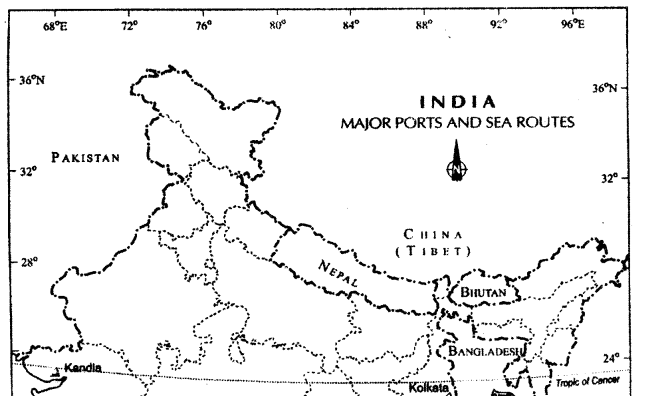
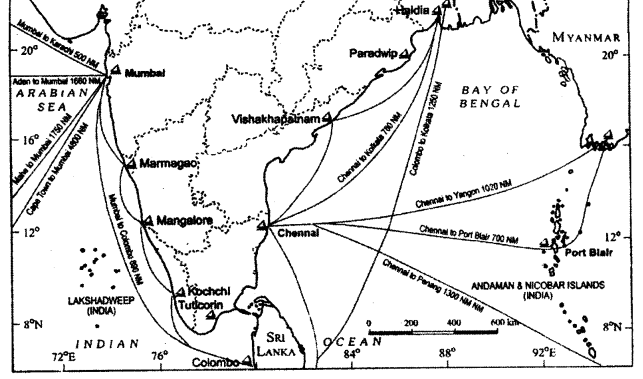
Ports are protected inlets on the coast providing shelter to ships. An ideal port should haye indented coast line, deep water, rich hinterland and good climate. India has a coastline of 7,517 km long. There are 12 major, 22 medium and 185 minor ports.

Ports on the Western Coast:

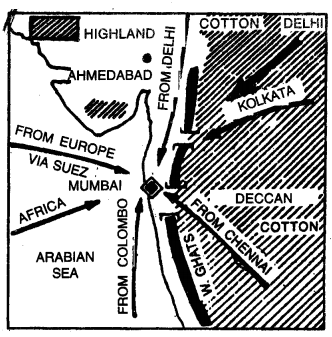
1. Kandla. It is located at the head of gulf of Kachchh. It is a tidal port and is expected to take the place of Karachi. It is a natural and safe harbour connected with a vast and rich hinterland of North West India. An offshore terminal has been built at Vadinar. It has the facilities of entrance of large ships. It is located on the Suez Canal route. Main items of imports include petroleum, chemicals, fertilisers and machinery. Its main exports are salt, sugar, cement and cotton goods.
Geography Class 12 Important Questions Chapter 11 International Trade 1
(2) Mumbai. Mumbai occupies central position on the west coast of India. It stands on an island connected with the mainland. Mumbai has developed as a port for historical reasons. The British Colonial interests were the major forces for its development. It is the only natural deep-water harbour of India. It is a 20 km. long and 10 km. wide port. It is connected with Europe through Suez Canal.

It has rich productive hinterland of black cotton soil region. It is a spacious and safe port with natural facilities for the big ships. It has 54 docks and many warehouses. It is also known as the ‘Gateway of India’. It is an important industrial and commercial town of India.

Textiles, oil seeds, hides and skins and manganese are its major exports. The imports include machinery, petroleum, raw films, fertilisers, paper and medicines. A new mechanised port is being developed at Nhava Sheva. (Jawaharlal Nehru port), it is the largest container port in India.

(3) Mormugao. This port lies on the west coast in Goa on an estuary. It is a deep natural harbour. Its hinterland includes Goa, Maharashtra and Karnataka. It exports mainly iron ore, groundnut and manganese. The imports include machinery and manufactured goods. Konkan Railway has helped its development.

(4) New Mangalore. It lies in Karnataka to export iron ore, fertilisers coffee, tea, yarn, etc.

(5) Cochin. Cochin lies on the Malabar coast in Kerala. It is called the queen of the Arabian sea. It has a large sheltered back waters formed by lagoons. It is a safe, deep and natural harbour. It is located on the route to Australia and the far east. It is an important naval centre and a shipyard. The major exports include tea, coffee, cashew nuts, rubber, pepper, cardamoms and cotton goods. The imports include oil, fertilisers, machinery and coal.
Geography Class 12 Important Questions Chapter 11 International Trade 2
Geography Class 12 Important Questions Chapter 11 International Trade 3

(B) Ports on the Eastern Coast:

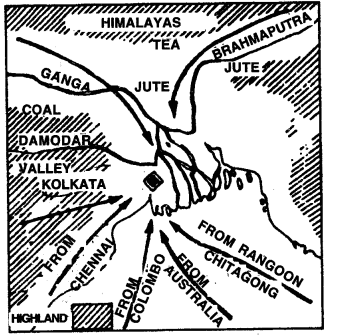
(6) Kolkata. It is a river port on the mouth of Hugh about 120 kms. inland. It has a rich hinterland of productive agricultural Ganges-Brahmputra delta and Chhottanagpur region rich in minerals. It is located on the route to Japan and U.S.A. Ships have to depend upon tides to enter this port.

It gets silted and needs constant dredging. A new port of Haldia is being developed to share the burdens of Kolkata. It is the second biggest port of India. Its main exports are jute, tea, sugar, iron ore, mica and coal. The imports consist of machinery, chemicals, rubber, paper, etc.

(7) Vishakhapatnam. It is a new major port on the east coast of India. It lies mid-way between Kolkata and Chennai. It is a well protected natural harbour enclosed by hard rocks of Dolphin nose. It is connected with a mining region of iron ore, coal and manganese. Its hinterland includes Andhra Pradesh, Madhya Pradesh and Odisha. It has the largest shipyard of India. It exports iron ore, manganese, oilseeds, mica and tobacco. The imports include rice, machinery and petroleum.

(8) Paradip. It is a new major port on the Odisha coast on Mahanadi Delta. It is a deep natural port. It provides facilities for the stay of big ships. It has a vast hinterland of Odisha-Chhatisgarh-Jharkand with minerals, forest products and agricultural resources. It exports iron ore to Japan and other minerals like chrome, manganese and mica. The imports include fertilisers, chemicals and rice.

(9) Chennai. It is an artificial, man-made port on the east coast. It is the third largest port of India.
Geography Class 12 Important Questions Chapter 11 International Trade 4

Two concrete walls (Break waters) have been built to provide shelter. Its hinterland includes Tamil Nadu and Karnataka. It is a rich agricultural region. The principal exports include tea, coffee, oilseeds, hides and skins, rubber, cotton goods and tobacco. The imports include, coal, rice, paper, chemicals and machinery.
(10) Ennore. It lies 25 km. North of Chennai.

(11) Tuticorn. It is a major port and lies South of Chennai.

Question 2.
Describe the main features of India’s Foreign trade.
Answer:
India’s Foreign Trade.
In ancient period, India had a large foreign trade. India was called the ‘Golden sparrow’. During the British Period, India became a market for the manufactured goods from Europe. The agricultural raw materials were exported to Britain. After Independence, India’s foreign trade has undergone many changes. It has the following characteristics

  • Coastal Trade. Above 90% trade of India is by sea.
  • Low Foreign Trade. The total amount of trade is very low. It is only 1% of the international trade of the world.
  • Low per-capita Trade. Due to large population, the per capita trade in India is low as compared to other countries.
  • Increase in Volume and Value of Trade. India’s trade is rising in volume as well as value.
YearImports 7 croresExports ₹ croresTotal
1950-516086081,214
1990-9143,19832,55375.751
2000-2001230.873203,571134.444
2010-20111,683,4671,142.6492,826,116

(v) Unfavourable Balance of Trade. Due to large import of machinery and petroleum, the balance of trade is becoming unfavourable.

YearImport ₹ croresExport ₹ croresBalance ₹ crores
1990-9143,19332,55310,645
2000-01230.873203,57127.302
201.0-20111,683,4671,142,649540,818

(vi) Features of Export Trade—
(а) Traditional export. India still exports a large number of traditional goods like tea, jute-goods, cotton textile, oilseeds, minerals, hides and skins. Now, a large variety of goods are being exported.

(b) Manufactured goods and Engineering goods. India used to export mostly raw material, but now manufactured goods occupy a major share in the total exports. Their share has increased to 35%.

(c) A large number of buyers of exports. India has now trading links with a large number of countries. About 3000 items are exported every year.

(d) Change in direction of foreign trade. Great Britain was the biggest buyer of Indian goods. Our trade increased with U.S.A. and Russia during the last decade. Now, Japan is the biggest purchaser of Indian goods.

(vii) Features of import trade.
(a) Predominance of machinery. India is on the road to industrialisation. Machinery and transport- equipment form the major items of import.

(b) Increase in the transport of manufactured goods. The imports of manufactured goods is increasing. Paper, silk, chemicals and petroleum are being imported.

(c) Decrease in imports of food grains. Green Revolution has led to an increase in food production. Therefore, import of cotton, wheat, jute has decreased.

(d) Change in direction of foreign trade. U.S.A. has again emerged as the largest supplier of goods to India. Import trade has increased with Bangladesh, Japan, Russia, Iran and West Germany.

International Trade Important Extra Questions HOTS

Question 1.
‘India’s international trade has changed in recent years in terms of volume, composition and direction.’ Support the statement with examples. (C.B.S.E. 2009)
Answer:
Many changes have taken place in India’s foreign trade after 1947.
1. Volume of trade. The volume of trade has increased many times. In 1951, the total trade was ₹ 1,250 crore; but due to industrial development; it has risen to ₹ 28,26,116 crores in 2010-11.

2. Change in Composition of Exports. The import-export trade has undergone many changes. India used to export tea, jute, leather, iron ore, spices, etc. But now manufactured goods are exported such as Engineering goods, ready-made garments, Handicrafts, etc.

3. Changes in the Composition of Imports. The ratio of foodgrains, cotton, jute increased in import trade. But now petroleum, fertiliser, steel, industrial raw materials, machinery, chemicals, are mostly imported.

Question 2.
‘Most of India, foreign trade is carried through sea routes’. Explain the statement giving three reasons.
Or
Describe the importance of sea routes in handling India is foreign trade. (Delhi 2019)
Answer:

  • India’s long coastline foster the development of ports.
  • Indian ports are all weather ports having good harbour facilities.
  • Most of India is foreign trade is carried through the sea routes.
  • Sea routes act as receiving points of foreign consignment coming to India for distribution.


Transport and Communication Class 12 Important Extra Questions Geography Chapter 10

Here we are providing Class 12 Geography Important Extra Questions and Answers Chapter 10 Transport and Communication. Geography Class 12 Important Questions are the best resource for students which helps in class 12 board exams.

Class 12 Geography Chapter 10 Important Extra Questions Transport and Communication

Transport and Communication Important Extra Questions Very Short Answer Type

Question 1.
What is total length of roads in India ?
Answer:
42 lakh kms.

Question 2.
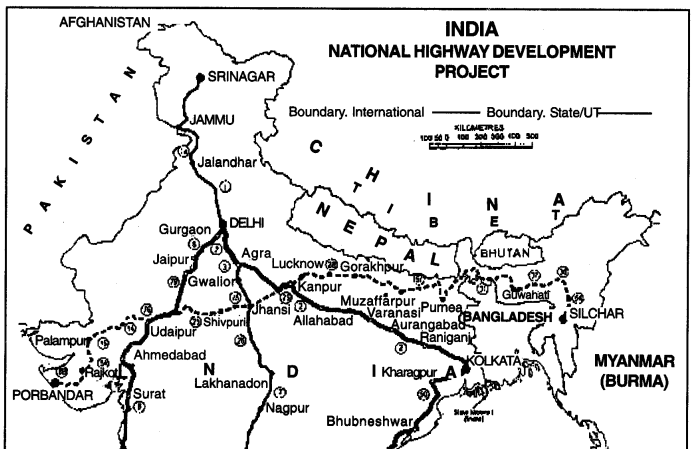
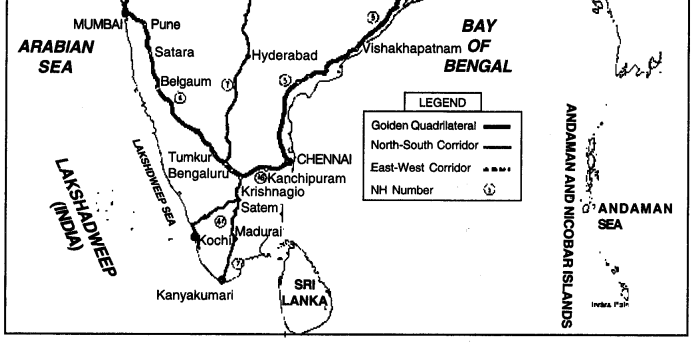
Name the two terminal stations of East- west Corridor.
Answer:
Silchar and Porbandar.

Question 3.
Which is the longest National Highway ?
Answer:
National Highway no 7- (Varanasi to Kanniyakumari).

Question 4.
What is the National average density of the roads in India ?
Answer:
125 km.

Question 5.
What is the total length of railways in India ?
Answer:
1,15,000 km.

Question 6.
How many international airports are there in India ?
Answer:
17.

Question 7.
When was Prasar Bharti set up ?
Answer:
In 1997.

Question 8.
When was radio transmission started in India ?
Answer:
In 1927.

Question 9.
Expand PSLV.
Answer:
Polar Satellite Launch Vehicle.

Question 10.
When was the first telecast by Doordarshan started ?
Answer:
15 September, 1959.

Question 11.
On which levels does the transportation functions as a lifeline of the economy ?
Answer:
Global, national, regional and local.

Question 12.
Name three forms of Communication.
Answer:
Physical (Postal Services), through Telegraph and through Airwaves.

Question 13.
Which is the longest National highway in India ?
Answer:
Prom Varanasi to Kanniyakumari—2,369 km.

Question 14.
Which states has the highest and the lowest density of metalled roads in India ?
Answer:

  • The Highest road density—Kerala (387 per 100 sq. km.)
  • The lowest road density Jammu & Kashmir— (3.5 km per 100 sq. km.)

Question 15.
State any two advantages of air transport in the International trade. (CBSE – 2018)
Answer:

  • Over long distances deliver items quickly.
  • Require less time.

Question 16.
On the basis of configuration and purpose, compare the two satellite systems in India. (Sample Paper 2018-19)
Answer:
(1) Indian National Satellite System (INSAT).
(2) Indian Remote Sensing Satellite System (IRS)

Question 17.
Name the two categories of air transport in India.
Answer:
International and domestic.

Question 18.
Name the Headquarters of Northern Railway zone.
Answer:
New Delhi.

Question 19.
Identify the Indian seaport which provides port facilities to its landlocked neighbour countries. Name any one such country. (Sample Paper 2018-19)
Answer:
Kolkata Seaport and Nepal Sea Port.

Question 20.
Name the Air service of India which connects all the continents.
Answer:
Air India.

Question 21.
Which category of roads in India constitute only 2% of the total road length but carry about 40% of the total road traffic ?
Answer:
National Highways.

Question 22.
Name a port of the Maharashtra and a port of Tamil Nadu which have been constructed to reduce the pressure of the existing major ports.
Answer:
(a) Maharashtra – Nhava Sheva
(b) Tamil Nadu – Ennore.

Question 23.
Why is the density of rural roads very low in hilly areas of India? Give one reason. (C.B.S.E. 2013)
Answer:
It is difficult to construct roads due to hilly terrain of the area.

Question 24.
State the main function of National Highways Authority of India (NHAI). (C.B.S.E. 2013)
Or
What are the major functions of the National Highways Authority of India?
Or
Which is the apex body responsible to improve the quality of roads at National level in India? (C.B.S.E. Delhi 2017 Set-II)
Answer:
To improve the quality of National Highway.

Question 25.
What means of transport is more suitable for long distanes in Northern Eastern region ? (C.B.S.E. 2013)
Answer:
Pawan Hans Helicopters.

Question 26.
Name the northern most international air port of India. (C.B.S.E. 2014)
Answer:
Amritsar.

Transport and Communication Important Extra Questions Short Answer Type

Question 1.
What are the important modes of transport in India ?
Answer:

  • Railways
  • Roadways
  • Airways
  • Waterways
  • Pipelines.

Question 2.
What are the disadvantages of road transport?
Answer:
Disadvantages of Road Transport.

  • Road transport is costly.
  • It results in air pollution.
  • Heavy goods cannot be taken to long distance.
  • Road transport is more accident prone.

Question 3.
What is the Golden Quadrilateral ?
Or
Explain the term ‘Gloden Quadrilateral.
Answer:
It is a super-highway project linking Delhi, Kolkata, Chennai and Mumbai. It has six super highways. It forms the shape of a Quadrilateral.

Question 4.
Name four national highways mentioning their terminals.
Answer:
(i) Sher Shah Suri Marg. National Highway No. 1. (Delhi to Amritsar)
(ii) National Highway No. 3. Between Agra and Mumbai.
(iii) National Highway No. 7. Between Varanasi and Kanniyakumari.
(iv) National Highway No. 2. Between Delhi and Kolkata.

Question 5.
Name two national waterways.
Answer:
1. National Waterway No. 1. Pravagraj Haldia on Ganga river.
2. National Waterway No. 2. Sadiya to Dhubri or Brahmaputra.

Question 6.
Name the different types of railways in India on the basis of width. Where does India rank in world railways ?
Answer:
Rail Transport
Indian railway system is the main artery of the country’s inland transport. It is the biggest in Asia and the fourth largest in the world. It has a route length of 63221 km on which 12,670 trains run every day connecting 7,500 stations. Indian railways comprise of three gauges: broad gauge (1.616 metres is the distance between both the lines); metre gauge (1.00 metre) and narrow gauge (0.762 and 0.610 metres). Its fleet of locomotives comprises of steam, diesel and electric engines.

Different parts of railways having different width have been constructed in India due to its diverse relief. Broad gauge railway lines are constructed in plains while narrow gauge railway lines are constructed in hilly region.

  • Broad gauge = 1.6 metres wide
  • Metre gauge = 1 metre wide
  • Narrow gauge = 0.76 metre wide.
GaugeTotal routePercentage
Broad46.887 km71.11%
Metre13,210 km21.27%
Narrow3,124 km94%
Total63,221100%

Question 7.
Describe the two main types of air services in India.
Answer:
The air services In India are of two types viz. international and domestic. Air India provides international air services for both passengers and cargo traffic to 35 destinations from four focal points—Delhi, Mumbai, Chennai and Kolkata. Air India carried 3.83 million passengers in 2000-01.

Major international air routes are Delhi-Rome-Frankfurt, Mumbai-London, Delhi-Moscow, Kolkata-Tokyo, Kolkata-Perth, Mumbai- London-New York. Indian Airlines, Affiance Air (subsidiary of Indian Airlines), private scheduled airlines and air taxis provide domestic air services.

Indian Airlines operations also extends to the neighbouring countries of Southeast Asia and West Asia. At present, there are two private scheduled airlines operating on the domestic network; 38 companies hold non-scheduled air taxi operators permit. Private operators presently cater to nearly 52.8 per cent of the domestic air traffic. The share of private sector airways has increased rapidly after liberalisation.

Question 8.
What are the problems of having three railway gauges ?
Answer:
The railways in India are of three gauages— Broad gauge, metre gauge and narrow gauge. The metre gauge is being converted into broad gauge. This is called unigauge project. It avoids the transhipment of goods from one gauge to another. It will increase the capacity of transportation by trains and will he cheaper also.

We have already noted that Indian Railways operate on three different gauges. This poses problems in the smooth flow of goods and passengers. The shift from one gauge line to the other involves unloading and transhipment which is time-consuming and expensive. The perishable commodities cannot withstand such a delay. Moreover, the passenger and freight traffic has been increasing day by day. The tracks are not suitable to take the heavy loads.

Question 9.
Describe the different means of communication.
Answer:
Communication network carries information from one place to another physically like postal services, through wires like telegraph and telephone, or through airwaves like radio and television. Some communication systems work in cooperation with transport system like postal services. Others, however, function independent of the transport system such as radio.

Question 10.
Where does India rank in the world in context to roadways ? Describe the major National Highways.
Or
“India has one of the largest network of roads in the world.” Support the statement with examples. (Delhi 2019)
Answer:
Roads. The road network in India is one of the largest in the world. The road length has increased from 397.62 thousand kilometres in 1950-51 to around 42 lakh kilometres. Of the total kilometreage, the length of the surfaced (metalled) roads increased from 156.11 thousand kilometres in 1950-51 to 833.0 thousands kilometres while the unsurfaced (unmetalled) road length during the same period increased from 241.5 thousand kilometres to 940 thousand kilometres.

National Highways. A number of important National Higways in India run in north-south and east- west directions. They link one part with the other

  • Sher Shah Suri Marg is historically very important. It connects Kolkata with Peshawar. It is now known as National Highway 1, which links Delhi and Amritsar,
  • National Highway 2 which links Delhi and Kolkata
  • National Highway 3 runs between Agra and Mumbai via Gwalior, Indore and Nasik.
  • National Highway 7 is the longest one which links Varanasi with Kanniyakumari via Jabalpur, Nagpur, Hyderabad, Bangalore and Madurai. It traverses a distance of 2,325 km.
  • National Highways 5 and 17 run along the eastern and western coasts respectively.
  • National Highways 15 represents the border road in Rajasthan desert and run through Kandla, Jaisalmer, Bikaner and joins the border road in Punjab.

Question 11.
Name the different units manufacturing Railway equipments.
Answer:
Indian Railways run six units to manufacture rolling stock. These are :
(i) Chittaranjan Locomotive Works, Chittaranjan
(ii) Diesel Locomotive Works, Varanasi
(iii) Integral Coach Factory, Perambur
(iv) Rail Coach Factory, Kapurthala
(v) Wheel and Axle Plant, Bangalore, and
(vi) Diesel Component Works, Patiala.

Question 12.
Describe the national waterways of India.
Answer:
The Inland Waterways Authority of India was set up in 1986 for the development, maintenance, and regulation of National Waterways in the country. At present, there are only three National Waterways in the country. Ten other waterways are being considered for upgradation as National Waterways.

The three national Waterways are:

  • National Waterway 1 : The Allahabad-Haldia stretch of the Ganga-Bhagirathi Hooghly river system (1620 km);
  • National Waterways 2 : The Sadiya-Dhubri stretch of the Brahmaputra river (891 km);
  • National Waterways 3 : The West Coast Canal from Kottapuram to Kollam alongwith Udyogmandal and Champakar canals (205 km).

Question 13.
Write a note on Akashvani.
Answer:
Akashvani : Radio is an effective means of mass communication in the country. Radio broadcasting started in India in 1927 with two private transmitters located at Mumbai and Kolkata. All India Radio (AIR) was constituted in 1936. It is also known as Akashvani. At the time of Independence there were six radio stations. At present, the All India Radio has 208 stations and 327 transmitting centres.

These stations and transmitting centres provide services to 99 per cent of the population and 90 per cent of the area of the country. Private parties also have set up about 100 FM radio stations. All India Radio broadcastes a variety of programmes like information, education and entertainment.

Question 14.
Write a note on Doordarshan in India.
Answer:
Doordarshan: Doordarshan, the national television of India, is one of the largest terrestrial networks in the world. It has changed socio-cultural life of the people both in villages and in towns. DD-1 operates through a network of 1,042 terrestrial transmitters that reaches to over 87 per cent of the population.

There are 65 additional transmitters giving terrestrial support to other channels. First telecast by Doordarshan was made on 15 September, 1959. Television was confined to certain cities up to 1975. The first experiment with satellite technology in India known as the Satellite Instructional

Television Experiment (SITE), was conducted in 1975-76. National programme and use of colour television could be started in the country only by 1992. Afterwards, television facility expanded very rapidly.

All India Radio has introduced commercial programmes also. Vivid Bharati channels have commercial broadcasting. Besides Vividh Bharati, other channels and local stations also provide commercial services. For rtiral audiences, several programmes are regularly transmitted.

Similarly, programmes on family welfare and healthcare are broadcasted every day. Music and drama are major components of the schedule of broadcasting. All India Radio commissioned the National Channel in 1998, which is essentially a night service, airing evening to morning broadcast.

Question 15.
What do you mean by ‘Open Sky Policy5 ?
Answer:
Air transport terminals are called airports. Air transport cost is comparatively very high, and therefore, it is mainly used for passenger services. Only light and valuable cargo is dispatched by cargo aircraft. In order to help Indian exporters and make their export more competitive, the Government of India introduced the ‘open sky policy5 for cargo. Under this policy any foreign airlines or association of exporters can bring freighters to the country for upliftment of cargo.

Question 16.
What do you know about Sher Shah Suri Marg ?
Answer:
Sher Shah Suri built the Shahi (Royal) road to strengthen and consolidate his empire from the Indus Valley to the Sonar Valley in Bengal. This road was renamed the Grand Trunk (GT) road during the British period, connecting Calcutta and Peshawar. At present, it extends from Amritsar to Kolkata. It is bifurcated into 2 segments:

  • National Highway (NH)- 1 from Delhi to Amritsar, and
  • NH-2 from Delhi to Kolkata.

Question 17.
What are the importance of Konkan Railway ? (C.B.S.E. 2017)
Or
Describe any three features of Konkan Railway. (C.B.S.E. Delhi 2017)
Answer: Konkan Railway. One of the important achievements of Indian Railways has been the construction of Konkan Railway in 1998. It is 760 km long rail route connecting Roha in Maharashtra to Mangalore in Karnataka. It is considered an engineering marvel.

It crosses 146 rivers, streams, nearly 2000 bridges and 91 tunnels. Asia’s largest tunnel which is nearly 6.5 km long, also lies on this route. The states of Maharashtra, Goa and Karnataka are partners in this undertaking.

Question 18.
State any six characteristics of road transport in India. (C.B.S.E. 2009)
Answer:

  • India has one of the largest road network in the world.
  • The total length of roads in India is 42 lakh kms.
  • About 85% of passenger and 70 percent of freight traffic is carried by roads.
  • Roads continue to concentrate in and around urban centres.
  • Rural areas have the least km of roads.
  • 5846 km long Golden Quadrilateral network connects Delhi, Chennai, Kolkata and Mumbai.

Question 19.
Which is the most effective and advanced personal communication system in India ? Explain any four characteristics of it. (C.B.S.E. 2009)
Answer:
Internet is the most effective and advanced personal communication system in India.
Characteristics.

  • It is widely used in urban areas.
  • It connects the user through E-mail with the world.
  • It is widely used for e-commerce and carrying out money transactions.
  • It is a store house of detailed data.

Question 20.
Explain with five suitable examples how the level of Economic development and nature of terrian affect the density of roads in India. (C.B.S.E. 2013)
Or
Why is the distribution of roads not uniform in India? Explain with l examples. (CBSE2016)
Answer:
The distribution of roads is not uniform in the country. The level of economic development and nature of terrian are the main determinants of density of roads.

  • Construction of roads is easy and cheaper in plain area.
  • Quality of roads is better in plains, as compared to roads in high altitude areas.
  • The density of road is 10.48 km in Jammu and Kashmir (including Ladakh) where as it is 387.24 km in Kerala (a plain area).
  • The density of roads is high in northern states due to the high level of economic development.

Question 21.
What are National Highway ? Explain any four uses of national ‘ highways in India ? (C.B.S.E. 2013)
Or
Describe any five characteristics of national Highway of India. (CBSE 2018)
Answer:
National Highway: The main roads which are constructed by the Central Government are known as the National Highways.

  • These are meant for inter-state transport.
  • These help in movement of defence goods and material in strategic areas.
  • These connect the state capitals, major cities ports, railway junctions, etc.
  • These carry 40% of road traffic, while these ae only 2% of the total road length.

Question 22.
The railway network in the north Indian Plain is dense. Why ?
Answer:
A dense network of railways is developed in the north Indian plains. About 50% of the total length of railways in India is found in northern India. The northern railways is the longest railway with a length of 10,977 kms. Many physical and economic factors are responsible for it.

  • Northern plain is a level plain with low altitude. It is best suited for the construction of railways.
  • Due to dense population, big towns have developed which has led to high density of railway.
  • The intensive development of agriculture and industries has promoted the construction of railway lines.
  • It is essential to connect Mumbai and Kolkata with their hinterlands or northern plain.

Question 23.
Describe the growth and development of Border Roads in India. (C.B.S.E. 2013)
Or
Which apex body develop the border roads ? Explain the importance of border roads with examples. (Outside Delhi 2019)
Answer:
Looking at the strategic importance of our border areas, the Border Roads Organisation was set up in 1960 and entrusted with the construction and maintenance of roads in the border states of the country. These border roads have helped in accelerating the economic development in these areas by increasing accessibility besides helping in strengthening of the defence preparedness.

It includes the highest road of the world from Manali to Leh, at an altitude of 4220 metres above sea level. Along Indo-Chinese border, Hindustan Tibetan Road has been constructed. The board has constructed about 22800 km of Border roads and manages above 16400 km. of roads in border area.

Question 24.
Why has Punjab the highest density of roads ? Explain five factors responsible for the same.
Answer:
Punjab has the highest density of surfaced roads. The density of roads is 74 km. per 100 sq. km. It is due to the following factors:

(1) Punjab plain is a gently sloping alluvial plain. It is easy to construct roads.

(2) Punjab is an agriculturally developed state. For the easy and quick movements of agricultural products, roads have been constructed.

(3) Punjab exports wheat, rice and other crops to other parts of India. Therefore quick means of transportation is required.

(4) The per capita income of people and the standard of living is quite high. So the state needs a lot of manufactured goods and raw materials. Roads provide door to door service.

(5) The movement of passenger traffic is high. So, roads are required especially for the rural areas.

Question 25.
‘A well-knit and co-ordinated system of transport is necessary for sustained economic growth of the country’. Discuss.
Answer:
Transport network is established to facilitate the movement of people and goods. It is the means of bringing human beings and the things they need and use together. It functions as a lifeline of the spatial economy at all territorial levels: A transport system involves origin, destination, route and the carrier.

  • Origin. Origin is the point where the traffic originates.
  • Destination. Destination is the point where it terminates.
  • Route. Route is the surface on which movement takes place.
  • Carrier. The carrier is the vehicle that moves the passenger or cargo. A well-knit and coordinated system of transport plays an important role in the sustained economic growth of the country.

Question 26.
Account for the growing importance of roads.
Answer:
In India, the growing importance of road transport vis-a-vis rail transport is rooted in following reasons:

  • Construction cost of road is much lower than that of railway line
  • Roads can traverse comparatively more dissected and undulating topography
  • Road transport can economically carry few persons and relatively small amount of goods.
  • Cost of loading and unloading is much lower in case of road transport, because it provides door-to-door service.
  • Road transport also supplements other modes of transportation. It provides link between railway stations and airports and their hinterlands.

Question 27.
How are Indian Railways contributing to the growth of national economy ? Explain with examples. (C.B.S.E. 2011)
Answer: Indian Railways :
(i) Indian railways network is one of the longest in the world.

(ii) It facilitates the movement of both freight and passengers. The total freight carried by railways is 557.39 million tonnes. The total number of passengers carried by railways is 5112 million.

(iii) Metro rail has revolutionised the urban transport system in Kolkata and Delhi.

(iv) Railways developed around towns, raw material producing areas, hill stations have been developed for the exploitation of resources.

(v) Railways could run to remain the main means of transport for the masses.

Question 28.
Distinguish between
(a) Personal communication and
(b) Mass communication.
Or
Classify means of communication on the basis of scale and quality into two categories. Explain any two characteristics of each category. (Outside Delhi C.B.S.E. 2017)
Answer:

Personal CommunicationMass Communication
1. Personal communi­cation are the means of delivering messages belween individuals or small groups.

2. Messages are carried between the sender and the receiver both ways.

3. These means of communication include post card, letter, telegram. fax, telephone.

1. These are the means of delivering messages from an individual or a group to a large audience.

2. Messages  are delivered from a sender to a large audience usually one­way.

3. These means of communic. ion include newspapers, magazines and other periodicals, electronic media like radio, television, films, etc.

Question 29.
Distinguish between a National and a State highway.
Answer:

National HighwaysState Highways
1. These are the major roads of the whole country.

2.  These connect the different capitals of state with major industrial and commercial towns of the country.

3. These are maintained by the Central Govt.

4. Total length of national highways in India is 71,000 kms.

5. These have commercial and strategic signi­ficance;

6. Sher Shah Suri Marg (G.T. Road) is a national highway.

1. These are the major roads within a state.

2. These connect the state capitals with the major towns and district head- quarters within a state.

3. These are maintained by the State Govt.

4. The total length of state highways is 1,37,712 kms.

5. These have admini­strative signifi-cance.

6. Amritsar-Chandigarh is a state highway.

Question 30.
What are border roads ? Gi ve I two characteristics of border roads. (C.B.S.E. 2013, Outside Delhi 2019)
Answer:
Border roads are strategically important roads along the Northern and North-eastern boundary of the country.
(i) These are roads in high altitudes and mountainous areas.
(ii) These are contructed and maintained by BRO (Border Road Organisation).

Question 31.
Describe any three advantage of Satellite Communication in India. (C.B.S.E. 2014)
Answer:
Advantage of Satellite Communication
Satellite communication is vital for the country due to economic and strategic reasons:
(i) They are significant means of communication.
(ii) These can be used for the weather-forecast, monitoring of natural calamities, surveillance of border areas.
(iii) This is useful in the management of natural resources.

Question 32.
‘The distribution of roads in I India is not uniform’. Examine the statement giving three reasons. (Sample Paper 2018-19) (C.B.S.E. 2014)
Answer:
(i) The density of roads varies from only 10.48 km in Jammu and Kashmir (including Ladakh) to 387.24 km in Kerala.
(ii) Nature of topography is the main basis of road density.
(iii) Construction of roads is easy and cheaper on plains, while it is expensive on hilly terrain.

Question 33.
Describe any three advantages of pipelines as a means of transport in India. (C.B.S.E. 2014)
Answer:
(i) Pipelines are used to transport liquids and gases.
(ii) It is environmental-friendly means of transport.
(iii) Pipelines can be laid through difficult terrain and also under water.

Question 34.
Define the term ‘communication.’ Describe the importance of telecommunication. (Outside Delhi 2019)
Answer:
Communication is an activity of conveying information through the exchange of thoughts, messages or information by speech, visual, writing or behaviour.
Importance of Telecommunication:

  • Telecommunication is an important tool for busines. This device is used to receive and send messages, access data etc.
  • This refers to the exchange of information with electronic and electrical means over a long distance.
  • Telecommunication also useful for students.
  • Telecommunication is helpful for people living in areas that do not have special care facility. With this they get in touch with a healthcare provider.
  • Telecommunication play a vital role in transport sector.

Transport and Communication Important Extra Questions Long Answer Type

Question 1.
Describe the distribution of railways in India.
Answer:
Distribution of Railways. A close look at the railway map of India in any atlas would reveal the following pattern of the railway network:
(1) Northern plains. A dense network of railways has been developed in the Northern Indian Plain from Amritsar to Howrah with a few focal points like Delhi- Kanpur-Mughal Sarai, Lucknow, Agra and Patna.

The whole of Northern Plain is very well connected. While connectivity is more efficient in east-west direction, it is not so efficient in the north and south direction from the trunk routes. The rail network in this plain is highly correlated to the level of agricultural and industrial development. Delhi is the focal point from where railway lines radiate in all directions. It is connected with ports through superfast trains.

Many favourable factors have led to development of a dense network of railways in Northern Plains.
Favourable factors. A dense network of railways is developed in the north Indian plains. About 50% of the total length of railways in India is found in northern India. The northern railways is the longest railway with a length of 10,977 kms. Many physical and economic factors are responsible for it.

  • Northern plain is a level plain with low altitude. It is best suited for construction of railway.
  • Due to dense population, big towns have developed which have led to high density of railway.
  • The intensive development of agriculture and industries h as promoted the construction of railway lines.
  • It is essential to connect Mumbai and Kolkata with their hinterlands of northern plain.

(2) Peninsular plateau. The peninsular region, Gujarat and Tamil Nadu have a denser rail network as compared to other parts. The whole of the peninsular region has a hilly and plateau terrain. The concentration of population is moderate. Therefore, the rail network is also sparse. Trunk routes are aligned in such a way that there are efficient connections between Mumbai-Chennai, Chennai-Cochin, Chennai- Delhi and Chennai-Hyderabad.

(3) Coastal plains. There is a distinct contrast in the rail network between eastern coastal plains and western coastal plains. There exists a long trunk route all along the east coast. Such a rail track is the Konkan Railway of 837 km. long which has been built along the western coast from Mumbai to Cochin.

The outcrops of the Western Ghats being very close to the coast, restrict the extent of the coastal plain while the eastern coast is wider and the Ghats lie away from the coast.

(4) Areas with sparse Rail network. Himalayas, west Rajasthan, Brahmaputra valley, North East hilly region have sparse rail-network.

(a) Himalayan Region. The mountainous terrain of the Himalayas is such a noteworthy region. The rugged terrain, hill and valley topography, backward economy and sparse population are the factors responsible for the sparse rail network in this region.

(b) Western Rajasthan. In western Rajasthan a few metre gauge railway lines have penetrated the arid tract.

(c) Brahmaputra valley. The Brahmaputra Valley has two parallel lines but no railway line has been constructed on the Meghalaya plateau.

(d) N.E. Region. In Tripura, Mizoram, Manipur and Nagaland, no railways have been constructed. The main reasons for the absence of a railway network are the hilly terrain and forested tracts. The cost involved in providing railway tracks in these regions is too high. The sparse population is another important aspect which has not encouraged this investment.

Question 2.
Describe the major oil and gas pipelines of India.
Answer:
(1) Naharkatiya Barauni pipeline. Oil India Limited constructed the first pipeline of 1,152 km from Naharkatiya oilfield in Assam to Barauni refinery in Bihar via Noonmati (1962-68).

2. Haldia-Kanpur pipeline. To transport refined petroleum products. Barauni-Kanpur pipeline was laid down in 1966. Haldia-Maurigram-Rajbandh pipeline was constructed later.

3. Ankleshwar-Koyali pipeline. Extensive network of pipelines has been constructed in the Gujarat region. First pipeline connected the Ankleshwar oilfield to Koyali refinery (1965). Later, Kalol-Sabarmati crude pipeline, the Navagaon-Kalol-Koyali pipeline and the Mumbai High-Koyali pipeline were laid.

4. Ahmedabad-Koyali pipeline. Ahmedabad has been linked with Koyali by pipeline for transport of petroleum products.

5. Ankleshwar-Vadodara pipeline. Gas pipelines have also been laid down between Khambhat and Dhuvaran, Ankleshwar and Uttaran, and Ankleshwar and Vadodara. Gas Authority of India Limited (GAIL) operates over 4,200 km of pipeline in the country and supplies gas to power plants.

6. HBJ gas pipeline. Construction of a cross country 1,750 km long Hazira-Bijapur-Jagdishpur (HBJ) pipeline has already been completed. This pipeline has now been extended from Bijapur to Dadri in Uttar Pradesh.

7. Kandla-Delhi pipeline. GAIL is also implementing a 1,246 km long LPG pipeline project from Kandla/Jamnagar in Gujarat to Luni in Uttar Pradesh via Delhi.

8. Mathura-Jalandhar pipeline. The Mathura refinery gets its crude from the Mumbai High through pipeline, which extends from Salaya on the Gulf of Kachchh to Mathura, Petroleum product supply pipeline exists between Mathura and Jalandhar via Delhi and Ambala, and between Mumbai and Pune for the transport of petroleum products.

Geography Class 12 Important Questions Chapter 10 Transport and Communication 1
Geography Class 12 Important Questions Chapter 10 Transport and Communication 2

Question 3.
Describe the main features of development of roads in India.
Answer:
The history of roads construction in India is very old. Sher Shah Suri constructed Grand Trunk Road. After independence, a 10 year road development scheme known as the Nagpur Plan, was prepared. Four types of roads are found in India:
(i) National Highways (79,243 km)
(ii) State Highways (1,31,899 km)
(iii) District Roads (4,67,763 km)
(iv) Village Roads (26,50,000 km)

Main features of Roads in India:

(1) India has 13,94,000 kms of metalled roads.
(2) India has 8,73,500 kms of unmetalled roads.
(3) India has just 41 km. road length for every
100 sq. km. area. It has a road length of 251 km for every 1 lakh people.
(4) India has 79,243 kms of National highways.
(5) About 26 lakh automobiles move on roads of India.
(6) Annual income from roads is about 1500 crore rupees.
(7) Indian roads carry about 30% of total freight of the country.
(8) The important National highways are:

  • Sher Shah Suri Marg (G.T. Road) Kolkata to Jammu.
  • Delhi-Mumbai Road
  • Kolkata-Mumbai Road
  • Mumbai-Chennai Road
  • Great Deccan Road (Varanasi to Kanyakumari)
  • Kolkata-Chennai Road.
  • Pathankot-Srinagar Road.
  • The Border Road Development Board was established in 1960.

It has got constructed about 38,028 km. long metalled roads in border areas. It has constructed the world’s highest road from Manali (H.P.) to Leh (Ladakh). The average height of this road is 4,270 metres.

Question 4.
Describe the main features of develop¬ment of railways in India.
Answer:
Railways in India. The first railway line was constructed between Mumbai and Thane in the year 1853. It was only 34 km. long. Railways are the chief means of transport in India.

Main Characteristics:

  • Indian Railways have a total length of 62,759 kms.
  • It is the largest railway system in Asia and the fourth largest in the world.
  • More than 18 lakh workers are engaged in Indian railways.
  • Indian railways have about 12,670 trains which operate over 6,867 stations for a distance of 13 lakh kms.
  • These railways carry 130 lakh passengers and 13 lakh tons freight daily.
  • Railways have an investment of a capital of 8.0 crore rupees and yield an annual income of ? 21,000 crore.
  • Indian railways have about 11,000 locomotives,38.0 coaches and 4 lakh wagons.
  • Most of the railways are found in the level Gangetic plain.
  • Railways have not been extensively developed in Jammu-Kashmir and Ladakh N.E. India, Western ghats, Chhotta Nagpur Plateau and Thar Desert (Rajasthan).
  • In Southern India, construction of railways is retarded due to hilly areas and rivers.
  • India has 4,259 diesel locomotives, 2,302 electric locomotives and 347 steam locomotives. The electric trains run over a distance of 11,772 kms.

Indian railways run of three gauges:

  • Broad gauge—1.67 metres wide (49%)
  • Metre gauge—1 metre wide (44%)
  • Narrow gauge—0.76 metre wide (7%)

During year 1996-97, seven new rail zones have been created out of existing ones. The four following zones have been started:

  • North-Central with headquarters at Allahabad.
  • Central-Eastern with headquarters at Hajipur (Bihar).
  • North-Western with headquarters at Jaipur.
  • West-Southern with headquarters at Bangalore.
  • Central with headquarters at Jabalpur.
  • Eastern with headquarters at Bhubneshwar.
  • S.E. Central Railway at Bilaspur.

Question 5.
Describe the inland waterways of India.
Or
Examine the role of inland waterway, authority of India. Explain why inland water transport is an important mode of transport.(C.B.S.E. 2016)
Or
“Waterways is an important mode of transport for both passengers and cargo traffic in India.” Support the statement with examples.
(Delhi 2019)
Answer :
For the development, maintenance and regulation of natural waterways in India, the inland waterways authority was set up in 1986. It has identified 13 inland waterways which could be upgraded.

Inland Waterways: Water transport is a cheaper means of transport and is suitable for carrying heavy and bulky materials. India is endowed with many navigable rivers and inland water bodies but the share of inland waterways is only one per cent in the country’s transport system.

(1) A total river length of 3,700 km. of major rivers is navigable by mechanised boats but only 1,700 km. of this length is utilised.

(2) We also have a network of about 4,300 km. of canals, of which a stretch of 485 km. is navigable by mechanised crafts but only 3.5 km. is actually utilised. It shows that the inland waterways are greatly underutilised.

(3) Ganga, Brahmaputra and their tributaries are navigable. The deltaic areas of Godawari, Krishna and Mahanadi, lower reaches of Narmada and Tapti, backwaters of Kera, Mondoai and Juari rivers of Goa are some of the major inland waterways.

(4) Buckingham canal in Andhra Pradesh and Tamil Nadu and the Cumberjua Canal are also important navigable canals. The policy for the development of inland waterways is formulated by Central Inland Water Transport Board, New Delhi. The national waterways are developed, maintained and managed by the Inland Waterways Authority of India (IWAI) which was set up in 1986. The national waterways

(Prayagraj-Haldia stretch of Ganga-Bhagirathi-Hugli River system) Act, 1982 has the provision that the regulation and development of this waterway is the responsibility of the Central Government. The river navigation services are operated for carrying goods between Kolkata and Assam, Kolkata and Farakka and Kolkata and Cachar, by Central Inland Water Transport Corporation, which is a Government of India undertaking.

Question 6.
Transport plays an important role in strengthening the social, political and economic unity of India. Explain the statement by giving five examples.
Or
“The triple transport system plays an important role in strengthening the social, political economic unity of India.” Explain.
Answer:
Integrating role of transport. Means of transport are the lifeline of a country. A developed and efficient system of transport is vital for maintaining the sovereignty and economic unity of the country. Under the 20 years Nagpur Plan, a balanced and integrated transport system of rail, road and waterways has been aimed at. The different means of transport have played an integrating role in the political and economic unity of India.

(i) These have connected far flung areas with one another. Leh has been connected with Kanniyakumari, while Assam has been connected with Kutch.

(ii) Means of transport distribute foodgrains, manufactured goods, raw materials and minerals to different parts of the country.

(iii) Pipelines supply petroleum and gas to different areas.

(iv) The commercialisation of agriculture, manufacturing growth of towns and cities have been achieved due to means of transport.

(v) The new road, railway lines have integrated the border areas with the rest of the country. Jawahar tunnel connects Kashmir valley with India.

(vi) Railways line through gaps in the Vindhyan- Satpura hills and in Western Ghats have provided easy connection between the North and South.

(vii) Ganga as a waterway has acted as a unifying agent right from U.P. to West Bengal. Thus, each means of transport has played its own role in a unified system of transport.

Question 7.
Why is air transport important for India ? Describe the different types of Air trans¬port in India.
Answer:
Importance of Air Transport
Air transport is the fastest but costliest mode of transport. It is an important mode for a country of the size of India where the terrain and the climatic conditions are so diverse and important commercial and industrial centres are located at great distances. It is vital for our internal transport system as well as for the links with other countries. India occupies a central location between western Europe and Africa on the one hand and South-East and East Asia, on the other.

Types of Air transport: The air transport in India has two sectors.
(i) Air India : The Air India handles the foreign traffic, both passengers and cargo from four focal points, Delhi, Mumbai, Chennai, Kolkata. It connects all the continents through its services. The Air India carried 21.33 lakh passengers in 1997-98.

(ii) Indian Airlines. The domestic traffic is handled by the Indian Airlines Corporation. It carries passengers, cargo and mail to different destinations within the country as well as to eight neighbouring countries.

(iii) Vayudoot. To augment the air transport in the country the Vayudoot airlines was set up in 1981. It generally provides links with remote and inaccessible areas which are not covered by the Indian Airlines.

(iv) Pawan Hans. In 1985, the Pawan Hans Limited was established to provide helicopter services in order to link far-flung and inaccessible areas in hilly and forested regions.

Question 8.
Describe the different type of Roads.
Or
Evaluate the utility of ‘Golden Quadrilateral.’ (Outside Delhi 2019)
Answer :
Six types of Roads are formed in India :
(i) Golden Quadrilateral Super Highways. A major road development project linking Delhi-Kolkata- Chennai-Mumbai by six-lane super highways. North South corridor links Srinagar with Kanya Kumari and The East-West corridor links Silchar with Porbandar. It is 5,846 km. long.

(ii) National Highways. They connect capitals and main towns. These are maintained by the Central Public Works Department (CPWD), are known as the National Highways. There was a road length of National Highways 79,243km in 2010-11.

(iii) State Highways : The States and Union territories also construct and maintain roads. The state capital is linked with the district headquarters by state highways. It has a total length of 1,31,899km. and is 20% of the total length of roads.

(iv) District Roads. These connect district headquarters of a state. It has a total length of 6 lakh kms. 4,67,763 km is the total length of district road.

(v) Rural Roads. The rural areas are inter-linked by rural roads, which are generally dusty tracks. It can safely be said that the lower the level of roads in its type-hierarchy the poorer the quality of the road.26,50,000 km is the total length.

(vi) Border Roads. The border roads organisation was set up in 1960 for the development of roads of strategic importance in Northern and North-eastern borders. It has completed 30,028 kms. roads inaccessible areas of difficult terrain.

Transport and Communication Important Extra Questions HOTS

Question 1.
“Transport and communication are the necessary infrastructure for the economic development of a country5. Explain.
Or
Why is the transport a vital sector of the economy ?
Answer :
A good network of roads, railways, waterways and airways are the lifeline of a country. The agricultural and economic development of a country depends upon efficient transport system. The development of means of transport is essential for the utilisation of natural resources. It is the basis of industries and trade of the country. It helps to join the far-flung regions into a single national economy.

These also help in defending the independence and the national unity of a country. Just as the arteries supply blood to the different parts of human body, similarly, transport system maintains the movement of men and goods in different parts of the country.

Question 2.
Why is the Indian Railway System divided into seventeen zones ? Name the headquarters of Eastern, Western, Northern and Southern Zones. (C.B.S.E. 2009)
Answer :
Railway Zones have been made to improve the efficiency of Railways. It helps in handling freight and passenger traffic.

S.No.ZoneHeadquarters
1.EasternKolkata
2.WesternMumbai
3.NorthernNew Delhi
4.SouthernChennai.

Question 3.
Analyse the importance and declining popularity of water transport in India in recent times. (Sample Paper 2018-19)
Answer:
Importance
(1) One of the important if water transportation is that it does not require route construction.
(2) The oceans are linked with each other and are negotiable with ships of various sizes.
(3) The energy cost of water transportation is lower. In ancient times, river ways were the main
highways of transportation in the case of India. But these last importance because.

  • Competition from Railways
  • Lack of water
  • Poort maintenance of water bodies.


Framing the Constitution Class 12 Important Extra Questions History Chapter 15

Here we are providing Class 12 History Important Extra Questions and Answers Chapter 15 Framing the Constitution: The Beginning of a New Era. Class 12 History Important Questions are the best resource for students which helps in class 12 board exams.

Class 12 History Chapter 15 Important Extra Questions Framing the Constitution: The Beginning of a New Era

Framing the Constitution Important Extra Questions Very Short Answer Type

Question 1.
When was the Indian Constitution framed?
Answer:
Between 9 Dec. 1946 and 26 Nov. 1949 A.D.

Question 2.
Who was the President of the Constituent assembly?
Answer:
Dr Rajendra Prasad.

Question 3.
Who was the Chairman of the Drafting Committee?
Answer:
Dr B.R. Ambedkar.

Question 4.
How many members of the Constituent Assembly were there?
Answer:
389.

Question 5.
How many members remained in the Constituent Assembly after the partition of India?
Answer:
299.

Question 6.
Who gave an objective resolution of the Constituent Assembly?
Answer:
Jawaharlal Nehru.

Question 7.
Under whose recommendation, the Constituent Assembly was formed?
Answer:
Under the recommendation of the Cabinet Mission.

Question 8.
Who was the Constitutional Advisor of the Government of India?
Answer:
B.N. Rau.

Question 9.
Who was the Chief Draughtsman of the Indian Constitution?
Answer:
S.N. Mukherjee.

Question 10.
Name the official language of India.
Answer:
Hindi.

Question 11.
When was the Indian Constitution framed? When was it enforced?
Answer:
The Indian Constitution was framed from December 1946 to November 1949 and was enforced on 26 January 1950.

Question 12.
Discuss the significance of the Indian Constitution. Give any two points.
Answer:

  1. It wanted to heal the wounds of the past.
  2. It enabled people belonging to different classes, castes, and communities to share a new political experience by coming together with each other.
  3. It strengthened democratic institutions in the country.

Question 13.
What were the demands of low-caste people and linguistic minorities at the time of making the Indian Constitution?
Answer:

  1. The low-caste people demanded an end to ill-treatment by the upper-caste people.
  2. They also demanded reservation of separate seats, on the basis of their population, in legislatures, government departments, and local bodies.
  3. The linguistic minorities demanded freedom of speech in their respective mother-tongue. They also demanded redistribution of provinces on linguistic basis.

Question 14.
Name any six leaders who played an important role in the Constituent Assembly.
Answer:

  1. Pt. Jawaharlal Nehru
  2. Sardar Patel
  3. Dr. Rajendra Prasad
  4. Dr. B.R. Ambedkar
  5. K.M. Munshi
  6. Alladi Krishnaswami Aiyar

Question 15.
Who was the President of the Constituent Assembly? Who was the Chairman of its Drafting Committee?
Answer:

  • Dr. Rajendra Prasad was the President of the Constituent Assembly.
  • Dr. B.R. Ambedkar was the Chairman of the Drafting Committee of the Constituent Assembly.

Question 16.
In the 19th century, what efforts were made by the social reformers for social justice and what efforts were made by communists and socialists for economic justice? Give one point each.
Answer:

  1. The social reformers opposed child- marriage and supported widow-remarriage.
  2. The communists and the socialists brought all laborers and peasants together. In other words, they organised them.

Question 17.
What provisions were made in the Constitution to make the Centre more strong? Give any three arguments.
Answer:

  1. More subjects were included in the union list.
  2. The Union Government has control over many minerals and important industries.
  3. Article 356 empowers the center to take over the state administration on the recommendation of the Governor.

Question 18.
What argument was given against Hindi being made a national language?
Answer:
The people in South India were strongly opposed to Hindi. They viewed every propaganda for Hindi as cutting the very root of the provincial languages.

Question 19.
Which two features of the Indian Constitution had a substantial agreement?
Answer:

  1. Granting the right to vote to every adult citizen of India. It was called the Universal Adult Franchise.
  2. Emphasis on secularism. It is the soul of the Indian Constitution.

Question 20.
In what way was the right to vote to every adult Indian a unique provision?
Answer:
The right to vote to every adult citizen of India is a unique feature of the Indian Constitution. The people in the United States and the United Kingdom got this right after a long struggle. But the Indians got it during the framing of the Constitution.

Question 21.
What Fundamental Rights enshrined in the Indian Constitution ensure religious freedom?
Answer:
They are as follows:

  • Right to Equality
  • Right to Freedom of Religion
  • Cultural and Educational Rights.

Question 22.
Mention any two arguments given by Balakrishna Sharma for greater power to the Centre. (C.B.S.E. 2013 (O.D.))
Answer:
Bal Krishna Sharma stated that only a strong centre can make plans for the interest of the country, can provide requisite resources, can establish proper order and can save the country from foreign invasion.

Question 23.
Why is ‘Objectives Resolutions’ of Nehru considered a momentous resolution? Give any two reasons. (C.B.S.E. 2013 (D.))
Answer:

  1. It proclaimed India as an ‘Independent, Sovereign Republic’.
  2. It guaranteed its citizens justice, equality, and freedom.

Question 24.
How were the discussions in the Constituent Assembly influenced by the opinions expressed by the public? State any two examples. (C.B.S.E. 2013 (O.D.))
Answer:

  1. Calcutta based All India Varnashrama Swarajya Sangh suggested that our Constitution should enshrine principles as given in ancient Hindu books.
  2. Some people proposed the abattoirs should be closed and slaughter should be prohibited.

Question 25.
Mention how the provisions of the Government of India Act, 1935 were incorporated in the Indian Constitution by the Assembly members. (C.B.S.E. 2013 (O.D.))
Answer:
Government of India Act, 1935 had a provision of the strong and united centre. This provision was incorporated in the Indian Constitution by the Assembly members and they gave a very strong centre to the country.

Framing the Constitution Important Extra Questions Short Answer Type

Question 1.
India is a Secular, Democratic, Republic. Explain.
Answer:
The Constitution established Secular, Democratic, Republican system in India. A secular state means that all religions are given equal treatment in the state. All religions enjoy equal freedom. In secular states, there is no particular state religion. The citizens are not discriminated on the basis of religion. All the people can adopt any religion which they like. They also enjoy the freedom to worship.

A Democratic state means that all citizens enjoy equal rights. The administration is run by the representatives elected by the people during periodical elections.

The Republic means that the head of the state will not be an emperor. He will be the President who is indirectly elected by an Electoral College.

Question 2.
In the Constituent Assembly, Congress itself was a broad front. Elucidate.
Answer:
About 82% of members of the Constituent Assembly were from the Indian National Congress. These members had diverse views such as:

  1. The Congress had many members who lacked identical views. It had atheists who did not believe in the existence of God. It also had secular members who gave equal respect to all religions. There were also many members who were technically Congressmen but spiritually associated with Hindu Mahasabha and R.S.S.
  2. Viewed economically, a few members of the Constituent Assembly were socialists in their economic philosophy. Contrary to it, there were also members who supported landlords and Zamindars.
  3. The Congress also had many independent members. These members were drawn from different castes and religious groups.
  4. There were also many members who represented the women.
  5. There were also members who were experts in the law.

Thus, Congress seemed like a broad front. All its members held a wide range of views and had the diversity of opinions.

Question 3.
Which problems did India face at the time of its Independence? Briefly explain any of the two problems.
Answer:
India had faced two main problems at the time of Independence:

1. Problem of Refugees: There was an atmosphere of joy and hope on Independence Day 15 August 1947. But this was an unforgettable moment for innumerable Muslims and Hindus and Sikhs who lived in Pakistan. Millions of refugees moved from one place to another. Muslims were moving towards East and West Pakistan and Hindus and Sikhs were moving towards West Bengal and the Eastern part of Punjab. Many of them died before they reached their destination and those who survived had to be rehabilitated.

2. Problem of Local Kingdoms: There was another serious problem in front of the country and that was the problem of local kingdoms. During the British rule, almost one-third part of the country was under the control of those nawabs and maharajas who owed allegiance to the British crown.

They had the freedom to run their territory as they wished. When the British left India, the constitutional status of these nawabs and maharajas remained ambiguous. Few of these maharajas were dreaming of independent power in divided India. Indian freedom was incomplete without taking these states into the Union of India.

Question 4.
What were the limitations of the Constitutional reforms during the colonial period?
Answer:
The Constitutional reforms, during the colonial period, were in the response to the increasing demand of representative government. But Indians had no direct role in the passing of these different Acts (1909, 1919 and 1935). They were also enforced by the colonial government.

There was definitely an expansion of the electorate that elected the provincial bodies. But even in 1935, this right remained limited to 10-15% of the adult population. Till then, there was no arrangement of Universal Adult Franchise. The legislatures which were elected under the Act of 1933 were operating within the framework of colonial rule. They were responsible to the Governor appointed by the British.

Question 5.
How was the centre made more powerful and strong by the Constituent Assembly?
Answer:
Most of the members of the Constituent Assembly were in favour of the strong central government for India. Even Pt. Jawaharlal Nehru wanted a strong centre as he felt, writing a letter to the President of the Constituent Assembly, that, “it would be injurious to the interests of the country to provide for a weak central authority.” He was, in fact, convinced that only a strong central government could ensure peace and stability.

The following points make it clear that several attempts were made to make the center more strong and powerful:

  1. The Union list contained more subjects than the State list.
  2. Regarding the Concurrent list, the center and the state shared responsibility.
  3. The center enjoyed control over many important mineral and key industries.
  4. Article 356 empowered the center to take over a state administration on the recommendation of the Governor.
  5. The position of the center was also strong in fiscal affairs. It kept all the proceeds from customs duties and company taxes. However, it shared with states income from Income Tax and Excise Duties.

Question 6.
Which provisions of the Constitution ensure secularism and religious freedom?
Answer:
The following provisions of the Constitution have ensured secularism in the country:

  1. The word ‘secular’ has been included in the Preamble of the Constitution by 42nd Constitutional Amendment in 1976.
  2. There is a guarantee for equal treatment to all religions. No one can be discriminated on the basis of religion.
  3. The state considers all religious institutions as equal. No government school or college can impart any religious education.
  4. While granting employment, no discrimination can be made on the basis of religion. However, there is a scope for social reforms. That is why the practice of untouchability was prohibited in the Constitution.
  5. All citizens are free to adopt and preach any religion of their choice. They can also manage their religious affairs.

Question 7.
Explain how the Constituent Assembly reflected the diversity of the people of India and their opinions. (C.B.S.E. 2008 (D))
Answer:
The election of the members of the Constituent Assembly was held in 1946 on the basis of provincial elections. The Constituent Assembly included members from the British provinces besides representatives from Princely states. They were included because many of the Princely states had, one by one, become a part of the Indian Union. The Muslim League, prior to the independence of India, boycotted the meetings of the Constituent Assembly. So at that time, the Constituent Assembly was dominated by only one political party, that is the Indian National Congress. 82% members of the Constituent Assembly were Congress-men.

Congress in itself was a very big and extensive force. Its members held different views about different issues. Many of them were either atheists or seculars. A few members of the Constituent Assembly belonged to R.S.S. or Hindu Mahasabha. Economically speaking, a few members had socialist leanings and the others favoured the big landlords and zamindars.

Question 8.
Explain how the constructional developments before 1946 were different from those made by the Constituent Assembly. (C.B.S.E. 2008 (D))
Answer:
The constructional efforts made before 1946 were quite different from the constructional efforts made for the setting up of the Constituent Assembly. The Indians had no role in the passing of Government of India Acts of 1909, 1919 and 1935. These laws were framed and implemented by the colonial government. However, the number of members in the Provincial Assemblies were increased. But till 1935, only 10 to 15% of the adult population enjoyed the right to cast vote. There was no provision for Universal Adult Franchise.

The Provincial Assemblies elected under the Govt, of India Act, 1935, were working under the colonial rule. They were responsible to Governor-General who was appointed by the British Government. On the other hand, Nehru on 13 December 1946 talked of a constitution for an independent and the sovereign Indian Republic.

Question 9.
Explain the problems raised in the Constituent Assembly about the tribals. What did they want for them? (C.B.S.E. 2008 (O.D.))
Answer:
The issue of the tribals was raised in the Constituent Assembly mainly by N. G. Ranga and Jaipal Singh. N. G. Ranga referred to them as the oppressed people. He highlighted their problems which are as under:

  1. They were uprooted from the place where they lived.
  2. They were devoid of the jungles and meadows.
  3. They were forced to run in search of new houses.
  4. They were looked down upon by society as they were primitive and backward.
  5. The tribals had their own laws and lands. No one can snatch them. But many traders bought their land in the name of the open market. They enslaved the tribal people and kept them as slaves from generation to generation.

Jaipal laid stress on the point that the hiatus between the tribals and the rest of the society must be filled. The emotional and material gap between them and the society must be filled up. He pleaded that seats must be reserved for the tribals in the

Assembly. It will compel the people to hear the voice of the tribals and to go near them.

Question 10.
Explain why many leaders demanded a strong centre during the debates in Constituent Assembly? How were powers to legislature finally divided? (C.B.S.E. 2008)
Answer:

1. The issue of the relation between the center and states was highly debated in the meetings of the Constituent Assembly. Those who were in favour of the strong centre included Jawaharlal Nehru. In a letter addressed to the President of the Constituent Assembly, he had said, “As the partition has now become a reality, “a weak central government will be quite harmful to the country because a weak centre will not be able to establish peace, coordination and raise voice at the international level.”

2. Similarly, Dr. B.R. Ambedkar had also stated that he wanted a strong and unified center. It should be much stronger than visualized in the Govt, of India Act of 1935. Referring to the massacre on the roads on account of the partition of the country, many members emphasised on the need for a strong centre so that violence may be curtailed. Replying to the demand for more powers to the state, Gopalaswami Ayyar had stated, “the Centre should be as strong as possible.”

3. Bal Krishan Sharma, a member of the United Province, threw a lot of light on the need for a strong center. He stated that only a strong centre can make plans for the interest of the country, can provide requisite resources, can establish proper order and can save the country from foreign invasion.

So as compared to states, the centre has been made strong in India. The states have been empowered to frame laws on subjects mentioned in the State list. All subjects of national importance have been kept in the Union list.

Question 11.
Why did several members in the Constituent Assembly support the cause of the depressed classes? What did the Assembly finally recommend for them? (C.B.S.E. 2008 (O.D.))
Answer:
During the freedom struggle, Dr Ambedkar demanded separate constituencies for the backward classes. Mahatma Gandhi opposed it by saying that it will segregate them from the mainstream of society. The issue was much debated in the Constituent Assembly.

1. The members of the backward classes stated that society made use of their labour and services
but kept them away from the social mainstream. The people of upper castes avoided to meet them. They neither eat with them nor allow the people belonging
backward classes to visit temples.

2. Nagappa stated that numerically the backward class people were not a minority. They constitute 20 to 25% of the total population. But they have been kept away from society. They have neither education nor participation in administration.

3. Sh. K. J. Khandelkar, addressing the Constituent Assembly dominated by members of upper castes, stated: “We have been crushed for centuries. We have been so crushed that our brain and body do not work. Our heart has become feelingless. Now we are not able to move ahead. This is our plight.”

At last, the Constituent Assembly suggested the following:

1. Untouchability will be eradicated.
2. The Hindu temples will be opened to people belonging to all castes.
3. Seats will be reserved for backward classes in the Assemblies and Educational Institutions.

Question 12.
How were the discussions within the Constituent Assembly influenced by the opinions expressed by the people? Explain. (C.B.S.E. 2009 (D))
Answer:
The discussions within the Constituent Assembly were also influenced by public opinions. The arguments of different sections were published in newspapers and there was a public debate on all the proposals. In this way, criticism and counter-criticism in the process had a great impact on the consensus that was ultimately reached on specific issues. The public was also asked for submissions to create a sense of collective participation. Hundreds of responses came. Religious minorities asked for special safeguards as well.

Framing the Constitution Important Extra Questions Long Answer Type

Question 1.
The years immediately preceding the making of the Constitution had been exceptionally tumultuous. Give examples in support of this statement.
Answer:
Before the independence of India on 15 August 1947, the political and social conditions in the country were tumultuous. No doubt the people had great hope for free, peaceful and prosperous India but they also felt depressed and disappointed due to many incidents such as communal riots that followed our independence and in which more than two lakh people were killed.

  1. Indian independence accompanied the partition of the country. The country was divided into two parts namely India and Pakistan.
  2. The people still remembered the Quit India Movement of 1942. It was perhaps the most widely popular movement against the alien rule.
  3. The people were still reminiscent of Azad Hind Fauj constituted by Subash Chandra Bose with foreign aid, the purpose of which, of course, was to win freedom.
  4. During the late 1940s, there were mass protests of workers and peasants in different parts of the country.
  5. There was a lack of social harmony as the Congress and the Muslim League repeatedly failed to arrive at any reconciliation.
  6. There were persistent riots in northern and eastern India. There were many killings in Calcutta in August 1946.

Question 2.
Discuss the role of six most important members of the Constituent Assembly. Throw light on their contribution.
Answer:
There were nearly three hundred members in the Constituent Assembly. But the most dominant voices in the House were a few. They included Jawaharlal Nehru, Vallabh Bhai Patel, Rajinder Prasad, B.R. Ambedkar, K.M-. Munshi and Alladi Krishnaswamy Aiyar. All of them played a significant role in the meetings and deliberations of the Constituent Assembly.

Jawaharlal Nehru: He presented the Objectives Resolution in the Constituent Assembly on 13 December 1946. It not only outlined the ideals of the Constitution but also provided a framework within which the constitution was to be framed. He also moved a resolution which proposed that the National flag of India should be a horizontal tri-colour of saffron, white and dark green in equal proportion, with an Ashok Chakra in navy blue at the centre.

Sardar Patel: He did not remain at the fore-front and worked mostly behind the scenes. He played an important role in the drafting of various reports. His role was very crucial as he worked mostly to reconcile opposing and contradictory points of view put forward by different members of the House.

Rajinder Prasad: As he was the President of the Constituent Assembly, his role naturally ought to be very important and impressive. He steered the discussions and deliberations in such a way that constructive decisions easily cropped up. He ensured that all the members of the Assembly got a chance to speak and express their views freely.

Dr, B.R. Ambedkar: He was a lawyer and an economist. He was in fact a non-Congress member. He was the Chairman of the Drafting Committee of the Constitution and the law minister in the Union Cabinet. He scrutinised and compiled the reports submitted by various committees of the Constituent Assembly. He prepared a Draft Constitution and presented it before the Constituent Assembly for perusal, discussion and approval. His role was quite significant.

K.M. Munshi: He was a lawyer from Gujarat who helped a lot in the drafting of the Constitution.

Alladi Krishnaswamy Aiyar: He was a lawyer from Madras. He, like K.M. Munshi, gave crucial input in the writing of the Constitution.

Question 3.
Examine any four major issues that went into the making of the Indian Constitution.
Answer:
The making of the Indian Constitution was greatly influenced by many subjects or issues. These issues were such without which the establishment of real democracy was not possible. Out of these important issues, the main was as follows:

1. Political equality and socio-economic justice
The right to Universal Adult Franchise was the symbol of political equality. However, this political equality was incomplete without social and economic justice. So, it was essential to abolish social and economic discrimination.

2. Issues concerning the Dalits and the untouchables. It was essential to give special patronage for the upliftment of the Dalits and the Untouchables. The same was needed for the scheduled tribes.

3. Centralised federation:
A federal government with a strong centre was set up to maintain the unity and integrity of the nation. This federation was a symbol of unity amidst diversity.

4. Separate electorate:
The Dalits and minority communities were demanding separate electorate so that they may be able to get their representatives elected in the legislature. But it could endanger one’s loyalty towards the state. t So this view was rejected and to remove this apprehension or misgiving, seats were reserved for the Dalits. The reservation of seats for the Dalits in the Legislature was a solution to the demand for a separate electorate.

Framing the Constitution Important Extra Questions HOTS

Question 1.
What was the fear or concern of many leaders regarding the grant of community rights?
Answer:
Though community rights were considered important yet many leaders feared that they might divide the loyalty of the citizens. They will be a hurdle in national unity and make a state weak.

Question 2.
What did the Language Committee of the Constituent Assembly suggest regarding the issue of Hindi as a national language?
Answer:
The Language Committee of the Constituent Assembly had suggested the following:

  1. Hindi in the Devanagri script would be the official language in India.
  2. The transition to Hindi would be gradual. For the first fifteen years, English would remain in use for all official purposes.
  3. Each province will be allowed to opt for one regional language for official work in the province.

Question 3.
How was the Constituent Assembly organised? This Assembly represented the whole country, then why had it become a group of one party?
Answer:
The members of the Constituent Assembly were elected on the basis of provincial elections held in 1946. It included members not only from the British provinces but also from princely states of India. The members of princely states were inducted in the Assembly because most of the princely states had already merged with India.

The Constituent Assembly included popular leaders from all over the country. Pt. Jawaharlal Nehru, Dr Rajinder Prasad, Sardar Patel and Maulana Abul Kalam Azad were members of the Indian National Congress. The members who were from other political parties included Dr B.R. Ambedkar, Dr Shyama Prasad Mukherji and Frank Anthony. There were also a few women members such as Sarojini Naidu and Vijay Laxmi Pandit.

Thus, the Constituent Assembly basically represented the whole country but the Muslim League boycotted its early meetings. Because of the absence of the members of the Muslim League, the Constituent Assembly had mainly members from the Congress party. 82% of members of the Constituent Assembly were Congress-men. Thus, it is right to say that though the Constituent Assembly represented the whole country, yet it had mostly members belonging to the Congress party.

Question 4.
In the Constituent Assembly, our law-makers had to discern many conflicting interests. Give a few examples to explain this statement.
Or
“The discussions within the Constituent Assembly were also influenced by the opinion expressed by the public.” Examine the statement. (C.B.S.E. 2012 (O.D.))
Answer:
The Constituent Assembly of India encouraged public debates. It was always influenced by the opinions expressed by the public. All its recommendations and deliberations were reported in newspapers. It was done to reach a consensus on specific issues. It also encouraged public participation. On many intricate issues, the public submitted its responses. Hence, there were views and counter¬views. Therefore, our law-makers had to take an account of many conflicting interests. A few examples are given here below:

  1. Calcutta-based All India Varnashrama Swarajya Sangh suggested that our Constitution should enshrine principles as laid down in ancient Hindu books.
  2. Some people proposed the abattoirs should be closed and cow-slaughter should be prohibited.
  3. The people belonging to low-castes demanded that their ill-treatment by upper-caste people must end. They also wanted reservation of seats in the legislature and government departments.
  4. Religious minorities demanded special safeguards.

Question 5.
“A communist member, Somnath Lahiri, saw the dark hand of British imperialism hanging over the deliberations of the Constituent Assembly.” Examine the statement and give your own views in support of your ‘.answer. (C.B.S.E. 2012 (O.D.))
Answer:
A communist member, Somnath Lahiri, saw the dark hand of British imperialism hanging over the deliberations of the Constituent Assembly. He urged the members especially Indians, to completely free themselves from the influences of imperial rule.

During the winter of 1946-47, when the Assembly was constituted, the British were still in India. An interim administration headed by Jawaharlal Nehru was in place, but it could only operate under the directions of the Viceroy and the British Government in London. Lahiri exhorted his colleagues to realise that the Constituent Assembly was British made and was working the British plans as the British should like it to be worked out.

Question 6.
The problem of separate electorates was an intricate problem that confronted the Constituent Assembly. Discuss the debate held in the Assembly over this issue.
Answer:
Arguments in favour of Separate Electorates

  1. It is a political framework in which minorities can live in harmony with people who are in majority.
  2. It is an arrangement which can minimise differences between different communities.
  3. It can provide good representation to the minorities in the political system of the country.
  4. It enables others to hear the voice of the minority and take into account its views and opinions.
  5. Only the minority people can choose their true representative.

Arguments against Separate Electorates

  1. It was a measure deliberately introduced by the foreign rulers to divide the people.
  2. It can lead to riots, violence and civil war.
  3. It is a poison in any political system.
  4. It divides the nation and causes bloodshed as one community turns against the other.
  5. It is a mischief left behind by the British.
  6. It is harmful not only to the nation but also to the minorities. It is rather suicidal to the minorities.
  7. It is self-destructive as it isolates the minorities from the majority.
  8. It divides the loyalty of the citizens towards their nation.

Framing the Constitution Important Extra Questions Source-Based

Read the following passages and answer the questions that follow:

Question 1.
“We are not going just to copy”

This is what Jawaharlal Nehru said in his famous speech of 13 December 1946:

My mind goes back to the various Constituent Assemblies that have gone before and of what took place at the making of the great American nation when the fathers of that nation met and fashioned out a Constitution which has stood the test of so many years, more than a century and a half, and of the great nation which has resulted, which has been built upon the basis of that Constitution. My mind goes back to that mighty revolution which took place also over 150 years ago and to the Constituent Assembly that met in that gracious and lovely city of Paris which has fought so many battles for freedom, to the difficulties that Constituent Assembly had and to how the King and other authorities came in its way, and still, it continued.

The House will remember that when these difficulties came and even the room for a meeting was denied to the then Constituent Assembly, they betook themselves to an open tennis court and met there and took the oath, which is called the Oath of the Tennis Court, that they continued meeting in spite of Kings, in spite of the others, and did not disperse till they had finished the task they had undertaken. Well, I trust that it is in that solemn spirit that we too are meeting here and that we, too, whether we meet in this chamber or other chambers, or in the fields or in the market-place, will go on meeting and continue our work till we have finished it.
(i) How was the American Constitution finalised and explain its results?
Answer:
There were certain problems in the making of American Constitution-keeping in mind the interests of all the constituent states and making proper provisions for the strength of the federal system. There was another problem that to what extent voters could be limited. Even then the Nation-builders formed such a Constitution which is standing high even today and which has become base of formation of a great nation.

(ii) What does Nehru’s determination to pass The Constitution Show? Explain any two such difficulties that were faced by the Constituent Assembly. (C.B.S.E. 2010 (D))
Answer:
Nehru Ji believed that the work of framing the Constitution which the Constituent
Assembly has taken in its hands, will definitely be completed. Following problems were there in its way—
(a) To solve the problem of separate electorate.
(b) To solve the language problem and to determine the national language.

Question 2.
“That is very good, Sir – bold words, noble words”

Somnath Lahiri said:
Well, Sir, I must congratulate Pandit Nehru for the fine expression he gave to the spirit of the Indian people when he said that no imposition from the British will be accepted by the Indian people. Imposition would be resented and objected to, he said, and he added that if need be we will walk the valley of struggle. That is very good, Sir – bold words, noble words.

But the point is to see when and how are you going to apply that challenge. Well, Sir, the point is that the imposition is here right now. Not only has the British Plan made any future

Constitution dependent on a treaty satisfactory to the Britisher but it suggests that for every little difference you will have to run to the Federal Court or dance attendance there in England or to call on the British Prime Minister Clement Attlee or someone else. Not only is it a fact that this Constituent Assembly, whatever plans we may be hatching, but we are also under the shadow of British guns, British Army, their economic and financial stranglehold-which means that the final power is still in the British hands and the question of power has not yet been finally decided, which means the future is not yet completely in our hands.

Not only that, but the statements made by Attlee and others recently have made it clear that if need be, they will even threaten you with division entirely. This means, Sir, there is no freedom in this country. As Sardar Vallabh Bhai Patel put it some days ago, we have freedom only to fight among ourselves. That is the only freedom we have got… Therefore, our humble suggestion is that is it not a question of getting something by working out this Plan but to declare independence here and now and call upon the Interim Government, call upon the people of India, to stop fratricidal warfare and lookout against its enemy which still has the whip hand, the British Imperialist and go
together to fight it and then resolve our claims afterwards when we will be free.
(i) Why did Somnath Lahiri congratulate Pandit Nehru? Explain.
Answer:
Jawaharlal Nehru said that no imposition from the British will be accepted fly the Indian people. Any imposition would be resented and objected to. If any need arises then we will walk the valley of struggle. That is why Somnath Lahiri congratulated Pandit Nehru.

(ii) Explain the intentions of the British in not framing the Constitution beforehand. What did they want?
Answer:
British wanted to divide the country by dividing the people. They wanted to keep India as its slave indirectly even after independence and it should remain under their shadow. That is why the British were not framing the Constitution in hand. If they could have done then the country’s constitutional problem could have solved earlier which they did not want to do so.

(iii) Explain the views of Sardar Yallabhbhai Patel on the issue. (C.B.S.E. 2010 (D))
Answer:
Sardar Patel said that we have freedom only to fight among ourselves. That is the only freedom we have got. Therefore, our humble suggestion is that it is not a question of getting something by working out this plan but to declare independence here and now and call upon the interim government and Indian people to stop fratricidal warfare and lookout against its enemy which still has the whip in hand, the British imperialism and go together to fight it and then resolve our claim afterwards when we will be free:

Question 3.
What should the Qualities of a National Language be?

A few months before his death, Mahatma Gandhi reiterated his views on, the language question:

This Hindustani should be neither Sanskritised Hindi nor Persianised Urdu but a happy combination of both. It should al§o freely admit words wherever necessary from the different regional languages and also assimilate words from foreign languages, provided that they can mix well and easily with our national language.

Thus, our national language must develop into a rich and powerful instrument capable of expressing the whole gamut of human thought and feelings. To confine oneself of Hindi or Urdu would be a crime against intelligence and the spirit of patriotism.
(i) Which language was supported by Mahatma Gandhi as the national language and why? Give any two reasons.
Answer:
Mahatma Gandhi supported Hindustani as the national language for India.
(a) Hindustani was a blend of Hindi and Urdu. It was a very popular language in the country. It was spoken by a large number of people.
(b) It was a composite language enriched by the interaction of different cultures.

(ii) What kind of language did he want? Write any four points.
Answer:
(a) Gandhiji wanted that Hindi should not be Sanskritised nor Persianised.
It should be a mixture of the two.
(b) It should imbibe words even from the regional languages.
(c) It should incorporate words and terms from different sources and foreign languages.
(d) It should have a composite character expressing human views and values.

(iii) What did Mahatma Gandhi consider against patriotism and loyalty?
Answer:
He did not remain confined to Hindi or Urdu. He considered it a sin, to stick to any one of these two languages, against patriotic spirit and wisdom.

Question 4.
“The Real Minorities are the Masses of this Country”

Welcoming the Objectives Resolution introduced by Jawaharlal Nehru, N.G. Ranga said:

Sir, there is a lot of talk about minorities. Who are the real minorities? Not the Hindus in the so-called Pakistan provinces, not the Sikhs, not even the Muslims. No, the real minorities are the masses of this country. These people are so depressed and oppressed and suppressed till now that they are not able to take advantage of the ordinary civil rights. What is the position? You go to the tribal areas.

According to law, their own traditional law, their tribal law, their lands cannot be alienated. Yet our merchants go there, and in the so-called free market, they are able to snatch their lands. Thus, even though the law goes against this snatching away of their lands, still the merchants are able to turn the tribal people into veritable slaves by various kinds of bonds and make them hereditary bond-slaves.

Let us go to the ordinary villagers. There goes the money-lender with his money and he is able to get the villagers in his pocket. There is the landlord himself, the zamindar, and the malar and there are the various other people who are able to exploit these poor villagers. There is no elementary education even among these people. These are the real minorities that need protection and assurances of protection. In order to give them the necessary protection, we will need much more than this Resolution
(i) How is the notion of minority defined by N.G. Ranga?
Answer:
According to N.G. Ranga, the masses or the common people of India were the real minorities. These people have been so depressed that they never enjoyed any civil right.

(ii) Do you agree with Ranga? If not, mention who are the real minorities according to you and why?
Answer:
Yes, we agree with Ranga’s view because only backward, depressed and oppressed classes could be considered as minorities who must be given necessary facilities to bring them back in the mainstream of society.

(iii) Explain the condition of ordinary villagers.
Answer:
Condition of ordinary villagers is quite a pity. There goes the moneylender with his money and he is able to get the villagers in his pocket. Zamindar and malguzar exploit these poor villagers. There is no elementary education even among these people.

(iv) Describe the living conditions of the tribals. (C.B.S.E. 2010 (O.D.))
Answer:
The living condition of tribal people was not good. According to law, their own traditional law, their tribal law, their lands cannot be alienated. Yet our merchants go there and in the so-called free market, they are able to snatch their lands. Thus, even though the law goes against the snatching away of their lands, still the merchants are able to turn the tribal people into veritable slaves by various kinds of bonds and make them hereditary bondslaves.

Question 5.
“I believe separate electorates will be suicidal to the minorities”

During the debate on 27 August 1947, Govind Ballabh Pant said:

I believe separate electorates will be suicidal to the minorities and will do them tremendous harm. If they are isolated forever, they can never convert themselves into a majority and the feeling of frustration will cripple them even from the very beginning. What is it that you desire and what is our ultimate objective? Do the minorities always want to remain as minorities or do they ever expect to form an integral part of a great nation and as such to guide and control its destinies?

If they do, can they ever achieve that aspiration and that ideal if they are isolated from the rest of the community? I think it would be extremely dangerous for them if they were segregated from the rest of the community and kept aloof in an airtight compartment where they would have to rely on others even for the air they breathe… The minorities if they are returned by separate electorates can never have any effective voice.
(i) How will separate electorates prove suicidal to the minorities? Explain the views of G.B. Pant.
Answer:
G.B. Pant was of the view that the separate electorate will prove suicidal not only to the minorities but for the whole nation as well. It would permanently isolate the minorities from the majority community. As a result, minorities will not have an effective say within the government. It would cripple the minorities and make them feel frustrated.

(ii) Will the creation of separate electorates solve the problem of minorities? If so, how?
Answer:
From one point of view, the separate electorate
can solve the problems of minorities. They will get a chance to choose a representative from their own community. As a result, their participation in administration will increase and they will get the right status in society. But this way will be proved fatal for national unity.

(iii) Suggest any one way to solve the problem of minorities. (C.B.S.E. 2010 (O.D.))
Answer:
The most important way to solve the problem of minorities is to reserve seats for them in different institutions.

Question 6.
“The British element is gone, but they have Left the mischief behind”

Sardar Vallabhbhai Patel said:
It is no use saying that we ask for separate electorates because it is good for us. We have heard it long enough. We have heard it for years, and as a result of this agitation we are now a separate nation … Can you show me one free country where there are separate electorates? If so, I shall be prepared to accept it. But in this unfortunate country, if this separate electorate is going to be persisted in, even after the division of the country, woe betide the country; it is not worth living in. Therefore, I say, it is not for my good alone, it is for your own good that I say it, forget the past. One day, we may be united … The British element is gone, but they have left the mischief behind. We do not want to perpetuate that mischief. (Hear, hear). When the British introduced this element they had not expected that they will have to go so soon. They wanted it for their easy administration. That is all right. But they have left the legacy behind. Are we to get out of it or not?
(i) What did Sardar Vallabhbhai Patel say in opposition to the provision of separate electorates?
Answer:
Sardar Patel stated that there was no provision of separate electorates in any free country of the world.

(ii) What were the evil-effects of the separate electorates?
Answer:
The provision of separate electorates was not good for the country. It has led to the partition of the country. It has brought woes to the people.

(iii) What did he say while making an appeal to abolish separate electorates?
Answer:
According to Sardar Patel, the provision of separate electorates was like a poison in the political system. It had turned one community against another. It had divided the nation and caused bloodshed.

(iv) According to Patel, whose mischief it was to provide for separate electorates? Why had they done so?
Answer:
According to Sardar Patel, the provision of separate electorates was the mischief of the British. They have gone but left their mischief behind. They deliberately introduced it to divide the people.

Planning and Sustainable Development in Indian Context Class 12 Important Extra Questions Geography Chapter 9

Here we are providing Class 12 Geography Important Extra Questions and Answers Chapter 9 Planning and Sustainable Development in Indian Context. Geography Class 12 Important Questions are the best resource for students which helps in class 12 board exams.

Class 12 Geography Chapter 9 Important Extra Questions Planning and Sustainable Development in Indian Context

Planning and Sustainable Development in Indian Context Important Extra Questions Very Short Answer Type

Question 1.
When was the First Five Year Plan started? State its period.
Answer:
In 1951; 1951-56.

Question 2.
When has the 10th Five Year Plan ended?
Answer:
31.3.2007.

Question 3.
State two approaches of planning?
Answer:
Sectoral and Regional.

Question 4.
What was the period of plan holiday?
Answer:
1966-67, 1968-69.

Question 5.
Examine the twin environmental problems that have emerged in the ‘Indira Gandhi Canal Command Area’. (C.B.S.E. Outside Delhi 2017)
Answer:
The problems that have emerged in the ‘Indira Gandhi Canal Command area’ are water logging and soil salinity.

Question 6.
How much area can be irrigated in drought prone areas?
Answer:
Less than 30%.

Question 7.
Name two hilly areas of Hill development.
Answer:
Darjeeling and Nilgiris.

Question 8.
In which district of Himachal Pradesh is Bharmaur tribal area located?
Answer:
In Bharmaur and Holi Tehsil of Chamba District.

Question 9.
Name two hill ranges in Bharmaur region.
Answer:
Pir Punjal and Dhaula Dhar Ranges.

Question 10.
State the population and population density of Bharmaur region.
Answer:
Total population = 32246 and the density of population = 20 person per sq. km.

Question 11.
From which Barrage was the Indira Canal taken out ?
Answer:
Harike Pattan.

Question 12.
When was NITI Aayog formed?
Answer:
On 1st January 2015.

Question 13.
What was the main objective to implement the Fourth Five Year Plan for the people in drought prone areas ? (C.B.S.E. 2009)
Answer:
The main objective was to provide employment to the people in drought prone areas.

Question 14.
In which Five Year Plan of India was the Hill Area Development programme initiated?
Answer:
Hill Area Development programme was initiated during the Fifth Five Year Plan (1974-75 upto 1977-78) to harness indiginous resources.

Question 15.
What is sectoral planning ? (C.B.S.E. 2013)
Answer:
Development of various sectors of the economy.

Question 16.
How has the Gaddi Tribal community of Bharamaur region maintained the district identity ? (C.B.S.E. 2013)
Answer:
By practising Transhumance.

Planning and Sustainable Development in Indian Context Important Extra Questions Short Answer Type

Question 1.
What do you mean by Planning? How is it a sequential process ?
Answer:
Planning is the process of evolving a sequence of actions, which are designed to solve problems in future. The planning problems vary but tend to be primarily economic and social; the planning period also varies according to the type and level of planning; but all planning involves a sequential process, which can be conceptualised into a number of stages.

Question 2.
In which areas Hill Area Development Programmes was intiated ?
Answer:
Hill Area Development Programme. Hill Area Development Programmes were initiated during the Fifth Five Year Plan covering 15 districts comprising all the hilly districts of Uttar Pradesh (present Uttarakhand), Mikir Hill and North Cachar hills of Assam, Darjeeling district of West Bengal and Nilgiri district of Tamil Nadu.

The National Committee on the Development of Backward Area in 1981 recommended that all the hill areas in the country having height above 600 m and not covered under tribal sub-plan, be treated as backward hill areas.

Question 3.
What steps have been recommended for development of backward areas ?
Answer:
The National committee on the development of Backward areas have recommended the following steps:

  • All the people should get benefits.
  • To develop the local resources and talent.
  • To make the subsistence economy investment oriented.
  • Backward areas should not be exploited in internal trade.
  • To benefit the labourers by setting the markets.
  • To maintain the ecological balance.

Question 4.
Which aspects have been developed in hill area development ?
Answer:
The detailed plans for the development of hill areas were drawn keeping in view their topographical, ecological, social and economic conditions. These programmes aimed at harnessing the indigenous resources of the hill areas through development of horticulture, plantation agriculture, animal husbandry, poultry, forestry and small-scale and village industry.

Question 5.
What were the objectives of Drought Prone Area Programme ?
Answer:
Drought Prone Area Programme. This programme was initiated during the Fourth Five Year Plan wdth the objectives of providing employment to the people in drought-prone areas and creating productive assets. Initially this programme laid emphasis on the construction of labour-intensive civil works. But later on, it emphasised on irrigation projects, land development programmes, afforestation, grassland development and creation of basic rural infrastructure such as electricity, roads, market, credit and services.

Question 6.
Which areas are Drought Prone Areas in India ?
Answer:
Planning Commission of India (1967) identified 67 districts (entire or partly) of the country prone to drought. Irrigation Commission (1972) introduced the criterion of 30 per cent irrigated area and demarcated the drought prone areas.

Broadly, the drought-prone area in India are spread over semi-arid and arid tract of Rajasthan, Gujarat, Western Madhya Pradesh, Marathwada region of Maharashtra, Rayalseema and Telangana plateaus, Karnataka plateau and highlands and interior parts of Tamil Nadu. The drought prone areas of Punjab, Haryana and north-Rajasthan are largely protected due to spread of irrigation in these regions.

Question 7.
What do you mean by Indira Gandhi Canal Command Area? Describe its location and extent.
Answer:
Indira Gandhi Canal Command Area
The areas through which the Indira canal has been built and will get the benefits of it, are called its command area. Indira Gandhi Canal Project is a gigantic human effort to transform a part of desert land into a land of prosperity and plenty.

It is one of the largest canal systems of the world. The command area of Indira Gandhi Canal is located in north-western part of the Thar desert of Rajasthan in the districts of Ganganagar, Bikaner, Jaisalmer, Barmer, Jodhpur and Churu. It is strecthed over an area of 2,37,725 sq. km., an approximate area of 525 x 45 sq. km along the border of Pakistan. The Indira Gandhi Main Canal runs parallel to the Pakistan border for an approximate distance of 38 km from north-east to south-west.

Question 8.
When was Indira Gandhi canal started? Name the states through which I this canal runs.
Answer:
Origin of Indira Canal

(i) Origin: Work on the Indira Gandhi canal began on 31 March, 1958.

(ii) Place of origin: This canal originates from Harike barrage near the confluence of Satluj and Beas rivers in Ferozpur district of Punjab.

(iii) Capacity: It is 40 metres wide at the bottom and 6.4 metres deep. The carrying capacity of canal is 18,500 cusecs of water at its head. According to a proposal in 1981, Rajasthan was allocated 8.6 million acre feet ofRavi-Beas surplus water. The Indira Gandhi Canal envisages the utilisation of 7.6 million acre feet of water allocated to Rajasthan.

(iv) Sharing States: The Indira Gandhi Canal is feeder up to a length of 204 km and traverses for a length of 150 km in Punjab and 19 km in Haryana where it does not have any outlet.

(v) Head of Canal: The head of the main canal is located near Masitanwali in Hanumangarh tehsil of Ganganagar district. The tail of the 445 km long main canal is located near Mohangarh in Jaisalmer district.

(vi) Command area: The Command Area of the canal is further extended till Gadra road in Barmer district, through Sagarmal Gopa branch. Construction work of the project is in progress and is being carried out into two states. Water was released in the main canal on 11 October 1967 and reached its tail on 1 January, 1987.

Question 9.
Describe the impact of irrigation on environment of command area.
Answer:
Impact of Irrigation on Environment.
Introduction of irrigation has brought about perceptible changes in agricultural landscape, and has increased agricultural production tremendously,

(i) Rise in water table. But it has led to environmental degradation in terms of water-logging and soil salinity. The ground-water table is rising at an alarming rate of 0.8 metre per year in most parts of Stage I. According to an estimate of the ground-water department, about 25 per cent of land under the command area in the vicinity of Ghaggar basin is critical area as the groundwater level in this area is less than 6 metres below surface level. About 50 per cent area of this region would be critical by the turn of this century if measures are not taken to arrest it.

(ii) Salinity in soils. In a large part of the command area in Stage I, soil salinity has arisen because of water-logging and the presence of strong salt regime in the soils.

(iii) Fertility of soil. This has adversely affected the soil fertility and agricultural productivity. This
problem is expected to be more serious in the command area of Stage II, where irrigation was introduced in mid-eighties. This part of the command area is underlain by hard pan of calcium carbonate and clay at a depth of few* metres which causes parched water table and water logging.

Question 10.
‘The development is a mixed  bag of opportunit ies as well as [9nl; deprivations of India’. Support the statement with suitable examples.
(C.B.S.E. 2011)
Answer:
In India, development is marked by social discrimination and regional disparity. Present development has not been able to address the issues of social justice, regional imbalance and environment degradations. Development has effect on deteriorating human conditions. Environment pollution—air, soil, water have not only led to the tragedy of commons but also have threatened the existence of our society.

Thus, development in India is a mixed bag of opportunities as well as neglect and deprivation.

  • Few metropolitans with small section of population have modern facilities.
  • Large rural areas and slums in the urban areas do not have basic amenities.
  • Different sections of the society do not have opportunities of development.
  • Majority of Scheduled Castes, Scheduled Tribes, landless agricultural labourers, poor farmers, are the most marginalised lot.
  • A large segment of female population is the worst sufferer among all.

Question 11.
Distinguish between sectoral planning and Regional planning.
Or
Examine the concept of Regional Planning.
Answer:
Generally, there are two approaches to planning, i.e. sectoral planning and regional planning.

1. Sectoral planning. The sectoral planning means formulation and implementation of the sets of schemes or programmes aimed at development of various sectors of the economy such as agriculture, irrigation, manufacturing, power, construction, transport, communication, social infrastructure and services.

2. Regional planning. There is no uniform economic development over space in any country. Some areas are more developed and some lag behind. This uneven pattern of development over space necessitates that the planners have a spatial perspective and draw the plans to reduce regional imbalance in development. This type of planning is termed as regional planning.

Question 8.
When was Indira Gandhi canal; started? Name the states through which At this canal runs.
Answer:
Origin of Indira Canal
(i) Origin. Work on the Indira Gandhi canal began on 31 March, 1958.

(ii) Place of origin. This canal originates from Harike barrage near the confluence of Satluj and Beas rivers in Ferozpur district of Punjab.

(iii) Capacity. It is 40 metres wide at the bottom and 6.4 metres deep. The carrying capacity of canal is 18,500 cusecs of water at its head. According to a proposal in 1981, Rajasthan was allocated 8.6 million acre feet of Ravi-Beas surplus water. The Indira Gandhi Canal envisages the utilisation of 7.6 million acre feet of water allocated to Rajasthan.

(iv) Sharing States. The Indira Gandhi Canal is feeder up to a length of 204 km and traverses for a length of 150 km in Punjab and 19 km in Haryana where it does not have any outlet.

(v) Head of Canal. The head of the main canal is located near Masitanwali in Hanumangarh tehsil of Ganganagar district. The tail of the 445 km long main canal is located near Mohangarh in Jaisalmer district.

(vi) Command area. The Command Area of the canal is further extended till Gadra road in Barmer district, through Sagarmal Gopa branch. Construction work of the project is in progress and is being carried out into two states. Water was released in the main canal on 11 October 1967 and reached its tail on 1 January, 1987.

Question 9.
Describe the impact of irrigation on environment of command area.
Answer:
Impact of Irrigation on Environment.
Introduction of irrigation has brought about perceptible changes in agricultural landscape, and has increased agricultural production tremendously,

(i) Rise in water table. But it has led to environmental degradation in terms of water-logging and soil salinity. The ground-water table is rising at an alarming rate of 0.8 metre per year in most parts of Stage I. According to an estimate of the ground-water department, about 25 per cent of land under the command area in the vicinity of Ghaggar basin is critical area as the groundwater level in this area is less than 6 metres below surface level. About 50 per cent area of this region would be critical by the turn of this century if measures are not taken to arrest it.

(ii) Salinity in soils. In a large part of the command area in Stage I, soil salinity has arisen because of water-logging and the presence of strong salt regime in the soils.

(iii) Fertility of soil. This has adversely affected the soil fertility and agricultural productivity. This problem is expected to be more serious in the command area of Stage II, where irrigation was introduced in mid-eighties. This part of the command area is underlain by hard pan of calcium carbonate and clay at a depth of few metres which causes parched water table and water logging.

Question 10.
‘The development is a mixed bag of opportunities as well as deprivations of India’. Support the statement with suitable examples. (C.B.S.E. 2011)
Answer:
In India, development is marked by social discrimination and regional disparity. Present development has not been able to address the issues of social justice, regional imbalance and environment degradations. Development has effect on deteriorating human conditions. Environment pollution air, soil, water have not only led to the tragedy of commons but also have threatened the existence of our society.

Thus, development in India is a mixed bag of opportunities as well as neglect and deprivation.

  • Few metropolitans with small section of population have modern facilities.
  • Large rural areas and slums in the urban areas do not have basic amenities.
  • Different sections of the society do not have opportunities of development.
  • Majority of Scheduled Castes, Scheduled Tribes, landless agricultural labourers, poor farmers, are the most marginalised lot.
  • A large segment of female population is the worst sufferer among all.

Question 11.
Distinguish between sectoral planning and Regional planning.
Or
Examine the concept of Regional Planning.
Answer:
Generally, there are two approaches to planning, i.e. sectoral planning and regional planning.
1. Sectoral planning. The sectoral planning means formulation and implementation of the sets of schemes or programmes aimed at development of various sectors of the economy such as agriculture, irrigation, manufacturing, power, construction, transport, communication, social infrastructure and services.

2. Regional planning. There is no uniform economic development over space in any country. Some areas are more developed and some lag behind. This uneven pattern of development over space necessitates that the planners have a spatial perspective and draw the plans to reduce regional imbalance in development. This type of planning is termed as regional planning.

Question 12.
‘In India the Planning is still centralised’. Discuss and mention the subjects under it.
Answer:
In India, Planning is still centralized. National Development Council, consisting of the central cabinet, members of the Planning Commission and chief ministers of states and union territories set the policy of the planning. The Planning Commission is entrusted with the formulation of the national plans.

Subjects of national significance, such as defence, communication, railway, etc., come under the scope of Central Government, while vital elements of rural development, such as agriculture, power, education, health, social services, small-scale industries and development of roads and transport fall in the scope of the state government. In most cases, strategies, policies and programmes are formulated by the Planning Commission and states are simply asked to implement them.

Question 13.
What do you mean by “Target area’ and ‘Target group’? What programmes are being undertaken in these areas ?
Answer:
With the planning experience of about one and half decades, it was realised that regional imbalances in economic development were getting accentuated. In order to arrest the accentuation of regional and social disparties, the Planning Commission introduced the ‘target area’ and ‘target group’ approaches to planning.

Some of the examples of programmes directed towards the development of target areas are Command Area Development Programme, Drought Prone Area Development Programme, Desert Development Programme, Hill Area Development Programme.

The Small Farmers Development Agency (SFDA) and Marginal Farmers Development Agency (MFDA) which are the examples of target group programme. In the 8th Five Year Plan special area programmes were designed to develop infrastructure in hill areas, north-eastern states, tribal areas and backward areas.

Planning and Sustainable Development in Indian Context Important Extra Questions Long Answer Type

Question 1.
Describe the overview of planning prespective in India.
Answer:
After Independence, the Planning Commission stated the following Five Year Plans.
1. First Five Year Plan. The First Five Year Plan was launched in 1951 and covered the period, 1951-52 to 1955-56.

2. The Second and Third Five Year Plans. Second and Third Five Year Plans covered the period from 1956-57 to 1960-61 and 1961-62 to 1965-66 respectively.

3. Plan Holiday. Two successive droughts during mid-sixties (1965-66 and 1966-67) and war with Pakistan in 1965 forced a plan holiday in 1966-67 and 1968-69.

4. Rolling Plans. This period was covered by annual plans, which are also termed as rolling plans.

5. The Fourth Five Year Plan. The Fourth Five Year Plan began in 1969-70 and ended in 1973-74.

6. The Fifth Five Year Plan. Following this the Fifth Five Year Plan began in 1974-75 but it was terminated by the then government one year earlier, i. e., in 1977-78.

7. The Sixth Five Year Plan. The Sixth Five Year Plan took off in 1980.

8. The Seventh Five Year Plan. The Seventh Five Year Plan covered the period between 1985 and 1990.

9. The Eight Five Year Plan. Once again due to the political instability and initiation of liberalisation policy, the
Eighth Five Year Plan got delayed. It covered the period, 1992 to 1997.

10. The Ninth Five Year Plan. The Ninth Five Year Plan covered the period from 1997 to 2002.

11. The Tenth Five Year Plan. The Tenth Plan began in 2002 and ended on 31.3.2007.

12. The Eleventh Plan. The Eleventh Five Year Plan covered the period of 2007 to 2012.

13. The Twelfth Five Year Plan. The Twelfth Five Year Plan started on 2012 and currently in progress.

Question 2.
Describe the physical environment of Bharmaur regions.
Answer:
1. Location and Area. This region lies between 32° 11′ N and 32°41′ N latitudes and 76° 22′ E and 76° 53’E longitudes and is spread over an area of about 1,818 sq. km.

2. Relief. The region mostly lies between 1,500 m to 3,700 m above the mean sea level. This region popularly known as the homeland of Gaddis is surrounded by lofty mountains on all sides. It has Pir Panjal in the north and Dhaula Dhar in the south. In the east, the extension of Dhaula Dhar converges with Pir Panjal near Rohtang Pass.

3. River. The river Ravi and its tributaries the Budhil and the Tundahen, drain this territary, and carve out deep gorges. These rivers divide the region into four physiographic divisions called Holi, Khani, Kugti and Tundah areas.

4. Climate. Bharmaur experiences freezing weather conditions and snowfall in winter. Its mean monthly temperature in January remains 4°C and in July 26°C.

Question 3.
Describe the development in Bharmaur integrated Tribal region and state their effects. (C.B.S.E. 2014)
Or
Examine the importance of ‘Integrated Tribal Development Project’
Answer:
Geography Class 12 Important Questions Chapter 9 Planning and Sustainable Development in Indian Context 1
Geography Class 12 Important Questions Chapter 9 Planning and Sustainable Development in Indian Context 2

implemented in Bharmaur region of Himachal Pradesh. (C.B.S.E. 2016)

What was the main aim of the ‘Tribal Sub-Plan’ introduced in 1974 in Bharmaur area? Review its contribution in the development of the Bharmaur region. (CBSE Outside Delhi 2017)
Answer:
Case Study-Integrated Tribal Development Project in Bharmaur Region.

1. Social life. Bharmaur tribal area comprises Bharmaur and Holi tehsils of Chamba district of Himachal Pradesh. It is a notified tribal area since 21 November 1975. Bharmaur is inhabited by ‘Gaddi’, a tribal community who have maintained a distinct identity in the Himalayan region as they practised transhumance and conversed through Gaddiali dialect.

Bharmaur tribal region has harsh climate conditions, low resources base and fragile environment. These factors have influenced the society and economy of the region. According to the 2001 census, the total population of Bharmaur sub-division was 37.246, i.e., 20 persons per sq. km. It is one of the most (economically and socially) backward areas of Himachal Pradesh. Historically, the Gaddis have experienced geographical and political isolation and socio-economic deprivation. The economy is largely based on agriculture and allied activities such as sheep and goat rearing.

2. Developmental Programmes. The process of development of tribal area of Bharmaur started in 1970s when Gaddis were included among ‘scheduled tribes’. Under the Fifth Five Year Plan, the tribal sub-plan was introduced in 1974 and Bharmaur was designated as one of the five Integrated Tribal Development Projects (ITDP) in Himachal Pradesh.

This area development plan was aimed at improving the quality of life of the Gaddis and narrowing the gap in the level of development between Bharmaur and other areas of Himachal Pradesh. This Plan laid the highest priority on development of transport and communications, agriculture and allied activities, and social and community services.

3. Objectives. The most significant contribution of tribal sub-plan in Bharmaur region is the development of infrastructure in terms of schools, healthcare facilities, portable water, roads, communications and electricity. But the villages located along the river Ravi in Holi and Khani areas are the main beneficiaries of infrastructural development. The remote villages in Tundah and Kugti areas still do not have sufficient infrastructure.

4. Social benefits. The social benefits derived from ITDP include tremendous increase in literacy rate, improvement in sex ratio and decline in child marraige.

(i) The female literacy rate in the region increased from 1.88 per cent in 1971 to 42.83 per cent in 2001.

(ii) The difference between males and females in literacy level, i.e., gender inequality, has also declined.

(iii) Traditionally, the Gaddis had subsistence agricultural, i.e., cumpastoral economy having emphasis on foodgrains and livestock production. But during the last three decades of twentieth century, the cultivation of pulses and other cash crops has increased in Bharmaur region. But the crop cultivation is still done with traditional technology.

(4) The declining importance of pastoralism in the economy of the region can be guaged from the fact that at present only about one-tenth of the total households practise transhumance. But the Gaddis are still very mobile as a sizeab . auction of them migrate to Kangra and surrounding areas during winter to earn their livings from wage labour.

Question 4.
Write an essay on sustainable development.
Answer:
Natural resources are a kind of assets which are double edged. They provide raw materials and energy for development; they also form a part of the environment which influences health and vitality. Wise use of the resources is therefore essential for human survival and development. The key lies in sustainable development which Mahatma Gandhi advocated as early as 1908.

Sustainable development refers to a process of development wherein the quality of the environment is maintained by the use of exhaustible resources. This is to ensure the quality of the total stock of all forms of wealth (including environmental wealth) must not be depleted. Many forms of development erode the environmental resources upon which they are based; which in turn, undermines present economic development and reduces future possibilities drastically. Therefore, sustainable development should keep in view the stability of the ecosystem.

With this view the International Union of Conservation of Nature has defined sustainable development as ‘improving the quality of human life while living within the carrying capacity of the supporting ecosystem. Thus the question is not simply of sustenance of life but of good quality of life.

The processes of human-environment interaction depend upon the level of technology and institutions nurtured by a society. While the technology and institutions have helped in increasing the pace of human-environment interaction, the momentum thus generated, in return has accelerated technological progress and transformation and creation of institutions. Hence, development is a multidimensional concept and signifies the positive, irreversible transformation of the economy, society and environment.

The concept of development is dynamic and has evolved during the second half of twentieth century. In the post World War II era, the concept of development was synonymous to economic growth which is measured in terms of temporal increase in Gross National Product (GNP) and per capita income/per capita consumption.

But, even the countries having high economic growth, experienced speedy rise in poverty because of its unequal distribution. So, in 1970s, the phrases such as redistribution with growth and equity were incorporated in the definition of development.

While dealing with the questions related to redistribution and equity, it was realised that the concept of development cannot be restricted to the economic sphere alone. It also includes the issues such as improving the well-being and living standard of people, availing of the health, education and equality of opportunity and

ensuring political and civil rights. By 1980s, development emerged as a concept encapsulating wide¬spread improvement in social as well as material well being of all in a society.

Geography Class 12 Important Questions Chapter 9 Planning and Sustainable Development in Indian Context 3
Geography Class 12 Important Questions Chapter 9 Planning and Sustainable Development in Indian Context 4

The notion of sustainable development emerged in the wake of general rise in the awareness of environmental issues in the late 1960s in Western World. It reflected the concern of people about undesirable effects of industrial development on the enviornment. The publication of ‘The Population Bomb’ by Ehrlich in 1968 and ‘The Limits to Growth’ by Meadows and others in 1972 further raised the level of fear among environmentalists in particular and people in general.

This sets the scenario for the emergence of new models of development under a broad phrase ‘sustainable development.’Concerned with the growing opinion of world community on the environmental issues, the United Nations established a World Commission on Environment and Development (WCED) headed by the Norwegian Prime Minister Gro Harlem Brundtland.

The Commission gave its report (also known as Brundtland Report) entitled ‘Our Common Future’ in 1987. The report defines sustainable development as a “development that meets the needs of the present without compromising the ability of future generations to meet their own needs.”

Question 5.
What changes have been brought in western Rajasthan due to the Indira Gandhi Canal ?
Answer:
Command Area Development Programme
The Command Area Developmet Programme is an integrated area development approach towards the command areas of major and medium irrigation projects in the country. This programme is aimed at bridging the gap between created irrigation potential and its utilisation.

It is one of the major irrigation projects in India where this programme was introduced at the earliest. The importance of this programme is all the more in this command area because it requires efficient utilisation of irrigation water and overall economic and ecological development.

1. To check desertification. Due to scarcity of rainfall, Thar desert is rapidly advancing towards adjoining states. By afforestation and pasture development, the advance of this desert has been arrested.

2. Drinking water. The water table is low in this area. Fresh water is supplied to rural areas.

3. Development of transport system. This transport system is inadequate due to sandy area. This project will help in the development of transport.
It will provide communication and civic amenities which include construction of roads, connecting the settlements with markets, construction of new markets and supplying drinking water.

4. Agricultural development. Rajasthan is a man-made desert. Agriculture is possible in fertile areas. Irrigation will help in cultivation of wheat, sugarcane, etc. It is estimated that foodgrains worth ? 400 crore can be produced in this area. It will overcome problem of famines.Farm development includes surveying and planning water course lining, land levelling, shaping and reclaimation of degraded lands.

5. Industrial development. About 1200 cusecs water will be supplied to agro-based industries.

6. Irrigation. On its completion, the canal will be able to irrigate 14 Lakh hectares of land.
Implementation of this programme has helped in bringing the land under irrigation rapidly, increase
in water-use efficiency, agricultural production and productivity.

7. Afforestation. Afforestation and pasture development which includes canal side and roadside plantation, block plantation near new settlements, sand dune stabilisation and pasture development on culturable waste land.

8. Cropping pattern. Deficiency in soil-moisture has been a limited factor for agricultural development in western Rajasthan. Farmers can raise crops during kharif season only and a large tract of cultivable land lies uncropped in the form of cultivable waste land and fallow land. Introduction of irrigation has helped in increasing the net sown and double cropped areas.

In this region before introduction of irrigation, drought-resistant crops such as bajra, guar, moong, moth and gram occupied about 95 per cent of the gross cropped area. The cropping pattern of the region has changed drastically with the introduction of irrigation. As commercial crops such as cotton, groundnut, wheat and mustard have come up rapidly and occupy about 65 per cent of the gross cropped area in Stage I of the Canal Command Area.

Wheat occupied about one-fourth of the gross cropped in the Canal Command Area in 1984-85 followed by cotton, mustard and guar. Groundnut is coming up as a major irrigated crop in kharif season in the lower parts of the command area.

Agricultural production and productivity per hectare has increased rapidly in the command area of Indira Gandhi Canal. It will help in availability of modern agricultural inputs including ensuring supply of HYV seeds, chemical fertilisers, insecticides and pesticides and providing agricultural extension and training facilities to the farmers.

9. Development of Pastures. It will help livestock rearing by bringing an area of 3.66 Lakh hectares under pastures.

10. Civic amenities. This is a newly settled area and, therefore, requires civic amenities, infrastructural facilities and supply of modern agricultural inputs. It will increase employment opportunities. The population density will be increased. It will bring a socio-cultural and economic revolution in this area.

Planning and Sustainable Development in Indian Context Important Extra Questions HOTS

Question 1.
Explain any three human values which are required to empower socially and economically disadvan¬taged people. (C.B.S.E. 2013)
Answer:
The planning process has to take special care of those people which have remained economically and socially backward. Some resource rich regions remain backward. Their development requires technology. The social benefits required are :

  • Education can empower socially disadvantaged people. Education should be provided to all sections of the society.
  • The sex ratio has to be in favour of women. Social evils of female foeticide and infanticide should be stopped.
  • Child marriage is a curse and abolishing it will empower all sections of the society.

Understanding Partition Class 12 Important Extra Questions History Chapter 14

Here we are providing Class 12 History Important Extra Questions and Answers Chapter 14 Understanding Partition: Politics, Memories, Experiences. Class 12 History Important Questions are the best resource for students which helps in class 12 board exams.

Class 12 History Chapter 14 Important Extra Questions Understanding Partition: Politics, Memories, Experiences

Understanding Partition Important Extra Questions Very Short Answer Type

Question 1.
When did India get independence?
Answer:
On 15th August 1947 A.D.

Question 2.
How many people died during the partition of India?
Answer:
Scholars believe that they could be within the range of 200,000 to 500,000.

Question 3.
How many people migrated during the partition of India?
Answer:
Around 15 million people.

Question 4.
When did the British give a separate Electorate to Muslims?
Answer:
In 1909 through Minto-Morley reforms.

Question 5.
What was the major objective of Arya Samaj?
Answer:
To revive Vedic learning and combine it with modern education in the sciences.

Question 6.
When and between whom the Lucknow Pact was made?
Answer:
Between Congress and Muslim League in 1916 A.D.

Question 7.
When were elections held in India for the provincial legislatures?
Answer:
In 1937 A.D.

Question 8.
In how many provinces, Congress made the government in 1937?
Answer:
In seven provinces.

Question 9.
Why did congress reject Muslim League’s offer to form a joint government in the United Province?
Answer:
Because it had an absolute majority over there.

Question 10.
When did Muslim League demand Pakistan?
Answer:
In 1940.

Question 11.
Who wrote ‘Sare Jahan Se Achha Hindustan Hamara?
Answer:
Urdu Poet Mahammad Iqbal.

Question 12.
When was Cabinet Mission sent to India by the British government?
Answer:
In March 1946.

Question 13.
When did Muslim League elaborate ‘Direct Action Day’?
Answer:
On 16th August 1946.

Question 14.
During the partition of India, how did the survivors describe the events of 1947?
Answer:
The survivors used the following words to describe the partition of the country in 1947:

  • Marshal-la (Martial Law)
  • Mara-Mari (Killings)
  • Raula (Tumult)
  • Hullar (Disturbance or Uproar).

Question 15.
Why did the Congress not accent the proposal to form a joint government with the Muslim League in the United Provinces? Give any two reasons.
Answer:

  1. The Congress had won an absolute majority in the province.
  2. The Muslim League supported Landlordism whereas Congress wanted to abolish it.

Question 16.
What did the Urdu poet Mohammad Iqbal meant by ‘northwest Indian Muslim State’?
Answer:
Addressing a meeting of the Muslim League in 1930, Mohammad Iqbal visualized the need for a ‘northwest Indian Muslim State’. He did not stress the emergence of a new state. He only wanted the reorganization of Muslim-majority areas in north-western India. In fact, he wanted an autonomous state within the Indian federation.

Question 17.
Why and when was the Cabinet Mission sent to India?
Answer:
The Cabinet Mission was sent to India in 1946 to fulfill the following objectives:

  • It wanted to examine the demands made by the Muslim League.
  • It was to suggest a suitable political framework for an independent India.

Question 18.
On the basis of any two points, tell the significance of the oral sources of history.
Answer:

  1. It helps us to grasp experiences and memories.
  2. It enables historians to give a beautiful and vivid description of events.

Question 19.
On which two demands of Jinnah, the discussions about the transfer of power broke down?
Answer:

  1. Jinnah stuck on the demand that Muslim members of the Executive Council must be elected by the Muslim League.
  2. He also wanted to have a system of veto in the council on a communal basis.

Understanding Partition Important Extra Questions Short Answer Type

Question 1.
The partition of India was a holocaust. Justify your answer by giving five examples.
Answer:
The partition of India was not only a political event but also a holocaust. It can be substantiated with the following examples:

  1. Lakhs of people were killed. A large number of women were either raped or abducted.
  2. Millions of people had become refugees in alien lands.
  3. A large number of people were rendered homeless.
  4. Most of the people had lost their movable assets and immovable property.
  5. Many people were separated from their relatives or friends.
  6. There were killings, rape, arson, and loot. In other words, the partition of India in 1947 was a holocaust. It meant destruction or slaughter on a mass- scale.

Question 2.
Do you agree that the partition of the country was the contribution of separate electorates?
Answer:
The partition of India in 1947 was a culmination of communal politics. In 1909, the colonial government in India had created separate electorates for Muslims. The separate electorates meant that Muslims were entitled to elect their own representatives from the designated constituencies. It led to sectarian politics and communal clashes. Some politicians raised sectarian slogans to woo the voters.

Because of those separate electorates, the religious identities got a functional use. At times, they also got hardened. In other words, the creation of separate electorates increased opposition and hostility between different communities. They had an unhealthy impact on Indian politics which resulted in the partition of India in 1947.

Question 3.
What were the reasons for the establishment of the Muslim League in India? What was the contribution of the British Policy of ‘Divide and Rule’ in the establishment of the Muslim League?
Answer:
The Muslim League was established in India because of the following reasons:

  1. The Muslims belonging to high classes had so far not forgotten that they had ruled India for many years. They had lost all their rights during the British rule. They established the Muslim League to attain an influential position in the society.
  2. A Mohammadan Anglo-Oriental College was set up at Aligarh. It had an English principal. He used to instigate the Muslim students against the Hindus.
  3. Another reason for the establishment of the Muslim League was the British policy of Divide and Rule. The white men always told the Muslims that Congress was a Hindu party. So it cannot think about the welfare of the Muslims. The white men succeeded in their policy because the Muslims had made up their minds to create their own political party.

Question 4.
Under what circumstances, India attained independence?
Answer:
India fought a long-drawn war to attain its freedom. After the Second World War, the British Government was so weakened that it was impossible for her to control all the colonies. So in 1946, the British Government declared that it wanted to end its rule in India. It sent a Cabinet Mission to India for this purpose. This Mission proposed to call the Constituent Assembly and constitute an Interim Government.

As soon as the Interim Government was set up, the Muslim League raised its demand for Pakistan. So there were communal riots at many places like Bengal, Bihar, and Bombay. Under these circumstances, Lord Mountbatten placed his proposal for the division or partition of the country. All accepted this proposal. At last, India was partitioned on 15 August 1947. Since then, India is an independent country.

Question 5.
Why did the Cabinet Mission visit India? What were its recommendations? Analyze the provisions of the Cabinet Mission of 1946. (C.B.S.E. 2015 (D))
Answer:
A three-member Cabinet Mission visited India in March 1946. Its purpose was to examine the demand of the Muslim League for the creation of Pakistan. It also wanted to suggest a suitable political framework for independent modern India. It toured the whole country for three months. At last, it made the following recommendations:

  1. It suggested a loose three-tier confederation for India.
  2. It also suggested a weak central government having control only on foreign affairs, defense, and communications.
  3. It retained provincial assemblies but categorized them into three groups for the elections to Constituent Assembly. Group-A was for the Hindu-majority provinces, Group-B had Muslim-majority provinces of the north-west and Group-C also had Muslim-majority provinces of the north-east including Assam.
  4. All groups of provinces would also have regional units. They would also be empowered to set up intermediate-level executives and legislatures of their
    own.

Question 6.
How personal letters and autobio¬graphies give us information about any person (author)? How these sources are different from government sources?
Answer:
Personal letters and autobiographies of any person only express those facts which the author wants to express in front of the world. Those facts could have been wrong as well. Except for this, we cannot get any type of information that the author does not want to disclose. Even then these personal letters and autobiographies give us information, to a certain extent, about the aspirations and problems of the masses.

These sources are different in two ways from government sources:

1. The language of the letters is generally shaped by the feeling that they might be printed one day. On contrary it, the language of government documents is determined by the government. These documents are secret documents and are out of reach of the general masses.

2. Personal letters generally disclose that how the government is responsible for the problems of the general masses. On the other hand, government documents blame the public and their leaders for any event or riots which took place in the country. The government never takes responsibility for itself for such events.

Question 7.
Write a critical note on the Provincial Elections held in 1946.
Answer:
After 1937, provincial elections were once again held in 1946. The results of these elections were as given below:
1. The Congress won all the seats in the general constituencies. It captured 91.3% of the non-Muslim votes.
2. The Muslim League also got a spectacular victory in constituencies reserved for the Muslims. It won all the thirty reserved constituencies in the centre. It got 86.6% of the Muslim vote.
3. Out of the total of 509 reserved constituencies in all the provinces, the Muslim League won in 442 constituencies. In other words, the Muslim League was able to prove that it really represented the Muslim community in India. It came up as the dominant party of the Muslims and vindicated its claim that it was the only spokesman of the Muslims of India.
4. In these elections, only a few people enjoyed the right to vote. The voters were just 10 to 12% of the total population. Similarly, only one per cent voters enjoyed the right to vote for the Central Assembly.

Question 8.
Enumerate the causes that led to the partition of India. Was this partition essential or could it be postponed?
Or
Partition of the country was the result of intricate problems which crept up because of communal tensions and policies of the British. Explain this statement.
Answer:
The communal tensions and the British policy of Divide and Rule led to the partition of India in 1947. The British Policy of Divide and Rule had strengthened communal politics in the country. If Hindu Mahasabha stood for the cause of the Hindus, the Muslim League vindicated the cause of the Muslims. The British spread the venom of hatred in different communities and played them against each other. As such they prepared a ground for the partition of the country.

Question 9.
Are you ready to accept that Congress approval for separate electorates in Lucknow Pact was one of the reason behind the partition of India? Give arguments in support of your answer.
Answer:
The Lucknow Pact was signed in 1916. In it, the Congress had accepted separate electorates. The Congressmen thought that it would strengthen Hindu- Muslim unity. But it was a blunder on the part of Congress. An understanding that had reached between the Congress and the Muslim League did not last long.

The differences erupted between the two parties. Following their policy of Divide and Rule, the British instigated one community against the other. Consequently, the Muslim League continued making communal demands. It started demanding Pakistan for the Muslims which resulted in the partition of the country.

Question 10.
Discuss the consequences of the Lucknow Pact.
Answer:
From the national perspective, the Lucknow Pact of 1916 was quite significant. It had brought both Moderates and Assertive Nationalists on one platform. They had parted ways from each other since 1907. Even more important than this development was the unity of understanding between the Congress and the Muslim League. Under this Pact, both Congress and the Muslim League opened to put forward their collective demands which included:

  • Most of the members in the legislative council should be elected.
  • These legislative councils should be given more powers than already given.
  • Half of the members should be from India in the Executive of the Viceroy.

Question 11.
Discuss the development of nationalism among the Muslims.
Answer:
Communalism played a significant role in the creation of nationalism among the Muslims. The communal feelings made them think that there was no such thing as a Hindu nation. On the other hand, they believed in Hindu Nation and Muslim Nation.

It was well known that before 1870, the Muslims had no communal feelings. Their communalism is the contribution of the colonial rule in India. In 1857, the Hindus and the Muslims had fought unitedly against the British rule. But the British had charged more severe punishments to only Muslims due to which the Muslims later on turned out to be aggressive. The British played a great role in it. When the National Movement started in the country, the British felt concerned for their empire in India.

They did not want unity between the Hindus and Muslims which was the basis of a national upsurge. So they adopted the policy of Divide and Rule. They followed this policy not only politically but also with people belonging to different religions. They also decided to attract Muslim landlords, land owners and newly-educated youth. They taught all the Muslims that their interests varied from that of the Hindus.

They advised all the Muslims that they should form their own organization if they want to make any progress. Sayyed Ahmed Khan helped a lot in instilling a feeling of separatism among the Muslims. During the last days of his life, he had become a conservative. He declared that the interests of the Hindus and the Muslims were different. So he laid the foundation of aggressive nationalism in the Muslims. He opposed the formation of Congress in 1885 with all his might.

Question 12.
Assess the impact of the partition of India on Indian women.
Answer:
The partition of India had the following impacts on the women in the country:

  1. The women were kidnapped and sold in the market. They faced character-assassination and an assault on their respect.
  2. The women were not given any right to express their bitter experiences.
  3. The government remained indifferent towards the plight of the women.
  4. To protect the honor and respect of the women, many relatives themselves killed the women of their families.
  5. Many women considered it better to commit suicide than to fall prey in the hands of the enemy.

Question 13.
Why did Congress reject the offer of the Muslim League to form a Joint Government? Explain. (C.B.S.E. 2009 (O.D.))
Or
How did the Congress ministries contribute to the widening of the rift between the Congress and the Muslim League? Explain. (C.B.S.E. 2010 (O.D.))
Answer:
The Congress rejected the offer of the Muslim League to form a Joint Government because it had won an absolute majority in the United Provinces. Moreover, the Congress had rejected the Muslim League proposal for the coalition government partly because Congress wanted to abolish landlordism although the party had not taken any concrete steps in this direction. On the other hand, the Muslim League tended to support landlordism. Most importantly, the Congress had not achieved any substantial gains in the “Muslim Mass Contact” program it launched. In this way, Congress contributed to the widening of the rift between the Congress and the Muslim League.

Question 14.
Explain how the migration in Bengal was more protracted? (C.B.S.E. 2010 (O.D.))
Answer:
After the partition, Muslim families kept migrating to Pakistan for many years. This migration was more protracted in Bengal as compared to other parts of the country. This meant that the Bengali division produced a process of suffering that may have been less concentrated but was as agonising. Furthermore, unlike Punjab, the exchange of population in Bengal was not near-total.

Many Bengali Hindus remained in East Pakistan while many Bengali Muslims continued to live in West Bengal. Finally, Bengali Muslims (East Pakistanis) rejected Jinnah’s two-nation theory through political action, breaking away from Pakistan and creating Bangladesh in 1971-72. Religious unity could not hold East and West Pakistan together.

Question 15.
Why did Congress vote for dividing Punjab into two halves? Explain. (C.B.S.E. 2010 (D))
Answer:
Initially, the Congress was against the partition of the country. But in March 1947, the Congress high command agreed to divide Punjab into two halves. One part would constitute the Muslim-majority areas. The other part would include areas having a Hindu-Sikh majority.

Many Sikh leaders and Congressmen were convinced that partition of Punjab was a necessary evil. The Sikhs felt that if they did not accept the partition, they would be over-powered by the Muslim majorities. Then they would be dictated and controlled by Muslim leaders.

A similar principle was applied to Bengal. There was a section of Bhadralok Bengali Hindus. They wanted to retain political power with them. They were also apprehensive of the Muslims. As the Hindus were in minority in Bengal, they thought, it prudent to divide the province. It would help them retain their political dominance. Thus Congress changed its perception about the partition of the country after adopting a pragmatic approach.

Question 16.
“Amidst all the turmoil following March 1947, Gandhiji’s valiant efforts bore fruit to bring harmony among the people.” Justify the statement. (C.B.S.E. 2011 (O.D.))
Answer:
From March 1947 onwards, the bloodshed continued for one year. One of its main reasons was the collapse of all government institutions. At the end of the year, there was no sign of any administrative system. The whole of the Amritsar district became a scene of bloodshed. The British officials were unable to handle the situation. Indian sepoys and soldiers came to act as Hindus, Muslims or Sikhs.

This increased more communal tension in the country. Gandhiji came forward to restore communal harmony. He went on to journey from the villages of Noakhali in East Bengal (present Bangladesh) to the villages of Bihar. Then he moved to the riot turned slums of Calcutta and Delhi. Everywhere he reassured the minority community, whether Hindus or Muslims.

Question 17.
Analyze the impact of the partition of India on Punjab and Bengal. (C.B.S.E. 2015 (D))
Answer:
The partition had an adverse impact on Punjab and Bengal. Both the states were divided into two halves. One with Muslim majority, while the other with the Hindu or Sikh majority. It was felt that if there is no partition, they would be swamped by the Muslim community. The political power would not be in their control and began to fear the ‘tutelage of Muslims. The partition was most bloody and destructive in Punjab. There was a complete breakdown of authority in the city.

British officials were unable to handle the situation. The near-total displacement of Hindu and Sikhs eastward into India from West Punjab and of almost all Punjabi speaking Muslims to Pakistan happened in a relatively short period of two years between 1946 and 1948. In Bengal, the migration was even more protracted with people moving across a porous border. People here also faced bloodshed and violence. In both, the states, women, and girls became prime targets of persecution. Attackers treated women’s bodies as territory to be conquered. Dishonoring women of a community was seen as dishonoring the community itself and a mode of taking revenge.

Question 18.
Analyze the role of memoirs and oral narratives in constructing the history of the partition of India. (C.B.S.E. 2015 (D))
Or
Oral testimonies and memoirs are the important sources as for constructing the history of partition of India.” Examine the statement. (C.B.S.E. 2017 (D))
Answer:
Oral narratives, memoirs, diaries, family histories, first-hand written accounts all these help us understand the trials and tribulations of ordinary people during the partition of the country. These people viewed Partition in terms of the suffering and the challenges of the times. For them, it was not a mere constitutional division or just the party politics, it meant an unexpected change in life between 1946-50 and beyond.

It even required psychological, emotional, and social adjustments. Memories and experiences shape the reality of an event. One of the strengths of personal reminiscence is that it helps us grasp experiences and memories in detail. It enables historians to write richly textured, vivid accounts of what happened to people during an event such as Partition. It is impossible to extract such information from government documents. Oral history also allows historians to broaden the boundaries of their discipline by rescuing from oblivion the lived experiences of the poor and the powerless.

Question 19.
Examine the events that took place during the 1920s and 1930s which consolidated the communal identities in the country. (C.B.S.E. 2017 (O.D))
Answer:
Many events in the decades of 1920 and 1930s led to the emergence of tension between Hindus and Muslims due to which the partition of the country took place.

  1. Muslims were angered by ‘music before mosque’ by the cow protection movement and by the efforts of the Arya Samaj to being back to the Hindu fold those who had recently connected to Islam.
  2. Hindus were angered by the rapid spread of tabligh and Tanzim after 1923.
  3. As middle-class publicists and communal activists sought to build greater solidarity within their communities, mobilizing people against the other community, riots spread in different parts of the country.

Understanding Partition Important Extra Questions Long Answer Type

Question 1.
Discuss the growth of Communalism between 1930 to 1940. Also, evaluate the attempts made by nationalist movement to stop it.
Or
“The communal politics that started during the early decades of the 20th century was largely responsible for the partition of the country”? Examine the statement. (C.B.S.E. 2018)
Answer:
The communal factor was quite rampant in the Indian politics between 1930 and 1940. It was due to the Divide and Rule policy adopted by the colonial rulers. This communal element threatened the national movement for independence. Though all the important leaders of various political parties tried to suppress the communal feelings, yet they failed to control it. Communalism ruled the roost during the British rule in India.

The spread of Communalism: The following reasons were responsible for the spread of communalism in the country:

  1. There was a limited franchise. Only 10 to 12% of people enjoyed the right to vote.
  2. There were separate electorates for the Hindus and the Muslims. It generated communal feelings.
  3. The Congress failed to win those seats in the provincial elections which were reserved for the minorities. Four hundred and eighty-two seats were reserved for the Muslims. Out of these, Congress was able to win only 26 seats. 15 out of these 26 seats existed in Northwest Frontier Province. The Hindu Mahasabha also lost most of the seats. The same was the case with the political parties under the control of Zamindars and moneylenders.
  4. The Congress had adopted a basic agricultural programme which resulted in various Peasants’ ‘Movements.

Because of these factors, the zamindars and the moneylenders had started supporting the communal political parties. They had realized that their interest could be best served by strengthening communal parties. They did not see any future for those parties which sought wide political participation of the people. Under these circumstances, Mohammad Ali Jinnah started opposing the Congress everywhere. He started preaching that there was a danger of majority Hindus swallowing the minority Muslims. He also preached that both Hindus and the Muslims were distinct nations, different from each other. They cannot exist together.

Demand for Pakistan: In 1940, the Muslim League passed a Resolution that demanded the partition of India at the time of its independence. It demanded a separate state of Pakistan for the Muslims. As there were many Hindu communal organisations like the Hindu Mahasabha, the communal demand of the Muslim League drew the attention of all. A few Hindu fundamentalists also preached that Hindu was a separate nation and India was for the Hindus. It strengthened the cause of the Muslim League.

The Hindu fundamentalism was in fact not fully justified. In this country the religious, linguistic and caste minorities never felt that their interests were endangered because of the Hindu dominance. The majority of the Hindus also convinced them that they need not worry owing to their large number in the country. But when a few of the majority community voiced communal feelings, it naturally created a sense of insecurity among the minorities. In such a situation, communal feelings gained ground.

For example, during 1940s, the Muslim League had won seats only in those constituencies where most of the minority community people lived. But the party remained weak in those areas like NWFP, Punjab, Sindh, and Bengal where the Muslims were in majority.

Activities of Communal Organisations: The interesting thing is that sometimes the communal forces joined hands against the Congress. For example, the communal organizations in NWFP, Punjab, Sindh and Bengal supported the Muslim League in the formation of its governments. They were more opposed to Congress than to the Muslim League. They also adopted a pro-government attitude. It can be termed as their unique characteristic that the communal forces of NWFP, Punjab, Sindh, and Bengal were pro-Muslim League and pro-British. They were only inimical towards Congress. So they failed to raise any social and economic demands of the people. They represented the cause of the rich.

Attempts to contain communalism by nationalist movement: The national movement strongly opposed the communal forces. Even then, it was unable to face the challenge put by communal forces. At last, communalism resulted in the partition of the country. Some scholars feel that communal forces won at last because the nationalist leaders did not like to talk to them. They never tried to win their confidence. But the reality is otherwise. From the very start, the nationalist leaders tried to have a dialogue with the communal forces.

But it was not possible to satisfy and convince the communal bigots. If one communal group was satisfied, the other raised its own different demands. Between 1937 and 1939, the Congress leaders met Jinnah time and again and tried to assuage his feelings. But Jinnah was not serious and did not put forward any concrete demand. Rather he implored on the Congress to accept the fact that it was a party of the nationalist Hindus and represented only the Hindus. He was ready to talk to Congress only if this condition was met. It was not easy for the Congress to accept this demand of Jinnah. By doing so, it would have left its basic secular nationalist philosophy.

The truth is that communalism spread more when attempts to contain it increased. In fact, there was no need to satisfy the communal forces. A strong struggle was needed to uproot communalism from the country. But the nationalists could not do it. However, we should not underestimate the role played by nationalist forces. In spite of the communal riots of 1946-47, India formed its secular constitution. The principle of secularism is still the soul of the Indian Constitution.

Question 2.
Discuss the provincial elections held in 1937. What were its results and influences?
Or
How did the provincial elections of 1937 prepare ground for the partition of the country?
Or
Examine the outcomes of the provincial elections of 1937 and also examine the role of congress ministries and the Muslim League in it. (C.B.S.E. 2019 (O.D.))
Answer:
To constitute provincial parliaments, elections were held for the first time in 1937. These elections provided a limited1 franchise. Only 10 to 12% of people enjoyed the right to vote.

Results: During these elections, the results were favorable for the Congress. Out of the eleven provinces, it got an absolute majority in five provinces. It formed governments in seven provinces. But in the reserved constituencies, the Muslim League did not show good results. It got only 4.4% of the Muslim votes. It did not win even a single seat in Northwest Frontier Province. There were 84 reserved seats in Punjab. But the Muslim League won only two seats. Similarly, it won three seats in Sindh out of the total of 33 reserved seats.

Impact:

1. In United Provinces, the Muslim League wanted to form a joint government along with Congress. But Congress had got an absolute majority there. So it did not accept the demand of the Muslim League. Some scholars feel that it was here that the Muslim League realised that if India remained united, it is possible that the Muslims might not remain in a dominating position. In other words, the Muslims who were in minority would not be able to attain any political power. So it wanted to strengthen its position as a political party and told its members that the interests of the Muslims could best be served only by a Muslim Party.

The Congress cannot do it as it was a Hindu party according to the propagandist of the Muslim League. But at that time there were a few takers for the insistence of Jinnah that Muslim League should be considered as the sole representative of the Muslims. However the Muslim League was popular in the United Provinces, Bombay and Madras but it had a weak social base in Bengal. It had a negligible role in N.W.F.P and Punjab. It could not even form its government in Sindh. It is strange that within ten years, it was able to get its demand for Pakistan accepted. It also started strengthening its social base.

2. The Congress ministries also increased the hiatus between the Congress and the Muslim League. In United Provinces, the Congress had rejected the offer of the Muslim League to form a joint government because Muslim League supported the Zamindari System whereas Congress wanted to abolish it though it had so far not done anything in this regard. The Congress could also not succeed in increasing its base among the Muslims. It however remained a secular party.

3. In the last years of the 1930s, the leaders of Congress had started emphasizing secularism more than before. But all the ministers and leaders were not unanimous about it. In 1937, Maulana Azad raised the issue that if the Congress members were not free to join the Muslim League then why were they being stopped having links with Hindu Mahasabha.

According to him, such a situation prevailed in Madhya Pradesh. Only then in 1938, the Congress working committee declared that the members of the Congress could not be the members of Hindu Mahasabha. It was the time when the strength of the Hindu Mahasabha and R.S.S. was on the increase. In the 1930s, the R.S.S. had increased its influence from Nagpur to the United Provinces, Punjab and other parts of the country. By 1940s, the R.S.S. had about one lakh volunteers. They believed that India, was the land of the Hindus. Such a communal situation was a signal towards the future partition of the country.

Question 3.
Discuss in detail the plans of the Cabinet Mission Plan.
Answer:
After the declaration by Clement Attlee, a three-member Cabinet Mission reached India in March, 1946. Its three members were Lord Patthic Lawrence, Stafford Cripps and Alexander. It met 472 political leaders of India and discussed all political problems with them. On 16 May, 1946, it presented its plan which had the following recommendations:

  1. India would be a loose three-tier confederation and would include all the provinces and the princely states.
  2. This confederation would have its own Legislature and Executive having representatives from both the provinces and the princely states.
  3. The princely state will get control of all those subjects which would not be given to the confederation.
  4. The provinces would be free to collaborate regarding subjects of common interest.
  5. To frame the Constitution of India, a Constituent Assembly would be organized. It would have 389 members who would be elected by the people.
  6. The minorities would be allotted seats in proportion to their population.
  7. Till the formation of a new government, there would be an interim government. It would have 14 members drawn from all political parties.

Question 4.
During the period of partition, what steps were taken by Mahatma Gandhi to re-establish communal harmony?
Answer:
After the turmoil of partition of the country in 1947, Mahatma Gandhi took the following steps to restore communal harmony in the country. All his efforts bore fruit in no time:

1. He believed in the path of non-violence. He was convinced that non-violence could change the heart of any person. So he moved from the villages of Noakhali in East Bengal to the villages in Bihar and also went to the slum-dwellers in Delhi and Calcutta. Everywhere he stopped Hindus and Muslims from killing each other. In fact, he made a heroic effort to stop communal violence.

2. Gandhiji assured protection to all the members of minority communities. In October 1946, he went to East Bengal where majority of Muslims were killing the minority Hindus. He valiantly persuaded the local Muslims to guarantee the safety of the Hindus.

3. He acted as a mediator between the Hindus and the Muslims and strengthened mutual trust and confidence between the two.

4. He exhorted the people of Delhi on 28 November 1947 to protect all the Muslims. He also began his fast to bring about a change of heart. Many Hindu and Sikhs also observed fast along with Gandhiji. According to Maulana Azad, the effect of this fast was electric. He strengthened Hindu-Muslim unity even by sacrificing his life.

In other words, Gandhiji had miraculous power. In all turmoiled areas, his arrival was as welcome as is the rain after a long and harsh summer.

Question 5.
Explain the development since March, 1946 that led to the partition of India.
Answer:
The major events that led towards the partition of India since March, 1946 were as under:

1. Arrival of the Cabinet Mission: After the Second World War, the Labour Party came to power in England. Clement Attlee became the Prime Minister of England. He was in favor of making India a free and independent country. In accordance with his declaration, a mission of ministers came to India on 23 March, 1946 to resolve the problems of India. This Mission held meetings with different political leaders of India. It recommended that a federal government might be set up in India.

2. Communal Riots: Elections to the Constituent Assembly were held in 1946. The Indian National Congress won these elections with a thumping majority. Because of jealousy, the Muslim League refused to join the Interim Government and again raised its demand for Pakistan and gave a clarion- call for Direct Action. It resulted in communal riots at various places. At last, the Interim Government was formed in September 1946. The Muslim League agreed to participate in this government but did not extend any cooperation to the Prime Minister.

3. Failure of the Interim Government: When an Interim Government was formed in 1946, the Congress and the Muslim League got an opportunity to work hand in hand. But the Muslim League always put some obstacles in every work initiated by the Congress. A.s a result, the Interim Government remained a failure. It became quite evident that the Hindus and the Muslims could not rule together.

4. The British Declaration to Free and Leave India. On 20 February, 1947, Clement Attlee, the British Prime Minister declared to leave India in June 1948. This Declaration also classified that the British would leave India only if the Muslim League and the Congress agreed to govern the country unitedly. However, the Muslim League was not ready for it. It wanted to attain a separate Pakistan for the Muslims. Consequently, the British Government started planning for the partition of the country.

5. The Partition of the Country: With the aim of dividing India into two parts, Lord Mountbatten was sent as the Viceroy of India. With his sagacious wisdom, he brought round both, Nehru and Patel for the partition of the country. At last, India was partitioned in 1947.

Question 6.
Critically examine the impact of Cabinet Mission proposals on Indian polity.
Or
Explain the reasons why the plan, suggested by the Cabinet Mission was finally not accepted by the Congress and the Muslim League.
Or
What were the proposals of the Cabinet Mission in 1946? Why did the Indian National Congress and the Muslim League ultimately reject them? (CJB.S.E. Sample Paper 2011)
Answer:
The main recommendations of the Cabinet Mission (1946) are as under:

  1. India will be accepted as a federation. It will include all the provinces and princely states of the country.
  2. The Union will have?itSilegislature and executive. The legislature will have representatives from all the provinces and the princely states.
  3. The princely states will have those subjects which have not been given to the Union.
  4. The provinces will have the right to form joint groups so that they may determine collective subjects.
  5. A Constituent Assembly will be established to frame a Constitution for India. The total number of members of the Constituent Assembly will be 389 who will be elected from the provinces on the basis of the population of the state.
  6. The minorities will be alloted seats in proportion to the percentage of their population in the country.
  7. An Interim Government will be established in the country till the new Constitution is framed.

Critical Evaluation. Almost all the political parties had accepted free recommendations in the beginning. But later on, they started interpreting these recommendations in their own1 tray. The Muslim League demanded that’ there “must be a federation and in the future, there must also be a right to secede. The Congress wanted’tfrat the provinces must have the right, to choose a group of their choice.

In this way, the resolution of Cabinet Mission Plan was disapproved. It paved a way for the partition of India.

Question 7.
Explain the valiant efforts of Gandhiji in restoring communal harmony. (C.B.S.E. 2009 (O.D.))
Answer:
After the turmoil of partition of the country in 1947, Mahatma Gandhi took the following steps to restore communal harmony in the country. All his efforts bore fruit in no time:

1. He believed in the path of non-violence. He was convinced that non-violence could change the heart of any person. So he moved from the village of Noakhali in East Bengal and villages in Bihar. He also went to the slum-dwellers in Delhi and Calcutta. Everywhere he stopped Hindus and Muslims from killing each other. In fact, he made a heroic effort to stop communal violence.

2. Gandhiji assured protection to all the members of minority communities. In October 1946, he went to East Bengal where majority of Muslims were killing the minority Hindus. He valiantly persuaded the local Muslims to guarantee the safety of Hindus.

3. He acted as a mediator between the Hindus and the Muslims and strengthened mutual trust and confidence between the two.

4.(iv) He exhorted the people of Delhi on 28 November 1947 to protect all the Muslims. He also began his fast to bring about a change of heart. Many Hindus and Sikhs also observed fast along with Gandhiji. According to Maulana Azad, the effect of this fast was electric. He strengthened Hindu-Muslim unity even by sacrificing his life.

In other words, Gandhiji had miraculous power. In all turmoiled areas, his arrival was as welcome as is the rain after a long and harsh summer.

Question 8.
Explain how the demand for Pakistan was formalized gradually. (C.B.S.E. 2010 (D))
Answer:

1. On 23rd March 1940, Muslim League passed a resolution demanding limited autonomy for Muslim-dominated areas of the sub-continent. But there was no mention of partition or Pakistan in this resolution. On contrary to it, Sikandar Hayat Khan, Prime Minister of Punjab and leader of the Unionist Party, who had drafted the 1940 resolution, declared in Punjab Assembly speech on 1 March 1941 that ‘‘Muslim Raj here and Hindu Raj elsewhere ”

2. Some people believe that the demand for the creation of Pakistan could be traced back to the Urdu poet Mohammad Iqbal. During his presidential speech to the Muslim League in 1930, he stressed the need for a ‘North West Indian Muslim State’. But in this address, he was not stressing the creation of a new country” but was stressing on an autonomous unit of Muslim-dominated areas in North-Western India. This unit must have been structured in the Indian federation.

3. It took only seven years between the raising of demand of Pakistan and actual partition of the country. No one was aware of the meaning of the creation of Pakistan or how it might shape the lives of people in the future. Many people who migrated from their homelands in 1947 thought that when peace prevailed again then they would return to their homelands.

Question 9.
Explain why many scholars have written of the months after the independence as being Gandhiji’s ‘finest hours’. (C.B.S.E. 2010 (O.D.))
Answer:
There is no denying the fact that the months after the independence were Gandhiji’s ‘finest hours’. Its base is the struggle done by him for communal harmony. Gandhiji struggled so hard for independence and that independence was achieved with a very heavy price and the country was divided with independence. Hindus and Muslims wanted to kill each other. So Gandhiji called the Hindus, Sikhs and Muslims of riot-hit areas of Calcutta (Bengal) to forget the past and built a spirit of mutual trust between them. He also called them to take oath of living in peace with each other.

After establishing peace in Bengal, he went over to Delhi. From here he wanted to visit the riot-hit areas of Punjab. While in the capital, his meetings were disrupted by refugees who objected to readings from the Koran. Some shouted slogans asking why he did not speak of the sufferings of those Hindus and Sikhs still living in Pakistan. According to D.G. Tendulkar, “Gandhiji was equally concerned with the sufferings of the minority community in Pakistan. He wanted to go to their succor.

But with what face could he now go there, when he could not guarantee full redress to the Muslims in Delhi?” The last result of Gandhiji’s struggle was his death on 30 January, 1948. It was his great sacrifice for the country.

Question 10.
Explain how the Constitution of India protects the rights of the Central Government and the States. (C.B.S.E. 2013 (D))
Answer:
There was a vigorous debate in the Constituent Assembly on the topic of rights of the Central Government and the states. Jawaharlal Nehru was in favour of a strong Centre. He wrote a letter to the president of the Constituent Assembly in which he pointed out that a weak Centre would be dangerous for country because it would not be capable of coordinating important matters of common concern and of effectively speaking for the whole country in the international sphere.

In the draft of Constitution, all the subjects are divided into three lists – Central list, State list and Concurrent list. Subjects in the first list were to be under the jurisdiction of the Central Government. The second list of subjects was vested with the States. Centre and the States both shared the responsibility of the third list. But more subjects were kept under the Central control. Under Article 356, the Centre was given the power to take over a State administration on the recommendation of the Governor.

K. Santhanam from Madras strongly favoured the rights of the states. He felt that a reallocation of powers of the states as well as of the Centre is necessary. If the Centre was given more responsibility then it could not function in an effective manner. Some of its functions must be transferred to states then only the Centre could become more strong. In the State List, many subjects are given on which state governments can make laws. Moreover to bring about a change in the State List, the assent of Rajya Sabha or the Upper House of the Parliament is required. In this way, the rights of the states are also protected by the Constitution of India.

Question 11.
Examine the outcome of the provincial elections of 1937 and explain the role of Congress ministries and the Muslim League on it.
Answer:
To constitute provincial parliaments, elections were held for the first time in 1937. These elections provided a limited franchise. Only 10 to 12% of people enjoyed the right to vote.

Results: During these elections, the results were favorable for the Congress. Out of the eleven provinces, it got an absolute majority in five provinces. It formed governments in seven provinces. But in the reserved constituencies, the Muslim League did not show good results. It got only 4.4% of the Muslim votes. It did not win even a single seat in Northwest Frontier Province. There were 84 reserved seats in Punjab. But the Muslim League won only two seats. Similarly it won three seats in Sindh out of the total of 33 reserved seats.

Impact :

1. In United Provinces, the Muslim League wanted to form a joint government along with the Congress. But Congress had got an absolute majority there. So it did not accept the demand of the Muslim League. Some scholars feel that it was here that the Muslim League realized that if India remained united, it is possible that the Muslim might not remain in a dominating position. In other words, the Muslims who were in minority would not be able to attain any political power. So it wanted to strengthen its position as a political party and told its members that the interests of the Muslim could best be served only by a Muslim Party.

The Congress cannot do it as it was a Hindu Party according to the propagandist of the Muslim League. But at that time there were a few takers for the insistence of Jinnah that the Muslim League should be considered as the sole representative of the Muslim. However, the Muslim League was popular in the United Provinces, Bombay, and Madras but it had a weak social base in Bengal. It had a negligible role in N.W.F.P. and Punjab. It could not even form its government in Sindh. It is strange that within ten years, it was able to get its demand for Pakistan accepted. It also started strengthening its social base.

2. The Congress ministries also increased the hiatus between the Congress and the Muslim League. In United Provinces, the Congress had rejected the offer of the Muslim League to form a joint government because Muslilm League supported the Zamindari System whereas Congress wanted to abolish it though it had so far not done anything in this regard. The Congress could also not succeed in increasing its base among the Muslim. It however remained a secular party.

3. In the last years of the 1930s, the leaders of the Congress had started emphasizing secularism more than before. But all the ministers and leaders were not unanimous about it. In 1937, Maulana Azad raised the issue that if the Congress members were not free to join the Muslim League then why were they being stopped having links with Hindu’Mahasabha. According to him, such a situation prevailed in Madhya Pradesh.

Only then in 1938, the Congress working committee declared that the members of the Congress could not be the members of Hindu Mahasabha. It was the time when the strength of the Hindu Mahasabha and R.S.S. was on the increase. In the 1930s the R.S.S. had increased its influence from Nagpur to the United Provinces, Punjab, and other parts of the country. By the 1940s, the R.S.S. had about one lakh volunteers. They believed that India was the land of the Hindus. Such a communal situation was a signal towards the future partition of the country.

Understanding Partition Important Extra Questions HOTS

Question 1.
Why do contemporary observers and scholars describe the violent incidents during the partition of the country as a holocaust? Give any two reasons.
Answer:
According to contemporary observers and scholars, violent incidents, during the partition were like holocaust which meant destruction or slaughter on a mass-scale.

  1. The Indians and the Pakistanis considered each other as enemies. There were attempts from both sides to wipe out the entire population.
  2. There were innumerable incidents of killing, rape, arson, and loot.

Question 2.
By the end of 1947, there was a complete breakdown of authority in Punjab. Give any two examples.
Answer:

  1. There was bloodshed in Amritsar. There was no administrative machinery to restore law. The British officials did not know how to handle the situation. They neither intervened nor took any decision to improve the situation.
  2. The Indian soldiers and policemen came to act as Hindus, Muslims or Sikhs.

Question 3.
What was the two-nation theory of Jinnah? How did it prove a myth?
Answer:
Jinnah stated that Hindus and Muslims were two different communities. So they cannot live together. There should be separate states for the both. But this theory, based on the religious bond, proved a myth in 1971-72 when Bangladesh separated from Pakistan.

Question 4.
Critically examine the importance of oral history in studying an event such as the Partition of India. (C.B.S.E. 2008 (O.D.))
Answer:
By oral history, we generally mean the individual experiences of the people. The information about such individual experiences can be gathered by having interviews with the concerned people.

Merits: The main advantage of the oral history is that it can be helpful in enlivening the events that occurred in the past. By this method, we can even know the experiences of the weak and the poor, who are often neglected in history.

Demerits: The main disadvantage of oral history is that it is based on memoirs. It lacks credibility and is unreliable. Our view of Oral History and Partition: When we adopt the method of oral history about the partition of the country, our knowledge is widened. In Govt, reports we get data and statistics, but they do not tell us about the trials and tribulations of the people.

For example, we can know how many women were exchanged after the partition of the country between India and Pakistan but we cannot know how much sorrow and hardships those women suffered. Only the bearer knows where the shoe pinches. Only the distressed women can relate their tales of woes.

Question 5.
“Some scholars see partition as a culmination of communal politics.” Examine the statement. (C.B.S.E. 2011 (D))
Or
Explain how the Indian partition was a culmination of communal politics that started developing in the opening decades of the 20th century. (C.B.S.E. 2013 (D))
Or
“Some scholars see partition as a culmination of a communal politics that started development in the opening decades of the twentieth century.” Examine the statement. (C.B.S.E. 2012 (O.D.), 2015 (D))
Or
Explain why some scholars see the partition of India as the culmination of communal politics. (C.B.S.E. 2017 (D.))
Answer:
Some scholars believe that partition of the country was the culmination of communal politics. It started in the opening decades of the 20th century. They also say that the separate electorate which was created by the colonial government in 1909, had a great impact on communal politics.

Separate electorates meant that Muslims could now elect their own representatives in designated constituencies. This created a temptation for politicians working within this system to use sectarian slogans and gather a following by distributing favours to their own religious groups. Religious identities thus acquired a functional use within a modern political system, and the logic of electoral politics deepened and hardened these identities.

Community identities no longer indicated simple differences in faith and belief, they came to mean active opposition and hostility between communities. However, while separate electorates did have a profound impact on Indian politics, we should be careful not to over-emphasize their significance or see partition as a logical outcome of their work.

Understanding Partition Important Extra Questions Source-Based

Read the following passages and answer the questions that follow:

Question 1.
“I am simply returning my father’s

Karz, his debt”

This is what the researcher recorded:

During my visits to the History Department Library of Punjab University, Lahore, in the winter of 1992, the librarian, Abdul Latif, a pious middle-aged man, would help me a lot. He would go out of his way, well beyond the call of duty, to provide me with relevant material, meticulously keeping photocopies requested by me ready before my arrival the following morning. I found his attitude to my work so extraordinary that one day I could not help asking him, “Latif Sahib, why do you go out of your way to help me so much?” Latif Sahib glanced at his watch, grabbed his namaz topi and said, “I must go for namaz right now but I will answer your question on my return.” Stepping into his office half an hour later, he continued.

“Yes, your question. I …. I mean my father belonged to Jammu, to a small village in Jammu district. This was a Hindu-dominated village and Hindu ruffians of the area massacred the hamlet’s Muslim population in August 1947. On a late afternoon, when the Hindu mob had been at its furious worst, my father discovered he was perhaps the only Muslim youth of the village left alive. He had already lost his entire family in the butchery and was looking for ways of escaping.

Remembering a kind, elderly Hindu lady, a neighbor, he implored her to save him by offering him shelter at her place. The lady agreed to help father blit said, ’Son if you hide here, they will get both of us. This is of no use. You follow me to the spot where they have piled up the dead. You lie down there as if dead and I will dump a few dead-bodies on you. Lie there among the dead, son, as if dead through the night and run for your life towards Sialkot at the break of dawn tomorrow.’

“My father agreed to the proposal. Off they went to that spot, father lay on the ground and the old lady dumped a number of bodies on him. An hour or so later a group of armed Hindu hoodlums appeared. One of them yelled. ‘Any life left in anybody?’ and the others started, with their crude staffs and guns, to feel for any trace of life in that heap. Somebody shouted. There is a wrist watch on that body !’ and hit my father’s fingers with the butt of his rifle. Father used to tell us how difficult was for him to keep his outstretched palm, beneath the watch he was wearing, so utterly still. Somehow he succeeded for a few seconds until one of them said, ‘Oh, it’s only a watch. Come let us leave, it is getting dark.’ Fortunately, for Abbaji, they left and my father lay there in that wretchedness the whole night, literally running for his life at the first hint of light. He did not stop until he reached Sialkot.

“I help you because that Hindu man helped my father. I am simply returning my father’s karz, his debt.”

“But I am not a Hindu,” I said. “Mine is a Sikh family, at best a mixed Hindu-Sikh one.” “I do not know what your religion is with any surety. You do not wear uncut hair and you are not a Muslim. So, for me you are a Hindu and I do my little bit for you because a Hindu man saved my father.”

(i) Which incident is referred to in this report of the researcher? What kind of a period it was?
Answer:
The report of the researcher describes an incident that occurred at the time of the partition of India. It was a period of unprecedented violence, genocide, and loot.

(ii) What kind of a man was Abdul Latif? Why did he go out pf his way to help the researcher so much?
Answer:
Abdul Latif was a pious middle-aged man. His father lived in a Hindu-dominated village of Jammu District. One day the Hindu ruffians attacked the houses of the Muslims. While all other Muslims were killed by the mob, the father of Abdul Latif somehow escaped the fury of the people. He was left alone and wanted to escape. But a kind, elderly Hindu lady gave him shelter at the place where the dead bodies were kept by the Hindus. She saved his life. Abdul Latif helped the researcher so much because he wanted to return the debt of his father. He helped the researcher very much, even out of the way, as he was a Hindu Sikh.

(iii) How did any elderly Hindu women save the life of the father of Abdul Latif?
Answer:
On the suggestion of a kind, elderly Hindu lady,
the father of Abdul Latif kept lying among the dead bodies of the Muslim for the whole night. The armed Hindu ruffians even reached there. But somehow the father of Abdul Latif was about to save himself. As soon as it was dawn, he ran to Sialkot to save his life.

Question 2.
“No, no! You can never be ours.” This is the third story the researcher related:

I still vividly remember a man I met in Lahore in 1992. He mistook me to be a Pakistani studying abroad. For some reason he liked me. He urged me to return home after completing my studies to serve the qaum (nation). I told him I shall do so but, at some stage in the conversation, I added that my citizenship happens to be Indian. All of a sudden his tone changed, and much as he was restraining himself, he blurted out, “Oh Indian! I had thought you were Pakistani.” I tried my best to impress upon i him that I always see myself as South Asian. “No, no! You will never be ours. Your people wiped out my entire village in 1947, we have sworn enemies and shall always remain so.”
(i) What did the person advise to the researcher who met him in Lahore in 1992? Why did he say this? Explain.
Answer:
The person advised the researcher that, he should return home after completing his studies to serve the qaum (nation). He asked this because he mistook him to be a Pakistani studying abroad.

(ii) What did the person react on knowing that the researcher was an Indian?
Answer:
When he came to know that the researcher is an Indian than all of a sudden his tone changed. He said that Indians are his enemies.

(iii) What did the Indians try to explain?
Answer:
The Indian tried to explain that he did not consider himself as an Indian but as South Asian. It means that as South Asian it hardly matters that whether he is Indian or Pakistani.

(iv) Who was right and why Explain. (C.B.S.E. 2011)
Answer:
Both were right because that person was very angry with the blood-shed of 1947 in which people of his village were wiped out. On the other hand, the researcher was trying to make a new thinking by eliminating the enmity between them.

Question 3.
“A voice in the wilderness”

Mahatma Gandhi knew that he was “a voice in the wilderness” but he nevertheless continued to oppose the idea of Partition:

But what a tragic change we see today. I wish the day may come again when Hindus and Muslims will do nothing without mutual consultation. I am day and night tormented by the question of what I can do to hasten the coming of that day. I appeal to the League not to regard any Indian as its enemy… Hindus and Muslims are born of the same soil. They have the same blood, eat the same food, drink the same water and speak the same language.

Speech at Prayer Meeting, 7 September 1946, CWMG, Vol. 92, P. 139 But I am firmly convinced that the Pakistan demand as put forward by the Muslim League is un-Islamic and I have not hesitated to call it sinful. Islam stands for the unity and brotherhood of mankind, not for disrupting the oneness of the human family. Therefore, those who want to divide India into possible warring groups are enemies alike of Islam and India. They may cut me to pieces but they cannot make me subscribe to something which I consider to be wrong.

Harijan, 26 September 1946, CWMG, Vol. 92, p. 229
(i) Which concern of Mahatma Gandhi has been expressed in this excerpt?
Answer:
This excerpt expresses the concern of Mahatma Gandhi about the future partition of India.

(ii) What arguments did he give against partition?
Answer:
Mahatma Gandhi gave the following arguments:
(a) The demand for Pakistan, put forward by
the Muslim League, was un-Islamic and sinful. Islam stands for the unity and brotherhood of mankind. It is sinful to disrupt the oneness of the human family.
(b) Those who want to divide India into different walling groups, are the enemies of both Islam and India.
(c) They can cut my body to pieces but they cannot compel me to accept what is wrong.

(iii) What appeal did he make to the Muslim League? What arguments did he advance for rt?
Answer:
Mahatma Gandhi appealed to the Muslim League not to regard any Indian as its enemy. He stated that the Hindus and the Muslims were born on the same soil. They had the same blood. They ate the same food. They took the same water. They also spoke the same language. So Mahatma Gandhi exhorted the Muslim League not to be prejudiced towards the Indians.

Question 4.
A Small Basket of Grapes

This is what Khushdeva Singh writes about his experience during one of his visits to Karachi ‘ in 1949.

My friends took trie to a room at the airport where we all sat down and talked (and) had luri&h together. I brief to travel from Karachi to London … at 2.30 am. … At 5.60 p.m. … I told my friends that they had given me so generously of their time, I thought it would be too much for them to wait the whole night and suggested they must spare themselves the trouble. Bit nobody left until it.was inner time.

…Then they said they were leaving and that I must have, a little resh before emplaning. … I got up at, about 1.45 a.m and when I opened the door, I saw that all of them were still there … They all accompanied me to the plane, and, before parting,, presented me with a small basket of grapes. 1 had no words to express my gratitude for the overwhelming affection with which I was treated and the happiness this stopover had given me.
(i) Who was Khushdeva Singh?
Answer:
Khushdeva Singh was a Sikh doctor. He was a specialist in the treatment of typhoid. He was posted at Dharampur when there was a partition of India. This town is now in Himachal Pradesh.

(iii How did his friends show their affection to him during his visit to Karachi?
Answer:
When Khushdeva Singh visited Karachi, all his friends remained with him. They stayed for all the night at the place where Khushdeva Singh had put up. They remained with him till he caught an airplane for London. Before departing, they offered a basket of grapes to their friend. It was a symbol of their love for him.

(iii) How was Khushdeva Singh seen as a symbol of humanity and harmony?
Answer:
Khushdeva Singh was a kind-hearted and humane doctor. He offered food, shelter, and security to all migrant Muslims, Sikhs, and Hindus without any discrimination during an era of violence when India was partitioned.

(iv) This source is an example of oral history. How does oral history help historians reconstruct events of the recent past? Give two points.
Answer:
The oral history provides numerous examples for written descriptions. It provides truthful material that is helpful to the historians for the reconstruction of the past history.

Question 5.
What “recovering” Women Meant

Here is the experience of a couple, recounted by Prakash Tandon in his Punjabi Century, an autobiographical social history of colonial Punjab:

In one instance, a Sikh youth who had run amuck during the Partition persuaded a massacring crowd to let him take away a young, beautiful Muslim girl. They got married, and slowly fell in love with each other. Gradually memories of her parents, who had been killed, and her former life faded. They were happy together, and a little boy was born. Soon, however, social workers and the police, laboring assiduously to recover abducted women, began to track down the couple.

They made inquiries in the Sikh’s home-district of Jalandhar; he got scent of it and the family ran away to Calcutta (Kolkata). The social workers reached Calcutta (Kolkata). Meanwhile, the couple’s friends tried to obtain a stay-order from the court but the law was taking its ponderous course. From Calcutta (Kolkata) the couple escaped to some obscure Punjab village, hoping that the police would fail to shadow them. But the police caught up with them and began to question them. His wife was expecting again and now nearing her time.

The Sikh sent the little boy to his mother and took his wife to a sugar-cane field. He made her as comfortable as he could in a pit while he lay with a gun, waiting for the police, determined not to lose her while he was alive. In the pit, he delivered her with his own hands. The next day she ran a high fever, and in three days she was dead. He had not dared to take her to the hospital. He was so afraid the social workers and the police would take her away.
(i) This excerpt belongs to which book? Whose story is related to it?
Answer:
This excerpt has been recounted by Prakash Tandon in his book entitled “Punjabi Century”. It is the story of a young couple.

(ii) How was a Sikh youth married to a Muslim girl? What kind of family life did they have?
Answer:
A Sikh youth came across a massacring crowd during the partition of India. He saw a young and beautiful Muslim girl. He fell in love with her and got married. A little boy was born to them after some time. They lived a happy married life.

(iii) Why was their family life on the verge of destruction?
Answer:
Their happy family life was threatened when the social activists along with the policemen followed them. They wanted to send the girl back to her country.

(iv) On what dark aspects does the incident throw light?
Answer:
This incident tells us that those who stood for the recovery of women were callous. They did not care for the feelings and sentiments of the recovered women. Sometimes they caused more trouble than any concrete help.