Colonial Cities Class 12 Important Extra Questions History Chapter 12

Here we are providing Class 12 History Important Extra Questions and Answers Chapter 12 Colonial Cities: Urbanisation, Planning and Architecture. Class 12 History Important Questions are the best resource for students which helps in class 12 board exams.

Class 12 History Chapter 12 Important Extra Questions Colonial Cities: Urbanisation, Planning and Architecture

Colonial Cities Important Extra Questions Very Short Answer Type

Question 1.
Name three Presidency cities established by the British.
Answer:
Bombay, Calcutta and Madras.

Question 2.
Who gave Bombay to the British East India Company in 1661 A.D.?
Answer:
Bombay was given to the company in 1661 A.D. by the English King.

Question 3.
Name the important centres of imperial administration and central during the Mughal Empire.
Answer:
Agra, Delhi and Lahore.

Question 4.
Which south Indian cities were femous for their temples?
Answer:
Madurai and Kanchipuram.

Question 5.
What is Qasbah?
Answer:
Qasbah is a small town in the countryside, often the seat of a local notable.

Question 6.
What is meant by Ganj?
Answer:
Ganj refers to a small fixed market.

Question 7.
When and where did the different Europeans establish their base in India?
Answer:
Portugues in Panaji in 1510, the Dutch in Masulipatnam in 1605, the British in Madras in 1639 and the French in Pondicherry in 1673.

Question 8.
Why did the importance of Surat, Masulipatnam and Dhaka decline during the British period?
Answer:
Due to shifting of trade to other places such as Madras, Bombay and Calcutta. .

Question 9.
How did the British try to raise money for administering towns?
Answer:
Through the systematic annual collection of municipal taxes.

Question 10.
How much was the urban population in India in 1900 and 1940?
Answer:
10 per cent in 1900 and 13 per cent in 1940.

Question 11.
When was railway introduced in India?
Answer:
In 1853 A.D.

Question 12.
Name three cities developed as railway towns.
Answer:
Jamalpur, Waltair and Bareilly.

Question 13.
When did the decennial (conducted every ten years) census become a regular feature in India? Also, tell its importance.
Or
When was the first All India Census attempted? Mention two of its early aims. (C.B.S.E. 2009 (D))
Answer:
The first All-India census was attempted in the year 1872. However, the decennial census became a regular feature since 1881. This collection of data is an invaluable source to study urbanisation in India.

Question 14.
What factors helped in the establishment of industries in Bombay and Calcutta in the middle of the 19th century?
Answer:

  1. These cities were linked to the whole country by the expanding network of railways.
  2. There was an availability of cheap labour. Therefore, it was convenient to set up new factories in these towns.

Question 15.
What were the two important industrial cities of India in the nineteenth century? What was manufactured there?
Answer:
In the nineteenth century, there were two main industrial cities, that is, Kanpur and Jamshedpur. Kanpur was famous for leather, woollen and cotton textiles. But Jamshedpur was known for the production of steel.

Question 16.
What were the objectives of early hill-stations?
Or
How were the hill-stations a distinctive feature of colonial urban development? Give two reasons. (C.B.S.E. 2010 (D))
Answer:

  1. The initial hill-stations served the needs of the British army.
  2. They served as places to stay troops, guard frontiers and launch campaigns against enemy rulers.

Question 17.
How important were the hill- stations for the colonial economy?
Or
Why were hill stations important for the colonial economy? Give any two reasons. (C.B.S.E. 2010 (D))
Or
Why did the hill stations become an ideal destination for the British and Europeans? Give any one reason. (C.B.S.E. 2014 (O.D.))
Answer:
Hill stations were very important for the colonial economy on account of the following reasons:

  1. They had tea and coffee plantations in their vicinity.
  2. There was an influx of immigrant labour from the plains as these hill-stations provided many opportunities for jobs.

Question 18.
What was the Lottery Committee of Calcutta (1817)?
Or
Give any two functions of the Lottery Committee in the context of colonial Calcutta (Kolkata). (C.B.S.E. 2008 (O.D.))
Or
Name the region where the lottery committee initiated town planning ‘. during the 18th century. Mention any ‘one feature of it. (C.B.S.E. 2015 (O.D.))
Answer:
The Lottery Committee was set up at Calcutta in 1817 after the departure of Lord Wellesley. It carried on the work of town planning with the help of the government. It was named as the Lottery Committee because it raised funds through public lotteries. However, it used these funds for the improvement of the town.

Question 19.
What did the city of Bombay gain by the opening of Suez Canal in 1869?
Answer:

  1. The opening of the Suez Canal strengthened the links of Bombay with the entire world economy.
  2. It developed Bombay as the most important city in India. In fact, Bombay was declared as the Urbs Prima in India-a Latin phrase, which meant that Bombay was a great city of India.

Question 20.
What is the importance of architecture for students of history?
Answer:
Architecture helps in giving shape to our ideas with the help of stone, brick, wood or plaster. Social relations and identities are reflected in many ways through the bungalow of the government officers, the palatial house of the rich merchant to the humble hut of the labourer.

Question 21.
Name two buildings each made in Neo-Gothic and Indo-Saracenic styles during the colonial period.
Answer:

  1. Neo-Gothic Style: The Secretariat, University of Bombay and High Court.
  2. Indo-Saracenic Style: Gateway of India, Taj Mahal Hotel.

Question 22.
Name two buildings of Neo-Gothic style and name those Indians who donated money for these buildings.
Answer:

  1. University Hall: Sir Cowas Jee Jehangir Readymoney.
  2. Rajabai Tower: Premchand Roychand.

Question 23.
Mention any two characteristic features of the “middle classes” in the new colonial cities under the British. (C.B.S.E. 2008 (O.D.))
Answer:

  1. The middle class had access to new education centres like schools, colleges and libraries.
  2. As they were educated, they could express their views in newspapers, journals and social gatherings. It helped in the creation of the new public environment.

Question 24.
Who were the Dubashes in colonial cities? Explain one function they performed. (C.B.S.E. 2008 (O.D.))
Answer:
In the colonial cities, the Dubashes were those people who spoke in both the local language and English language. They used to act as agents or traders. They acted as mediators between the British and Indian society. They constructed their houses in the traditional way near the markets of the Black Town.

Question 25.
Mention two changes that were seen in the network of trade in the urban centres from the mid 18th century. (C.B.S.E. 2010 (O.D.))
Answer:

  1. Traders migrated from the old Mughal centres to new centres in search of work and patronage.
  2. Importance of commercial centres like Dhaka, Surat, etc., declined when trade shifted to other places, like Bombay.

Question 26.
Mention two features of the Fort St. George of White Town, where most of the Europeans lived. (C.B.S.E. 2010 (O.D.))
Answer:

  1. The white towns were those parts of the colonial towns where the white people lived. The cantonment areas were also developed at safe places.
  2. They had wide roads, barracks, churches and parade grounds. Besides, they had big bungalows as well as gardens.

Question 27.
Mention two fears of Conservatives in introducing social changes in the new cities built by the British. (C.B.S.E. 2010 (O.D.))
Answer:

  1. Conservatives feared that the British could destroy their social customs.
  2. They also feared that the British could convert them to Christians.

Question 28.
Who were Dubashes? What did they do in Madras (now Chennai)? (C.B.S.E. 2010 (O.D.))
Answer:
Dubashes were those Indians who knew the local language and English language. They also worked as agents and traders and played the role of mediocre between Indian society and the British.

Question 29.
How was the separation between town and country fluid? State any two reasons. (C.B.S.E. 2010 (O.D.))
Answer:
(i) Peasants travelled long distances to visit pilgrimage and they went through towns.
(ii) They generally collected in towns at the time of famine.

Question 30.
Mention two new transport facilities introduced in the new colonial cities and also one important effect of it. (C.B.S.E. 2010 (O.D.))
Answer:

  1. In 1853, railways were introduced, which completely changed the outlook of cities. It connected colonial city with the rest of India.
  2. New facilities lead to the development of ship industry.

Question 31.
Mention two characteristics of the Neo-Gothic style of architecture for public buildings. (CB.S.E. 2010 (D), 2014 (O.D.))
Answer:

  1. The building constructed in this style had high pitched roofs, pointed arches and extensive decoration.
  2. This style was adopted in the construction of churches in northern Europe during the medieval period

Question 32.
How did the introduction of the railway in 1853 bring a change in the fortunes of towns? Mention any two changes. (C.B.S.E. 2010 (D))
Or
Analyse how did the introduction of the railways by the British prone advantageous for the Indians in the late nineteenth century. (C.B.S.E. 2015 (D))
Answer:

  1. The centre of economic activities started to move away from traditional centres because these towns were near to old routes and rivers.
  2. Each railway station became a centre of a collection of raw material and distribution of imported items.

Question 33.
Mention two characteristics of the neoclassical style of architecture for public buildings in India during the British period. (C.B.S.E. 2010 (D))
Answer:

  1. The First characteristic of it was the construction of geometrical structures fronted with lofty pillars.
  2. It was delved from a style that was originally typical of buildings in ancient Rome. It was considered particularly appropriate for the British Empire in India.

Question 34.
Mention the significance of census operation undertaken by the British in India. (C.B.S.E. 2011 (D))
Answer:
Census data helped the British to undertake development works in new cities. This census data was also a valuable source to study the development of urbanisation in India.

Question 35.
Why did paupers from rural areas flock to the cities? Mention any two reasons. (C.B.S.E. 2011 (O.D.))
Answer:
(i) Paupers from rural areas flocked to the cities in the hope of employment.
(ii) Some saw cities as places of opportunity, others were attracted by the allure of a different way of life.

Question 36.
Why were Kanpur and Jamshedpur known. as prosper “Industrial Cities”? (Give any two reasons. (C.B.S.E. 2012 (O.D.))
Answer:
Kanpur and Jamshedpur were known as prosper industrial cities, because:

  1. Kanpur was specialised in the production of leather, woollen and cotton textiles.
  2. Jamshedpur was specialised in steel production.

Colonial Cities Important Extra Questions Short Answer Type

Question 1.
Why and how the phase of towns changed by the middle of the 18th century?
Or
Describe briefly these changes that came about in the Indian towns during the 18th century. (C.B.S.E. 2010 (O.D.))
Or
Explain the changes that came in the eighteenth century in towns, established by Mughals. (C.B.S.E.2011 (O.D.))
Or
Describe briefly the changes that came in towns from the mid 18th century onwards. (C.B.S.E. 2011 (O.D.))
Or
Highlight the significant variations observed in the pattern of urbanisation during the nineteenth century in India. (C.B.S.E. 2019 (O.D.))
Answer:
There was a new phase of change in towns by the middle of the 18th century. Commercial towns like Surat, Masulipatnam and Dhaka, which were growing in the 17th century, declined with the shift of trade to other places. After the Battle of Plassey in 1757, the British gradually acquired political control and the trade of the English East India Company expanded. Colonial port cities like Madras, Calcutta and Bombay emerged as new economic capitals. These cities also emerged as centres of the colonial administration and political power.

New institutions and buildings were developed. Urban spaces were ordered in new ways. New occupations were developed and that is why people moved towards these colonial cities. By about 1800, these three cities were the largest cities in India from the point of view of population.

Question 2.
Why Colonial (British) Government gave special emphasis on mapping?
Or
Why was the Colonial Government? keen on mapping? Mention any two reasons. (C.B.S.E. 2011 (D))
Answer:
Right from its early years, the colonial government gave special emphasis on mapping, because of the following reasons:

  1. The government believed that good maps are very much necessary to understand the landscape and know about topography.
  2. When towns began to grow, maps were prepared to make plans of development of these towns. Maps were also prepared to develop commerce and consolidate power.
  3. Maps of towns give information about the location of rivers, hills and vegetation. This information is very much important for planning structures for defence purposes.
  4. These maps also show the density and quality of houses and alignment of roads, location of ghats, used to gauge commercial possibilities and even plan strategies of taxation.

Question 3.
Which problems were faced by the Census Commissioners in collection and classification of data?
Answer:
Following problems were faced by the Census Commissioners in collection and classification of data:

1. Generally, people refused to cooperate in this process or gave wrong information to the census officials.

2. For a long time, people were suspicious about census operations. People believed that the government is conducting enquiries to impose new taxes on them.

3. People of upper castes were not willing to give any information about females of their household. Females were expected to remain within the four walls of the house. They were not subjected to public gaze or enquiry.

4. It was also very difficult to collect data related to mortality and diseases. All deaths were not reported. Generally, people were not treated by licensed doctors. In such a condition, it was not possible to accurately calculate the cases of illness or deaths.

Question 4.
What was the role of the introduction of the railway in 1853 C.E. in the process of urbanisation?
Answer:
The railway was introduced in 1853 C.E. It changed the fortunes of towns. The centre of economic activities was shifted away from traditional towns because these towns were situated along old routes and rivers. Each railway station became a centre of the collection of raw material and distribution point for imported goods. For example, Mirzapur, on the banks of Ganga, was the centre of the collection of cotton and cotton goods from the Deccan. This town declined when a railway link was made to Bombay. Railway workshops and colonies were established with the expansion of the railway network. As a result, railway towns like Waltair, Jamalpur and Bareilly were developed.

Question 5.
Why were the records preserved in the colonial cities?
Answer:
All the colonial cities emphasised on the upkeep of enormous data. The British always considered it important to carry out regular surveys, gather statistical data and publish official reports. We came to know about the following from the accumulated data:

  1. The record of the trading activities helped the British in regulating their commercial affairs.
  2. The collection of data helps in the study of the level of urbanisation.
  3. The census, survey maps and records of the municipality are invaluable for studying colonial cities.
  4. The gathered data brings out the rate of growth in the population. It also studies the social changes that occur from time to time.

Question 6.
How did the urban and rural elements merge in the colonial city of Madras?
Answer:
Madras was an important commercial town during the colonial rule. Most of the Europeans lived in this city as the administration and judicial systems were favourable to them. They settled near Fort St. George. But the Black Town developed outside the fort. It was laid out in straight lines. In this town, the weavers, artisans, middlemen and interpreters lived. Thus, Madras had a semi-rural air about it.

The development of Madras was made to fulfil the needs and provide essential comforts to the white people living there.

Question 7.
Why were the cities of Calcutta, Madras and Bombay fortified? How did it lead to the development of White Town and Black Town?
Answer:
Madras, Calcutta and Bombay had become important ports by the eighteenth century. They had many factories and mercantile offices built by the East India Company. So the British got these cities fortified to ensure the protection of both men and the goods. In Madras, the White men settled in Fort St. George. They settled in Fort William in Calcutta. They lived near the Fort in Bombay.

On the other hand, the Indians lived outside these forts. They had their own settlements where the merchants, artisans and other workers lived together. All these cities had separate quarters for the Indians and the European. The Indians lived in the Black Towns whereas the white lived in the White Towns. The Black areas symbolised chaos and anarchy, filth and disease but the white areas stood for hygiene and cleanliness.

Question 8.
Why did the British take upon themselves the task of town planning from the early years of their rule in Bengal?
Or
Mention any two reasons for the British to take upon themselves the tasks of town planning in Bengal in the very beginning. (C.B.S.E. 2011 (O.D.))
Answer:
The credit for the beginning of modern town planning in India goes to the British. They framed regulations for urban land use, which were inspired by a vision of good town planning. There were many reasons for the British taking upon themselves the task of town-planning from the early years of their rule in Bengal.

Concern for Defence: The British adopted the task of town-planning as they needed defence against local rulers. Siraj Ud-Daulah, the Nawab of Bengal, attacked Calcutta in 1756. He sacked the small fort built by the English men to keep their goods. The traders of the East India Company always questioned the sovereignty of the Nawab and were not ready to pay customs duties. So, Sirajudaula wanted to assert his authority.

Construction of another Fort: Siraj Ud-Daulah was defeated in the Battle of Plassey in 1757. So, East India Company decided to build a new fort, which was invincible and impregnable. It was named Fort William.

Question 9.
What was the Lottery Committee? Under it, what steps were taken for the town-planning in Calcutta?
Answer:
The town planning of Calcutta was inspired by a vision of what the city should look like. It also meant that all the available space should be well-utilised and organised. The British built Fort William in Calcutta. They also developed the Maidan. When Lord Wellesley became the Governor-General in 1798, he built for himself a massive palace known as the Government House. This building depicted the authority of the British. Lord Wellesley also set up various committees for the development of the city.

Why was the Lottery Committee constituted?

The Lottery Committee was constituted in 1817 to help the government in carrying out the work of town¬planning in Calcutta. This committee was named the Lottery Committee because it raised funds for the development of the town through public lotteries. In other words, the government did not provide all the funds for the development of cities and town-planning. Rather the funds of town-planning were raised by responsible public-minded citizens.

Steps initiated under Lottery Committee: The Lottery Committee took various steps for the development of Calcutta. They can be enumerated as follows:

  1. The Lottery Committee commissioned a new map of Calcutta so that it may have a comprehensive picture of the city.
  2. It took up road-building in the part of the city where mostly the Indians lived.
  3. It removed all the encroachment from the banks of the river. It also removed many huts to make the city more beautiful and cleaner.
  4. Due to the demolition of the huts, many poor labourers were displaced. The Committee sent all these people to the outskirts of Calcutta.Question 10.
    Describe any two architectural styles used by the British in the construction of public buildings in Bombay. Give one example from each.
    Or
    Explain briefly a few architectural styles adopted by the British. (C.B.S.E. 2013 (D))
    Answer:
    Basically, three architectural styles were used for the construction of public buildings in Bombay and two of them are given ahead:

1. The Neo-Classical Style: The buildings constructed in this architectural style had geometrical structures. They also had lofty pillars in the front. It resembled the style of buildings in ancient Rome. This style was considered most suitable for the construction of buildings in British India. The Town Hall of Bombay was built in 1833 and was based on this architectural style. Similarly, the Elphinstone Circle, a group of commercial buildings was built in 1860.

2. The Neo-Gothic Style: The buildings constructed in the Neo-Gothic architectural style had high-pitched-roofs, pointed arches and extensive decoration. This style was adopted in the construction of the churches in northern Europe during the medieval period. It was again revived in England in the mid 19th century. In Bombay, many buildings like the Secretariat, the High Court and the University of Bombay were built in this style.

Question 11.
How are the architectural styles important historically?
Answer:
The British gave a lot of attention to the architectural beauty of the buildings and cities. So, they adopted various styles, which are considered historically very important.

  1. They reflect the aesthetic ideas of the British and also show that sometimes the British varied from their ideals.
  2. Their buildings also express the vision of those who built them.
  3. Their buildings expressed their power and authority. For example, the Government House built by Lord Wellesley conveyed the authority of the British. In other words, the attributes of the British power were expressed through their massive structures.
  4. They not only reflected the prevalent tastes but also moulded them.
  5. They were the symbols of modernity, civilisation and culture.

Question 12.
Why were the towns, built by the Mughals, during the 16th and 17th centuries famous? Explain with examples. (C.B.S.E. 2010 (D))
Answer:

  1. Towns built by the Mughals, during the 16th and 17th centuries were famous for the concentration of population, their large buildings, royal grandeur and wealth.
  2. Delhi, Agra and Lahore were important centres of power and imperial administration. Mansabdars and Jagirdars in their respective territories generally maintained houses in these cities. Residence in these centres of power was symbolic of the status and prestige of a noble.
  3. The presence of the emperor and nobles in these centres meant that a number of services had to be provided.
  4. The treasury was also located in the imperial capital. Thus, the revenues of the kingdom flowed into the capital regularly.
  5. The emperor lived in a fortified palace and the town was enclosed by a wall, with entry and exit being regulated by different gates.

Question 13.
How did the colonial cities reflect the mercantile culture of the British rulers? Explain. (C.B.S.E. 2011 (O.D.))
Or
How did the colonial cities reflect the mercantile culture of the new rulers during the mid 19th century? Explain. (C.B.S.E. 2013 (D))
Answer:
The colonial cities reflected the mercantile culture of the new rulers. Political power and patronage shifted from Indian rulers to the merchants of East India Company. Indians who worked as middlemen, interpreters, traders and suppliers of goods also had an important place in these new cities. Economic activity near the river or the sealed to the development of docks and ghats.

Along the shore were godowns, mercantile offices, insurance agencies for shipping, transport depots, and banking establishments. Further inland was the chief administrative officer of the company. The writer’s building in Calcutta (Kolkata) was one such office. Around the periphery of the fort, European merchants and agents built palatial houses in European styles. Some build garden houses in the suburbs. Racially exclusive clubs, racecourses and theatres were also built for the ruling elite.

Question 14.
Describe the characteristics of public buildings built in the new classical style with special reference to the Town Hall’ of Bombay. (C.B.S.E. 2011 (O.D.))
Answer:
For constructing public buildings, three main architectural styles were used. Two of these were prevalent in England. The first one was neo-classical or the new classical. Its characteristic included constructions of geometrical structures fronted with lofty pillars. It was considered particularly appropriate for the British empire in India. The British imagined that a style that embodied the grandeur of imperial Rome could now be made to express the glory of imperial India.

The Town Hall in Bombay was built in this style in 1833. Another group of commercial buildings, built during the 1860s was the Elphinstone circle. This building was inspired by the models in Italy. It made innovative use of covered arcades at ground level to shield the shopper and pedestrian from the fierce sun and rain of Bombay.

Question 15.
Why did the British colonial power import European style in Bombay’s architecture? Explain briefly three architectural styles adopted by them. (C.B.S.E. 2013 (D))
Answer:
European style created an atmosphere of familiarity for the British. When they saw buildings in the European style, they found a familiar landscape in India, which was an alien country for them. So, they felt at home in Bombay. Moreover, they thought that the buildings would distinguish them from the Indian. Three architectural styles were:

  • The Neo-Classical Style: The buildings constructed in this style had geometrical structures.
  • The Neo-Gothic Style: The buildings made in this style had high pitched roofs, pointed arches and extensive decoration.
  • Indo-Saracenic Style: This style was a mixture of the Indian style with European style.

Question 16.
Explain how the conversion of Census data into convenient statistical data by the Britisher in India riddled. with ambiguities in the late nineteenth century. (C.B.S.E. 2015 (D))
Answer:
The conversion of census data into convenient statistical data by the British in India riddled with ambiguities because of the overlapping identities, the people gave wrong information during surveys. They were suspicious of the census which would impose new taxes. They even feared of being low status. Moreover, the figures of mortality and disease were difficult to collect as all the deaths were not registered and illness were neither reported nor treated by licensed doctors.

Question 17.
Explain why some hill stations were developed during the colonial period in India. (C.B.S.E. 2018)
Answer:
The Hill station was very important for the British as they fulfilled the following objectives:

  1. They were strategic places for the stay of troops.
  2. They facilitated defence and guarded the frontiers.
  3. They were the best places to launch a campaign against enemy rulers.
  4. The temperate and cool climate of the hill- stations was suitable for the British who associated hot weather with epidemics.
  5. Hill stations served as cantonments for the army in the hills. They also protected the army in the hills. They also protected the army from diseases like cholera and malaria.
  6. They were developed as sanitariums. These were the places where soldiers cosmic be sent for rest, recreation and recovery from diseases.

Colonial Cities Important Extra Questions Long Answer Type

Question 1.
While explaining the process of urbanisation in Madras, describe the development of White Town and Black Town over there.
Answer:
The Company had, first of all, made the port of Surat, situated on the west coast, as the centre of its trading activities. Later on, the British traders reached the east coast in search of textiles. They constructed a trading post at Madraspatam in 1639 C.E. Local people called this settlement as Chenapattanam. The Company had bought the rights to settle over there from local Telugu lords, the Nayaks of Kalahasti who wanted to encourage trading activities in their region.

The British had to fortify the Madras because of their rivalry (1746-63) with the French East India Company. They also increased the political and administrative functions of their representatives. French were defeated in 1761 C.E. and Madras became more secure. Now, Madras began to grow as an important commercial town.

White Town:

  1. Fort St. George became the nucleus of the White Town. where most of the Europeans lived. It looked unique and distinctive because of the walls and the bastions. A stay in the fort was allowed on the basis of colour and religion.
  2. The Europeans like the English, the Dutch and the Portuguese were allowed to stay in this fort.
  3. The workers of the Company were not allowed to marry with the Indians.
  4. The administrative and judicial system was in favour of the whites. Though small in numbers, the Europeans were still the rulers. The development of Madras was made to fulfil the needs and provide essential comforts to the white people living there.

Black Town: The Black Town was developed outside the Fort. The population of Black Town was laid out in straight lines, which was one of the important features of colonial towns. But it was demolished in the mid-1700s and the area was cleared so that a security zone could be built around the Fort. Later on, another Black Town was developed further to the north. This town comprised artisans, weavers, middlemen and interpreters. They played an important role in the trade of the Company.

The new Black Town of Madras was just like traditional Indian towns. Living quarters for the people were built around its own temple and bazaar. People of different castes lived over there in the narrow lanes that crisscrossed the township. An area called Chintadripet was only meant for weavers. In the same way, Washermanpet Royapuram was a settlement for Christian boatmen who worked for the Company.

Question 2.
Discuss the main aspects of town planning of Calcutta after the departure of Lord Wellesley. What was the result of the opposition of racial division of the city?
Answer:
After the departure of Wellesley, the work of town planning of Calcutta was taken over by the Lottery Committee (1817) with the help of the government. This committee was named as the Lottery Committee because it raised the funds for town improvement through public lotteries. It means that till the early decades of the 19th century, the work of raising funds for the city was considered as the responsibility of not only government but of public-minded citizens as well.

The Lottery Committee prepared a new map for the city so that a new comprehensive picture of Calcutta should come forward. The Committee undertook certain activities, which included road-building in the Indian part of the city and to clear encroachments on the banks of the river. The Committee wanted to make Indian part of the city cleaner, that is why it removed a number of huts and displaced a number of poor labourers. They were given places in the outskirts of Calcutta.

The solution to problems of health and hygiene: In the next few decades, the threat of epidemics gave a boost to town planning in Calcutta. From 1817, cholera started spreading and the plague made its appearance in 1896. Medical science had not yet been able to establish the cause of these diseases. Then, the government acted according to the accepted theory of the time, which says that there is a direct relationship between living conditions and the spread of disease. This idea was also supported by the prominent Indian traders of Calcutta like Dwarkanath Tagore and Cowasjee. They felt that it was necessary to make Calcutta more healthy.

Densely populated areas were considered unsanitary because these areas obstructed direct sunlight and circulation of air. That’ is why ‘busty’ or huts of working people were demolished very quickly. The poor people of the city including hawkers, workers, porters, artisans and the unemployed were forced to move to distant parts of the city. Strict building regulations were made because of frequent fires. In 1836, thatched huts were banned and tiled roofs were made compulsory.

Official intervention in the city became more stringent by the late 19th century. All the initiatives for town planning, including funding, were taken over by the government. As a result, more huts were cleared and the British portions were developed in the towns at the cost of other areas.

The opposition of Racial Divides: The racial divide of the city, i.e., White and Black Town, was reinforced on the basis of ‘healthy’ and ‘unhealthy’. Indian representatives in municipal corporation opposed against the more development of European parts of the town. The public also protested against these government policies. It also strengthened the feeling of anti-colonialism and nationalism among Indians.

Question 3.
How was the capitalist class of Bombay developed? What was its contribution to the economic development of the city?
Answer:
Bombay was the commercial capital of colonial India. It was a premier port on the western coast and that is why it was the centre of international trade. Half of the imports and exports of India passed through Bombay by the end of the 19th century. Opium was one of the important items of this trade. The East India Company exported this opium to China. Indian traders and middlemen were partners in this trade.

They helped in integrating Bombay’s economy with the opium-growing areas like Malwa, Rajasthan and Sind. This integration with the Company was profitable for them. This profit helped in the growth of an Indian capitalist class. This class included the people of many communities like Parsi, Marwari, Gujarati Bania, Konkani Muslim, Bohra, Jew and Armenian.

The American Civil War started in 1861 and it stopped the arrival of American cotton into the international market. It increased the demand for Indian cotton. It was a great opportunity for capitalists of Bombay for earning huge profits. Suez Canal was opened in 1869, which further strengthened links of Bombay with the world economy. Bombay government and Indian merchants took advantage of this opportunity and declared Bombay as ‘Urbs Prima in India’ or the most important city of India. By the late 19th century, Indian merchants were investing their money in industries like cotton mills and also helped in building activities of the city.

Question 4.
Discuss the main stages of town planning and architecture of Bombay. Explain mainly the buildings made in neo-classical style.
Or
Taking the example of Bombay (Mumbai), explain how the imperial vision of the British was realised through town planning. (C.B.S.E. 2008 (O.D.))
Or
“The architecture in colonial. Bombay represented ideas of imperial power, nationalism and religious glory.” Support the statement with examples. (C.B.S.E. 2015 (O.D.))
Answer:
Initially, Bombay was a state of seven islands. With the increase in population, these islands were connected to create more space and a new big city was created. With the growth of Bombay’s economy, a need was felt from the mid 19th century to expand railway and shipping and even develop the administrative structure. A number of new buildings were constructed at this time. The architectural style of these buildings was usually European.

Bungalows and Public Buildings: Initially, these buildings looked very strange in comparison with the traditional Indian buildings. But gradually, Indians too used the European style of architecture and they adopted this style. On the other hand, the British adopted some of the Indian styles to suit their needs. One of its examples is bungalows, which were made for government officers in Bombay and the other parts of the country.

The bungalow was constructed on a large piece of land. It not only ensured privacy for the people living in it but also marked a distance horn the Indian world around. It had a traditional pitched roof and surrounding veranda to keep the bungalow cool. There were separate quarters for domestic servants in the compound.

Basically, three architectural styles were used for public buildings. Two of these styles were prevalent in England. One of these styles was the neo-classical style. The buildings constructed in this style had geometrical structures. They also had lofty pillars in the front. It resembled the style of buildings in ancient Rome. This style was considered most suitable for the construction of buildings in British India. The Town Hall of Bombay was built in 1833 and based on this architectural style.

A number of commercial buildings were built in the decade of 1860, which was known as Elphinstone Circle. Later on, its name was changed to Horniman Circle.

This building was inspired by the buildings of Italy. It made innovative use of covered arches at ground level to shield the shopper and pedestrian from the fierce sunlight and the rain of Bombay.’

Question 5.
Hill stations were a distinctive feature of colonial urban development. In this context, throw some light on the development and importance of hill stations.
Or
Explain why hill stations were a distinctive feature of colonial urban development. (C.B.S.E. 2008 (D))
Or
Explain why some hill stations were developed during the colonial period in India. (C.B.S.E. 2018)
Answer:
Almost all hill-stations in India were developed by the British. The hill- stations were an important aspect of colonial urban development. They were set-up and developed to fulfil the needs of the British army. Shimla was founded during the course of the Gurkha War (1815-16). Similarly, the British developed Mount Abu during the Anglo- Maratha War of 1818. They snatched Darjeeling from the rulers of Sikkim in 1835.

Importance
The hill-stations were very important for the British as they fulfilled the following objectives:

1. They were strategic places for the stay of troops.

2. They facilitated defence and guarded the frontiers.

3. They were the best places to launch a campaign against enemy rulers.

4. The temperate and cool climate of the hill stations was suitable for the British who associated hot weather with epidemics.

5. Hill stations served as cantonments for the army in the hills. They also protected the army from diseases like cholera and malaria.

6. They were developed as sanitariums. These were the places where soldiers could be sent for rest, recreation and recovery from diseases.

7. They were frequently visited by the British rulers like the Viceroys. Most of the British officials moved to hill stations during the summer season. In 1864, John Lawrence, the then Viceroy of India, officially moved its council to Shimla. The official residence of the Commander-in-Chief of the Indian Army was also in Shimla.

8. The hill stations provided many opportunities for recreation. They served as picnic-spots and place to organise tea-parties, race and visits to the theatre.

9. The hill-stations were important for the economy of the British. They had tea and coffee plantations in the nearby areas. So, they had a large number of immigrant labour.

Question 6.
How can you say that the pace of urbanisation and city development was sluggish after 1800 C.E.? What factors were responsible for it?
Answer:
After 1800 C.E., the pace of urbanisation in India was sluggish. The growth of urban population in proportion to the total population of India was almost stagnant. From 1900 to 1940, the urban population increased from 10 to 13%. Besides, the smaller towns did not grow because they had limited economic opportunities. Only the cities like Calcutta, Bombay and Madras grew rapidly. They became sprawling cities because they offered ample opportunities for employment. They became commercial and administrative centres. But most of the other urban centres remained the same.

The other urban centres did not grow as only Calcutta, Madras and Bombay had become the hub of the colonial economy. They had become export centres of Indian goods. But after the Industrial Revolution in England, the trend of growth was reversed. These cities had become the centres to export Indian goods. Hence, the other areas did not develop well.

The introduction of railways in 1853 C.E. also accelerated the economic activities in Calcutta, Bombay and Madras. The traditional towns lagged behind in growth as they were located along old routes and rivers. For example, Mirzapur was a famous collection centre of cotton and cotton goods from the Deccan. When a rail link was made to Bombay, this town witnessed a decline. On the other hand, cities like Jamalpur, Voltaire and Bareilly developed the most as they came on a rail track.

Colonial Cities Important Extra Questions HOTS

Question 1.
Give any two points showing differences in the character of towns and rural areas. Explain briefly the difference between town and countryside in the precolonial period. (C.B.S.E. 2011 (O.D.))
Answer:
Towns were quite different from the rural areas. The differences can be seen as follows:

  1. In the rural areas or the countryside, people cultivated land, forage in the forest and rear animals.
  2. On the other hand, towns are characterised by specific forms of economic activities and cultures.

Question 2.
Why did many people in the beginning view census with suspicion?
Or
State any two difficulties faced by the Census Commissioners in collecting and classifying the data.
Answer:
People viewed the census with suspicion because of the following reasons:

  1. They thought that the census was conducted to impose new taxes.
  2. They were unwilling to give any information about the women of the household.

Question 3.
Why should the historians use sources like the census with great caution?
Answer:
The historians should use the data of the census with great care and caution because of the following reasons:

  • The collection of data may be biased.
  • It may not provide all the requisite information.

Question 4.
Why was India unable to become a modern industrial country during the colonial period?
Answer:
The British government had biased industrial policies. As a result, the British hardly supported industrial development of India. That is why India was unable to become a modern industrial country.

Question 5.
Why medieval nature of towns started changing in the 18th century? Give reasons.
Answer:
Medieval nature of towns started changing during the 18th century. Old towns declined and new towns developed with the political and commercial realignments. Towns related to the Mughal rule declined with the gradual decline of Mughal power. New regional powers emerged and the importance of regional capitals increased; including Lucknow, Hyderabad, Poona, Nagpur, etc.

Question 6.
Give any two reasons why the Colonial Government was keen on producing good maps. (C.B.S.E. 2008 (D))
Or
Why was the Colonial Government keen on mapping from the early years? ‘Mention two reasons. (C.B.S.E. 2010 (D), 2014 (D))
Answer:
The Colonial Government paid special attention to prepare good maps. They did so because of the following reasons:

  1. The government believed that the maps were essential to know the detail of any location.
  2. When the cities started growing big, the need for the maps was felt to prepare plans of urban development. The maps were also considered essential to strengthen political authority.

Question 7.
State two reasons for the migration of the working class to the big cities. (C.B.S.E. 2009 (O.D.))
Answer:

  1. Big cities had new institutions and every type of facility was available over there.
  2. They had ample opportunities for new jobs and occupations.

Question 8.
In the colonial period, the nature of towns was different from that of the villages. Even then the separation between the two was fluid. Elucidate.
Answer:
The distinct character of towns and villages:
The towns were quite different from the villages during the colonial rule. It is evident fro>m the points are given below:

  1. The towns represented specific, cultures and economic activities. But in the villages, people cultivated land, reared animals and went to a forest in search of food.
  2. The towns were inhabited by people who came from various walks of life such as, the artisans, traders, administrators and rulers. So, they dominated the rural people, which were mostly peasants and milk-men.
  3. The towns and cities were fortified by walls. It symbolised their separation and aloofness from the rural people. On the other hand, the villages were not fortified by the walls.

The fluid relationship between towns and countryside (villages): Though the towns and villages were quite distinct from each other yet their separation from each other was fluid, which is clear from the following points:

  1. The peasants covered long distances whenever they went on pilgrimage. So they passed through many towns.
  2. During natural calamities like famines, the villagers flocked to towns.
  3. Sometimes, goods and human-beings went to villages from the towns. For example, the people of towns and cities took shelter in the countryside whenever their towns or cities were attacked by the enemy.

Question 9.
“The British Government consciously developed the city of Madras to reflect their racial superiority.” Justify the statement by giving suitable arguments.
Answer:
The development of the city of Madras shows the racial superiority of the British. It also shows the subordinate position of the Indian people and traders.

  1. Fort St. George became the nucleus of the White Town where most of the Europeans lived. It looked unique and distinctive because of the walls and the bastions.
  2. A stay in the fort was allowed on the basis of colour and religion. The Europeans like the English, the Dutch and the Portuguese were allowed to stay in this fort.
  3. The workers of the Company were not allowed to marry with the Indians.
  4. The administrative and judicial system was in favour of the white. Though small in numbers, the Europeans were still the rulers.
  5. The development of Madras was made to fulfil the needs and provide essential comforts to the white people living there.
  6. The Black Town developed outside the Fort. It was laid out in straight lines, which is a main feature of the colonial cities.

Colonial Cities Important Extra Questions Source-Based

Read the following passages and answer the questions that follow:

Question 1.
“For the regulation of nuisances of every description”

By the early nineteenth century, the British felt that permanent and public rules had to be formulated for regulating all aspects of social life. Even the construction of private buildings and public roads ought to conform to standardised rules that were clearly codified. In his Minute on Calcutta (Kolkata) (1803) Wellesley wrote:

It is a primary duty of Government to provide for the health, safety and convenience of the inhabitants of this great town, by establishing a comprehensive system for the improvement of roads, streets, public drains, and watercourses, and by fixing permanent rules for the construction and distribution of the houses and public edifices, and for the regulation of nuisances of every description.
(i) From where has the given excerpt been taken? Who wrote it?
Answer:
This excerpt has been taken from the Minute on Calcutta (Kolkata) (1803). It was written by Lord Wellesley.

(ii) Why did the British feel concerned about rules in the 19th century?
Answer:
In the 19th century, the British felt concerned about laws on account of the following:
(a) They realised the need for town-planning. They wanted to regulate the construction of buildings and public roads.
(b) They were concerned about public health because of the threat of epidemics.

(iii) According to Wellesley, what was the responsibility of the Government towards Calcutta (Kolkata)?
Answer:
Lord Wellesley considered it the duty of government to regulate all aspects of social life. It is the primary duty of the government to ensure arrangements for health, safety and town-planning. He wanted the government to evolve a comprehensive plan for the improvement of roads, streets, public drains and watercourses.

(iv) After the departure of Wellesley, which committee continued the work of town-planning in Calcutta (Kolkata)?
Answer:
After the departure of Wellesley, the work of town planning was carried on by the Lottery Comnlitstee which was constituted in 1817. It raised funds for the improvement of the town through public lotteries.

Question 2.
A Rural City

Read this excerpt on Madras from the Imperial Gazetteer, 1908:
……. the better European residences are built in the midst of compounds which almost attain the dignity of parks, and rice-fields frequently wind in and out between these in almost rural fashion. Even in the most thickly peopled native quarters such as Black Town and Triplicane, there is little of the crowding found in many other towns
(i) From where has this excerpt been taken?
Answer:
This excerpt has been taken from “Imperial Gazetteer”.

(ii) Where were better European houses situated? How did they look?
Answer:
The European residences were quite better. They were built in the midst of compounds. So they had the dignity of parks.

(iii) In comparison to these, what was the position of Black Town and Triplicane?
Answer:
In comparison to the European residences, the Black Town and Triplicane had houses of the natives. They were thickly populated. But even then, the atmosphere was barren. They did not have any dignity.

(iv) Madras (Chennai) had a semi-urban air about it. Why and how?
Answer:
During the colonial rule, Madras (Chennai) was fast expanding. As a result, many new suburbs came up around the city. Many people settled in these suburbs. So slowly and steadily the areas of villages became a part of the city. An a result, Madras (Chennai) had a semi-rural air about it.

Question 3.
Escaping to the Countryside

This is how the famous poet Mirza Ghalib described what the people of Delhi did when the British forces occupied the city in 1857:

Smiting the enemy and driving him before them, the victors (i.e., the British) overran the city in all directions. All whom they found in the street they cut down… For two to three days every road in the city, from the Kashmiri Gate to Chandni Chowk, was a battlefield. Three gates-the Ajmeri, the Turcoman and the Delhi-were still held by the rebels … At the naked spectacle of this vengeful wrath and malevolent hatred the colour fled from men’s faces, and a vast concourse of men and women … took to precipitate flight through these three gates. Seeking the little villages and shrines outside the city, they drew breath to wait until such time as might favour their return.
(i) Who was Mirza Ghalib? What has he described in this excerpt?
Answer:
Mirza Ghalib was a famous poet. He described what the people of Delhi did when the British forces occupied Delhi in 1857.

(ii) What happened in Delhi after two or three days of its occupation?
Answer:
When the British had occupied the Delhi in 1857, all its roads from the Kashmiri Gate to Chandni Chowk had become the battlefield. The rebels were driven out of the city. Many of them were even smitten, the British forces overran the city in all directions.

(iii) How did the people escape from Delhi and where did they take shelter?
Answer:
The people fled from the Ajmeri Gate, the Turcoman Gate and the Delhi Gate which were still under the control of the rebels. They took shelter in small villages and shrines outside the city.
Human Settlements Class 12 Important Extra Questions Geography Chapter 4

Here we are providing Class 12 Geography Important Extra Questions and Answers Chapter 4 Human Settlements. Geography Class 12 Important Questions are the best resource for students which helps in class 12 board exams.

Class 12 Geography Chapter 4 Important Extra Questions Human Settlements

Human Settlements Important Extra Questions Very Short Answer Type

Question 1.
What is a settlement ?
Answer:
A settlement is a cluster of dwellings of different sizes.

Question 2.
Name any two modern towns built by the British in modern style? (Sample Paper 2018-19)
Answer:
Mumbai, Chennai.

Question 3.
Which town was developed as centre of modern industries after 1850? (Sample Paper 2018-19)
Answer:
Jamshedpur.

Question 4.
Name any two towns of India, initially developed as educational centres. (C.B.S.E. Outside Delhi 2017 Set-III)
Answer:
Varanasi, Aligarh, Pilani etc., developed as educational centres.

Question 5.
Name the local names of hamleted settlements.
Answer:
Panna, Para, Palli, Nagla and Dhani.

Question 6.
Why is India a popular tourist destination in the world. (CBSE 2018)
Answer:
Because of favourable climatic conditions, medical services, heritage home, national parks, etc.

Question 7.
Name the areas of dispersed settlements are found.
Or
Name any one state of India, where dispersed settlements are found. (Outside Delhi 2019)
Answer:
Meghalaya, Uttarakhand, Himachal Pradesh and Kerala.

Question 8.
Name two most ancient town in India. (C.B.S.E. 2014)
Answer:
Varanasi and Ayodhaya.

Question 9.
Name three nodal towns of India.
Answer:
Mumbai, Chennai and Kolkata.

Question 10.
Name three satellite towns around Delhi.
Answer:
Ghaziabad, Rohtak and Gurgaon.

Question 11.
What is the population size of the class I cities in India ?
Answer:
1,00,000 persons and above.

Question 12.
Which type of the rural settlement in India includes Panna, Para, Palli, Nagla, Dhani, etc.
Answer:
Hamleted settlement.

Question 13.
Give any two examples of mining towns in India, (C.B.S.E. 2013)
Or
Name any two towns of India, initially developed as mining towns. (C.B.S.E. Outside Delhi 2017 Set-11)
Answer:
Jharia and Raniganj.

Question 14.
Name any one area of hamleted settlement in India. (Outside Delhi 2019)
Answer:
Chattisgarh, Lower Valleys of Himalayas.

Human Settlements Important Extra Questions Short Answer Type

Question 1.
On what factors does the location of rural settlements depend ?
Answer:
There are various factors and conditions responsible for having different types of rural settlements in India.
These include:
(i) physical features – nature of terrain, altitude, climate and availability of water
(ii) cultural and ethnic factors social structure, caste and religion
(iii) security factors – defence against thefts and robberies.

Question 2.
Name the main types of rural settlements in India.
Answer:
Rural settlements in India can broadly be put into four types:
(i) Clustered, agglomerated or nucleated,
(ii) Semi-clustered or fragmented,
(iii) Hamleted, and
(iv) Dispersed or isolated.

Question 3.
What are administrative towns? State one example from India. (Sample Paper 2017-18)
Answer:
Towns supporting administrative headquarters of higher order are called administrative towns e.g. Chandgara.

Question 4.
What is the meaning of a settlement ? What is its base ?
Answer:
Human Settlement means cluster of dwellings or any type of size where human beings live. For this purpose, people may erect houses and other structures and command some area or territory as their economic support-base. Thus, the process of settlement inherently involves grouping of people and apportioning of territory as their resource base.

Question 5.
What is the basic difference between rural and urban settlements ? (C.B.S.E. Delhi 2017)
Answer:
The basic difference between rural and urban settlements is as follows :
The rural settlements derive their life support or basic economic needs from land based primary economic activities, whereas, urban settlements, depend on processing of raw materials and manufacturing of finished goods on the one hand and a variety of services on the other.

Question 6.
How does an agglomeration develop ?
Answer:
Majority of metropolitan and mega cities are urban agglomerations. An urban agglomeration may consist of any one of the following three combinations :
(i) a town and its adjoining urban outgrowths
(ii) two or more contiguous towns with or without their outgrowths, and
(iii) a city and one or more adjoining towns with their outgrowths together forming a contiguous spread.

Question 7.
State any three characteristics of clustered rural settlements in India.
Answer:
(i) This is a cluster of compact houses.
(ii) The General living area is separated from farming area.
(iii) These settlements are rectangular and linear in shape.

Question 8.
Classify Indian Towns on the basis of their evolution in three different periods. Name one town of each period. (C.B.S.E. 2009)
Answer:
The Indian towns are classified into three groups on the basis of their Evolution in different periods.

Types of Town Example :

  • Ancient Towns — Pataliputra
  • Medieval Towns — Agra
  • Modern Towns — Chandigarh.

Question 9.
What are salient characteristics of Indian cities ?
Answer:
Indian Cities : Salient Characteristics.

Salient features of the Indian cities are as follows :
1. Most towns and cities are over-grown villages and have much rural semblance behind their street frontages.

2. People are even more rural in their habits and attitude, which reflects their socio-economic outlook in housing and other aspects.

3. Sizeable chunk of cities are full of slums largely due to the influx of immigrants without much infrastructure.

4. Several cities have distinct marks of earlier rulers and old functions.

5. Functional segregation is distinctly rudimentary, non-comparahle to western cities.

6. Social segregation of population is based either on caste, religion, income or occupation.

Question 10.
Classify Town and Cities on basis of population size.
Answer:
Towns and Cities based on Population Size
Census of India classifies urban centres into six classes. Urban centre with population of more than one lakh is called a city and less than one lakh is called a town. Cities accommodating population between one to five million are called metropolitan cities and more than five million are mega cities. Majority of metropolitan and mega cities are urban agglomerations. An urban agglomeration may consist of any one of the following three

Combinations :
(i) a town and its adjoining urban outgrowths
(ii) two or more contiguous towns with or without their outgrowths, and
(iii) a city and one or more adjoining towns with their outgrowths.

It is evident that majority of urban population lives in 423 cities, i.e., only 8.2 per cent of all urban places. They support 60.3 per cent of the total urban population of the country. Out of 423 cities, 35 cities / urban agglomerations have population more than 1 million each, thus they are metropolitan cities. Six of them are mega cities with population over five million each. More than one-fifth (21.0%) of urban population lives in these mega cities.

More than half (55.2%) of the towns (with population less than 20 thousand each) accommodate only 11.0 percent of urban population. One-fourth (26.78%) of urban population lives in middle-sized towns of the country. These medium towns recorded highest growth during the last decade, raising their share in total urban population from 24.3 per cent to 26.8 percent.

Question 11.
Differentiate between Hamletled and Dispersed Survival Settlements of India. (C.B.S.E. 2016)
Answer:
Hamletled settlements: When a village is fragmented on social and ethnic factors, its units are separated from each other. They bear a common name. These units are called pauna, Para, Palli, nagla and dhani. Such villages are more frequently found in the middle and lower Ganga plains.

Dispersed settlements: Isolated settlements are called dispersed settlements. These are found in forests, on hill slopes and fragmente fields. These include hamlets of few huts. Dispersion of settlements is caused by extremely fragmented nature of the terrain. Many areas of Meghalaya, Uttaranchal, Himachal Pradesh and Kerala have this type of settlement.

Question 12.
Discuss the factors that determine the type of rural settlements. (C.B.S.E. 2011)
Answer:
The rural settlements vary in size, shape and lay-out plans. The types of rural settlement depends upon the following factors :
(i) Physical Factors. Physical factors such as relief, altitude, drainage, water table, climate and soil play an important role in determining the type of settlement. In dry areas, the houses are clustered around a source of water.

(ii) Cultural Factors. Ethnic and cultural factors such as tribal, caste or communal identity are also important in determining the lay-out of a rural settlement. The nucleus of the settlement is occupied by land-owners. Harijan Dwellings are located on the periphery away from the main settlement. The settlement is divided into several units.

(iii) Historical factors. The Northern plains of India have been exposed to frequent invasions from invadors and conquerors. The villagers preferred to live in compact settlement in order to defend against the invaders.

Question 13.
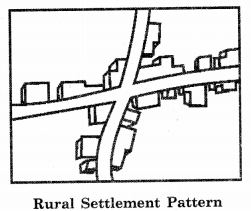
Study the diagram given below and answer the questions that follow: (CBSE 2016)
.Geography Class 12 Important Questions Chapter 4 Human Settlements 1
(5.1) Identify and name the given rural settlement pattern.
(5.2) In which type of areas do we find such types of settlement patterns?
(5.3) Give an important characteristic of this type of settlement pattern.
Answer:
(5.1.) It is a cross shaped settlement.
(5.2) These settlements emerge at places where two roads converge on the third.
(5.3) Houses extend in all the four directions.

Human Settlements Important Extra Questions Long Answer Type

Question 1.
What is a Town ? Classify Towns according to urban Historians and describe their evolution.
Or
“Examine flourished since prehistoric times in India.” (Delhi 2019)
Or
Examine the level of urbanisation in India after Independence. (Delhi 2019)
Or
“Towns flourished since prehistoric times in India.” Examine. (Delhi 2019)
Answer:
Definition of Town
Town is defined in different ways in different countries. In India, the census of India 2001 identifies two types of towns : Statutory and Census :

Statutory Towns : Ail places which have municipal, or corporation, or cantonment board, or a notified town area committee.

Census Towns: All other places which satisfy the following criteria :

  • A minimum population of 5,000 persons;
  • At least 75 percent of male wmrking population engaged in non-agricultural pursuits;
  • A density of population of atleast 400 persons per sq. km.

Evolution of towns in india

Towns flourished since prehistoric times in India. Even at the time of Indus valley civilisation, towns like Harappa and Mohanjodaro were in existence. The second phase of urbanisation began around 600 B.C.E. It continued with periodic ups and downs until the arrival of Europeans in India in the 18th century. Urban historians classify towns of India as :
(1) Ancient towns
(2) Medieval towns, and
(3) Modern towns.

(1) Ancient Towns : At least 45 towns have historical background and have been in existence at least for over 2000 years. Most of them developed as religious and cultural centres. Varanasi is one of the important towns among these. Ayodhya, Prayagraj (Allahabad), Pataliputra (Patna), Mathura and Madurai are some other ancient towns.

(2) Medieval Towns : About 100 of the existing towns have their roots in the medieval period. Most of them developed as headquarters of principalities and kingdoms. Most of them are fort towns and came up on the ruins of earlier existing towns. Important among them are Delhi, Hyderabad, Jaipur, Lucknow, Agra and Nagpur.

(3) Modern Towns : The British and other Europeans modified the urban scene. As an external force, starting their foothold on coastal locations, they first developed some trading ports such as Surat, Daman, Goa, Puducherry, etc. The British later consolidated their hold from three principal nodes – Mumbai (Bombay), Chennai (Madras) and Kolkata (Calcutta) – and built them in the British fashion.

Rapidly extending their domination either directly or through super control over the princely states, they established their administrative centres, hill-towns as summer resorts, and added new civil, administrative and military areas to them. Towns based on modern industries also evolved after 1850. Jamshedpur can be cited as an example.

After independence, a large number of towns emerged as administrative headquarters (Chandigarh, Bhubaneshwar, Gandhinagar, Dispur, etc.) and industrial centres (Durgapur, Bhilai, Sindri, Barauni, etc.). Some old towns also developed as satellite towns around metropolitan cities such as Ghaziabad, Rohtak, Gurgaon, etc. around Delhi. With increasing investment in rural areas, a large number of medium and small towns have developed all over the country.

Human Settlements Important Extra Questions HOTS

Question 1.
‘Towns act as nodes of economic growth.’ Discuss.
Answer:
Cities act as nodes of economic growth provide goods and services not only to urban dwellers but also to the people of the rural settlements in their hinterlands in return for food and raw materials. This functional relationship between the urban and rural settlements takes place through transport and communication network.

Question 2.
‘Rural and urban settlements differ in their way of life, attitude and outlook.’ Explain.
Answer:
Rural and urban settlements differ also in their way of life, attitude and outlook. Rural people are less mobile and therefore social relations among them are intimate. They employ simple techniques to perform their activities and their pace of life is slow. In urban areas, on the other hand, way of life is complex and fast and social relations are formal and institutionalized.


Human Development Class 12 Important Extra Questions Geography Chapter 3

Here we are providing Class 12 Geography Important Extra Questions and Answers Chapter 3 Human Development. Geography Class 12 Important Questions are the best resource for students which helps in class 12 board exams.

Class 12 Geography Chapter 3 Important Extra Questions Human Development

Human Development Important Extra Questions Very Short Answer Type

Question 1.
When did United Nations published its first human development report ?
Answer:
In 1990.

Question 2.
Where does India rank in the world human development index ?
Answer:
135th.

Question 3.
What is the infant mortality rate in India ?
Answer:
47 per thousand.

Question 4.
What is the average life expectancy in India ?
Answer:
66.8 years.

Question 5.
What is the literacy rate in India ?
Answer:
74.04% (2011).

Question 6.
Which state has the higghest and lowest literacy rate in India ? Mention literacy rate. (C.B.S.E. 2009, 2013)
Answer:
Bihar—63.82% (2011 census).
Keral (95%)

Question 7.
Which state has the highest Human Development Index in India ?
Answer:
Kerala—0.921.

Question 8.
Name the four aspects of human development.
Answer:
Economic, social, cultural and political development.

Question 9.
What is poverty ratio in India ?
Answer:
26%.

Question 10.
State three indicators of HDI.
Answer:
(i) Longevity of life
(ii) Knowledge
(iii) High standard of living.

Question 11.
What is the female and male literacy rate. Total number of literates in India Total 77.84 crores (2011 census).
Answer:
Female—65.46% (2011 census).
Male—82.14% (2011 census).

Question 12.
What is the total number of literates in India ?
Answer:
77.84 crores (2011 census).

Question 13.
Which state has the lowest HDI value ?
Or
Which state of India has the highest percentage of population below poverty line? (C.B.S.E. Delhi 2017)
Answer:
Bihar 0.367.

Question 14.
Define the term poverty. (C.B.S.E. 2013)
Answer:
A state of deprivation.

Human Development Important Extra Questions Short Answer Type

Question 1.
What is the goal of Human Development ? Give its three aspects.
Answer:
The well being of the people is the main goal of human development. Money alone cannot bring about well being. The three main aspects are :

  • Economic development
  • Social development
  • Cultural development.

Question 2.
Define Human Development. State its important elements.
Answer:
Human development is a process of widening people’s choices as well as raising the level of well being. Its important elements are—long and healthy life, education and decent standard of living. Additional elements include political freedom, guaranted human rights, self reliance and self esteem.

Question 3.
‘Human Development Index (HDI) is a core set of composite index’. Explain.
Answer:
It is difficult to measure quantitatively the quality of life and level of human well being. The United Nations Development Programme (UNDP) has developed a composite index known as the HDI. It measures the various dimensions of human development. It includes—

(i) Longevity of life
(ii) Knowledge base
(iii) Decent standard of living.
The variables included are life expectancy, poverty, adult literacy, purchasing power and per capita GNP. For this aim only one index, a composite index is used rather than several indices.

Question 4.
“Life expectancy has increased remarkably’”. Give reasons
Answer:
(i) This increase is due to increasing food security.
(ii) Expansion of medical and health facilities.
(iii) Per capita availability of pulses and cereals increased from 394.9 gms. in 1951 to 417 gms. in 2001.
(iv) The number of hospitals and dispensaries has increased 10 times.
(v) The number of doctors and nurses has increased 10 times.

Question 5.
The literacy rate is higher in southern states than that in northern states. Give reasons,
Answer:
High literacy rate is found in southern states. Kerala has the highest literacy rate of 93.91 per cent while Bihar has the lowest literacy rate (63.82%). Tamil Nadu, Karnataka, Maharashtra, Madhya Pradesh, Gujarat and southern states have high literacy rate but the states of Rajasthan, Uttar Pradesh, Bihar, Jharkhand, Arunachal Pradesh and Meghalaya which lie in the northern and north¬eastern parts, have low literacy rates.

Reasons :
(i) The southern states are more urbanised.
(ii) The Christian Missionaries have done a lot of work to spread education.
(iii) Many social and religious organisations have contributed towards education.
(iv) Enlightened administration and high proportion of non-agricultural workers.

Question 6.
Describe the paradoxes faced by development of towns.
Answer:
Many paradoxes are found in towns alongwith buildings, roads and other facilities such as :
(i) Jhuggi and Slums
(ii) Traffic Jam and Rush
(iii) Crime and Poverty
(iv) Begging, polluted water and air.

Question 7.
Define Poverty.
Answer:
Poverty is a state of deprivation. In absolute terms it reflects the inability of an individual to satisfy certain basic needs for a sustained, healthy and reasonably productive living.

Question 8.
Assess the Global position of India in respect of Human Development.
Answer:
HDI of India. As compared to the pre-independence days India has done well in development in general but it ranks 136th among 172 countries in terms of the UNDP’s Human Development Index (HDI) and is placed in the group of countries with ‘Medium Human Development’ (HDI of 0.571 in 2011).

Question 9.
Enumerate the Indicators used for measuring the level of Human Development.
Answer:
The quality of life and the level of Human well-being are difficult to measure quantitatively. But UNDP has developed a composite index (HDI). It includes three sets of indicators
(i) Health indicators
(ii) social indicators
(iii) economic indicators.

Several variables have gradually been added to the above sets of indicators.
1. Health indicators. These are related to longevity, birth rate and death rate with special reference to infant mortality, nutrition and life expectancy at birth.

2. Social indicators. These include literacy particularly female literacy, enrolment of school-going children, drop out ratio and pupil-teacher ratio.

3. Economic indicators. These are related to wages, income, and employment. Per capita Gross Domestic Product, incidences of poverty and employment opportunity are also favoured indicators in this group.

Question 10.
Describe the trend of fertility and mortality rates in India since 1951.
Answer:
Fertility and Mortality rates
(1) Death rate. The crude death rate (number of deaths per thousand of population in a particular year) in India has declined rapidly from 27.1 in 1951 to 7.48 per thousand in 2011.

(2) Decline in infant mortality rate (number of deaths of children under one year of age per thousand live births) has decreased from 148 to 47.5 per thousand.

(3) Child (0-4 years) mortality rate declined from 51.9 per thousand to 22.5. It means risk of death has declined at each stage of life. Certainly it is a definite improvement in health.

(4) The birth rates have also declined but at a slower rate. It came down from 40.8 per thousand to 26.1

(5) Simultaneously, total fertility rate also registered decline from 6 children per woman of child¬bearing age to 2.9.

Question 11.
Examine the causes of comparatively low literacy rates in the country.
Answer:
In India, the literacy rate, according to 2011 census, is 74.04 per cent. The male literacy rate is 82.14 per cent while female literacy rate is 65.46 per cent. Thus there is a gap of 16.68 per cent in male and female literacy rate. Several social and economic factors are responsible for low literacy rate in India.

  • General poverty of people.
  • Low status of women.
  • High ratio of drop-outs from schools.
  • Low female literacy rate.
  • Farm based economy.
  • Prejudices against female education.
  • Fast growing population.

But due to changing socio-economic conditions, the literacy rate is steadily increasing.

Question 12.
Identify the area of high and low literacy in the country.
Answer:
There are wide regional disparities in literacy rate. It varies from 63.82 per cent in Bihar to 93.91 per cent in Kerala (2011).
(1) Kerala maintains its top position closely followed by Lakshadweep (92.28 per cent) and Mizoram (91.58 per cent).

(2) Bihar ranks last in literacy among the states and union territories of India.

(3) Total 22 states and union territories are above the national average while 13 are below it.

(4) Literacy is very high (above 72 per cent) in 17 states and 7 union territories viz., Kerala, Mizoram, Lakshadweep, Tripura, Himachal Pradesh, Maharastra, Sikkim, Tamil Nadu, Nagaland, Manipur, Uttarakhand, Gujarat, Dadar & Nagar Haveli, West Bengal, Punjab, Haryana, Karnataka, Meghalaya, Goa, Delhi, Chandigarh, Puducherry, Andaman and Nicobar Islands and Daman and Diu.

Reasons :
(i) These are most urbanised states union territories
(ii) some of them are highly influenced by social and religious organisations.
(iii) Highest level of literacy in Kerala may be attributed to the states’ long tradition of education due to enlightened administration and high proportion of non-agricultural workers.

Question 13.
Why Human Development is necessary? Explain.
Answer:
According to Paul Streeten, human development is necessary on account of the following reasons :
1. The ultimate purpose of the entire exercise of development is to improve the human conditions and enlarge people’s choices.

2. Human development is a means to higher productivity. A well-nourished, healthy, educated, skilled, alert labour force is the most productive asset. Therefore, investments on these sectors are justified on grounds of productivity too.

3. It helps in reducing the rate of growth of population.

4. Human development is friendly to the physical environment also. Deforestation, desertification and soil erosion declines when poverty declines.

5. Improved living conditions and reduced poverty contributes to a healthy civil society, enhanced democracy and greater social stability.

6. Human development also helps in reducing civil disturbances in the society and in increasing political stability.

Question 14.
Distinguish between Economic development and Human development.
Answer:
The basic difference between the concepts of economic development and the human development is :
(i) The first focuses exclusively on the increase in income, while the second embraces the widening of all aspects of human life—economic, social, cultural or political.

(ii) Economic development is essential but in a different perspective. The basic tenet behind this is that it is the use of income and not income itself that is decisive in expanding human choices. Since the real wealth of nations is their people, the goal of development should be the enrichment of human life.

Question 15.
Write a note on indicators of Human development used in India.
Answer:
Indicators of Human Development. The quality of life and the level of human well-being are difficult to measure quantitatively. However, in search of a comprehensive measure that could capture the various dimensions of human development, the United Nations Development Programme (UNDP) has developed composite index, now known as the Human Development Index (HDI).

It includes
(i) longevity of life
(ii) knowledge base, and
(iii) a decent material standard of living. Initially, life expectancy was chosen as an index of longevity, adult literacy as an index of knowledge and per capita Gross National Product adjusted for Purchasing Power Parity (PPP) as an index of decent life. Therefore, a methodolgy was evolved to construct a composite index rather than several indices.

Question 16.
‘Development is freedom. Discuss.
Or
Explain the Western Euro-Centric view of development.
Answer:
According to Euro-centric Western view, development is freedom. It is believed that “Development is freedom” which is often associated with modernisation, leisure, comfort and affluence.

The present day symbols of develpment are :

  • Computerisation
  • Industrialisation
  • Efficient transport
  • Communication network
  • Larger education development
  • Advanced medical facilities
  • Safety and security of individual.

Every individual, community and government measures its performance or levels of development in relation to the availability and access to some of these things. But, this may be partial and one-sided view of development. It is often called the western or euro¬centric view of development. For a postcolonial country like India, colonisation, marginalisation, social discrimination and regional disparity, etc. show the other face of development.
So, it is said, ‘Development and Environmental degradation are two faces of the same coin.

Question 17.
Which factors determine the nature of human development ?
Answer:
Low scores in the HDI is a matter of serious concern but, some reservations have been expressed about the approach as well as indicators selected to calculate the index values and ranking of the states/ countries.
(1) Lack of sensitivity to the historical factors like colonisation, imperialism and neo-imperialism

(2) Socio-cultural factors like human rights violation, social discrimination on the basis of race, religion, gender and caste.

(3) Social problems like crimes terrorism and war

(4) Political factors like nature of the state, forms of the government (democracy or dictatorship) level of empowerment are some factors that are very crucial in determining the nature of human development. These aspects have special significance in case of India and many other developing countries.

Question 18.
Describe the indicators of a healthy life. Describe the progress made in India in these.
Answer:
Indicators of a Healthy Life. Life free from illness and ailment and living a reasonably long life span are indicative of a healthy life.

  • Availability of pre and post natal health care
  • facilities in order to reduce infant mortality and
  • post delivery deaths among mothers
  • old age health care
  • adequate nutrition and
  • safety of individual are some important measures of a healthy and reasonably long life progress in India.

1. Death Rate. India has done reasonably well in some of the health indicators like decline in death rate from 25.1 per thousand in 1951 to 8.1 per thousand in 1999.

2. Decline in Infant Mortality Rate. Infant mortality from 148 per thousand to 70 during the same period.

3. Life expectancy. Similarly, it also succeeded in increasing life expectancy at birth from 37.1 years to 62.3 years for males and 36.2 to 65.3 years for females from 1951 to 1999. Though, these are great achievements, a lot needs to be done.

4. Birth rate. Similarly, it has also done reasonably well in bringing down birth rate from 40.8 to 26.1 during the same years, but it still is much higher than many developed countries.

Human Development Important Extra Questions Long Answer Type

Question 1.
Explain the relation between Environ¬ment, Resources and Development. State the views of different writers.
Or
“The prime task before any development activity in India is to maintain parity between population and resources.” Justify the statement. (Delhi 2019)
Or
“Development is a substantive concept once it is achieved it will address all the socio¬cultural and environmental ills of the society.” Analyse the statement. (Outside Delhi 2019)
Answer:
Population, Environment and Development. Development in general and human development in particular is a complex concept used in social sciences. It is complex because for ages it was thought that development is a substantive concept and once it is achieved it will address all the socio-cultural and environmental ills of the society.

Though, development has brought in significant improvement in the quality of’ life in more than one way but increasing regional disparities, social inequalities, discriminations, deprivations, displacement of people, abuse of human rights and undermining human values and environmental degradation have also increased.

Population and Resources. At the other extreme of this approach lie the views expressed by the Neo-Malthusians, environmentalists and radical ecologists. They believe that for a happy and peaceful social life proper balance between population and resources is a necessary condition. According to these thinkers, the gap between the resources and population has widened after eighteenth century.

There have been marginal expansion in the resources of the world in the last three hundred years but there has been phenomenal growth in the human population. Development has only contributed in increasing the multiple uses of the limited resources of the world while there has been enormous increase in the demand for these resources. Therefore, the prime task before any development activity is to maintain parity between population and resources.

It is not the availability of resources that is as important as their social distribution. Resources everywhere are unevenly distributed. Rich countries and people have access to large resource baskets while the poor find their resources shrinking. Moreover, unending pursuit for the control of more and more resources by the powerful and use of the same for exhibiting ones prowess is the prime cause of conflicts as well as the apparent contradictions between population resource and development.

Indian culture and civilisation have been very sensitive to the issues of population, resource and development for a long time. It would not be incorrect to say that the ancient scriptures were essentially concerned about the balance and harmony among the elements of nature.

Mahatma Gandhi in the recent times advocated the reinforcement of the harmony and balance between the two. He was quite apprehensive about the on-going development particularly the way industrialisation has institutionalised the loss of morality, spirituality, self-reliance, non-violence and mutual co-operation and environment.

In his opinion, austerity for individual, trusteeship of social wealth and non-violence are the key to attain higher goals in the life of an individual as well as that of a nation. His views were also re-echoed in the Club of Rome Report “Limits to Growth” (1972), Schumacher’s book “Small is Beautiful” (1974), Brundtland Commission’s Report “Our Common Future” (1987) and finally in the “Agenda-21 Report of the Rio Conference” (1993).


Rebels and the Raj Class 12 Important Extra Questions History Chapter 11

Here we are providing Class 12 History Important Extra Questions and Answers Chapter 11 Rebels and the Raj: The Revolt of 1857 and its Representations. Class 12 History Important Questions are the best resource for students which helps in class 12 board exams.

Class 12 History Chapter 11 Important Extra Questions Rebels and the Raj: The Revolt of 1857 and its Representations

Rebels and the Raj Important Extra Questions Very Short Answer Type

Question 1.
Who was the last Mughal emperor?
Answer:
Bahadur Shah Zafar.

Question 2.
Who started the Doctrine of Lapse?
Answer:
Lord Dalhousie.

Question 3.
Which state was captured by the British on the issue of misgovernance?
Answer:
Awadh.

Question 4.
Who was Nawab of Awadh when it was captured in 1850 A.D.?
Answer:
Nawab Wajid Ali Shah.

Question 5.
Who led the revolt of 1857 in Kanpur?
Answer:
Nana Saheb, the adopted son of Peshwa Baji Rao II.

Question 6.
Who led the revolt of 1857 in Awadh?
Answer:
Begum Hazrat Mahal and her son Birjis Qadr.

Question 7.
Name the famous state captured under the Doctrine of Lapse?
Answer:
Jhansi.

Question 8.
What was the immediate cause of the revolt of 1857?
Answer:
The issue of greased cartridges.

Question 9.
Who said that ‘Awadh is just like a cherry that will drop into our mouth one day’?
Answer:
Lord Dalhousie.

Question 10.
When and who started Subsidiary Alliance?
Answer:
Subsidiary Alliance was started by Lord Wellesley in 1798 A.D.

Question 11.
Where was Nawab Wajid Ali Shah exiled?
Answer:
He was exiled to Calcutta.

Question 12.
Name the major centres of the revolt of 1857.
Answer:
Merrut, Delhi, Lucknow, Kanpur, Jhansi etc.

Question 13.
Who painted ‘In Memoriam’?
Answer:
Joseph Noel Paton.

Question 14.
Who said, “Khoob Lari mardana woh to Jhansi Wali Rani thi”?
Answer:
Subhadra Kumari Chauhan.

Question 15.
What was the role of cartridges covered with fat of animals in the mutiny of 1857?
Or
What was the immediate cause for the mutiny of 1857? ,
Answer:
In 1857, the soldiers were given new cartridges coated with the fat of cows and pigs. The soldiers had to peel them out with their teeth before using them. It corrupted their caste and religious norms. Therefore, the Hindu and the Muslim soldiers refused to use these cartridges. They revolted against the British to preserve their faith.

Question 16.
Give an example of a revolt by a famous tribe before the mutiny of 1857.
Answer:
Many peasant revolts were witnessed in different parts of the country before the rebellion of 1857. For example, Fraizies revolted against the oppression of farmers by the Zamindars of the Britishers. They were from a Muslim community.

Question 17.
Where was the fight for freedom fought in India? How did the Britishers crush it?
Answer:
The struggle for the freedom of India was fought in Delhi, Haryana, Uttar Pradesh, Bihar and Punjab. The British crushed it with the help of their own power and the cooperation of a few kings of the Indian states.

Question 18.
How the revolt of 1857 acquired legitimacy?
Answer:
Mughal Emperor Bahadur Shah accepted to become the leader of the revolt. Now, revolt could be carried on in the name of the Mughal emperor. In this way, Revolt of 1857 acquired legitimacy.

Question 19.
How events moved swiftly after 13th May in the mutiny of 1857?
Answer:

  • Delhi was captured by rebels.
  • Mughal emperor Bahadur Shah gave his support to the mutiny.

Question 20.
“Rebel Sepoys (1857) began their actions with any signal.” Give any two signals in this regard.
Answer:

  1. At many places, it was the firing of the evening gun.
  2. At few other places, this signal was the sounding of the bugle.

Question 21.
“Rumours and prophecies played a part in moving people to action before the Revolt of 1857.” Write any of the two rumours or prophecies in this regard.
Answer:

  1. There spread a rumor that the British had mixed bone dust of cows and pigs into the flour which was sold in the market.
  2. A prophecy was made that on the centenary of the Battle of Plassey, on 23rd June 1857, the British rule would come to an end.

Question 22.
Why did the British become increasingly interested in acquiring the territory of Awadh?
Answer:

  • The Britishers felt that the soil of Awadh was very good for the cultivation of indigo and cotton.
  • They also thought that this state could be developed into a principal market of North India.

Question 23.
When and who annexed Awadh into the British empire?
Answer:
Awadh was conquered and annexed into the British empire by Lord Dalhousie in 1856.

Rebels and the Raj Important Extra Questions Short Answer Type

Question 1.
How did the message about the Revolt of 1857 spread?
Answer:
The Revolt of 1857 was associated not only with the people of the court but also with ordinary men and women. Besides the ranis, rajas, nawabs, and taluqdars, many common people, religious persons and self-styled prophets participated in it.

  1. The message of rebellion was carried by ordinary men and women.
  2. At some places, even the religious people spread the message of the Revolt of 1857. For example, in Meerut, a Fakir used to ride on an elephant. Many sepoys met him time and again.
  3. After the annexation of Awadh, Lucknow had many religious leaders and self-styled prophets who preached the destruction of the British rule.
  4. At many places, the local leaders played an important role. They urged the peasants, Zamindars, and tribals to revolt.
  5. In Uttar Pradesh, Shah Mai motivated and mobilized the residents of Barout paragana.
  6. Similarly, Gonoo, a tribal who cultivated in Singhbhum in Chotanagpur, became a rebel leader of the Kol tribe.

Question 2.
What were the causes for the discontent among the soldiers before the Mutiny of 1857?
Or
Discuss military causes for the Revolt of 1857.
Answer:
There were many reasons for discontent among the soldiers:

1. Fear of New Cartridges: The sepoys were provided bullets which were coated with the fat of cows and pigs. Before use, the soldiers had to bite these bullets. So they feared that it would corrupt their caste and religion.

2. Grievances about Leave and Promotions: The sepoys were not easily granted leaves. They were also paid lower salaries as compared to the British soldiers. They were not given due promotions which enraged the soldiers and nurtured a sense of discontent among them.

3. Grouse Against Misbehaviour and Racial Abuse: Earlier, the British officials had very friendly relations with the sepoys. They joined them in their leisure activities and talked to them in the local language. They also familiarised themselves with their customs and culture. They posed themselves as fatherly figures to all the Indian soldiers. But after 1840s, there was a change for the worse. The British officers started considering themselves as superior. They treated Indian sepoys as their social inferiors and ignored their feelings and sensibilities. They even abused and assaulted them. It was naturally resented by the soldiers.

4. Nexus between Soldiers and Villagers: Awadh was the nursery of the Bengal Army. In other words, a large number of soldiers were recruited from the villages in the vicinity of Awadh. So these soldiers had a close relationship with the villages. Such a link between the two had grave implications during the mutiny.

Question 3.
List any five ways in which I taluqdars of Awadh were affected by the British Policy. (C.B.S.E. Sample Paper 2011)
Or
How did the British dispossess the taluqdars of Awadh during 1857? Explain with examples. (C.B.S.E. 2014 (D))
Answer:
The taluqdars of Awadh felt influenced by the British policy in the following way:

  1. The forts and castles of the taluqdars were demolished and their armed forces were disbanded.
  2. They were deprived of their lands under the Summary Settlement of 1856. Many taluqdars lost even more than half the villages under their control.
  3. Their freedom was snatched.
  4. They lost a lot of power and respect because of the loss of their land.
  5. The demand for revenue was doubled. It generated a sense of anger among the taluqdars.

Question 4. What was Subsidiary Alliance?
Or
Examine the provisions of the ‘Subsidiary Alliance System’ devised by Lord Wellesley in 1798 for India. (C.B.S.E. 2015 (O.D.))
Answer:
Subsidiary Alliance was a system of land revenue introduced by Lord Wellesley in 1798 C.E. All the local rulers had to accept the following terms and conditions who entered into such an alliance with the British:

  1. The ally would have to keep a British armed contingent in his territory.
  2. The British would be responsible for the protection of their ally from any type of external and internal threats to their power.
  3. Resources for maintaining the British contingent would be provided by the ally.
  4. The ally could not enter into the agreement with other local rulers or foreign companies or engage in warfare without the permission of the British.
  5. One British Resident would be stationed in the Court of the allied king.

Question 5.
What was the thinking of the British behind the removal of taluqdars in Awadh? Up to what extent, this thinking was correct?
Answer:
The British land revenue officials thought that if they could remove taluqdars then they could give land to their actual owners. It will reduce the level of exploitation of peasants and increase the revenue returns for the State but this did not actually happen. There was a definite increase in revenue returns for the State but the burden of demand on peasants remained the same.

Officials soon came to know that most of the areas of Awadh were actually heavily overassessed. At some places, the increase of revenue demanded was from 30% to 70%. That is why neither taluqdars and nor the peasants were happy. The result of the dispossession of taluqdars was the breakdown of the whole of the social order. The ties of loyalty and patronage were disrupted which had bounded the peasants to the taluqdars.

Question 6. How the relationship of the sepoys with the British officers underwent a significant change in the years preceding the uprising of 1857?
Or
Examine the relationship of the Indian sepoys with their superior white officers in the years preceding the uprising in 1857. (C.B.S.E. 2010 (O.D.))
Or
“The relationship of the sepoys with the superior white officers underwent a significant change in the years preceding the uprising of 1857.” Support the statement with examples. (C.B.S.E. 2014 (O.D.))
Or
How did the white officers make it a point during 1820 till 1840 to maintain friendly relations with the sepoys? (C.B.S.E. 2010 (O.D.))
Answer:
During the years preceding the uprising of 1857, the relationship of the sepoys with their British officials underwent significant change. In the decade 1820, British officers stressed maintaining friendly relations with the sepoys. They would even take part in their leisure activities, wrestle with them, fence with them, and went out hawking with them. Some of these officials were fluent in speaking Hindustani and were familiar with local customs and culture. These officers had strictness and love of parents in them.

But this situation began to change in the decade of 1840. A sense of superiority began to develop among the officers and they started treating the Indian sepoys as their racial inferiors. They hardly cared about their sentiments. Abuse and physical violence became very common which increased the distance between sepoys and their officers. The place of trust was taken by suspicion. The episode of the greased cartridges was a classic example of this thing.

Question 7.
Which types of laws were used by the British to suppress the Revolt of 1857 in North India?
Answer:
The British passed a number of laws to help them quell the insurgency before sending their troops to reconquer North India. With the help of a number of Acts passed in May and June 1857, the British put the whole of North India under Martial Law. Military officers and ordinary Britons were given the authority to try and punish Indians who were suspected of rebellion. It was put out that only one punishment could be given to rebels and that was death.

Question 8.
How did the Mutiny of 1857 start? Give a brief description of the events concerning the uprising in Meerut.
Answer:
The uprising of 1857 started in the afternoon of 10 May, 4857 in the cantonment of Meerut. It broke out in the lines of the native infantry. It then quickly spread to the cavalry and soon engulfed the whole city. The ordinary people of the city also joined the sepoys who took up arms and attacked the white people. They ransacked their bungalows and burnt their property. They also destroyed the government buildings like the jail, the court, the treasury, and the post office and cut down the telegraph lines to Delhi.

The next day, i.e., on 11th May 1857, the sepoys reached the gates of the Red Fort in Delhi. They briefed Bahadur Shah, the last Mughal king, about the incidents in Meerut and requested him to both bless and lead the uprising against the white men. At first, the emperor was a bit hesitant but later on, he accepted their demand. His approval gave legitimacy to the revolt as it was carried on in the name of the Mughal emperor.

Question 9.
How did the Revolt of 1857 spread?
Answer:
The Revolt of 1857 broke out on 10 May 1857. Starting from the cantonment of Meerut, it reached Delhi on the very next day. Within a few days, it spread to other parts of the country. Besides the soldiers, the ordinary people also participated in it. The soldiers took up arms and ammunition and attacked the white men. They destroyed government buildings and plundered public property.

At many places, the revolt started with a signal. But in many other places, it started with the firing of the evening gun or the sounding of the bugle. The Hindus joined hands with Muslims to exterminate the British. They also attacked the rich and the money-lenders who were allies of the British. They defied all kinds of authority and hierarchy. The mutiny had turned into a rebellion against the British. It had become the first war of independence in India. The British rule had fallen like a house of cards.

Question 10.
Describe the annexation of Awadh by the British. Why did the British take a keen interest in it?
Or
Explain the provisions of the subsidiary Alliance imposed on Awadh ] in 1801 by the British. (C.B.S.E. 2012 (D))
Or
Critically examine Lord Dalhousie’s policy of annexation in Awadh. (C.B.S.E. 2015 (O.D.))
Answer:
The British had long cherished to occupy and control Awadh. In 1851 C.E., Lord Dalhousie, the Governor-General of India, had described the kingdom of Awadh as “a cherry that will drop into our mouth one day”. However, the British were able to annex Awadh to the British Empire in 1856 C.E.

The first step towards the acquisition of Awadh was the imposition of the Subsidiary Alliance in 1801 C.E. Subsidiary Alliance was a system devised by Lord Wellesley in 1798 C.E. It stipulated the following conditions on the Nawab:
(a) He will have to disband his military force.
(b) He will permit the British to send and station their troops within the kingdom.
(c) He will act in accordance with the advice of the British Resident.
(d) He will enter into agreements with other rulers or engage in warfare only with the permission of the British.

In other words, the Nawab had lost its independence and had become dependent on the British to maintain law and order within the kingdom. He had also lost his control over the rebellious chiefs and taluqdars.

The British Interest in Awadh: The British had a keen interest in acquiring the territory of Awadh. It is clear from the following points:

  • The soil of Awadh was good for the production of cotton and indigo.
  • It was ideally located to become the principal market of North-India.

Question 11.
How did the British display terror against the mutineers? Did they have any place for clemency?
Answer:
After the Revolt of 1857, the British felt shocked. They were filled with a feeling of anger, vengeance and retribution. It is seen from the brutal way in which they execute the rebels. Many rebels were blown from the cannons. Many other rebels were hanged from the gallows. To make them feel afraid of the British power, the British officials widely circulated the images of these executions through popular journals.

No place for pleas of Clemency: The British were blind because of the upsurge of vengeance and revenge in their hearts. So they ridiculed all pleas for moderation and clemency. The British Press mocked when Governor-General Canning declared to show leniency and mercy to win back the loyalty of the sepoys. The Punch, a British Journal of comic satire, published a cartoon in which Canning was shown as a fatherly-figure, keeping his protective hand over the head of a sepoy who still held an unsheathed sword in one hand and a dagger in the other.

It showed that both the sword and the dagger were dripping with blood. In other words, the British people and press were adamant not to show any mercy or clemency towards the Indian rebels.

Question 12.
Discuss the general causes for the Revolt of 1857.
Answer:
The following were the main reasons for the Revolt of 1857:

1. Many Indians had turned against the British because of the policy of Lapse initiated by Lord Dalhousie.

2. The British considered India as a market for raw material to factories in England. So they made many efforts to destroy the Indian trade and industry. It increased poverty in the country and therefore people started despising the British rule.

3. The Indian sepoys had a feeling of discontentment against the imperial rule. They got low salaries as compared to the British soldiers and were also maltreated. They could not bear this insult for long.

4. In 1856, the soldiers were given the new ‘Enfield’ Rifles. The cartridges of these rifles were coated with the fat of cows and pigs. So the Indian soldiers refused to accept and use these cartridges. Slowly and steadily this incident led to the emergence of the Revolt of 1857.

Question 13.
What were the causes for the mutiny of Indian soldiers in 1857?
Or
Describe the grievances of the Indian sepoys against the British rule before the revolt of 1857. (C.B.S.E. 2008 (D))
Answer:
The following causes were responsible for the mutiny of soldiers in India in 1857:

1. The Indian soldiers were given the new Enfield Rifles. The cartridges of these rifles were coated with the fat of cows and pigs. The soldiers felt that when they would bite these bullets, it would corrupt their caste and religion.

2. In many cantonments, the Indian soldiers refused to use the flour which was said to have the bone dust of cows and pigs.

3. A law was passed in 1857 according to which the Indian soldiers could be sent across the sea to fight against any enemy. During those days, many Hindu soldiers considered it a sin against their religion to go across the sea.

4. The Indian soldiers were maltreated during the parade. The Indians could not bear this humiliation and insult for long.

5. There was discontentment among the Indian soldiers as they were paid less salary than their counterparts in the British. They also faced difficulty in getting leaves.

6. The British officials often poked fun at the culture and civilization of the Indian soldiers. So the Indian soldiers wanted to avenge their insult.

7. When Mangal Pandey, a soldier, was given cartridges coated with the fat of cows and pigs, he felt infuriated and killed a British official. So he was sentenced to death for this crime. It spread a wave of anger among all Indian soldiers. As a result, they rose in rebellion against the British.

Question 14.
Discuss the legacy of the Revolt of 1857.
Or
Critically evaluate the long-term impact of the Revolt of 1857 on Indian Politics.
Or
“The national movement in the 20th century draws its inspiration from the events of 1857.” Support this statement with examples. (C.B.S.E. 2011 (O.D.))
Answer:
Undoubtedly, the Revolt of 1857 did not achieve the desired result. Although it did not succeed, it left a deep and long-term impact on Indian politics. It created an urge for freedom in the minds of the people. This seed of freedom planted in 1857 yielded its fruit in 1947 when India attained freedom. In fact, it was the first national struggle for freedom wherein the people wanted to get rid of British rule.

It prepared a base for the development of the modern national movement for independence. It left an indelible imprint on the minds of the Indians and initiated a new tradition of opposing the foreign rule at every step. Soon the heroic deeds of the heroes of this national struggle for freedom reached every home who became a symbol of power to the people.

Question 15.
Analyze the significance of unity amongst the Hindu and the Muslims during the events of 1857.
Answer:
Most of the strength of the Revolt of 1857 lay in the unity between the Hindus and the Muslims. This spirit of unity and harmony was visible in the soldiers, the leaders, and the people. Bahadur Shah Zafar was a Muslim but even then, all the rebels accepted him as their leader. Not only this, the Hindu sepoys of Meerut moved towards Delhi and reached Red Fort to seek the blessings of the Mughal Emperor. The soldiers, the Hindus, and the Muslims were considerate towards the feelings and sentiments of each other.

For example, wherever the revolt succeeded, the cow slaughter was immediately banned so that the Hindus may not feel hurt. Besides, the Hindus and the Muslims had an equal representation in the leadership of the rebellion. Regarding the Hindu-Muslim unity, a senior British official admitted that they had not been able to divide the Hindu and the Muslims this time.

Question 16.
Describe how the British celebrated those, who they believed, saved the English and repressed the rebels during the revolt of 1857. (C.B.S.E. 2008 (D))
Answer:
Only a few Indian rulers played a constructive role in the revolt of 1857. They included Bahadur Shah, Kunwar Singh, Rani of Jhansi, and Nana Sahib. They were the victims of the expansionist policy of the British. Their kingdoms were usurped by the Britishers on one pretext or the other. So these leaders led the revolution in their respective regions or province. They valiantly faced the British forces but most of the Indian rulers were selfish and afraid of the British power. So instead of taking part in the revolt, they helped the Britishers in crushing the revolt of 1857.

The Sindhiyas of Gwalior, the Holkars of Indore, the Nizam of Hyderabad, the Rajput rulers of Jodhpur and other regions, the Nawab of Bhopal, and most of the other Indian rulers helped the Britishers. In fact, the British Govt was able to crush the revolt because of the help and co-operation of these rulers. In this regard, Canning, the then Governor-General of India, had said that these Sardars (Chiefs) “acted as a dam before the storm, otherwise this storm could uproot us with even a single wave”. The British rulers rewarded these rulers of India with Jagirs and rewarding posts.

Question 17.
Describe the alternative power structure that the rebels tried to establish during the revolt of 1857. (C.B.S.E. 2008 (D))
Or
Examine the structure of authority and administration that the rebels wanted after the collapse of British rule in India. (C.B.S.E. 2010 (O.D.))
Answer:
The revolutionaries of 1857 were in search of an alternative strategy. For example, after the British rule was demolished in Delhi, Lucknow, and Kanpur, the revolutionaries wanted to set up a uniform rule or authority at all the places. Though this experiment did not succeed, yet it was clear from their efforts that they wanted to establish the rule that existed prior to the 18th century.

These leaders took the help of the old Darbari culture. They made appointments on different posts and made arrangements for the collection of land, revenue, and the disbursement of salary to the soldiers. They issued decrees to end loot. They also planned strategies to continue the war against the British rule and took steps to strengthen their control of the army. In all these attempts, the revolutionaries were taking the help of the Mughal period rulers in the 18th century. The Mughal period was a symbol of all those things which were lost.

Question 18.
How do the official accounts present the Revolt of 1857? Explain. (C.B.S.E. 2010 (O.D.))
Answer:
Many official accounts are available for the revolt of 1857. Colonial administrators and military men left their versions in letters and diaries, autobiographies, and official histories. We can also gauge the official mindset and the changing British attitude through a number of memos and notes, assessments of situations, and reports that were produced. Many of these have now been collected in a set of mutiny records.

These tell us about the fears and anxieties of officials and their perception of the rebels. The stories of the revolts that were published in British newspapers and magazines narrated in detail the violence of the mutineers- and these stories inflamed public feelings provoking demands of retribution and revenge.

Question 19.
Examine the proclamations issued by the rebels in 1857 and explain why did they want to reject everything associated with the British rule in India. (C.B.S.E. 2010 (O.D.))
Answer:

1. In all their proclamations, the rebels repeatedly appealed to all sections of society. They did not take caste or creed into consideration.

2. Many proclamations were made by the Muslim princes. But all such proclamation took into consideration the sentiments of the Hindus.

3. This revolution was expressed in such a way that Hindus and Muslims will be equally affected by this.

4. Many pamphlets were issued which glorified the co-existence of different Communities under the Mughal Empire.

5. Bahadur Shah appealed in the name of Prophet Muhammad and Lord Mahavir to the public to rise against the white people.

Rebels rejected everything associated with the British rule in India because they had no faith in the British. They argued that the British had destroyed their traditional lifestyle “which they want to rejuvenate.

Question 20.
“The annexation of Awadh displaced not just the Nawab but also dispossessed the taluqdars of the region, causing break down of an entire social order.” Critically examine the statement. (CJB.S.E. 2011 (D))
Answer:
The annexation of Awadh not only displaced the Nawab but also dispossessed the taluqdars of this region. The whole of the countryside of Awadh was dotted with the forts and estates of taluqdars. These people controlled the land and power of their areas for centuries. Before the arrival of the British, these taluqdars maintained armed sepoys and had their own forts. The British were not ready to tolerate their power which is why, exactly after the annexation of Awadh, the taluqdars were disarmed and their forts were destroyed.

The entire social order was broke down with the dispossession of taluqdars. The ties of patronage and loyalty were disrupted that had bound the peasants to the taluqdars. Before the Britishers, these taluqdars were oppressed but some of them seemed to be generous father figures. They extracted a number of dues from the peasants but helped them during their bad times. Now during the British rule, the peasants were directly exposed to over-assessment of revenue and non-flexible methods of revenue collection.

Question 21.
How do the British pictures of the mutiny of 1857 offer a variety of images that were meant to provoke different emotions and reactions? Explain. (C.B.S.E. 2012 (iO.D.))
Answer:
British pictures offer a number of images that were prepared to provoke different emotions and reactions.
In some of the pictures made by the British, the British heroes were commemorated who saved the English and repressed the rebels. One of the painting ‘Relief of Lucknow’ was painted by Thomas Jones Barker in 1859, is an example of this type when the Lucknow was besieged by the rebel forces then the commissioner of Lucknow, Henry Lawrence, collected the whole of the Christian population and took shelter in the heavily fortified Residency.

Later on, Lawrence was killed but the Residency remained protected under the command of Colonel Inglis. On September 25, Henry Havelock and James Outram reached over there and cut through the rebel forces. They even reinforced the British troops. After 20 days, the new commander of British forces in India, Colin Campbell, came over there with his forces and saved the besieged British forces.

The British historians described the siege of Lucknow and their survival as the ultimate victory of the British power. The painting of Barker shows the moment of Campbell’s entry. It created a sense that the troubled times and the rebellion were over. The British emerged victoriously.

Question 22.
Explain how the merchants in India were badly affected by the monopolization of trade by the British Government, according to the Azamgarh Proclamation of 25th August 1857. (C.B.S.E. 2012 (O.D.))
Answer:
The Azamgarh proclamation of 25th August 1857 is one of the most important sources of our knowledge about what the rebels wanted. The Proclamation said that “It is well known to all, that in this age, the people of Hindustan, both Hindus and Mohammedans, are being ruined under the tyranny and the oppression of the infidel and treacherous English”. It also says that the British Govt had monopolized the trade and all the important merchandise. The British monopolized the trade of indigo and trade of unimportant things was left for the people. The British taxed with postages and tolls, etc., and merchants were liable to jail and had to face a lot at the complaint of a worthless person.

Question 23.
Explain how the mutinies were so organized in India in 1857. (C.B.S.E. 2012 (O.D.))
Answer:
The Revolt of 1857 was well-planned and well-coordinated. It is evident from the following points:

1.There was coordination and harmony between sepoys and the ordinary people. Both wanted to target the white people.

2. The revolt got a tinge of legitimacy as it was carried forward under the leadership of Bahadur Shah Zafar the last Mughal Emperor in India.

3. The Hindus and the Muslims united and rose together against the white people.

4. There was communication between the sepoy lines of various cantonments.

5. Another example of good planning and organization can be cited from Awadh where Captain Hearsey of the Awadh Military Police was provided protection by his Indian subordinates during the mutiny. The 41st Native Infantry, which had killed all its white officers, insisted that the military police would either kill Captain Hearsey or hand him over as a prisoner but the military police refused to kill Captain Hearsey.

At last, they decided to settle the issue in a panchayat having native officers drawn from ehchsTegiment. In other words, many decisions during the rebellion were taken collectively.

Question 24.
Explain briefly how the rebel proclamations in 1857 were visualized to achieve unity among all sections of the population. (C.B.S.E. 2012 (O.D.))
Answer:
The rebel proclamations in 1857 appealed again and again to all groups of population irrespective of their creed, caste, color, etc. Most of the proclamations were issued on the names of Muslim princes. But these proclamations also addressed the sentiments of Hindus. This rebellion was seen as a war in which Hindus and Muslims both had equally to gain or lose.

The British tried to create religious divisions among Hindus and Muslims but. these were hardly seen during the uprising. The British spend? 50,000 in Bareilly in western U.P., in Dec. 1857, to incite the Hindus against the Muslims but failed in their attempt.

Question 25.
Examine the participation of taluqdars of Awadh in the Revolt of 1857. (C.B.S.E. 2018)
Answer:
The taluqdars of Awadh felt influenced by the British policy in the following way:

  1. The forts and castles of the taluqdars were demolished and their armed forces were disbanded.
  2. They were deprived of their lands under the Summary Settlement of 1856. Many taluqdars lost even more than half the villages under their control.
  3. Their freedom was snatched:
  4. They lost a lot of power and respect because of the loss of their land.
  5. The demand for revenue was doubled. It generated a sense of anger among the taluqdars.

Rebels and the Raj Important Extra Questions Long Answer Type

Question 1.
To what extend the discontent against the foreign rule was responsible for the Revolt of 1857? Can it be called the first war of Iatliao Independence?
Or
What were the reasons for the revolt of 1857? Was it a mutiny of sepoys or a national struggle for freedom? Justify your answer with arguments
Answer:
The mutiny of 1857 is termed the first war of Indian Independence. It is true that tin’s rebellion was started by the sepoys but soon it had become a mass rebellion. It was a revolutionary uprising against the British. The main reason for this rebellion was extensive discontent among the common people. The people of India were oppressed by the policies and imperialist exploitation of the British. The native rulers, farmers, traders, soldiers, and the ordinary people all suffered insult and humiliation under British rule. All of them wanted to get free from th^ British by any means. So as the fire of rebellion broke out in 1857, the people belonging to different religions, castes, and sections of society participated in it. The following points will clarify that this revolt was the result of extensive discontentment among the people:

A. Political Causes:

  1. The Subsidiary Alliance of Lord Wellesley and the Doctrine of Lapse enforced by Lord Dalhousie generated a sense of discontentment and dissatisfaction among all the Indians.
  2. The pension of Nana Sahib was stopped due to which he turned against the British.
  3. The Rani of Jhansi was not permitted to adopt a son so she was also annoyed with the British.
  4. The Zamindars and chiefs were also against the British because their laid had been snatched by the British officials and rulers

B. Economic Causes:

1. Due to the industrial revolution, the things produced in England were quite cheap. As a result, the sale of British goods increased immensely. The Indian industry almost collapse and many artisans and craftsmen of India lost their means of livelihood and therefore they turned against the British.

2. Because of the British. the policy of trade, the Indian trade was shattered^ If Indian things were sent to England, a heavy-duty was imposed on these things. Consequently, the Indian goods became very costly, and therefore there was a decline in the demand for Indian goods. In fact, the Indian trade lost its ground.

3. During the British rule, the Zamindars were considered as the owners of the land. They collected a fixed revenue and deposited it in the government treasury. On the other hand, they collected revenue from the farmers as per their wish. As a result, the farmers felt suffocated and wanted to get rid of this oppression and exploitation.

4. Heavy taxes were imposed on the people of India. The taxes were so much that the people found it .difficult to survive. Ultimately they revolted against the government.

C. Social And Religious Causes:

1. The Christian missionaries were engaged in the process of religious conversion. They were exhorting Indians to adopt Christianity due to which many Indians turned against them.

2. William Bentinck had introduced many reforms in Indian society. He had abolished customs like Safi and permitted the remarriage of Hindu widows. He also banned child marriages. Many Hindus considered it as an interference in their religious affairs.

3. There was also widespread discontentment among the Indians because of the British system of Education. As the British introduced western education, western ideas, and western institutions, many Indians felt that it was an attempt to turn them into Christians.

4. Many Indians were enraged when the Christian missionaries criticized Hindu scriptures.

D. Military Causes:

1.In 1856, the British Parliament passed a law by which the Indians could be sent across the sea to fight against any enemy. During those days, the Hindus considered it a sin against their religion to cross the sea. So they opposed the British rule.

2. The Indian soldiers were maltreated during the parade. So they could not bear their insult for long.

3. The Indian soldiers got less salary as compared with their British counterparts. It generated a sense of discontentment among the Indian soldiers.

4. The British officials made fun of the Indian culture and civilization even in front of the Indian soldiers. Naturally, the Indian soldiers wanted to avenge their insult.

E. Immediate Cause:

The soldiers were given new Enfield rifles. The cartridges of these rifles were coated with the fat of the cows and pigs. So a few sepoys of the Barrackpur cantonment refused to use them. Mangal Pandey, a soldier, felt so enraged that he killed a British official. He was later on hanged to death for this offense. All other Indian soldiers lost their patience and revolted against the British.

Nature of the Rebellion

  1. People from1 all the sections of society
    participated in the rebellion though their number was limited.
  2. The people and the soldiers were against the British. They wanted to get rid of them.
  3. The soldiers revolted not to seek any concessions but to get freedom from the foreign rule.
  4. The rebellion did not spread in all parts of
    a country. Many cities remained calm and quiet. If they were calm, it did not mean that they were with the British. They were silent due to their infirmities but were definitely against the British.
  5. The Hindus and the Muslims unitedly fought against the British. They were not happy with the British rule. So they collectively rose against the British. Thus, the revolt of 1857 was not a mutiny but the first war of Indian Independence.

Question 2.
How the Revolt of 1857 began? How it spread everywhere or became a rebellion?
Or
Describe the main events of the Revolt of 1857.
Answer:

1. Mutinies began at Cantonment of Meerut: The sepoys in the cantonment of Meerut broke out in mutiny on the late afternoon of 10th May 1857. The mutiny began in the lines of the native infantry. It very quickly spread to the cavalry and then in the city. The ordinary people of surrounding villages and towns also joined the sepoys. The sepoys captured the bell of arms where arms and ammunition were kept.

Then they attacked the white people and started to burn their bungalows and property. The record office, court, jail, treasury, post-office, etc., were plundered and destroyed. The telegraph line joining Delhi with Meerut was cut down. As darkness descended, many sepoys (a group) rode on horses towards Delhi.

2. Delhi: The group of sepoys arrived at the gates of the Red Fort on the early morning of 11th May 1857. It was the holy month of Ramzan in which Muslims pray and have the fasts. The Mughal emperor heard the commotion at the gates of Red Fort. The sepoys told him that they had come from Meerut after killing alb the English men there because they asked them to bite bullets which were coated with the fat of cows and pigs with their feet®. They also told him that it will corrupt the faith of Hindus and Muslims.

Then another group of sepoys also entered Delhi. Ordinary people of Delhi also joined them. A large number of Europeans were killed. Rich people of Delhi were attacked and looted. Delhi had gone out of control of the British. Some sepoys even entered the Red Fort and demanded the blessing of the emperor. Bahadur Shah was surrounded by sepoys and was left with no option but to comply. In this way, revolt acquired a type of legitimacy because now it could be carried on in the name of the Mughal emperor.

North India remained quiet through 12th and 13th May. Once the news spread about the fall of Delhi and Bahadur Shah’s concept of rebellion, the situation changed very quickly. Mutiny rose swiftly in Cantonment after Cantonment in the Gangetic valley and some to the west of Delhi.

3. Spread of Revolt: Sepoys began their activities with any specific signal. At many places, this signal was firing of the evening gun and at many places, it was sounding of the bugle.

The targets of attack widened when ordinary people began joining the revolt. Moneylenders and rich people became the objects of rebel wrath in major towns like Kanpur, Lucknow, and Bareilly. They were considered not only as oppressors by the peasants but were seen as allies of the British. Houses of the rich were looted and destroyed in many places. The mutiny of sepoys became a rebellion very quickly.

4. Awadh: The most dangerous form of the revolt was seen in Awadh where Nawab was removed by the British on the issue of misgovernance. Here, the leader of the revolt was the young son of Nawab Birjis Qadr.

Rebels and the Raj Important Extra Questions HOTS

Question 1.
Why did the moneylenders and the rich people become victims of the wrath of mutineers in the Revolt of 1857?
Answer:
The rebels humiliated all the elites and specifically targeted the moneylenders and the rich people because they considered them as local oppressors and the allies; of the British. These people exploited and oppressed, the farmers. So the rebels attacked them. They looted and demolished their homes.

Question 2.
Why was the revolt in Awadh so extensive?
Answer:
Awadh was one of the major centers of the Revolt of 1857. It was because of the following reasons:

  1. Nawab Wajid Ali Shah was the beloved and
    popular leader of the people but the British dethroned him. They accused him of misgovernance and sent him on exile to Calcutta which increased discontentment among the people.
  2. The British army recruited a large number of sepoys from the villages of Awadh. These sepoys were given low wages and faced difficulty in getting leave: So they felt discontent and unhappy at the events that happened in Awadh.
  3. The sepoys of Awadh were also enraged because of the greased cartridges.

Question 3.
Was the Revolt of 1857 a struggle for freedom or a sepoy mutiny? Give arguments in support of your answers,
Answer:
The Revolt of 1857 was evidently a war for independence. It can be substantiated with the following arguments:

  1. It was a revolt in which sepoys, as well as the ordinary people, participated.
  2. The Hindus and the Muslims united to rise against the Britishers. They targeted not only the white men but also their allies like, the moneylenders who fleeced and oppressed the peasants.
  3. The people generally defied all kinds of authority and hierarchy.

Question 4.
How did the Nawab of Awadh become powerless with the Subsidiary Alliance?
Answer:

  1. The Nawab of Awadh was deprived of his military force with the subsidiary alliance. As a result, the Nawab became increasingly dependent on the British to maintain law and order within the state.
  2. Now he had no control over the rebellious chiefs and taluqdars.

Question 5.
What was the implication of a link between the sepoys and the rural world in the course of the uprising of 1857?
Answer:
The link between the sepoys and the rural world had a great impact on the nature of the uprising. When the sepoys defied the orders of their superiors and took up arms then they were quickly joined by their relatives of villages. Everywhere people went over to towns and joined the collective acts of rebellion.

Question 6.
“The condition of peasants of Awadh deteriorated with the removal of taluqdars.” Elucidate the statement.
Or
“The dispossession of taluqdars meant the breakdown of an entire social order.” Critically examine the statement. (C.B.S.E. 2009 (O.D.))
Answer:
Taluqdars were oppressors even in the pre- British times but a number of taluqdars also appeared to be generous father figures in the eyes of masses. They used to extract a number of dues from the peasants but also helped them during their bad times. Now during the British rule, the peasants were directly exposed to the over-assessment of revenue and non-flexible methods of revenue collection.

There was no guarantee that the revenue demand of the state would be reduced or collection postponed in case of crop failure or in the times of hardship. Peasants also had no guarantee that they would get the loan and support in times of festivities which the taluqdars had earlier provided.

Question 7.
“Rumours circulate only when they resonate, with the deep fears and suspicion of the people.” How was this statement true in the context of the Revolt of 1857? (C.BS.E. Sample Paper 2011)
Or
“The rumours in 1857 began to make sense when seen in the context of the policies pursued by the British from the late 1820s.” Support your answer with evidence. (C.B.S.E, 2009 (D))
Or
Explain how rumours and prophecies played an important part in moving people to action during the Revolt of 1857. (C.B.S.E. 2014 (O.B.))
Answer:
In reality, the rumours spread only if they create a feeling of awe and doubt among the people. The British policies created a sense of awe and terror in the minds of the people. So the rumours spread with a rapid speed. The following policies had a hand in the spread of the rumors:

  1. Under the leadership of Lord William Bentinck, the British Government was implementing special policies to reform the Indian society through the western system of education, western ideas, and western institutions.
  2. With the help of a few sections of society, they opened and established many English medium schools, colleges, and universities.
  3. The British formulated laws to abolish Sati Pratha in 1829 and legitimize the Hindu widow remarriage.
  4. The Christian Missionaries propagated Christianity in the whole of India.
  5. The adopted son was not recognized to inherit ’ the property of his parents.
  6.  The cartridges were coated with the fat of cow or pig. The soldiers had to cut them, before use, with their teeth.

Question 8.
Art and Literature, as much as the writing of history, have helped in keeping alive the memory of 1857. Explain this statement by citing an example of Rani of Jhansi.
Or
“Visual images and literature as much as the writing of history have helped in keeping alive the memory of the revolt of 1857.” Assess this statement. (C.B.S.E. 2008 (O.D.))
Or
Describe how art and literature helped in keeping alive, the memory of 1857. (C.B.S.E. 2010 (D))
Answer:
Art and literature played a significant role in keeping alive the memory of the Revolt of 1857. The writing of history also weaved around the revolt. It is evident from the following points:

1. The leaders of the revolt were presented as heroic figures. They were highly praised for having risen against oppressive imperial rule.

2. The events of 1857 were celebrated as the first war of independence in which all sections of the people of India put a joint battle against the repressive British rule.

3. The poets composed many heroic poems. For example, Subhadra Kumari Chauhan wrote the lines: “Khoob Lari Mardani Woh To Jhansi Wali Rani Thi”. The children in many parts of India grew up reading these lines about Rani of Jhansi who had fought valiantly against the British. She is often presented as a ‘mardana’ – masculine figure chasing the enemy.

She held a sword in one hand and the reins of the horse in the other. She wore armour and fought for the freedom of her motherland. She killed many British soldiers alone. She valiantly fought against the imperial rule till her last. So she is presented as a symbol of firm determination to resist injustice, oppression and alien rule.

Question 9.
Discuss the role of rumours and prophecies in the expansion of the Revolt of 1857.
Or
“Rumours and prophecies played a part in moving the people into action during the revolt of 1857”. Examine the statement with rumours and reasons for the believed.” (C.B.S.E. 2017 (O.D.))
Answer:
Rumours and prophecies played a significant role in the Revolt of 1857. It is clear from the following examples:
Rumours about Cartridges: There was a rumour that the new cartridges of Enfield Rifles were greased with the fat of cows and pigs. This rumor fried fire are the sepoy-lines of North India.

Rumors about Flour Mixed with Bone Dust: There was a rumor that the British had conspired to destroy the caste and religion of both the Hindus and the Muslims. Some people spread the rumour that the British had mixed bone dust of cows and pigs into the flour that was sold in the market. So the common people, as well as the sepoys in various cantonments, refused to touch and eat this flour. Some people considered it as the British attempt to convert Indians to Christianity. The British contradicted these rumours but nobody believed them.

Distribution of Chapattis: Another thing that defied any explanation was the distribution of chapattis from village to village. At night, a person gave five chapattis to the watchman of the village. He asked him to make five more chapattis and distribute them in the next village. The meaning and purpose of such distribution of the chapattis remained an enigma to most of the people.

Question 1.
Why were the Rumours Believed by the People? The rumours reflect the mind of the people who were agitated against the British. They brought out the fear and apprehensions, faiths and convictions of the people. They exposed the fears and suspicions of the people. It can be understood from the following points:

1.Lord William Bentinck, the Governor-General of the British Empire in India, introduced certain reforms in the Indian society. He introduced western education, western ideas, and western institutions. He set up English-medium institutions. But the Hindus considered his attempts as the methods of westernisation of Indiahi&ociety.
2. Lord William Bentinck abolished customs like Sati and child-marriage1,( British also permitted the remarriage of Hindu widows. But the traditional Hindus took these steps, as an interference in their religious affairs. They as if the British were bent upon to destroy all those sacred ideas that the Indians had long cherished.
3. As the people considered the alien rule as impersonal and oppressive, they believed in all rumors and prophecies about this British rule.

Question 2.
Why was the revolt in Awadh so extensive?
Answer:
Awadh was one of the major centres of the Revolt of 1857. It was, because of the following reasons:

  1. Nawab Wajid Ali Shah was the beloved and popular leader of the people but the British dethroned him. They accused him of misgovernance and sent him on exile to Calcutta which increased discontentment among the people.
  2. The British army recruited a large number of sepoys from the villages of Awadh. These sepoys were given low wages and faced difficulty in getting leave; So they felt discontent and unhappy at the events that happened in Awadh.
  3. The sepoys of Awadh were also enraged because of the greased cartridges.

Question 3.
Was the Revolt of 1857 a struggle for freedom or a sepoy mutiny? Give arguments in support of your answers.
Answer:
The Revolt of 1857 was evidently a war for independence. It can be substantiated with the following arguments:

  1. It was a revolt in which sepoys, as well as the ordinary people, participated. ,
  2. The Hindus and the Muslims united to rise against the Britishers. They targeted not only the white men but also their allies like, the moneylenders who fleeced and oppressed the peasants.
  3. The people generally defied all kinds of authority and hierarchy.

Question 4.
How did the Nawab of Awadh become powerless with the Subsidiary Alliance?
Answer:

  1. The Nawab of Awadh was deprived of his military force with the subsidiary alliance. As a result, the Nawab became increasingly dependent on the British to maintain law and order within the state.
  2. Now he had no control over the rebellious chiefs and taluqdars.

Question 5.
What was the implication of the link between the sepoys and the rural world in the course of the uprising of 1857?
Answer:
The link between the sepoys and the rural world had a great impact on the nature of the uprising. When the sepoys defied the orders of their superiors and took up arms then the^were quickly joined by their relatives of villages. Everywhere people went over to towns and joined the collective acts of rebellion.

Question 6. “The condition of peasants of Awadh deteriorated with the removal of taluqdars.” Elucidate the statement.
Or
“The dispossession of taluqdars meant the breakdown of an entire social order.” Critically examine the statement. (C.B.S.E. 2009 (O.D.))
Answer:
Taluqdars were oppressors even in the pre- British times but a number of taluqdars also appeared to be generous father figures in the eyes of masses. They used to extract a number of dues from the peasants but also helped them during their bad times. Now during the British rule, the peasants were directly exposed to the over-assessment of revenue and non-flexible methods of revenue collection.

There was no guarantee that the revenue demand of the state would be reduced or collection postponed in case of crop failure or in the times of hardship. Peasants also had no guarantee that they would get the loan and support in times of festivities which the taluqdars had earlier provided.

Question 7.
“Rumours circulate only when they resonate, with the deep fears and suspicion of the people.” How was this statement true in the context of the; Revolt of 1857? (CJ3.S.E. Sample Paper 2011)
“The rumours in 1857 began to make sense when seen in the context of the policies pursued by the British from the late 1820s.” Support your answer with evidence. (CJS.S.E. 2009 (D))
Or
Explain how rumours and prophecies played an important part in moving people to action during the Revolt of 1857. (C.B.S.E. 2014 (O.D.))
Answer:
In reality, the rumours spread only if they create a feeling of awe and doubt among the people. The British policies created a sense of awe and terror in the minds of the people. So the rumours spread with a rapid speed. The following policies had a hand in the spread of the rumors:

  1. Under the leadership of Lord William Bentinck, the British Government was implementing special policies to reform the Indian society through the western system of education, western ideas, and western institutions.
  2. With the help of a few sections of society, they opened and established many English medium schools, colleges, and universities.
  3. The British formulated laws to abolish Sati Pratha in 1829 and legitimize the Hindu widow remarriage.

Rebels and the Raj Important Extra Questions Source-Based

Question 1.
The Azamgarh Proclamation, 25 August 1857

This is one of the main sources of our knowledge about what the rebels wanted:

Section III — Regarding Public Servants: It is not a secret thing, that under the British Government, natives employed in the civil and military services have little respect, low pay, and no manner of influence; and all the posts of dignity and emolument in both the departments are exclusively bestowed on Englishmen, …… Therefore, all the natives in the British service ought to be alive to their religion and interest, and abjuring their loyalty to the English, side with the Badshahi Government, and obtain salaries of 200 and 300 rupees for the present, and be entitled to high posts in the future……..

Section TV—Regarding Artisans. It is evident that the Europeans, by the introduction of English articles into India, have thrown the weavers, the cotton dressers, the carpenters, the blacksmiths, and the shoemakers, etc., out of employ, and have engrossed their occupations, so that every description of native artisan has been reduced to beggary. But under the Badshahi Government, the native artisans will exclusively be employed in the service of the kings, the rajahs, and the rich; and this will no doubt ensure their prosperity Therefore, these artisans ought to renounce the English services.
(i) How did the introduction of English articles affect the artisans?
Answer:
With the arrival of a large number of foreign goods in India, the British established their sole control over all kinds of artisans. As a result, they became unemployed. Their condition became like that of the beggars.

(ii) How did the conditions of the artisans improve under the Badshahi Government?
Answer:
In the monarchical government, the native craftsmen were employed in the service of the kings and the rich people. In this way, they got a chance for their development. It brought a considerable change in their condition.

(iii) Why were the Public servants dissatisfied with the British Government?
Answer:
In the British government, the government servants were not given any respect. They were paid less. They were even devoid of any power. The status posts were given only to the Englishmen. So the Indian government employees were not satisfied with the British government.

(iv) What did the rebel proclamation repeatedly appeal for?
Answer:
The declarations of the revolutionaries appealed time and again that all the Indians should take special care of their religion and interest. They should give up their loyalty and service for the British and side with the monarchical government.

Question 2.
What the Sepoys Thought

This is one of the artist (petition or application) of rebel sepoys that have survived:

A century ago the British arrived in Hindostan and gradually entertained troops in their service, and became masters of every state. Our forefathers have always served them, and we also entered their service…By the mercy of God and with our assistance the British also conquered every place they liked, in which thousands of us, Hindustani men were sacrificed, but we never made any excuses or pretenses nor revolted…

But in the year eighteen fifty-seven, the British issued an order that new cartridges and muskets which had arrived from England were to be issued; in the former of which the fats of cows and pigs were mixed; and also that attach of wheat mixed with powdered bones was to be eaten; and even distributed them in every Regiment of infantry, cavalry, and artillery…

They gave these cartridges to the sowars (mounted soldiers) of the 3rd Light Cavalry, and ordered them to bite them; the troopers objected to it and said that they would never bite them, for if they did, their religion and faith would be destroyed… upon this the British officers paraded the men of the 3 Regiments and having prepared 1,400 English soldiers, and other Battalions of European troops and Horse Artillery, surrounded them, and placing six guns before each of the infantry regiments, loaded the guns with grape and made 84 new troopers prisoners, and put them in jail with irons on them… The reason that the sowars of the Cantonment were put into jail was that we should be frightened into biting the new cartridges.

On this account we and all our country-men having united together, have fought the British for the preservation of our faith…. we have been compelled to make war for two years and the Rajahs and Chiefs who are with us in faith and religion, are still so and have undergone all sorts of trouble; we have fought for two years in order that our faith and religion may not be polluted. If the religion of a Hindoo or Mussalman is lost, what remains in the world?
(i) With which rebellion were these sepoys associated?
Answer:
These sepoys were associated with the Revolt of 1857.

(ii) How did the Indian Youth help the British?
Answer:
The Indian youth won many regions for the British. They made many sacrifices to conquer these territories. They never retreated from achieving their mission.

(iii) Which order of the British led to the Revolt of 1857?
Answer:
In 1857, the British issued an order that the Indian soldiers would have to use the new cartridges and muskets. These cartridges and muskets had the coating of the fat of cows and pigs. Besides the Indian soldiers were given the flour of wheat to eat. But this flour was mixed with bone dust of animals. The Indian soldiers felt that if they complied the British order, their religion and faith would be destroyed. So they united for the preservation of their faith. There was an acute dis¬contentment among them because of new cartridges and muskets.

(iv) How were the sepoys treated when they refused to use the new cartridges?
Answer:
When the Indian sepoys refused to use new cartridges and muskets, they were not treated well. The British became cruel and inflicted all kinds of troubles and tortures. All the Indian soldiers were surrounded and six guns were placed before each of the infantry regiment. Eighty-four soldiers were put behind bars to frighten all other soldiers.

Question 3.
Rebel of Rebellion Maulvi Ahmadullah Shah

Maulvi Ahmadullah Shah was one of the many maulvis who played an important part in the revolt of 1857. Educated in Hyderabad, he became a preacher when young. In 1856, he was seen moving from village to village preaching jihad (religious war) against the British and urging people to rebel. He moved in a palanquin, with drumbeaters in front and followers at the rear. He was therefore popularly called Danka Shah—the maulvi with the drum (danka). British officials panicked as thousands began following the Maulvi and many Muslims began seeing him as an inspired prophet.

When he reached Lucknow in 1856, he was stopped by the police from preaching in the city. Subsequently, in 1857, he was jailed in Faizabad. When released, he was elected by mutinous 22nd Native Infantry as their leader. He fought in the famous Battle of Chinhat in which the British forces under Henry Lawrence were defeated. He came to be known for his courage and power. Many people in fact believed that he was invincible, had magical powers, and could not be killed by the British. It was this belief that partly formed the basis of his authority.
(i) Who was Maulvi Ahmadullah Shah?
Answer:
Many maulvis played a significant role in the revolt of 1857. Maulvi Ahmadullah Shah was one of them.

(ii) Discuss his activities against the British in 1856.
Answer:
In 1856, he went from village to village and preached Jihad (religious war) against the British. He urged all the people to rebel against the British. He moved in a palanquin. The drum¬beaters moved before him. His followers moved at his back. So he was popularly called as Danka Shah, that is, the maulvi with a drum.

(iii) Why were the British officers tense? What did they do to control the activities of Ahmadullah Shah?
Answer:
The British officials felt tense and panicky when thousands of people followed the maulvi. He had become an inspired prophet for many Muslims. So the British wanted to control and check his activities. They stopped him from preaching in Lucknow in 1856 and he was sent to jail in Faizabad in 1857.

(iv) What did the people think about him?
Answer:
The people respected the maulvi for his courage and power. They considered him invincible and possessing magical powers.

Question 4.
The Rebel of 1857: Shah Mai

Shah Mai lived in a large village in pargana Barout in Uttar Pradesh. He belonged to a clan of Jat cultivators whose kinship ties extended over chaurasia des (eighty-four villages). The lands in the region were irrigated and fertile, with rich dark loam soil. Many of the villagers were prosperous and saw the British land revenue system ass oppressive: the revenue demand was high and its collection inflexible. Consequently, cultivators were losing land to outsiders, to traders and moneylenders who were coming into the area.

Shah Mai mobilised the headmen and cultivators of chaurasia des, moving at night from village to village, urging people to rebel against the British. As in many other places, the revolt against the British turned into a general rebellion against all signs of oppression and injustice. Cultivators left their fields and plundered the houses of moneylenders and traders. Displaced proprietors took possession of the lands they had lost. Shah Mai’s men attacked government buildings, destroyed the bridge over the river and dug up metalled roads – partly to prevent government forces from coming into the area, and partly because bridges and roads were seen as symbols of British rule.

They sent supplies to the sepoys who had mutinied in Delhi and stopped all official communication between British headquarters and Meerut. Locally acknowledged as the Raja, Shah Mai took over the bungalow of an English officer, turned it into a ‘hall of justice”, settling disputes and dispensing judgements. He also set up an amazingly effective network of intelligence. For a period the people of the area felt that firangi raj was over, and their raj had come. Shah Mai was killed in battle in July 1857.
(i) Name any four rebels of the Revolt of 1857.
Answer:
(a) Bahadur Shah
(b) Nana Sahib
(c) Shah Mai
(d) Maulvi Ahmadullah Shah.

(ii) Who was Shah Mai?
Answer:
Shah Mai lived in a large village which fell in Barout pargana in Uttar Pradesh. He was a Jat cultivator. His kinship ties extended over eighty-four villages.

(iii) What was the reason for the prosperity of most of the people of his village?
Answer:
Most of the villagers were prosperous because of the following:
(a) The land was fertile and well-irrigated.
(b) It had a rich dark loam soil.

(iv) Why were the people annoyed with the British Government?
Answers
The people were discontent with the British Rule because of the following:
(a) Their land revenue system was oppressive.
(b) The revenue demand was high.
(c) The collection of revenue was inflexible.

Question 5.
Ordinary Life in Extraordinary Times

What happened in the cities during the months of the revolt? How did people live through those months of tumult? How was normal life affected? Reports from different cities tell us about the breakdown in routine activities. Read these reports from the Delhi Urdu Akhbar, 14 June 1857:

The same thing is true for vegetables and saag (spinach). People have been found to complain that even kaddu (pumpkin) and baingan (brinjal) cannot be found in the bazaars. Potatoes and arvi (yam) when available is of stale and rotten variety, stored from before by farsighted kunjras (vegetable growers). From the insides of the garden the city, some produce does reach a few places but the poor and the middle class can only lick their lips and watch them (as they are earmarked for the select).

There is something else that needs attention which is causing a lot of damage to the people which is that the water-carriers have stopped filling water. Poor Surface (gentility) are seen carrying water in pails on their shoulders and only then the necessary household tasks such as cooking, etc. can take place. The halalkhors (righteous) have become haramkhors (corrupt), many mohallas have not been able to earn for several days and if this situation continues then decay, death and disease will combine together to spoil the city’s air and an epidemic will spread all over the city and even to areas adjacent and around.
(i) From where has this report been taken?
Answer:
This report has been taken from the Delhi Urdu Akhbar dated 14 June 1857.

(ii) How was the normal life of the cities affected?
Answer:
Because of the Revolt of 1857, the normal life of the cities was affected. There was a complete breakdown of routine activities.

(iii) What was the position of vegetable supply in the cities?
Answer:
The supply of vegetable was disrupted. The people complained about the non-availability of even pumpkin and brinjal. If potatoes and; jam were available, they were stale and rotten. No doubt, some people brought vegetable from the gardens that existed in the cities. But these vegetables was very costly. Only the rich and the middle classes could afford it.

(iv) What does the second report tell us?
Answer:
According to the second report, the water- carriers had stopped filling water. Many people carried water in pails on their shoulders. It was used mostly for cooking.

Migration: Types, Causes and Consequences Class 12 Important Extra Questions Geography Chapter 2

Here we are providing Class 12 Geography Important Extra Questions and Answers Chapter 2 Migration: Types, Causes and Consequences. Geography Class 12 Important Questions are the best resource for students which helps in class 12 board exams.

Class 12 Geography Chapter 2 Important Extra Questions Migration: Types, Causes and Consequences

Migration: Types, Causes and Consequences Important Extra Questions Very Short Answer Type

Question 1.
From which countries, people have been migrating to India ?
Answer:
Central and Western Asia as well as South East Asia.

Question 2.
To which countries Indian traders migrate ?
Answer:
Malaysia and Singapore.

Question 3.
Why did skilled labourers migrated to Middle-East ?
Answer:
Due to increase in oil production.

Question 4.
Which information have been added in Census ?
Answer:
Place of Birth and Place of Residence.

Question 5.
How many migrants are in India on the basis of last residence ?
Answer:
31.5 crores.

Question 6.
Explain why female migration is higher from rural to rural areas in India. (Delhi 2019)
Answer:
This is because of marriage of female from one village to the another village. After marriage women is to live at another village away from her parents village. That is why female migration is higher from rural to rural areas in India.

Question 7.
From which, country maximum migration has taken place ?
Answer:
Bangladesh.

Question 8.
Which state has maximum migrants ?
Answer:
Maharashtra—23 lakh.

Question 9.
Which state has maximum emigrants ?
Answer:
Uttar Pradesh—26 lakh.

Question 10.
State two causes of migration.
Answer:
Push factor and Pull factors.

Question 11.
In which state of India is the number of immigrate the largest. (Outside Delhi 2019)
Answer:
Uttar Pradesh.

Migration: Types, Causes and Consequences Important Extra Questions Short Answer Type

Question 1.
Name the two main types of I migration. Name the four main streams of migration.
Answer:
The migration is of two types :
(а) Internal. Within the country.
(b) International. Out of the country.

The internal migration has four streams :
(i) Rural to rural
(ii) Rural to urban
(iii) Urban to urban
(iv) Urban to rural.

Question 2.
Differentiate between immigration and emigration. (Sample Paper 2018-19)
Answer:
Immigration-Migrants who move into a new place. Emigration-Migrants who move out of a place are Emigrants.

Question 3.
In Intra-state migration, from rural to urban areas males have the larger share. Why ? (C.B.S.E. 2017)
Or
Explain why male migration is higher than, females from rural to urban areas in India. (Delhi 2019)
Answer:
Men migrate from rural areas to urban areas in search of work and employment. The push factors compel men to migrate.

Question 4.
In Mumbai Agglomeration, the number of migrants is the highest. Why ?
Answer:
Mumbai Agglomeration is the largest town of India. The state is also large in size. Mumbai is the largest port and industrial town of India. So people migrate to this town in search of work and employment.

Question 5.
ExpIain the main reasons for the migration of. males and females separately in India. (C.B.S.E. 2014)
Answer:
Males migrate mainly for work and employment. Females migrate from their parental house due to their marriage. Males move for life security while women move for medical treatment, etc.

Question 6.
Distinguish between Pull factors and Push factors affecting migration.
Answer:
There are two main causes of migration:
(a) Push factors
(b) Pull factors.
(a) Push factors. These factors compel people to leave their place of residence. In India, people migrate from rural to urban areas mainly due to poverty, high population pressure on land, lack of basic infrastructural facilities like health care, education, etc. Besides these, natural disaster like flood, drought, earthquakes, Tsunami, wars and local conflicts also give extra push to migrate.

(b) Pull factors. There are pull factors which attract people from rural areas to cities. The most important pull factor for majority of the rural migrants to urban areas is the better opportunities, availability of regular work and relatively higher wages. Better opportunities for education, better health facilities and sources of entertainment, etc., are also quite important pull factors.

Question 7.
Write a note on immigration from neighbouring countries.
Answer:
India also experiences, immigration from and migration to neighbouring countries. Indian Census 2001 has recorded that more than 5 million persons have migrated to India from other countries. Out of these, 96 per cent came from the neighbouring countries : Bangladesh (3.0 million) followed by Pakistan (0.9 million) and Nepal (0.5 million). Included in this are 0.16 million refugees from Tibet, Sri Lanka, Bangladesh, Pakistan, Afghanistan, Iran and Myanmar. As far as emigration from India is concerned, it is estimated that there are around 20 million people of Indian Diaspora, spread across 110 countries.

Question 8.
Distinguish between Intra-State Migration and Inter-State Migration.

Intra State-MigrationInter-State Migration
 1. If the movement of population is within remains the same State, it is called Intra­State Migration.

2. For example, migration between Agra and Bareilly (Uttar Pradesh).

1. If the movement of the population occurs beyond the boundaries of the State, it is called Inter-State Migration.

2.  For   example, migration between Agra (Uttar Pradesh) and  Bharatpur (Rajasthan).

Migration: Types, Causes and Consequences Important Extra Questions Long Answer Type

Question 1.
Define a Migrant. On what factors does migration depend ? Explain the terms ‘Pull’ and ‘Push’ factors used in migration. (C.B.S.E. 2011)
Answer:
Migration. The movement of population from one place to another is called migration. A migrant person is one who at a given census was enumerated at a place other than his/her place of birth.

There are four streams of migration :

  • Rural to rural
  • Rural to urban
  • Urban to urban
  • Urban to rural.

Causes of Migration :
Migration occurs due to many factors :

  • Search for jobs.
  • To get better living conditions in towns.
  • Migration due to marriages of females.
  • Social insecurity.
  • Political disturbances.

Pull factors. When migration occurs due to the attraction of a city or town, it is called ‘Pull factor’. People migrate in search of better facilities for education, recreation, health, etc. to towns.

Push factors. When people do not find means of livelihood in the villages, they move towards towns. Rural resources of land were not able to sustain any longer. They are just ‘pushed out’ to big cities. This is called Push factor.

Question 2.
Describe the economic, demographic, social and environmental consequences of Migration.(C.B.S.E. 2014)
Or
Examine the economic and social consequences of migration in India.(C.B.S.E. 2016)
Or
How is migration a response to the uneven distribution of opportunities over a space? Explain the economic con-sequences of migration in India. (C.B.S.E. Outside Delhi 2017 Set-T)
Or
Explain the causes and consequences of Rural Urban migration in India. (Sample Paper 2018-19)
Answer:
Consequences of Migration. Migration is a response to the uneven distribution of opportunities over space. People tend to move from place of low opportunity and low safety to the place of higher opportunity and better safety. This, in turn, creates both benefits and problems for the areas, people migrate from and migrate to. Consequences can be observed in economic, social, cultural, political and demographic terms.

1. Economic Consequences. A major benefit for the source region is the remittance sent by migrants. Remittances from the international migrants are one of the major sources of foreign exchange. In 2002, India received US$ 11 billion as remittances from international migrants. Punjab, Kerala and Tamil Nadu receive very significant amount from their international migrants.

Use of Foreign Remittances.
(1) Remittances are mainly used for food, repayment of debts, treatment, marriages, children’s education, agricultural inputs, construction of houses etc.

(2) For thousands of the poor villages of Bihar, Uttar Pradesh, Orissa, Andhra Pradesh, Himachal Pradesh, etc. remittance works as life blood for their economy.

(3) Migration from rural areas of Eastern Uttar Pradesh, Bihar, Madhya Pradesh and Orissa to the rural areas of Punjab, Haryana, Western Uttar Pradesh accounted for the success of their green revolution strategy for agricultural development.

2. Demographic Consequences. Migration leads to the redistribution of the population within a country. Rural urban migration is one of the important factors contributing to the population growth of cities. Age and skill selective out migration from the rural area have adverse effect on the rural demographic structure.

However, high out migration from Uttaranchal, Rajasthan, Madhya Pradesh and Eastern Maharashtra have brought serious imbalances in age and sex composition in these states. Similar imbalances are also brought in the recipients states.

3. Social Consequences. Migrants act as agents of social change. The new ideas related to new technologies, family planning, girl’s education, etc. get diffused from urban to rural areas through them.
(1) Migration leads to intermixing of people from diverse cultures.

(2) It has positive contribution such as evolution of composite culture and breaking through the narrow considerations.

(3) It widens up the mental horizon of the people at large.

(4) But it also has serious negative consequences such as anonimity, which creates social vacuum and sense of dejection among individuals.

(5) Continued feeling of dejection may motivate people to fall in the trap of anti-social activities like crime and drug abuse.

4. Environmental Consequences.

  • Overcrowding of people due to rural-urban migration has put pressure on the existing social and physical infrastructure in the urban areas.
  • This ultimately leads to unplanned growth of urban settlement and formation of slums shanty colonies.
  • Apart from this, due to over-exploitation of natural resources, cities are facing the acute problem of depletion of ground water, air pollution, disposal of sewage and management of solid wastes.

5. Others.
(1) Migration (even excluding the marriage migration) affects the status of women directly or indirectly.

(2) In the rural areas, male selective out migration leaving their wives behind puts extra physical as well mental pressure on the women.

(3) Migration of ‘women’ either for education or employment enhances their autonomy and role in the economy but also increases their vulnerability.

(4) If remittances are the major benefits of migration from the point of view of the source region, the loss of human resources particularly highly skilled people is the most serious cost.

Migration: Types, Causes and Consequences Important Extra Questions HOTS

Question 1.
“The sex-ratio in Asian Urban areas remains male dominated, while in rural areas it remains female dominated.” Evaluate the statement. (Outside Delhi 2019)
Answer:
Men migrate from rural areas to urban areas in search of work and employment. The push factors compel men to migrate so the sex ratio in Asian Urban areas remains male dominated and rural areas remains female dominated because of marriage. After marriage the girl is to live at another area away from her parents house.

Question 2.
Explain any three push factors that have caused rural to urban migration in India. (C.B.S.E. 2013)
Answer:
Push factors compel people to leave their place of residence.

  • People migrate from rural areas to urban areas mainly due to poverty.
  • People migrate due to lack of basic infrastructural facilities like health care and education.
  • Natural disasters also force people to migrate.