Nomadic Empires Class 11 Important Extra Questions History Chapter 5

Here we are providing Class 11 History Important Extra Questions and Answers Chapter 5 Nomadic Empires. Class 11 History Important Questions with Answers are the best resource for students which helps in class 11 board exams.

Class 11 History Chapter 5 Important Extra Questions Nomadic Empires

Nomadic Empires Important Extra Questions Very Short Answer Type

Question 1.
What do you understand by Nomadic Empires?
Answer:
Historically, both the terms-Nomadic and Empire-are defined with contradiction yet we observe, that narrow sense is diluted, in context to the empire established by Mongols who were basically, undeveloped nomadic tribes. Still, they formed the first trans-continental empire in world history.

Question 2.
What are the sources that tell about the Nomadic Empire?
Answer:
These are-chronicles, travelogues, and documents produced by city-based literati. These authors have often produced extremely ignorant and biased reports of nomadic life.

Question 3.
Who were the members of city-based Literati?
Answer:
Those were Buddhist, confusion, Christian, Turkish and Muslim.

Question 4.
Whether you think that they had compiled time records about the administration of nomadic Empires?
Answer:
No, they had exaggerated the events in order to ensure better Patronship from the rulers/great Khans. People from various religions were not familiar with Mongol customs hence, many of them produced sympathetic records like eulogies.

Question 5.
What transition mode in production, do you see in nomadic empires?
Answer:
It was a transition from a tribal to a Feudal mode of production.

Question 6.
What kind of change/transition of production brought in the Administration?
Answer:
A relatively classless society myriad and scattered look turn to become a complex society, the largest in which lord, owners of land and the peasants were of wide difference among them.

Question 7.
What do the conspiracy historical records reveal?
Answer:
These exhibit a number of languages like Chinese, Mongolian, Persian, and Arabic. Vital material worth factual records are available in languages like Italian, Latin, French, and Russian.

Question 8.
What is “Mongol-un Niuea Lobea an”?
Answer:
It was a secret history book of the Mongols. It was the Mongolian and Chinese version (language) that got mixed randomly.

Question 9.
Why does one feel hardship while studying books on nomadic Empires?
Answer:
These are composed of a mixture of Mongol and Turkic terminology thrust into the Persian language. Hence, stimulus shrinks, and difficulty is felt.

Question 10.
What the books difficult to read?
Answer:

  1. “Secret History of the Mongols” by Igor de Rachewiltz.
  2. Mongol and Turkic terminology by Gerhard Doer for.

Question 11.
What kind of warning given to the French ruler by Genghis Khan’s grandson MongKe?
Answer:
He openly challenged the French ruler Louis IX professing their powers supreme and. having with them mandate from God.

Question 12.
What achievements the campaign of 1236-41 did attain?
Answer:
The campaigner Batu, grandson of Genghis Khan devastated land up to Moscow, seized Poland and Hungary, and camped outside Vienna.

Question 13.
Why are said Genghis Khan’s conquests the wrath of God?
Answer:
Genghis Khan declared that he is equipped with a decree/ mandate by God to conquer the entire world. He brutally killed several thousand people in many parts of China, the middle east, and Europe.

Question 14.
What had Genghis Khan done at the festival ground?
Answer:
He addressed the rich people, accusing them of the sinner and introducing himself as magistrate appointed by God’s especially to punish them. It was his shrewd and conceit tendency. He grabbed all wealth of the merchants forcibly there.

Question 15.
What question was asked from the only escaped person from the wrath of God in Bukhara?
Answer:
It was an inquiry on after-war position. The escaped person reported-“They came, they mined the walls, they burnt, they slew, they plundered and they departed.”

Question 16.
Describe the topography of Steppes of Central Asia.
Answer:

  1. In the area of the modern state of Mongolia.
  2. Wide horizons, rolling plains, ringed by the snowcapped Altai mountains to the west, the arid Gobi desert in the South, and the land as the north and west flourish with numerous springs and two rivers i.e. Qnon and Selenga.

Question 17.
Where did the hunter-gathers reside?
Answer:
At the north Siberian forest area.

Question 18.
Whether the climate and living conditions were good in the areas near the Siberian desert?
Answer:
No, that area was unhabitable yet these tribes were compelled to reside there. Extreme temperature, harsh and long winters, dry summers and sparsed rain had made the living conditions tougher.

Question 19.
In which two classes, the society was divided into tribes?
Answer:
These classes were of the poor and rich families.

Question 20.
Why did Genghis Khan face difficulties while managing a complex of agriculture economies and Urban settlements (Sedentary Societies)?
Answer:
Genghis Khan was from a nomadic tribe and that tribe was classified as Pastoralists and the hunter-gatherer society.

Question 21.
What was the reason for the unity of the two societies of the Steppe land in spite of different political and social organizations of nomadic and agrarian economies?
Answer:
It was the scant resources, that motivated the Mongols and other central Asian nomads to trade and barter with China people. Thus, trade had united them, we can state.

Question 22.
What trade the Mongols did with the Chinese?
Answer:
It was in line with the barter system. Mongols would provide the Chinese with horses, furs, and games in exchange for agricultural produce and iron utensils.

Question 23.
Why did the Mongol exercise inevitably pressure on parties in China?
Answer:
They worried to run the trade in their own favor hence, exerted pressure on the Chinese and sometimes, even plundered them.

Question 24.
What is a visual testament to the fear perpetrated by raids on agrarian societies of north China?
Answer:
It is the popular great wall of China.

Question 25.
Can you say the barbaric instinct in Genghis Khan matured during childhood and youth?
Answer:
Yes, he was merely a child when his father was murdered, the hardships born by his mother in maintenance, and severe pain, he endured when his wife was kidnapped. These circumstances would have fuelled the animal instinct that usually dwells in all human beings.

Question 26.
Which conquests had made Temujin (Genghis Khan) confident enough to conquest the trans-continental world?
Answer:
These were-J’amuqa and Tartars (his father’s assassins), the Kereyits, and Ong Khan–all defeated by him. :

Question 27.
What were the three kingdoms in China at the time of the attack by Genghis Khan?
Answer:
Control of Tibetan people (HsiHsia) in north-west provinces, Jurchen of Chin dynasty and Shung dynasty ruling on South China.

Question 28.
Give a brief account of the devastation spread by Mongol armies in certain cities.
Answer:
About 1,747,000 people were killed in Nishapur, 1,600,000 in Herat, and 8,00,000 people were killed in Baghdad. Similarly, 70,000 people in the Baihaq district, 70,000 in Nasa, and 12,000 people were killed at Tun (Kurdistan province).

Question 29.
Write about other conquests of Genghis Khan.
Answer:
Defeated Russian forces at the Crimea (Azerbaijan), encircled the Caspian sea. Another wing captured Afghanistan and the Sindh province.

Question 30.
Why had Genghis Khan canceled his campaign in North India (Assam)?
Answer:
His soothsayer namely Shaman reported him some ill- omens and dubious results in case marched through that route.

Question 31.
When was Temujin proclaimed as Genghis Khan?
Answer:
It was in 1206 when he was awarded the title of the universal ruler (i.e. Genghis Khan).

Question 32.
How were the military achievements of Genghis Khan astounding?
Answer:

  1. All soldiers were habitual since their birth, in hunting operations through uneven terrain and mountain topography.
  2. Horse riding was a common practice added to every Mongol since his tender age.

Question 33.
What were fighting weapons to destroy fortified encampments?
Answer:
These were-siege engines and naphtha bombs.

Question 34.
What had signaled the emergence of new political trends?
Answer:
It was the defeat of Mongols at the hands of Hungarian steppes and Egyptian forces.

Question 35.
Why would have the Mongols defeated at the hands of the Egyptian military?
Answer:
It was because-

  1. Jochi and Ogodei lineages were marginalized by the Toluyid branch of Genghis Khan’s descendants,
  2. The army was called back from Iraq to the center in order to deploy them in the conquest of China.

Question 36.
What was the cause for the suspension of Mongol expansion in the west?
Answer:
It was due to internal unrest between the members of the ruling family.

Question 37.
Which tribes were in the Mongol Confederacy?
Answer:
It was included groups like Turkic Vighars, Kereyits, etc.

Question 38.
What attempts Genghis Khan made for reinforcement of his confederacy?
Answer:

  1. Made old tribal identities non-valid.
  2. Divided old tribal groupings and distributed their members into new military limits.
  3. The largest unit of soldiers (10,000 soldiers) included fragmented groups of people from a variety of different tribes and clans.

Question 39.
Who was not in the army of Genghis Khan?
Answer:
Genghis Khan’s four sons.

Question 40.
What do you understand by the term ulus?
Answer:
That term refers to newly conquered but not fixed territories.

Question 41.
Mention the distribution of Ulus among four sons of Genghis Khan.
Answer:
Russian steppes were given to Jochi, Transoxiana steppe, and lands north of Pamir were given to Chaghatai, Ogden was made Crown Khan and Toluy was given ancestral lands of Mongolia and smaller towns like Baihaq and Tun (Kurdistan). This predominant vice has dusted on his virtues like the greatest leader of all time, convener of scattered tribal society to unite, ruler of a grand trans-continental empire, and keeper of trade routes well restored. Actually, the contrasting images are not simply a case of dissimilar perspectives, they should make us pause and reflect on how one perspective can completely erase all others.

Question 42.
What tax did Genghis Khan impose on nomads?
Answer:
They would give one-tenth of horses or livestock as – provisions. It was called the quaker tax.

Question 43.
What communication System did Genghis Khan maintain?
Answer:
The messengers were appointed in outposts at regularly N spaced distances. It was a squad Of horse riders. ..j

Question 44.
How did ecological devastation caused in parts of Khurasan?
Answer:
As the Khans’ were busy in campaigns, they left qanats (underground canals) unmaintained and it resulted in an expansion of the desert

Question 45.
What is the contradistinction between a chronicle report of I gory killings by Genghis Khan and an eye witness report on the same?
Answer:
The II Khanid chronicle reported the killing of 30,000 soldiers while an eyewitness report states that only 400 soldiers had defended the citadel of Bukhara viz only 400 were killed.

Nomadic Empires Important Extra Questions Short Answer Type

Question 1.
What do you understand by the term years? Explain.
Answer:
It was actually Yasaq when this code of law was promulgated by Genghis Khan at the Quriltan of 1206. Yasaq means law, decree, or order in its literary meaning. The detail on the organization of the hunt, the army, and the postal system, the David Ayalon, a researcher found as ingredients of that code of Law. By the middle of the thirteenth century, the Mongols named it as Yasa in a more general sense to mean the legal code of Genghis Khan. It was a compilation of the customary traditions of the Mongol tribes but in referring to it as Genghis Khan’s Code Of Law, the Mongols people also laid a claim to a law-giver like Soloman, whose authoritative Code could be imposed on their subjects,

Question 2.
Do you understand why Genghis Khan did have an identity as a conqueror and brutal murderer of the people in spite of his being the greatest leader of all time?
Answer:
Generally, the predominant virtue or vice imprints the image of the ruler in the head and heart of the common populace. Genghis Khan had ordered massacres in cities like Nishapur, Herat, Baghdad, and smaller towns like Baihaq and Tun (Kurdistan). This predominant vice has dusted on his virtues like the greatest leader of all time, convener of scattered tribal society Lo unite, ruler of a grand transcontinental empire, and keeper of trade routes well restored. Actually, the contrasting images are not simply a case of dissimilar perspectives, they should make us pause and reflect on how one perspective can completely erase all others.

Question 3.
What had ensured creating so vast an empire of the Mongols? Discuss?
Answer:
The only thing that remained a powerful force was the inspiration of the nomadic empire i.e. Genghis Khan. Apart from that driving force, we can not understand the inspiration that led to the confederation of fragmented groups of people in the pursuit of an ambition to create an empire merely on going over the nature of documentation on the Mongols and any other nomadic regime. Presently, Mongolia is enjoying freedom from Soviet control and it has revered Genghis Khan as a great natural hero and his achievements are recognized with pride. Thus, Genghis Khan has once again appeared as an iconic figure for the Mongol people among the populace there.

Question 4.
Discuss the implication of the term barbarian.
Answer:
This term has been derived from the greek Barbaros i.e. non-Greek, It was the name of the person on the basis of his language sounded i.e. Barbar. Analogous to children unable to speak or reason properly, cowardly, effeminate, luxurious, cruel, slothful, greedy, and politically unable to govern themselves; were depicted as barbarians in Greek texts. This word was used in the sense of stereotype by Romans for the German tribes, the Gauls, and the Huns. Steppe barbarians were addressed with different terms but none of them carried a positive meaning.

Question 5.
Reproduce the warning that was given by Monglke, the grandson of Genghis Khan to the French ruler Louis IX and enunciate the hidden intention thereupon.
Answer:
We can reproduce said warning as under-“In heaven, there is only the Eternal sky, on Earth, there is only one lord, Genghis Khan, the son of Heaven when by the power of the eternal Heaven, the whole world from the rising of the sun to its setting shall be at one in joy and peace, then it will be made clear what we are going to do if when you have understood that the degree of the Eternal Heaven, you are unwilling to pay attention and believe it, saying, “Our country is far away, our mountains are mighty, our sea is vast,” and in this confidence, you bring an army against us, we know what we can do. He who made easy what was difficult and near, what was far off, the Eternal Heaven Knows.”

Review on the essential components of warning:

  1. Genghis Khan’s empire had covered and going to cover the limit of rising and setting sun throughout the world.
  2. It has been stated that Genghis Khan’s rule over the earth is predetermined by the Eternal Heaven.
  3. It reveals a strong determination to bring peace and joy to the entire world and its inhabitants.
  4. It threatens Louis IX that it is worth no use considering that the distance and inaccessible territories would defend France.
  5. The last line lays emphasis on an assumption that nowhere is far or near and easy or difficult under the grace of the Eternal Heaven.

Conclusion-The above five important points have been aptly soaked in the creation of psychological terror, a eulogy of the Mongol power and demonstration through speech a strong determination and invincible courage’. His strong faith in the Almighty has also been reflected through this warning.

Question 6.
Discuss the rise of new political trends in Mongols after Genghis Khan?
Answer:
In the period after Genghis Khan and particularly after the 1260s, the original impetus of campaigns could not be sustained in the west. Western Europe and Egypt were within the grasp of Mongol forces yet their retreat from the Hungarian Steppes and defect at the hands of the Egyptian forces exhibited a major change in their attitude. In the first two generations, descendants of Jochi and Ogodei jointly controlled the office of Genghis Khan.

They were marginalized by the Toluyid branch of Genghis Khanid descendants. The later rulers took more interest in the conquest of China. Hence, westward expansion was ceased. Jochen and Toluyid descendants began to develop rivalry along the Russian-Iranian frontier. It also had diverted the Jochids away from further European Campaigns.

Question 7.
What was the political set-up in the nomadic empire? Discuss.
Answer:

  1. There were all group members, recruited in the military consisting of the largest unit of soldiers (Turman) i.e. 10,000 soldiers. It integrated different tribes and clans with a new identity.
  2. A new form of the military had to serve under Genghis Khan’s four sons and captains of army units (Royan).
  3. Genghis Khan’s true friends were given representation in statecraft addressed as Anda.
  4. A rank of Naukar was given to fourth-grade employees.
  5. Four uluses were divided under the rule of Genghis Khan’s four sons.
  6. Genghis Khan envisaged that his sons would rule the empire collectively like a federation.
  7. Military contingents (Tama) of the individual princes were
    placed in each ulus.
  8. Quriltan was conferred with power to decide dominion share of the family members, campaigns, distribution of booty, pasture land, and succession.

Question 8.
Why was there a conflict of interest between pastoralists and peasants? Would Genghis Khan express sentiments of this nature in a speech to his nomad commanders?
Answer:
Pastoralists were used to graze the fields of peasants and occupy the area they owned. Their interest was different because peasants had turned into traders while the pastoralists had an only games, furs of animals, etc. to exchange with them. In order to gain more share of profit in trade, they sometimes looted them of foodgrains and iron utensils. During the decade of 1230, the Mongols waged their successful war against the chin dynasty in north China and committed a massacre of the peasantry and their fields were converted into pasture lands.

However, this contradiction was eased’ in the decade of 1290 when Ghazan Khan, a descendant of Genghis Khan’s youngest son Toluy warned family members and other generals to avoid pillaging the peasantry. No, Genghis Khan would have not expressed the sentiments as these were expressed by Ghazan Khan in the decade of 1290.

Question 9.
How can you say Yasa, an extremely empowering ideology?
Answer:
It is because of the following significance added to it-

  1. It addressed the Mongol’s ruling over urban societies with their respective histories, cultures, and laws.
  2. Mongols could protect their identity and distinctiveness through their ancestral Yasa.
  3. It was although a compilation of the traditions of the Mongol tribes yet referred to a GenghisKhan’s Code of Law.
  4. Yasa sewed Mongol people around a body of shared beliefs and acknowledged their affirming to Genghis Khan and his descendants.
  5. It gave them, the confidence to return their ethnic identity and impose their law upon their defeated subjects.

Question 10.
Did the meaning of Yasa alter over the four centuries separating Genghis Khan from Abdullah Khan? Why did Hafiz-i – Tanish make a reference to Genghis Khan’s as in connection with Abdullah Khan’s prayer at the Muslim festival ground?
Answer:
No, instead of any alteration separating Genghis Khan from Abdullah Khan; it became more coherent and interwoven over the four centuries. Hafiz-i-Tanish, the chronicler had referred to Genghis Khans “as” in order to exhibit how even the tricky and extorting act of him i.e. warning rich Muslim residents at the festival ground in Bukhara to confess that they were a sinner and he would compensate for their sins by parting with their hidden wealth-had been remembered as if any noble-deed was performed at that ground. He says that Genghis Khan’s distant descendant Abdullah Khan had offered his holiday prayers that place.

Question 11.
What developments took place during the period 1236 to 1260?
Answer:
Batu, the grandson of Genghis Khan launched a campaign in Russia, Poland, and Austria along 1236-42. Mongke launched fresh campaigns in Iran and China during 1253-55 and events like the capture of Baghdad, the end of the Abbasid caliphate, the establishment of the II- Khanid state of Iran under Hulegn, and conflict took place between the Jochids and the II Khans.

Question 12.
What developments did take place in Nomadic Empires by the middle of the thirteenth century?
Answer:
We can sum-up these alterations as under:

  1. Pressure on the peasantry was witnessed greater in areas distant from the original steppe habitat of the nomads.
  2. Common patrimony, shared by all sons of Genghis Khan; was gradually replaced by Individual dynasties.
  3. The term Ulus was earlier used for territories not fixed but it carried meaning which declared it as territorial domination.

Question 13.
Speeches activate motors in the human mind so far as the audience set-on on the action immediately. Why does it happen? Reproduce the extract of the warning given by Mongke, the grandson of Genghis Khan to the French Ruler.
Answer:
Perhaps it takes place owing to the skill of oration. A speech could be made effective when observation, experiments are done, generalization made and the conclusion arrived at; with the determination of action thereupon. These stages naturally make the m^n bold enough and he renders both touchy and catchy speech. That speech with its echoes activates motor nerves immediately into; the conscience of the audience and with the same pace, the action is decided. Sometimes, the speeches are fumed into crusades which result in undue troubles to the populace and the nation simultaneously.

Reproduction of vital part of the speech cum warning-“In heaven, there is only the eternal sky, On Earth, there is only one lord, Genghis Khan, the son of Heaven-When by the power of the Eternal Heaven the whole world from the rising of the sun to its setting shall be at one in joy and peace, then it will be made clear what we are going to do.”

Vital elements-

  1. The Heaven is touched beautifully while the mission is that of wielding on worldwide earth.
  2. In order to intimidate each individual not only Louis IX, but it is also sufficient here to give a glimpse of one’s sound aim or mission and that too keeping the entire world with joy and peace under a single umbrella.

The tone of provocation, the fine blending of material with that of meta-physical, presentation of Genghis Khan as deputy of God himself to rule over the world-are really amazing and heart-touching.

Question 16.
In what ways do you see the manifestation of speeches so provoking in the period of Nomadic empires?
Answer:
Mongols were in minority and that too of multilingual, multi-cultural and multi-customary, practices. They were first master-mind Great Khans at whom by virtue of literature and pre-cooked pronunciations, threats, warnings, challenges, and tricks adding populace to their own avowed aim, established a transcontinental empire and suppressed to neglect even of Alexander, who dreamt of being Shahenshah of the world.

Their actions in course of attainment of aims were condemnable and cognizable heinous crimes to society as murder, massacre, plunder, loot, extortion, etc. They massacred as per available records, 1, 74,7000 people in Nishapur, a toll of 1, 600,000 people at Herat, and 1258,800,000 people at Baghdad. Smaller towns that also had been made blood-reservoir were Nasa-70,000, Baihq district-70,000, and Tun (Kuhistan)-12,000 individuals.

Nomadic Empires Important Extra Questions Long Answer Type

Question 1.
“It is the phenomenon of circumstances which reformed Temujin into Genghis Khan i.e. The King of the universe. Coincide essence of revenge against exploitation of steppe tribes by Chinese at the south duly planned.” Describe the circumstances formed since the beginning and their impact on Genghis Khan.
Answer:
As per the requirement of things to be brought nearer and give birth to cause and effect, the action and its results for every phenomenon, we would have to understand the meaning of circumstances in broader view in which topography, Landforms, Climate, Soil, Terrian and moreover, the training of instincts, etc. under the following sub-heads:-

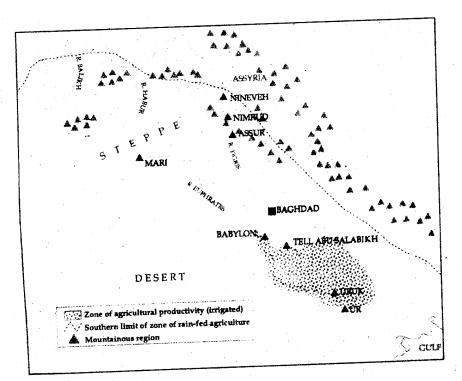
(A) Location and conditions of a terrain-The map of the entire Mongol Empire exhibits is surrounded by a number of seas and oceans and particularly, we will discuss here, Central Asia’s Steppes where Temujin was born. It was the modem state of Mongolia where during the lifetime of Genghis Khan; a majestic landscape with wide horizons, rolling plains, surrounded by snowcapped Altai mountains in the west, the arid Gobi desert in the South were existed and drained by the Qnon and Selenga rivers was topography and landforms. Moreover, there were numerous springs from the melting snow of the hills in the north and the west. There was, therefore, no dearth of the game, however, in small quantum, available in a good season.

B. Society-As the topography determines all physical traits
and pursuits, here were the hunter-gatherers and pastoralists i.e. two kinds of survival-based societies. At the north of Siberian forests, the hunter-gatherer’s and at its south, there were pastoralists.

Owing to the similarity of language, tribes like Tatars, Kotan, and Manchus were jointly called the Mongols. There was a Turkish tribe also in the west of the Steppe. Thus, there was a multi-cultural and multi¬social assembly of people under the Nomadic Empire.

C. Childhood and its percussions-Child Temujin were born near the Onon River in the north of present-day Mongolia. His clan was Borjigid and a group of family was known as Kiryat. He saw his father i.e. chieftain of Kiryat murdered at his tender age. He also witnessed his mother’s problems in course of rearing his brothers and step-brothers. He suffered all ills prevailing in the tribe and he was once captured, enslaved and his wife was kidnapped soon after his, marriage.

These shocks became a source of his intelligence as these made him more aware of society than his physical age expected. We t can see the percussions in the form of ghost massacre, he committed ‘ through the army on conquests of Nishapur, Herat, Baghdad, etc. cities and smaller towns like Nasa, Baihaq, and Tun (Kuhistan Province). The instinct of cruelty thus had born and nurtured since the tender age of Genghis Khan.

Temujin had to fight in order to get back his wife. Some friends ( like Jamuqa were turned hostile, his father’s murderers (Tatars) were thrust into his mental faculty, and the spirit of revenge cooked therein. He soon developed a strategy, however, unfair and defeated all his rivals r and murdered them. Thus, emotions backed motivation, became the highway to move in plunder, loot, arson, and massacre, he committed fearlessly but in a facade of his being a deputy of God, the almighty.

His tricky mind had its manifestation in the form of the warning to Louis IX by Mongke, his grandson, his own declaration, decree before the populace of rich at the festival ground, etc. In the festival ground, how in a shrewd manner, he says-‘O people know that you have committed great sins and that the great ones among you have committed these sins. If you ask me what proof I have for these vices, I say it is because I am the punishment of God. If you had not committed great sins, God would not have sent a punishment like me upon you.

(d) Skill of uniting people–Genghis Khan created a vague impression that he had born as a magistrate of God to punish the sinners. He first met the people of diverse tribes, applied the statement of suppression of ally and explained to them how could they fight against exploitation made by Chinese rulers at that time. The similarity of language helped him the most. He expressed this rubbish to rule the world, made them bold by saying that he had a mandate from God. The extract of his grandson’s warning to Louis IX makes it face-“In Heaven, there is truly one Eternal sky, on the earth, there is only one lord. Thus, they constituted a confederacy of Mongols and conducted war campaigns. He attained the title of Genghis Khan (Universal Ruler) under a proclamation.

E. Pseudo-Polity-The polity exercised or practiced by Mongols or the Great Khan’s was actually a pseudo one as in the name of Eternal Heaven. He bagged the support of the diverse society in central Asia steppes. His title proclaimed was also a mirage as he was only a Chieftain to the confederacy, not a universal king at the time that proclamation was made.

Mongol rulers were shrewd ones, as we can reproduce the difference between the speech made by Genghis Khan and mentioned by Hafiz-i-Tanish, a chronicler about the same place. That place was festival ground where Genghis Khan declared all rich as sinners and himself as to punish them by Eternal Heaven. He further says that they can compensate for sins by parting with their hidden wealth.

Thus he very shrewd way, compelled the populace to give him all their hidden wealth in a mixture of emotional exploitation and physical coercion (terror). At the same place, the chronicler writes that his distant descendant Abdullah Khan had gone to offer holiday prayer there. It exhibits that the entire race of great Khans was shrewd enough in misrepresentation of facts and strong affinity and reverence for its founder.

The same type of misrepresentation we see, in the matter of Yasaq initially accepted as law, decree or order and confined merely to the affairs like the organization of the hunt, the army, and postal system. The late Mongol’s redefined it as Yasa i.e. sacred law given to them by their ancestor. They made overt amendments matching with the size of the empire and the trends of the populace and thus, the entire contents of that code overhauled. However, all successors of Genghis Khan 1 maintained it thoroughly attached to the creation of their ancestors.

They also laid a claim, Genghis Khan’s being not less than other law¬givers like Moses and the king Soloman. A blend of all tribal people was recruited as soldiers and officers were deployed at the places/ territories which were not their native-lands.

Eg. Chinese secretaries deployed in Iran and Persians in China. Genghis Khan divided the empire into Uluses and made each son governor in each such division.

Conclusion-On the basis of aspects of great Khans ruling procedure and mechanism, it can be. stated that circumstances themselves had knitted the web of a nomadic empire which was trans-continental in its expansion.

The Central Islamic Lands Class 11 Important Extra Questions History Chapter 4

Here we are providing Class 11 History Important Extra Questions and Answers Chapter 4 The Central Islamic Lands. Class 11 History Important Questions with Answers are the best resource for students which helps in class 11 board exams.

Class 11 History Chapter 4 Important Extra Questions The Central Islamic Lands

The Central Islamic Lands Important Extra Questions Very Short Answer Type

Question 1.
What are the sources used for the description of the Central Islamic lands?
Answer:
These are Chronicles-

  • Tawarikh,
  • Sira,
  • Hadith and
  • Tafsir-are composed of a compilation of Akhbar, Khabar, and isnad.

Other Material-

  • Legal texts,
  • travelogues,
  • stories and poems.

Documentary-

  • Arabic papyri,
  • official orders,
  • private correspondences.

Epigraphy-Study of inscriptions.

Numismatic–Study of coins.

Question 2.
What was Aramaic?
Answer:
It was a language of Hebrew and Arabic family or group of languages. This language can be seen on the Ashokan pillars.

Question 3.
Who was Muhammed?
Answer:
He was an Arab by culture and a merchant by profession. . His tribe was Quraysh. He was murals and therefore, chosen as chief of his tribe. Subsequently, he became a prophet to Islam.

Question 4.
How was Islam came into being in Arabia?
Answer:
It was due to the rise of Muhammed, the chief of the Quraysh tribe as a prophet and with his declaration as rasul (messenger) of Cod.

Question 5.
Who was considered a member of Umma?
Answer:
The man who offers Salat, generous to the poor (i.e. gives alms) and keeps him away from any theft and piracy.

Question 6.
Whether you think, raid and loot of caravans was not theft but labor?
Answer:
Actually, Islam has considered theft confine to mere defraud or cheat not involving the use of force, tricks, etc. which tantamounted to exhort things that genuinely and legally not one’s owned or earned.

Question 7.
What would the Umma do in Islamic concern?
Answer:
Umma or the community of believers in God would bear witness (Shahada) to the existence of the religion before God as well as before members of other religious communities.

Question 8.
Who are Muslims?
Answer:
Followers of Islamic order or religion are Muslims because since Prophet Muhammed’s ruling, coincide religion made integral parts to constitution and raids for booty were not considered “theft” however; abstain from theft was the feature of eligibility to become a member of Umma.

Question 9.
Who was Marsalis?
Answer:
Non-Arabs were addressed as Marsalis. These became members of Arab tribes through the patronage of prominent tribesmen. They were discriminated against by, Arab tribes on several counts.

Question 10.
Who brought messages to Muhammed?
Answer:
He was a divine figure reckoned with Archangel Gabriel (Jibril). His first word was Iqra from which has come to the term Quran.

Question 11.
What is considered in Islamic cosmology?
Answer:
Angels are considered as one of the three intelligent forms of life in the Universe. The other two are humans and Jinns.

Question 12.
Who opposed the Muslims at the beginning of Islam?
Answer:
Those were the groups of affluent Meccans. They took it as negligence to their deities, they .worship under idolatry system. They thought this new religion may bring their image till then formed in the popular down and the prosperity as well.

Question 13.
What were the basic tenets of Islam?
Answer:

  1. One has to enroll with Umma (a community of believers).
  2. The communist will bear witness (Shahada) to the existence of the religion before God and other religious communities.
  3. The members of that community will be called Muslims.
  4. The member shall have the promise of salvation on the day of judgment (iqama).
  5. He will have to share the resources of the community while on earth.

Question 14.
What is Hijri Era?
Answer:
Counting of year system like B.C. in Gregorian calendar in Islamic empire is called Hijri Era. It is counted the day, Muhammed left Mecca with his followers to Medina.

Question 15.
What is written after the date of the Hijri calendar?
Answer:
AH e.g. 1427 shall be written for 2006 as the Hijri era starts from 622 CE.

Question 16.
What is the calculation formula of Hijri vis-a-vis Gregorian Christian (C) years?
Answer:
It is – (H × 32/33) + 622 = C – Christian
(C – 622) × 33/32 = H – Hijri

Eg. 2006 C.E. in Hijri shall be:-
(2006 – 622) × 33/32 = 1427 H

Question 17.
What kind of political institutions are required for consolidation and protection of the community?
Answer:
States and governments like institutions.

Question 18.
How are states and governments created?
Answer:
These are inherited from the past, borrowed from outside, or created from scratch.

Question 19.
Which kind of political order had Muhammed created?
Answer:

  1. Umma converted into a wider community to include polytheists and Jews of Medina.
  2. Certain modifications were done in rituals/ethical ‘ principles.
  3. Alms tax (Zakat) imposed.
  4. Raids (Ghazw) on Meccan caravans allowed to collect booty in order to run the expenses of an organization.

Question 20.
Whether Muhammed had waged war against any – country?
Answer:
Yes, the Muslim community under Muhammed fought ‘ against Meccans and Jews of Medina when they reacted to the raids, Muhammed conducted. As a result of the battle, Muhammed conquered Mecca.

Question 21.
Tell the expansion of the Islamic kingdom under Muhammed?
Answer:
Entire Arabia including Mecca and Medina.

Question 22.
Why did the idols get remove from Kaba?
Answer:
It was because idolatry was strongly opposed to the Islamic order.

Question 23.
To whom was the political authority of Muhammed transferred?
Answer:
It was to Umma (i.e. a community of believers). Caliphate was created later-on.

Question 24.
What was Caliphate?
Answer:
It was a governing system like an aristocracy in which the leader of the community (amir aluminum) would rule as a deputy (Khalifa) of the Prophet Muhammed.

Question 25.
Write the names of the first and third Khalifa.
Answer:
The first Caliph was Abu Bakr and the third was Uthman.

Question 26.
Describe the area expansion under the Caliphate regime in Arab.
Answer:
The regions carried under the Arab empire were-Syria, Iraq, Iran (Sasanian empire), and Egypt including the Byzantine empire. Three successful campaigns from 637-642 had brought frontiers of the Arab empire so extended.

Question 27.
What was the behavior of Muslims to Jews and Christians during the seventh century?
Answer:
The Caliph treated them as protected subjects in its constitution akin to scheduled caste and scheduled tribes treated in India’s constitution.

Question 28.
Who had formed the two sects-Shias and Sunni’s of Islam?
Answer:
Ali, the fourth Caliph fought two wars against representatives of the Meccan aristocracy. Hence, Meccan formed a sect of Sunnis, and Ali’s own sect formed Shia.

Question 29.
Who was Muawiya?
Answer:
Muawiya was a kinsman of Uthman, the third Caliph of Meccan aristocracy. He was during Ali’s regime, became governor of Syria.

Question 30.
what were the consequences of two battles fought by Ali, the fourth Caliph?
Answer:
In the first battle of the Camel (657 CE), Ali defeated Aisha, Muhammed’s wife, but in the second battle of Siffin (northern Mesopotamia), he had to enter in a truce with Muawiya, a kinsman of Uthman.

Question 31.
Who had founded the Umayyad dynasty?
Answer:
Muawiya, a kinsman of the third Caliph Uthman founded the Umayyad dynasty in 661 CE. It lasted in 750 CE i.e. about one hundred years, it ruled.

Question 32.
Who was Kharjis?
Answer:
There were the enemies of Ali, the fourth Caliph. A Kharji assassinated Ali in a mosque at Kufa in Baghdad.

Question 33.
Who had established an authoritarian rule after the ruination of the Caliphate system of the aristocracy?
Answer:
The Umayyad dynasty had founded an authoritarian ruling system. Muawiya, a kinsman of Uthman, the third Caliph was the first Umayyad Caliph. It was based on hereditary succession.

Question 34.
What were the salient features of the Umayyadian dynasty?
Answer:
The skill of statecraft or ruling and the army were the cardinal elements of that ruling system. The legacy of Islam was however maintained.

Question 35.
What were the main achievements of Abd al-Malik, an Umayyad?
Answer:
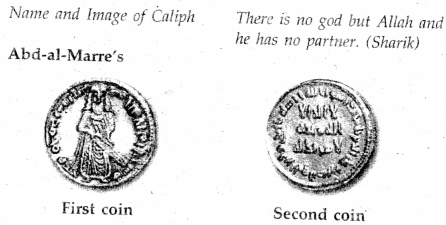
He adopted Arabic as the language of administration and circulated Islamic coinage. It was called dinar in gold and dirham in silver. The shape, symbol, and inscriptions were copied from Byzantine coin (denarius) and Iranian coin (drachm) but in the Arabic version. Dome of the Rock was built in Jerusalem.

Question 36.
How did the Umayyad dynasty meet to decline?
Answer:
There was a loop-hole in their centralization drive for Muslim monarchy (Polity) which had to meet a movement i.e. Dawa of Abbasids, another family of Meccan origin in 750 CE. The revolutionists gave it the color of religion i.e. a drive to restore the original Islam of the Prophet.

Question 37.
What were the reasons for the fall of the Umayyad dynasty?
Answer:

  1. The mixed Arab-Iranian public in Khurasan (Iran) favored the revolutionists. Their demand for reduction in taxes was left unheard.
  2. Iraqi soldiers in the Arab military disliked the rule of the Syrians (Umayvads).
  3. Iranian Muslims (Mawalis) were upset due to racial discrimination by the Umayyads.

Question 38.
Who were Abbasids?
Answer:
They were descendants of Abbas, the Prophet’s uncle. They claimed the throne on a promise that a Messiah (Mahdi) from the family of the Prophet (Ahl al-Bayt) will liberate the populace from the oppressive regime of the Umayyads.

Question 39.
Where was the battle between the Umayyads and Abbasids took place?
Answer:
It at the bank of the river Zab in which the last Umayyad Caliph, Marwan was defeated.

Question 40.
How can you say that Abbasids also established the monarchy in the name of the Caliphate like the Umayyads?
Answer:
They maintained imperial architecture and court ceremonials of the Umayyads.

Question 41.
What reasons do you ascribe for the fall of Abbasid’s regime?
Answer:

  1. Pro-Arab and Pro-Iranian conflict in the army broke out.
  2. The civil war of 810 CE more fuelled factionalism.
  3. Shiism competed with Sunnis for power.

Question 42.
Name some smaller dynasties after Abbasids.
Answer:
These were-

  1. Tahirids in Khurasan (Iran),
  2. Samanids in Transco Xiana (Turan),
  3. Tulunids in Egypt and Syria.

Question 43.
Who had occupied Baghdad and when?
Answer:
Buyid rulers (Shahenshah) of the Daylam region in Iran captured Baghdad in 945 CE.

Question 44.
Who were Fatimids?
Answer:
They were belonged to the Ismaili sub-sect of Shiism and claimed rightful ruler as they were descended from the Prophet’s daughter Fatima. They conquered Egypt in 969 and established the Fatimid Caliphate.

Question 45.
Who were Turks and how did they set themselves under Umayyad and Abbasid regimes?
Answer:
Turks were nomadic tribes from the Central Asian Steppes of Turkistan extended up to the borders of China. Being skilled riders and warriors, they set themselves as soldiers and slaves under Umayyad and Abbasid regimes.

Question 46.
Who was the founder of the Turkish sultanate?
Answer:
Alptegin Ghazni in 961 CE.

Question 47.
Who had supported Mahmud Ghazni (998-1030)?
Answer:
The Abbasid Caliph supported Mahmud because he wanted to ruin Shiite power and Mahmud was eager to receive the title of Sultan from the Caliph especially because he was a slave under them earlier.

Question 48.
Who were Tughril and Chghri Beg?
Answer:
They were brothers and Seljuq Turks. Earlier, they had entered Turan as soldiers in the armies of Samanids and Qarakhanids (non-muslim Turks of farther east).

Question 49.
Why is Nishapur famous?
Answer:
Umar Khayyam, an Islamic poet born in Nishapur (Khurasan) and it was made the capital by Seljuq Turks in 1037.

Question 50.
Who had received the title of Sultan in 1055 CE?
Answer:
It was Tughril Beg, a Seljuq Turk and became ruler. The Caliph, al-Qaim awarded him the title of Sultan.

Question 51.
What were the major events that took place from the eleventh to thirteenth centuries?
Answer:
A number of conflicts one after another between European Christians and the Arab states took place during that period of two hundred years. There were called Crusades.

Question 52.
What was the reason for Christian’s dissension from Islamic society?
Answer:

  1. Jerusalem, the holy place of Christian was captured by the Caliphs in 638.
  2. Palestine was their holy land because Jesus was crucified and he was resurrected there.

Question 53.
What had happened in the eleventh century?
Answer:
Main events of eleventh-century were-

  1. Conversion of Normans, Hungarians, and slaves into Christianity.
  2. Clergy and the warrior class (i.e. the priest and the nobility) launched a drive for bringing in political stability and economic growth based on agriculture and trade.

Question 54.
What was the control imposed by the Peace of God?
Answer:

  1. To reduce possibilities of armed conflict between Principalities on feudal lines.
  2. To degenerate plunder and loot by splitting groups or organizations so formed.

Question 55.
What religion-based rulings were made by the Christian Priests in order to control military confrontation?
Answer:

  1. Some periods declared sacred in Church’s calendar.
  2. Conflicts against Churchman and the common people pronounce as sins in Christian codes.
  3. Conflicting soldiers and print cities were declared enemies of God.
  4. Non-believer’s (viz. non-Christians) suppression was declared as noble-deed.

Question 56.
Who had seized the sultanate of Malik Shah after his death in 1092?
Answer:
It was Byzantine emperor, Alexius-I. He regained Asia Minor and northern Syria.

Question 57.
Which wars were designated as Crusades?
Answer:
The wars fought between 1095 and 1291 i.e. for the period about one hundred years were crusades. These were wars between Muslims and Christians.

Question 58.
How did the first crusade come into being?
Answer:
Pope Urban 111 joined Alexius I, the Syrian emperor, and launched the first crusade in 1090-98.

Question 59.
What have the Muslim writers mentioned Christians in their records about the first crusade in which Christians seized Antioch in Syria and cleared Jerusalem?
Answer:
Christians have been mentioned as firing or firangi and this attack was a Frankish invasion.

Question 60.
What was called Outremer?
Answer:
It was the joint name of territories (four in number) conquered by Christians in the region of Syria-Palestine.

Question 61.
What was the cause of the second crusade in 1145-49?
Answer:
The Turks had captured Edessa in 1144 CE and Pope accumulated the support of the German and French army.

Question 62.
What was Jihad?
Answer:
It was also crusaded but conducted by Muslims. The first Jihad was fought in 1107 and Jerusalem was regarded by Salah al-Din (Saladin).

Question 63.
How was the behave of Saladin against the Christians?
Answer:
It was humane yet Churches were turned into mosques and custody of the Church (Holy Sepulchre i.e. main Church) was given to Christians.

Question 64.
What were the consequences of the third crusade?
Answer:
The consequences of the third crusade were that Chr’ ‘tians could regain Palestine and an unrestricted monument to Jerusalem for pilgrims.

Question 65.
Who had again driven the Christian away from Palestine?
Answer:
It was the Mamluks, the rulers of Egypt. He drove them finally in 1291. No crusades were fought thereafter as Christians understood it a futile and e\er failed strategy or no time ripen for final freedom to Palestine.

Question 66.
What was the land revenue called in Islamic lands?
Answer:
It was Kharaj which varied from half to a fifth of the products according to the condition of cultivation. Muslim cultivated land was charged with one-tenth (Ushr) of the product under the Kharaj system of taxation.

Question 67.
What was Iqtas?
Answer:
Revenue assignment to the official in lieu of salary was called Iqtas. According to this system, the officers (mainly Jagirdars/ Army officers) were allowed a collection of Kharaj from their territories assigned and later to salary requirement.

Question 68.
Name some crops grown by peasants in Islamic lands?
Answer:
Crops like cotton, oranges, bananas, watermelons, spinach, and brinjals were mainly grown.

Question 69.
What was the name of cities established for soldiers?
Answer:
These were called Misra (garrison cities). Arab soldiers were called Jund.

Question 70.
Name the two building complexes in the center of the city.
Answer:
It was masjid al-Jami (congregational mosque) and suq (the central market place).

Question 71.
What was Geniza (Ghaniza)?
Answer:
It was a sealed room containing a huge collection of Jewish documents. It had been discovered in Fustat where Ben Ezra Synagogue had been erected.

Question 72.
What kinds of documents were found in Geniza?
Answer:
These were personal letters between merchants, family, and friends, contracts, promises of dowry, bank documents, laundry lists, and other (common documents).

Question 73.
Wherefrom the gold and silver obtained in Islamic lands?
Answer:
Gold was obtained from Africa (Sudan) and silver from Central Asia (Zarafshan Valley).

Question 74.
What was the greatest contribution of the Muslim world to medieval economic life?
Answer:
It was the development of superior methods of payment and business organization. Letters of credit including cheques (Sakk) and bill of exchange (Suftaja) were adopted to transfer money from one place or individual to another.

Question 75.
What was Muzarba?
Answer:
It was formal business arrangements in which capital was given to traveling merchants and shared profits and losses in agreed proportion between traveling merchants and the people engaged in businesses other than trading in distant lands.

Question 76.
What was the trick followed in order to escape from the law which restricted interest-bearing transactions (riba)?
Answer:
That process was called Hiya. Under it, money was borrowed in one type of currency (coin) and paid in another. Thus, interest in the disguise of the commission was earned on currency exchange (bill of exchange).

Question 77.
What was the way told by religious scholars to know the will of God?
Answer:
It was Ilm derived from the Quran and the model behavior of the Prophet (Sunna).

Question 78.
In what work, the Ulamas had devoted themselves?
Answer:
They devoted themselves to writing tafsir and hadith and some among them had preferred Sharia (the straight path) to govern the relationship of Muslims with God through ibadat and with the rest of humanity through social affairs (Muamalat).

Question 79.
What were the four schools of law (Mazhab)?
Answer:
These were-Maliki, Hanafi, Shafii, and Hanbali. These were named after the leading jurists (faqih).

Question 80.
What is Quran?
Answer:
It is a collection of messages (revelations) which God sent to the Prophet Muhammed between 610 and 632 first in Mecca and then in Medina.

Question 81.
What was called customary laws and laws of the state on political and social order?
Answer:
These were-Urf and Siyaysa Sharia.

Question 82.
Who were religious-minded people in medieval Islam?
Answer:
Those people were Sufis. They got deeper personal knowledge of God through asceticism (Rahbaniya) and mysticism (Lasawwuf).

Question 83.
What was pantheism?
Answer:
It was the idea of the oneness of God and his creation which implies that the human soul must be united with its maker.

Question 84.
What was the influence of Greek philosophy and science on Islam?
Answer:
An alternative vision of God was developed in the Islamic approach.

Question 85.
Which subjects were taught in the schools of Alexandria, Syria, and Mesopotamia?
Answer:
These were-Greek philosophy, mathematics, and medicines.

Question 86.
What effect the study of new subjects had made on Islamic beliefs.
Answer:
Scholars with a theological bent of mind (Mutazila) used Greek logic, and methods of reasoning (Kalam) to defend Islamic beliefs.

Question 87.
What is Shahnama (Book of Kings)?
Answer:
It is an epic of 50,000 couplets. It is an anthology of traditions and legends (Rustam’s story etc.). It was composed by Firdausi.

Question 88.
Name some history books of Islamic lands.
Answer:

  1. Ansab al-Ashraf (Genealogies of the Nobles) by Baladhuri and,
  2. Tarikh al-Rusul Wal Muluk (History of Prophets and Kings) by Tabari.

The Central Islamic Lands Important Extra Questions Short Answer Type

Question 1.
Discuss the structure of the mosque built during Islamic regimes?
Answer:
The main features of a mosque were-

  1. Sahn (an open courtyard),
  2. Vaulted Hall,
  3. mihrab (a niche),
  4. Minbar or mimbar (a pulpit),
  5. Minaret (a tower).

Central courtyard (Iwan) can be seen in caravan, saris, hospitals, and palaces e.g. Khirabat- al-Mafjar (Palestine) and Qusayr Amra (Jordan).

Question 2.
What were the two art forms that emerged in the Islamic religion?
Answer:
These art forms were-

  1. Calligraphy (Art of beautiful writing) and,
  2. Arabesque (geometric and vegetal designs).

Calligraphic art has been best preserved in manuscripts of the Quran dating from the eighth and ninth centuries. Plant and floral designs, based on the idea of the garden, were used in buildings and book illustrations.

Question 3.
What is excellent or unique in the history of the Central Islamic lands?
Answer:
A unique in the history of the central Islamic lands was a merger of three important aspects of human civilization i.e. religion, community, and politics into one. We can see them as three circles that merge and appear as one in the seventh century. It could separate in the next five centuries. Later on, the influence of Islam over state and government became nominal and politics involved many things that have no sanction in religion and thus, the circles of religion and community were overlapped by politics. Politics became a separate circle. The only way the circles of religion and community could have separated was through the progressive secularisation of Muslim society. Philosophers and Sufis advocated this, suggesting that civil society should be made autonomous and rituals be replaced by private spirituality.

Question 4.
Describe a morning scene in Basra.
Answer:
Basra is a city that falls in IraQuestion Here were settled Arab soldiers (Jind) who formed the backbone of the administration. It was a garrison city. There were a number of companies (branches of troops) parading in the morning. Military headquarter we see here. We could see them doing prayer in a mosque because such was made mandatory under Islamic administration.

Question 5.
What knowledge could one obtain from Geniza records? Explain.
Answer:
Geniza records consisted of over two lakh fifty thousand manuscripts and fragments dating back from the Fa timid, Ayyubid, and early Mamluk periods. Most of the documents were written in Judaeo-Arabic, a version of Arabic written in Hebrew characters that were commonly used by Jewish communities throughout the medieval Mediterranean. These provide rich insight into personal and economic experiences and into Mediterranean and Islamic culture. These suggest that the business skills and commercial techniques of merchants of the medieval Islamic world were more advanced than those of their European counterparts. On the basis of a study on these documents, Goitein composed a multi-volume history of the Mediterranean, and Amitav Ghosh composed “In an Antique Land.”

Question 6.
Discuss the structure of city settlement in the Central Islamic Lands.
Answer:
Cities that flourished in the central Islamic lands can be described as-

  1. Capital cities,
  2. Garrison cities.

Capital cities were founded by Caliphs like Abbasid in Baghdad, Medina. Garrison cities were Kufa and Basra in Iraq, Fustat, and Cairo in Egypt. Apart from these cities, there were developed towns such as Damascus, Isfahan, and Samarqand.

Formation of a city-In the middle of the city, there were two building complexes-

  1. the congregation mosque (masjid al-Jami) and
  2. the central market place (suq).

There were shops, merchants’ lodgings (fandub), and offices of the money changer. Administrators, scholars, and merchants lived close to the center of the city. In its outer circle, there were residences for ordinary citizens and soldiers. Churches, Synagogues, and mosques were built everywhere at a small ’ distance. There were subsidiary markets and public baths in these cities. Homes of Urban poor people, vegetable market, caravan stations, and unclean shops (tanning and butchering) were at the outskirts of the cities. There were inns and cemeteries beyond the city walls.

Question 7.
Describe the condition of agriculture in the Central Islamic Lands.
Answer:
Condition of Agriculture

  1. It was the principal occupation of the settled populations.
  2. Ownership inland was that of small and big farmers. The large estates were owned by the state:
  3. Kharaj was the land revenue paid by the peasants. It was varied from half to a fifth of the products according to the conditions of cultivation (i.e. irrigated, fallow, fertile, sandy, etc.). The concession was given to Muslim peasants as they were charged in proportion to one-tenth (Ushr) of the produce.
  4. Irrigation system supported by the state in Nile Valley. Construction of dams, canals, and digging of wells given priority. Tax concession was given to the people who brought forest land under cultivation. Crops like cotton, oranges, bananas, watermelons, Spinach, and brinjals were grown and exported to Europe.

Question 8.
What was the treatment of Franks (Firangis or Christians) with Muslims in Central Islamic Lands? Explain.
Answer:
We can conclude about the treatment of Christians with Muslims as mixed type. It differs from one territory to another. It has been seen that the earliest of the crusaders settled down in Syria and Palestine were more tolerant to Muslims than those who came later. The early comers were properly associated with Muslims hence, there was fraternity among them. An instance of their treatment with the Muslim community has been given in this chapter extracted from Kitab al- Inbar. The author says that he had a friend Chief Theodore Sophia’s in Antioch.

He once was invited by that friend. He met a retired old knight who owned property in Antioch. Here he offered not Frankish but Muslim food to him. He heard him saying while on the dining table that he had appointed an Egyptian woman as a cook and ate never the pork meat. However, when they were strolling in the market place, a crowd of Franks collected against him to attack. That was because they mistook him for another Arab who once had killed their brother. Anyhow, his friend could cool them down by saying that the author was a businessman.

Hence, a mixed type of treatment with Muslims in territories under Franks can be concluded.

Question 9.
Enumerate the business and trade in the Central Islamic Lands.
Answer:
The Central Islamic lands witness ample growth in business and trade particularly, the topography supported their trading maneuver. Muslim empire was spread between the Mediterranean and the Indian ocean. The Arab and Iranian traders, therefore, monopolized regularly the maritime trade between China, India, and Europe.

Two major routes of that trade were-

  1. The Red Sea and
  2. The Persian Gulf.

Spices, textile, porcelain, and gunpowder were shipped from India and China to Aden and Aydhab i.e. ports at the Mediterranean. The ports of the second route i.e. the Persian Gulf were-Siraf and Basra.

Camel caravans were used to transport the mercantile from the ports of Aden and Aydhab of the first route and Siraf Aijd Basra of the second route to the warehouses (Makhan) of Baghdad i.e. the capital of Abbasids Caliphate. Warehouses were also established in Damascus and Aleppo.

It was then disbursed for local consumption or onward transmission. Jewish merchants had handled exports to Europe from the port of Alexandria. Subsequently, Cairo emerged as a center of commerce which had increased the importance of the Red Sea route. In order to buy paper and other goods of Central Asia origin, Iranian merchants set-out from Baghdad along the Silk Route to China via the oasis cities of Bukhara and Samarqand. Bukhara and Samarqand were the cities linking commercial networks extended north to Russia and Scandinavia. For exchange of European goods (fur and slaves).

Question 10.
Describe the consequences of crusades conducted by Christians and Muslims during the period between 1095 and 1291.
Answer:
These crusades left a lasting impact on two aspects of Christian-Muslim relations. One was the harsher attitude of the Muslim state towards its Christian subjects which resulted from the bitter memories of the conflict as well as the need for security in areas of mixed populations. The other impact was the greater influence of Italian mercantile communities from Pisa, Genoa, and Venice in the trade between the East and West even after the restoration of Muslim power.

Question 11.
Discuss the causes of the fall of the Caliphate?
Answer:
Following reasons can be ascribed for the break-up of the Caliphate-

  1. Baghdad was not a central place hence, it had become difficult to maintain control over the distant provinces.
  2. The civil war of 810 between supporters of Amin and Mamun (sons of the Caliph Harun al-Rashid) created a new power block of Turkish slave officers (Mamluk).
  3. The confrontation started between Shiism and Sunnis.
  4. Minor dynasties such as Tahirids, Samanids, Tulunids in Khurasan, Turan, Egypt, and Syria rose and the Caliphate limited to Central Iraq and Western Iran. Baghdad also was seized by a Shiite clan of Daylam (Iran). Those were Buyids.

Thus, the Caliphate system was shattered and the sultanate system established. Fatimids also had conquered Egypt in 969.

Question 12.
Discuss the achievements of the Caliphate?
Answer:
It was a system of polity in which the leader of the community(amir al-mining) became the deputy (Khalifa) of the

Prophet Muhammed. The objectives of the Caliphate were-

  • to return control over the tribes constituting the Umma and,
  • to raise resources for the state.

This system was adopted after the death of the Prophet Muhammed. The three powerful Caliphs were-Abu Bakr, Umar, and Uthman. The first Caliph Abu Bakr suppressed the revolts by a series of campaigns. The second Caliph Umar shaped the Umna’s policy of expansion of power. He conducted raids and conquered the lands belonging to Byzantine Empire in the West and the Sasanian empire in the east. Religious conflicts between Christians and Zoroastrians and revolts by the aristocracy weakened these two empires. The Arabs brought Syria, Iraq, Iran, and Egypt under the control of Medina.

The Arab empire under Uthman witnessed control over the vast territory between the Nile and the Oxus. Soon conflicts over the distribution of resources and offices began touching climax. Blind favor to Quraysh provoked opposition in Iraq and Egypt simultaneous to the opposition in Medina which resulted from the assassination of Uthman. Thus, Ali became the fourth Caliph. Here, two sects developed i.e.Shias and Sunnis. Ali defeated Muhammed’s wife, Aisha in the battle of the Camel in 657 but could not suppress Muawiya, a kinsman of Uthaman. In the battle at Siffin (northern Mesopotamia), Ali had to resort to a truce and it split his followers. The opposite group Kharji’s assassinated Ali at Kufa. Thus, there was established Umayyad dynasty which lasted till 750 C.E.

Question 13.
Who were Umayyads and how did they manage the centralization of polity?
Answer:
Umayyads was a prosperous clan of the Quraysh tribe and Muawiya was its first Caliph. He shifted capital at Damascus and adopted the court ceremonies and administrative institutions of the Byzantine empire. He introduced hereditary succession. These were the innovations of the Umayyads adopted by the Caliphs. They retain power for 90 years and the Abbasids for two centuries.

It was an imperial power and mainly based on statecraft and loyalty of Syrian troops. There were Christian advisers in the administration, Zoroastrian scribes, and bureaucrats. Islam provided legitimacy to the rule of the Umayyads and Abbasids. During the reign of Abd al-Malik and his successors, Arabic was accepted as the language of administration, and the introduction of an Islamic coinage was an important achievement. Dinar was the gold coin while dirham was the silver coin. Aba al-Malik also built the Dome of the Rock.

Question 14.
Discuss Byzantine and Iranian coins and that of Arab-Islamic coins?
Answer:
Byzantine coins were called denarius while the Iranian coins were drachma. Symbols of crosses, Sine alters along with an inscription of Greek and Pchlari (the language of Iran).

Aba-al-Malik removed these symbols and language inscribed thereon but the shape and size were kept unchanged. Initially, Abd- al-Malik inscribed his portrait with name and image. Subsequently, it was made epigraphic. A Kalima was inscribed in Arabic which means–There is no god but Allah and He has no partner (Sharik). This change was made because there developed dissatisfaction subsequently representation of living beings in art and craft.
Class 11 History Important Questions Chapter 4 The Central Islamic Lands 1

Question 15.
Discuss the causes and consequences of the Abbasid revolution.
Answer:
It was named as Dawa movement and it brought down the Umayyads and replaced them with another family of Meccan regions, the Abbasids in 750 CE. Abbasids were the descendants of Abbas, the Prophet’s uncle. This revolution broke out in Khurasan (eastern Iran) where a mixed Arab-Iranian population was mobilized. Arab soldiers were from Iraq and resented the dominance of the Syrians. The Umayyad regime had not reduced the taxes and their demand for privileges left unaccepted. Iranian Muslims (Mawalis) were discriminated against by Arabs. Thus, Umayyad’s Caliph Marwan was defeated in a battle at the river Zab and thereafter, Abbasid Caliphate formed.

Question 16.
Outline the fiscal system adopted in die Central Islamic lands.
Answer:
Fiscal System-Owing to the rapid growth of urban centers, cities, towns and the trade, income, and expenditure of the state had also spurt-up. This increased the importance of money in the central Islamic Lands. In order to pay for goods and services, coins of gold, silver, and copper were minted and circulated in bags sealed by money-changers.

Gold was brought from Sudan in Africa, silver from Europe (Zarafshan valley), and precious metals and coins were also brought from Europe. Demand for money inspired dead people to release their accumulated reserves and idle wealth into circulation. Credit facilities were also developed. Letter of Credit (Sakk) and bill of exchange (Suftajer) was used for the transfer of money from one place to another. Commercial papers like promissory notes, cheques, etc. freed merchants from the need to carry cash everywhere. It made their journey safer. Salaries to soldiers or rewards to poets and minstrels were paid in Sakk (cheques). Investment increased and partnership business’s opened. Thus, the fiscal system under Islamic land was approximately in modem line.

Question 17.
Explain the Quran and the difficulties in case of it as source material for the history of early Islam.
Answer:
The Quran is a book in Arabic consisting of 114 chapters (Suras). Chapters are in descending order of length i.e. the shortest chapter is the less. Only first Sura is a short prayer (al-Fatihah. This book is considered as a collection of messages which God gave to Prophet Muhammad between 610 and 632, first in Mecca and then in Medina. It was completed in 650 CE. The verses engraved on the Dome of the Rock in Jerusalem and oh the coins in the seventh century are the earliest.

Problems for the use of the Quran as source material for the history of early Islam have arisen. The one is to understand it literally as the theologians believe these as the speech of God (Kalam Allah). The rationalists have given a wider interpretation of the Quran. Such dual-position raises controversy to arrive at the conclusion. The second problem is that of events not narrated by m Quran. It only refers to the events therefore, Medieval scholars have to make sense of many verses with the help of hadith. We see, there are many hadith written to help in the reading of the Quran.

Question 18.
Whether the thoughts of Abdul-Latif, a twelfth-century legal and medical scholar of Baghdad about an ideal student as extracted in this chapter are relevant to a student today?
Answer:
We think the suggestions are all relevant to a student today provided that one could construe the meaning and implication of this extract in a positive manner. We can sum up the main points suggested as under-

  1. Self-conscience without the proper guidance of teachers ipso- facto is unscientific as it may be mere fiction.
  2. Don’t think the limitation of the teacher but take all good that he delivers as your review, introspection, and churning on the same would lead you to the facts.
  3. Don’t do cramming but understand the topics so better way as the physical presence of the book is no more required.
  4. Histories, biographies, and Geography are the subjects that introduce a man to his surroundings. Analyze and compare the cause and effects of all events and activities.
  5. Frame opinion after study on biographies of great men cautiously by taking your nature as innocent as a child.
  6. Once the conclusion has arrived, stay undeniable there even if the world criticizes you.

On the basis of the above points, the study becomes perfect and scientific for which no options remain. Here literally suggested submission before Prophet and distrust your nature but its implication leads to the scientific process of the study. We can replace prophet with. the generalization which is made after experiments done impartially. Similarly, distrust of your nature implies cleanliness of head and heart while in a study which is necessary to grasp the sense in its basic form and generalization thereafter would automatically provide with the apparent light in the matter so churned.

Conclusion-Hence, we can state that cramming and study are useless even in modem sense and curriculum and the same has been started and suggested in the aforesaid extract.

Question 19.
Discuss the influence of Greek philosophy, mathematics and medicine added to the curriculum of schools under the central Islamic Lands?
Answer:
Study on these subjects promoted critical inquiry and had a profound influence on Islamic intellectual life. Scholars with a logical bent of mind Eg. Mutazila started using Greek logic and methods of reasoning (Kalam) to defend Islamic beliefs. Philosophers (Malaysia) posed wider questions and provided fresh answers. Books on medicines were confused like al-Qanun fil Tibb (Canon of Medicine) by Ibn Sina. The poetry of that period is called Nazm and prose is called nature. Ode (qasida) is the poetic composition by poets of the Abbasid period.

Abu Nawas composed classical poetry on themes like wine and male love. Sufi’s glorified the intoxication caused by the wine of mystical love. An Arabic vocabulary was developed. The Father of the new Persian poetry was Radaki, a court poet under Samanids. Rubai and Ghazals were composed.

The rubai is a four line-stanza in which the first two lines set the stage, the third is finely poised and the fourth delivers the point. Umarkhayyam of Bukhara was a famous poet who composed rubai. Diwans and Mathnavi (anthologies and epic poetry) were composed during the period of Mahmud of Ghazni. Firdausi composed Shahnama (Book of King) and Kitab-Al-Fihrist describes a large number of works written in prose for the moral education and amusement of readers.

Other books written during this period were Kalilawa Dimna, Stories of Alexander and Sindbad, The Thousand and One Nights, Kitab al-Bukhala, Akhlaq, Mirrors for Princes Tarikh (Ansab al-Ashraf) and Tarikh al-Rusul Wal Muluk, Rihla and Ahsan al-Taqasim, Muruj al Dhahab and Tahqiq mail-Hind.

Question 20.
Describe the Sufis and their new method of devotion.
Answer:
Sufis were religious minded people in medieval Islam. They preached knowledge of God through asceticism (Rahbaniya) and mysticism. These people sought to renounce the world (Zuhd) and rely on God alone (Tawakkul). Mysticism attained new heights by the idea of pantheism and love. Pantheism is the idea of the oneness of God and His creation which implies that the human soul must be united with its maker. Ishq or intense love can only help in the merger of the soul with god. Sufis used musical concerts (Sama) to introduce ecstasy and stimulate emotions of love and passion. Rabia and Bayazid Bistani were some Sufis. Sufism was beyond the boundaries of caste, race, religion, and creed. According to theory, religion is more personal and less institutional.

The Central Islamic Lands Important Extra Questions Long Answer Type

Question 1.
Give a brief account of the society, its largest organization (Caliphate, Sultanate, etc.), Cultural, Vocational, literary, scientific achievements, and religion as a motive for cause and the effects in the Central Islamic Lands.
Answer:
Society is formed of individuals and individuals are the finished product of families. Again we know that family, the first unit of Society formation, actually determines the instincts and motives that manifest before him in the shape of events either good or bad as calculated by society on its perceived goals in a fixed timeline or the phase of time.

The topography, sense of realization or religion as adopted and adapted to the contemporary society, availability of sources and resources including water, humans, minerals, soil, and their proportionate adjustment (Formation of climate, temperature, precipitation, etc.)-all determine combinedly, the account of human actions in the lap of nature. Such account constitutes the history of a particular time frame classified with certain distinctions and comparisons. We can give a summed-up account of the Central Islamic Lands as under-

A. Society-(a) Topography-We see, the central Islamic lands covered by the Mediterranean sea and Black sea at the west, the Red Sea at the south, the Arabian sea at eastern-west along with the Persian Gulf and Caspian and Aral sea at the north and north-east respectively. There are also existed rivers like Euphrates, Nile, etc.

Impact-Trade and commerce developed at the climax. Terrestrial routes like the silk route and sea routes like the Red Sea route and Persian Gulf route were invented.

Red-Sea route-Aden and Aydhab ports of this sea started receiving Indian and Chinese goods. Eg. spices, textile, porcelain, and gunpowder.

Persian Gulf Route-Goods mentioned above were carried to Siraf and Basra ports of the Persian Gulf.

Silk Route-China reached through the oasis cities of Bukhara and Samarqand. It was the terrestrial way. Camel caravans and carts were used. These two cities were also important for trading with European countries.

Structure of Society-It indicates that leaders and businessmen were the important organs of society. There were sailors, peasants, soldiers, money-changers, common people, and slaves in the society.

Religion-Islam propagated by Prophet Muhammed who was Arab by language and a merchant by profession. Before Muhammad, there was prevalent idolatry in Islamic lands. In Mecca, there was a cube-like structure called Kaba in which idols were placed and worshipped. An idol was called Sanam and the shrine in which it was placed called shrine. Arabs were polytheistic and nothing was clear for the notion of a supreme God.

They began to call it Allah, as Jewish and Christian tribes living in their midst, had faith in Jew and Jesus Christ. Muhammad declared him a rasul of God and suggested Salat for Arabs. This religion was called Islam and its followers were called Muslims. Rituals were very simple as one has to join with Salat, distribute alms to beggars and keep away himself from theft. Umma had to bear witness (Shahadat) to the existence of the religion before God as well as before members of other religious communities.

This new religion garnered the support of the mass in Mecca but the affluent section of society created problems for the propagation of this religion. Muhammad had to leave Mecca and went to Medina. This day was later adopted as the first day of the Hijri era in the Muslim calendar. In order to create a religious bound political institution, Muhammad converted Umma into a wader community to include polytheists and tv Jews of Medina under political institution. He made certain ethics and rituals matching with the demand- of society and the circumstances. Agriculture, trade, Zakat, and ghazwa were the source of survival for the community. Thus, rituals to the effect of abstaining from the theft were removed.

Initially, all were nomadic people divided into Qabilas like Quraysh. After Muhammed, there became his descendants as Umayyads, Abbasids, Mawalis, Kharjis, etc. However, they all were Muslims and followers of Islam. Shias and Sunni sects were also formed during Ali, the fourth Caliph’s regime.

B. Political Structure-Muhammed established Islam religion along with the political organization, initially of his tribe Quraysh and then conversion of Christians, Jewish, etc. into Islam. Raids on Meccan caravans and nearby oases kept alive in order to keep the populace well earned and satisfied.

As Muhammed had died intestate, Umma became powerful and its leader was accepted as Caliph or deputy of Prophet Mohammad. The Amir Almuminin did not even take care of the wife, uncle, cousins, etc. for leadership which created a rift and internal conflicts which we see as the Battle of the Camel (657), Battle at Siffin (northern Mesopotamia), the assassination of Uthman and Ali Abbasid revolution, etc.

Under the Caliphate system, Abu Bakr, Umar, Uthman, and Ali reigned as Caliph i.e. deputy to Prophet. After Ali’s assassination, other Caliphs were the Umayyads and Abbasids. The first four Caliphs ruled from 632 to 661 (i.e. 29 years), Umayyads ruled from 662 to 750 C E. (i.e. about 90 years) and Abbasids ruled from 751 to 810 (i.e. 59 years). The Caliphate system declined gradually in 810 CE and Sultanate System came into existence.

The first Turk was Mamluk. He had to tackle Buyids (Iranian title holders of Shahanshah), Fatimids, Tahirids, Samanids, and Tulumids. Thus, Central Islamic Lands witnessed a number of rulers as Caliph coincide the Turk dynasty from 810 to 961 C E when Alptegin, father of Mahmud of Ghazni established Ghaznavid Sultanate. Thereafter, Seljuq Turks i.e. Tughril and Chaghri Beg, two brothers ruled as Sultan when this title was given to him by the Caliph al-Qaim.

Crusades took place during the eleventh to the thirteenth centuries. Christians wanted Palestine but could not achieve success even after the three crusades they conducted. Finally, the Mamluks (Sultan) drove them under a Jihad started first by Salah al-Din (Saladin) his predecessor.

We can state that the Central Islamic land had witnessed a blend of governing systems under the Caliphate and Sultanate.

C. Agriculture-Three kind of landholding i.e.

  1. Small
  2. big and
  3. the large estates.

The state had overall control on agricultural land and a large chunk of coffer was contributed by the land revenue. Revenue for land was named Kharaj which varied from half to a fifth of the produce- Muslims were given concession as only Ushr (One-tenth of the produce) was charged as tax r Kharaj from them. Immigration facilities were given extra heed and care by the Caliphs and other rulers. We see Iqta System was adopted from the tenth century onward’s. Crops like cotton, oranges, bananas, watermelons, spinach, and brinjals were grown and exported to Europe.

D. Culture-Tafsir, Judith, Sharia, Mazhab, etc. were consolidated and society followed the rules under Sharia. Reasoning (Qiyas) was also given importance while writing Sharia for the Muslims. Owing to differences in the interpretation of sources and methods of jurisprudence, four schools of law were formed. These were-Maliki, Hanafi, Safii, and Hanbali schools knew in the name of their propounders of the jurists.

A group of religious-minded people was known as Sufis. They were believers in Rahabaniya and mysticism. They were like sadhus in Hinduism. Sufis sought to renounce the world and rely on God alone. Does this settle society influence by the ideas of pantheism and? love. Rabia of Basra, Bayazid Bistami of Iran and Dhulnan Mistri, etc. were the Saints or Sufis:

Greek philosophy, mathematics, and medicine were the subjects taught in schools that coincide with other Arabic subjects of the central Islamic lands. These new subjects promoted critical inquiry and had a profound influence on, Islamic intellectual life. The logic was used to, defend Islamic beliefs. A number of books were written on medicine, law, and humanities. Prose and poetry saw exquisite growth. Poets of Persian origin revitalized and reinvented Arabic poetry and challenged the cultural hegemony of the Arabs. Pahlavi, the Iranian language t suffered a setback: Its version was prepared and it Was named New Persian. This language was preferred by all Caliphate and other rulers of Sultanate during that phase of the time. Rudaki was considered the father of New Persian poetry and UmarKhayyam brought rubai : (Persian poem) to the climax. A number of books in history, geography, humanities (storied, fables, etc.) were written in this period of history.

E. Economy-

  1. Urbanization took place and garrison cities, port cities, and capital cities were established. These were in Kufa, Basra, Baghdad, Damascus, Aleppo, Alexandria, Daylam, Samarkand. Samaria, Antioch, and Tripoli.
  2. Goins of gold, silver, and copper were minted. Bags filled with coins were sealed by money changers. Gold was brought from Sudan (Africa) and silver from Zarafsan valley in Central Asia. Precious metals and corns came from Europe.
  3. Letters of Credit and bill of exchange etc. methods of payment were adopted.
  4. Family businesses set-up everywhere. Businesses were also run through employees like firms. and companies of modem period. When rib was declared unlawful, the people adopted hiya i.e. earning of interest on transactions unfair way.
  5. Ample supply of coins and trade promotion developed the trend of investment. People began releasing their accumulated reserves and idle wealth into circulation.

Conclusion-Thus, on the basis of the above parameters, discussed,

we can conclude that nomadic tribes of the Central Islamic Lands gradually formed political institutions mainly on the Aristocracy line and d a blend of religion and politics is witnessed from the sixth to thirteenth centuries. Several Caliphates and Sultanates were formed and declined during the period of seven hundred years. Civil wars, crusades in varied colors and forms were fought one after another. In the fields of language, literature, architecture, and economy we observe, certain progress had been achieved.

MCQ Questions for Class 12 Accountancy Chapter 6 Accounting for Share Capital

Accounting for Share Capital Class 12 MCQs Questions with Answers

Share Capital MCQs Class 12 Chapter 6 Question 1.

Reserve capital is not a part of:

(A) Authorised Capital
(B) Subscribed Capital
(C) Unsubscribed Capital
(D) Issued Capital
Answer:
(C) Unsubscribed Capital

Accounting For Share Capital MCQ Question 2.

The part of authorized capital which can be called up only on the company being wound up is called :

(A) Issued Capital
(B) Unsubscribed Capital
(C) Reserve Capital
(D) None of these
Answer:
(C) Reserve Capital

Explanation:
Reserve capital represents the portion of subscribed capital that remains un-called except in case of winding up or at the time of liquidation.

MCQ Questions for Class 12 Accountancy Chapter 6 Accounting for Share Capital

Share Capital MCQ Class 12 Chapter 6 Question 3.

The owners of the shares are called :

(A) Share Capital
(B) Shareholders
(C) Creditors
(D) Debtors
Answer:
(B) Shareholders

Explanation:
As the shareholders are the owners of the share capital, they are called the owners of the shares of the company.

Share Capital Of A Company Means MCQ Question 4.

The first stage of incorporating a company is:

(A) Registration
(B) Promotion
(C) Commencement of business
(D) None of the above
Answer:
(B) Promotion

Explanation:
The incorporation of a company as per the Companies Act, 2013 begins with its promotion.

MCQ Questions for Class 12 Accountancy Chapter 6 Accounting for Share Capital

Accounting For Share Capital Class 12 MCQ Question 5.

Those preference shares which do not carry the right to receive arrears of dividend:

(A) Non-participating Preference Shares
(B) Irredeemable Preference Shares
(C) Non-convertible Preference Shares
(D) Non-cumulative Preference Shares
Answer:
(D) Non-cumulative Preference Shares

Explanation:
The non-cumulative preference shares are the shares which do not carry the right to receive arrears of dividend. Non-participating Preference Shares are the shares which do not have a share in surplus profits and on which only a fixed rate of dividend is paid. Non-convertible Preference Shares are the preference shares which don’t have the right to be converted into equity shares. Preference shares which don’t have any maturity date are called irredeemable preference shares.

Share Capital Class 12 MCQ Chapter 6 Question 6.

ESOP offered by company will create / retain :

(A) A sense of belongingness in employees
(B) High calibre
(C) High Productivity
(D) All of the above
Answer:
(D) All of the above

Explanation:
The employee stock ownership plan is giving the shares to the employees in order to create a sense of belongingness in employees and creates high calibre and productivity of employees.

MCQ Questions for Class 12 Accountancy Chapter 6 Accounting for Share Capital

Share Capital MCQ Class 12 Chapter 6 Question 7.

Pick the odd one out:

(A) Irredeemable preference share
(B) Participating preference share
(C) Cumulative preference share
(D) Open-ended preference share
Answer:
(D) Open-ended preference share

Explanation:
Open ended preference shares is not a type of preference share rest all are the types of preference share.

MCQ Of Share Capital Class 12 Chapter 6 Question 8.

Subscription of shares should not be less than % of the issued shares.

(A) 85%
(B) 90%
(C) 95%
(D) 100%
Answer:
(B) 90%

Accounting For Share Capital MCQs Class 12 Question 9.

A company forfeited 4,0(N) shares of 10 each on which application money of 3 has been paid. Out of these 2,000 shares were reissued as fully paid up and 4,000 has been transferred to capital reserve. Calculate the rate at which these shares were reissued:
(A) ₹ 10 per share
(B) ₹ 9 per share
(C) ₹ 11 per share
(D) ₹ 8 per share
Answer:
(B) ₹ 9 per share

MCQ Questions for Class 12 Accountancy Chapter 6 Accounting for Share Capital

Explanation:
As the amount in the forfeiture share account is ₹ 6,000 and ₹ 4,000 was transferred to the capital reserve account. Thus, ₹ 2,000 was the discount given, making the discount ₹ 1 per share. Thus the share was issued at ₹ 9 per share.

MCQs Of Share Capital Class 12 Chapter 6 Question 10.

Vanya Ltd. forfeited 20,000 equity shares of ₹ 100 each for non-payment of first and final call of ₹ 40 per share. The maximum amount of discount at which these share can be re-issued will be :

(A) ₹ 8,00,000
(B) ₹ 12,00,000
(C) ₹ 20,00,000
(D) ₹ 20,000

Answer:
(B) ₹ 12,00,000

Explanation:
Amount forfeited at the time of forfeiture of shares
= ₹ 20,000 x 60
= ₹ 12,00,000

MCQ Of Share Capital Chapter 6 Class 12 Question 11.

Which of the following is not a purpose for which the Securities Premium amount can be used?

(A) Issuing fully paid bonus shares to shareholders
(B) Issuing partly paid-up bonus shares to shareholders
(C) Writing off preliminary expenses of the company
(D) In purchasing its own shares (buyback)
Answer:
(B) Issuing partly paid-up bonus shares to shareholders

MCQ Questions for Class 12 Accountancy Chapter 6 Accounting for Share Capital

Explanation:
The securities premium amount cannot be used to issue partly paid-up bonus shares to shareholders, as the shares are partly paid up.
It can only be used for:

  • To issue fully paid-up bonus shares to the shareholders.
  • To write off preliminary expenses of the companies.
  • To write off the commission paid or expenses on the issue of shares/debentures.
  • To pay a premium on the redemption of preference shares or debentures of the company.
  • Buy-back of equity shares and other securities as per Section 68.

Accounting For Shares Class 12 MCQ Question 12.

A forfeited share can :

(A) not be re-issued at discount
(B) re-issued at a maximum discount of 10%
(C) be re-issued at a maximum discount equal to the amount forfeited
(D) None of the above
Answer:
(C) be re-issued at a maximum discount equal to the amount forfeited

Explanation:
The discount on the reissue of forfeited shares cannot be more than the forfeited amount of the shares, so it can be issued at a discount and it can be more than 10% if the forfeited amount is more than 10%.

MCQ Questions for Class 12 Accountancy Chapter 6 Accounting for Share Capital

MCQ On Share Capital Class 12 Chapter 6 Question 13.

When forfeited shares are re-issued the amount of discount allowed on these shares cannot exceed :

(A) 10% of called-up capital per share
(B) 6% of paid-up capital per share
(C) The amount received per share on forfeited shares
(D) The unpaid amount per share on forfeited shares
Answer:
(C) The amount received per share on forfeited shares

Share Capital MCQ Questions Class 12 Question 14.

Gama Chemicals Ltd. is a newly formed company. How much discount per share can it allow for issuing its shares to the public ?

(A) 6%
(B) 10%
(C) 5%
(D) None of these
Answer:
(D) None of these

Explanation:
A company cannot issue its shares at a discount as per the Companies Act, 2013.

MCQ Questions for Class 12 Accountancy Chapter 6 Accounting for Share Capital

Question 15.

Share Allotment Account is a/an :

(A) Personal Account
(B) Real Account
(C) Nominal Account
(D) None of these
Answer:
(A) Personal Account

Explanation:
Share Application or Share Allotment or Share Capital A/c, all are personal accounts as they represent money from the shareholders.

Question 16.

Balance in Share Forfeiture Account is shown in the balance sheet under the head of:

(A) Reserves and Surplus
(B) Long-term Borrowings
(C) Share Capital
(D) Other Current Liabilities
Answer:
(C) Share Capital

Explanation:
As the share forfeiture form the share capital it is shown in the share capital head of the Balance Sheet.

MCQ Questions for Class 12 Accountancy Chapter 6 Accounting for Share Capital

Question 17.

Pick the odd one out:

(A) Issue of shares to vendors
(B) Issue of shares to general public
(C) Issue of shares to underwriters
(D) Issue of shares to promoters
Answer:
(B) Issue of shares to general public

Explanation:
Issue of shares to general public is the only one which is not done to settle previous debt but to raise share capital.

Question 18.

Identify the journal entry for the issue of forfeited shares at par.

ParticularsL.FAmount Dr. (₹)Amount Cr. (₹)
(A) Bank A/c  Dr.

To Share Capital A/c

 
(B) Bank A/c   Dr.

Share Forfeiture A/c   Dr.

To Share Capital A/c

 
(C) Share Forfeiture A/c Dt

To Share Capital A/c

 
(D) Noneof these 

Answer:
Option (A) is correct.

Explanation:
The journal entry for the reissue of forfeited share will be the same as the issue of shares.

MCQ Questions for Class 12 Accountancy Chapter 6 Accounting for Share Capital

Question 19.

Ltd. invited applications for 10,000 shares of ₹ 10 each. Applications were received for 9,000 shares. Identify the kind of subscription.

(A) Under Subscription
(B) Over Subscription
(C) Full Subscription
(D) None of the above
Answer:
(A) Under Subscription

Explanation:
As out of 10,000 shares, application was received only for 9,000 shares. This is a case of under subscription of shares.

MCQ Questions for Class 12 Accountancy Chapter 6 Accounting for Share Capital

Question 20.

HR Limited issued 10,000 equity shares ₹ 10 each at 10% premium. All shares were subscribed and amount was received. Identity the amount to be transferred to Securities Premium Reserve A/c.

(A) ₹ 10,000
(B) ₹ 1,000
(C) ₹ 1,00,000
(D) ₹ 9,000
Answer:
(A) ₹ 10,000

Explanation:
Total value of shares = 10,000 x ₹ 10 = ₹ 1,00,000
Premium = 10% of 1,00,000 = ₹ 10,000
Thus, ₹ 10,000 will be transferred to the securities premium account.

Question 21.

The Journal Entry to acquire an asset from vendor will be :

ParticularsL.FAmount Dr. (₹)Amount Cr. (₹)
(A) Sundry AsseLs AJc

To Vendors A/c

(B) Vendors A/c Dr.

To Sundry Assets A/c

(C) Sundry Assets A/c Dr

To Cash A/c

(D) Cash A/c

To Vendor’s A/c

Answer:
(A) Sundry Assets A/c Dr.
To Vendor’s A/c

Explanation:
When the asset is acquired from the vendor, the sundry asset account is debited and vendor’s account is credited with that amount.

MCQ Questions for Class 12 Accountancy Chapter 6 Accounting for Share Capital

Assertion And Reason Rased MCQs

Directions: In the following questions, a statement of Assertion (A) is followed by a statement of Reason (R). Mark the correct choice as:
(A) Both Assertion (A) and Reason (R) are true, and Reason (R) is the correct explanation of Assertion (A).
(B) Both Assertion (A) and Reason (R) are true, but Reason (R) is not the correct explanation of Assertion (A).
(C) Assertion (A) is true, but Reason (R) is false.
(D) Assertion (A) is false, but Reason (R) is true.

Question 1.

Assertion (A): A share is a fractional part of the share capital and forms the basis of ownership interest in a company.
Reason (R): Shares refer to the units into which the total share capital of the company is divided.

Answer:
(B) Both Assertion (A) and Reason (R) are true, but Reason (R) is not the correct explanation of Assertion (A).

Explanation:
Shares are the fractional part or the unit of share capital forming the basis of ownership of company because buying a share by a person makes him/her a shareholder and thus the owner to the extent of the shares purchased.

MCQ Questions for Class 12 Accountancy Chapter 6 Accounting for Share Capital

Question 2.

Assertion (A): The equity shareholders are paid dividend on the shares held by them.
Reason (R): As the equity shareholders are the owners and dividend form their earning.

Answer:
(A) Both Assertion (A) and Reason (R) are true, and Reason (R) is the correct explanation of Assertion (A).

Explanation:
The equity shareholders are given dividend as per the shares hold by them from the profit earned by the company as they get the ownership of the company to the extent of shares hold by them.

Question 3.

Assertion (A): Preference shareholders are given a fixed rate of dividend even if the company earns no profit.
Reason (R): The preference shares have preferential right of dividend to be paid as fixed amount or an amount calculated at a fixed rate, which may either be free of or subject to income tax.

Answer:
(D) Assertion (A) is false, but Reason (R) is true.

Explanation:
If the company does not earn profit, the preference shareholders are not given dividend as dividend cannot be declared in case of no profit even if they have preferential rights.

MCQ Questions for Class 12 Accountancy Chapter 6 Accounting for Share Capital

Question 4.

Assertion (A): Authorised share capital is not issued to the public at once.
Reason (R): Companies do not exhaust their authorised capita] in the beginning but only a part of the authorised capital is issued for public subscription. Rest of the authorised capital is raised by the company in a phased manner depending on the need for funds.

Answer:
(A) Both Assertion (A) and Reason (R) are true, and Reason (R) is the correct explanation of Assertion (A).

Question 5.

Assertion (A): The securities premium amount received by the company will be shown in the balance sheet directly.
Reason (R): Securities premium account is the a capital receipt.

Answer:
(A) Both Assertion (A) and Reason (R) are true, and Reason (R) is the correct explanation of Assertion (A).

Question 6.

Assertion (A): The security premium amount can be used to issue partially paid up bonus shares.
Reason (R): According to Section 52(2) of the Companies Act, 2013, the amount of Securities Premium Reserve can be used only for some specific purposes.

Answer:
(D) Assertion (A) is false, but Reason (R) is true.

MCQ Questions for Class 12 Accountancy Chapter 6 Accounting for Share Capital

Exploitation:
According to Section 52(2) of the Companies Act, 2013, the amount of Securities Premium Reserve can be used only for the following purposes:

  • To issue fully paid-up bonus shares to the shareholders.
  • To write off preliminary expenses of the companies.
  • To write off the commission paid or expenses on issue of shares/debentures.
  • To pay premium on the redemption of preference shares or debentures of the company.
  • Buy-back of equity shares and other securities as per Section 68.

Question 7.

Assertion (A): Tara Ltd. gave shares worth ₹ 1,50,000 to the vendor from whom they bought a machinery.
Reason (R): The company can issue shares as against the payment to the vendors.

Answer:
Option (A) is correct

Explanation:
Instead of paying the amount, the company can issue shares to the vendors from the authorised share capital, at par, premium or discount.

MCQ Questions for Class 12 Accountancy Chapter 6 Accounting for Share Capital

Question 8.

Assertion (A): Govind Ltd. invited applications for issuing 20,00,000 equity shares of ₹ 10 each. The public applied for 17,10,000 shares. The company cannot proceed for the allotment of shares.
Reason (R): The application can only be processed if the company receives a minimum of 12.5% subscription.

Answer:
Option (C) is correct.

Explanation:
The company can only proceed with the allotment when it receives 90% of the application for subscription.

Case-Based MCQs

I. Based on below information, you are required to answer the following questions:
Nidiya Limited was incorporated on 1st April 2017 with registered office in Mumbai. The capital clause of memorandum of Association reflected a registered capital of 8,00,000 equity shares of ₹ 10 each and 1,00,000 preference shares of ₹ 50 each. Since some large investments were required for building and machinery the company in consultation with vendors, M/s VPS Enterprises, issued 1,00,000 equity shares and 20,000 preference shares at par to them in full consideration of assets acquired.

Besides this the company issued 2,00,000 equity shares for cash at par payable as ₹ 3 on application, 2 on allotment, 3 on first call and 2 on second call. Till date second call has not yet been made and all the shareholders have paid except Mr. Ajay who did not pay allotment and calls on his 300 shares and Mr. Vipul who did not pay first call on his 200 shares. Shares of Mr. Ajay were then forfeited and out of them 100 shares were reissued at ₹ 12 per share.

MCQ Questions for Class 12 Accountancy Chapter 6 Accounting for Share Capital

Question 1.

Shares issue to vendors of building and machinery, Ms. VPS Enterprises, would be classified as:

(A) Preferential Allotment
(B) Employee Stock Option Plan
(C) Issue for consideration other than cash
(D) Right Issue of Shares

Answer:
(C) Issue for consideration other than cash

Question 2.

How many equity shares of the company have been subscribed?

(A) 3,00,000
(B) 2,99,500
(C) 2,99,800
(D) None of the above
Answer:
(C) 2,99,800

Explanation:
No. of shares forfeited at the end of the year: 200

MCQ Questions for Class 12 Accountancy Chapter 6 Accounting for Share Capital

Question 3.

What is the amount of security premium reflected in the balance sheet at the end of the year?

(A) ₹ 200
(B) ₹ 600
(C) ₹ 400
(D) ₹ 1,000
Answer:
(C) ₹ 400

Explanation:
Called-up amount = ₹ 8 per share Re-issue amount = ₹ 12 per share ‘
Premium = ₹ 4 per share Number of shares re-issued = 100 Security premium reflected in the balance sheet at the end of the year = 100 x ₹ 4 = ₹ 400

Question 4.

What amount of share forfeit tie would be reflected in the balance sheet?

(A) ₹ 600
(B) ₹ 900
(C) ₹ 200
(D) ₹ 300
Answer:
(A) ₹ 600

Explanation:
No. of shares forfeited at the end of the year: 200 Amount of sharexfofteiture to be reflected in the balance sheet: 200 x ₹ 3 = ₹ 600

MCQ Questions for Class 12 Accountancy Chapter 6 Accounting for Share Capital

II. Based on below information you are required to answer the following questions:
The directors of Bhagat and Company Ltd. issued 50,0 equity shares of ₹ 10 each at ₹ 12 per share, payable as ₹ 5 on application including the premium,₹ 4 on allotment and the balance on final call. Applications were received for 70,000 shares out of which applications for 8,000 shares were rejected and their money was refunded. Money overpaid on application was applied towards sums due on allotment. All the money were duly received except from one shareholder holding 500 shares who failed to pay the final call money.

Question 1.

What is the amount received on application of shares?

(A) ₹ 3,50,000
(B) ₹ 2,80,000
(C) ₹ 1,50,000
(D) ₹ 60,000
Answer:
(A) ₹ 3,50,000

Explanation:
Application ₹ 70,000 shares are received at the rate of ₹ 5 inclusive of the. premium of ₹ 2.70,0 x ₹ 5 = ₹ 3,50,000

MCQ Questions for Class 12 Accountancy Chapter 6 Accounting for Share Capital

Question 2.

What is the amount that will be transferred to the securities premium account?

(A) ₹ 1,50,000
(B) ₹ 1,00,000
(C) ₹ 60,000
(D) ₹ 40,000
Answer:
(B) ₹ 1,00,000

Explanation:
As only 50,000 shares were issued.
50,000 x ₹ 2 = ₹ 1,00,000

Question 3.

What is the amount to be received on the Allotment of share?

(A) ₹ 2,00,000
(B) ₹ 1,40,000
(C) ₹ 1,50,000
(D) ₹ 1,00,000
Answer:
(B) ₹ 1,40,000

Explanation:
As ₹ 60,000 out of ₹ 2,00,000 is already received so only ₹ 1,40,000 is to be received.

MCQ Questions for Class 12 Accountancy Chapter 6 Accounting for Share Capital

Question 4.

How much money is still not paid up on the allotted shares?

(A) ₹ 1,500
(B) ₹ 2,000
(C) ₹ 3,000
(D) ₹ 500
Answer:
(A) ₹ 1,500

Explanation:
The first and final call amount (₹ 3) is not received on 500 shares.
500 x ₹ 3 = ₹ 1,500

III. Based on below information you are required to answer the following questions:
Sangita Limited invited applications for issuing ₹ 60,0 shares of ₹ 10 each at par. The amount was payable as follows: On Application ₹ 2 per share On Allotment ₹ 3 per share One First and Final Call ₹ 5 per share Applications were received for 92,000 shares. Allotment was made on the following basis :
(i) To applicants for 40,000 shares – Full
(ii) To applicants for 50,000 shares – 40%
(iii) To applicants for 2,000 shares – Nil
₹ 08,000 was realised on account of allotment (excluding the amount carried from application money) and ₹ 2,50,000 on account of call. The directors decided to forfeit shares of those applicants to whom full allotment was made and on which allotment money was overdue.

Question 1.

The above case shows which of the following case of subscription?

(A) Undersubscription
(B) Oversubscription
(C) Subscription at par
(D) None of the above
Answer:
(B) Oversubscription

MCQ Questions for Class 12 Accountancy Chapter 6 Accounting for Share Capital

Question 2.

How many shares will be issued for the applicants on 50,000 shares?

(A) 50,000
(B) 40,000
(C) 30,000
(D) 20,000
Answer:
(D) 20,000

Explanation:
40% of 50,000 = 20,000

Question 3.

How much allotment amount is already received during application?

(A) ₹ 60,0000
(B) ₹ 40,000
(C) ₹ 1,00,000
(D) ₹ 4,000
Answer:
(A) ₹ 60,0000

Explanation:
30,000 x ₹ 2 = ₹ 60,000 received extra from the group of 50,000 shares is to be adjusted in the share allotment.

MCQ Questions for Class 12 Accountancy Chapter 6 Accounting for Share Capital

Question 4.

What amount is received at the time of first and final call?

(A) ₹ 3,00,000
(B) ₹ 2,50,000
(C) ₹ 3,50,000
(D) ₹ 2,75,000
Answer:
(B) ₹ 2,50,000

MCQ Questions for Class 12 Accountancy with Answers

An Empire Across Three Continents Class 11 Important Extra Questions History Chapter 3

Here we are providing Class 11 History Important Extra Questions and Answers Chapter 3 An Empire Across Three Continents. Class 11 History Important Questions with Answers are the best resource for students which helps in class 11 board exams.

Class 11 History Chapter 3 Important Extra Questions An Empire Across Three Continents

An Empire Across Three Continents Important Extra Questions Very Short Answer Type

Question 1.
Write the continental expansion of the Roman empire.
Answer:
This empire was extended to territories of Europe, North Africa, and Western Asia i.e. Islamic countries.

Question 2.
What are the sources worth reckoning about Roman and Iranian empires?
Answer:
These are:

  1. Textual sources including accounts of contemporary historians,
  2. Documentary sources including inscriptions and papyri, and
  3. Material remains including the things discovered by archaeologists through excavation and field surveys.

Question 3.
Which sea was called the heart of the Roman empire?
Answer:
It was the Mediterranean sea because the Roman empire was at its north and south and it had a center or middle location.

Question 4.
Mention the area controlled by Iran.
Answer:
It was extended from south to Caspian sea down to eastern Arabia and larger parts of Afghanistan.

Question 5.
Mention the time-line for early Europe and the late empire in the context of the Roman empire.
Answer:
The whole period of the third century is early Europe and the period thereafter is late Europe.

Question 6.
What do you understand by the term Princeps?
Answer:
It was a Latin term meaning leading citizen i.e.’ the first citizen of the empire or the emperor.

Question 7.
What was the nature of the republic during the regime of Augustus? i.e. 27  B.C.E.
Answer:
It was actually, an aristocracy system of Government in which the senate was the most powerful. The senate was a body constituted by wealthy families popularly known as nobility.

Question 8.
What was seen specifically in the Roman empire?
Answer:
It was its diverse culture yet bound together by a common system of government. Briefly, it can be stated that there was unity in diversity in terms of the diverse culture of people.

Question 9.
What was the language of the upper class in the Roman empire?
Answer:
It was the Greek language.

Question 10.
What was the specific or chief organ of government in the Roman empire?
Answer:
It was the army. As the available records of contemporary history state, there was a vast army consisting of six lakhs soldiers in the fourth century. This organ of government had the power to determine the fate of emperors.

Question 11.
What was the system of succession to the throne in the so-called republic of the Roman empire?
Answer:
It was based on family descent either natural or adopted e.g. Tiberius was the adopted son of Augustus.

Question 12.
What do you understand by gender in connection with Roman society?
Answer:
The term ‘gender’ incorporates in its scope; the family structure and other similar institutions of society in connection with the Roman empire.

Question 13.
What was the term “literary” in connection with the Roman empire?
Answer:
It is referred to as casual literacy among communities of the Roman empire due to the sudden befall of calamities like the volcano explosion of 79 C.E. in Pompeii.

Question 14.
What meaning the term culture reflects on the culture of people during the Roman empire existed from the first to third half-century?
Answer:
It is meant by and implied to diverse nature of society learned about seven different languages including Greek and Latin both accepted as administrative languages or it may be stated that these languages patronized by the then rulers.

Question 15.
What do you understand by pluralism in religion?
Answer:
It implies general religions and cults simultaneously, were running that period in parallel.

Question 16.
What was an effective tool for ruling so diverse empires?
Answer:
It was the decentralization of powers among Princep, the Senate, and the Army and coordination of their efforts/activities into one i.e. Principate or so-called republic.

Question 17.
What reason would you imagine in the womb of events that resulted in mutiny?
Answer:
The senate can be attributed to failed that period during which soldier wars had taken place.

Question 18.
What was the manner of recruitment of soldiers in the Roman empire and Iranian empire?
Answer:
The soldiers were given privileges and perks. They were duly recruited as modern and paid. Their service tenure was also fixed (i.e. 25 years service).

However, the manner of recruitment under the Iranian army was that of coercive as military service was made necessary for every citizen who had attained the age of eighteen years and compelled to serve at least at his being of forty-three. It was termed a conscripted army by the historians of that time.

Question 19.
Name the historians of the Roman empire.
Answer:
These were-Cassius Dio, Tacitus, Columella, Pliny the Elder (author of Natural History), and Olympiodrous of Thebes.

Question 20.
How did the term “Draconian” is added to the dictionary?
Answer:
The addition of this word to the dictionary is related to the harsh behavior of the ruler called Draco in the Greek language. It is worthwhile to quote here that he had punished with a death sentence even for petty crimes. Generally, draconian means harsh or inhuman mostly in the treatment of others.

Question 21.
What do you understand by mosaic?
Answer:
It was a kind of drawing on wall-pictures or patterns with glass and stones as material e.g. as in Edessa found by archaeologists.

Question 22.
What is a special characteristic of mosaic at Edessa?
Answer:
It has been known through an inscription found that wife of king Edgar and her family had been depicted in the mosaic of that palace.

Question 23.
For what the Pompeii is famous?
Answer:
The archaeologists have found a wine merchant’s dining room pari-passu to modem pub where mystical animals were drawn on the walls.

Question 24.
What are graffitis?
Answer:
These were the funniest writings on walls in Pompeii.

Question 25.
What do you mean by the term funniest in connection with graffitis?
Answer:
It means a thing that has no productive values other than keeping people in mirth or ecstasy.

Question 26.
Write the names of deities worshipped by people under the Roman empire?
Answer:
These were known as Jupiter, Juno, Minerva, and Mars including several Greek and Eastern deities.

Question 27.
What do you understand by the term monolith?
Answer:
A society or culture absolutely orthodox and of rigid communities/traditions.

Question 28.
Who was addressed Laity in the Roman empire?
Answer:
Those were the ordinary members of a religious community below priests or clergy who had official positions within the community.

Question 29.
What were Colosseums?
Answer:
These were the public places or areas where the trained people (gladiators) fight wild beasts and finally, knock them down. The excellent muscle power developed by them and the skill as well, was observed by the populace gathered there, on special occasions and thus, they entertained.

Question 30.
How did the western Roman empire suffer?
Answer:
As the administration was conducted through provincial units complied with certain changes adopted by the society, kingdoms independent by the German groups from the north i.e. Goths, Vandals, Lombards were established. It resulted in a decline in fragments of the Roman empire. This period was specifically described as kingdoms of the post-Roman period.

Question 31.
What had happened to the eastern part of the Roman empire?
Answer:
Despite the plague affected the Mediterranean in the 540 C.E., this part of the empire witnessed general prosperity and expansion till the sixth century.

Question 32.
What do you understand by Christianisation?
Answer:
It was the process by which Christianity spread among different groups of the population and became the dominant religion.

Question 33.
What is the condition of Egypt during the period of the sixth century under Justinian, the ruler of the Roman empire?
Answer:
It was a densely settled part of the empire in the fifth and sixth centuries than it would be even in the twentieth-century i.e. in the modern period. Income from taxes from those regions was worked out over 2.5 million solidi (gold coin) per year. It was equivalent to 35,000 pounds of gold.

Question 34.
Who was destroyed by the Arabs between the period around 511 to 774 C.E.?
Answer:
These were the Visigoths of Spain, Franks of Gaul, and Lombards in Italy.

Question 35.
What different kind of world did come in the offing when Arabs had conquered the western kingdoms?
Answer:
It was known as the Medieval period of history.

Question 36.
Where was the second capital of the Roman Empire established?
Answer:
It was established by Constantine in 313 C.E. at the site of modern Istambul in Turkey previously called Byzantium but on the name of the emperor, it was called Constantinople.

Question 37.
How did the Roman empire get economic stability?
Answer:
The emperor, Constantine had introduced a new denomination, the solidus (a gold coin weighing 4Vi grams). It had an abundant supply from the regions in North Africa. On this count, we can say that the empire would have got stability.

Question 38.
What was the financial condition of the senate members in the Roman empire?
Answer:
The members of the senate were the wealthiest people. Each of them owned a medium-city-like area, the comforts, and facilities as a medium-sized city.

Question 39.
Who was the emperor of the Roman empire during 284-305 C.E. and what changes did he bring in the realm?
Answer:
He was Diocletian. He fortified the frontiers, reorganized provincial boundaries, and separated military frontiers and those of the civilians. Thus, military commanders (duces) became more powerful. He abandoned territories with little strategic and economic importance.

Question 40.
Why is Constantine remembered so in the Roman empire?
Answer:

  1. He introduced solidus (the gold coin) which outlasted the Roman empire itself.
  2. Oil presses and glass pictures (screw presses and watermills) were established amply under his rule.
  3. Invested more in the promotion of cottage industries in villages.
  4. Followed by reinforced changes that were brought by his predecessor Diocletian in administration.

An Empire Across Three Continents Important Extra Questions Short Answer Type

Question 1.
The text has referred to three writers whose work is used to say something about how the Romans had treated their workers. Can you identify them? Record the section for yourself and describe any two methods the Romans used to control labor.
Answer:
Yes, those three writers were-Tacitus, Columella, and Pliny the Elder.

Tacitus writes on labor controlling networks. He states the slaves were misbehaved and tortured to the extent, they sometimes committed the murder of their owners. He has written that a City Perfect (as of today’s Mayor or Chief Councillor) was murdered by one of his slaves which ultimately, resulted in riots, so uncontrolled as the slaves besieged the senate-house. However, the convict was executed. It shows the senators did not take notice of so grave a situation. No laws reducing punishment were passed particularly, made for the slaves.

The slaves were sometimes grouped into gangs or smaller teams and sternly supervised. As per Columella, another historian of that period, most groups were made in each group of ten slaves. The Natural History writer, Pliny who was also Elder (councilor) to administration, states that slaves were chained together by their feet so that they could save the expenditure incurred on supervision and a permanent measure to keep them busy with the work so assigned to them. He further states, a seal was put upon the workmen’s apparel and they had to wear a mark or a net with a close mesh on their heads.

Agricultural labor was also in a pathetic state and the same conditions prevailed when we talk of workers in factories and workshops. A law was passed in 398 C.E. allowing branding upon the body of laborers/ workmen so that they would be recognized if and when they run away and try to hide. Private employers began doing contracts in term of debts when they would provide the laborers/workers at the time of joining for a period of 25 years ahead and thus, debt bondage oppressed their instincts to the extent, they tolerated every draconian treatment and had surrounded them in servitude although they were free.

Question 2.
It is told that some specific events and circumstances add new words to the vocabulary. Can you state the event that added the term Draconian? Please, explain.
Answer:
Yes, “Draconian” a specific term got popularity owing to Draco, the Greek lawmaker in the Roman empire. He, during the early sixth century B.C.E., had recommended a law in 398 C.E., which referred to workers being branded so they could be recognized if and when they run away and try to hide.

It was gross inhuman treatment with the laborers i.e. the main active and sensitive part of the project/ work. Hence, the pains inflicted upon laborers by branding so severe and harsh to mankind would have accumulated and said law, we see added to the dictionary since then for all kinds of rules, regulations, decrees, orders, implications, and ordinances equally implied.

Question 3.
What were Frankincense and its origin?
Answer:
It was an aromatic resin used in perfumes. It was extracted by the process of piercing the bark of Boswellia trees. The Arabian peninsula was suitable for the natural growth of those trees in forest areas there.

Question 4.
Describe the living standard of Aristocrat’s (nobles) during the Roman empire.
Answer:
These were those rich people called members to the senate in government like councilors of modem period. They owned a medium city like big area with all affluent and appurtenance facilities and ease. Hippodromes, fora, temples, fountains, and different kinds of baths were essential components to their possession.

Every councilor had an income of 4,000 pounds of gold per annum from their properties not including grain, rice, and other produce which, if sold, would have exchanged for at least 1500 pounds. The second class people came into being when Gallienus imposed a prohibition on the recruitment of senators into the army in order to prevent control of the empire from falling into their hands. Their income was one thousand or fifteen hundred pounds of gold per year. It has been mentioned by Olympiodorus, the historian of that period.

Question 5.
What period, you would say or the contemporary historian had stated as “Late Antiquity”, why would have this phrase used for, explain.
Answer:
It was the period around the fourth to seventh centuries. The term “antiquity” is archaeological and denotes the period around the modern and the past i.e. medieval period. Several natural and economic changes were witnessed by this period about that of three centuries. Constantine and Diocletian were the emperors of that period. It was Diocletian who inserted division of power in army and civilians including senators. He curtailed the territories less productive and minimal importance in view of defense i.e. strategy.

Constantine on his part had reinforced the division of power made by his predecessor viz. Diocletian and is remembered for circulation of gold coin solidus weighing 4.5 grams. This measure brought economic stability. the empire as there was no dearth of supply from North Africa. He established his second capital at Byzantium (Istambul in Turkey at present) and named I Constantinople (i.e. the palace of the emperor Constantine). Cotta industries got patronage of these two rulers and factories mainly h of oil presses and glass factories, was established.

Question 6.
Who was Nero and why is he famous even today?
Answer:
Nero was a Roman citizen known to the Greek language and one of the extremists among the slaves/workers/workmen coerced and tortured badly by their factory owners, land-owners, and senators. He led the motion violently when a slave convicted as the murderer of Lucius Pedanius Secundus was being taken to execute under the order of the senate. He rebuked the population for watching deafly; the injustice, so severe practiced on the slaves. The crowd was ready to attack senators and the jailor got blows of stones and was tortured in their hands. This was the first mass agitation led by Nero.

Question 7.
Who were plebs Sordida? Do you see they resemble modem film stars and sportsmen? How?
Answer:
In context to the Roman empire, plebs Sordida were the unkempt lower class people but addicted to circus and theatre display including slaves. Their activities were confined to observe the moods of their owners mostly senators and keep them at mirth. There were no laws preventing their execution on the displeasure of their owners. Thus, that section of society was of the least value and even today, these activities are called pastimes i.e. merely for recreation at leisure and these people are like soothsayers in Shakespearean plays.

The theatrical quality, however, has preferred by the public to the extent, one may see one or more lessons on text-books recommended by NCERT by virtue of their keen observation of society and its instincts soaked into the ocean of western culture and cunning manners. Travesty of words and dialogues, the electronic media has technically sorted and pseudo trends are being implanted into human minds.

The logic for such are invincible in globalization and trying to create a universal soul that would make humanity universal. We are thus, soon, going to be universal-men once described by our culture as-“Ayam Nijah Paroveti Ganana Laghuchetsam, Udara Caritanamatu Vasudhaiva Kutumbakam.” No doubt, it is a renaissance but just reverses the cycle of the renaissance that had begun since thirteenth century C.E. from Italy.

Question 8.
What had resulted when debt-bondage did the attack on the labor instincts?
Answer:
The workmen/laborers/coolies/workers/servants etc. suffered when draconian tricks were practiced on them severely. It gradually hammered nails in their head and heart of them, it gave birth to rebellion in Judaea against Roman domination e.g. great Jewish revolt of 66 C.E.’The revolutionaries destroyed the money lenders’ bonds to won popular support.

Question 9.
Who was the exception of labor coercion?
Answer:
Despite labor coercion to a severe degree by virtue of draconian laws, the emperor Anastasius of the late fifth century offered high wages in course of the frontier city of Dara constructed by him. It is pertinent to mention that-that the entire city was built by workers in less than three weeks’ time. We also came to know through Papyri that widespread wage-labor had become inputs of the Mediterranean by the sixth century especially, in the east.

Question 10.
Describe some less-advanced states under the Roman empire.
Answer:
Numidia (modem Algeria) witnessed transhumance during the Roman empire. There were pastoral and semi-nomadic communities. Transhumance was the regular animal movement of the herdsmen between the higher mountain regions and low lying ground in search of pasture for sheep and other flocks. They had oven-shaped huts (Papalia) with them, all portable. In Spain, the villages called Costella was inhabited by the Celtic speaking peasantry. However, with the expansion of Roman estates in North Africa, the pastures of these communities were drastically reduced and their movements more tightly regulated.

Question 11.
Discuss the sophistication trends in the Roman economy.
Answer:
Economic Life under the Roman empire was most advanced. Diversified applications of water power around the Mediterranean, development of water-powered milling technology, the use of hydraulic mining techniques in the Spanish gold and silver mines and gigantic industrial scale, well organized commercial and banking networks, and widespread use of gold coins indicate prima facie the sophisticated economy under the Roman empire.

Question 12.
Who were equities and what was their role in the Roman empire?
Answer:
The term equities denote the horse-rider, hence, it refers to knights who were the second most powerful and wealthy group after senators viz. this group represents the army, the third organ of the government. They were families whose property qualified them to serve in the cavalry. Mostly, people of this group were landowners and some others were ship-owners, traders, and bankers, viz. people were involved in business activities.

Question 13.
Discuss the traditional religious culture of Greek and Roman under the Roman empire.
Answer:
Both Greek and Roman were poly-theist. There were numerous cults in which gods like Jupiter, Juno, Minerva, and Mars and several Greek and eastern deities worshipped in thousands of temples, shrines, and sanctuaries throughout the empire. The above were mainly Roman/Italian gods. Polytheists had no common name or label to describe themselves. Judaism was diverse within the Jewish communities of late antiquity. Bishops were orthodox type and used to criticize the common Christians for beliefs and practices they did thereupon. They made a very rigid1 set of beliefs and practices.

Question 14.
Describe the condition of the middle class under the Roman empire.
Answer:
The middle class was consisting of government servants in the bureaucracy and soldiers as also prosperous merchants and farmers in the eastern provinces. The middle class has been described as clients to the great senatorial houses.

Question 15.
Who were humiliates?
Answer:
Humilores was the term incorporating jointly all lower classes of the Roman society. They conferred a rural labor force of which many were permanently employed on the large, estates, workers in industrial and mining departments, migrant workers for the grain and olive harvests, and building industry i.e. construction of houses, public-houses including palaces. Self-employed artisans were better fed than wage laborers (in big cities) including slaves.

Question 16.
Discuss the Roman bureaucracy during early fifth-century C.E.
Answer:
It was an affluent group because it drew the bulk of its salary in gold and invested much of this in buying up assets like land. There was corruption in the judicial and administration of military supplies. Bureaucrats were extorting animals and provincial governors were corrupt. As historians and other members of the intelligentsia condemned these practices, the government passed time to time several legislations to curb the corrupt practices. Olympiodoriis, the historian of that period has mentioned that a number of laws were passed in order to abolish corrupt practices. The government being autocratic responded to protest with violence in the cities of the East.

The law passed by the fourth century C.E. imposed restrictions on the arbitrary tendencies of the emperor as it provided protection to civil rights. For an instance, Ambrose, the powerful Bishop protested sternly against the repressive measures they practiced on the civilian population.

Question 17.
How independent were women in the Roman world? Compare the situation of the Roman family with the family in India today.
Answer:
Women were independent the most in the Roman empire with the right to get a share in their father’s property and became independent property owners on her father’s death. The Dowry system was also prevalent in that society. Thus, women were two ways benefited. We can state that married couples were not one financial entity but two, and the wife enjoyed complete legal independence. She was free to get a divorce from her husband only through the notice of intent to dissolve the marriage. The marriageable age for males was their late twenties or early thirties while it was late teens or early twenties for the females. It means boys were eligible to marriage after twenty-five while it was eighteen or nineteen for the girls.

Thus, a large gap between husband and wife and would have encouraged a certain inequality. Mostly arranged marriages were solemnized but women were often subjected to domination by their husbands. Augustine, the bishop of the North African city of Hippo writes that his mother was regularly beaten by his father and that most other wives in that small town had similar bruises to show. Father had substantial legal control over their children viz. they were free to kill their unwanted children e.g. such children would be left to die by leaving them out in the cold.

Indian Succession (Reforms) Act, 2005 has also provided women in India, right to get a share in their fathers’ properties equal to their siblings. Divorce cases are also piling up at the courts of this country. Women have been given reservations on 33% of the assembly and parliament seats including at the level of local self-government viz. village, block, and district levels (Panchayati Raj).

An Empire Across Three Continents Important Extra Questions Long Short Answer Type

Question 1.
Outline the Roman administration, the structure of society, Gender, literacy, culture, and economic expansion under the Roman empire.
Answer:
We would like to answer this question under the following sub-heads:
(a) Administration-It was an aristocracy form of government. The administration was done through provinces under a single emperor. Organs of the Roman government were the emperor, the senate (wealthy families mostly landowners), and the army (equities consisting of ship owners, bankers, traders, and landowners). These were knights and categorized under middle class) viz. three organs. Tacitus, the contemporary writer says that the middle class was a client to the great senatorial houses. The fourth organ was that of Humiliores (i.e. lower class). It was consisting of plebs Sordida addicted to the circus and theatrical displays and finally, the slaves.

Early administration was called Principate alias aristocracy in which emperor was Princep (leading citizen) not the absolute ruler but actually, such was only a facade as it was the emperor who had exercised the real power of administration. Senate was powerful till it was a republic. Senate was consisting of the wealthiest families of Roman and later, Italian descent, mainly landowners. Senators only had written the Roman histories. There were also emperors who behaved with suspicion or brutality and violence against the senatorial class but even after efforts made skilfully, this class could not bring back the days of the republic i.e.; the period when it had absolute powers to rule. Urban centers were developed and the large chunk coffer constituted income from taxation on provinces, urban centers, and the villages.

(b) Gender-It was witnessed that women were given independent legal rights to the effect that they were made heir to the property of their natal family, entitled to own and manage the property at their will, and independent property owner on their father’s death. Those were not transferred to their husbands’ authority after marriage. They were made free to divorce their husbands or their husbands would free to divorce them and it needed no more than a notice of intent to dissolve the marriage. Despite so many legal rights given, male domination was all apparent as Saint Augustine, the bishop had described the coercive treatment of his father to his mother. Perhaps that was because of the large gap between the marriageable age of boys and girls i.e. 30 years and 19 years respectively.

(c) Literacy-Advertisements and graffiti (wall writing) in Pompeii reveals that there was casual literacy. The papyri survived in hundreds, disclose documents such as contracts were written by professional scribes. The general public was illiterate but soldiers, army officers, and estate managers were well educated to tackle their affairs. Greek, Latin, Celtic, Aramaic, and Coptic were the languages. The former two were widely used and patronized by the emperor. The latter was mostly in oral form as no script till then developed.

(d) Culture-Diversity of religious cults and local deities is witnessed all through the Roman empire. There were languages like Greek, Latin, Aramaic, Coptic, and Celtic, etc. Greek and Latin, there was diversity in styles of dress and costume, the food people ate, their forms of social organization (tribal/non-tribal) and their patterns of the settlement were also of diverse nature. Aramaic was the dormant language group of the Near East (west of the river Euphrates).

(e) Economic expansion-Economic infrastructure of the Roman empire was consisting of harbors, mines, quarries, brickyard, and olive oil factories. Major trading items were wheat, wine, and olive oil. Wine and olive oil were transported in containers called amphorae. Spanish olive oil of this period was mainly carried in a container called Dressel-20. Prices of commodities were determined on perfect competition as for instance, Spanish producers had captured the markets for olive oil from their Italian counterparts. North Africa subsequently became a major producer of olive oil. During the later fifth and sixth centuries, the Aegean, southern Asia Minor (Turkey), Syria, and Palestine became major exporters of wine and olive oil.

Producer regions of the Roman empire were Campania (Italy), Sicily, Fayum (Egypt), Galilee, Byzantium (Tunisia), southern Gaul (Gallia Narbonensis), and Baetica (Southern Spain). The writers like Strabo and Pliny had stated this fact.

Less advanced territories were the villages like Numidia (Algeria) and Castella. Transhumance was in vogue, as these communities were that of herdsman.

There were well-organized commercial and banking networks, water-powered milling-technology, the use of hydraulic mining techniques, and the industrial sector developed in the first and second centuries. The Papyri survived from later centuries (i.e. 4th to 7th century) reveals an affluent society where money was in extensive use and rural estates generated vast incomes in gold. Only Egypt contributed taxes of over 2.5 million solidi (gold coin) roughly equal to 35,000 lbs. of gold.

(f) Social Hierarchies-Hierarchy of society can be mentioned as

  1. senators (Patres),
  2. leading members of the equestrian class,
  3. section of people attached to the great houses,
  4. plebs Sordida (lower class) and
  5. slaves.

Italian families were two-third of the total number of senators. The first two groups above (i.e. senators and equities) were merged into one in the early part of the fourth century under emperor Constantine I. Half of all families were of African or eastern origin. The middle class was that of government servants, the army as also ship-owners, traders, and 1 banker. The lower class was collectively known as humiliates. This class comprised of the rural labor force, industry and mine workers, seasonal workers in the agriculture and construction industry, self employed artisans, and slaves. Silver coins were exhausted in the fourth century and gold coins circulated. Constantine founded this new monetary system on gold. There was enormous income from the industrial and mining sectors also as Constantine preferred the promotion of cottage industries.

Conclusion-Thus, we see how an empire across three continents had survived for more than six hundred years. It was a common type of administration wherein diverse cultures, religions, languages, etc. made their imprints, on the pages of history. Coercion and torture of the labor class were, however, pathetic and it finally, gave birth to the revolutionaries like Nero who shattered the system of slavery in spite of it was favored blindly by the senate. During the early seventh century, we see a reduction in this trend after the Jewish war.

Writing and City Life Class 11 Important Extra Questions History Chapter 2

Here we are providing Class 11 History Important Extra Questions and Answers Chapter 2 Writing and City Life. Class 11 History Important Questions with Answers are the best resource for students which helps in class 11 board exams.

Class 11 History Chapter 2 Important Extra Questions Writing and City Life

Writing and City Life Important Extra Questions Very Short Answer Type

Question 1.
What do you understand by the term Mesopotamia?
Answer:
It is derived from the Greek language which has to means “the middle river”.

Question 2.
What was the land of Mesopotamia civilization at the beginning of recorded history?
Answer:
It was called Sumer and Akkad.

Question 3.
When did Babylon become an important city?
Answer:
After 200 BC.

Question 4.
Who had released Babylonia from Assyrian domination?
Answer:
It was Nabopolassar in 625 BC.

Question 5.
Who was the last ruler of independent Babylon?
Answer:
Nabonidus.

Question 6.
Write Geographical feature and extent of Mesopotamia Civilization?
Answer:
Undulating plains in northeast, flanked by tree-covered mountain ranges, steppe in the North and desert in South- Plains were fertile.

Question 7.
What has been mentioned in the Old Testament about Mesopotamia?
Answer:
Its book of Genesis refers to ‘Shima’ for Sumer i.e. the land of Mesopotamia civilization. This term has meaning therein explained was “a land of brick-built cities”.

Question 8.
Name the crops grown in Mesopotamia?
Answer:
Wheat, barley, peas, etc.

Question 9.
Name the industries supported by nature in Mesopotamia?
Answer:
These were agriculture or farming, animal husbandry (goat and sheep), Dairy, wool, etc.

Question 10.
What is urbanization?
Answer:
A shift of the economy from primary occupations (Agriculture, fishing, herding, forging) to secondary, occupations (manufacturing, processing, trading) and tertiary i.e. a number of services.

Question 11.
Write the names of necessities imported into Mesopotamian cities’?
Answer:
These items were-wood, copper, tin, silver, gold, shell, and various types of stone slabs. These were imported from Turkey and Iran.

Question 12.
What was and is the cheapest mode of transport?
Answer:
It was and is still the transportation over water because it requires nothing to feed while rowing across the river.

Question 13.
What is verbal communication?
Answer:
It consists of spoken sounds through language and writing.

Question 14.
How is writing a specific verbal communication?
Answer:
Spoken sounds are represented in visible signs in course of writing.

Question 15.
What are tablets?
Answer:
Tablets are like written pages with a difference. These were prepared by scribes themselves while writing on them.

Question 16.
What is the style of writing or script used by Mesopotamians?
Answer:
It is a picture like signs and numbers written on clay tablets. Pictures of oxen, fish, grains, number boats, tools, etc are mainly drawn with various signs.

Question 17.
At what point of need, the writing would have begun in Mesopotamian cities?
Answer:
Wiping would have begun when society needed to keep ‘ records of transactions.

Question 18.
To what extent the clay tablet did prove helpful to archaeologists?
Answer:
As written on clay tablets was an easy medium even for a penniless scribe; a giant account of contemporary life, the archaeologists gained through them. This is the reason, more details than Indus Valley Civilization, the archaeologists obtained about the ‘ life of ordinary people in Mesopotamia.

Question 19.
What was the position of literacy in Mesopotamian civilization?
Answer:
As the syllables were used in place of vowels and consonants in cuneiform signs, very few Mesopotamian could read and write. There were hundreds of signs to learn many of these were complex.

Question 21.
What is meant by the term Uruk?
Answer:
It means the city par excellence.

Question 22.
Apart from being means of storing information and of T sending messages afar what dignity had the writing acquired in a civilization of Mesopotamia?
Answer:
The writing was seen as a sign of superiority of urban culture – apart from being a means of storing information and of sending messages.

Question 23.
How many types of settlements formed cities in Mesopotamia?
Answer:
These were of three kinds –

  1. settlements developed artistic temples
  2. settlements developed as centers of trade and
  3. imperial settlement or cities.

Question 24.
What were the major hazards to agriculture in Mesopotamia?
Answer:

  1. Frequent floods in quiet channels of the Euphrates (river) and change, of course, causing immersion of agricultural land forever.
  2. Misuse of water by the people living in upstream and villages. Downstream were left without water.
  3. Continuous conflicts among groups of farmers on one or other issues.

Question 25.
How do you think the clashes /conflicts between war leaders in Mesopotamia would have checked?
Answer:
It could be possible with the creation of new institutions or practices in society such as the judiciary, the government, etc. A change in the attitude of the community would have checked the clashes between the war leaders. Distribution of water resources later-on reduced the possibility of conflict.

Question 26.
Discuss whether city life would have been possible without the use of metals.
Answer:
Actually, city life first starts with the secondary works, and such power of occupation is possible where different tools of carpentry, carving, inscription, etc. are readily available. Again tools can only be made of metals that were imported by the people of Mesopotamia from Turkey and Iran or across the Gulf. Likewise, exchange was possible because people of those countries were in need of food grains as there was less scope for agriculture but plenty of minerals.

On the above premise, we can see that city life in Mesopotamia was impossible without metals which they imported from other countries.

Writing and City Life Important Extra Questions Short Answer Type

Question 1.
What are the components that constitute urbanization? Discuss.
Answer:
Urbanization grows only when an economy is developed in spheres other than food production. Urban economics comprise besides food production, trade, manufacturers, and services viz. secondary and tertiary occupations. Again, urbanization takes place only in a.country where the raw material is sufficient, self-sufficiency in food grain production achieved and people generally have come under influence of the countries other than their own where several arts likes, sculpture, handicrafts, masonry, architecture, etc. have grown in fact and the people there are benefited.

One should keep in mind that division of labor is the vital constituent of urbanization. It means, even works is divided into several segments e.g, one will quarry the stone, the other will fetch the same to road or path made for cart or vehicle. Some others will do loading on the car, cart driver will fetch the load to destined place, another person v 11 give it proper shape under the expert guidance of artisan, the sculptor will carve it and then some other person will put the same at an appropriate place. Thus, a single work is divided into a number of units and a particular group of people will act upon it till it is completed. Transport is also a major constituent of urbanization.

Question 2.
How can you say urbanization an agglomeration of distinct artisans, craftsmen, and artists?
Answer:
We hardly see primary jobs like daily, agriculture, etc. in cities. The cities, actually are a grid of craftsmen and traders engaged in secondary and tertiary occupations. Interdependence can be seen in the cities-as city people cease to be self-sufficient and depends on the products or services of other people. For instance, a stone carver requires bronze tools, specific stone slabs, which he would get through traders. On-premises above, we justify the statement that depicts urbanization as an agglomeration of distinct craftsmen and artisans.

Question 3.
Whether city life would have been possible without the use of metals?
Answer:
No, certainly not. Metals are key factors in the formation of urbanization. All arts and artifacts require the use of metal one way or the other. In the case of Mesopotamia cities, the scribes would have not composed epics and other documents had there been no tools for digging soil, sieving the same, kneading. Similarly, a trade would have not been possible without vessels that require carpentry and tools for this craft. The reed used for writing would have not got tip oblique cut, in the absence of a knife made up of iron or bronze.

Question 4.
What, was the importance of writing to city life in Mesopotamia? Explain.
Answer:
We know that all societies have languages in which certain spoken sounds convey certain meanings. It is called verbal communication. Writing is also verbal communication but in different ways. In this manner of verbal communication, spoken sounds are represented in visible signs.

Mesopotamia had invented some signs and numbers to convey their messages, to keep a record of transactions in business, and to record events of the contemporary period. It is natural for city dwellers to keep, records of transactions that occurred at different times which involved many people and a variety of goods. Mesopotamia used to write on clay tablets as we find hundreds of written clay tablets in Mesopotamia sites. These tablets were the precious source from which everything pertaining to that period has become apparent before archaeologists.

Subsequently, the writing was used not only for keeping records but also for making dictionaries, giving legal validity to land transfers, narrating the deeds of kings, and announcing the changes, a king had made in the customary laws of the land. It was Sumerian language till 2400 BC but replaced then by the Akkadian language. This language continued for more than two thousand years i.e. up to the 1st century CE.

Literature in Sumerian language, we also see; in the form of Epic above – Enmerkar, one of the earliest rulers of Uruk. Thus, we can say that writing became an integral part of Mesopotamians.

Question 5.
What was an urban artifact found in Mesopotamia? Describe the structure, appearance of the same, and the purpose for which it was used.
Answer:
Mesopotamia’s urban artifact was that of seal making. These were made of stone in a cylindrical shape. Every seal has been pierced down at the center and fitted with a stick. Pictures have been carved on these stone seals. People of Mesopotamia used to roll them over wet clay in order to create continuous pictures. Some seals are found with cuneiform writing i.e. the script used by them.

These seals were used for authentication of the purity of contents in bags, sachets, and cloth package. In course of sealing, wet clay would be spread on the package or on the mouth of a pot, and then it would get seal rolled through. the stick fitted with the seal. These seals were used equally on a clay tablet duly engraved with a cuneiform script in order to give it authenticity. Thus, we can state that seal was the mark of a city dweller’s role in public life.

Question 6.
Write about the family norms of Mesopotamia?
Answer:
A nuclear family consisting of a man, his wife, and children was the family norm in Mesopotamia. Married son and his family somewhere often resided with his parents. An offer from the bridegroom party and acceptance of the bride’s party was necessary. Groom’s party would offer gifts to the bride’s party. They would eat together on the wedding day and the offering would be made in a temple. Dowry system was also in vogue there in the form of herds, fields, or in cash.

Question 7.
Describe the settlements and structure of colonies in Mesopotamia as discovered by archaeologists in the 1930’s.
Answer:
The archaeologists excavated ordinary houses in Ur, a town in Mesopotamia during the decade of 1930. They found narrow winding streets and irregular shapes of house plots there. It indicates that no town planning was adopted by those people. Drains and clay pipes were found in inner courtyards and it is thought that house roofs sloped inwards and rainwater was channeled via drainpipes into a basin-like safety tank. There was no light from the front side but it has been guessed that these were backdoors allowing sunlight to enter into rooms.

There has. been seen no provision of windows or ventilation in houses found in these colonies. Archaeologists consider this system would also have given families their privacy. The threshold of these houses was raised and as archaeologists have found, a clay tablet, it says, the raised threshold would bring wealth to the house. The said tablet reveals the front door not opening towards another was considered auspicious. According to archaeologists, these were superstitions prevailing in the populace there. They state further that the cemetery was only for the noble or rich people and ordinary were buried under the floors of ordinary houses.

Question 8.
How skillfully the archaeologists have excavated and traced a small town at Abu Salabikh and what conclusion from the remains had they arrived at?
Answer:
Unlike the excavation of the Indus Valley civilization, the Mesopotamia excavators have a much higher standard of accuracy and care. They have excavated this small town about 10 hectares in an area pertaining to the period of 2500 BCE with a population of less than 10,000. They aptly scraped surfaces and the top few millimeters of the mud and could make out different colors, textures, and rows of brick walls or pits and other features. They sieved tons of earth to recover plants and animal remarks.

Thus, carefully they identified species of plants and animals and charred bones of fish, kitchens were identified because they searched out carbonized seeds and fibers at those places. As they found teeth of young pigs on the streets, it was concluded that pigs must have roamed freely here. Again they found pig bones in a burial. The archaeologists made microscopic studies of room floors to decide which rooms in a house were roofed and which were open to the sky.

Question 9.
What source of study does reveal the fact that Mesopotamians were proud of city dwelling? Explain.
Answer:
Mesopotamians had to fight wars from time to time against pastoralists and nomadic communities of the Western desert and thus, the cities destroyed in war; yet they recalled them in their epics namely Gilmesh and Enmerkar. These are in long poems. The former epic says that the ruler of Uruk Enmerkar wanted lapis lazuli and precious metals for the beautification of a city temple and had sent his messenger to Aratta, a distant country but he could not convince the ruler of Aratta, he frequently went there and came back to the king. At last, the message was communicated through a letter inscribed on a clay tablet.

The letter epic says that Gilgamesh conquered several kingdoms, but in a historic battle, his fast friend was killed. That event filled his heart with agony so large as he renounced the kingdom and set out to find the secret of immortality. After his journey to far-off places, he at last returned and could console himself by walking along the city wall. He admired the foundations made of fired bricks that he had put into place. He takes consolation in the city that his people had built. This narration confirms the fact that Mesopotamians were proud of their city more than anything else they had.

Question 10.
Narrate how were the Mesopotamians first to calculate time and mathematics.
Answer:
We know that the events and happening may be transmitted to next generations orally and it requires least records to black and white. However, this may not be the case with scientific and mathematical calculations. A written record is a must for the same. As the remains found by archaeologists, we may assume automatically that the greatest legacy of Mesopotamian to the world is its scholarly tradition of time reckoning and mathematics.

It is surprising to know that around 1800 BCE are tablets with multiplication and division tables, square root tables, and tables of compound interest. The square root of 2 was given as 1+24/ 60+51 /602+10/603. Its answer is 1.41421296 i.e. slightly different from the correct answer 1.41421356. in the urban institution of schools, the students those periods had to solve problems like a field of an area such and such is covered one finger deep in water; find out the volume of water.

We can state in brief that Mesopotamians were known to division the year into 12months, the division of the month into four weeks, the day into 24 hours, and the hour into 60 minutes. The successors of Alexander adopted these time divisions and they transmitted to the Roman world, the world of Islamic, and to medieval Europe in an orderly manner. Archaeologists had concluded on the basis of their finding that Mesopotamians were also known to solar and lunar eclipses, the position of stars, and constellations in the night sky. These all achievements were ascribed to writing. Hence, the writing system was the nucleus around which likewise discoveries had revolved.

Question 11.
Do you think the pre-occupation in the urban world of Mesopotamia is a modern phenomenon? If not so, then why?
Answer:
No, we cannot imagine so because Babylonia acknowledges as the center of high culture by the great Assyrian Kings like Assurbanipal who ruled during 668 – 627 BCE. It is worth mentioning that he had established a Library at his capital in Nineveh. He had collected hundreds of clay tablets on history, epics, omen literature, astrology, hymns, and poems. Cuneiform tablets were written as far back as 2000 BCE were intelligible because Sumerian and Akkadian languages till then taught in schools there. Vocabulary texts, sign lists, and bilingual tablets, the archaeologists have found in the above-said library. They have also traced cataloging of the tablets kept in a particular basket in that library.

On the basis of the above, we cannot imagine the occupation with the urban world of Mesopotamia as the work of modern historians there.

Question 12.
Why do you think Assurbanipal and Nabonidus cherished early Mesopotamian traditions?
Answer:
We think so on the basis of the remains of literature available in the library at Nineveh and the accounts given by Nabonidus, the last ruler of independent Babylon, on day tablets. As per discoveries made by archaeologists, Assurbanipal, the last Assyrian king had settled his capital in Nineveh and ruled during 668-627 BCE. Similarly, Nabonidus ruled during 666 – 331 BCE and Babylon was the premier city of the world during his regime. It was spread on land more than 850 hectares with a triple wall, great palaces and temples, a stepped tower, and a professional way to the ritual center.

It has been discovered by the archaeologists that Assurbanipal, above said king, had established a library containing hundreds of clay tablets on history, epics, omen literature, astrology, hymns, and poems. The king himself had declared that he had checked and collected tablets and stored them all in the library for their use in the future. This declaration itself exhibits his interest to keep alive, the Mesopotamian traditions. In a similar way,’ when we talk about Nabonidus, we find by his own writing how he was interested in giving perpetuity to the religion.

It is plausible to mention that he had appointed his daughter as High Priestess and selected her uniform, as he saw on the carved image of the priestess. Again, his interest to restore continuity to Mesopotamian tradition is ex-facie from repair, he got to be done of the broken statue of Sargon, the king of Akkad who ruled around 2370 BCE. He has himself written on one of the clay tablets that in order to maintain reverence for gods and respect for kingship; he would summon skilled craftsmen and get the statute to be repaired immediately.

Question 13.
Why is Mesopotamia known for city civilization? Discuss the main characteristics of that civilization.
Answer:
In order to answer this question, what needed first is to describe the location of Mesopotamia. In this aspect of the matter, we would like to state that this city presently is part of the Republic of IraQuestion Its geographical location can be represented as under:
Class 11 History Important Questions Chapter 2 Writing and City Life 1
Mesopotamia-A land constituting desert, mountains, steppe, and irrigated zone.

As we observe in the map above, there are green plains in the north-east, a stretch of upland i.e. Steppe in the north, tributaries of Tigris in the east, a desert in the south. The desert in the south supports cities because the rivers Euphrates and Tigris carry silt and mud here which has made this desert fertile. Crops grown in this desert are wheat, barley, peas, or lentils. Steppe is the grass-land where cattle like sheep and goats are reared. In its undulating plains, there are trees and wildflowers and this land receives enough rain to grow crops. Tigris and its tributaries provide routes of communication into the mountains of Iran. Assyria, Nineveh, Nimrud, Assur, Baghdad, Babylon, Tell Abusalebikh, Uruk, and Ur were the archaeological sites where this civilization was found.

Mesopotamia thus exists between the Euphrates and Tigris rivers and known for its prosperity, city life, rich literature, and its mathematics and astronomy. Eastern Mediterranean, northern Syria, and Turkey followed its writing system after 2000 BCE. The language of this land was Sumerian and Akkadian. It is similar to Hebrew and became widely spoken after 1000 BCE. The important cities were Uruk, Ur, Mari, Abusalebikh, and Assyria.

Question 14.
How the Mesopotamian story and that mentioned in Bible are analogous?
Answer:
God had ordered Noah, a man in course of the water body gobbling-up the entire surface of the earth which was resulting in the destruction of life, that we should do something which might save the complete extinction of life on earth. He took a vast box containing single species each of all species of organisms comprising of both the plants and animal world, making these species seated within, and rowed across the water on a huge boat. Thus, the giant deluge could not destroy the earth. This same story has been restated in the legend of Mesopotamia except for the ‘slight’ change of the man Utanpishtim for Noah in the Bible.

Writing and City Life Important Extra Questions Long Answer Type

Question 1.
Narrate the important characteristics of Mesopotamia civilization and explain how archaeologists could explain so many things about the cities, the culture, society, and family traits of that period.
Answer:
The important characteristics of Mesopotamia’Civilization can be briefed as under –

1. First writing style discovered by archaeologists pertains to the period 3200 BCE. It contains pictures like signs and numbers.

2. It is the first city civilization in the world. It is that of 600 years earlier than the Indus Valley civilization.

3. The first known language here was Sumerian gradually replaced by Akkadian around 2400 BCE.

4. It was the first civilization where the Cuneiform script was used in writing.

5. It was the civilization of pastoral nomads i.e. Akkadians, Amorites, Assyrians, and Aramaeans.

6. The Warka Head i.e. a female head statute exhibits that sculpture had progressed even before 3000 BCE in this civilization. It is a world-famous piece of sculpture admired for its delicate modeling of the woman’s mouth, chin, and cheeks. It was modeled in a hard stone from Turkey. The sculptor has used lapis lazuli, shell, and bitumen decently in order to figurines eyes and eyebrows.

7. This was the .civilization where the first-ever library established by Assurbanipal, an Assyrian king during 668 – 627 BCE. It contained several hundred clay tablets on history, epics, omen- literature, astrology, hymns, and poems. Again, it was the first civilization in which scribes were assigned with the work of writing and patronized by the rulers. They valued the writing system very first.

8. Architecture in its most progressed state, we only see, very first in this civilization. The palace of king Zimrilim at Mari is worth seeing. The plan of the palace exhibits how skillfully, the building has been constructed. The entrance gate, audience hall, outer court, inner court, kitchen, courtyard, scribes office, lavatory, and bath are the features of this splendid building. As described in the theme, these all rooms and halls were beautifully paved, and painting on the walls and ceilings is worth seeing. There were 260 rooms and a covered area of 2.4 hectares.

9. The seals here were of splendid shape and size. These were cylindrically fitted with a stick so that they could be rolled on the objects meant for sealing. Cuneiform writing and pictures of various animals, we can see on them. These seals were inscribed on stones; of special kinds perhaps, imported from Iran.

10. It was the first civilization in which the war leaders began to contribute to temple construction. He would send men out to fetch
five stones and metals for the benefit of the god and community and organize the distribution of temple wealth in an efficient way by accounting for things that came in and went out. They began to build and rebuild temples at selected spots in their villages. Moon god of Ur or Ivanna (the goddess of love and war) were their main gods.

About cities, the culture, society and family traits-
(a) Cities- Cities began to develop from 5000 BCE in Southern Mesopotamia. These were developed around temples, as a center of trade, and imperial cities. These people first began to build temples. The earliest known temple was a small shrine made of unbaked bricks. Actually, temples were the center of all activities like oil processing, grain grinding, spanning, and weaving of woolen clothes. Employer of merchants and keeper of written records of distributions and allotments of grains all settled near temples. Thus, activities gradually developed in the premises of temples, and these became the main urban institutions. Mari was a trading town that was made capital by king Zimrilim during 1810 – 1760 BCE. The subjects were the pastoral people here as agriculture and cattle rearing were the main occupations. Another town was Ur where a dense settlement with unplanned construction, the archaeologist have found.

(b) Societies- As we know, geographical conditions determine the eating habits, dress, houses, or shelters of the people living in a particular land. Mesopotamia civilization developed in a place with grasslands, deserts, mountains, and in the proximity of rivers: Euphrates and Tigris. Hence, nomadic and cattle rearing people used to live here. These included the Akkadians, Amorites, Assyrians, and Aramaeans. For an instance, the kings of Mari were Amorites whose dress differed from that of the original inhabitants. The society there used to live in unplanned colonies except where a royal palace has existed.

(c) Family traits- There were nuclear family systems openly adopted although a married son and his family often resided with his parents. The father was the head of the family. As per written documents in the form of clay tablets discovered by Archaeologists, an arranged marriage system was in vogue there. A declaration was made about the willingness to marry, the bride’s parents giving their consent to the marriage. Then a gift was given by the groom’s people to the bride’s people. The Dowry system was also in vogue as the bride was given her share of the inheritance by the father at the time of marriage.