Reproductive Health Class 12 Important Extra Questions Biology Chapter 4

Here we are providing Class 12 Biology Important Extra Questions and Answers Chapter 4 Reproductive Health. Important Questions for Class 12 Biology are the best resource for students which helps in Class 12 board exams.

Class 12 Biology Chapter 4 Important Extra Questions Reproductive Health

Reproductive Health Important Extra Questions Very Short Answer Type

Question 1.
Expand STD and CDRI:
Answer:
STD: Sexually transmitted diseases.
CDRI: Central Drug Research Institute.

Question 2.
Comment on the RCH program of the government to improve the reproductive health of the people:
Answer:
Creating public awareness regarding reproduction-related aspects and providing facilities to build up a healthy society with an added emphasis on the health of mother and child are the basic aims of the RCH programs.

Question 3.
What is the significance of progesterone- estrogen combination as a contraceptive measure?
Answer:
Birth control pills like Mala-D and Saheli are commonly called combined pills as they have progesterone-estrogen combinations. These prevent ovulation from the ovaries. These also retard the entry of sperms in the uterus.

Question 4.
Males in whom testes fail to descend to the scrotum are generally infertile. Why?
Answer:
If the testes fail to descend to the scrotum, gametogenesis could be inhibited as the process of spermatogenesis requires a marginally lesser ambient temperature (2°C less) than that in the abdominal cavity.

Question 5.
Mention one positive and one negative application of amniocentesis. (CBSE 2010)
Answer:

  • Positive application: To detect congenital defects or genetic disorders.
  • Negative application: Sex determination leads to female foeticide.

Question 6.
Which age group has the highest infection rates of sexually transmitted infections (STIs) including HIV?
Answer:
Young people aged between 15 and 24 years.

Question 7.
Mention any two events that are inhibited by the intake of oral contraceptive pills to prevent pregnancy in humans: (CBSE 2009 (S))
Answer:

  1. Inhibition of ovulation.
  2. Inhibition of motility and secretory activity of oviducts.

Question 8.
After a successful in vitro fertilization, the fertilized egg begins to divide. Where is this egg transferred before it reaches the 8-cell stage and what is this technique named? (CBSE Sample Paper)
Answer:

  1. Fallopian tube.
  2. Zygote intrafallopian transfer (ZIFT).

Question 9.
Name two STDs that can be transmitted through contaminated blood. (CBSE 2009 (S))
Answer:

  1. AIDS
  2. Hepatitis-B.

Question 10.
List the main methods of birth control:
Answer:

  1. Mechanical methods
  2. Surgical methods
  3. Chemical and hormonal methods
  4. Natural methods of birth control.

Question 11.
What are the two factors which have raised life expectancy in developing countries?
Answer:

  1. The decline in death rate.
  2. Increase in longevity.

Question 12.
What are the causes of death of women between ages 15 and 19 years?
Answer:
Complications of pregnancy, childbirth, unsafe abortions.

Reproductive Health Important Extra Questions Short Answer Type

Question 1.
Define reproductive health. How does this affect society?
Answer:
Reproductive health means total well-being in all aspects of reproduction, i.e. physical, emotional, behavioral, and social. A society with people having physically and functionally normal reproductive organs and normal emotional and behavioral interactions among them in all sex-related aspects are called a reproductively healthy society.

Question 2.
What is the significance of reproductive health in a society?
Answer:
A reproductively healthy society survives in a normal way. Reproductive health ensures that all individuals in the reproductive age group are fertile and able to carry on the human race further. Individuals should be educated about reproduction-related aspects like controlled population, absence of sex-abuses, and sex-related crimes in the society and this will enable people to think and take up necessary steps to build up a society that is reproductively healthy.

Question 3.
Is sex education necessary in schools? If so why?
Answer:
Yes, sex education should be encouraged in schools to give the right information to the young minds to save them from myths and misconceptions about sex-related aspects. Proper information about reproductive organs, adolescence and related changes, safe and hygienic sexual practices, sexually transmitted diseases like AIDS, etc. would help people to lead a reproductively healthy life. Thus sex education is necessary to make society reproductively healthy.

Question 4.
What are the suggested reasons for the population explosion?
Answer:
The following are the suggested reasons for population explosion:

  1. the rapid decline in death rate.
  2. the decline in maternal mortality rate (MMR).
  3. the decline in infant mortality rate (IMR).
  4. increase in the number of people in reproducible age.

Question 5.
The present population growth rate in India is alarming. Suggest ways to check it.
Answer:

  1. Widespread information and materials for birth control.
  2. The spread of education facilities.
  3. Making young people career conscious.
  4. Providing vocational training for gainful employment.
  5. Raising marriage age.

Question 6.
Suggest the reproduction-related aspects in which counseling should be provided at the school level.
Answer:
Counseling should be provided to students about reproduction-related problems as:

  1. Students are experiencing physical, physiological, and psychological changes during adolescence.
  2. Students should be guided about the harms of early sex, hygiene of reproductive organs, and STDs.

Question 7.
Is the use of contraceptives justified? Give reasons.
Answer:
The use of contraceptives is justified because these methods prevent or delay pregnancy and in the long run, help to check the uncontrolled growth of the population and thereby reduce the ill effects of overpopulation on the reproductive health of the society.

Question 8.
Amniocentesis, the fetal sex determination test, is banned in our country. Is it necessary? Comment.
Answer:
Amniocentesis is a fetal sex determination test based upon the chromosomal pattern in the amniotic fluid surrounding the developing embryo. It should be legally banned throughout the country as such a ban shall check increasing female foeticide cases and maintain a normal sex ratio in the country.

Question 9.
Name the hormone composition of oral contraceptives used by a human female. Explain how does it act as a contraceptive? (CBSE 2009)
Answer:

  1. Progesterone or progesterone- estrogen combination is used as an oral contraceptive by human females.
  2. These pills inhibit ovulation as well as implantation. They also alter the quality of cervical mucus to prevent or retard entry of sperms.

Question 10.
What are the conditions in which medical termination of pregnancy is advised?
Answer:

  1. If pregnancy is likely to produce a congenitally malformed child.
  2. In case of rape.
  3. Contraceptive failure.
  4. Pregnancy is likely to harm the mother.

Question 11.
Comment on the essential features required for an ideal contraceptive.
Answer:

  1. User friendly, i.e. comfortable and easy to use.
  2. Without any side effects.
  3. Reversible.
  4. Completely effective against pregnancy.

Question 12.
All reproductive tract infections (RTIs) are STDs, but all STDs are not RTIs. Justify with an example:
Answer:
Among the common STDs gonorrhea, syphilis, genital herpes, chlamydiosis, hepatitis-B, AIDS, etc., hepatitis-B and AIDS are not infections of the reproductive organs, though their mode of transmission could be through sexual contact also. All other diseases are transmitted through sexual contact and are also infections of the reproductive tract.

Reproductive Health Important Extra Questions Long Answer Type

Question 1.
Suggest the aspects of reproductive health that need to be given special attention in the present scenario:
Answer:
Conferring upon the demands of the present situation of our country, the following aspects of reproductive health should be given special attention:

  1. Control of the human population.
  2. Creation of awareness about reproduction-related aspects among people including sex education to the students.
  3. Implementation of various action plans to attain reproductive health and building a reproductively healthy society.
  4. Continued research on reproduction-related areas.
  5. Providing medical assistance and care to people especially during pregnancy, delivery, STDs, abortions, contraception, menstrual problems, infertility, etc.
  6. Measures of birth control.

Question 2.
Briefly give an account of various intra-uterine contraceptive (IUD) measures. What are their advantages? How do they function?
Answer:
Different types of lUDs are presently available such as the non-medicated lUDs (e.g. Lippes loop), copper releasing IUDs (CUT, CU 7, Multiload 375), and the hormone-releasing ones (Progestasert, LNG-20). Functions. lUDs increase phagocytosis of sperms within the uterus and the Cu ions released by some suppress sperm motility and the fertilizing capacity of the sperms. The hormone-releasing lUDs, in addition, make the uterus unsuitable for implantation and the cervix hostile to the sperms. Advantages. LEDs are ideal contraceptives for females who want to delay pregnancy and/or space children. It is one of the most widely accepted methods of contraception in India.

Question 3.
What are the measures one has to take to prevent contracting STDs?
Answer:
STDs are sexually transmitted diseases that are transmitted from an infected person to a normal person through sexual intercourse. STDs are a major threat to a healthy society and can be prevented by adopting the following practices:

  1. Avoidance of sex with multiple partners.
  2. Avoidance of sex with unknown partners.
  3. Complete abstinence from sex with infected individuals.
  4. Use of condoms during sexual intercourse.
  5. In case of doubt, a qualified doctor should be consulted.

Question 4.
People of which age group are more vulnerable to the incidence of infection of STDs? Suggest three ways of preventing STDs.
Answer:
Though all persons are vulnerable to these infections, their incidence is reported to be very high among persons in the age group of 15-24 years.

Preventive measures:

  1. Avoid sex with unknown partners/ multiple partners.
  2. Always use condoms during coitus.
  3. In case of doubt, go to a qualified doctor for early detection and get it completely cured.

Question 5.
Removal of gonads cannot be considered a contraceptive option. Why?
Answer:
Removal of gonads cannot be considered as a contraception option because of the following reasons:

  1. It should not have side effects. Gonads also secrete hormones. Thus the other functions will be harmed.
  2. It should not interfere with sexual desire.
  3. It is an irreversible process. It will lead to infertility.

Question 6.
What are the various oral contraceptives used? How do they function? What is the advantage of Saheli?
Or
Why do some women use ‘Saheli’ pills? (CBSE2009)
Or
Name an oral pill used as a contraceptive by a human female. Explain how does it prevent pregnancy? (CBSE 2011)
Answer:

  1. Few oral contraceptives used are Mala D, Saheli, etc.
  2. Oral administration of small doses of either progestagens or progestagen- estrogen combinations is another contraceptive method used by females.
  3. They are used in the form of tablets and hence are popularly called the ‘pills’.
  4. Pills have to be taken daily for a period of 21 days starting preferably within the first five days of the menstrual cycle. After a gap of 7 days (during which menstruation occurs), it has to be repeated in the same pattern till the desired period of contraception.
  5. Functions. They inhibit ovulation and implantation as well as alter the quality of cervical mucus to prevent/ retard entry of sperms.
  6. Pills are very effective with lesser side effects and are well accepted by females.

Question 7.
A mother of a one-year-old daughter wanted to space her second child. Her doctor suggested Cu-T. Explain its contraceptive actions. (CBSE Delhi 2008)
Or
How does Cu-T act as an effective contraceptive for human females? (CBSE 2009, 2011)
Answer:
Role of Cu-T as the contraceptive:

  1. Copper-T increases phagocytosis of spermatozoa within the uterus.
  2. Copper ions released also suppress the motility of sperms as well as their fertilizing ability.
  3. It is a reversible technique and can be removed as and when required.

Question 8.
Name two hormones that are constituents of contraceptive pills. Why do they have high and effective contraceptive value? Name a commonly prescribed non¬steroidal oral pill: (CBSE Outside Delhi 2016)
Answer:

  1. Oral contraceptive pills contain progesterone alone or a combination of progesterone and estrogen hormones.
  2. Effective contraceptive pills:
    (a) Inhibition of ovulation
    (b) Inhibition of motility and secretory activity of fallopian tubes.
    (c) Changes in the endometrium layer of the uterus make it unsuitable for implantation.
  3. ‘Saheli’ contains a non-steroidal preparation called centchroman.

Question 9.
Suggest some methods to assist infertile couples to have children. (CBSE Delhi 2008 (S) Outside Delhi 2013)
Answer:
There are numerous assisted reproductive technologies (ART) available that can bless infertile couples with children.

They are:

  • IVF: In Vitro Fertilisation (Test-tube babies).
  • ET: Embryo Transfer
  • ZIFT: Zygote Intra Fallopian transfer.
  • GIFT: Gamete Intra Fallopian Transfer.
  • ICSI: Intracytoplasmic sperm injection.
  • IUI: Intrauterine Insemination.

Question 10.
(i) Name any two copper-releasing lUDs:
Answer:
Copper releasing lUDs.
(a) CuT,
(b) Cu7 and
(c) Multiload 375.

(ii) Explain how do they act as effective contraceptives in human females? (CBSE 2014, Sample Paper 2019-20)
Answer:
The action of copper-releasing lUDs.
(a) Increases phagocytosis of sperms within the uterus.
(b) Suppress sperm motility.
(c) Then lUDs also suppress fertilizing capacity of sperms.

Question 11.
Suggest and explain the assisted reproductive techniques which will help a couple to have children, where the female had a blockage in the fallopian tube and the male partner had a low sperm count. (CBSE Sample paper 2018-19) Answer:
1. Since the female partner is having a blockage in the fallopian tube, In Vitro fertilization, followed by embryo transfer (ET) will help her conceive. In this case, sperms from the male partner will be collected and injected into the ovum of the female partner to form a zygote under simulated conditions in the laboratory, and an embryo with more than 8 blastomeres will be transferred into the uterus IUT – intrauterine transfer, to complete its further development.

2. Since the male partner is suffering from low sperm count, and intracytoplasmic sperm injection technique should be used to directly inject sperm into the ovum.

Question 12.
List the objectives of Reproductive and Child Health Care Programmes (RCH):
Answer:
Objectives of RCH are as follows:

  1. Creating awareness about various reproduction-related problems.
  2. Providing facilities and support for building up a reproductively healthy society.
  3. Providing audiovisual and print media support to various government and non-government organizations.
  4. Educating the people and providing the right information to save them from myths and misconceptions.
  5. Providing proper education regarding reproductive organs, adolescence and related changes, safe and hygienic sexual practices.
  6. Providing information regarding the danger of sexually transmitted diseases, AIDS, etc.

Question 13.
Define population. What are the aims of the population study?
Answer:
The population is defined as the total number of individuals of a species present in a particular area. The members of a population have some common characteristics, share a common gene pool, and are capable of interbreeding among themselves to produce fertile offsprings. Aims of Population Study. An alarming rise in the human population has created many serious problems. Therefore, population education has been introduced into the school and college curricula.

Population education is aimed at making the students aware of the:

  • consequences of uncontrolled population growth such as environmental pollution, depletion of natural resources, extinction of species, etc ;
  • benefits of lowering population growth rate to the biosphere ;
  • advantages of a small family to humans ;
  • growth, distribution, and density of population ;
  • relation of population to the standards of life.

Question 14.
Define birth rate, death rate, and fertility rate.
Answer:
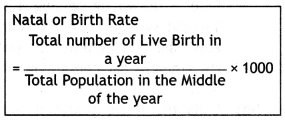
1. Birth or natality rate: It is generally expressed as the number of births per 1,000 individuals of a population per year. It increases the population size (total number of individuals of a population) and population density.

The national average birth rate in India is about 28.6 per 1,000 per year. Among Indian states, Kerala has the lowest birth rate of 18 per 1,000, while U.P. has the highest of 34.8 per 1,000.
Class 12 Biology Important Questions Chapter 4 Reproductive Health 1
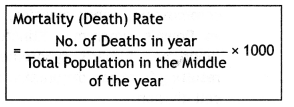
2. Death or mortality rate: It is the opposite of the natality rate. It is commonly expressed as the number of deaths per 1,000 individuals of a population per year.
Class 12 Biology Important Questions Chapter 4 Reproductive Health 2
3. Fertility rate: It is the number of live births per unit time per unit number of fertile females. Fertility Rate
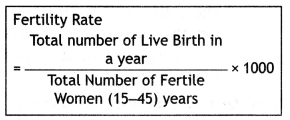
Class 12 Biology Important Questions Chapter 4 Reproductive Health 3

Question 15.
What is family planning? List the ways of family planning:
Answer:
Family planning: The main objective of family planning or family welfare program is to prevent the fertilization of the ovum by the male sperm and stop the increase in population growth by various methods, such as contraceptives, intrauterine devices, vasectomy, and tubectomy. The contraceptives (Anirudh) for males and intra-uterine devices, loop for females are used to avoid pregnancy.

Vasectomy is the method of sterilizing males by surgical operation of sperm duct or vas deferens. Tubectomy is the method of sterilizing females by the surgical operation of fallopian tubes. Whatever the method employed, it must take care of the health of the persons concerned.

Because of the family planning methods, the birth rate in India is reduced to some extent. The government gives incentives to those who adopt family planning.

Ways of family planning:

  • Late marriage for young persons.
  • Increase in the sources of recreation so as to divert the attention from sex.
  • The couple should not mate between 8-18th days from the start of the menstrual cycle.
  • Use of contraceptives.
  • Sterilization.
  • Use of drugs.
  • Abortion.
  • Restrict the family to two children.

Question 16.
Suggest the various measures of population control:
Answer:
Population control: Population explosion can be checked by two methods-population education and birth control.

A. Population education: The knowledge about the relationship of population size and the availability of resources for the welfare of the society is called population education.

  1. The students should be convinced about the relationship between overpopulation and unemployment.
  2. The citizens should be told how the large size of the population is eating away the resources of the state and the reasons for the limited availability of healthcare, education facilities, and other welfare schemes.
  3. People should be made aware of how a large number of children eat away the meager resources of the family with nothing left for bad days, how large families rely on indebtedness to meet emergencies, how child bread earners do not improve the conditions of the family, how uneducated children remain a burden on the society, etc. They should be convinced that a small family can live comfortably even with meager resources.

B. Birth control:

  1. Mass media of communication. Radio, television, newspapers, magazines, hoardings, and posters should be employed to spread the message of family planning and birth control and its advantages. The future of mankind depends on the stabilization of the human population at a level that ensures basic necessities of life, employment, and happiness,
  2. The law about marriageable age should be widely published and strictly enforced (21 years for boys and 18 years for girls). In developed countries, women marry at the age of 25-35 years.
  3. As far as possible, stress should be laid on raising the social status of women. Women having higher social status prefer smaller families. Such women generally marry late.
  4. Remove the superstitions and wrong beliefs in the society about a higher number of children being God’s gift connected with earthly or heavenly prosperity.

Question 17.
What is amniocentesis? Write its procedure and significance:
Answer:
Amniocentesis is a fetal sex determination test based upon the chromosomal pattern in the amniotic fluid surrounding the developing embryo. It should be legally banned throughout the country as such a ban shall check increasing female foeticide cases and maintain a normal sex ratio in the country.

Procedure:

  1. The fetus bathes in the amniotic fluid that fills the amniotic cavity. At an early stage of pregnancy (14th or 15th week), the location of the fetus and placenta is determined by sonography (use of high-frequency sound waves).
  2. Then a small amount of amniotic fluid is drawn by passing a special surgical syringe needle through the abdominal wall and uterine wall into the amniotic sac containing the amniotic fluid.
  3. Celts that have sloughed from the fetus’s skin or respiratory tract into the fluid are thus sucked into the syringe.

Significance:

  1. These cells can be examined for chromosomal abnormalities, such as Down’s syndrome, Klinefelter’s syndrome, Turner’s syndrome, etc resulting from non-disjunction during cell division.
  2. The cells can also be cultured and in about a fortnight enough cells become available for test. The cells and fluid are also tested for metabolic disorders such as phenylketonuria, sickle-cell anemia, etc.

Question 18.
Write a note on test-tube babies: (CBSE 2014)
Answer:
Test-Tube Babies: In some women normal conception is not possible because of blocked oviducts or spermicidal secretions in the vagina or the low sperm count of the husband. In such cases, her ovum is removed, fertilized by her husband’s sperm in a laboratory dish, checked that development has begun, and a morula (up to 32 cell stage) replaced or implanted in her uterus.

The entire operation is carried out under sterilized conditions. With proper medical care, she will give birth to a normal child on the completion of gestation. The baby produced in this manner (conceived out of and nursed in the uterus) is called a test-tube baby. The baby is not reared in the test tube. A scientific term for this procedure is in vitro (“in glass”) fertilization.

The success rate of the technique is less than 20%. To increase the chances of success, the prospective mother is given fertility drugs which cause many ovarian follicles to mature at the same time. This releases many eggs simultaneously, thereby increasing the chances of success.

A developing embryo can be inserted into the uterus of another female, called a surrogate mother, provided her hormones are in the proper phase of the reproductive cycle for implantation to occur.

Question 19.
Correct the following statements:
1. Surgical methods of contraception prevent gamete formation.
Answer:
Surgical methods of contraception block gamete transport and thereby prevent conception.

2. All sexually transmitted diseases are completely curable.
Answer:
Few sexually transmitted diseases are curable if detected at an early stage and some sexually transmitted diseases are not curable, e.g. AIDS.

3. Oral pills are very popular contraceptives among rural women.
Answer:
Oral pills are very popular contraceptives among educated urban women.

4. In E.T. techniques, embryos are always transferred into the uterus.
Answer:
In E.T. techniques, 8-celled embryos may be transferred into the fallopian tubes and more than 8-celled embryos are transferred into the uterus.

Question 20.
Reproductive and Child Healthcare (RCH) programs are currently in operation. One of the major tasks of these programs is to create awareness amongst people about the wide range of reproduction-related aspects. This is important and essential for building a reproductive health society.
1. “Providing sex education in schools is one of the ways to meet this goal.” Give four points in support of your opinion regarding this statement. (CBSE Delhi 2016)
Answer:
Sex education is important in schools:
(a) to provide the right information about myths and misconceptions.
(b) to create awareness about reproduction.
(c) to provide knowledge about the growth of reproductive organs and sexually transmitted diseases (STDs)
(d) to guide the students about social evils such as sex abuse, sex-related crimes, etc.

(ii) List any two indicators that indicate a reproductively healthy society.
Answer:
Indicators about a reproductively healthy society.
(a) Low infant mortality rate (IMR)
(b) Low maternal mortality rate (MMR)

  • Increased number of couples with small families.
  • Better detection and cure of STDs.

Question 21.
Give a brief account of Assisted Reproductive Technologies (ART). (CBSE Outside Delhi 2013, 2019)
Answer:
Where corrective treatments are not available, there are special techniques called Assisted Reproductive Technologies (ART) to help the couple produce children; they are as follows:
1. Test-Tube baby programs:
(a) In this method, ovum from the wife or a donor female and the sperms from the husband or a donor is allowed to fuse under simulated conditions (as that of the body) in the laboratory; it is called in vitro fertilization (IVF).

2. The zygote or early embryo is transferred into the uterus or fallopian tube for further development; this process is called Embryo Transfer (ET) and can be done in the following ways:
(a) The zygote or embryo up to eight blastomeres is transferred into the fallopian tube; it is called Zygote Intra Fallopian Transfer (ZIFT).
(b) Embryos with more than eight blastomeres are transferred into the uterus. It is called Intrauterine Transfer (IUT).

3. Gamete Intra Fallopian Transfer (GIFT): This method involves the transfer of an ovum collected from a donor female into another female, who cannot produce ova, but can provide suitable conditions for fertilization and further development of the fetus up to parturition.

4. Intra Cytoplasmic Sperm Injection (ICSI): In this method, the sperm is directly injected into the ovum to form an embryo in the laboratory, and then embryo transfer is carried out.

5. Artificial insemination:
(a) In this method, the semen collected from the husband or a healthy donor is artificially introduced into the vagina or into the uterus (intrauterine insemination).
(b) This method is used in cases where infertility is due to the inability of the male partner to inseminate the female or due to very low sperm counts in the ejaculates.

Question 22.
It is commonly observed that parents feel embarrassed to discuss freely with their adolescent children about sexuality and reproduction. The result of this parental inhibition is that the children go astray sometimes.
(i) Explain the reasons that you feel are behind such embarrassment amongst some parents to freely discuss such issues with their growing children.
Answer:
Parents feel embarrassed because of the following reasons:
(a) Indian society is not that broad-minded. So parents feel shy talking openly about these matters to their children.
(b) Improper communication and age gap are the reasons behind such embarrassment.

(ii) By taking one example of a local plant and animal, how would you help these parents to overcome such inhibitions about reproduction and sexuality? (CBSE Delhi 2017)
Answer:
Parents can take the example of China rose to explain the process of sexual reproduction. They can also take an example of the male honeybee and orchid Ophrys flower.

It is evident that sexual attraction is a natural phenomenon. The honeybee is attracted to an Ophrys flower and assumes its one petal as its female partner and pseudo copulate with it. So it is a natural phenomenon and parents should talk regarding this matter to their children.

Question 23.
(a) Explain one application of each one of the following:
(A) Amniocentesis:
Answer:

  • Detection of a genetic disorder
  • Detection of chromosomal disorder
  • Sex determination
  • Karyotyping (used for detecting chromosomal aberrations)

(B) Lactational amenorrhea:
Answer:
It is a kind of natural contraception to prevent pregnancy. When the women breastfeed regularly her menstrual cycle stops for some period and thus can’t have a baby.

(C) ZIFT:
Answer:
Application of ZIFT (Zygote Intrafallopian Transfer)- In vitro fertilization, the zygote or early embryos at eight blastomeres stage are transferred to the fallopian tale to complete its further development inside the body of the mother. Hence this method is very helpful for infertile couples.

(b) Prepare a poster for the school program depicting the objectives of the “Reproductive and Child Health Care Programme”. (CBSE Delhi 2019)
Answer:
Reproductive and Child Health Care:

Objectives of RCH:

  • Creating awareness about various reproduction-related problems.
  • Providing facilities and support for building up a reproductively healthy society.
  • Providing audio-visual and print, media support, to various government and non-government organizations.
  • Educating the people and providing the right information to save them from myths and misconceptions.
  • Providing proper education regarding reproductive organs, adolescence and related changes, safe and hygienic sexual practices.
  • Providing information regarding the danger of sexually transmitted diseases, AIDS, etc.
  • Awareness regarding that gender selection and detection is punishable.

Example – Hum do hamare do, Beti bachao beti padhao, Do boond zindasi ke etc.

Human Reproduction Class 12 Important Extra Questions Biology Chapter 3

Here we are providing Class 12 Biology Important Extra Questions and Answers Chapter 3 Human Reproduction. Important Questions for Class 12 Biology are the best resource for students which helps in Class 12 board exams.

Class 12 Biology Chapter 3 Important Extra Questions Human Reproduction

Human Reproduction Important Extra Questions Very Short Answer Type

Question 1.
Given below are the events in human reproduction. Write them in correct sequential order? Insemination, gametogenesis, fertilization, parturition, gestation, implantation.
Answer:
Gametogenesis, insemination, fertilization, implantation, gestation, parturition.

Question 2.
The path of sperm transport is given below. Provide the missing steps in blank boxes:
Class 12 Biology Important Questions Chapter 3 Human Reproduction 1
Answer:
A = Vasa efferentia; B = Vas deferens.

Question 3.
What is the role of the cervix in the human female reproductive system?
Answer:
The cavity of the cervix called the cervical canal, and the vagina collectively forms the birth canal for parturition. It also regulates the entry of sperms into the uterus.

Question 4.
Why are menstrual cycles absent during pregnancy?
Answer:
The high levels of progesterone and estrogens during pregnancy suppress the gonadotropins which are essential for the transformation of the primary follicle into Graafian follicle and ovulation.

Question 5.
Give the scientific term for the following:
1. Release of the ovum from the ovary.
2. Onset of the menstrual cycle in females.
3. The structures that pick up ova from the body cavity.
Answer:

  1. Ovulation
  2. Menarche
  3. Fimbriae.

Question 6.
What is the location of Cowper’s glands in the body?
Answer:
Cowper’s glands are situated laterally attached to the urethra beneath the urinary bladder at the base of spongy tissue.

Question 7.
Where are sperms stored in males?
Answer:
They are stored in the epididymis.

Question 8.
What is follicular atresia?
Answer:
Follicles in the ovaries which undergo regression and disappear due to death and disposal by phagocytes during the reproductive years of the female are referred to as follicular atresia.

Question 9.
Which particular part of mammalian sperm secretes enzymes to facilitate penetration of sperm?
Answer:
Acrosome.

Question 10.
Name the hormones involved in the regulation of spermatogenesis.
Answer:
GnRH, LH, FSH, Androgen Binding Protein (ABP), Inhibin, androgens.

Question 11.
How many eggs do you think were released by the ovary of a female dog which gave birth to six puppies? HOTS
Answer:
Six eggs.

Question 12.
What will happen if the fallopian tubes are partially blocked and the ovulated eggs are prevented from reaching the uterus?
Answer:
Fertilization may take place but the zygote may develop in the tube instead of the uterus.

Question 13.
Name the cells which produce testosterone. What is the function of this hormone?
Answer:
Interstitial cells (Leydig’s cells) of testis secrete the testosterone hormone. Function. They control secondary sexual characters.

Question 14.
How does the ovum which is released in the body cavity enter the fallopian tube?
Answer:
Ciliary movements of epithelial cells lining the lumen of nearby fallopian tubes induce the ovum to pass into the open fimbriated funnel-shaped end called ostium.

Question 15.
At what stage of life is oogenesis initiated in a human female? When does the oocyte complete oogenesis? (CBSE Sample Paper)
Answer:
Oogenesis is initiated during the embryonic development stage. It is completed at the time of ovulation.

Question 16.
When do morphogenetic cell movements take place?
Answer:
As blastocyst undergoes gastrulation.

Question 17.
Define spermiogenesis. Where does it occur? (CBSE Delhi 2008 (S))
Answer:
The transformation of non-motile spermatids into motile spermatozoa is called spermiogenesis. It occurs inside seminiferous tubules of testes.

Question 18.
How does colostrum provide initial protection against diseases to newborn infants? Give one reason. (CBSE 2009)
Answer:
The colostrum provides antibodies that are essential to developing resistance for newborn babies.

Human Reproduction Important Extra Questions Short Answer Type

Question 1.
Why scrotal sacs are present outside the body? (CBSE Outside Delhi 2014)
Answer:
The scrotal sac is a pouch of deeply pigmented skin divided into two separate sacs. Each sac contains one testis. The normal temperature of the testes in the scrotum is about 2°C lower than the internal body temperature, the ideal temperature for developing sperms.

Question 2.
Write the location and functions of Sertoli cells in humans? (CBSE 2012, 2014)
Answer:
Sertoli cells. These are present in the seminiferous tubules of the testis. They provide nutrition to germ cells. They play a vital role in the maturation of spermatids into motile sperms.

Question 3.
Name the muscular and glandular layer of the human uterus. Which one of these layers undergoes cyclic changes during the menstrual cycle? Name the hormone essential for the maintenance of this layer. (CBSE 2009)
Answer:

  1. Muscular layer – Myometrium
    Glandular layer – Endometrium.
  2. Endometrium undergoes cyclic changes during the menstrual cycle.
  3. LH hormone maintains the lining of the uterus.

Question 4.
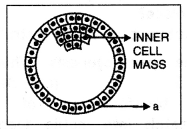
Study the figure given below and answer the questions that follow:
Class 12 Biology Important Questions Chapter 3 Human Reproduction 2
(i) Name the stage of the human embryo the figure represents.
Answer:
Blastocyst (Blastula).

(ii) Identify ‘a’ in the figure and mention its function.
Answer:
Trophoblast

(iii) Mention the fate of the inner cell mass after implantation in the uterus,
Answer:
Inner cell mass gets differentiated as embryo after implantation.

(iv) Where are the stem cells located in this embryo? (CBSE 2009)
Answer:
Stem cells are located in the inner cell mass.

Question 5.
Write two major functions each of testis and ovary?
Answer:
Functions of Testis:

  • Production of sperms and
  • Secretion of male sex hormones, androgens (e.g. testosterone).

Functions of Ovary:

  • Production of ova and
  • Secretion of female sex hormones, e.g. estrogens, progesterone.

Question 6.
What is the function of the acrosome and head?
Answer:
Functions of acrosome: It secretes sperm lysins which dissolve the membrane around the egg and thus facilitate the penetration of sperm into the ovum.

The function of the head: Head contains a nucleus that contains hereditary information. The fusion of nuclei is involved during fertilization.

Question 7.
Point out the differences in male and female urethra?
Answer:
In the case of the male urethra, there is a single opening for the elimination of urine and for the ejaculation of sperms. In females, there are two separate openings, one for the elimination of urine and the other is a vaginal orifice. The urethra in males is continued into the penis and in the case of females, it has not been found.

Question 8.
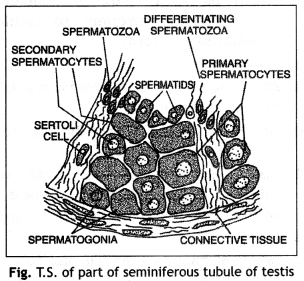
Draw a labeled diagram of a part of the seminiferous tubule showing spermatogenesis. (CBSE Delhi 2010, 2014, Outside Delhi 2019)
Answer:
Section of the testis:
Class 12 Biology Important Questions Chapter 3 Human Reproduction 3

Question 9.
During reproduction, the chromosome number (2n) reduces to half (n) in the gametes and again the original number (2n) is restored in the offspring. What are the processes through which these events take place?
Answer:

  1. Chromosome number is reduced to half or (n) during gametogenesis.
  2. Restoration of chromosome number to diploid or (2n) stage occurs during fertilization.

Question 10.
What is the significance of ampullary- isthmic junction in the female reproductive tract?
Answer:
The ampullary isthmic junction is the site where fertilization of the ovum takes place.

Question 11.
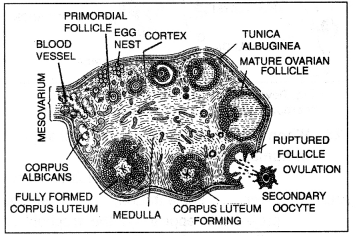
Draw a labeled diagram of the section through the ovary.
Or
Draw a labeled diagram of a section through the ovary showing various stages of follicles growing in it. (CBSE Delhi 2014, 2019)
Answer:
T.S. of Ovary:
Class 12 Biology Important Questions Chapter 3 Human Reproduction 4
Fig. T.S. of Ovary

Question 12.
Differentiate between Graafian follicle and Corpus luteum.
Answer:

Graafian follicleCorpus luteum
1. SphericaL or at the sac-Like mass of cells.1. Large mass of big conicaL yellow cells.
2. Each Graaflan follicle contains a Large, centrally placed ovum surrounded by many Layers of granuLar cells.2. It is the structure formed after the release of the ovum.
3. Estrogen hormone is secreted.3. Progesterone hormone is secreted.

Question 13.
Differentiate between spermiogenesis and speciation. (CBSE Outside Delhi 2019)
Answer:
Difference between spermiogenesis and Speramiation: Spermiogenesis is the process of transformation of non-motile spermatids into mature motile sperms (male-gametes) whereas speciation is the release of sperms from Sertoli cells of seminiferous tubules.

Question 14.
Define ooplasm and germinal vesicle.
Answer:

  • Ooplasm: The cytoplasm of the haploid ovum is called the ooplasm.
  • Germinal vesicle: The nucleus of the ovum at the time of fertilization is termed a germinal vesicle.

Question 15.
Explain the significance of fertilization.
Answer:
Significance of fertilization.

  1. The fusion of male and female pronuclei in fertilization restores the diploid number of chromosomes.
  2. The activation of secondary oocyte undergoes maturation to form ovum.
  3. Fertilization initiates cleavage or segmentation.
  4. The combination of the chromatin material from two different parents forms the physical basis of biparental inheritance and variation.

Question 16.
What is the cortical reaction?
Answer:
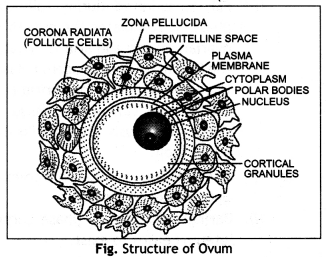
It is a reaction occurred during fertilization that presents polyspermy, i.e. fusion of multiple sperm with one egg. In this reaction, the cortical granules present beneath the secondary oocyte’s plasma membrane fuse with the plasma membrane and release their contents (enzymes) between the plasma membrane and zona pellucida. These enzymes harden the zona pellucida.

Question 17.
What is a fetus?
Answer:
It is the unborn young one of a viviparous animal after it has taken form in the uterus. In human beings, it represents the product of conception from the end of the eighth week to the moment of birth.

Question 18.
List the characteristics of the morula stage.
Answer:
Characteristics of morula stage:

  1. The embryo consists of a solid ball of cells called blastomeres. They are arranged like a mulberry.
  2. Morula consists of an outer layer of smaller cells and an inner mass of larger cells.
  3. Zona pellucida layer persists during morula.

Question 19.
What is the placenta?
Answer:
It is the structure formed by the union of the fetal and uterine tissue for purpose of nutrition, respiration, and excretion of the embryo. Although the blood vessels of the embryo and the mother come close but are kept separated by some barriers between them. The useful substances pass from maternal blood to fetal blood while the wastes (excretory products and C02) are passed from the fetal blood to maternal blood.

Question 20.
Give the names and functions of the hormones involved in the process of spermatogenesis. Write the names of the endocrine glands from where they are released.
Answer:

HormoneEndocrIne glandFunctions
(1) FSHAntenor pituitaryStimuLates Sertoli cells to secrete some factors which help in spermatogenesis.
(2) ICSH/LH-do-StimuLates Leydig’s cells of testes to secrete androgens (especially testosterone) which regulate spermatogenesis.

Question 21.
How does colostrum provide initial protection against diseases to newborn infants? Give one reason. (CBSE 2009)
Answer:
The colostrum provides antibodies that are essential to developing resistance for newborn babies.

Question 22.
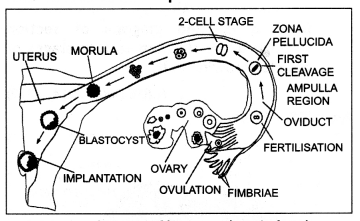
Diagrammatically shows the development of the human embryo in the female reproductive tract.
Answer:
Events of development:
Class 12 Biology Important Questions Chapter 3 Human Reproduction 5
Fig. Development of the human embryo in the female reproductive tract (Fertilisation-implantation)

Question 23.
When and where do chorionic villi appear in humans? State their function. (CBSE Delhi 2013, 2019)
Answer:

  1. After implantation, finger-like projections appear on the trophoblast called chorionic villi. They are surrounded by uterine tissue and maternal blood.
  2. The chorionic villi and uterine tissue become interdigitated with each other and jointly form structural and functional units between the developing embryos and maternal bodies called the placenta.

Question 24.
State the fate of the trophoblast of a human blastocyst at the time of implantation and that of the inner cell mass immediately after implantation. (CBSE Outside Delhi 2019)
Answer:
The trophoblast layer of the human blastocyst gets attached to the endometrium and the inner cell mass gets differentiated into an embryo. After attachment, the uterine cells divide rapidly and cover the blastocyst. As a result, the blastocyst becomes embedded in the endometrium of the uterus. It is termed Implantation.

Human Reproduction Important Extra Questions Long Answer Type

Question 1.
Briefly explain the primary male sex organs of man.
Answer:
The testes, male gonads, produce sperms that are suspended outside the abdominal cavity in a sac of skin called the scrotum. It results in maintenance of the temperature of the testis which is lower than the rest of the body. It is a condition favorable to sperm production.

Each testis is an oval-shaped structure and is composed of a large number of seminiferous tubules surrounded by connective tissue in which occurs numerous cells called Interstitial cells or Leydig cells. These cells produce a male sex hormone named testosterone. Seminiferous tubules are lined by a layer of germinal epithelial cells. In between the germinal cells, certain large cells called Sertoli cells are present. They are nutritive in function. The germinal epithelial cells produce sperms by spermatogenesis.

Question 2.
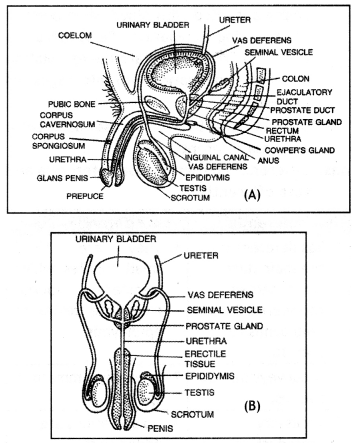
Draw well-labeled sketches of the front view and sagittal section of the male reproductive system of man. (CBSE Delhi 2019)
Answer:
The male reproductive system of man:
Class 12 Biology Important Questions Chapter 3 Human Reproduction 6

Question 3.
Explain the events taking place at the time of fertilization of an ovum in a human female. (CBSE 2010, 2014, (Delhi) 2016)
Answer:
Fertilization is the fusion of two gametic nuclei to form a diploid zygote. It involves a series of chemical and physical steps as follows:

The cortical cytoplasm of the ovum shows the physicochemical reactions called the cortical reactions:

  1. Sperm lysins dissolve the membranes around the egg.
  2. The Head of sperm containing a nucleus and proximal centriole physically passes into the ovum.
  3. Normally these reactions result in the formation of a fertilization membrane outside the egg plasma membrane.
  4. Cortical granules burst and release their contents between the egg plasma membrane and zona pellucida, i.e. perivitelline space (no fertilization membrane formation). The plasma membrane shows increased permeability for water, phosphate, and potassium.
  5. The electrical potentiality of plasma membrane changes from positive to negative, NAD kinase enzyme becomes activated after fertilization for the oxidation and reduction reaction of the cell.
  6. The rate of DNA synthesis increases with great pace after fertilization. Hence the ovum is now ready for mitosis (cleavage).
  7. Cleavage results in multicellular individuals.

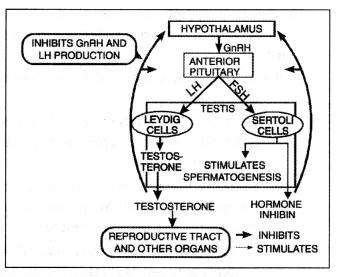
Question 4.
Give the hormonal control of the male reproductive system. (CBSE Delhi 2009)
Answer:
Hormonal control of the male reproductive system:
1. Hypothalamus: It releases gonadotropin-releasing hormones (GnRH) which bring the release of gonadotropins from the pituitary.

2. Anterior pituitary secretes two gonadotropins:
(a) Follicle Stimulating Hormone (FSH): It stimulates spermato¬genesis in the germ cells of seminiferous tubules of the testis to produce haploid and motile male gametes, called spermatozoa, so is also called games kinetic hormone.
Class 12 Biology Important Questions Chapter 3 Human Reproduction 7
Fig. Hormonal control of the male reproductive system

(b) Interstitial Cells Stimulating Hormone (ICSH): It stimulates interstitial cells to secrete male sex hormone called testosterone.

3. Sertoli cells secrete androgen binding protein (ABP) which concentrates testosterone in the seminiferous tubules.

4. Testosterone hormone secreted by interstitial or Leydig’s cells of testes. It regulates secondary sex organs and secondary sexual characters. It regulates the growth, maintenance, and functioning of secondary sex organs like epididymis, vasa deferentia, prostate gland, seminal vesicles, penis, etc. Testosterone also stimulates the development of mate secondary sexual characters like the appearance of facial hair, deepening of the voice, broadening of shoulders, elongation of bones, and increase in height.
Question 5.
Give an account of the secondary sex organs of a human male. (CBSE Delhi 2011)
Answer:
Secondary Sex OrgAnswer: The tubules meet and join at one end of the seminiferous to form ducts called rete testes that form vasa efferentia leading to the epididymis. It is a narrow tube about 6 m long lying in a coiled mass on the outside of the testis and store sperms. The epididymis in turn leads to the muscular sperm duct, the two sperm ducts open into the top of the urethra, just below the point where it leaves the bladder.

In a short coiled tube, the seminal vesicle branches from each sperm duct just above its opening into the urethra. Reproductive glands. They open into the urethra, the prostate gland, which surrounds it at the point where it leaves the bladder and Cowper’s gland a little lower down.

The urethra in males traverses through the corpus Spongiosum of the penis. Corpora Spongiosum consists of spongy and highly vascular connective tissue containing numerous small spaces that are normally empty but filled with blood when the penis is erect during copulation. The penis becomes erect and firm to facilitate the ejaculation of semen (spermatic fluid) into the vagina of the female.

Question 6.
Differentiate between vasa deferentia and vasa efferentia.
Answer:
Differences between vasa deferentia and vasa efferentia:

Vas deferensVasa efferentia
1. Vas deferens is the main duct that carries the sperms from the epididymis to the urethra.1. They are 10-20 smaLL tubuLes which transfer sperms from rete testes to the epididymis.
2. It conveys mature sperms.2. It conveys immature sperms.
3. Accessory reproductive glands pour their secretions into it.3. No secretions are added to it.

Question 7.
Describe the structure of the seminiferous tubule.
Answer:
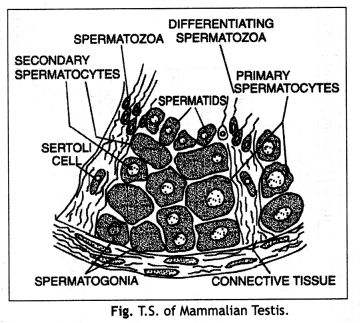
Each seminiferous tubule is lined by germinal epithelium. The majority of cells in this epithelium are cuboidal spermatogenic cells but a few are large, pyramidal, supporting Sertoli or nurse cells. The cuboidal cells, by mitotic divisions, produce spermatogonia into the lumen of the seminiferous tubule.

The spermatogonia grow into primary spermatocytes, which undergo meiosis, producing haploid cells, first secondary spermatocytes, and then spermatids. The latter metamorphose into spermatozoa. Differentiation of spermatozoa from spermatogonia is called spermatogenesis. The spermatozoa are nourished during development by nurse cells. Mature spermatozoa lie free in the cavity of the seminiferous tubules. Scattered in the connective tissue are Leydig’s cells which secrete a hormone called testosterone.

Question 8.
The mother germ cells are transformed into a mature follicle through series of steps. Provide the missing steps in the blank boxes.
Class 12 Biology Important Questions Chapter 3 Human Reproduction 8
Answer:
A = Primary oocyte; B = Secondary follicle, C = Tertiary follicle.

Question 9.
What is the difference between a primary oocyte and a secondary oocyte?
Answer:

primary oocytesecondary oocyte
1. It is a diploid structure.1. It is a haploid structure.
2. It is formed from oogonium through mitosis and differentiation.2. It is formed from the primary oocyte after it undergoes the first meiotic division.
3. No polar body is formed during its development.3. A polar body is extruded during its formation.

Question 10.
What is spermiogenesis? List the changes that take place during spermiogenesis.
Answer:
Spermiogenesis. The process of differentiation of motile sperm from the spermatid is called spermiogenesis.

Changes during spermiogenesis:

  1. The nucleus becomes compact and forms the head.
  2. Distal centriole forms the tail of the sperm.
  3. The acrosome is formed at the tip of the head.
  4. Mitochondria get arranged in the form of a spiral.
  5. The cytoplasm is changed to a sheath.

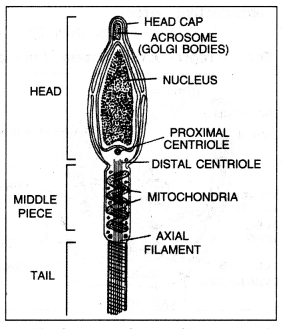
Question 11.
Draw a mammalian sperm and label its four major parts. (CBSE Delhi 2008, 2011, 2013)
Answer:
Class 12 Biology Important Questions Chapter 3 Human Reproduction 9

Question 12.
Give the functions of the following:
1. corpus luteum
2. endometrium
3. acrosome
4. sperm tail
5. fimbriae.
Answer:
1. Functions of corpus luteum:
(a) It secretes a small amount of estradiol hormone and a significant amount of progesterone.
(b) It also secretes the relaxin hormone.

2. Functions of the endometrium:
(a) It is an internal layer of the uterus. It undergoes cyclic changes during the menstrual cycle.
(b) It provides pits for implantation of the blastocyst.
(c) It takes part in the formation of the placenta.

3. Function of acrosome: It contains hydrolytic enzymes that are used to contact and penetrate the egg at the time of fertilization.

4. Function of sperm tail: It provides motility to the sperm.

5. Function of fimbriae: They help in the collection of ovum after ovulation.

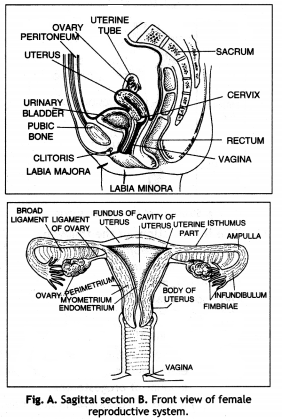
Question 13.
Draw a labeled diagram of the human female reproductive system. (CBSE Delhi 2011, 2013)
Answer:
The female reproductive system of human:
Class 12 Biology Important Questions Chapter 3 Human Reproduction 10

Question 14.
Write a short note on the structure and functions of the vagina.
Answer:
Structure of vagina: The vagina is a muscular tube lined with a membrane. It is composed of a special type of stratified epithelium which is supplied with blood vessels and nerves. It extends from the uterus to the vestibule. The anterior surface of the vagina is in relation to the base of the bladder and urethra. The vagina receives the male sex organ during copulation.

Functions of the vagina:

  1. It receives the penis of males during copulation.
  2. It serves as the receptacle for the sperms.
  3. It acts as a birth canal.

Question 15.
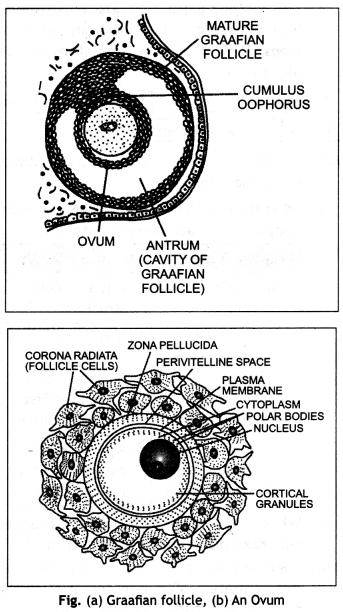
Draw a labeled diagram of the Graafian follicle and ovum. (CBSE 2011, 2012)
Answer:
Graafian follicle:
Class 12 Biology Important Questions Chapter 3 Human Reproduction 11

Question 16.
What is a menstrual cycle? Give an account of a simplified 28-day menstrual cycle. (CBSE 2019 C, Outside Delhi 2019)
Answer:
Menstrual cycle: The cycLic changes that occur in the reproductive organs of primate femaLes (monkeys, apes, and human beings) constitute the menstruaL cycLe. The cycLe of events starts from one menstruation tiLt the onset of the next and Lasts for about 28/29 days (a menses).

Simplified menstrual cycle (28-day Cycle):

PhaseDaysEvents
Menstrual phase1-5Endometrium breaks down, menstruation begins. The cells of en domain urn, secretions, blood, and the unfertilized ovum constitute the menstrual flow.
Follicular phase (ProLiferative phase)6-13Progesterone production is reduced. In fact, menstrual flow is associated with withdrawaL of progesterone.
Ovulatory phase14Endometrium rebuilds, FSH secretion, and estrogen secretion increase.
Luteal phase (Secretory phase)15-28Both LH and FSH attain a peak level. The concentration of estrogen in the blood is also high and reaches its peak. Ovulation occurs. Corpus luteum secretes progesterone. The endometrium thickens and uterine glands become secretory.

Question 17.
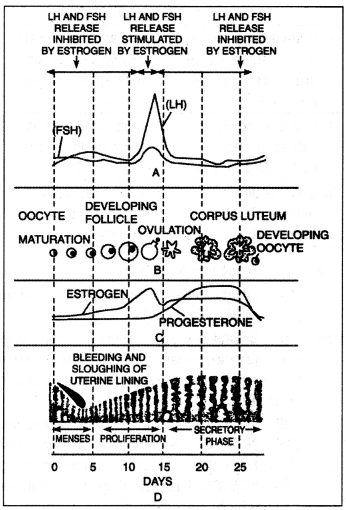
Show with graphic sketch the hormonal control over the menstrual cycle.
Class 12 Biology Important Questions Chapter 3 Human Reproduction 12
Fig. MenstruaL cycLe showing hormonal relations: (A) Gonadotropin, (B) Ovarian cycle, (C) Ovarian hormones, (D) Uterine cycle.

Question 18.
DifferentIate between proliferative and secretory phases.
Answer:
Differences between proliferative and secretory phases:

Proliferative phasesSecretory phases
1. Growth of Graafian follicle and maturation and release of ovum occurs.1. Prepares the uterus for receiving the fertilized ovum and in case, there is no fertilization, endometrium breaks resulting in bleeding.
2. It is the first phase that follows menstruation.2. It is the second phase that folLows after the release of an ovum.
3. It starts on the 5th day of menstruaL cycLe and Lasts up to 14 days.3. It starts after the 14th day when the corpus Luteum is formed.
4. It is caused by estrogen and controLled by FSH.4. Corpus Luteum is formed under the impact of LH.
5. Contraction of uterine muscLes increases.5. Contraction of uterine muscles decreases.

Question 19.
1. What is ovulation?
2. What happens to the Graafian follicle after ovulation?
Answer:
1. Ovulation: The release of eggs (at secondary oocyte stage) after rupturing of Graafian follicle is called ovulation.

2. After the ovulation, the granulosa cells as well as the stroma cells from theca Interna rapidly multiply to fill the cavity of the Graafian follicle which becomes the corpus luteum. If fertilization occurs, the corpus luteum grows further and secretes hormone. If fertilization does not take place, the corpus luteum regresses and forms a yellow body.

Question 20.
Differentiate between zona pellucida and corona Radiata.
Answer:
Differences between zona pellucida and corona Radiata:

Zona PellucidaCorona Radiata
1. The non-ceLLuLar, secretory layer around the ovum is termed zona Pellucidar (or Coleman).1. The ceLLular layer around zona petLucida is termed Corona Radiata.
2. This Layer is thick and transparent.2. It is a very thick layer of follicular cells with granular cytoplasm.
3. It encLoses perivitelline space around the pLasma membrane.3. It does not enclose any space.

Question 21.
Compare mature mammalian sperm and ovum.
Answer:
Similarities:

  1. Both are gametes and take part in fertilization,
  2. Both are haploid.
  3. Both are a carrier of the heredity characters,
  4. Both are unicellular structures.

Differences:

Mammalian spermMammalian ovum
1. Sperm is motiLe and encLosed by an only singLe plasma membrane.1. Ovum Is sphericaL, non-motile, and surrounded by zona pesticide and corona radiate.
2. It is differentiated into four parts, i.e. head, neck, middle piece, and tait.2. It is a spherical, aLecithaL egg with acentric nucLeus.
3. SmaLL amount of cytopLasm present.3. A large amount of cytoplasm.
4. Centriotes and acrosome present.4. CentnoLe and acrosome absent.
5. Mitochondria arranged in the form of a spiral.5. Mitochondria scattered in the cytoplasm.

Question 22.
Briefly explain the steps of fertilization. (CBSE Delhi 2019)
Answer:
Fertilization is the process of fusion of motile sperm and non-motile ovum which takes place in the fallopian tube (oviduct).

  • Fertilization is internal in human females.
  • Fertilization is a Physico-chemical process.
  • Acrosome in sperm’s head releases enzymes that dissolve the membrane of the egg to facilitate entry of sperm into the ovum.

Steps involved during fertilization:

  1. Acrosomal reactions and penetration of sperm.
  2. Cortical granule reaction.
  3. Formation of pronuclei.
  4. The fusion of pronuclei.

Question 23.
In our society, women are often blamed for giving birth to their daughters. Can you explain why this is not correct? (CBSE Delhi 2014)
Answer:
Sex chromosomes determine sex in human beings. In males, there are 44+XY chromosomes, whereas, in females, there are 44+XX chromosomes. Here X and Y chromosomes determine sex in human beings.

Two types of gametes are formed in males, one type is having 50% X-chromosome, whereas another type is having Y-chromosome. In females, gametes are of one type and contain X-chromosome. Thus females are homogametic. If a male gamete having Y-chromosome (endosperm) undergoes fusion with a female gamete having an X-chromosome, the zygote will have an XY chromosome and this gives rise to a male child.

If a male gamete having an X-chromosome (gymnosperm) undergoes fusion with a female gamete having an X-chromosome, the zygote will be having XX-chromosome and this gives rise to a female child.

Question 24.
What is fetal ejection reflex? Explain how it leads to parturition?
Answer:
Fetal ejection reflex is a neuroendocrine mechanism initiated by a fully formed fetus and placenta which helps in parturition.

It operates as below:

  1. Foetus secretes hormones from its adrenal glands. These hormones stimulate the posterior pituitary of the mother to release oxytocin.
  2. Oxytocin causes forceful contraction of smooth muscles of myometrium called labor pains, which further stimulates more secretion of oxytocin.
  3. The stimulatory reflex between uterine contraction and oxytocin secretion continues which causes more forceful contraction of uterine muscles.
  4. Uterine contraction pushes the young gradually out through the dilated cervix (caused by relaxin) and vagina.

Question 25.
Give an account of the histology of testis.
Answer:
Each testis is composed of a large number of seminiferous tubules surrounded by connective tissue in which there are numerous cells present called interstitial cells or Leydig cells. The testis is covered by a layer of dense connective tissue called tunica albuginea. From it, various septa radiate inward into the cavity of the testis dividing it into many lobules. The seminiferous tubules are coiled structures.

Each tubule is lined by a layer of germinal epithelial cells. In between the germinal cells, certain large cells called Sertoli cells are present. They are nutritive in function. The germinal epithelial cells give rise to sperms. They are in various stages of development like spermatogonia, primary spermatocytes, secondary spermatocytes, and spermatids. The Leydig cells which lie in connective tissue produce a male sex hormone called testosterone.

Question 26.
Explain the histological structure of the mammalian ovary.
Answer:
The ovary is a female gonad: It produces female sex cells called ova and the female sex hormones. Histologically the ovary is composed of fibrous connective tissue.

Its central part is called the stroma. It contains blood capillaries and nerve fibers. The outer part is called the cortex. A large number of Graafian follicles are embedded in a cortical layer. Each follicle is sac-shaped and contains female germ cells. It develops from the germinal layer. In a sexually mature female, the follicles are all at different stages of development and of different sizes. The cells of follicles are all of different sizes.

The cells of the follicle secrete a hormone called estrogen. In the connective tissue are present corpus luteum. It is formed at the site of a ruptured Graafian follicle. It secretes another hormone called progesterone.

Question 27.
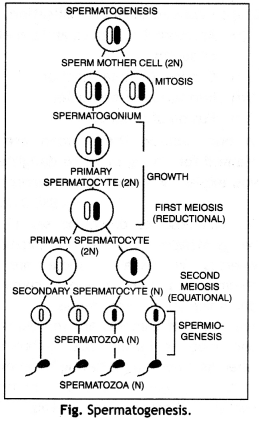
What is spermatogenesis? Briefly describe the process of spermatogenesis.
Or
Give a schematic view of spermatogenesis in humans. (CBSE Delhi 2008, 2010)
Answer:
Spermatogenesis. The process of sperm formation from the sperm mother cells of testis (male gonad) is called spermatogenesis. It is completed in four phases, viz. spermatocytogenesis, meiosis I, meiosis II, and spermiogenesis. Spermatocytogenesis, Meiosis I and Meiosis II. The sperms are formed from the sperm mother cells present in the germinal layer of seminiferous tubules of the testis. Some of the mother cells enlarge to divide mitotically to form spermatogonia.

Growth phase: Some of them enter a period of growth and are called primary spermatocytes which are diploid.

Maturation phase: These cells divide meiotically to form two haploid secondary spermatocytes. Each secondary spermatocyte again divides mitotically. Thus one primary spermatocyte forms haploid spermatids.

Spermiogenesis: These develop into complete spermatozoan. These possess head which is embedded in the nourishing cells called Sertoli cells. The process of conversion of spermatid into spermatozoan is called spermiogenesis or spermine peliosis.

Since each primary spermatocyte divides meiotically to form 4 sperms thus 400 sperms or spermatozoa will be formed from 100 primary spermatocytes. The sperm consists of the acrosome (head), nucleus, and tail.

When sperm production starts, this age is called sexual maturity. It is generally 14-16 years. Spermatogenesis is controlled by the hormone (FSH) of the anterior lobe of the pituitary gland.
Class 12 Biology Important Questions Chapter 3 Human Reproduction 13

Question 28.
What role do pituitary gonadotropins play during the follicular and ovulatory phases of the menstrual cycle? Explain the shifts in steroidal secretions.
Answer:
Gonadotropin-releasing hormone (GnRH) also called gonadotropin-releasing factor (GnRH) is secreted by the hypothalamus of the brain, which stimulates the release of follicle-stimulating hormone (FSH) and luteinizing hormone (LH). FSH stimulates the ovarian follicles to produce estrogens during the proliferative phase. LH stimulates the corpus luteum of the ovary to secrete progesterone.

  1. The menstrual phase is caused by the reduction of progesterone and estrogens.
  2. The proliferative phase is caused by the increased production of estrogens.
  3. LH causes ovulation. LH also causes a transformation of the empty Graafian follicle into the corpus luteum by luteinization inside the ovary. LH also stimulates the corpus luteum to secrete progesterone hormone to help in implantation, placentation, and maintenance of pregnancy.
  4. A secretory phase is caused by the increased production of progesterone.

Question 29.
A woman has conceived and implantation has occurred. Discuss the sequence of changes up to parturition which will take place within her body under the influence of hormones.
Answer:

  1. Under the impact of progesterone and estrogen the size of the uterus and birth canal increases. Relaxation of pelvic ligament takes place. The placenta is developed between chorionic and uterine tissues.
  2. Breast size increases to full maturity under the impact of progesterone. Corpus luteum grows in the early month and then regresses in the later month.
  3. Menstrual cycle and ovulation do not occur.
  4. Uterine changes: Sex hormones, the estrogenic and placental gonadotropins are excreted with urine.
  5. The volume of blood increases.

Some of the endocrine glands such as the adrenal cortex, anterior pituitary, and thyroid show enlargement. Relaxin hormone is essential in relaxing the pelvic ligament during parturition.

Oxytocin controls uterine contraction during childbirth.

Question 30.
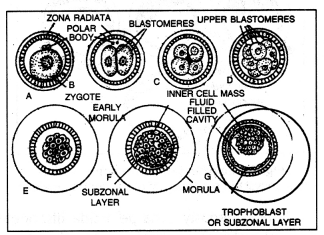
The zygote passes through several developmental stages till implantation. Describe each stage briefly with suitable diagrams. (CBSE 2010)
Answer:
Cleavage is a holoblastic type but there is a tendency to show size differences of the blastomeres from the very start. Cleavage
Class 12 Biology Important Questions Chapter 3 Human Reproduction 14

Fig. CLeavage in mammalian ovum (pig) Fri sectional view A. zygote; B. two-ceU stage; C. four-cell stage: D. sixteen-celL stage; E. morula stage; F and G. Blastocyst (diagrammatic)

The first cleavage takes place in the cytoplasm of the ovum on an imaginary axis (animal pole to vegetal pole). The first division results in two blastomeres. One blastomere is slightly larger than the other. The larger cell divides first and thus forms the three blastomeres. Then the smaller blastomere divides and thus four blastomeres are formed. It is a 4-celled stage.

2nd cleavage is at a right angle to the 1st cleavage. One member of the large blastomeres of 4-cell stage divides forming 5-cell condition followed by 6-7 stage ultimately 8-celled stage. Successive cleavage divisions result in the formation of the solid mass of cells. The thus solid ball-like stage is called the morula stage.

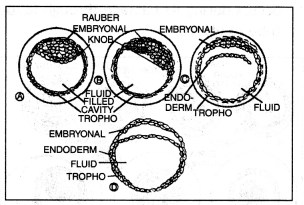
Conversion of morula into blastula is initiated by dynamic rearrangement of small blastomeres. A central fluid-filled cavity called blastocoel (segmentation cavity) appears. Externally placed blastomeres lose their rounded form and become flat. This trophoblast along with the lining of the uterus forms extra-embryonic membranes. This provides protection and nourishment to the developing embryo.
Class 12 Biology Important Questions Chapter 3 Human Reproduction 15

Fig. Development of a blastodermic vesicle (blastocyst) in pig (diagrammatic sectional view).

Simultaneously zona pellucida disappears and the embryo gets implanted into the uterus. Below the blastodermic vesicle, there appears formative tissue, i.e. inner cell mass. From this inner cell mass, the proper embryo is formed.

Question 31.
Explain the following:
(i) Failure of testes to descend into the scrotum produces sterility.
Answer:
Failure of testes to descend into scrotum is called cryptorchidism. It leads to sterility because the scrotum provides a lower temperature (2°C) than the body temperature necessary for the spermatogenic tissue of testes to produce sperms.

(ii) Spermatids possess a haploid chromosome number.
Answer:
Spermatids possess haploid chromosome numbers because they are produced as a result of spermatogenesis (a kind of reductional or meiotic division). Moreover, it is essential because during fertilization diploid number of chromosomes will be restored in the fertilized egg. The haploid number of chromosomes in the spermatids helps in the maintenance of a specific number of chromosomes in the species.

(iii) The first half of the menstrual cycle is called the proliferative phase as well as the follicular phase.
Answer:
The first half of the menstrual cycle is called the follicular phase because estrogens secreted by the cells of maturing Graafian follicles control the changes in the secondary sex organs. It is also called the proliferative phase because the growth and proliferation of tissue on the wall of the uterus, vagina take place.

(iv) The second half of the menstrual cycle is called the luteal phase as well as the secretory phase.
Answer:
The second half of the menstrual cycle is called the secretory phase as well as a luteal phase because during this phase secretion occurs due to the luteinizing hormone (LH) which stimulates ovulation, the formation of corpus luteum and progesterone.

(v) Primary sex organs control the growth, function, and maintenance of secondary sex organs.
Answer:
Primary sex organs control the growth, function, and maintenance of secondary sex organs because they secrete hormones such as testosterone in males and estrogen and progesterone in females.

(vi) Why are the human testes located outside the abdominal cavity? Name the pouch in which they are present. (CBSE 2014)
Answer:
(a) Testes are located in the scrotal sac (scrotum).
(b) It helps in maintaining the low temperature (2-2.5°C) lower than the normal body temperature required for maturation of sperms.

Question 32.
Describe the formation of three germ layers in a mammalian embryo.
Answer:
The blastodermic vesicle is surrounded by the outer cellular layer (trophectoderm). The blastodermic vesicle shows an internal cluster of cells due to differentiation. This cluster of cells is called inner cell mass. Now the morphogenetic movements (epiboly, emboly, etc.) of the cells in small masses or sheets take place. As a result, three germinal layers (i.e. endoderm, mesoderm, and ectoderm) are formed. Formation of endoderm.

Some cells from the inner cell mass detach. Cells move in sheets or masses in the blastocoel. These are the potential endodermal cells. These cells arrange themselves as second layer inner to the outer layer of a blastodermic vesicle. The blastocoel disappears and a new cavity appears. This new cavity is called archenteron or primitive gut. This archenteron will give rise to the gut tract.

Formation of mesoderm: At the margin of the embryonic disc, cells multiply at an increased rate. The thickness of the embryonic disc increases. These cells detach from the embryonic disc and give rise to the mesoderm.

Formation of ectoderm: After the formation of mesoderm, the cells of the embryonic disc arrange themselves so as to form the ectoderm.

Question 33.
Write functions of the placenta.
Answer:
The placenta serves primarily as an organ that permits the interchange of materials carried in the blood of mother and fetus. Its main functions are:

  • Nutrition: Supply of nutrient materials to the fetus.
  • Respiration: Supply of 02 to the fetus and receives C02 back from it.
  • Excretion: Fluid nitrogenous waste products escape through the placenta.
  • Barrier: The placenta is a barrier-like semipermeable membrane.
  • Storage: The placenta stores fat, glycogen, and iron for the embryo before the formation of the liver.
  • Hormonal function: The placenta secretes extra ovarian hormones estrogen and progesterone in females during pregnancy that serves to maintain the fetus.

Question 34.
Briefly describe the process of oogenesis. (CBSE 2004)
Or
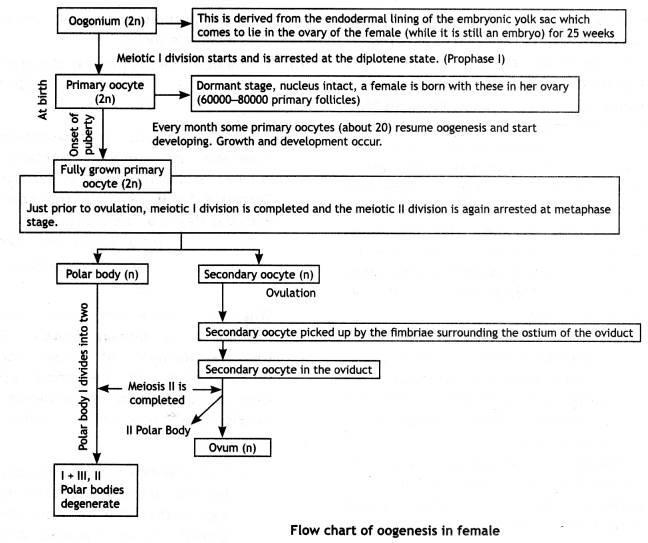
Give a schematic representation of oogenesis in humans. Mention the number of chromosomes at each stage. Correlate the life phases of the individual with the stages of the process. (CBSE (Delhi) 2008, 2009 (S), Outside Delhi 2013)
Or
When and where are primary oocytes formed in a human female? Trace the development of these oocytes till ovulation (in the menstrual cycle). How do gonadotropins influence this developmental process? (CBSE 2010)
Answer:
Oogenesis:
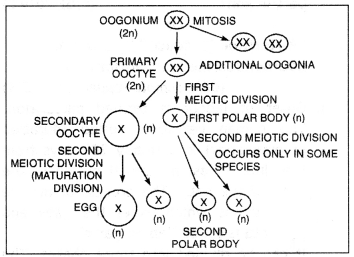
1. The phenomenon of the formation of haploid ova (egg) from the diploid egg mother cell of Ovary (female gonad) is called oogenesis. It occurs in three phases, i.e. multiplication, growth, and maturation.
Class 12 Biology Important Questions Chapter 3 Human Reproduction 16
Fig. Oogenesis

2. One ovum (n) is formed from one primary oocyte (2n) as a result of oogenesis.
3. The oogenesis is also controlled by the FSH hormone.
Class 12 Biology Important Questions Chapter 3 Human Reproduction 17

Question 35.
How does parturition take place? Which hormones are involved in the induction of parturition? (CBSE 2019 C)
Or
‘Parturition is induced by a complex neuroendocrine mechanism’. Justify. (CBSE Sample Paper 2018-2019)
Answer:
The onset of labor is termed parturition. The human gestation period (duration of pregnancy) is normally 280 days from the time of the last menstrual period to the birth of the baby. The process of uterine contractions that expel the baby and placenta is called ‘labor pains’.

It can be divided into three phases. The first stage is dilation, which usually lasts from 2 to 20 hours and ends up with the cervix of the uterus fully open or dilated. The second state, expulsion which lasts from about 2 to 100 minutes begins with full crowning, the appearance of the baby’s head in the cervix and continues while the baby is pushed, head first, down through the vagina into outside where it draws its first breath.

During this phase, placentation which lasts for 10-15 minutes after the birth of the child, the placenta and the fetal membranes are loosened from the lining of the uterus by another series of contractions and expelled. They are collectively called after birth or decidua.

Hormonal control:

  • Oxytocin (birth hormone) promotes the contraction of the uterine muscles.
  • Relaxin allows the pubic symphysis and ligaments to dilate.
  • Corticotropin-releasing hormone (CRH) takes part in the ‘Clock’ that establishes the timing of birth.

Question 36.
A mother is ready to feed her newborn baby just after parturition by nature.
(i) Name the cells which secrete milk.
Answer:
Lacteriferous cells of alveoli of mammary glands. They are present in the breast.

(ii) Name the process of producing the milk.
Answer:
Lactation.

(iii) Name the milk produced during the first few days, after parturition.
Answer:
Colostrum.

(iv) Name the hormone meant for the release of milk.
Answer:
Oxytocin hormone released by the posterior lobe of the pituitary body.

(v) Why the doctors recommend breastfeeding during the initial period of infant growth? (CBSE Delhi 2016)
Answer:
Mother’s milk is low in fat but rich in proteins such as lactalbumin and lactoprotein. Colostrum also contains major immunoglobin IgA. It provides passive immunity to the newborn baby.

Question 37.
Describe the structure of an ovum.
Or
1. Draw a diagram of the structure of a human ovum surrounded by corona Radiata. Label the following parts:
(a) Ovum
(b) Plasma Membrane
(c) Zona Pellucida.
2. State the function of Zona Pellucida. (CBSE Delhi 2013)
Class 12 Biology Important Questions Chapter 3 Human Reproduction 18

Answer:
1. Structure of ovum: Most animaL eggs are spherical or oval, non-motiLe but on close examination, it is noted that one pole is different from the other. The pole from which polar bodies are given off is called an animal pole while the opposite is termed as a vegetal pole. Thus it is said to have polarity. Thus various cytoplasmic substances are distributed along the axis in an unequal manner.

The nucleus also called (germinal vesicle) having a chromatin network is surrounded by the nuclear membrane. It also contains prominent nucleolus. All animal eggs contain some reserve material to provide food called yolk. The cytoplasm of an ovum is called the ooplasm. It lacks a centrosome but contains cortical granules derived from Golgi bodies in its outer region termed cortex.

2. Function of Zona pellucida: During fertilization as a result of the cortical reaction, zona pellucida hardens and prevents the entry of additional sperms (polyspermy).

Question 38.
(i) Explain the following phases in the menstrual cycle of a human female:
(a) Menstrual phase
(b) Follicular phase
(c) Luteal phase
Answer:
Menstrual cycle: The cyclic changes that occur in the reproductive organs of primate femaLes (monkeys, apes, and human beings) constitute the menstruaL cycLe. The cycLe of events starts from one menstruation tiLt the onset of the next and Lasts for about 28/29 days (a menses).

Simplified menstrual cycle (28-day Cycle):

PhaseDaysEvents
Menstrual phase1-5Endometrium breaks down, menstruation begins. The cells of en domain urn, secretions, blood, and the unfertilized ovum constitute the menstrual flow.
Follicular phase (ProLiferative phase)6-13Progesterone production is reduced. In fact, menstrual flow is associated with withdrawaL of progesterone.
Ovulatory phase14Endometrium rebuilds, FSH secretion, and estrogen secretion increase.
Luteal phase (Secretory phase)15-28Both LH and FSH attain a peak level. The concentration of estrogen in the blood is also high and reaches its peak. Ovulation occurs. Corpus luteum secretes progesterone. The endometrium thickens and uterine glands become secretory.

(ii) A proper understanding of the menstrual cycle can help immensely in family planning. Do you agree with the statement? Provide reasons for your answer. (CBSE Delhi 2017)
Answer:
Yes, a proper understanding of the menstrual cycle can help immensely in family planning. Day 10 to 17 of the menstrual cycle is called the fertile period of a human female. If coitus is done during this period, there is an increased chance of conception. But if coitus abstains during this period, pregnancy can be prevented. Pills used by females are also dependent on the menstrual cycle.

The pills have to be taken daily for a period of 21 days starting preferably within the first five days of the menstrual cycle. It is repeated again after a period of 7 days. These inhibit ovulation and implantation as well.

Question 39.
(i) Explain the menstrual cycle in human females.
Answer:
Menstrual cycle: The cycLic changes that occur in the reproductive organs of primate femaLes (monkeys, apes, and human beings) constitute the menstruaL cycLe. The cycLe of events starts from one menstruation tiLt the onset of the next and Lasts for about 28/29 days (a menses).

(ii) How can the scientific understanding of the menstrual cycle of human females help as a contraceptive measure? (CBSE Delhi 2018)
Answer:
Scientific understanding of the menstrual cycle can be helpful in human females to adopt any contraceptive measure as it can help in demarking the dates during which the chances of contraception are higher. For example, periodical abstinence is one such method in which couples avoid coitus during the 10-17 day of the menstrual cycle when ovulation is expected. Coitus can also be avoided during the time span in which the chances of fertilization are higher if there is a scientific understanding of the menstrual cycle.

Question 40.
(i) Draw a diagram of the adult human female reproductive system and label the different:
(a) parts of the fallopian tube
(b) layers of the uterus wall
Answer:
The female reproductive system of human:
Class 12 Biology Important Questions Chapter 3 Human Reproduction 10

(ii) Explain the events during the fertilization of an ovum in humans. (CBSE Delhi 2018C)
Answer:
When sperm comes in contact with zona pellucida of the ovum, this induces changes in the membrane that blocks the entry of additional sperm.

Thus, it ensures that only one sperm can fertilize an ovum. Secretion of acrosome helps sperm enter into the cytoplasm of the ovum through zona pellucida and plasma membrane. This induces completion of the meiotic division of secondary oocyte and the formation of a haploid ovum and a second polar body. The haploid nucleus of the ovum fuses with the sperm nucleus to form a diploid zygote, i.e. fertilization occurs.

Question 41.
(a) Name the hormones secreted and write their functions:
(i) by corpus luteum and placenta (any two).
Answer:
The Corpus luteum and placenta secrete progesterone. It helps in maintaining the pregnancy as a rising level of progesterone inhibits the release of GnRH which in turn inhibits the production of FSH, LH, and progesterone.

(ii) during the Follicular phase and parturition.
Answer:
FSH is secreted during the follicular phase. It stimulates the growth of the ovarian follicles and also stimulates the formation of estrogen. Relaxin is secreted during parturition. It softens the connective tissue of public symphysis that facilitates parturition.

(b) Name the stages in a human female where:
(i) Corpus luteum and placenta co-exist.
Answer:
The Corpus luteum and placenta co-exist up to blastocyst formation.

(ii) Corpus luteum temporarily ceases to exist. (CBSE (Delhi) 2017)
Answer:
During the menstruation phase corpus luteum ceases to exist.

Very Important Figures:
Class 12 Biology Important Questions Chapter 3 Human Reproduction 19

Sexual Reproduction in Flowering Plants Class 12 Important Extra Questions Biology Chapter 2

Here we are providing Class 12 Biology Important Extra Questions and Answers Chapter 2 Sexual Reproduction in Flowering Plants. Important Questions for Class 12 Biology are the best resource for students which helps in Class 12 board exams.

Class 12 Biology Chapter 2 Important Extra Questions Sexual Reproduction in Flowering Plants

Sexual Reproduction in Flowering Plants Important Extra Questions Very Short Answer Type

Question 1.
Name the component cells of the egg apparatus in an embryo sac?
Answer:
One egg or oosphere and two synergids.

Question 2.
Name the part of gynoecium that determines the compatible nature of pollen grain?
Answer:
Stigma

Question 3.
Name the common function that cotyledons and nucellus perform?
Answer:
Nourishment (embryo by cotyledons and embryo sac by nucellus).

Question 4.
Complete the following flow chart. Pollen grain?
Answer:
Class 12 Biology Important Questions Chapter 2 Sexual Reproduction in Flowering Plants 1
A = Generative cell.

Question 5.
Name the structure formed the development of microsporangia?
Answer:
Pollen sac.

Question 6.
Why pollen grains can be preserved as fossils?
Answer:
It is due to the presence of sporopollenin present in exine.

Question 7.
Indicate the stage where meiosis occurs (1, 2 or 3) in the flow chart.
Class 12 Biology Important Questions Chapter 2 Sexual Reproduction in Flowering Plants 2
Answer:
1 = Meiosis

Question 8.
State the reason why pollen grains lose their viability when the tapetum in the anther is malfunctioning?
Answer:
As tapetum provides nutrition, the pollen loses its viability due to non-availability of nutrition.

Question 9.
In a case of polyembryony, if an embryo develops from the synergid and another from the nucellus, which is haploid and which is diploid?
Answer:
Synergid embryo is haploid (n) and nucellus embryo is diploid (2n).

Question 10.
Can an unfertilised, apomictic embryo sac give rise to a diploid embryo? If yes, then how?
Answer:
Yes, if the embryo develops from the cells of nucellus or integument, it will be diploid.

Question 11.
Why is an embryo sac diploid in agamospermy?
Answer:
The embryo sac is diploid because it is formed without reductional division.

Question 12.
How do drones develop in honeybees? Name the process.
Answer:
In honeybees, unfertilised eggs develop the drones. They are sterile male. The process is called parthenogenesis.

Question 13.
What is chalaza?
Answer:
Chalaza is the part of nucellus from where integuments arise.

Question 14.
What do you mean by agamospermy?
Answer:
Agamospermy is the formation of embryos by asexual reproductive processes.

Question 15.
What types of pollution occur in Vallisneria? (CBSE Delhi 2019)
Answer:
By water (Hydrophily)

Question 16.
Name a few plants which show viviparous germination?
Answer:
Rhizophora and Sonneratia.

Question 17.
A bilobed, dithecous anther has 100 microspore mother cells per microsporangium. How many male gametophytes this anther can produce? (CBSE 2010)
Answer:
100 × 4 = 400.

Question 18.
An anther with malfunctioning tapetum often fails to produce viable male gametophyte? Give one reason? (CBSE 2010)
Answer:
Tapetum provides nutrition. In the case of malfunctioning tapetum, due to absence of nutrition, it fails to produce viable gametophyte.

Question 19.
How many pollen grains and ovules are likely to be formed in the anther and the ovary of an angiosperm bearing 25 microspore mother cells and 25 megaspore mother cells respectively? (CBSE Sample Paper 2018-19)
Answer:
25 Microspore mother cells will form 100 pollen grains, whereas 25 megaspore mother cells will form 25 ovules respectively.

Question 20.
In the case of polyembryony, an embryo A develops from the synergids and the embryo B develops from the nucellus. State the ploidy of embryo A and B? (CBSE Sample Paper 2018-19)
Answer:
A-Haploid
B-Diploid

Question 21.
Write one advantage and one disadvantage of cleistogamy to flowering plants? (CBSE Delhi 2018C)
Answer:
Advantage:
It maintains pure lines.

Disadvantage:
Only parental characters are preserved.

Question 22.
Why does the zygote begin to divide only after the division of the primary endosperm cell?
Answer:
Division and storage of food in primary endosperm cell forms endosperm which is pre-requirement for developing embryo, which is formed due to division of the zygote.

Sexual Reproduction in Flowering Plants Important Extra Questions Short Answer Type

Question 1.
What is inflorescence?
Answer:
The arrangement and distribution of flowers on a peduncle are called an inflorescence. The axis of the inflorescence is termed peduncle. The flattened peduncle is called the receptacle.

Question 2.
Differentiate between flower and inflorescence?
Answer:
Differences between flower and inflorescence:

FlowersInflorescence
1. It is a modified shoot.1. It is an arrangement of flowers on the floral axis.
2. The stalk of flowers is called Pedicet.2. The stalk of an inflorescence is called a peduncle.

Question 3.
List the functions of a flower?
Answer:
Functions of a flower:

  1. Production of pollen and ovules.
  2. Aids in pollination.
  3. Fertilisation.
  4. Development of seed and fruit.
  5. Helps in the dispersal of seeds and fruits.

Question 4.
Name the various methods by which anther dehisces?
Answer:

  1. By Longitudinal intros.
  2. By Longitudinal dextrose.
  3. By Apical pores.
  4. Transverse dehiscence.

Question 5.
Geitonogamy flowering plants are genetically autogamous but functionally cross-pollinated? Justify? (CBSE 2013)
Answer:

  1. Geitonogamy. It is a transfer of pollen grains from the anther to the stigma of another flower of the same plant.
  2. Geitonogamy is functionally cross-pollination because it involves a pollinating agent, however genetically it is similar to autogamy since the pollen grains come from the same plant.

Question 6.
List the advantages of self-pollination?
Answer:
Advantages of self-pollination:

  1. Parental characters can be preserved.
  2. Self-pollination helps in maintaining pure lines.
  3. No extra energy required, thus it is an economical process.
  4. Even if smaller quantities of pollen grains are produced, there is a high chance of pollination.
  5. Self-pollination avoids wastage of pollen grains.

Question 7.
What are the disadvantages of self¬pollination?
Answer:
Disadvantages of self-pollination:

  1. There is a gradual decrease in the vigour of the plants produced through self-pollination.
  2. The yield is decreased.
  3. The size and number of seeds also go on decreasing generation after generation.
  4. The plants become susceptible to diseases.

Question 8.
Give the characters of wind-pollinated flowers?
Answer:
Characters of wind-pollinated flowers:

  1. The size of the flower is very small.
  2. Bright coloured corolla, nectar glands and fragrance are absent.
  3. Pollen grains are produced in large quantities.
  4. Versatile fixation of anthers aids in shaking off pollen grains in the air.
  5. Pollen grains are dry, smooth and very light, e.g. coconut palm, date palm, Cannabis (Bhang), maize and grasses.

Question 9.
Define ornithophily, chiropterophily and malacophilous?
Answer:

  • Ornithophily: Pollination carried out by small birds is called ornithophily, e.g. Australian plants.
  • Chiropterophily: It is pollination by bats, e.g. Sausage tree.
  • Malacophily: Snails also bring pollination; it is termed malacophilous.

Question 10.
Give an account of the significance of double fertilisation? (CBSE 2010)
Answer:
Significance of double fertilisation:

  1. After double fertilisation, the development of the endosperm starts when it is required by developing embryo.
  2. It ensures that nutritive tissue is formed.
  3. It is an advanced character over gymnosperms where endosperm develops before fertilisation. If fertilisation fails, the energy spent on endosperm development gets wasted; while in angiosperms it develops after double fertilisation.
  4. Double fertilisation provides the characteristics of male plants as well as the nutritive tissue.

Question 11.
Describe the structure of the fruit?
Answer:
Structure of Fruit: True fruit is enclosed by a wall called the pericarp. When well developed and fleshy, it is differentiated (in most fruits) into three distinct parts-an outer epicarps, middle mesocarp and inner endocarp. In the ripe mango the outer, thin and leathery part (peel), which is usually discarded, is the epicarp.

The sweet, fleshy part that is edible is the mesocarp, and the innermost hard and woody part that encloses the seed is the endocarp. The nature of these three parts, however, varies in different fruits.

In dry fruits, the pericarp is dry, usually papery or woody, and is not distinguishable into the three parts.

Question 12.
(i) Suppose the haploid number of chromosomes in a flowering plant is 12. What will be the ploidy in the cells of integuments, nucellus, antipodals, endosperm and embryo of that plant?
Answer:

Name of the partNo. of Chromosomes
(a) Integument (2n)12 × 2 = 24
(b) NuceLtus (2n)12 × 2 = 24
(c) Antipodats (in)12 × 1 = 12
(d) Endosperm (3n)12 × 3 = 36
(e) Embryo (2n)12 × 2 = 24

(ii) How many haploid cells are present in a mature female gametophyte of a flowering plant? Name them? (CBSE 2010)
Answer:
(a) 6 haploid cells
(b) 3 antipodals, 1 egg cell and 2 synergids.

Question 13.
What do you mean by monosporic development of female gametophyte?
Answer:
In monosporic development as in (Polygonum) the development of embryo sac, only one megaspore situated towards chalazal end remains functional. The remaining three megaspores gradually degenerate and finally disappear. The functional haploid megaspore enlarges in size and, by means of three successive mitotic divisions, gives rise to an eight- nucleate embryo sac.

Question 14.
(i) How are parthenocarpic fruit produced by some plants and apomictic seeds by some? Explain.
Answer:
Parthenocarpy is the production and development of seedless fruits without pollination and fertilisation. Parthenocarpic fruits are normal. Example: Banana, Pineapple, Guava, Grapes, etc.
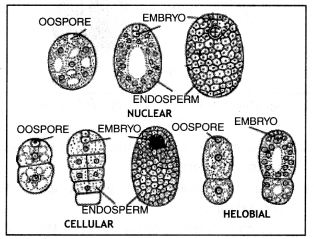
Apomixis is the mode of reproduction which does not involve the formation of zygote through gametic fusion. Example: Some species of grass.

(ii) When do farmers prefer using apomictic seeds? (CBSE Outside Delhi 2016)
Answer:
Farmers prefer apomictic seeds because they are free from infection and avoid using hybrid seeds which are costly.

Question 15.
Write any two ways by which apomictic seeds may be developed in angiosperms? (CBSE Delhi 2019 C) Answer:
Parthenocarpy. In certain plants, the fruits are formed without the act of fertilisation. Such fruits are called parthenocarpic fruits and the phenomenon is known as parthenocarpy. Parthenocarpic fruits are either seedless or contain empty or non-viable seeds.

In these fruits, the stimulus (seed factor) for fruit growth is provided by the tissue of the ovary wall itself. Seedless varieties of grapes and oranges contain those of the seeded varieties. Most commonly cultivated varieties of banana and pineapple are parthenocarpic. Polyembryony: Formation of more than one embryo in the seed. Onions, groundnuts, mangoes lemons and oranges are some of the examples. Polyembryony is very common among conifers.

Question 16.
You are conducting artificial hybridisation on papaya and potato. Which one of them would require the step of emasculation and why? However, for both, you will use the process of bagging. Justify giving one reason? (CBSE Delhi 2019)
Answer:

  1. Potato: Potato plant has a bisexual flower, which means it has both male and female reproductive parts in the same flower. And the plant is Monoecious. Hence it needs emasculation to prevent autogamy.
  2. Papaya: In case of papaya plant, male and female flowers are present on separate plants, that is each plant is either male or female (dioecious). This condition prevents both autogamy and geitonogamy.

So for artificial hybridisation, both will require bagging to prevent contamination of stigma.

Question 17.
Normally one embryo develops in one seed but when an orange seed is squeezed many embryos of different shapes and sizes are seen. Mention how it has happened? (CBSE 2011)
Answer:
In many citrus varieties, some of the nucellar cells surrounding the embryo sac start dividing, protrude into embryo sac and develop into embryos. In such species, each ovule contains many embryos. The occurrence of more than one embryo in a seed is referred to as polyembryony.

Question 18.
A pollen grain in angiosperm at the time of dehiscence from an anther could be 2-celled or 3-celled. Explain. How are the cells placed within the pollen grain when shed at a 2-celled stage? (CBSE 2017)
Answer:
In the majority of angiosperms, pollens are released in a 2-celled stage. However, in other species, the generative cell divides into two male gametes and forms a 3-celled stage. When the pollen grain is shed at the 2-celled stage, it has two unequal cells, a bigger vegetative cell and a smaller generative cell.

Question 19.
Do you think apomixis can be compared with asexual reproduction? Support your answer, giving one reason. How is apomixis beneficial to farmers? Explain. (CBSE Delhi 2018C)
Answer:
A few flowering plants such as some species of Asteraceae and grasses have evolved a special mechanism to produce seeds without fertilisation. This is called apomixis. So apomixis is a form of asexual reproduction.

Production of hybrid seeds is costly; if hybrids with desirable characteristics can be made into apomicts, there is no segregation of characters in the hybrid progeny. The farmer can continue using hybrid seeds year after year and need not to buy new seeds.

Sexual Reproduction in Flowering Plants Important Extra Questions Long Answer Type

Question 1.
Give an account of a structure of typical anther?
Answer:
Structure of anther. A typical angiosperm anther is bilobed with each lobe having two cells or theca, i.e. they are dithecous. Often a longitudinal groove runs lengthwise separating the theca. The bilobed nature of an anther is very distinct in the transverse section of the anther. The anther is a four-sided (tetragonal) structure consisting of four microsporangia located at the corners, two in each lobe.

The microsporangia develop further and become pollen sacs. They extend longitudinally all through the length of an anther and are packed with pollen grains.

Question 2.
Write about the structure of microsporangium? (CBSE 2014)
Answer:
A microsporangium is more often circular in outline and is surrounded by a four-layered wall:

  1. The outermost layer is the single layer of the epidermis.
  2. The second layer is endothecium, where cells develop thickenings.
  3. The middle layer is of 2-4 cells.
  4. Tapetum, the innermost layer, is of large diploid/polyploid and binucleate or multinucleate cells.
  5. There are four pollen sacs.
  6. Each pollen sac has sporogenous tissue.

Question 3.
Describe the development of microspore in angiosperms?
Answer:
Microsporogenesis and formation of pollen grains:

  1. Every cell of the sporogenous tissue is a potential pollen mother cell (PMC) and can give rise to microspore tetrad/ pollen grains.
  2. But some of them forego this potential and differentiate into the pollen mother cells of microspore mother cells.
  3. Each microspore mother cell undergoes meiosis to form a cluster of four haploid cells, called microspore tetrad.
    Class 12 Biology Important Questions Chapter 2 Sexual Reproduction in Flowering Plants 3
  4. As the anther matures, the microspores dissociate from the tetrad and develop into pollen grains.
  5. The tetrad may be tetrahedral, isobilateral, T-shaped, L-shaped and linear.
  6. The nucleus of the microspore undergoes mitosis to form large vegetative cell and a small spindle¬shaped generative cell that floats in the cytoplasm of the vegetative cell.

Question 4.
What is pollination? Name different types of pollination?
Answer:
Pollination: It is the transfer of pollen grains from the anther to stigma.Class 12 Biology Important Questions Chapter 2 Sexual Reproduction in Flowering Plants 4

Question 5.
With a neat diagram, explain the 7-celled, 8-nucleate mature female gametophyte? (CBSE Delhi 2014, Outside Delhi 2019)
Answer:
Structure of mature female gametophyte. The female gametophyte is formed from the contents of megaspore. However, it always remains embedded within the membrane of the megaspore. The mature female gametophyte is 7-celled (an egg, two synergids, three antipodals and a central cell).

Out of the seven cells of mature female gametophyte, the egg cell fuses with male gamete to form a zygote, one synergid degenerates and the other synergid directs the pollen tube entry. The central cell fuses with the male gamete to form triploid primary endosperm nucleus and the three antipodals degenerate before or after fertilisation.

They sometimes act as antipodal haustoria:
Class 12 Biology Important Questions Chapter 2 Sexual Reproduction in Flowering Plants 5

Question 6.
Tabulate the differences between self-pollination and cross-pollination?
Answer:
Differences between self-pollination and cross-pollination:

Self-pollinationCross-pollination
1. It is the transference of pollen grains from the anther to the stigma of the same flower.1. It is the transference of pollen grains from the anther to the stigma of another flower of another plant.
2. Self-pollination always occurs through touch or wind.2. Cross-pollination always occurs through an external agent.
3. Both anthers and stigmas mature simultaneously.3. The anthers and stigmas mature at different times.
4. It can occur in closed flowers.4. It occurs only when the flowers are open.
5. It gives rise to pure lines.5. It gives rise to offspring having variations.

Question 7.
Briefly explain contrivances for self-pollination?
Answer:
Class 12 Biology Important Questions Chapter 2 Sexual Reproduction in Flowering Plants 6

Question 8.
What is bagging technique? How is it useful in plant breeding programmes?
Answer:
Bagging technique: It is a technique used during artificial hybridisation of plant breeding to ensure cross-pollination.

For this removal of anthers from the flower bud before the anther dehisces using a pair of forceps is necessary. This step is referred to as emasculation. Emasculated flowers have to be covered with a bag of suitable size, generally made up of butter paper, to prevent contamination of its stigma with unwanted pollen.

This process is called bagging. When the stigma of bagged flower attains receptivity, mature pollen grains collected from anthers of the male parent are dusted on the stigma, and the flowers are rebagged, and the fruits are allowed to develop.

If the female parent produces unisexual flowers, there is no need for emasculation. The female flower buds are bagged before the flowers open. When the stigma becomes receptive, pollination is carried out using the desired pollen and the flower rebagged.

Advantages of bagging technique:

  1. It is necessary for cross-breeding for the crop improvement programme.
  2. Commercially superior varieties can be obtained.

Question 9.
What are zoophily, zoophilous flowers and entomophilous flowers? List the characters of entomophilous flowers?
Answer:

  • Zoophily: Pollination by animals is called Zoophily.
  • Zoophilous flowers: The flowers which get pollinated with the aid of animals are called zoophilous flowers.
  • Entomophilous flowers: Insect pollinated flowers are called entomophilous flowers.

Characters of Entomophilous flowers:

  • The flowers are of large size.
  • Corolla of flowers is brightly coloured.
  • Some flowers are very fragrant.
  • They bear nectar-secreting glands.
  • The pollen grains are heavy with the rough and spiny surface.
  • The stigmatic surface is sticky.

Question 10.
What are the advantages of cross-pollination?
Answer:
Advantages of cross-pollination:

  1. It increases variability and certain new and useful characters appear in the offsprings.
  2. Sometimes harmful characters are eliminated.
  3. It leads to the production of new varieties.
  4. Several disease-resistant varieties of important crop plants have been produced as a result of cross-pollination.
  5. It increases the power of adaptation among the offsprings.
  6. The number of seed production can be increased among useful cereal crops.

Question 11.
Differentiate between anemophilous and entomophilous flower? (CBSE Delhi 2008 (S))
Answer:
Differences between anemophilous and entomophilous flowers:

Anemophilous flowerEntomophilous flower
1. The flowers are small.1. The flowers are either Large or if small the are grouped to form a mass.
2. Flowers are neither brightly coloured nor emit any odour.2. The flowers are brightLy coLoured and emit odour.
3. The flowers are devoid of any nectar and edible pollen.3. The flowers usually possess nectar or edible pollen.

Question 12.
How does the floral pattern of Mediterranean orchid Ophrys guarantee cross-pollination? (CBSE 2010, 2019)
Answer:
In many species of Mediterranean orchid Ophrys, the shape, colour marking and odour of flower are like the female moth Colpa.

The Ophrys employs sexual deceit to get pollination done by the Colpa. The male moth matures earlier than the female. It mistakes the Ophrys flower for female and tries to copulate. Thus it pollinates the flower.

Question 13.
Explain the events in the embryo sac during the process of fertilisation?
Answer:
Fertilisation. The fusion of male and female gametes is called fertilisation. The process was first discovered by Strasburger (1884).

Pollen tube enters through the micropyle and releases male gametes. This is called Porogamy. If pollen tube enters through chalaza, it is called chalazogamy and if pollen tube enters through integuments, it is called misogamy. One male gamete (1n) fuses with egg or oosphere to form oospore (2n) and second male gamete fuses with secondary nucleus (2n) to form the primary endosperm nucleus (3n).

In angiosperms where both male gametes are functional and bring about fertilisation of oosphere and secondary nucleus to form oospore and primary endosperm nucleus, is called double fertilisation.

Question 14.
What do you understand by double fertilisation? (CBSE Sample Paper) (CBSE Delhi (C) 2008)
Or
Where does triple fusion take place in a flowering plant? (CBSE 2010)
Answer:
In angiosperms both the male gametes are functional. Double fertilisation is a process in which the egg nucleus and secondary nucleus are fertilized at one time by the male gametic nuclei. The fusion of one male gamete nucleus (1n) with egg or oosphere (1n) is called syngamy and results in the formation of oospore (2n).

The second male gamete fuses with the secondary nucleus; it is called triple fusion which results in the formation of the primary endosperm nucleus (3n). Thus it takes place in the embryo sac. It was first discovered by Nawaschin (1898).

Question 15.
What is the fate of floral parts after fertilisation?
Answer:
After fertilisation, the transformation of parts of the flower is as follows:

Before fertilizationAfter fertilization
1. Calyx, Corolla, Androecium, Style, StigmaWither off
2. OvaryFruit
3. Ovary wallPericarp
4. OvuleSeed
5. IntegumentsSeed coats
6. Outer integumentTesta
7. Inner integumentTeg men
8. MicropyleMacrophyte
9. FunicteStalk of seed
10. Nucellus (persistent)Pensperm
11. Egg cellZygote (oospore)
12. SynergidsDisintegrate and disappear

Question 16.
Write an account of various types of fruits?
Answer:
Types of fruits:
Class 12 Biology Important Questions Chapter 2 Sexual Reproduction in Flowering Plants 7

  • Simple fruit: Fruits develop from a single ovary.
  • Aggregate fruit: Develops from the polycarpellary, apocarpous ovary. Composite fruit. Which develops from the inflorescence.
  • Dry fruit: When mesocarp, epicarp and endocarp all are hard.
  • Succulent fruit: When mesocarp is pulpy.

Question 17.
Mention two strategies evolved by flowers to prevent self-pollination? (CBSE 2014)
Answer:
Contrivances favouring cross-pollination In many plants there are devices which completely or partially prevent self-pollination and encourage cross¬pollination.

  1. Unisexuality: The flowers are unisexual, i. e. stamens and carpels occur in different flowers. They may be present on the same plant, e.g. in maize or on different plants, e.g. in Papaya. The first condition is called monoecious and second is called dioecious.
  2. Dichogamy: When stamens and carpels of bisexual flowers mature at different times, it is called dichogamy. If stamens mature first it is called a protandrous condition, or if carpels mature first it is called protogynous condition.

Question 18.
Draw a monocot endospermic seed? (CBSE 2012, 2019)
Answer:
Seeds of angiosperm:
Class 12 Biology Important Questions Chapter 2 Sexual Reproduction in Flowering Plants 8
Seeds of angiosperm.

Question 19.
Give a brief account of post-pollination events? (CBSE Delhi 2016)
Answer:
Post-pollination events:

  1. The fusion of male and female gametes is called fertilisation. The process was first discovered by Strasburger (1884).
  2. Pollen tube enters through the micropyle and releases male gametes. This is called Porogamy. If pollen tube enters through chalaza, it is called chalazogamy and if pollen tube enters through integuments, it is called misogamy.
  3. One male gamete fuses with egg or oosphere to form oospore (2n) and second male gamete fuses with secondary nucleus (2n) to form the primary endosperm nucleus (3n).
  4. In angiosperms where both male gametes are functional and bring about fertilisation of oosphere and secondary nucleus to form oospore and primary endosperm nucleus, is called double fertilisation.
  5. Development of endosperm from the primary endosperm nucleus.
  6. Development of embryo from a zygote,
  7. Development of seed from the ovule.

Question 20.
(i) Can a plant flowering in Mumbai be pollinated by pollen grains of the same species growing in New Delhi? Provide explanations for your answer.
Answer:
Yes, it is possible by artificial hybridisation in which pollen grains of one flower is introduced artificially on the stigma of another flower. But there should not be self-incompatibility.

However, it is important to make sure that only the desired pollen grains are used for pollination and the stigma is protected from contamination (from unwanted pollen). This is achieved by emasculation and bagging techniques.

(ii) Draw the diagram of a pistil where pollination has successfully occurred. Label the parts involved in reaching the male gametes to its desired destination. (CBSE 2017)
Answer:
Class 12 Biology Important Questions Chapter 2 Sexual Reproduction in Flowering Plants 9

Question 21.
Differentiate between parthenocarpy and parthenogenesis. Give one example of each? (CBSE2018)
Answer:
Parthenocarpy is the process which produces fruits from unfertilised ovules in plants. Unfertilised ovules develop into fruits prior to fertilisation. Such fruits do not contain seeds.

However, parthenogenesis can be described as a process in which unfertilised ovum develops into an individual (virgin birth) without fertilisation. Therefore, it can be considered a method of asexual reproduction.

Such a type of reproduction is commonly shown by some invertebrates and lower plants, e.%. rotters, honeybees and some lizards and birds (turkey), etc.
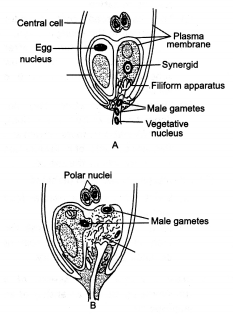
Another key difference between parthenogenesis and parthenocarpy is parthenogenesis is shown by animals and plants while parthenocarpy is shown by plants only.

Question 22.
The embryo sac in female gametophyte is seven celled and eight nucleated structure. Justify the statement with the help of a labelled diagram? (CBSE Sample Paper 2018-19)
Answer:
A typical embryo sac has three cells that are grouped together at the micropylar end and constitute the egg apparatus. The egg apparatus, in turn, consists of two synergids and one egg cell.

Three cells are at the chalazal end and are cast the antipodals. The Large central cell has two polar nuclei.

Thus, a typical angiosperm embryo sac at maturity is 7-celled and 8-nucLeated.
Class 12 Biology Important Questions Chapter 2 Sexual Reproduction in Flowering Plants 10

Question 23.
List the changes that occur when an ovule matures into a seed? (CBSE Sample Paper 2018-19)
Answer:

  1. Integuments of ovules harden and become tough protective seed coats.
  2. The micropyle remains as a small pore in the seed coat.
  3. As the seed matures, its water content is reduced.
  4. Seeds become relatively dry. It has 10-15 percent moisture by mass.
  5. The general metabolic activity of the embryo slows down.
  6. The embryo may enter a state of inactivity called dormancy.

Question 24.
What are the various adaptations or contrivances met within angiosperms flowers which favour cross-pollination?
Answer:
Contrivances favouring cross-pollination: In many plants, there are devices which completely or partially prevent self-pollination and encourage cross-pollination.
1. Unisexuality: The flowers are unisexual, i.e. stamens and carpels occur in different flowers. They may be present on the same plant, e.g. in Three cells are at the chalazal end and are called the antipodals. The large central cell has two polar nuclei.

Thus, a typical angiosperm embryo sac at maturity is 7-celled and 8-nucleated.

Structure of typical embryo sac.
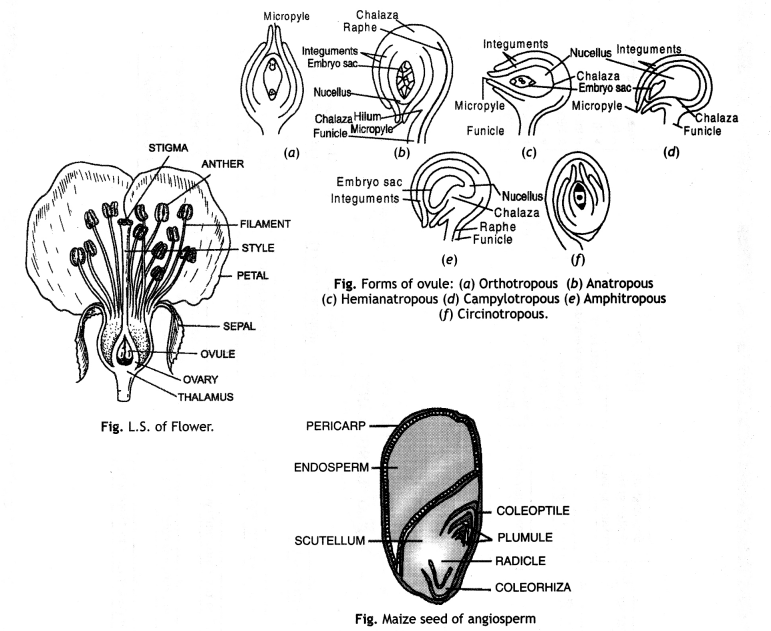
maize or on different plants e.g. in Papaya. The first condition is called monoecious and second is called dioecious. In monoecious plants, both self-and cross-pollination can occur but mostly there is cross-pollination as sex organs mature at different times. In dioecious only cross-pollination occurs.
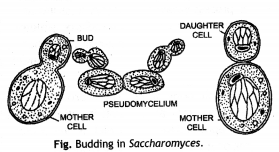
2. Dichogamy: When stamens and carpels of bisexual flowers mature at different times it is called dichogamy.

If stamens mature first, it is called a protandrous condition, or if carpels mature first, it is called protogynous condition. Dichogamy prevents self-pollination and ensures cross-pollination.

3. Self-sterility: In orchids, pollen grains of one flower does not germinate on the stigma of the same flower. This is called self-sterility but pollen grain germinates on the stigma of some other plant and thus ensures cross pollination.

4. Heterostyly: In primrose, there are different lengths of styles which ensure cross-pollination.

5. Herkogamy (Herko-barrier): In bisexual flowers, e.g. in Salvia and pea, peculiarities of petals ensure insect pollination, thus aids in cross-pollination.

Question 25.
With a neat labelled diagram, describe the parts of a typical angiosperm ovule? (CBSE Delhi 2014)
Answer:
Structure of ovule. Each ovule consists of nucellus surrounded by two integuments and a stalk or funiculus.

  1. Funiculus is a stalk-like structure by which ovule is attached to the placenta.
    Class 12 Biology Important Questions Chapter 2 Sexual Reproduction in Flowering Plants 11
    v.s. of the mature ovule to show various parts.
  2. Hilum: It is the point of attachment of the body of the ovule with the funiculus.
  3. Raphe: It is the longitudinal ridge formed by the lengthwise fusion of funiculus with the body of ovule in a typical anatropous ovule.
  4. Nucellus: It is a mass of diploid cell called megasporangium. It provides nourishment in the development of embryo sac.
  5. Embryo sac: It is the female gametophyte which contains the egg apparatus.
  6. Integuments from seed coats, i.e. testa and tegmen.
  7. Micropyle: It is a small opening which is left by the integument in the ovule for the passage of pollen tube into the ovule.
  8. Chalaza: The basal region of the ovule where the funiculus is attached is termed chalaza.

Question 26.
Describe the structure of typical embryo sac and the functions performed by its various constituents?
Or
Draw a schematic labelled diagram of fertilized embryo sac of angiosperm? (CBSE 2008, 2012, 2013)
Answer:
In the mature ovule, within the nucellus towards the micropylar end is a large cell called embryo sac. It is also called a female gametophyte. It contains cytoplasm, two free nuclei and six small cells. Two free nuclei fuse to form a secondary nucleus.

Out of these, three cells constitute egg apparatus (two synergids and one oosphere or egg cell). The other three cells lie at the chalazal end of embryo sac and are called antipodal cells. They are small and enclosed in thin cell walls.

In egg apparatus, egg fuses with male gamete to form zygote or oospore which later gives rise to the embryo. Synergids help in fertilisation. Secondary nucleus fuses with the second male gamete to form primary endosperm nucleus which later on forms endosperm.

The three antipodal cells degenerate:
A typical embryo sac has three cells that are grouped together at the micropylar end and constitute the egg apparatus. The egg apparatus, in turn, consists of two synergids and one egg cell.

Three ceLLs are at the chaLazaL end and are cast the antipodals. The Large centraL ceLL has two poLar nucLei.

Thus, a typical angiosperm embryo sac at maturity is 7-celLed and 8-nucLeated.
Class 12 Biology Important Questions Chapter 2 Sexual Reproduction in Flowering Plants 10

Question 27.
Describe the structure of typical microspore (pollen grain)?
Or
Name the organic material of exine and intine of an angiospermous pollen grain. Mention their role. (CBSE Delhi 2014) Answer:
Structure of pollen grains:

  1. Pollen grains are normally spherical in outline.
  2. Each pollen grain has a prominent two-layered wall.
  3. The outer layer is called exine and the inner layer is called intine.
  4. The exine is hard and made of sporopollenin. It shows a variety of architecture as per the characteristic of each species.
    Class 12 Biology Important Questions Chapter 2 Sexual Reproduction in Flowering Plants 12
  5. Intine is thin and it is made of cellulose and pectin.
  6. At certain places, exine is either absent or very thin and such places are called germ pores. In monocots, there are germinal furrows.
  7. A mature pollen grain has two cells-a vegetative cells and a generative cell.
  8. The vegetative cell is larger, has abundant reserve food and a large irregular-shaped nucleus.
  9. The generative cell is small, spindle¬shaped and floats in the cytoplasm of the vegetative cell.

Question 28.
Draw a well-labelled diagram of T.S. of the anther? (CBSE Sample paper 2009)
Or
Draw a labelled schematic diagram of the transverse section of a mature anther of an angiosperm plant. (CBSE Delhi 2013)

Answer:
T. S. of anther
Class 12 Biology Important Questions Chapter 2 Sexual Reproduction in Flowering Plants 13
(A) Transverse section of a tetra eusporangiate anther to show its various tissue;
(B) Enlarged view of one microsporangium showing wall layers.

Question 29.
Explain the development of the female gametophyte. Illustrate the answer with suitable diagrams? (CBSE Delhi 2019, Outside Delhi 2019)
Answer:
Development of female gametophyte:

  1. The functional megaspore is the first cell of the female gametophyte of angiosperms.
  2. It enlarges to form the female gametophyte, also called embryo sac.
  3. Its nucleus undergoes a mitotic division and the two nuclei move to the opposite poles, forming the 2-nucleate embryo sac.
  4. Two successive mitotic divisions in each of these two nuclei result in the formation of an 8-nucleate embryo sac.
    Class 12 Biology Important Questions Chapter 2 Sexual Reproduction in Flowering Plants 14
    Fig. Development of embryo sac.
  5. Cell wall formation starts at the eight-nucleate stage, resulting in the formation of a typical female gametophyte.
  6. Three cells are grouped together at the micropylar end to form the egg apparatus, consisting of two synergids and a female gamete/egg cell.
  7. Three cells are grouped together at the chalazal end. They are called antipodal cells.
  8. The remaining two nuclei are called polar nuclei. They move to the centre of the embryo sac (now called a central cell) and fuse to form a diploid secondary nucleus.
  9. Thus, a typical angiosperm embryo sac is 8-nucleate and 7-celled.

Question 30.
Show the germination of pollen grain with diagrams only? (CBSE 2011, 2019 C)
Answer:
Germination of Pollen Grain:
Class 12 Biology Important Questions Chapter 2 Sexual Reproduction in Flowering Plants 15
Germination of pollen grain and formation of male gametophyte in an angiosperm.

Question 31.
What do you mean by the development of the embryo? Support the answer with a diagram? (CBSE Delhi 2014)
Answer:
Development of embryo.
1. The zygote or oospore divides by a transverse wall into an upper suspensor cell and lowers embryonal cell.

2. The suspensor cell which lies towards the micropylar end divides by transverse divisions to constitute 7-10 cells called suspensor.

3. The upper cell of the suspensor filament towards the micropylar end is called a haustorial cell, whereas the cell lying above the embryo cell is called hypophysis.

4. The haustorial cell enlarges in size and attaches the suspensor to the tip of embryo sac.

5. The embryonal cell divides by second longitudinal division at a right angle to the first and then by transverse division to form an octant or eight- celled embryo.

6. Out of these eight cells, the lower four cells of octant away from the suspensor give rise to the plumule and the two cotyledons, while the above four cells of octant near the suspensor from the hypocotyl and stele of the radicle.

7. Then this octant divides by a periclinal division to form outer single-layered dermatogen from which arises the epidermis layer. The inner cells further divide to form periblem below the dermatogen and the central plerome.

8. The periblem forms the cortex while the plerome gives stele of the embryo.

9. The lowermost cell of suspensor, which is lying just above the octant cells is known as hypophysis. The hypophysis divides to give rise to the dermatogen and periblem of the radicle.

10. A fully developed embryo of dicotyledons has an embryonal axis differentiated into plumule, two cotyledons and radicle.

11. In the beginning, the embryo is globular. When two cotyledons differentiate from the sides with faint plumule in the centre, the embryo becomes heart¬shaped. Then the embryo undergoes rest and ovule is transformed into the seed.

Monocot embryo: Unlike the dicots where the embryonal mass is formed of eight cells, the anterior cells forming the plumule and the cotyledons, and the posterior forming hypocotyl, the development is much variable in monocots, i.e. grass family. In some cases, suspensor does not develop at all. Only one cotyledon appears in monocots as a terminal structure. The plumule always appears laterally from it.

Question 32.
Draw the stages of development of the embryo in a dicot angiosperm?
Answer:
Stages of embryo development in a dicot angiosperm:
Class 12 Biology Important Questions Chapter 2 Sexual Reproduction in Flowering Plants 16
Stages of embryo development in a dicot angiosperm.

Question 33.
Explain the role of tapetum in the pollen grain wall formation?
Answer:
Role of tapetum in pollen grain wall formation. During microsporogenesis, the cells of tapetum provide various enzymes, hormones, amino acids and other nutritive materials to the dividing microsporocytes.

The main functions of tapetum are:

  1. Transportation of nutrients into anther locule at the time of meiosis in spore mother cells.
  2. Secretion of enzymes and hormones.
  3. Production of Ubisch bodies which are coated with sporopollenin to cause thickening of the exine.
  4. Secretion of any oily material (Pollenkitt) outside of mature pollen.
  5. Secretion of special proteins for pollen to recognise compatibility.

Question 34.
Describe in brief the various special modes of reproduction? Mention their economic significance?
Answer:
Special modes of reproduction:
1. Apomixis (Agamospermy): It is a modified form of reproduction in which seeds are formed without fusion of gametes. It includes the process whereby a diploid cell of nucellus develops into an embryo, giving a diploid seed with a genetic constitution identical to the parent. The organism that reproduces by apomixis is called apomict.

2. Parthenocarpy: In certain plants, the fruits are formed without the act of fertilisation. Such fruits are called parthenocarpic fruits and the phenomenon is known as parthenocarpy. Parthenocarpic fruits are either seedless or contain empty or non-viable seeds. In these fruits, the stimulus (“seed factor”) for fruit growth is provided by the tissue of the ovary wall itself. Seedless varieties of grapes and oranges contain those of the seeded varieties. Most commonly cultivated varieties of banana and pineapple are parthenocarpic.

3. Polyembryony: It is the formation of more than one embryo in the seed. Onion, groundnut, mango, lemon and oranges are some of the examples. Polyembryony is very common among conifers.

4. Sporophytic budding: It may occur in the nucellus and integuments, resulting in the development of an embryo. Examples: Orange, mango, onion, etc.

5. Micropropagation: In this method, tissue and organ culture is utilised. Tissue or organs grow on suitable medium containing hormones. Tissue proliferates to form a callus. From this callus, arise new plantlets. Each plantlet, when transferred to pot or soil, produces a new plant. Thus by this method, an indefinite number of plants can be raised from a small mass of partial tissue.

6. Plant tissue culture. It also helps in propagating plants to a great extent.

Question 35.
Fertilisation is essential for the production of seed, but in some angiosperms, seeds develop without fertilisation?
(i) Give an example of an angiosperm that produces seeds without fertilisation. Name the process.
Answer:
(a) Species of Asteraceae and grass.
(b) Process of formation of seeds without fertilization is called apomixis.

(if) Explain the two ways by which seeds develop without fertilisation. (CBSE 2009)
Answer:
Apomixis is a form of asexual reproduction that mimics sexual reproduction:
(a) The diploid egg cell is formed without reduction division and develop into an embryo without fertilisation.
(b) In some varieties of citrus and mango, some of the nucellar cells surrounding the embryo sac start dividing, produce embryo sac and develop into embryos. In such species, each ovule contains many embryones. Such a process is called polyembryony.

Question 36.
Write a note on the development of endosperm. Mention the types with examples?
Answer:
Development of endosperm: Endosperm develops after double fertilisation in angiosperms. It is triploid and develops from the primary endosperm nucleus.

In angiosperms three types of endosperm development are observed:
1. Nuclear endosperm. In nuclear endosperm development, the nucleus divides by free nuclear division, there is the appearance of the central vacuole, all the nuclei are pushed towards periphery then starts cytokinesis and results in the formation of cells but in coconut, vacuole persists which is filled with fluid.

2. Cellular endosperm. In cellular endosperm, each and every division is followed by cytokinesis, so endosperm is cellular from the very beginning, e.g. Datura, Petunia.

3. Helobial endosperm. It is intermediate between cellular and nuclear endosperm. The first division is followed by cytokinesis to form two unequal cells, micropylar cell and chalazal cell. Further divisions in each cell are free nuclear divisions. This type of endosperm is found in order Helobiales.
Class 12 Biology Important Questions Chapter 2 Sexual Reproduction in Flowering Plants 17
Types of endosperm development.

Question 37.
What are the advantages of seeds to plants and mankind? (CBSE Delhi 2014)
Answer:
1. Advantages of seeds to plants:
(a) Seeds have better adaptive strategies for dispersal to new habitats for better survival.
(b) Seeds have reserve food materials to nourish the seedlings during seed germination.
(c) The hard seed coat provides protection to the young embryo.
(d) Since seeds are formed after sexual reproduction, they show genetic recombinations leading to variations.
(e) Since seed formation does not depend on water (for fertilisation), their formation is more certain and they are the units of multiplication and continuity of the species.

2. Advantages of seeds to mankind:
(a) Seeds are stored and used as food throughout the year.
(b) Seeds are also used to raise the crop in the favourable seasons depending on their viability.

Question 38.
(i) Draw a diagrammatic sketch of a transverse section of an anther of an angiosperm. Label its different walls and the tissue forming microspore mother cells?
Answer:
T. S. of anther
Class 12 Biology Important Questions Chapter 2 Sexual Reproduction in Flowering Plants 13
(A) Transverse section of a tetra eusporangiate anther to show its various tissue;
(B) Enlarged view of one microsporangium showing wall layers.

(ii) Describe the process of microsporogenesis up to the formation of a microspore?
Answer:
Microsporogenesis and formation of pollen grains:

  1. Every cell of the sporogenous tissue is a potential pollen mother cell (PMC) and can give rise to microspore tetrad/ pollen grains.
  2. But some of them forego this potential and differentiate into the pollen mother cells of microspore mother cells.
  3. Each microspore mother cell undergoes meiosis to form a cluster of four haploid cells, called microspore tetrad.
    Class 12 Biology Important Questions Chapter 2 Sexual Reproduction in Flowering Plants 3
  4. As the anther matures, the microspores dissociate from the tetrad and develop into pollen grains.
  5. The tetrad may be tetrahedral, isobilateral, T-shaped, L-shaped and linear.
  6. The nucleus of the microspore undergoes mitosis to form large vegetative cell and a small spindle¬shaped generative cell that floats in the cytoplasm of the vegetative cell.

(iii) Write the function of ‘germ pore’ in a pollen grain of an angiosperm? (CBSE Delhi 2018C)
Answer:
Germ pores allow the germinating of pollen tube with contents of the male gametes and vegetative cell to come out of the pollen grains.

Question 39.
(i) When a seed of orange is squeezed, many embryos instead of one are observed. Explain how it is possible?
Answer:
When a seed of orange is squeezed, many embryos instead of one are observed. It is due to polyembryony. Polyembryony is the occurrence of more than one embryo in a seed.

The nucellar cells, synergid or integument cells develop into a number of embryos of different sizes in orange.
Sometimes the formation of more than one egg in an embryo sac can lead to polyembryony.

(ii) Are these embryos genetically similar or different? Comment.
Answer:
These embryos are genetically similar because in such embryos parental characters are maintained. In this process, there is no segregation of characters in the offspring.

Question 40.
(i) Describe any two devices in a flowering plant which prevent both autogamy and geitonogamy?
(ii) Explain the events up to double fertilisation after the pollen tube enters one of the synergids in an ovule of an angiosperm? (CBSE 2018)
Or
Explain the post-pollination events up to double fertilization that occurs in angiosperm. (CBSE 2019 (c))
Answer:
(i) Autogamy: It is the transfer of pollen grains from the anther to the stigma of the same flower.

Geitonogamy: It is the transfer of pollen grains from the anther to the stigma of another flower of the same plant.

Two devices that prevent both autogamy and geitonogamy are:
(a) Self-incompatibility: This is a genetic mechanism which prevents self pollen from fertilising the ovules by inhibiting pollen germination or growth of pollen tube in the pistil.
(b) Dioecious plants: Male and female flowers are present on different plants.

(ii) The events seen after the pollen tube enters one of the synergids in an ovule is as follows:
(a) After reaching the ovary, pollen tube enters the ovule through the micropyle and thus enters one of the synergids through filiform apparatus.

(b) After entering one of the synergids, the pollen tube releases the two male gametes into the cytoplasm of the synergid.

(c) One of the male gametes moves towards the egg cell and fuses with its nucleus and results in the formation of the zygote (diploid cell). This is called syngamy.

(d) The other male gamete moves towards the two polar nuclei present in the central cell and fuses to form triploid primary endosperm nucleus (PEN) i.e., there is a fusion of three haploid nuclei and hence termed as triple fusion.

(e) Two types of fusions-syngamy and triple fusion-take place in an embryo sac. Hence the phenomenon is termed double fertilisation.

(f) After fertilisation, the primary endosperm nucleus becomes the primary endosperm cell (PEC) and develops into endosperm while zygote develops into an embryo.
Class 12 Biology Important Questions Chapter 2 Sexual Reproduction in Flowering Plants 18

Fig. (A) EnLarged view of an egg apparatus showing entry of poLLen tube into a synergy, (B) Discharge of male gametes into a synergid and the movements of the sperms, one Into the egg and the other Into the centraL celL.

Very Important Figures

Class 12 Biology Important Questions Chapter 2 Sexual Reproduction in Flowering Plants 19

Reproduction in Organisms Class 12 Important Extra Questions Biology Chapter 1

Here we are providing Class 12 Biology Important Extra Questions and Answers Chapter 1 Reproduction in Organisms. Important Questions for Class 12 Biology are the best resource for students which helps in Class 12 board exams.

Class 12 Biology Chapter 1 Important Extra Questions Reproduction in Organisms

Reproduction in Organisms Important Extra Questions Very Short Answer Type

Question 1.
What is the life span?
Answer:
The period from birth to natural death of an organism is termed its life span.

Question 2.
Why is reproduction essential for organisms?
Answer:
Reproduction is a process by which an organism produces young ones of its own kind to maintain the continuity of the species. It enables the species to live generation after generation.

Question 3.
What type of modification are ginger, potato, onion and Samarkand?
Answer:
Underground modification of stem.

Question 4.
Name sub-aerial stems which help in multiplication.
Answer:
Pistia, Chrysanthemum Eichhornia, Pineapple.

Question 5.
Name artificial methods of vegetative propagation.
Answer:

  1. Cutting of stem, root and leaf.
  2. Grafting
  3. Layering
  4. Gootee.

Question 6.
Which type of division is involved in asexual reproduction?
Answer:
Only mitotic division occurs during asexual reproduction.

Question 7.
Male honeybee has 16 chromosomes whereas its female has 32 chromosomes. Give one reason. (CBSE Outside Delhi 2016)
Answer:
Male honey bee develops from haploid unfertilised egg (Ovum), whereas female develops from the diploid fertilized zygote.

Question 8.
The diploid number of chromosomes in an angiospermous plant is 16. What will be the number of chromosomes in its endosperm and antipodal cells? (CBSE Outside Delhi 2019)
Answer:
Number of chromosomes in endosperm = 24 (3N)
Number of chromosomes in antipodal cells = 8(N)

Question 9.
Banana is a true fruit and also a parthenocarpic fruit. Justify. (CBSE Foreign 2008)
Answer:
Banana develops from the ovary (true fruit) and develops without fertilisation (parthenocarpic fruit).

Question 10.
Pick out the ancestral line of angiosperms from the list given below: Conifers, seed ferns, cycads, ferns. (CBSE 2008)
Answer:
Seed ferns.

Question 11.
Why is apple referred to as false fruit? (CBSE 2010)
Answer:
In the case of apple, thalamus contributes to fruit formation, while most of the plant’s fruit develops from the ovary.

Question 12.
Name the type of cell division that takes place in the zygote of an organism exhibiting haplontic life cycle. (CBSE 2011)
Answer:
Meiosis

Question 13.
Mention the unique flowering phenomenon exhibited by Strobilanthus Ludhiana (Neelakuranji). (CBSE 2012)
Answer:
It is a monocarpic flowering plant. It flowers once in 12 years.

Question 14.
Some flowers, selected for artificial hybridisation, do not require emasculation but bagging is essential for them. Give a reason. (CBSE Delhi 2019 C)
Answer:
Bagging is the covering of flower by butter paper on polythene. The emasculated flower buds of the female parent and floral buds or male parent are bagged in order to protect them from contamination with unwanted pollen grains.

Question 15.
Cucurbits and papaya plants bear staminate and pistillate flowers. Mention the categories they are put under separately on the basis of the type of flowers they bear. |HOTSj (CBSE 2012)
Answer:
Cucurbits-Monoecious plants Papaya-Dioecious plants.

Question 16.
Why is banana considered a good example of parthenocarpy? (CBSE 2011)
Answer:
It is propagated vegetatively because there is no seed formation.

Question 17.
Name an alga that reproduces asexually through zoospores. Why are these reproductive units called so? (CBSE Outside Delhi 2013)
Answer:

  1. Chlamydomonas
  2. They are called so because they are microscopic motile structures.

Question 18.
Name the phenomenon and one bird where the female gamete directly develops into a new organism. (CBSE Outside Delhi 2013)
Answer:

  1. Parthenogenesis
  2. Turkey bird

Question 19.
Name the vegetative propagules in the following: (CBSE 2014)
(a) Agave
Answer:
Bulbils

(b) Bryophyllum.
Answer:
Leaf bud

Question 20.
Mention a characteristic and a function of zoospores in some algae. (CBSE 2010)
Answer:

  • Zoospores are microscopic and flagellated motile spores.
  • They are reproductive structures.

Reproduction in Organisms Important Extra Questions Short Answer Type

Question 1.
Is there a relationship between the size of an organism and its life span? Give two examples in support of your answer.
Answer:
No, there is no relationship between size and life span of organisms. Large-sized tiger and small-sized dog both live for about 20 years. The very large-sized elephant has a life span of up to 90 years. On the other hand, small-sized tortoise lives for 200 years. Similarly, the mango tree has a much shorter life span as compared to peep at the tree.

Question 2.
Offspring formed due to sexual reproduction have better chances of survival. Why?
Answer:
The offspring formed due to sexual reproduction show variations due to crossing over during gametogenesis, random segregation of gametes or random fertilisation. These useful variations produced in offspring help the organisms to adapt and survive.

Question 3.
How are the progeny formed from asexual reproduction different from those formed by sexual reproduction?
Answer:
The progeny formed from asexual reproduction is genetically similar to the parent, while those formed by sexual reproduction are genetically different from the parents due to new gene combinations formed during crossing over, random segregation and fertilisation.

Question 4.
Mention two inherent characteristics of Amoeba and yeast that enable them to reproduce asexually.
Answer:

  1. Amoeba and yeast are unicellular organisms.
  2. Both have a very simple body structure.
  3. Both reproduce by fission.

Question 5.
Why do we refer to offspring formed by the asexual method of reproduction as clones?
Answer:
Offspring formed by asexual reproduction are called clones because they are morphologically and genetically similar to the parent.

Question 6.
Higher organisms have resorted to sexual reproduction in spite of its complexity. Why?
Answer:
Higher organisms have resorted to sexual reproduction in spite of its complexity because, at the same time, sexual reproduction provides two-fold advantages:

  1. Here genetic recombination, interaction, etc. take place which causes variations in the offspring thus also form raw materials for evolution.
  2. The offspring adapt more comfortably and quickly to the changes in the environmental conditions.

Question 7.
What are gemmules and conidia? Name one organism each in which these are formed. (CBSE Sample Paper 2019, 20)
Answer:
Gemmules: These are internal buds. They consist of a small group of archaeocytes, enclosed by a protective coat. They are formed in freshwater sponges e.g. Spongilla.

Conidia: They are formed in Penicillium. They are non-motile spores produced single or in the chain by a constriction at the tip of special hyphal branches called conidiophores.

Question 8.
Give examples of plants which are propagated vegetatively from underground stems and creeping stems.
Answer:
Underground stems. Mint and Chrysanthemum, Banana, Turmeric, Ginger, Aspidium, Adiantum. Creeping stems. Runners (mint, grass), stolons (strawberry) and offset (Eichhornia).

Question 9.
Differentiate between a zoospore and a zygote.
Answer:
Difference between a zoospore and a zygote:

Zoospore

Zygote

1. It is an asexual spore produced by algae and some fungi and Is capable of moving about by means of flagella.1. It is a non-mottle cell produced by the certain union of male and female gametes. It Lacks flagella.
2. It Is haploid or diploid in nature.2. It is diploid in nature.

Question 10.
List the pre-fertilisation events.
Answer:
Pre-fertilisation events. These include all the events of sexual reproduction prior to the fusion of gametes. The two main pre-fertilisation events are gametogenesis and gamete transfer.

Question 11.
Why does the zygote in angiosperms start developing into embryo only after some endosperm is formed?
Answer:
Zygote in angiosperms starts developing into embryo only after some endosperm is formed because endosperm is nutritive in function. It provides nutrients to the zygote for further growth and development.

Question 12.
Why is the offspring formed by asexual reproduction referred to as clone?
Answer:
The offspring formed by asexual reproduction is referred to as clone because the offspring is morphologically and genetically similar to the parent.

Question 13.
Mention the site where syngamy occurs in amphibians and reptiles respectively. (CBSE 2010)
Answer:

  1. In amphibians, syngamy occurs in the external medium, i.e. water.
  2. In reptiles, syngamy occurs in the body of an organism.

Question 14.
Why do internodal segments of sugarcane fail to propagate vegetatively even when they are in contact with damp soil? (HOTS) (CBSE Sample Paper)
Answer:
Sugarcane plants propagate vegetatively only when nodes are in contact with damp soil. Adventitious roots emerge from nodes and not from internodes because nodes bear buds.

Question 15.
Why do algae and fungi shift to a sexual mode of reproduction just before the onset of adverse conditions? (CBSE Delhi 2014, 2015)
Answer:
The organisms produced through asexual reproduction have low adaptability to the changing environment. Thus algae and fungi shift to a sexual mode of reproduction during the onset of adverse conditions.

Question 16.
A moss plant produces a large number of antherozoids but relatively only a few egg cells. Why? (CBSE 2010)
Answer:
In a moss plant, an antheridium produces many sperms while one archegonium produces only one egg cell. That is why there are a large number of antherozoids and a few egg cells.

Question 17.
Mention the reasons for the difference in ploidy of zygote and primary endosperm nucleus in an angiosperm. (CBSE 2010)
Answer:
A zygote is diploid (2n) as one male gamete fuses with egg or oosphere, while primary endosperm nucleus is triploid as one male gamete fuses with a secondary nucleus which is already diploid.

Question 18.
In haploid organisms that undergo sexual reproduction, name the stage when meiosis occurs. Give reasons for your answer.
Answer:
Haploid organisms form gametes without meiosis. Mate and female gametes fuse to form a diploid zygote. Zygote being diploid undergoes meiosis to form haploid organisms e.g. Ulothrix, Chlamydomonas.

Question 19.
Describe the importance of syngamy and meiosis in the life cycle of an organism. (CBSE Delhi 2016)
Answer:
Syngamy is a fusion of haploid gametes. It restores diploid nature in the zygote. Meiosis occurs during gametogenesis, thus produces haploid gametes. Both are important for maintaining chromosome number (ploidy) in an organism.

Question 20.
Angiosperms bearing unisexual flowers are said to be either monoecious or dioecious. Explain with the help of one example each. (CBSE Delhi 2016)
Answer:
In dioecious plants, male flowers termed a staminate flower, and female flowers, termed as pistillate flowers, are borne on different; plants. Thus plants are either male or female.

Examples: Papaya, date palm, etc.
In monoecious plants, male and female flowers are present on the same plants. Example: Maize, coconut, cucurbits, etc.

Question 21.
Write the significance of meiocytes. (CBSE (Delhi) 2016)
Answer:
Significance of meiocytes. Meiocytes are gamete-producing cells which undergo meiosis. They are diploid. As a result of meiosis, they produce haploid gametes. During fertilisation, a fusion of haploid gametes restores diploid nature of zygote. It undergoes mitosis to form complete new young one.

Question 22.
Why do organisms like algae and fungi shift from asexual mode of reproduction to sexual mode? (CBSE Delhi 2018C)
Answer:
During favourable conditions, organisms opt for asexual reproduction but when the conditions are adverse or unfavourable, organisms undergo sexual reproduction.

Question 23.
What is a juvenile phase in organisms? (CBSE Delhi 2018C)
Answer:
It is the stage of growth and attaining maturity in their life before they can reproduce sexually. It is also called the vegetative phase.

Question 24.
(i) State the difference between meiocyte and gamete with respect to chromosome number.
Answer:
Meiocytes are diploid (2n) and gametes are haploid.

(ii) Why is a whiptail lizard referred to as parthenogenetic? (CBSE 2012)
Answer:
Whiptail lizard eggs develop without fertilisation

Reproduction in Organisms Important Extra Questions Long Answer Type

Question 1.
Define:
(i) juvenile phase,
Answer:
Juvenile phase. The period of growth in the life of organisms before they start reproducing sexually and attain a level of maturity is called juvenile phase. It is followed by the reproductive phase.

(ii) reproductive phase
Answer:
Reproductive phase. The period of active reproductive behaviour, when the organisms show marked morphological and physiological changes is called reproductive phase. It is followed by senescence phase.

(iii) senescence phase.
Answer:
Senescence phase. The period when the reproductive phase ends and concomitant changes occur in the body such as slowing of metabolism is called senescence phase. It is followed by death.

Question 2.
Distinguish between asexual and sexual reproduction. Why is vegetative reproduction also considered as a type of asexual reproduction?
Answer:
1. Differences between asexual reproduction and sexual reproduction.

Asexual ReproductionSexual Reproduction
1. The process involves only one cell or one parent.1. This process involves two cells or gametes belonging to either the same or different parents.
2. The whole body of the parent may act as a reproductive unit or it can be a single cell or a bud.2. The reproductive unit is called gamete which is unicellular and haploid.
3. The offspring are genetically similar to the parent.3. The offspring differ from the parents.
4. Only mitotic division takes place.4. Meiosis and mitosis both take place.
5. No formation of sex organs.5. Formation of sex organs is essential.
6. No evolutionary significance.6. It introduces variation; hence it is of evolutionary significance.

2. Vegetative reproduction is also considered a type of asexual reproduction because it does not involve meiotic division and there is no formation and fusion of gametes.

Question 3.
How does an encysted Amoeba reproduce on the return of favourable conditions? (CBSE Sample Paper 2019-20)
Answer:
Multiple fission in encysted Amoeba:

  • Amoeba withdraws pseudopodia and secretes a cyst wall around itself. This phenomenon is called encystation.
  • Amoeba divides by multiple fission.
  • It produces a large number of pseudo- conidiospores.
  • The cyst wall breakdown.
  • The spores are liberated and settle down on suitable substrates and grow as amoebae. This process is also called sporulation.

Question 4.
Discuss the advantages and disadvantages of asexual reproduction.
Answer:
Advantages of asexual reproduction:

  1. It involves simple mitotic division in single-parent and it may produce a large number of young ones.
  2. Young ones produced by asexual methods are genetically similar to the parent.
  3. It helps in the dispersal of offspring to far off places.

Disadvantages of asexual reproduction.

  1. The young ones thus produced do not possess much capacity to adapt rapidly to the environmental changes taking place in quick succession.
  2. No genetic recombination occurs; thus no variation occurs.

Question 5.
Discuss the advantages and disadvantages of sexual reproduction.
Answer:
Advantages of sexual reproduction:

  1. Genetic recombination, interaction, etc. take place which causes variations in the offspring, thus also form raw materials for evolution.
  2. The offspring adapt more comfortably and quickly to the change in environmental conditions and have better chances of survival.

Disadvantages of sexual reproduction. Usually, two parents of opposite sexes are required (except in hermaphrodite).

Question 6.
List various methods of natural vegetative propagation. Give examples:
Answer:

  1. Vegetative propagation by stems, e.g.Grasses, Turmeric, Onion, Colocasia, Potato, Gladiolus and Crocus.
  2. Vegetative propagation by roots, e.g. Murraya sp., Albizzia Lebbac, Dalbergia sissoo, Tuberous roots of sweet potato, Asparagus, Tapioca, Dahlia and Yams (Dioscorea).
  3. Vegetative propagation from reproductive organs. Flower buds of century plant (Agave sp.) develop into bulbils.

Question 7.
Define external fertilisation. Mention its disadvantages:
Answer:
The fertilisation in which the fusion of gametes occurs outside the body of the female in an external medium, i.e. water, is called external fertilisation.

Examples. Bony fishes, amphibians, etc. Organisms that exhibit external fertilisation show great synchrony between the sexes in order to liberate the gametes at the same time.

Disadvantages of external fertilisation:

  1. A large number of gametes are produced to ensure fertilisation, thus there is wastage.
  2. The offspring formed are extremely vulnerable to predators, thus threatening their survival up to adulthood.

Question 8.
Explain the process of budding in yeast. (CBSE 2010)
Answer:
Budding in yeast. It is a common type of vegetative reproduction. In a medium which is abundantly supplied with sugar, yeast cytoplasm forms a bud-like outgrowth. The growth soon enlarges and a part of the nucleus protrudes into the bud and breaks off. The bud then begins to grow and then separates from the mother cell. Often it will itself form a bud before it breaks away, and straight or branched chains are produced.
Class 12 Biology Important Questions Chapter 1 Reproduction in Organisms 1

Thus, as a result, branched or unbranched chains of cells called pseudo my cilium are produced. The cells are loosely held together. Sooner or later they become independent.

Question 9.
Describe the importance of vegetative propagation.
Answer:
Merits of vegetative propagation:

  1. Plants produced by vegetative propagation are genetically similar and constitute a uniform population called a clone.
  2. Plants with reduced power of sexual reproduction, long dormant period of seed, poor viability, etc. are multiplied by vegetative methods.
  3. Some fruit trees like banana and pineapple do not produce viable seeds. So these are propagated by only vegetative methods.
  4. It is a more rapid and easier method of propagation.
  5. Good characters are preserved by vegetative propagation.
  6. Some plants such as doob grass (Cynodon dactylon) which produce only a small quantity of seed are mostly propagated by vegetative propagation.
  7. Grafting helps in getting an economically important plant having useful characteristics of two different individuals in a short time.

Question 10.
Describe the post-fertilisation changes in a flower.
Answer:
Post-fertilisation changes in a flower.
Class 12 Biology Important Questions Chapter 1 Reproduction in Organisms 2

Question 11.
Write a note on sexuality in plants.
Or
Coconut palm is monoecious while date palm is dioecious. Why are they called so?
Answer:
Sexuality in organisms: Sexual reproduction in organisms generally involves the coming together of gametes from two different individuals. But this is not always true.

Sexuality in Plants: Plants may have both male and female reproductive structures in the same plant (bisexual) or on different plants (unisexual). In several fungi and plants, terms such as homothallic and monoecious are used to denote the bisexual condition, and heterothallic and dioecious are used to describe the unisexual condition.

In flowering plants, the unisexual male flower is staminate, i.e. bearing stamens, while the female is pistillate or bearing pistils. In some flowering plants, both male and female flowers may be present on the same individual (monoecious) or on separate individuals (dioecious). Some examples of monoecious plants are cucurbits and coconuts and dioecious plants are papaya and date palm.

Very Important Figures:
Class 12 Biology Important Questions Chapter 1 Reproduction in Organisms 3
Class 12 Biology Important Questions Chapter 1 Reproduction in Organisms 4

International Business Class 11 Important Extra Questions Business Studies Chapter 11

Here we are providing Business Studies Class 11 Important Extra Questions and Answers Chapter 11 International Business. Business Studies Class 11 Important Questions with Answers are the best resource for students which helps in class 11 board exams.

Class 11 Business Studies Chapter 11 Important Extra Questions International Business

International Business Important Extra Questions Short Answer Type

Question 1.
Explain the importance and advantages of foreign trade.
Answer:
Importance of External Trade: Due to unequal distribution of natural resources and skills of different countries, foreign trade is the only solution to specialise in the production of those goods for which a large number of resources and facilities available in a country and export the surplus production to other countries and simultaneously make imports other goods from some other country.

Foreign trade makes available the goods to the consumers of countries where they are not produced. Thus, it improves the standard of living of the people. Foreign trade is also important for the economic development of a nation. Capital equipment and scarce raw materials can be imported. Similarly, surplus commodities can be exported to other countries and foreign exchange may be earned.

Advantages of Foreign Trade:
The advantages of foreign trade are discussed below –
1. Optimum use of Resources: Foreign trade leads to the international division of labour and specialisation. It reduces wastage of resources resulting from the production of uneconomic goods. The resources are also used efficiently.

2. Standard of Living: International trade helps the people living in different countries to raise their standard of living by providing goods and services which cannot be produced economically in a particular country.

3. International Relations: Foreign trade makes different countries dependent upon each other. A country having surplus products can sell its surplus stock to the deficient countries and a country having a deficiency of a product can import it from another country. This promotes goodwill and cordial relations among the nations of the world.

4. Stabilisation of Prices: Foreign trade leads to stabilisation of prices of commodities throughout the world by adjusting demand and supply. This would not have been possible in the absence of foreign trade.

5. Employment: Foreign trade helps in increasing employment opportunities in the export-oriented industries.

6. Economies of Large-scale: Foreign trade facilitates the specialisation of a country in the production of certain goods. This will help to carry on the production of some commodities not only for home consumption but also for external consumption. This will lead to several economies of large scale production. The resources will also be utilised in a better way.

7. Growth of Economy: Under-developed and developing countries can exploit their unutilised natural resources with the import of technical know-how, machinery and equipment from the advanced countries.

Question 2.
Differentiate between Internal (Home) Trade and Foreign (external) Trade.
Answer:
Difference between Home Trade and Foreign Trade:

BasisInternal TradeExternal Trade
1. MeaningIt means trade conducted within the boundaries of a country.It means trade between traders of two different countries setting at for from places.
2. RestrictionsThere are no restrictions on the volume of the home trade.There are several restrictions on the volume of foreign trade, e.g., licensing, quota, tariffs, exchange control, etc.
3. TransportIt uses locally available means of transport.It uses the sea and other modes of transport. Due to long distances, transport cost is higher.
4. RiskIt involves comparatively less risk in transit.It involves several risks in transit. Sea transport carries more risks compared to surface transport.
5. Foreign LanguageThere is no problem with foreign language and culture.The difference between language and social set up of different countries hinder the free flow of trade.
6. PaymentsPayments can be made in cash or through cheque. It is easier to collect payments.Payments are made through banks. The procedure of payment is time-consuming and cumbersome.
7. CurrencyTrade is carried in terms of the currency of the country.Currencies of the two countries are involved. The exchange rate between the two has to be fixed.
8. LawsNational laws, rules and regula¬tions govern the internal trade.Laws of the respective countries, international law and customs govern the external trade.

Question 3.
Explain the various terms used in foreign trade.
Answer:
Terms used in external trade:
Some of the important terms used in export trade are given below –

  1. Free on Board (FOB): The importer has to bear all costs and risks of loss or damage from the port of shipment.
  2. Cost and Freight (C&F): Under this contract, the exporter is expected to deliver the goods at the port of shipment. The freight charges are payable by the exporter. The importer bears the risk of loss or damage to the goods after this destination. C&F price consists of the FOB price plus freight charges.
  3. Cost, Insurance and Freight (CIF): Under CIF contract, the exporter bears the costs and freight for bringing the goods to the port of destination. It includes charges of insurance against the risks of loss or damage to the goods during transit.

Question 4.
Differentiate between Bill of Lading and Charter Party.
Answer:
The distinction between Bill of Lading and Charter Party:

Points of DistinctionBill of LadingCharter Party
1. ReceiptIt is a receipt of goods on board the ship.It is not a receipt of goods.
2. Document of titleIt is a document of title to the goods.It is not a document of title.
3. TransferabilityIt can be transferred freely by endorsement and delivery.It cannot be transferred.
4. LeaseIt is not a lease of the ship.It is a lease of the ship.
5. UseIt is used when a part of the ship is to be hired.It is used when the whole ship is to be hired.
6. StampIt requires a 25 paise stamp.It requires a stamp of higher value.
7. ControlShipowner always retain control on the shipShipowner loses control of the ship for a temporary’ period.
8. CrewMaster and crew remain agents of the shipowner.Master and crew become agents of the exporter for a temporary’ period.
9. Types(a) Clean

(b) Foul

(a) Voyage charter

(b) Time charter

10. Collateral securityIt can be used as collateral to borrow money.It can no he used as a collateral-dl to borrow none’.
11. Clauses and WarrantiesDoes not mention loading and unloading day and lay days.Mentions days allowed for loading and unloading and lay days.

Question 5.
Explain the various methods of payment in External Trade.
Answer:
External Trade payment can be made through various methods. The important methods for payment of international trade are as follows:

  1. Advance Payment
  2. Open Account
  3. Documentary Bills
  4. Letter of Credit
  5. Direct Remittance
  6. International Credit Card.

1. Advance Payment: Advance payment means the payment made along with the order by the importer as the exporter is always interested in advance payment of the goods exported. The importer can send payment to the exporter by means of:
(a) Bank Draft.
(b) International Money Order.
(c) Telegraphic/Mail Transfer.
(d) Electronic Transfer.

2. Payment against Open Account: Exporter generally ship the goods and send the shipping documents to the importer and make debit his account for the payment due on goods sent. The importer may make periodic payments against his account. This is convenient for both the exporter and the importer. The exporter is relieved of the botheration of drawing and discounting the bills of exchange. The importer is relieved of the botheration of accepting bills of exchange or getting letters of credit in favour of the exporter.

3. Documentary Bill: The exporter draws a bill of exchange on the importer. The bill may be

  • Sight Bill, or
  • Usance Bill.

In case of a sight bill, the importer has to make the payment immediately and obtain the shipping documents/ This mode is known as Documents against Payment (D/P). In case of a usance bill, the exporter is given some time to make the payment. However, documents are passed on to him against acceptance of the bill. It is known as Documents against Acceptance (D/A) bill.

The exporter draws a bill of exchange on the importer and attaches to it shipping documents such as a bill of lading, insurance policy, invoice, consular invoice, certificate of origin, and certificate of quality. Such a bill is known as a documentary bill. It is sent through the exporter’s bank which will present it to the importer through his bank or agent. Documentary bills may be of two types:

  1. D/A Bill: In case of documents against acceptance, the bank will hand over the shipping documents to the importer when the latter gives acceptance on the bill of exchange.
  2. D/P Bill: In case of documents against payment bill, the documents are to be released by the bank only on the payment of the bill either at the time of presentation or within a specified period of time.

4. Letter of Credit: The exporter can request the importer to open a letter of credit with his bank in favour of the exporter. When such an arrangement is made, the importer’s bank will accept the bill of exchange drawn by the exporter under the terms of the letter of credit. After acceptance, the bill is returned to the exporter who can get it discounted with his bank. He can also wait till the period of maturity and instruct his bank to collect payment on its maturity from the importer’s bank.

5. Direct Remittance: Under this method, the exporter sends the goods to the importer and also passes on the shipping documents to him. After receipt of documents, the importer can remit the payment to the exporter through the banking channel or telegraphically. This method involves risk for the exporter as the importer may not send the payment in time.

The modes of direct remittance are as follows –
1. Bank Draft: Bank draft is a popular method of making payment in respect of foreign transactions. A bank draft is issued in favour of the exporter by a commercial bank on receipt of the necessary amount.

In fact, a bank draft is a sort of cheque drawn by a bank on its foreign branch, directing the foreign branch to pay the specified amount of money in a particular currency to the person named in the bank draft. The bank charges a nominal commission for providing this service.

2. Telegraphic Transfer: Under this method, there is a transfer by the telegraph or cable of bank deposits from one country to another. As in case of bank draft, the money is deposited with the importer’s bank which will in return send a telegram to its bank in the exporter’s country to pay a specified amount either to the exporter or his bank.

This method of making the transfer is adopted only when the traders are in a hurry to settle accounts. This method is costlier as compared to other methods. That is why it is not commonly used.

6. International Credit Card: Multinational banks issue international credit cards to importers whose financial position are very sound. They make payment through these cards to the exporter for the goods shipped.

Question 6.
What is special Economic Zones (SEZ’s) Explain their benefits in brief?
Answer:
Special economic zones have been set up with a view to encouraging free trade for the pair of promotion of exports. A special Economic Zone is a duty-free enclave deemed to be foreign territory for the purpose of trade operations and duties and tariff. Goods going to SEZ area shall be treated as “deemed exports.” Goods coming from the SEZ area into DTA (Domestic Tariff Area) shall be treated as imported goods. An SEZ may be set up in the public, private or joint sector or by the state government as notified by the control government.

Special Economic Zones (SEZs) Meaning & Functions: A SEZ is a specifically delineated duty-free enclave and is deemed as a foreign territory for the purposes of trade operations, duties and tariffs. SEZ units may be set up for manufacture of goods and rendering of services, products, processing, assembling, trading, repair, remarking, reconditioning, re-engineering including making of gold/silver/platinum jewellery or tides thereof or in connection therewith.

The EPZs are being converted into SEZs. At present, there are four SEZs in India. The only difference between EPZs and SEZs is that in an EPZ customs permission is necessary for taking the raw material from one place to another, but it is not needed in an SEZ.

The SEZs are not subjected to any predetermined value additions, export-obligations, input/output wastage norms and are treated as outside the customer’s territory.

Under the Export-import (EXIM) Policy 2002-2007, SEZs would get income tax benefits. The advantage would be that the tax concession; would be available for the full tax concession period and not curtailed by the expiry of a notified date as happens now. Currently, income tax concessions for SEZs are for 10 years or 2009-10 whichever is earlier. Offshore banking has been presented in India for the first time.

This will provide units in the SEZ access to funds from abroad at international rates. This means that the cost of funds for the exporters from the SEZs would be less. Exporters in the SEZs wanting to raise ADRs/GDRs also need not go to the US and Europe. Sitting here, they will be able to do so using the overseas banking units (OBUs) set up in the SEZs. Units in the SEZs would be able to get world-class security in their backyard itself without having to go looking for it elsewhere. SEZs in India would become more attractive to foreign investors.

SEZs: described as the “best of our dream projects”: would also benefit in a big way with the government deciding to treat bank branches in these zones as overseas branches free of CRR, SLR and priority sector lending requirements. This would help SEZ units, as well as developers in bringing down the cost of funds as overseas branches of Indian banks, are in a position to lend at much lower rates than those prevailing in the Indian market.

SEZ units will also have the freedom to carry out hedging in commodities, make liberal overseas investments out of their export earnings and borrow overseas without being hindered by existing regulations. Ultimately, this could lead the banking sector to go in for global banking centres which can operate like offshore facilities despite their location on Indian soil.

The new exam policy has given a leg uH to banking sector reforms by permitting Indian banks to set up overseas banking units in SEZs. This means that exporters operating out of the SEZ units and developers would be permitted to hold dollar accounts and the OBUs operating out of the SEZs would be able to deal in multiple currencies. Additionally, through OBUs, exporters in SEZs would have access to financing at international costs.

This is because the OBUs would be exempt from CRR, SLR and priority’ sector lending requirements, which would permit them to operate on par with their overseas branches. Under the new scheme, foreign banks registered in India would also be permitted to set up OBUs in SEZs through the finer details of the scheme would be announced later.

Benefits available to Units in SEZs:

  1. They can import goods without payment of duty.
  2. Reimbursement of central sales tax.
  3. Exemption from payment of central excise duty on all goods eligible for procurement.
  4. Reimbursement of central excise duty, if any, paid on bulk-tea procured by SEZ units so long as a levy on bulk tea in this regard is in force.
  5. Reimbursement of duty paid on fuels or any other^goods procured from DTA as per the rate of drawback notified by the Directorate General of Foreign Trade from the date of such notification.

Question 7.
Explain the various agreements of WTO.
Answer:
WTO Agreements As against GATT which covered only rules relating to trade in goods, the WTO agreements cover trade in goods, services as well as intellectual property. WTO Agreements make the government responsible to formulate the policies and procedure and make them transparent in order to avoid disputes among the nations. Major WTO agreements are discussed below:

Agreements Forming Part of G ATT: The erstwhile General Agreement on Tariffs and Trade (GATT) after its substantial modification in 1994 (effected as part of the Uruguay Round of negotiations) is very much part of the WTO agreements. Besides the general principles of trade liberalisation, GATT also includes certain special agreements evolved to deal with specific non-tariff barriers. Some of the specific agreements contained in the GATT are listed in the bank on GATT 1994 major agreements.

Agreement on Textile and Clothing (ATC): This agreement was evolved under WTO to phase out the quote restrictions as imposed by the developed countries on exports of textiles and clothing from the developing countries. The developed countries were imposing various ends of quota restrictions under the Multi-Fibre Arrangement (MFA) that itself was a major departure from the GATT’s basic principle of free trade in goods.

Under the ATC, the developed countries agreed to remove quota restrictions in a phased manner during a period of ten years starting from 1995. ATC is considered a landmark achievement of the WTO. It is due to the ATC that the world trade in textile and clothing has become virtually quota-free since 1st January 2005, thus, benefiting immensely the developing countries to expand their textiles and clothing exports.

Agreement on Agriculture (AoA): It is an agreement to ensure free and fair trade in agriculture. Though original GATT rules were applicable to trade in agriculture, these suffered from certain loopholes such as exemption to member countries to use some non-tariff measures such as customs tariffs, import quotas and subsidies to protect interests of the farmers in the home country. Trade-in agriculture became highly distorted especially due to the use of subsidies by some of the developed countries.

AoA is a significant step towards an orderly and fair trade in agricultural products. The developed countries have agreed to lower down the customs duties on their imports and subsidies to the exports of agricultural products. Due to their higher dependence on agriculture, the developing countries have been exempted from making similar reciprocal offers.

General Agreement on Trade in Services (GATS): Agreements are applicable to services also like on goods or merchandise, although services are intangible and cannot be toughed like commodities. GATS is regarded as a landmark achievement of the Uruguay Rbiind as it extends the multilateral rules and disciplines to services. It is because of GATS that the basic rules governing ‘trade in goods’ have become applicable to trade in services.

Three major provisions of GATS governing trade in services are as follows –

  • All member countries are required to remove restrictions on trade in services in a phased manner. The developing countries, however, have been given greater freedom to decide about the period by which they would liberalise and also the services they would like to liberalise by that period.
  • GATS provides that trade in services is governed by ‘Most Favoured Nations’ (MFN) obligation that prevents countries from discriminating among foreign suppliers and services.
  • Each member country shall promptly publish all its relevant laws
    and regulations pertaining to services including international agreements pertaining to trade and services to which member is a signatory.,

Agreement on Trade-Related Aspects of Intellectual Property’ Rights (TRIPS): The WTO’s agreement on Trade-Related Aspects of Intellectual Property Rights (TRIPS) was negotiated in 1986-1994. It was the Uruguay Round of GATT negotiations where for the first time the rules relating to intellectual property rights were discussed and introduced as part of the multilateral trading system. Intellectual property means information with commercial values such as ideas, inventions, creative expression and others.

The agreement sets out the minimum standards of protection to be adopted by the parties in respect of seven intellectual properties, viz., copyrights and related rights, trademarks, geographical indication, industrial designs, patents, layout design of integrated circuits, and undisclosed information (trade secrets).