NCERT Solutions for Class 10 Sanskrit Shemushi Chapter 1 शुचिपर्यावरणम्

We have given detailed NCERT Solutions for Class 10 Sanskrit Shemushi Chapter 1 शुचिपर्यावरणम् Questions and Answers come in handy for quickly completing your homework.

Shemushi Sanskrit Class 10 Solutions Chapter 1 शुचिपर्यावरणम्

Class 10 Sanskrit Shemushi Chapter 1 शुचिपर्यावरणम् Textbook Questions and Answers

अभ्यासः

प्रश्न 1.
एकपदेन उत्तरं लिखत-

(क) अत्र जीवितं कीदृशं जातम्?
उत्तराणि:
दुर्वहमत्र

(ख) अनिशं महानगरमध्ये किं प्रचलति?
उत्तराणि:
कालायासचक्रम्

(ग) कुत्सितवस्तुमिश्रितं किमस्ति?
उत्तराणि:
भक्ष्यम्

(घ) अहं कस्मै जीवनं कामये?
उत्तराणि:
मानवाय

(ङ) केषां माला रमणीया?
उत्तराणि:
ललितलतानां

प्रश्न 2.
अधोलिखितानां प्रश्नानाम् उत्तराणि संस्कृतभाषया लिखत-

(क) कविः किमर्थं प्रकृतेः शरणम् इच्छति?
उत्तराणि:
कविः सुजीवनार्थं प्रकृतेः शरणम् इच्छति।

(ख) कस्मात् कारणात् महानगरेषु संसरणं कठिनं वर्तते?
उत्तराणि:
यानानां हि अनन्ताः पङ्कतयः महानगरेषु सन्ति अतः तत्र संसरणं कठिनं वर्तते।

(ग) अस्माकं पर्यावरणे किं किं दूषितम् अस्ति?
उत्तराणि:
अस्माकं पर्यावरणे वायुमण्डलं जलम्, भक्ष्यम्, धरातलं च सर्व दुषितम् अस्ति।

(घ) कविः कुत्र सञ्चरणं कर्तुम् इच्छति?
उत्तराणि:
कविः एकान्ते कान्तारे सञ्चरणं कर्तुम् इच्छति।

(ङ) स्वस्थजीवनाय कीदृशे वातावरणे भ्रमणीयम्?
उत्तराणि:
स्वस्थजीवनाय खगकुलकलरव गुञ्जिते-कुसुमावलि समीरचालिते वातावरणे भ्रमणीयम्।

(च) अन्तिमे पद्यांशे कवेः का कामना अस्ति?
उत्तराणि:
अन्तिमे पद्यांशे कवेः मानवेभ्यः शान्तिप्रिय-जीवनस्य कामना अस्ति।

प्रश्न 3.
सन्धिं / सन्धिविच्छेदं कुरुत-

(क) प्रकृतिः + _________ = प्रकृतिरेव
उत्तराणि:
एव

(ख) स्यात् + _________ + _________ = स्यान्नैव
उत्तराणि:
न, एव

(ग) _________ + अनन्ता = ह्यनन्ताः
उत्तराणि:
हि

(घ) बहिः + अन्तः + जगति = _________
उत्तराणि:
बहिरन्तर्जगति

(ङ) _________ + नगरात् = अस्मान्नगरात्
उत्तराणि:
अस्मात्

(च) सम् + चरणम् = _________
उत्तराणि:
पञ्चरणम्

(छ) धूमम् + मुञ्चति = _________
उत्तराणि:
धूमंमुञ्चति

प्रश्न 4.
अधोलिखितानाम् अव्ययानां सहायतया रिक्तस्थानानि पूरयत-

भृशम्, यत्र, तत्र, अत्र, अपि, एव, सदा, बहिः

(क) इदानीं वायुमण्डलं ___________ प्रदूषितमस्ति।
उत्तराणि:
भृशम्

(ख) ___________ जीवन दुर्वहम् अस्ति।
उत्तराणि:
अत्र

(ग) प्राकृतिक वातावरणे क्षणं सञ्चरणम् ___________ लाभदायकं भवति।
उत्तराणि:
अपि

(घ) पर्यावरणस्य संरक्षणम् ___________ प्रकृतेः आराधना।
उत्तराणि:
एव

(ङ) ___________ समयस्य सदुपयोगः करणीयः।
उत्तराणि:
सदा

(च) भूकम्पित-समये ___________ गमनमेव उचितं भवति।
उत्तराणि:
बहिः

(छ) ___________ हरीतिमा ___________ शुचि पर्यावरणम्।
उत्तराणि:
यत्र, तत्र

प्रश्न 5(अ).
अधोलिखितानां पदानां पर्यायपदं लिखत-

(क) सलिलम् – _________
(ख) आम्रम् – _________
(ग) वनम् – _________
(घ) शरीरम् – _________
(ङ) कुटिलम् – _________
(च) पाषाणः – _________
उत्तराणि:
(क) जलम्
(ख) रसालम्
(ग) कान्तारम्
(घ) तनुः
(ङ) वक्रम्
(च) प्रस्तर:

प्रश्न 5(आ).
अधोलिखितपदानां विलोमपदानि पाठात् चित्वा लिखत-

(क) सुकरम् – ___________
(ख) दूषितम् – ___________
(ग) गृह्णन्ती – ___________
(घ) निर्मलम् – ___________
(ङ) दानवाय – ___________
(च) सान्ताः – ___________
उत्तराणि:
(क) दुष्करम्
(ख) निर्मलं
(ग) मुञ्चति
(घ) दुषितं
(ङ) मानवाय
(च) ध्वानम्

प्रश्न 6.
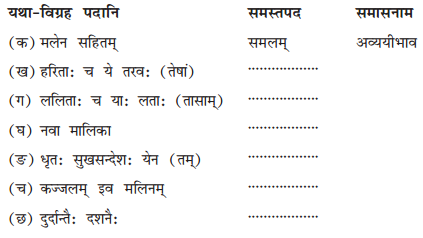
उदाहरणमनुसृत्य पाठात् चित्वा च समस्तपदानि समासनाम च लिखत-
NCERT Solutions for Class 10 Sanskrit Shemushi Chapter 1 शुचिपर्यावरणम् Q6
उत्तराणि:
(ख) हरिततरूणाम् – कर्मधारय समास
(ग) ललितलतानाम् – कर्मधारय समास
(घ) नवमालिका – कर्मधारय समास
(ङ) धृतसुखसन्देशम् – बहुब्रीहि समास
(च) कज्जलमलिनम् – कर्मधारय समास
(छ) दुर्दान्तैर्दशनै – कर्मधारय समास

प्रश्न 7.
रेखाङ्कित-पदमाधृत्य प्रश्ननिर्माणं कुरुत-

(क) शकटीयानम् कज्जलमलिनं धूम मुञ्चति।
उत्तराणि:
कीदृशम्

(ख) उद्याने पक्षिणां कलरवं चेतः प्रसादयति।
उत्तराणि:
केषाम्

(ग) पाषाणीसभ्यतायां लतातरुगुल्माः प्रस्तरतले पिष्टाः सन्ति।
उत्तराणि:
के

(घ) महानगरेषु वाहनानाम् अनन्ता पङ्क्तयः धावन्ति।
उत्तराणि:
केषु कुत्र

(ङ) प्रकृत्याः सन्निधौ वास्तविक सुखं विद्यते।
उत्तराणि:
कस्याः

योग्यताविस्तारः
यह पाठ आधुनिक संस्कृत कवि हरिदत्त शर्मा के रचना संग्रह ‘लसल्लतिका’ से संकलित है। इसमें कवि ने महानगरों की यांत्रिक-बहुलता से बढ़ते प्रदूषण पर चिन्ता व्यक्त करते हुए कहा है कि यह लौहचक्र तन-मन का शोषक है, जिससे वायुमण्डल और भूमण्डल दोनों मलिन हो रहे हैं। कवि महानगरीय जीवन से दूर, नदी-निर्झर, वृक्षसमूह, लताकुञ्ज एवं पक्षियों से गुञ्जित वनप्रदेशों की ओर चलने की अभिलाषा व्यक्त करता है।

समास-समसनं समासः
समास का शाब्दिक अर्थ होता है-संक्षेप। दो या दो से अधिक शब्दों के मिलने से जो तीसरा नया और संक्षिप्त रूप बनता है वह समास कहलाता है। समास के मुख्यतः चार भेद हैं-

  1. अव्ययीभाव
  2. तत्पुरुष
  3. बहुव्रीहि
  4. द्वन्द्व

1. अव्ययीभाव- इस समास में पहला पद अव्यय होता है और वही प्रधान होता है और समस्तपद अव्यय बन जाता है।
यथा-निर्मक्षिकम् मक्षिकाणाम् अभाव:

यहाँ प्रथमपद ‘निर्’ है और द्वितीयपद मक्षिकम् है। यहाँ मक्षिका की प्रधानता न होकर मक्षिका का अभाव प्रधान है, अतः यहाँ अव्ययीभाव समास है। कुछ अन्य उदाहरण देखें-

  • उपग्रामम् – ग्रामस्य सपीपे – (समीपता की प्रधानता)
  • निर्जनम् – जनानाम् अभाव: – (अभाव की प्रधानता)
  • अनुरथम् – रथस्य पश्चात् – (पश्चात् की प्रधानता)
  • प्रतिगृहम् – गृहं गृहं प्रतिः – (प्रत्येक की प्रधानता)
  • यथाशक्ति – शक्तिम् अनतिक्रम्य – (सीमा की प्रधानता)
  • सचक्रम् – सक्रेण सहितम्: – (सहित की प्रधानता)

2. तत्पुरुष- ‘प्रायेण उत्तरपदार्थप्रधानः तत्पुरुषः’ इस समास में प्राय: उत्तरपद की प्रधानता होती है और पूर्वपद उत्तरपद के विशेषण का कार्य करता है। समस्तपद में पूर्वपद की विभक्ति का लोप हो जाता है।
यथा- राजपुरुषः अर्थात् राजा का पुरुष। यहाँ राजा की प्रधानता न होकर पुरुष की प्रधानता है, और राजा शब्द पुरुष के विशेषण का कार्य करता है।

  • ग्रामगतः – ग्राम गतः।
  • शरणागात – शरणम् आगतः।
  • देशभक्तः – देशस्य भक्तः।
  • सिंहभीतः – सिंहात् भीतः।
  • भयापन्नः – भयम् आपन्नः।
  • हरित्रातः – हरिणा त्रातः।

तत्पुरुष समास के दो भेद हैं-कर्मधारय और द्विगु।
1. कर्मधारय- इस समास में एक पद विशेष्य तथा दूसरा पद पहले पद का विशेषण होता है। विशेषण-विशेष्य भाव के अतिरिक्त उपमान-उपमेय भाव भी कर्मधारय समास का लक्षण है।
यथा-

  • पीताम्बरम् – पीतं च तत् अम्बरम्।
  • महापुरुषः – महान् च असौ पुरुषः।
  • कज्जलमलिनम् – कज्जलम् इव मलिनम्।
  • नीलकमलम् – नीलं च तत् कमलम्।
  • मीननयनम् – मीन इव नयनम्।
  • मुखकमलम् – कमलम् इव मुखम्।

2. द्विगु- ‘संख्यापूर्वी द्विगुः’
इस समास में पहला पद संख्यावाची होता है और समाहार (एकत्रीकरण या समूह) अर्थ की प्रधानता होती है।
यथा- त्रिभुजम्-त्रयाणां भुजानां समाहारः।
इसमें पूर्ववद ‘त्रि’ संख्यावाची है।

  • पंचपात्रम् – पंचाना पात्राणां समाहारः।
  • पंचवटी – पंचानां वटानां समाहारः।
  • सप्तर्षिः – सप्तानां ऋषीणां समाहारः।
  • चतुर्युगम् – चतुर्णा युगानां समाहारः।

3. बहुब्रीहि- ‘अन्यपदप्रधानः बहुबीहिः’
इस समास में पूर्व तथा उत्तर पदों की प्रधानता न होकर किसी अन्य पद की प्रधानता होती है।
यथा-

  • पीताम्बरः – पीतम् अम्बरम् यस्य सः (विष्णुः)। यहाँ न तो पीतम् शब्द की प्रधानता है और न अम्बरम् शब्द की अपितु पीताम्बरधारी किसी अन्य व्यक्ति (विष्णु) की प्रधानता है।
  • नीलकण्ठः – नीलः कण्ठः यस्य सः (शिवः)।
  • दशाननः – दश आननानि यस्य सः (रावण:)।
  • अनेककोटिसारः – अनेककोटिः सारः (धनेम्) यस्य सः।
  • विगलितसमृद्धिम् – विगलिता समृद्धिः यस्य तम् (पुरुषम्)।
  • प्रक्षालितपादम् – प्रक्षालितौ पादौ यस्य तम् (जनम्)।

4. द्वन्द्व- ‘उभयपदार्थप्रधान: द्वन्द्वः’
इस समास में पूर्वपद और उत्तरपद दोनों की समान रूप से प्रधानता होती है। पदों के बीच में ‘च’ का प्रयोग विग्रह में होता है।
यथा-

  • रामलक्ष्मणौ – रामश्च लक्ष्मणश्च।
  • पतरौ – माता च पिता च।
  • धर्मार्थकाममोक्षाः – धर्मश्च, अर्थश्च, कामश्च, मोक्षश्च।
  • वसन्तग्रीष्मशिशिराः – वसन्तश्च ग्रीष्मश्च शिशिरश्च।

कविपरिचय- प्रो० हरिदत्त शर्मा इलाहाबाद केन्द्रीय विश्वविद्यालय में संस्कृत के आचार्य रहे हैं। इनके कई संस्कृत काव्य प्रकाशित हो चुके हैं। जैसे-गीतकंदलिका, त्रिपथगा, उत्कलिका, बालगीताली, आक्रन्दनम्, लसल्लतिका इत्यादि। इनकी रचनाओं में समाज की विसंगतियों के प्रति आक्रोश तथा स्वस्थ वातावरण के प्रति दिशानिर्देश के भाव प्राप्त होते हैं।

भावविस्तारः
पृथिवी, जल, तेजो वायुराकाशश्चेति पञ्चमहाभूतानि प्रकृतेः प्रमुखतत्त्वानि। एतैः तत्त्वैरेव पर्यावरणस्य रचना भवति। आवियते रेतः समन्तात् लोकोऽनेनेति पर्यावरणम्। परिष्कृतं प्रदूषणरहितं च पर्यावरणमस्मभ्यं सर्वविधजीवनसुखं ददाति। अस्माभिः सदैव या प्रयतितव्यं यथा जलं स्थलं गगनञ्च निर्मलं स्यात्। पर्यावरणसम्बद्धाः केचन श्लोकाः अधोलिखिताः सन्ति-
यथा-

पृथिवीं परितो व्याप्य, तामाच्छाद्य स्थितं च चत्।
जगदाधाररूपेण, पर्यावरणमुच्यते।।

दूषणविषये-

सृष्टौ स्थितौ विनाशे च नृविज्ञैर्बहुनाशकम्।
पञ्चतत्वविरुद्ध यत्साधितं तत्प्रदूषणम्।।

युप्रदूषणविषये-

प्रक्षिप्तो वाहनधूमः कृष्णः बह्वपकारकः।
दुष्टैरसायनयुक्तो घातक: श्वासरुग्वहः।।

नप्रदूषणविषये-

यन्त्रशाला परित्यक्तैर्नगरेदूषितद्रवैः।
नदीनदी समुद्राश्च प्रक्षिप्तैर्दूषणं गताः।।

दूषण निवारणाय संरक्षणाय च-

शोधनं रोपणं रक्षावर्धनं वायुवारिणः।
वनानां वन्यवस्तूनां भूमेः संरक्षणं वरम्।।
एते श्लोकाः पर्यावरणकाव्यात् संकलिताः सन्ति।

सम-तद्भव- शब्दानामध्ययनम्-
धोलिखितानां तत्समशब्दानां तदुद्भूतानां च तद्भवशब्दानां परिचयः करणीय:
तत्सम – तद्भव
प्रस्तर – पत्थर
वाष्प – भाप
दुर्वह – दूभर
वक्र – बाँका
कज्जल – काजल
चाकचिक्य – चकाचक, चकाचौंध
धूमः – धुआँ
शतम् – सौ (100)
बहिः – बाहर

दः परिचयः
स्मन् गीते शुचि पर्यावरणम् इति ध्रुवकं (स्थायी) वर्तते। तदतिरिक्त सर्वत्र प्रतिपङ्क्ति 26 मात्राः सन्ति। इदं गीतिकाच्छन्दसः मस्ति।

Class 10 Sanskrit Shemushi Chapter 1 शुचिपर्यावरणम् Additional Important Questions and Answers

अतिरिक्त प्रश्नाः

1. अधोलिखितं पद्यांशं पाठित्वा प्रदत्तान प्रश्नान् उत्तरत-

(क) दुर्वहमत्र जीवितं जातं प्रकृतिरेव शरणम्।
शुचि-पर्यावरणम्॥
महानगरमध्ये चलदनिशं कालायसचक्रम्।
मनः शोषयत् तनुः पेषयद् भ्रमति सदा वक्रम्॥
दुन्तैिर्दशनैरमुना स्यान्नैव जननसनम्। शुचि …॥

प्रश्न 1.
एकपदेन उत्तरत (केवलं प्रश्नद्वयमेव)-

  1. चक्रम कीदृशम् चलति?
  2. अस्माकम् शरणम् किम्?
  3. अत्र जीवितं कथं जातम्?

उत्तराणि:

  1. वक्रम्
  2. प्रकृतिः
  3. दुर्वहम्

प्रश्न 2.
पूर्णवाक्येन उत्तरत (केवलं प्रश्नमेकमेव)-

  1. चक्रम् वक्रम् कदा चलति?
  2. अमुना दुर्दान्तैः दशनैः किं न स्यात्?

उत्तराणि:

  1. मनः शोषयत् तनुः पेषयद् कालायसचक्रम् सदा वक्रम् चलति।
  2. अमुना दुर्दान्तैः दशनैः जनग्रसनं नस्यात

प्रश्न 3.
भाषिककार्यम् (केवलं प्रश्नत्रयमेव)-

  1. “अहर्निशम्” इति पदस्य पर्यायपदं पद्यांशे किम्?
  2. “सरलैः” इति पदस्य विपर्यय पदं पद्यांशे किम
  3. “पर्यावरणम्” इति पदस्य विशेषणपदं किम्?
  4. ‘सदा वक्रम् भ्रमति’ अत्र क्रियापदं किम्?

उत्तराणि:

  1. अनिशम्
  2. दुर्दान्तः
  3. शुचि
  4. भ्रमति

(ख) कज्जलमलिनं धूमं मुञ्चति शतशकटीयानम्।
वाष्ययानमाला संधावति वितरन्ती ध्वानम्॥
यानानां पङ्क्तयो ह्यनन्ताः कठिनं संसरणम्। शुचि …।

प्रश्न 1.
एकपदेन उत्तरत (केवलं प्रश्नद्वयमेव)-

  1. कि कज्जलमलिनं धूमं मुञ्चति?
  2. वाष्पयानमाला कि कुर्वन्ती संधावति?
  3. वाष्पयानमाला कि वितरन्ती अस्ति?

उत्तराणि:

  1. शतशकटीयानम्
  2. ध्वानम्
  3. ध्वानम्

प्रश्न 2.
पूर्णवाक्येन उत्तरत (केवलं प्रश्नमेकमेव)-

  1. संसरणम् कठिनम् किमर्थम् भवति?
  2. शतशकटीयानम् किं करोति?

उत्तराणि:

  1. अनन्ताः यानानां पंक्तयः अतः संसरणम् कठिनम् भवति।
  2. शतशकटीयानम् कज्जलमलिनं धूमं मुञ्चति।

प्रश्न 3.
भाषिककार्यम् (केवलं प्रश्नत्रयमेव)-

  1. ‘शतशकटीयानम्’ कर्तृपदस्य क्रियापदं किम्?
  2. अनंताः’ इति पदस्य विशेष्यपदं किम्?
  3. ‘चलनम्’ इति क्रियापदस्य पर्यायपदं किम्?
  4. श्लोके ‘सरलम्’ इति पदस्य कः विपर्ययः आगतः?

उत्तराणि:

  1. मुञ्चति
  2. पक्तयः
  3. संसरणम्
  4. कठिनम्

(ग) वायुमण्डलं भृशं दूषितं न हि निर्मलं जलम्।
कुत्सितवस्तुमिश्रितं भक्ष्यं समलं धरातलम्॥
करणीयं बहिरन्तर्जगति तु बहु शुद्धीकरणम्। शुचि …॥

प्रश्न 1.
एकपदेन उत्तरत (केवलं प्रश्नद्वयमेव)-

  1. जलम् कीदृशम् अस्ति?
  2. भृशं दूषितम् किम् अस्ति?
  3. कुत्सितवस्तु मिश्रितं किम्?

उत्तराणि:

  1. निर्मलम्
  2. वायुमण्डलम्
  3. धरातलम्

प्रश्न 2.
पूर्णवाक्येन उत्तरत (केवलं प्रश्नमेकमेव)-

  1. मनुष्यैः किं करणीयम्?
  2. धरातलं कीदृशं जातम्?

उत्तराणि:

  1. मनुष्यैः बहिरन्तर्जगति तु बहु शुद्धीकरणम् करणीयम्।
  2. समलं धरातलम् जातम्।

प्रश्न 3.
भाषिककार्यम् (केवलं प्रश्नत्रयमेव)

  1. ‘दूषितम्’ इति पदस्य विपर्ययपदं श्लोके किम्?
  2. ‘वायुमण्डलम्’ इति पदस्य विशेषणपदं किम्?
  3. ‘करणीयम्’ इति क्रियापदस्य कर्तृपदं किम्?
  4. श्लोके ‘अत्यधिकम्’ इति पदस्य क: पर्यायः आगतः?

उत्तराणि:

  1. निर्मलम्
  2. दूषितम्
  3. शुद्धीकरणम्
  4. भृशम्

(घ) कञ्चित् काल नय मामस्मान्नगराद् बहुदूरम्।
प्रपश्यामि ग्रामान्ते निर्झर-नदी-पयःपूरम्।।
एकान्ते कान्तारे क्षणमपि मे स्यात् सञ्चरणम्। शुचि …॥

प्रश्न 1.
एकपदेन उत्तरत (केवलं प्रश्नद्वयमेव)-

  1. कविः कस्मात् दूरं गच्छति?
  2. कीदृशे कान्तारे सः क्षणमपि संरचरण कर्तुम् इच्छति।
  3. ग्रामान्ते निर्झर-नदी कीदृशं भवति?

उत्तराणि:

  1. नगरात्
  2. एकान्ते
  3. पयः पूरम्

प्रश्न 2.
पूर्णवाक्येन उत्तरत (केवलं प्रश्नमेकमेव)

  1. ग्रामान्ते सः किम् द्रष्टुम् इच्छति?
  2. एकान्ते कान्तारे मे किं स्यात्?

उत्तराणि:

  1. ग्रामान्ते सः निर्झर-नदी-पयः पूरम् द्रष्टुम् इच्छति।
  2. एकान्ते कान्तारे में क्षणमपि सञ्चरणं स्यात्।

प्रश्न 3.
भाषिककार्यम् (केवलं प्रश्नत्रयमेव)

  1. अतिसमीपम्’ इति पदस्य विपर्ययपदम् किम्?
  2. कान्तारे’ इति पदस्य विशेषणपदं किम्?
  3. ‘जलम्’ इति पदस्य पर्यायपदं किम्?
  4. श्लोके ‘सञ्चरणम्’ इति कर्तृपदस्य क्रियापदं किम्?

उत्तराणि:

  1. बहुदूरम
  2. एकान्ते
  3. पयः
  4. स्यात्

(ङ) हरिततरूणां ललितलतानां माला रमणीया।
कुसुमावलिः समीरचालिता स्यान्मे वरणीया।।
नवमालिका रसालं मिलिता रुचिरं संगमनम्। शुचि …॥

प्रश्न 1.
एकपदेन उत्तरत (केवलं प्रश्नद्वयमेव)-

  1. कीदृशानां वृक्षाणां माला रमणीया भवेत्?
  2. लतानाम् माला कीदृशी भवेत्?
  3. संगमनम् कीदृशं भवेत्?

उत्तराणि:

  1. हरितानाम्
  2. रमणीया
  3. रुचिरम्

प्रश्न 2.
पूर्णवाक्येन उत्तरत (केवलं प्रश्नमेकमेव)-

  1. केन चलिता कुसुमावलिः वरणीया स्यात्?
  2. नवमालिका संगमनं कीदृशम्?

उत्तराणि:

  1. समीरेण चालिता कुसमावलिः वरणीया स्यात्।
  2. नवमालिका रुचिरं संगमनम्।

प्रश्न 3.
भाषिककार्यम् (केवलं प्रश्नत्रयमेव)-

  1. रमणीया’ इति विशेषणपदस्य विशेष्यपदं श्लोके किम्?
  2. श्लोके ‘चालिता’ इति क्रिया पदस्य कर्तृपदं किम्?
  3. अत्र ‘आम्रम्’ इति पदस्य पर्यायपदं किम्?
  4. श्लोके ‘दुर्गमनम्’ इति कः विपर्ययः?

उत्तराणि:

  1. माला
  2. समीरेण
  3. रसालम्
  4. संगमनम्

(च) अयि चल बन्धो! खगकुलकलरव गुञ्जितवनदेशम्।
पुर कलरव सम्भ्रमितजनेभ्यो धृतसुखसन्देशम्।।
चाकचिक्यजालं नो कुर्याज्जीवितरसहरणम्। शुचि … ||

प्रश्न 1.
एकपदेन उत्तरत (केवलं प्रश्नद्वयमेव)-

  1. कविः कीदृशम् सन्देशम् दातुम् इच्छति?
  2. कविः कुत्र चलितुम् इच्छति?
  3. कविः कं सम्बोधयति?

उत्तराणि:

  1. धृतसुखम्
  2. खगकुलकलरवदेशम्
  3. बंधुवर

प्रश्न 2.
पूर्णवाक्येन उत्तरत (केवलं प्रश्नमेकमेव)-

  1. किम् जीवितम् रसं न हरेत्?
  2. पुर कलरव सम्भ्रमित जनेभ्यः सुखसन्देशं कुत्र प्राप्नोति?

उत्तराणि:

  1. नगराणाम् चाकचिक्यजालं जीवितम् रसं न हरेत्।
  2. पुर-कलरव सम्भ्रमित जनेभ्यः सुखसन्देशं खगकुलकलरव गुजितवनदेशे प्राप्नोति।

प्रश्न 3.
भाषिककार्यम् (केवलं प्रश्नत्रयमेव)-

  1. ‘ग्राम’ इति पदस्य विपर्ययपदं किम्?
  2. ‘चल’ इति क्रियापदस्य कर्तृपदं किम्?
  3. ‘चाकचिक्यजालं’ इति कर्तृपदस्य क्रियापदं किम्?
  4. श्लोके ‘नगर’ इति पदस्य कः पर्यायः आगतः?

उत्तराणि:

  1. पुर
  2. बन्धो
  3. कुर्यात्
  4. पुर

(छ) प्रस्तरतले लतातरुगुल्मा नो भवन्तु पिष्टा।
पाषाणी सभ्यता निसर्गे स्यान्न समाविष्टा॥
मानवाय जीवनं कामये नो जीवन्मरणम्। शुचि …॥

प्रश्न 1.
एकपदेन उत्तरत (केवलं प्रश्नद्वयमेव)-

  1. लतातरुगुल्माः कुत्र न पिष्टा:भवन्तु?
  2. पाषाणी सभ्यता कुत्र समविष्टा न स्यात्?
  3. कविः कि न कामयते?

उत्तराणि:

  1. प्रस्तरतले
  2. निसर्ग
  3. जीवन्मरणम्

प्रश्न 2.
पूर्णवाक्येन उत्तरत (केवलं प्रश्नमेकमेव)-

  1. कविः कस्य कामना करोति?
  2. प्रस्तरे तले के न भवन्तु?

उत्तराणि:

  1. कविः मानवाय जीवनस्य कामना करोति।
  2. प्रस्तरतले लतातरुगुल्माः प्रियः न भवन्तु।

प्रश्न 3.
भाषिककार्यम् (केवलं प्रश्नत्रयमेव)-

  1. सभ्यता’ इति पदस्य विशेषणपदं किम्?
  2. अहम्’ इति कर्तृपदस्य क्रियापदं किम्?
  3. ‘जीवन्मरणं’ इति पदस्य विपर्ययपदं किम् प्रयुक्तम्?
  4. ‘पाषाणीसभ्यता निसर्गे न स्यात्’। अत्र कर्तृपदं किम्?

उत्तराणि:

  1. पाषाणी
  2. कामये
  3. जीवनम्
  4. पाषाणीसभ्यता

2. अधोलिखित कथनेषु रेखांकितपदानि आधृत्य प्रश्ननिर्माणं क्रियाताम्-

(क) मानव जीवनाय शुचि-पर्यावरणं आवश्यकम् भवति।
(i) कीदृशम्
(ii) क:
(iii) कम्
(iv) कुत्र
उत्तराणि:
(i) कीदृशम्

(ख) महानगरमध्ये कालायसचक्रम् अनिशं चलति।
(i) केन
(ii) क:
(iii) कुत्र
(iv) कम्
उत्तराणि:
(iii) कुत्र

(ग) चक्रम् सदा वक्रम भ्रमति।
(i) कः
(ii) केन
(iii) कीदृशम्
(iv) कुत्र
उत्तराणि:
(iii) कीदृशम्

(घ) अमुना दुर्दान्तैः अशनैः जनग्रसनम् न स्यात्।
(i) कः
(ii) केन
(iii) केषाम्
(iv) कुत्र
उत्तराणि:
(ii) केन

(ङ) शतं शकटीयानम् धूम्र मुञ्चति।
(i) केन
(ii) क:
(iii) कति
(iv) केषाम्
उत्तराणि:
(iii) कति

(च) यामानां पक्तयः अनन्ताः कठिनं संसरणम् भवति।
(i) कः
(ii) केषाम्
(iii) कुत्र
(iv) कम्
उत्तराणि:
(ii) केषाम्

(छ) वायुमण्डलं अत्यधिकं दूषितं जातम्।
(i) केषाम्
(ii) कीदृशम्
(iii) कः
(iv) कम्
उत्तराणि:
(ii) कीदृशम्

(ज) प्रकृत्याः सन्निधौ वास्तविकं सुखं विद्यते।
(i) कम्
(ii) कस्याः
(iii) केषाम्
(iv) कः
उत्तराणि:
(ii) कस्याः

(झ) उद्याने पक्षिणां कलरवं चेतः प्रसादयति।
(i) केषाम्
(ii) कः
(iii) कम्
(iv) कुत्र
उत्तराणि:
(i) केषाम्

(त्र) पाषाणीसभ्यतायां लतातरुगुल्माः प्रस्तरतले पिष्टाः सन्ति।
(i) के
(ii) क:
(iii) केषाम्
(iv) कुत्र
उत्तराणि:
(i) के

(ट) शकटीयानम् कज्जलमालिनं धूमं मुञ्चति।
(i) किम्
(ii) कम्
(iii) कीदृशम्
(iv) कथम्
उत्तराणि:
(iii) कीदृशम्

(ठ) प्रस्तरतले लतातरुगुल्मा पिष्टाः न भवन्तु।
(i) के
(ii) कुत्र
(iii) किम्
(iv) केन
उत्तराणि:
(ii) कुत्र

(ड) महानगरेषु, वाहनानाम् अनन्ताः पङक्तयः धावन्ति।
(i) केषु
(ii) कस्मै
(iii) के
(iv) किम्
उत्तराणि:
(i) केषु

(ढ) शकटीयानम् कज्जलमलिन धूम मुञ्चति।
(i) कम्
(ii) किम्
(iii) कथम्
(iv) कानि
उत्तराणि:
(ii) किम्

(ण) कविः मानवस्य जीवनस्य कामनां करोति।
(i) कथम्
(ii) केन
(iii) कस्मै
(iv) कस्य
उत्तराणि:
(iv) कस्य

3. अधोलिखितानां श्लोकानाम् अन्वये रिक्तस्थानपूर्तिः।

(क) दुर्वहमत्र जीवितं जातं प्रकृतिरेव शरणम्।
शुचि-पर्यावरणम्॥
महानगरमध्ये चलदनिशं कालायसचक्रम्।
मनः शोषयत् तनुः पेषयद् भ्रमति सदा वक्रम्॥
दुर्दान्तैर्दशनैरमुना स्यान्नैव जनग्रसनम्॥ शुचि …..॥

अन्वयः
अत्र जीवितं (i) _______ जातं प्रकृतिः एवं शरणम् शुचि-पर्यावरणम् (एव शरणम्) (ii) _______ मध्ये कालाय सचक्रम् अनिशं चलत् मनः (iii) _______ तनुः प्रेक्षेयद् सदा वक्रम भ्र मति अमुना दुर्दान्तैः (iv) _______ जनग्रसनम् न एवं स्यात् ।।1।।

मञ्जूषा- दशनैः, दुर्वहम्, शोषयत्, महानगर
उत्तराणि:
(i) दुर्वहम्
(ii) महानगर
(ii) शोषयत्
(iv) दशनैः

(ख) कज्जलमलिनं धूमं मुञ्चति शतशकटीयानम्।
वाष्पयानमाला संधावति वितरन्ती ध्वानम्॥
यानानां पङ्क्तयो ह्यनन्ताः कठिनं संसरणम्॥ शुचि…॥

अन्वयः
(अद्यत्वे देशे) शतशकटीयानम् (i) ________ धूमं मुञ्चति, वाष्पयानमाला (ii) ________ वितरन्ती संधावति। यानानां (iii) ________ पङ्क्त यः हि (येन) (iv) ________ संसरणम्।

मञ्जूषा- कठिनं, कज्जलमलिनं, ध्वानम्, अनन्ताः
उत्तराणि:
(i) कज्जलमलिनं
(ii) ध्वानम्
(iii) अनन्ताः
(iv) कठिन

(ग) वायुमण्डलं भृशं दूषितं न हि निर्मल जलम्।
कुत्सितवस्तुमिश्रितं भक्ष्यं समलं धरातलम्॥
करणीयं बहिरन्तर्जगति तु बहु शुद्धीकरणम्॥ शुचि…॥

अन्वयः
(अद्य) वायुमण्डलं (i) ________ दूषितं, निर्मल जलम् हि न, (ii) ________ कुत्सित वस्तु मिश्रितं समलं (iii) ________ अन्तजगति तु (iv) ________ करणीयं बहु शुद्धीकरणम्।।

मञ्जूषा- भक्ष्यं, भृशं, धरातलम्, निर्मल
उत्तराणि:
(i) भृशं
(ii) भक्ष्य
(iii) धरातलम्
(iv) निर्मल

(घ) कञ्चित् कालं नय मामस्मान्नगराद् बहुदूरम्।
प्रपश्यामि ग्रामान्ते निर्झर-नदी-पयःपूरम्॥
एकान्ते कान्तारे क्षणमपि मे स्यात् सञ्चरणम्॥ शुचि …॥

अन्वयः
कञ्चित् कालं माम् (i) _________ नगरात् बहु दूरम् नय। ग्रामान्ते (अहम्) (ii) _________ नदी-पयः पूरम् प्रापश्यामि। (iii) _________ कान्तारे में क्षणम् अपि (iv) _________ स्यात्।

मञ्जूषा- सञ्चरणम्, अस्मात्, एकान्ते, निर्झर
उत्तराणि:
(i) अस्मात्
(ii) निर्झर
(iii) एकान्ते
(iv) सञ्चरणम्

(ङ) हरिततरूणां ललितलतानां माला रमणीया।
कुसुमावलिः समीरचालिता स्यान्मे वरणीया॥
नवमालिका रसालं मिलिता रुचिरं संगमनम्। शुचि …॥

अन्वयः
हरित तरूणाम् ललित (i) ________ रमणीया माला (ii) ________ चालिता कुसमावलिः मे वरणीया स्यात् (iii) ________ नवमालिका (iv) ________ संगमनम् मिलिता।

मञ्जूषा- रुचिरं, लतानां, रसालं, समीर
उत्तराणि:
(i) लतानां
(ii) समीर
(iii) रसालं
(iv) रुचिरं

(च) अयि चल बन्धो! खगकुलकलरव गुञ्जितवनदेशम्।
पुर-कलरव सम्भ्रमितजनेभ्यो धृतसुखसन्देशम्॥
चाकचिक्यजालं नो कुर्याज्जीवितरसहरणम्॥ शुचि …॥

अन्वयः
बन्धो! खगकुल (i) ________ गुञ्जितवनदेशम् (ii) ________ पुर-कलरव सम्भ्रमित (iii) ________धृत सुख सन्देशम्। चाकचिक्यजालं जीवित (iv) ________ हरणम् न कुर्यात्।

मञ्जूषा- जनेभ्यः, कलरव, रस, चल
उत्तराणि:
(i) कलरव
(ii) चल
(iii) जनेभ्यः
(iv) रस

(छ) प्रस्तरतले लतातरुगुल्मा नो भवन्तु पिष्टा।
पाषाणी सभ्यता निसर्गे स्यान्न समाविष्टा।
मानवाय जीवनं कामये नो जीवन्मरणम्। शुचि …॥

अन्वयः
लतातरु गुल्मा: (i) ________ न पिष्टाः भवन्तु। (ii) ________ पाषाणी सभ्यता (iii) ________ न स्यात्। (अहम्) मानवाय (iv) ________ कामये जीवन्मरणम् न।
मञ्जूषा- जीवन, प्रस्तरतले, निसर्ग, समाविष्टा
उत्तराणि:
(i) प्रस्तरतले
(ii) निसर्गे
(iii) समाविष्टा
(iv) जीवनं

4. श्लोकक्रमानुसारं वाक्यानि पुनः लेखनीयानि-

प्रश्न (अ).
(क) अमुना दुर्दान्तैः दशनौः जनग्रसनम् न स्यात्।
(ख) महानगरेषु कालायसचक्रम् अहर्निशम् चलति।
(ग) चक्रम सर्वदा वक्रम् भ्रमति।
(घ) अधुना प्रकृतिरेव शरणम् गन्तव्यम्।
(ङ) अस्मिन् संसारे जीवितं कठिन अस्ति।
(च) अस्मभ्यम्-पर्यावरणम् आवश्यकम्।
(छ) चक्रम् मनः शोषयति तनुः च पेषयति।
(ज) शुचि-पर्यावरणम् आवश्यकम् अस्ति।
उत्तराणि:
(क) अस्मिन् संसारे जीवितं कठिनं अस्ति।
(ख) महानगरेषु कालायसचक्रम् अहर्निशम् चलति।
(ग) चक्रम् मनः शोषयति तनुः च पेषयति।
(घ) चक्रम सर्वदा वक्रम् भ्रमति।
(ङ) अमुना दुर्दान्तः दशनैः जनग्रसनम् न स्यात्।
(च) अधुना प्रकृतिरेव शरणम् गन्तव्यम्।
(छ) अस्मभ्यम्-पर्यावरणम् आवश्यकम्।
(ज) शुचि-पर्यावरम् आवश्यकम् अस्ति।

प्रश्न (आ).
(क) शुचि-पर्यावरणम् आवश्यकम् अस्ति।
(ख) वायु-प्रदूषणम् भवति।
(ग) शकटीयानम् धूमं मुञ्चति।
(घ) महानगरेषु वाहनानाम् अन्नताः पङक्तयः धावन्ति।
(ङ) पर्यावरणम् प्रदूषितम् भवति।
(च) शतशकटीयानम् कज्जलमलिनं धूम मुञ्चति।
(छ) महानगरेषु चलनम् कठिनम् भवति।
(ज) वाष्पयानमाला ध्वानम् वितरन्ती सधावति।
उत्तराणि:
(क) शकटीयानम् धूमं मुज्जति।
(ख) शतशकटीयानम् कज्जलमलिनं धूमं मुञ्चति।
(ग) वाष्पयानमाला ध्वानम् वितरन्ती सधावति।
(घ) महानगरेषु वाहनानाम् अन्नताः पङक्तयः धावन्ति।
(ङ) वायु-प्रदूषणम् भवति।
(च) महानगनेषु चलनम् कठिनम् भवति।
(छ) पर्यावरणम् प्रदूषितम् भवति।
(ज) शुचि-पर्यावरणम् आवश्यकम् अस्ति।

5. समुचितानि पर्यायपदानि मेलनं कुरुत-

खण्ड ‘क’ – खण्ड ‘ख’
(क) जीतितम् – सुन्दरी
(ख) दुर्वहम् – पुष्पपक्तिः
(ग) तनुः – वायु:
(घ) वृक्षाणाम् – वरणीया
(ङ) रमणीया – त्यजति
(च) कुसमावलिः – अत्यधिकम्
(छ) चयनीया – कुटिलम्
(ज) समीरः – जीवनम्
(झ) चाकचिक्यजालम् – शरीरम्
(ञ) रसालम् – दुष्करम्
(ट) मुञ्चति – तरुणाम्
(ठ) वक्रम् – कृत्रिमप्रभावपूर्णजगत्
(ड) भक्ष्यम् – आम्रम्
(ढ) संसरणम् – मलेनयुक्तम्
(ण) भृषम् – सञ्चलनम्
(त) समलम् – खाद्यपदार्थ
(थ) शुचिः – मनसि
(द) यानानाम् – इच्छामि
(ध) धरातलम् – अवलोकयामि
(न) अन्तर्जगति – नहि
(प) बहु – वने
(फ) प्रपश्यामि – पवित्रम्
(ब) कान्तारे – मित्र
(भ) बन्धु – वाहनानाम्
(म) नो – पृथ्वी
(य) कामये – अत्यधिकम्
उत्तराणि:
(क) जीवनम्
(ख) दुष्करम्
(ग) शरीरम्
(घ) तरुणाम्
(ङ) सुन्दरी
(च) पुष्पपक्तिः
(छ) वरणीया
(ज) वायुः
(झ) कृत्रिमप्रभावपूर्ण जगत्
(ञ) आम्रम्
(ट) त्यजति
(ठ) कुटिलम्
(ड) खाद्यपदार्थ
(ढ) सञ्चलनम्
(ण) अत्यधिकम्
(त) मलेन युक्तम्
(थ) पवित्रम्
(द) वाहनानाम्
(ध) पृथ्वी
(न) मनसि
(प) अत्यधिकम्
(फ) अवलोकयामि
(ब) वने
(भ) मित्र
(म) नहि
(य) इच्छामि

6. ‘क’ स्तम्भे विशेषणपदं लिखितम् ‘ख’ स्तम्भे पुनः विशेष्यपदम्। तयोः मेलनं कुरुत-

‘क’ स्तम्भ – ‘ख’ स्तम्भ
(क) शुचि – (i) दशनः
(ख) दुर्दान्तः – (ii) वायुमण्डलम्
(ग) दूषितम् – (iii) कान्तरे
(घ) निर्मल – (iv) पर्यावरणम्
(ङ) समलं – (v) धरातलम्
(च) एकान्ते – (vi) धुर्म
(छ) मलिनं – (vii) पक्तयः
(ज) अनंताः – (viii) जलम्
उत्तराणि:
(क) (iv)
(ख) (i)
(ग) (ii)
(घ) (viii)
(ङ) (v)
(च) (iii)
(छ) (vi)
(ज) (vii)

7. निम्न ‘क’ वर्गीय पदार्थ ‘ख’ वर्गीय पदेषु विपर्यायपदानि चीयताम्-

‘क’ पदानि – ‘ख’ विपर्यायपदानि
(क) निर्मलम् – अदुर्दान्तः
(ख) भक्ष्यम् – निर्मलम्
(ग) बहु – ग्रहणति
(घ) करणीयम् – एकम्
(ङ) नगरात् – अन्ताः
(च) बहुदूरम् – सरलम्
(छ) कान्तारे – अकरणीयम्
(ज) रमणीया – ग्रामात्
(झ) रुचिरम् – समीपम्
(ञ) बन्धो! – नगरे
(ट) कुर्यात् – अरमणीया
(ठ) जीवितम् – मलम्
(ड) सभ्यता – अभक्ष्यम्
(ढ) मानवाय – न्यून
(ण) भृषम् – अरुचिरम्
(त) दूषितम् – शत्रों!
(थ) शुचि – अकुर्यात्
(द) वक्रम् – मरणम्
(ध) दुर्दान्तः – असभ्यता
(न) मलिनम् – दानवाय
(प) मुञ्चति – न्यूनम्
(फ) शतम् – अदूषितम्
(ब) अनन्ताः – अशुचि
(भ) कठिनम् – सरलम्
उत्तराणि:
(क) मलम्
(ख) अभक्ष्यम्
(ग) न्यून
(घ) अकरणीयम्
(ङ) ग्रामात्
(च) समीपम्
(छ) नगरे
(ज) अरमणीया
(झ) अरुचिरम्
(ञ) शत्रो!
(ट) अकुर्यात्
(ठ) मरणम्
(ड) असभ्यता
(ढ) दानवाय
(ण) न्यूनम्
(त) अदूषितम्
(थ) अशुचि
(द) सरलम्
(ध) अदुर्दान्तः
(न) निर्मलम्
(प) ग्रहणति
(फ) एकम्
(ब) अन्ताः
(भ) सरलम्

NCERT Solutions for Class 9 Sanskrit Shemushi Chapter 2 स्वर्णकाकः

We have given detailed NCERT Solutions for Class 9 Sanskrit Shemushi Chapter 2 स्वर्णकाकः Questions and Answers come in handy for quickly completing your homework.

Shemushi Sanskrit Class 9 Solutions Chapter 2 स्वर्णकाकः

Class 9 Sanskrit Shemushi Chapter 2 स्वर्णकाकः Textbook Questions and Answers

अभ्यासः

प्रश्न 1.
एकपदेन उत्तर लिखत –

(क) माता काम् आदिशत्?
(ख) स्वर्णकाक: कान् अखादत्?
(ग) प्रासादः कीदृशः वर्तते?
(घ) गृहमागत्य तया का समुद्घटिता?
(ङ) लोभाविष्टा बालिका कीदृशीं मञ्जूषां नमति?
उत्तर:
(क) पुत्रीम्
(ख) तण्डुलान्
(ग) स्वर्णमयः
(घ) मञ्जूषा
(ङ) बृहत्तमाम्

प्रश्न 2.
अधोलिखितानां प्रश्नानाम् उत्तराणि संस्कृतभाषया लिखत –

(क) निर्धनायाः वृद्धायाः दुहिता कीदृशी आसीत्?
(ख) बालिकया पूर्व कीदृशः काकः न दृष्टः आसीत्?
(ग) निधनायाः दुहिता मञ्जूषायां कानि अपश्यत?
(घ) बालिका किं दृष्ट्वा आश्चर्यचकिता जाता?
(ङ) गर्विता बालिका कीदृशं सोपानम् अयाचत् कीदृशं च प्राप्नोत्?
उत्तर:
(क) निर्धनायाः वृद्धायाः दुहिता विनम्रा मनोहरा च आसीत्।
(ख) बालिकया पूर्व एतादृशः स्वर्णपक्षः रजतचञ्चुः स्वर्णकाकः न दृष्टः आसीत्।
(ग) निर्धनायाः दुहिता मञ्जूषायां महाहाणि हीरकाणि अपश्यत्।
(घ) बालिका वृक्षस्य उपरि स्वर्णमयं प्रासादं दृष्ट्वा आश्चर्यचकिता जाता।
(ङ) गर्विता बालिका स्वर्णमय सोपानम् अयाचत् ताम्रमयं च प्राप्नोत्।

प्रश्न 3.
(अ) अधोलिखितानां शब्दानां विलोमपदं पाठात् चित्वा लिखतशब्दाः विलोमपदानि –

शब्दाः – विलोमपदानि
(क) पश्चात् – ………..
(ख) हसितुम् – ………
(ग) अधः – ……………
(घ) श्वेतः – ………….
(ङ) सूर्यास्त: – ………….
(च) सुप्तः – …………..
उत्तर:
शब्दाः – विलोमपदानि
(क) पश्चात् x पूर्वम्
(ख) हसितुम् x रोदितुम्
(ग) अधः x उपरि
(घ) श्वेतः x कृष्णः
(ङ) सूर्यास्त: x सूर्योदयः
(च) सुप्तः x प्रबुद्धः

(आ) सन्धिं कुरुत –

(क) नि + अवसत् – ………….
(ख) सूर्य + उदयः – ………….
(ग) वृक्षस्य + उपरि – ………….
(घ) हि + अकारयत् – ………….
(ङ) च + एकाकिनी – ………….
(च) इति + उक्त्वा – ………….
(छ) प्रति + अवदत् – ………….
(ज) प्र + उक्तम् – ………….
(झ) अत्र + एव – ………….
(ञ) तत्र + उपस्थिता – ………….
(ट) यथा + इच्छम् – ………….
उत्तर:
(क) नि + अवसत् – न्यवसत्
(ख) सूर्य + उदयः – सूर्योदयः
(ग) वृक्षस्य + उपरि – वृक्षस्योपरि
(घ) हि + अकारयत् – ह्यकारयत्
(ङ) च + एकाकिनी – चैकाकिनी
(च) इति + उक्त्वा – इत्युक्त्वा
(छ) प्रति + अवदत् – प्रत्यवदत्
(ज) प्र + उक्तम् – प्रोक्तम्
(झ) अत्र + एव – अत्रैव
(ञ) तत्र + उपस्थिता – तत्रोपस्थिता
(ट) यथा + इच्छम् – यथेच्छम्

प्रश्न 4.
स्थूलपदान्यधिकृत्य प्रश्ननिर्माणं कुरुत –

(क) ग्रामे निर्थना स्वी अवसत्।
(ख) स्वर्णकाकं निवारयन्ती बालिका प्रार्थयत्।
(ग) सूर्योदयात् पूर्वमेव बालिका तत्रोपस्थिता।
(घ) बालिका निर्धनमातुः दुहिता आसीत्।
(ङ) लुब्धा वृद्धा स्वर्णकाकस्य रहस्यमभिज्ञातवती।
उत्तर:
(क) ग्रामे का अवसत्?
(ख) कं निवारयन्ती बालिका प्रार्थयत्?
(ग) कस्मात् पूर्वमेव बालिका तत्रोपस्थिता?
(घ) बालिका कस्याः दुहिता आसीत्?
(ङ) लुब्धा वृद्धा कस्य रहस्यमभिज्ञातवती?

प्रश्न 5.
प्रकृति-प्रत्यय-संयोगं कुरुत (पाठात् चित्वा वा लिखत) –

(क) वि + लोक् + ल्यप् – ………….
(ख) नि – क्षिप् + ल्यप् – ………….
(ग) आ + गम् + ल्यप् – ………….
(घ) दृश् + क्त्वा – ………….
(ङ) शी + क्त्वा – ………….
(च) लघु + तमप् – ………….
उत्तर:
(क) वि + लोक् + ल्यप् – विलोक्य
(ख) नि – क्षिप् + ल्यप् – निक्षिप्य
(ग) आ + गम् + ल्यप् – आगम्य
(घ) दृश् + क्त्वा – दृष्ट्वा
(ङ) शी + क्त्वा – शयित्वा
(च) लघु + तमप् – लघुतम (लघुतमम्)

प्रश्न 6.
प्रकृति-प्रत्यय-विभागं कुरुत –

(क) रोदितुम् – ………….
(ख) दृष्ट्वा – ………….
(ग) विलोक्य – ………….
(घ) निक्षिप्य – ………….
(ङ) आगत्य – ………….
(च) शयित्वा – ………….
(छ) लघुतमम् – ………….
उत्तर:
(क) रोदितुम् – रुद् + तुमुन्
(ख) दृष्ट्वा – दृश् + क्त्वा
(ग) विलोक्य –वि + लोक् + ल्यप्
(घ) निक्षिप्य – नि + क्षिप् + ल्यप्
(ङ) आगत्य – आ + गम् + ल्यप्
(च) शयित्वा – शी + क्त्वा
(छ) लघुतमम् – लघु + तमप्

प्रश्न 7.
अधोलिखितानि कथनानि कः/का, कं/कां च कथयति –

कथनानि – क:/का – कं/काम्
(क) पूर्व प्रातराशः क्रियताम्। – …………. – ………….
(ख) सूर्यातपे तण्डुलान् खगेभ्यो रक्ष। – …………. – ………….
(ग) तण्डुलान् मा भक्षय। – …………. – ………….
(घ) अहं तुभ्यं तण्डुलमूल्यं दास्यामि। – …………. – ………….
(ङ) भो नीचकाक! अहमागता, महां तण्डुलमूल्यं प्रयच्छ। – …………. – ………….
उत्तर:
कथनानि – कः/का – कं/काम्
(क) पूर्व प्रातराशः क्रियताम्। – स्वर्णकाक:बालिकाम्
(ख) सूर्यातपे तण्डुलान् खगेभ्यो रक्ष। – वृद्धा मातापुत्रीम्
(ग) तण्डुलान् मा भक्षया – बालिकास्वर्णकाकम्
(घ) अहं तुभ्यं तण्डुलमूल्यं दास्यामि। – स्वर्णकाकःबालिकाम्
(ङ) भो नीचकाक! अहमागता, मां तण्डुलमूल्यं प्रयच्छ। – लुब्धायाः पुत्रीस्वर्णकाकम्

प्रश्न 8.
उदाहरणमनुसृत्य कोष्ठकगतेषु पदेषु पञ्चमीविभक्तेः प्रयोगं कृत्वा रिक्तस्थानानि पूरयत –

यथा-मूषक: बिलाद् बहिः निर्गच्छति। (बिल)
(क) जनः …………. बहिः आगच्छति। (ग्राम)
(ख) नद्यः …………. निस्सन्ति। (पर्वत)
(ग) …………. पत्राणि पतन्ति। (वृक्ष)
(घ) बालकः …………. बिभेति। (सिंह)
(ङ) ईश्वरः …………. त्रायते। (क्लेश)
(च) प्रभुः भक्तं …………. निवारयति। (पाप)
उत्तर:
(क) ग्रामात्
(ख) पर्वतात्/पर्वतेभ्यः
(ग) वृक्षात्
(घ) सिंहात्
(छ) क्लेशात्
(च) पापात्

Class 9 Sanskrit Shemushi Chapter 2 स्वर्णकाकः Additional Important Questions and Answers

अतिरिक्त कार्यम्

प्रश्न 1.
निम्नलिखितम् अनुच्छेदं पठित्वा तदाधारिताना प्रश्नानाम् उत्तराणि लिखत –

1. पुरा कस्मिंश्चिद् ग्रामे एका निधना वृद्धा स्त्री न्यवसत्। तस्याः च एका दुहिता विनमा मनोहरा चासीत्। एकदा माता स्थाल्या तण्डुलान् निक्षिप्य पुत्रीम् आदिशत्। “सूर्यातपे तण्डुलान् खगेभ्यो रक्षा” किञ्चित् कालादनन्तरम् एको विचित्रः काकः समुड्डीय तस्याः समीपम् अगच्छत्

(i) एकपदेन उत्तरत (केवलं प्रश्नद्वयमेव)

  1. वृद्धा स्त्री कीदृशी आसीत्?
  2. वृद्धायाः कीदृशी दुहिता आसीत्?
  3. निर्धनास्त्री कुत्र न्यवसत्?

उत्तर:

  1. निर्धना
  2. विनम्रा
  3. कस्मिंश्चिद्ग्रामे

(ii) पूर्णवाक्येन उत्तरत (केवलं प्रश्नमेकमेव)

  1. किञ्चित्कालानन्तरम् किम् अभवत्?
  2. दुहिता कीदृशी आसीत?

उत्तर:

  1. किञ्चित्कालानन्तरम् एको विचित्रः काकः समुड्डीय तस्याः समीपम् अगच्छत्।
  2. दुहिता विनम्रा मनोहरा चासीत्।

(iii) भाषिककार्यम् (केवलं प्रश्नत्रयमेव)

  1. अनुच्छेदे ‘न्यवसत्’ इति क्रियापदस्य कर्तृपदं किमस्ति?
  2. ‘दुहिता विनम्रा’ अनयोः पदयोः विशेषणपदं किम्?
  3. अस्मिन् अनुच्छेदे ‘धनवती’ इति पदस्य कः विपर्ययः आगतोऽस्ति?
  4. पुत्री इत्यर्थे किं पदं प्रयुक्तम्?

उत्तर:

  1. स्त्री
  2. विनम्रा
  3. निर्धना
  4. दुहिता

2. नैतादृशः स्वर्णपक्षो रजतचञ्चुः स्वर्णकाकस्तया पूर्व दृष्टः। तं तण्डुलान् खावन्तं हसन्तञ्च विलोक्य बालिका रोदितुमारब्धा। तं निवारयन्ती सा प्रार्थयत्-“तण्डुलान् मा भक्षया मदीया माता अतीव निर्धना वर्तते।” स्वर्णपक्षः काकः प्रोवाच, “मा शुचः। सूर्योदयात्प्राग् ग्रामाबहिः पिप्पलवृक्षमनु त्वया आगन्तव्यम्। अहं तुभ्यं तण्डुलमूल्यं दास्यामि।” ङ्केप्रहबिता बालिका निनामपि न लेभा

(i) एकपदेन उत्तरत (केवलं प्रश्नद्वयमेव)

  1. स्वर्णकाकस्य चञ्चुः कीदृशः आसीत्?
  2. बालिकायाः माता कीदृशी आसीत्?
  3. क: तण्डुलान् अखादत्?

उत्तर:

  1. रजतस्य
  2. निर्धना
  3. स्वर्णकाक:

(ii) पूर्णवाक्येन उत्तरत (केवलं प्रश्नमेकमेव)

  1. स्वर्णकाकं निवारयन्ती सा कि प्रार्थयत्?
  2. स्वर्णकाकः किम् अवदत्?

उत्तर:

  1. स्वर्णकाकं निवारयन्ती सा प्रार्थयत्-“तण्डुलान् मा भक्षय। मदीया माता अतीव निर्धना वर्तते।”
  2. स्वर्णकाकः प्रोवाच मा शुचः। सूर्योदयात्प्राग् ग्रामाद्बहिः पिप्पवृक्षमनु त्वया आगन्तव्यम्। अहं तुभ्यं तण्डुलमूल्यं दास्यामि।

(iii) भाषिककार्यम् (केवलं प्रश्नत्रयमेव)

  1. अनुच्छेदे ‘हसितुम्’ इत्यस्य पदस्य कः विपर्ययः लिखितः?
  2. रोदितुमारब्धा’ इत्यस्याः क्रियायाः अनुच्छेदे कर्तृपदं कि वर्तते?
  3. ‘प्रहर्षिता बालिका निद्रामपि न लेभे’। अत्र वाक्ये विशेषणपदं किमस्ति?
  4. ‘दृष्ट्वा ‘ इत्यर्थे किं पदं प्रयुक्तम्?

उत्तर:

  1. रोदितुम्
  2. बालिका
  3. प्रहर्षिता
  4. विलोक्य

3. सूर्योदयात्पूर्वमेव सा तत्रोपस्थिता। वृक्षस्योपरि विलोक्य सा च आश्चर्यचकिता सजाता यत् तत्र स्वर्णमयः प्रासादो वर्तते। यदा काकः शयित्वा प्रबुद्धस्तदा तेन स्वर्णगवाक्षात्कथितं “हहो बाले! त्वमागता, तिष्ठ, अहं त्वत्कृते सोपानमवतारयामि, तत्कथय स्वर्णमयं रजतमयम् तासमय वा”? कन्या अवदत्-“अहं निर्धनमातुः दुहिता अस्मि। तानसोपानेनैव आगमिष्यामि।” परं स्वर्णसोपानेन सा स्वर्णभवनम् आरोहत्

(i) एकपदेन उत्तरत (केवलं प्रश्नद्वयमेव)

  1. सूर्योदयात् पूर्वमेव का तत्र उपस्थिता?
  2. कन्या कस्याः दुहिता आसी?
  3. काकः किं कृत्वा प्रबुद्धः?

उत्तर:

  1. बालिका (सा)
  2. निर्धनमातुः
  3. शयित्वा

(ii) पूर्णवाक्येन उत्तरत (केवलं प्रश्नमेकमेव)

  1. स्वर्णगवाक्षात् काकेन किं कथितम्?
  2. कन्या किं प्रावोचत्?

उत्तर:

  1. स्वर्णगवाक्षात् काकेन कथितम्-हंहो बाले! त्वमागता, तिष्ठ, अहं त्वत्कृते सोपानमवतारयामि।
  2. कन्या प्रावोचत् अहं निर्धनमातुर्दुहिताऽस्मिा ताम्रसोपानेनैव आगमिष्यामि।

(iii) भाषिककार्यम् (केवलं प्रश्नत्रयमेव)

  1. ‘अधः’ इत्यस्य पदस्य कः विपर्ययः अनुच्छेदे लिखितोऽस्ति?
  2. ‘अहं निर्धनमातुः दुहिता अस्मि’। अत्र वाक्ये ‘अहम्’ इति कर्तृपदस्य क्रियापदं किम्?
  3. अनुच्छेदे ‘ताम्रमयं सोपानम्’ अनयो: पदयोः विशेषणपदं किमस्ति?
  4. अस्ति’ इत्यर्थे कि पदं प्रयुक्तम्?

उत्तर:

  1. उपरि
  2. अस्मि
  3. ताम्रमयं
  4. वर्तते

4. चिरकाल भवने चित्रविचित्रवस्तूनि सज्जितानि दृष्ट्वा सा विस्मयं गता। श्रान्तां तां विलोक्य काकः अवदत् “पूर्व लघुप्रातराशः क्रियताम्-वद त्वं स्वर्णस्थाल्यां भोजनं करिष्यसि किं वा रजतस्थाल्याम् उत ताम्रस्थाल्याम्”? बालिका अवदत्-ताप्रस्थाल्याम् एव अहं-“निर्धना भोजनं करिष्यामि।” तदा सा आश्चर्यचकिता सञ्जाता यदा स्वर्णकाकेन स्वर्णस्थाल्यां भोजनं पर्यवेषितम्। न एतादृशम् स्वादु भोजनमद्यावधि बालिका खादितवती। काकोऽववत्-“बालिके! अहमिच्छामि यत् त्वम् सर्वदा अत्रैव तिष्ठ परं तव माता तु एकाकिनी वर्तते। अतः त्वं शीघ्रमेव स्वगृहं गच्छ ।”

(i) एकपदेन उत्तरत (केवलं प्रश्नद्वयमेव)

  1. कीदृशीं तां विलोक्य काकः प्राह?
  2. बालिका कीदृशं भोजनम् अद्यावधि न खादितवती?
  3. कीदृशानिवस्तूनि दृष्ट्वा सा विस्मयं गता?

उत्तर:

  1. श्रान्ताम्
  2. स्वादु
  3. चित्रविचित्रवस्तूनि

(ii) पूर्णवाक्येन उत्तरत (केवलं प्रश्नमेकमेव)

  1. सा बालिका कथं विस्मयं गता?
  2. काकः किम् अवदत्

उत्तर:

  1. चिरकाल भवने चित्रविचित्रवस्तूनि सज्जितानि दृष्ट्वा सा विस्मयं गता।
  2. काकः अवदत् बालिके। अहमिच्छामि यत्त्वं सर्वदा अत्रैव तिष्ठ पर तव माता तु एकाकिनी वर्तते। त्वं शीघ्रमेव स्वगृहं गच्छ।

(iii) भाषिककार्यम् (केवलं प्रश्नत्रयमेव)

  1. तदा सा कन्या आश्चर्यचकिता सञ्जाता’। अस्मिन् वाक्ये विशेषणपदं किमस्ति?
  2. अनुच्छेदे ‘जननी’ इत्यस्य पदस्य कः पर्यायः लिखितः?
  3. ‘त्वम्’ इत्यस्य कर्तृपदस्य अनुच्छेदे क्रियापदं किमस्ति?
  4. ‘दृष्ट्वा ‘ इत्यर्थे किम् पदं प्रयुक्तम्?

उत्तर:

  1. आश्चर्यचकिता
  2. माता
  3. तिष्ठ
  4. विलोक्य

5. इत्युक्त्वा काकः कक्षाभ्यन्तरात् तिनः मञ्जूषाः निस्सार्य तां प्रत्यवदत् “बालिके! यथेच्छ गृहाण मञ्जूषामेकाम्।” लघुतमा मञ्जूषां प्रगृह्य बालिकया कथितम् इयत् एव मदीयतण्डुलानां मूल्यम्। गृहमागत्य तया मञ्जूषा समुद्घाटिता, तस्यां महार्हाणि हीरकाणि विलोक्य सा प्रहर्षिता तहिनाद्धनिका च सजाता

(i) एकपदेन उत्तरत (केवलं प्रश्नद्वयमेव)

  1. काकः कक्षाभ्यन्तरात् कति मञ्जूषाः निस्सारयति?
  2. कीदृशी मञ्जूषां प्रगृह्य बालिका कथितम्?
  3. किं विलोक्य सा प्रहर्षिता सञाता?

उत्तर:

  1. तिस्रः
  2. लघुतमाम्
  3. हीरकाणि

(ii) पूर्णवाक्येन उत्तरत (केवलं प्रश्नमेकमेव)

  1. मञ्जूषायां कानि विलोक्य सा बालिका प्रहर्षिता अभवत्?
  2. काकः किं अवदत्?

उत्तर:

  1. मञ्जूषायां महार्हाणि हीरकाणि विलोक्य सा बालिका प्रहर्षिता अभवत्।
  2. बालिके! यथेच्छं गृहाण मञ्जूषामेकाम्।

(iii) भाषिककार्यम् (केवलं प्रश्नत्रयमेव)

  1. ‘प्रत्यवदत्’ इति क्रियापदस्य अनुच्छेदे कर्तृपदं किमस्ति?
  2. अनुच्छेदे ‘सा’ इति कर्तृपदस्य क्रियापदं किम् आगतम्?
  3. “निष्क्रम्य’ इति पदस्य कः विपर्ययः अत्र अनुच्छेदे लिखितः?
  4. ‘ग्रहणं कुरु’ इत्यर्थे किं पदं प्रयुक्तम्?

उत्तर:

  1. काकः
  2. सजाता
  3. आगत्य
  4. गृहाण

6. तस्मिन्नेव ग्रामे एका अपरा लुब्धा वृद्धा न्यवसत्। तस्या अपि एका पुत्री आसीत्। ईयया सा तस्य स्वर्णकाकस्य रहस्यम् ज्ञातवती। सूर्यातपे तण्डुलान् निक्षिप्य तयापि स्वसुता रक्षार्थं नियुक्ता। तथैव स्वर्णपक्षः काकः तण्डुलान् भक्षयन् तामपि तत्रैवाकारयत्। प्रातस्तत्र गत्वा सा काकं निर्भर्त्सयन्ती प्रावोचत्-“भो नीचकाक! अहमागता, मां तण्डुलमूल्यं प्रयच्छ।” काकोऽब्रवीत्-“अहं त्वत्कृते सोपानम् अवतारयामि। तत्कथय स्वर्णमयं रजतमय तासमयं वा।” गर्वितया बालिकया प्रोक्तम्-“स्वर्णमयेन सोपानेन अहम् आगच्छामि।” परं स्वर्णकाकस्तत्कृते तासमयं सोपानमेव प्रायच्छत्। स्वर्णकाकस्तां भोजनमपि तानभाजने एव अकारयत्

(i) एकपदेन उत्तरत (केवलं प्रश्नद्वयमेव)

  1. तस्मिन् एव ग्रामे कीदृशी वृद्धा न्यवसत्?
  2. स्वर्णकाकः तां बालिका कस्मिन् भोजनम् अकारयत्?
  3. लुब्धा वृद्धायाः एका का आसीत्?

उत्तर:

  1. लुब्धा
  2. ताम्रभाजने
  3. पुत्री

(ii) पूर्णवाक्येन उत्तरत (केवलं प्रश्नमेकमेव)

  1. सा वृद्धा ईर्ष्णया किम् अभिज्ञातवतो?
  2. तस्मिन्नेव ग्रामे एकाऽपरा कीदृशी वृद्धा न्यवसत्?

उत्तर:

  1. सा वृद्धा ईयया तस्य स्वर्णकाकस्य रहस्यम् अभिज्ञातवती।
  2. तस्मिन्नेव ग्रामे एकाऽपरा लुब्धा वृद्धा न्यवसत्।

(iii) भाषिककार्यम् (केवलं प्रश्नत्रयमेव)

  1. अनुच्छेदे ‘अकारयत्’ इति क्रियायाः कर्तृपदं किम्?
  2. अनुच्छेदे ‘लुब्धा वृद्धा’ इति कर्तृपदस्य क्रियापदं किमस्ति?
  3. ‘प्रशंसयन्ती’ इति पदस्य कः विपर्ययः अनुच्छेदे आगतः?
  4. ‘वसति स्म’ इति अर्थ किं पदं प्रयुक्तम्?

उत्तर:

  1. स्वर्णकाकः
  2. न्यवसत्
  3. निर्भर्त्सयन्ती
  4. न्यवसत्

प्रश्न 7.
प्रतिनिवृत्तिकाले स्वर्णकाकेन कक्षाभ्यन्तरात् तिम्रः मञ्जूषाः तत्पुरः समुत्क्षिप्ताः। लोभाविष्टा सा बृहत्तमा मञ्जूषां गृहीतवती। गृहमागत्य सा तर्षिता यावद् मञ्जूषामुद्घाटयति तावत् तस्या भीषणः कृष्णसर्पो विलोकितः। लुब्धया बालिकया लोभस्य फलं प्राप्तम्। तदनन्तरं सा लोभ पर्यत्यजत्

(i) एकपदेन उत्तरत (केवलं प्रश्नद्वयमेव)

  1. केन तिनः मञ्जूषाः कन्यायाः पुरः समुत्क्षिप्ता:?
  2. लोभाविष्टा सा कन्या कीदृशीं मञ्जूषां गृहीतवती?
  3. मञ्जूषाम् उद्घाट्य सा किम् पश्यति?

उत्तर:

  1. स्वर्णकाकेन
  2. बृहत्तमाम्
  3. कृष्णसर्पः

(ii) पूर्णवाक्येन उत्तरत (केवलं प्रश्नमेकमेव)

  1. गृहमागत्य यदा सा तर्षिता मञ्जूषाम् उद्घाटयति तदा कं विलोकयति?
  2. लुब्धया बालिकया कस्य फल प्राप्तम्?

उत्तर:

  1. गृहमागत्य यदा सा तर्षिता मञ्जूषाम् उद्घाटयति तदा तस्यां भीषणं कृष्णसर्प विलोकयति।
  2. लुब्धया बालिकया लोभस्य प्राप्तम्।

(iii) भाषिककार्यम् (केवलं प्रश्नत्रयमेव)

  1. अनुच्छेदे ‘समुत्क्षिप्ताः’ इति क्रियायाः कर्तृपदं किम्?
  2. अस्मिन् अनुच्छेदे ‘लोभाविष्टा’ इति विशेषणं कस्यै आगतम्?
  3. ‘तदनन्तरं सा लोभं पर्यत्यजत्’। अत्र अव्ययपदं किमस्ति?
  4. तस्य समक्षे’ इत्यर्थे किं पदं प्रयुक्तम्?

उत्तर:

  1. स्वर्णकाकेन
  2. बालिकार्य
  3. अनन्तरम्
  4. तत्पुरः

प्रश्न 2.
निम्नवाक्येषु रेखाङ्कित पदानां स्थानेषु प्रश्नवाचकं पदं लिखत –

प्रश्न 1.
पुरा कस्मिंश्चिद् ग्रामे एका वृद्धा न्यवसत्।
(क) क;
(ख) का
(ग) किम्
(घ) के
उत्तर:
(ख) का

प्रश्न 2.
तस्याः दुहिता विनम्रा मनोहरा च आसीत्।
(क) का
(ख) कीदृशम्
(ग) कीदृशः
(घ) कीदृशी
उत्तर:
(घ) कीदृशी

प्रश्न 3.
सा पुत्रीम् आदिदेश।
(क) काम्
(ख) कम्
(ग) किम्
(घ) कथम्
उत्तर:
(क) काम्

प्रश्न 4.
सूर्यातपे तण्डुलान् खगेभ्यो रक्ष।
(क) कथम्
(ख) काभ्यः
(ग) केभ्यः
(घ) कस्यै
उत्तर:
(ग) केभ्यः

प्रश्न 5.
तदा एक: विचित्रः काकः समुड्डीय ताम् उपाजगाम।
(क) के
(ख) काः
(ग) क:
(घ) कीदृशः
उत्तर:
(ग) क:

प्रश्न 6.
सा प्रार्थयत् – तण्डुलान् मा भक्षय।
(क) का
(ख) कः
(ग) के
(घ) काः
उत्तर:
(क) का

प्रश्न 7.
प्रहर्षिता बालिका निद्राम् अपि न लेभे।
(क) कथम्
(ख) कीदृशी
(ग) कीदृशः
(घ) कीदृशम्
उत्तर:
(ख) कीदृशी

प्रश्न 8.
अहं तुभ्यं तण्डुलमूल्यं प्रदास्यामि।
(क) कम्
(ख) कस्यै
(ग) केभ्यः
(घ) काभ्यः
उत्तर:
(ख) कस्यै

प्रश्न 9.
वृक्षस्य उपरि विलोक्य सा आश्चर्यचकिता सञ्जाता।
(क) का
(ख) काः
(ग) कीदृशः
(घ) कीदृशी
उत्तर:
(घ) कीदृशी

प्रश्न 10.
अहं त्वत्कृते सोपानम् अवतारयामि।
(क) किम्
(ख) कम्
(ग) काम्
(घ) कथम्
उत्तर:
(क) किम्

प्रश्न 11.
अहं निर्धनमातुः दुहिता अस्मि।
(क) कस्याः
(ख) कस्य
(ग) कः
(घ) का
उत्तर:
(क) कस्याः

प्रश्न 12.
श्रान्तां तां विलोक्य काकः प्राह।
(क) के
(ख) कथम्
(ग) काः
(घ) कः
उत्तर:
(घ) कः

प्रश्न 13.
अहं निर्धना ताम्रस्थाल्याम् एव भोजनं करिष्यामि।।
(क) कस्याम्
(ख) के।
(ग) काः
(घ) काभ्यः
उत्तर:
(क) कस्याम्

प्रश्न 14.
तव माता एकाकिनी वर्तते।
(क) किम्
(ख) कस्याः
(ग) के
उत्तर:
(ख) कस्याः

प्रश्न 15.
त्वं शीघ्रमेव स्वगृहं गच्छ।
(क) कीदृशः
(ख) कस्यै
(ग) का
(घ) कुत्र
उत्तर:
(घ) कुत्र

प्रश्न 16.
काकः कक्षाभ्यन्तरात् तिस्रः मञ्जूषाः निस्सार्य अवदत्।
(क) कति
(ख) कथम्
(ग) किम्
(घ) काम्
(घ) का
उत्तर:
(क) कति

प्रश्न 17.
लघुतमा मञ्जूषां प्रगृह्य बालिकया कथितम्।
(क) कम्
(ख) कया
(ग) कस्याः
(घ) काम्
उत्तर:
(ख) कया

प्रश्न 18.
तत्रैव एका अपरा लुब्धा वृद्धा न्यवसत्।
(क) कः
(ख) किम्
(ग) केभ्यः
(घ) का
उत्तर:
(घ) का

प्रश्न 19.
ईय॑या सा स्वर्णकाकस्य रहस्यम् अभिज्ञातवती।
(क) कथम्/कया
(ख) का
(ग) कस्मै
उत्तर:
(क) कथम्/कया

प्रश्न 20.
तथा अपि स्वसुता तण्डुलरक्षार्थं नियुक्ता।
(क) कथम्
(ख) के
(ग) कः
उत्तर:
(घ) का

प्रश्न 21.
महयं तण्डुलमूल्यं प्रयच्छ।
(क) कस्याः
(ख) किम्
उत्तर:
(ख) किम्

प्रश्न 22.
स्वर्णमयेन सोपानेन अहम् आगच्छामि।।
(क) कीदृशेण
(ख) कीदृशी
(ग) काभ्यः
उत्तर:
(क) कीदृशेण

प्रश्न 23.
लोभाविष्टा सा बृहत्तमा मञ्जूषां गृहीतवती।
(क) के
(ख) कस्याः
(ग) का
(घ) कीदृशी
उत्तर:
(घ) कीदृशी

प्रश्न 24.
तस्यां तया भीषणः सर्पः विलोकितः।
(क) कः
(ख) कम्
(ग) का
(घ) कम्
उत्तर:
(क) कः

प्रश्न 25.
लुब्धया बालिकया लोभस्य फलं प्राप्तम्।
(क) क;
(ख) किम्
(ग) केभ्यः
(घ) कस्य
उत्तर:
(घ) कस्य

प्रश्न 3.
निम्नवाक्यानि घटनाक्रमानुसारं पुनर्लिखत –

प्रश्न 1.

  1. बालिका सूर्योदयात् पूर्वम् एव तत्र उपस्थिता अभवत्।
  2. यदा मञ्जूषां सा उद्घाटितवती तदा तस्यां महाणि हीरकाणि दृष्ट्वा सा प्रसन्ना जाता।
  3. यदा काकः शचित्वा प्रबुद्धः जातः तदा सः स्वर्णगवाक्षात् अवदत्।
  4. कस्मिंश्चिद् ग्रामे एका धनहीना वृद्धा स्त्री अवसत्।
  5. बालिका अकथयत्-अहं ताम्रस्थाल्यामेव भोजनं करिष्यामि।
  6. बालिके! त्वम् आगता? तिष्ठ, अहं त्वत्कृते सोपानम् अवतारयामि।
  7. सा काकं भर्त्सयन्ती अवदत्।
  8. परं स्वर्णसोपानेन सा स्वर्णभवनम् आससाद।

उत्तर:

  1. कस्मिंश्चिद् ग्रामे एका धनहीना वृद्धा स्त्री अवसत्।
  2. बालिका सूर्योदयात् पूर्वम् एव तत्र उपस्थिता अभवत्।
  3. यदा काकः शचित्वा प्रबुद्धः जातः तदा सः स्वर्णगवाक्षात् अवदत्।
  4. बालिके। त्वम् आगता? तिष्ठ, अहं त्वत्कृते सोपानम् अवतारयामि।
  5. परं स्वर्णसोपानेन सा स्वर्णभवनम् आससाद।
  6. बालिका अकथयत् – अहं ताम्रस्थाल्यामेव भोजनं करिष्यामि।
  7. यदा मञ्जूषां सा उद्घाटितवती तदा तस्यां महाहाणि हीरकाणि दृष्ट्वा सा प्रसन्ना जाता।
  8. सा काकं भर्ल्सयन्ती अवदत्।

प्रश्न 2.

  1. इति उक्त्वा काकः कक्षायाः अभ्यन्तरात् तिस्रः मञ्जूषा: निस्सारयत्।
  2. लोभाविष्टा सा बृहत्तमा मञ्जूषां गृहीतवती।
  3. भो नीचकाक! अहम् आगता अस्मि। मह्यं तण्डुलमूल्यं प्रयच्छ।
  4. किञ्चित् कालात् अनन्तरं एकः विचित्रः काकः तत्र तामुपाजगाम।
  5. एकस्याः वृद्धायाः एका विनम्रा मनोहरा च कन्या आसीत्।
  6. कन्या प्रावोचत्-अहं निर्धन मातुः कन्या अस्मि। अतः ताम्र सोपानेन एव आगमिष्यामि।
  7. तस्मिन्नेव ग्रामे एका अपरा लुब्धा वृद्धा स्त्री अवसत्।
  8. एकदा सा पुत्रीम् आदिदेश-सूर्यातपे तण्डुलात् खगेभ्यो त्वं रक्ष।

उत्तर:

  1. एकस्याः वृद्धायाः एका विनम्रा मनोहरा च कन्या आसीत्।
  2. एकदा सा पुत्रीम् आदिदेश-सूर्यातपे तण्डुलात् खगेभ्यो त्वं रक्ष।
  3. किञ्चित् कालात् अनन्तरं एक: विचित्रः काकः तत्र तामुपाजगाम।
  4. कन्या प्रावोचत्-अहं निर्धन मातुः कन्या अस्मि। अतः ताम्र सोपानेन एव आगमिष्यामि।
  5. इति उक्त्वा काकः कक्षायाः अभ्यन्तरात् तिम्रः मञ्जूषाः निस्सारयत्।
  6. तस्मिन्नेव ग्रामे एका अपरा लुब्धा वृद्धा स्त्री अवसत्।
  7. भो नीचकाक! अहम् आगता अस्मि। मह्यं तण्डुलमूल्यं प्रयच्छ।
  8. लोभाविष्टा सा बृहत्तमा मञ्जूषां गृहीतवती।

प्रश्न 3.

  1. गृहम् आगत्य यदा सा मञ्जूषाम् उद्घाटयति तदा तस्मिन् एवं कृष्णसर्पम् अपश्यत्।
  2. हे नीच काक! अहम् आगता अस्मि, मह्यं तण्डुलानां मूल्यं प्रयच्छ।
  3. तदनन्तरं सा लोभम् अत्यजत्।
  4. तस्मिन् एवं ग्रामे एका लुब्धा वृद्धा अपि न्यवसत्।
  5. गर्विता बालिका अवदत्-अहं स्वर्णमयेन सोपानेव एव आगमिष्यामि।
  6. लुब्धया कन्यया लोभस्य फलं प्राप्तम्।
  7. तस्याः अपि एका ईर्ष्यालु: कन्या अपि आसीत्।
  8. सूर्यातपे सापि तण्डुलान् निक्षिप्य स्वसुता तेषां रक्षार्थ नियुक्तवती।

उत्तर:

  1. तस्मिन् एव ग्रामे एका लुब्धा वृद्धा अपि न्यवसत्।
  2. तस्याः अपि एका ईर्ष्यालुः कन्या अपि आसीत्।
  3. सूर्यातपे सापि तण्डुलान् निक्षिप्य स्वसुतां तेषां रक्षार्थ नियुक्तवती।
  4. हे नीच काक! अहम् आगता अस्मि, महयं तण्डुलानां मूल्यं प्रयच्छ।
  5. गर्विता बालिका अवदत्-अहं स्वर्णमयेन सोपानेव एव आगमिष्यामि।
  6. गृहम् आगत्य यदा सा मञ्जूषाम् उद्घाटयति तदा तस्मिन् एवं कृष्णसर्पम् अपश्यत्।
  7. लुब्धया कन्यया लोभस्य फलं प्राप्तम्।
  8. तदनन्तर सा लोभम् अत्यजत्।

प्रश्न 4.
निम्न पदानां पर्यायपदानि मेलयत-

पदानि – पर्यायः

  1. निर्धना – अवदत्
  2. एकदा – तस्याः समक्षे
  3. पुरा – शोकं कुरु
  4. माता – अतीव प्रसन्ना
  5. शुचः – स्वर्णशरीरम्
  6. प्रबुद्धः – अद्यपर्यन्तम्
  7. स्वर्णमयम् – निक्षिप्ताः
  8. चिरकालम् – दृष्ट्वा
  9. दुहिता – असन्तुष्टा (उत्कण्ठिता)
  10. विस्मयम् – एकवारम् (एकस्मिन् दिवसे)
  11. प्राह – खादन्
  12. अद्यावधि – प्राचीने काले
  13. प्रगृह्य – जागरितः
  14. विलोक्य – दीर्धकालम्
  15. प्रहर्षिता – जननी
  16. भक्षयन् – गृहीत्वा
  17. तत्पुरः – धनहीना
  18. समुत्क्षिप्ताः – आश्चर्यम्
  19. पर्यत्यजत् – तुभ्यम्
  20. तर्षिता – सुता
  21. त्वत्कृते – त्यक्तवती

उत्तर:

पदानि – पर्यायः

  1. निर्धना – धनहीना
  2. एकदा – एकवारम् (एकस्मिन् दिवसे)
  3. पुरा – प्राचीनेकाले
  4. माता – जननी
  5. शुचः – शोकं कुरु
  6. प्रबुद्धः – जागरितः
  7. स्वर्णमयम् – स्वर्णशरीरम्
  8. चिरकालम् – दीर्घकालम्
  9. दुहिता – सुता
  10. विस्मयम् -आश्चर्यम्
  11. प्राह – अवदत्
  12. अद्यावधि – अद्यपर्यन्तम्
  13. प्रगृह्य – गृहीत्वा
  14. विलोक्य – दृष्ट्वा
  15. प्रहर्षिता – अतीव प्रसन्ना
  16. भक्षयन् – खादन्
  17. तत्पुरः – तस्याः समक्षे
  18. समुत्क्षिप्ताः – निक्षिप्ता:
  19. पर्यत्यजत् – त्यक्तवती
  20. तर्षिता – असन्तुष्टा (उत्कण्ठिता)
  21. त्वत्कृते – तुभ्यम्

प्रश्न 5.
‘क’ स्तम्भे विशेषणानि ‘ख’ स्तम्भे विशेष्याणि दत्तानि। तानि समुचित योजयत –

‘क’ स्तम्भ – ‘ख’ स्तम्भ

  1. वृद्धा – स्वर्णकाक:
  2. मनोहरा – माता
  3. कस्मिंश्चिद् – बालिका
  4. स्वर्णपक्ष: – भवनम्
  5. निर्धना – मञ्जूषा
  6. प्रहर्षिता – सा
  7. स्वर्णमयम् – काक:
  8. आश्चर्यचकिता – ग्राम
  9. प्रबुद्धः – दुहिता
  10. एकाकिनी – माता
  11. इयत् – स्त्री
  12. तिस्रः – मूल्यम्

उत्तर:

‘क’ स्तम्भ – ‘ख’ स्तम्भ

  1. वृद्धा – स्त्री
  2. मनोहरा – दुहिता
  3. कस्मिंश्चिद् – ग्रामे
  4. स्वर्णपक्ष: – स्वर्णकाकः
  5. निर्धना – माता
  6. प्रहर्षिता – बालिका
  7. स्वर्णमयम् – भवनम्
  8. आश्चर्यचकिता – सा
  9. प्रबुद्धः – काकः
  10. एकाकिनी – माता
  11. इयत् – मूल्यम्
  12. तिस्रः – मञ्जूषा

Units and Measurements Class 11 Important Extra Questions Physics Chapter 2

Here we are providing Class 11 Physics Important Extra Questions and Answers Chapter 2 Units and Measurements Important Questions for Class 11 Physics with Answers are the best resource for students which helps in Class 11 board exams.

Class 11 Physics Chapter 2 Important Extra Questions Units and Measurements

Units and Measurements Important Extra Questions Very Short Answer Type

Question 1.
If the size of the atom were enlarged to the tip of the sharp pin, how large would the height of Mount Everest be?
Answer:
1010 m.

Question 2.
What does the LASER mean?
Answer:
It stands for Light Amplification by Stimulated Emission of Radiation.

Question 3.
If the Universe were shrunk to the size of the Earth, how large would the Earth be on this scale?
Answer:
1o-11 m (size of an atom.).

Question 4.
A research worker takes 100 careful readings in an experiment. If he repeats the same experiment by taking 400 readings, then by what factor will the probable error be reduced?
Answer:
By a factor of 4.

Question 5.
What is the number of significant figures in 0.06070?
Answer:
4.

Question 6.
Which of the following reading is most accurate?
(a) 7000m,
(b) 7 × 10² m,
(c) 7 × 10³ m
Answer:
(a) i.e. 7000 m.

Question 7.
The density of a cube is calculated by measuring the length of one side and its mass. If the maximum errors in the measurement of mass and length are 3% and 2% respectively, then what is the maximum possible error in the measurement of density?
Answer:
3% + 3 × 2% = 9%.

Question 8.
The mass of a body as measured by two students is given as 1.2 kg and 1.23 kg. Which of the two is more accurate and why?
Answer:
The second measurement is more accurate as it has been made to the second decimal point.

Question 9.
Do the inertial and gravitational masses of ordinary objects differ in magnitude?
Answer:
No.

Question 10.
Are S.I. units Coherent? Why?
Answer:
Yes, because all the derived units in this system can be obtained by multiplying or dividing a certain set of basic units.

Question 11.
Do A.U. And Å represents the same magnitudes of distance?
Answer:
No, 1 A.U. = 1.496 × 10¹¹ m and 1 Å = 1010 m.

Question 12.
What does SONAR stand for?
Answer:
It stands for Sound Navigation and Ranging.

Question 13.
What is the atomic mass unit (a.m.u.)?
Answer:
It is defined as \(\frac{1}{12}\)th of the mass of one 6C12 atom
i.e. 1 a.m.u. = \(\frac{1}{12} \times \frac{12}{6.023 \times 10^{23}}\) = 1.66 × 10⁻²⁷ kg

Question 14.
Which is the most accurate clock?
Answer:
Cesium atomic clock.

Question 15.
Write the S.I. units of the following physical quantities:
(a) Luminous intensity
Answer:
Candela (cd)

(b) Temperature
Answer:
Kelvin (K)

(c) Electric current
Answer:
Ampere (A)

(d) Amount of substance
Answer:
Mole (mol)

(e) Plane angle
Answer:
Radian (rd)

(f) Solid angle
Answer:
Steradian (sr)

(g) Pressure.
Answer:
Nm-2 = pascal (pa).

Question 16.
What is the difference between mN, Nm, and nm?
Answer:

  • mN means.milli-newton, 1 mN = 10-3N.
  • Nm means newton-meter, 1 Nm = 1 J
  • nm means namometer, 1 nm = 10-9 m.

Question 17.
If x = a + bt + ct2 where x is in meter and t in seconds, what is the unit of c?
Answer:
The unit on the left-hand side is a meter so the units of ct2 should also be a meter. Since t2 has units of s2, so the unit of c is ms-2

Question 18.
Will the dimensions of a physical quantity be the same, whatever be the units in which it is measured? Why?
Answer:
Yes, the dimensions don’t depend on the system of units chosen.

Question 19.
Write the dimensions of:
(i) gravitational constant
Answer:
[M-1 L3 T2]

(ii) Plank’s constant
Answer:
[M L2 T-1]

(iii) torque
Answer:
[M L2 T2]

(iv) surface tension
Answer:
[M L0 T-2]

(v) angular momentum.
Answer:
[M L2 T-1]

Question 20.
Name at least two physical quantities each having dimensions:
(a) [M L-1 T-2]
Answer:
Pressure and stress,

(b) [M L2 T-1]
Answer:
Plank’s constant and angular momentum.

Question 21.
State the principle of homogeneity of dimensions?
Answer:
It states that the dimensions of each term on both sides of an equation are the same.

Question 22.
Which are the main types of errors in a physical measurement?
Answer:
Main errors are systematic error, random error, gross error, relative error, and percentage error.

Question 23.
Which one is large, the number of microseconds in a second or the number of seconds in a year?
The number of seconds in a year = 107s and the number of microseconds in a second = 106μs. So the number of seconds in a year is larger than microseconds in a second.

Question 24.
Do significant figures change if the physical quantity is measured in different systems of units?
Answer:
No, significant figures don’t depend on the system of units. e.s. 250 g = 2.50 × 10⁻¹ kg.
Both have 3 significant figures.

Question 25.
Suggest a distance corresponding to each of the following order of length:
(a) 10-4 m
Answer:
Size of the atomic nucleus

(b) 10-9 m
Answer:
Size of the oil molecule

(c) 104 m
Answer:
Height of Mount Everest

(d) 107 m
Answer:
Radius of Earth

(e) 109 m.
Answer:
The radius of Sun.

Question 26.
What do you understand by the following?
(a) Century
Answer:
It is the largést unit of time, 1 century = 100 years.

(b) Shake
Answer:
It is the smallest unit of time, 1 shake = 10-8s.

(c) Lunar month
Answer:
It is the time taken by the moon to complete one revolution around the Earth, 1 lunar month = 27.3 days.

(d) Leap year
Answer:
A year that is divisible by four and in which the month of February is of 29 days is called a leap year.

(e) Tropical year.
Answer:
The year in which the total solar eclipse takes place is called a tropical year.

Question 27.
What is the role of power (index) of a measurable in the formula used for calculation of a quantity in regard to the error in the quantity as determined in the given experiment?
Answer:
The error in the quantity becomes power times the error,
i.e. if x = pa qb. Then
\(\frac{\Delta x}{x}=a \frac{\Delta p}{p}+b \frac{\Delta q}{q}\)

Question 28.
How will you find the size of a liquid molecule?
Answer:
Using the formula, t = \(\frac{\mathrm{nV}}{500 \mathrm{~A}}\) we can find the size of the liquid molecule.
where V = volume of liquid (say oleic acid),
n = no. of drops in the solution of \(\frac{1}{500}\) concentration
A = area of the film of oleic acid left
t = thickness of the film.

Question 29.
What do you mean by the term measurement?
Answer:
Measurement means the comparison of a physical quantity with its unit to find out how many times the unit is contained in the given physical quantity.

Question 30.
Sort out the incorrect representation of units and write them
(i) m/sec
Answer:
ms-1

(ii) Newton
Answer:
newton

(iii) kelvin
Answer:
kelvin

(iv) m.m.
Answer:
mm

(v) Jk-1
Answer:
JK-1

(vi) kg/m3
Answer:
kgm-3

(vii) wH
Answer:
Wh

(viii) gms-2
Answer:
gs2

(ix) length = 5M
Answer:
length = 5 m

(x) B = 4g (B = magnetic field intensity).
Answer:
B = 4G

Question 31.
Define light year.
Answer:
It is defined as the distance traveled by light in one year.
1 L.Y. (ly) = 3 × 10⁸ ms-1 × 365 × 24 × 60 × 60s ≈ 9.46 × 10¹⁵ m.

Question 32.
Define Astronomical distance.
Answer:
It is defined as the distance between the Earth and Sun.
1 A.U. = 1.496 × 10¹¹ m~ 1.5 × 10¹¹ m.

Question 33.
What is the limit of
(i) accuracy
Answer:
The least count of the measuring instrument is the limit of accuracy with which a physical quantity can be measured.

(ii) error?
Answer:
The error in measurement is taken equal to half the least count.

Question 34.
What do you mean by ‘Order of magnitude’?
Answer:
Order of magnitude is defined as the approximation to the nearest power of 10 used to express the magnitude of a physical quantity under consideration, e.g.

  1. The order of magnitude of the time interval of 1.2 × 10⁻⁶ s is -6.
  2. The order of magnitude of the distance of 4.5 × 10⁶ is +6.

Question 35.
Find the order of magnitude of a light-year.
Answer:
I light year = 9.46 × 10¹⁵ m ≈ 1016m
∴ The order of magnitude of light-year is +16.

Question 36.
Derive the dimensional formula of:
(a) Angular velocity
Answer:
Angular velocity = \(\frac{\text { Angle }}{\text { Time }}=\frac{1}{\mathrm{~T}}\) = [M0 L0 T-1]

(b) Angular momentum
Answer:
Angular momentum = momentot inertia × Angular velocity
= mass x (radius of rotalion)2 (Time)-1
= [M L2 T-1].

Question 37.
Derive the dimensional formula of:
(a) Impulse
Answer:
Impulse = Force x Time
= [M L T-2][T]
= [M L2 T-1].

(b) Surface energy
Answer:
Surfäce energy = \(\frac{\text { Energy }}{\text { Surface area }}\)
= \(\frac{\left[\mathrm{ML}^{2} \mathrm{~T}^{-2}\right]}{\left[\mathrm{L}^{2}\right]}\)
= [M L0 T-2].

Question 38.
Derive the dimensional formula of
(a) Specific gravity
Answer:
Specific gravity = \(\frac{\text { Density of substance }}{\text { Density of water at } 4^{\circ} \mathrm{C}}\)
= \(\frac{\left[\mathrm{ML}^{3} \mathrm{~T}^{0}\right]}{\left[\mathrm{ML}^{-3} \mathrm{~T}^{0}\right]}\)
= [M0 L0 T0]

(b) Coefficient of viscosity .
Answer:
Coefficient of viscosity = \(\frac{\text { Force } \times \text { Distance }}{\text { Area } \times \text { velocity }}\)
= \(\frac{\left[\mathrm{MLT}^{-2}\right][\mathrm{L}]}{\left[\mathrm{L}^{2}\right]\left[\mathrm{LT}^{-1}\right]}\)
= [M L-1 T-1]

Question 39.
Derive the dimensional formula of:
(a) Universal gas constant
Answer:
Universal gas constant = \(\frac{\text { Pressure } \times \text { Volume }}{\text { Temperature }}\)
= \(\frac{\left[\mathrm{ML}^{-1} \mathrm{~T}^{-2}\right]\left[\mathrm{L}^{3}\right]}{[\mathrm{K}]}\)
= [M L T2 K-1]

(b) Specific heat.
Answer:
Specific heat = \(\frac{\text { Heat }}{\text { Mass } \times \text { Temperature }}\)
= \(\frac{\left[\mathrm{ML}^{2} \mathrm{~T}^{-2}\right]}{[\mathrm{MK}]}\)
= [M0 L2 T-2 K-1].

Question 40.
Derive the dimensional formula of:
(a) Coefficient of elasticity
Answer:
Coefficient of elasticity = \(\frac{\text { Stress }}{\text { Strain }}\)
= \(\frac{\left[\mathrm{ML}^{-1} \mathrm{~T}^{-2}\right]}{\left[\mathrm{M}^{0} \mathrm{~L}^{0} \mathrm{~T}^{0}\right]}\)
= [M L-1 T-2]

(B) Boltzmann’s constant
Answer:
Boltzmann’s constant = \(\frac{\text { Energy }}{\text { Temperature }}\)
= \(\frac{\left[\mathrm{ML}^{2} \mathrm{~T}^{-2}\right]}{[\mathrm{K}]}\)
= [M L2 T-2 K-1]

Question 41.
Define dimensions of a physical quantity.
Answer:
They are defined as the powers to which the fundamental units of mass, length, and time have to be raised to obtain its units, e.g. derived unit of area is [M0 L2 T0]. Thus its dimensions are 1 zero in mass, 2 in length, and zero in time.

Question 42.
Define the dimensional formula of a physical quantity.
Answer:
It is defined as an expression that shows which of the fundamental units and with what powers appear into the derived unit of a physical quantity.
e.g. dimensional formula of force is [M1 L1 T2].

Question 43.
Define dimensional equation of a physical quantity.
Answer:
It is defined as the equation obtained by equating the symbol of a physical quantity with its dimensional formula, e.g. [F] = [M L T-2] is the dimensional equation of force.

Question 44.
Define one kilogram.
Answer:
It is the mass of platinum-iridium cylinder (90% Pt + 10% Ir) having its diameter equal to its height (both equal to 3.9 cm) kept in the International Bureau of Weights and Measures of Sevres near Paris.

Question 45.
Define one second.
Answer:
It is defined as the time interval occupied by 9, 192, 631, 770 vibrations corresponding to the transition between two hyperfine levels of cesium -133 (Cs133) atom in the ground state.

Question 46.
Define one ampere.
Answer:
It is defined as that constant current which when flowing through two parallel, straight conductors of the infinite length of negligible cross-section held one meter apart in a vacuum produces a force of 2 × 10⁻⁷ N/m between them.

Question 47.
Define Kelvin.
Answer:
It is defined as \(\frac{1}{273.16}\) fraction of the thermodynamic temperature at the triple point of water.

Question 48.
Define radian.
Answer:
It is defined as the angle made at the center of a circle by an arc of length equal to the radius of the circle.

Question 49.
Define steradian.
Answer:
It is defined as the solid angle made at the center of a sphere by an area cut from its surface whose area is equal to the square of the radius of the sphere.

Question 50.
Define one mole.
Answer:
It is defined as the amount of substance that contains the same number of elementary units {i.e. atoms) as there are atoms in 0.012 kg of carbon-12.

Question 51.
Define standard meter.
Answer:
It is defined to be equal to exactly 1650763.73 wavelengths of orange-red light emitted in vacuum by krypton-86 atom i.e. kr86.
i. e. 1 metre = 16,50,763.73 wavelengths.
Or
It is also defined as the distance traveled by light in \(\frac{1}{299792458}\) second.

Here 299792458 ms-1 is the exact value of the velocity of light.

For all practical purposes, c = 2.9 × 10⁸ ms-1 = 3.0 × 10⁸ ms-1.

Units and Measurements Important Extra Questions Short Answer Type

Question 1.
If the size of a nucleus is scaled up to the tip of a sharp pin, what roughly is the size of an atom?
Answer:
The size of a nucleus is in the range of 10-15 m to 10-14 m. The tip of a sharp pain may be taken to be in the range of 1o-5 m to 10-4 m. Thus we are scaling up the size of the nucleus by a factor of 10-5/10-15 = 1010. An atom roughly of size 10-10 m will be scaled up to a rough size of 10-10 × 1010 = 1 m. Thusanucleus in an átom is as small in size as the tip of a sharp pin placed at the center of a sphere of radius about a meter.

Question 2.
(a) What do you mean by physical quantity?
Answer:
It is defined as a quantity that can be measured, e.g. mass, length, time, etc.

(b) What do you understand by:
(i) Fundamental physical quantities?
Answer:
They are defined as those quantities which cannot be expressed in terms of other quantities and are independent of each other, e.g. mass, length, time.

(ii) Derived physical quantities?
Answer:
They are defined as the quantities which can be expressed in terms of fundamental quantities, e.g. velocity, acceleration, density, pressure, etc.

Question 3.
(a) Define the unit of a physical quantity.
Answer:
It is defined as the reference standard used to measure a physical quantity.

(b) Define:
(i) Fundamental units.
Answer:
They are defined as the units of fundamental quantities. They are independent of each other and are expressed by writing the letter of the fundamental quantity in a parenthesis.
e.g. Fundamental units of mass, length and time are [M], [L], [T] respectively.

(ii) Derived units.
Answer:
They are defined as those units which can be derived from fundamental units. They are expressed by writing the symbol of a derived quantity in a parenthesis.
e.g. D.U. of velocity = [u]
acceleration = [a]
pressure = [P]
work = [W] and so on.

Question 4.
Define one Candela.
Answer:
It is defined as the luminous intensity in a perpendicular direction of a surface of \(\frac{1}{600,000}\) square meter area of a black body at a temperature of freezing platinum (1773°C) under a pressure of 101,325 N/m2.

It is the S.I. unit of luminous intensity.

Question 5.
What is the advantage of choosing wavelength of light radiation as standard of length?
Answer:

  1. It can be easily made available in any standard laboratory as Krypton is available everywhere.
  2. It is well defined and does not change with temperature, time, place or pressure, etc.
  3. It is invariable.
  4. It increases the accuracy of the measurement of length (1 part in 109).

Question 6.
Which type of phenomenon can be used as a measure of time? Give two examples of it.
Answer:
Any phenomenon that repeats itself regularly at equal intervals of time can be used to measure time.

The examples are:

  1. Rotation of earth – the time interval for one complete rotation is called a day.
  2. Oscillations of a pendulum.

Question 7.
Find the number of times the heart of a human being beats in 10 years. Assume that the heartbeats once in 0.8s.
Answer:
In 0.8 s, the human heart makes one beat.

∴ In 1 s, the human heart makes = \(\frac{1}{0.8}=\frac{10}{8}\) beats.

∴ In 10 years, the human heart makes
= \(\frac{10}{8}\) × 365 × 24 × 60 × 60 beats.
= 3.942 × 10⁸ beats.

Question 8.
Why it is not possible to establish a physical relation involving more than three variables using the method of dimensions?
Answer:
The dimensional analysis fails to derive a relation involving more than three unknown variables. The reason is that there will be more than three unknown factors in that case whose values cannot be determined from the three relations which we get by comparing the powers of M, L, and T.

Question 9.
What is the difference between accurate and precise measurement?
Answer:
A given measurement is said to be accurate in relation to other similar measurements if the error involved in it is least.

A given measurement is said to be precise in relation to other similar measurements if it is taken with an instrument with the minimum least count.

Question 10.
Pick up the most accurate and most precise measurement out of (a) 50.0 m, (b) s.oe m, (e) 5.00 cm, (f) 5.00 mm.
Answer:
The following table gives the relative error in count of the given measurement:

lΔlΔl/l
50.00 m0.01 m0.01/50 = 0.2 × 10⁻³
5.00 m0.01 m0.01/5 = 0.2 × 10⁻²
5.00 cm0.01 cm0.01/5 = 0.2 × 10⁻²
5.00 mm0.01 mm0.01/5 = 0.2 × 10⁻²

Clearly, the first measurement is most accurate because the relative error in it is minimum. The fourth measurement is most precise because it is taken with an instrument having the minimum least count among the v given measurements.

Question 11.
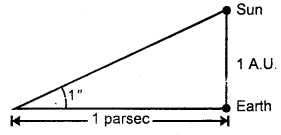
Define one parsec.
Answer:
It is defined as the distance at which an arc of length equal to y one astronomical unit subtends an angle of one second at a point.
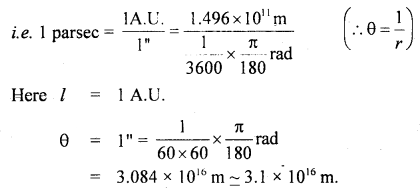
Class 11 Physics Important Questions Chapter 2 Units and Measurements 1
Class 11 Physics Important Questions Chapter 2 Units and Measurements 2
Note: 1 L.Y. = 6.3 × 10⁴ A.U.
1 parsec = 3.26 L.Y.

Question 12.
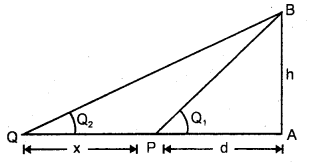
Define annual parallax.
Answer:
It is defined as the angle (θ) subtended by the basis at the object (0). It is also called the parallactic angle.
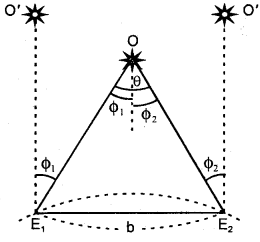
Class 11 Physics Important Questions Chapter 2 Units and Measurements 3
∴ Parallactic angle = \(\frac{\text { Length of arc }}{\text { Radius }}\)
Or
θ = \(\frac{b}{s}\)

∴ s = \(\frac{b}{θ}\)

The parallax method is used to measure the distance of stars.
Here, b = basis = E1E2 distance where E1 and E2 are the two observation points on earth. θ = angle made by the star at point O. To find θ, let us observe the star 0’ simultaneously and let Φ1 and Φ2 be the angles made at E1 and E2.
∴ θ = Φ1 + Φ2
∴ s = \(\frac{b}{\phi_{1}+\phi_{2}}\)

Question 13.
Give Avogadro’s method to measure distances of the order of 10-10 m.
Answer:
It is the indirect method of measuring the distances of the order of 10-10 m which is the size of an atom i.e. small distances. An atom is a tiny sphere. When such atoms lie packed in any substance; empty spaces are left in between. According to Avogadro’s hypothesis, the volume of all atoms in one gram of substance is \(\frac{2}{3}\) of the volume occupied by one gram of the substance.

i.e. V’ = \(\frac{2}{3}\)V ….(i)
Where V = actual volume of one gram mass.
V’ = volume occupied by atoms in I gram mass.
ρ = density of the substance.
∴ V = \(\frac{1}{ρ}\) …(ii)

Let m = atomic weight of the substance.
N = Avogadro’s number

∴Number of atoms in I gram of the substance = \(\frac{N}{M}\)
If r be the radius of each atom, then
V’ = no. of atoms in I gram x volume of each atom
Or
V’ = \(\frac{N}{M}\) x \(\frac{4}{3}\) 4πr3 …. (iii)

∴ From (i), (ii), and (iii), we get
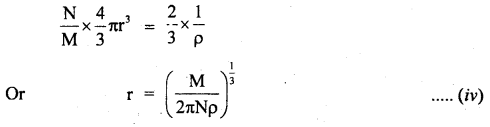
Class 11 Physics Important Questions Chapter 2 Units and Measurements 4
Thus, r the radius of an atom can be calculated from equation (iv).

Question 14.
What arè the characteristics of a standard unit?
Answer:
The characteristics of a standard unit are as follows:

  1. It should be well defined.
  2. It should be of the proper size.
  3. It should be easily accessible.
  4. It should be reproducible in all places.
  5. It should not change with time, place, and physical conditions such as pressure, tèmperature, etc.
  6. It should be widely accepted.

Question 15.
What are the advantages of the S.I. system?
Answer:
Following are the main advantages of the S.I. system over other systems of units i.e. (C.G.S, FPS, and MKS).
1. It is a coherent system of units i.e. a system based on a certain set of fundamental units from which all derived units are obtained by multiplication or division without introducing numerical factors i.e. units of a given quantity are related to one another by the power of 10. So the conversions are easy.

2. S.I. is a rational system of units as it assigns only one unit to a particular physical quantity e.g. Joule is the S.I. unit for all types of energies while MKS units of mechanical energy, heat energy, and electrical energy are Joule, calorie, and watt-hour respectively.

3. It is an absolute system of units: There are no gravitational units on the system. The use of factor ‘g’ is thus eliminated.

4. It is a metric system i.e. the multiples and submultiples of units are expressed as powers of 10.

Question 16.
Point out the measurable likely to create the maximum error in the following experimental measurement.
Young’s modulus ‘Y’ of the material of the beam is calculated using the relation Y = mgl3/4bd3δ
When w = mg, δ = depression, I, b, d = length, breadth, thickness.
Answer:
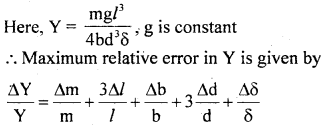
Class 11 Physics Important Questions Chapter 2 Units and Measurements 5
Thus clearly m, l, b, d and 8 introduce the maximum error in the measurement of Y.

Question 17.
Classify the physical quantities on basis of their dimensional formula.
Answer:
They are divided into the following four categories:
1. Dimensional variables: They are defined as the physical quantities which possess dimensions and have variable values e.g. Area, velocity, force, etc.

2. Non-dimensional variables: They are defined as the physical quantities which have no dimensions but have variable values, e.g. Angle, specific gravity, strain, sin0, cos0 (i.e. trigonometric functions).

3. Dimensional constants: They are defined as the physical quantities which have both dimensions and constant values, e.g. Plank’s constant, speed of light in vacuum, gravitational constant.

4. Dimensionless constants: They are defined as the physical quantities which do not have dimensions but have constant values, e.g. n, e, pure numbers 1, 2, 3, …… etc.

Question 18.
What are the limitations of dimensional analysis?
Answer:
Following are the limitations of dimensional analysis:

  1. Dimensionless constants involved in the physical relationship can not be determined.
  2. It fails to derive the relations involving plus or minus signs like s = ut + \(\frac{1}{2}\)at2,
    v = u + at,
    v2 — u2 = 2as etc.
  3. It fails to derive a relation involving more than three physical quantities.
  4. This method does not help to derive the relations containing exponential and trigonometrical functions.
  5. This method gives no information on whether a quantity is a scalar or vector.
  6. It does not tell about the physical correctness of a relation.

Question 19.
Define significant figures. State the rules for determining the number of significant figures in a given measurement.
Answer:
They are defined as the number of digits up to which we are sure about their accuracy. In other words, they are defined as those digits that are known correctly in an experimental observation plus one more digit that is uncertain.

Following are the rules for determining significant figures:

  1. All non-zero digits are significant.
  2. All zeros occurring between non-zero digits are significant.
  3. All zeros to the right of the last non-zero digit are not significant.
  4. All zeros to the right of a decimal point and to the left of a non¬zero digit are not significant, e.g. 0.000879 has (3) significant figures.
  5. All zeros to the right of a decimal point and to the right of a non-zero digit are significant, e.g. 0.2370 contains (4) sig-fig.
  6. All zeros to the right of a non-zero digit and to the left of an expressed decimal are significant, e.g. 21900. has (5) sig-fig.

Question 20.
Mankind has existed for about 106 years whereas the s. the universe is about 1010 years old. If the age of the universe is taken to be one day, how many seconds has mankind existed?
Answer:
Since
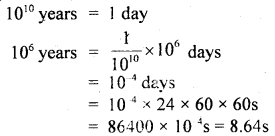
Class 11 Physics Important Questions Chapter 2 Units and Measurements 6
Mankind has existed for 8.64s on the new chosen scale.

Question 21.
State and explain the rule for finding the maximum possible error in a result.
Answer:
The maximum possible error is found in different ways in different types of results as follows:
(a) When the result involves the sum of two quantities,
i. e. if x = p + q
then, maximum possible error = maximum absolute error in first quality + maximum absolute error in the second quality. i.e. Δx = Δp + Δq

(b) When the result involves the difference of the quantities
i.e. if x = p – q
then, maximum possible error in x = maximum absolute error in p + maximum possible error in q
i.e. Δx = Δp + Δq

(c) When the result involves the multiplication of two quantities i.e. x = pq; then maximum relative error in x is given by
\(\frac{\Delta x}{x}=\frac{\Delta p}{p}+\frac{\Delta q}{q}\)

(d) When the result involves the quotient of tw«j observed quantities i.e. when x = p/q, then Maximum relative error in x is given by
\(\frac{\Delta x}{x}=\frac{\Delta p}{p}+\frac{\Delta q}{q}\)

(e) When the result involves some power oFa physical quantity, i.e. when x = pa qb, then maximum absolute e> u r in x is given by
\(\frac{\Delta x}{x}=a \frac{\Delta p}{p}+b \frac{\Delta q}{q}\)

i.e. maximum possible relative error in x = power × relative . error in p + power × relative error in q.

Thus the error is always additive in nature and maximum, permissible error is equal to the sum of maximum possible error in the i. individual quantities of that quantity.

Question 22.
How do you represent very large and very small physical y quantities? Write the prefixes, multiple, submultiple, and their symbols in a tabular form.
Answer:
The very long and very small quantities are written in powers of 10. The prefixes are tabled below:

S.No. Power of 10PrefixSymbol
1. 1012Tera (Trillion)T
2. 109Giga (billion)G
3. 106mega(million)M
4. 103kiloK
5. 102Hectah
6. 101Decada
7. 10-1Decid
8. 10-2Centic
9. 10-3mullm
10. 10-6microu
11. 10-9nanon
12. 10-12picop
13. 10-15femtof
14. 10-18Attoa

Question 23.
Explain the importance of reference frames in measurements.
Answer:
(a) All measurements are made with reference to a point or portion i.e., a frame of reference.
(b) The number of time units contained in a physical quantity gets changed with a change in the reference frame.
(c) The same physical quantity may have different values in different reference frames.

Question 24.
Briefly describe the various techniques to measure time.
Answer:
The various techniques to measure time are:
(a) The synchronous motor run on a.c. of frequency 50 hertz is used to measure time as its rotation provides a time scale.

(b) Electronic oscillations: The semiconductor oscillators produce high-frequency oscillations i.e. of a very small time period. These oscillations thus can be used to measure the small time intervals.

(c) Quartz-crystal clocks: These clocks work on the piezoelectric effect. The oscillations so produced can be used to measure time intervals.

(d) Atomic clock: These are usually Cs-133 atom clocks whose electrons make a definite number of repeated jumps between two energy levels. These are very precise and are used to define second, so time can be measured.

(e) Decay of elementary particles: The study of decay can provide a scale for the measurement of very small intervals of time as unstable elementary particles decay between 10-16 to 10-24 seconds.

(f) Radioactive dating: Very long intervals of time can be measured by comparing them with the techniques of radioactive dating. The half-life period of decay of carbon is a standard time frame to determine the age of fossils etc.

Question 25.
Explain the rules for finding significant figures in the sum, difference, product, and quotients of true numbers.
Answer:
The rules for counting significant figures in algebraic operations are given below:
1. Addition and Subtraction: The sum or the difference of two numbers has significant figures only in those places where these are in the least precise amongst the given number. For example, if we subtract 45.7 from 46.9267 the result is 1.2267. But it should be written only 1.2 because the least precise of the two numbers is 45.7 and there is only one digit after the decimal.

Similarly in the sum of numbers 4205, 112.39, 77.93, and 213.2532, the correct result is 824.0 to the significant figures. So, in addition, or subtraction the same number of the decimal. places are retained in the result as are present in the number with the minimum amount of decimal places.

2. Multiplication and Division: The product or quotient of two numbers does not have more significant figures than are present in the least precise of the given numbers. e.g. in the product of two quantities 0.025 with 40, we get 1.000 but the answer is to be written as 1.0 because there are two significant figures in 40 the least of the two numbers. Similarly in a quotient when we divide 16.775 by 2.5, we get 6.71. The result of the significant figure will be 6.7.

Question 26.
Is it possible for an equation to be dimensionally correct still to be wrong? If so indicate the number of ways in which this might happen.
Answer:
It is possible that an equation may be dimensionally correct but physically it is wrong. For example the displacement of a particle moving with velocity u and acceleration ‘a’ after time t is given by
s = ut + 1/2at2

However, s = 1/2at2 is dimensionally correct, as [L] = [LT2][T2]2 shows dimensions on LHS = dimensions on RHS. Therefore, in certain circumstances, an equation may be dimensionally correct but actually, it is not physically correct. This happens especially in equations involving the sum and difference of two or more terms and in functions involving trigonometric functions. For example, the displacement y maybe y = a where a is the amplitude. This is dimensionally correct but does not give the full picture of the physical phenomenon.

The correct equation is

y = a sin wt or y = a sin \(\frac{2 \pi}{\lambda}\) (vt + x) etc.

Question 27.
Show that bigger is the unit smaller is the numerical value of physical quantity and vice-versa.
Answer:
In any system of unit, the following relations hold good
n1u1 = n2u2

Where n1 and n2 are the numerical values, u1 and u2 represent the unit of a physical quantity. This relation is based on the simple thing that the magnitude of a physical quantity remains the same in different systems of units.
Thus nu = constant or n ∝ \(\frac{1}{u}\)

If larger the n smaller will be the unit (u) and smaller the numerical value (n) Larger will be u. E.g. if the length of a rod l be 1 m in the S.I. system. Then it is 100 cm in the C.G.S. system i.e.

l = 1 m = 100 cm. Here clearly 1 < 100 and m > cm. Hence proved.

Question 28.
The difference in the order of magnitude of the longest and shortest distances and most massive and least massive objects are quite different. Write the same and compare them.
Answer:
The size of the nucleus is of the order 10-15 m and the intergalactic distance is of the order of 1022 m. So, the ratio between the longest and the shortest distance is:
\(\frac{10^{22} \mathrm{~m}}{10^{-15} \mathrm{~m}}\) = 1037

The smallest mass is the mass of an electron of the order of 10-30 kg and the longest mass is the mass of the galaxy of the order of 1042 kg. So, the ratio of maximum to minimum mass is
\(\frac{10^{42} \mathrm{~kg}}{10^{-30} \mathrm{~kg}}\) = 1072

Now the ratio between the mass ratio and distance ratio is
\(\frac{10^{72}}{10^{37}}\) = 1035

The ratio betwe< n minimum mass and minimum distance is
\(\frac{10^{-30} \mathrm{~kg}}{10^{-15} \mathrm{~m}}\) = 10-15

The ratio between maximum mass and minimum distance is
\(\frac{10^{42} \mathrm{~kg}}{10^{22} \mathrm{~m}}\) = 1020

Question 29.
Define the terms
(i) mean absolute error
Answer:
The arithmetic means of all the absolute errors is known as mean absolute error.
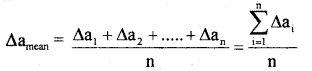
Class 11 Physics Important Questions Chapter 2 Units and Measurements 7
(ii) relative error and
Answer:
The relative error is the ratio of mean absolute error to the mean or true value of the quantity measured.
Relative error = \(\frac{\Delta \mathrm{a}_{\text {mean }}}{\mathrm{a}_{\text {mean }}}\)

(iii) percentage error.
Answer:
Percentage error is the relative error expressed in percent
Percentage error = \(\frac{\Delta \mathrm{a}_{\text {mean }}}{\mathrm{a}_{\text {mean }}}\) × 100

Question 30.
State the rules applied in rounding off measurements.
Answer:
While rounding off measurements, the following rules are applied:
1. If the digit to be dropped is smaller than 5, then the preceding digit should be left unchanged.
e.g. 7.93 is rounded off to 7.9.

2. If the digit to be dropped is greater than 5, then the preceding digit should be raised by 1.
e.g. 17.26 is rounded off to 17.3.

3. If the digit to be dropped in 5 followed by digits other than zero, then the preceding digit should be raised by 1.
e.g. 7.351 on being rounded off to first decimal becomes 7.4.

4. If the digit to be dropped in 5 or 5 followed by zeros, then the preceding digits are not changed if it is even.
e.g. (a) 3.45 on being rounded off becomes 3.4.
(b) 3.450 on being rounded off becomes 3.4.

5. If the digit to be dropped in 5 or 5 followed by zeros, then the preceding digit is raised by one if it is odd.
e.g. (a) 3.35 on being rounded off becomes 3.4.
(b) 3.50 on being rounded off becomes 3.4.

Note: Rules (iv) are based on the convention that the number is to be rounded off to the nearest even number.

Units and Measurements Important Extra Questions Long Answer Type

Question 1.
State the rules for writing the units of physical quantities in the S.I. system.
Answer:
While writing the units of physical quantities following rules are followed with S.L units:
(1) The S.l. units are written in the form of symbols after the number i.e., number of time, the unit is contained in the physical quantity so that physical quantity = nu

With symbols, certain rules are laid down:

  • Units in symbols are never written in plural i.e., meters is only m and not ms, years is y.
  • The units based on the name of the scientists are written beginning with small letters and with capital letters in symbolic form viz, weber (Wb), newton (N), etc.
  • No full stop is used at the end of the symbol.
  • Symbols of units not based on the name of scientists are written as small letters viz. kilogram (kg), second (s), etc.

(2) Bigger and smaller number of units are represented with symbols corresponding to the power of 10 viz. 106 is mega (M), 1012 is Tera (T), 10-3 is milli (m), 10-9 is nano (n), etc.

(3) All units are written in numerator viz. kg/m3 is kg m, Nm2c2.

(4) The units are written within parenthesis in graphs below the corresponding taxes viz. (ms-1) and (s) in the velocity-time graph.

(5) Units of a similar physical quantity can be added or subtracted.

Question 2.
Explain the Triangular method.
Answer:
It is used to measure the distance of an accessible or inaccessible hill or a tower by measuring the angle which the object makes at point P (say)

Let x = distancy of point P from the foot of tower = PA .
∴ h = x tan θ

It is also used to measure the distance of an inaccessible object eg. a tree on the other bank of a river.
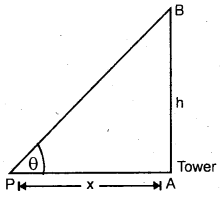
Class 11 Physics Important Questions Chapter 2 Units and Measurements 8
Let h = height of the inaccessible object.
Let θ1, θ2 = be the angle made at P and Q by the object.
Let PA = d, PQ = x.

∴ In ΔPAB and ΔQAB,

Class 11 Physics Important Questions Chapter 2 Units and Measurements 9
Class 11 Physics Important Questions Chapter 2 Units and Measurements 10

Question 3.
What are the uses of dimensional analysis? Explain each of them.
Answer:
Dimensional analysis is used for:
(a) checking the dimensional correctness of the given physical equation or relation.
(b) converting one system of units to another system.
(c) deriving the relationship between various physical quantities.

(a) checking of the dimensional correctness of a physical relationship is done by using the principle of homogeneity of dimensions. If the dimensions of M, L, T of each term on R.H.S. are equal to the dimensions of M, L, T of each term on L.H.S., then the given- physical relation is dimensionally correct, otherwise wrong.

(b) conversion: It is based on the fact that the magnitude of a physical quantity remains the same whatever may be the system of units, i.e. n1u1 = n2u2.
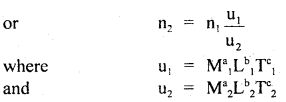
Class 11 Physics Important Questions Chapter 2 Units and Measurements 11
are the units of M, L, T in the first and second system of units of a physical quantity having dimensions of M, L, T, and a, b, c respectively.

Class 11 Physics Important Questions Chapter 2 Units and Measurements 12
Thus if fundamental units of both systems, dimensions of the quantity, and its numerical value n1 in one system, are known then we can easily calculate n2 in another system.

(c) Derivation of a relationship between various physical quantities is based on the principle of homogeneity of dimensions.

Following are the steps used:

  1. We must Know the physical quantities (say p, q, r) upon which a physical quantity say x depends.
  2. We must know the dimensions of p, q, r say a, b, c respectively.

  3. Class 11 Physics Important Questions Chapter 2 Units and Measurements 13
  4. Now, write the dimensions of each physical quantity on both sides of the equation
  5. and compare the powers of M, L, T to find a, b, c. Putting values of a, b, c in the equation
  6. we get the required relation.

Numerical Problems:

Question 1.
The average distance from Earth to the Sun is 1.49 × 10¹¹ m. Find out the value of 1 percent in m.
Answer:
According to the definition of parsec,
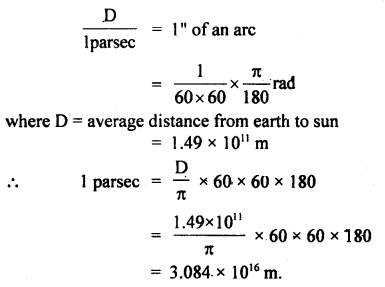
Class 11 Physics Important Questions Chapter 2 Units and Measurements 14

Question 2.
The parallax of a heavenly body measured from two points: diametrically opposite on the Earth’s equator is 60 seconds. If the radius of the Earth is 6.4 × 10⁶ m, determine the distance of the heavenly body from the center of Earth. Convert this distance in AU.
Answer:
Here
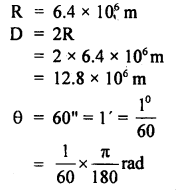
Class 11 Physics Important Questions Chapter 2 Units and Measurements 15
∴ The distance of the heavenly body from Earth is given by
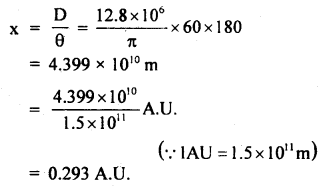
Class 11 Physics Important Questions Chapter 2 Units and Measurements 16

Question 3.
Find the height of a rock mountain if on moving 100 m towards the rock in the horizontal direction through the base of
the rock, the angle of elevation of itš top increases from 300 to 45°.
Answer:
Here d = 100 m, θ1 = 30°, θ2 = 45°, h =?
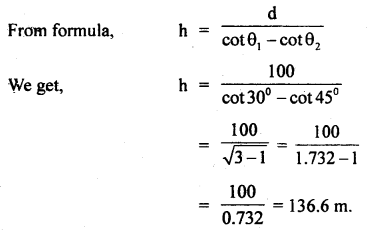
Class 11 Physics Important Questions Chapter 2 Units and Measurements 17

Question 4.
Find the number of air molecules in a room of volume 12 m3. Given 1 mole of air at N.T.P. occupies a volume of 22.4 liters.
Answer:
No. of atoms in I mole of air = N
= 6.023 × 10²³

∴ Also at N.T.P., 1 mole of air occupies 22.4 liters of volume
= 22.4 × 10⁻³ m3

∴ No. of molectiles ir 22.4 × 10⁻³ m3 volume = 6.023 × 10²³
∴ No. of molecules in 12 m3 volume = \(\frac{6.023 \times 10^{23}}{22.4 \times 10^{-3}}\) × 12
= 3.23 × 1026

Question 5.
(a) Convert ION into dyne using dimensional analysis.
Answer:
Newton (N) and dyne are the S.I. and C.G.S. units of force having dimensional formula [MLT-2]
∴ a = 1, b = 1, c = – 2

S.I. system
n1 = 10
M1 = 1 kg
L1 = 1 m
T1 = 1 s

C.G.S. system.
n2 = ?
m2 = 1 g
L2= 1 cm
T2 = 1 s
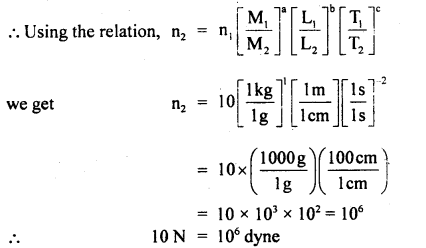
Class 11 Physics Important Questions Chapter 2 Units and Measurements 18
(b) Find the units of length, mass, and time of the unit of force, velocity, and energy are 100 dynes, 10 cms-1, and 500 erg respectively.
Answer:
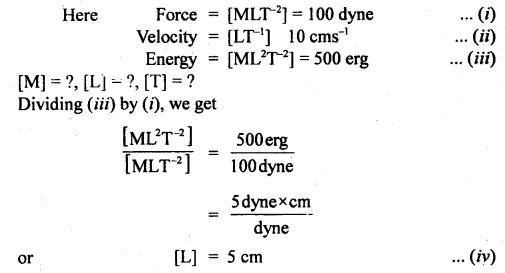
Class 11 Physics Important Questions Chapter 2 Units and Measurements 19
Class 11 Physics Important Questions Chapter 2 Units and Measurements 20

Question 6.
Check the dimensional correctnesïof the relation
V = \(\sqrt{\frac{2 G M}{R}}\)
Answer:
It is done using the principle of homogeneity of dimensions i.e. if the dimensions of each term of both sides of the equation are the same, Then it is dimensionally correct.
Now dimensions of V = [LT-1].
G = [M-1 L3 T2]
M = [M]
R = [L]

∴ Dimensions of L.H.S. = [V] = [LT-1] …(f)
Dimensions of R.H.S = \(\sqrt{\frac{G M}{R}}\)
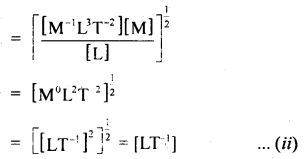
Class 11 Physics Important Questions Chapter 2 Units and Measurements 21

Now from equations (i) and (ii), it is clear that the dimensions of L.H.S = R.H.S, so the given relation is dimensionally correct.

Question 7.
Suppose that the oscillatións of a simple pendulum depend on
(i) mass of the bob (m),
(ii) length of the string (1),
(iii) acceleration due to gravity (g) and (iv) angular displacement
(iv) Dimensionally show which of the above factors here an influence upon the period and in what way?
Answer:
Let t ∝ ma lb gc θd
or t = k’ ma lb gc qd ….(i)
here k’ is a dimensionless constant.

Since q is dimensionless, hence equation (i) reduces to
t = K ma lb gc …(ii)

where K. = k1d is another dimensionless constant.
Now writing the dimensional formula of each physical quantity on both sides of equation (ii), we get
[M0 L0 T-1] = [M]a [L]b [LT2]c = [Ma Lb-c T-2c]

Comparing dimensions of
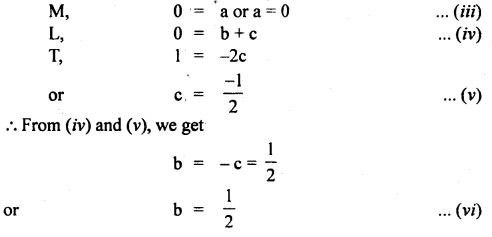
Class 11 Physics Important Questions Chapter 2 Units and Measurements 22
Class 11 Physics Important Questions Chapter 2 Units and Measurements 23
Thus from equation (vii), we see that the period of the pendulum is directly proportional to the square root of the length of string, and inversely proportional to the square root of acceleration due to gravity and is independent of the mass of the bob.

Question 8.
Given that the period T of oscillation of a gas bubble from an explosion underwater depends on P, d, and E, where the symbols are pressure, density, and total energy of the explosion. Find dimensionally a relation for T.
Answer:
Let T ∝pa db Ec
or
T = k pa db Ec …(i)
where k is a dimensionless constant.

Writing dimensional formula of each physical quantity on both sides of equation (i), we get
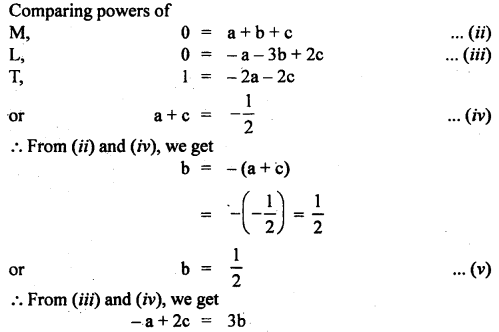
Class 11 Physics Important Questions Chapter 2 Units and Measurements 24
Class 11 Physics Important Questions Chapter 2 Units and Measurements 25

Question 9.
If the velocity of light c, the constant of gravitation G, and Plank’s constant h be chosen as fundamental units, find the value of a gram, a centimeter, and a second in terms of new units of mass, length, and time respectively.
Given c = 3 × 10¹⁰ cms-1
G = 6.67 × 10⁻⁸ dyne cm2 g-2
h = 6.6 × 10⁻²⁷ ergs.
Answer:
Class 11 Physics Important Questions Chapter 2 Units and Measurements 26
Class 11 Physics Important Questions Chapter 2 Units and Measurements 27
Class 11 Physics Important Questions Chapter 2 Units and Measurements 28

Question 10.
Assuming that the mass m of the largest stone that can be moved by a flowing river depends on the velocity y density p and acceleratión due to gravity g. Show that m varies as the sixth power of the velocity of flow.
Answer:
Let, m ∝ va
m ∝ρbb
Class 11 Physics Important Questions Chapter 2 Units and Measurements 29
where k is a dimensionless constant.

Writing dimensions of each physical quantity on both sides of equation (i), we get
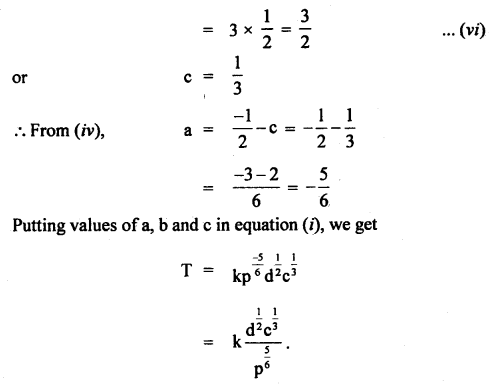
[M1 L0 T0] = [LT-1] [ML-3]b [LT-2]c
[Mb L a-3b+2c T-a-2c]

Comparing powers of:
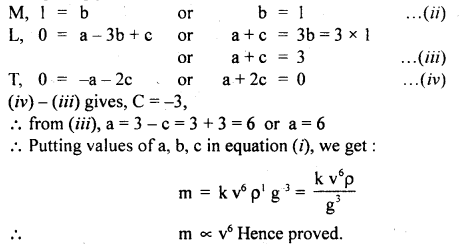
Class 11 Physics Important Questions Chapter 2 Units and Measurements 30

Question 11.
The radius of Earth is 6.37 × 10⁶ m and its average density is 5.517 × 10³ kg m-3. Calculate the mass of Earth to correct significant figures.
Answer:
M = pV
Here, R = 6.37 × 10⁶ m,
ρ = 5.517 × 10³ kg m3
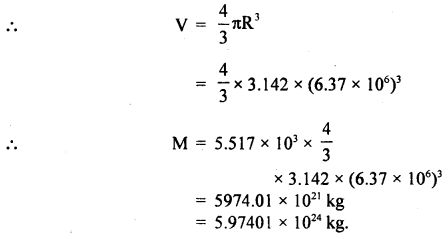
Class 11 Physics Important Questions Chapter 2 Units and Measurements 31
Here R has 3 significant figures and the density has four. Thus the final result should be rounded off to 3 significant figures.

Hence, M = 5.97 × 1024 kg.

Question 12.
The length, breadth, and thickness of a block of metal were measured with the help of Vernier Callipers. The measurements are:
l = (5.250 ± 0.001) cm
b = (3.450 ± 0.001) cm,
t = (1.740 ± 0.001) cm.
Find the percentage error in the volume of the block.
Answer:
The volume of the block is given by:
V = lbt

∴ The relative percentage error in V is given by:
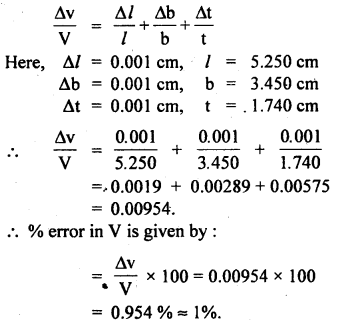
Class 11 Physics Important Questions Chapter 2 Units and Measurements 32

Question 13.
An experiment measures quantities a, b, c, and x is calculated from the relation:
x = ab2/c3
The percentage errors in a, b, c are ± 1%, ± 3%, and ± 2% respectively what is the % error in x?
Answer:
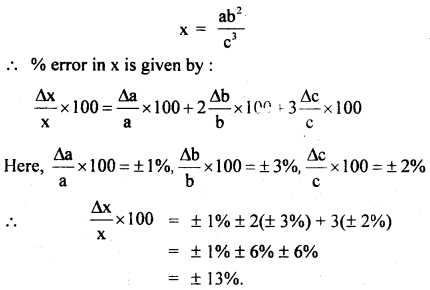
Class 11 Physics Important Questions Chapter 2 Units and Measurements 33

Question 14.
The radius of the proton is about 10-9 microns and the radius of the universe is about 1028 cm. Name a physical object whose size is approximately halfway between these two extremes on the logarithmic scale.
Answer:
Radius of proton, x1 = 10-9 microns = 10-9 × 10⁶m .
= 10-15m

Radius of universe, x2 = 1028 cm = 1026m.

If x be the size halfway between these two extremes on the logarithmic scale is:
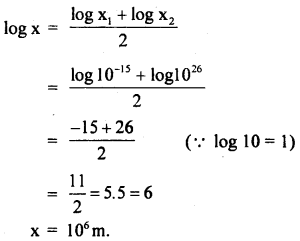
Class 11 Physics Important Questions Chapter 2 Units and Measurements 34
Since 106m is the order of the size of the Earth. So the physical object is Earth.

Question 15.
The velocity v (cms-1) of a particle is given in terms of time t (s) by the equation y = at + \(\frac{b}{t+c}\). What are the dimensions of a, b and c?
Answer:
v = at + \(\frac{b}{t+c}\).

L.H.S. is velocity, so according to principle of homogeneity t, of dimensions, at and must have the dimensions of \(\frac{b}{t+c}\) velocity.
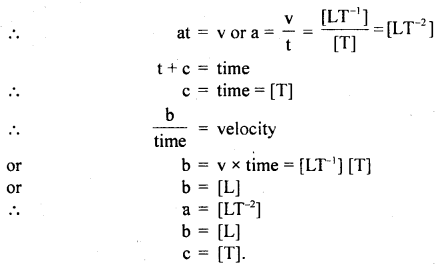
Class 11 Physics Important Questions Chapter 2 Units and Measurements 35

Question 16.
The young’s modulus (Y) of a material is given by the relation Y = \(\frac{\mathbf{M g L}}{\pi \mathbf{r}^{2} \boldsymbol{l}}\). If the percentage error in W(= mg), L, r and l are 0.5%, 1%, 3% and 4% respectively, what is the percentage error in Y? If the calculated value of Y is 18.79 × 10¹¹ dyne cm-2, to what value should we round off the result?
Answer:
The total percentage error in Y is given by:
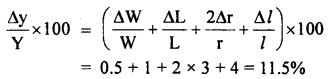
Class 11 Physics Important Questions Chapter 2 Units and Measurements 36
Since Y = 18.79 × 10¹¹ dyne cm-2, it can be rounded off to
Y = 19 × 1011 dyne cm-2

The total percentage error in this result is:
\(\frac{19 \times 11.5}{100}\) = 2.2

So, the result of Y can be quoted as (19 ± 2.2) × 1011 dyne cm-2

Question 17.
The refractive index as measured by relation:
μ = \(\frac{\text { real depth }}{\text { apparent depth }}\) was found to have values 1.29, 1.33, 1.34, 1.35, 1.32, 1.36, 1.30, 1.33.
Find the mean value of μ, the mean value of the absolute error, the relative error, and the percentage error.
Answer:
Mean value of μ
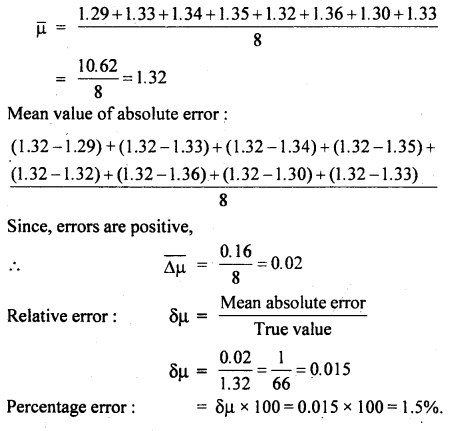
Class 11 Physics Important Questions Chapter 2 Units and Measurements 37

Question 18.
Derive the dimensions of a/b in the relation:
F = a\(\sqrt{x}\) + bt2
where F is the force, x is the distance and t is the time.
Answer:
Here, F= a\(\sqrt{x}\) + bt2 …(i)

According to the principle of homogeneity of dimensions, a \(\sqrt{x}\) and bt2 should have dimensions of F.
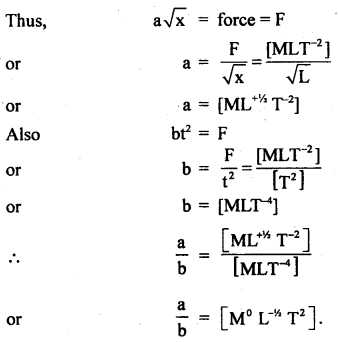
Class 11 Physics Important Questions Chapter 2 Units and Measurements 38

Question 19.
Calculate the number of seconds in a:
(i) day
(ii) year
and express them in orders of magnitude.
Answer:
(i) No.of seconds in a day = 24 × 60 × 60s
= 86400s
= 8.64 × 10⁴s
= 0.864 × 10⁵s
∴ order of magnitude = 5

(ii) No.of seconds in a year = 365 days
= 365 × 0.864 × 105s
= 315360 × 105s
= 31536 × 107s
∴ order of magnitude = 7.

Question 20.
A stone is lying in a fluid stream. The force F acting on it depends on the density of the fluid δ, the velocity of flow v, and the maximum area of cross-section A perpendicular to the direction of flow. Find the relation between the force F and the velocity v.
Answer:
Let, F ∝ ρa
∝ vb
∝ Ac
or
F ∝ pa vb Ac
or
F = k pa vb Ac …(i)

Now writing the dimensional formula of each physical quantity on both sides of equation (i), we get:
[MLT-2] = [ML-3]a [LT-1]b [L2]c
= [Ma L-3a+b+2c T-b] …(ii)

Comparing dimensions of M, L, T on both sides of equation (ii), we get:
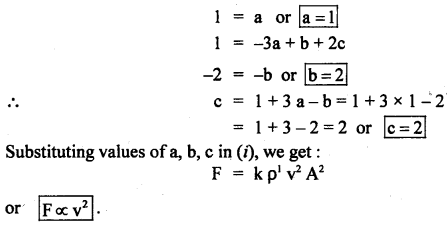
Class 11 Physics Important Questions Chapter 2 Units and Measurements 39

Question 21.
If we suppose the velocity of light (c), acceleration due to gravity (g), and pressure (p) as the fundamental units, then And the dimensional formula of mass in this system of units.
Answer:
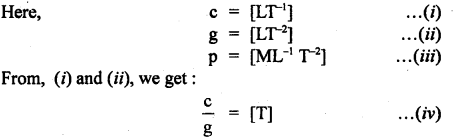
Class 11 Physics Important Questions Chapter 2 Units and Measurements 40
Class 11 Physics Important Questions Chapter 2 Units and Measurements 41

Question 22.
The density p of a piece of metal of a mass m of and volume V is given by the formula, ρ = m/V.
If, m = 325.32 ± 0.0lg
V = 136.41 ± 0.01 cm3.
Find the percentage error in p:
Answer:
Here, m = 325.32g, Δm = 0.01 g
V = 136.41 cm3, ΔV = 0.01 cm3
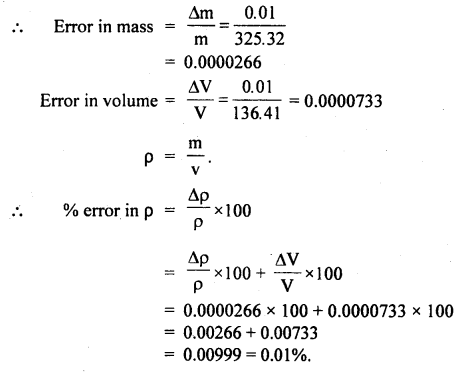
Class 11 Physics Important Questions Chapter 2 Units and Measurements 42
Question 23.
The specific resistance σ of a circular wire of radius r cm, resistance R Ω and and length L is given by:
σ = \(\frac{\pi r^{2} R}{L}\)
If, r = 0.20 ± 0.02 cm
R = 20 ± 1Ω
L = 80 ± 0.01 cm, then find the % error in σ.
Answer:
% error in σ is given by:
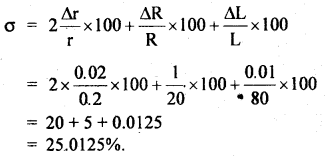
Class 11 Physics Important Questions Chapter 2 Units and Measurements 43

Question 24.
If S2 = a t4, where S is in meters, t in second, then find the unit of a.
Answer:
Here, S2 = a t4
According to the principal of homogeneity of dimensions,
at4 = m2
∴ a = \(\frac{\mathrm{m}^{2}}{\mathrm{t}^{4}}\) = m2 s-4

Question 25.
Calculate the value of 600m. + 600mm with due regard to the significant digits.
Answer:
Here, because there is no significant digit after the decimal point in 600m, so 600m + 600mm.
= 600m + 600 × 10-3m
= 600m + 0.600m
= 600.6m = 601m.

Value-Based Type:

Question 1.
The teacher of class XI asked Madan and Prathiva to find the distance of the moon from the Earth. Pratibha said it is impossible to find. But Madan was excited to know. He observed the moon from two diametrically opposite points A and B on Earth. The angle q subtended at the moon by the two directions of observation is 1°54′. Given the diameter of the Earth to be about (1.276 × 10⁷ m).
(i) Which values arc depicted by Madan?
Answer:
The values depicted by Madan are :
(a) Curiosity
(b) Sincerity
(c) Willing to know and implement the scientific ideas.

(ii) Which mathematical concept is used in the above problem?
Answer:
Parallax method

(iii) Compute the distance of the moon from the Earth?
Answer:
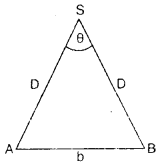
Class 11 Physics Important Questions Chapter 2 Units and Measurements 44
We have
Class 11 Physics Important Questions Chapter 2 Units and Measurements 45

Question 2.
Muesli went to London to his uncle who is a doctor over there. He found that the currency is quite different from India. He could not understand the pound and how it is converted into rupees. He asked an English man that how far is central London from here.

He replied that it is about 20 miles. Mukesh was again confused as he never used these units in India. When his uncle came back from his clinic he curiously inquired all about it. His uncle told him about the unit system used in England. He explained that here F.P.S system is used.

It means distance is measured in the foot, Mass in the pound, and time in seconds. But in India, it is an MKS system.
(i) What values are depicted by Mukesh?
Answer:
(a) Curiosity
(b) Willing to know
(c) Intelligence

(ii) How many types of unit systems are there?
Answer:
The unit system is:
(a) CGS (centimeter, gram and second) system
(b) FPS (foot, pound and second) system
(c) MKS (meter, kilogram, and second) system

Question 3.
Two friends Sachin and Dinesh are confused as a book with many printing errors contains four different formulas of the displacement ‘y’ of a particle undergoing a certain periodic motion.
(a) y=asin 2πt/T
(b) y = asinvt
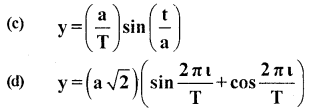
Class 11 Physics Important Questions Chapter 2 Units and Measurements 46
[a = Maximum displacement of the particle,
v = Speed of the particle, T = time-period of motion]

Sachin told that he has no idea whereas Dinesh ruled out the wrong formulas on dimensional grounds.
(i) which values are displayed by Dinesh?
Answer:
the values displayed by Dinesh are:
(a) Sincerity
(b) Curiosity
(c) application of knowledge

(ii) which one of the above is correct? Give justification to support your answer.
Answer:
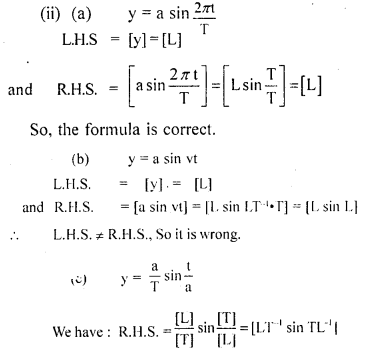
Class 11 Physics Important Questions Chapter 2 Units and Measurements 47
Class 11 Physics Important Questions Chapter 2 Units and Measurements 48
L.H.S = R.H.S ; Hence the equation is correct.

Physical World Class 11 Important Extra Questions Physics Chapter 1

Here we are providing Class 11 Physics Important Extra Questions and Answers Chapter 1 Physical World. Important Questions for Class 11 Physics with Answers are the best resource for students which helps in Class 11 board exams.

Class 11 Physics Chapter 1 Important Extra Questions Physical World

Physical World Important Extra Questions Very Short Answer Type

Question 1.
Name that branch of science that deals with the study of Earth.
Answer:
Geology.

Question 2.
Name that branch of science that deals with the study of stars.
Answer:
Astronomy.

Question 3.
Name the scientist and the country of his origin whose field of work was elasticity.
Answer:
Robert Hook, England.

Question 4.
The word “Physics” comes from a Greek word. Name the word.
Answer:
The word is ‘fuses meaning ‘Nature’.

Question 5.
The word science has come from a Latin verb. Name the verb.
Answer:
The name of the Latin verb is ‘Scientia’.

Question 6.
What is the meaning of the verb ‘Scientia’?
Answer:
To ‘know’

Question 7.
Name the scientist and the country of his origin who received the Nobel Prize for his work on molecular spectra.
Answer:
C.V. Raman, India.

Question 8.
What is the most incomprehensible thing about the world?
Answer:
It is comprehensible.

Question 9.
Name a great scientist who gave the following comment on science.
“Science is not just a collection of laws, a catalog of unrelated facts. It is a creation of the human mind, with its freely invented ideas and concepts.”
Answer:
Albert Einstein.

Question 10.
Which famous philosopher gave the following comments on science?
“We know very little and yet it is astonishing that we know so much, and still more astonishing that so little knowledge of science can give so much power.”
Answer:
Bertrand Russel.

Question 11.
Who discovered the electron?
Answer:
J.J. Thomson.

Question 12.
Who discovered neutron?
Answer:
James Chadwick.

Question 13.
Who gave the general theory of relativity?
Answer:
Albert Einstein.

Question 14.
Who proposed the wave theory of light?
Answer:
Huygen.

Question 15.
Name four physics devices widely used in medical diagnosis.
Answer:

  1. X-rays,
  2. Ultrasound,
  3. Stethoscope,
  4. Microscope.

Question 16.
Name Indian-born scientist who received Nobel Prize for his discoveries in astronomy.
Answer:
S. Chandra Shekhar.

Question 17.
Metaphysics is a science that is concerned with what?
Answer:
Supernatural .events.

Question 18.
Which science is considered to be the mother of all sciences?
Answer:
Physics.

Question 19.
Name the discovery made by S.N. Bose.
Answer:
Bose-Einstein Statistics.

Question 20.
Name the scientist and the country of his origin whose field of work was ‘cosmic rays’.
Answer:
Hess, Austria.

Question 21.
What are the meaning of the Sanskrit word ‘Vijnan’ and the Arabic word ‘Ilm’?
Answer:
Knowledge.

Question 22.
Name the Sanskrit equivalent word of Physics.
Answer:
Bhautiki.

Question 23.
Name the field of Physics in which India was a leading country in the sixties.
Answer:
Cosmic rays.

Question 24.
Who discovered X-rays?
Answer:
W. Roentgen.

Question 25.
Which electronic media can help in eradicating illiteracy in India?
Answer:
Television.

Question 26.
Name the technology based on the amplification of light by population inversion?
Answer:
Laser.

Question 27.
Who discovered nuclear forces?
Answer:
H. Yukawa.

Question 28.
To which country he belonged?
Answer:
japan.

Question 29.
Who discovered Radium?
Answer:
Pierre Curie and Marie Curie.

Question 30.
Name the discovery made by W. Roentgen.
Answer:
X-rays.

Question 31.
What has been said by P.A.M. Dirac regarding physics in relation to society?
Answer:
P.A.M. Dirac said, “It is more important to have beauty in the equations of physics than to have them agree with experiments.”

Question 32.
What did Issac Newton say to measure the degree of impact of science on society?
Answer:
He said “Nature is pleased with simplicity, and affects not the pomp of superfluous causes.

Question 33.
What Neils Bohr said regarding science in relation to society?
Answer:
He said “The task of science is both to extend the range of our experience and to reduce it to order.

Question 34.
Name a few Indian physicists who have made significant contributions in the field of physics.
Answer:
C.V. Raifiaq, S. Chandra Shekhar, S.N. Bose, Homi J. Bhabha, and Meghnath Saha.

Question 35.
Name the scientific principle on which airplane works.
Answer:
Bernoulli’s theorem.

Question 36.
Name the scientific principle on which radio and T.V. works.
Answer:
Propagation of electromagnetic waves.

Question 37.
Name the scientific principle upon which laser works.
Answer:
Amplification by a process called population inversion.

Question 38.
Name the technology which works on the scientific principle “Newton’s second and third laws of motion”.
Answer:
Rocket propulsion.

Question 39.
Name the forces which are of nuclear origin.
Answer:
Strong forces.

Question 40.
What is Physics?
Answer:
It is that branch of science which deals with nature and natural phenomena.
Or
It is that branch of physical science that is to seek out and understands the basic laws of nature upon which all physical phenomena depend. It has brought to us deeper and deeper levels of understanding nature.

Question 41.
What is Science?
Answer:
It is defined as the systematic study of physical phenomena.

Question 42.
What are Biological Sciences? Give three examples.
Answer:
Those sciences which deal with living things are called Biological Sciences, e.g. Zoology, Botany, Ornithology.

Question 43.
What are Physical Sciences? Give a few examples.
Answer:
They ate defined as the sciences which deal with non-living things,
e.g. Physics, Chemistry, Astronomy, Astrology, Geology, Geography, Oceanology.

Question 44.
Define Theory.
Answer:
It is defined as the behavior of physical systems explained in terms of a set of a minimum number of laws.

Question 45.
What do you understand by the term scientific method?
Answer:
The systematic observations, logical reasoning, model-making, and theoretical prediction form the scientific method.

Question 46.
Name the scientific principle on which electric generator works.
Answer:
Electromagnetic induction (E.M.I.).

Question 47.
Name the technology which works on the scientific principle ‘Nuclear Fission’.
Answer:
Nuclear Reactor.

Question 48.
Name the technology which works on the scientific principle “Digital logic of electronic circuits”.
Answer:
Calculators and computers.

Question 49.
Name the scientific principle upon which the working of cyclotron defends.
Answer:
The motion of charged particles under electric and magnetic fields.

Question 50.
Name the. scientist and his country who discovered wireless1 telegraphy.
Answer:
G. Marconi, Italy.

Physical World Important Extra Questions Short Answer Type

Question 1.
Differentiate between Biological and Physical sciences?
Answer:

Biological Sciences

Physical Sciences

(i) They deal with living things.(i) They deal with non-living things.
(ii) The study of the biological specimens is conducted at the molecular level.(ii) The study of matter is conducted at atomic or ionic levels i.e. at much smaller levels.

Question 2.
What is the relation between Physics and Technology?
Answer:
Broadly speaking, physics and technology both constitute science. Physics is the heart and technology is the body of science.

The application of the principles of physics for practical purposes becomes technology, e.g.

  1. Airplanes fly on the basis of Bernoulli’s theorem.
  2. Rockets propulsion is based on Newton’s second and third laws of motion.
  3. The generation of pow%r from the nuclear reactor is based on the phenomenon of controlled nuclear fission.
  4. Lasers are based on the population inversion of electrons and so on. Thus, we can say that to some extent technology is applied to Physics.

Question 3.
What is the relation between Physics and society?
Answer:
Most of the development made in Physics has a direct impact on society, e.g.

  1. Exploration of new sources of energy is of great importance to society.
  2. Rapid means of transport are no less important for society.
  3. society has-been enriched due to the advances in electronics, lasers, and computers.
  4. The development of T.V., radio, satellites, telephone, the telegraph has revolutionized the means of communications which have a direct impact on society and so on.

Question 4.
Is Science on speaking terms with humanities?
Answer:
Yes, there is a deep relation between the development of humanity on account of science. Many socio-economic, political, and ethical problems are being tackled and solved by science. Science has greatly helped in developing art and culture. Many musical instruments have been developed due to the theories in Physics. The steam engine is inseparable from the industrial revolution which had a great impact on human civilization.

Question 5.
What is the relation between Physics and Technology?
Answer:
The interplay between physics and technology is the basic to the progress of science which is ever dynamic. Laws in waves and oscillation opened several technological fields which include telescopy, ultrasounds, microscopy, X-rays, and laser. Powerhouses, big cranes, healing devices, etc. work on the principle of electromagnetism. Atomic energy and nuclear weapons are on account of fission. Similarly, Radar, television, the internet, etc. are all based on simple laws of physics. So until there is no theory i.e. physics, there can be no experiment i.e. technology. Hence both are deeply related.

Question 6.
Is Physics more of a philosophy or more of a mathematical science?
Answer:
Physics is not a purely abstract science devoid of philosophy. Physicists are natural philosophers and Einstein is an example to quote. So Philosophy has provided the backbone to Physics.

Question 7.
Define Biophysics.
Answer:
It is defined as the understanding of biological processes based upon the principles of Physics. For example, spectroscopic techniques are used to study the constitution of biological molecules and disorders in them. Laws of thermodynamics are used to explain various biological activities of predators and also the activities of molecules.

Hence the application of Physics to bioscience is now well known to all of us.

Question 8.
Define Technology?
Answer:
It is defined as the study of newer techniques of producing machines, gadgets, etc. by using scientific discoveries and advancements. It is largely dependent on Physics.

Question 9.
Has imagination any role in Physics?
Answer:
One of the definitions of Physics says that “It is the science-based on imagination and intuition which can be tested experimentally and mathematically.” Thus, imagination has a great role in the development of physics. Schrodinger, De-Broglie, Heisenberg, and most of the other scientists who were physicists were great imaginers.

Question 10.
Name a few aspects of your daily life in which you rely on the simplicity of nature.
Answer:
Laws of Physics represent the nature in simplest form. We face nature in many ways in our daily life. For example, we work, walk, write, talk and stand on our feet, and so on. The natural way of taking bath, chewing food, etc. can easily be understood in terms of simple laws of science. Even though actions like swimming, running, and playing may be complex but the underlying laws of nature are quite simple such as Newton’s laws, friction, etc.

Question 11.
The physicists think at a level far higher than a normal individual. Explain.
Answer:
For everyone to become a leader in his field, he has to think for a higher level than an ordinary person. This is more so for the case of physicists as the technological development meant for uplifting the living condition of mankind is highly dependent on the farsightedness of the physicists in particular. He must think at a level that is philosophical and mathematically quantifying so that they can visualize the requirement of people is quite advance.

Question 12.
Name a few wartime and maritime applications of Physics.
Answer:
(a) Wartime: The wartime applications are Bombs, nuclear weapons, jet fighter bombers, missiles, ships, radar, sonar, wireless communications, transportation, and electronics.

(b) Maritime: The maritime application of physics is Navigation of ships, tankers, airplanes, T.V., radio, and music system, etc.

Question 13.
Name five Indian scientists and the field of their work.
Answer:
Following are the five Indian Scientists and the field of their work:

NameField of work
(1) C.V. RamanRaman effect (Scattering of light by molecules)
(2) S. ChandrashekarTheory of Black Hole
(i.e. structure and evolution of stars)
(3) J.C. BoseE. M. Waves
(4) S.N. BoseBose-Einstein statistics
(5) H.J. BhabhaCosmic rays

Question 14.
Who invented:
(i) Computer
Answer:
Charles Babbage

(ii) Transistor,
Answer:
J. Bardeen

(iii) Electric bulb and Telegraphy,
Answer:
A. Edison

(iv) Radar,
Answer:
Appleton

(v) Wireless telegraphy,
Answer:
Marconi

(vi) Telephone.
Answer:
Graham Bell.

Question 15.
Name the theories given by the following:
(i) Neil Bohr
Answer:
Theory of atomic structure

(ii) Lawrence,
Answer:
Cyclotron

(iii) Henry Becquerel,
Answer:
Natural radioactivity

(iv) Galileo,
Answer:
Principle of Inertia

(v) Bragg,
Answer:
Crystal structure by X- rays

(vi) Abdus Salam,
Answer:
Unified Field Theory

(vii) Millikan.
Answer:
Charge on an electron.

Question 16.
Give the nationality of the following scientists:
(i) Van der Waals,
Answer:
Dutch

(ii) Curie,
Answer:
French

(iii) Yukawa,
Answer:
Japanese

(iv) Galileo,
Answer:
Italian

(v) Michelson,
Answer:
U.S.A. (American)

(vi) Heisenberg,
Answer:
German

(vii) Archimedes,
Answer:
Greek

(viii) Maxwell,
Answer:
Scottish

(ix) Cavendish,
Answer:
English

(x) Hubble.
Answer:
Austrian.

Question 17.
List the Various gadgets you use in your house.
Answer:
The following are the gadgets commonly used in our house:

  1. Pressure Cooker
  2. Electric light
  3. Tube light
  4. Electric fan
  5. Water cooler
  6. Refrigerator
  7. Washing machine
  8. Gas stove
  9. Electric iron
  10. Mixi
  11. Geyser
  12. Electric motor.

Question 18.
Write the physical principle upon which the working of the gadgets mentioned in the above question is based.
Answer:
These are based on the following physical principles:

  1. The boiling point rises with the increase in pressure.
  2. Light is produced when the current is passed through a given resistor.
  3. Light is emitted when an electric discharge is passed through the gas.
  4. A rotating magnetic field is produced on passing current which notates the motor.
  5. Due to evaporation of water, cooling in the air which is being forced out by the fan is produced.
  6. On absorbing heat from the surroundings, compressed volatile liquid on sudden expansion causes cooling.
  7. Current produces a rotating magnetic field that operates the motor.
  8. Heat is produced due to the burning of L.P.G.
  9. It works on the principle of heating effect of electric current.
  10. Torque is produced on the coil due to the electric current passed through it, hence it rotates.
  11. Current shows the heating effect when passed through the conductor.
  12. It rotates due to the torque produced on the coil on passing an electric current through it.

Question 19.
Name one Scientist each from the following countries who have won Nobel Prize.
(a) Japan
Answer:
H. Yukawa

(b) England
Answer:
Janies Chadwick

(c) India
Answer:
C.V. Raman

(d) The U.S.A.
Answer:
K. Feynman

(e) Germany.
Answer:
Max. Plank.

Question 20.
How Darwin showed that scientific themes are at once simple even though phenomena in nature may be complex.
Answer:
Darwin found a simple basis for the origin of species and descent of man which is “Living things change producing descendants with different characteristics in a process that has been going on for as long as there has been life” by taking a large number of observations on the theory of evolution while onboard ship.

Question 21.
Illustrate by an example the beauty of a Scientific Theory.
Answer:
The theory proposed by Darwin was opposed by the church and now we have new discoveries such as selfish genes and punctuated equilibria but Darwin’s basic theory still holds. This is the beauty of Davin’s theory of evolution.

Question 22.
In science sometimes we observed certain phenomena experimentally but are unable to give a logical equation or theory for that sometimes, it also happens that we have a scientific theory supported by’ mathematical formulation yet are unable to test it immediately. Site one such example.
Answer:
Einstein worked to establish a relation between the energy and mass of the body. He was of the view that these are the two sides of the same coin or two facts of the same physical quantity. He succeeded when he gave his mass-energy equation E = mc2. But its experimental verification came 40 years later in 1945 when the atomic bomb was exploded over Japan.

Question 23.
Why do we call physics an exact science? What is the aim of science?
Answer:
Physics is called exact science because it is based on the measurement of fundamental quantities.
The main aim of science is to find the truth behind the various processes taking place in the universe.

Question 24.
How science has helped in solving the food problem in several countries?
Answer:
Science has helped in solving food problem in the following ways:
(a) It has given improved and new agricultural implements.
(b) Science has improved the quality of seeds by genetic engineering.
(c) High-yielding hybrid varieties of grains have been developed. Some easily reaping varieties have also been developed and grown.
(d) Use of pesticides and insecticides has saved crops from being destroyed by insects and pests.
(e) Some new types of crops are also developed and are being developed to meet the requirement of society.

Question 25.
What is a scientific temperament and scientific way of doing things?
Answer:
A mindset molded in a particular set of thinking called the scientific way is known as scientific temperament. It is not only based on logic, facts but on reliable observations. The ultimate test of truth in science is experimental verification.

A scientific way of doing things involves the following steps:
(a) Identifying the problem or aim.
(b) Collecting all relevant information or data related to the problem.
(c) Hypothesising or proposing a possible theory.
(d) Taking experimental observation yielding consistent results.
(e) Predicting or making statements.

Question 26.
What is the scope of Physics?
Answer:
The scope of Physics is very wide i.e. the domain of Physics covers a very wide variety of natural phenomena.

For example, the range of distances we study in Physics varies from 1014 m (size of the nucleus) to 1025 m (size of the universe).

Similarly, the range of masses included in the study of Physics varies from 10-30 kg (mass of an electron) to 1055 kg (mass of the universe). Also, the range of time i.e. time intervals of events we come across in the study of Physics varies from 1022 seconds (time taken by light to cross a nuclear distance) to 10-8 seconds (lifetime of the sun).

Thus we see that the scope of Physics is really very wide. It includes; optics, electricity waves, and oscillations, heat and thermodynamics, magnetism, atomic and nuclear physics, computers, and electronics.

Question 27.
Physics is an exciting subject! Comment.
Answer:
The study of Physics is exciting in many ways, e g.:

  1. Journey to the moon with controls from the grounds.
  2. Lasers and their ever-increasing applications.
  3. Live transmission of events thousands of kilometers away on the T: V.
  4. The speed and memory of the fifth generation of computers.
  5. Study of various types of forces in nature.
  6. Technological advances in health science.
  7. The use of robots is quite exciting.
  8. Telephone calls over long distances and so on. Thus, Physics is exciting not only to the scientist but also to a layman, children, women, etc. The musical instruments, toy guns, toy trains, etc. all are constructed using simple principles of physics like collision, potential energy, and vibration, etc. Today the situation is that even our thought process and social values are affected by Physics. Thus, it is quite amazing.

Question 28.
Write a short note on the origin and development of Physics.
Answer:
Physics as a science took roots from the days of Copernicus, i. e., nearly four centuries ago when it was not well understood and it was considered as a part of philosophy, i.e., knowledge. Later on, with the development of knowledge about nature and its various activities, the knowledge was divided into physical and biological sciences.

Some important developments like Newton’s law of gravitation, ideas about light were developed in the 18th century. The 19th century saw some of the great discoveries in Physics and at the end f the century i.e. 1889, the electromagnetic theory was developed, Fouriuatun of Einstein’s and Plank’s ideas were laid down apart from laying the basis for the industrial revolution. Physics progressed very fast in the first quarter of the 20th century.

Atomic structure, the theory of relativity, quantum theory, nuclear physics, basics of laser theory and most of the other developments took place in this period. Then came transistors, semiconductors, television, radar, and few important discoveries during World War II.

Further development in quantum mechanics, thin-film technology, computers, lasers was developed from 1950 onward. Today we have no theoretical development beyond quantum mechanics. A unified theory is not being tried yet. This is the present status with achievements in applied fields.

Question 29.
Explain the role of science in the entertainment industry.
Answer:
Progress in science especially in physics and technology has enriched no other field as the field of entertainment. We see scientific toys like robots for children and merry-go-rounds of all sorts in amusement and entertainment parks which are not only highly entertaining but also test the endurance of an individual.

These are based on the laws of forces and the critical stages are those when a man is pitted against gravity. T.V. has invaded a large number of houses as a source of entertainment and so are the music blaring CD players. Computers have become another source of individual indoor entertainment. The use of laser beams in music and drama shows and disco dances is highly rewarding.

With the improvement in physics and technology, circus entertainment to have changed with the application of science. Thus, we conclude that the role of science and technology in the entertainment industry has increased tremendously.

Question 30.
Give some of the uses and applications of artificial satellites.
Answer:
The following are the fields where satellites are being used –
(a) Remote sensing
(b) Communication
(c) Spying
(d) Weather forecasting

(a) Remote sensing: In remote sensing, infrared photography s used from a high altitude. The technique has improved a lot and the resolution has gone down to about 5m in an area. This technique has helped in mineral and oil exploration. It has also helped in the study of forest living and crop patterns.

(b) Communication: In the field of communication, satellites have brought revolution during the last 20 years. Now new items are flashed all around the globe. Cricket matches can be seen anywhere on the globe which is played in one small part of a country. Internet, E-mail, etc. have brought people much more closer and the world has become a unified entity.

(c) Spying: In spying also use IR technology.

(d) Weather forecasting: Weather forecasting has become more reliable with the use of satellites. The rains, cyclones can now be predicted with greater accuracy 36 hours in advance or even earlier. The movement of glaciers, the position of ice and snow deposition, and the resulting flow of water in rivers is known well in advance.

Physical World Important Extra Questions Long Answer Type

Question 1.
How Physics is related to other sciences?
Answer:
Physics is so important to a branch of science that without the knowledge of Physics, other branches of science cannot make any progress.

This can be seen from the following:
(a) Physics in relation to Mathematics: The theories and concepts of Physics lead to the development of various mathematical tools like differential equations, equations of motion, etc.

(b) Physics in n .ation to Chemistry: The concept of iñteraction between various particles leads to understanding the bonding and the chemical structure of a substance. The concept of X-ray diffraction and radioactivity has helped to distinguish between the various solids and to modify the periodic table.

(c) Physics in relation to Biology: The concept of pressure and its measurement has helped us to know the blood pressure of a human being, which in turn is helpful to know the working of the heart. The discovery of X-rays has made it possible to diagnose the various diseases in the body and fracture in bones.

The optical and electron microscopes are helpful in the studies of various organisms. Skin diseases and cancer can be cured with the help of high-energy radiation like x-rays, ultraviolet rays.

(d) Physics in relation to Geology: The internal structure of various rocks can be known with the study of the crystal structure. The age of rocks and fossils can be known easily with the help of radioactivity i.e. with the help of carbon dating.

(e) Physics in relation to Astronomy: Optical telescope has made it possible to study the motion of various planets and satellites in our solar system.

The radio telescope has helped to study the structure of our galaxy and to discover pulsars and quasars (heavenly bodies having star-like structures). Pulsars are rapidly rotating neutron stars. Doppler’s effect predicted the expansion of the universe. Kepler’s laws are responsible to understand the nature of the orbits of the planets around the sun.

(f) Physics in the relation to Meteorology: The variation of pressure with temperature leads to the forecast of the weather.

(g) Physics in relation to Seismology: The movement of the earth’s crust and the types of waves produced help us in studying the earthquake and its effect.

Question 2.
Write a short note on origin and Fundamental forces in nature.
Answer:
These are the following four basic forces in nature:
(a) Gravitational forces
(b) Electromagnetic forces
(c) Weak forces
(d) Strong force or nuclear forces.

Some of the important features of these forces are discussed below:
(a) Gravitational forces: These are the forces of attraction between any two bodies in the universe due to their masses separated by a definite distance. These are governed by Newton’s law of gravitation given by
F = G \(\frac{m_{1} m_{2}}{r^{2}}\)

Class 11 Physics Important Questions Chapter 1 Physical World 1
where m1, m2 are the masses of two bodies
r = distance between them
G = universal gravitational constant
= 6.67 × 10⁻¹¹ Nm2kg-2

Characteristics of gravitational forces:

  1. They are always attractive. They are never repulsive. They exist between macroscopic as well as microscopic bodies.
  2. They are the weakest forces in nature.
  3. They are central forces in nature i.e. they set along the line joining the centers of two bodies.
  4. They are conservative forces.
  5. They obey inverse square law i.e. F ∝\(\frac{1}{r^{2}}\) they vary inversely as the square of the distance between the two bodies.
  6. They are long-range forces i.e. gravitational forces between any two bodies exist even when their distance of separation is quite large.
  7. The field particles of gravitational forces are called gravitons. The concept of the exchange of field particles between two bodies explains how the two bodies interact from a distance.

(b) Electromagnetic forces: They include the electrostatic and magnetic forces. The electrostatic forces are the forces between two static charges while magnetic forces are the forces between two magnetic poles. The moving charges give rise to the magnetic force. The combined action of these forces is called electromagnetic forces.

Characteristics of electromagnetic forces:

  1. These forces are both attractive as well as repulsive.
  2. They are central forces in nature.
  3. They obey inverse square law.
  4. They are conservative forces in nature.
  5. These forces are due to the exchange of particles known as photons which carry no charge and have zero rest mass.
  6. They are 1036 times stronger as compared to gravitational forces and 1011 times stronger than weak forces.

(c) Strong forces: They are the forces of nuclear origin. The particles inside the nucleus are charged particles (protons) and neutral particles (neutrons) which are bonded to each other by a strong interaction called nuclear force or strong force. Hence they may be defined as the forces binding the nucleons (protons and neutrons) together in a nucleus. They are responsible for the stability of the atomic nucleus.

They are of three types:

  1. n-n forces are the forces of attraction between two neutrons.
  2. p-p forces are the forces of attraction between two protons.
  3. n-p forces are the forces of attraction between a proton and a neutron.

Characteristics of Nuclear forces:

  1. They are basically attractive in nature and become repulsive when the distance between nucleons is less than O.S fermi.
  2. They obey inverse square law.
    (a) and
    (b) types are the forces that we encounter in the macroscopic world while
    (c) and
    (d) types are the forces that we encountered in the microscopic world.

(c) Weak forces: They are defined as the interactions which take, place between elementary particles during radioactive decay of a radioactive substance. In P-decay, the nucleus changes into a proton, an electron, and a particle called anti-neutrino (which is uncharged). The interaction between the electron and the anti-neutrino is known as weak interaction or weak force.

Characteristics of Weak forces:

  • They are 1025 times stronger than the gravitational forces.
  • They exist between leptons and leptons, leptons and mesons. etc.

Question 3.
Distinguish between the studies in the fields of science, engineering, and technology. Give an outline of the two or three industrial revolutions brought about by advancements in technology over the last twenty-five years or so.
Answer:
Science is concerned with the unfolding of the basic aspects of nature. It formulates simple laws and finds the rhythm in nature, materials, and energy. Using basic principles of science, the ways to use them for the production of different kinds of articles is called technology, i.e., it is the application of science.

The execution of the application of technology in engineering. The production of articles using machines and implements in engineering. This involves the design, development, and manufacturing of articles.

The most notable technology development in the last 25 years is in the field of information technology, computers, and electronic media. The revolution in information technology has opened up fields on the internet, satellite linking of information systems and services other peripheral developments in the industry.

Computers have changed the face of society and made life easy in several fields. It has improved work efficiency in many segments of the industry and public life. Computers have touched the lives of children playing video games and adults alike. It has helped big organizations like railways, banks, and financial institutions like the insurance sector.

India has become one of the biggest centers of software exports and a big foreign exchange earner. Advance scientific research and industrial designing are being done by computers. TV has entered most Indian houses and community centers-courtesy revolution in electronic media.

The younger generation is mad after the stereo music with CD facilities. The transistors and tape recorders are left far behind. Electronic media has changed the face of the entertainment industry as well as information dissemination. Quick transmission of news, views, and comments are accepted as natural ones by listeners and viewers.

Value-Based Type:

Question 1.
A debate was organized by a school on woman’s innate nature, capacity, and intelligence. The arguments given by the two groups were as under:
Team A: Nature makes little difference in men and women in their anatomy and feeling. So, women are not on par with men. Hence, she is inferior to men in spheres of activity like sports, scaling of mountains like the Himalayas, etc.
Team B: The students of team ‘B’ have demolished this view using scientific arguments, and by quoting examples of great women, in science and other spheres; and persuade yourself and others that, give equal opportunity, women are on par with men.
Now, Answer these questions:
(i) Which values are displayed by team ‘B’?
Answer:
The values displayed by team B are:
(a) Gender equality.
(b) Justice and support to women.
(c) Equal opportunities to women.

(ii) Do you think team B was correct? Give proper justification with examples.
Answer:
Yes, there is no difference in the capacity of women and men as far as working capacity, intelligence, decision making is concerned. It is a biological fact that the development of the human brain does not depend upon sex but on nutrition contents and heredity. If equal opportunities are afforded to both men and women, then the female mind will be as efficient as the male mind.

The list of successful women from various fields is as under Kalpana Chawala, Madame Curie, Indira Gandhi, Mother Teresa, Margaret Thatcher, etc.

Question 2.
Two friends of class XI Mohan and Raghav were discussing the role of physics in society. Mohan Said to Raghav that physics does not have any impact on our society. Since he was a student of Arts Stream. But Mohan who is a science student explained that physics and Society are directly linked because whatever is discovered in physics, it immediately affects society.

The latest technology has played an important role in the fields of communication such as radios, computers, TVs, mobile phones and connects the people with each other. Nuclear energy has brought a profound change in the thinking and living style of human beings.
(i) Which values are displayed here by Mohan?
Answer:
The values displayed by Mohan are :
(a) Intelligence
(b) Awareness
(c) Logical

(ii) Give some discoveries which have really affected society more.
Answer:
(a) Theory of relativity
(b) X-ray
(c) Radioactivity
(d) Photoelectric effect
(e) Steam engine (based on laws of thermodynamics)
(f) Computer (Based on Digital logic)
(g) Super Conductivity
(h) Radio and TVs.

Question 3.
India has had a long and unbroken tradition of great Scholarship in mathematic, astronomy, linguistics, logic, and ethics. Yet, in parallel with this, several superstitious and obscurantist attitudes and practices flourished in our society and unfortunately continue even today-among many educated people too.

A student of Class XI gave an idea to overcome this evil of our society by using scientific explanations through mass media, radio television, and newspapers.
(i) Which values are displayed by the student?
Answer:
(a) Awareness
(b) Scientific and logical ideas
(c) Concern for the upliftment of our society to eradicate the evils of society.
(d) Intelligence, Sharp mind.

(ii) How will you use your knowledge of science to develop strategies to counter these attitudes?
Solution:
Educating the common man is the only way to get rid of superstitions and obscurantist attitudes. The mass media like newspapers, magazines, radio, television, etc. Can play a vital role. School and college curriculum can be suitably developed so that there is an emphasis on these topics. Teachers can play an important role to organize the seminar and motivate them.

Question 4.
A seminar was organized to know the views of students on whether the particular application is good, bad or something that cannot be so clearly categorized:
(a) Prenatal sex determination.
(b) Development of nuclear weapons.
(c) Mass vaccination
(d) Cloning
(e) Purification of water for drinking.

Now, answers these questions:
(i) Which values arc depicted here?
Answer:
To create awareness through group activities, to develop problem-solving ability, scientific knowledge can be put to good or bad use, depending on the user.

(ii) Do you think such type of group activities are important in day-to-day life?
Answer:
Yes.

(iii) Give justification for each of the above topics from (a-e):
Answer:
(a) Bad, it leads to the practice of abortion in the case of the female fetus.
(b) Bad, because nuclear weapons may cause mass destruc¬tion of mankind.
(c) Good, because it helped to eradicate the disease.
(d) Bad, because it can destroy the normal family life.
(e) Good, because it will help to improve good health of the citizens.

Chemistry in Everyday Life Class 12 Important Extra Questions Chemistry Chapter 16

Here we are providing Class 12 Chemistry Important Extra Questions and Answers Chapter 16 Chemistry in Everyday Life. Class 12 Chemistry Important Questions are the best resource for students which helps in Class 12 board exams.

Class 12 Chemistry Chapter 16 Important Extra Questions Chemistry in Everyday Life

Chemistry in Everyday Life Important Extra Questions Very Short Answer Type

Question 1.
Name a substance that can be used as an antiseptic as well as a disinfectant. (CBSE 2019C)
Answer:
Phenol / C6H65OH

Question 2.
Differentiate between disinfectants and antiseptics. (CBSE 2012)
Answer:
Both antiseptics and disinfectants kill or prevent the growth of microorganisms. Antiseptics are applied to living tissues (cuts, wounds). But disinfectants are applied to inanimate objects only (floor, instruments).

The same substance can act as an antiseptic as well as a disinfectant by varying the concentration of the solution used. For example, 0.2% solution of phenol acts as an antiseptic and its 1% solution is a disinfectant.

Question 3.
What is the cause of a feeling of depression in human beings? Name a drug that can be useful in treating this depression. (CBSE 2012)
Answer:
The cause of depression in human beings is a low level of noradrenaline. Because of the low level of noradrenaline, the signal-sending activity of the hormones becomes low and the person suffers from depression. Phenelzine is useful in treating this depression.

Question 4.
Name one substance that can act as both:
(i) Analgesic and antipyretic. (CBSE Sample Paper 2012)
Answer:
Aspirin

(ii) Antiseptic and disinfectant. (CBSE Sample Paper 2011)
Answer:
Phenol

Question 5.
What is the tincture of iodine? What is its use? (CBSE 2019C)
Answer:
2 – 3% iodine solution of alcohol-water is called tincture of iodine. It is a powerful antiseptic and is applied on wounds.

Question 6.
(a) Which one of the following is a food preservative?
Equanil, Morphine, Sodium benzoate. (CBSE Delhi 2013)
Answer:
Sodium benzoate

(b) If the water contains dissolved Ca2+ ions, out of soaps and synthetic detergent, which will you use for cleaning clothes? (CBSE AI 2013)
Answer:
Synthetic detergent.

Question 7.
Among the following which one acts as a food preservative?
Aspartame, Aspirin, Sodium benzoate, Paracetamol
Answer:
Sodium benzoate.

Chemistry in Everyday Life Important Extra Questions Short Answer Type

Question 1.
What are food preservatives? Name two such substances. (CBSE 2012)
Answer:
Food preservatives are chemical substances that are added to food materials to prevent spoilage and to retain their nutritive value for long periods. For example, sodium benzoate, potassium metabisulphite.

Question 2.
(i) Why is bithional added to soap?
Answer:
Bithional acts as an antiseptic agent and reduces the odors produced by the bacterial decomposition of organic matter on the skin.

(ii) Which class of drugs is used in sleeping pills? (CBSE AI 2018)
Answer:
Tranquilizers.

Question 3.
(i) What class of drug is Ranitidine?
Answer:
Antacid

(ii) Which of the following is an antiseptic?
0. 2% phenol, 1% phenol(CBSE AI 2013)
Answer:
0.2% phenol: antiseptic; 1% phenol: disinfectant

Question 4.
Give one example for each of the following:
(i) An artificial sweetener whose use is limited to cold drinks.
Answer:
Aspartame.

(ii) A non-ionic detergent. (CBSE Sample Paper 2011)
Answer:
Ester of stearic acid and polyethylene glycol
CH3(CH2)16COO(CH2CH2O)nCH2CH2OH

Question 5.
Sleeping pills are recommended by doctors to the patients suffering from sleeplessness but it is not advisable to take their doses without consultation with the doctor. Why? (CBSE Sample Paper 2011)
Answer:
Most of the drugs taken in doses higher than recommended may cause harmful effects and act as poison leading to death. Therefore, a doctor must always be consulted before taking any medicine, who will advise the patient for proper and safe doses of the drug.

Question 6.
Why do soaps not work in hard water? (CBSE Delhi 2011)
Answer:
Hard water contains calcium and magnesium salts. Therefore, in hard water soap gets precipitated as insoluble calcium and magnesium soaps which being insoluble stick to the cloth as gummy mass and blocks the ability of soap to remove oil or grease from the cloth.

Question 7.
Explain the following term with one suitable example:
Antifertility drugs (CBSE 2010)
Answer:
Antifertility drugs. These are the chemical substances used to control the pregnancy. These are also called oral contraceptives birth control pills. The common drugs used as antifertility drugs are norethindrone, ethynylestradiol (nostril), mifepristone, ormeloxifene, etc.

Chemistry in Everyday Life Important Extra Questions Long Answer Type

Question 1.
(i) What type of drug is used in sleeping pills?
(ii) What type of detergents is used in toothpaste?
(iii) Why is the use of alitame as an artificial sweetener not recommended?
OR
Define the following terms with a suitable example in each:
(i) Broad-spectrum antibiotics
(ii) Disinfectants
(iii) Cationic detergents (CBSE Delhi 2019)
Answer:
(i) Tranquilizers
(ii) Anionic detergents
(iii) With alitame, it is difficult to control the sweetness of food to which they are added.

OR
(i) Broad-spectrum antibiotics: These are the antibiotics that are effective against several types of harmful microorganisms and are used for curing a variety of diseases, for example, chloramphenicol.

(ii) Disinfectants: The chemical substances which are used to kill microorganisms but cannot be applied on living tissues are called disinfectants, for example, phenol (1% solution).

(iii) Cationic detergents: The substances which have a long hydrocarbon chain with a positive charge on the nitrogen atom (cationic part) which is involved in cleaning action are called cationic detergents. These are quaternary ammonium salts of amines with acetates, chlorides, or bromides as anions, for example, cetyltrimethylammonium bromide.

Question 2.
What is the following substance? Give one example of it:
Antacids (CBSE2011, CBSE Delhi 2012)
Answer:
Antacids: These are the chemical substances that neutralize excess acid in the gastric juices and give relief from acid indigestion, acidity, heartburns, and gastric ulcers. Until 1970, the antacids such as sodium bicarbonate or a mixture of aluminum and magnesium hydroxide have been commonly used for the treatment of acidity.

However, excessive bicarbonate can make the stomach alkaline and trigger the production of even more acid. Nowadays, acidity is cured by drugs such as cimetidine (Tagamet), ranitidine (Zantac), omeprazole, lansoprazole, etc.

Question 3.
(i) Which one of the following is a food preservative?
Equanil, Morphine, Sodium benzoate
Answer:
Sodium benzoate

(ii) Why is bithional added to soap?
Answer:
Bithional acts as an antiseptic agent and reduces the odors produced by the bacterial decomposition of organic matter on the skin.

(iii) Which class of drugs is used in sleeping pills? (CBSE Delhi 2013)
Answer:
Tranquilizers.

Question 4.
(i) What class of drug is Ranitidine?
Answer:
Antacid

(ii) If the water contains dissolved Ca2+ ions, out of soaps and synthetic detergent, which will you use for cleaning clothes?
Answer:
Synthetic detergent

(iii) Which of the following is an antiseptic:
0. 2% phenol, 1% phenol? (CBSE 2013)
Answer:
0.2% phenol: antiseptic; 1% phenol: disinfectant

Question 5.
(i) Give two examples of macromolecules that are chosen as drug targets.
Answer:
Carbohydrates, proteins.

(ii) What are antiseptics? Give an example.
Answer:
The chemical substances which are used to either kill or prevent the growth of micro-organisms are called antiseptics. These are not harmful to live tissues and can be safely applied on wounds, cuts, ulcers, diseased skin surfaces, etc.
For example, Dettol.

(iii) Why is the use of aspartame limited to cold foods and soft drinks? (CBSE Delhi 2014)
Answer:
Aspartame is unstable at cooking temperatures and therefore, it is used as sugar substitute for cold foods and
soft drinks.

Question 6.
(i) Name the sweetening agent used in the preparation of sweets for a diabetic patient.
Answer:
Saccharin

(ii) What are antibiotics? Give an example.
Answer:
Antibiotics are chemical substances that are produced by micro-organisms (bacteria, fungi, moulds) and can inhibit the growth or even destroy other micro-organisms. For example, Penicillin.

(iii) Give two examples of macromolecules that are chosen as drug targets. (CBSE Delhi 2014)
Answer:
Proteins, lipids.

Question 7.
(a) Differentiate between antiseptic and disinfectant. Give one example of each.
(b) Why do we require artificial sweetening agents?
OR
Define the following terms:
(a) Tranquilizers
(b) Antacids
(c) Analgesics (CBSE2019C)
Answer:
(a) Antiseptics: Antiseptics are the chemical substances that are used to either kill or prevent the growth of micro-organisms. These are not harmful to live tissues and can be safely applied on wounds, cuts, diseased skin surfaces. For example, Dettol, Savlon, furnace, tobramycin, etc.

Disinfectants: Disinfectants are chemical substances that kill micro-organisms but cannot be applied to living tissues. In other words, they also kill micro-organisms like antiseptics but are not safe for living tissues. These are commonly applied to inanimate objects such as the floor, drainage systems, instruments, etc. Some common examples of disinfectants are phenol (1% solution), chlorine (0.2 to 0.4 ppm), etc.

(b) Artificial sweetening agents are used to reduce calorie intake. These also protect teeth from decay.
OR
(a) The chemical substances used for the treatment of stress, fatigue, mild and severe mental diseases are called tranquilizers.

Tranquilizers are neurologically active drugs that affect the message transfer mechanism from nerve to receptor. These are used to relieve or reduce mental tension, irritability, excitement, and anxiety leading to calmness. These form an essential component of sleeping pills.

(b) Acidic stomach is necessary for good health, but excessive acidity in the stomach can cause discomforts such as acid indigestion, heartburn, irritation, or pain of gastric ulcers. The chemical substances which neutralize excess acid in the gastric juices and give relief from add indigestion, acidity, heartburns, and gastric ulcers are called antacids.

(c) The chemical substances which are used to relieve pains without causing impairment of consciousness, mental confusion, incoordination or paralysis, or some other disturbances of the nervous system are called analgesics.

These are of two types:

  1. Non-narcotic (non-addictive) drugs
  2. Narcotic drugs

Question 8.
Explain the following terms with one suitable example for each:
(i) A sweetening agent for diabetic patients
Answer:
A sweetening agent for diabetic patients: The chemical substances which give a sweetening effect to food but do not add any calorie to our body are called artificial sweetening agents. The sweetening agent for diabetic patients is saccharin.

(ii) Enzymes
Answer:
Enzymes: Enzymes are biological catalysts produced by living cells that catalyze the biochemical reaction in living organisms. Chemically enzymes are naturally occurring simple or conjugated proteins and some enzymes are non-proteins also. These increase the rates of biochemical reactions by providing alternative paths of lower energy. For example, maltase, which catalyzes the hydrolysis of maltose to glucose.
Class 12 Chemistry Important Questions Chapter 16 Chemistry in Everyday Life 1

(iii) Analgesics (CBSE AI 2011)
Answer:
Analgesics: These are medicines used to relieve pains. Aspirin and some other antipyretics are also used as analgesics. Certain narcotics (which produce sleep and unconsciousness) are also used as analgesics. For example, morphine, codeine, heroin, marijuana. These are known to be habit-forming.

Question 9.
Define and write an example for the following:
(a) Broad-spectrum antibiotics.
Answer:
Broad-spectrum antibiotics: These are the antibiotics that are effective against several types of harmful micro-organisms. Therefore, these are used for curing a variety of diseases. The common examples are tetracycline, Chloromycetin, and chloramphenicol which are effective against a variety of diseases.

Other important broad-spectrum antibiotics used are vancomycin and ofloxacin. The antibiotic dysidazirine is found to be toxic to certain strains of cancer cells.

(b) Analgesics (CBSE Sample Paper 2019)
Answer:
Analgesics: The chemical substances which are used to relieve pains without causing impairment of consciousness, mental confusion, incoordination or paralysis, or some other disturbances of the nervous system are called analgesics.

These are of two types:

  1. Non-narcotic (non-addictive) drugs
  2. Narcotic drugs

1. Non-narcotic drugs: The common non-addictive analgesics are aspirin and paracetamol. Aspirin (2-acetoxy benzoic acid) is the most familiar example. It inhibits the synthesis of compounds known as prostaglandins which stimulate inflammation in the tissues and cause pain. These drugs are effective in relieving skeletal pain such as that due to arthritis.

Aspirin has also been very popular because it has antipyretic (temperature lowering) properties. Now, aspirin also finds use in the prevention of heart attack because it has anti-blood-clotting action. In addition, many other potential applications of aspirin, presently under investigation, include pregnancy-related complications, viral inflammation in AIDS patients, Alzheimer’s disease, dementia, cancer, etc.

Because of the shortcomings of aspirin, other analgesics like naproxen, ibuprofen, and diclofenac sodium or potassium find use as alternatives.

2. Narcotic drugs: Certain narcotics (which produce sleep and unconsciousness) are also used as analgesics. For example, morphine and its derivatives codeine, heroin, and marijuana are used in severe pain as analgesics. These are known to be habit-forming. When used in medicinal doses, these relieve pain and produce sleep. However, in excessive (poisonous) doses these produce stupor coma, convulsions and ultimately leading to death.

These analgesics are mainly used for relief in postoperative pains, cardiac pain, and pains related to childbirth and terminal cancer.

Question 10.
(a) Why are metal hydroxides better alternatives than sodium hydrogen carbonate in antacids?
(b) Why is aspirin used in the prevention of heart attacks?
(c) Why antihistamines do not affect the secretion of acid in the stomach?
OR
Define the following terms with a suitable example of each:
(a) Tranquilizers
(b) Antibiotics
(c) Non-ionic detergents (CBSE AI 2019)
Answer:
(a) Metal hydroxides are better alternatives than sodium hydrogen carbonates because of being insoluble. These do not increase the pH above neutrality. However, excessive hydrogen carbonates can make the stomach alkaline and may trigger the production of even more acid.

(b) Aspirin is a blood thinner and has anti-blood-clotting action and therefore, used in the prevention of heart attacks.

(c) Antihistamines do not affect the secretion of acid in the stomach because anti-allergic and antacid drugs work on different receptors. The receptors present in the stomach do not react with antihistamines.
OR
(a) Tranquilizers: These are substances used to relieve mental diseases. They reduce tension and anxiety. They act on higher centers of the nervous system. These are the constituents of sleeping pills. The common examples are Derivatives of barbituric acid, Equanil, luminal, diazepam, methedrine, etc.

(b) Antibiotics: Antibiotics are chemical substances that are produced by micro-organisms (bacteria, fungi, molds) and can inhibit the growth or even destroy other micro-organisms. For example, penicillin.

(c) Non-ionic detergents: These detergents do not contain any iron in their constitution and therefore, are non-ionic like the esters of high molecular mass. However, these contain polar groups which can form hydrogen bonds with water. For example, polyethylene glycol stearate.

Question 11.
(i) Why bithional is added in soap?
(ii) Why magnesium hydroxide is a better antacid than sodium bicarbonate?
(iii) Why soaps are biodegradable whereas detergents are non-biodegradable?
OR
Define the following terms with a suitable example in each:
(i) Antibiotics
(ii) Artificial sweeteners
(iii) Analgesics (CBSE Delhi 2019)
Answer:
(i) Bithional is added to soap because it acts as an antiseptic agent and reduces the odors produced by the bacterial decomposition of organic matter on the skin.

(ii) Magnesium hydroxide is insoluble and does not increase the pH above neutrality. But excess sodium bicarbonate can make the stomach alkaline and may trigger the production of even more acid.

(iii) The synthetic detergents have hydrocarbon chains that are highly branched. Bacteria cannot degrade them easily. Therefore, detergents are non-biodegradable. On the other hand, soaps have unbranched chains which can be biodegraded more easily. Hence, soaps are biodegradable.
OR
(i) Antibiotics: Antibiotics are chemical substances that are produced by microorganisms (bacteria, fungi, and molds) and can inhibit the growth or even destroy other micro-organisms, for example, penicillin, ampicillin, Amoxycillin, etc.

(ii) Artificial sweeteners: These are the chemical compounds that give a sweetening effect to the food and enhance its odor and flavor, for example, saccharin, aspartame, alitame, etc.

(iii) Analgesics: These are neurologically active pain-killing drugs that reduce or abolish pain without causing impairment of consciousness, incoordination, mental confusion, paralysis, or some other disturbances of the nervous system, for example, aspirin, paracetamol, naproxen, ibuprofen, etc.

Question 12.
Give reasons for the following:
(i) Use of aspartame as an artificial sweetener is limited to cold foods.
Answer:
It is unstable at cooking temperature.

(ii) Metal hydroxides are better alternatives than sodium hydrogen carbonate for the treatment of acidity.
Answer:
Excessive hydrogen carbonate can make the stomach alkaline and trigger the production of even more acid. Metal hydroxides being insoluble do not increase the pH above neutrality,

(iii) Aspirin is used in the prevention of heart attacks. (CBSE Sample Paper 2018, 2019)
Answer:
Aspirin has anti-blood-clotting action.

Question 13.
(i) Why is bithional added to soap?
Answer:
To impart antiseptic properties

(ii) What is the tincture of iodine? Write its one use.
Answer:
2-3% solution of iodine in the alcohol-water mixture is the tincture of iodine. Iodine dissolved in alcohol, used as an antiseptic, and applied on wounds.

(iii) Among the following, which one acts as a food preservative?
Sodium benzoate, Aspartame (CBSE 2016)
Answer:
Sodium benzoate

Question 14.
(a) Which one of the following is a disinfectant?
0-2% solution of phenol or 1% solution of phenol
(b) What is the difference between agonists and antagonists?
(c) Write one example of each of
(i) Artificial sweetener
(ii) Antacids
OR
Define the following terms with a suitable example of each:
(a) Antiseptics
(b) Bactericidal antibiotics
(c) Cationic detergents (CBSE Al 2019)
Answer:
(a) 1% solution of phenol

(b) Agonists are substances that bind the receptor and produce a biological response.
Antagonists are the substances that bind to the receptor but inhibit its natural biological response.

(c) (i) Saccharin
(ii) Ranitidine
OR
(a) Antiseptics: The chemicals which either kill or prevent the growth of microorganisms when applied on living tissues are called antiseptics, for example, tobramycin.

(b) Bactericidal antibiotics: The chemicals which have a killing effect on microbes are called bactericidal antibiotics, for example, penicillin.

(c) Cationic detergents: The molecules which have long hydrocarbon chains with a positive charge on the nitrogen atom (cationic part) which is involved in cleansing action are called cationic detergents. These are quaternary ammonium salts of amines with acetates, chlorides, or bromides as anions. The cationic part of the molecule is involved in the cleansing action, for example, cetyltrimethylammonium bromide.

Question 15.
(i) How are synthetic detergents better than soaps?
Answer:
The detergents are better than soaps because of the following reasons:
(a) Detergents can be used for washing even in hard water. On the other hand, soaps cannot be used in hard water.
(b) Detergents can be used in acidic solutions because they are not readily decomposed in an acidic medium. On the other hand, soaps cannot be used in an acidic medium because they are decomposed into carboxylic acids in an acidic medium.
(c) Detergents have a stronger cleansing action than soap.

(ii) Can you use soaps and synthetic detergents to check the hardness of water? (CBSE 2015)
Answer:
Soaps give an insoluble precipitate of calcium and magnesium in hard water whereas detergents do not give a precipitate. Therefore, soaps but not detergents can be used to check the hardness of the water.

Question 16.
Explain the role of the allosteric site in enzyme inhibition?
Answer:
Some drugs do not bind to the enzyme’s active site. These bind to a different site of enzyme which is called the allosteric site. This bonding of inhibitor at the allosteric site changes the shape of the active site in such a way that the substrate cannot recognize it. As a result, the affinity of the substrate for the active site is reduced.
Class 12 Chemistry Important Questions Chapter 16 Chemistry in Everyday Life 2
It may be noted that if the bond formed between enzyme and inhibitor is a strong covalent bond and therefore cannot be broken easily, then the enzyme gets blocked permanently. The body then degrades the enzyme-inhibitor complex and synthesizes a new enzyme.

Question 17.
What are food additives? Describe the following with suitable examples:
(i) Preservatives
(ii) Artificial sweetening agents
Answer:
Food additives are the chemicals that are added to food for their preservation and enhancing their appeal. Some common food additives are:
(a) Flavours and sweeteners
(b) Food colors (dyes)
(c) Stabilising agents
(d) Antioxidants
(e) Preservatives
(f) Nutritional supplements such as vitamins, minerals, and amino acids.

(i) Preservatives: These are the chemical substances that are added to the food materials to prevent their spoilage and to retain their nutritive value for long periods. These preservatives prevent the rancidity of food and inhibit the growth or kill the micro-organisms.

The common salt is generally added to resist the activity of micro-organisms in food. The preservation of food by adding a sufficient amount of salt to it is called salting. It is used for the preservation of raw mango, amla, beans, tamarind, fish, meat, etc. The salt prevents the water from being available for microbial growth.

Sugar syrup is also used for preserving many fruits such as apples, mango, strawberry, carrot, etc. Besides these vinegar, oils, spices, citric acid is also used as food preservatives, which are used for pickles, ketchup, jams, squashes, etc.

The growth of microbes in food material can also be prevented by adding certain chemical substances. The most common preservative used is sodium benzoate (C6H5COONa), salts of propanoic acid, sorbic acid, and potassium metabisulphite (source of sulfur dioxide). Certain food preservatives such as butylated hydroxyanisole (BHA) and butylated hydroxytoluene (BHT) for edible oils also act as antioxidants.

(ii) Artificial sweetening agents. These are the chemical compounds that give a sweetening effect to the food and enhance its odor and flavor. Ortho- sulphobenzimide known as saccharin is the most popular sweetening agent and has been used for many articles of food. It has a very sweet taste and is about 550 times sweeter than sucrose.

Other artificial sweeteners commercially used in food articles are aspartame (methyl ester), alitame, dulcin (urea sweetener), dihydrochalcones (DHC), sucralose, etc.