Neural Control and Coordination Class 11 Important Extra Questions Biology Chapter 21

Here we are providing Class 11 Biology Important Extra Questions and Answers Chapter 21 Neural Control and Coordination. Important Questions for Class 11 Biology are the best resource for students which helps in Class 11 board exams.

Class 11 Biology Chapter 21 Important Extra Questions Neural Control and Coordination

Neural Control and Coordination Important Extra Questions Very Short Answer Type

Question 1.
What are the major divisions of the forebrain?
Answer:
Cerebrum, Thalamus, Hypothalamus.

Question 2.
Which parts of the central nervous system constitute the grey matter?
Answer:
Areas that contain cell bodies of the neurons.

Question 3.
Name the major lobes of the cerebral hemisphere?
Answer:
Frontal, parietal, temporal and occipital.

Question 4.
What is the function of cerebral spinal fluid?
Answer:
It maintains a constant pressure inside the cranium.

Question 5.
What is the junction between two neurons known as?
Answer:
Synapse.

Question 6.
What is the polarized state of the nerve membrane?
Answer:
It is the state of the nerve membrane when its inner side is electronegative to its outer side.

Question 7.
Give two examples of unconditioned reflexes.
Answer:
(i) Salivation on tasting food.
(ii) Constriction of the pupil on the illumination of the eye.

Question 8.
Name the types of cells present in the retina.
Answer:
Rods, cones, bipolar neurons, ganglion cells, supporting cells.

Question 9.
Where is iodopsin present in the eye?
Answer:
In the cone cells of the retina

Question 10.
Where are taste buds located?
Answer:
In the mucous membrane over the papillae on the tongue.

Question 11.
Name the main parts of the human brain.
Answer:
Cerebrum, cerebellum, medulla, thalamus, and hypothalamus.

Question 12.
How many cranial nerves and spinal nerves do we possess?
Answer:
12 pairs of cranial nerves and 31 pairs of spinal nerves.

Question 13.
Which part of the brain controls posture and equilibrium?
Answer:
Cerebellum.

Question 14.
What is a polarised membrane?
Answer:
It is electrically positive outside and negative inside.

Question 15.
Compare rods and cones.
Answer:
Rods work in dim light and dark. Cones work in bright light.

Question 16.
What is the blind spot?
Answer:
The point of the retina from where the optic nerve starts and receptor cells are absent.

Neural Control and Coordination Important Extra Questions Short Answer Type

Question 1.
What are receptors?
Answer:
Receptors are peripheral nerve endings in the skin or special sense organs. They collect information from the external or internal environment of the body; transform them into electrical potential changes, which then pass along the afferent neurons to CNS.

Question 2.
Why does vitamin A deficiency produce night blindness?
Answer:
Vitamin ‘A’ is the constituent of rhodopsin, a pigment present in the photoreceptor cells of the eye. Rhodopsin breaks up into opsin and rode to visualize things in bright and dim light. There is constant consumption of vitamin A in rod cells. Deficiency of vitamin A causes impairment of synthesis of rhodopsin leading to night blindness, i.e., inability to see in the dark.

Question 3.
Why does the nerve impulse flow more rapidly in myelinated nerve fibers than in the non-myelinated fibers?
Answer:
Due to the following reasons nerve impulse flows more rapidly in myelinated nerve fibers:

  1. Myelin sheath provides insulation to the nerve fibers from electrical disturbances between the neighboring fibers.
  2. Myelin sheath is impermeable to free ions present in the extracellular fluid. So, it prevents the exchange of ions between the extracellular fluid and the interior of the myelinated axon.
  3. The myelin sheath is absent at the Nodes of Ranvier, so, action potential jumps from one Node of Ranvier to the next. Thus, the nerve impulse flows in the form of leaps or jumps. This is known as the saltatory conduction of impulse.
  4. It is more rapid than the smooth flow of impulse.

Question 4.
What is a synapse?
Answer:
It is the junction between axon terminals of a neuron and dendrites or the cell body of another neuron. There is a narrow fluid-filled space, called Synaptic Cleft separating axon terminals and dendrites at the synaptic junction. So, the two-neurons forming synapse does not form actual continuity between the neurons.
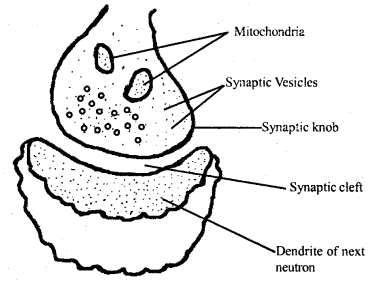
Neural Control and Coordination Class 11 Important Extra Questions Biology 1
Structure of Synapse

Question 5.
Draw a labeled diagram of a section of the retina to illustrate its structure.
Answer:
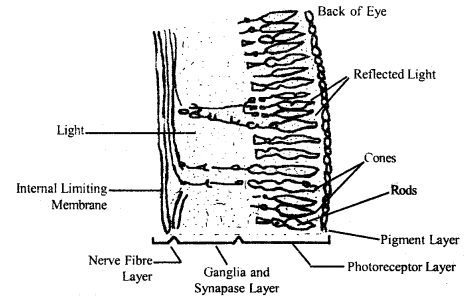
Neural Control and Coordination Class 11 Important Extra Questions Biology 2
Diagrammatic representation of the sectional view of the retina.

Question 6.
What functions does the hypothalamus serve in coordinating the various activities of the body?
Answer:

  1. It contains nerve centers for temperature regulation, hunger, thirst, and emotional reactions.
  2. It secretes neurohormones, which control the secretion of anterior pituitary hormones.
  3. It synthesizes the posterior pituitary hormones and controls their release into the blood.

Question 7.
What is a nerve fiber? How is it classified according to myelin sheath?
Answer:
A nerve fiber is a long axon or dendrite of a neuron. According to the presence and absence of myelin sheath around the fibers.

These are classified as:

  1. Myelinated nerve fiber (i.e., presence of myelin sheath) and
  2. Non-myelinated nerve fiber (i.e., absence of myelin sheath).

Question 8.
Explain Motor-end plate.
Answer:
A Motor-end plate is a specialized structure formed by the muscle fiber at the point where the axon terminal is applied to it. The axon of the motor neuron is divided into branches near the muscle fibers. Each branch loses its myelin sheath near its termination and ends in an expanded foot-like form which is supplied closely to a muscle fiber.

There is no actual continuity between the neuron and muscle fiber. The membranes of the two are separated from each other by a narrow cleft-like fluid-filled space.

Question 9.
What are the biological functions of Dorsal and Ventral spinal nerve roots fibers?
Answer:
Dorsal spinal nerve root fibers bring impulses from the peripheral tissues, giving rise to sensations like touch, temperature, and pain, or to involuntary spontaneous activities called Reflexes.

Ventral spinal nerve root fibers: Some of the root fibers go to skeletal muscle fibers directly to stimulate or inhibit their activities; many others go to autonomic ganglia and end in them.

Question 10.
Our rods and cones evenly distributed over the entire surface of the retina? Why or not? At which point on the retina is a point-to-point image formed?
Answer:
The retina is composed of several layers of cells. First, there are the photoreceptor cells, the rods, and cones, partially embedded in the microvilli of pigmented epithelium cells of the choroids. The rod cells are present on the periphery of the retina in the human eye. The total number of rod cells has been estimated to be between 110 – 125 million. They contain a visual pigment called Rhodopsin.

The cone cells are shorter, thicker, and conical in shape. Cone cells are responsible for the perception of different colors. The total number of cone cells is 6.36 – 6.8 million. Cones are abundant on the rear wall and fovea centralis of the retina.

The point-to-point image is formed on the blind spot. From it, the optic nerve and blood vessels exit the retina and join the diencephalon of the brain.

Question 11.
Blindspot in the eye is devoid of the ability of vision. Why is it so?
Answer:
It is devoid of rods and cone cells. It is unstable to light rays.

Question 12.
If a strong odor is smelled continuously for some time, the sensation of that weakens. Justify.
Answer:
When a person continuously inhales the fumes in the air of a strong-smelling substance the sense of smell progressively and rapidly declines and finally disappears. This is because the olfactory cells get fatigued rapidly due to overstimulation. This is called olfactory adaptation, which develops from various changes in the olfactory epithelium and olfactory centers of the brain.

Question 13.
Which part of the nervous system participates in the maintenance of balance and co-ordinate body movements?
Answer:
The cerebellum process all the data and co-ordinates muscle movement in conjunction with the cortex and sends signals to the muscles to adjust.

Question 14.
What is a reflex action? What units of the nervous systems are involved with a typical vertebrate reflex arc?
Answer:
It is a spontaneous, automatic, mechanical, nerve-mediated response evoked at the unconscious level by the stimulation of any specific receptor without exercising the will of an organism.

There, are more than 200 reflexes “wired” into our nervous system all following the sequence from stimulus to reflex along the specific neural pathway that makes up the reflex arc. The simplest reflex arc involves some specific receptor, afferent sensory neuron towards an aggregation of nervous tissue which may be ganglion or the spinal cord.

Question 15.
Which nerve tract connects the right and left hemispheres of the cerebrum? Into what four lobes in each hemisphere divided?
Answer:
A longitudinal fissure splits the brain into two halves, the left, and right cerebral hemispheres. Other grooves divide the surface of each cerebral hemisphere into four lobes. The frontal lobe, temporal lobe at the front, parietal lobe, and occipital lobe at the back.

Question 16.
What is the primary function of neuroglia cells? What special structure is produced by Schwann cells?
Answer:
The neuroglia cells perform many house-keeping functions, provide nutritional support to the neurons and consume waste products. They also insulate, separating each neuron from the others.

Schwann cells, a type of neuroglial, wrap around the axon with concentric layers of the insulating plasma membrane.

Question 17.
How does a wave of depolarization spread along with a nerve fiber?
Answer:
Nerve cells have polarized membranes, having an electrical potential difference across the membrane. The trigger zone for a particular neuron is the place on the membrane where voltage-gated channels are clustered most densely. When stimulated opening of voltage-gated Na+ ion channel brings Na+ ions into the cell, a temporary, very localized, but rapid inflow of Na+ ions into the cells occurs, wiping out the local electrical potential difference in the immediate vicinity. This is called depolarization.

When the site of stimulation has less charge difference than the membrane surface surrounding it, this potential difference establishes a small, localized current in the immediate vicinity, which influences the nearby Na+ channels to open and depolarizing these cells.

The depolarization thus spreads, producing a local current, which induces passive Na+ channels to open and so to depolarize the near % site. In this way, initial depolarization passes outward over the membrane and spreads out in all directions along with the nerve fiber, from dendron to axon.

Question 18.
What is a synapse? How does the nerve cell across the synapse?
Answer:
A nerve signal travels from neuron to neuron all around the body. These associations are called Synapse.

There are mainly two types of synapses:

  1. Electrical and
  2. Chemical depending upon the nature of the transfer of information across the synapse.

In electrical synapses, cells are separated by a gap, the synaptic cleft, of only 0.2 mm. So that an action potential arriving at the presynaptic side of the cleft can sufficiently depolarize the postsynaptic membrane to directly trigger its action potential.

Chemical synapses are the common type of synapse consists of a bulbous expansion of a nerve terminal called a synaptic knob. The cytoplasm of the synaptic knob contains numerous tiny round sacs synaptic vesicles. Each vesicle contains a neurotransmitter substance responsible for the transmission of nerve impulses across the synapse.
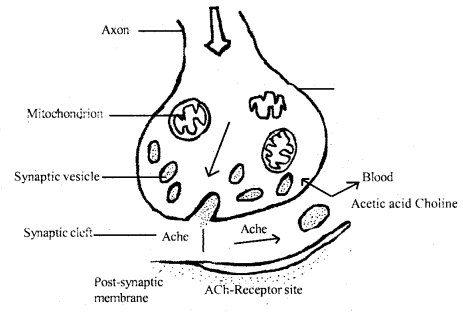
Neural Control and Coordination Class 11 Important Extra Questions Biology 3

Question 19.
What is the action potential of a neuron? Do all neurons possess the same action potential?
Answer:
Depolarisation is caused by rapid change in membrane permeability and a corresponding shift in the balance of ions. If the shift of ions and consequent shift in electrical charges is sufficient, it will trigger a wave of transient membrane depolarisation known as nerve impulse or Action potential. Different neurons possess different densities of Na+ ion channels, different neurons exhibit different action potentials. However, for anyone neuron, the action potential is always the same.

Question 20.
Why is the mode of conduction of electrical impulse along the myelinated neuron is advantageous to a non-myelinated neuron? What is this type of conduction called?
Answer:
The myelinated nerve fibers carry impulses nearly 20 times faster than the non-myelinated nerve fibers. These avoid the dissipation of impulses into adjacent fibers. The myelin sheath serves as a highly insulating layer that prevents the flow of ions between the fluid external to the myelin sheath and within the axon.

In non-myelinated fiber, ionic charges and depolarization are repeated over the membrane along the length of the fiber and action potential flow over the entire length of the fiber. But in myelinated fibers, ionic changes and depolarization are repeated only at the nodes. Thus the impulse is more rapid in myelinated fibers and requires less energy. This jumping of depolarization from node to node is called saltatory conduction of nerve impulse.
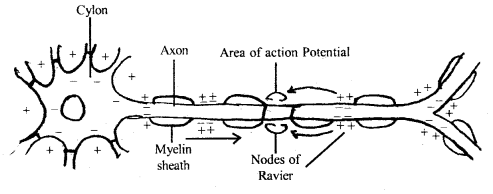
Neural Control and Coordination Class 11 Important Extra Questions Biology 4
Saltatory conduction

Question 21.
(a) Make a clearly labeled diagram of the inner ear of a human being.
Answer:
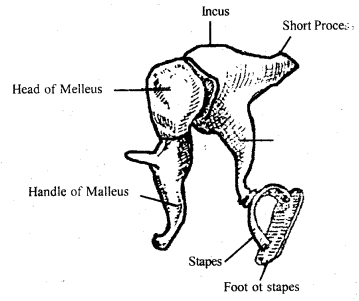
Neural Control and Coordination Class 11 Important Extra Questions Biology 5
Diagrams showing the inner ear

(b) Describe how each of the following is achieved in us
(i) hearing
(ii) balance.
Answer:
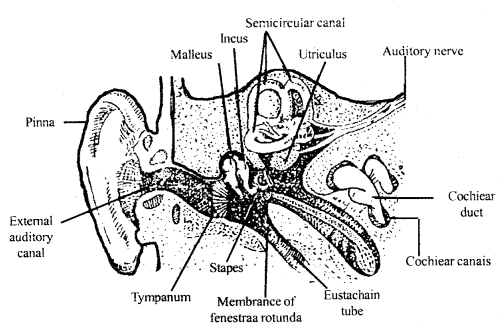
Neural Control and Coordination Class 11 Important Extra Questions Biology 6

Neural Control and Coordination Important Extra Questions Long Answer Type

Question 1.
(a) Describe the reflex arc with a diagram.
Answer:
The neurons forming the pathway taken by the nerve impulses in the reflex action form the Reflex Arc.
The reflex arc consists of

  1. Receptor,
  2. An afferent neuron or sensory neurons from receptor to CN system,
  3. The efferent neuron of motor neurons from CN system to specific muscle fibers or gland cells,
  4. a number of connectors or intermediate neurons conducting impulses form the afferent to the efferent neurons.
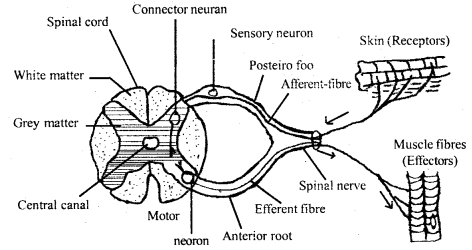
Neural Control and Coordination Class 11 Important Extra Questions Biology 7
Reflex Arc

When a specific stimulus is applied to a specific group of receptors, it stimulates the receptor to initiate a nerve impulse along the afferent neurons. This impulse travels along with the afferent connector and efferent neurons to reach an effector-muscle or gland for that reflex. Thus the flow of impulse can only be in a single direction in a reflex arc, i.e.,

Stimulus → receptor → afferent neuron → CN system efferent neuron ← (connector neuron)

(b) Distinguish between conditioned reflex and unconditioned reflex.
Answer:
Differences between conditioned reflex and unconditioned reflex:

Conditioned ReflexUnconditioned Reflex
It is a reflex, acquired after birth by applying an indifferent stimulus before or along with the stimulus for an inborn reflex.It is a reflex, which can be evoked even immediately after birth and needs no previous encounter with the stimulus exciting it.

Question 2.
(a) Give an account of spinal nerves in man.
Answer:
There are 31 pairs of a spinal nerve in man. From each segment of the spinal cord, there are two spinal nerves. Each spinal nerve is a mixed nerve, containing both sensory and motor nerve fibers. It runs between the spinal cord and peripheral tissue. The two roots, i.e., motor or ventral and sensory or dorsal connect the spinal nerve to the spinal cord.

The DORSAL ROOT carries sensory or afferent fiber and has a dorsal root ganglion at its middle. The VENTRAL ROOT contains a motor or efferent nerve fibers. The dorsal root fibers bring impulses from the peripheral tissue and give rise to sensations like touch, temperature, and pain.

The ventral nerve root fibers pass impulses to muscles and glands in the peripheral tissues. The spinal nerve has been named according to its relation with the vertebral column.
These are

  1. Eight pairs of cervical
  2. 12 pairs of thoracic
  3. 5 pairs of lumber,
  4. 5 pairs of sacral and
  5. a pair of coccygeal or caudal.

(b) What biological functions are served by the skeletal system?
Answer:

  1. The skeletal system forms the rigid structural framework of the body and supports the weight of the body along with its limbs.
  2. It affords protection to the internal organs against mechanical injury by forming cage-like compartments, e.g., skull.
  3. It serves as a storage depot for calcium and phosphate, which are released for a number of functions of the body.
  4. It participates in movement and locomotion.
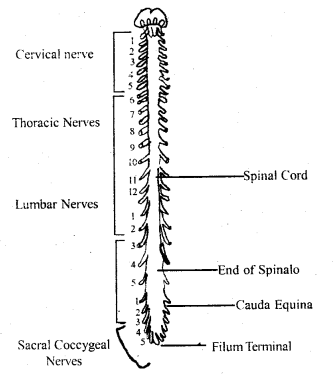
Neural Control and Coordination Class 11 Important Extra Questions Biology 8
The spinal nerve in man

Question 3.
Distinguish between:
(a) Afferent neurons and efferent neurons.
Answer:
Afferent neurons and efferent neurons:
Afferent neurons: These conduct sensory impulses from the receptors present in the peripheral organs and tissues towards the central nervous system. Their bodies are called afferent neurons.

Efferent neurons: These conduct motor impulses from the central nervous system to the peripheral organs and tissues serving as effectors. Their cell bodies are called efferent neurons.

(b) Rods and cones
Answer:
Rods: Rod cells are rod-like, elongated cells, bearing long, thin cylinders, containing a visual pigment called Rhodopsin. Rod cells are present on the periphery of the retina in the human eye. These cells do not form color vision.

Cones: Cone cells are shorter, thicker, and conical in shape. These are highly sensitive to bright light and colors. They contain a violet color pigment called rhodopsin. Cone cells are responsible for the perception of different colors. Cones are abundant on the rear wall and fovea centralis of the retina.

(c) Resting membrane potential and action potential.
Answer:
Resting membrane potential: The surface of the axon carries a positive charge relative to its interior and this electrical potential difference across the plasma membrane is called resting membrane potential.

Action potential: The shift of ions and consequents shift in electrical charges is sufficient enough; it will trigger a wave of transient membrane depolarization known as nerve impulse or Action potential.

(d) Impulse conduction in myelinated nerve fiber and unmyelinated nerve fiber.
Answer:
Impulse conduction in myelinated nerve fiber: The myelinated fibers carry impulses nearly 20 times faster than the non-myelinated nerve fibers. These avoid dissipation of impulse into adjusting fibers. The myelin sheath serves as a highly insulating layer that prevents the flow of ions. Impulses are rapid.

Non-myelinated nerve fiber: Ionic changes and depolarization are repeated over the membrane all along with the fiber. Impulse requires less energy and does not need to run all along with the fiber.

(e) Aqueous humor and vitreous humor.
Answer:
Aqueous humor: The chamber between the cornea and lens is filled with a clear watery fluid, the aqueous humor.

Vitreous humor; The chamber behind the lens is filled with a semisolid gelatinous material the vitreous humor.

(f) Blindspot and yellow spot.
Answer:
Blindspot: It s a small insensitive light area of about 0.5 cm. in diameter. It is devoid of rod and cone cells. It is unable to receive light rays.
Yellow spot: A tiny circular area, about 6 mm in diameter in the retina is a yellow spot. Here the vision is sharpest. It has rod and cone cells.

(g) Cranial nerve and spinal nerves.
Answer:
Cranial nerve: There are 12 pairs of cranial nerves, 10 originate from the brain stem, but all pass through the foramina of the skull. Cranial nerves contain only sensory fibers. The remainder contains both sensory and motor fibers.

Spinal Nerve: They arise from the cord. 31 pairs of segmental spinal nerves arise from the cord. They contain both receptor neurons and effectors neurons.


Class 12 Accountancy 1 Mark Questions Chapter 5 Dissolution of a Partnership Firm

Here we are providing 1 Mark Questions for Accountancy Class 12 Chapter 5 Dissolution of a Partnership Firm are the best resource for students which helps in class 12 board exams.

One Mark Questions for Class 12 Accountancy Chapter 5 Dissolution of a Partnership Firm

Question 1.
Differentiate between Dissolution of Partnership and Dissolution of a Partnership Firm on the basis of ‘Court’s Intervention’. (CBSE Delhi 2019)
Answer:
Class 12 Accountancy Important Questions Chapter 5 Dissolution of a Partnership Firm 1

Question 2.
State any two situations when a partnership firm can be compulsorily dissolved. (CBSE Delhi 2019)
Answer:
A firm is compulsorily dissolved in the following cases: (Any two)

  1. When all the partners or all but one partner become insolvent.
  2. When the business of the firm becomes illegal.

Question 3.
Distinguish between ‘Reconstitution of Partnership’ and ‘Dissolution of Partnership Firm’ on the basis of ‘Closure of books’.
Answer:
Class 12 Accountancy Important Questions Chapter 5 Dissolution of a Partnership Firm 2

Question 4.
State the basis of calculating the amount of profit payable to the legal representative of a deceased partner in the year of death. (CBSE Outside Delhi 2019)
Answer:
Profit may be estimated

  • On the basis of last year’s the profit/Average profits of last given no. of years
  • On the basis of Turnover/Sales.

Question 5.
State any two grounds on the basis of which the court may order for the dissolution of the partnership firm. (CBSE Outside Delhi 2019)
Answer:
At the suit of a partner, the court may order a partnership firm to be dissolved on any of the following grounds:

  • when a partner becomes insane;
  • when a partner becomes permanently incapable of performing his duties as a partner.

Question 6.
State any two situations when a partnership firm can be compulsorily dissolved. (CBSE Outside Delhi 2019)
Answer:
A firm is compulsorily dissolved in the following-cases:

  • When all the partners or all but one partner become insolvent.
  • When the business of the firm becomes illegal.

Question 7.
State any two contingencies that may result into dissolution of a partnership firm.(CBSE Outside Delhi 2019)
Answer:
Contingencies that may result into dissolution of a partnership firm:

  • If the firm is constituted for a fixed term, on the expiry of that term
  • If constituted to carry out one or more ventures, on the completion of the venture.

Question 8.
State the order of payment of the following, in case of dissolution of the partnership firm.
(i) to each partner proportionately what is due to him/her from the firm for advances as distinguished from capital (i.e. partner’ loan);
(ii) to each partner proportionately what is due to him on account of capital; and
(iii) for the debts of the firm to the third parties; (CBSE Sample Paper 2019-20)
Answer:
(iii) for the debts of the firm to the third parties;
(i) to each partner proportionately what is due to him/her from the firm for advances as distinguished from capital (i.e. partner’ loan);
(ii) to each partner proportionately what is due to him on account of capital

Question 9.
A and B are partners in a firm sharing profits in the ratio of 3 : 2 Mrs. B has given a loan of ₹ 40,000 to the firm and A has also given a loan of ₹ 80,000 to the firm. The firm was dissolved and its assets realised ₹ 60,000.
State the order of payment of Mrs. B’s loan and A’s loan assuming that there was no other third party liability – of the firm.
Answer:
Order of payment:
First, the third party loan i.e. Mrs. B’s loan will be paid.
The Partner’s loan i.e. A’s loan will be paid.

Question 10.
A B and C are partners in a firm. On April 1, 2013, A and B were declared insolvent by a court. Will the partnership firm be treated as dissolved?
Answer:
Yes.

Question 11.
Mohan and Kanwar are partners in a firm. Their firm was dissolved on 1.1.2013. Mohan was assigned the work of dissolution. For this work, Mohan was paid ₹ 500. Mohan paid dissolution expenses of ₹ 400 from his own pocket. Will any Journal Entry be passed for ₹ 400 paid by Mohan?
Answer:
No.

Question 12.
A firm has investment fluctuation fund of ₹ 10,000. It does not have investments on its Balance Sheet at the time of its dissolution. In which account(s), amount of investments fluctuation fund be transferred?
Answer:
In Partners’ Capital Accounts.

Question 13.
Why is cash balance not transferred to Realisation Account on the dissolution of a partnership firm?
Answer:
Cash is a liquid asset.

Question 14.
A firm was dissolved on April 1, 2013. The assets side of its Balance Sheet has furniture of ₹ 2,500 whereas on the liabilities side, creditors appeared for ₹ 4,000.-Half of the creditors took half of the furniture at 10% discount and the remaining creditors were paid at 10% premium. What journal entries are required?
Answer:
No journal entry will be passed for the first half of the creditors but for the remaining creditors, entry will be:
Class 12 Accountancy Important Questions Chapter 5 Dissolution of a Partnership Firm 3

Question 15.
Should intangible assets be treated in the manner of treatment of tangible assets at the time of dissolution of a partnership firm?
Answer:
Yes.

Question 16.
In case of dissolution of a firm which liabilities are to be paid first?(CBSE 2011 Compartment Delhi)
Answer:
Debts of third parties.

Question 17.
In case of dissolution of a firm, which item on the liabilities side is to be paid last? (CBSE 2011 Compartment Delhi)
Answer:
Partners’ capital.

Question 18.
A firm has furniture of₹ 6,000 which was taken over by a creditor of₹ 5,000 in full settlement of his claim. Mention whether any journal entry will be passed for this. If yes, pass the journal entry.
Answer:
No, journal entry will be passed.

Question 19.
Creditors of ₹ 50,000 took over stock at agreed value of₹ 45,000 and balance Was paid to him. Pass the journal entry for this transaction.
Answer:
The Journal entry will be:
Class 12 Accountancy Important Questions Chapter 5 Dissolution of a Partnership Firm 4

Question 20.
Drawers of bills payable ₹ 25,000 took over furniture at agreed value of₹ 29,000 and paid the excess value. Pass journal entry for this transaction.
Answer:
The Journal entry will be:
Class 12 Accountancy Important Questions Chapter 5 Dissolution of a Partnership Firm 5

Question 21.
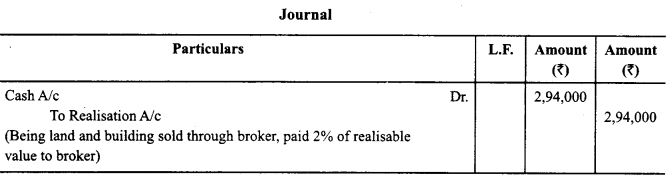
Land and Building (book value) ₹ 1,60,000 sold for ₹ 3,00,000 through a broker who charged 2% commission on the deal. Journalise the transaction, at the time of dissolution of the firm. (CBSE Sample Paper 2018-19)
Answer:
Class 12 Accountancy Important Questions Chapter 5 Dissolution of a Partnership Firm 6

Question 22.
State any one occasion for the dissolution of the firm on court’s orders when a partner becomes. (Compt. Delhi 2017)
Answer:
Partner becomes permanently incapable of performing his duties as a partner.

Question 23.
Name the asset that is not transferred to the debit side of Realisation account, but brings certain amount of cash against its disposal at the time of dissolution of the firm. (CBSE Delhi 2014)
Answer:
Unrecorded assets

Question 24.
Ram and Shyam formed partnership at will. Ram gave a notice on January 1, 2013 to dissolve the firm. Can partnership firm be dissolved even without consent of Shyam? Give reason.
Answer:
Yes.

Class 12 Accountancy 1 Mark Questions Chapter 4 Reconstitution of Partnership Firm: Retirement/Death of a Partner

Here we are providing 1 Mark Questions for Accountancy Class 12 Chapter 4 Reconstitution of Partnership Firm: Retirement/Death of a Partner are the best resource for students which helps in class 12 board exams.

One Mark Questions for Class 12 Accountancy Chapter 4 Reconstitution of Partnership Firm: Retirement/Death of a Partner

Question 1.
What is meant by ‘Gaining Ratio’ on retirement of a partner?
Or
P, Q and R were partners in a firm. On 31st March, 2018 R retired. The amount payable to R ₹ 2,17,000 was transferred to his loan account. R agreed to receive interest on this amount as per the provisions of Partnership Act, 1932. State the rate at which interest will be paid to R. (CBSE Delhi 2019)
Answer:
The ratio in which retiring Partner’s Share is distributed between remaining Partner is called gaining ratio.
Or
Rate of interest will be 6% p.a.

Question 2.
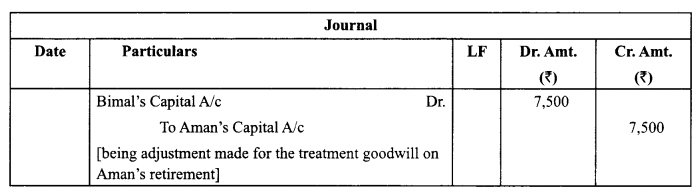
Aman, Bimal and Deepak are partners sharing profits in the ratio of 2 : 3 : 5. The goodwill of the firm has been valued at ₹ 37,500. Aman retired. Bimal and Deepak decided to share profits equally in future. Calculate gain/sacrifice of Bimal and Deepak on Aman’s retirement and also pass necessary journal entry for the treatment of goodwill. (CBSE Outside Delhi 2019)
Answer:
Old Ratio = 2:3:5
New Ratio =1:1 (on Aman’s Retirement)
Bimal’s Gain = 1/2 – 3/10 = 2/10
Deepak’s Gain = 1/2 – 5/10 = nil
Firm’s Goodwill = 37,500 .
A man’s share = 2/10 x 37,500 = 7,500

Class-12-Accountancy-Important-Questions-Chapter-4-Reconstitution-of-Partnership-Firm-Retirement-Death-of-a-Partner-1

Question 3.
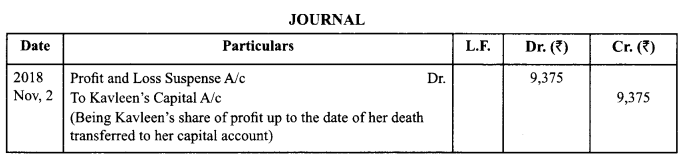
Riyansh, Garv and Kavleen were partners in a firm sharing profit and loss in the ratio of 8 : 7 : 5. On 2nd November 2018, Kavleen died. Kalveen’s share of profits till the date of her death was calculated at ₹ 9,375. Pass the necessary journal entry. (CBSE Sample Paper 2019-20)
Answer:
Class 12 Accountancy Important Questions Chapter 4 Reconstitution of Partnership Firm Retirement Death of a Partner 2

Question 4.
At the time of retirement how is the new profit sharing ratio among the remaining partners calculated₹ (CBSE Compt. 2019)
Answer:
The new share of each of the remaining partner is calculated as his/her own share in the firm plus the share acquired from the retiring partner.

Question 5.
In which ratio do the remaining partners acquire the share of profit of the retiring partner? (CBSE Compt. 2017)
Answer:
Gaining ratio.

Question 6.
At the time of retirement of a partner, state the condition when there is no need to compute gaining ratio. (CBSE 2013 Compartment OD)
Answer:
When the remaining partners share profits in old ratio.

Question 7.
On the retirement of a partner, how is the profit sharing ratio of the remaining partners decided?
Answer:
On the basis of old profit sharing ratio.

Question 8.
Why is gaining ratio of the remaining partners calculated at the time of retirement/death of a partner?
Answer:
Gaining ratio of the remaining partners is calculated to determine amount of goodwill payable by them to retired/deceased partner.

Question 9.
State the ratio in which share of goodwill of the retiring partner is debited to Capital Accounts of the remaining partners.
Answer:
In their gaining ratio.

Question 10.
Abha and Beena were partners sharing profits and losses in the ratio of 3 : 2 on April 1st 2013, they decided to admit Chanda for 1/5th share in the profits. They had a reserve of ₹ 25,000 which they wanted to show in their new balance sheet. Chanda agreed and the necessary adjustments were made in the books. On October 1st 2013, Abha met with an accident and died. Beena and Chanda decided to admit Abha’s daughter Fiza in their partnership, who agreed to bring ₹ 2,00,000 as capital. Calculate Abha’s share in the reserve on the date of her death. (CBSE Sample Paper 2015)
Answer:
₹ 12,000

Question 11.
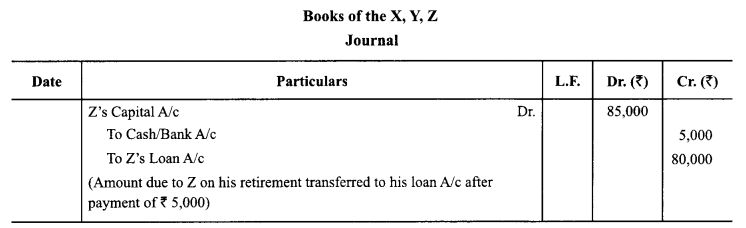
X, Y and Z were partners sharing profits and losses in the ratio of 3:2:2. Z retired and the amount due to him was ₹ 85,000. He was paid ₹ 5,000 immediately. The balance was payable in three equal annual installments carrying interest @ 6% p.a. Pass necessary journal entry for recording the same on the date of Z’s retirement.
(Compt. Delhi 2017)
Answer:
Class 12 Accountancy Important Questions Chapter 4 Reconstitution of Partnership Firm Retirement Death of a Partner 3

Question 12.
Ram, Mohan and Sohan were partners in a firm sharing profits in the ratio of 4 : 3 : 1. Mohan retired. His share was taken over equally by Ram and Sohan. In which ratio will the profit and loss on revaluation of assets and liabilities on the retirement of Mohan be transferred to capital accounts of the partners?
(CBSE 2010 Compartment Delhi)
Answer:
In old profit sharing ratio.

Class 12 Accountancy 1 Mark Questions Chapter 3 Reconstitution of Partnership Firm: Admission of a Partner

Here we are providing 1 Mark Questions for Accountancy Class 12 Chapter 3 Reconstitution of Partnership Firm: Admission of a Partner are the best resource for students which helps in class 12 board exams.

One Mark Questions for Class 12 Accountancy Chapter 3 Reconstitution of Partnership Firm: Admission of a Partner

Question 1.
What is meant by Issued Capital ? (CBSE Delhi 2019)
Answer:
Issued capital means such capital as the company issues from time to time for subscription-section 2(50) of the companies Act 2013.

Question 2.
What is meant by ‘ Employees Stock Option Plan? (CBSE Delhi 2019)
Answer:
FSOP means an option granted by the company to its employees & employee directors to subscribe the share at a price that lower than the market price i.e., fair value. It is an option granted by the company but it is not an obligation on the employee to subscribe it.

Question 3.
A and B were partners in a firm sharing profits in the ratio of 3 : 2. C and D were admitted as new partners.
A sacrificed ith of his share in favour of C and B sacrificed 50% of his share in favour of D. Calculate the 4 new profit sharing ratio of A, B, C and D.(CBSE Outside Delhi 2019)
Answer:
Old ratio = 3:2
A’s Sacrifice (in favour of C) = 1/4 x 3/5 = 3/20
B’s Sacrifice (in favour of D) = 1/2 x 2/5 = 2/10
A’s New Share = 3/5 – 3/20 = 9/20
B’s New Share = 2/5 – 2/10 = 2/10

Question 4.
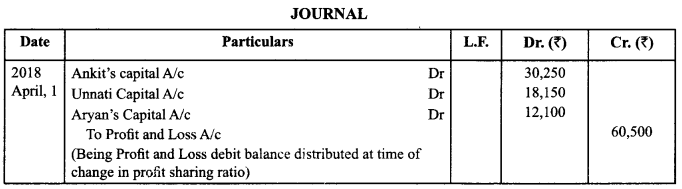
Ankit, Unnati and Aryan are partners sharing profits in the ratio of 5:3:2. They decided to share future profits in the ratio of 2:3:5 with effect from 1st April, 2018. They had the following balance in their balance sheet, passing necessary Journal Entry:
Class 12 Accountancy Important Questions Chapter 3 Reconstitution of Partnership Firm Admission of a Partner 1
Answer:
Class 12 Accountancy Important Questions Chapter 3 Reconstitution of Partnership Firm Admission of a Partner 2

Question 5.
A and B are partners in a firm. They admit C as a partner with l/5th share in the profits of the firm. C brings ₹ 4,00,000 as his share of capital. Calculate the value of C’s share of Goodwill on the basis of his capital, given that the combined capital of A and B after all adjustments is ₹ 10,00,000. (CBSE Sample Paper 2019-20)
Answer:
Class 12 Accountancy Important Questions Chapter 3 Reconstitution of Partnership Firm Admission of a Partner 3

Question 6.
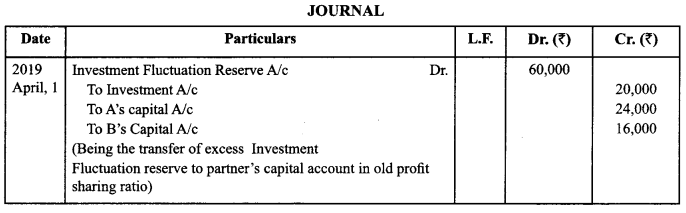
A and B are partners in a firm sharing profits and losses in the ratio of 3:2.On 1st April, 2019 they decided to admit C their new ratio is decided to be equal. Pass the necessary journal entry to distribute Investment Fluctuation Reserve of ₹ 60,000 at the time of C’s admission, when Investment appear in the books at ₹ 2,10,000 and its market value is ₹1,90,000.
Answer:
Class 12 Accountancy Important Questions Chapter 3 Reconstitution of Partnership Firm Admission of a Partner 4

Question 7.
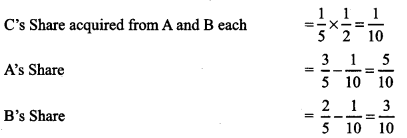
A and B are in partnership sharing profits and losses in the ratio of 3:2. They admit C into partnership with 1/5th share which he acquires equally from A and B. Accountant has calculated new profit sharing ratio as 5:3:2. Is accountant correct:
Answer:
Class 12 Accountancy Important Questions Chapter 3 Reconstitution of Partnership Firm Admission of a Partner 5
New Profit Sharing ratio of A: B: C ¡s 5:3: 2
Yes, new profit sharing ratio is 5:3:2

Question 8.
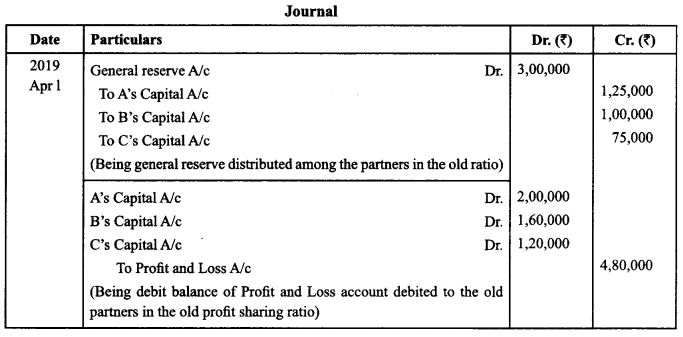
A, B and C were partners sharing profits in the ratio of 5 : 4 : 3. They decided to change their profit sharing ratio to 2:2:1 w.e.f. 1st April, 2019. On that date, there was a balance of ₹ 3,00,000 in General Reserve and a debit balance of ₹ 4,80,000 in the Profit and Loss Account.
Pass necessary journal entries for the above on account of change in the profit sharing ratio.
Answer:
Class 12 Accountancy Important Questions Chapter 3 Reconstitution of Partnership Firm Admission of a Partner 6

Question 9.
At the time of admission of a partner, who decides the share of profit of the new partner out of the firm’s profit? (CBSE Compartment 2019)
Answer:
It is decided mutually among the old partners and the new partner.

Question 10.
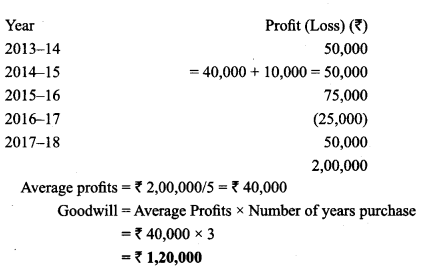
Hari and Krishan were partners sharing profits and losses in the ratio of 2 : 1. They admitted Shyam as a partner for 1/5th share in the profit. For this purpose the Goodwill of the firm was to be value on the basis of three years’s purchase of last five years average profits. The profits for the last five years were:
Class 12 Accountancy Important Questions Chapter 3 Reconstitution of Partnership Firm Admission of a Partner 7
Calculate Goodwill of the firm after adjusting the following:
The profit of 2014-15 was calculated after charging ₹ 10,000 for abnormal loss of goods by fire.
Answer:
Class 12 Accountancy Important Questions Chapter 3 Reconstitution of Partnership Firm Admission of a Partner 8

Question 11.
Amit and Beena were partners in a firm sharing profits and losses in the ratio of 3 : 1. Chaman was admitted as a new partner for 1/6th share in the profits. Chaman acquired 2/5th of his share from Amit. How much share did Chaman acquired from Beena? (CBSE 2018-19)
Answer:
Chaman acquired 1/6 – (1/6 x 2/5) = 3/30 from Beena.

Question 12.
Ritesh and Hitesh are childhood friends. Ritesh is a consultant whereas Hitesh is an architect. They contributed equal amount and purchased a building for ₹2 crore. After 10 years they sold it for ₹3 crore and shared the profit equally. Are they doing the business in partnership.
Answer:
No.

Question 13.
Pawan and Jayshree are partners. Bindu is admitted for l/4th share. State the ratio in which Pawan and Jayshree will sacrifice their share in favour of Bindu? (CBSE Sample Paper 2014)
Answer:
Old ratio i.e. 1 : 1

Question 14.
X and Y are partners. Y wants to admit his son K into business. Can K become the partner of the firm?
Answer:
Yes, if X agrees to it otherwise not.

Question 15.
Name any one factor responsible which affect the value of goodwill.
Answer:
Location of a business.

Question 16.
Vishal & Co. is involved in developing computer software which is a high value added product and Tiny & Co. is involved in manufacturing sugar which is a low value item. If capital employed of both the firms is same, value of goodwill of which firm will be higher?
Answer:
Vishal & Co.

Question 17.
State a reason for the preparation of ‘Revaluation Account’ at time of admission of a partner.
Answer:
To record the effect of revaluation of assets and liabilities.

Question 18.
In which ratio is the profit or loss due to revaluation of assets and liabilities transferred to capital accounts?
Answer:
Old Ratio of existing partners.

Question 19.
Change in Profit Sharing Ratio amounts to dissolution of partnership or partnership firm?
Answer:
Dissolution of partnership.

Question 20.
State one occasion on which a firm can be reconstituted. (CBSE 2012, Delhi)
Answer:
Change of profit sharing ratio among the existing partners.

Question 21.
What is the formula of calculating sacrificing ratio? (CBSE 2011, Outside Delhi)
Answer:
Sacrificing Ratio = Old Ratio-New Ratio.

Question 22.
By which name the profit sharing ratio in which all partners, including the new partner, will share fixture profits?
Answer:
New profit sharing ratio.

Question 23.
If the new partner acquires his share in profits from all the old partners in their old profit sharing ratio, by which ratio will the old partners sacrifice their profit sharing ratio?
Answer:
Old profit sharing ratio.

Question 24.
Name the accounting standard, issued by the Institute of Chartered Accountants of India, which deals with treatment good will.
Answer:
AS 26.

Question 25.
When the new partner brings amount of premium for goodwill, by which ratio is this amount credited to old partners’ Capital Accounts?
Answer:
Sacrificing ratio.

Question 26.
What is the formula for calculating inferred goodwill?
Answer:
Net worth of business on the basis of new partner’s capital minus net worth of business in new firm.

Class 12 Accountancy 1 Mark Questions Chapter 2 Accounting for Partnership: Basic Concepts

Here we are providing 1 Mark Questions for Accountancy Class 12 Chapter 2 Accounting for Partnership: Basic Concepts are the best resource for students which helps in class 12 board exams.

One Mark Questions for Class 12 Accountancy Chapter 2 Accounting for Partnership: Basic Concepts

Question 1.
Chhavi and Neha were partners in a firm sharing profits and losses equally. Chhavi withdrew a fixed amount at the beginning of each quarter. Interest on drawings is charged @ 6% p.a. At the end of the year, interest ‘ on Chhavi’s drawings amounted to ₹ 900. Pass necessary journal entry for charging interest on drawings.
Answer:
Class 12 Accountancy Important Extra Questions Chapter 2 Accounting for Partnership Basic Concepts 1

Question 2.
Dev withdrew ₹ 10,000 on 15th day of every month. Interest on drawings was to be charged @ 12% per
annum. Calculate interest on Dev’s drawings. (CBSE Outside Delhi 2019)
Answer:
Interest On Drawings = 1,20,000 x 12/100 x 6 x 12 = 7,200

Question 3.
Amit, a partner in a partnership firm withdrew ₹ 7,000 in the beginning of each quarter. For how many months would interest on drawings be charged₹ (CBSE SP 2019-20)
Answer:
7 1/2 months.

Question 4.
Raj and Seema started a partnership firm on 1st July, 2018. They agreed that Seema was entitled to a commission of 10% of the net profit after charging Raj’s salary of ₹ 2,500 per quarter and Seema’s commission. The net profit before charging Raj’s salary and Seema’s commission for the year ended 31st March, 2019 was ₹ 2,27,500. Calculate Seema’s commission. (CBSE Compt. 2019)
Answer:
Net profit before salary and commission = ₹ 2,27,500
Net Raj’s salary ₹ 2,500 x 3 = ₹ 7,500
Net profit after Raj’s salary but before Seema’s commission = ₹ 2,20,000
Seema’s commission = 10/110 of ₹ 2,20,000
= ₹ 20,000

Question 5.
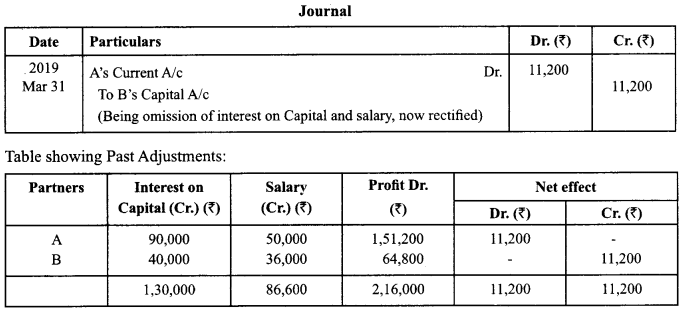
A and B are partners in a firm sharing profits and losses in the ratio of 7 : 3. Their fixed capitals were : A ₹ 9,00,000 and B ₹ 4,00,000. The partnership deed provided the following: (CBSE Compt. 2019)
(i) Interest on capital @ 10% p.a.
(ii) A’s salary ₹ 50,000 per year and B’s salary ₹ 3,000 per month.
Profit for the year ended 31st March 2019 ₹ 2,78,000 was distributed without providing for interest on capital and partner’s salary.
Showing your working clearly, pass the necessary adjustment entry for the above omissions.
Answer:
Class 12 Accountancy Important Extra Questions Chapter 2 Accounting for Partnership Basic Concepts 2

Question 6.
Partners of ABC Corporation have agreed that D, a minor, should be admitted as a partner in the firm. What will be liability of D?
Answer:
Limited.

Question 7.
X, Y and Z are partners in a firm. The firm had adopted fixed capital method. Mention the account in which the interest on capital will be recorded:
Answer:
Capital Account.

Question 8.
A partnership deed provides for the payment of interest on capital but there was a loss instead of profits during the year 2010-11. Will the interest on capital be allowed?
Answer:
No.

Question 9.
Where is interest on a partner’s loan debited to Profit and Loss Account or Profit and Loss Appropriation Account?
Answer:
Profit and loss Account.

Question 10.
Is interest on a partner’s loan is payable even in case of loss to the firm?
Answer:
Yes.

Question 11.
Net profit of a firm is ₹ 30,000, partners’ salary is ₹ 12,000 and interest on capital is ₹ 20,000. Mention the amount of partners’ salary and interest on capital which should be debited to Profit and Loss Appropriation Account if both items are treated as appropriation.
Answer:
Partners’ salary ₹ 11,250, Interest on capital ₹ 18,750.
Note: In the ratio of salary and interest on capital i.e. 12,000 : 20,000 = 3:5.

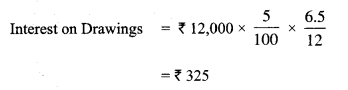
Question 12.
Ram and Shyam are partners sharing profits/losses equally. Ram withdrew ₹ 1,000 p.m. regularly on the first day of every month during the year 2013-14 for personal expenses. If interest on drawings is charged @ 5% p.a. Calculate interest on the drawings of Ram.
Answer:
Class 12 Accountancy Important Extra Questions Chapter 2 Accounting for Partnership Basic Concepts 46

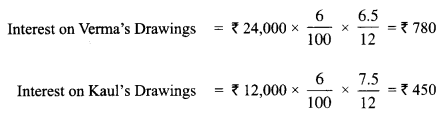
Question 13.
Verma and Kaul are partners in a firm. The partnership agreement provides that interest on drawings should be charged @ 6% p.a. Verma withdraws X 2,000 per month starting from April 01, 2013 to March 31, 2014. Kaul withdraw ₹ 3,000 per quarter, starting from April 01, 2013. Calculate interest on partner’s drawings.
Answer:
Class 12 Accountancy Important Extra Questions Chapter 2 Accounting for Partnership Basic Concepts 3

Question 14.
Himanshu withdraws ₹ 2,500 at the end of each month. The partnership deed provides for charging the interest on drawings @ 12% p.a. Calculate interest on Himanshu’s drawings for the year ending 31st December, 2013.
Answer:
Class 12 Accountancy Important Extra Questions Chapter 2 Accounting for Partnership Basic Concepts 47

Question 15.
Bharam is a partner in a firm. He withdraws ₹ 3,000 at the starting of each month for 12 months. The books . of the firm closes on March 31 every year. Calculate interest on drawings if the rate of interest is 10% p.a.
Answer:
Bharam withdraws ₹ 3,000 at the starting of each month.
Class 12 Accountancy Important Extra Questions Chapter 2 Accounting for Partnership Basic Concepts 48

Question 16.
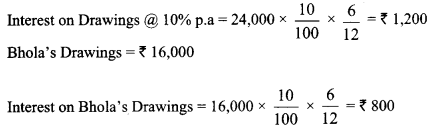
Amit and Bhola are partners in a firm. They share profits in the ratio of 3 : 2. As per their partnership agreement, interest on drawings is to be charged @ 10% p.a. Their drawings during 2013 were ₹ 24,000 and ₹ 16,000, respectively. Calculate interest on drawings based on the assumption that the amounts were withdrawn evenly, throughout the year.
Answer:
Amit’s Drawings = ₹ 24,000
Class 12 Accountancy Important Extra Questions Chapter 2 Accounting for Partnership Basic Concepts 4
Note: In the absence of date of drawings, it is assumed drawings have been made in the middle of each month/period.

Question 17.
A, B and C were partners in a firm sharing profits in the ratio of 3 : 2 : 1. B was guaranteed a profit of X 2,00,000. During the year the firm earned a profit of ₹ 84,000. Calculate the net amount of Profit/Loss transferred to the capital accounts of A and C. (CBSE Sample Paper 2017-18)
Answer:
Net Amount of Loss transferred to:

  • A’s Capital Account: ₹ 87,000
  • C’s Capital Account: ₹ 29,000