Class 12 Accountancy 1 Mark Questions Chapter 10 Accounting Ratios

Here we are providing 1 Mark Questions for Accountancy Class 12 Chapter 10 Accounting Ratios are the best resource for students which helps in class 12 board exams.

One Mark Questions for Class 12 Accountancy Chapter 10 Accounting Ratios

Question 1.
What will be the effect on current ratio if a bills payable is discharged on maturity? (CBSE SP 2019-20)
Answer:
The current ratio will increase

Question 2.
Debt Equity Ratio of a company is 1:2. Purchase of a Fixed asset for ₹ 5,00,000 on long term deferred payment basis will increase, decrease or not change the ratio?
Answer:
Increased

Question 3.
It is a simple arithmetical expression of relationship between two figures. Name the term.
Answer:
Ratio

Question 4.
The liquidity of a business firm is measured by its ability to satisfy its long-term obligations as they become due. Name a ratio used for this purpose.
Answer:
Current Ratio.

Question 5.
X Ltd. has a Debt-Equity Ratio at 3 : 1. According to the management it should be maintained at 1 : 1. What is the choice to do so?
Answer:
To increase the equity or reduce the debt.

Question 6.
How the solvency of a business is assessed by Financial Statement Analysis? (CBSE Delhi 2012)
Answer:
With the help of solvency ratios.

Question 7.
Assuming that the debt to equity ratio is 1 : 2, state giving reason, whether the ratio will improve, decline or will have no change in case equity shares are issued for cash. (CBSE Foreign 2006)
Answer:
Decrease.

Question 8.
Debt to equity ratio of a company is 08 : 1. State whether long term loan obtained by the company will increase, decrease or not change the ratio. (CBSE Outside Delhi 2008)
Answer:
Increase.

Question 9.
Inventory Turnover ratio of a company is 3 times. State, giving reason, whether the ratio improve, decline or do not change because of increase in the value of closing stock by ₹ 5,000. (CBSE Outside Delhi 2008)
Answer:
Decrease.

Question 10.
Trade Receivables Turnover Ratio of a company is 6 times. State with reason whether the ratio will improve, decrease or not change due to increase in the value of closing inventory by ₹ 50,000. (CBSE Foreign 2008)
Answer:
No change. .

Question 11.
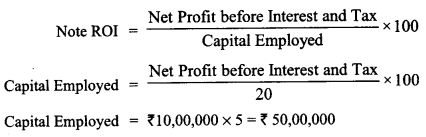
If a company has earned ₹ 10,00,000 as profit before interest and tax, ROI is 20%. State the capital employed in the company.
Answer:
₹ 5,00,000
Class 12 Accountancy Important Questions Chapter 10 Accounting Ratios 1

Question 12.
What will be operating profit if operating ratio is 88.94? (CBSE Delhi 2009)
Answer:
Operating Profit = 100 – 88.94 = 11.06

Question 13.
State with reason whether repayment of long-term loan will result in increase, decrease or no change of debt- equity ratio. (CBSE Outside Delhi 2010 Compt.)
Answer:
Decrease.

Question 14.
A company has Share Capital of ₹ 5,00,000, Reserves and Surplus of ₹ 2,00,000 and Debt Equity Ratio of 1.8 : 1. It has issued additional Share Capital of ₹ 2,00,000 for cash and bonus shares of₹ 1,00,000. What will be new Debt Equity Ratio?
Answer:
1.4 : 1

Class 12 Accountancy 1 Mark Questions Chapter 9 Analysis of Financial Statements

Here we are providing 1 Mark Questions for Accountancy Class 12 Chapter 9 Analysis of Financial Statements are the best resource for students which helps in class 12 board exams.

One Mark Questions for Class 12 Accountancy Chapter 9 Analysis of Financial Statements

Question 1.
State any one limitation of Financial Statement Analysis. (CBSE Compartment Delhi 2014, 2015)
Answer:
Historical Analysis of financial Statement.

Question 2.
State any one objective of analysis of financial statements. (CBSE Compartment Delhi 2014)
Answer:
To measure earning capacity of business.

Question 3.
State the type of Financial Statement Analysis in which figures of the same items of various years are compared.
Answer:
Horizontal analysis.

Question 4.
Which type of financial statement analysis helps a company to establish the relationship between different items financial statement of a same year?
Answer:
Vertical analysis.

Question 5.
“One of the objectives of Financial Statement Analysis is to assess solvency of business”. What does the term ‘solvency’ mean here ?
Answer:
Solvency means ability to pay the debts.

Class 12 Accountancy 1 Mark Questions Chapter 8 Financial Statements of a Company

Here we are providing 1 Mark Questions for Accountancy Class 12 Chapter 8 Financial Statements of a Company are the best resource for students which helps in class 12 board exams.

One Mark Questions for Class 12 Accountancy Chapter 8 Financial Statements of a Company

Question 1.
State the importance of financial analysis for labour unions. (CBSE SP 2019-20)
Answer:
Labor unions analyse the financial statements to assess whether an enterprise can increase their pay.

Question 2.
If operating is not given, what is the time for the operating cycle assumed?
Answer:
12 months.

Question 3.
If the operating cycle is given for 12 months and the payment cycle for trade payables is 15 months, how will you classify the liability?
Answer:
Non-current Liability.

Question 4.
Name any one line item that can be shown under the major heading ‘Equity and Liabilities’ in a company’s Balance Sheet.
Answer:
Shareholders’Funds

Question 5.
Name any one item that can be disclosed under ‘Short Term Provisions’.
Answer:
Provision for Doubtful debts.

Question 6.
How would you treat preliminary expenses?
Answer:
Preliminary expenses are written off in the year in which they are incurred.

Question 7.
Give one example of unamortised expenses.
Answer:
Discount on issue of shares / debentures.

Question 8.
State any one component of shareholders’ funds.
Answer:
Reserves & Surplus.

Question 9.
How would you treat share forfeiture account?
Answer:
Added in the subscribed.

Question 10.
Mention one component of Reserves and Surplus.
Answer:
Securities Premium Reserves.

Question 11.
Pratiksha Cartons Limited has given guarantee of ₹ 75,00,000 to a bank for raising loans from the bank by its subsidiary’ company. Where will this be shown in books of the company?
Answer:
This will be mentioned in Notes to Accounts.

Class 12 Accountancy 1 Mark Questions Chapter 7 Issue and Redemption of Debentures

Here we are providing 1 Mark Questions for Accountancy Class 12 Chapter 7 Issue and Redemption of Debentures are the best resource for students which helps in class 12 board exams.

One Mark Questions for Class 12 Accountancy Chapter 7 Issue and Redemption of Debentures

Question 1.
What is meant by ‘Issue of Debentures as Collateral Security’ ? (CBSE Outside Delhi 2019)
Answer:
Debenture issued as secondary security/additional security over and above the primary security is known as Issue of Debentures as Collateral Security.

Question 2.
State the provision of the Companies Act, 2013 for the creation of Debenture Redemption Reserve. (CBSE Outside Delhi 2019)
Answer:
Where a company has issued Debentures, it shall create a DRR equivalent to at least 25% of the nominal value of debentures outstanding for the redemption of such debentures.

Question 3.
Profit arisen on account of buying an existing business at profit is transferred to which account?
Answer:
Capital Reserve.

Question 4.
Name the debentures which continue till the continuity of the company.
Answer:
Irredeemable.

Question 5.
Name the debenture which may be converted into equity shares at specified time.
Answer:
Convertible debentures.

Question 6.
Name the debentures which have charge on the company’s assets.
Answer:
Secured debentures (also known as mortgaged debentures).

Question 7.
When a debenture is issued at a price less than its face value or nominal value, what does such difference represent?
Answer:
Discount.

Question 8.
When debentures are redeemed more than the face value of debenture, What does the difference between face value of debenture and redeemed value of debenture is called?
Answer:
Premium on redemption of debentures.

Question 9.
Name the head under which ‘discount on issue of debentures’ appears in the Balance Sheet of a company.
Answer:
Head ‘Current Assets’ and sub-head ‘Other Current Assets’.

Question 10.
What does the repayment or discharge of liability on account of debentures is called?
Answer:
Redemption of debentures.

Question 11.
Under which head is the ‘Debenture Redemption Reserve’ shown in the Balance Sheet?
Answer:
‘Reserve & Surplus’.

Question 12.
When the company issues debentures to the lenders as an additional/secondary security, in addition to other assets already pledged/ some primary security. What does such issue of debentures is called? (CBSE 2018)
Answer:
Issue of dedentures as collateral security.

Question 13.
It is a written instrument acknowledging a debt under the common seal of the company, name the term.
Answer:
Debenture.

Question 14.
State an exception to the creation of Debenture Redemption Reserve as per Companies (Share Capital and Debentures) Rules 18(7). (CBSE Sample Paper 2014 Modified)
Answer:
Banking Companies

Question 15.
Mention the type of debentures whose ownership passes on mere delivery of debenture certificates.
Answer:
Bearer debentures.

Question 16.
Can ‘Securities Premium’ be used as working capital?
Answer:
No.

Question 17.
A company purchased net assets of another company worth ₹ 20,00,000 and issued debentures worth ₹ 19,00,000. What type of profit has the buying company made?
Answer:
Capital Profit.

Question 18.
Vikas Infrastructure Ltd. has issued 50,000, 10% debentures of ₹ 100 each at par redeemable after the end of 7th year. Mention the amount by which the company should create Debenture Redemption Reserve as per Companies (Share Capital and Debentures) Rules 2014 before starting redemption of debenture. Answer with giving reason.
Answer:
₹ 12,50,000.

Question 19.
Axis Ltd. has issued 8,000, 10% debentures of₹ 100 at a premium of ₹ 5 per debenture redeemable at the end of 5 years. The company has created Debenture Redemption Reserve with ₹ 4,00,000. After 5 years, the company redeemed all the debentures ₹ Where should the company transfer the amount of Debenture Redemption Reserve?
Answer:
General Reserve.

Class 12 Accountancy 1 Mark Questions Chapter 6 Accounting for Share Capital

Here we are providing 1 Mark Questions for Accountancy Class 12 Chapter 6 Accounting for Share Capital are the best resource for students which helps in class 12 board exams.

One Mark Questions for Class 12 Accountancy Chapter 6 Accounting for Share Capital

Question 1.
What is meant by over subscription of shares? (CBSE Compt. 2019)
Answer:
Oversubscription of shares means that the company receives applications for more than the number of shares offered to the public for subscription.

Question 2.
What is meant by ‘par value’ of a share? (CBSE Compt. 2019)
Answer:
Par value is the nominal value or the face value of the share.

Question 3.
Is Reserve Capital a part of Unsubscribed Capital or Uncalled Capital? (CBSE Delhi 2018)
Answer:
Yes.

Question 4.
A company issued 25,000 equity shares of ₹ 10 each but received applications for.30,000 shares. Name the case of subscription.
Answer:
Over subscription

Question 5.
Neelam Limited has the following balances appearing in the balance sheet:
Class 12 Accountancy Important Questions Chapter 6 Accounting for Share Capital 1
The company decided to redeem its 9% debentures at a premium of 10%. You are required to state how much securities premium amount can be used for redemption of debentures.
Answer:
₹ 12,00,000.

Question 6.
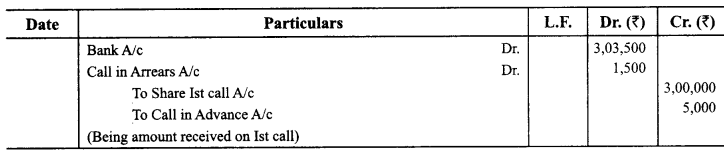
On 1.1.2016 the first call of ₹ 3 per share became due on 1,00,000 equity shares issued by Kamini Ltd. Karan a holder of 500 shares did not pay the first call money. Arjun a shareholder holding 1000 shares paid the second and final call of ₹ 5 per share along with the first call.
Pass the necessary journal entry for the amount received by opening ‘Calls-in-arrears’ and ‘Calls-in- advance’ account in the books of the company. (CBSE Outside Delhi 2016)
Answer:
Class 12 Accountancy Important Questions Chapter 6 Accounting for Share Capital 2

Question 7.
Where will you show call in arrears in the balance sheet?
Answer:
As deduction from the subscribed but not fully paid share capital.

Question 8.
Where will you show call in advance in the balance sheet?
Answer:
It is shown under other current liabilities.

Question 9.
At what rate of interest, interest on call in arrears, is charged?
Answer:
10%p.a.

Question 10.
At what rate interest on calls-in-advance is paid by the company according to Table F of Companies Act, 2013? ’ (CBSE Delhi Compt.2014)
Answer:
As per Table F, company is required to pay interest on the amount of calls in advance @ 12% p.a.

Question 11.
How would you deal in a situation where the value of purchase considerations is more than the value of net assets while acquiring a business?
Answer:
It would refer to loss.

Question 12.
How will you deal in a situation where the value of net assets is more than the value of purchase consideration while acquiring a business?
Answer:
It would refer to gain.

Question 13.
Which account will you debit while issuing the shares to the promoters of a company against their services?
Answer:
Goodwill Account or Incorporation Expenses Account.

Question 14.
When can shares held by a shareholder be forfeited?. (CBSE Delhi 2017)
Answer:
On the non-payment of call money due.

Question 15.
A Ltd forfeited a share of 100 issued at a premium of 20% for non-payment of first call of 30 per share and’ final call of 10 per share. State the minimum price at which this share can be reissued. (CBSE Sample Paper 2016)
Answer:
₹ 40 per share!

Question 16.
Give the meaning of forfeiture of share.
Answer:
Cancellation of shares.

Question 17.
At the time of forfeiture of shares, what amount is credited to share forfeiture account?
Answer:
The amount already received.

Question 18.
Where will you show the share forfeited account in the balance sheet of a company?
Answer:
As an addition in the subscribed capital.

Question 19.
What amount of share capital is debited when the shares are forfeited?
Answer:
Called up money.

Question 20.
What amount of share capital is credited when the forfeited shares are reissued?
Answer:
Paid up capital of shares at the time of reissue.

Question 21.
Y Ltd. forfeited 100 equity shares of ₹ 10 each for the non-payment of first call of ₹ 2 per share. The final call of ₹ 2 per share was yet to be made.
Calculate the maximum amount of discount at which these shares can be re-issued. (CBSE Delhi 2017)
Answer:
₹ 6 per share or ₹ 600.

Question 22.
If a question is silent on the question of excess money received with application, how would you treat it?
Answer:
In the absence of any information, excess money over the amount due on allotment shall be refunded.