Organic Chemistry: Some Basic Principles and Techniques Class 11 Important Extra Questions Chemistry Chapter 12

Here we are providing Class 11 chemistry Important Extra Questions and Answers Chapter 12 Organic Chemistry: Some Basic Principles and Techniques. Chemistry Class 11 Important Questions are the best resource for students which helps in Class 11 board exams.

Class 11 Chemistry Chapter 12 Important Extra Questions Organic Chemistry: Some Basic Principles and Techniques

Organic Chemistry: Some Basic Principles and Techniques Important Extra Questions Very Short Answer Type

Question 1.
What type, of hybridisation, is involved in
(i) planar and
Answer:
sp2

(ii) linear molecules?
Answer:
sp.

Question 2.
Arrange the following in increasing order of C – C bond strength:
C2H6, C2H4C2H2.
Answer:
C2H6 < C2H4 < C2H2.

Question 3.
Arrange the following in decreasing order of C — C bond length:
Answer:
C2H6 > C2H4 > C2H2.

Question 4.
What is the type of hybridisation of C atoms in benzene?
Answer:
It is an sp2 type of hybridisation.

Question 5.
What are isomers?
Answer:
Compounds having the same molecular formula but different physical and chemical properties are called isomers.

Question 6.
Select electrophiles out of the following:
H+ Na+, Cl, C2HSOH, AlCl3, SO3, CN, CH3CH2+,: CCl2, R-X.
Answer:
H+, Na+, A1Cl3, SO3, CH3CH2+,: CCl2, R-X.

Question 7.
Select nucleophiles from the following.
BF3 NH3 OH, R-X, C2H5OH, H3O+, NO2, CN.
Answer:
NH3, OH, C2H5OH, CN

Question 8.
Give the I.U.P.A.C. names of the following compounds
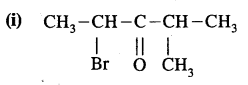
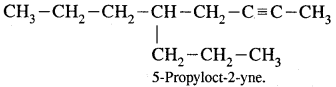
Organic Chemistry Some Basic Principles and Techniques 1
Answer:
2-Bromo-4 – methyl pent-3- one
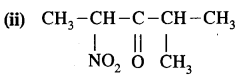
Organic Chemistry Some Basic Principles and Techniques 2
Answer:
4-Methyl-2-nitro pent – 3 – one
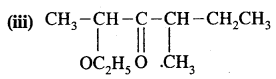
Organic Chemistry Some Basic Principles and Techniques 3
Answer:
2 – Ethoxy – 4 – methoxypent – 3 – one
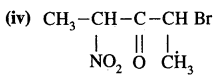
Organic Chemistry Some Basic Principles and Techniques 4
Answer:
2-Bromo-4-nitro pent-3-one

(v) (CH3)4C
Answer:
2, 2-Dimethylpropane

(vi) (CH3)2CHCOOH.
Answer:
2-Methyl propanoic acid.

Question 9.
What is a functional group?
Answer:
The atom or group of atoms present in a molecule that determines its chemical properties is called the functional group.

Question 10.
Arrange the following in increasing order of-I effect.
(i) -NO2, -COOH, -F, -CN, – I.
Answer:
-I < -F < -COOH < -CN <NO2.

Question 11.
Arrange the following in decreasing order of + I effect: CH3-, D, (CH3)3C-, (CH3)2CH-, CH3-CH22
Answer:
(CH3)3C → (CH3)2CH → CH3-CH2 → CH3 → D

Question 12.
Name the alkyl groups derived from isobutane.
Answer:
(CH3)2CH – CH2– isobutyl and (CH3)3C – tertiary butyl.

Question 13.
What type of isomerism is shown by butane and isobutane.
Answer:
Chain or nuclear isomerism.

Question 14.
Write the tautomer of acetaldehyde and its I.U.P.A.C. name.
Answer:
CH2 = CH-OH and its I.U.P.A.C. name is Eth-1-en-1-ol,

Question 15.
Give one example of functional isomerism.
Answer:
CH3– CH2– OH and CH3 – O – CH3.

Question 16.
Give one example of position isomerism.
Answer:
CH3 – CH2 – CH2OH and CH3CH(OH) CH3 .

Question 17.
Draw the structure of the tautomer of phenol and write its I.U.P.A.C name.
Answer:
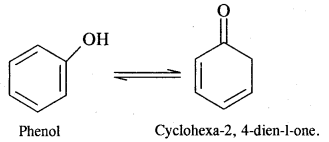
Organic Chemistry Some Basic Principles and Techniques 5

Question 18.
A compound is formed by the substitution of two chlorine atoms for two hydrogen atoms in propane. What is the number of structural isomers possible?
Answer:
Four
1. CH3CH2CHCl2
2. CH3CHClCH2Cl
3. CH3CCl2CH3
4. ClCH2 – CH2 – CH2Cl

Question 19.
Write the metamer of diethyl ether. What is its I.U.P.A.C. name?
Answer:

  1. CH3O CH3 CH2 CH3 Its I.U.P.A.C. name is 1 -Methoxypropane.
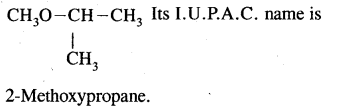
  2. Organic Chemistry Some Basic Principles and Techniques 6

Question 20.
Give the I.U.P.A.C. name of CH2 = CH-CH (CH3)2
Answer:
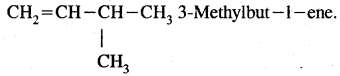
Organic Chemistry Some Basic Principles and Techniques 7

Question 21.
How many cr and it bonds are present in each of the following molecules?
(a) H-C = CCH=CH-CH3
Answer:
No. of σC-C = 4;
No. of σC-H = 6.

Total no. of σ bonds =10.
Total no. of πC=C bonds = 2 + 1=3.

(b) CH2=C=CH-CH3.
Answer:
(b) No. of σC-C = 3 bonds = 3,
No. of σC-H = 6;

Total No. of , σ-bonds = 3 + 6 = 9
No. of πC=C bonds = 2.

Question 22.
What is the shape of the following molecules
(a) H3 C = O
Answer:
HCHO formaldehyde C: sp2 hybridised; shape: Trigonal planar

(b) CH3F
Answer:
CH3F; C = sp3 hybridised shape: Tetrahedral

(c) HON.
Answer:
H-C ≡ N; C is sp hybridised, HCN is linear.

Question 23.
Write the T.U.P.A.C. name of
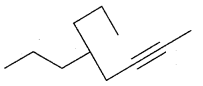
Organic Chemistry Some Basic Principles and Techniques 8
Answer:
Compound is
Organic Chemistry Some Basic Principles and Techniques 9

Question 24.
Give the condensed and bond-line structural formula for
(a) Penta-1, 4-dien
Answer:
CH2 = CH – CH2 – CH = CH2
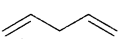
Organic Chemistry Some Basic Principles and Techniques 10

(b) Hexa-1, 3, 5 triene.
Answer:
CH2 = CH – CH = CH – CH = CH
Its bond line structure is

Organic Chemistry Some Basic Principles and Techniques 11

Question 25.
Write the I.U.P.A.C. names of HOOC-C ≡ C-COOH and
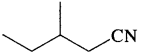
Organic Chemistry Some Basic Principles and Techniques 12
Answer:
But-2-yne – 1,4-dioic acid and 3-Methyl pentanenitrile.

Question 26.
How will you purify essential oils?
Answer:
Essential oils are volatile and are insoluble in water, Therefore, they are purified by steam distillation.

Question 27.
A liquid (1.0 g) has three components. Which technique will you employ to separate them?
Answer:
Column chromatography.

Question 28.
A reaction carried out using aniline as a reactant as well as a solvent. How will you remove unreacted aniline?
Answer:
By steam distillation.

Question 29.
How will you separate a mixture of O-nitrophenol and /Mutrophenol?
Answer:
Steam distillation O-Nitrophenol being volatile distils over along with water while p-nitrophenol being non-volatile remains in the flask.

Question 30.
How will you purify a liquid having non-volatile impurities?
Answer:
Simple distillation will give pure liquid while the non-volatile impurities in the flask as residue.

Question 31.
Suggest a method to purify
(i) Kerosene containing water
Answer:
By solvent extraction using a separating funnel.

(ii) a liquid that decomposes at its boiling point.
Answer:
Distillation under reduced pressure.

Question 32.
Suggest methods for the separation of the following mixtures:
(i) A mixture of liquid A,(B. Pt. =365 K) and liquid B (b.p.356 K)
Answer:
Fractional distillation B.Pts of two liquids differ only by just 9°.

(ii) A mixture of liquid C (b.p. 353 K) and liquid D (b.p. 413 K).
Answer:
Simple distillation, since B.Pts of two liquids, are wide apart.

Question 33.
Name two compounds that do not contain halogen but give a positive Beilstein test.
Answer:
Urea and thiourea give a positive Beilstein test due to the formation of volatile cupric cyanide.

Question 34.
Lassaigne’s test is not shown by diazonium salts. Why?
Answer:
Diazonium salts lose N2 on heating much before they have a chance to react with fused sodium metal.

Question 35.
What type of compounds are purified by sublimation?
Answer:
Substances whose vapour pressures become equal to atmospheric pressure much below their melting point.

Question 36.
How will you separate iodine from sodium chloride?
Answer:
By sublimation.

Question 37.
Name two methods that can be safely used to purify aniline.
Answer:
Vacuum distillation and steam distillation.

Question 38.
Define the term elution as applied to column chromatography.
Answer:
The process of extraction of different adsorbed compounds from the column by means of a suitable solvent is called elution.

Question 39.
Suggest a suitable technique of separating naphthalene from kerosene oil present in a mixture.
Answer:
Simple distillation.

Question 40.
What conclusion would you draw if during Lassaigne’s test a blood-red colouration is obtained?
Answer:
It shows the presence of N & S together in the compound.

Question 41.
What type of organic compounds cannot be Kjeldahlised?
Answer:
A compound containing an N atom in the ring or the presence of – NO2, (nitro) and — N =N -(azo) in them.

Question 42.
Can we estimate oxygen in the organic compound?
Answer:
No. it is estimated indirectly by subtracting the percentage of all elements present in an organic compound from 100.

Question 43.
Why do we use copper spiral in Duma’s method?
Answer:
To reduce back any oxides of nitrogen formed during combustion to nitrogen.

Question 44.
Give two examples of adsorbents used in chromatography.
Answer:

  1. Alumina gel (Al2O3) and
  2. Silica gel SiO2.

Question 45.
Is Lassaigne’s extract neutral, acidic or alkaline?
Answer:
It is alkaline.

Question 46.
The empirical formula of a compound is CH2. It’s one mole has a mass of 42 g. What is its molecular formula?
Answer:
Molecular formula = n × empirical formula
= \(\frac{42}{14}\) × CH2 = C3H6

Question 47.
In which C-C bond of CH3CH2CH2Br, the inductive effect is expected to be the least?
Answer:
The magnitude of the inductive effect diminishes as the number of intervening bonds increases. The effect is least in the C3-H bond.

Question 48.
Can you use K in place of Na for fusing an organic compound in Lassaigne’s test?
Answer:
No, because K is more reactive than Na.

Question 49.
Which solution is used to absorb CO2 produced during combustion?
Answer:
KOH solution is used to absorb CO2 gas.

Question 50.
What is the cause of geometrical isomerism in alkenes?
Answer:
Alkenes have a π-bond & the restricted rotation around the π-bond gives rise to geometrical isomerism.

Organic Chemistry: Some Basic Principles and Techniques Important Extra Questions Short Answer Type

Question 1.
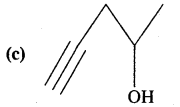
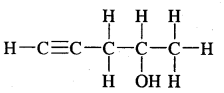
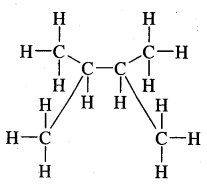
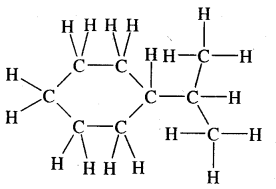
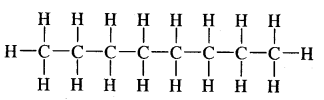
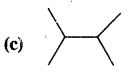
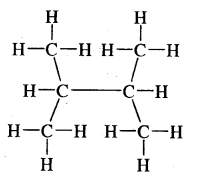
Expand each of the following bond-line formulae to show all the atoms including carbon and hydrogen.
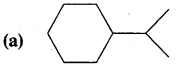
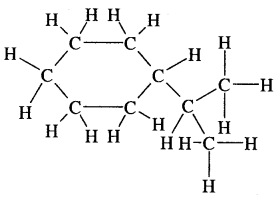
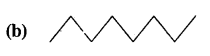
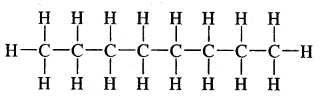
Organic Chemistry Some Basic Principles and Techniques 13
Answer:
Organic Chemistry Some Basic Principles and Techniques 14

Organic Chemistry Some Basic Principles and Techniques 15
Answer:
Organic Chemistry Some Basic Principles and Techniques 16

Organic Chemistry Some Basic Principles and Techniques 17
Answer:
Organic Chemistry Some Basic Principles and Techniques 18

Organic Chemistry Some Basic Principles and Techniques 19
Answer:
Organic Chemistry Some Basic Principles and Techniques 20

Question 2.
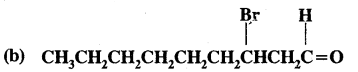
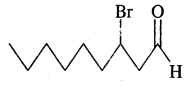
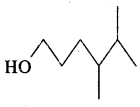
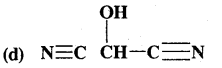
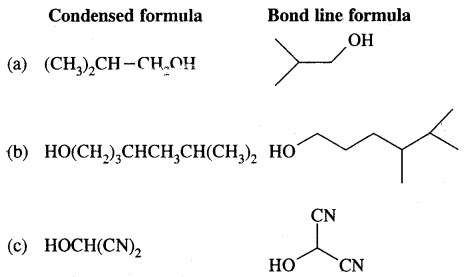
For each of the following compounds, write a more condensed and also their bond line formulae.
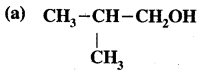
Organic Chemistry Some Basic Principles and Techniques 21
Answer:
Condensed formulae are
(CH3)2CH CH2 OH
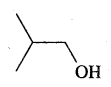
Organic Chemistry Some Basic Principles and Techniques 25

Organic Chemistry Some Basic Principles and Techniques 22
Answer:
CH3(CH2)5 CHBr CH2 CHO
Organic Chemistry Some Basic Principles and Techniques 26

Organic Chemistry Some Basic Principles and Techniques 23
Answer:
HO(CH2)3 CH(CH3) CH(CH3)2
Organic Chemistry Some Basic Principles and Techniques 27

Organic Chemistry Some Basic Principles and Techniques 24
Answer:
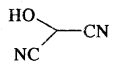
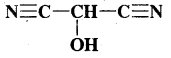
HOCH(CN)2
Organic Chemistry Some Basic Principles and Techniques 28

Question 3.
What is the type of hybridisation of each carbon in the following compounds?
(a) CH3Cl
Answer:
Organic Chemistry Some Basic Principles and Techniques 29

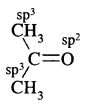
(b) (CH3)2CO
Answer:
Organic Chemistry Some Basic Principles and Techniques 30

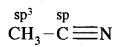
(c) CH3CN
Answer:
Organic Chemistry Some Basic Principles and Techniques 31

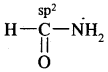
(d) HCONH2
Answer:
Organic Chemistry Some Basic Principles and Techniques 32

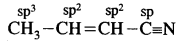
(e) CH3CH = CHCN.
Answer:
Organic Chemistry Some Basic Principles and Techniques 33

Question 4.
What is the shape of the following molecules:
(a) H2C = O
Answer:
In H2C = O; C is sp2 hybridised, hence its shape is H trigonal planar
Organic Chemistry Some Basic Principles and Techniques 34

(b) CH3F
Answer:
In CH3 -F; C is sp3 hybridized
∴ it is tetrahedral
Organic Chemistry Some Basic Principles and Techniques 35

(c) H-C ≡ N?
Answer:
In H-C ≡ N; C is sp-hybridized, hence HCN is linear
H—C ≡ N.

Question 5.
Give the I.U.P. A.C. names of the following compounds:
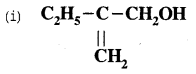
Organic Chemistry Some Basic Principles and Techniques 36
Answer:
2-Ethylprop-2-en-l-ol

(ii) CH3 – CH = CH COOH
Answer:
But-2-en-l-oic acid

(iii) (CH3)2C = CHCOCH3
Answer:
4-Methylpent-3-en-2-one
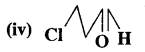
Organic Chemistry Some Basic Principles and Techniques 37
Answer:
3-Chloropropanal

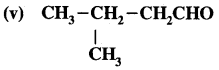
Organic Chemistry Some Basic Principles and Techniques 38
Answer:
3-Methylbutane-l-al

(vi) CH2 = CH – CN.
Answer:
Prop-2-en-1-nitrile.

Question 6.
Write the I.U.P.A.C. names of
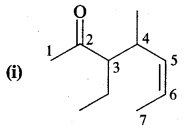
Organic Chemistry Some Basic Principles and Techniques 39
Answer:
3-Ethyl-4-methylhept-5-en-2-one
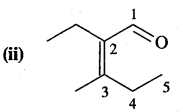
Organic Chemistry Some Basic Principles and Techniques 40
Answer:
2-Ethyl-3-methylpent-2-en-1 -one.

Question 7.
Write 1.U.P.A.C. names of
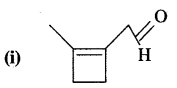
Organic Chemistry Some Basic Principles and Techniques 41
Answer:
2-[2-methylclo but-l-enyl] ethanal
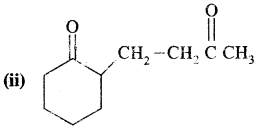
Organic Chemistry Some Basic Principles and Techniques 42
Answer:
2-(3-Oxobutyl) cyclohexane-1 one
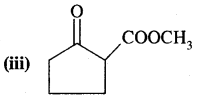
Organic Chemistry Some Basic Principles and Techniques 43
Answer:
Methyl (2-oxo cyclopentane-1-carboxylate
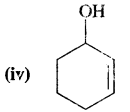
Organic Chemistry Some Basic Principles and Techniques 44
Answer:
Cyclohex-2-en-l-ol

Organic Chemistry Some Basic Principles and Techniques 45
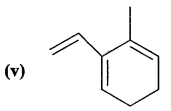
Answer:
2-Ethenyl-3-methyl-cyclohexa-l, 3-diene
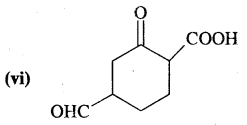
Organic Chemistry Some Basic Principles and Techniques 46
Answer:
4-Formyl-2-oxo-cyclohexane-l carboxylic acid.

Question 8.
Draw the structures of
(i) Methyl t-butyl ether
Answer:
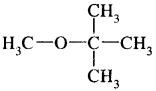
Organic Chemistry Some Basic Principles and Techniques 47

(ii) 2-Chloro-1, 1, 1-trifluoro ethane
Answer:
F3C – CH2Cl

(iii) 2-Methyl buta, 1, 3-diene
Answer:
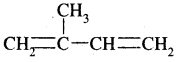
Organic Chemistry Some Basic Principles and Techniques 48

(iv) Pent-2-en-l-ol
Answer:
CH3 – CH2 – CH = CH – CH2OH

(v) Cyclo hex-2-en-l-ol
Answer:
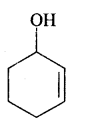
Organic Chemistry Some Basic Principles and Techniques 49

(vi) l-Bromo-3-chloro cyclohex-1-ene
Answer:
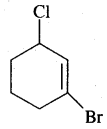
Organic Chemistry Some Basic Principles and Techniques 50

Question 9.
Write I.U.P.A.C. names of
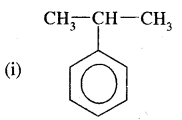
Organic Chemistry Some Basic Principles and Techniques 51
Answer:
(2-Isopropyl) benzene

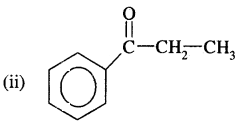
Organic Chemistry Some Basic Principles and Techniques 52
Answer:
1-Phenylpropane-l-one

Organic Chemistry Some Basic Principles and Techniques 53
Answer:
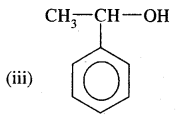
1 -Phenylethan-1 -ol

Organic Chemistry Some Basic Principles and Techniques 54
Answer:
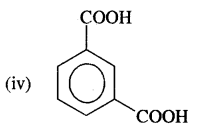
1, 3-Benzene dicarboxylic acid
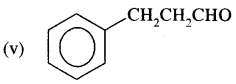
Organic Chemistry Some Basic Principles and Techniques 55
Answer:
3-Phenylpropanal

Organic Chemistry Some Basic Principles and Techniques 56
Answer:
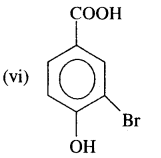
3-Boromo-4-hydroxybenzoic acid
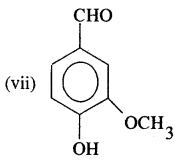
Organic Chemistry Some Basic Principles and Techniques 57
Answer:
4-Hydroxy-3-methoxy benzaldehyde.

Question 10.
Write the structure of
(i) O-Ethyl anisole
Answer:
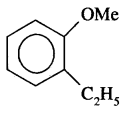
Organic Chemistry Some Basic Principles and Techniques 58

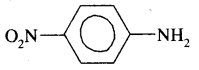
(ii) p— nitroaniline
Answer:
Organic Chemistry Some Basic Principles and Techniques 59

(iii) 4-Ethyl-I-fluoro-2-nitrobenzene.
Answer:
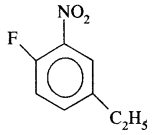
Organic Chemistry Some Basic Principles and Techniques 60

Question 11.
Which is more polar bond in the following pairs of molecules
(a) H3C-H, H3C-Br
Answer:
C —Br since Br is more electronegative than H.

(b) H3C-NH2, H3C-OH
Answer:
C—O since O is more electronegative than N.

(c) H3C-OH, H3C-SH.
Answer:
C — O since O is more electronegative than S.

Question 12.
In which C-C bond of CH3CH2CH2Br, the inductive effect is expected to be the least.
Answer:
The magnitude of the inductive effect decreases with distance from the active centre and hence this effect is least in C2—C3 bond.
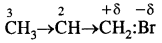
Organic Chemistry Some Basic Principles and Techniques 61

Question 13.
Write the resonance structures of
(a) CH3COO- and
Answer:
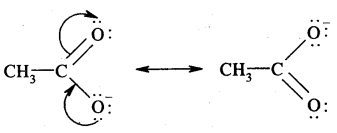
Organic Chemistry Some Basic Principles and Techniques 62

(b) CH6H5NH2. Show the movement of electrons by curved arrows.
Answer:
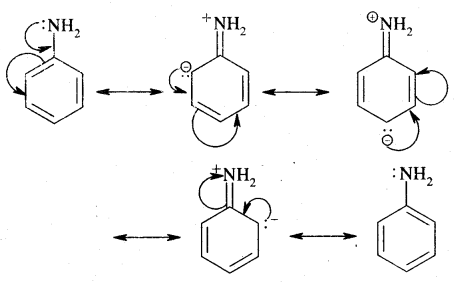
Organic Chemistry Some Basic Principles and Techniques 63

Question 14.
Which of the following pairs of structures do not constitute resonance structures?
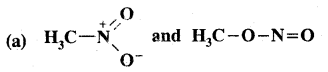
Organic Chemistry Some Basic Principles and Techniques 64
Answer:
They differ in the position of atoms and hence are not resonance structures.
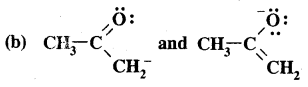
Organic Chemistry Some Basic Principles and Techniques 65
Answer:
They are a pair of resonance structures as they differ in the position of electrons.
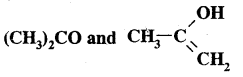
Organic Chemistry Some Basic Principles and Techniques 66
Answer:
They differ in the position of atoms and so are not resonance structures. They are tautomers.

(d) CH3CH = CHCH3 and CH3CH2CH=CH2
Answer:
They are not resonance structures as they differ in the position of atoms.

Question 15.
Write the resonance structures of CH2 = CH-CHO and arrange them in decreasing order of stability.
Answer:
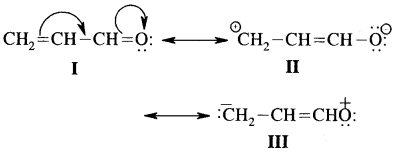
Organic Chemistry Some Basic Principles and Techniques 67
The structure I is most stable as each C & O have octets completed and there is no charge on either of them.
II & III involve charge separation hence both are less stable than I. However II is more stable than III because in II more electronegative oxygen carries a negative charge.

Thus decreasing order of stability is I > II > III.

Question 16.
Using curved arrow notation show the formation, of reactive intermediates when the following covalent bonds undergo heterolytic fission.
(a) CH3-SH3
Answer:

Organic Chemistry Some Basic Principles and Techniques 68

(b) CH3-CN
Answer:
Organic Chemistry Some Basic Principles and Techniques 69

(c) CH3-CU
Answer:
Organic Chemistry Some Basic Principles and Techniques 70

Question 17.
Giving proper justification categorise the following molecules/ ions as nucleophiles or electrophiles:
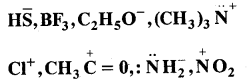
Organic Chemistry Some Basic Principles and Techniques 71
Answer:
Organic Chemistry Some Basic Principles and Techniques 72
are all nucleophiles as each one of them has one or more lone pairs of electrons to donate.

Organic Chemistry Some Basic Principles and Techniques 73
are all electrophiles. All these species have a sextet of electrons around positive centres.

Question 18.
A mixture contains two components A and B. The solubilities of A and B in the water near its boiling point are 10 grams per 100 ml and 2g per 100 ml respectively. How will you separate A and B from this mixture?
Answer:
Fractional crystallisation. When the saturated hot solution of this mixture is allowed to cool, the less soluble component B crystallises out first leaving the more soluble component B in the mother liquor.

Question 19.
A mixture containing benzoic acid and nitrobenzene is given to you. Using an appropriate chemical reagent, how will you proceed to separate them?
Answer:
The mixture is shaken with a dilute solution of NaHCO3 and extracted with-ether or chloroform when nitrobenzene goes into the organic layer; Distillation of this will yield nitrobenzene. The aqueous layer is acidified with dil. HCl and the solution are cooled.

Filteration gives benzoic acid.
C6H5COOH + NaHCO3 → C6H5COONa + CO2 + H2O.
C6H5COONa + HCl (dil.) → C6H5COOH + NaCl.

Question 20.
The Rf value of A and B in a mixture determined by TLC in a solvent mixture are 0.65 and 0.42 respectively. If the mixture separated by column chromatography using the same solvent mixture as a mobile phase, which of the two components A or B will elute first? Explain.
Answer:
Since the Rf value of A is 0.65, therefore, it is less strongly adsorbed as compared to component B with an Rf value of 0.42. Therefore an extraction in column chromatography, A will elute first.

Question 21.
Without using column chromatography, how will you separate a mixture of camphor and benzoic acid?
Answer:
Sublimation cannot be used as both camphor and benzoic acid sublime on heating. Therefore, a chemical method using NaHCO3 solution is used when benzoic acid dissolves leaving camphor behind. The filtrate is then cooled with dilute HCl to get benzoic acid.

Question 22.
0.12g of an organic compound containing phosphorus gave 0.22g of Mg2P207 by the usual analysis. Calculate the percentage of phosphorus in the compound.
Answer:
Mass the substance taken (w) = 0.12g
Wt. of Mg2P2O7 formed (x) = 0.22 g
222 g of Mg2P2O7contain phosphorus = 62 g.

% of phosphorus = \(\frac{62}{222} \times \frac{0.22}{0.12}\) × 100 = 51.20

Question 23.
Compare inductive & mesomeric effects.
Answer:

Inductive effectMesomeric effect
1. It operates in saturated gp. of compounds.1. It occurs in unsaturated & especially in conjugated compounds.
2. It involves electrons in σ – bonds.2. It involves electrons in π – bonds.
3. Electron pair is slightly displaced & there only partial charges are developed.3. The electron pair is transferred completely with the result full positive & negative charges are created.
4. It is transmitted over only a quite short distance.4. It is transmitted from one end to the other of quite large molecules provided conjugation (i.e. delocalised orbitals) is present through which it can proceed.

Question 24.
What is the difference between distillation, distillation under reduced pressure & steam distillation?
Answer:

DistillationDistillation under reduced pressureSteam distillation
This is used to separate volatile liquid from non-volatile liquid or solid separately.This is used to purify liquids that decompose at or below their boiling points.This is used for purifying substances that are steam volatile & immiscible with water.

Question 25.
How will you purify sugar which has impurities of sodium chloride?
Answer:
Sugar may be purified by the crystallization method. This can be purified by shaking the impure solid with hot ethanol at 345K. The sugar will dissolve whereas common salt remains insoluble. The hot solution is filtered, concentrated & allowed to cool when crystals of sugar will separate out. In this case, hot water has been used as a solvent. The purification of sugar would not have been possible since both sugar’& common salt are soluble in water.

Question 26.
Differentiate between Ionic & free radical reactions.
Answer:

Ionic reactionsFree radical reactions
1. These occur only rarely in the gas phase but mainly in a solution of polar solvents; the reaction is influenced by the polarity of the solvent.1. These occur in gas phases or in non-polar solvents.

Question 27.
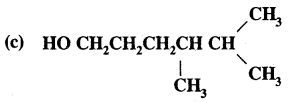
For each of the following compounds, write a more condensed formula & also their bond-line formula.
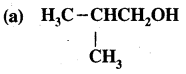
Organic Chemistry Some Basic Principles and Techniques 74
(b) HOCH2CH2CH2CHCH3CHCH3CH3
Organic Chemistry Some Basic Principles and Techniques 75
Answer:
Organic Chemistry Some Basic Principles and Techniques 76

Question 28.
Expand each of the following bond line formulae to show all the atoms including carbon & hydrogen.
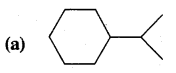
Organic Chemistry Some Basic Principles and Techniques 77
Answer:
Organic Chemistry Some Basic Principles and Techniques 78

Organic Chemistry Some Basic Principles and Techniques 79
Answer:
Organic Chemistry Some Basic Principles and Techniques 80

Organic Chemistry Some Basic Principles and Techniques 81
Answer:
Organic Chemistry Some Basic Principles and Techniques 82

Question 29.
Explain why is (CH3) C+ more stable than CH3 C+ H2 & C+ H3 is the least stable cation?
Answer:
Hyperconjugation interaction in (CH3)3 C+ is greater than in C++ H3 C+ H2 has 9 C -H bonds. In C H3, the C -H bonds are in the nodal plane of the vacant 2p-orbital & hence cannot overlap with it.
Thus C+ H3 is least stable.

Question 30.
The choice of the solvent is of great importance in crystallizing organic substances. What are the characteristics of a suitable solvent?
Answer:
A suitable solvent must have the following characteristics;

  1. The impurities & pure compound must have a large difference in their solubilities.
  2. The pure compound must have low solubility at room temperature but high solubility at its boiling point.
  3. The impurity should either be insoluble at room temperature or must have high solubility so that crystallization may give a high yield.
  4. The solvent should have an average boiling point.
  5. The solvent should neither react with the compound nor with impurities.
  6. The solvent should not be highly inflammable.

Organic Chemistry: Some Basic Principles and Techniques Important Extra Questions Long Answer Type

Question 1.
Explain the principle of steam distillation.
Answer:
Steam distillation: The process of steam distillation is employed in the purification of substance from non-volatile impurities provided the substance itself is volatile in steam and insoluble in water.

This method is based on the facts that

  1. A liquid boils at a temperature when its vapour pressure becomes equal to the atmospheric pressure.
  2. The vapour pressure of a mixture of two immiscible liquids is equal to the sum of the vapour pressures of the individual liquids.

In the actual process, steam is continuously passed through the impure organic liquid. Steam heats the liquid and it gets practically condensed to water. After some time mixture of the liquid and water begins to boil, because the vapour pressure of the mixture becomes equal to the atmospheric pressure.

Obviously, this happens at a temperature that is lower than the boiling point of the substance or that of water. Thus an organic compound boils below its boiling points and chances of decomposition avoided. For example, a mixture of aniline (b.p 453 K) with decomposition and water (b.p. 373 K) under normal atmospheric pressure boils at 371K. At this temperature the
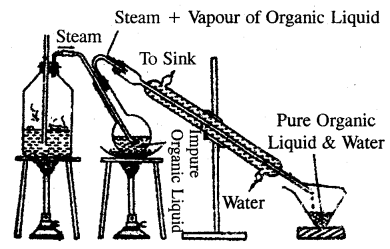
Organic Chemistry Some Basic Principles and Techniques 83
Steam Distillation

water boils at 371 K. At this temperature, the vapour pressure of water is 717 mm and that of aniline is 43 mm and therefore the total pressure is equal, to 760 mm. Thus in steam distillation, the liquid gets distilled at a temperature lower than its boiling point and chances of decomposition avoided. The proportion of water and liquid in the mixture that distils over is given by the relation.

\(\frac{w_{1}}{w_{2}}=\frac{P_{1} \times 18}{P_{2} \times M}\)
where w1 and w2 stand for the masses of water and liquid that distils over. P1 and P2 are vapour pressure of water and of liquid at the distillation temperature and M is the molecular mass of the liquid.

Question 2.
Dehydrobromination of compounds (A) and (B) yield the same alkene (c) Alkene (c) Can regenerate (A) and (B) by the addition of HBr in the presence and absence of peroxide respectively. Hydrolysis of A and B give isomeric products (D) and (E) respectively. 1, 1-Diphenyl ethane is obtained on the reaction of (C) of benzene in the presence of H+ ions. Give structures of A to E with reactions.
Answer:
Alkene (C) on reaction with benzene in the presence of H+ ions gives 1, 1-Diphenyl ethane. Therefore C must be styrene as depicted below
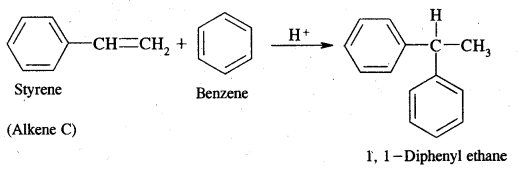
Organic Chemistry Some Basic Principles and Techniques 84
Now dehydrobromination of A and B give the same alkene C, i.e.,
styrene.
∴ A and B must be isomeric alkyl bromide.
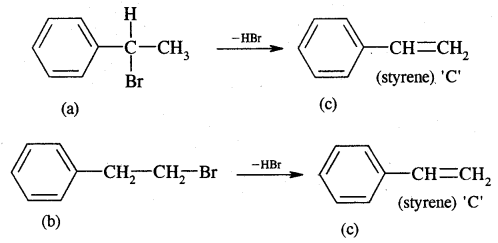
Organic Chemistry Some Basic Principles and Techniques 85
A and B can be obtained by the addition of HBr in the presence and absence of peroxide to styrene.
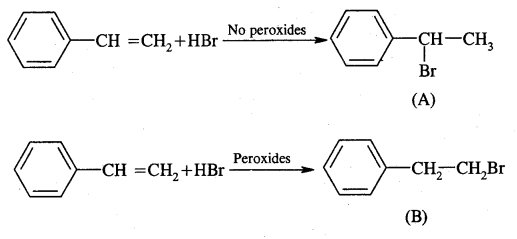
Organic Chemistry Some Basic Principles and Techniques 86
Hydrolysis of A and B give isomeric alcohols (D) & (E) as
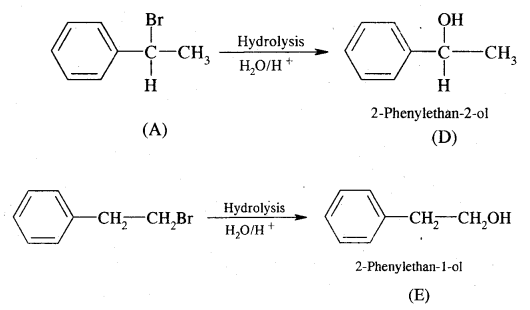
Organic Chemistry Some Basic Principles and Techniques 87

Question 3.
What are reaction intermediates? How are they generated by bond fission?
Answer:
The species which are generated as a result of bond fission are called reaction intermediates. The important reaction intermediates are:
1. Free Radicals: A free radical may be defined as an atom or group of atoms having an impaired electron. These are obtained as a result of homolytic fission of covalent bonds.

Organic Chemistry Some Basic Principles and Techniques 88
These free radicals are neutral particles, extremely transient, (short-lived) and highly reactive. They get consumed as soon as they are formed. They pair up their electron with another electron from wherever it is available. They occur only as a reaction intermediate. Their presence is felt in reactions, but cannot be isolated in a free state. For example dissociation of Cl2 gas in the presence of Ultraviolet light produces free radicals.
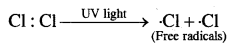
Organic Chemistry Some Basic Principles and Techniques 89
The alkyl free radicals are obtained when free radical: Cl reacts with alkanes.
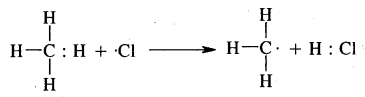
Organic Chemistry Some Basic Principles and Techniques 90
Free radical may be primary, secondary, tertiary depending upon whether, one, two or three carbon atom attached to the carbon atoms carrying the odd electron.
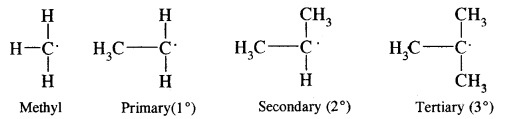
Organic Chemistry Some Basic Principles and Techniques 91
The stability is CH3 < 1° < 2° < 3°.

2. Carbocation or carbonium ion: It is defined as a group of atoms that contain positively charged carbon having only six electrons. It is obtained by heterolytic fission of a covalent bond involving a carbon atom.
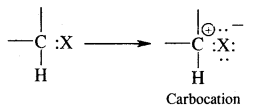
Organic Chemistry Some Basic Principles and Techniques 92
They are also classified as primary, secondary and tertiary depending upon whether one, two or three carbon atoms are attached to the carbon bearing the positive charge as:
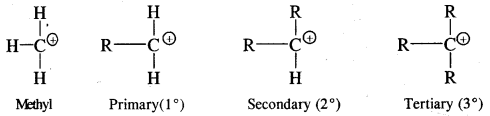
Organic Chemistry Some Basic Principles and Techniques 93
Thus the order of stability if CH3+ < 1° < 2° < 3°.

3. Carbanion: A carbanion may be defined as a species containing a carbon atom carrying a negative charge. These are generated by the atom in which the atom linked to carbon goes without the bonding electrons. As a result of this carbon acquires a negative charge. For example, the removal of hydrogen of methyl part of acetaldehyde molecule as H+ ion leaving both the electron on carbon.
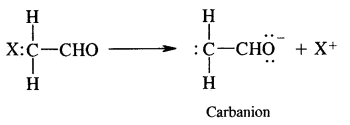
Organic Chemistry Some Basic Principles and Techniques 94
They are also very reactive species. They are also classified as primary, secondary and tertiary depending upon whether one, two or three carbon atoms are attached to the carbon atom bearing negative
charge.
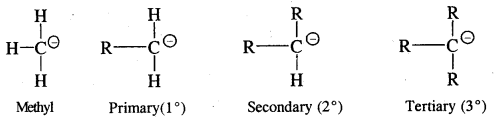
Organic Chemistry Some Basic Principles and Techniques 95
The order of stability is the reverse of free radicals and carbocations
CH3 > 1° > 2° > 3°.

(iv) Carbenes: The carbenes are reactive neutral species in which carbon atom has six electrons in the valency shell out of which two are shared. The simplest carbene is methylene (CH2). It is formed when diazomethane is decomposed by the action of light.

Organic Chemistry Some Basic Principles and Techniques 96
It is very reactive. It reacts with alkenes by adding to the double bond forming cyclopropane.
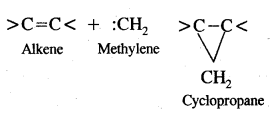
Organic Chemistry Some Basic Principles and Techniques 97


Organic Chemistry: Some Basic Principles and Techniques Important Extra Questions Numerical Problems

Question 1.
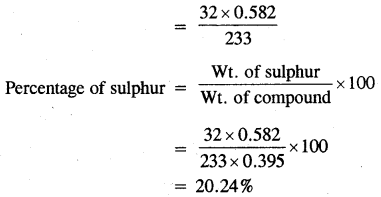
0.395 g of an organic compound by various method for the estimation of sulphur gave 0.582g of BaS04. Calculate the percentage of Sulphur.
Answer:
Mass of BaSO4 = 0.582 g
BaSO4 = S
233 = 32

233g of BaSO4 contain sulphur = 32g
0. 582 g of BaSO4 contains sulphur
Organic Chemistry Some Basic Principles and Techniques 98

Question 2.
0.15g of an organic compound gave 0.12g of AgBr by carius method. Find the percentage of bromine in the compound.
Answer:
Mass of AgBr formed = 0.12g
188 g of AgBr contains bromine = 80g.

Therefore, 0.12g of AgBr will contain bromine
= \(\frac{80 \times 0.12}{188}\) = 0.051 g

Percentage of bromine = \(\frac{0.051}{0.15}\) × 100 = 34%

Question 3.
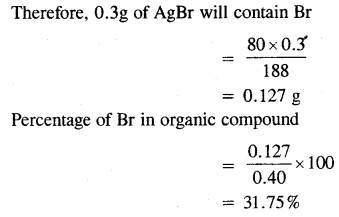
0.40 g of an organic compound gave 0.3g of AgBr by carius method. Find the percentage of bromine in the compound.
Answer:
Mass of compound = 0.40 g

Now, 188 g of AgBr contains bromine = 80g.
Organic Chemistry Some Basic Principles and Techniques 99

Question 4.
0.15 g of an organic compound gave 0.12g of silver bromide by the carius method. Find out the percentage of bromine in the compound.
Answer:
Here the mass of substance taken = 0.15g
Mass of AgBr formed = 0.12g
Now 1 mole of AgBr = 1 g. atom of Br
or
188 g = 80g of Br

188g of AgBr contains bromine = 80g.
Hence 0.12g of AgBr contain bromine
= \(\frac{80 \times 0.12}{188}\) = 0.051 g

Thus, 0.15g of compound contains 0.051g of Br
Percentage of Br = \(\frac{0.051}{0.15}\) × 100 = 34%

Question 5.
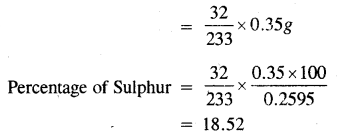
0.2595g of an organic compound when treated with carius method, gave 0.35g of BaSO4. Calculate the percentage of Sulphur in the compound.
Answer:
Here the mass of substance taken = 0.35g
Mass of BaSO4 ppt. formed = 0.35g

Now 1 mole of BaSO4 = 1 g. atom of Sulphur
233 g of BaSO4 = 32g of S
i. e. 233g of BaS04 contains 32g of Sulphur

Therefore 0.35g of BaSO4 will contain Sulphur
Organic Chemistry Some Basic Principles and Techniques 100

Question 6.
0.12g of an organic compound containing Phosphorus gave 0.22g of Mg2P2O7 by the usual analysis. Calculate the percentage of Phosphorus in the compound.
Answer:
Here the mass of organic compound taken = 0.12g
Mass of Mg2P2O7 formed = 0.22g .
Now 1 mole of Mg2P2O7 = 222 g of Mg2P2O7
= 62g of Phosphorus

i. e. 222g of Mg2P2O7 contains Phosphorus = 62g
Therefore 0.22g of Mg2P2O7 contains Phosphorus
= \(\frac{62}{222}\) × 0.22

Hence Percentage of Phosphorus = \(\frac{62}{222} \times \frac{0.22}{0.12}\) × 100 = 51.2

Question 7.
In a Dumas nitrogen estimation, 0.303g of an organic compound gave 50 cm3 of nitrogen collected at 300k & 715 m.m. of pressure. Calculate the percentage of nitrogen in the compound, (vapour pressure of water at 300K = 15 m.m.).
Answer:
Vapour pres1 re of the gas = 715 – 15 = 700 mm.
V1 = 50 cm3, V2 =?, P1 = 700 mm, P2 = 760 mm,
T1 = 300 K, T2 = 273 K
Applying \(\frac{\mathrm{P}_{1} \mathrm{~V}_{1}}{\mathrm{~T}_{1}}=\frac{\mathrm{P}_{2} \mathrm{~V}_{2}}{\mathrm{~T}_{2}}\)
or
V2 = \(\frac{P_{1} V_{1} T_{2}}{P_{2} T_{2}}\)
= \(\frac{700 \times 50 \times 273}{760 \times 300}\)
= 41.9 cm3

22400 cm3 of nitrogen at S.T.P. weighs = 28g.
41.9 cm3 of nitrogen at S.T.P. weighs
= \(\frac{28}{22400}\) × 41.9 = 0.0524 g

Percentage of nitrogen = \(\frac{0.0524}{0.3}\) × 100 = 17.46

Question 8.
In an estimation of Sulphur by various method, 0.2175g of a compound gave 0.5825g barium sulphate. Calculate the percentage of sulphur in the compound.
Answer:
Mass of the compound = 0.2175 g
Mass of barium sulphate = 0.5825 g
Molecular mass of BaS04 = 137 + 32 + 64 = 233 g

233 g of BaSO4 contains sulphur = 32g
0.5825g of BaSO4 contains Sulphur
= \(\frac{32}{233}\) × 0.5825g

Percentage of Sulphur = \(\frac{32}{233} \times \frac{0.5825}{0.2175}\) × 100
= 36.78

Question 9.
0.515 g of an organic compound containing Phosphorus give 0.214g of magnesium Pyrophosphate in various method for the estimation of Phosphorus. Calculate the percentage of Phosphorus in the given organic compound.
Answer:
Mass of organic compound = 0.515 g
Mass of magnesium Pyrophosphate = 0.214 g
Molar mass of Mg2P2O7 = 222 g

222 g of Mg2P2O7 obtained from Phosphorus = 62g
0.214g of Mg2P2O7 are obtained from Phosphorus
= \(\frac{62}{222}\) × 100 = 0.0597 g

Percentage of Phosphorus = \(\frac{0.0597}{0.515}\) × 100 = 11.6

Question 10.
In Duma’s method for estimation of Nitrogen 0.3g of an organic compound gave 50 mL of nitrogen collected at 300K temperature & 715 mm pressure. Calculate the percentage composition of nitrogen in the compound (Aqueous tension at 300K = 15 mm)
Answer:
Volume of nitrogen collected at 300K & 715 mm Pressure = 50 mL
Actual pressure = 715 – 15 = 700 mm

Volume of nitrogen at S.T.P = \(\frac{273 \times 700 \times 50}{300 \times 760}\) = 41.9 mL
22400 mL of nitrogen weighs = \(\frac{28 \times 41.9}{22400 g}\)

Percentage of nitrogen = \(\frac{28 \times 41.9 \times 100}{22400 \times 0.3}\) = 17.46

Question 11.
Ammonia produced when 0.75g of a substance was KJeldahlized, neutralized 30 cm3 of 0.25N H2SO4. Calculate the percentage of nitrogen in the compound.
Answer:
Mass of organic substance = 0.75g
Volume of H2SO4 used up = 30 cm3
Normality of sulphuric acid = 0.25 N 30 cm3

H2SO4 of normality 0.25 N = 30 mL of NH3 solution of normality 0.25N
But 1000 cm3 of ammonia solution of normality 1 contains 14 g of nitrogen

Therefore, 30 cm3 of 0.25N ammonia solution will contain nitrogen
= \(\frac{14}{1000}\) × 30 × 0.25
Percentage of nitrogen = \(\frac{14}{1000}\) × \(\frac{30 \times 0.25}{0.75}\) × 100 = 14
An Elementary School Classroom in a Slum Summary Line By Line Explanation by Stephen Spender in English

We have decided to create the most comprehensive English Summary that will help students with learning and understanding. In this article, we are Discussed the Summary Of An Elementary School Classroom In A Slum.

An Elementary School Classroom in a Slum Summary in English by Stephen Spender

An Elementary School Classroom in a Slum Poem by Stephen Spender About the Poet

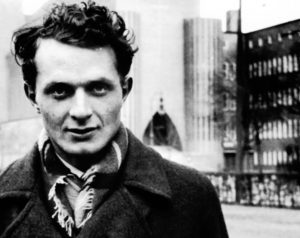
Stephen Spender (1909-1995), an English poet and essayist, was one of the pioneers of poetic movement in the 1930s.. Spender took a keen interest in the social and political problems of his times. As a social reformer and pacifist of his time, he questions the value of education and the morals and ethics of individuals.

The trials and tribulations of the post-World War, Europe finds expression in Spender’s verse and prose. Books by Spender include ‘Poem of Dedication’, ‘The Edge of Being’, ‘The Creative Element’, etc.

Poet NameStephen Spender
Born28 February 1909, Kensington
Died16 July 1995, Westminster, London, United Kingdom
SpouseNatasha Spender (m. 1941–1995), Inez Pearn (m. 1936–1939)
EducationGresham’s, University College, University College School Junior Branch, University of Oxford
NominationsLambda Literary Award for Gay Fiction
An Elementary School Classroom in a Slum Summary by Stephen Spender

An Elementary School Classroom in a Slum Introduction to the Poem

In this poem, Spender depicts the injustice which prevails in society. He talks of social injustice and class inequalities, denial of opportunities to slum dwellers, and also expresses his thoughts on the widening gap between the rich and the poor. He somewhere or the other seems to be hitting hard at the capitalist economy, which helps the rich to get richer and the poor poorer.

The Civil Rights Movement in America had gained pace and Spender’s poem supports it when he exposes the condition of the ‘haves’ and the ‘have notes’. The poem lucidly brings forth the miserable condition of the children of the slum and the inadequate educational facilities provided to them. The poem talks of racial discrimination and is a socialist proclamation that a country can prosper only if education reaches to the downtrodden in the society.

An Elementary School Classroom in a Slum Theme

  • In ‘An Elementary School Classroom in a Slum’, Spender beautifully brings out the themes of social injustice and class inequalities.
  • Poverty is also another theme of the poem. The poet creates an image of children in poverty. It is poverty that has caused the children to be weighed down, diseased and twisted. The poet believes that poverty is created through the oppressive power of capitalism.

An Elementary School Classroom in a Slum Stanza Wise Explanation Summary in English

The poem describes a primary school in a slum. Children studying in the slum classroom depict the social injustice and perpetual poverty, prevailing among the slum dwellers.

In the first stanza, Spender describes the miserable condition of the children. The faces of the children are unlike the usual children of schools. Instead of being exuberant and energetic, they are like rootless weeds, withered and worn out. They are unclean and untidy, as they are malnourished, sick and hungry. Just as weeds are not wanted in the garden, so are these children of the slum unwanted in the society. They have pale faces. Their hair is uncombed. A tall slim girl has her head bowed down as though she is exhausted physically because of malnutrition and emotionally because of poverty. The other students of the class are also in the same situation. There is a boy, who is as thin as paper, again because of malnutrition and lack of civic amenities.

He has eyes like that of a rat, searching for food and betterment. Another child in the class, who is a victim of genetic disorder, has gnarled bones and stunted growth. He has inherited this debilitating disease from his father and recites his lesson from his desk in a mellow and weak voice. In one corner of this poorly-lit and ill-equipped class, is a sweet, unnoticed young child lost in the world of his dreams. The dull and monotonous classroom does not interest him and hence, his mind deviates towards the squirrel in her tree room. He too, dreams of fun and frolic in an open space.

In the second stanza, the poet describes the dirty classroom. On the walls are displayed the names of people who have given donations. The bust of Shakespeare is displayed in the clear background of the sky. Walls have pictures of the beautiful Tylorese Valley as well as a map of the world. The children’s eyes can only view a narrow road enclosed with a dull sky. It is quite a dreary and depressing place for children.

In the third stanza, the pensive poet suddenly turns belligerent (aggressive) and feels that Shakespeare is ‘wicked’. This is because he misleads the children. He shows them a beautiful world of ships, sun and love which is not only unreal for them but has a corrupting influence on these children and instigates them to steal and try to escape from their cramped holes. Their existence is indeed very sad.

These emaciated children are so thin that it appears that they are ‘wearing’ only skins. The spectacles they are wearing have glass which has been broken and mended. Their entire appearance reeks of their deprivation. The poet shows his outrage by suggesting that the maps on their walls should show huge slums instead of beautiful scenic graphics.

Finally, in the last stanza, the poet reveals the appalling truth that there can be no change for the better unless a governor, a school inspector or an educationist or a visitor comes to the school. The map in their classroom is the only medium for the children to view the world outside their slums. The windows of their classroom shut them and confine them to their world of poverty and helplessness.

Next, poet appeals to those people who are in power to liberate these slum children from the horrendous life that they are leading. He also exhorts the people themselves, to break open these windows which appear to have sealed the fate of these children. He would like to see these children bask in the educational facilities in this world, and run carefree on the golden sands and enjoy a new lease of life and freedom. The poet earnestly desires that each and every child should be able to enjoy the fundamental right to freedom. They should have access to all kinds of books, new as well as old. They should also be able to learn from nature around them.

Spender ends the poem on a positive note as he expresses his belief that people who are ignited by the spirit of knowledge and learning are the ones who create history. It is the moral liability of everyone to break barriers between the haves and the have-nots, and give a meaningful education to all. For history remembers only those people who are educated and have enlightened themselves for a better world.

An Elementary School Classroom in a Slum Summary Reference-to-Context Questions

Read the extracts given below and answer the questions that follow.

1. Far far from gusty waves these children’s faces.
Like rootless weeds, the hair torn round their pallor:
The tall girl with her weighed-down head. The paper-
seeming boy, with rat’s eyes.

a. What are the children compared to?
Answer:
The children have pale faces and torn and scattered hair all over their faces like rootless weeds. A thin boy is compared to a paper.

b. Why do you think the tall girl is sitting with a weighed-down head?
Answer:
The tall girl is sitting with a weighed-down head because she is depressed of being poor. She also feels humiliated and embarrassed because of the lack of education.

c. Give two phrases which tell us that the children are undernourished.
Answer:
(i) rootless weeds
(ii) rat’s eyes

d. Name the poetic device used in the second line.
Answer:
Simile

2. The stunted, unlucky heir
Of twisted bones, reciting a father’s gnarled disease,
His lesson, from his desk. At back of the dim class
One unnoted, sweet and young. His eyes live in a dream,
Of squirrel’s game, in tree room, other than this.

a. Who is the ‘unlucky heir’ and what has he inherited?
Answer:
The stunted boy with twisted bones sitting in the slum classroom is the unlucky heir. He has inherited the deformity of gnarled disease.

b. What is the stunted boy reciting?
Answer:
The stunted boy has inherited the disease and despair of his parents and has become a carrier of his father’s disease and poverty. He is reciting his lesson in the class from his desk.

c. Who is sitting at the back of the dim class?
Answer:
One unnoted sweet and young dreamer, who dreams about a squirrel’s game, is sitting at the back of the dim class. He is dreaming of his future.

d. What is the ‘tree room’?
Answer:
It is the squirrel’s nest or hole from which the squirrel is moving in and out.

3. On sour cream walls, donations, Shakespeare’s head,
Cloudless at dawn, civilized dome riding all cities.
Belled, flowery, Tyrolese valley. Open-handed map
Awarding the world its world.

a. Which walls have been referred to in these lines?
Answer:
They are the walls of a classroom in an elementary school in a slum.

b. What is meant by ‘sour cream walls’?
Answer:
The walls are damp, unpleasant and dirty. They have not been painted freshly and is pealing off the surface.

c. What donations are there on the walls?
Answer:
On this wall many donated items have been put up that represent different world. A bust of Shakespeare and domes of huge buildings in the cities. There is also a reflection of the early morning cloudless sky on the wall. There is the beautiful picture of the valley of Tyrolese and the world map.

d. Explain, ‘Awarding the world its world’.
Answer
The rich people who have drawn these maps have depicted these places that are unreachable for these children. They are giving the world its world which however, does not belong to them.

4. And yet, for these
Children, these windows, not this map, their world.
Where all their future’s painted with a fog,
A narrow street sealed in with a lead sky
Far far from rivers, capes, and stars of words.

a. Who are ‘these children’? What do ‘these windows’ refer to?
Answer:
‘These children’ are the poor children living in a slum. ‘These windows’ are the windows of the classroom where the children are now sitting.

b. What has been said to be the world for these children?
Answer:
The narrow street under the dull sky has been said to be their world. Their fate is sealed by the windows in the classroom, and does not go beyond as the map suggests.

c. What has been said about their future?
Answer:
Their future is painted with fog. It means that the poor children have no bright hopes about their future. There is no one to guide them, their future is not clear and is sealed by the darkness of the sky that is above the narrow street they live in.

d. Explain the importance of the last line.
Answer:
These children have no access to the beauties of nature, they cannot see the rivers or the capes, or the stars of words. The highly literate people of the world will never be known to them.

5. Surely, Shakespeare is wicked, the map a bad example,
With ships and sun and love tempting them to steal—
For lives that slyly turn in their cramped holes
From fog to endless night? On their slag heap, these children
Wear skins peeped through by bones and spectacles of steel
With mended glass, like bottle bits on stones.

a. Why is Shakespeare described as wicked?
Answer:
Shakespeare is an epitome of high literary excellences, but in the slum schools, where hardly any learning takes place and the children are troubled by disease and despair, literary training is a far cry. That is why, Shakespeare has been described as wicked.

b. Explain: ‘from fog to endless night’.
Answer:
The expression describes the miserable and pathetic lives of the slum children. From foggy mornings till late nights, these children make desperate attempts to live their life, sustaining it despite all odds. Their life is full of misery, hopelessness and suffering.

c. What does the reference of ‘slag heap’ mean?
Answer:
The poet is comparing the extremely starved and malnourished bodies to the large pile of waste metal remains. When they sit within their classrooms, they appear to be the heaps of untidy piles of bones, or like a slag heap.

d. How do the slum children look like?
Answer:
Slum children look like skeletons wearing broken glasses as spectacles.

6. On their slag heap, these children
Wear skins peeped through by bones and spectacles of steel
With mended glass, like bottle bits on stones.
All of their time and space are foggy slum.
So blot their maps with slums as big as doom.

a. Which two images are used to describe these slums?
Answer:
The two images used to describe slums are:
(i) foggy slums
(ii) slums as big as doom

b. What sort of life do these children lead?
Answer:
These children lead miserable lives. They are physically weak.

c. Which figure of speech is used in the last line?
Answer:
In the last line, ‘Simile’ is used as the figure of speech.

d. What request does the poet make here?
Answer:
The poet wants the maps to mention clearly the slums that they live in.

7. Unless, governor, inspector, visitor,
This map becomes their window and these windows
That shut upon their lives like catacombs,
Break O break open till they break the town

a. What is meant by ‘this map’?
Answer:
It is a map of the world which is hung on the wall in the classroom.

b. What are ‘these windows’ which the poet talks of?
Answer:
They are the classroom windows from where the children could see only a narrow street and a dull sky.

c. What has been referred to as ‘catacombs’?
Answer:
The little narrow homes of the slum-dwellers are referred to as ‘catacombs’. They lead a life that is shut inside the slum.

d. Why is there a mention of three categories of people?
Answer:
The three categories of people are the ones who can improve the conditions of the slum.

8. Break O break open till they break the town
And show the children to green fields, and make their world
Run azure on gold sands, and let their tongues
Run naked into books the white and green leaves open
History theirs whose language is the sun.

a. To whom does ‘they’ refer?
Answer:
‘They’ refers to the children sitting in the classroom of an elementary school in a slum.

b. What would they break?
Answer:
The poet hopes that one day they would break free from the chains of the slum. They will rise above all deprivations and create a beautiful world for themselves.

c. What other freedom should they enjoy?
Answer:
They should enjoy equal rights as citizens and get education entitled to them. They should have a bright future like all others.

d. Explain the last line of the extract.
Answer:
The poet feels that history will be changed if the people are educated. And according to him, history is created by those who have the warmth and exposure to the sun and the brightness of the wide world.

9. The stunted, unlucky heir
Of twisted bones, reciting a father’s gnarled disease,
His lesson, from his desk. At the back of the dim class
One unnoted, sweet and young.

a. Who is the unlucky heir?
Answer:
The boy with stunted growth is the unlucky heir of his father’s gnarled disease of twisted bones.

b. What will he inherit?
Answer:
All that he will inherit is his father’s gnarled disease of twisted bones.

c. Who is sitting at the back of the dim class?
Answer:
A young unnoted, sweet boy is sitting unnoticed at the back of the dim class.

d. Why is the disease referred to as ‘gnarled’?
Answer:
The disease has been referred to as ‘gnarled’ because it has restricted his growth and gave him twisted bones.

CBSE Class 6 Sanskrit Sample Paper Set 3

We have given detailed NCERT Solutions for Class 6 Sanskrit come in handy for quickly completing your homework.

CBSE Class 6 Sanskrit Sample Paper Set 3

निर्धारित समय: 3 घंटे
पूर्णांक: 80

खण्ड: – क
अपठित-अवबोधनम्

प्रश्न 1.
अधोलिखितं अनुच्छेदम् पठित्वा प्रश्नानाम् उत्तराणि लिखत- (10)

एकस्य वृक्षस्य शाखासु अनेके काकाः वसन्ति स्म। तस्य वृक्षस्य कोटरे एक सर्पः अपि अवसत्। काकानाम् अनुपस्थितौ सर्पः काकानाम् शिशून् खादति स्म। काकाः दुःखिताः आसन्। तेषु एकः वृद्धः काकः उपायम् अचिन्तयत्। राजसेवका: वृक्षस्य समीपे जलाशयम् आगच्छति स्म। शिलायां स्थितं तस्याः आभरणम् आदाय एकः काकः वृक्षस्य उपरि अस्थापयत्। राजसेवकाः काकम् अनुसृत्य वृक्षस्य समीपम् अगच्छन्। ते तत्र सर्प अमारयन्। अतः एव उक्तम्-उपायेन सर्वं सिद्धयति।

प्रश्ना:
I. एकपदेन उत्तरत- (1 × 4 = 4)
(i) के दुःखिताः आसन्?
(ii) कः उपायं अचिन्तयत्?
(iii) वृक्षस्य कोटरे कः अवसत्?
(iv) केन सर्वं सिद्धयति?

II. पूर्णवाक्येन उत्तरत- (2 × 2 = 4)
(i) काकाः कुत्र वसन्ति स्म?
(ii) सर्पः कान् खादति स्म?

III. यथा निर्देशं लिखत- (1 × 2 = 2)

(i) ‘शिलायां’ इत्यत्र का विभक्तिः?
(क) षष्ठी
(ख) सप्तमी
(ग) प्रथमा
(घ) द्वितीया

(ii) ‘अधः’ इति पदस्य विलोमपदं किम्?
(क) उपरि
(ख) समीपम्
(ग) अपि
(घ) सर्वं

खण्डः – ख
रचनात्मकं कार्यम्

प्रश्न 2.
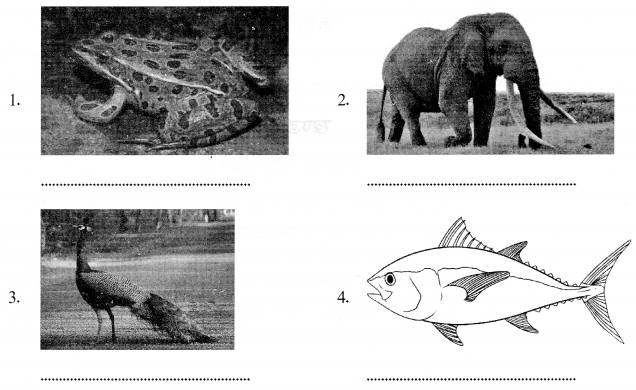
मञ्जूषातः उचितपदानि चित्वा चित्राणाम् संस्कृतेन लिखत- (1 × 4 = 4)

मञ्जूषा – उल्लूकः, कपोतः, गजः, मयूरः, मण्डूकः, मत्स्यः

CBSE Class 6 Sanskrit Sample Paper Set 3 Q2

प्रश्न 3.
अधोलिखितशब्दान् आधृत्य सार्थकवाक्यानि रचयत- (4)

1.छात्राःकन्दुकेनकर्षन्ति
2.कृषकाःपुस्तकम्पचति
3.बालौक्षेत्राणिखेलतः
4.महिलाभोजनम्पठन्ति
  1. ______________
  2. ______________
  3. ______________
  4. ______________

प्रश्न 4.
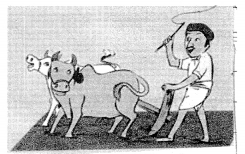
चित्रम् दृष्ट्वा प्रश्नस्य उत्तरं लिखत- (1 × 5 = 5)

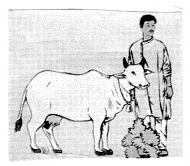
प्रश्न: 1.
नरस्य समीपे का तिष्ठति?
CBSE Class 6 Sanskrit Sample Paper Set 3 Q4

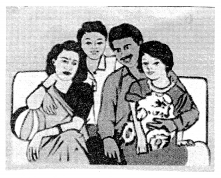
प्रश्नः 2.
जनकस्य अङ्के का अस्ति?
CBSE Class 6 Sanskrit Sample Paper Set 3 Q4.1

प्रश्न: 3.
कः हलेन कर्षति?
CBSE Class 6 Sanskrit Sample Paper Set 3 Q4.2

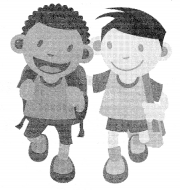
प्रश्न: 4.
एतौ कौ स्तः?
CBSE Class 6 Sanskrit Sample Paper Set 3 Q4.3

प्रश्नः 5.
एते के स्तः?
CBSE Class 6 Sanskrit Sample Paper Set 3 Q4.4

खण्ड: – ग
अनुप्रयुक्त व्याकरणम्

प्रश्न 5.
वर्णसंयोजनं कृत्वा कोष्ठके लिखत- (4)
यथा – त् + अ + इ + आ + ग् + अः = तडागः

  1. भ् + आ + र् + अ + त् + अ + स् + य् + अ = ______________
  2. व् + इ + ह् + आ + र् + अ + म् = ______________
  3. ब् + आ + ल् + उ + क् + आ = ______________
  4. स् + आ + ग् + अ + र् + आ + त् = ______________

प्रश्न 6.
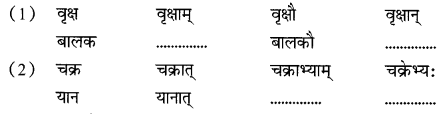
(अ) उचितशब्दरूपैः रिक्तस्थानानि पूरयत- (½ × 4 = 2)
CBSE Class 6 Sanskrit Sample Paper Set 3 Q6

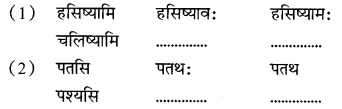
(ब) उचित धातुरूपैः रिक्तस्थानानि पूरयत- (½ × 4 = 2)
CBSE Class 6 Sanskrit Sample Paper Set 3 Q6.1

प्रश्न 7.
कोष्ठकात् उचितं पदं चित्वा वाक्यं पूरयत- (1 × 4 = 4)

  1. __________ कूजतः। (कोकिले / कोकिला)
  2. एतानि __________ सन्ति। (भवन / भवनानि)
  3. __________ लिखति। (छात्रा / छात्राः)
  4. __________ पतति। (नारिकेलं / नारिकेले)

प्रश्न 8.
मञ्जूषातः अव्ययपदानाम् प्रयोगेण रिक्तस्थानानि पूरयत- (1 × 4 = 4)

कुतः, कदा, कुत्र, कथं, किम्

  1. जगन्नाथपुरी __________ अस्ति?
  2. गङ्गानदी __________ प्रवहति?
  3. त्वं __________ गमिष्यसि?
  4. तव स्वास्थ्यं __________ अस्ति?

प्रश्न 9.
मञ्जूषातः शब्दान् चित्वा रिक्तस्थानानि पूरयत- (5)

कृत्वा, दृष्ट्वा, गृहीत्वा, तीर्खा, श्रुत्वा

  1. ते बालकाः __________ नद्यां उत्तीर्णाः।
  2. पथिकः बालकान् दुःखितान् __________ अपृच्छत्।
  3. पुस्तकानि __________ विद्यालयं गच्छ।
  4. ‘मोहनः कार्यं __________ गृहं गच्छति।
  5. ‘पथिकस्य वचनं __________ बालकाः प्रसन्नाः अभवन्।

प्रश्न 10.
कोष्ठकात् उचितं पदं चित्वा वाक्यानि पूरयत- (1 × 4 = 4)

  1. बालकाः __________ सह. पठन्ति। (मित्रैः/मित्र)
  2. नराः __________ वदन्ति। (मुखं/मुखने)
  3. फलानि __________ पतन्ति। (वृक्षात्/वृक्षस्य)
  4. __________ सैनिकाः सन्ति। (शिविरे/शिविरः)

खण्डः – घ
पठित-अवबोधनम्

प्रश्न 11.
अधोलिखितं गद्यांशं पठित्वा प्रश्नान् उत्तरत- (5)

एषः समुद्रतटः। अत्र जनाः पर्यटनाय आगच्छन्ति। केचन तरङ्गैः क्रीडन्ति। केचन च नौकाभिः जलविहारं कुर्वन्ति। तेषु केचन कन्दुकेन क्रीडन्ति। बालिकाः बालकाः च बालुकाभिः बालुकागृहं रचयन्ति। मध्ये-मध्ये तरङ्गाः बालुकागृहं प्रवाहयन्ति। एषा क्रीडा प्रचलति एव। समुद्रतटाः न केवलं पर्यटनस्थानानि। अत्र मत्स्यजीविनः अपि स्वजीविकां चालयन्ति।

प्रश्नाः
I. एकपदेन उत्तरत- (1 × 2 = 2)
(i) जनाः काभिः जलविहारं कुर्वन्ति?
(ii) समुद्रतटे जनाः किमर्थम् आगच्छन्ति?

II. पूर्णवाक्येन उत्तरत- (1 × 2 = 2)
(i) बालकाः केन क्रीडन्ति?
(ii) समुद्रतटे के स्वजीविकां चालयन्ति?

III. निर्देशानुसारं लिखत- (½ × 2 = 1)
(i) ‘तरङ्गः’ इति पदे किम् वचनम्?
(क) एकवचनम्
(ख) द्विवचनम्
(ग) बहुवचनम्

(ii) रिक्तस्थानं पूरयत-
तरङ्गाः __________ प्रवाहयन्ति।
(क) गृहम्
(ख) बालुका
(ग) बालुकागृहम्
(घ) मध्ये

प्रश्न 12.
अधोलिखितं पद्यांशं पठित्वा प्रश्नानाम् उत्तराणि लिखत- (5)

स्पृशन्ति पादैः पातालं च।
नभः शिरस्सु वहन्ति वृक्षाः।।
पयोदर्पणे स्वप्रतिबिम्बम्।
कौतुकेन पश्यन्ति वृक्षाः।।

प्रश्नाः
I. एकपदेन उत्तरत- (1 × 2 = 2)
(i) शिरस्सु नभः के वहन्ति?
(ii) वृक्षाः कैः पातालं स्पृशन्ति?

II. पूर्णवाक्येन उत्तरत- (1 × 2 = 2)
(i) वृक्षाः पयोदर्पणे कौतुकेन किम् पश्यन्ति?

III. निर्देशानुसारं उत्तरत- (½ × 2 = 1)
(i) ‘आकाशः’ इति पदस्य पर्यायः कः?
(क) पातालः
(ख) पयः
(ग) नभः
(घ) वृक्षः

(ii) ‘दर्पणे’ इति पदे का विभक्तिः?
(क) प्रथमा
(ख) तृतीया
(ग) चतुर्थी
(घ) सप्तमी

प्रश्न 13.
मञ्जूषातः उचितशब्दान् चित्वा रिक्तस्थानानि पूरयत- (4)

अगच्छन्, मानवाः, प्रियं, कृष्णः

  1. प्रियवाक्यप्रदानेन सर्वे __________ तुष्यन्ति।
  2. __________ वैनतेयः एकं पदं न गच्छति।
  3. पिकस्य वर्णः __________ भवति।
  4. __________ हि वक्तव्यं।

प्रश्न 14.
निम्नलिखितेभ्यः पदेभ्यः भिन्नप्रकृतिकं पंद चिनुत- (2)

  1. रामः, कृष्णः, सीता, बलरामः। ______________
  2. क्रीडति, धावति, मतिः, खेलति। ______________
  3. क्रूरता, मधुरता, गीता, कटुता। ______________
  4. श्वेतः, पीतः, नीलः, नीतः। ______________

प्रश्न 15.
मञ्जूषातः समानार्थकपदानि चित्वा लिखत- (4)

उचितम्, राज्ञः, मीनः, वा

  1. मत्स्यः
  2. अथवा
  3. युक्तम्
  4. नृपस्य

प्रश्न 16.
मञ्जूषातः विलोमपदानि चित्वा लिखत- (2)

ग्रीष्मे, सरसा, अक्षमम्, जागरणे

  1. क्षमम्
  2. स्वपने
  3. शीते
  4. नीरसा

प्रश्न 17.
तत्समशब्दान् लिखत- (2)

  1. चिडिया
  2. सूरज
  3. चाँद
  4. किसान

प्रश्न 18.
पद्यांशान् योजयत- (5)

(क)(ख)
1. पुस्तके पठितः पाठःजीवने यो न सार्थकः।
2. किं भवेत् तेन पाठेन।जीवने नैव साधितः
3. उद्येमन हिप्रविशन्ति मुखे मृगाः
4: सर्वः कामानवाप्नोतुसर्वो भद्राणि पश्यतु।

प्रश्न 19.
घटनाक्रमानुसारं अधोलिखितानि वाक्यानि पुनः लेखनीयानि। (½ × 6 = 3)

  1. अजीजः सफलः आसीत्।
  2. स्वामी तस्मै अवकाशस्य वेतनस्य च पूर्णं धनं ददाति।
  3. अजीजं दृष्ट्वा स्वामी चकितः भवति।
  4. सहसा एका मधुमक्षिका निर्गच्छति तस्य च हस्तं दशति।
  5. पीडितः स्वामी अत्युच्चैः चीत्करोति।
  6. एका अन्या मधुमक्षिका तस्य ललाटे दशति।

The Third Level Summary Line By Line Explanation by Jack Finney in English

We have decided to create the most comprehensive English Summary that will help students with learning and understanding.

The Third Level Summary in English by Jack Finney

The Third Level by Jack Finney About the Author

Jack Finney (2 October 1911-16 November 1995) was born in Milwaukee, Wisconsin, and given the name John Finney. His father died when he was three years old and he was renamed Walter Braden Finney in honour of his father. Yet the nickname Jack remained with him throughout his life. He attended Knox College in Galesburg, Illinois. His best-known works are science fiction and thrillers. Two of his novels, ‘The Body Snatchers’ and ‘Good Neighbor Sam’ became the basis of popular films.

Poet NameJack Finney
Born2 October 1911, Milwaukee, Wisconsin, United States
Died14 November 1995, Greenbrae, California, United States
AwardsWorld Fantasy Award—Life Achievement
MoviesInvasion of the Body Snatchers, The Invasion
The Third Level Summary by Jack Finney

The Third Level Introduction to the Chapter

The Grand Central Station of New York has two levels. But Charley, the thirty-one year old protagonist of the story, a city dweller, declares that there are three and claims to have been there as well.

The Third Level Theme

The story, ‘The Third Level’ clearly explores the science fiction genre of ‘time travel’. Jack Finney, the recipient of the World Fantasy Award, interweaves fantasy with reality in his projection of time travel. Charley, the protagonist wishes to be transported to the third level, the world of Galesburg, Illinois, 1894, which is supposed to be a much happier and quieter place to be in.

The story also dwells on the theme of escapism as a psychological refuge from the grim realities of the present day world along with a desire to stay with the past—a desire that Charley’s wife Louisa does not contest. Sam has also happily escaped, with no desire to return to his old profession.

The story exposes the vulnerable side of the common man. Surrounded by myriad problems, we humans, sometimes experience a craving for peace and serenity, and look for possible escapes. This story is about time intersection, an illusion, a kind of long dream that we do not experience during our sleep.

The Third Level Summary in English

“The Third Level”, written by Jack Finney blends fiction with reality. It is also about a man’s wish to escape from the harsh realities of present life. Charley, though he does not admit it, wants to go into the past as he is unhappy. He is unhappy with his wife. In fact, he is as unhappy as he finds the world in which he lives full of hurry, tension and war. His psychiatrist friend, Sam tells his stamp collecting also as an escape into the past.

There were only two levels at Grand Central Station. However, Charley found a third one. It was by chance. Many a times, he was lost there. He was always discovering new doorways, new corridors and new tunnels. He had begun to think that the Grand Central was always pushing out tunnels and new corridors like roots of a huge tree.

There he lost his way and found himself on the third level. This level was entirely different and olcl-fashioned. The locomotive, the brass spittoons and the naked gaslights belonged to the previous century. He desired to escape to Galesburg, the town of his dreams. However, he was nearly arrested. The money he gave to pay the fare was different from that in use those days. The booking clerk thought that he was cheating. Charley, thus, ran into the present. He never found the third level again. However, his psychiatrist friend, who did not believe that the third level existed, found it and escaped to Galesburg of 1894.

The Third Level Main Characters in the Chapter

Charley

Charley is a thirty-one year old man in a tan gabardine suit and a straw hat. One night, on his way back from work, he decides to take the subway at the Grand Central Station, which as everyone knows, has two levels. Preoccupied and in a hurry, Charley discovers an unknown exit that takes him through a long corridor, into the third level.

Here, there were fewer ticket windows, the man at the booth wore green eye-shades, the lights were open-flame gas lights, and women wore old-fashioned, fully covered dresses. The newspaper, ‘The World’, was dated June 11,1894. Charley knows that from there, the third level of the Grand Central, he could go to anywhere in the United States, 1984. He decides to buy two tickets to Galesburg, Illinois, for his wife Louisa and himself from the ticket window in the third level.

Galesburg, with its big old houses, huge lawns and tremendous trees represents an idyllic world to Charley, with the World War II still forty years into the future. However, the clerk at the window refuses the currency Charley offers. Charley leaves, deciding to return the next day, after converting all his savings into old-style currency. But Charley has never again found the third level.

When Charley tells his psychiatrist friend, Sam Weiner about this, Sam tells him that it was “a waking dream wish fulfilment” as Charley was “unhappy” in the modern world with its insecurities and fears, and just wanted to escape. Charley never again found the corridor that led to the third level at the Grand Central. Ironically, his friend Sam, the psychiatrist, disappeared, only to reach Galesburg, Illinois, in 1894.

Sam

Sam Weiner is Charley’s friend, and psychiatrist, and the next most important character in the story. He concludes that the third level is a figment of Charley’s imagination, induced by the pressures of modern living.

When Charley fails to find the third level of the Grand Central Station, his wife Louisa is worried for him and tells him to stop looking for it. But after sometime, both start looking for it because they find proof that the third level exists. Charley’s friend, Sam Weiner disappears. A first-day cover that Charley discovers in his collection, is signed by Sam and is from Galesburg, Illinois, dated July 18,1894. Charley subsequently discovers that Sam had bought eight- hundred dollars worth of old-style currency and moved to Galesburg, Illinois, in 1894. He had . set up a hay, feed and grain business as he had always said that it is what he really wished to do. Clearly, he could not go back to his old business—psychiatry—in Galesburg, Illinois, in 1894.

Louisa

Charley’s wife Louisa was initially angry with Sam’s suggestion that Charley was unhappy, ‘ when Charley tells him about his sojourn to the third level of the Grand Central Station in New York. Then Sam explains that it is not marital unhappiness, but dissatisfaction and discontent with modern day living with its insecurity, fear, war and worry. To escape from these pressures, Charley’s mind had sought refuge in the idyllic world of the third level. Louisa’s conviction in the existence of the third level is affirmed only when she sees the note sent by Sam himself, from Galesburg, Illinois, dated July 18, 1894. Since then, Louisa has been actively involved in looking for the third level, along with her husband, Charley.

The Third Level Summary Questions and Answers

Question 1.
Why did Charley meet a psychiatrist?
Answer:
Charley met a psychiatrist, since he was in a dilemma. He felt sure that he had been on the third level of the Grand Central Station, which everyone knows has only two levels. Even the Presidents of the railroads would swear on a stack of timetables that there were only two levels.

Question 2.
What was the psychiatrist’s diagnosis?
Answer:
The psychiatrist said that Charlie was unhappy. The modern world, full of insecurity, fear, war and worry oppressed him, and he just wanted to escape.

Question 3.
What proof did the psychiatrist provide?
Answer:
Charley’s psychiatrist and his friends said that his stamp-collecting was an indication of his desire to seek “a temporary refuge from reality”, as was his collection of first-day covers.

Question 4.
What was Charley’s argument when the psychiatrist told him that the stamp collection was a temporary refuge from reality?
Answer:
Charley argued that his grandfather lived in nice and peaceful times, yet he was the one . who had started the stamp collection. He did not need any “temporary refuge from reality”. He added that President Roosevelt collected stamps too.

Question 5.
How does Charley describe Galesburg, Illinois, 1894?
Answer:
Charley describes it as a wonderful town with a leisurely way of life with big old frame houses, huge lawns, tremendous trees and a peaceful and tranquil world. During summer evenings, people sat in their lawns, with men smoking cigars and women waving palm-leaf fans. The first World War was twenty years away and the second World War was forty years into the future.

Question 6.
What is a first-day cover?
Answer:
When a new stamp is issued, stamp collectors buy some and use them to mail envelopes to themselves on the very first day of sale and the postmark proves the date. The envelope is called a first-day cover. They are never opened. You just put a blank paper inside the envelope.

Question 7.
What role does the first-day cover play in the story?
Answer:
One night,while fussing with his stamp collection, Charley comes across a first-day cover that should not have been there. It had been mailed to his grandfather at his home in Galesburg in July 18, 1894. However, instead of a blank paper, it contained a letter for Charley from Sam. It urged him to come back to the third level with Louisa, and keep looking for it till he found it.

Question 8.
What was the content of the note that Sam wrote to Charley?
Answer:
Sam said that he had found the third level, that he had already been there for two weeks, that life was peaceful, calm and tranquil. He urged Charley and Louisa to go back to the third level and keep looking for it till they found it.

Question 9.
How was Charley often lost on the Grand Central Station?
Answer:
Cllarley had went to the Grand Central Station hundreds of times. However, at times, he was always lost in new doorways and corridors. Once, he entered a tunnel and came out in the lobby of a hotel. Another time, he reached in an office building.

Question 10.
How did Charley compare the Grand Central to a huge tree? Why?
Answer:
Charley always found new tunnels and staircase at the Grand Central. He began to suspect that Grand Central was like a huge tree. It used to push out new corridors and tunnels like the roots of a tree.

The Laburnum Top Poem Summary Line By Line Explanation by Ted Hughes in English

We have decided to create the most comprehensive English Summary that will help students with learning and understanding.

The Laburnum Top Poem Summary in English by Ted Hughes

The Laburnum Top Poem by Ted Hughes About the Poet

NameTed Hughes
Born17 August 1930, Mytholmroyd, United Kingdom
Died28 October 1998, North Tawton, United Kingdom
EducationPembroke College, University of Cambridge
SpouseCarol Orchard (m. 1970–1998), Sylvia Plath (m. 1956–1963)
AwardsCosta Book of the Year, Guggenheim Fellowship for Creative Arts, US & Canada, Guardian Children’s Fiction Prize
The Laburnum Top Poem Summary by Ted Hughes

The Laburnum Top Poem Summary in English

Laburnum is known as amaltas in Hindi.

On a bright September afternoon, the laburnum, a short tree with hanging branches and yellow flowers, stood soundless and motionless. A few leaves that had yellowed and some seeds lay scattered around it. Just then, all of a sudden a small singing bird with yellow feathers on its wings, the goldfinch, arrived chirping. She entered the foliage like a lizard—smooth, watchful and hasty.

As she entered, the tree suddenly seemed to come alive. It started up like a machine. There were shrill sounds of twittering arid the tree seemed to quiver with joy. The mother bird was like the engine of her family. Like an engine she added life to the tree and flitted from branch to branch, showing her striped face, with yellow and black markings that were peculiar to her. Then with a mysterious, low whistle she flew off into the sky. Once again the laburnum quietened down as it was before her arrival.

The Laburnum Top Poem Summary Questions and Answers

1. The Laburnum top is silent, quite still
In the afternoon yellow September sunlight,
A few leaves yellowing, all its seeds fallen.

a. Mention the poetic device used in the ‘The Laburnum top is silent, quite still’. Why has it been used? Alteration. The Laburnum top is silent, quite still. The repeated sound creates a musical effect.

b. Mention the colour suggested by the poet. Also mention the words that suggest colour.
The colour is yellow. The colour is suggested by the yellow September sunlight and the yellowing leaves.

c. What is the stillness disturbed by?
It is disturbed by the arrival of the goldfinch.

d. What season is the poet talking about? Mention the words that suggest the season.
Autumn. The words that suggest the season are September; leaves yellowing and all the seeds fallen.

2. Till the goldfinch comes, with a twitching chirrup
A suddenness, a startlement, at a branch end.
Then sleek as a lizard, and alert, and abrupt,
She enters the thickness, and a machine starts up
Of chitterings, and a tremor of wings, and trillings –
The whole tree trembles and thrills.

a. What changes the scene completely?
Answer:
The arrival of the goldfinch changes the scene completely.

b. What is the affect on the tree?
Answer:
There is a lot of movement and sound.

c. How does the bird enter the tree? Mention the poetic device.
Answer:
Like a lizard, watchfully and unexpectedly. Simile.

d. ‘… and a machine starts up.’ What is compared to a machine? What is the poetic device?
Answer:
The tree becomes noisy and trembles like a machine. Metaphor.

e. What is the mood of the poem now? How is it suggested?
Answer:
Happy and excited as if trembling with delight. The word that suggest it are ‘The whole tree trembles and thrills’. .

f. Mention the words that show movement?
Answer:
enters, machine starts up, tremor of wings, and trillings, trembles, thrills.

g. Mention the words that show sound. Name the poetic device,
Answer:
twitching chirrup, machine starts up; chitterings. Onomatopoeia.

h. Mention the adjectives used for the goldfinch.
Answer:
sleek, alert, and abrupt.

3. It is the engine of her family.
She stokes it full, then flirts out to a branch-end
Showing her barredface identity mask

a. Who is the‘she’in these lines?
Answer:
The goldfinch.

b. What is her arrival compared to?
Answer:
The starting of an engine.

c. What are the similarities in an engine and a tree then?
Answer:
Both are noisy and pulsating.

d. What does she do to the engine?
Answer:
She ‘stokes it full’ implying she adds fuel to it and causes it to come to life.

e. What is the ‘barred face identity mask’?
Answer:
It’s distinctive face with yellow and black markings.

f. What does she do on the tree?
Answer:
She moves about playfully from branch to branch.

4. Then with eerie delicate whistle-chirrup whisperings
She launches away, towards the infinite
And the laburnum subsides to empty.

a. What does the goldfinch finally do?
Answer:
It flies away from the laburnum after producing a whistling sound.

b. Why has the sound been described as ‘eerie delicate whistle-chirrup whisperings’?
Answer:
The sound of a goldfinch is peculiar. It is a liquid, twittering song with trills.

c. Where does she go?
Answer:
She flies into the sky.

d. What is the effect on the tree?
Answer:
It once again reverts back into silence.

e. What do the words ‘eerie delicate’ suggest?
Answer:
They suggest an unusual and weak sound.