Reproduction in Organisms Class 12 Notes Biology Chapter 1

By going through these CBSE Class 12 Biology Notes Chapter 1 Reproduction in Organisms, students can recall all the concepts quickly.

Reproduction in Organisms Notes Class 12 Biology Chapter 1

→ Reproduction is an important characteristic of the life cycle of living organisms. It involves producing offsprings from the existing (parent) organism. It occurs by asexual and sexual means.

→ Asexual reproduction generally takes place in protozoans, lower chordates, and lower invertebrates. It involves no formation and fusion of gametes. It occurs by various methods like budding, fission, fragmentation, plasmogamy, etc. Budding may be external (e.g. Hydra) or internal (e.g. Spongilla). Fission may be binary fission (e.g. Amoeba, Paramecium) or multiple fission (e.g. Amoeba, Plasmodium). Plasmotomy as in Opalina and fragmentation as in coelenterate colony and sponges.

→ Asexual reproduction is uniparental and does not produce variations in the next generation. The off-springs are identical to their parent and can be called clones.

→ Sexual reproduction takes place by the formation and fusion of gametes.
It involves various processes

  1. gametogenesis i.e. formation of sex cells called the gametes. Gametes are produced by both male (male gamete) and female (female gamete) of the same species,
  2. fertilization is the fusion of spermatozoa (male gamete) with the ovum (female gamete) to form a zygote,
  3. development is the formation of a completely new individual from the zygote by repeated mitotic divisions.

→ Sexual reproduction involves the fusion of gametes called syngamy. It may be isogamous (e.g. Monocystis) or anisogamous (e.g. human beings). If the fusing gametes are similar (isogametes) .it is isogamous and if the fusing gametes are \ dissimilar, (heterogametes or isogametes) its anisogamy. In human beings, the sperm is microscopic, motile, and flagellated while the ovum is large, non-motile, spherical, and laden with food.

→ Syngamy may be exogamy if the fusing gametes are from two parents and endogamy if the fusing gametes are from the same parent.

→ Sperms and ova are produced by meiosis from spermatogonia and oogonia found in the testes of males and ovaries of females.

→ Sexual reproduction is biparental and introduces variations in the – offsprings. Sexual reproduction involving the fusion of male and female pronuclei is called conjugation e.g. ciliates.

→ Parthenogenesis is the process of the development of an egg into an offspring without fertilization. It may be natural (e.g. Apisindica) or artificial (Echinus). ,

→ Organisms may be unisexual or dioecious (e.g. human beings) or bisexual or monoecious (e.g. earthworm).

→ In sexually reproducing organisms the reproductive system consists of three types of organs:

  1. primary sex organs, ‘viz. testes and ovaries, which produce haploid gametes by meiosis;
  2. secondary sex organs, such as prostate and seminal vesicles in males and fallopian tubes, uterus, and vagina in the female, which are ducts to convey appropriate site for fertilization to the gametes and glands to provide useful secretions;
  3. accessory sex organs, viz. facial hair, broad larynx, etc. in males and breasts in females, to distinguish between the two sexes by appearance.

→ The male reproductive system consists of a pair of testes suspended in the scrotal sac; a pair of ducts, each differentiated into an epididymis to store the sperms, a vas deferent for conduction of sperms and penis as an intermittent organ. A male urethra passing through an erectile penis, and 3 types of glands, viz., a pair of seminal vesicles, a prostate gland, and a pair of Cowper’s glands. The secretion of glands mix with sperms to form semen.

→ Testes consist of numerous coiled seminiferous tubules (crypts). Each is lined by germinal epithelium formed of germ cells and Sertoli (nurse) cells. Germ cells produce spermatozoa which obtain nutrition from the Sertoli cells. The interstitial cells (Leydig’s cells) of testes produce the male sex hormone, testosterone. Secondary sex glands of males include a prostrate, two seminal vesicles, and two Cowper’s glands. The secretion of these glands along with the sperms from the semen.

→ The female reproductive system is comprised of a pair of ovaries, two fallopian tubes (oviducts), a uterus, and a vagina. Each ovary is lined by the germinal epithelium of germ cells which form primary follicles. A primary follicle changes into Graafian follicles under the influence of FSH. Ovulation is controlled by the Luteinising hormone. Ovaries also secrete estrogens and progesterone hormones. ,

→ Fallopian tubes (oviducts) are differentiated into infundibulum, ampulla, isthmus, and uterine part. Fallopian tubes conduct the ovum towards the uterus.

→ The uterus is the site of fetal growth during pregnancy. The uterus (womb) is differentiated into the fundus, body, and cervix. The vagina acts as the birth canal. Vulva is the external genitalia. It comprises of vestibule, labiaminora, labia majora and clitoris. Breasts are accessory sex organs of females. Their size depends upon the estrogen of the ovary at puberty and lactogenic hormone after parturition.

→ Puberty is the period of sexual maturity. It is characterized by the development of secondary sexual characters. It comes between 13 to 16 years in the male and between 10 to 14 years in the female. It is controlled by testosterone in male and estrogens in the female.

→ Gametogenesis is the process of formation of haploid gametes (sperms and ova) in the primary sex organs, gonads (testes and ovaries).

→ Spermatogenesis occurs in seminiferous tubules of the testes. In it, diploid spermatogonium undergoes growth phase to form diploid primary spermatocyte which undergoes meiosis and form 4 haploid spermatids. Each spermatid transforms into sperm by a process called spermiogenesis. A mature sperm consists of a head, a neck, a middle piece, and a tail.

→ Oogenesis occurs in the ovary. A diploid oogonium undergoes a growth phase and forms a diploid primary oocyte which undergoes meiosis and forms a haploid ovum in 2 or 3 polar bodies. The human ovum is alecithal and is surrounded by many egg envelopes.

→ The menstrual cycle is cyclic changes in the ovaries and the reproductive tracts of primate females which culminate into the period vaginal bleeding called menstruation. It takes 28 days. It consists of four phases: Proliferative, ovulatory, luteal, and menstrual. The proliferative phase involves the growth and proliferation of the uterine endometrium, fallopian tubes, and vagina.

→ Ovulation occurs in the ovulatory phase. In the luteal phase, empty Graafian follicle changes into corpus luteum which secretes progesterone, further proliferation of the endometrium, and secretion of uterine milk. This is followed by menstruation if the ovum remains unfertilized. If fertilization occurs it is followed by implantation and normal growth of the fetus.

→ Menopause is the period when ovulation and the menstrual cycle stops. It generally occurs between 45 to 55 years.

→ The primate females show the menstrual cycle, the females of most of the mammals become sexually responsive during the heat period, they have an estrous cycle.

→ Asexual reproduction: Reproduction which involves no formation and fusion of gametes.

→ Binary fission: Type of asexual reproduction in which parent divides into two daughters.

→ Conjugation: Type of sexual reproduction found in ciliate protozoans. e.g. Paramecium.

→ Copulation: the sexual union of male and fèrnale. Also called coition.

→ Cytokinesis: Division of cytoplasm during cell division.

→ Epididymis: Secondary sex organs of males, which store sperms.

→ Gametogenesis: The formation of haploid gametes in the gonads.

→ Gestation period: The period of embryonic development between fertilization and delivery.

→ Hermaphrodite: Organisms with both testes and ovaries.

→ Isogamy: When two fusing gametes are morphologically and physiologically similar.

→ Karyokinesis: Division of the nucleus during the cell division.

→ Menopause: Period when ovulation and menstruation stop in the female.

→ Oogenesis: Formation of the ovum in the ovary.

→ Parthenogenesis: Development of an unfertilized ovum.

→ Reproduction: Method of producing progeny by the existing individuals for the continuation of the race.

→ Sexual reproduction: Method of reproduction that involves fusion of the gametes.

→ Spermatogenesis: Formation of haploid sperms in the testes.

→ Vitellogenesis: Formation of the yolk in the ovum.
Fermentation

Learninsta presents the core concepts of Microbiology with high-quality research papers and topical review articles.

Fermentation

In 1856 fermentation, reaction was first demonstrated by Louis Pasteur in yeast. The study of fermentation and its practical uses is named as Zymology. Any energy releasing metabolic process that takes place only under anaerobic condition is called fermentation. It can also be defined as a metabolic process that release energy from a sugar or other organic molecule.

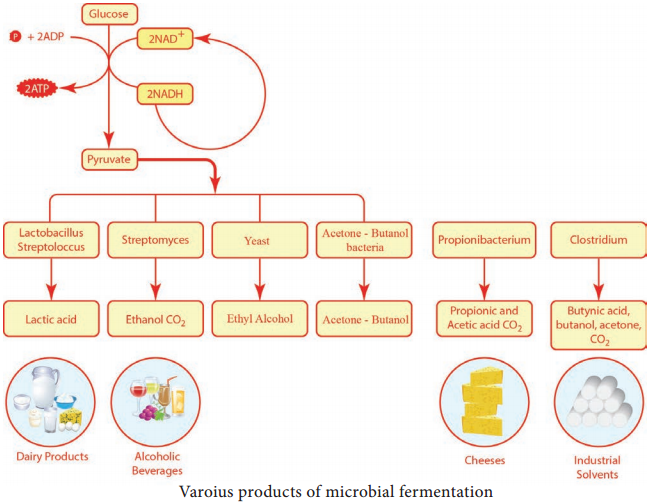
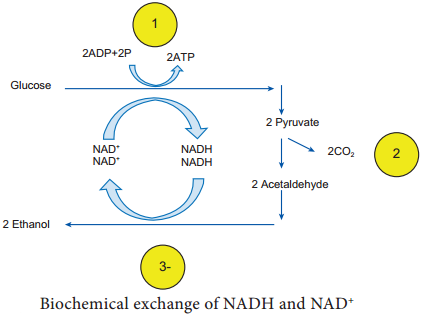
It does not require oxygen or an electron transport system, and uses an organic molecule as the final electron acceptor. Fermentation reaction yields only a small amount of energy (2 ATP). (Figure 4.9). Organic electron acceptors such as pyruvate or acetaldehyde react with NADH to form NAD+, producing CO2 and organic solvent like ethanol. Fermentation can be classified as Lactic acid fermentation and alcohol fermentation.
Fermentation img 1

Lactic acid fermentation

During Glycolysis, in the first step of lactic acid fermentation, a molecule of glucose is oxidized to 2 molecules of pyruvic acid and it generates the energy. In the next step pyruvic acid is reduced by NADH to form lactic acid. Lactobacillus and Streptococcus are some of the lactic acid producing genera (Figure 4.10).
Fermentation img 2

Anaerobes do not use an electron transport chain to oxidize NADH to NAD+ and therefore use fermentation as alternative method to maintain a supply of NAD+ for the proper function of normal metabolic pathways. Facultative anaerobes can use fermentation under anaerobic condition and carryout aerobic respiration when oxygen is present.

Fermentation reoxidizes NADH to NAD+ by converting pyruvic acid into various organic acids.

During fermentation, NADH is converted back into the coenzyme NAD+ so that it can be used again for Glycolysis.

Milk is converted into fermented products such as curd, yogurt and cheese. The fermentation of lactose in milk by these bacteria produces lactic acid which acts on milk protein to give yogurt its texture and characteristic tart flavour. Here lactase enzyme is produce by the bacteria which convert the lactose into
lactic acid.

Homolactic acid fermentation

In this type of fermentation, organism produces lactic acid alone. So it is referred to as homolactic fermentation.

Glucose + 2ADP + 2P → Lactic acid + 2 ATP

Heterolactic acid fermentation

In this type of fermentation, organism produces Lactic acid as well as other acids or alcohol. So it is known as hetero fermentation or heterolactic and often uses the pentose phosphate pathway.
Fermentation img 3

Alcohol Fermentation

Alcohol fermentation begins with the Glycolysis which yields two molecules of pyruvic acid and two molecules of ATPs. In the next step, the two molecules of pyruvic acid are converted to two molecules of acetaldehyde and two molecules of CO2.

The acetaldehydes are then reduced by NADH to form ethanol. The ethanol and CO2 produced by the yeast Saccharomyces is used in alcoholic beverages and to raise bread dough respectively.

Protein Metabolism

Learninsta presents the core concepts of Microbiology with high-quality research papers and topical review articles.

Protein Metabolism

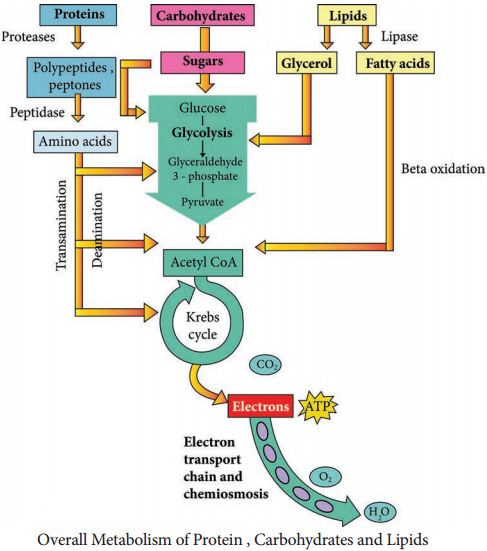
Many microbes use protein as their source of carbon and energy. Pathogenic microorganisms secrete protease enzyme that hydrolyze proteins and polypeptides to amino acids which are then transported into the cell and catabolized.

Protease (Peptidase or proteinase) helps in proteolysis (Figure 4.8). These proteolytic enzymes break the long chains of proteins into peptides and eventually into amino acids. The enzymes are classified based on the sites at which they catalyse the cleavage of proteins as exopeptidase and endopeptidase.

The protein catabolism involves two reactions namely,

  • Deamination and
  • Transamination

Deamination is the removal of the amino group from an amino acid. Transamination is the transferring of amino group from an amino acid to an amino acid acceptor.

The organic acid resulting from deamination can be converted to pyruvate, acetyl CoA or TCA cycle intermediates to release energy. Excess nitrogen from deamination may be excreted as ammonium ion.
Protein Metabolism img 1

Lipid Catabolism

Learninsta presents the core concepts of Microbiology with high-quality research papers and topical review articles.

Lipid Catabolism

Microorganisms frequently use lipids such as triglyceride or triacylglycerol (esters of glycerol and fatty acids) as common reserve energy sources. These can be hydrolyzed to glycerol and fatty acid by microbial lipases. The glycerol is then phosphorylated and oxidized to Dihydroxyacetone phosphate and then catabolized in the Glycolysis pathway.

Fatty acids from triacylglycerols and other lipids are often oxidized in the β-oxidation pathway. In this pathway fatty acids are degraded to acetyl CoA (2C segment), then it enters into the TCA cycle.

Lipid catabolism comprises two major spatially and temporarily separated steps, namely lipolysis, which releases fatty acids and head groups and is catalyzed by lipases at membranes or lipid droplets, and degradation of fatty acids to acetyl-CoA, which occurs in peroxisomes through the β-oxidation pathway in green.

The released fatty acids are catabolized in a process called β-oxidation, which sequentially removes two-carbon acetyl groups from the ends of fatty acid chains, reducing NAD+ and FAD to produce NADH and FADH2, respectively, whose electrons can be used to make ATP by oxidative phosphorylation.

Lipid metabolism begins in the intestine where ingested triglycerides are broken down into smaller chain fatty acids and subsequently into monoglyceride molecules by pancreatic lipases, enzymes that break down fats after they are emulsified by bile salts.

Lipid metabolism is the process that most of the fat ingested by the body is emulsified into small particles by bile and then the lipase secreted by the pancreas and small intestine hydrolyzes the fatty acids in the fat into free fatty acids and monoglycerides.

Electron Transport Chain

Learninsta presents the core concepts of Microbiology with high-quality research papers and topical review articles.

Electron Transport Chain

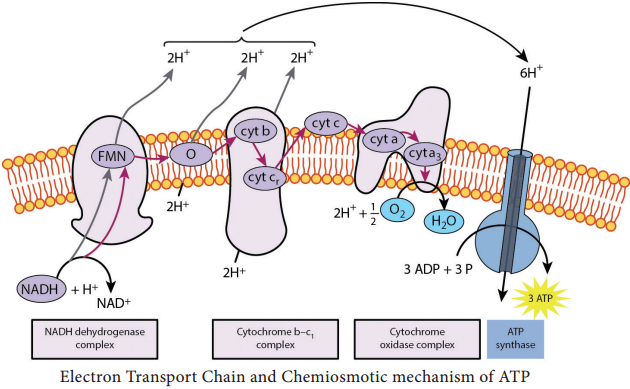
An electron transport chain consists of a sequence of carrier molecules that are capable of oxidation and reduction. In and FADH2 to acceptor such as molecular Oxygen. In the process, protons are pumped from the mitochondrial matrix to the inner membrane space, and eventually combine with O2 and H+ to form water (Figure 4.6).

As the electrons flow through the chain, much of their free energy is conserved in the form of ATP. The process by which energy from electron transport is used to make ATP is called as oxidative phosphorylation.

Respiratory chain is an electron transport chain where a pair of electrons or hydrogen atoms containing electron from the substrate oxidized is coupled to reduction of oxygen to water.

The mitochondrial system is arranged Eukaryotic cell, the ETC is contained in the inner membrane of mitochondria or chloroplast membrane, whereas in prokaryotic cells, it is found in plasma membrane or cytoplasmic membrane.

The ETC is carried out through a series of electron transporters embedded in the inner mitochondrial membrane that transfer electrons from electron donors NADH into three complexes of electron carriers.
They are:

1. Flavoproteins:
These proteins contain flavin, a coenzyme derived from riboflavin (Vit B12). One important flavoprotein is flavin mono nucleotide.

2. Ubiquinones (coenzyme Q):
These are small non protein carriers.

3. Cytochromes:
These are proteins with iron containing group, capable of existing alternately as reduced (Fe2+) and oxidized form (Fe3+). Cytochromes involved in ETC include cyt (b),cyt c1, cyt c, cyt a, cyt a3.

The first step in electron transport chain is the transfer of high energy electrons from NADH to FMN. This transfer actually involves the passage of hydrogen atom with 2e to FMN, which then picks up an additional H+ from the surrounding aqueous medium.
Electron Transport Chain img 1

As a result of the first transfer, NADH is oxidized to NAD+, and FMN is reduced to FMNH2.

In the second step, FMNH2 passes 2 H+ to the other side of the mitochondrial membrane and passes 2 e to coenzyme Q. As a result, FMNH2 is oxidized to FMN. Coenzyme Q also picks up additional 2H+ from the surrounding aqueous and releases to other side of the membrane.

In the next step, electrons are passed successively from coenzyme Q to cyt b1, cyt c1, cyt c, cyt a, cyt a3.
Each cytochrome in the chain is reduced, as it picks up electrons and is oxidized as it gives up electrons. The last cytochrome cyt a3 passes its electrons to molecular O2 which picks up protons from the surrounding medium to form H2O.

FADH2 derived from the Krebs cycle is another source of electrons. Thus at the end of ETC, NADH pumps three protons (synthesizes 3ATPs) whereas FADH2 pumps only two protons (synthesizes 2ATPs).

Chemiosmotic Mechanism of ATP

Chemiosmotic mechanism of ATP synthesis was first proposed by the Biochemist, Peter Mitchell in 1961. In ETC, when energetic electrons from NADH pass down the carriers, some of the carriers (proton pumps) in the chain pump [actively transport] protons across the membrane to inner membrane space.

Thus in addition to a concentration gradient, an electrical charge gradient is created. The resulting electro chemical gradient has potential energy called proton motive force.

The proton diffuses across the membrane through protein channels that contain an enzyme called ATP synthase. When this flow occurs, energy is released and is used by the enzyme to synthesize ATP from ADP and phosphate.

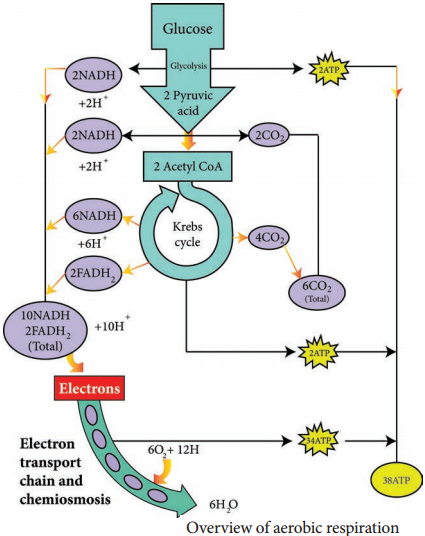
At the end of the chain, electrons join with protons and O2 in the matrix fluid to form H2O. Thus O2 is the final electron acceptor. ETC also operates in photophosphorylation and is located in thylakoid membrane of Cyanobacteria (BGA), and of eukaryotic chloroplasts. Overview of Aerobic respiration (Figure 4.7):
Electron Transport Chain img 2

1. Electron transport chain regenerates NAD and FAD which can be used again in Glycolysis and Krebs cycle.

2. Various electrons transfer in the electron transport chain generates about 34 ATP, (10 NADH = 10 × 3 = 30 + 2 FADH2 = 2 × 2 = 4).

3. A total of 38 ATP molecules is generated from one molecule of glucose oxidized in prokaryotes, whereas in eukaryotes, 36 molecules of ATP is generated because in eukaryotes, some energy is lost when electrons are shuttled across the mitochondrial membranes that separate Glycolysis (in the cytoplasm) from the electron transport chain (Table 4.2). There is no such separation exists in prokaryotes.
C6H12O6 + 6CO2 + 38ADP + 38Pi → 6CO2 + 6H2O + 38 ATP

Glycolysis

1. Oxidation of glucose to Pyruvic acid.
2. Production of 2 NADH

Preparatory step

2 ATP (substrate level phosphorylation)
6 ATP (Oxidative phosphorylation in ETC)
Preparatory step

1. Formation of acetyl CoA produces 2NADH

6 ATP (Oxidative phosphorylation in ETC)
Krebs cycle

1. Oxidation of succinyl CoA to succinic acid
2. Production of 6 NADH
3. Production of 2 FADH

2 ATP (Substrate level phosphorylation)
18 ATP (Oxidative phosphorylation in ETC)
4 ATP (Oxidative phosphorylation in ETC)
Total 38 ATP  

1 NADH = 3 ATPs and 1 FADH2 = 2 ATP