General Principles and Processes of Isolation of Elements Class 12 Notes Chemistry Chapter 6

By going through these CBSE Class 12 Chemistry Notes Chapter 6 General Principles and Processes of Isolation of Elements, students can recall all the concepts quickly.

General Principles and Processes of Isolation of Elements Notes Class 12 Chemistry Chapter 6

The extraction and isolation of an element from its combined form involves various principles of chemistry. Metallurgy is the scientific and technological process of extracting a metal from its ore. The natural materials in which the metals or their compounds occur in the earth are called minerals. The mineral from which the metal is extracted conveniently and economically is called an ore. Ores are usually contaminated with earthly or undesired materials known as Gangue.

The extraction and isolation of metals from their respective ores involve the following major steps :

  1. The concentration of the ore
  2. Isolation of the metal from its concentrated ore, and
  3. Purification of the metal.

Principle Ores of Some Important Metals:
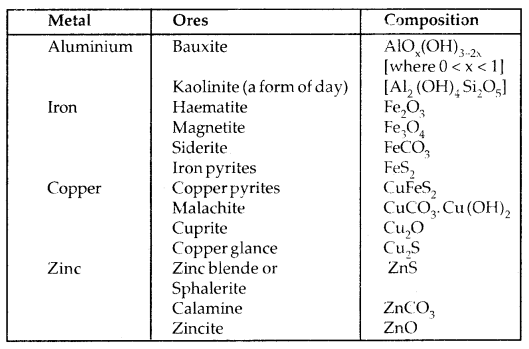
General Principles and Processes of Isolation of Elements 12 Notes Chemistry 1
Among metals, aluminium is the most abundant. For the purpose of extraction, bauxite is chosen for aluminium. For iron, usually oxide ores [Haematite Fe203] are taken. Before proceeding for concentration, ores are graded and crushed to a reasonable size.

Concentration Of Ores: Removal of the unwanted materials (e.g. sand, clays etc.) from the ore is called concentration, dressing, or benefaction. Unwanted impurities present in the ore are called gangue.

The nature of the impurities, the type of the metal and the environmental factors are taken into consideration.
(a) Hydraulic Washing: it is based on the difference in gravities of the ore and the gangue particles. It is, therefore, a type of gravity separation. When a stream of water is run through the powdered ore, the lighter gangue particles are washed away and heavier ore particles settle down.

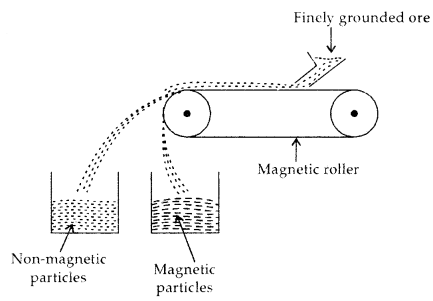
(b) Magnetic Separation: This procedure is based on the difference in the magnetic properties of the ore and impurities present in it. When passed over the conveyer belt of a magnetic roller, magnetic particles settle in a heap nearer and non-magnetic impurities a bit away, as shown below:
General Principles and Processes of Isolation of Elements 12 Notes Chemistry 2
Magnetic Separation

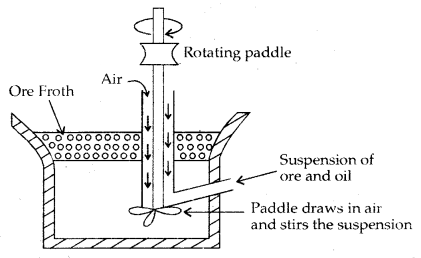
Froth Floatation Process: This process is used for removing gangue from sulphide ores only. Powdered sulphide ore is mixed with water to which Collectors (e.g. pine oil, fatty acid, xanthates etc.) enhance the non-wettability of the mineral particles and froth stabilizers (e.g. cresols, aniline) which stabilize the froth ore added. The mineral particles become wet by oils while the gangue particles by water.

A rotating paddle agitates the mixture and draws air in it. As a result, froth is formed which carries the mineral particles. The froth is light and is skimmed off from where ore particles are recovered after drying it
General Principles and Processes of Isolation of Elements 12 Notes Chemistry 3
Froth Flotation Process

Leaching: This process consists of treating the powdered ore with a suitable reagent (such as acids bases or other chemicals) which can n selectively dissolve the ore but not the impurities.

In Baeyer’s process, pure aluminium oxide is obtained from the bauxite ore (which contains impurities of Fe2Os and silicates) by treating the powdered ore with a 45% solution of NaOH when alumina dissolves leaving behind impurities like Fe203 which are filtered off.

General Principles and Processes of Isolation of Elements 12 Notes Chemistry 4
Na [Al(OH)4] or NaAlO., is neutralized by CO2 when Al(OH)3 gets precipitated.

General Principles and Processes of Isolation of Elements 12 Notes Chemistry 5
Al(OH)3, obtained above is filtered, washed and finally heated to about 1473 K to get pure alumina Al2O3

General Principles and Processes of Isolation of Elements 12 Notes Chemistry 6
Extraction of Crude Metal From Concentrated Ore: The concentrated ore must be converted into a form that is suitable for a reduction. Sulphide ore is usually converted into its oxide before reduction. Oxides are easier to reduce.

Two steps are involved
(a) Conversion of the concentrated ore into oxide ore
(b) Reduction of the metal oxide into metal

(a) Conversion To Oxide:
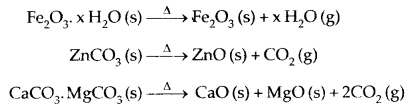
1. Calcination: It is the process of converting ore into its oxide by heating it strongly below its melting point either in the absence or limited supply of air. Volatile matter is driven off.
General Principles and Processes of Isolation of Elements 12 Notes Chemistry 7
2. Roasting: It is the process of converting ore into its metallic oxide by heating strongly at a temperature insufficient to melt in excess of air.
2 ZnS + 3O2 → 2 ZnO + 2 SO2
2 PbS + 3O2 → 2 PbO + 2SO2
2 Cu2S + 3O2 → 2 Cu2O + 2 SO2

(b) Reduction of oxide to the metal: It is done with a suitable reducing agent (C or CO or even another metal)
MxO + yC → xM + yCO

Thermodynamic Principles Of Metallurgy: The change in Gibbs energy ΔG is given by
ΔG = ΔH – TΔS …(1)
where ΔH = Enthalpy change at temperature T
ΔS = Entropy change at temperature T

Also ΔG° = -RT ln K. ……….(2)
where R = Gas constant;
K = Equilibrium constant.
The reaction will proceed if ΔG° is negative K in that case will be positive.

This happens only when the reaction proceeds towards products.
1. When the value of ΔG° is negative in equation (1) then only the reaction will proceed. If ΔS is positive, on increasing the temperature (T), the value of TΔS would increase (ΔH < TΔS) and then ΔG will become -ve.

2. If reactants and products of two reactions are put together in a system and the net ΔG of the possible reactions is – ve, the overall reaction will occur. So the process of interpretation involves the coupling of the two reactions, getting the sum of their ΔG and looking for its magnitude and sign. Such coupling is easily understood through Gibbs energy (ΔG°) vs – T plots for the formation of the oxides.

H.J. T Ellingham gave a graphical representation of Gibbs energy. It provides a sound basis for considering the choice of reducing agent in the reduction of oxides. Such a diagram helps us in predicting the feasibility of the thermal reduction of ore.

The reducing agent forms its oxide when the metal oxide is reduced. The role of the reducing agent is to provide ΔG° negative and large enough to make the sum of ΔG° of the two reactions (oxidation of the reducing agent and reduction of the metal oxide) negative.

As we know, during reduction, the oxide of a metal decomposes.
MxO (s) → xM (Solid or Liquid) + \(\frac{1}{2}\) O2(g) ……..(3)

The reducing agent takes away the oxygen.
xM (s or l) + \(\frac{1}{2}\) O2 → MxO(s) ……[ΔG°(M, MxO) ………(4)

If reduction is carried out through equa lion (3), the oxidadion of the reducing agent (e.g. C or CO) will be as:
C(s) + \(\frac{1}{2}\) Oz(g) → CO(g) …………[ΔG(C, CO)]…..(5)
CO(g) + \(\frac{1}{2}\) Oz(g) → CO2(g)……[ΔG(C, CO)]…(6)

If carbon is taken, there may be complete oxidation to CO2
\(\frac{1}{2}\) C(s)+ \(\frac{1}{2}\)O2 (g) → \(\frac{1}{2}\)CO2(g) ….[2 ΔG(C, CO)]…(7)

On subtracting equation (4), we get
MxO(s) + C(s) → xM(s or l) +CO(g) …(8)
MxO (s) + C (s) → xM (s or l) + CO2 (g) …(9)
MxO (s) + \(\frac{1}{2}\)C(s) → xM (s or l) + \(\frac{1}{2}\)CO2 (g). …..(10)

These reactions describe the actual reduction of the metal oxide MxO that is to be accomplished.
Increasing T (Heating) favours a negative value of ΔrG°. Therefore, the temperature is chosen such that the sum of ΔrG° in the two combined redox process is negative.

Applications:
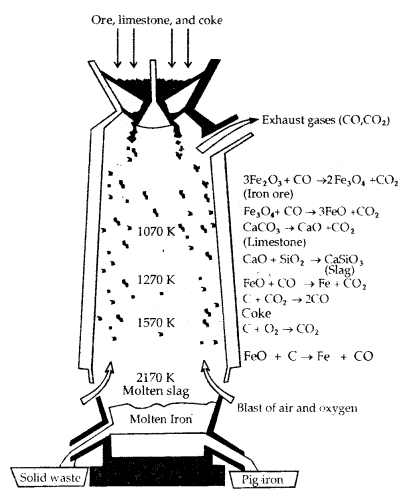
(a) Extraction of Iron from its Oxides: Concentrated oxide ores of iron are mixed with limestone and coke and fed into a Blast furnace from the top. Here coke reduces oxide to the metal as follows:
FeO(s) + C(s) → Fe(s or l) + CO(g) ……….(11)

In two steps:
1. FeO(s) → Fe(s) + \(\frac{1}{2}\)O2 (g) [ΔG(FeO, Fe)] …….(2)
2. C(s) + \(\frac{1}{2}\) O2 (g) → CO(g) [ΔG(C, CO)] ……..(3)

From (12) and (13), The ne.t Gibbs energy change becomes
ΔG(C, CO) + ΔG(FeO, Fe) = ΔrG ……….(14)

∴ The resultant reaction will take place when the r.h.s. of equation (14) becomes negative.

The reactions occurring in the Blast furnace at different temperatures are as follows:
At 500 – 800 K (lower temp, range)
3 Fe2O3 + CO → 2 Fe3O4 + CO2
Fe3O4 + 4CO → 3 Fe + 4 CO2
Fe2O3 + C0 → 2Fe + CO2

At 900 -1500 K (higher temp, in the blast furnace)
C + CO2 → 2CO
FeO + CO → Fe + CO2

Limestone is also decomposed to CaO which removes silicate impurity of the ore as slag. The slag is in a molten state and separates out from iron.
CaCO3 (s) → CaO (s) + CO2 (g)
CaO (s) + SiO2 (s) → CaSiO (fusible slag)

Iron obtained from Blast furnace contains 4% carbon and many impurities in smaller amount (e.g. S, P, Si, Mn) is called pig iron. Cast iron is different from pig iron. It has a slightly lower carbon content (3%) and is extremely hard and brittle.
General Principles and Processes of Isolation of Elements 12 Notes Chemistry 8
Blast Furnace

Further Reductions: Wrought iron or malleable iron is the purest form of commercial iron and is prepared from cast iron by oxidising

impurities in a reverberatory furnace lined with haematite. This haematite oxidises carbon to carbon monoxide :
Fe2O3 + 3 C → 2 Fe + 3CO

Limestone is added as a flux and sulphur, silicon and phosphorus are oxidised and passed into the slag. The metal is removed and freed from the slag by passing through rollers.

(b) Extraction of Copper from Cuprous Oxide [Copper (I) Oxide]: Most of the copper ores are sulphide ores, concentrated sulphide ores are roasted/smelted to give oxides.
2 Cu2S + 3 O2 → 2 Cu2O + S

The oxide can then be easily reduced to give Cu metal.
Cu20 + Ccoke → 2 Cu + CO

In the actual process, the ore is heated in a reverberatory furnace after mixing with silica.
In the furnace, iron oxide slags off’ as iron silicate and copper is produced in the form of copper matte which contains Cu2S and FeS.
FeO + SiO2 → Fe Si O3(slag)

In the silica-lined convertor, copper matte is charged. Some silica is added and a hot air blast is blown when the following reactions take place.
2 FeS + 3O2 → 2 FeO + 2SO2
FeO + SiO2 → FeSiO3
2 Cu2S + 3O2 → 2 Cu2O + 2 SO2
2 Cu2O + Cu2S → 6 Cu + SO2
The solidified copper obtained has a blistered appearance due to the evolution of SO2 and so it is called blister copper.

(C) Extraction of Zinc from Zinc Oxide: Zinc oxide is reduced using coke

General Principles and Processes of Isolation of Elements 12 Notes Chemistry 9
The metal is distilled off and collected by rapid chilling.

Electrochemical Principles Of Metallurgy: In electrolysis, metal ions in solution or molten form are reduced or by adding some reducing element. Here
ΔG° =. – n FE° ….(i)
where n = no. of electrons transferred
E° = Standard e.m.f. of the cell [redox couple]
F = Faraday = 96,500 C
ΔG° = Change in standard Gibbs energy.

More reactive metals have large negative values of the electrode potential. So their reduction is difficult. If the difference of two E° values corresponds to a positive E° and consequently negative ΔG° in the equation
1. above, then the less reactive metal will come out of the solution and more reactive metal will go into the solution.
Cu2+ (aq) + Fe (S) → Cu (S) + Fe2+ (aq)

Examples:
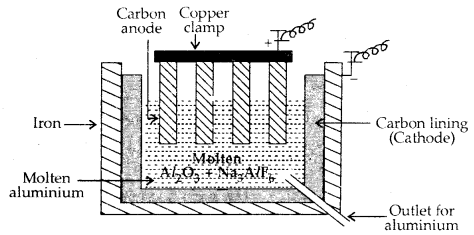
Metallurgy of Aluminium: Purified Al2O3 is mixed with Na3 AlF6 or CaF2 to, lower the melting point of the mix and to make the solution conductive. The fused matrix is electrolysed.
2 Al2O3 + 3C → 4 Al + 3 CO2

This process of electrolysis is widely known as the Hall-Fieroult process.

Steel cathode and graphite anode are used. The graphite anode is useful here for the reduction of oxide to the metal.
General Principles and Processes of Isolation of Elements 12 Notes Chemistry 10
Electrolytic cell for the extraction of aluminium

The electrolysis of the molten mass is carried out in an electrolytic cell using carbon electrodes. The oxygen liberated at the anode reacts with the carbon of the anode producing CO and CO2.This way for each kg of aluminium – produced, about 0.5 kg of carbon anode is burnt away.

The electrolytic reactions are:
Cathode: Al3+ (melt) + 3e → Al (l)
Anode: C(s) + O2- (melt) → CO(g) + 2e
C(s) + 2 O2- (melt) → CO2 (g) + 4e

Copper from low-grade ores and scraps: Copper is extracted from low grades ores by Hydrometallurgy. It is leached out using acid or bacteria. The solution containing Cu2+ (aq) is treated with iron or H2.
Cu2+ (aq) + H2 (g) → Cu (s) + 2H+(aq)

Oxidation-Reduction: Some non-metals are extracted based on oxidation. Chlorine from prime solution is oxidized to Cl2.
2 Cl (aq) + 2 H2O (l) → 2 OH (aq) + H2 (g) + Cl2 (g)

In the extraction of gold and silver, metal is leached with CN.
Ag → Ag+ + e oxidation
Au → Au+ + e oxidation

The metal is later recovered by the displacement method.
4 Au (s) + 8 CN (aq) + 2H2O (aq) + O2 → 4 [Au (CN)2] (aq) + 4 OH (aq)
2 [Au (CN)2](aq) + Zn (s) → 2 Au (s) + [Zn (CN)4]2- (aq)
In this reaction zinc acts as a reducing agent.

Refining: To obtain metal of high purity and to remove the last traces of impurities from the extracted metal, they are subjected to refining.

It is based upon the difference in properties of the metal and the impurity.
Several techniques are listed below:

  1. Distillation,
  2. Liquation,
  3. Electrolysis,
  4. Zone refining,
  5. Vapour phase refining,
  6. Chromatographic methods.

1. Distillation: This is useful for low boiling metals like Zn and Hg.

2. Liquation: A low melting metal like tin (Sn) can be made to flow on a sloping surface leaving higher melting impurities.

3. Electrolytic Refining: Impure metal is made anode. A strip of pure metal is made the cathode. The electrolyte (bath) contains soluble salt of the same metal.
Anode: M → Mn+ + e
Cathode: Mn+ + ne → M

Copper is refined by the electrolytic method. Here acidified solution of copper sulphate acts as an electrolyte.
Anode: Cu(s) → Cu2+ + 2e
Cathode: Cu2+ + 2e → Cu(s)

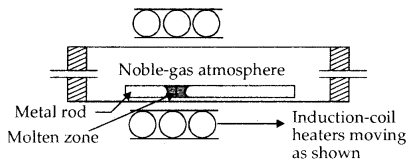
4. Zone Refining: This method is based upon the principle that the impurities are more soluble in the melt than in the solid state of the metal. The molten zone moves along with the mobile heater fixed at one end of the impure metal. As the heater moves forward the pure metal crystallises out of the metal and the impurities pass on into the adjacent molten zone. At one end, impurities get concentrated. This end is cut off.
General Principles and Processes of Isolation of Elements 12 Notes Chemistry 11
Zone-Refining Process

Vapour Phase Refining: Mond’s Process for Nickel Refining

General Principles and Processes of Isolation of Elements 12 Notes Chemistry 12
The carbonyl complex is subjected to a higher temperature so that it is decomposed to give pure metal.

General Principles and Processes of Isolation of Elements 12 Notes Chemistry 13
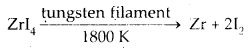
van Arkel Method for Refining Zirconium or Titanium: This method is very useful for removing all the oxygen and nitrogen present in the form of impurity in certain metals like Zr and Ti. The crude metal is heated in an evacuated vessel with iodine. The metal iodide, being more covalent, volatilises.
Zr + 2I2 → ZrI4.
General Principles and Processes of Isolation of Elements 12 Notes Chemistry 14
Chromatographic Methods: This method is based on the principle that different components of a mixture are differently adsorbed on an adsorbent.

Column Chromatography: It is very useful for the purification of the elements which are available in minute quantities and the impurities are not very different in chemical properties from the element to be purified.

There are several chromatographic techniques such as

  1. Paper chromatography
  2. Gas chromatography

Uses of Aluminium, Copper, Zinc and Iron: Alloys containing Al are light and are very useful. A1 wires conduct electricity. It is used as a reductant.

Copper is used to making wires in the electrical industry. Several alloys of copper with Zn, Sn and Ni are largely used.
Zinc is used for galvanising iron. It is used as a reducing agent. Similarly different forms of iron: Cast iron, Wrought iron, Steel find wide applications.

A Summary of the Occurrence and Extraction of Some Metals is Presented in the following Table:
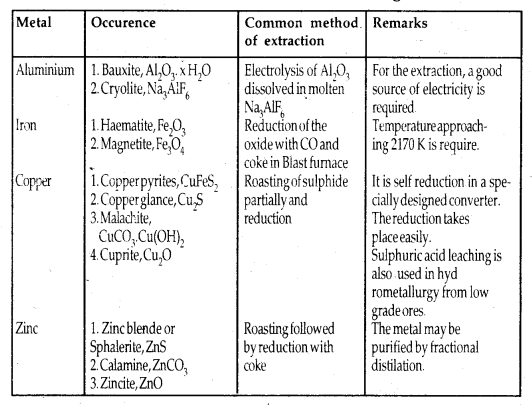
General Principles and Processes of Isolation of Elements 12 Notes Chemistry 15

Corynebacterium diphtheriae

Learninsta presents the core concepts of Microbiology with high-quality research papers and topical review articles.

Corynebacterium diphtheriae

Several species of the genus Corynebacterium are normal flora of skin, upper respiratory tract (URT), urogenital and intestinal tract. The most important member of the genus is C. diphtheriae the causative agent of diphtheria, a localized inflammation of the throat with greyish white pseudomembrane and a generalized toxemia due to the secretion and dissemination of a highly potent toxin.

The name Corynebacterium diphtheria is derived from Greek word ‘Coryne’ – “Club shaped swellings” or “Knotted rod” ‘Diphthera’ – Leather.

Morphology

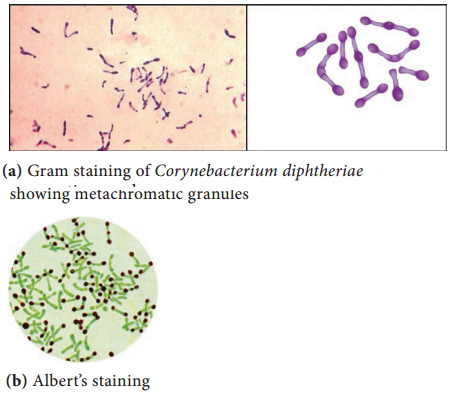
They are Gram positive slender rods, pleomorphic club shape or coryneform bacterium Non – motile, non – sporing and non – capsulated (Figure 7.9 a & b).
Corynebacterium diphtheriae img 1

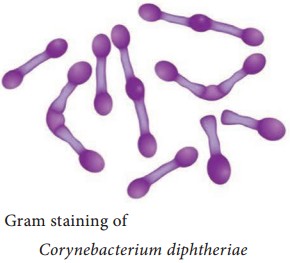
The bacilli are arranged in a characteristic fashion in angular fashion resembling the letters V or L. This has been called Chinese letter or cuneiform arrangement (Figure 7.10).

They are club shaped due to the presence of metachromatic granules at one or both ends. These granules are composed of polymetaphosphates and represent energy storage depots.
Corynebacterium diphtheriae img 2

Cultural Characteristics

  • They are aerobic and facultative anaerobe. Optimum temperature is 37°C and pH 7.2.
  • They grow on the following media and show the characteristic colony morphology (Table 7.5).

Table 7.5: Colony Morphology of Corynebacterium diphtheriae on cultural media

Media

Colony Morphology

Loeffler’s Serum slopeThey glow on this medium very rapidly. Colonies appear after 6-8 hours of incubation. The colonies are small, circular white or creamy and glistening.
Tellurite Blood AgarGrey or black colonies. Based on colony morphology on tellurite medium, three main biotypes – Gravis, Intermedius and Mitis.

Toxin

• The pathogenicity is due to production of a very powerful exotoxin by virulent strains of diphtheria bacilli.
• The toxigenicity of diphtheria bacillus depends on the presence of a tox<sup>+</sup> gene which can be transferred from one bacterium to another by lysogenic bacteriophages, of which beta phage is the most important.

Properties

The diphtheria toxin is a heat – labile protein and has a molecular weight of about 62,000 Dalton. It consists of two fragments

  • Fragment A (24,000 Dalton) – It has all enzymatic activity.
  • Fragment B (38,000 Dalton) – It is responsible for binding the toxin to the target cells.

Mode of Action

The toxin acts by inhibiting protein synthesis, specifically fragment A inhibits polypeptide chain elongation in the presence of NAD by inactivating the elongation factor (EF – 2) the toxin has special affinity for myocardium, adrenal gland and nerve endings.

Pathogenicity

Source of infection – Airborne droplets
Route of entry – Upper respiratory tract
Incubation period – 3 – 4 days

Site of infection – Faucial (nasal, otitis, conjunctival, laryngeal, genital) diphtheria is most commonly seen in children of 2-10 years.

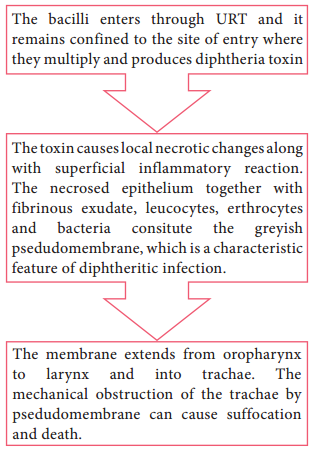
Faucial diphtheria is the most common type. The infection is confined to humans only. The toxin has both local (flowchart 7.3) as well as systemic effects.
Corynebacterium diphtheriae img 3
Flowchart 7.3: Localized effect of diphtheria toxin

Systemic effects

The toxin diffuses into the blood stream and causes toxemia. It has got affinity for cardiac muscle, adrenal and nerve endings. It acts on the cells of these tissues.

Clinical Manifestations

  1. Laryngeal obstruction, asphyxia (it is a condition of severe deficient supply of oxygen, causing suffocation).
  2. Diphtheritic myocarditis (inflammation of heart muscle), polyneuropathy (damage of multiple peripheral nerves), paralysis of palatine (the top part of the inside of the mouth) and ciliary muscles.
  3. Degenerative changes in adrenal glands, kidney and liver may occur.

Specimen:
Two swabs from the lesions are collected. One swab is used for smear preparationand other swab for inoculation on culturemedia.

Direct microscopy:
Smears are stained with both Gram stain and Albert stain.

  • Gram Staining – Gram positive slender rods were observed.
  • Albert staining – Club shaped with metachromatic granules were observed.

Culture:
The swabis inoculated on Loeffler’s serum slope, after overnight incubation at 37°C, the plates were observed for characteristic colonies, which are identified by gram staining.

Prophylaxis

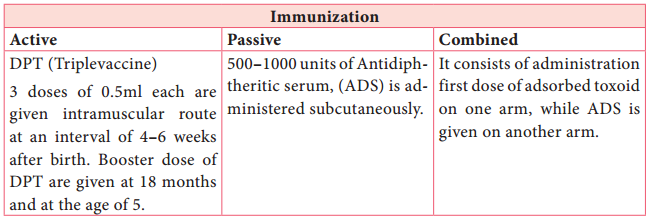
Diphtheria can be controlled by immunization. Three methods of immunization are available (Table 7.6).
Corynebacterium diphtheriae img 4
Table 7.6: Immunization for diphtheria

Treatment

The specific treatment for diphtheria consists of administration of antitoxin with dose of 20,000-100,000 units of ADS intramuscularly and antibiotic therapy using penicillin.

Neisseria meningitidis (Meningococcus)

Learninsta presents the core concepts of Microbiology with high-quality research papers and topical review articles.

Neisseria meningitidis (Meningococcus)

The genus Neisseria is included in the family Neisseriaceae (Figure 7.6). It contains two important pathogens Neisseria meningitidis and Neisseria gonorrhoeae, both the species are strict human pathogens. N. meningitides causes meningococcal meningitis (formerly known as cerebrospinal fever).

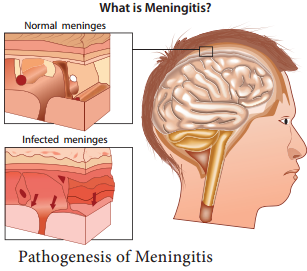
The word Meningitis is derived from Greek word ‘meninx’ means membrane and ‘it is’ means inflammation. It is an inflammation of meanings of brain or spinal cord. Bacterial meningitis is a much more severe disease than viral meningitis.

Morphology

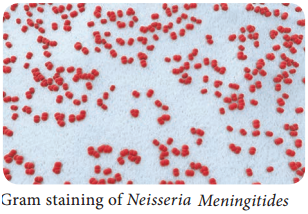
They are Gram negative diplococci (0.6µm-0.8µm in size) arranged typically in pairs, with adjacent sides flattened. They are non – motile, capsulated (Fresh isolates). Cocci are generally intracellular when isolated from lesions (Figure 7.7).
Neisseria meningitidis (Meningococcus) img 1

Cultural Characteristic

They are strict aerobes, but growth is facilitated by 5-10% CO<sub>2</sub> and high humidity. The optimum temperature is 35°C-36°C and optimum pH is 7.4-7.6. They are fastidious pathogens, growth occurs on media enriched with blood or serum. They grow on the following media and show the characteristic colony morphology (Table 7.4).
Neisseria meningitidis (Meningococcus) img 2

Table 7. 4: Colony morphology of Neisseria Meningitides on media

Name of the Media

Colony Morphology

Chocolate agarColonies are large, colorless to grey opaque colonies.
Mueller Hinton agarColonies are small, round, convex grey, translucent with entire edges. The colonies are butyrous in consistency and easily emulsified.

Pathogenesis

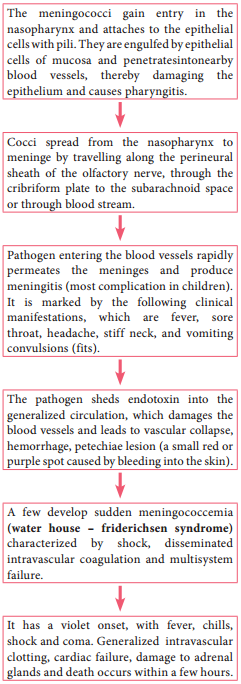
N. meningitidis is the causative agent of meningococcal meningitis, also known as pyogenic or septic meningitis. Infection is most common in children and young adults. Meningococci are strict human pathogens. Human nasopharynx is the reservoir of N.meningitidis. The pathogenesis is dicussed in the
flowchart 7.2.

Source of infection – Airborne droplets
Route of entry – Nasopharynx
Site of infection – Meninges
Incubation period – 3 days

Flowchart 7.2: Pathogenesis of Neisseria Meningitides
Neisseria meningitidis (Meningococcus) img 3

Laboratory Diagnosis

Specimens:

CSF, blood, nasopharyngeal scrapings from petechiae lesions are the specimens collected from pyogenic meningitis patients.

Direct Microscopy:

CSF is centrifuged, and smear is prepared from the deposit for gram staining. Meningococci are Gram negative diplococci, present mainly inside polymorphs and many pus cells are also seen.

Culture:

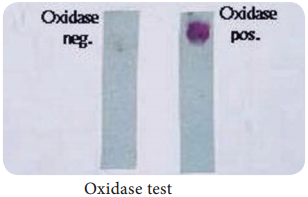
The centrifuged deposit of CSF is inoculated on chocolate agar. The plate is incubated at 36°C under 5-10% CO2 for 18-24 hours. After incubation period, meningococcusis identified by gram staining, colony morphology and biochemical reactions. N. meningitides is catalase and oxidase positive (Figure 7.8).
Neisseria meningitidis (Meningococcus) img 4

Treatment and Prophylaxis

Penicillin – G is the drug of choice. In penicillin allergic cases, chloramphenicol is recommended.

  • Monovalent and polyvalent vaccines (capsular polysaccharide) induce good immunity in older children and adults.
  • Conjugate vaccines are used for children below the age of 2 years.

Streptococcus pyogenes (Flesh eating Bacteria)

Learninsta presents the core concepts of Microbiology with high-quality research papers and topical review articles.

Streptococcus pyogenes (Flesh eating Bacteria)

The genus Streptococcus includes a large and varied group of bacteria. They inhabit various sites, notably the upper respiratory tract. However, some species of which Streptococcus pyogenes is the most important and are highly pathogenic. The name Streptococcus is derived from Greek word ‘Streptos’ which means twisted or coiled.

Morphology

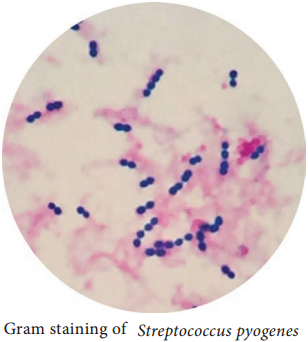
  • They are Gram positive, spherical or oval cocci and arranged in chains (0.6µm-1µm)
  • They are non – motile, non – sporing. Some strains are capsulated (Figure 7.4).

Streptococcus pyogenes (Flesh eating Bacteria) img 1

Cultural Characteristics

  • They are aerobe and facultative anaerobe. Optimum temperature is 37°C and pH is 7.4 to 7.6
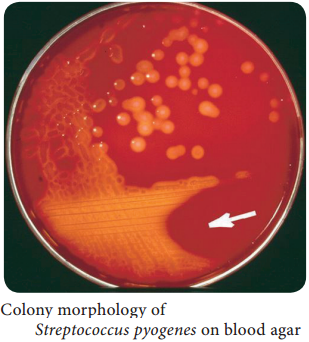
  • They grow only in media enriched with blood or serum. It is cultivated on blood agar. On blood agar, the colonies are small, circular, semitransparent, low convex, with an area of clear hemolysis around colonies (Figure 7.5).
  • Crystal violet blood agar – a selective medium for Streptococcus pyogenes.

Streptococcus pyogenes (Flesh eating Bacteria) img 2

Antigenic Structure

Capsule:

It inhibits phagocytosis

Cell wall:

The outer layer of cell wall consists of protein and lipoteichoic acid which helps in attachment to the host cell. Middle layer of cell wall consists of Group Specific C – Carbohydrate that is used for Lancefield grouping. Inner layer of cell wall is made up of peptidoglycan which has pyrogenic and thrombolytic activity.

Toxins and Enzymes:

Streptococcus pyogenes produces several exotoxins and enzymes which contribute to its virulence.

Toxins and Hemolysins:

Streptococci produces two types of hemolysins which are Streptolysin O and Streptolysin S.

Erythrogenic toxin: (Pyrogenic exotoxin)

The induction of fever is the primary effect of this toxin and it is responsible for the rash of scarlet fever.

Enzymes:

The various enzyme of Streptococcus pyogenes which exhibits virulence activity are listed in Table 7.3.

Enzymes of Streptococcus pyogens and its virulence nature

Enzymes

Virulence nature

Streptokinase (fibrinolysin)It promotes the lysis of human fibrin clot by catalyzing the conversion of plasminogen into plasmin. It facilitates the spread of infection by breaking down the fibrin barrier around the lesions.
DeoxyribonucleasesIt liquefy the highly viscous DNA that accumulate in thick pusand responsible for thin serous character of streptococcal exudates
HyaluronidaseIt breaks down hyaluronic acid of the tissues and favours spread of streptococcal lesion along intercellular spaces.
Other enzymesNADase, lipase, amylase, esterase, phosphates and other enzymes.

Pathogenesis

Streptococcus pyogenes is intrinsically a much more dangerous pathogen than Staphylococcus aureus and has a much greater tendency to spread in the tissues.

Mode of transmission:

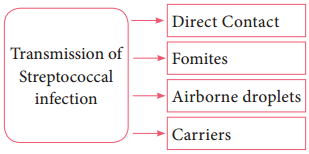
Streptococcal infections are transmitted by the following ways:
Streptococcus pyogenes (Flesh eating Bacteria) img 3

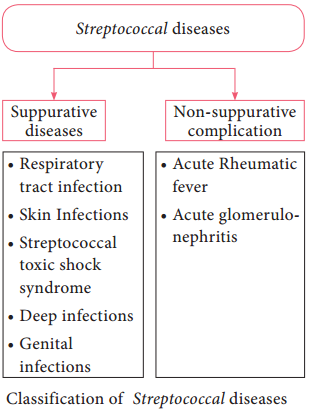
Streptococcal diseases may be broadly classified, and it is shown in flowchart 7.1
Streptococcus pyogenes (Flesh eating Bacteria) img 4

Suppurative Infections

1. Respiratory tract infection

a. Streptococcal sore throat:

Sore throat (acute tonsillitis and pharyngitis) is the most common streptococcal diseases. Tonsillitis is more common in older children and adults. The pathogen may spread from throat to the surrounding tissues leading to suppurative (pus – formation) complication such as cervical adenitis (inflammation of a lymph node in the neck) otitis media (inflammation of middle ear), quinsy (ulcers of tonsils) Ludwig’s angina (purulent inflammation around the sub maxillary glands) mastoiditis (inflammation of mastoid process).

b. Scarlet fever:

The disease consists of combination of sore throat and a generalized erythematous (redness of skin or mucous membranes) rash.

2. Skin infections

a. Erysipeals:

It is an acute spreading lesion. The skin shows massive brawny oedema with erythema it is seen in elderly persons or elders.

b. Impetigo: (Streptococcal pyoderma)

It is a skin infection that occurs most often in young children. It consists of superficial blisters that break down and eroded areas whose surface is covered with pus. It is the main cause leading to acute glomerulonephritis in children.

c. Necrotizing fasciitis:

It is an invasive, infection characterized by inflammation and necrosis of the skin, subcutaneous fat and fascia. It is a life-threatening infection.

3. Streptococcal toxic shock syndrome

Streptococcal pyrogenic exotoxin leads to streptococcal toxic shock syndrome (TSS). It is a condition in which the entire organ system collapses, leading to death.

4. Genital infections

Streptococcus pyogenes is an important cause of puerperal sepsis or child bed fever (infection occur when bacteria infect the uterus following child birth)

5. Deep infection

Streptococcus pyogenes may cause pyaemia (blood poisoning characterized by pus forming pathogens in the blood) septicemia (A condition in which bacteria circulate and actively multiply in the bloodstream) abscess in internal organs such as brain, lung, liver and kidney.

Non – Suppurative Complication

Streptococcus pyogenes infections are sometimes followed by two important non – suppurative complications which are, acute rheumatic fever and acute glomerulonephritis. These complications occur 1-4 weeks after the acute infection and it is believed to be the result of hypersensitivity to some streptococcal
components.

1. Rheumatic fever

It is often preceded by sore throat and most serious complication of haemolytic streptococcal infection. The mechanism by which Streptococci produce rheumatic fever is still not clear. A common cross – reacting antigen exist in some group A streptococci and heart, therefore, antibodies produced in response to the streptococcal infection could cross react with myocardial and heart valve tissue, causing cellular destruction.

2. Acute glomerulonephritis

It is often preceded by the skin infection. It is caused by only a few “nephritogenic types (strains)”. It develops because some components of glomerular basement membrane are antigenically similar to the cell membranes of nephritogenic streptococci.

The antibodies Formed against Streptococci cross react with glomerular basement membrane and damage. Some patients develop chronic glomerulonephritis with ultimate kidney failure.

Laboratory Diagnosis

Specimens:

Clinical specimens are collected according to the site of lesion. Throat swab, pus or blood is obtained for culture and serum for serology.

Direct Microscopy:

Gram stained smears of clinical specimens is done, where Gram positive cocci in chains were observed. It is indicative of streptococcal infection.

Culture:

The clinical specimen is inoculated on blood agar medium and incubated at 37° C for 18-24 hours. After incubation period, blood agar medium was observed for zone of beta – haemolysis around colonies.

Catalase test:

Streptococci are catalase negative which is an important test to differentiate Streptococci from Staphylococci.

Serology:

Serological tests are done for rheumatic fever and glomerulonephritis. It is established by demonstrating high levels of antibody to streptococci toxins. The standard test is antistreptolysin Otitration. ASOtitres higher than 200 units are indicative of prior Streptococcal infection.

Treatment and Prophylaxis

  • Penicillin G is the drug of choice.
  • In patients allergic to penicillin, erythromycin or cephalexin is used.
  • Antibiotics have no effect on established glomerulonephritis and rheumatic fever.
  • Prophylaxis is indicated only in the prevention of rheumatic fever, it prevents streptococcal reinjection and further damage to the heart.
  • Penicillin is given for a long period in children who have developed early signs of rheumatic fever.

Surface Chemistry Class 12 Notes Chemistry Chapter 5

By going through these CBSE Class 12 Chemistry Notes Chapter 5 Surface Chemistry, students can recall all the concepts quickly.

Surface Chemistry Notes Class 12 Chemistry Chapter 5

The branch of chemistry which deals with the nature of surface and species present on it is called surface chemistry. Adsorption on solid or on solution surfaces and colloidal properties are important surface effects.

Adsorption: The phenomenon of higher concentration of molecular species (gases or liquids) on the surface of solids than in the bulk is called adsorption.

The solid on the surface of which adsorption occurs is called adsorbent. The substances that get adsorbed on the solid surface is called adsorbate. The adsorbent may be a solid or a liquid and the adsorbate may be a gas or a liquid.

The phenomenon of absorption differs from adsorption as:

AbsorptionAdsorption
1. It is the phenomenon in which the particles of gas or liquid get uniformly distributed throughout the body of the solid.1. It is the phenomenon of higher concentration of particles of gas or liquid on the surface than if! the bulk of the solid.
2. Absorption occurs at uniform rate.2. Adsorption is rapid in the beginning and its rate slowly decreases.

Types Of Adsorption:
Depending upon the nature of forces between the molecules of the adsorbate and the adsorbent, the adsorption maybe classified as: physical adsorption and chemical adsorption.
1. Physical adsorption: When the particles of the adsorbate are held to the surface of the adsorbent by the weak forces such as van der Waals forces, the adsorption is called physical adsorption or physisorption. The attractive forces are weak and therefore, these can be easily overcome either by increasing the temperature or by decreasing the pressure. In other words, physical adsorption can be easily reversed or decreased.

2. Chemical adsorption: When the molecules of the adsorbate are held to the surface of the adsorbent by the chemical forces, the adsorption is called chemical adsorption or chemisorption, hi this case, a chemical reaction occurs between the adsorbed molecules and the molecules or atoms of adsorbent.

Table: Comparison between Physisorption and Chemisorption:
PhysisorptionChemisorption
1. Enthalpy of adsorption, usually is of the order of 20 – 40 kJ mol-11. Enthalpy of adsorption, is of the order 40-400 kJ mol-1.
2. Molecules of adsorbate and adsorbent are held by van der Waals interactions.2. Molecules of adsorbate and adsorbent are held by chemical bonds.
3. It usually takes place at low temperature and decreases with increasing temperature.3. It takes place at relatively high temperatures.
4. It is not very specific i.e., all gases are absorbed on all solids to some extent.4. It is highly specific and takes place when there is some possibility of compound formation between the adsorbate and the adsorbent molecules.
5. Multi-molecular layers may be formed on the adsorbent.5. Usually mono-molecular layer is formed on the adsorbqnt,
6. It does not require any activation energy.6. It requires activation energy.
7. The amount of gas adsorbed is related to the ease of liquefaction of the gas.7. There is no such correlation.
8. it is reversible in nature.8. It is irreversible in nature.

Freundlich Adsorption Isotherm:
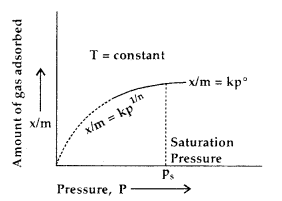
The adsorption of a gas on the surface of the solid depends upon the pressure of the gas. The extent of adsorption is generally expressed as x/m where m is the mass of the adsorbent and x is the mass of adsorbate when equilibrium has been attained. On the basis of experimental studies, Freundlich gave the following relationship between the amount of gas adsorbed (x) per unit mass of the adsorbent (m) and the pressure (p).
\(\frac{x}{m}\) = kp1/n
where n is a constant (whole number) which depends upon the nature of adsorba te and adsorbent.

A graph between the amount (x/m) adsorbed by an adsorbent and the equilibrium pressure (or concentration for solutions) of the adsorbate at constant temperature is called Adsorption Isotherm.
Surface Chemistry 12 Notes Chemistry 1
At low pressure \(\frac{x}{m}\) ∝ p1 ………..(i)

At high pressure \(\frac{x}{m}\) ∝ p0 ………..(ii)

In the intermediate range of pressure, combining (i) and (ii)
\(\frac{x}{m}\) ∝ p0-1
∝ p1/n where n is an integer (n > 1)
or
\(\frac{x}{m}\) = kp1/n ………..(iii)
where k is a constant depending upon the nature of the adsorbate and adsorbent.

This relationship is called Freundlich Adsorption Isotherm
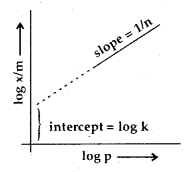
Taking logs on both sides of (iii)
log \(\frac{x}{m}\) = log k + \(\frac{1}{n}\) log p

A graph between log \(\frac{x}{m}\) against log p should, therefore, be a straight line with slope equal to \(\frac{1}{n}\) and ordinate intercept equal to log K.
Surface Chemistry 12 Notes Chemistry 2
Adsorption From Solution Phase:
Solids can adsorb solutes from solutions so when a solution of acetic acid in water is shaken with charcoal, a part of the acid is adsorbed by charcoal and the concentration of the acid decreases in the solution.

The following conclusions have been made regarding adsorption from solution phase:

  1. The extent of adsorption decreases with increase in temperature.
  2. The extent of adsorption increases with the increase in the surface area of the absorbent.
  3. The extent of adsorption depends upon the concentration of the solute in the solution.
  4. The extent of adsorption depends upon the nature of the absorbent and the adsorbate.

Freundlich equation as applied to solutions is modified as \(\frac{x}{m}\) = k C1/n  i.e., where C is the equilibrium concentration,
or
log \(\frac{x}{m}\) = log k + \(\frac{1}{n}\) log C

Applications of Adsorption:
1. Production of high vacuum: The remaining traces of air can be adsorbed by charcoal from a vessel evacuated by a vacuum pump to give a very high vacuum.

2. Gas masks: Gas mask (a device which consists of activated charcoal or mixture of adsorbents) is usually used for breathing in coal mines to adsorb poisonous gases.

3. Control of humidity: Silica and aluminium gels are used as adsorbents for removing moisture and controlling humidity.

4. Removal of colouring matter from solutions: Animal charcoal removes colours of solutions by adsorbing coloured impurities.

5. Heterogeneous catalysis: Adsorption of reactants on the solid surface of the catalysts increases the rate of reaction. There are many gaseous reactions of industrial importance involving solid catalysts. Manufacture of ammonia using iron as a catalyst, manufacture of H2SO4 by contact process and use of finely divided nickel in the hydrogenation of oils are excellent examples of heterogeneous catalysis.

6. Separation of inert gases: Due to the difference in degree of adsorption of gases by charcoal, a mixture of noble gases can be separated by adsorption on coconut charcoal at different temperatures.

7. In curing diseases: A number of drugs are used to kill germs by getting adsorbed on them.

8. Froth floatation process: A low grade sulphide ore is concentrated by separating it from silica and other earthy matter by this method using pine oil and frothing agent (see Unit 6).

9. Adsorption indicators: Surfaces of certain precipitates such as silver halides have the property of adsorbing some dyes like eosfn, fluorescein, etc. and thereby producing a characteristic colour at the end point.

10. Chromatographic analysis: Chromatographic analysis based on the phenomenon of adsorption finds a number of applications in analytical and industrial fields.

Catalysis: Potassium chlorate when heated strongly decomposes slowly giving dioxygen. The decomposition between 653 – 873 K.
2 KClO3 → 2 KCl + 3O2

However with a little of MnO a decomposition occurs only at 473 – 633 K and also at a much accelerated rate. MnO2 is a catalyst for this reaction.
Surface Chemistry 12 Notes Chemistry 3
A substance which accelerates the rate of a chemical reaction, itself remaining chemically and quantitatively unchanged after the reaction is called a catalyst.

Promoter is a substance that enhances the activity of a catalyst, while Poison is a substance that decreases the activity of a catalyst. In the reaction for the manufacture of NH3 by Haber’s process.
Surface Chemistry 12 Notes Chemistry 4
Fe is catalyst and Molybdenum (MO) is a promoter.

Homogeneous And Heterogeneous Catalysis:
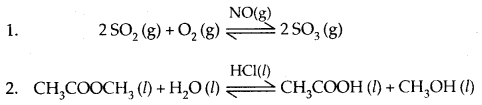
When the reactants and the catalyst are in the same phase (liquid or gas), the process is said to be homogeneous catalysis.

Example:
Surface Chemistry 12 Notes Chemistry 5
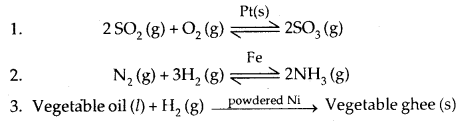
When the reactants and the catalyst are in different phases, the process is called heterogeneous catalysis.
Surface Chemistry 12 Notes Chemistry 6
Important Features of solid catalysts are:
(a) Activity: It depends upon the strength of chemisorption to a large extent. .
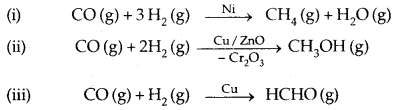
(b) Selectivity: Selectivity of a catalyst is its ability to direct a reaction to yield a particular product. For example, starting with H2 and CO and using different catalysts, we get different products.
Surface Chemistry 12 Notes Chemistry 7
Thus a catalyst is highly selective in nature, i.e., a given substance can act as a catalyst only in a particular reaction and not for all the reactions. A catalyst for a particular reaction may fail to catalyse any other reaction.

Shape-Selective Catalysis by Zeolites: The catalytical reaction that depends upon the pore structure of the catalyst and the size of the reactant and product molecules is called shape selective catalysis. Zeolites are good shape-selective catalysts because of their honey comb¬like structure.

An important Zeolite catalyst used in the petroleum industry is ZSM-5. It converts alcohols directly into gasoline (petrol) by dehydrating them to give a mixture of hydrocarbons.

Enzyme Catalysis: Enzymes are complex nitrogeneous organic compounds which are produced by living plants and animals. They are actually protein molecules of high molecular mass, and form colloidal solutions in water. The enzymes are also referred to as Bio-Chemical Catalysts as they also occur in the bodies of animals and plants and such a phenomenon is known as Bio-Chemical Catalysis.

The following are examples of enzyme-catalysed reactions:
1. Inversion of cane-sugar
Surface Chemistry 12 Notes Chemistry 8
2. Conversion of glucose into ethyl alcohol.
Surface Chemistry 12 Notes Chemistry 9
3. Decomposition of urea into ammonia and CO2.
Surface Chemistry 12 Notes Chemistry 10

EnzymeSourceEnzymatic Reaction
InvertaseYeastSucrose → Glucose and fructose
ZymaseYeastGlucose → Ethyl alcohol and carbondioxide
DiastaseMaltStarch → Maltose
MaltaseYeastMaltose → Glucose
UreaseSoyabeanUrea → Ammonia and carbon dioxide
PepsinStomachProteins → Amino acids

Characteristics Of Enzyme Catalysis:
Enzyme catalysis is unique in its efficiency and high degree of specificity. The following characteristics are exhibited by enzyme catalysts:
1. Most highly efficient: One molecule of an enzyme may transform one million molecules of the reactant per minute.

2. Highly specific nature: Each enzyme is specific for a given reaction, i.e., one catalyst cannot catalyse more than one reaction. For example, the enzyme urease catalyses the hydrolysis of urea only. It does not catalyse hydrolysis of any other amide.

3. Highly active under optimum pH: The rate of an enzyme- catalysed reaction is maximum at a particular pH called optimum pH, which is between pH value 5-7.

4. Highly active under optimum temperature: The rate of an enzyme reaction becomes,maximum at a definite temperature, called the optimum temperature. On either side of the optimum temperature, the enzyme activity decreases. The optimum temperature range for enzymatic activity is 298-310 K. Human body temperature being 310 K is suited to enzyme-catalysed reaction.

5. Increasing activity in presence of activators and co¬enzymes: The enzymatic activity is increased in the presence of certain substances, known as co-enzymes. It has been observed that when a small non-protein (vitamin) is present along with an enzyme, the catalytic activity is enhanced considerably.

Activators are generally metal ions such as Na+ Mn2+, CO2+, Cu2+, etc. These metal ions, when weakly bonded to enzyme molecules, increase their catalytic activity. Amylase in presence of sodium chloride i.e., Na+ ions are catalytically very active.

6. Influence of inhibitors and poisons: Like ordinary catalysts enzymes are also inhibited or poisoned by the presence of certain substances. The inhibitors or poisons interact with the active functional groups on the enzyme surface and often reduce or completely destroy the catalytic activity of the enzymes. The use of many drugs is related to their action as enzyme inhibitors in the body.

Mechanism of Enzyme Catalysis: There are a number of cavities present on the surface of collodial particles of enzymes. These cavities are of characteristic shape and possess active groups such as – NH2, – COOH, – SH, – OH etc. These are actually the active centres on the surface of enzyme particles. The molecules of the reactant (substrate), which have complementary shape, fit into these cavities just like a key fits into a lock.

An activated complex is formed which then decomposes to yield the products in two steps as outlined below:
Step I: E + S → ES*
Step II: ES* → E + P

Some Industrial Catalytical Processes:

ProcessCatalyst
1. Haber’s process for the manu-facture of ammonia N2(g) + 3H2(g) → 2NH3(g)1. Finely divided iron, molybdenum as promoter; conditions: 200 bar pressure and 723 – 773K temperature.
2. Ostwald’s process for the manu-facture of nitric acid.
4NH3(g) + 5O2(g) → 4N0(g) + 6H2O(g)
2NO(g) + O2(g) → 2NO2(g)
4NO2(g) + 2H2O(l) + O2(g) → 4HNO3(l)
2. Platinised asbestos; temperature: 573K.
3. Contact process for the manu-facture of sulphuric acid.
2SO2(g) + O2 (g) ⇌ 2SO3(g)
SO3(g) + H2SO4 (l) → H2S2O7 (l)oleum
H2S2O7 (l)+H2O (l) → 2H2SO4 (l)
3. Platinised asbestos or vanadium pentoxide (V205); temperature 673-723K.

Colloids: A colloid is a heterogeneous system in which one substance is dispersed (dispersed phase) as very fine particles in another substance called dispersion medium.

The essential difference between a solution and a colloid is that of particle size. Their size is in between that of true solution and suspension

Classification of Colloids: Colloids are classified on the basis of the following criteria:
(a) Physical state of dispersed phase and dispersion medium.
(b) Nature of interaction between dispersed phase and dispersion medium.
(c) Type of particles of the dispersed phase.
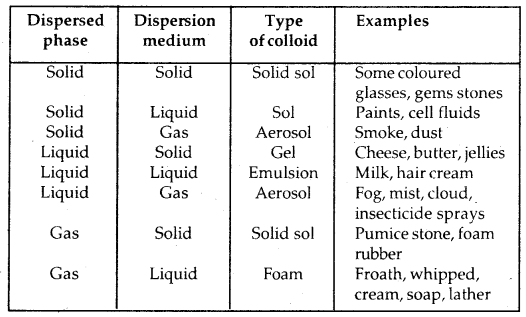
(a) Physical state of dispersed phase and dispersion medium: Depending upon whether the dispersed phase and the dispersion medium are solids, liquids or gases, eight types of colloidal systems are possible.

Types of Collodial Systems:
Surface Chemistry 12 Notes Chemistry 11
(b) Depending upon the nature of interactions between the dispersed phase and dispersion medium, the colloids can be classified as Lyophilic Colloids and Lyophobic Colloids.

1. Lyophilic collids: The colloidal solutions in which the particles of the dispersed phase have a great affinity (or love) for the dispersion medium are called lyophilic colloids. Such solutions are reversible in nature. In case water acts as the dispersion medium, the lyophilic colloid is called hydrophilic colloid. The common examples of lyophilic colloids are glue, gelatin, starch, proteins, rubber etc.

2. Lyophobic colloids: The colloidal solutions in which the particles of the dispersed phase have no affinity or love, rather have hatred for the dispersion medium, are called lyophobic collids. The solutions of metals like Ag and Au, hydroxides like Al (OH)3 and Fe (OH)3 and metal sulphides like As2S3 are examples of lyophobic colloids.
Such sols are formed with difficulty. They are irreversible in nature.

Multimolecular Macromolecular And Associated Colloids:
Depending upon the molecular size, the colloids can be classified as:
1. Multimolecular colloids: In this type, the particles consist of an aggregate of atoms or small molecules with molecular size less than 1 nm. For example, sols of gold atoms and sulphur (S8) molecules. In these colloids, the particles are held together by Van der Waals forces.

2. Macromolecular colloids: In this type, the particles of the dispersed phase are sufficiently big in size (macro) to be of colloidal dimensions. In this case, a large number of small molecules are joined together through their primary valencies to form giant molecules.

These molecules are called macro molecules and each macromolecule may consist of hundreds or thousands of simple molecules. The solution of such moleucles are called macromolecular soluions. For example, colloidal solution of starch, cellulose, etc.

3. Associated colloids: These are the substances which behave as normal electrolytes at low concentration but behave, as colloidal particles at higher concentration. These associated particles are also called miscelles. For example, in aqueous solution, soap (sodium stearate) ionises as:
Surface Chemistry 12 Notes Chemistry 12
In concentrated solutions, these ions get associated to form an aggregate of colloidal size.

General Methods Of Preparation Of Sols:
Lyophilic sols are readily formed by simply mixing the dispersed phase and the dispersion medium under ordinary conditions.

Lyophobic sols can generally be prepared by two methods.
1. Condensation methods,
2. Dispersion methods.

→ Condensation methods: In these methods, the smaller particles are condensed suitably to be of colloidal size. This can be done by chemical reactions or by exchange of solvent.

→ Dispersion methods: In these methods, the large particles of a substance (suspension) are broken into smaller particles. This can be done by mechanical dispersion, by electrical dispersion or Bredig’s arc method and by peptisation.

Purification Of Colloidal Solutions:
The colloidal solutions prepared usually contain impurities especially electrolytes which can destabilize the sols. These impurities must be eliminated to make the colloidal solution stable.

The following methods are commonly used for the purification of colloidal solutions.
1. Dialysis: The method is based upon the fact that colloidal particles cannot pass through a parchment or cellophane membrane while the ions of the electrolyte can pass through it. The colloidal solution is taken in a bag made of cellophane or parchment.

The bag is suspended in fresh water. The impurities slowly diffuse out of the bag leaving behind pure colloidal solution. For example, dialysis can be used for removing HCl from the ferric hydroxide sol.

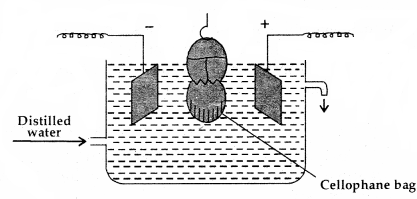
2. Electrodialysis: The ordinary process of dialysis is slow:
Surface Chemistry 12 Notes Chemistry 13
An apparatus for electrodialysis

To speed up the process of purification, the dialysis is carried out by applying electric field. This process is called electrodialysis.

3. Ultra-filtration: It is the process of removing the impurities from the colloidal solution by passing it through graded filter paper called ultrafilter papers. These filter papers are made from ordinary filter papers by impregnating them with colloidal solutions.

As a result, the size of the pores gets reduced. These filter papers allow the ions and molecules of the impurities to pass but retain colloidal particles. Ordinary filter papers cannot be used for this purpose since the colloidal particles also easily pass through the pores of these papers.

Properties Of Colloidal Solutions: The important properties of colloidal solutions are:
1. Heterogeneous nature: The colloidal solutions are heterogenous in nature consisting of dispersed phase and dispersion medium.

2. Visibility: The colloidals are not visible to naked eye and these can be seen with ultra microscopes.

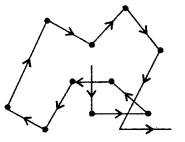
3. Brownian movement: The colloidal particles have continuous zigzag motion called Brownian movement.
Surface Chemistry 12 Notes Chemistry 14
Brownian Movement

4. Tyndall effect: When the light is passed through the colloidal solution, the path of the light becomes visible when viewed from a direction at right angle to the incident beam. This phenomenon was studied by Tyndall and is known as Tyndall effect. The phenomenon of scattering oflight’by colloidal particles as a result of which the path of the beam becomes visible is called Tyndall effect.

5. Electrical properties: The particles of the colloidal solutions possess electrical charge, positive or negative. The presence of charge is responsible for the stability of these solutions. It may be noted that only the sol particles carry some charge while the dispersion medium has no charge. For example, the collodial solutions of gold, arsenious sulphide (AS2S3) are negatively charged while those of Fe (OH)3 and Al (OH)3 have positive charge. In the case of silver chloride sol, the particles may either be positively or negatively charged.

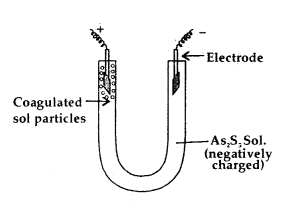
The presence of the charge on the sol particles and its nature whether positive of negative can be determined with the help of a phenomenon known as electrophoresis. In this experiment, the colloidal particles move towards positive or negative electrodes depending upon their charge under the influence of electrical field.

The phenomenon of movement of colloidal particles under an applied electric field is called electrophoresis.

If the particles accumulate near the negative electrode, the charge on the particles is positive. On the other hand, if the sol particles accumulate near the positive electrode the charge on the particles is negative.
Surface Chemistry 12 Notes Chemistry 15
A set up for electrophoresis

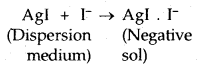
Origin of charge: The charge on the colloidal particles may be due to selective adsorption of ions. The particles contributing the dispersed phase adsorb only those ions preferentially which are common with their own lattice ions. For example, if silver nitrate solution is added to an aqueous solution of potassium iodide, the silver iodide will adsorb negative ions (I) from the dispersion medium to form a negatively charged sol.
Surface Chemistry 12 Notes Chemistry 16
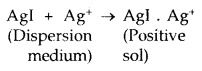
However, if silver iodide is formed by adding potassium iodide to silver nitrate solution, the sol will be positively charged due to the adsorption of Ag+ ions present in the dispersion medium.
Surface Chemistry 12 Notes Chemistry 17
Coagulation Of Colloidal Solution: The phenomenon of precipitation of a colloidal solution by the addition of excess of an electrolyte is called coagulation or floculation.

→ Factors governing coagulation
1. Nature of the electrolytes: The coagulation capacity of different electrolytes depends upon the valency cf the active ion or called floculating ion. It is the ion carrying charge opposite to the charge on the colloidal particles. According to Hardy Schulz law, greater the valency of the active ion or floculating ion greater will be its coagulating power. Thus, to coagulate negative sol of As2S3, the coagulating power of different cations has been found to decrease in the order as:
Al3+ > Mg2+ > Na+

Similarly, to coagulate a positive sol such as Fe (OH)3, the coagulating power of different anions has been found to decrease in the order:
[Fe(CN)6]4- > PO4 3- > SO42- > Cl

The minimum concentration of an electrolyte which is required to cause the coagulation or flocculation of a sol is known as flocculation value. It is usually expressed as milli moles per litre.

Protection of Colloids: The process of protecting the lyophobic colloidal solution from precipitation by the electrolytes due to the previous addition of some lyophilic colloid is called protection. The colloid which is added to achieve such a protection is called protecting colloid.

Gold Number: The different protecting colloids differ in their portecting powers. Zsigmondy introduced a term called gold number to describe the protective power of different colloids. This is defined as the minimum number of milligrams of the protective colloid required to just prevent the coagulation of a 10 ml of a given gold sol when 1 ml of a 10% solution of sodium chloride is added to it.

The coagulation of gold sol is indicated by change incolour from red to blue. The gold number of a few protective colloids are as follows:
Surface Chemistry 12 Notes Chemistry 18
It may be noted that smaller the value of gold number, greater will be protecting power of the protective colloid. Therefore, reciprocal of gold number is a measure of the protective power of a colloid. Thus, out of the list given above, gelatin is the best protective colloid.

Emulsions: Emulsions are the colloidal solutions of two immiscible liquids in which the liquid acts as the dispersed phase as well as the dispersion medium. Normally they are obtained by mixing an oil with water. Since the two do not mix well, the emulsion is generally unstable and is stabilised by adding a suitable outside reagent called emulsifier or emulsifying agent. The substances that are commonly employed for the purposes are gum, soap, glass powder, etc.

Types of Emulsions: These are of two types:
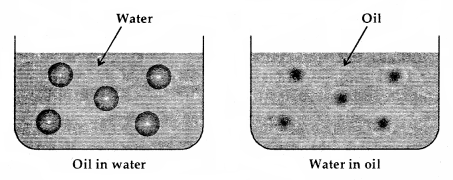
1. Oil-in-water emulsions: In this case, oils acts as the dispersed phase (small amount) and water as the dispersion medium (excess) e.g., milk is an emulsion of soluble fats in water and here casein acts as an emulsifier. Vanishing cream is another example of this class. Such emulsions are called aqueous emulsions.

2. Water-in-oil emulsions: In this case water acts as the dispersed phase while the oil behaves as the dispersion medium e.g., butter, cod liver oil, cold cream etc. Such types of emulsions are called oily emulsions.

Surface Chemistry 12 Notes Chemistry 19
Types of Emulsions

Demulsification: It is the process of decomposing an emulsion back into its constituent liquids. The demulsification can be done by centrifugation, filtration, boiling, freezing and some chemical methods.

Following are the interesting noteworthy examples of colloids which we come across in daily life.

  1. Blue colour of the sky: Dust particles along with water suspended scatter blue light due to which sky looks blue to, us.
  2. Fog, mist and rain: Clouds are aerosols. It is possible to cause artificial rain by throwing electrified sand.
  3. Food articles like milk, butter, fruit juices are all colloids.
  4. Blood-: Blood is a colloidal solution of an albuminoid substahce. Alum and FeCl3 solution stop oozing blood due to coagulation. ,
  5. Soils: Fertile soils are colloidal in nature in which humus . acts as a protective colloid.
  6. Formation of delta: River water is a colloidal solution of clay.

Sea water contains several electrolytes. When river water meets sea water, the electrolytes present in sea water, coagulate the colloidal solution of clay resulting in its deposition with the formation of delta.

Applications of colloids: Colloids are widely used in the industry.
Some examples are:
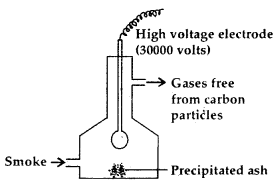
1. Cottrell Smoke Precipitator: Smoke is a colloidal solution of solid particles such as carbon, arsenic compounds, dust etc. in air. The smoke is led through a chamber containing platgs having a charge opposite to that carried by smoke particles.” The particles on coming in contact with these plates lose their charge and get precipitated. The particles thus settle down on the floor of the chamber.
Surface Chemistry 12 Notes Chemistry 20
Cottrell Smoke Precipitator

2. Purification of drinking water: Alum is added to water to coagulate the suspended impurities present in water from natural resources to make it fit for drinking purposes.

3. Medicines: Most of the medicines are colloidal in nature. . Milk of magnesia, an emulsion, is used for stomach disorder. Argyrol is a silver sol used as an eye lotion. Colloidal antimony is used in curing Kalazar. Colloidal gold is used for intramuscular injection. Colloidal medicines are more effective because of large surface area and hence are easily assimilated.

4. Tanning: Animal hides due to colloidal nature bear positive charge when it is soaked in tanning or chromium salts which Contain negatively charged colloidal particles, mutual coagulation takes place leading to hardening of leather. The process is called tanning.

5. Cleansing action of soaps and detergents: Soaps and detergents act as emulsifiers and remove greasy impurities and dust of clothes which is washed away.

6. Photographic plates & films are prepared by coating an emulsion of light sensitive AgBr in gelatin over glass plates or celluloid films.

7. Rubber industry: Latex is a colloidal solution of rubber particles which are negatively charged. Rubber is ob tained by coagulation of latex.

8. Industrial products: Paints, inks, synthetic plastics and rubber, graphite lubricants, cement etc. are all colloidal solutions.