Coordination Compounds Class 12 Notes Chemistry Chapter 9

By going through these CBSE Class 12 Chemistry Notes Chapter 9 Coordination Compounds, students can recall all the concepts quickly.

Coordination Compounds Notes Class 12 Chemistry Chapter 9

Coordination Compounds or complex compounds are usually formed by the transition metals ¡n which the metal atoms or ions are bound to a number of anions or neutral molecules Chlorophyll, haemoglobin and vitamin B12 are coordination compounds of magnesium, iron and cobalt respectively.

Wernet’s Theory of Coordination Compounds:
Alfred Werner, a Swiss chemist proposed the concept of a primary valence and a secondary valence for a metal ion. Werner in 1998 propounded his theory of coordination compounds.

The main postulates are:

  1. In coordination compounds metals show two types of linkages (valences) primary and secondary.
  2. The primary valences are normally ionisable and are satisfied by negative ions.
  3. The secondary valences are non-ionizable. These are satisfied by neutral molecules or negative ions. The secondary valence is equal to the coordination number and is fixed for a metal.
  4. The ion.s/groups bound by the secondary linkages to the metal have characteristic spatial arrangements corresponding to different numbers.

Such spatial arrangement is called coordination polyhedra. The species within the square bracket are coordination entities or complex part and the ions outside the coordination entities or complex part are called counter ions.

Werner further postulated that octahedral, tetrahedral, and square planar geometrical shapes are more common in coordination compounds of transition metal.

[CO(NH3)6]3+, [Cr(H2O)6]3+, [Cr Cl (NH3)5]2+, [COCl2(NH3)4]+ are octahedral complexes [NiCO)4] and [PtCl4]2- are tetrahedral and square planar respectively.

Difference between a double salt and a complex: Both double salts, as well as coordination compounds, are formed by the combination of two or more stable compounds in a stoichiometric ratio.

  1. KCl + MgCl2 + 6 H2O → KCl. MgCl2. 6H20 (carnallite)
  2. FeSO4 + (NH4)2SO4 + 6 H2O → FeSO4. (NH4)2 SO4. 6H2O (Mohr’s salt)
  3. 4 KCN + Fe (CN)2 → K4[Fe(CN)6]
  4. CoCl3 + 6 NH3 → [Co(NH3)6]Cl3

1 and 2 are examples of double salts
3 and 4 are examples of coordination compounds.

Double salts lose their identity in aqueous solutions. They dissociate into simple ions completely when dissolved in water.

Coordinate complexes retain their identity both in the solid-state and in aqueous solutions. For example [Fe (CN)6]4- does not dissociate into Fe2+ and CN ions.

→ Coordination Sphere: The central atom/ion and the ligands attached to it are enclosed in a square bracket is collectively called the Coordination sphere. For example in K4[Fe (CN)6], [Fe(CN)6]4- is coordination sphere and ionisable group K+ written outside the coordination group is called Counterion.

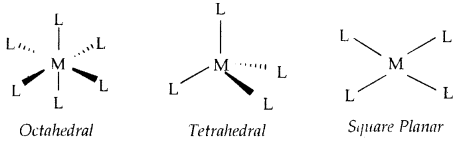
→ Coordination Polyhedron: The spatial arrangement of the ligand atoms which are directly attached to the central atom/ion defines polyhedron about the central atom/ion [Co(NH3)6]3+, [Ni (CO)4] and [Pt Cl]2- are respectively octahedral, tetrahedral and square planar coordination polyhedra.
Coordination Compounds Class 12 Notes Chemistry 1
(Shapes of different coordination polyhedra. M = Central metal/ ion and L = a unidentate ligand)

→ Oxidation Number of Central Atom: The oxidation number of the central atom in a complex is defined as the charge it would carry if all the ligands are removed along with the electron pairs that are shared with the central atom. Oxidation no. of copper in [Cu (CN)4]3- is + 1 and it is written as Cu (I).

→ Coordination Entity/Complexion: A coordination entity constitutes a central metal atom or ion bonded to a fixed number of ions or molecules. For example, [CoCl (NH3)3] is a coordination entity in which the cobalt ion is surrounded by three ammonia molecules and three chloride ions. Other examples are [Ni (CO)4], [PtCl, (NH3)2], [Fe (CN)6]3-, [CO(NH3)6]3+.

→ Central atom/ion: In a coordination entity, the atom/ion to which a fixed number of ions/ groups are bound in a definite geometrical arrangement around it, is called the central atom or ion. For example, the central atom/ion in the coordination entities: [NiCl2 (H2O)4], [COCl(NH3)5]2+, [Fe(CN)6]3- are Ni2+, CO3+ and Fe3+, respectively. These central atoms/ions are also referred to as Lewis acids.

→ Ligands: The ions or molecules bound to the central atom/ion in the coordination entity are called ligands. These may be simple ions such as Cl, small molecules such as H2O or NH3, larger molecules such as H2NCH2CH2NH2 or N (CH2 CH2 NH2)3 or even macromolecules, such as proteins. When a ligand is bound to a metal ion through a single donor atom, as with Cl, H2O or NH3, the ligand is said to be unidentate.

When a ligand can bind itself through two donor atoms as in H2NCH2CH2NH2 (ethane-1,2-diamine) or C2O42- (oxalate), the ligand is said to be bidentate, and when several donor atoms are present in a single ligand as in N (CH2CH2NH2)3, the ligand is said to be polydentate. Ethylenediaminetetracetate ion (EDTA4-) is an important hexadentate ligand. It can bind through two nitrogen and four oxygen atoms to a central metal ion.
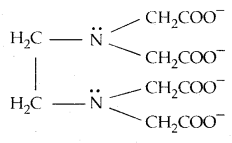
Coordination Compounds Class 12 Notes Chemistry 2
When a di- or polydentate ligand uses its two or more donor atoms to bind a single metal ion, it is said to be a chelate ligand. The number of such ligating groups is called the denticity of the ligand. Such complexes,
called chelate complexes tend to be more stable than similar complexes containing unidentate ligands. The ligand, which can ligate through two different atoms is called ambidentate ligand. Examples of such ligands are the NO2 and SCN ions. NO2 ion can coordinate either through v nitrogen or through oxygen to a central metal atom/ion
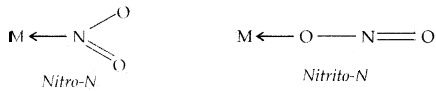
Coordination Compounds Class 12 Notes Chemistry 3
→ Coordination Number: The coordination number (CN) of a metal ion in a complex can be defined as the number of ligand donor atoms to which the metal.is directly bonded. For example, in the complexions, [PtCl6]2+ and [Ni(NH3)4]2+ the coordination number of Pt and Ni are 6 and 4 respectively. Similarly, in the complexions, [Fe(C2O4)3]2- and [Co(en)3]3+, the coordination number of Fe and Co both is 6 because C2O42- and en (ethane-1, 2-diamine) are bidentate ligands.

It is important to note here that the coordination number of the central atom/ ion is determined only by the number of sigma bonds formed by the ligand with the central atom/ion. Pi bonds, if formed between the ligand and the central atom/ion, are not counted for this purpose.

Homoleptic and Heteroleptic Complexes [Co(NH3)6]3+ in which metal is bound to only one kind of donor group, i.e., NH3 is called homoleptic complex. [Co(NH3)4 Cl2]+ complex in which a metal is bound to more than one kind of donor groups is called heteroleptic complex.

→ Nomenclature of Coordination Compounds: The formulae and names for coordination entities are based on the recommendations of the International Union of Pure and Applied Chemistry (IUPAC).

Formulae of Mononuclear Coordination Entities:
The following rules are applied while writing the formulae:

  1. The central atom is listed first.
  2. The ligands are then listed in alphabetical order. The placement of ligand in the list does not depend upon its charge.
  3. Polydentate ligands are also listed alphabetically. In the case of abbreviated ligand. The first letter of the abbreviation is used to determine the position of the ligand in alphabetical order.
  4. The formula for the entire coordination entity, whether charged or not, is enclosed in square brackets. When ligands are polyatomic, their formulae are enclosed in square brackets. When ligands are polyatomic their formulae are enclosed in parenthesis. Ligand abbreviations are also enclosed in parenthesis.
  5. There should be no space between the names of the ligands and the metal within a coordination sphere.
  6. When the formula of a charged coordination entity is to be written without that of the counter ion, the charge is indicated outside the square brackets as a right superscript with the number before the sign. For example, [Co(CN)6]3-, [Cr (H2O)6]3+ etc.
  7. The charge of the cations is balanced by the charge of the anions.

Note: The 2004 IUPAC draft recommends that ligands will be sorted alphabetically, irrespective of the charge.

The naming of Mononuclear Coordination Compounds Rules:

  1. The cation is named first.
  2. The ligands are named in alphabetical order before the name of the central atom/ion.
  3. Names of the anionic ligands end in – O. No special ending for neutral ligands .and cationic ligands. Aqua for H20, amine for NH3, carboxyl for CO and nitrosyl for NO, cyano for CN, Oxo for O2-.
  4. Prefixes mono, di, tri etc. are used to indicate the number of individual ligands in the coordination entity. When the names of the ligands include a number, then the terms bis, tris takes are used, the ligand to which they refer is placed in parenthesis. For example, [NiCl2 (P Ph3)] is named as dichloro bis (triphenylphosphine) nickel (II).
  5. The oxidation number/state of the metal in cation, anion or neutral coordination entity is indicated by a Roman numeral in parenthesis.
  6. If the complexion is an anion, the name of the metal ends with -ate. For example Cr in [Cr(CN)6]3- is chromate,
  7. The neutral complex molecule is named the same as that of the complex cation.

Note: The 2004IUPAC draft recommends that anionic ligands will end with – ido so that chloro would become chloride, etc.

Examples:

  1. Cr [(NH3)3 (H2O)3]Cl3: triamine tri aqua chromium (III) chloride.
  2. [Co (H2N CH2CH2NH2)3]2 (SO4)3: tris (ethane -1,2 di-ammine) Cobalt (III) sulphate.
  3. [Cr(H2O)6] Cl3: Hexaaquachromium (111) chloride.
  4. [Ag(NH3)2] [Ag(CN)2]: diammine silver (I) dicyano argentate (I).

→ Isomerism in Coordination Compounds: Isomers are two or more compounds that have the same chemical formula, but different arrangements of atoms.
1. Stereoisomerism:
(a) Geometrical isomerism,
(b) Optical isomerism.

2. Structural Isomerism:
(a) Linkage isomerism,
(b) Coordination isomerism,
(c) Ionisation isomerism,
(d) Solvate isomerism.

Stereoisomers have the same chemical formula and chemical bonds but they have different special arrangements. Structural isomers have different bonds.

→ Geometrical Isomerism: It arises in heteroleptic complexes due to different possible geometric arrangements of the ligands. If in square planar complex [MX2L2], the two ligands X are on the same side and two ligands L are on the other, it is called CIS-isomer. If the two ligands X and L are opposite to each other, it is called a Trans-Isomer.
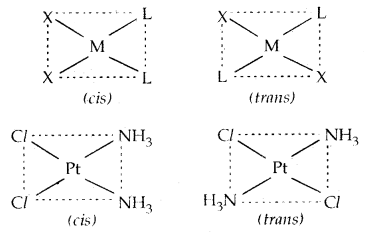
Coordination Compounds Class 12 Notes Chemistry 4
Example: [Pt (NH3)2 Cl2]: diammine dichloroplatinum (II)

Octahedral complexes [CO(NH3)4Cl2]+ and [Co{en)2Cl2]+ exist as cis and trans isomers.
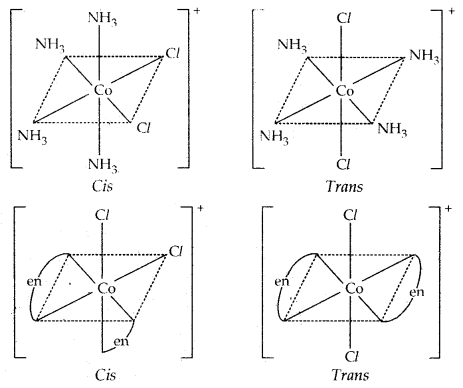
Coordination Compounds Class 12 Notes Chemistry 5
2. Optical isomerism: The isomers which rotate the plane polarised light equally but in opposite directions are called optical isomers. The isomer which rotates the plane polarised light to right is called dextrorotatory (designated as d-) while the one which rotates the plane of polarised light to the left is called laevorotatory (designated as 1). The main requirement for optical activity is that the molecule/ion should not have a plane of symmetry.

For example, complexes such as [Co(en)3]3+ and [Cr(ox)3]3- exist as optical isomers.
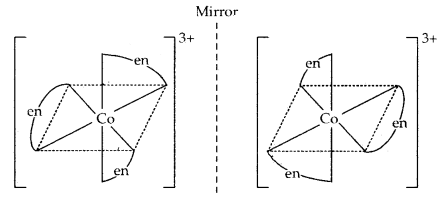
Coordination Compounds Class 12 Notes Chemistry 6
Another example of the optical isomers is shown by the complex [Co(en)2 Cl2]+.
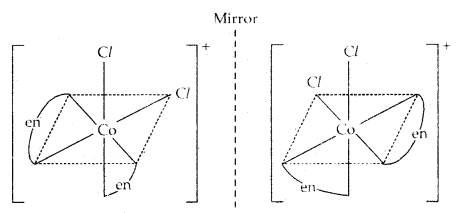
Coordination Compounds Class 12 Notes Chemistry 7
2. Structural Isomerism: They are further divided into:
1. Linkage Isomerism: It arises in a coordination compound containing ambidentate ligand. The complex [CO(NH3)5(NO2)]Cl2 exists in two forms: the red form in which the nitrite ligand is bound through oxygen (- ONO) and the yellow form in which nitrate is bound through nitrogen (-NO2). ,

2. Coordination Isomerism: It arises due to the interchange of ligands between cationic and anionic entities of different metal ions present in a complex. For example
[CO(NH3)6] [Cr (CN)6] and [Cr (NH3)6] [CO(CN)6]

3. Ionisation Isomerism: This isomerism arises when the counter ion m a complex salt is itself a potential ligand and can displace a ligand which can then become the counter ion.
(a) [CO(NH3)4O2]NO2 gives NO2 ions in solution and [CO(NH3)4 Cl(NO2)]Cl which gives Cl ions in solution.

(b) [CO(NH3)5 SO4] Br which gives a ppt. with AgNO3 [of AgBr] and [Co (NH3)Br[ SO4 which gives ppt. with Bad2 solution.

4. Solvate or Hydrate Isomerism: It is similar to ionisation isomerism with the only difference that water (H2O) is involved as a \ solvent. For example aqua complex Cr[(H2O)6]Cl3 – violet and its solvate isomer [Cr(H2O)5 Cl] Cl2. H2O – grey-green.

Bonding in Coordination Compounds:
There are two theories,
1. Valence Bond Theory for Bonding in Coordination Compounds: This theory was developed by Linus Pauling in 1930.
The basic assumptions of the theory are:
(a) The central metal atom in the complex must make available a number of empty orbitals equal to its coordination number for accommodating the electrons from ligands.
(b) The appropriate atomic orbitals (s, p, d) of the metal hybridise to give a new set of equivalent hybrid orbitals which are directed towards the ligand sites.
(c) The d orbitals used for hybridization may be either inner (n – 1)d orbitals or outer nd orbitals.
(d) The hybrid orbitals of the metal overlap with the filled orbitals of\the ligands to form coordinate bonds.

Thus, With the help of V.B. theory, the geometry of the complex can be predicted if the number of unpaired electrons is known. Alternatively, the number of unpaired electrons can be predicted from the known geometry of the complex.

The common types of geometries and hybrid orbitals used are:

Coordination Compounds Class 12 Notes Chemistry 8
The theory may be illustrated by two important examples:
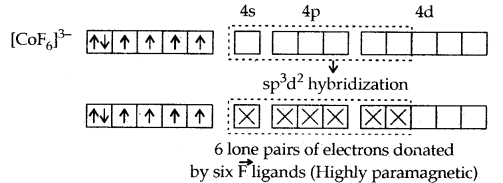
1. [CO(NH3)6]3+ and [COF6]3-. In these complexes, Co (III) has six d- electrons. The first complexion is diamagnetic and the second has paramagnetic character due to four unpaired electrons. In the [CO(NH3)6]3+ complex, the two 3d electrons get paired up with the other two leaving two vacant orbitals and these vacant orbitals get d2sp3 hybridized. In the second [COF6]3- complexes, the 3d electrons are not disturbed and the outer 4d orbitals are used for hybridization.
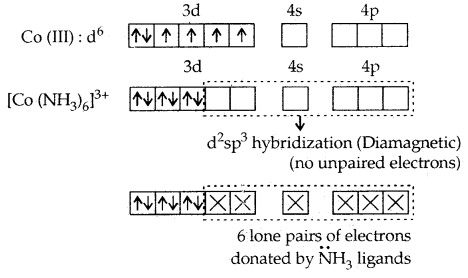
Coordination Compounds Class 12 Notes Chemistry 9
Coordination Compounds Class 12 Notes Chemistry 10
[CO(NH3)6]3+ is called an inner orbital or low spin or spin paired complex. The paramagnetic octahedral complex [COF6]3- is failed outer orbital or high spin or spin-free complex.

In a tetrahedral complex one s and three p-orbitals are hybridized to form four equivalent orbitals oriented tetrahedrally, e.g., [Ni Cl4]2-.
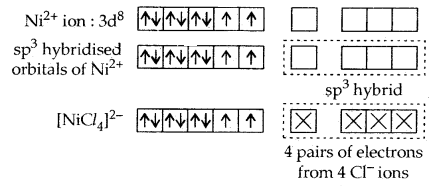
Coordination Compounds Class 12 Notes Chemistry 11
It is paramagnetic. (High spin complex).

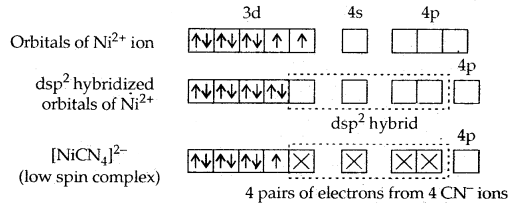
In the square planar complexes, the hybridisation involved is dsp2. An example is [Ni(CN)4]2-. Here nickel is in a + 2 oxidation state and has the electronic configuration 3d8.
Coordination Compounds Class 12 Notes Chemistry 12
It is a diamagnetic complex.

Magnetic properties of Coordination Compounds: For metal ions with up to three electrons in the d-orbitals like Ti3+ (d); V3+ (d2); Cr3+ (d3) two vacant d orbitals are available for octahedral hybridisation with 4s and 4p orbitals. The magnetic behaviour of these free ions and complex is similar.

When more than three 3d electrons are present, the required pair of 3d orbitals for octahedral hybridisation is not directly available (as a consequence of Hund’s rule). Thus, for d4 (Cr2+, Mn3+), d5 (Mn2+, Fe3+), d6 (Fe2+, CO3+) cases, a vacant pair of d orbitals results only by the pairing of 3d electrons which leaves two, one and zero unpaired electrons respectively.

The magnetic data agree with maximum spin pairing in many cases, especially with coordination compounds containing d6 ions. However, with species containing d4 and d5 ions, there are complications. [Mn (CN)6]3- has a magnetic moment of two unpaired electrons while [MnCl6]3- has a paramagnetic moment of four unpaired electrons. [Fe(CN)6]3- has a magnetic moment of a single unpaired electron while [FeF6]3- has a paramagnetic moment of five unpaired electrons. [COF6]3- is paramagnetic with four unpaired electrons while [Co(C2O4)3]3- is diamagnetic.

This apparent anomaly is explained by valence bond theory in terms of the formation of inner orbital and outer orbital coordination entities. [Mn(CN)6]3-, [Fe(CN)6]3- and [Co(C2O4)3]3- are inner orbital complexes involving d2 sp3 hybridisation, the former two complexes are paramagnetic and the latter diamagnetic. On the other hand, [MnCl]3-/ [FeF6]3- and [COF6]3- are outer orbital complexes involving sp3d2 hybridisation and are paramagnetic corresponding to four, five and four unpaired electrons.

Limitations of Valence Bond Theory:

  1. It involves a no. of assumptions.
  2. It does not give a quantitative interpretation of magnetic data.
  3. It does not explain the colour shown by coordination compounds.
  4. It does not explain the thermodynamic or kinetic stabilities of co-ordinate compounds.
  5. It does not make exact predictions regarding the tetrahedral and square planar structures of 4-coordination complexes.
  6. It does not distinguish between weak and strong ligands.

2. Crystal Field Theory: This theory envisages the metal ligand to be purely ionic arising.from electrostatic interactions between the metal and ligand. Ligands are treated as point charges in case of anions or dipoles in case of neutral molecules. The five d orbitals in an isolated gaseous metal atom/ion have the same energy, i.e., they are degenerate.

On the arrival of the ligands, these d-orbitals split up. Those orbitals which lie on the direct path of the ligands are repelled more than those which lie away from the path of approaching ligands. This pattern of splitting depends upon the nature of the crystal field.

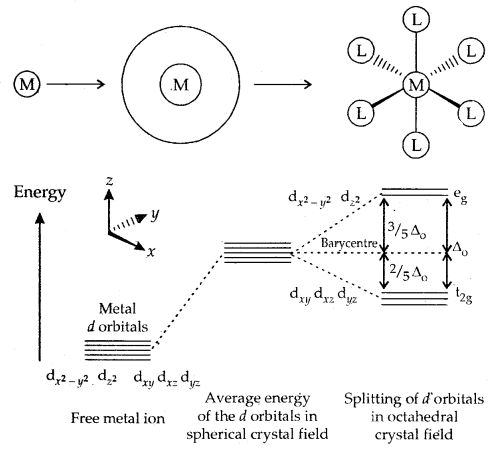
A. Crystal Field splitting into Octahedral Coordination Entities: In an octahedral complex when the six ligands approach the metal atom/ ion, out of five d-degenerate orbitals, three-d orbitals (dxy, dyz, dzx) which lie away from the path of the approaching ligands (∵ they lie in between the axes) are repelled less than those two d-orbitals (dx2y2 and dz2) which lie on the direct path [they lie in between the axes].

Thus the degeneracy of the five d-orbitals are lost and these d-orbitals split up. This splitting gives two sets of orbitals -12 set of three orbitals of lower energy and eg set of two orbitals (dx2y2 and dz2) of higher energy. It is called Crystal Field Splitting and the difference of energy is denoted by Δ0 (o -for octahedral complex). The energy of two eg orbitals is raised by \(\frac{3}{5}\) Δ0 and that of the three t2g will decrease by \(\frac{2}{5}\) Δ0.

The crystal field splitting, Δ0, depends upon the field strength of the ligands which is in the order:
I < Br < SCN < Cl < S2- < F < OH < C2O42- < H2O < NCS < edta4- < NH3 < en < CN < CO such a series is called spectrochemical series.

In d1 complexes, the single d-electron occupies the lower t2g orbital. In d2 and d3 coordination entities, the d-electrons occupy the three t2g orbitals singly in keeping with Hund’s Rule.

For d4 ions, two different patterns are possible:

  1. the 4th electron could either enter the lower energy t2g level and pair with an existing electron, or
  2. it could occupy the higher energy e2g level. It depends upon two factors:
    (a) The magnitude of crystal field splitting energy Δ0.
    (b) The pairing energy P [energy required for electron pairing in a single orbital).

1. If Δ0 < P, the 4th electron enters one of the eg orbitals. Ligands for which Δ0 < P is known as Weak field ligands and form high spin complexes.
Coordination Compounds Class 12 Notes Chemistry 13
Crystal Field Splitting of d-orbitals in an Octahedral complex

2. If Δ0 > P, the 4th electron occupies a lower energy t2g orbital. Ligands producing this effect are known as strong field ligands and form low spin complexes.

Calculations show that d4 to d7 coordination entities are more stable for the strong field as compared to weak field cases.

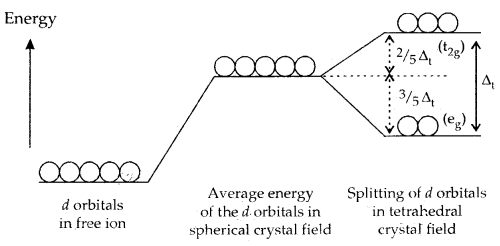
B. Crystal Field Splitting into Tetrahedral Coordination Entities: In tetrahedral complexes, splitting of d-orbitals is such that it is opposite to that of octahedral complexes. The eg set of d-orbitals of the metal ion is lower in energy and the t2g set has higher energy. Moreover, the value of Δt [t for tetrahedral complex] is smaller than Δ0 (Δt = \(\frac{4}{9}\) Δ0) for the same ligands and metal-ligand distances. Consequently, the orbital splitting energies are not sufficiently large for forcing pairing of electrons, i.e., electrons prefer to remain unpaired and thus low spin complexes are rarely observed in tetrahedral complexes.
Coordination Compounds Class 12 Notes Chemistry 14
d-orbitals splitting in tetrahedral crystal field

Colour in Coordination Compounds: Formation of coloured complexes is .the characteristic property of transition elements. It can be explained readily on the basis of crystal field theory, taking an example of an octahedral complex of [Ti (H2O)6]3+ in which the metal ion Ti3+ is a 3d1 system.

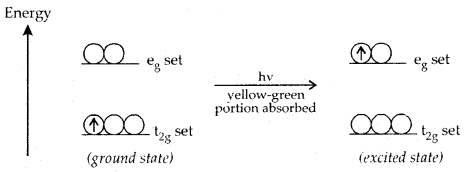
The t2g set is lower in energy and the eg set is higher in energy. The rotary 3d1 electron prefers to remain in t2g set in the ground state. If the light corresponding to a yellow-green region of white light is absorbed by this complex, it will excite the electron from the t2g set to the next available eg
set[t2g eg° → t°2g eg1 ]. Thus the complex appears violet.
Coordination Compounds Class 12 Notes Chemistry 15
The transition of an electron in [Ti(H2O)6]3+ complex

The colour of the complexes is explained by crystal field theory due to the d-d transition of the electron. Removal of the ligands does not cause crystal field splitting and hence the complex becomes colourless,
e.g., where CuSO4.5H20 [Complex: [Cu (H2O)4]2+. SO42-. H2O] is blue in colour due to absorption of the red region of white light, anhydrous CuSO4 s white. Removal of water from [Ti(H2O)6]Cl3 on heating renders it colourless.

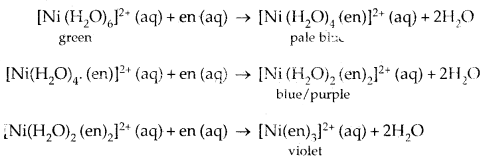
The influence of the ligand on the colour of a complex may be illustrated by considering the [Ni (H2O)6]2+ complex, which forms when nickel (II) chloride is dissolved in water. If the identity ligand, ethane- 1, 2-diamine (en) is progressively added in the molar ratios en: Ni, 1:1, 2:1,3:1 the following series of reactions with associated colour changes occur.
Coordination Compounds Class 12 Notes Chemistry 16
Limitations of Crystal Field Theory:

  1. As ligands are assumed to be point charges, anionic ligands are expected to have a greater splitting effect. However, actually, they are found to be at the lower end of the spectrochemical series.
  2. It does not take into account the covalent character of bonding between the ligand and the central atom/ion.
  3. Though OH ion in the spectrochemical series lies below H2O and NH3, yet it produces a greater splitting effect.

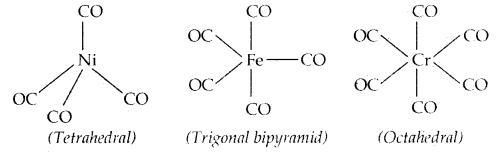
→ Bonding in Metal Carbonyls: The homoleptic carbonyls (compounds containing carbonyl ligands only) are formed by most of the transition metals. Tetracarbonylnickel (o), viz., [Ni (CO)4] is tetrahedral, Penta carbonyl iron (o) is trigonal bipyramidal while Hexa carbonyl chromium (o) is octahedral.
Coordination Compounds Class 12 Notes Chemistry 17
Stability of Coordination Compounds: Consider the reaction
M + 4 L → ML4
Stability constant (on Equilibrium constant)
K = \(\frac{\left[\mathrm{ML}_{4}\right]}{\left[\mathrm{M} \mid[\mathrm{L}]^{4}\right.}\)

The numerical value of the stability constant is a measure of the stability of the complex in the solution.

Importance And Applications of Coordination Compounds: These compounds are widely present in the mineral, plant and animal world. They play important functions in analytical chemistry, metallurgy, biological systems, industry and medicine.
1. Hardness of water is estimated by simple titration with Na2 EDTA. The Ca2+ and Mg2+ ions present in hard water make stable complexes with EDTA.

2. Metallurgical extraction of silver and gold make use of complex formations. Gold can be extracted from [Au (CN)2] complex by the addition of zinc.

3. Purification of Nickel can be achieved by Mond’s process by converting impure nickel to complex [Ni (CO)4] which decomposes to yield pure nickel.

4. Chlorophyll, the green pigment present in plants responsible for photosynthesis, is a coordination compound of Magnesium. Haemoglobin, the red blood pigment of blood that acts as an oxygen carrier is a coordination compound of iron. Vitamin B12, Cyanocobalamin, the anti-pernicious anaemia factor, is a cord in. m compound of cobalt.

5. Coordination comp us are used as catalysts for many industrial processes. Rhodium complex [(Ph3P) RhCl]. a Wilkinson catalyst is used for the hydrogenation of alkenes.

6. Articles can be electroplated with silver and gold much more smoothly and evenly from a solution of complexes Ag (CN)2] and [Au (CN)2] than from a solution of simple metal ions.

7. In black and white photography, the developed film is fixed by washing with hypo solution which dissolves the under-composed AgBr to form a complex io,n [ Ag (S2O3)2]3-.

8. Cis-platin is used for the treatment of cancer. Excess of copper and iron are removed by the chelating ligands D-penicillamine and desferrioxamine B via the formation of coordination compounds. EDTA is used in the treatment of lead poisoning

The d-and f-Block Elements Class 12 Notes Chemistry Chapter 8

By going through these CBSE Class 12 Chemistry Notes Chapter 8 The d-and f-Block Elements, students can recall all the concepts quickly.

The d-and f-Block Elements Notes Class 12 Chemistry Chapter 8

Transition Elements: d-Block. elements are called transition elements. They are placed in between the s-block on their left and the p-block on their right. They are called transition elements because they have properties intermediate between those of s- and p-block elements and represent a change from the most electropositive s-block elements to the least electropositive elements.

This element has partly filled (n -1) d-subshell in their atomic or ionic state. They are called d-block elements since in them 3d, 4d, 5d and 6d subshells are incomplete and the last electron enters (n -1) d subshell, i.e., penultimate (last but one) shell.

General Electronic Configuration:
The outermost shell: Their general electronic configuration is (n – 1) d1-10 ns0-2 where n is the outermost shell. Filling of 3d, 4d, 5d and 6d subshells leads to first transition series [4th period], 2nd transition series [5th period], 3rd transition series [6th period] and 4th incomplete transition series [7th period] respectively.

1st Transition Series or 3d series: Starts from Sc (At. No. 21) and ends at Zinc (Zn; atomic no. = 30).

Their configuration is 3d1-10 ns1-2.

  • Scandium (Sc) = 21 = [Ar]18 3d1 4s2.
  • Titanium (Ti) = 22 = [Ar]18 3d2 4s2
  • Vanadium (V). = 23 = [Ar]18 3d3 4s2
  • Chromium (Cr) = 24 = [ Ar]18 3d5 4s1
  • Manganese (Mn) = 25 = [Ar]18 3d6 4s2
  • Iron (Fe) = 26 = [Ar]18 3d6 4s2
  • Cobalt (Co) = 27 = [Ar]18 3d7 4s2
  • Nickel (Ni) = 28 = [Ar]18 3d8 4s2
  • Copper (Cu) = 29 = [Ar]18 3d10 4s1
  • Zinc (Zn) == 30 = [Ar]18 3d10 4s2

It may be noted that the electronic configuration of chromium and copper given above are exceptional. They have a single electron in the 4s-orbital. It is due to the extra-stability of 3d5 and 3d10 (half-filled and completely filled) orbitals. They consist up of 10 elements.

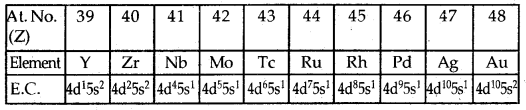
2nd Transition Series or 4d Series: Starts from the element Ytterium (Y) [Z = 39] and ends of cadmium (Cd; Z = 46). Their electronic configuration is 4d0-10 5s1-2. Palladium (Pd; Z = 46) has exceptional configuration of 4d10 5s°. They consists up of ten elements.
The d-and f-Block Elements Class 12 Notes Chemistry 1
Third Transition Series or 5d series: Corresponds to filling of 5d sub-level. They consist up of ten elements La (Z = 57), H/(Z = 72), Ta, W, Re, Os, Ir, Pt, Au and Hg(Z = 80).

The electronic configuration of 3rd transition elements in the inner and valence shell is given below:
The d-and f-Block Elements Class 12 Notes Chemistry 2
Fourth Transition Series or 6d Series: Corresponds to tire filling up of 6d Sub level and starts with Actinium (Ac; Z = 89), Rf (earlier Ku, Z = 104), Db, Sg, Bh, Hs, Mt, Ds, Rg and ends at Uub (Z = 112).
The d-and f-Block Elements Class 12 Notes Chemistry 3
The fundamental difference in the electronic configuration of Representative Elements and Transition Elements: In the representative elements (s- and p-block elements), the valence electrons are present only in the outermost shell while in the transition elements, the valence electrons are present in the outermost shell as well as d- orbitals of the penultimate shell.

Zinc (Zn), Cadmium (Cd) and mercury (Hg) are misfits according to the definition of transition elements as they have 3d10, 4d10, 5d10 (completely filled inner d-orbitals) in the ground state of their atoms or in one of the common oxidation states (dipositive ions: Zn2+, Cd2+, Hg2+) respectively. They do not show properties of transition elements to any appreciable extent, except for their ability to form complexes.

The d-block of the periodic table contains the elements of Groups 3-12 in which the d-orbitals progressively filled in each of the four long periods.

General Properties of Transition Elements:
(a) Metallic character: All the elements of d block are metals. This is due to the fact that they have low ionisation energy values and have only one dr two s-electrons in the outermost shell. The transition elements exhibit good mechanical properties i.e., they are hard, malleable and ductile. Except for Zn, Cd and Hg, they have high m. and b.pts. They have thermal and electrical conductivity and metallic lustre.

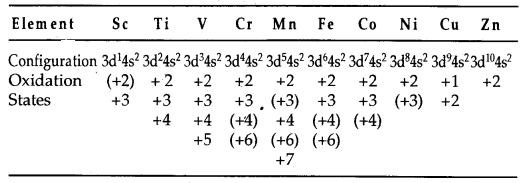
(b) Variable oxidation states: The transition elements exhibit a variety of oxidation states in their compounds. This is due to the fact that (n -1) d orbitals are of comparable energy to ns orbitals and therefore some or all of the (n -1) d electrons can be used along with ns electrons in compounds formation. Some common oxidation states exhibited by elements of the first transition series are listed below:
The d-and f-Block Elements Class 12 Notes Chemistry 4
(The value in parentheses are less common oxidation states.)

(c) Coloured compounds: Most of the compounds of transition elements are coloured. The d orbitals in transition metal compounds are not of equal energy. In transition elements, the d-orbital are partly filled and electron may be promoted from one d level to another d level by absorbing visible light. Consequently, the compound has the colour complement to the absorbed light. For example, Cu2 absorbs red light and transmitted light contains an excess of the other colours of the spectrum and appears to be blue.

The ions Zn2+, Cu+, Ti4+, Sc3+ are white because they have either completely empty or completely filled d-subshell.

(d) Magnetic properties: Most of the transition metals and their compounds are paramagnetic i.e., they are attracted by the magnetic field. This, the property is due to the presence of unpaired electrons in the d orbitals of their atoms. The elements like iron, nickel and cobalt have appreciable paramagnetism and are called ferromagnetic substances. The magnetic moment of compounds of d-block elements are determined by spin only values which may be related to the number of impaired electrons (n) as

Spin magnetic moment (μs) = \(\sqrt{n(n+2)}\)

The agreement between the observed and calculated values is quite good for most of the elements. However, for the latter half of the series, the contribution from orbital magnetic moments is observed.

(e) Complex formation: The transition elements have a great tendency to form complexes.

This is because of:

  • their small cation size
  • high effective nuclear charge and
  • presence of empty d-orbitals of appropriate energy for bonding to the ligands.

It has been noticed that

  1. In each transition series, the stability of complexes increases with an increasing atomic number of the element and in a particular oxidation state with decreasing size of its atoms.
  2. In the case of metal atoms that show more than one oxidation state, the complexes of greater stability are formed with the metal ions of the highest charge.

(f) Catalytic properties: Many transition metals and their compounds show catalytic properties e.g., Fe, Pt, V2O5, Ni etc. This property may be due to either the use of the d-orbitals or from the formation of transient intermediate compounds to absorb and activate the reacting substances.

(g) Alloy Formation: Transition metals mix freely with each other in the molten state and on cooling a solution of different transition metals to form alloys. For example, chromium dissolves in nickel to form Cr-Ni alloy; manganese dissolves in iron to form manganese steel. They take part in alloy formation because their atoms can exchange lattice sites of each other. Such alloys are formed by atoms with metallic radii that are within about 15 per cent of each other.

(h) Formation of Interstitial Compounds: Interstitial compounds are those which are formed when small atoms like H, C or N are trapped inside the crystal lattices of metals. They are usually non-stoichiometric and are neither typically ionic nor covalent. Many of the transition metals form interstitial compounds particularly with small non-metal atoms such as hydrogen, boron, carbon and nitrogen.

These small atoms enter into the voids sites between the packed atoms of the crystalline metal, e.g., TiC, Mn4N, Fe3M and TiH2 etc. The formulae quoted do not, of course, correspond to any normal oxidation state of the metal and often non-stoichiometric material is obtained with such composition as VH056 and TiH17. Because of the nature of their composition, these compounds are referred to as interstitial compounds.

The principal physical and chemical characteristics of these compounds are as follows:

  1. They have high melting points, higher than those of pure metals.
  2. They are very hard, some borides approach diamond in hardness.
  3. They retain metallic conductivity.
  4. They are chemically inert.

Some Important Compounds of Transition Metals:
Oxides: Transition metal oxides are formed by the action of oxygen with transition metals at high temperature. The general formulas of the oxides of transition metals are MO, M2O3, M3O4, MO2, M2O5 and MO3.

It has been observed that:

  • the oxides in which the metals are in a lower oxidation state are basic in nature.
  • the oxides in which the metal is in a higher oxidation state are acidic in nature.
  • the oxides in which the metal exhibits intermediate oxidation states are amphoteric.

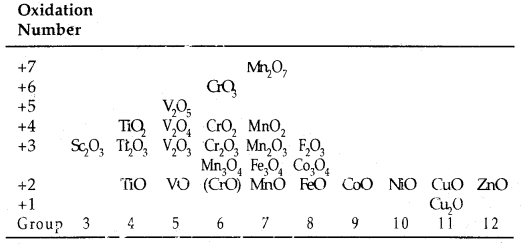
For example, among the oxides of manganese, MnO is basic, Mn2O3, Mn3O4 and MnO2 are amphoteric while Mn2O7 is acidic.

Oxides Of 3d Metals:
The d-and f-Block Elements Class 12 Notes Chemistry 5
Chemical Reactivity and E° Values: Transition metals vary widely in their chemical reactivity. Many of them are sufficiently electropositive to dissolve in mineral acids, although a few are ‘noble’: that is, they are unaffected by simple acids.

The metals of the first series with the exception of copper are relatively more reactive and are oxidised by 1M H+, though the actual rate at which these metals react with oxidising agents like hydrogen ion (H+) is sometimes slow. For example, titanium and vanadium, in practice, are passive to dilute non-oxidising acids at room temperature. The Ee values for M2+/M indicate a decreasing tendency to form divalent cations across the series.

This general trend towards less negative Ee values is related to the increase in the sum of the first and second ionisation enthalpies. It is interesting to note that the Ee values for Mn, Ni, and Zn are more negative than expected from the general trend. Whereas the stabilities of half-filled d subshell (d5) in Mn2+ and completely filled d subshell (d10) in zinc are related to their Eθ values; for nickel, Eθ value is related to the highest negative enthalpy of hydration.

An examination of the Eθ values for the redox couple M3+/M2+ shows that Mn3+ and CO3+ ions are the strongest oxidising agents in aqueous solutions. The ions Ti2+, V2+ and Cr2+ are strong reducing agents and will liberate hydrogen from a dilute acid. e.g.
2 Cr2+(aq) + 2 H+(aq) → 2 Cr3+(aq) + H2(g)

Trends in Stability of Higher oxidation states as exhibited in the oxides and halides of 3d-Series:
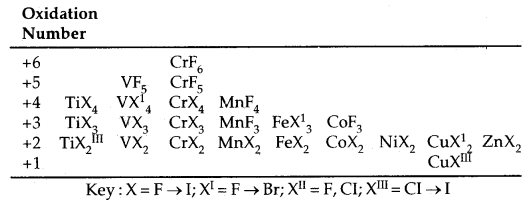
The table below shows the stable halides of the 3d series of transition metals. The highest oxidation numbers are achieved in Ti tetrahalides, VF5 and CrF6. The +7 state for Mn is not represented but MnOF3 is known and beyond Mn, no metal has a trihalide except Fe and COF3.

The ability of F to stabilize the higher oxidation state is due to either higher lattice energy of the higher compound as in the case of COF3 or higher bond energy terms for the higher covalent compounds e.g. VF5 and CrF6.

Table: Formulae of halides of groups 4 to 12:
The d-and f-Block Elements Class 12 Notes Chemistry 6
Halides: Transition metals react with halogens at high temperature to form transition metal halides. The order of reactivity of halogens is F > Cl > Br > I. The halides of higher oxidation states are the fluorides because metals can be oxidised to higher oxidation states with only fluorine which is most reactive. Bonding in fluorides is mainly ionic. In chlorides, bromides and iodides, the ionic character decrease with the atomic mass of halogen.

The ability of O to stabilize the higher oxidation state is also demonstrated in the oxohalides. Although Vv is represented only by VF5, the oxohalides VOX3 are known where X = F, Cl or Br. Another feature of fluorides is their instability in the low oxidation states e.g., VX2 (X = Cl, Br or I) and the same applies to CuX. On the other hand, all Cu11 halides are known except the iodide, in this case, Cu2+ oxidises I to I2:
Cu2+ + 2I→ CuI(S) + \(\frac{1}{2}\) I2

However Cul is unstable in solution and undergoes disproportionation.
2Cu+ → Cu2+ + Cu

The stability of Cu2+ (aq) rather than Cu+ (aq) is due to the much more negative Ah d H ° of Cu2+ (aq) than Cu+ (aq), which more than compensates for the 2nd IE of Cu.

The highest oxidation number in the oxides (Table) coincides with the group number and is attained in Sc2O3, to Mn2O7. Beyond Group 7, no higher oxides of Fe above Fe2O3, are known, although ferrates (VI):(FeO4)2- are formed in alkaline media they readily decompose to Fe2O3 and O2. Besides the oxides, oxidations stabilise Vv as VO2+, Vlv VO2+ and TiIV as TiO2+.

The ability of O to stabilise these high oxidation states exceeds F in this regard. Thus the highest Mn fluoride is MnF4 whereas the highest oxide is Mn2O7. The ability of oxygen to form multiple bonds to metals explains its superiority. In the covalent oil Mn2O7, each Mn is tetrahedrally surrounded by O’s including an Mn-O-Mn bridge. The tetrahedral [MO4]n- ions are known for Vv, CrvI, Mnv, MnvI and MnvII.

Comparison of the First Row Transition Metals Through The d-EIectron Configuration:
In the d° configuration of the simple ions, only Sc3+ is known to have this configuration. This configuration then occurs for those metals in which the formal oxidation states equal the total no. of 3d and 4s electron. This is true for Ti (IV), V (V), Cr (VI) and Mn (VII).

→ The d1 Configuration: Except Vanadium (IV), all others with this configuration are either reducing or undergo disproportionation. For .example, disproportionation occurs for Cr (V) and Mn (VI)
3 CrO43- + 8H+ → 2 CrO4 + Cr3+ + 4 H2O
3 MnO42- + 4H+ → 2 MnO4 + MnO + 2H20

→ The d2 Configuration: This configuration ranges from Ti11 which is very strongly reducing, to FeVI which is very strongly oxidizing. Vanadium (III) is also reducing.

→ The d3 configuration is shown by Chromium (III). It is quite stable and takes part in complex formation.

→ The d4 Configuration: There are really no stable species with the configuration Cr (II) is strongly reducing. ,

→ The d5 Configuration: The two important species with this configuration are Mn2+ and Fe3+, the latter may, however, be reduced to Fe2+.

→ The d6 Configuration: Iron (II) and Cobalt (III) are important species with this configuration. Iron (II) is quite stable although a mild reducing agent and cobalt (III) are stable in the presence of strong complexing reagents.

→ The d7 Configuration: The species with this configuration is cobalt (II) which is stable in aqueous solutions but gets oxidized to form CO (III) complexes in the presence of strong ligands.

→ The d8 Configuration: Nickel (II) is the most important species with this species.

→ The d9 Configuration: This configuration is found in Cu2+ compounds. It is by far the most important in the chemistry of copper.

→ The d10 Configuration: The two species Cu+ and Zn2+ are important with this configuration. Whereas Copper (I) is easily oxidized to copper (II), zinc (II) is the only state known for zinc.

General Group Trends in the Chemistry of the d-Block Metals:
Group 4:
The titanium group of transition metals consists up of the elements titanium, zirconium and hafnium. The most important member of this group is titanium. It is extremely strong, has a high melting point and is resistant to corrosion. It is in great demand as a structural material. Zirconium and hafnium are silvery-white metals. The most stable oxidation state for the elements of this group is +4.

The titanium also possesses a + 3 oxidation state. The typical compounds of these elements are chlorides, TiCl4, ZrCl4, HfCl4 and oxides TiO2, ZrO2 and HfO2, ZrO2 is a refractory material. Zirconium and hafnium occur together and exhibit similar properties.

Their atomic radii (Zr = 160 pm, Hf = 159 pm) are almost equal. This is due to the reason that usually increases in size down the group is cancelled by the lanthanide contraction. Zirconium and hafnium are both important for the generation of nuclear energy.

The vanadium group (Group 5): consists of vanadium, niobium and tantalum. The most stable oxidation state for this group is + 5. Vanadium is used as an additive to steel. The most important compound of vanadium is its pentoxide, V2O5, which is used as a catalyst in many reactions. Niobium alloys are used in jet engines, Tantalum is very resistant to corrosion and is used for making apparatus in chemical plants. It is also used in surgery, as for bone pins.

The chromium group (Group 6): contains the elements, chromium, molybdenum and tungsten. The most important oxidation states for chromium are + 3 and + 6, and for molybdenum and tungsten are + 5 and + 6. The zero oxidation states for these elements arise in metal carbonyls such as Cr (CO)6.

These elements have very high melting and boiling points. Tungsten is the metal with the highest melting point. These metals are also very hard. Chromium is unreactive or passive at low temperatures because of the formation of a surface coating of oxide. It is due to this passive behaviour that chromium is used for electroplating iron to prevent rusting.

The metals of this group are very useful. Chromium is used in many ferrous alloys such as stainless steel, chrome steel, etc. It is also used for electroplating iron or some other metals to prevent corrosion. K2Cr2O7 is a very important and useful compound of chromium.

Molybdenum and tungsten form very hard alloys with steel and are used in making cutting tools. Tungsten is also used as filament in electric bulbs. Molybdenum disulphide, MoS2 acts as a lubricant because it has a layer lattice.

Group 7: the manganese group: consist of the elements manganese, technetium and rhenium. These elements exhibit all the oxidation states from 0 to + 7, the most important being + 2, + 4 and + 7 for manganese and + 4 and + 7 for technetium and rhenium.

The elements of this group have quite a high melting and boiling points.

Manganese is obtained from its oxide ores by reduction with carbon or aluminium. Manganese metal does not have any use as such but is used in the manufacture of alloys such as ferromanganese (Fe + Mn) and manganese bronze (Mn + Cu + Zn). KMnO4 is an important compound of Mn which is used as an oxidizing agent and finds so many other applications. Manganese dioxide is used as a catalyst. Rhenium is used in electronic filaments, high-temperature thermocouples and in flashbulbs.

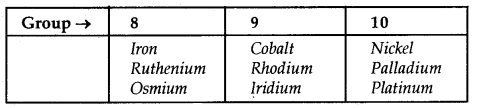
The metals of group 8,9 and 10 are known as iron group metals: These elements are:
The d-and f-Block Elements Class 12 Notes Chemistry 7
The first triad comprising of iron, cobalt and nickel is known as ferrous metals. These metals are ferromagnetic. Iron and cobalt exhibit oxidation states of + 3 and + 2 in their compounds while nickel compounds are generally in the + 2 oxidation state.

The elements of the second and third triad, ruthenium, rhodium, palladium, osmium, iridium and platinum are collectively known as platinum metals. These elements are relatively less abundant and exhibit a wider range of oxidation states. They are inert and serve as good catalysts.

The copper group (group 11): includes the elements copper, silver and gold. These metals are known as coinage metals. They form alloys with many metals. The most stable oxidation state for copper is + 2. For silver and gold, the oxidation state of + 1 is relatively more stable. The metals of this group have the highest electrical and thermal conductivities.

The zinc group (group 12): consists of the elements zinc, cadmium and mercury. The elements of this group show none of the characteristic properties of transition metals. The metals of this group are moderately electropositive and exhibit an oxidation state of + 2. Since their ionization energy is very high none of these metals possesses an oxidation state higher than + 2. Mercury, due to metal-metal bond also shows a formal oxidation state of +1. The elements of this group are diamagnetic. Mercury is the only metal that exists as a liquid.

Potassium Dichromate (K2Cr2O7):
Preparation: Chromite ore is fused with sodium or potassium carbonate in free access of air when the following reaction occurs.
The d-and f-Block Elements Class 12 Notes Chemistry 8
The yellow solution of sodium chromate (Na2CrO4) is filtered and acidified with a calculated amount of sulphuric acid from which orange sodium dichromate Na2Cr2O7. 2H2O can be crystallised.
2 Na2CrO4 + 2H+ → Na2Cr2O7 + 2Na+ + H2O

Potassium dichromate is prepared by treating the solution of sodium dichromate with a calculated amount of potassium chloride.
Na2Cr2O7 + 2 KCl → K2Cr2O7 + 2 NaCl.

Orange crystals of potassium dichromate crystallise out. The dichromate and chromate are interconvertible in an aqueous solution depending upon the pH of the solution.
2 CrO42- + 2 H+ → Cr2O72- + H2O.
Cr2O72- + 2 OH → 2 CrO42- + H2O.

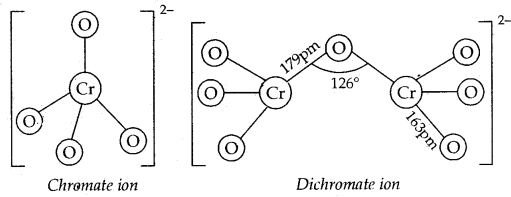
The structures of chromate ionCrO42-, and dichromate ion, Cr2O72- and shown below. Whereas CrO42- is tetrahedral sharing one comer with Cr-O-Cr bond angle of 126°.
The d-and f-Block Elements Class 12 Notes Chemistry 9
In acidic solution, both sodium and potassium dichromates are strong oxidizing agents, the former has a greater solubility in water.
Cr2O72- + 14 H+ + 6e → 2 Cr3+ + 7 H2O [E° = 1.33 V]

→ Acidified solution oxidizes
1. iodides to iodine
6I → 3I2 + 6e

2. sulphides to sulphur
3 H2S → 6 H+ + 3 S + 6e

3. tin (II) to tin (IV)
3 Sn2+ → 3 Sn4+ + 6e

4. iron (II) salts to iron (III)
6 Fe2+ → 6 Fe3+ + 6e
The full ionic equation may be obtained by adding the two half-reactions. e.g.,
Cr2072- + 14 H+ + 6 Fe2+ → 2 Cr3+ + 6 Fe3+ + 7 H2O.

Potassium Permanganate, KMn04:
Preparation:
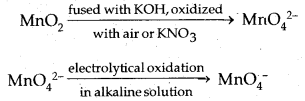
1. KMnO4 is prepared by fusion of MnO, and KOH with an oxidizing agent like KNO3.
The d-and f-Block Elements Class 12 Notes Chemistry 10
Potassium manganate (K2MnO4) gives KMnO4 in a neutral/acidic solution.
3 MnO42- + 4H) → 2 MnO4 + MnO2 + 2H2O

2. Comfnercially, KMnO4 is prepared from MnO2 by electrolytic oxidation.
The d-and f-Block Elements Class 12 Notes Chemistry 11
KMnO4 forms dark purple crystals. It is not very soluble in water. When heated it decomposes at 240°C.
The d-and f-Block Elements Class 12 Notes Chemistry 12
KMnO4 shows weak temperature-dependent paramagnetism. It arises due to the coupling of the diamagnetic ground state of MnO4 ion with paramagnetic excited states under the influence of the magnetic field.

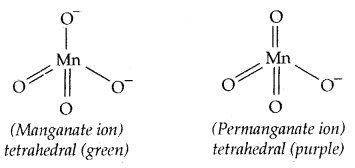
The manganate and permanganate ions are tetrahedral. The green MnO42- is paramagnetic with one unpaired electron, but MnO4 is diamagnetic.
The d-and f-Block Elements Class 12 Notes Chemistry 13
Permanganic acid (HMnO4) can be obtained by low-temperature evaporation of its aqueous solution. It is a strong oxidizing agent and in a pure state, it is explosive above 0°C.

→ Acidified KMnO4 is a strong oxidizing agent:
MnO4 + e → MnO42-
[Reduction half reaction]; E° = + 0.56 V

MnO4 + 4H+ + 3e → MnO2 + 2H2O
[Reduction half reaction]; E° = + 1.69 V.

MnO4 + 8H+ + 5e → Mn2+ + 4 H2O
[Reduction half reaction]; E° = + 1.52 V.

A few important oxidizing reactions of KMnO4 are given below.
1. In acid solutions:
(a) Iodine is liberated from potassium iodide:
10I + 2MnO4 + 16H+ → 2Mn2+ + 8H20 + 5I2

(b) Fe2+ ion is converted to Fe3+:
5Fe2+ + MnO4 + 8H+ → Mn2+ + 4H2O + 5Fe3+
The green iron (II) solution changes to yellow iron (III) solution.

(c) Oxalate ion or oxalic acid is oxidized at 60°C:
5 C2O42- + 2MnO4+ 16H+ → 2Mn2+ + 8H2O + 10CO2

(d) Hydrogen sulphide is oxidized, sulphur being precipitated:
H2S + 2H+ → + S2-
5S2- + 2MnO4 + 16H+ → 2Mn2+ + 8H2O + 5S

(e) Sulphurous acid or sulphite is oxidized to a sulphate or sulphuric acid:
5 SO32- + 2MnO4 + 6H+ → 2Mn2+ + 3H2O + 5SO42-

(f) Nitrite is oxidized to nitrate:
5NO2 + 2MnO4 + 6H+ → 2Mn2+ + 5NO3 + 3H2O

2. In neutral or faintly alkaline solution:
(a) A notable reaction is the oxidation of iodide to iodate:
2MnO4 + H2O + I → 2MnO2 + 2OH + IO3

(b) Thiosulphate: s oxidised almost quantitatively to sulphate, a trace of thionate being formed
8MnO4 + 3S2O32- + H2O → 8MnO2 + 6SO42- + 2OH

(c) Manganous salt is oxidised to MnOz; the presence of zinc sulphate or zinc oxide catalyses the oxidation:
2MnO4 + 3Mn2+ + 2H2O → 5MnO2 + 4H+

Note: Permanganate titrations in presence of hydrochloric acid are unsatisfactory since hydrochloric acid is oxidised to chlorine.

Uses: Besides its use in analytical chemistry, potassium permanganate is used as a favourite oxidant in preparative organic chemistry. Its uses for the bleaching of wool, cotton, silk and other textile fibres and for the decolourisation of oils are also dependent on its strong oxidising power.

→ The Inner Transition Elements (f-Block): It consists up of two series of elements.
1. Lanthanoids (58-71) which follow lanthanum (57) in the periodic table. are fourteen in number. Because La (57) closely resembles the lanthanoids, it is usually included in the study of lanthanoids and the general symbol Ln is often used.

2. Actinoids [the fourteen elements (90-103)] which follow actinium (89). A discussion of actinoids also includes actinium (Ac), besides the 14 elements.

In the case of lanthanoids, 4f orbitals/are filled up and in the case of actinoids, 5f orbitals are filled up. That is why they are called Inner Transition Elements as the last electron (also called differentiating electron) enters the antepenultimate energy level, ie.., (n – 2) f-orbitals: inner to the penultimate energy level and they form a transition series within the transition series (d-block elements)

Lanthanides or Landhanoids or Lanthanoness: In these elements, the last electron enters the 4f-orbitals and is also referred to as the first inner transition series. Earlier they were called rare earth.

Actinides or Actinoids or Actions: In these elements, the last electron enters one of the 5f-orbitals and is also required as the second inner transition series.

The study of lanthanoids is easier because they show only one stable oxidation state (+ 3). On the other hand, the chemistry of actinoids is much more complicated partly because they show a wide range of oxidation states and partly because they are radioactive.

→ Electronic Configuration: General E.C. of lanthanoids and actinoids is (n – 2) f1-14 (n – 1) d0-1 ns2. Thus they have three incomplete shells, viz., (n – 2), (n – 1) and nth. Their electronic config. is given below.
The d-and f-Block Elements Class 12 Notes Chemistry 14
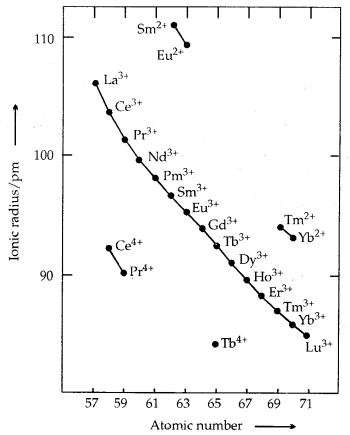
Trends in Ionic Radii of Trivalent Lanthanoids

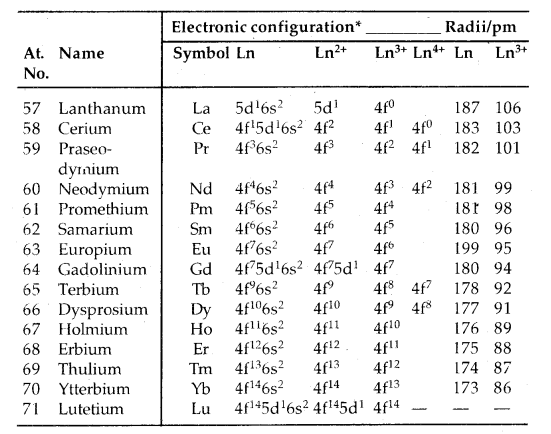
Table: Electronic configurations and radii of lanthanum and lanthanoids:
The d-and f-Block Elements Class 12 Notes Chemistry 15
Only electrons outside [Xe] core are indicated.

The overall decrease in atomic and ionic radii from lanthanum to lutetium (the lanthanoid contraction) is a unique feature in the tire chemistry of lanthanoids. It is due to the imperfect shielding of one 4f electron from another 4f electron due to the highly diffused shape of f-orbitals. With the increase in nuclear charge, there is a fairly regular decrease in their sizes.

The cumulative effect of the contraction of the lanthanoid series called lanthanoid contraction causes the radii of the third transition series to be very similar to those of the correspond ing members of the 2nd series. As a.result Zr (160 pm) and Hf (159 pm) have identical radii and so exist together.

Thus Zr and Hf face difficulty in their separation.
Colour and Paramagnetism: Many trivalent lanthanoids are coloured both in the solid-state and in aqueous solutions. It is due to the presence of f-electrons. Neither Lu3+ ion (f°) nor Lu3+ (f14) shows any colour. All others (having f1 to f13 arrangement) show colour. The lanthanoid ions other than f° (La3+, Ce4+) type and the f14 type (Yb2+, Lu3+) are all paramagnetic due to the presence of unpaired electrons. Paramagnetism is maximum in neodymium.

→ Ionisation Enthalpies: The IE1 and IE2 are around 600 kJ mol-1 and 1200 kJ moH comparable with those of calcium. The values of IE3 indicate that the exchange energy considerations impart a degree of stability to empty, half-filled and completely filled f-level (f°, f7, f14). It is evident from the abnormally low values of IE3 of lanthanum, gadolinium and lutetium.

→ Oxidation States: All the lanthanoids show a + 3 oxidation state which is most significant: Some of them show + 2 and + 4 oxidation states also as ions in solution or in solid compounds. This irregularity arises mainly from the extra stability of empty, half-filled or completely filled f-subshell. CeIV [16Rn-noble gas] is formed easily, but it is a strong oxidant reverting to the common oxidation state of + 3.
Ce4+ + e → Ce3+] Reduction half reaction
E° for the above is = + 1.74 V

If can oxidise water, but the reaction rate is slow. Pr, Nd, Tb and Dy also exhibit + 4 states in oxides MOr Eu2+ is formed by losing the two s-electrons (F). However, Eu2+ is a strong reducing agent changing to the common oxidation state + 3.
EU2+ → EU3+ + e

Similarly Yb2+ [f14] is a reductant. Tb (IV) [f7] is an oxidant.
Tb4+ + e- → Tb3+

Samarium also shows oxidation states of + 2 and + 3 like Eu.

Properties and Uses:
1. All the lanthanides are silvery-white soft metals and tarnish rapidly in the air. Hardness increases with increasing atomic number, Samarium is steel hard.

2. M.Pts are in the range of 1000 to 1200 K, but Sm melts at 1623 K

3. They have a metallic structure.

4. They are good conductor of heat and electricity.

5. In their chemical behaviour, lanthanoids are generally similar to calcium (Ca = 20), but with increasing atomic number, they behave more like aluminium.

6. Values for E° for the reduction half-reaction.
Ln3+ (aq) + 3e → Ln (s) are in the range of – 2.2 to – 2.4 V except for Ln = Eu, for which it is – 2.0 V,

7. The metals combine with hydrogen when heated gently.
2 Ln + 3 H2 → 2 Ln H3

8. When heated in carbon, carbides of the type Ln3C, Ln2C3 and LnC2 are formed.

9. They liberate H2 gas from dilute acids.
2 Ln + 6HCl (dil.) → 2 LnCl3 + 3H2I

10. They bum in halogens to form halides.
2 Ln + 3X2 → 2 LnX3

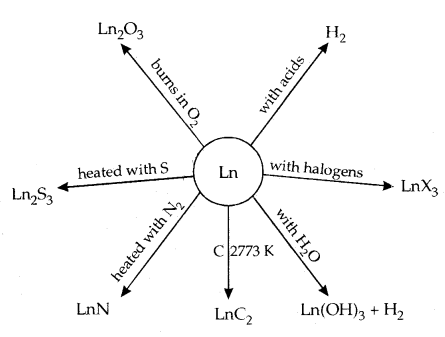
11. They form oxides and hydroxides of the type M2O3 and M (OH)3. They are basically like alkaline earth metal oxides and hydroxides. A summary of the chemical reactions of lanthanoids are given below:
The d-and f-Block Elements Class 12 Notes Chemistry 16
The best use of the lanthanoids is for the production of alloy steels for plates and pipes. A well-known alloy is Misch Metall which consists of a lanthanoid metal (~ 95%) and iron (~ 5%) and traces of S, C, Ca and Al. It is used to produce bullets, shell and lighter flint. Mixed oxides are used as catalysts in cracking. Some Ln oxides are used as phosphors in TV screens.

→ The Actinoids: The elements which follow actinium (89) in the periodic table are called actinoids [Starting from Th – 90 to Lr – 103.]

→ Actinoids are radioactive elements. Earlier members have relatively long half-lives and later ones from day to 3 minutes for Lr. This makes their study difficult.

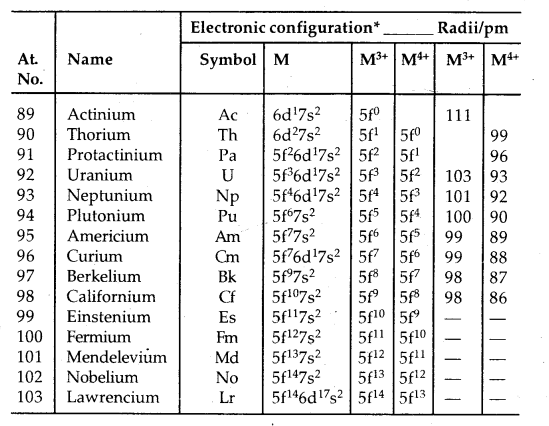
→ Electronic Configuration: All the actinoids have a 7s2 electron configuration and variable occupancy of the 5f and 6d subshells. The irregularities in the electronic configuration of actinoids like those in lanthanoids are related to the stabilities of 5f°, 5f7 and 5f14. 5f orbitals participate in bonding to a greater extent.

→ Oxidation states: There is a greater range of oxidation states shown by actinoids due to the comparable energies of 5f, 6d and 7s levels.

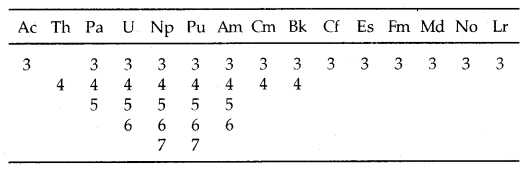
The electronic configurations and oxidation states of actinoids are in the following tables.
The d-and f-Block Elements Class 12 Notes Chemistry 17
Table: Oxidation states of actinium and actinoids:
The d-and f-Block Elements Class 12 Notes Chemistry 18
Unlike 4f orbitals of lanthanoids which are buried, 5f orbitals of actinoids participate in bonding to a far greater extent. In addition to showing an oxidation state of + 3 like lanthanoids, actinoids also show oxidation states of + 4, + 5, + 6 and + 7. Actinoids which show several oxidation states [Np, Pu, Am] make it difficult to review their chemistry.

Physical and Chemical reactivity of actinoids

  • Actinoids are all silvery-white metals.
  • They are highly reactive metals, especially when finely divided.
  • Boiling water reacts with them to give a mixture of oxides, hydrides.

Some applications of d-Block elements

  1. Iron and Steel are the most important construction materials.
  2. Compounds like TiO are prepared for use in the pigment industry.
  3. Mn02 is used in dry battery cells. The battery industry also requires Zn and Ni/Cd.
  4. Cu, Ag and Au are coinage metals.
  5. Many of the metals and their compounds find use as catalysts like finely divided Ni, V2O5, TiCl4, Fe etc.
  6. PdCl2 is used in the Wacker process for the oxidation of ethyne to ethanol
  7. Ni-complexes are used in the polymerisation of alkynes and other organic compounds like benzene.
  8. AgBr is used in the photographic industry.

An Overview of Leptospira Interrogans

Learninsta presents the core concepts of Microbiology with high-quality research papers and topical review articles.

An Overview Leptospira Interrogans

Spirochaetes of the genus Leptospira are actively motile, delicate and possess numerous closely wound spirals with characteristic hooked ends. Several Leptospires are saprophytes, while many are potential pathogens of rodents, domestic animals and humans. The genus Leptospira consists of two important
species, which are Leptospira interrogans and Leptospira biflexa.

Leptospira interrrogans is the causative agent of leptospirosis, a zoonotic disease. The word Leptospira is derived from Latin word ‘Leptos’ = fine or thin and ‘spira’ = Coil and interrogans = Question mark (The shape of this spirochete accounts for its name)

Morphology

  • They are spiral bacteria (5-20µm × 0.1µm) with numerous closely set coils. Their ends are hooked and resemble umbrella handles.
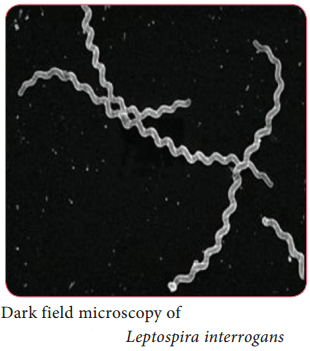
  • They are actively motile by rotatory movements. They cannot be seen under light microscope due to its thinness, best observed by dark fieldmicroscopy (Figure 7.24), phase contrast and electron microscope.
  • They stain poorly with aniline dyes, it may be stained with giemsa stain or silver impregnation techniques.

Leptospira Interrogans img 1

Antigenic Structure

Leptospires show considerable antigenic cross reaction.

  1. Genus – Specific somatic antigen – It is present in all members of the genus.
  2. Surface antigens – This antigen is used to classify Leptospira into serogroups and serotypes.

Pathogenicity

Source of infection:

Contaminated water

Route of entry:

Through cuts or abrasions on skin or mucosa

Incubation period:

6-8 days

  • Leptospira interrogans causes a zoonotic disease named Leptospirosis. It is transmitted to humans by direct or indirect contact with water, contaminated by urine of carrier animals (rat and dog).
  • Leptospira enter the body through cuts or abrasions on skin or through mucous membranes of the mouth, nose or conjunctiva.
  • After an incubation period of 6-8 days. There is onset of febrile (related to fever) illness with Leptospira in blood (Septicemic phase) which lasts for 3-7 days.
  • The organisms disappear from the blood and invades liver, kidney, spleen, meninges producing meningeal irritation such as headache, vomiting.
  • The pathogen persists in the internal organs and most abundantly in the kidney. Severe Leptospirosis (Weil’s disease) is associated with Fever, conjunctivitis (inflammation of conjunctiva), albuminuria (presence of albumin in the urine), jaundice and hemorrhage. It is a fatal illness with hepatorenal (Kidney failure with severe liver damage).

Clinical manifestations

  • In severe cases, vomiting, headache, irregular fever and intense infection of the eyes.
  • Jaundice, Albuminuria (The presence of protein Albumin in the urine) and purpuric hemorrhages sometimes occur on skin and mucosa.

Laboratory Diagnosis

The diagnosis of Leptospirosis is made by the following ways

  • Direct microscopy of blood or urine
  • Isolation of pathogen by culture
  • Serological tests.

Direct Microscopy

Blood:

Leptospira can be observed in the blood by dark – filed microscope. Blood examination is useful in first week as Leptospira disappear from blood after 8 days.

Urine:

Leptospira may be present in urine in the 22nd week of the disease and intermittently thereafterup to 6 weeks. Centrifuged deposit of urine may be observed by Dark filed microscopy.

Culture:

Blood (1st week) and urine (22nd – 6  week) can be cultured in Korthof ’s medium. Media are incubated at 37°C for 2 days and then left at room temperature for 2 weeks. Culturesare examined every third day for the presence of Leptospira under DFM.

Serological tests

It is very useful method of diagnosis two types of serological tests are used, which are,

a. Screening tests:

These tests are genus – specific and done using reactive genus specific antigen (non – pathogenic L. biflexapatoc I strain).

Screening test includes – CFT, ELISA, SEL, HAT indirect IF these tests are capable to detect IgM and IgG leptospiral antibodies.

b. Serotype specific tests:

These tests identify the infecting serovar by demonstrating specific antibodies.

  • Macroscopic agglutination test
  • Microscopic agglutination test

Treatment and Preventions

  • Leptospira are sensitive to penicillin and tetracycline.
  • Preventive measures include rodent control, disinfection of water.

Treponema Pallidum of Medical Bacteriology

Learninsta presents the core concepts of Microbiology with high-quality research papers and topical review articles.

Treponema Pallidum of Medical Bacteriology

Treponema pallidum is included in the family Spirochaetaceae. They are slender spirochaetes with fine spirals having pointed ends. Some of them are pathogenic for humans, while others are normal flora in mouth and genitalia.

These pathogens are strict parasites and the diseases caused by Treponema are called Treponematoses. Treponema pallidum is the causative agent of syphilis. The name Treponema pallidum is derived from Greek words, which means, Trepos – Turn Nema – Thread and palladium – Pale staining.

Morphology

It is thin, delicate spirochete with tapering ends, about 10µm long and 0.1-0.2 µm wide. It has about ten regular spirals, which are sharp and angular, at regular intervals of about 1µm. They are actively motile (endoflagella), exhibiting rotation around the long axis, backward and forward movements and flexion of the
whole body.

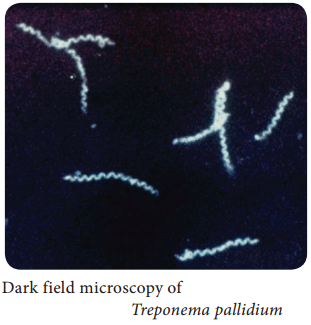
It cannot be seen under light microscope and does not take ordinary bacterial stains. It can be seen under the dark ground (Figure 7.22) or phase contrast microscope.It can be stained by silver impregnation method.
Treponema Pallidum of Medical Bacteriology img 1

Culture

  • Pathogenic Treponema cannot be grown in artificial culture media.

Pathogenesis

Source of infection – Human beings (patients)
Mode of transmission – Sexual contact
Site of entry – Through minute abrasions/cuts on skin or mucosa

Incubation period – 10 – 90 days

  • Treponema pallidum causes venereal syphilis, which is acquired by sexual contact. The pathogen enters the human body through cut on the skin or mucosa of genital areas.
  • The clinical disease sets in after an incubation period of about a month. There are 3 clinical stage of venereal syphilis, namely – primary, secondary and tertiary syphilis.

Primary syphilis

  • A papule appears on the genital area that ulcerates, forming a chancre of primary syphilis called hard chancre.
  • The chancre is covered by thick exudates, very rich in spirochetes.
  • The regional lymph nodes are swollen, discrete, rubbery and non – tender.
  • Even before the chancre appears, the spirochetes spread from the site of entry into the lymph and bloodstream, so the patient may be infectious during the late incubation period.
  • The chancre invariably heals within 10-40 days, even without treatment, leaving a thin scar.

Secondary syphilis

  • Secondary syphilis sets in 1-3 months after the primary lesion heals. During this interval, the patient is asymptomatic.
  • The secondary lesions are due to widespread multiplication of the spirochetes and dissemination through the blood.
  • Secondary syphilis is characterized by appearance of papular skin rashes, mucous patches in the oropharynx and condylomata (a raised growth on the skin resembling a wart).
  • The lesions are abundant in spirochetes and the patient is most infectious during the secondary stage.
  • There may be retinitis (inflammation of the retina of the eye), meningitis, periostitis, and arthritis.
  • Secondary lesions usually undergo spontaneous healing, in some cases taking as long as 4 or 5 years.
  • After the secondary lesions disappear, there is a period of dormant known as latent syphilis the patient does not show any clinical symptoms but with positive serology.

Tertiary syphilis

  • After several years, manifestations of tertiary syphilis appear. These consist of cardiovascular lesions including aneurysms (enlargement of an artery), gummata (a small rubbery granuloma that has a necrotic centre) and meningovascular manifestations. Tertiary lesions contain few spirochetes.
  • In few cases, neurosyphilis such as tabesdorsalis or general paralysis of the insane develops. These are known as late tertiary or quaternary syphilis.

Congenital syphilis

In congenital syphilis, the infection is transmitted from mother to fetus by crossing the placental barrier.

Non – Venereal syphilis

It may occur in doctors or nurses due to contact with patients lesion during examination. The primary chancre occurs usually on the fingers.

Laboratory Diagnosis

The diagnosis of syphilis includes

  1. Demonstration of Treponemes
  2. Serological tests

Specimen:
Exudates are collected from the chancre. Blood (serum) is collected for serology.

Demonstration of Treponemes

a. Dark ground microscopy:

The wet film is prepared with exudates and examined under dark ground microscope. Under dark field examination Treponema pallidum appears motile spiral organism.

b. Treponemes in tissues:

It can be demonstrated by silver impregnation method of staining.

Serological tests

Non – Treponemal tests – In the standard tests for syphilis includes;

  • VDRL – Venereal Diseases Research Laboratory test.
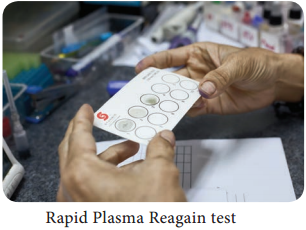
  • RPR – Rapid Plasma Reagain (Figure 7.23).

VDRL or RPR tests are used for serological screening for syphilis and more useful for the assessment of cure following treatment.
Treponema Pallidum of Medical Bacteriology img 2

Treponemal Tests:

The treponemal tests includes

  • TPHA – Treponema pallidum hemagglutination assay
  • FTA – ABS – Fluorescent treponemal antibody absorption test.

These two tests are used to confirm the diagnosis.

Treatment and Preventive Measure

In early syphilis

  1. Benzathine benzyl penicillin, 24 lakhs units intramuscularly in a single dose.
  2. Alternatively, doxycycline 100 mg twice a day orally for 15 days.

In late syphilis

Benzathine benzyl penicillin 24 lakhs units, intramuscularly once weekly for 3 weeks.

  1. Avoiding sexual contact with an infected individual.
  2. Use of sex barriers (condoms).

Mycobacterium Tuberculosis (Tubercle Bacillus)

Learninsta presents the core concepts of Microbiology with high-quality research papers and topical review articles.

Mycobacterium Tuberculosis (Tubercle Bacillus)

The genus Mycobacterium is distinguished by its thick, complex, lipidrich waxy cell walls. This high lipid content (Mycolic acids) imparts the characteristic of acid fastness or resistance to decolorization by a strong acid after staining with carbol fuchsin. Many of the Mycobacterial species are saprophytes but several species are highly significant human pathogens.

Mycobacterium tuberculosis is the causative agent of tuberculosis (TB) It is a killer disease and ranks as one of the most serious infection diseases of the developing countries. TB is primarily a disease of the lungs but may spread to other sites of the body.

The name Mycobacterium tuberculosis is derived form,

  • Mycobacterium (Greek) – Fungus like bacterium
  • Tuberculosis (Latin) – Swelling or Knob

Morphology

They are acid fast bacilli, slightly curved rods, it may occur singly or in small clumps. They are non-motile, non-sporing, and non-capsulated.

Cultural Characteristics

They are obligate aerobe, optimum temperature is 37°C and optimum pH is 6.4-7.0. The pathogen grows on an enriched culture media – Lowenstein Jensen medium.

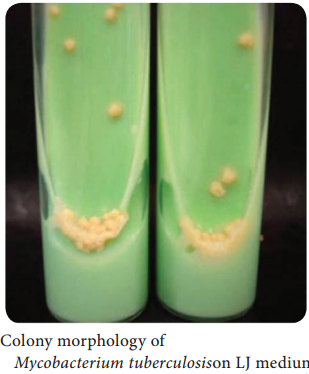
The colonies appear in about 2-3 weeks. The colonies are dry, rough, raised, irregular colonies with a wrinkled surface. Initially creamy white and becoming yellowish later (Figure 7.19).
Mycobacterium Tuberculosis (Tubercle Bacillus) img 1

Pathogenesis

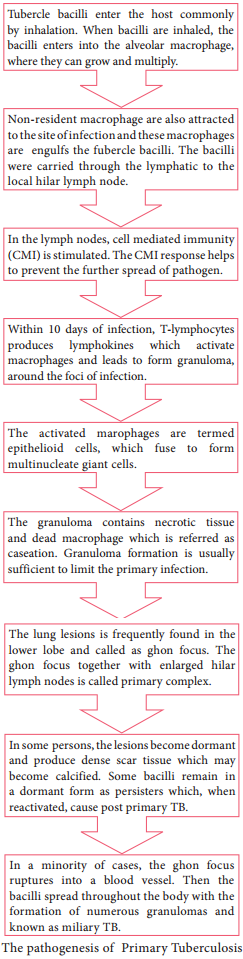
Human tuberculosis is divisible into two form, they are Primary TB and Secondary TB. The pathogenesis of Primary Tuberculosis is described in flowchart 7.8.

Source of infection – Airborne droplets
Route of entry – Respiratory tract
Incubation period – 3 – 6 weeks.
Mycobacterium Tuberculosis (Tubercle Bacillus) img 2

Secondary TB – (Post primary TB)

It is caused by reactivation of the primary lesion or by exogenous reinfection. Granulomas of secondary TB most often occur in the apex of the lungs. The necrotic element of the reaction causes tissue destruction and the formation of large area of caseation termed tuberculomas.

The presence of caseous necrosis and cavities are two important clinical manifestations of secondary TB. The cavities may rupture into blood vessels, spreading the bacilli throughout the body and break into airways, releasing the pathogen in aerosols and sputum – called as open tuberculosis (Figure 7.20).
Mycobacterium Tuberculosis (Tubercle Bacillus) img 3

Clinical Symptoms

It includes, cough that lasts for more than 2-3 weeks, weight loss, fever, night sweat and loss of appetite.

Laboratory Diagnosis

Specimen:

In case of pulmonary tuberculosis the most usual specimen is sputum.

Direct Microscopy:

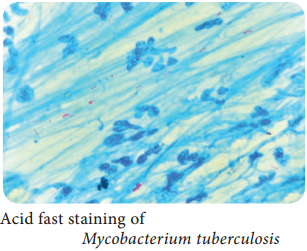
Smear is made from the sputum specimen and stained by Ziehl – Neelson technique. It is examined under oil immersion objective lens. The acid fast bacilli appear as bright red bacilli against a blue background.

Culture:

The specimen is inoculated onto LJ – medium and incubated at 37°C for 2 weeks the tubercle bacilli usually grow in 2-8 weeks. The bacterial growth is confirmed by Ziehl – Neelsonstaining.

1. Tuberculin Skin test

Mantoux test:

This method has been used routinely. In this test 0.1 ml of PPD (Purified protein derivative) containing 5 TU (Tuberculin unit) is injected intradermally on the flexor aspect of forearm (Figure 7.21) The site is examined after 48-72 hours and induration are measured (diameter in mm).

Positive test:

Indurations of diameter d10 mm or more is considered positive.

Negative test:

Indurations of 5 mm or less is negative.

2. Gene Xpert MTB

It is an automated diagnosis test it detects DNA sequences specific for M. tuberculosis and rifampicin resistance by PCR. Results can be obtained within 2 hours.

Treatment

The antitubercular drugs include two types of agents which are;

Bactericidal agents – Rifampicin (R), Isoniazid (H), Pyrazinamide (z), Streptomycin.
Bacteriostatic agents – Ethambutol (E).

The regimen for treating TB consists of an intensive phase of 2 months of isoniazid, rifampin, pyrazinamide and ethambutol, followed by a continuation phase of 4 months of isonizid and Rifampin.

Prophylaxis and Control Measures

The BCG (Bacille – Calmette – Guerin) administered by intradermal injection of the live attenuated vaccine. The immunity may last for about 10 years. The prevention of TB can be done by the following general measures such as

  1. Adequate nutrition.
  2. Practicing good hygiene (washing hands)
  3. Health education.
  4. Cover the mouth with a tissue when you cough or sneeze.