Chemical Bonding and Molecular Structure Class 11 Notes Chemistry Chapter 4

By going through these CBSE Class 11 Chemistry Notes Chapter 4 Chemical Bonding and Molecular Structure, students can recall all the concepts quickly.

Chemical Bonding and Molecular Structure Notes Class 11 Chemistry Chapter 4

Chemical Bond: The attractive force which holds various constituents (atoms, ions, etc.) together in different chemical species is called.a chemical bond.

There are various theories to explain the formation of a chemical bond. They are

  1. Kossel-Lewis approach.
  2. Valence-Shell Electron-Pair Repulsion (VSEPR) Theory
  3. Valence Bond (VB) Theory
  4. Molecular Orbital Theory.

Kossel-Lewis Approach to Chemical Bonding: All noble gases [except He] have 8 electrons in their valence shells. They are chemically inactive. In the case of all other elements, there are less than 3 electrons in the valence shells of their atoms, and hence they are chemically reactive.

“The atoms of different elements combine with each other in order to complete their respective octets (i.e8 electrons in their outermost shell) or duplet (i.e., the outermost shell having 2 electrons in case of H, Li, and Be) to attain stable inert gas configuration”.

Lewis Symbols: Writing symbols of elements with valence shell electrons represented by dots are called Lewis Symbols.

Chemical Bonding and Molecular Structure Class 11 Notes Chemistry 1
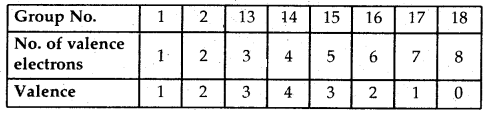
→ Significance: The number1 of valence electrons helps to calculate the common or Group Valence of the element. The group valence of the elements is generally either equal to the number of dots in Lewis Symbols or 8 minus the number of dots or valence electrons.

Facts for chemical bonding (Kossel)

  1. The highly electronegative halogens and highly electropositive alkali metals are separated by noble gases in the periodic table.
  2. The formation of a negative ion and a positive ion is due to the gain or loss of electrons by atoms.
  3. The negative and positive ions thus formed attain the nearest noble gas configuration. The noble gases (with the exception of He which has a duplet of electrons) have a particularly stable outer shell configuration of eight (Octet) electrons, ns2np6.
  4. The negative and positive ions are stabilized by electrostatic attraction.

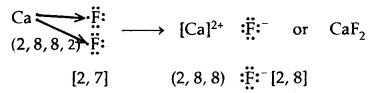
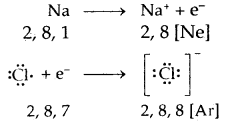
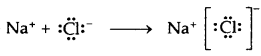
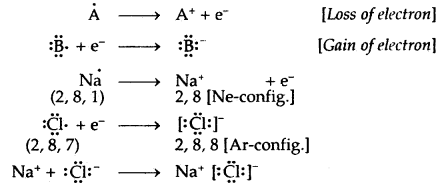
Electrovalent or Ionic Bond: When a bond is formed by complete transference of electrons from one atom to another so as to complete their octets or duplets the bond is called an ionic or electrovalent bond. For example
Chemical Bonding and Molecular Structure Class 11 Notes Chemistry 2
→ Formation of Calcium chloride
Chemical Bonding and Molecular Structure Class 11 Notes Chemistry 3
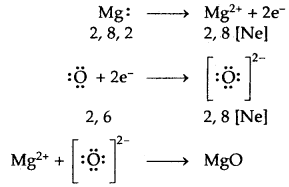
→ Formation of MgO
Chemical Bonding and Molecular Structure Class 11 Notes Chemistry 4
The no. of electrons gained or lost during the formation of an ionic bond is called the electro valency of the elements.

Factors favoring the formation of an ionic bond.

  1. Atom going to lose electrons must have low ionization enthalpy so that it can lose electrons readily. Elements of I and II. groups prefer to form, ionic bonds because they have low values of Ionisation enthalpy.
  2. Elements that accept electrons must have a High Negative Value of electron gain enthalpy so that they can retain the electrons. Halogens have high values of E.G. enthalpy.
  3. Lattice enthalpy should be high. This, in turn, depends upon.
    (a) Charge on the ion: Greater the charge on the ion, greater the lattice energy.
    (b) Size of the ions: Smaller the size of the ion, the greater the lattice energy.

→ Octet Rule: According to the electronic theory of chemical bonding as developed by Kossel and Lewis, atoms can combine either by transfer of valence electron’s from one atom to another (gain or loss) or by sharing valence electrons in order to have an octet in their valence shells. This is known as the Octet rule.

→ Covalent Bond: A covalent bond is formed as a result of the mutual sharing of electrons between the two atoms to complete their octet or duplet. No. of electrons contributed by each atom is called covalency.

If one pair of electrons (one electron from each atom) is mutually shared between the two atoms, a single covalent bond is formed.

Chemical Bonding and Molecular Structure Class 11 Notes Chemistry 5
If two pairs of electrons (two electrons from each atom) are mutually shared between the two atoms, a double covalent bond is formed.

Chemical Bonding and Molecular Structure Class 11 Notes Chemistry 6
If three pairs of electrons (three electrons from each atom) are mutually shared between the two atoms.

Chemical Bonding and Molecular Structure Class 11 Notes Chemistry 7
Chemical Bonding and Molecular Structure Class 11 Notes Chemistry 8
Lewis Representation of Simple Molecules (the Lewis Structures)
The Lewis dot structures provide a picture of bonding in molecules and ions in terms of the shared pairs of electrons and the octet rule. While such a picture may not explain the bonding and behavior of a molecule completely, it does help in understanding the formation and properties of the molecules to a large extent. Writing of Lewis dot structure m molecules is, therefore, very useful.

The Lewis-dot-structures can be written by adopting the following steps:
1. The total number of electrons required for writing the
structures is obtained by adding the valence electrons of the combining atoms. For example, in the CH4 molecule, there are eight valence electrons available .for bonding (4 from carbon and 4 from the four hydrogen atoms).

2. For anions, each negative charge would mean the addition of one electron. For cations, each positive charge would result in the subtraction of one electron from the total number of valence electrons. For example, for the CO32- ion, the 2- charges indicate that there are two additional electrons than those provided by the neutral atoms. For NH4+ ion, 1+ charge indicates the loss of the electrons from the group of neutral atoms.

3. Knowing the chemical symbols of the combining atoms and
having knowledge of the skeletal structure of the compound (known or guessed intelligently), it is easy to distribute the total number of electrons as bonding shared pairs between the atoms in proportion to the total bonds.

4. In general the least electronegative atom occupies the central position in the molecule/ion. For example in the NF3 and CO32-, nitrogen and carbon are the central atoms whereas fluorine and oxygen occupy the terminal positions.

5. After accounting for the shared pairs of electrons for single bonds, the remaining electron pairs are either utilized for multiple bonding or remain as the lone pairs. The basic requirement being that each bonded atom gets an octet of electrons.

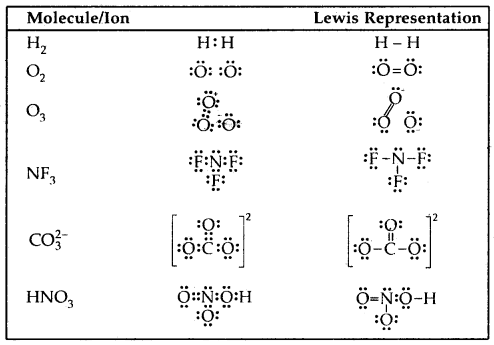
→ Lewis representation of a few molecules/ions are given in the table below:

Table: The Lewis Representation of Some Molecules
Chemical Bonding and Molecular Structure Class 11 Notes Chemistry 9
Each H atom attains the configuration of helium (a duplet of electrons)

→ Formal Charge: Lewis dot structures, generally, do not represent the actual shape of the molecules.

The formal charge of an atom in a polyatomic molecule or ion is the difference between the number of valence electrons in that atom in an isolated state or free State and the no. of electrons assigned to that atom in the Lewis structure.

Formal charge (F.C) on an atom in a Lewis structure = [total no. of valence electrons in the free atom] – [total no. of non-bonding or lone pair of electrons] – \(\frac{1}{2}\) [total no. of bonding (shared) electrons]

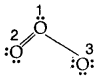
The molecule of O3 can be considered
Chemical Bonding and Molecular Structure Class 11 Notes Chemistry 10
The atoms have been numbered 1. 2 and 3

The formal charge on

  1. the central atom O marked 1
    = 6 – 2 – \(\frac{1}{2}\) [6] = + 1
  2. the end O atom marked 2 = 6 – 4 – \(\frac{1}{2}\)[4] = 0
  3. the end O atom marked 3 = 6 – 6 – \(\frac{1}{2}\)(2) = – 1

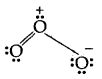
Hence we represent O3 along with formal charges as follows:
Chemical Bonding and Molecular Structure Class 11 Notes Chemistry 11
Generally, the lowest energy structure is the one with the smallest formal charges on the atoms. The formal charge is a factor based on a pure covalent view of bonding in which electron pairs are shared equally by neighboring atoms.

Limitations of the Octet Rule: It is mainly useful to understand the structures of organic compounds and applies to the elements of the second period of the periodic table. But it is not universal.

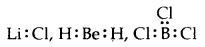
1. The incomplete octet of the central atom: In some compounds, the number of electrons surrounding the central atom is less than eight. This especially is the case with elements having less than four valence electrons. Examples are LiCl, BeH2 and BCl3
Chemical Bonding and Molecular Structure Class 11 Notes Chemistry 12
Li, Be and B have 1, 2, and 3 valence electrons only. Other such compounds are AlCl3 and BF3.

2. Odd electrons molecules: In molecules with an odd number of electrons like nitric oxide, NO, and nitrogen oxide, NO2, the octet rule is not satisfied for all the atoms.

Chemical Bonding and Molecular Structure Class 11 Notes Chemistry 13
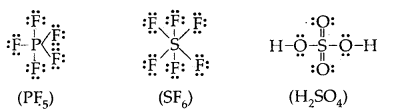
3. The expanded octet Elements in and beyond the third period of the periodic table have, apart from 3s and 3p orbitals, 3d orbitals are available for bonding. In a number of compounds of these elements, there are more than eight valence electrons around the central atom. This is termed the expanded octet. The octet rule does not apply in such cases.

Some of the examples of such compounds and PF3, SF6, H2SO4, and a number of coordination compounds.
Chemical Bonding and Molecular Structure Class 11 Notes Chemistry 14
4. It is clear that the octet rule is based upon the chemical inertness of noble gases. However, some noble gases (Xenon and Krypton) also combine with oxygen and fluorine to form a number of compounds like XeF2, XeF4, SeOF2, KIF2, etc.

5. The theory does not account for the shape of molecules.

6. It does not explain the relative stability of the molecules being totally silent about the energy of a molecule.

Ionic or Electrovalent Bond: An ionic (or electrovalent) bond is formed by a complete transfer of one or more electrons from the atom of metal to that of a non-metal.

As a result of this electron transfer, the following changes occur in the reacting atoms.
(a) Both the atoms acquire stable noble gas configuration.
(b) The atom that loses its electrons becomes positively charged ions called a cation, whereas the atoms which gain these electrons becomes negatively charged ion called an anion.
(c) The two oppositely charged ions, i.e., ‘he cation and the anion, are then held together by the Coulomb forces of attraction to form an ionic bond.

Thus, an ionic bond that may be defined as the Coulomb force of attraction which holds the oppositely charged ions together is called an ionic bond.
1. Lattice Enthalpy (Lattice energy): The Lattice enthalpy of an ionic solid is defined as the energy required to completely separate one mole of a solid ionic compound into gaseous constituent ions. For example, the lattice enthalpy of NaCl is 788 kJ mol-1. This means that 788 kJ of energy is required to separate to an infinite distance 1 mol of solid NaCl into 1 mol of Na+ (g) and mole of Cl (g).
Chemical Bonding and Molecular Structure Class 11 Notes Chemistry 15
For two atoms to form an ionic bond, the following factors are necessary

  1. Low ionization enthalpy. The atom going to lose electrons must have a low value of ionization enthalpy.
  2. High electron gain enthalpy. The atom going to accept electrons must have a high negative value of electron gain enthalpy.
  3. High lattice enthalpy. The lattice energy of the compound should be high. The greater the charge on the ion and the smaller the size, the greater is the lattice enthalpy.

An ionic bond is formed if lattice energy and electron affinity took together are greater than ionization energy. The larger the negative value of lattice energy greater is than the stability of the ionic compound. The stability of an ionic compound is provided by its enthalpy of lattice formation and not simply by achieving an octet of electrons around the ionic species in a gaseous state.

Example of Ionic Bond
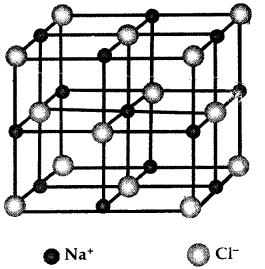
Chemical Bonding and Molecular Structure Class 11 Notes Chemistry 16
One Na+ is surrounded by C Cl ions and vice-versa Rock Salt Structure
1. Na+ Cl (Ionic Solid)
Chemical Bonding and Molecular Structure Class 11 Notes Chemistry 17
Chemical Bonding and Molecular Structure Class 11 Notes Chemistry 18
2. MgO
Chemical Bonding and Molecular Structure Class 11 Notes Chemistry 19
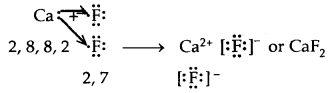
3. CaF2
Chemical Bonding and Molecular Structure Class 11 Notes Chemistry 20

Properties of Ionic solids:

  1. Ionic compounds are solids, whereas covalent compounds can be solids, liquids, or gases.
  2. Ionic compounds do not contain molecules but are made up of ions, whereas covalent compounds are molecular.
  3. Ionic compounds have high melting points and boiling points due to strong electrostatic forces of attraction between ions. Covalent compounds, on the other hand, have low melting points and boiling points.
  4. Ionic compounds are generally soluble in water or any polar
    solvent whereas covalent compounds are insoluble in water, but soluble in non-polar solvents.
  5. Ionic compounds take part in ionic reactions whereas covalent compounds take part in molecular reactions.
  6. Ionic bonds are non-directional in nature, whereas covalent bonds have directional characteristics.

Bond Parameters
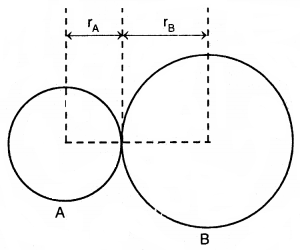
1. Bond length: Bond length is defined as the equilibrium distance between the nuclei of two bonded atoms in a molecule. Bond lengths are measured by spectroscopic, X-ray diffraction, and electron diffraction techniques. Each atom of the bonded pair contributes to the bond length (Fig.) In the case of a covalent bond, the contribution from each atom is called the covalent radius of that atom.
Chemical Bonding and Molecular Structure Class 11 Notes Chemistry 21
The bond length in a covalent molecule AB
R = rA + rB (R is the bond length and rA and rB are the covalent radii of atoms A and B respectively)

The covalent radius is measured approximately as the radius of an atom’s core which is in contact with the core of an adjacent atom in a bonded situation. The covalent radius is half of the distance between two similar atoms joined by a covalent bond in the same molecule.

The van der Waals radius represents the overall size of the atom which includes its valence shell in a nonbonded situation. Further, the van der Waals radius is half of the distance between two similar atoms in separate molecules in a solid. Covalent and van der Waals radii of chlorine and depicted in Fig.
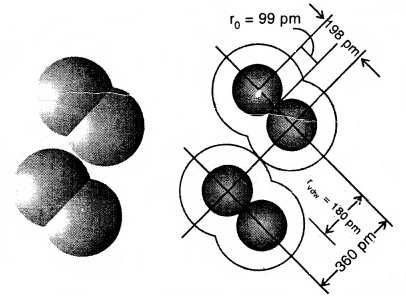
Chemical Bonding and Molecular Structure Class 11 Notes Chemistry 22
Covalent and van der Waals radii in a chlorine molecule. The inner circles correspond to the size of the chlorine atom (rvdw and r0 are van der Waals and covalent radii respectively)

2. Bond angle: It is defined as the angle between the orbitals containing bonding electron pairs around the central atom in a molecule/complexion. For example, the bond angle in water can be represented as under:
Chemical Bonding and Molecular Structure Class 11 Notes Chemistry 23
3. Bond enthalpy: It is defined as the amount of energy required to break one mole of bonds of a particular type between two atoms in a gaseous state.

The unit of bond enthalpy is kJ mol-1 For example H-H bond enthalpy in hydrogen molecule is 435.8 kJ mol-1
H2 (g) → H (g) + H (g); ΔH = 435.8 kj mol-1

4. Bond order: In the Lewis description of the covalent bond the bond order is given by the number of bonds between the two atoms in a molecule. The bond order in H2 is one, in O2 it is two and in N2 it is three.

Isoelectronic molecules and ions have identical bond orders. For example F2 and O22- have bond order = 1.N2, CO and NO+ have bond order 3.

The stabilities of molecules can be understood by the statement. With the increase in bond order, bond enthalpy increases and bond length decreases.

5. Resonance structures: According to the concept of resonance, whenever a single Lewis structure cannot describe a molecule accurately, a number of structures with similar energy, positions of nuclei, bonding, and non-bonding pairs of electrons are taken as the canonical structures of the resonance hybrid which describes the molecule accurately. Thus for Cl the two structures shown below constitute the canonical structures and their hybrid, (III, below) represents the structure of O, more accurately. Resonance is represented by a double-headed arrow.
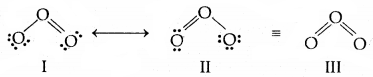
Chemical Bonding and Molecular Structure Class 11 Notes Chemistry 24
Resonance in O3 molecule. I and II represent the two canonical forms III is the resonance hybrid.

Some of the other examples of resonance structures are provided by the carbonate ion and the carbon dioxide molecule.
1. Carbonate ion (CO3)

Chemical Bonding and Molecular Structure Class 11 Notes Chemistry 25
2. Carbon-dioxide
Chemical Bonding and Molecular Structure Class 11 Notes Chemistry 26
6. Electronegativity: The electronegativity is the ability of an atom of an element in a molecule to attract electrons towards itself in a shared pair of electrons.

Table: Difference between electronegativity and electron affinity (electron gain enthalpy)

ElectronegativityElectron affinity (electron gain enthalpy)
1. It is the tendency of an atom to attract shared pair of electrons.1. It is the tendency of an atom to attract outside electrons.
2. It is the property of a bonded atom.2. It is the property of an isolated atom.
3. The elements with symmetrical configurations have specific electronegativities.3. The elements with symmetrical configurations have almost zero electron affinities.
4. It has no units.4. It has units of kJ mol-1 of V atom-1

7. Polarity of Bonds: An ionic bond is formed due to the complete transfer of electrons from one atom to another. A covalent bond is formed due to the mutual sharing of electrons. A covalent bond between two atoms of different elements is called a polar covalent bond. A polar bond is partly covalent bond and partly ionic. The percentage of ionicity in a covalent bond is called the percentage ionic character in that bond. The ionic character in a bond is expressed in terms of bond dipole moment (μ).

The dipole moment of a bond depends upon the difference in the electronegativity of the two atoms held together by the chemical bond.

The dipole moment of two and opposite charges is given by the product of the charge and the distance separating them. Thus
Dipole moment, μ = charge (q) × Distance separation (r)
= q × r

In the HCl molecule, the chlorine is more electronegative. Therefore, the bonding electrons lie closer to the chlorine atom. As a result, H- atom develops a slight positive (+q) and Cl atom a slight negative (-q) charge, thereby generating a dipole in the HC1 molecule.

Chemical Bonding and Molecular Structure Class 11 Notes Chemistry 27
For non-polar bonds, there is no charge separation. Therefore, q = 0. As a result, the dipole moment of a non-polar bond is zero.

Dipole moment and the ionic character in bonds: Ionic character in a covalent bond depends upon the difference between the electronegativity of two atoms. The greater the electronegativity difference, the greater is the charge separation, and therefore, the greater is the ionic character in the bond.

The valence shell electron pair repulsion (VSEPR) theory: The main postulates of the VSEPR theory are:

  1. Pairs of electrons in the valence shell of a central atom repel each other.
  2. These pairs of electrons tend to occupy positions in space that minimize repulsion and thus maximize distances between them.
  3. The valence shell is taken as a sphere with the electron pairs localizing on the spherical surface at a maximum distance away from one another.
  4. Multiple bonds are treated as if it is a single electron pair and the two or the three electron pairs of multiple bonds are treated as single super pair.
  5. Where two or more resonance structures can depict a molecule, the VSEPR model is applicable to any such structure.

Predicting the shape of molecules on the basis of VSEPR theory: According to the VSEPR theory/the geometry of a molecule is determined by the number of electron pairs around the central atom. So to predict the geometry of the molecules, no. of electron pairs (both shared and one pair) should be known.

The repulsive interactions of electron pairs decrease in the order l – l – p > l – pb – p > b – pb – p repulsions.

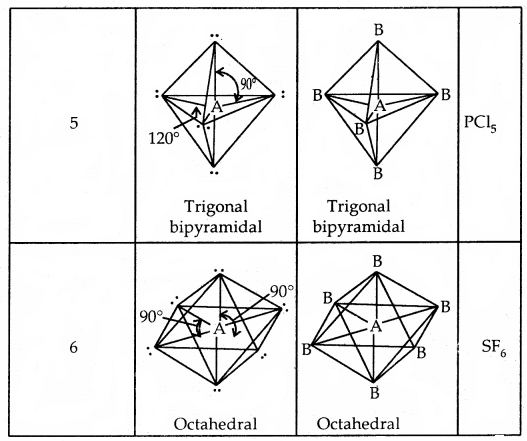
The geometry of Molecules in which the Central Atom has No Lone Pair of Electrons
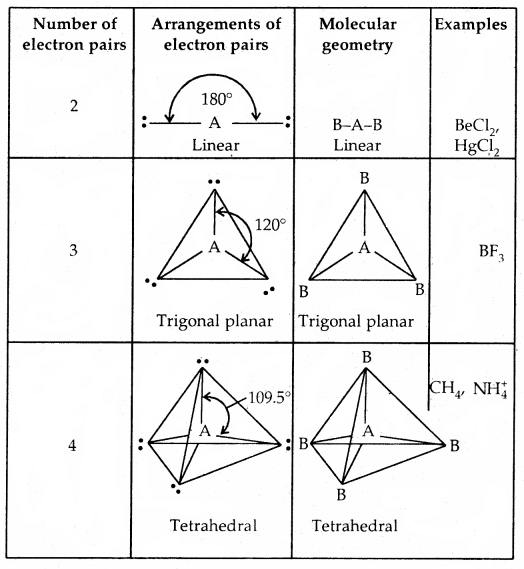
Chemical Bonding and Molecular Structure Class 11 Notes Chemistry 28
Chemical Bonding and Molecular Structure Class 11 Notes Chemistry 29
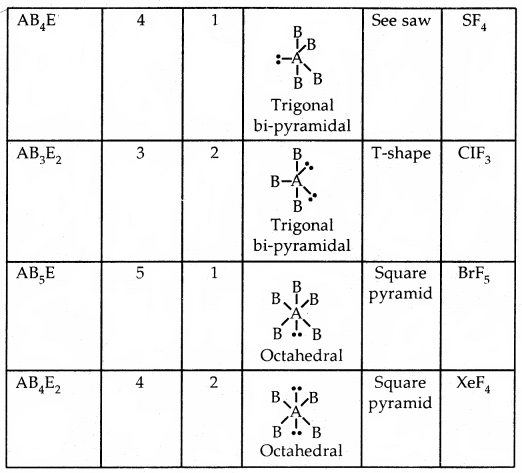
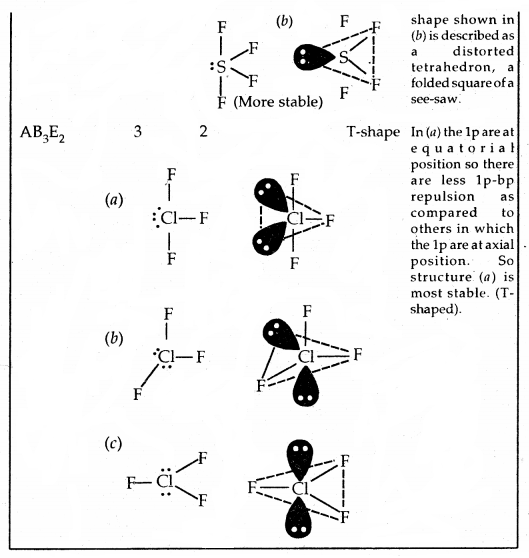
Shapes (Geometries) of some simple molecules/ions with central Ions having One or More Lone Pairs of Electron (E)
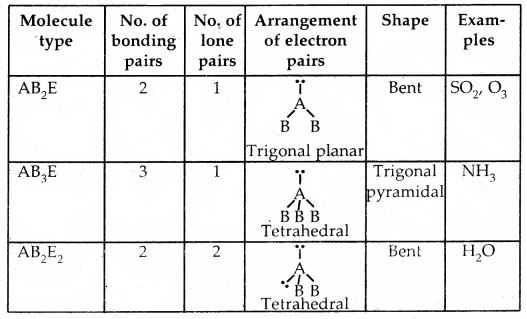
Chemical Bonding and Molecular Structure Class 11 Notes Chemistry 30
Chemical Bonding and Molecular Structure Class 11 Notes Chemistry 31
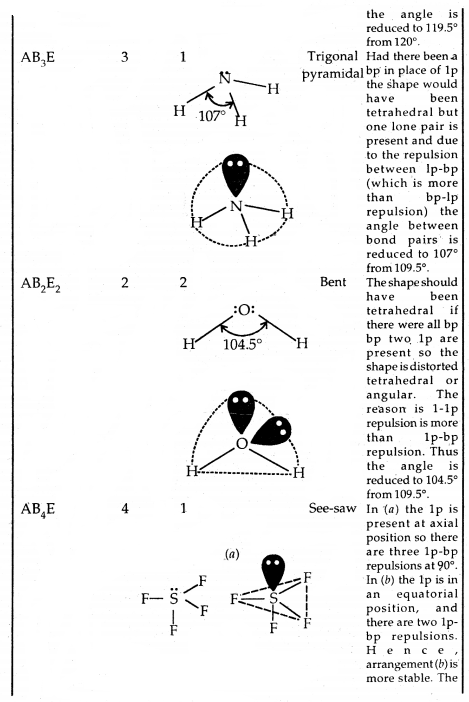
Shapes of Molecules containing Bond Pair and Lone Pair
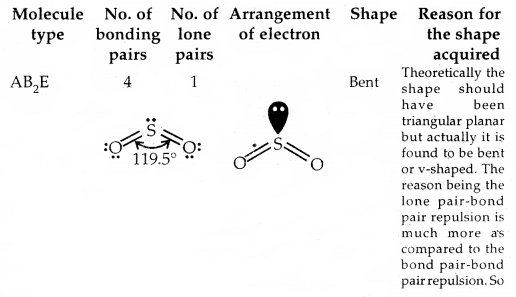
Chemical Bonding and Molecular Structure Class 11 Notes Chemistry 32
Chemical Bonding and Molecular Structure Class 11 Notes Chemistry 33
Chemical Bonding and Molecular Structure Class 11 Notes Chemistry 34
Valence Bond Theory: The main postulates of the valence bond theory are:

  1. A covalent bond is formed due to the overlap of the outermost half-filled orbitals of the combining atoms. The strength of the bond is determined by the extent of overlap.
  2. The two half-filled orbitals involved in the covalent bond formation should contain electrons with opposite spins. The two electrons then move under the influence of both nuclei.
  3. The completely-filled orbitals (orbitals containing two paired electrons) do not take part in the bond formation.
  4. An s-orbital does not show any preference for direction. The non-spherical orbitals such as p-and d-orbitals tend to form bonds in the direction of the maximum overlap, i.e., along the orbitals axis.
  5. Between the two orbitals of the same energy; the orbital which is non-spherical (e.g., p- and d-orbitals forms stronger bonds than the orbitals which are spherically symmetrical, e.g., s-orbital.
  6. The valence of an element is equal to the number of half-filled orbitals present in it.

In the valence bond model, the stability of a molecule is explained in terms of the following type of interactions:
(a) electron-nuclei attraction interactions, i.e., the electrons of one atom are attracted by the nucleus of the other atom also.
(b) electron-electron repulsive interactions, i.e., electrons of one atom are repelled by the electrons of the other atom.
(c) nucleus-nucleus repulsive interactions, i.e., the nucleus of one atom is repelled by the nucleus of the other atom.

Valence Bond Description of Hydrogen molecule: A hydrogen molecule is a stable molecule. That is why one mole of H2 molecules requires energy equal to 433 kJ to dissociate into hydrogen atoms, viz.
H2 (g) + 433 kJ → 2H (g)

The formation of a hydrogen molecule from two hydrogen atoms may be considered to take place through the following steps:
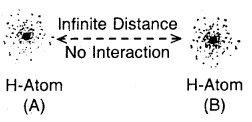
Step 1. Consider two hydrogen atoms HA and HB at large separation from each other, so that there is no interaction between them. Since, there is no interaction between the two H atoms, hence the total energy is equal to the sum of the energies of the two H atoms. (Fig. a)
Chemical Bonding and Molecular Structure Class 11 Notes Chemistry 35
(a) No interactions at large distances

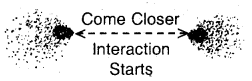
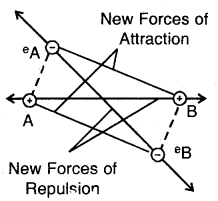
Step 2. Now, let the two H atoms approach each other. When the two atoms come closer new attractive and repulsive forces begin to operate. The electrons of one atom are attracted by the nucleus of the other atom. At this stage, both the electrons are attracted by both nuclei. Since, attractive interactions lead to a decrease of energy, hence as the two
Chemical Bonding and Molecular Structure Class 11 Notes Chemistry 36
(b) Interactions start as atoms come closer.
atoms approach each other the energy of the system starts decreasing. (Fig. b, e, d).

Step 3. When two hydrogen atoms, HA and HB come still closer the electron-electron (eA — eB) and the nucleus- nucleus repulsive interactions start operating. The repulsive interaction tends to increase energy. As long as the attractive interactions are stronger than the repulsive interactions, the energy of the system continues to decrease.

At a certain distance between the two atoms, the attractive and repulsive interaction balance each other, and the energy of the system attains a minimum value. At the state, two H atoms have a fixed distance between them and form a stable H2 molecule. The internuclear separation when the energy of the system is minimum is called bond length The H—H bond length in H2(g) is 75 pm (0.74 A).
Chemical Bonding and Molecular Structure Class 11 Notes Chemistry 37
New forces of attraction and repulsion between two H-atoms approaching each other

Step 4. Now, if the two H- atoms in an H2 molecule are formed to come closer than the equilibrium internuclear separation (bond length: 74 pm), the repulsive forces start predominating and as a result, the energy of the system increases very sharply (Fig. above)
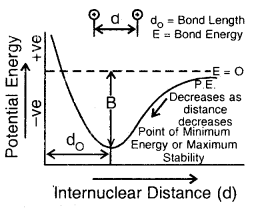
Chemical Bonding and Molecular Structure Class 11 Notes Chemistry 38
(d) Potential energy diagram showing the variation of energy with the internuclear distance between two H-atoms

2. Overlap of atomic orbitals: Various types of atomic orbitals overlap leading to the formation of covalent bonds are:
(a) s-s overlap: In this type of overlap, half-filled s-orbital of the two combining atoms overlap each other.
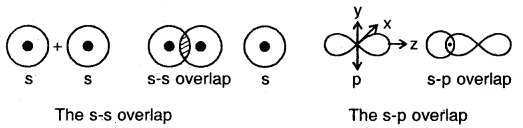
Chemical Bonding and Molecular Structure Class 11 Notes Chemistry 42
(b) s-p overlap: Here a half-filled s-orbital of one atom overlaps with one of the p-orbitals having only one electron in it.

(c) p-p overlap along the orbital axis: This is called head-on, end-on, or end-to-end linear overlap. Here, the overlap of the two half-filled p-orbitals takes place along the line joining the two nuclei.
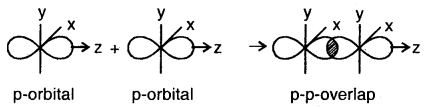
Chemical Bonding and Molecular Structure Class 11 Notes Chemistry 43
(d) p-p sideways overlap: This is also called lateral overlap, in this type of overlap, two p-orbitals overlap each other along a line perpendicular to the internuclear axis, i.e., the two overlapping p- orbitals are parallel to each other.
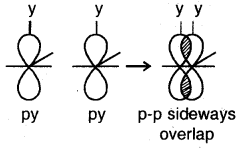
Chemical Bonding and Molecular Structure Class 11 Notes Chemistry 44
The p-p sideways overlap

Hybridization of Atomic Orbitals:
Hybridization: It may be defined as the phenomenon of mixing of orbitals of nearly the same energy so as to redistribute their energies and to give rise to new orbitals of equivalent energies and shapes.

The new orbitals that are formed are called hybridized or hybrid orbitals. As a general rule, the number of hybrid orbitals produced from hybridization is equal to the number of orbitals that are mixed together. For example, when an s orbital is mixed with a p orbital two sp hybrid orbitals are produced. The two orbitals lie in a straight line and make an angle of 180°. Examples of molecules with sp hybrid orbitals are BeF2 and CH ≡ CH (acetylene).
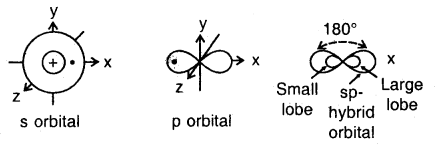
Chemical Bonding and Molecular Structure Class 11 Notes Chemistry 39
The ground state configuration of the boron is 1 s22s22p1x. If one of the 2s electrons is promoted to an orbital of a little higher energy, say 2p1y orbital, then the configuration 1s2 2s1 2p1 2p1y would result. The three equivalent orbitals formed from one 2s and two 2p orbitals are called sp2 hybrid orbitals, which are coplanar and directed at an angle of 120° to each other as shown. The orbitals form a stronger bond than the sp orbitals.
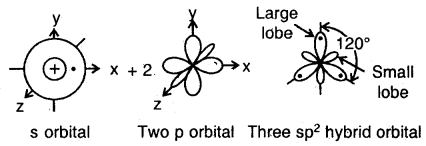
Chemical Bonding and Molecular Structure Class 11 Notes Chemistry 40

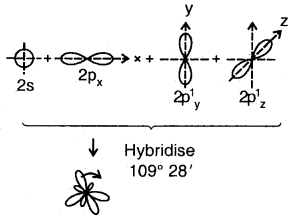
sp3 Hybridization: The ground state configuration of carbon = 6 = 1s2, 2s2, 2px1 2p1y
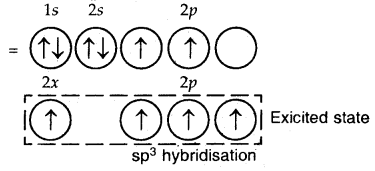
Chemical Bonding and Molecular Structure Class 11 Notes Chemistry 41
Chemical Bonding and Molecular Structure Class 11 Notes Chemistry 45
4sp3 hybrid orbitals of C

The four sp3 hybrid orbitals are directed towards the four corners of the tetrahedron. The bond angles are 109°28′.

Example of sp3 hybridization: Shape of CH4
The shape of CH4 Molecule
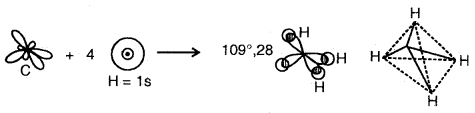
Chemical Bonding and Molecular Structure Class 11 Notes Chemistry 46
4sp3 hybrid orbitais of C

Sigma (σ) and Pi (π) bonds
1. Sigma (σ) Bond: It is formed as a result of s-s, s-p, or p-p overlap axially or on the internuclear axis. A sigma bond îs strong as a result of overlapping on the internuclear axis.
1. Combination of s-orbitais
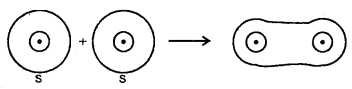
Chemical Bonding and Molecular Structure Class 11 Notes Chemistry 47
2. Combina Lion of s- and p- orbitais bond
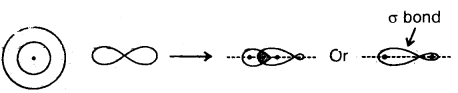
Chemical Bonding and Molecular Structure Class 11 Notes Chemistry 48
3. End to end combination of two p-orbitals
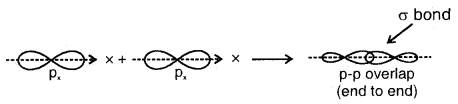
Chemical Bonding and Molecular Structure Class 11 Notes Chemistry 49
2. Pi (π) Bond: When a bond is formed by the lateral or sideways overlapping of atomic orbitals, it is known as a pi (π) bond. A π bond is weaker than a bond as the overlapping is not effective and is made up of two half-electron-clouds, 1/2 above and 1/2 below the internuclear axis. It is always present in addition to ao bond in molecules containing a double bond or a triple bond. Between two atoms forming a single covalent bond, it has to be a bond. A Pi (π) bond has no primary effect on the direction of the bond. It however shortens the internuclear distance.
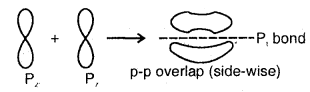
Chemical Bonding and Molecular Structure Class 11 Notes Chemistry 50
The relative bond strength.has the order p-p < s-p < s-s

In addition to the sp hybridization in BeF2 sp2 hybridization in BF3 and sp3 hybridization in CH4, we have hybridization involving d-orbitals also.

The elements of the third period contain d-orbitals also in addition to s and p orbitals. The 3d orbitals are comparable in energy to 3s and 3p orbitals.

Due to the availability of d orbitals, valencies of 5, 6, and 7 are also expected.
1. sp3d hybridization. This involves the mixing of one s three p and one d-orbitals. These orbitals hybridize to form five sp3d hybrid orbitals which are directed towards the corners of a regular trigonal bipyramidal geometry. For example, PF5 has this geometry.

2. sp3d2 hybridization. This involves the mixing of one-s orbital, three p, and two d-orbitals. These six orbitals hybridize to form, six sp3d2 hybrid orbitals which are directed towards the corners of an octahedral geometry. For example, the SF6 molecule has octahedral geometry.

3. sp3d3 hybridization. This involves the mixing of one s, three p, and three-d orbitals forming seven sp3d3 hybrid orbitals. These adopt pentagonal bipyramidal geometry. For example, IF7 has this geometry.

4. dsp2 hybridization. In this case, one d(dx2– y2), one, and two p orbitals get hybridized to form four dsp2 hybrid orbitals. These hybrid orbitals have square planar geometry. For example [Ni(CN)4]2- ion.

Molecular Orbital Theory: Molecular orbital theory was developed by Hund and Milliken in 1932. The basic idea of molecular orbitals theory is that atomic orbitals of individual atoms combine to form molecular orbitals. The electrons in molecules are present in these molecular orbitals which are associated with several nuclei. These molecular orbitals are filled in the same way as the atomic orbitals in atoms are filled.

The molecular orbitals are formed by the combination of atomic orbitals of the bonded atoms.

The salient features of the Molecular orbital theory are:

  1. The electrons in a molecule are present in the various molecular orbitals as the electrons of atoms are present in the various atomic orbitals.
  2. The atomic orbitals of comparable energies and proper symmetry combine to form molecular orbitals.
  3. While an electron in an atomic orbital is influenced by one nucleus, in a molecular orbital, it is influenced by two or more nuclei depending upon the number of atoms in the molecule. Therefore, we can call- a molecule orbital Polycentric.
  4. The no. of MOs formed is equal to the no. of combining AOs. When two atomic orbitals combine, two MOs are formed. One is called bonding molecular orbital and the other is called an antibonding molecular orbital.
  5. The bonding MO has lower energy and hence greater stability than the corresponding antibonding MO.
  6. Just as the electron probability distribution around a nucleus in an atom is given by an atomic orbital the electron probability distribution around a group of nuclei in a molecule is given by a molecular orbital.
  7. The MOs obey the Aufbau principle, Pauli Exclusion principle, and Hund’s rule like AOs.

Formation of Molecular Orbitals/Linear Combination of Atomic Orbitals (ICAO)
If φA and φB represent the wave functions of atomic orbitals A and B of hydrogen atoms forming hydrogen molecule, then
φMO = φA ± φB
Therefore the two molecular orbitals a and a* are formed as follows:
σ = φA + φB
σ* = φA – φB
where σ is called bonding molecular orbital and σ* is called an antibonding molecular orbital.

For example, s-orbitals of two hydrogen atoms combine to form two MOs — σ1s and σ*1s (bonding and antibonding MOs).

Similarly, 2s atomic orbitals may combine to form two MOs: σ2s and σ*2s.
If the 2 axes is assumed to be the internuclear axis, then 2p atomic orbitals combine to form sigma orbitals. The 2pz atomic orbitals combine to form aMOs (σ2pz, σ*2pz) while 2px and 2py orbitals combine to form nMOs (π2px, π*2px, π2py, π*2py).

Energy Level Diagrams for Molecular Orbitals: 1s, 2s and 2p orbitals of two atoms combine to form bonding MOs: σ1s, σ2s, σ2pz, π2px, π2py. and antibonding MOs:

σ*l s,’ σ*2s, σ*2pz, π*2px and π*2py. The energy levels of these molecular orbitals have been determined experimentally by spectroscopic methods. It is observed that for diatomic molecules of the second period Li2 to Ne2 there are two types of energy levels of MOs. For molecules Li2, Be2, B2, C2, and N2 the sequence of energies of MOs may be written as
σ1s, σ*ls, σ2s, σ*2s, π2px = π2py, σ2pz, π*2px π*2py, σ*2pz

On the other hand, for the molecule 02, F2 and Ne2.the sequence of energies of MOs are:
σ1s, σ1s, σ2s, σ*2s, σ2pz, π2px = π2py, π*2px = π*2py, σ*2pz.

The main difference between the two types of sequences is that for molecules O2, F2 and Ne2, the σ2pz MO is lower in energy than π2px and π2py MOs while in the case of molecules Li2, Be2, B2, C2, and N2, σ2pz MOs higher energy than π2px arid π2py MOs.

Bond Order: It is defined as the number of covalent bonds in a molecule. Bond order can .be calculated from the number of electrons in bonding and antibonding molecular orbitals as:

Bond order = \(\frac{\text {No. of electrons in bonding MOs-No. of electrons in anit-bonding MOs }}{2}\)
or
= \(\frac{\mathrm{N}_{b}-\mathrm{N}_{a}}{2}\)

The bond orders of 1, 2, or 3 correspond to the single, double, or triple bonds. But bond order may be fractional also in some cases.

Information Conveyed by Bond Order.

  1. If the value of bond order is positive; it indicates a stable molecule and if the value of bond order is negative or zero, it means that the molecule is unstable.
  2. The stability of a molecule is measured by its bond
    dissociation energy. But the bond dissociation energy is directly proportional to the bond order.
  3. Bond order is inversely proportional to the bond length. The higher the bond order value, the smaller is the bond length.
  4. If all electrons are doubly occupied in different molecular orbitals the molecule is diamagnetic. If there are one or more unpaired electrons, it is paramagnetic like O2.

Conditions for the combination of Atomic Orbitals:

  1. The combining atomic orbitals must have the same or nearly the same energy. This means that Is orbital can combine with another 1s, but not with 2s orbitals because the energy of 2s is appreciably higher than that of Is.
  2. The combining atomic orbitals must have the same symmetry as the molecular axis.
  3. The combining atomic orbitals must overlap to the maximum extent. In this type, sigma (σ) molecular orbitals are symmetrical around the bond axis while pi (π) molecular orbitals are not symmetrical. If the internuclear axis is taken to be in the Z-direction it can be seen that a linear combination of 2pz-orbitals of two atoms also produces two sigma molecular orbitals σ2pz and σ*2pz.

Molecular orbitals obtained from 2px and 2py orbitals are not symmetrical around the bond axis because of the positive lobes above and negative lobes below the molecular plane. Such molecular orbitals are labeled as π and π*. A π bonding MO has a large electron density above and below the internuclear axis. The σ* antibonding MO has a node between the nuclei.
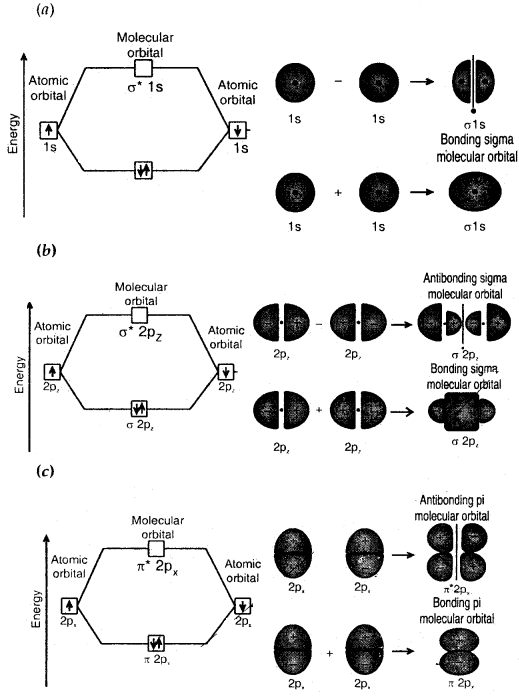
Chemical Bonding and Molecular Structure Class 11 Notes Chemistry 51
Contoursmnd energies of bonding and antibonding molecular orbitals formed through combinations of (a) Is atomic orbitals; (b) 2pz atomic orbitals and (c) 2px atomic orbitals

Molecular Orbital Electronic Configurations: Molecular orbital electronic configurations of some molecules/ions are given below:
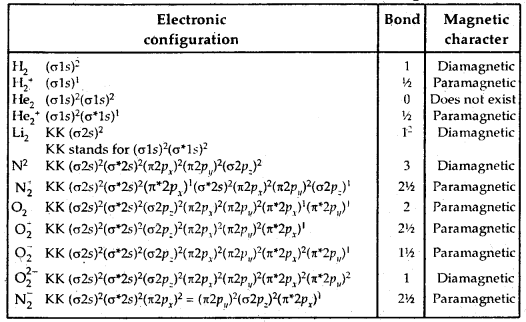
Chemical Bonding and Molecular Structure Class 11 Notes Chemistry 52
→ Hydrogen Bond: The attractive force which binds the hydrogen atom of one molecule with the electronegative atom (F, O, N) of another molecule is known as a hydrogen bond.

A hydrogen bond is weaker than a covalent bond. The strength of a hydrogen bond ranges from 10 – 40 kJ mol-1 while that of a normal covalent bond is of the order of 400 kJ mol-1

Cause of formation of the hydrogen bond. When hydrogen is bonded to a strongly electronegative element, A (such as F, O, or N) the electron pair shared between the two atoms lies far away from the hydrogen atom. As a result, the hydrogen atom becomes highly electropositive with respect to the other atom, A.

Since the electrons are displaced towards A, it acquires partial charge (δ+). In other words, the bond H-A becomes polar and may be represented as Hδ+ – Aδ. The electrostatic force of attraction between positively charged hydrogen- atom of one molecule and negatively charged atom of neighboring molecule results in the formation of the hydrogen bond. This may be represented as:

Chemical Bonding and Molecular Structure Class 11 Notes Chemistry 53
Conditions for Hydrogen Bonding: The conditions for hydrogen bonding are:

  1. The molecule must contain a hydrogen atom attached to the highly electronegative atom (F, O, or N).
  2. The size of the electronegative atom should be quite small. (HF), water (H2O), ammonia (NH,) alcohols (ROH), carboxylic acids (RCOOH), amines (RNH2), etc. Due to hydrogen bonding, some of the properties of these molecules are influenced.

→ Types of Hydrogen Bonds: Hydrogen bonding may be classified into two types.
(a) Intermolecular hydrogen bond: It is a hydrogen bond formed between two different molecules of the sai^e or different substances. This type of linking results in the association of molecules and increases the melting point, boiling point, viscosity, solubility, etc.

Chemical Bonding and Molecular Structure Class 11 Notes Chemistry 54
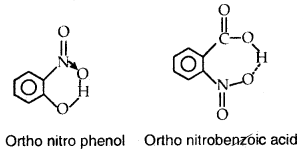
(b) Intramolecular hydrogen bond: Intramolecular hydrogen bond is formed between the hydrogen atom and the highly electronegative atom (F, O, or N) present in the same molecule. An intramolecular hydrogen bond results in the cyclization of the molecules and prevents their association. Consequently, the effect of intramolecular hydrogen bonds on physical properties is negligible.

For example, intramolecular hydrogen bonds are present in molecules such as o-nitro phenol, o-nitro benzoic acid, etc.
Ortho nitro phenol Ortho nitrobephobic acid
Chemical Bonding and Molecular Structure Class 11 Notes Chemistry 55
→ Chemical Bond: The force which holds the constituent atoms together with a molecule is called a chemical bond.

→ Electrovalent or Ionic bond: A bond formed by the complete transference of electrons from one atom to another to acquire the stable electronic configuration of the nearest gas is called an Ionic bond.

→ Electrovalency: The number of electrons so transferred (gained or lost) is called the electrovalency of the element.

→ Covalent Bond: When two atoms share the electrons mutually in order to complete their octet or duplet, the bond so formed is called a covalent bond.

→ Coordinate Bond: When the electron pair shared between the two atoms is donated by one of the two atoms, it is called a coordinate bond.

→ Sigma (σ) bond: When a bond is formed between the two atoms by the overlap of their atomic orbitals along the internuclear axis (end to end of head-on overlap) the bond so formed is called sigma (σ) bond.
It is due to s-s, s-p, p-p overlap.

→ Pi (π) Bond: It is formed by the side-wise or lateral overlap of only p-orbitals in a direction perpendicular to the internuclear axis.

  1. Pi (π) bond is weaker than a sigma (σ) bond.
  2. Whenever a Pi (π) bond is formed, it is formed in addition to a sigma (σ) bond in multiple bonds (a double or triple bond)
  3. A single bond between the 2 atoms is always a sigma (σ) bond.

→ Bond length: The average distance between the centers of the nuclei of the two bonded atoms is called it’s the bond length.

→ Bond Enthalpy (Bond Energy): The energy required to break one mole of a particular type of bond so as to separate them into gaseous atoms is called bond dissociation energy or bond energy.

→ Dipole Moment: The product of the magnitude of charge (q) and the distance (d) between the centers of charges is called a dipole moment. Mathematically
Dipole moment = µ = q × d

→ Hybridization: It is the phenomenon of mixing of the atomic orbitals belonging to the same atom but having slightly different energies so that redistribution of energy takes place between them resulting in the formation of new orbitals of equal energies and identical shapes.

→ Hydrogen bonding: It can be defined as the attractive force which binds the hydrogen atom of one molecule with the more electronegative atom (like F, O, or N) of another molecule.

  1. Intermolecular hydrogen bond: It is formed between two different molecules of the same or different compounds like H-bonds in water (H2O), alcohol (R-OH), and HF.
  2. Intramolecular hydrogen bond: It is formed between the H atom and the more electronegative atom (F, O, or N) within the same molecule as in o-nitrophenol.

Chemical Bonding and Molecular Structure Class 11 Notes Chemistry 56
→ Ionic compound: It is a three-dimensional aggregation of positive and negative ions in an ordered arrangement called the crystal lattice.

→ Valence Shell Electron Pair Repulsion (VSEPR) Theory: According to this theory used to explain the geometrical shapes of molecules-molecular geometry is determined by repulsions between lone pairs and bond pairs as follows: The order of these repulsions is lone pair-lone pair > lone pair-bond pair > bond pair-bond pair.

→ Bond Angle: It is defined as the angle between the orbitals containing bonding electron pairs around the central atom in a molecule or complexion.
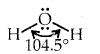
Chemical Bonding and Molecular Structure Class 11 Notes Chemistry 57
The bond angle in the water of H-O-H is 104.5° as shown above.

→ Bond enthalpy: It is defined as the amount of energy required to break one mole of bonds of a particular type between two atoms in a gaseous state. The unit of bond enthalpy is kJ m-1.

→ Bond order: In the Lewis description of covalent bond, the Bond order is given by the number of bonds between the two atoms in a molecule, e.g., bond orders in H2 (H-H), O7(O = O), and N2(N = N) are 1, 2 and 3 respectively.

→ Resonance: Whenever a single Lewis structure cannot explain all the observed properties of a molecule, a number of structures with almost similar energy, positions of the nuclei, bonding, and non-bonding pairs of electrons are taken as the canonical structures of the hybrid which describes the molecule accurately.
Development Of Biotechnology

Learninsta presents the core concepts of Biology with high-quality research papers and topical review articles.

Development Of Biotechnology

Biotechnology has developed by leaps and bounds during the past century and its development can be well understood under two main heads namely conventional or traditional biotechnology and modern biotechnology.

1. Conventional or traditional biotechnology:
This is the kitchen technology developed by our ancestors, and it is as old as human civilization. It uses bacteria and other microbes in the daily usage for preparation of dairy products like curd, ghee, cheese and in preparation of foods like idli, dosa, nan, bread and pizza.

This conventional biotechnology also extends to preparation of alcoholic beverages like beer, wine, etc. With the advancement of the science and technology during the 18th century, these kitchen technologies gained scientifi validation.

Modern biotechnology

There are two main features of this technology, that differentiated it from the conventional technology they are

  • Ability to change the genetic material for getting new products with specific requirement through recombinant DNA technology.
  • Ownership of the newly developed technology and its social impact.

Today, biotechnology is a billion dollar business around the world, where in pharmaceutical companies, breweries, agro industries and other biotechnology based industries apply biotechnological tools for their product improvement.

Modern biotechnology embraces all methods of genetic modifiation by recombinant DNA and cell fusion technology. The major focus of biotechnology are:-

Fermentation
For production of acids, enzymes, alcohols, antibiotics, fine chemicals, vitamins and toxins.

Biomass
Biomass for bulk production of single cell protein, alcohol, and biofuel.

Enzymes
Enzymes as biosensors, in processing industry.

Biofuels
Biofuels for production of hydrogen, alcohol, methane.

Microbial inoculants
As biofertiliser, and nitrogen fiers.

Plant and animal cell
Culture for production of secondary metabolites, monoclonal antibodies.

Recombinant DNA technology
For production of fine chemicals, enzymes, vaccines, growth hormones, antibiotics, and interferon.

Process engineering
Tools of biotechnology is used for effluent treatment, water recycling. This unit will reveal the various aspects of modern biotechnology, its products and applications.

Mutation – Types, Mutagenic Agents and Their Significance

Learninsta presents the core concepts of Biology with high-quality research papers and topical review articles.

Mutation – Types, Mutagenic Agents and Their Significance

Genetic variation among individuals provides the raw material for the ultimate source of evolutionary changes. Mutation and recombination are the two major processes responsible for genetic variation. A sudden change in the genetic material of an organisms is called mutation. The term mutation was introduced by Hugo de Vries (1901) while he has studying on the plant, evening primrose (Oenothera lamarkiana) and proposed ‘Mutation theory’.

There are two broad types of changes in genetic material. They are point mutation and chromosomal mutations. Mutational events that take place within individual genes are called gene mutations or point mutation, whereas the changes occur in structure and number of chromosomes is called chromosomal mutation.

Agents which are responsible for mutation are called mutagens, that increase the rate of mutation. Mutations can occur either spontaneously or induced. The production of mutants through exposure of mutagens is called mutagenesis, and the organism is said to be mutagenized.
Mutation -Types, Mutagenic Agents And Their Significance. img 1

Types of mutation

Let us see the two general classes of gene mutation:

  • Mutations affcting single base or base pair of DNA are called point mutation
  • Mutations altering the number of copies of a small repeated nucleotide sequence within a gene

Mutation -Types, Mutagenic Agents And Their Significance. img 3

Point mutation

It refers to alterations of single base pairs of DNA or of a small number of adjacent base pairs.

Types of point mutations

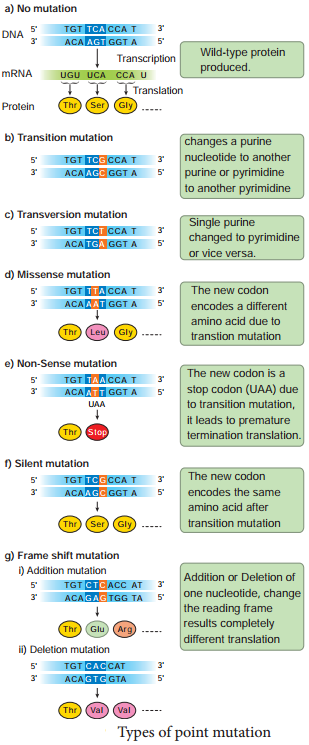
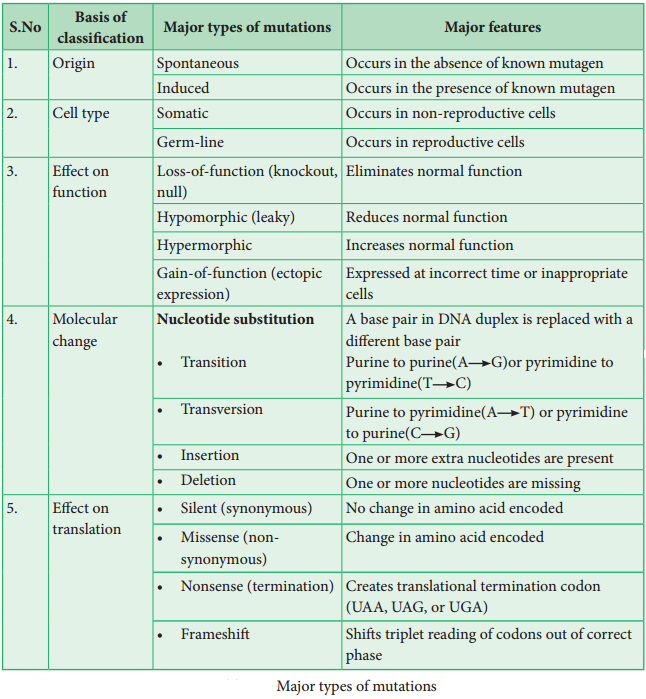
Point mutation in DNA are categorised into two main types. They are base pair substitutions and base pair insertions or deletions. Base substitutions are mutations in which there is a change in the DNA such that one base pair is replaced by another (Figure: 3.17).

It can be divided into two subtypes: transitions and transversions. Addition or deletion mutations are actually additions or deletions of nucleotide pairs and also called base pair addition or deletions. Collectively, they are termed indel mutations (for insertion-deletion).

Substitution mutations or indel mutations affect translation. Based on these different types of mutations are given below. The mutation that changes one codon for an amino acid into another codon for that same amino acid are called Synonymous or silent mutations. The mutation where the codon for one amino acid is changed into a codon for another amino acid is called Missense or non-synonymous mutations.

The mutations where codon for one amino acid is changed into a termination or stop codon is called Nonsense mutation. Mutations that result in the addition or deletion of a single base pair of DNA that changes the reading frame for the translation process as a result of which there is complete loss of normal protein structure and function are called Frameshift mutations (Figure: 3.19).
Mutation -Types, Mutagenic Agents And Their Significance. img 2

Mutagenic agents

The factors which cause genetic mutation are called mutagenic agents or mutagens. Mutagens are of two types, physical mutagen and chemical mutagen. Muller (1927) was the first to fid out physical mutagen in Drosophila.

Physical mutagens:

Scientists are using temperature and radiations such as X rays, gamma rays, alfa rays, beta rays, neutron, cosmic rays, radioactive isotopes, ultraviolet rays as physical mutagen to produce mutation in various plants and animals.

Temperature:

Increase in temperature increases the rate of mutation. While rise in temperature, breaks the hydrogen bonds between two DNA nucleotides which affects the process of replication and transcription.

Radiation:

The electromagnetic spectrum contains shorter and longer wave length rays than the visible spectrum. These are classified into ionizing and non-ionizing radiation. Ionizing radiation are short wave length and carry enough higher energy to ionize electrons from atom.

X rays, gamma rays, alfa rays, beta rays and cosmic rays which breaks the chromosomes (chromosomal mutation) and chromatids in irradiated cells. Non-ionizing radiation, UV rays have longer wavelengths and carry lower energy, so they have lower penetrating power than the ionizing radiations. It is used to treat unicellular microorganisms, spores, pollen grains which possess nuclei located near surface membrane.

Sharbati Sonora

Sharbati Sonora is a mutant variety of wheat, which is developed from Mexican variety (Sonora 64) by irradiating of gamma rays. It is the work of Dr. M.S.Swaminathan who is known as ‘Father of Indian green revolution’ and his team.

Castor Aruna

Castor Aruna is mutant variety of castor which is developed by treatment of seeds with thermal neutrons in order to induce very early maturity (120 days instead of 270 days as original variety).

Chemical mutagens:

Chemicals which induce mutation are called chemical mutagens. Some chemical mutagens are mustard gas, nitrous acid, ethyl and methyl methane sulphonate (EMS and MMS), ethyl urethane, magnous salt, formaldehyde, eosin and enthrosine. Example: Nitrous oxide alters the nitrogen bases of DNA and disturb the replication and transcription that leads to the formation of incomplete and defective polypeptide during translation.

Comutagens

The compounds which are not having own mutagenic properties but can enhance the effects of known mutagens are called comutagens. Example: Ascorbic acid increase the damage caused by hydrogen peroxide. Caffine increase the toxicity of methotrexate.

Chromosomal mutations

The genome can also be modified on a larger scale by altering the chromosome structure or by changing the number of chromosomes in a cell. These large-scale variations are termed as chromosomal mutations or chromosomal aberrations. Gene mutations are changes that take place within a gene, whereas chromosomal mutations are changes to a chromosome region consisting of many genes.

It can be detected by microscopic examination, genetic analysis, or both. In contrast, gene mutations are never detectable microscopically. Chromosomal mutations are divided into two groups: changes in chromosome number and changes in chromosome structure.

I. Changes in chromosome number

Each cell of living organisms possesses fixed number of chromosomes. It varies in different species. Even though some species of plants and animals are having identical number of chromosomes, they will not be similar in character. Hence the number of chromosomes will not differentiate the character of species from one another but the nature of hereditary material (gene) in
chromosome that determines the character of species.

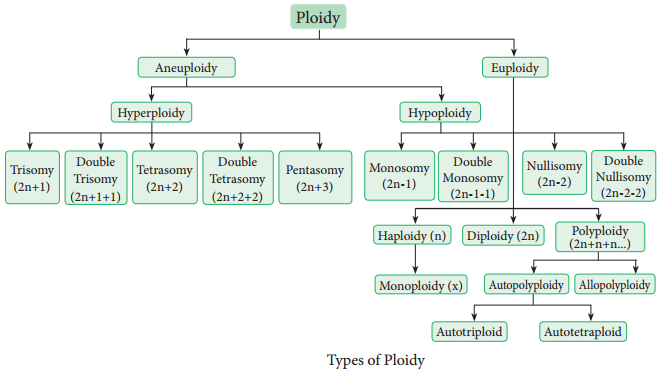
Sometimes the chromosome number of somatic cells are changed due to addition or elimination of individual chromosome or basic set of chromosomes. This condition in known as numerical chromosomal aberration or ploidy. There are two types of ploidy.

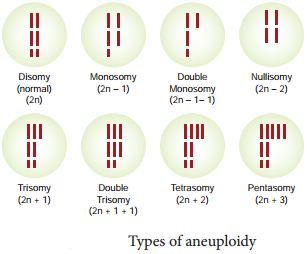
  1. Ploidy involving individual chromosomes within a diploid set (Aneuploidy)
  2. Ploidy involving entire sets of chromosomes (Euploidy) (Figure 3.20)

1. Aneuploidy

It is a condition in which diploid number is altered either by addition or deletion of one or more chromosomes. Organisms
showing aneuploidy are known as aneuploids or heteroploids. Thy are of two types, Hyperploidy and Hypoploidy (Figure 3.21).
Mutation -Types, Mutagenic Agents And Their Significance. img 4

Hyperploidy

Addition of one or more chromosomes to diploid sets are called hyperploidy. Diploid set of chromosomes represented as Disomy. Hyperploidy can be divided into three types. They are as follows,

(a) Trisomy

Addition of single chromosome to diploid set is called Simple trisomy (2n+1). Trisomics were first reported by Blackeslee (1910) in Datura stramonium (Jimson weed). But later it was reported in Nicotiana, Pisum and Oenothera. Sometimes addition of two individual chromosome from diffrent chromosomal pairs to normal diploid sets are called Double trisomy (2n+1+1).

(b) Tetrasomy

Addition of a pair or two individual pairs of chromosomes to diploid set is called tetrasomy (2n+2) and Double tetrasomy (2n+2+2) respectively. All possible tetrasomics are available in Wheat.

(c) Pentasomy

Addition of three individual chromosome from different chromosomal pairs to normal diploid set are called pentasomy (2n+3).

2. Hypoploidy

Loss of one or more chromosome from the diploid set in the cell is called hypoploidy. It can be divided into two types. They are

(a) Monosomy

Loss of a single chromosome from the diploid set are called monosomy(2n-1). However loss of two individual or three individual chromosomes are called double monosomy (2n-1-1) and triple monosomy (2n-1-1-1) respectively. Double monosomics are observed in maize.

(b) Nullisomy

Loss of a pair of homologous chromosomes or two pairs of homologous chromosomes from the diploid set are called Nullisomy (2n-2) and double Nullisomy (2n-2-2) respectively. Selfig of monosomic plants produce nullisomics. They are usually lethal.
Mutation -Types, Mutagenic Agents And Their Significance. img 5

(ii) Euploidy

Euploidy is a condition where the organisms possess one or more basic sets of chromosomes. Euploidy is classifid as monoploidy, diploidy and polyploidy. The condition where an organism or somatic cell has two sets of chromosomes are called diploid (2n). Half the number of somatic chromosomes is referred as gametic chromosome number called haploid(n).

It should be noted that haploidy (n) is diffrent from a monoploidy (x). For example, the common wheat plant is a polyploidy
(hexaploidy) 2n = 6x = 72 chromosomes. Its haploid number (n) is 36, but its monoploidy (x) is 12. Therefore, the haploid and diploid condition came regularly one after another and the same number of chromosomes is maintained from generation to generation, but monoploidy condition occurs when an organism is under polyploidy condition. In a true diploid both the monoploid and haploid chromosome number are same. Thus a monoploid can be a haploid but all haploids cannot be a monoploid.

Polyploidy

Polyploidy is the condition where an organism possesses more than two basic sets of chromosomes. When there are three, four, fie or six basic sets of chromosomes, they are called triploidy (3x) tetraploidy (4x), pentaploidy (5x) and hexaploidy (6x) respectively.

Generally, polyploidy is very common in plants but rarer in animals. An increase in the number of chromosome sets has been an important factor in the origin of new plant species. But higher ploidy level leads to death. Polyploidy is of two types. They are autopolyploidy and allopolyploidy.

1. Autopolyploidy

The organism which possesses more than two haploid sets of chromosomes derived from within the same species is called autopolyploid. They are divided into two types. Autotriploids and autotetraploids.

Autotriploids have three set of its own genomes. They can be produced artifially by crossing between autotetraploid and diploid
species. They are highly sterile due to defective gamete formation. Example: The cultivated banana are usually triploids and are seedless having larger fruits than diploids.

Triploid sugar beets have higher sugar content than diploids and are resistant to moulds. Common doob grass (Cyanodon dactylon) is a natural autotriploid. Seedless watermelon, apple, sugar beet, tomato, banana are man made autotriploids. Autotetraploids have four copies of its own genome. They may be induced by doubling the chromosomes of a diploid species. Example: rye, grapes, alfalfa, groundnut, potato and coffee.

2. Allopolyploidy

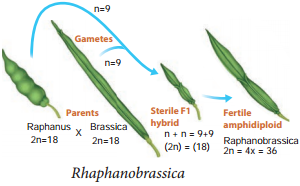
An organism which possesses two or more basic sets of chromosomes derived from two different species is called allopolyploidy. It can be developed by interspecific crosses and fertility is restored by chromosome doubling with colchicine treatment. Allopolyploids are formed between closely related species only. (Figure 3.22)
Mutation -Types, Mutagenic Agents And Their Significance. img 6

Karpechenko (1927) a Russian geneticist, crossed the radish (Raphanus sativus, 2n=18) and cabbage (Brassica oleracea, 2n=18) to produce F1 hybrid which was sterile. When he doubled the chromosome of F1 hybrid he got it fertile. He expected this plant to exhibit the root of radish and the leaves like cabbage, which would make the entire plant edible, but the case was vice versa, so he was greatly disappointed.

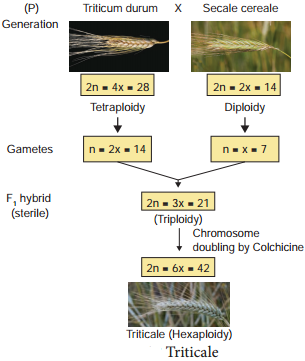
Example: 2 Triticale, the successful fist man made cereal. Depending on the ploidy level Triticale can be divided into three main groups.

(i) Tetraploidy:
Crosses between diploid wheat and rye.

(ii) Hexaploidy:
Crosses between tetraploid wheat Triticum durum (macaroni wheat) and rye

(iii) Octoploidy:
Crosses between hexaploid wheat T. aestivum (bread wheat) and rye Hexaploidy Triticale hybrid plants demonstrate characteristics of both macaroni wheat and rye.

For example, they combine the high-protein content of wheat with rye’s high content of the amino acid lysine, which is low in wheat. It can be explained by chart below (Figure: 3.23).
Mutation -Types, Mutagenic Agents And Their Significance. img 7

Signifiance of Ploidy

  • Many polyploids are more vigorous and more adaptable than diploids.
  • Many ornamental plants are autotetraploids and have larger flowers and longer flowering duration than diploids.
  • Autopolyploids usually have higher in fresh weight due to more water content.
  • Aneuploids are useful to determine the phenotypic effcts of loss or gain of different chromosomes.
  • Many angiosperms are allopolyploids and they play a role in the evolution of plants.

II Structural changes in chromosome (Structural chromosomal aberration)

Structural variations caused by addition or deletion of a part of chromosome leading to rearrangement of genes is called structural chromosomal aberration. It occurs due to ionizing radiation or chemical compounds. On the basis of breaks and reunion in chromosomes, there are four types of aberrations. They are classified under two groups.

A. Changes in the number of the gene loci

  • Deletion or Defiiency
  • Duplication or Repeat

B. Changes in the arrangement of gene loci

  • Inversion
  • Translocation

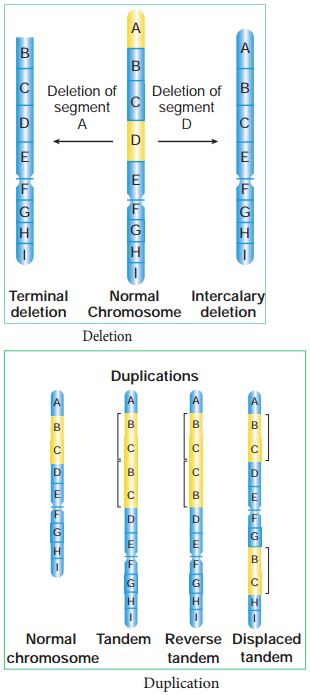
1. Deletion or Defiiency

Loss of a portion of chromosome is called deletion. On the basis of location of breakage on chromosome, it is divided into terminal deletion and intercalary deletion. It occurs due to chemicals, drugs and radiations. It is observed in Drosophila and Maize. (Figure 3.24)

2. Duplication or Repeat

The process of arrangement of the same order of genes repeated more than once in the same chromosome is known as duplication. Due to duplication some genes are present in more than two copies. It was first reported in Drosophila by Bridges (1919) and other examples are Maize and Pea. It is three types.

4. Translocation

The transfer of a segment of chromosome to a non-homologous chromosome is called translocation. Translocation should not
be confused with crossing over, in which an exchange of genetic material between homologous chromosome takes place.
Translocation occurs as a result of interchange of chromosome segments in non-homologous chromosomes. There are three types

  • Simple translocation
  • Shif translocation
  • Reciprocal translocation
    Mutation -Types, Mutagenic Agents And Their Significance. img 8

Crossing Over, Recombination and Gene Mapping

Learninsta presents the core concepts of Biology with high-quality research papers and topical review articles.

Crossing Over, Recombination and Gene Mapping

Crossing over is a biological process that produces new combination of genes by interchanging the corresponding segments between non-sister chromatids of homologous pair of chromosomes. The term ‘crossing over’ was coined by Morgan (1912).

It takes place during pachytene stage of prophase I of meiosis. Usually crossing over occurs in germinal cells during gametogenesis. It is called meiotic or germinal crossing over. It has universal occurrence and has great significance. Rarely, crossing over occurs in somatic cells during mitosis. It is called somatic or mitotic crossing over.

Mechanism of Crossing Over

Crossing over is a precise process that includes stages like synapsis, tetrad formation, cross over and terminalization.

(i) Synapsis

Intimate pairing between two homologous chromosomes is initiated during zygotene stage of prophase I of meiosis I. Homologous chromosomes are aligned side by side resulting in a pair of homologous chromosomes called bivalents. This pairing phenomenon is called synapsis or syndesis. It is of three types,

  • Procentric synapsis: Pairing starts from middle of the chromosome.
  • Proterminal synapsis: Pairing starts from the telomeres.
  • Random synapsis: Pairing may start from anywhere.

(ii) Tetrad Formation

Each homologous chromosome of a bivalent begin to form two identical sister chromatids, which remain held together by a centromere. At this stage each bivalent has four chromatids. Ths stage is called tetrad stage.

(iii) Cross Over

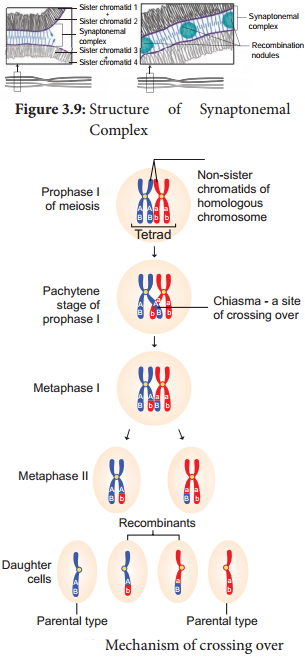
After tetrad formation, crossing over occurs in pachytene stage. The non-sister chromatids of homologous pair make a contact at one or more points. These points of contact between nonsister chromatids of homologous chromosomes are called Chiasmata (singular-Chiasma).

At chiasma, cross-shaped or X-shaped structures are formed, where breaking and rejoining of two chromatids occur. This results in reciprocal exchange of equal and corresponding segments
Crossing Over, Recombination And Gene Mapping img 1

(iv) Terminalisation

After crossing over, chiasma starts to move towards the terminal end of chromatids. This is known as terminalisation. As a result, complete separation of homologous chromosomes occurs. (Figure 3.10)

Importance of Crossing Over

Crossing over occurs in all organisms like bacteria, yeast, fungi, higher plants and animals. Its importance is

Exchange of segments leads to new gene combinations which plays an important role in evolution. Studies of crossing over reveal that genes are arranged linearly on the chromosomes. Genetic maps are made based on the frequency of crossing over. Crossing over helps to understand the nature and mechanism of gene action.
If a useful new combination is formed it can be used in plant breeding.

Recombination

Crossing over results in the formation of new combination of characters in an organism called recombinants. In this, segments of DNA are broken and recombined to produce new combinations of alleles. This process is called Recombination.

Calculation of Recombination Frequency (RF)

The percentage of recombinant progeny in a cross is called recombination frequency. The recombination frequency (cross over frequency) (RF) is calculated by using the following formula. The data is obtained from alleles in coupling confiuration.

Genetic Mapping

Genes are present in a linear order along the chromosome. They are present in a specific location called locus (plural: loci). The diagrammatic representation of position of genes and related distances between the adjacent genes is called genetic mapping.

It is directly proportional to the frequency of recombination between them. It is also called as linkage map. The concept of gene mapping was first developed by Morgan’s student Alfred H Sturtevant in 1913.
It provides clues about where the genes lies on that chromosome.

Map distance

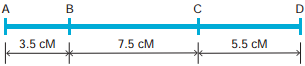
The unit of distance in a genetic map is called a map unit (m.u). One map unit is equivalent to one percent of crossing over (Figure 4.). One map unit is also called a centimorgan (cM) in honour of T.H. Morgan. 100 centimorgan is equal to one Morgan (M).

For example: A distance between A and B genes is estimated to be 3.5 map units. It is equal to 3.5 centimorgans or 3.5 % or 0.035 recombination frequency between the genes.
Crossing Over, Recombination And Gene Mapping img 2

Uses of genetic mapping

  • It is used to determine gene order, identify the locus of a gene and calculate the distances between genes.
  • They are useful in predicting results of dihybrid and trihybrid crosses.
  • It allows the geneticists to understand the overall genetic complexity of particular organism.

Classification of Elements and Periodicity in Properties Class 11 Notes Chemistry Chapter 3

By going through these CBSE Class 11 Chemistry Notes Chapter 3 Classification of Elements and Periodicity in Properties, students can recall all the concepts quickly.

Classification of Elements and Periodicity in Properties Notes Class 11 Chemistry Chapter 3

Why do we need to Classify Elements?
At present 114 elements are known. Efforts to synthesise new elements are continuing. It is very difficult to study such a large number of elements individually and to study their properties separately. The necessity was felt to organise their knowledge in a systematic way by classifying the elements.

Genesis of Periodic Classification: Classification of elements into groups led to the development of Periodic Law and Periodic Table.

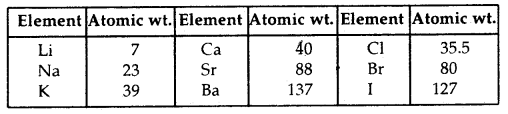
J. Dobereiner was the first who made several groups of three elements (Triads). In each case he noticed the middle element of each of the Triads had an atomic weight about halfway between the atomic weights of the other two elements. Also, the properties of the middle element were in between these of the other two elements. He referred to them as the Law of Triads. It worked for only a few elements.

Dobereiner’s Triads:
Classification of Elements and Periodicity in Properties Class 11 Notes Chemistry 1
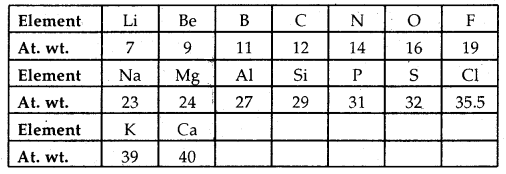
J.A. Newlands propounded the Law of Octaves. He arranged the elements in increasing order of their atomic weights and noted that every eighth element has properties similar to the first element like the octaves of music – sa, re, ga, ma, pa, dha, nee, sa Newland’s Law of Octaves seemed to be true only for elements up to calcium.

Newlands Octaves:
Classification of Elements and Periodicity in Properties Class 11 Notes Chemistry 2
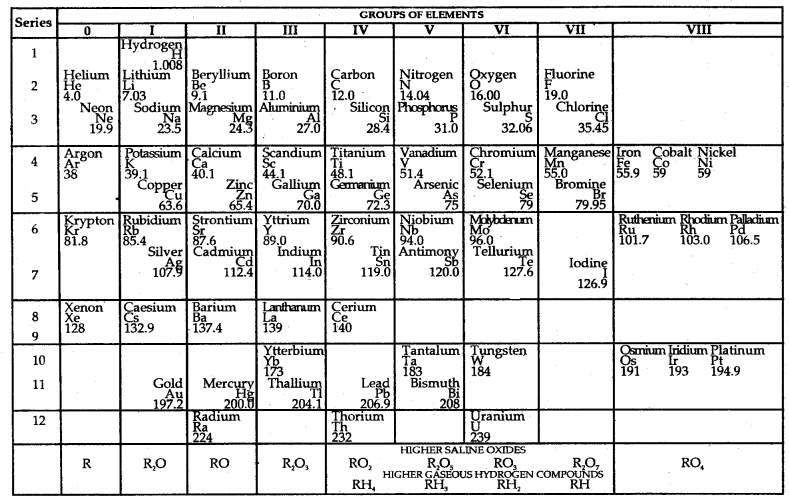
Russian chemist Mendeleev and German chemist Lothar Meyer working independently, let to the Periodic Law as we know it today. Mendeleev succeeded in arranging the elements in vertical columns called groups and horizontal rows called periods in his table based upon the increasing order of their atomic masses. He gave his well- known law:

”The properties of the elements are a periodic function of their atomic weights”. It was called Mendeleev law. He realised that .some of the elements did not fit in with his scheme of classification if the order of atomic weights was strictly followed. He ignored the order of atomic weights and placed the elements -with similar properties together. For example, iodine with a lower atomic weight than that of tellurium (Group VI) was placed in Group VII along with other halogens F, Cl, Br because of similarities in properties.

He left some gaps for elements that were yet undiscovered. For example, both gallium (Ga) and germanium (Ge) were unknown at his time: He left the gap below aluminium and a gap below silicon and called these elements Eka-Aluminium and Eka-Silicon. The boldness of Mendeleev’s quantitative predictions and their eventual success made him and his Periodic Table famous. Mendeleev’s periodic table published in 1905 is shown.

Characteristics of Mendeleev’s Periodic Table:
It consists up of

  1. Eight vertical columns called groups. Except for the VIII group, each group is. further subdivided in A and B. This subdivision is made on the basis of difference in their properties.
  2. Six horizontal row called periods.

Significance of Mendeleev’s Periodic Table

  1. Instead of studying properties of elements separately, they can be studied in groups containing elements with the same properties. It led to the systematic study of the elements.
  2. Prediction of new elements. At his time only 56 elements were known. He left blank spaces or groups for unknown elements.
  3. Mendeleev’s periodic table corrected the doubtful atomic weights.

Defects in the Mendeleev’s Periodic Table

  1. Hydrogen was placed in group IA. However, it resembles both groups IA elements (alkali metals) and group VII A (halogens). Therefore the position of hydrogen in the periodic table is Anomalous or Controversial.
  2. Anomalous pairs of elements. Some elements with higher atomic weight like Argon (39.9) precede potassium (39.1) with lower atomic weight.
  3. Based upon atomic weights, isotopes of an element could not be assigned to different groups. They have been assigned only one position in a group.
  4. Some dissimilar elements are grouped together while some similar elements are placed in different groups. For example, alkali metals in group IA which are highly reactive are in the same group as coinage metals like Cu, Ag, Au of group IB. At the same time, certain chemically similar elements like Cu (group IB) and Hg (group IIB) have been placed in different groups.
  5. Position of elements of group VIII. No proper place has been allotted to nine elements of group VIII which have been arranged in three triads without any justification.

Classification of Elements and Periodicity in Properties Class 11 Notes Chemistry 3
Mendeleev’s Periodic Table published in 1905

Modern Periodic Law and the present form of the Periodic Table.
Modern Period Law: The physical and chemical properties of the elements are periodic functions of their atomic number.

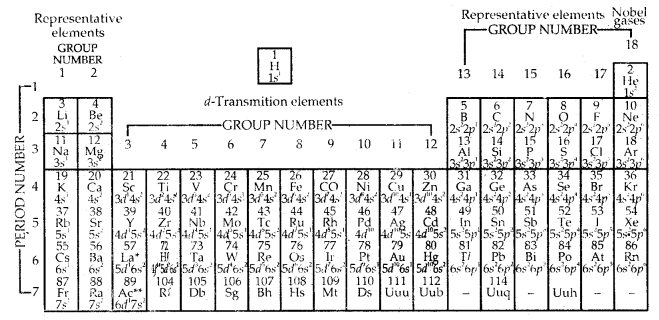
According to the recommendations of IUPAC, the groups are numbered from 1 to 18 replacing the older notation of groups 0, 1A, II A

There are 7 periods. The first period contains 2 elements. The subsequent periods contain 8, 8, 18, 18 32 elements respectively. The 7th period is incomplete and like the 6th period would have a theoretical maximum of 32 elements. In this form of Periodic Table, the elements of both the sixth and seventh periods (lanthanoids and actinoids respectively) are placed in Separate panels at the bottom.

Long Form of Periodic Table
General characteristics of the long form of the Periodic table:
1. There are in all, 18 vertical columns or 18 groups in the long-form periodic table.

2. These groups are numbered from 1 to 18 starting from the left.

3. There are seven horizontal rows called periods in the long-form periodic table. Thus, there are seven periods in the long-form periodic table.

The first period contains2 elementsShortest period
The second & Third period contains8 elements eachShort period
The fourth & Filth period contains18 elements eachLong-period
Sixth periods contains32 elementsLongest period
The seventh period containsIt is incompleteIncomplete period

4.  The elements of group 1, 2 .and 13 to 17 are called the main group elements. These are also called typical or representative or normal elements.

5. The elements of group 3 to 12 are called transition elements.

6. Elements with atomic number 58 to 71 (Ce to Lu) occurring after lanthanum (La) are called Lanthanides. Elements with atomic numbers 90 to 103 (Th to Lr) are called Actinides. These elements are called f-block elements and also inner-transition elements.
Classification of Elements and Periodicity in Properties Class 11 Notes Chemistry 4
Classification of Elements and Periodicity in Properties Class 11 Notes Chemistry 5
Long-form of the Periodic Table of the EIenient with their atomic numbers and ground state outer
electronic configurations. The groups are numbered i-18 in accordance with the 1984 IUPAC recommendations. this notation replaces the old numbering scheme of IA-VIIA, 4dIII, IB—VIIB and I) for the elements.

Nomenclature of the Elements with Atomic No. > 100
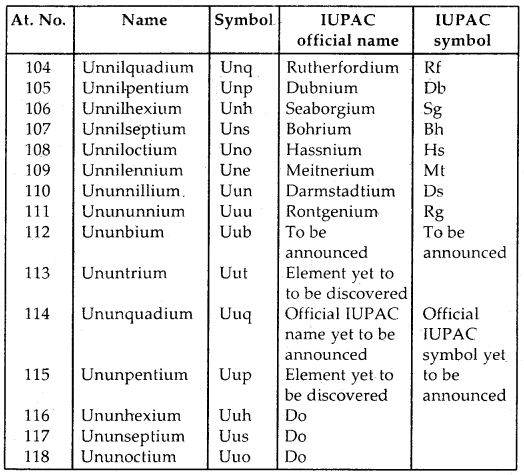
Table: Nomenclature of elements with atomic number above 103
Classification of Elements and Periodicity in Properties Class 11 Notes Chemistry 6
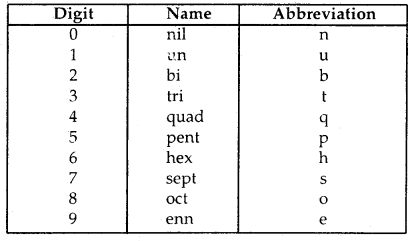
Notation for IUPAC Nomenclature of Elements
Classification of Elements and Periodicity in Properties Class 11 Notes Chemistry 7
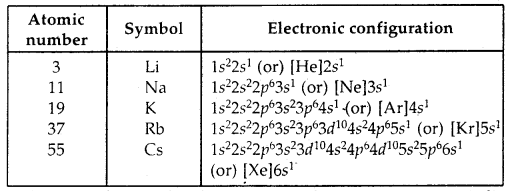
Electronic Configuration of the Elements and Periodic Table: In the long-form periodic table, the elements are arranged in the order of their atomic numbers. An atomic number of an element is equal to the number of protons inside the nucleus of its atom. In an atom, the number of electrons is equal to the number of protons (hence equal to the atomic number). As a result, there is a close connection between the electronic configurations of the elements and the long form of the periodic table.

Table: The relationship between the electronic configuration of electrons and their positions in the periodic
Classification of Elements and Periodicity in Properties Class 11 Notes Chemistry 8
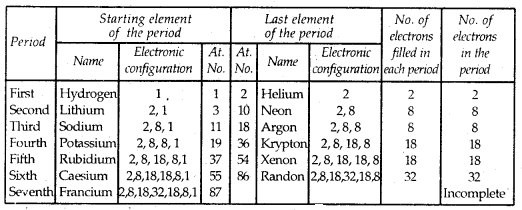
Electronic Configuration in Periods: The period indicates the value of n- for the outermost or valence shell. In other words, a successive period in the Periodic Table is associated with the filling of the next higher principal energy level (n = 1, n = 2, etc.). It can be readily seen that the number of elements in each period is twice the number of atomic orbitals available in the energy level that is being filled.

→ The first period (n = 1) starts with the filling of the lowest level (1s) and therefore has two elements hydrogen (1s1) and helium (1s2) when the first shell (K) is completed. The second period (n = 2) starts with lithium and the third electron and has the electronic configuration 1s22s2. Starting from the next element boron, the 2p orbitals are filled with electrons when the L shell is complete at neon (2s22p6).

→ Thus there are 8 elements in the second period. The third period (n = 3) begins at sodium, and the added electron enters a 3s orbital. Successive filling of 3s and 3p orbitals gives rise to the third period 8 elements from sodium to argon. The fourth period (n = 4) starts at potassium, and the added electrons fill up the 4s orbital.

→ Now you may note that before the 4p orbital is filled, filling up of 3d orbitals becomes energetically favourable and we come from scandium (Z = 21) which has the electronic configuration 3d1, 4s2. The fourth period ends at krypton with the filling up the ‘Ip orbitals. Altogether we have 18 elements in this fourth period. The fifth period (n = 5) beginning with rubidium is similar to the fourth period and contains the 4d transition Serietarting at yttrium (Z = 39). This period ends al xenon with the filling up of the Sp orbitals.

→ The sixth period (n = 6) contains 32 elements and successive electrons enter 6s, 4f, Sd and 6p orbitals, in the order-filling up of the 4f orbitals begins with caesium (Z = 58) and ends at lutetium (Z = 71) Lo give 4f-inner transition series which is called lanthanoid sêries. The seventh period (n = 7) is similar to the sixth period with the successive filling up of the 7s, 5f, 6d and 7p orbitals and includes most of the man-made radioactive elements.

→ This period will end at the elements with atomic number 118 which would belong to the noble gas family. Filling up of the 5f orbital after actinium (Z = 80) gives the 5f-inner transition series known as the actinoid series. The 4f- and 5f- transition series of elements are placed separately in the Periodic Table to maintain its structure and to preserve the principle classification by keeping elements with similar properties in a single column.
Classification of Elements and Periodicity in Properties Class 11 Notes Chemistry 9
Thus it can be seen that the properties oían element have periodic dependence upon its atomic number and not on relative atomic mass. All the elements in the same group have the same number of electrons (ns1 in alkali metals) in their valence shells and thus have, same properties.

Electronic Configurations and Types of Elements s-, p-, d-, f-Blocks:
The Aufbau (build-up) principle and the electronic configuration of atoms provide a theoretical foundation for periodic classification. The elements in a vertical column of the Periodic Table constitute a group or family and exhibit similar chemical behaviour. This similarity arises because these elements have the same number and same distribution of electrons in their outermost orbitals. We can classify the elements into four blocks viz., s-block, p-block, d- block and f-block depending on the type of atomic orbitals that are being filled with electrons. We notice two exceptions to this categorization.

Strictly, helium belongs to the s-block but its positioning in the p-block along with another group of 18 elements is justified because it has a completely filled valence shell (1s2) and as a result, exhibits properties characteristic of other noble gases. The other exception is hydrogen. It has alone s-electron and hence can be placed in group-1 (alkali metals). It can also gain an electron to achieve a noble gas arrangement and hence it can behave similarly to group 17 (halogen family) elements. Because it is a special case, hydrogen is placed separately at the top of the Periodic Table.

→ The s-Block Elements: The elements of group 1 (alkali metals) and group 2 (alkaline earth metals) which have ns1 and ns2 outermost electronic configuration belong to the s-Block Elements. They are all reactive metals with low ionization enthalpies. They lose the outermost electron(s) readily to form + lions (in the case of alkali metals) or + 2ion (in the case of alkaline earth metals). The metallic character and the reactivity increase as we go down the group. Because of high reactivity, they are never found pure in nature. The compounds of the s-block elements, with the exception of those of lithium and beryllium, are predominantly ionic.

→ The p-Block Elements: The p-Block Elements comprise those belonging to groups 13 to 18 and these together with the s-block elements are called the Representative Elements or Main Group Elements. The outermost electronic configuration varies from nsTnpl to ns2np6 in each period. At the end of each period is noble gas elements with a closed valence shell ns2np6 configuration.

All the orbitals in the valence shell of the noble gases are completely filled by electrons and it is very difficult to alter this stable arrangement by the addition or removal of electrons. The noble gases thus exhibit very low chemical reactivity Preceding the noble gas family are two chemically important groups of non-metals. They are the halogens (Group 17) and the chalcogens (Group 16).

These two groups of elements have high negative electron gain enthalpies and readily add one or two electrons respectively to attain the stable noble gas configuration. The non-metallic character increases as we move from left to right across a period and the metallic character increases as we go down the group.

→ The d-Block Elements (Transition Elements): These are the elements of Group 3 to 12 in the centre of the Periodic Table These are characterised by the filling of inner (n – 1) d orbitals by electrons and are therefore referred to as d-Block Elements. These elements have the outer electronic configuration (n – 1)d1-10ns1-2. They are all metals. They mostly form coloured ions, exhibit variable valence (oxidation .states), paramagnetism and are often used as catalysts.

However, Zn > Cd and Hg which have, the electronic configuration, (n – 1)d10ns2 do not show most of the properties of transition elements. In a way, transition metals form a bridge between the chemically active metals of s-block elements and the less active metals of Groups 13 and 14 and thus take their familiar name “transition elements”.

→ The f-Block Elements (Inner-Transition Elements): The two rows of elements at the bottom of the Periodic Table, called the Lanthanoids, Ce (Z = 58) – Lu (Z = 71) and Actinoids, Th (Z = 90) – Lr (Z = 103) are characterised by the outer, electronic configuration (n – 2)f1-14(n – 1)d0-1 ns2. The last electron added to each element is an f-electron.

These two series of elements are hence called the inner- transition elements (f-Block Elements). They are all metals. Within each series, the properties of the elements are quite similar. The chemistry of the early -actinoids .is more complicated than the corresponding lanthanoids, due to a large number of oxidation states possible for these actinoid elements.

Actinoid elements are radioactive. Many of the actinoid elements have been made only in nanogram quantities or even less by nuclear reactions and their chemistry is not fully studied. The elements after uranium are called transuranium elements.

The Lanthnoids show predominantly an oxidation state of + 3 (with a few exceptions + 2 or + 4) whereas Actinoids show variable oxidation states.

Metals, Non-Metals and Metalloids: The elements can be divided into Metals and Non-metals. Metals comprise more than 78% of all known elements and appear on the left side of the Periodic Table. Metals are usually solids at room temperature (mercury is an exception; gallium and caesium also have very low melting point 300K and 302K respectively). Metals usually have high melting and boiling points. They are good conductors of heat and electricity. They are malleable (can be flattened into thin sheets by hammering) and ductile (can be drawn into wires). In contrast, non-metals are located at the top right-hand side of the Periodic Table.

In fact, in a horizontal row, the property of elements change from metallic on the left to non-metals on the right. Non-metals are usually solids or gases at room temperature with low melting and boiling points (boron and carbon are exceptions). They are poor conductors of heat and electricity. Most non-metallic solids are brittle and are neither malleable nor ductile. The elements become more metallic as we go down a group; the non-metallic character increases as one goes from left to right across the Periodic Table.

The change from metallic to non-metallic character is not abrupt. The elements (e.g.r silicon, germanium, arsenic, antimony and tellurium) bordering this line and running diagonally across the Periodic Table show properties that are characteristic of both metallic and non-metals. These elements are called Semi-Metals or Metalloids.

Periodic Trends in Properties of Elements:
1. Ionization Enthalpy: The amount of energy required to remove the most loosely bound electron from an isolated gaseous atom in its ground state is called ionisation enthalpy.
X (g) → X(g) + e

The energy required to remove the first electron is known as the first ionization enthalpy and the second electron is the second ionization enthalpy and so on. The second ionization enthalpy is always greater than The first ionization enthalpy because once an electron is removed, it becomes a positive ion and its nucleus has increased attraction for electrons. This makes it more difficult to remove the second electron.

Ionization enthalpy decreases from top to bottom in a group and increases horn left to right in a period. Thus Cs has the lowest ionization enthalpy and fluorine has the highest ionization enthalpy. Thus IE3 > IE2 > IE1. IE of Li > Na > K > Rb > Cs and IE of Li in 2nd Period is lowest, whereas that of Na is highest.

The ionization enthalpy depends on two factors:

  1. The attraction of electrons to the nucleus.
  2. The repulsion of electrons from each other.

Screening or Shielding effect: A valence electron in a multi-electron atom is pulled by the nucleus And repelled by the other electrons in the core (inner shells). Thus the effective pull on the electron will be the pull due to the positive nucleus, less the repulsion due to core electrons.

The effective repulsive effect to the core electrons is called the screening or shielding effect. For example, the 2s electron in lithium is shielded by the inner core of Is electrons. As a result valence electron experiences a net positive charge less than + 3. In general, shielding is effective when the orbitals in the inner shells are completely filled.

2. Electron Gain (Enthalpy ΔegH): It is defined as the enthalpy change when a neutral gaseous atom takes up extra electrons to form an anion.
X(g) + e → X (g)

The value of electron gain enthalpy depends upon the atomic size, nuclear charge etc. with an increase in size, the electron gain enthalpy decreases as the nuclear attraction decreases. Thus electron gain enthalpy generally decreases in going from top to bottom in a group (F < Cl > Br > I). In a period from left to right, the electron gain enthalpy generally increases due to an increase in nuclear charge.

Thus halogens have very high electron affinity. However, the electron affinity of fluorine is less than that of chlorine. This is because fluorine has a small atomic size (only two shells). Also, electron repulsion is more in the case of fluorine, because of mutual electron-electron repulsions.

Factors affecting electron gain enthalpy:

  1. Atomic size: Smaller the atom, the greater is the magnitude of the electron gain enthalpy. This is because the added electron can go closer to the nucleus and as a result releases more energy.
  2. Effective nuclear charge: Greater the nuclear charge, the larger is the magnitude of electron gain enthalpy. This is because the electron would experience stronger attraction by virtue of a higher nuclear charge.
  3. Electronic configuration of the atom: An atom with a stable electronic configuration has a little or no tendency to add another electron. As a result, such elements have zero, or nearly zero electron gain enthalpy.

Periodic Variation of Electron gain enthalpy:
1. Variation of electron gain enthalpy in a group: The magnitude of the electron gain enthalpy of elements decreases in going from top to bottom in a group. However, the electron gain enthalpy of fluorine is lower than that of chlorine.

On moving from top to the bottom of a group,
(a) the-atomic size increases and
(b) the nuclear charge also increases.

The effect of these factors is opposite to each other. In group, the effect of an increase in the atomic size outweighs the effect of the increased nuclear charge. As a result, the tendency to accept an electron in its valency. shell and hence the magnitude of electron gain enthalpy decreases as we go down the group.

2. Variation of electron gain Enthalpy in a period: The magnitude of electron gain enthalpy increases across a period is going from left to right.

On moving from left to right in a period, the size of the atoms decreases, and the effective nuclear charge increases. Both these factors increase the force of attraction exerted by the nucleus on the electrons. As a result, the atom has a greater tendency to gain an extra electron from outside and therefore, the magnitude of electron gain enthalpy increases in going from left to right. However, some elements in each period show an exception to such periodicity. For example, Be, Mg, N, P and noble gases show very low, or even zero electron gain enthalpies.

Periodic Variation of Atomic and Ionic Radii: Atomic radius is one half of the distance between the nuclei of two identical atoms in a molecule bonded by a single bond. In a period, as, we move from left to right, the number of shells remain the same but as more electrons are added the nuclear charge increases.

This results in an increase in the number attraction for the electrons, which in turn brings about a decrease in the radius of the elements in a period. Thus, the radius decreases along a period (from left to right). However, in a group from top to bottom; the number of shells increases, therefore, the radius also increases, e.g., rLi < rNa < rK < rRb < … etc.

→ Ionic Radius: Ionic radius may be defined as “the effective distance from the centre and*nucleus of an ion up to which it has an influence on its electron cloud”.

→ Variation of Ionic radii in a group: The ionic radii of the ions belonging to the same group of elements and having identical charges, increases in going from top to bottom in a group. For example, the radii of the monovalent alkali metal ions increase from Li+ to Cs+.

→ Variation of the radii of isoelectronic ions: Atoms/ions of different elements having the same number of electrons are called isoelectronic ions. In other words, the ions which have the same number of electrons but different nuclear charges are called isoelectronic ions. The size of such ions depends upon the nuclear charge (as the total number of electrons remains the same).
Thus N3- > O2- > F > Na+ > Mg2+ > Al3+
Thus for isoelectronic ions, the ionic size decreases as the nuclear charge increases.

Cations are always smaller than their parent atoms because of

  1. the disappearance of the valence shell in some cases
  2. increase in effective nuclear charge.
    Thus Na+ < Na and Mg2+ < Mg.

Anions are always bigger in size than their parent atom. With the addition of one or more electrons to an atom, the effective nuclear charge per electron decreases. The electron cloud thus increases leading to an increase in the size of the anion.
Thus, F > F; Cl > Cl; O2- > O; S2- > S and so on.

→ Electronegativity: The ability of an atom in a chemical compound to attract the shared pair of electrons towards itself is called Electronegativity. It is not a measurable quantity, unlike IE and electron gain enthalpy. L Pauling gave numerical values of electronegativities to elements. F has been given a value of 4.0 arbitrarily, the highest in the periodic table. Electronegativity values are not constant. Electronegativity generally decreases from top to bottom in a group and increases across a period from left to right.

Electronegativity values (Pauling scale) across a period
Classification of Elements and Periodicity in Properties Class 11 Notes Chemistry 10
Within a Group

Group-1Group-17
Li = 1.0F = 4.0
Na = 0.9Cl = 3.5
K = 0.8Br = 2.8
Rb = 0.8
Cs = 0.7
I = 2.5
At = 2.2

Periodicity of Valence: Valence is the most characteristic property of the elements and is based upon electronic configurations. The valence of representative elements is usually (though not necessarily) equal to the number of valence electrons arid or equal to eight minus the number of outermost electrons.
Classification of Elements and Periodicity in Properties Class 11 Notes Chemistry 11
→ Anomalous Behaviour of Second Period Elements:
The first element of each of the groups 1 (lithium) and 2 (beryllium) and groups 13-17 (boron to fluorine) differs in many respects from the other, members of their respective group. For example, lithium unlike other alkali metals, .and beryllium unlike other alkaline earth metals, form compounds with pronounced covalent character, the other members of these groups predominantly form ionic compounds.

In fact, the behaviour of lithium and beryllium is more similar to the second element of the following group i.e., magnesium and aluminium, respectively. This sort of similarity is commonly referred to as a diagonal relationship in the periodic properties.

→ What are the reasons for the different chemical behaviour Of the first members of a group of elements in the s- and p- blocks compared to that of the subsequent members in the same group?

The anomalous behaviour is attributed to their small size) large charge/radius ratio and high electronegativity of the elements. In addition, the first member of the group has only four valence orbitals (2s and 2p) available for bonding, whereas the second member of the groups has nine valence orbitals (3s, 3p, 3d). As a consequence of this, the maximum covalency of the first member of each group is 4, whereas the other members of the groups can expand their valence shell to accommodate more than four pairs of electrons.

Furthermore, the first member of p-block elements displays greater ability to form pπ – pπ multiple bonds to itself (e.g., C = C, C ≡ G, N = N, N ≡ N) and to other second period elements (e.g., C = O, C = N, C ≡ N, N = O) compared to subsequent members of the same group.
Classification of Elements and Periodicity in Properties Class 11 Notes Chemistry 12
1. Lothar-Meyer Arrangement of Elements: When plotting a graph between the atomic volumes (gram atomic weight divided by density) and atomic weights of the elements he observed that the elements with similar properties occupied similar positions on the curve.

2. Mendeleev’s Periodic Law: The physical and chemical properties of elements are a periodic function of their atomic weights.

3. Moseley’s/Modem Periodic Law: The physical and chemical properties of the elements are a periodic function of their atomic numbers.

4. Periodicity of Properties of Elements: According to Modem Periodic Law the properties of the elements are repeated after certain regular intervals when these elements are arranged in order of their increasing atomic numbers. These regular intervals 2, 8, 8, 18, 18, 32 are called Magic Numbers.

5. Cause of Periodicity: The cause of periodicity in properties is the repetition of similar electronic configurations of the valence shells after certain regular intervals.

6. Groups: The vertical columns of elements in the periodic table are called Groups.

7. Periods: The horizontal rows of elements in the periodic table are called Periods:

→ There are 18 groups and 7 periods in the Modern Periodic Table
1. s-block Elements: These are the elements in which the last electron enters the s-subshell of the valence orbit.
Classification of Elements and Periodicity in Properties Class 11 Notes Chemistry 13
2. p-Block Elements: The p-block elements are those in which the last electron enters the p-subshell of the vaLence orbit. The elements of groups 13, 14, 15, 16, 17, 18 (excluding helium) in which p-orbitals are being progressively filled in are called p-block elements. Since each group has five elements, therefore, ¡ri all, there are 30 p-block elements in the periodic table.

The elements of the 18th group are called noble gases.
General outer shell electronic configuration of p-block elements: ns2 np1 6

3. d-Block Elements: Elements in which the last electron enters any one of the five d-orbitals of their respective penultimate, i.e., (n – 1)the shells are called d-bock elements.

Transition Elements: Since the properties of these elements are midway between those of s-block and p-block elements, they are called Transition Elements.

General outer shell electronic confìguration of d-block elements: (n—1)d1-10 n2.
Zn, Cd, Hg do not show most of the properties of transition elements.

4. f-Block Elements: Elements in which the last electron enters any onè o the seven f-orbitals of their respective ante-penultimate shells are called f-block elements. In all these elements, the s-orbital of the last shell (n.) is completely filled, the d-orbital of the penultimate (n – 1) shell invariably contains zero or one electron but the J-orbitals of the antepenultimate (n – 2) shell (being lower in energy than d – orbitals of the penultimate shell) gets progressively filled in. Hence

General outer shell electronic configuration.off-block elements: (n – 2)0-14 (n – 1) d0-1 ns2

→ They are called Lanthanides/Lanthanones/Lanthanoids. In their case, the antepenultimate 4/subshell is being filled up.

→ They are called Actinides/Actinones/Actinoids if their antepenultimate 5/subshell is being b lied up.

All the actinoids are radioactive elements.

→ Elements from neptunium to lawrencium (93Np – 103Lr) which have been prepared artificially through nuclear reactions are called Transuranic or Transuranium elements as (hey follow uranium in the periodic table.

→ Metalloids: The elements like silicon, germanium, arsenic, antimony and tellurium (Si, Ge, As, Sb, Te) which show the properties of both metals and non-metals are called Metalloids.

→ Ionization Enthalpy: The minimum amount of energy required to remove the most loosely bound electron from an isolated gaseous atom of an element is called it’s Ionization Energy/Ionization Potential/Ionization Enthalpy.
M (g) + energy → M+ (g) + e (g)

→ Units of I.E.: electron volts (eV) per atom
or
kilo calories per mole (k cal mol-1)
or
kilo Joules per mole (kj mol-1)

1 eV per atom = 23.06 kcal mol-1
= 96.49 kj mol-1.

→ Successive I.Es.
IE3 > IE2 > IE1
where M (g) + IE1 → M+ (g) + e (g)
M+ (g) + IE2 → M2+ (g) + e (g)
M2+ (g) + IE3 → M3+ (g) + e (g)

→ Variation of IE across a period: It generally increases from left to right in a period.

→ Variation of IE within a group: It generally decreases from top to bottom within a group.

→ Electron Gain Enthalpy of an element may be defined as the energy released when a neutral isolated gaseous atom accepts an extra electron from outside.
X(g) + e → X (g); ΔH = ΔegH

→ Variation across a period: In general, it becomes more and more negative from left to right in a period.

→ Variation within a group: In general, it becomes less negative as we move down a group.

→ Atomic Radius: The average distance from the centre of the nucleus to the outermost shell containing electrons.

They are of three types:

  1. Covalent radius
  2. Vander Waal’s radius
  3. Metallic radius

→ Variation across a period: In general it decreases in a period with an increase in atomic number from left to right.

→ Variation within a group: It increases with the increase in atomic number from top to bottom within a group.

→ Ionic Radius: It is defined as the effective distance from the centre of the nucleus of the ion up to which it exerts Its influence on the electronic cloud.

→ Variation within a group: The ionic radius increases as we move down a group.

The size of a cation is always less than its corresponding atom
Na+ < Na
Mg2+ < Mg

The size of an anion is always larger than its corresponding atom
Cl > Cl
O2- > o

→ Isoelectronic Ions or species: Ions of different elements which have the same number of electrons but the different magnitude of the nuclear charge are called Isoelectronic ions.
Na+, F, Mg2+ etc. are iso electronic ions.

The ionic radii of isoelectronic ions decrease with the increase in nuclear charge.
Classification of Elements and Periodicity in Properties Class 11 Notes Chemistry 14
→ Trends in groups and periods: Electronegativity. values for the representative elements increase along period and decrease down the group.

Summary of the Trends in the Periodic Properties of Elements in the Periodic Table
Classification of Elements and Periodicity in Properties Class 11 Notes Chemistry 15
→ Valency: The electrons present in the outermost shell of an atom are called valence electrons and the number of these electrons determine the valence or the valency of the atom. It is because of this reason that the outermost shell is also called the valence shell of the atom and the orbitals present in the valence shell are called valence orbitals.

→ Variation along a period: As the no. of electrons increases from 1 to 8 in representative elements across a period, the valency first increases from 1 to 4 and then decreases to zero in the case of noble gases.

→ Variation within a group: As the no. of electrons remain the same within a group, therefore, all the elements in a group exhibit the same valency.
Classification of Elements and Periodicity in Properties Class 11 Notes Chemistry 16
The resemblance of properties of Li with Mg (which is diagonally situated); Be with Al and B with Si is called Diagonal relationship.

It is due to similar polarising power.