Introduction to Accounting Class 11 Notes Accountancy Chapter 1

By going through these CBSE Class 11 Accountancy Notes Chapter 1 Introduction to Accounting, students can recall all the concepts quickly.

Introduction to Accounting Notes Class 11 Accountancy Chapter 1

In the period when ownership and management were treated, the prime objective of accounting was to ascertain profit and loss and the financial position of the enterprise. In the modern world, the growth of business required large investments and this brought in the period when ownership and management got separated, taking the place of professional management.

Accounting became an important tool In helping decision-making by the management as it makes available the required information. Accounting, therefore, means an information system that provides the accounting information to users thereof to arrive at the correct decision.

Meaning of Accounting
“Accounting is the art of recording, classifying and summarizing in a significant manner and in terms of money, transactions and events which are in part at least, of financial character and interpreting the result thereof.”.

– The American Institute of Certified Public Accountants
“Accounting is the art of recording and classifying business transactions and events, basically of a financial nature and the art of making significant summaries, analysis and interpretation of those transactions and events and communicating the results to persons who must make decisions or firm judgment.” – Smith and Ashburne.

Accounting can therefore be defined as the process of identifying, measuring, recording, and communicating the required information relating to the economic events of an organization to the interesting uses of such information.

Relevant aspects of the definition of accounting

  1. Economic events
  2. Identification, measurement, recording, and communication
  3. Organization
  4. The interested user of information

1. Economic Events: An economic event is known as a happening of consequence to a business organization which consists of transactions and which are measurable in monetary terms.

2. Identification, measurement, recording, and communication:
1. Identification: It means determining what transactions to record i.e. to identify events that are to be recorded.

2. Measurement: It means quantification (including estimates) of business transactions into financial terms by using monetary units.

3. Recording: Once the economic event is identified and measured in financial terms, these are recorded in books of accounts in monetary terms and in chronological order.

4. Communication: The economic events are identified, measured, and recorded in order that the pertinent information is generated and communicated in a certain form to
management and other internal and external users.

3. Organisation: It refers to a business enterprise, whether for profit or not-for-profit motive.

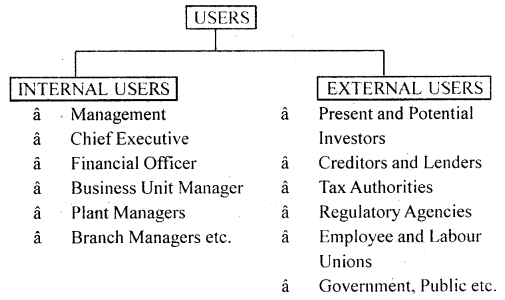
4. Interested user of information: Accounting is a means by which necessary financial information about business enterprise is communicated and is also called the language of business. Many users need financial information in order to make important decisions.
Introduction to Accounting Class 11 Notes Accountancy 1
Accounting as a source of information: Accounting is a service activity. Its function is to provide qualitative information primarily financial in nature, about economic entities that are intended to be useful in making economic decisions.

It is universally accepted that making available qualitative accounting information is an important objective because it is the basis to make decisions by its users. The accounting information expected by its users is provided through financial statements. Financial statements are Profit and Loss Account and the Position statement or Balance sheet made available the Information relating to profit and loss, and information relating to financial position.

Similarly, investors, lenders, creditors, employees, and the Government agencies by analyzing the financial statements can make decisions about investments pattern, lending and making credit available, information relating to providing funds & other dues, and natural accounts of government agencies respectively.

Branches of Accounting
1. Financial Accounting: It assists in keeping a systematic record of financial transactions, the preparation, and presentation of financial reports in order to arrive at a measure of organizational success and financial soundness.

2. Cost Accounting: It assists in analyzing the expenditure for ascertaining the cost of various products manufactured or services provided by the firm and fixation of prices thereof.

3. Management Accounting: It deals with the provisions of necessary accounting information to people within the organization to enable them in decision-making, planning, and controlling business operations.

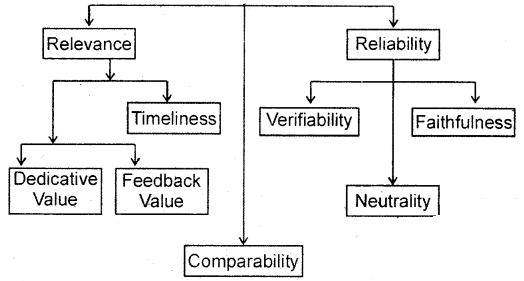
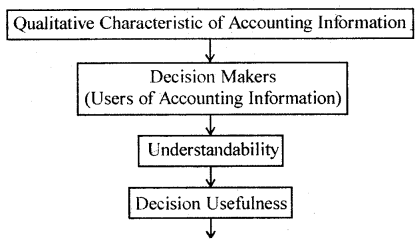
Qualitative Characteristics of Accounting Information:
1. Reliability: An accounting information should be objective and reliable. To be reliable, it should be free from errors and bias and should represent what it should represent.

2. Relevance: An accounting information should be relevant for decision making. To be relevant, information must be made available in time and help in prediction and feedback.

3. Understandability: An accounting information should be readily understandable by its user. It should be presented in simple terms and form.

4. Comparability: An accounting information will be useful and • beneficial to the different users only when it is comparable over time and with other enterprises. For this, there should be consistency, i.e. use of the common unit of measurement, common format of reporting, and common accounting policies.
Introduction to Accounting Class 11 Notes Accountancy 2
Introduction to Accounting Class 11 Notes Accountancy 3
Objectives of Accounting

  1. To keep systematic records of the business.
  2. To ascertain the financial results, i.e. profit or loss of the firm during a particular period.
  3. To show the financial position of the firm by preparing a position statement on a particular date.
  4. To communicate the accounting information to its users.

Role of Accounting: An accountant with his education training, analytical mind, and experience are best qualified to provide multiple need-based services to the end growing society. The accountants of today can do full justice not only to matters relating to taxation, costing, management accounting, financial layout, company legislation, and procedures but they can act in the fields relating to financial policies, budgetary policies, and even economic principles.

The service recorded by accountants to the society include the following:
(a) To maintain the Books of Account in a systematic manner.
(b) To act as a Statutory Auditor.
(c) To act as an Internal Auditor.
(d) To act as a Taxation Advisor.
(e) To act as a Financial Advisor. ,
(f) To act as a Management information system consultant.

Basic Terms in Accounting
1. Entity: It means a thing that has a definite individual existence.

2. Transaction: A event involving some value between two or more entities.

3. Assets: Anything which is in the possession or is the property of business enterprises including the amount due to it from others is called assets. Assets may be classified as Fixed Assets and Current Assets.

4. Liabilities: It refers to the amount which the business enterprise owes to outsiders excepting the amount owned to proprietors.

Liabilities may be classified as follows:

  1. Long-term Liabilities
  2. Current Liabilities

5. Capital: Amount invested in an enterprise in form of money or assets by its owner is known as capital.

6. Sales: Sales are total revenues from goods or services sold or provided to customers. It may be cash sales or credit sales.

7. Revenues: Amounts which business earned or received. Revenue in accounting means the income of a recurring nature from any source.

8. Expenses: Costs incurred by a business in the process of earning revenue are known as expenses.

9. Expenditure: Spending money or incurring liability for some benefits, service, or property received is called expenditure. It is of two types: Revenue expenditure and Capital expenditure.

10. Profit: The excess of revenue of a period over its related expenses during the accounting year is profit.

11. Gain: It is a monetary benefit, profits, or advantages resulting from events or transactions which are incidental to the business.

12. Loss: In accounting, this term conveys two different meanings:

  1. The result of the business for a period when total expenses exceed the total revenue.
  2. Some facts or activities against which the firm receives no benefit.

13. Discount: Discount is the deduction in the price of the goods sold. It is of two types:

  1. Trade discount and
  2. Cash discount.

14. Voucher: The documentary evidence in support of a transaction is known as a voucher.

15. Goods: It refers to the products in which the business unit is dealing, i.e. in terms of which it is buying and selling or producing and selling.

16. Drawings: Withdrawal of money and/or goods by the owner from J the business for personal use is known as drawings.

17. Purchases: Purchases are the total amount of goods procured by a business on credit and on cash, for use or sale.

18. Stock: Stock is a measure of something on hand – goods, spares, and other items in a business.

19. Debtors: They are persons and/or other entities who owe to an enterprise an amount for buying goods and services on credit.

20. Creditors: They are persons and/or other entities who have to be paid by an enterprise an amount for providing the enterprise goods and services on credit.
Detection of Foetal Disorders During Early Pregnancy

Learninsta presents the core concepts of Biology with high-quality research papers and topical review articles.

Detection of Foetal Disorders During Early Pregnancy

Ultrasound scanning Ultrasound has no known risks other than mild discomfort due to pressure from the transducer on the abdomen or vagina. No radiation is used during this procedure. Ultrasonography is usually performed in the first trimester for dating, determination of the number of foetuses, and for assessment of early pregnancy complications.

Amniocentesis

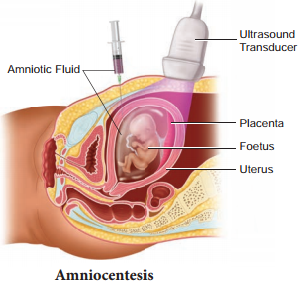
Amniocentesis involves taking a small sample of the amniotic fluid that surrounds the foetus to diagnose for chromosomal abnormalities (Fig. 3.1).
Detection Of Foetal Disorders During Early Pregnancy img 1

Amniocentesis is generally performed in a pregnant woman between the 15th and 20th weeks of pregnancy by inserting a long, thin needle through the abdomen into the amniotic sac to withdraw a small sample of amniotic fluid. The amniotic fluid contains cells shed from the foetus.

Chorionic villus sampling (CVS)

CVS is a prenatal test that involves taking a sample of the placental tissue to test for chromosomal abnormalities.

Foetoscope

Foetoscope is used to monitor the foetal heart rate and other functions during late pregnancy and labour. The average foetal heart rate is between 120 and 160 beats per minute. An abnormal foetal heart rate or pattern may mean that the foetus is not getting enough oxygen and it indicates other problems.

A hand-held doppler device is often used during prenatal visits to count the foetal heart rate. During labour, continuous electronic foetal monitoring is often used.

Assisted Reproductive Technology (Art)

Learninsta presents the core concepts of Biology with high-quality research papers and topical review articles.

Assisted Reproductive Technology (Art)

A collection of procedures, which includes the handling of gametes and/or embryos outside the body to achieve pregnancy is known as Assisted Reproductive Technology. It increases the chance of pregnancy in infertile couples. ART includes intra-uterine insemination (IUI), in vitro fertilization, (IVF) Embryo transfer (ET), Zygote intra-fallopian transfer (ZIFT), Gamete intrafallopian transfer (GIFT), Intra-cytoplasmic sperm injection (ICSI), Preimplantation genetic diagnosis, oocyte and sperm donation and surrogacy.

Intra-uterine insemination (IUI)

This is a procedure to treat infertile men with low sperm count. The semen is collected either from the husband or from a healthy donor and is introduced into the uterus through the vagina by a catheter after stimulating the ovaries to produce more ova. The sperms swim towards the fallopian tubes to fertilize the egg, resulting in normal pregnancy.

In vitro fertilization (IVF) or Test tube baby

In this technique, sperm and eggs are allowed to unite outside the body in a laboratory. One or more fertilized eggs may be transferred into the woman’s uterus, where they may implant in the uterine lining and develop. Excess embryos may be cryopreserved (frozen) for future use. Initially, IVF was used to treat women with blocked, damaged, or absent fallopian tubes. Today, IVF is used to treat many causes of infertility.

The basic steps in an IVF treatment cycle are ovarian stimulation, egg retrieval, fertilization, embryo culture, and embryo transfer. Egg retrieval is done by minor surgery under general anesthesia, using ultrasound guide aftr 34 to 37 hours of hCG (human chorionic gonadotropin) injection.

The eggs are prepared and stripped from the surrounding cells. At the same time, sperm preparation is done using a special media. After preparing the sperms, the eggs are brought together.

10,000-1,00,000 motile sperms are needed for each egg. Then the zygote is allowed to divide to form 8 celled blastomere and then transferred into the uterus for a successful pregnancy. The transfer of an embryo with more than 8 blastomeres stage into uterus is called Embryo transfer technique.

Zygote intra-fallopian transfer (ZIFT)

As in IVF, the zygote upto 8 blastomere stage is transferred to the fallopian tube by laparoscopy. The zygote continues its natural divisions and migrates towards the uterus where it gets implanted.

Intra uterine transfer (IUT)

Embryo with more than 8 blastomeres is inserted into uterus to complete its further development.

Gamete intra-fallopian transfer (GIFT)

Transfer of an ovum collected from a donor into the fallopian tube. In this the eggs are collected from the ovaries and placed with the sperms in one of the fallopian tubes. The zygote travels toward the uterus and gets implanted in the inner lining of the uterus.

Intra-cytoplasmic sperm injection (ICSI)

In this method only one sperm is injected into the focal point of the egg to fertilize. The sperm is carefully injected into the cytoplasm of the egg. Fertilization occurs in 75 – 85% of eggs injected with the sperms. The zygote is allowed to divide to form an 8 celled blastomere and then transferred to the uterus to develop a protective pregnancy.

Surrogacy

Surrogacy is a method of assisted reproduction or agreement whereby a woman agrees to carry a pregnancy for another person, who will become the newborn child’s parent after birth. Though in vitro fertilization (IVF), embryos are created in a lab and are transferred into the surrogate mother’s uterus.

Male infertility

Azoospermia is defined as the absence of spermatozoa in the ejaculate semen on atleast two occasions and is observed approximately in 1% of the population.

Micro-testicular sperm extraction (TESE)

Microsurgical sperm retrieval from the testicle involves a small midline incision in the scrotum, through which one or both testicles can be seen. Under the microscope, the seminiferous tubules are dilated and small amount of testicular tissue in areas of active sperm production are removed and improved for sperm yield compared to traditional biopsy techniques.

Infertility and Its Causes of Infertility

Learninsta presents the core concepts of Biology with high-quality research papers and topical review articles.

Infertility and Its Causes of Infertility

Inability to conceive or produce children even after unprotected sexual cohabitation is called infertility. That is, the inability of a man to produce sufficient numbers or quality of sperm to impregnate a woman or inability of a woman to become pregnant or maintain a pregnancy.

The causes for infertility are tumours formed in the pituitary or reproductive organs, inherited mutations of genes responsible for the biosynthesis of sex hormones, malformation of the cervix or fallopian tubes and inadequate nutrition before adulthood. Long-term stress damages many aspects of health especially the menstrual cycle. Ingestion of toxins (heavy metal cadmium), heavy use of alcohol, tobacco and marijuana, injuries to the gonads and aging also cause infertility.

Other causes of infertility

  • Pelvic inflmmatory disease (PID), uterine firoids and endometriosis are the most common causes of infertility in women.
  • Low body fat or anorexia in women. i.e. a psychiatric eating disorder characterised by the fear of gaining weight.
  • Undescended testes and swollen veins (varicocoele) in scrotum.
  • Tight clothing in men may raise the temperature in the scrotum and affect sperm production.
  • Under developed ovaries or testes.
  • Female may develop antibodies against her partner’s sperm.
  • Males may develop an autoimmune response to their own sperm.

Sexually Transmitted Diseases (Std)

Learninsta presents the core concepts of Biology with high-quality research papers and topical review articles.

Sexually Transmitted Diseases (Std)

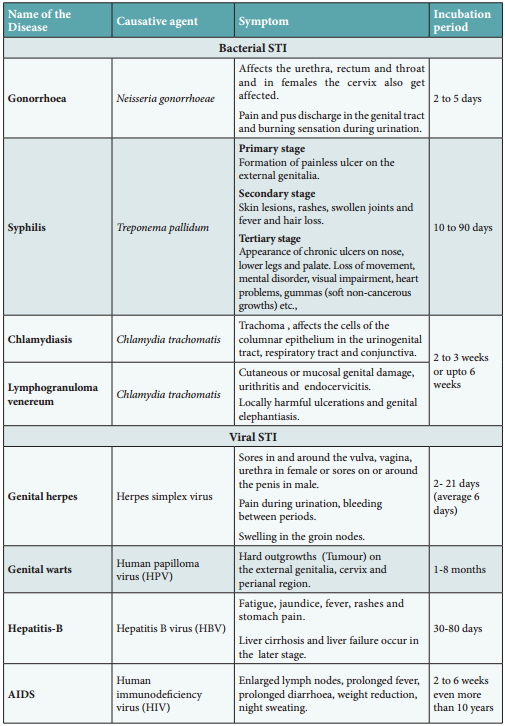
Sexually transmitted diseases (STD) or Venereal diseases (VD) or Reproductive tract infections (RTI) are called as Sexually transmitted infections (STI). Normally STI are transmitted from person to person during intimate sexual contact with an infected partner.

Infections like Hepatitis-B and HIV are transmitted sexually as well as by sharing of infusion needles, surgical instruments, etc with infected people, blood transfusion or from infected mother to baby.

People in the age of 15 to 24 years are prone to these infections. The bacterial STI are gonorrhoea, syphilis, chancroid, chlamydiasis and lymphogranuloma venereum. The viral STI are genital herpes, genital warts, Hepatitis-B and AIDS.

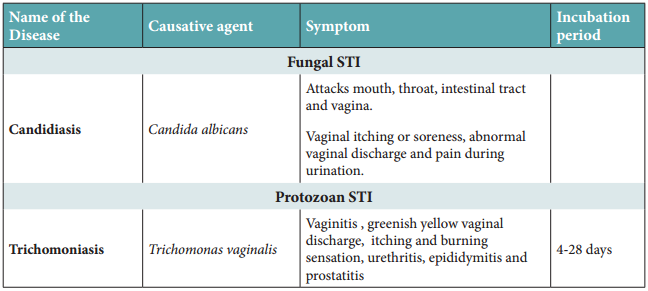
Trichomoniasis is a protozoan STI, and candidiasis is a fungal STI. STI caused by bacteria, fungi and protozoa or parasites, can be treated with antibiotics or other medicines, whereas STI caused by virus cannot be treated but the symptoms can be controlled by antiviral medications. Latex condoms usage greatly reduces the risk, but does not completely eliminate the risk of transmission of STI.

Prevention of STDs

  • Avoid sex with unknown partner/multiple partners.
  • Use condoms.
  • In case of doubt, consult a doctor for diagnosis and get complete treatment.

Sexually Transmitted Diseases (Std) img 1
Sexually Transmitted Diseases (Std) img 2

Cervical cancer

Cervical cancer is caused by a sexually transmitted virus called Human Papilloma virus (HPV). HPV may cause abnormal growth of cervical cells or cervical dysplasia. The most common symptoms and signs of cervical cancer are pelvic pain, increased vaginal discharge and abnormal vaginal bleeding. The risk factors for cervical cancer include

  • Having multiple sexual partners
  • Prolonged use of contraceptive pills

Cervical cancer can be diagnosed by a Papanicolaou smear (PAP smear) combined with an HPV test. X-Ray, CT scan, MRI and a PET scan may also be used to determine the stage of cancer. The treatment options for cervical cancer include radiation therapy, surgery and chemotherapy. Modern screening techniques can detect precancerous changes in the cervix.

Therefore screening is recommended for women above 30 years once in a year. Cervical cancer can be prevented with vaccination. Primary prevention begins with HPV vaccination of girls aged 9 – 13 years, before they become sexually active. Modification in lifestyle can also help in preventing cervical cancer. Healthy diet, avoiding tobacco usage, preventing early marriages, practicing monogamy and regular exercise minimize the risk of cervical cancer.