Recording of Transactions 1 Class 11 Notes Accountancy Chapter 3

By going through these CBSE Class 11 Accountancy Notes Chapter 3 Recording of Transactions 1, students can recall all the concepts quickly.

Recording of Transactions 1 Notes Class 11 Accountancy Chapter 3

As we know that, accounting involves a process of identifying and. analyzing the business transactions, recording them, classifying and summarising their effects, and finally communicating it to the interested users of accounting information. Now, we will discuss the details of each step involved in the accounting process. The first step involves identifying the transactions to be recorded and preparing the source documents which are in turn recorded in the basic book of original entry called journal and are then posted to individual accounts in the principal book called ledger.

Business Transactions and Source Document
Business Transactions: Business transactions are exchanges of economic consideration between parties and have the two-fold effect that one recorded in at least two accounts. For example, purchase of furniture for cash.

It involves the reciprocal exchange of two things:

  1. payment of cash,
  2. delivery of furniture.

Source Document: Each business transaction should be supported by documentary evidence such as cash memos, cash receipts, invoices or bills, debit and credit notes, pay-in-slip, cheque,s, etc. These business documents are called source documents.

Vouchers: On the basis of source document entries are, first of all, recorded on vouchers, and then on the basis of vouchers recording is made in the Journal or books of original entry. A separate voucher is prepared for each transaction and it specifies the accounts to be debited and credited. Vouchers are prepared by an accountant and each voucher is countersigned by an authorized person of the firm.

Types of Accounting Vouchers
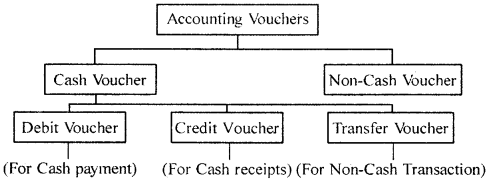
Recording of Transactions 1 Class 11 Notes Accountancy 1
Note: Transfer Voucher is also called Transaction Voucher. Specimen of Transaction Voucher

Recording of Transactions 1 Class 11 Notes Accountancy 2
Specimen of Debit Voucher
Recording of Transactions 1 Class 11 Notes Accountancy 3
Specimen of Credit Voucher
Recording of Transactions 1 Class 11 Notes Accountancy 4
The transaction with multiple debits and multiple credits are called complex transactions and the accounting voucher prepared for such transactions is called a Complex Voucher/Journal Voucher.

Specimen of Complex Transaction Voucher:
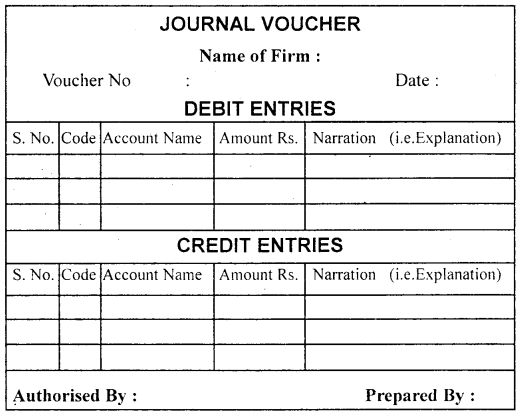
Recording of Transactions 1 Class 11 Notes Accountancy 5
Features of Accounting Voucher:
An accounting Voucher must contain the following essential features:

  1. It is written on a good quality paper;
  2. The name of the firm must be printed on the top;
  3. The date of the transaction is filled up against the date;
  4. The number of the voucher is to be in serial order;
  5. The name of the account to be debited or credited is mentioned;
  6. Debit and the credit amount is to be written in figure against the amount;
  7. Description of the transaction is to be given account-wise;
  8. The person who prepares the voucher must mention his name along with his signature;
  9. The name and signature of the authorized person are mentioned on the voucher.

Accounting Equation:
An accounting equation is a statement of equality between the resources (Assets) and the sources (Capital and Liabilities) which finance the resources. In simple words, an accounting equation signifies that the assets of a business are always equal to the total of its liabilities and capital (owner’s equity) in mathematical form:
Assets = Liabilities + capital

The accounting equation is also called the Balance Sheet Equation, as it depicts fundamental relationship among the components of the balance sheet.

Using Debit and Credit
Every transaction involves a give and takes aspect, in double-entry accounting both the aspect of the transaction is recorded. If the business acquires something, it must have been acquired by giving something. While recording each transaction, the total amount debited must be equal to the total amount credited.

The term ‘Debit’ and ‘Credit’ indicate whether the transaction is to be recorded on the left-hand side or right-hand side of the account. In its simplest form, an account looks like the English language letter “T”. This helps in ascertaining the ultimate position of each item at the end of an accounting period. In a “T” account, the left side is called debit (Dr.) and the right side is called credit (Cr.).

Specimen of T Account:
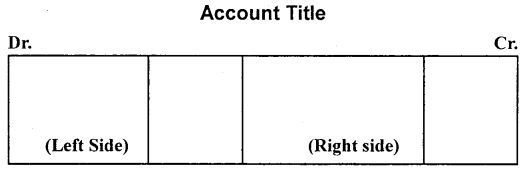
Recording of Transactions 1 Class 11 Notes Accountancy 6
Rules of Debit and Credit:
Recording of Transactions 1 Class 11 Notes Accountancy 7
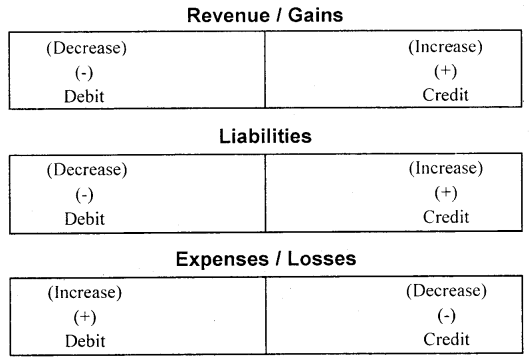
Two fundamental rules are followed to record the changes in these accounts:
1. For recording changes in Assets/Expenses/Losses

  1. “Increase in assets is debited and decrease in assets is Credited.”
  2. “Increase in expenses/losses is debited and decrease in expenses/losses is credited.”

2. For recording changes in Liabilities and Capital/Revenue/Gains.

  1. “Increase in liabilities is credited and decrease in liabilities is debited.”
  2. “Increase in the capital is credited and decrease in the capital is debited.”
  3. “Increase in revenue/gain is credited and decrease in revenue/gain is debited.

The rules applicable to the different kinds of accounts have been summarised in the following chart:
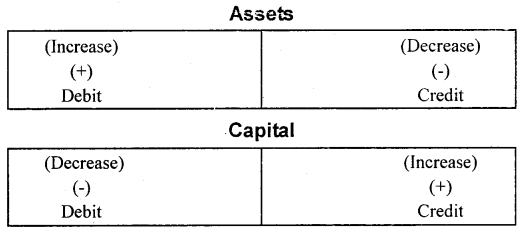
Recording of Transactions 1 Class 11 Notes Accountancy 8
Recording of Transactions 1 Class 11 Notes Accountancy 9
Books of Original Entry:
The book in which the transaction is recorded for the first time is called a journal or book of original entry. The source document is required to record the transactions in the journal. This practice provides a complete record of each transaction in one place and links the debit and credits for each transaction. The process of recording transactions in the journal is called journalizing. The process of transferring journal entry to individual accounts is called posting. This sequence causes the journal to be called the Book of Original Entry and the ledger account on the Principal Book of entry.

Journal is sub-divided into a number of books of original entry as follows:

  1. Journal proper
  2. Cash Book
  3. Other day Books
    (a) Purchase Book
    (b) Sales Book
    (c) Purchase Returns Book
    (d) Sales Returns Book
    (e) Bills Receivable Book
    (f) Bills Payable Book

Journal:
A Journal is a book in which transactions are recorded in the order in which they occur i.e., in chronological order. A Journal is called a book of prime entry (also called of original entry) because all business transactions are entered first in this book.

Format of Journal:
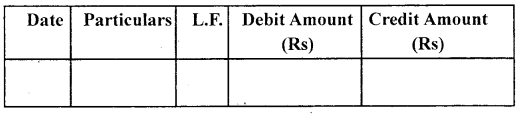
Recording of Transactions 1 Class 11 Notes Accountancy 10
1. Date Column: In this column, the date on which the transaction is entered is recorded. The year and month are written once till they change.

2. Particulars Column: In this column, first the name of accounts to be debited then the names of the account to be credited, and lastly the narration is entered.

3. L.F. (Ledger Folio) Column: In this column, the ledger page number containing the relevant account is entered at the time of posting.

4. Debit amount column: In this column, the amount to be debited is entered.

5. Credit amount column: In this column, the amount to be credited is entered.

The Ledger:
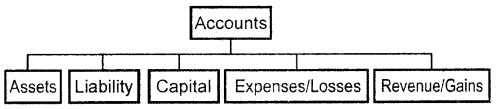
A ledger is a principal book that contains all the accounts (Assets Accounts, Liabilities Accounts, Capital Accounts, Revenue Accounts, Expenses Accounts) to which the transactions recorded in the books of original entry are transferred. As the ledger is the ultimate destination of all transactions, the ledger is called the “Book of Final Entry”.

Format of Ledger
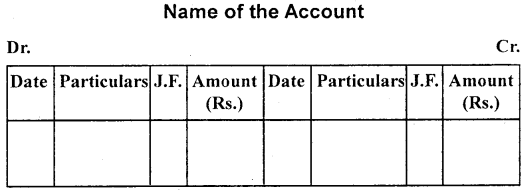
Recording of Transactions 1 Class 11 Notes Accountancy 11

  1. Name of the Account: The name of the item is written at the top of the format as the title of the account. The title of the account ends with the suffix ‘Account’.
  2. Dr./Cr.: Dr. means Debit side of the account that is left side and Cr. means Credit side of the account i.e. right side.
  3. Date: Year, Month, and Date of transactions are posted in chronological order in this column.
  4. Particulars: The name of the item with reference to the original book of entry is written on the debit/credit side of the account.
  5. Journal Folio: It records the page number of the original book of entry on which relevant transaction is recorded.
  6. Amount: This column records the amount in numerical figure, corresponding to what has been entered in the amount column of the original book of entry.

The distinction between Journal and Ledger:

JournalLedger
1. The Journal is the book of the first entry (original entry).1. The ledger is the book of secondary entry.
2. It is the book for chronological records.2. It is the book for analytical records.
3. It is prepared on the basis of source documents of transactions.3. It is prepared on the basis of the journal.
4. Process of recording in the Journal is called Journalising4. The process of recording in the ledger is known as posting.
5. Narration is written for each entry.5. No narration is given

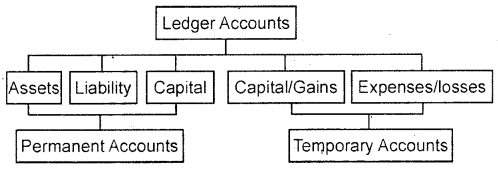
Classification of Ledger Accounts:
Recording of Transactions 1 Class 11 Notes Accountancy 12
All permanent accounts are balanced and carried forward to the next accounting period. The temporary accounts are closed at the end of the accounting period by transferring them to the trading and profit and loss accounts. This classification is also relevant for preparing financial statements.
Genetic Control of Rh Factor

Learninsta presents the core concepts of Biology with high-quality research papers and topical review articles.

Genetic Control of Rh Factor

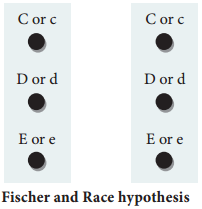
Fisher and Race Hypothesis:

Rh factor involves three different pairs of alleles located on three different closely linked loci on the chromosome pair. This system is more commonly in use today, and uses the ‘Cde’ nomenclature.
Genetic Control Of Rh Factor img 1

In the above Fig. 4.1, three pairs of Rh alleles (Cc, Dd and Ee) occur at 3 different loci on homologous chromosome pair. The possible genotypes will be one C or c, one D or d, one E or e from each chromosome. For e.g. CDE/cde; CdE/cDe; cde/cde; CDe/CdE etc., All genotypes carrying a dominant ‘D’ allele will produce Rh positive phenotype and double recessive genotype ‘dd’ will give rise to Rh negative phenotype.

Wiener Hypothesis

Wiener proposed the existence of eight alleles (R1, R2, RO, Rz, r, r1, r11, ry) at a single Rh locus. All genotypes carrying a dominant ‘R allele’ (R1, R2, RO, Rz) will produce Rh positive phenotype and double recessive genotypes (rr, r1r1, r11r11, ry ry) will give rise to Rh negative phenotype.

Incompatibility of Rh Factor – Erythroblastosis foetalis

Rh incompatability has great signifiance in child birth. If a woman is Rh negative and the man is Rh positive, the foetus may be Rh positive having inherited the factor from its father. The Rh negative mother becomes sensitized by carrying Rh positive foetus within her body. Due to damage of blood vessels, during child birth, the mother’s immune system recognizes the Rh antigens and gets sensitized. The sensitized mother produces Rh antibodies.

The antibodies are IgG type which are small and can cross placenta and enter the foetal circulation. By the time the mother gets sensitized and produce anti ‘D’ antibodies, the child is delivered.

Usually no effects are associated with exposure of the mother to Rh positive antigen during the first child birth, subsequent Rh positive children carried by the same mother, may be exposed to antibodies produced by the mother against Rh antigen, which are carried across the placenta into the foetal blood circulation. This causes haemolysis of foetal RBCs resulting in haemolytic jaundice and anaemia. This condition is known as Erythoblastosis foetalis or Haemolytic disease of the new born (HDN).

Prevention of Erythroblastosis Foetalis

If the mother is Rh negative and foetus is Rh positive, anti D antibodies should be administered to the mother at 28th and 34th week of gestation as a prophylactic measure. If the Rh negative mother delivers Rh positive child then anti D antibodies should be administered to the mother soon after delivery. This develops passive immunity and prevents the formation of anti D antibodies in the mothers blood by destroying the Rh foetal RBC before the mother’s immune system is sensitized. This has to be done whenever the woman attains pregnancy.

Human Blood Groups | ABO Blood Groups and Its Types

Learninsta presents the core concepts of Biology with high-quality research papers and topical review articles.

Human Blood Groups | ABO Blood Groups and Its Types

Multiple allelism occurs in humans, particularly in the inheritance of different types of blood groups. The blood group inheritance in human can be understood by learning about antigens and antibodies. The composition of blood, different types of blood groups (ABO) the blood antigens and antibodies were discussed in chapter 7 of class XI.

ABO blood types

Multiple allele inheritance of ABO blood groups Blood differs chemically from person to person. When two different incompatible blood types are mixed, agglutination (clumping together) of erythrocytes (RBC) occurs.

The basis of these chemical differences is due to the presence of antigens (surface antigens) on the membrane of RBC and epithelial cells. Karl Landsteiner discovered two kinds of antigens called antigen ‘A’ and antigen ‘B’ on the surface of RBC’s of human blood.

Based on the presence or absence of these antigens three kinds of blood groups, type ‘A’, type ‘B’, and type ‘O’ (universal donor)were recognized. The fourth and the rarest blood group ‘AB’ (universal recipient) was discovered in 1902 by two of Landsteiner’s students Von De Castelle and Sturli.

Bernstein in 1925 discovered that the inheritance of different blood groups in human beings is determined by a number of multiple allelic series. The three autosomal alleles located on chromosome 9 are concerned with the determination of blood group in any person.

The gene controlling blood type has been labeled as ‘L’ (after the name of the discoverer, Landsteiner) or I (from isoagglutination). The I gene exists in three allelic forms, IA, IB and IO. IA specifies A antigen. IB allele determines B antigen and IO allele specifies no antigen. Individuals who possess these antigens in their fluids such as the saliva are called secretors.

Each allele (IA and IB) produces a transferase enzyme. IA allele produces N-acetyl galactose transferase and can add N-acetyl galactosamine (NAG) and IB allele encodes for the enzyme galactose transferase that adds galactose to the precursor (i.e., H substances) In the case of IO/IO allele no terminal transferase enzyme is produced and therefore called “null” allele and hence cannot add NAG or galactose to the precursor.

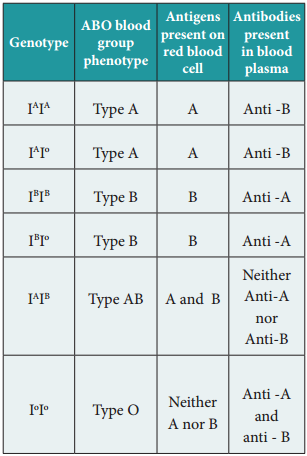
From the phenotypic combinations it is evident that the alleles IA and IB are dominant to IO, but co-dominant to each other (IA = IB). Their dominance hierarchy can be given as (IA = IB > IO). A child receives one of three alleles from each parent, giving rise to six possible genotypes and four possible blood types (phenotypes). The genotypes are IAIA, IA IO, IBIB, IBIO, IAIB and IO IO.
Human Blood Groups img 1
Genetic basis of the human ABO blood groups

Rhesus or Rh Factor

The Rh factor or Rh antigen is found on the surface of erythrocytes. It was discovered in 1940 by Karl Landsteiner and Alexander Wiener in the blood of rhesus monkey, Macaca rhesus and later in human beings. The term ‘Rh factor’ refers to “immunogenic D antigen of the Rh blood group system. An individual having D antigen are Rh D positive (Rh+) and those without D antigen are Rh D negative (Rh)”.

Rhesus factor in the blood is inherited as a dominant trait. Naturally occurring Anti D antibodies are absent in the plasma of any normal individual. However if an Rh (Rh negative) person is exposed to Rh+ (Rh positive) blood cells (erythrocytes) for the first time, anti D antibodies are formed in the blood of that individual. On the other hand, when an Rh positive person receives Rh negative blood no effect is seen.

Principles of Inheritance and Variation Multiple Alleles

Learninsta presents the core concepts of Biology with high-quality research papers and topical review articles.

Principles of Inheritance and Variation Multiple Alleles

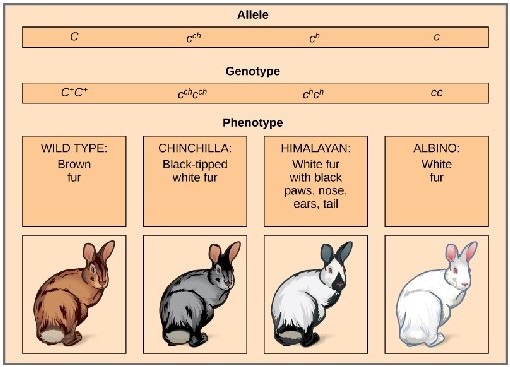
The genetic segregations in Mendelian inheritance reveal that all genes have two alternative forms – dominant and recessive alleles e.g. tall versus dwarf (T and t). The former is the normal allele or wild allele and the latter the mutant allele.

A gene can mutate several times producing several alternative forms. When three or more alleles of a gene that control a particular trait occupy the same locus on the homologous chromosome of an organism, they are called multiple alleles and their inheritance is called multiple allelism.

Multiple alleles exist in a population when there are many variations of a gene present. In organisms with two copies of every gene, also known as diploid organisms, each organism has the ability to express two alleles at the same time. They can be the same allele, which is called a homozygous genotype.

Multiple alleles refer to the occurrence of three or more than three alleles for a particular gene. Alleles are different or contrasting forms of a gene. For example, for the gene encoding for height, one allele can be for tallness, whereas the other can be for dwarfness.

Mendel implied that only two alleles, one dominant and one recessive, could exist for a given gene. The variant may be recessive or dominant to the wild-type allele. An example of multiple alleles is the ABO blood-type system in humans.

Polygenic Inheritance: Human skin color is a good example of polygenic (multiple gene) inheritance. A genotype with all “dominant” capital genes (AABBCC) has the maximum amount of melanin and very dark skin. A genotype with all “recessive” small case genes (aabbcc) has the lowest amount of melanin and very light skin.

Multiple alleles exist in a population when there are many variations of a gene present. In both haploid and diploid organisms, new alleles are created by spontaneous mutations. These mutations can arise in a variety of ways, but the effect is a different sequence of nucleic acid bases in the DNA.

Multiple alleles are present at the same locus of the chromosomes. A classical example of multiple alleles is found in ABO blood group system of humans. Despite the multiple alleles of any gene, an individual possess and can have only two alleles at a time.
Multiple Alleles img 1

Theory Base of Accounting Class 11 Notes Accountancy Chapter 2

By going through these CBSE Class 11 Accountancy Notes Chapter 2 Theory Base of Accounting, students can recall all the concepts quickly.

Theory Base of Accounting Notes Class 11 Accountancy Chapter 2

Accounting aims at providing information about the financial performance of a firm to its various users. Accounting information must be reliable and comparable based on some consistent accounting policies, principles, and practices. This calls for developing a proper theory base of accounting.

The importance of accounting theory need not.be over-emphasized as no discipline can develop without a sound theoretical base. The theory base of accounting consists of principles, concepts, rules, and guidelines developed over a period of time to bring uniformity and consistency to the process of accounting and enhance its utility to different users of accounting information.

Apart from these, the Institute of Chartered Accountants of India which is the regulatory body for the standardization of accounting policies in the country has issued Accounting Standards which are expected to be uniformly adhered to, in order to bring consistency in the accounting practices.

Generally Accepted Accounting Principles (GAAP)
Generally Accepted Accounting Principles refers to the rules or guidelines adopted for recording and reporting business transactions in order to bring uniformity in the preparation and presentation of financial statements. These principles are also referred to as concepts and conventions.

From the practical viewpoint, various terms such as principles, postulates, conventions, modifying principles, assumptions, basic accounting concepts, etc. have been used interchangeably. However, the principles of accounting are not static in nature. These are constantly influenced by changes in the legal, social and economic environment as well as the needs of the users.

Basic Accounting Concepts
The basic accounting concepts are referred to as the fundamental, ideas or basic assumptions underlying the theory and practice of financial accounting and are broad working rules for all accounting activities and developed by the accounting professions.

The important basic accounting concepts are following:
1. Business Entity Concept: This concept assumes that a business, has a distinct and separate entity from its owners. Thus, for the purpose of accounting, a business and its owners are to be treated as two separate entities.

2. Money Measurement Concept: The concept of money measurement states that only those transactions and happenings in an organization, which can be expressed in terms of money are to be recorded in the books of accounts. Also, the records of the transactions are to be kept not in the physical units but in the monetary units.

3. Going Concern Concept: This concept assumes that a business firm would continue to carry out its operations indefinitely (for a fairly long period of time) and- would not be liquidated in the near future.

4. Accounting Period Concept: The accounting period refers to the span of time at the end of which the financial statements of an enterprise are prepared to know whether it has earned profit or incurred losses during that period and what exactly is the position of its assets and liabilities, at the end of that period.

5. Cost Concept: The cost concept requires that all assets are recorded in the book of accounts at their cost price, which includes the cost of acquisition, transportation, installation, and making the assets ready for use.

6. Dual Aspect Concept: This concept states that every transaction has a dual or two-fold effect on various accounts and should therefore be recorded in two places. The duality principle is commonly expressed in terms of fundamental accounting equations, which is
Assets = Liabilities + Capital

7. Revenue Recognition (Realisation) Concept: Revenue is the gross inflow of cash arising from the sale of goods and services by an enterprise and use by others of the enterprise’s resources yielding interest royalties and dividends. The concept of revenue recognition requires that the revenue for business transactions should be considered realized when a legal right to receive it arises.

8. Matching Concept: The concept of matching emphasizes that expenses incurred in an accounting period should be matched with revenues during that period. It follows from this that the revenue and expenses incurred to earn this revenue must belong to the same accounting period.

9. Full Disclosure Concept: This concept requires that all material and relevant facts concerning the financial performance of an enterprise must be fully and completely disclosed in the financial statements and their accompanying footnotes.

10. Consistency Concept: This concept states that accounting policies and practices followed by enterprises should be uniform and consistent over a period of time so that results are composable. Comparabilities results when the same accounting principles are consistently being applied by different enterprises for the period under comparison, or the same firm for a number of periods.

11. Conservatism Concept: This concept requires that business transactions should be recorded in such a manner that profits are not overstated. All anticipated losses should be accounted for but all unrealized gains should be ignored.

12. Materiality Concept: This concept states that accounting should focus on material facts. If the item is likely to influence the decision of a reasonably prudent investor or creditors, it should be regarded as material, and shown in the financial statements. 13. Objectivity Concept: According to this concept, accounting transactions should be recorded in the manner so that it is free from the bias of accountants and others.

Systems of Accounting:
There are two systems of recording business transactions which are following:
1. Double Entry System: This system is based on the principle of “Dual Aspect” which states that every transaction has two effects, viz. receiving of a benefit and giving of a benefit. Each transaction, therefore, involves two or more accounts and is recorded at different places in the ledger. The basic principle followed is that every debit must have a corresponding credit. A double-entry system is a complete system as both the aspects of a transaction are recorded in the books of accounts.

2. Single Entry System: This system is not a complete system of maintaining records of financial transactions. It does not record the two-fold effect of each and every transaction. Instead of maintaining all the accounts, only personal accounts and cash books are maintained under this system. The accounts maintained under this system are incomplete and unsystematic and, therefore, not reliable.

Basis of Accounting
From the point of view of the timing of recognition of revenue and costs, there can be two broad approaches to accounting. These are:

  1. Cash basis
  2. Accrual basis

1. Cash Basis of Accounting: Under the cash basis, entries in the book of accounts are made when cash is received or paid and not when the receipt or payment becomes due. This system is incompatible with the matching principle, which states that the revenue of a period is matched with the cost of the same period.

2. Accrual Basis of Accounting: Under the accrual basis, revenue and costs are recognized in the period in which they occur rather than when they are paid. A distinction is made between the receipt of cash and the right to receive cash and payment of cash and the legal obligation to pay cash. Thus, under this system, the monitory effect of a transaction is taken into account in the period in which they are earned rather than in the period in which cash is actually received or paid by the enterprise.

Accounting Standards:
Accounting standards are written statements of uniform accounting rules and guidelines or practices for preparing the uniform and consistent financial statements and for other disclosures affecting the user of accounting information. However, the accounting standards cannot override the provision of applicable laws, customs, usages, and business environments in the country.

Kohler defines accounting standards as “a mode of conduct imposed on accountants by custom, law or professional body”.

In order to bring uniformity and consistency in the reporting of accounting information, the Institute of Chartered Accountants of India (ICAI) constituted an Accounting Standard Board in April 1977 for developing Accounting Standards. Accounting Standard Board submits the draft of the standards to the council of ICAI, which finalizes the accounting standards.

Accounting-Standards (AS):
The ICAI has issued the following standards:

  • AS 1 Disclosure of Accounting Policies
  • AS 2 Valuation of Inventories
  • AS 3 Cash Flow Statements
  • AS 4 Contingencies and Events Occurring after the Balance Sheet Date
  • AS 5 Net Profit or Loss for the Period, Prior Period Items and Changes in Accounting Policies
  • AS 6 Depreciation Accounting AS 7 Construction Contracts
  • AS 8 Accounting for Research and Development
  • AS 9 Revenue Recognition
  • AS 10 Accounting for Fixed Assets
  • AS 11 The Effects of Changes in Foreign Exchange Rates
  • AS 12 Accounting for Government Grants
  • AS 13 Accounting for Investments
  • AS 14 Accounting for Amalgamations
  • AS 15 Accounting for Retirement Benefits in the Financial Statements of Employers (recently revised and titled as Employee Benefits’)
  • AS 16 Borrowing Costs
  • AS 17 Segment Reporting
  • AS 18 Related Party Disclosures
  • AS 19 Leases
  • AS 20 Earnings Per Share
  • AS 21 Consolidated Financial Statements
  • AS 22 Accounting for Taxes on Income
  • AS 23 Accounting for Investments in Associates in Consolidated Financial Statements
  • AS 24 Discontinuing Operations
  • AS 25 Interim Financial Reporting AS 26 Intangible Assets
  • AS 27 Financial Reporting of Interests in Joint Ventures AS 28 Impairment of Assets
  • AS 29 Provisions. Contingent Liabilities and Contingent Assets

International Financial Reporting Standards (IFRS):
“International Financial Reporting Standards (IFRS) are a set of accounting standards developed by the International Accounting Standards Board (IASB), the international accounting standard-setting body, which came into existence in the year 2001.

The use of a single set of high-quality accounting standards would facilitate investment and other economic decisions across borders, increase market efficiency and reduce the cost of capital. IASB places emphasis on developing standards based on sound and clearly stated principles, from which interpretation is necessary. Therefore, IFRS are referred to as principles-based accounting standards.

IFRS issued by the IASB:

S.No.Title
1. IFRS 1First-time Adoption of International Financial Reporting Standards.
2. IFRS 2Share-Based Payment
3. IFRS 3Business Combinations
4. IFRS 4Insurance Contracts
5. IFRS 5Non-Current Assets Held for Sale and Discontinued Operations
6. IFRS 6Exploration for and Evaluation of Mineral Resources
7. IFRS 7Financial Instruments: Disclosures
8. IFRS 8Operating Segments
9. IFRS 9Financial Instruments
10. –IFRS for Small and Medium Enterprises. It provides standards applicable to private entities (those that are not publicly accountant as defined in this standard)

IASB has adopted all outstanding IAS and SIC issued by the IASC as its own standards. Those IAS and SIC continue to be in force to the extent they are not amended or withdrawn by the IASB. Out of 41 IAS, 12 IAS standards withdrawn and in effect 29 IAS are still applicable.

IFRS compliant financial statements are:

  1. Statement of Financial Position,
  2. Comprehensive Income Statement,
  3. Statement of Changes in Equity,
  4. Statement of Cash Flow, and
  5. Notes and Summary of Accounting Policies.

Difference between IFRS and Indian Accounting Standards:
The principal difference between the two is that while IFRS is based on principle and fair value. Indian Accounting Standards are based on rules and historical value.