Biotechnology Of Gene Therapy

Learninsta presents the core concepts of Biology with high-quality research papers and topical review articles.

Biotechnology Of Gene Therapy

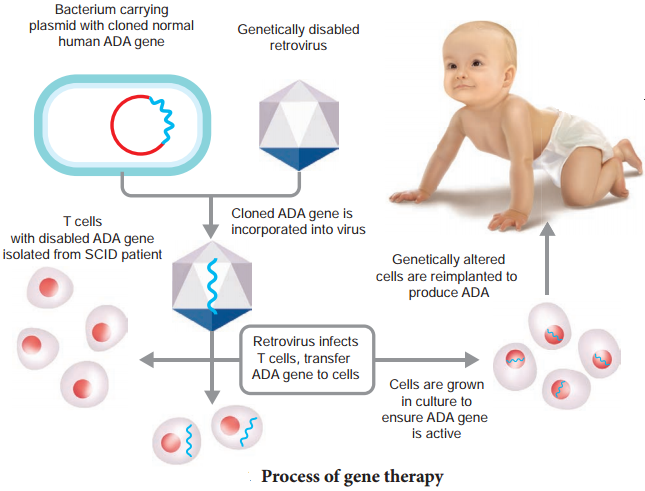
If a person is born with a hereditary disease, can a corrective therapy be given for such disease? Yes, this can be done by a process known as gene therapy. This process involves the transfer of a normal gene into a person’s cells that carries one or more mutant alleles. Expression of normal gene in the person results in a functional gene product whose action produces a normal phenotype.

Delivery of the normal gene is accomplished by using a vector. The main thrust of gene therapy has been directed at correcting single gene mutations as in cystic firosis and haemophilia. At present most genetic diseases have no effective treatment and so gene therapy could offer hope for many people.

There are two strategies involved in gene therapy namely; Gene augmentation therapy which involves insertion of DNA into the genome to replace the missing gene product and Gene inhibition therapy which involves insertion of the anti sense gene which inhibits the expression of the dominant gene (Fig. 9.3). The two approaches to achieve gene therapy are somatic cell and germ line gene therapy.
Biotechnology Of Gene Therapy img 1

Somatic cell therapy involves the insertion of a fully functional and expressible gene into a target somatic cell to correct a genetic disease permanently whereas Germline gene therapy involves the introduction of DNA into germ cells which is passed on to the successive generations. Gene therapy involves isolation of a specific gene and making its copies and inserting them into target cells to make the desired proteins.

It is absolutely essential for gene therapists to ensure that the gene is harmless to the patient and it is appropriately expressed and that they body’s immune system does not react to the foreign proteins produced by the new genes.

Applications In Medicine

Learninsta presents the core concepts of Biology with high-quality research papers and topical review articles.

Applications In Medicine

Recombinant Human Insulin

The Human insulin is synthesized by the β cells of Islets of Langerhans in the pancreas. It is formed of 51 aminoacids which are arranged in two polypeptide chains, A and B. The polypeptide chain A has 21 amino acids while the polypeptide chain B has 30 amino acids. Both A and B chains are attached together by disulphide bonds.

Insulin controls the levels of glucose in blood. It facilitates the cellular uptake and utilization of glucose for the release of energy. Deficiency of insulin leads to diabetes mellitus which is characterized by increased blood glucose concentration and a complex of symptoms which may lead to death, if untreated. A continuous program of insulin dependence is required to treat this deficiency.

In the early years, insulin isolated and purified from the pancreas of pigs and cows was used to treat diabetic patients. Due to minor differences in the structure of the animal insulin as compared to human insulin, it resulted in the occurrence of allergic reactions in some diabetic patients.

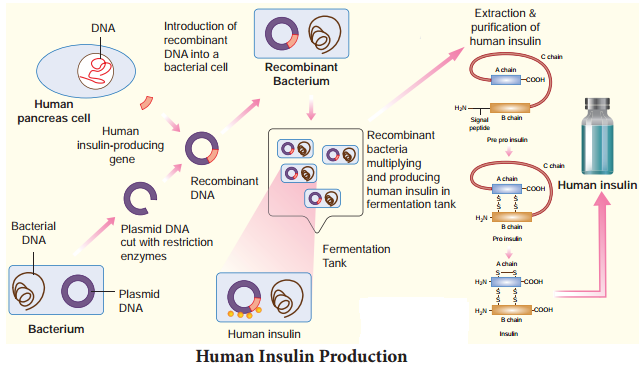
Production of insulin by recombinant DNA technology started in the late 1970s. This technique involved the insertion of human insulin gene on the plasmids of E.coli. The polypeptide chains are synthesized as a precursor called pre-pro insulin, which contains A and B segments linked by a third chain (C) and preceded by a leader sequence.

The leader sequence is removed after translation and the C chain is excised, leaving the A and B polypeptide chains (Fig. 9.1). Insulin was the first ever pharmaceutical product of recombinant DNA technology administered to humans. The approval to use recombinant insulin for diabetes mellitus was given in 1982. In 1986 human insulin was marketed under the trade name Humulin.
Applications In Medicine img 1

Interferons

Interferons are proteinaceous, antiviral, species specific substances produced by mammalian cells when infected with viruses. Interferons were discovered by Alick Isaacs and Jean Lindemann in 1957. Based on the structure of interferons they are classifid as α, β and γ interferons.

They stimulate the cellular DNA to produce antiviral enzymes which inhibit viral replication and protect the cells. Interferons could be isolated from blood, but the amount of blood required for isolation of interferons is enormous and not practical. To overcome this issue interferons could be produced by rDNA technology.

The yeast Saccharomyces cerevisiae is more suitable for production of recombinant interferons than E.coli, since E.coli does not possess the machinery for glycosylation of proteins. Interferons are used for the treatment of various diseases like cancer, AIDS, multiple sclerosis, hepatitis C and herpes zoster. In spite of the therapeutic applications interferons are not within the reach of the common man due to high cost for its production.

Recombinant Vaccines

Recombinant DNA technology has been used to produce new generation vaccines. The limitations of traditional vaccine production could be overcome by this approach. The recombinant vaccines are generally of uniform quality and produce less side effects as compared to the vaccines produced by conventional methods. Different types of recombinant vaccines include subunit recombinant vaccines, attenuated recombinant vaccines and DNA vaccines.

Subunit recombinant vaccines

Vaccines that use components of a pathogenic organism rather than the whole organism are called subunit vaccines; recombinant DNA technology is very suited for developing new subunit vaccines. It includes components like proteins, peptides and DNAs of pathogenic organisms. The advantages of these vaccines include their purity in preparation, stability and safe use.

Attenuated recombinant vaccines

This includes genetically modified pathogenic organisms (bacteria or viruses) that are made nonpathogenic and are used as vaccines. It is now possible to genetically engineer the organisms (bacteria or viruses) and use them as live vaccines and such vaccines are referred to as attenuated recombinant vaccines.

DNA Vaccines

Genetic immunisation by using DNA vaccines is a novel approach that came into being in 1990. The immune response of the body is stimulated by a DNA molecule. A DNA vaccine consists of a gene encoding an antigenic protein, inserted onto a plasmid, and then incorporated into the cells in a target animal. DNA instructs the cells to make antigenic molecules which are displayed on its surfaces.

This would evoke an antibody response to the free floating antigen secreted by the cells. The DNA vaccine cannot cause the disease as it contains only copies of a few of its genes. DNA vaccines are relatively easy and inexpensive to design and produce. Vaccines produced by these new techniques have definite advantages like producing target proteins, long lasting immunity and trigger immune response only against specific pathogens with less toxic effects.

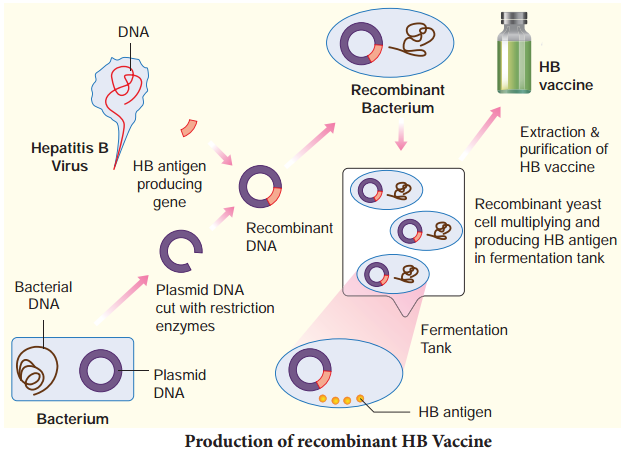
Recombinant hepatitis B vaccine as a subunit vaccine is produced by cloning hepatitis B surface antigen (HbsAg) gene in the yeast, Saccharomyces cerevisiae (Fig. 9.2).
Applications In Medicine img 2

Bioremediation in Human Welfare

Learninsta presents the core concepts of Biology with high-quality research papers and topical review articles.

Bioremediation in Human Welfare

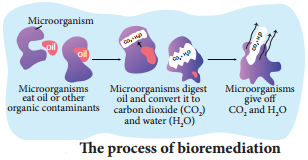
The use of naturally occurring or genetically engineered microorganisms to reduce or degrade pollutants is called bioremediation. Bioremediation is less expensive and more sustainable than other remediations available. It is grouped into in situ bioremediation (treatment of contaminated soil or water in the site) and ex situ bioremediation (treatment of contaminated soil or water that is removed from the site and treated).

Microorganisms involved in bioremediation

Aerobic microbes degrade the pollutants in the presence of oxygen. They mainly degrade pesticides and hydrocarbons. Pseudomonas putida is a genetically engineered microorganism (GEM). Ananda Mohan Chakrabarty obtained patent for this recombinant bacterial strain. It is multi- plasmid hydrocarbon degrading bacterium which can digest the hydrocarbons in the oil spills (Fig. 8.4).
Bioremediation in Human Welfare img 1

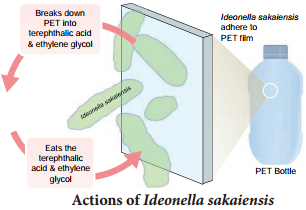
Nitrosomonas europaea is also capable of degrading benzene and a variety of halogenated organic compounds including trichloroethylene and vinyl chloride. Ideonella sakaiensis is currently tried for recycling of PET plastics (Fig. 8.5). These bacteria use PETase and MHETase enzymes to breakdown PET plastic into terephthalic acid and ethylene glycol.
Bioremediation in Human Welfare img 2

Anaerobic microbes degrade the pollutants in the absence of oxygen. Dechloromonas aromatica has the ability to degrade benzene anaerobically and to oxidize toluene and xylene. Phanerochaete chrysosporium an anaerobic fungus exhibits strong potential for bioremediation of pesticides, polyaromatic hydrocarbons, dyes, trinitrotoluene, cyanides, carbon tetrachloride, etc., Dehalococcoides species are responsible for anaerobic bioremediation of toxic trichloroethene to non-toxic ethane.

Pestalotiopsis microspora is a species of endophytic fungus capable of breaking down and digesting polyurethane. This makes the fungus a potential candidate for bioremediation projects involving large quantities of plastics.

Microbes In The Production Of Biogas

Learninsta presents the core concepts of Biology with high-quality research papers and topical review articles.

Microbes In The Production Of Biogas

Biogas is a mixture of different gases produced by the breakdown of organic matter in the absence of oxygen. Biogas can be produced from raw materials such as agricultural wastes, manure, municipal wastes, plant material, sewage, food waste, etc., Biogas is produced under anaerobic condition, when the organic materials are converted through microbiological reactions into gas and organic fertilizer.

Biogas primarily consists of methane (63 percent), along with CO2 and hydrogen. Methane producing bacteria are called methanogens and one such common bacterium is Methanobacterium.

Biogas is devoid of smell and burns with a blue flame without smoke. The Methanogens are also present in anaerobic sludge and rumen of cattle. In rumen, these bacteria help in the breakdown of cellulose. The excreta of cattle called dung is commonly called “Gobar”. Gobar gas is generated by the anaerobic decomposition of cattle dung. It consists of methane, CO2 with some hydrogen, nitrogen and other gases in trace amounts.

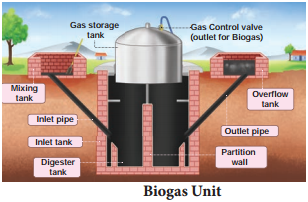
In a biogas plant, anaerobic digestion is carried out in an air tight cylindrical tank known as digester (Fig. 8.3). It is made up of concrete bricks and cement or steel. Bio-wastes are collected and slurry of dung is fed into this digester. It has a side opening into which organic materials for digestion are incorporated for microbial activity. Anaerobic digestion is accomplished in three stages: solubilisation, acidogenesis and
methanogenisis.

The outlet is connected to a pipe to supply biogas. The slurry is drained through another outlet and is used as fertilizer. Biogas is used for cooking and lighting. The technology of biogas production was developed in India mainly due to the efforts of Indian Agricultural Research Institute (IARI) and Khadi and Village Industries Commission (KVIC).
Microbes In The Production Of Biogas img 1

Microbes In Sewage Treatment And Energy Generation

Learninsta presents the core concepts of Biology with high-quality research papers and topical review articles.

Microbes In Sewage Treatment And Energy Generation

Sewage is the waste generated every day in cities and towns containing human excreta. It contains large amounts of organic matter and microbes, which are pathogenic to humans and are bio-degradable pollutants. Domestic waste consists of approximately 99 percent water, suspended solids and other soluble organic and inorganic substances. Sewage should not be discharged directly into natural water bodies like rivers and streams. Before disposal, sewage should be treated in sewage treatment plants to make it less polluting.

Microbes (mass of bacteria floc) are allowed to grow in aerated water (secondary treatment). They consume major part of organic matter in the effluent and reduce the BOD in the waste water (The details on waste water treatment are discussed in chapter 12).

Microbial fuel cell (MFC)

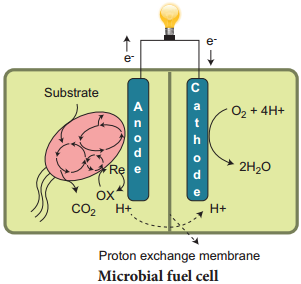
A microbial fuel cell is a bio-electrochemical system that drives an electric current by using bacteria and mimicking bacterial interaction found in nature (Fig. 8.2). Microbial fuel cells work by allowing bacteria to oxidize and reduce organic molecules.

Bacterial respiration is basically one big redox reaction in which electrons are being moved around. A MFC consists of an anode and a cathode separated by a proton exchange membrane. Microbes at the anode oxidize the organic fuel generating protons which pass through the membrane to the cathode and the electrons pass through the anode to the external circuit to generate current.
Microbes In Sewage Treatment And Energy Generation img 1