Biotechnology Of Animal Cloning

Learninsta presents the core concepts of Biology with high-quality research papers and topical review articles.

Biotechnology Of Animal Cloning

Cloning is the process of producing genetically identical individuals of an organism either naturally or artificially. In nature many organisms produce clones through asexual reproduction.

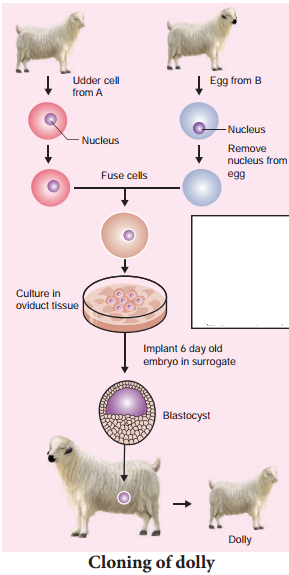
Cloning in biotechnology refers to the process of creating copies of organisms or copies of cells or DNA fragments (molecular cloning). Dolly was the first mammal (Sheep) clone developed by Ian Wilmut and Campbell in 1997. Dolly, the transgenic clone was developed by the nuclear transfer technique and the phenomenon of totipotency. Totipotency refers to the potential of a cell to develop different cells, tissues, organs and finally an organism.

The mammary gland udder cells (somatic cells) from a donor sheep (ewe) were isolated and subjected to starvation for 5 days. The udder cells could not undergo normal growth cycle, entered a dormant stage and became totipotent. An ovum (egg cell) was taken from another sheep (ewe) and its nucleus was removed to form an enucleated ovum.

The dormant mammary gland cell/udder cell and the enucleated ovum were fused. The outer membrane of the mammary cell was ruptured allowing the ovum to envelope the nucleus. The fused cell was implanted into another ewe which served as a surrogate mother. Five months later dolly was born. Dolly was the first animal to be cloned from a diffrentiated somatic cell taken from an adult animal without the process of fertilization (Fig. 9.8).
Biotechnology Of Animal Cloning img 1

Advantages and Disadvantages Of Cloning Animals

  • Offers benefis for clinical trials and medical research. It can help in the production of proteins and drugs in the field of medicine.
  • Aids stem cell research.
  • Animal cloning could help to save endangered species.
  • Animal and human activists see it as a threat to biodiversity saying that this alters evolution which will have an impact on populations and the ecosystem.
  • The process is tedious and very expensive.
  • It can cause animals to suffer.
  • Reports show that animal surrogates were manifesting adverse outcomes and cloned animals were affected with disease and have high mortality rate.
  • It might compromise human health through consumption of cloned animal meat.
  • Cloned animals age faster than normal animals and are less healthy than the parent organism as discovered in Dolly.
  • Cloning can lead to occurrence of genetic disorders in animals.
  • More than 90% of cloning attempts fail to produce a viable offspring.

Biological Products And Their Uses

Learninsta presents the core concepts of Biology with high-quality research papers and topical review articles.

Biological Products And Their Uses

A biological product is a substance derived from a living organism and used for the prevention or treatment of disease. These products include antitoxins, bacterial and viral vaccines, blood products and hormone extracts. These products may be produced through biotechnology in a living system, such as a microorganism, plant cell or animal cell, and are often more difficult to characterize than small molecule drugs.

Though recombinant DNA technology it is possible to produce these biological products on demand. There are many types of biological products approved for use – they are, therapeutic proteins, monoclonal antibodies and vaccines. Health care and pharmaceutical industries have been revolutionised by biotechnological proteins.

Hormones and antibodies are produced commercially, primarily for the medical industry. Recombinant hormones like Insulin, Human growth hormone, Recombinant vaccines and recombinant proteins like human alpha lactalbumin are available today.

Animals are used as bioreactors to produce desirable proteins. Antibodies are substances that react against the disease causing antigens and these can be produced using transgenic animals as bioreactors. Monoclonal antibodies, which are used to treat cancer, heart disease and transplant rejection are produced by this technology. Natural protein adhesives are non toxic, biodegradable and rarely trigger an immune response, hence could be used to reattach tendons and tissues, fill cavities in teeth, and repair broken bones.

Transgenic Animals

Learninsta presents the core concepts of Biology with high-quality research papers and topical review articles.

Transgenic Animals

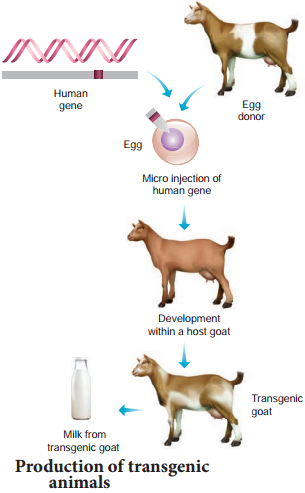
In early days selective breeding methods were carried out to improve the genetic characteristics of live stock and other domestic animals. With the advent of modern biotechnology it is possible to carry out manipulations at the genetic level to get the desired traits in animals. Transgenesis is the process of introduction of extra (foreign/exogenous) DNA into the genome of the animals to create and maintain stable heritable characters.

The foreign DNA that is introduced is called the transgene and the animals that are produced by DNA manipulations are called transgenic animals or the genetically engineered or genetically modified organisms.

The various steps involved in the production of transgenic organisms are

  • Identification and separation of desired gene.
  • Selection of a vector (generally a virus) or direct transmission.
  • Combining the desired gene with the vector.
  • Introduction of transferred vector into cells, tissues, embryo or mature individual.
  • Demonstration of integration and expression of foreign gene in transgenic tissue or animals.
    Transgenic animals such as mice, rat, rabbit, pig, cow, goat, sheep and fish have been produced (Fig. 9.7).

Transgenic Animals img 1

Uses Of Transgenesis

  • Transgenesis is a powerful tool to study gene expression and developmental processes in higher organisms.
  • Transgenesis helps in the improvement of genetic characters in animals.
  • Transgenic animals serve as good models for understanding human diseases which help in the investigation of new treatments for diseases.
  • Transgenic models exist for many human diseases such as cancer, Alzheimer’s, cystic fibrosis, rheumatoid arthritis and sickle cell anemia.
  • Transgenic animals are used to produce proteins which are important for medical and pharmaceutical applications.
  • Transgenic mice are used for testing the safety of vaccines.
  • Transgenic animals are used for testing toxicity in animals that carry genes which make them sensitive to toxic substances than non-transgenic animals exposed to toxic substances and their effects are studied.
  • Transgenesis is important for improving the quality and quantity of milk, meat, eggs and wool production in addition to testing drug resistance.

Molecular Diagnostics

Learninsta presents the core concepts of Biology with high-quality research papers and topical review articles.

Molecular Diagnostics

Early diagnosis of infectious diseases or inherent genetic defects is essential for appropriate treatment. Early detection of the disease is not possible using conventional diagnostic methods like microscopic examinations, serum analysis and urine analysis. These laboratory techniques are indirect and not always specific. Scientists are continuously searching for specific, sensitive and simple diagnostic techniques for diagnosis of diseases.

Recombinant DNA technology, Polymerase Chain Reactions (PCR) and Enzyme Linked Immunosorbent Assay (ELISA) are some of the techniques that are reliable and help in early diagnosis. Presence of pathogens like virus, bacteria, etc., is detected only when the pathogen produces symptoms in the patient. By the time the symptoms appear concentration of pathogen becomes very high in the body. However very low concentration of a bacteria or a virus, even when the symptoms of the disease does not appear, can be detected by amplification of their nucleic acid.

ELISA [Enzyme Linked Immunosorbent Assay]

ELISA is a biochemical procedure discovered by Eva Engvall and Peter Perlmanin (1971) to detect the presence of specific antibodies or antigens in a sample of serum, urine, etc., It is a very important diagnostic tool to determine if a person is HIV positive or negative.

ELISA is a tool for determining serum antibody concentrations (such as the antibodies produced in a person infected by pathogens such as HIV) and also for detecting the presence of specific antigens and hormones such as human chorionic gonadotropins.

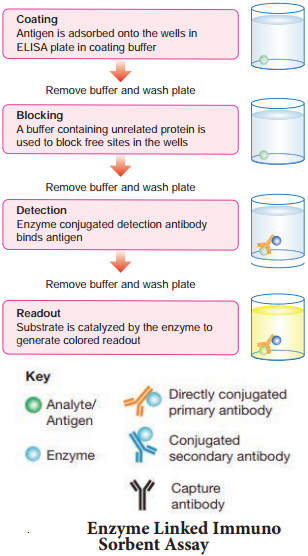
During diagnosis the sample suspected to contain the antigen is immobilized on the surface of an ELISA plate (Fig. 9.5). The antibody specific to this antigen is added and allowed to react with the immobilized antigen. The anti-antibody is linked to an appropriate enzyme like peroxidase.

The unreacted anti-antbody is washed away and the substrate of the enzyme (hydrogen peroxidase) is added with certain reagents such as 4-chloronaphthol. The activity of the enzyme yields a coloured product indicating the presence of the antigen. The intensity of the colour is directly proportional to the amount of the antigen. ELISA is highly sensitive and can detect antigens in the range of a nanogram.
Molecular Diagnostics image 1

There are four kinds of ELISA namely, Direct ELISA, Indirect ELISA, sandwich ELISA and competitive ELISA. It is a highly sensitive and specific method used for diagnosis. ELISA possesses the added advantages of not requiring radioisotopes or a radiation counting apparatus. PCR (Polymerase Chain Reaction) The polymerase chain reaction (PCR) is an invitro amplification technique used for synthesising multiple identical copies (billions) of DNA of interest. The technique was developed by Kary Mullis (Nobel laureate, 1993) in the year 1983.

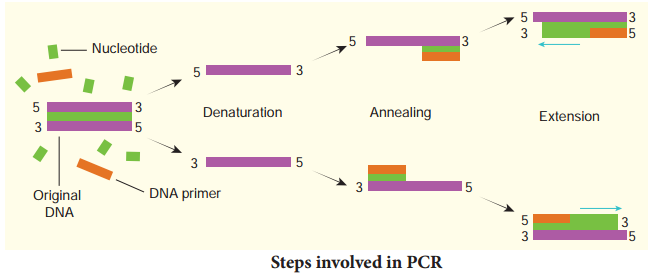
Denaturation, renaturation or primer annealing and synthesis or primer extension, are the three steps involved in PCR (Fig. 9.6). The double stranded DNA of interest is denatured to separate into two individual strands by high temperature .

This is called denaturation. Each strand is allowed to hybridize with a primer (renaturation or primer annealing). The primer template is used to synthesize DNA by using Taq – DNA polymerase.
Molecular Diagnostics image 2

During denaturation the reaction mixture is heated to 95° C for a short time to denature the target DNA into single strands that will act as a template for DNA synthesis. Annealing is done by rapid cooling of the mixture, allowing the primers to bind to the sequences on each of the two strands flanking the target DNA. During primer extension or synthesis the temperature of the mixture is increased to 75° C for a sufficient
period of time to allow Taq DNA polymerase to extend each primer by copying the single stranded template.

At the end of incubation both single template strands will be made partially double stranded. The new strand of each double stranded DNA extends to a variable distance downstream. These steps are repeated again and again to generate multiple forms of the desired DNA. This process is also called DNA amplification.

The PCR technique can also be used for amplifications of RNA in which case it is referred to as reverse transcription PCR (RT-PCR). In this process the RNA molecules (mRNA) must be converted to complementary DNA by the enzyme reverse transcriptase. The CDNA then serves as the template for PCR.

PCR In Clinical Diagnosis

The specificity and sensitivity of PCR is useful for the diagnosis of inherited disorders (genetic diseases), viral diseases, bacterial diseases, etc., The diagnosis and treatment of a particular disease often requires identifying a particular pathogen. Traditional methods of identification involve culturing these organisms from clinical specimens and performing metabolic and other tests to identify them.

The concept behind PCR based diagnosis of infectious diseases is simple – if the pathogen is present in a clinical specimen its DNA will be present.

Its DNA has unique sequences that can be detected by PCR, often using the clinical specimen (for example, blood, stool, spinal fluid, or sputum) in the PCR mixture. PCR is also employed in the prenatal diagnosis of inherited diseases by using chorionic villi samples or cells from amniocentesis. Diseases like sickle cell anemia, β-thalassemia and phenylketonuria can be detected by PCR in these samples.

CDNA from PCR is a valuable tool for diagnosis and monitoring retroviral infections e.g., Tuberculosis by Mycobacterium tuberculosis. Several virally induced cancers, like cervical cancer caused by Papilloma virus can be detected by PCR. Sex of human beings and live stocks, embryos fertilized invitro can be determined by PCR by using primers and DNA probes specific for sex chromosomes. PCR technique is also used to detect sex-linked disorders in fertilized embryos.

Applications of PCR

The differences in the genomes of two different organisms can be studied by PCR. PCR is very important in the study of evolutions, more specifically phylogenetics. As a technique which can amplify even minute quantities of DNA from any source, like hair, mummified tissues, bones or any fossilized materials.

PCR technique can also be used in the field of forensic medicine. A single molecule of DNA from blood stains, hair, semen of an individual is adequate for amplification by PCR. The amplified DNA is used to develop DNA fingerprint which is used as an important tool in forensic science. Thus, PCR is very useful for identification of criminals. PCR is also used in amplification of specific DNA segment to be used in gene therapy.

Stem Cell Therapy

Learninsta presents the core concepts of Biology with high-quality research papers and topical review articles.

Stem Cell Therapy

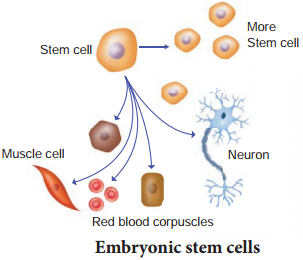
Stem cells are undifferentiated cells found in most of the multi cellular animals. These cells maintain their undifferentiated state even after undergoing numerous mitotic divisions.

Stem cell research has the potential to revolutionize the future of medicine with the ability to regenerate damaged and diseased organs. Stem cells are capable of self renewal and exhibit ‘cellular potency’. Stem cells can differentiate into all types of cells that are derived from any of the three germ layers ectoderm, endoderm and mesoderm.

In mammals there are two main types of stem cells – embryonic stem cells (ES cells) and adult stem cells. ES cells are pluripotent and can produce the three primary germ layers ectoderm, mesoderm and endoderm. Embryonic stem cells are multipotent stem cells that can differentiate into a number of types of cells (Fig. 9.4). ES cells are isolated from the epiblast tissue of the inner cell mass of a blastocyst.
Stem Cell Therapy img 1

When stimulated ES can develop into more than 200 cells types of the adult body. ES cells are immortal i.e., they can proliferate in a sterile culture medium and maintain their undifferentiated state. Adult stem cells are found in various tissues of children as well as adults. An adult stem cell or somatic stem cell can divide and create another cell similar to it. Most of the adult stem cells are multipotent and can act as a repair system of the body, replenishing adult tissues. The red bone marrow is a rich source of adult stem cells.

The most important and potential application of human stem cells is the generation of cells and tissues that could be used for cell based therapies. Human stem cells could be used to test new drugs.

Stem Cell Banks

Stem cell banking is the extraction, processing and storage of stem cells, so that they may be used for treatment in the future, when required. Amniotic cell bank is a facility that stores stem cells derived from amniotic fluid for future use.

Stem cells are stored in banks specifically for use by the individual from whom such cells have been collected and the banking costs are paid. Cord Blood Banking is the extraction of stem cells from the umbilical cord during childbirth. While the umbilical cord and cord blood are the most popular sources of stem cells, the placenta, amniotic sac and amniotic fluid are also rich sources in terms of both quantity and quality.