Population Attributes | Population Density | Natality | Mortality | Population Dispersion | Migration | Emigration | Immigration

Learninsta presents the core concepts of Biology with high-quality research papers and topical review articles.

Population Attributes | Population Density | Natality | Mortality | Population Dispersion | Migration | Emigration | Immigration

Population density

The density of a population refers to its size in relation to unit of space and time. Population density is the total number of that species within a natural habitat. The size of the population can be measured in several ways, including abundance (absolute number in population), numerical density (number of individuals per unit area (or) volume) and biomass density (biomass per unit area (or) volume).

The population density of a species can also be expressed with reference to the actual area of habitat available to the species When the size of individuals in the population is relatively uniform then density is expressed in terms of number of individuals (numerical density).

Natality

Populations increase because of natality. Natality is equivalent to birth rate and is an expression of the production of new individuals in the population by birth, hatching, germination (or) fission. The two main aspects of reproduction, namely fertility and fecundity play a significant role in a population. Natality rate may be expressed in crude birth rate number of organisms born per female per unit time.

Population Attributes img 1

Mortality

Mortality is the population decline factor and is oppposite to natality. Mortality can be expressed as a loss of individuals in unit time or death rate. Generally, mortality is expressed as specific mortality, that is, the number of members of an original population dying after the lapse of a given time. The crude death rate of a population can be calculated by the equation.

Population Attributes img 2

The rate of mortality (death) is determined by density. Mortality is high at high density because of the hazards of overcrowding, increased predation and spread of disease. Mortality rates vary among species and are correlated and influenced by a number of factors such as destruction of nests, eggs or young by storms, wind, floods, predators, accidents and desertion by parents.

Population Dispersion

Populations have a tendency to disperse or spread out in all directions, until some barriers are reached. This is observed by the migration of individuals into (Immigration) or out (Emigration) of the population area.

Migration

Migration is a peculiar and unique kind of mass population movement from one place to another and back. To avoid the severe winter cold, Siberian cranes migrate from Siberia to Vedanthangal in Tamil Nadu and return back in spring. Some fishes are known to migrate from sea to fresh water (anadromous migration, Salmon) and some from fresh water to sea (catadromous migration, Eel).

Emigration

Under natural conditions, emigration usually occurs when there is overcrowding. This is regarded as an adaptive behavior that regulates the population in a particular site and prevents over exploitation of the habitat. Further, it leads to occupation of new areas elsewhere.

Immigration

It leads to a rise in population levels. If the population increases beyond the carrying capacity, it can result in increased mortality among the immigrants or decreased reproductive capacity of the individuals. Both emigration and immigration are initiated or triggered by weather and other abiotic and biotic factors.
Definition Of Populations

Learninsta presents the core concepts of Biology with high-quality research papers and topical review articles.

Definition Of Populations

Population is defined as any group of organisms of the same species which can interbreed among themselves, and occupy a particular space and function as part of a biotic community. A population has various properties like population density, natality (birth rate), mortality (death rate), age distribution, biotic
potential, dispersion and ‘r’, ‘K’ selected growth forms.

A population possesses genetic characteristics that are directly related to their adaptiveness, reproductive success, and persistence in their habitats over time. Life history of an organism is an important part of this attribute. The population has a definite structure and function that can be described with reference to time.

A population is a distinct group of individuals, whether that group comprises a nation or a group of people with a common characteristic. Thus, any selection of individuals grouped together by a common feature can be said to be a population.

The top 10 most populous countries are: China, India, United States, Indonesia, Brazil, Pakistan, Nigeria, Bangladesh, Russia, and Mexico.

Three kinds of populations used in the history and philosophy of population genetics, population biology, and evolutionary ecology can be distinguished: theoretical, laboratory, and natural.

There are three types of population pyramids: expansive, constrictive, and stationary. Expansive population pyramids depict populations that have a larger percentage of people in younger age groups. Populations with this shape usually have high fertility rates with lower life expectancies.

Adaptations | Definition, Importance and Its Types

Learninsta presents the core concepts of Biology with high-quality research papers and topical review articles.

Adaptations | Definition, Importance and Its Types

In biology, adaptation is a dynamic evolutionary process that fits organisms to their environment and enhancing their evolutionary fitness. Adaptations can be a phenotypic or adaptive trait with a functional role in each individual organism that is maintained and has been evolved by natural selection. The adaptive traits may be structural adaptation, behavioural adaptation and physiological adaptation.

(a) Structural adaptations

The external and internal structures of animals can help them to adapt better to their environment. Some of the most common examples are mammals growing thicker fur to survive freezing climates. Some of the most attractive adaptations in nature occur for reasons of crypsis (e.g. camouflage) and mimicry.

Cryptic animals are those which camouflage perfectly with their environment and are almost impossible to detect. Certain reptiles and insects such as chameleons and stick insects show this type of adaptation, which helps in prey capture or to evade from predators. Likewise, horse legs are suitable for fast running and adapted for grasslands and similar terrestrial environments.

(b) Behavioural adaptations

Action and behaviour of animals are instinctive or learned. Animals develop certain behavioural traits or adaptations for survival. Fleeing from a predator, hiding during sleep, seeking refuge from climate change or moving to find different food sources are all behavioral adaptations.

The two most characteristic forms of behavioral adaptations are migration and courtship. Migration allows the animals to find better resources or evade threat. Courtship is a set of behavioral patterns to find a mate to reproduce. Most nocturnal animals remain underground or inactive during daytime. This is a modifiation of their feeding and activity pattern or habit or behaviour.

(c) Physiological adaptations

These are adaptations of organisms that help them to live and survive in their environment with unique niches. Example: Lions have sharp canines to hunt and tear meat and a digestive system suitable for digesting raw meat.

The two most well-known physiological adaptations are hibernation and aestivation. These are two different types of inactivity where the metabolic rate slows down so much that the animal can survive without eating or drinking. Aquatic medium and terrestrial habitats have their own respective environmental conditions. Hence organisms have to evolve appropriate adaptations to select suitable habitats and niches.

Adaptations of aquatic animals

  1. The pectoral fins and dorsal fins act as stabilizers or balancers and the caudal fin helps in changing the direction as a rudder.
  2. Arrangement of body muscles in the form of bundles (myotomes) help in locomotion.
  3. Stream lined structure helps in the swift movement of the animals in water.
  4. Respiration by gills making use of gases dissolved in water.
  5. Presence of air-bladders filled with air for buoyancy.
  6. Presence of lateral-line system. They function as rheoreceptors which is helpful in echolocating objects in water.
  7. Integuments rich in mucous glands are protected by scales.
  8. Maintain water and ionic balance in its body with excretory structures.

Adaptions of terrestrial animals

  1. Earthworms, land Planarians secrete a mucus coating to maintain a moist situation for burrowing, coiling, respiration, etc.,
  2. Arthropods have an external covering over the respiratory surfaces and welldeveloped tracheal systems.
  3. In vertebrate skin, there are many cellular layers besides the well protected respiratory surfaces that help in preventing loss of water.
  4. Some animals obtain their water requirement from food as partial replacement of water lost through excretion.
  5. Birds make nests and breed before the rainy season as there is availability of abundant food. But during drought birds rarely reproduce.
  6. Camels are able to regulate water effectively for evaporative cooling through the skin and respiratory system and excrete highly concentrated urine, and can also withstand dehydration up to 25% of their body weight.

NCERT Solutions for Class 11 English Snapshots Chapter 2 The Address

Here we are providing NCERT Solutions for Class 11 English Snapshots Chapter 2 The Address. Students can get Class 11 English The Address NCERT Solutions, Questions and Answers designed by subject expert teachers.

The Address NCERT Solutions for Class 11 English Snapshots Chapter 2

The Address NCERT Text Book Questions and Answers

Question 1.
‘Have you come back?’ said the woman. ‘I thought that no one had come back.’ Does this statement give some clue about the story? If yes, what is it?
Answer:
The narrator went back after the war to Marconi Street—Number 46, in search of her mother’s belongings. The belongings were with a non-Jewish lady, Mrs Dorling, who had stayed close by. This woman had often come to their place and regularly taken heavy boxes of silverware, cutlery, crockery etc. to keep with her till after the war. Not only did she volunteer to keep them, but had also insisted that they leave the things with her for safety.

However, when the narrator returned, Mrs Dorling at first refused to recognise her and then she expressed her surprise and said that she had not expected anyone to return. This is the first vital clue that the people who had once left the country were unwelcome. The people, who had volunteered to keep their belongings safely, were using their things as their own and had no intention of returning them. The political animosity had seeped into personal lives as well.

Question 2.
The story is divided into pre-War and post-War times. What hardships do you think the girl underwent during these times?
Answer:
The story is divided into pre-War and post-War times. The situations lend a direct contrast to each other. During the pre¬War times, the narrator and her mother lived a comfortable life, where there was bonding between the people in their neighbourhood. When during the first half of the War, the narrator visited her home she noticed that various things were missing. Her mother told her about Mrs Dorling, an old acquaintance, who had suddenly turned up and renewed their contact.

Since then, she had come regularly. She had insisted on taking their things to “save” all the “nice things”. The narrator’s mother also censured her daughter for not trusting the lady.As the narrator feared, when she went back after the war, Mrs Dorling stood at the door and “wanted to prevent it opening any further. Her face gave absolutely no sign of recognition.” She was wearing her mother’s green knitted cardigan but refused to talk to the narrator. She said that it was “not convenient” for her to talk. It was a betrayal of trust and sentiment.

The girl, like anyone who goes through war, must have undergone a traumatic experience. They were uprooted and insecure. They had to leave the country that they thought to be their own, leave their house and belongings that were not merely things but held memories and had sentiments attached to them. The basic necessities of life were not available. Moreover, they left behind the people who they thought were their friends. Above all, they lived a threatened life. This is evident through the observation of the narrator—“But gradually everything became more normal again. Bread was getting to be a lighter colour, there was a bed one could sleep in unthreatened, a room with a view one was more used to glancing at each day.”

Question 3.
Why did the narrator of the story want to forget the address?
Answer:
The narrator’s visit to Mrs Dorling’s house horrified her. She had come out of curiosity to see her possessions to see them, touch them, and relive the memories attached with them. But she felt oppressed in the strange atmosphere. Her eyes fell on the woollen tablecloth. The memories came flooding back to her. She followed the lines of the pattern and knew that somewhere on the edge there should be a bum mark that had never been repaired.

The cups on the tea table, the white pot, the spoons, all were so familiar and yet so strange. She recalled how as a child she had always fancied the apple on the pewter plate. She said one gets so used to touching all the lovely things in the house that one ceases to notice them unless something is missing. She recalled the time her mother had asked her to polish the silver. It was then that she had realised the spoons, forks and knives, they ate off every day were silver.

The objects were linked in her memory with the familiar life of earlier times but now they had lost their value because with the passage of time she felt cut off from them as they were now in unfamiliar surroundings. Moreover, she now lived in a small rented room where no more than a handful of cutlery could fit in the narrow table drawer. Hence, she thought of an easier way out to forget the address.

Question 4.
‘The Address’ is a story of human predicament that follows war. Comment.
Answer:
Although, this is apparently a very sad story about loss and regret emanating from the persecution of the Dutch Jews during the Second World War, it also speaks, more intimately, of the personal challenges we all must face as individuals in resolving crisis in our own lives. The story relays events before and after the war as the female narrator attempts to confront her past as she visits “the address” where her family’s past belongings were ‘stored,’ at a non- Jewish neighbour’s house.

She felt the urge to see them, touch and recall memories. On a deeper level, the story is a commentary on memories and remembering on what is worth remembering and what is worth forgetting: things “lose their value when you see them again, tom out of context…”

Responses To Abiotic Factors

Learninsta presents the core concepts of Biology with high-quality research papers and topical review articles.

Responses To Abiotic Factors

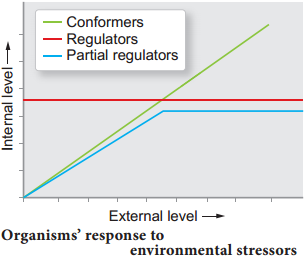
Every living organism responds to its environment. There are various ways by which organisms respond to abiotic conditions. Some organisms can maintain constant physiological and morphological conditions or undertake steps to overcome the environmental condition, which in itself is a response (Fig. 10.9).
Responses To Abiotic Factors img 1

The types of responses observed are

Regulate:

Some organisms are able to maintain homeostasis by physiological means which ensures constant body temperature, ionic / osmotic balance. Birds, mammals and a few lower vertebrate and invertebrate species are capable of such regulation.

Conform:

Most animals cannot maintain a constant internal environment. Their body temperature changes with the ambient temperature. In aquatic animals like fishes, the osmotic concentration of the body fluids changes with that of the ambient water osmotic concentration. Such animals are called Conformers. In case of extreme condition, the inhabitants relocate themselves as in migration.

Migrate:

Organisms tend to move away temporarily from a stressful habitat to a new, hospitable area and return when the stressful period is over. Birds migrate from Siberia to Vedanthangal in Tamilnadu to escape from the severe winter periods.

Suspend:

In certain conditions, if the organisms is unable to migrate, it may avoid the stress by becoming inactive. This is seen commonly in bears going into hibernation during winter. Some snails and fish go into aestivation to avoid summer related problems like heat and desiccation. Some lower animals suspend a certain phase of their life cycle, which is referred to as diapause.