Angiosperms Characteristics and its Silent Features

Learninsta presents the core concepts of Biology with high-quality research papers and topical review articles.

Angiosperms Characteristics and its Silent Features

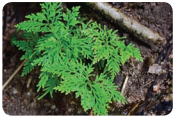
In the previous section, the characteristic features of one of the spermatophyte called Gymnosperms were discussed. Spermatophytes also include plants bearing ovules enclosed in a protective cover called ovary, such plants are called Angiosperms.

They constitute major plant group of our earth and are adapted to the terrestrial mode of life. This group of plants appeared during the early cretaceous period (140 million years ago) and dominates the vegetation on a global scale. The sporophyte is the dominant phase and gametophyte is highly reduced.
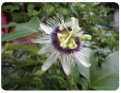
Angiosperms img 1

Salient Features of Angiosperms

  • Vascular tissue (Xylem and Phloem) is well developed.
  • Flowers are produced instead of cone
  • The Ovule remains enclosed in the ovary.
  • Pollen tube helps in fertilization, so water is not essential for fertilization.
  • Double fertilization is present. The endosperm is triploid.
  • Angiosperms are broadly classified into two classes namely Dicotyledons and Monocotyledons.

Characteristic Features of Dicotyledons and Monocotyledons

Dicotyledons

Morphological Features

Reticulate venation is present in the leaves. Presence of two cotyledons in the seed. Primary root radicle persists as tap root. Flowers tetramerous or pentamerous. Tricolpate (3 furrow) pollen is present.

Anatomical Features

  • Vascular bundles are arranged in the form of a ring in stem.
  • Vascular bundles are open (Cambium present).
  • Secondary growth is present.

Monocotyledons

Morphological features Parallel venation is present in the leaves. Presence of single cotyledon in the seed. Radicle doesn’t persist and fibrous root is present. Flowers trimerous. Monocolpate (1 furrow) Pollen is present.

Anatomical Features

  • Vascular bundles are scattered in the stem
  • Vascular bundles are closed (Cambium absent).
  • Secondary growth is absent.

Current Angiosperm Phylogeny Group (APG) System of classification doesn’t recognize dicots as a monophyletic group. Plants that are traditionally classified under dicots are dispersed in several clades such as early Magnolids and Eudicots.

Gymnosperms Various Types and its General Characteristics

Learninsta presents the core concepts of Biology with high-quality research papers and topical review articles.

Gymnosperms Various Types and its General Characteristics

Naked Seed Producing Plants

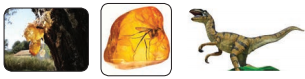
Michael Crichton’s Science Fiction is a book transformed into a Film of Steven Spielberg (1993) called Jurassic Park. In this film you might have noticed insects embedded in a transparent substance called amber which preserves the extinct forms. What is amber? Which group of plants produces Amber?
Gymnosperms img 1

Amber is a plant secretion which is an efficient preservative that doesn’t get degraded and hence can preserve remains of extinct life forms. The amber is produced by Pinites succinifera, a Gymnosperm. In this chapter we shall discuss in detail about one group of seed producing plants called Gymnosperms.

Gymnosperms (Gr. Gymnos = naked; sperma = seed) are naked seed producing plants. They were dominant in the Jurassic and Cretaceous periods of Mesozoic era. The members are distributed throughout the temperate and tropical region of the world.

General Characteristic Features

  1. Most of the gymnosperms are evergreen, woody trees or shrubs. Some are lianas (Gnetum)
  2. The plant body is sporophyte and is differentiated into root, stem and leaves.
  3. A well developed tap root system is present. Coralloid roots of Cycas have symbiotic association with blue green algae. In Pinus the roots have mycorrhizae.
  4. The stem is aerial, erect and branched or unbranched (Cycas) with leaf scars.
  5. In conifers two types of branches namely branches of limited growth (Dwarf shoot) and Branches of unlimited growth (Long shoot) is present.
  6. Leaves are dimorphic, foliage and scale leaves are present. Foliage leaves are green, photosynthetic and borne on branches of limited growth. They show xerophytic features.
  7. The xylem consists of tracheids but in Gnetum and Ephedra vessels are present.
  8. Secondary growth is present. The wood may be Manoxylic (Porous, soft, more parenchyma with wide medullary ray – Cycas) or Pycnoxylic (compact with narrow medullary ray-Pinus).
  9. They are heterosporous. The plant may be monoecious (Pinus) or dioecious (Cycas).
  10. Microsporangia and megasporangia are produced on microsporophyll and megasporophyll respectively.
  11. Male and female cones are produced.
  12. Anemophilous pollination is present.
  13. Fertilization is siphonogamous and pollen tube helps in the transfer of male nuclei.
  14. Polyembryony (presence of many embryo) is present. The naked ovule develops into seed. The endosperm is haploid and develop before fertilization.
  15. The life cycle shows alternation of generation. The sporophytic phase is dominant and gametophytic phase is highly reduced.
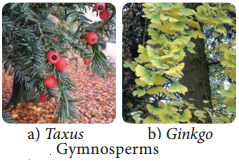
  16. The photograph of some of the gymnosperms is given in Figure 2.8. Sporne (1965) classified gymnosperms into 3 classes, 9 orders and 31 families.

The Classes Include:-

  • Cycadospsida
  • Coniferopsida
  • Gnetopsida.

Gymnosperms img 2

Comparison of Gymnosperm with Angiosperms

Gymnosperms resemble with angiosperms in the following features:-

  • Presence of well organised plant body which is differentiated into roots, stem and leaves.
  • Presence of cambium in gymnosperms as in dicotyledons.
  • Flowers in Gnetum resemble the male flower of the angiosperm. The zygote represent the first cell of sporophyte.
  • Presence of integument around the ovule.
  • Both plant groups produce seeds.
  • Pollen tube helps in the transfer of male nucleus in both.
  • Presence of eustele.

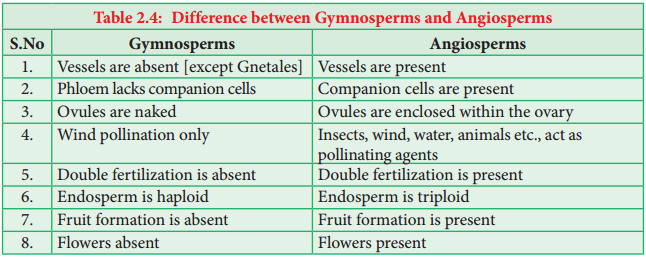
The difference between Gymnosperms and Angiosperms were given in Table 2.4.
Gymnosperms img 3

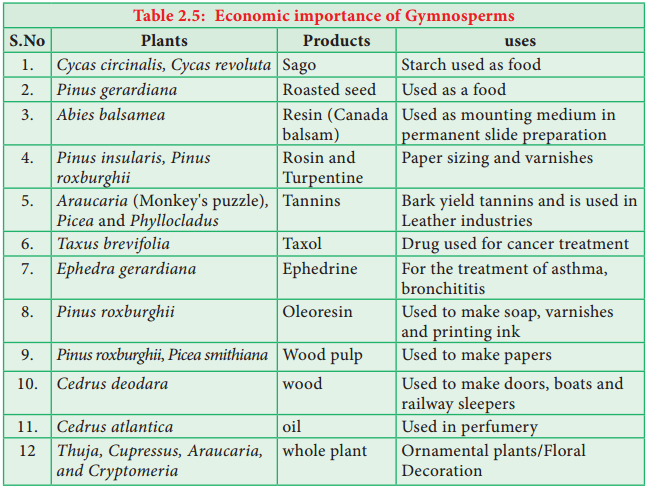
Economic Importance Of Gymnosperms
Gymnosperms img 4

Palaeobotany in India

The National wood fossil park is situated in Tiruvakkarai, a Village of Villupuram district of Tamil Nadu. The park contains petrified wood fossils approximately 20 million years old. The term ‘form genera’ is used to name the fossil plants because the whole plant is not recovered as fossils instead organs or parts of the extinct plants are obtained in fragments. Shiwalik fossil park-Himachal Pradesh, Mandla Fossil park-Madhya Pradesh, Rajmahal Hills-Jharkhand, Ariyalur – Tamilnadu are some of the fossil rich sites of India.

Some of the Fossil Representatives of Different Plant Groups are Given Below:

  • Fossil Algae – Palaeoporella, Dimorphosiphon
  • Fossil Bryophytes – Naiadita, Hepaticites, Muscites
  • Fossil Pteridophytes – Cooksonia, Rhynia, Baragwanthia, Calamites
  • Fossil Gymnosperms – Medullosa, Lepidocarpon, Williamsonia, Lepidodendron
  • Fossil Angiosperms – Archaeanthus, Furcula

Pteridophytes Types and its General Characteristic Features

Learninsta presents the core concepts of Biology with high-quality research papers and topical review articles.

Pteridophytes Types and its General Characteristic Features

Seedless Vascular Cryptogams

From the previous section, we are aware of the salient features of amphibious plants called bryophytes. But there is a plant group called pteridophytes which are considered as first true land plants. Further, they were the first plants to acquire vascular tissue namely xylem and phloem, hence called vascular cryptogams. Club moss, horsetails, quill worts, water ferns and tree ferns belong to this group. This chapter deals with the characteristic features of Pteridophytes.
Pteridophytes img 1

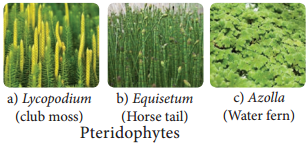
Pteridophytes are the vascular cryptogams and were abundant in the Devonian period of Palaeozoic era (400 million years ago). These plants are mostly small, herbaceous and grow well in moist, cool and shady places where water is available. The photographs for some pteridophytes are given in Figure 2.6.
Pteridophytes img 2

General Characteristic Features of Pteridophytes:

  1. Plant body is sporophyte (2n) and it is the dominant phase. It is differentiated into root, stem and leaves.
  2. Roots are adventitious.
  3. Stem shows monopodial or dichotomous branching.
  4. Leaves may be microphyllous or megaphyllous.
  5. Stele is protostele but in some forms siphonostele is present (Marsilea)
  6. Tracheids are the major water conducting elements but in Selaginella vessels are found.
  7. Sporangia, spore bearing bag like structures are borne on special leaves called sporophyll. The Sporophylls get organized to form cone or strobilus. Example: Selaginella, Equisetum.
  8. They may be homosporous (produce one type of spores-Lycopodium) or Heterosporous (produce two types of spores-Selaginella). Heterospory is the origin for seed habit.
  9. Development of sporangia may be eusporangiate (development of sporangium from group of initials) or leptosporangiate (development of sporangium from single initial).
  10. Spore mother cells undergo meiosis and produce spores (n).
  11. Spore germinates to produce haploid, multicellular green, cordate shaped independent gametophytes called prothallus.
  12. Fragmentation, resting buds, root tubers and adventitious buds help in vegetative reproduction.
  13. Sexual reproduction is oogamous. Sex organs, namely antheridium and archegonium are produced on the prothallus.
  14. Antheridium produces spirally coiled and multiflagellate antherozoids.
  15. Archegonium is flask shaped with broad venter and elongated narrow neck. The venter possesses egg or ovum and neck contain neck canal cells.
  16. Water is essential for fertilization. After fertilization a diploid zygote is formed and undergoes mitotic division to form embryo.
  17. Pteridophytes show apogamy and apospory.

Reimer (1954) proposed a classification for pteridophytes. In this classification, the pteridophytes are divided into five subdivisions.

  • Psilophytopsida
  • Psilotopsida
  • Lycopsida
  • Sphenopsida
  • Pteropsida.

There are 19 orders and 48 families in the classification.

Economic Importance

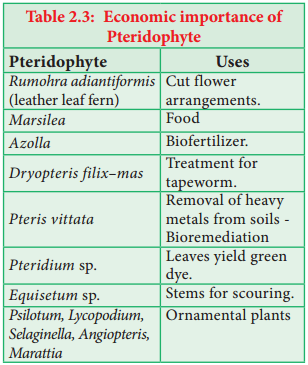
The Economic importance of Pteridophyte is given in Table 2.3
Pteridophytes img 3

Types of Stele

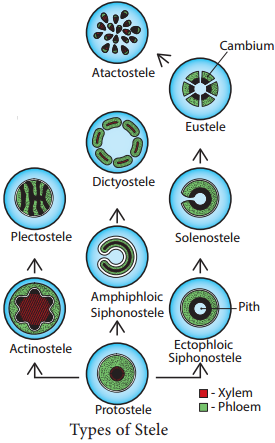
The term stele refers to the central cylinder of vascular tissues consisting of xylem, phloem, pericycle and sometimes medullary rays with pith (Figure 2.7).
Pteridophytes img 4

There are two types of steles

  1. Protostele
  2. Siphonostele

1. Protostele:

In protostele phloem surrounds xylem. The type includes Haplostele, Actinostele, Plectostele, and Mixed protostele.

(i) Haplostele:
Xylem surrounded by phloem is known as haplostele. Example: Selaginella.

(ii) Actinostele:
Star shaped xylem core is surrounded by phloem is known as actinostele. Example: Lycopodium serratum.

(iii) Plectostele:
Xylem plates alternates with phloem plates. Example: Lycopodium clavatum.

(iv) Mixed prototostele:
Xylem groups uniformly scattered in the phloem. Example: Lycopodium cernuum.

2. Siphonostele:

In siphonostele xylem is surrounded by phloem with pith at the centre. It includes Ectophloic siphonostele, Amphiphloic siphonostele, Solenostele, Eustele, Atactostele and Polycylic stele.

(i) Ectophloic Siphonostele:

The phloem is restricted only on the external side of the xylem. Pith is in centre. Example: Osmunda.

(ii) Amphiphloic Siphonostele:

The phloem is present on both the sides of xylem. The pith is in the centre. Example: Marsilea.

(iii) Solenostele:

The stele is perforated at a place or places corresponding the origin of the leaf trace.

(a) Ectophloic Solenostele:
Pith is in the centre and the xylem is surrounded by phloem Example Osmunda.

(b) Amphiphloic solenostele:
Pith is in the centre and the phloem is present on both sides of the xylem. Example: Adiantum pedatum.

(c) Dictyostele:
The stele is separated into several vascular strands and each one is called meristele. Example: Adiantum capillus-veneris.

(iv) Eustele:

The stele is split into distinct collateral vascular bundles around the pith. Example: Dicot stem.

(v) Atactostele:

The stele is split into distinct collateral vascular bundles and are scattered in the ground tissue. Example: Monocot stem.

(vi) Polycyclicstele:

The vascular tissues are present in the form of two or more concentric cylinders. Example: Pteridium.

Bryophytes Definition and its Economic Importance

Learninsta presents the core concepts of Biology with high-quality research papers and topical review articles.

Bryophytes Definition and its Economic Importance

Amphibians of Plant Kingdom

In the previous chapter, we noticed a wide range of thallus organization in Algae. Majority of them are aquatic. The development of heterotrichous habit, development of parenchyma tissue and dichotomous branching in some algae supports the view that colonization of plants in land occurred in the past.

Bryophytes are simplest and most primitive plant groups descended from alga – like ancestors. They are simple embryophytes. Let us learn about the structure and reproduction of these primitive land plants called Bryophytes in detail.
Bryophytes img 1

Bryophytes are simplest land inhabiting cryptogams and are restricted to moist, shady habitats. They lack vascular tissue and hence called ‘Non- vascular cryptogams’. They are also called as ‘amphibians of plant kingdom’ because they need water for completing their life cycle.

General Characteristic Features

  • The plant body of bryophyte is gametophyte and is not differentiated into root, stem and leaf like structure.
  • Most of them are primitive land dwellers. Some of them are aquatic (Riella, Ricciocarpus).
  • The gametophyte is conspicuous, long lived phase of the life cycle. Thalloid forms are present in liverworts and Hornworts.

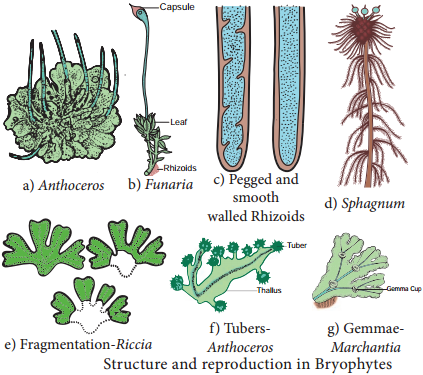
In Mosses leaf like, stem like structures are present. In Liverworts thallus grows prostrate on the ground and is attached to the substratum by means of rhizoids. Two types of rhizoids are present namely smooth walled and pegged or tuberculate.

Multicellular scales are also present. In Moss the plant body is erect with central axis bearing leaf like expansions. Multicellular rhizoids are present. The structure and reproduction in Bryophytes is given in Figure 2.5.
Bryophytes img 2

Vascular tissue like xylem and phloem are completely absent, hence called ‘Non vascular cryptogams’. Vegetative reproduction takes place by the formation of adventitious buds (Riccia fluitans) tubers develop in Anthoceros.

In some forms small detachable branches or brood bodies are formed, they help in vegetative reproduction as in Bryopteris fruticulosa. In Marchantia propagative organs called gemmae are formed and help in reproduction. Sexual reproduction is oogamous. Antheridia and Archegonia are produced in a protective covering and are multicellular.

The antheridia produces biflagellate antherozoids which swims in thin film of water and reach the archegonium and fuse with the egg to form diploid zygote.

Water is Essential for Fertilization

The zygote is the first cell of the sporophyte generation. It undergoes mitotic division to form multicellular undifferentiated embryo. The embryogeny is exoscopic (the first division of the zygote is transverse and the apex of the embryo develops from the outer cell). The embryo divides and give rise to sporophyte.

The sporophyte is dependent on gametophyte. It is differentiated into three recognizable parts namely foot, seta and capsule.

Foot is the basal portion and is embedded in the gametophyte through which water and nutrients are supplied for the sporophyte. The diploid spore mother cells found in the capsule region undergoes meiotic division and give rise to haploid spores. Bryophytes are homosporous. In some sporophytes elaters are present and help in dispersal of spores (Example: Marchantia). The spores germinate to produce gametophyte.

The zygote, embryo and the sporogonium constitute sporophytic phase. The green long living haploid phase is called gametophytic phase. The haploid gametophytic phase alternates with diploid sporophyte and shows heterologous alternation of generation. Proskauer in the year 1957 classified Bryophytes into 3 Classes namely:-

(i) Hepaticopsida:-
(Riccia, Marchantia, Porella and Riella)

(ii) Anthocerotopsida:-
(Anthoceros and Dendroceros)

(iii) Bryopsida:-
(Funaria, Polytrichum and Sphagnum).

Economic Importance

Dead thalli of Sphagnum gets accumulated and compressed, hardened to form peat. In northern Europe (Netherlands) peat is used as fuel in commercial scale. Apart from this nitrates, brown dye and tanning materials are derived from peat.

Sphagnum and peat are also used in horticulture as packing material because of their water holding capacity. Marchantia polymorpha is used to cure pulmonary tuberculosis. Sphagnum, Bryum and Polytrichum are used as food. Bryophytes play a major role in soil formation through succession and help in soil conservation.

Algae Classification and its Importance

Learninsta presents the core concepts of Biology with high-quality research papers and topical review articles.

Algae Classification and its Importance

Rain brings joy and life to various organisms on earth. Have you noticed some changes in and around you after the rain? Could you identify the reason for the slippery nature of the terrace and green patches on the wall of our home, green colour of puddles and ponds? Why should we clean our water tanks very often? The reason is algae.

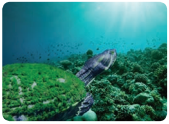
Algae are simple plants that lack true roots, true stems and true leaves. Two-third of our earth’s surface is covered by oceans and seas. The photosynthetic plants called algae are present here. More than half of the total primary productivity of the world depends on this plant group. Further, other aquatic organisms also depend upon them for their existence.
Algae Classification and its Importance img 1

Algae are autotrophs, and grow in a wide range of habitats. Majority of them are aquatic, marine (Gracilaria, and Sargassum) and freshwater (Oedogonium, and Ulothrix) and also found in soils (Fritschiella, and Vaucheria). Chlorella lead an endozoic life in hydra and sponges whereas Cladophora crispata grow on the shells of molluscs. Algae are adapted to thrive in harsh environment too.

Dunaliella salina grows in salt pans (Halophytic alga). Algae growing in snow are called Cryophytic algae. Chlamydomonas nivalis grow in snow covered mountains and impart red colour to the snow (Red snow). A few algae grow on the surface of aquatic plants and are called epiphytic algae (Coleochaete, and Rhodymenia). The study of algae is called algology or phycology. Some of the eminent algologists include F.E. Fritsch, F.E. Round, R.E. Lee, M.O. Parthasarathy Iyengar, M.S. Randhawa, Y. Bharadwaja, V.S. Sundaralingam and T.V. Desikachary.

General Characteristic Features

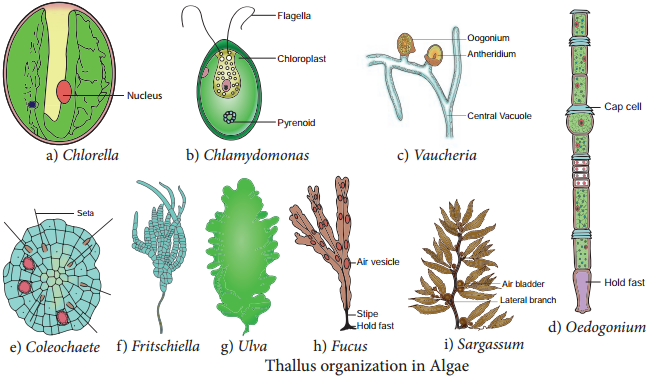
The algae show a great diversity in size, shape and structure. A wide range of thallus organisation is found in algae. Unicellular motile (Chlamydomonas), unicellular non-motile (Chlorella), Colonial motile (Volvox), Colonial non motile (Hydrodictyon), siphonous (Vaucheria), unbranched filamentous (Spirogyra), branched filamentous (Cladophora), discoid (Coleochaete) heterotrichous (Fritschiella), Foliaceous (Ulva) to giant kelps (Laminaria and Macrocystis). The thallus organization in algae is given in Figure 2.3.
Algae Classification and its Importance img 2

Algae are eukaryotes except blue green algae. The plant body does not show differentiation into tissue systems. The cell wall of algae is made up of cellulose and hemicellulose. Siliceous walls are present in diatoms. In Chara the thallus is encrusted with calcium carbonate.

Some algae possess algin, polysulphate esters of polysaccharides which are the sources for the alginate, agar agar and carrageenan. The cell has a membrane bound nucleus and cell organelles like chloroplast, mitochondria, endoplasmic reticulum, golgi bodies etc., Pyrenoids are present. They are proteinaceous bodies found in chromatophores and assist in the synthesis and storage of starch.

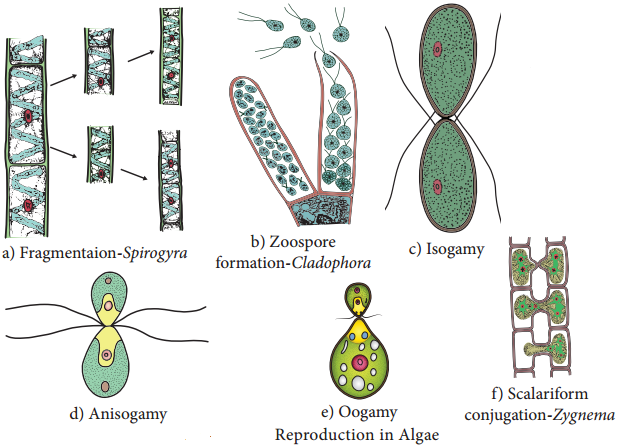
The pigmentation, reserve food material and flagellation differ among the algal groups. Algae reproduces by vegetative, asexual and sexual methods (Figure 2.4).

Vegetative reproduction includes fission (In unicellular forms the cell divides mitotically to produce two daughter cells Example: Chlamydomonas); Fragmentation (fragments of parent thallus grow into new individual Example: Ulothrix) budding (A lateral bud is formed in some members like Protosiphon and helps in reproduction) bulbils, (a wedge shaped modified branch develop in Sphacelaria) akinetes (Thick walled spores meant for perennation and germinates with the advent of favourable condition Example: Pithophora) and Tubers (Structures found on the rhizoids and the lower nodes of Chara which store food materials).
Algae Classification and its Importance img 3

Asexual reproduction takes place by the production of zoospores motile spores (Ulothrix, Oedogonium) aplanospore (thin walled non motile spores Example: Vaucheria); autospores (spores which look similar to parent cell Example: Chlorella); hypnospore (thick walled aplanospore – Example: Chlamydomonas nivalis) and Tetraspores (Diploid thallus of Polysiphonia produce haploid spores after meiosis).

Sexual Reproduction in Algae is of Three Types

  • Isogamy (Fusion of morphologically and Physiologically similar gametes Example: Ulothrix)
  • Anisogamy (Fusion of either morphologically or physiologically dissimilar gametes Example: Pandorina)
  • Oogamy (Fusion of both morphologically and physiologically dissimilar gametes. Example: Sargassum).

The life cycle shows distinct alternation of generation.

Classification

F.E. Fritsch proposed a classification for algae based on pigmentation, types of flagella, reserve food materials, thallus structure and reproduction. He published his classification in the book “The structure and reproduction of the Algae”(1935). He classified algae into 11 classes namely Chlorophyceae, Xanthophyceae, Chrysophyceae, Bacillariophyceae, Cryptophyceae, Dinophyceae, Chloromonadineae, Euglenophyceae, Phaeophyceae, Rhodophyceae, Cyanophyceae. The salient features of Chlorophyceae, Phaeophyceae and Rhodophyceae are given below.

Chlorophyceae

The members are commonly called ‘Green algae’. Most of the species are aquatic (Fresh water-Spirogyra, Marine – Ulva). A few are terrestrial (Trentipohlia). Variation among the shape of the chloroplast is found in members of algae. It is cup shaped (Chlamydomonas), discoid (Chara), girdle shaped, (Ulothrix), reticulate (Oedogonium), spiral (Spirogyra), stellate (Zygnema) and plate like (Mougeoutia).

Chlorophyll ‘a’ and Chlorophyll ‘b’ are the major photosynthetic pigments. Storage bodies called pyrenoids are present in the chloroplast and store starch. They also contain proteins. The cell wall is made up of inner layer of cellulose and outer layer of pectin.

Vegetative reproduction takes place by means of fragmentation and asexual reproduction is by the production of zoospores, aplanospores and akinetes. Sexual reproduction is present and may be isogamous, anisogamous or oogamous. Examples for this group of algae includes Chlorella, Chlamydomonas, Volvox, Spirogyra, Ulothrix, Chara and Ulva.

Phaeophyceae

The members of this class are called ‘Brown algae’. Majority of the forms are found in marine habitats. Pleurocladia is a fresh water form. The thallus is filamentous (Ectocarpus) frond like (Dictyota) or may be giant kelps (Laminaria and Macrocystis). The thallus is differentiated into leaf like photosynthetic part called fronds, a stalk like structure called stipe and a holdfast which attach thallus to the substratum.

The Pigments include Chlorophyll a, c, Carotenoids and Xanthophylls. A golden brown pigment called fucoxanthin is present and it gives shades of colour from olive green to brown to the algal members of this group. Mannitol and Laminarin are the reserve food materials.

Motile reproductive structures are present. Two laterally inserted unequal flagella are present. Among these one is whiplash and another is tinsel. Although sexual reproduction ranges from isogamy to oogamy, Most of the forms show oogamous type. Alternation of generation is present (isomorphic, heteromorphic or diplontic). Examples for this group include Sargassum, Laminaria, Fucus and Dictyota.

Rhodophyceae

Members of this group include ‘Red algae’ and are mostly marine. The thallus is multicellular, macroscopic and diverse in form. Porphyridium is the unicellular form. Filamentous (Goniotrichum) ribbon like (Porphyra) are also present.

Corallina and Lithothamnion are heavily impregnated with lime and form coral reefs. Apart from chlorophyll a, r-phycoerythrin and r-phycocyanin are the photosynthetic pigments. Asexual reproduction takes place by means of monospores, neutral spores and tetraspores.

The storage product is floridean starch. Sexual reproduction is oogamous. Male sex organ is spermatangium which produces spermatium. Female sex organ is called carpogonium. The spermatium is carried by the water currents and fuse with egg nucleus to form zygote.

The zygote develops into carpospores. Meiosis occurs during carpospore formation. Alternation of generation is present. Examples for this group of algae include Ceramium, Polysiphonia, Gelidium, Cryptonemia and Gigartina.

Economic Importance

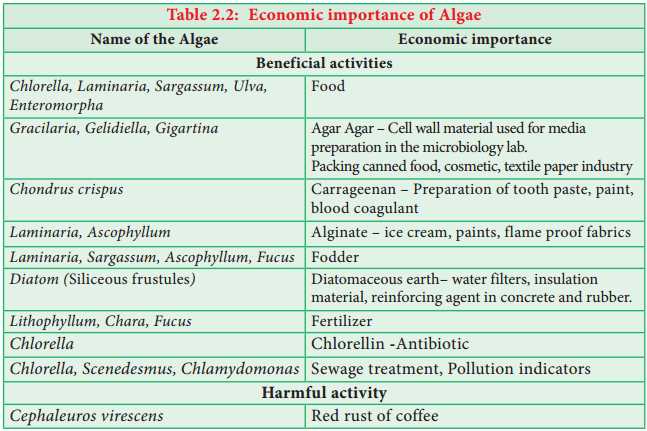
The Economic importance of Algae is given in Table 2.2
Algae Classification and its Importance img 4