Root System Types and its Characteristic Features

Learninsta presents the core concepts of Biology with high-quality research papers and topical review articles.

Root System Types and its Characteristic Features

The root is non-green, cylindrical descending axis of the plant that usually grows into the soil (positively geotropic). It develops from the radicle which is the first structure that comes out when a seed is placed in the soil. Root is responsible for absorption of water and nutrients and anchoring the plant.

I. Characteristic Features

  • Root is the descending portion of the plant axis.
  • Generally non-green in colour as it lacks chlorophyll.
  • Does not possess nodes, internodes and buds (Exception in sweet potato and members of Rutaceae, roots bear buds which help in vegetative propagation)
  • It bears root hairs (To absorb water and minerals from the soil)
  • It is positively geotropic and negatively phototropic in nature.

II. Regions of Root

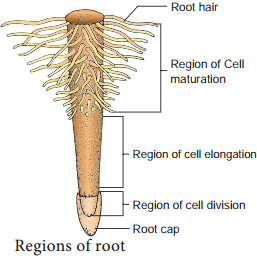
Root tip is covered by a dome shaped structure made of parenchymatous cells called root cap.
Root System img 1

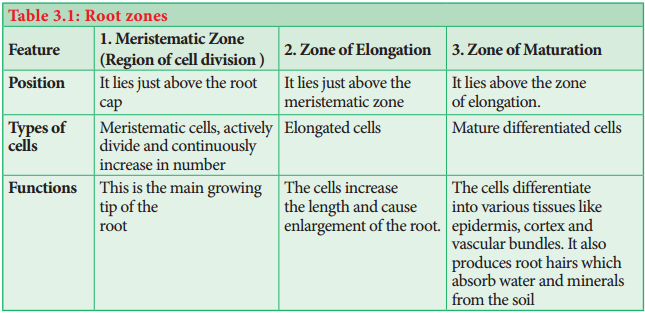
It protects the meristematic cells in the apex. In Pandanus multiple root cap is present. In Pistia instead of root cap, root pocket is present. A few millimeters above the root cap the following three distinct zones have been classified based on their meristematic activity.

  • Meristematic Zone
  • Zone of Elongation
  • Zone of Maturation

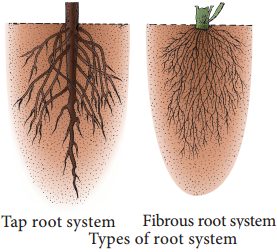
Types of Root System
Root System img 2

I. Tap Root System

Primary root is the direct prolongation of the radicle. When the primary root persists and continues to grow as in dicotyledons, it forms the main root of the plant and is called the Tap root. Tap root produces lateral roots that further branches into finer roots. Lateral roots along with the branches together called as secondary roots.

II. Adventitious Root System

Root developing from any part of the plant other than radicle is called adventitious root. It may develop from the base of the stem or nodes or internodes. Example: Monstera deliciosa, Piper nigrum. In most of the monocots the primary root of the seedling is short lived and lateral roots arise from various regions of the plant body. These are bunch of thread-like roots nearly equal in size which are collectively called fibrous root system generally found in grasses. Example: Oryza sativa, Eleusine coracana.
Root System img 3
Root System img 4

Functions of Root

Root performs two kinds of functions namely primary and secondary functions.

Primary Function

  • Absorb water and minerals from soil.
  • Help to anchor the plant firmly in the soil.

Secondary Function

In some plants roots perform additional functions. These are called secondary functions. To perform additional functions, structure of roots are modified.

Modifications of Root

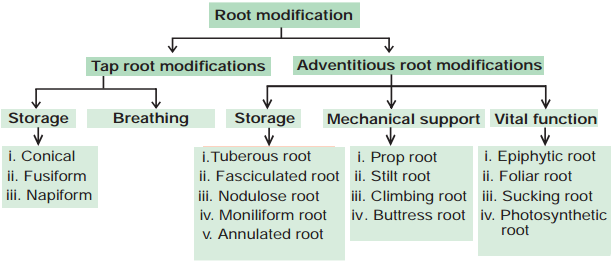
I. Tap Root Modification

a. Storage Roots

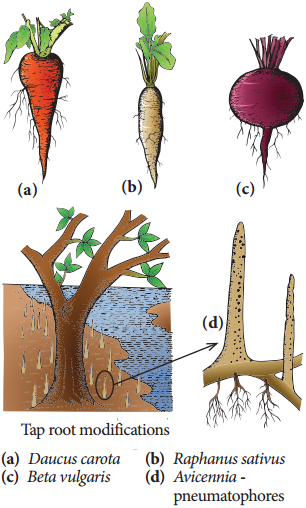
1. Conical Root:
These are cone like, broad at the base and gradually tapering towards the apex. Example: Daucus carota.

2. Fusiform Root:
These roots are swollen in the middle and tapering towards both ends. Example: Raphanus sativus

3. Napiform Root:
It is very broad at the apex and suddenly tapers like a tail at the base. Example: Beta vulgaris
Root System img 5

b. Breathing Root

Some mangrove plants like Avicennia, Rhizophora, Bruguiera develop special kinds of roots (Negatively geotropic) for respiration because the soil becomes saturated with water and aeration is very poor. They have a number of breathing pores on pneumatophores for exchange of gases.

II. Adventitious Root Modification

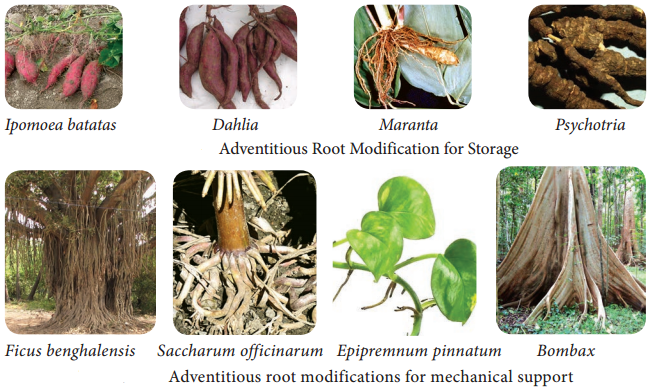
a. Storage Roots

1. Tuberous Root:
These roots are swollen without any definite shape. Tuberous roots are produced singly and not in clusters. Example: Ipomoea batatas.

2. Fasciculated Root:
These roots are in cluster from the base of the stem Example: Dahlia, Asparagus.

3. Nodulose Root:
In this type of roots, swelling occurs only near the tips. Example: Maranta (Arrow root) Curcuma amada (Mango ginger), Curcuma longa (Turmeric)

4. Moniliform or Beaded Root:
These roots swell at frequent intervals giving them a beaded appearance. Example: Vitis, Portulaca, Momordica.

5. Annulated Root:
These roots have a series of ring – like swelling on their surface at regular intervals. Example: Psychotria (Ipecac)

b. Mechanical Support

1. Prop (Pillar) Root

These roots grow vertically downward from the lateral branches into the soil. Example: Ficus benghalensis (banyan tree), Indian rubber.

2. Stilt (Brace) Root

These are thick roots growing obliquely from the basal nodes of the main stem. These provide mechanical support. Example: Saccharum officinarum, Zea mays, Pandanus and Rhizophora.

3. Climbing (clinging) Roots

These roots are produced from the nodes of the stem which attach themselves to the support and help in climbing. To ensure a foothold on the support they secrete a sticky juice which dries up in air, attaching the roots to the support. Example: Piper betel.

4. Buttress Root

In certain trees broad plank like outgrowths develop towards the base all around the trunk. They grow obliquely downwards and give support to huge trunks of trees. This is an adaptation for tall rain forest trees. Example: Bombax ceiba (Red silk cotton tree), Ceiba pentandra (whitesilkcottontree), Delonix regia, Bombax.
Root System img 6

c. Vital Functions

1. Epiphytic or Velamen Root

Some epiphytic orchids develop a special kind of aerial roots which hang freely in the air. These roots develop a spongy tissue called velamen which helps in absorption of moisture from the surrounding air. Example: Vanda, Dendrobium.

2. Foliar Root

Roots are produced from the veins or lamina of the leaf for the formation of new plant. Example: Bryophyllum, Begonia.

3. Sucking or Haustorial Roots

These roots are found in parasitic plants. Parasites develop adventitious roots from stem which penetrate into the tissue of host plant and suck nutrients. Example: Cuscuta (dodder), Cassytha, Orobanche (broomrape), Viscum (mistletoe), Dendrophthoe.

4. Photosynthetic or Assimilatory Roots

Roots of some climbing or epiphytic plants develop chlorophyll and turn green which help in photosynthesis. Example: Tinospora, Trapa natans (water chestnut), Taeniophyllum.
Parts of a Flowering Plant

Learninsta presents the core concepts of Biology with high-quality research papers and topical review articles.

Parts of a Flowering Plant

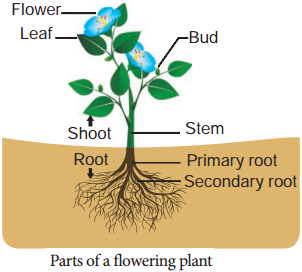
Flowering plants are called “Angiosperms” or Magnoliophytes. They are sporophytes consisting of an axis with an underground “Root system” and an aerial “Shoot System”. The shoot system has a stem, branches and leaves. The root system consists of root and its lateral branches.

There are four main flower parts in angiosperms: sepals, petals, stamens, and carpels.

A typical flower has four main parts or whorls known as the calyx, corolla, androecium, and gynoecium (Figure 1). The outermost whorl of the flower has green, leafy structures known as sepals. The sepals, collectively called the calyx, help to protect the unopened bud.

Most flowers have four main parts: sepals, petals, stamens, and carpels. The stamens are the male part whereas the carpels are the female part of the flower. Most flowers are hermaphrodite where they contain both male and female parts.

Stamen. The male parts of a flower consist of an elongated cluster of sacs, called an anther, which emerges atop a thin filament when the flower opens.

  • Stigma
  • Calyx
  • Pistil
  • Colas
  • More Hydro

Insights

Plant Parts:
Root, Stem, Leaf, Transpiration, Respiration in Plants, Flower, Androecium, Gynoecium, Fruit, Transport Of Water And Minerals In Plants.

Angiosperms:
Flowering plants that have a condensed shoot tip specialized for reproduction.

Anthers:
The bright yellow sacs that produce and contain the pollen grains.

  • Composites
  • Filament
  • Gametes
  • Gymnosperms
  • Nectar
  • Nectaries

The important parts of a flower include:

  • Sepals
  • Petals
  • Stamens
  • Pistil

Parts of a Flower

Petal:
The petals of a flower often attract insects or other animals.

Ovary:
The ovary is the part of the carpel (female parts of the flower) that produces seeds.

Stamen:
The male part of this flower is made up of six identical stamens.

  • Carpel
  • Stigma
  • Sepal

The pistil is a plant’s female part. It generally is shaped like a bowling pin and is located in the flower’s center. It consists of a stigma, style and ovary. The stigma is located at the top and is connected by the style to the ovary.

Style:
This is the name for the stalk of the pistil. When pollen reaches the stigma, it begins to grow a tube through the style called a pollen tube, which will eventually reach the ovary. The style therefore acts as a buffer against pollen contamination, since only compatible pollen is able to grow a pollen tube.

The primary purpose of a flower is reproduction. Since the flowers are the reproductive organs of plant, they mediate the joining of the sperm, contained within pollen, to the ovules – contained in the ovary. Pollination is the movement of pollen from the anthers to the stigma.

Basic parts of most all plants are roots, stems, leaves, flowers, fruits, and seeds. The roots help provide support by anchoring the plant and absorbing water and nutrients needed for growth. They can also store sugars and carbohydrates that the plant uses to carry out other functions.

The three main parts are: the roots, the leaves, and the stem. Each part has a set of jobs to do to keep the plant healthy. The roots absorb water and minerals from the soil and anchor the plant in the ground. The stem supports the plant above ground, and carries the water and minerals to the leaves.

The most beautiful rare flowers in the world include the Franklin tree flower, the Fire Lily, Kadupul flower, and Chocolate Cosmos. Rare flowers can be plants that only bloom under specific conditions or are only rarely found growing in the wild. One of the rarest flowers in the world is the Middlemist Red.

Now I bet you’re wondering how to get your own Animal Crossing: New Horizons Lily of the Valley. These unusual blooms are the rarest of all the Animal Crossing: New Horizons flowers, and actually can’t be grown using traditional means.
Parts of a Flowering Plant img 1

Life Span of Vegetative Morphology and its Various Types

Learninsta presents the core concepts of Biology with high-quality research papers and topical review articles.

Life Span of Vegetative Morphology and its Various Types

Based on life span plants are classified into 3 types. They are annuals, biennials and perennials

I. Annuals

A plant that completes its life cycle in one growing season. Example: Maize, Water melon, Groundnut, Rice.

II. Biennials

A plant that lives for two seasons, growing vegetatively during the first season and flowering and fruiting during the second season. Example: Carrot, Radish, Cabbage.

III. Perennials

A plant that grows for many years that flowers and set fruits for several seasons during the life span. When they bear fruits every year, they are called polycarpic perennials.

Example: Mango, Sapota. Some plants produce flowers and fruits only once and die after a vegetative growth of several years. These plants are called monocarpic perennials. Example: Bambusa, Agave, Musa.

Vegetative Morphology:
Any portion of a plant that is involved in growth, development, photosynthesis, support, etc., but not involved with sexual reproduction.

All plants die eventually. But according to researchers at the New York Botanical Garden in the Bronx, there is no specific lifespan for plants, except for the plants called “annuals,” which are plants that live for one growing season and then die.

The life span of a plant is the length of time it takes from the beginning of development until death, while the life cycle is the series of stages between the germination of the seed until the plant produces its own seeds.

While the concept of form in biology, opposed to function, dates back to Aristotle (see Aristotle’s biology), the field of morphology was developed by Johann Wolfgang von Goethe (1790) and independently by the German anatomist and physiologist Karl Friedrich Burdach (1800).

The two branches of morphology include the study of the breaking apart (the analytic side) and the reassembling (the synthetic side) of words; to wit, inflectional morphology concerns the breaking apart of words into their parts, such as how suffixes make different verb forms.

In this page you can discover 16 synonyms, antonyms, idiomatic expressions, and related words for morphology, like: morphological, patterning, surface structure, ontogeny, phylogeny, ultrastructural, neuroanatomical, microstructure, geomorphology, plasticity and syllable structure.

The internal structure of words and the segmentation into different kinds of morphemes is essential to the two basic purposes or morphology: the creation of new words and the modification of existing words.

Morphology is the study of the internal structure of words and forms a core part of linguistic study today. The term morphology is Greek and is a makeup of morph- meaning ‘shape, form’, and -ology which means ‘the study of something’.

According to the traditional view, the relation between morphology and syntax is the following: while morphology builds up word forms typically by combining roots with other roots and with affixes, but also by applying other operations to them, syntax takes fully inflected words as input and combines them into phrases.

Morphology:
Study of the rules that govern how morphemes, the minimal meaningful units of language, are used in a language.

Semantics:
The meaning of words and combinations of words in a language. The role of morphology in language acquisition and literacy development across languages. Morphemes are the smallest meaning-bearing units of the language. As such, they are the fundamental building blocks for communication during both language and reading development.

Life Span img 1

Plant Habitat and its Various Types

Learninsta presents the core concepts of Biology with high-quality research papers and topical review articles.

Plant Habitat and its Various Types

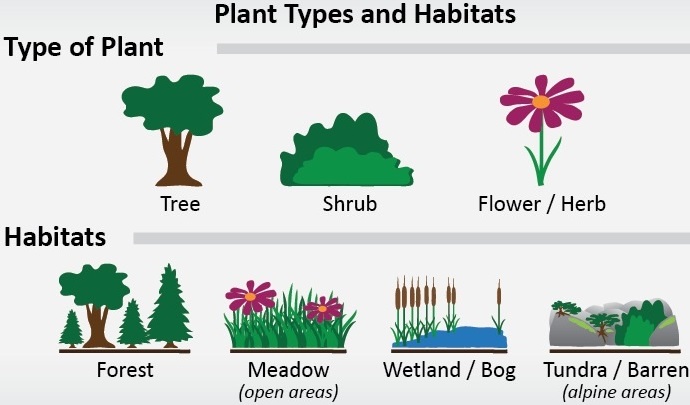
Depending upon where plants grow habitats may be classified into two major categories:

I. Terrestrial and
II. Aquatic

I. Terrestrial

Plants growing on land are called terrestrial plants.

II. Aquatic

Plants that are living in water are called aquatic plants or hydrophytes.

Different Types of Habitat

Forest Habitat:
Forest is a large area covered with plants.

Aquatic Habitat:
Habitat in water is aquatic habitats.

Grassland Habitat:
Grassland is regions dominated by grasses.

Dessert Habitat:
Mountainous and Polar Habitat.

Habitat indicates a specific place where a species or population normally lives in nature, it is a physical area, some particular part of the earth’s surface, air, soil or water.

There are five major biomes found in the world:
Aquatic, Desert, Forest, Grassland, and Tundra.

We will focus on eight habitats:
Polar, Tundra, Evergreen Forests, Seasonal Forests, Grasslands, Deserts, Rainforests, and Oceans. These are global habitats that cover vast areas of the Earth. Of course there are habitats that exist at a smaller scale, like regional, local or micro scale habitats.

Two main types of habitat are water and land. Some animals are more comfortable when they are wet, and others when they are dry!

Examples of Habitats Include:

  • Desert
  • Meadow
  • Woodland
  • Grassland
  • Forest
  • Seashore
  • Ocean

The two main types of habitats are terrestrial, or land habitats and aquatic, or water, habitats. Forests, deserts, grasslands, tundra, and mountains are just a few examples of terrestrial habitats.

The area where a particular organism lives naturally is called its habitat. The five major habitats are – forests, grasslands, deserts, mountains and polar regions, and aquatic habitat. Oceans and freshwater together form the aquatic habitat.

The chief environmental factors affecting the habitat of living organisms are temperature, humidity, climate, soil and light intensity.

It’s the entire neighborhood where an animal gets the food, water and cover it needs to survive. Scientists call this home or place its habitat. For humans, habitat may mean the neighborhood or city in which they live.

Different kinds of plants grow naturally in different areas too. Plants and animals will choose where they live mostly because of the water, food and climate of a specific are a habitat is the physical area where the animal or plant lives. An organism’s natural habitat has everything it needs to live.
Plant Habitat img 1

Habit and its Various Types of Vegatative Morphology

Learninsta presents the core concepts of Biology with high-quality research papers and topical review articles.

Habit and its Various Types of Vegatative Morphology

The general form of a plant is referred as habit. Based on habit, plants are classified into herbs, shrubs, climbers (vines) and trees.

I. Herbs

Herbs are soft stemmed plants with less wood or no wood. Example: Phyllanthus amarus, Cleome viscosa. According to the duration of their life they may be classified as annuals, biennials and perennials. Perennial herbs having a bulb, corm, rhizome or tuber as the underground stem are termed as geophytes. Example: Allium cepa

II. Shrubs

A shrub is a perennial, woody plant with several main stems arising from the ground level. Example: Hibiscus rosa sinensis (shoe flower).

III. Climbers (Vine)

An elongated weak stem generally supported by means of climbing devices are called Climbers (vines) which may be annual or perennial, herbaceous or woody. Liana is a vine that is perennial and woody. Liana’s are major components in the tree canopy layer of some tropical forests. Example: Ventilago, Entada, Bougainvillea.

IV. Trees

A tree is a stout, tall, perennial, woody plant having one main stem called trunk with many lateral branches. Example: Mango, Sapota, Jack, Fig, Teak. If the trunk remains unbranched it is said to be caudex. Example: Palmyra, Coconut.

A habit (or wont as a humorous and formal term) is a routine of behavior that is repeated regularly and tends to occur subconsciously.

The definition of habit is something that you do regularly, or an addiction. Brushing your teeth every morning and every night is an example of a good habit. Being addicted to heroin is an example of having a heroin habit.

Some common synonyms of habit are custom, practice, usage, and wont. While all these words mean “a way of acting fixed through repetition,” habit implies a doing unconsciously and often compulsively.

A hobby is a regular activity that is done for enjoyment. A habit is a regular action or behavior that is acquired through frequent repetition. The key difference between hobby and habit is that a hobby is pursued consciously whereas a habit is often a subconscious act.

Within psychology, the term habit refers to a process whereby contexts prompt action automatically, through activation of mental context-action associations learned through prior performances.

Habits are the things a person does repeatedly until such time that it becomes automatic. While behavior is the reaction of the system on the impulses around it, habit is the thing a person does repeatedly and subconsciously until it becomes a routine. This is the main difference between the two.
habit image 1