Taxonomic Aids

Learninsta presents the core concepts of Biology with high-quality research papers and topical review articles.

Taxonomic Aids

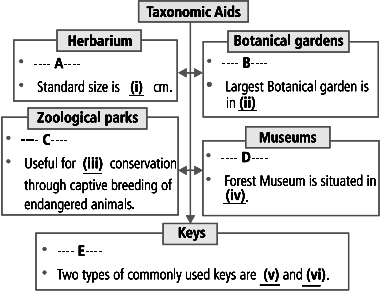
Taxonomic aids are the tools for the taxonomic study. Some techniques, procedures and stored information that are useful in identification and classification of organisms are called taxonomical aids. They are required in almost all branches of biological studies for their proper identification and for finding their relationship with others. Some of the taxonomical aids are keys, flora, revisions, monograph, catalogues, herbarium, botanical gardens etc.

Keys

Taxonomic keys are the tools for the identification of unfamiliar plants. These keys are based on characters which are stable and reliable. The most common type of key is a dichotomous key. It consists of a sequence of two contrasting statements. A pair of contrasting statements is known as couplet. Each statement is known as lead. The plant is correctly identified with keys by narrowing down the characters found in plant.

Example:

1.
(a) Flowers cream-coloured; fruiting calyx enclosing the berry …… Physalis
(b) Flowers white or violet; fruiting calyx not enclosing the berry ……… 2

2.
(a) Corolla rotate; fruit a berry ….. Solanum
(b) Corolla funnel-form or salver-form; fruit a capsule: …. 3

3.
(a) Radical leaves present; flowers in racemes; fruits without prickles ….. Nicotiana
(b) Radical leaves absent; flowers solitary; fruits with prickles ….. Datura

Another type of key for identification is the Polyclave or Multi-entry key. It consists of a list of numerous character states. The user selects all states that match the specimen. Polyclave keys are implemented by a computer algorithm.

Taxonomical aids are the collections of samples or preserved organisms which help in extensive research for the identification of various taxonomic hierarchy. Taxonomic studies of various species of plants, animals, and other organisms, which require correct classifications and identification.

Taxonomical aids are the samples or collection of samples of preserved organisms that help in the research of taxonomic hierarchy. The examples are herbarium, monograph, museum, zoological parks, flora, etc. Herbarium is a store that houses plant species or specimens and other related data for study. The most important taxonomical aids are herbaria, botanical gardens, keys, museums, and zoological parks.

Manual:
These provide information for identification of names of species occurring in an area.

Monograph:
These are handbooks which provide the available information of any one taxon. Common taxonomical aids include a herbarium, botanical gardens, zoological parks, museums, keys etc.

Separate taxonomical keys are required for each taxonomic categories like Family, Genus, Species for the identification purpose. The other type of key for taxonomic studies are Flora, Manuals, Monographs and Catalogues. These help in correct identification of organism.

The taxonomic aids are the aids which help in identification, classification and naming of a newly discovered organisms (plant or animal). It could be in the form of preserved document like herbaria or specimen kept at museums or scientific institutions.

Taxonomical aids are the representations or accumulation of samples of preserved bions that help in the study of the taxonomic hierarchy. The examples are herbarium, monograph, museum, zoological parks, flora, etc.

A manual serves as a taxonomic aid by guiding individuals to accurately identify and classify different plants and animals. A manual contains basic but necessary information for categorising plants and animals. The use of a manual is usually user-defined.

A taxonomic key is a device for quickly and easily identifying to which species an unknown plant belongs. The key consists of a series of choices, based on observed features of the plant specimen.it is often referred to as a dichotomous key.
Taxonomic Aids img 1

Taxonomic Hierarchy

Learninsta presents the core concepts of Biology with high-quality research papers and topical review articles.

Taxonomic Hierarchy

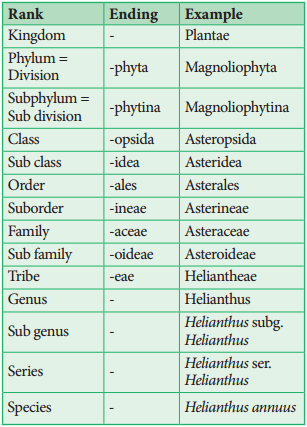
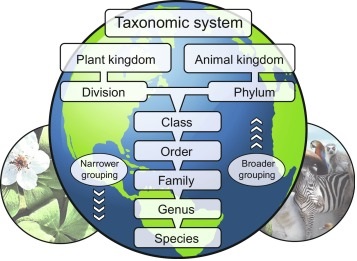
Taxonomic hierarchy was introduced by Carolus Linnaeus. It is the arrangement of various taxonomic levels in descending order starting from kingdom up to species. Kingdom is the highest level or rank of the classification. Example: Plantae

Taxonomic Hierarchy img 1

“Taxonomic hierarchy is the process of arranging various organisms into successive levels of the biological classification either in a decreasing or an increasing order from kingdom to species and vice versa.” Each of this level of the hierarchy is called the taxonomic category or rank.

The current taxonomic system now has eight levels in its hierarchy, from lowest to highest, they are: species, genus, family, order, class, phylum, kingdom, domain. There are seven main taxonomic ranks: kingdom, phylum or division, class, order, family, genus, species.

Taxonomy is the branch of biology that classifies all living things. He also developed a classification system called the taxonomic hierarchy, which today has eight ranks from general to specific: domain, kingdom, phylum, class, order, family, genus, and species.

Plants, Animals, Protists, Fungi, Archaebacteria, Eubacteria. How are organism placed into their kingdoms? You are probably quite familiar with the members of this kingdom as it contains all the plants that you have come to know – flowering plants, mosses, and ferns.

Phylum, Species, and Class are taxonomic category. But, Glumaceae is not a category. It is a botanical name assigned to order including the family of grass, used by Bentham and Hooker.

This phylogeny overturned the eukaryote-prokaryote dichotomy by showing that the 16S rRNA tree neatly divided into three major branches, which became known as the three domains of (cellular) life: Bacteria, Archaea and Eukarya (Woese et al 1990).

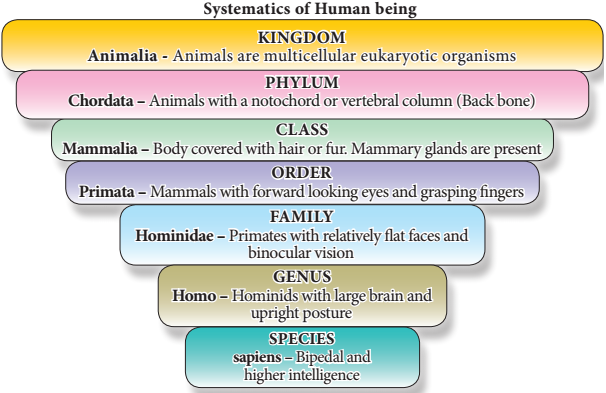
Classification, or taxonomy, is a system of categorizing living things. There are seven divisions in the system:

  1. Kingdom
  2. Phylum or Division
  3. Class
  4. Order
  5. Family
  6. Genus
  7. Species

An example of taxonomy is the way living beings are divided up into Kingdom, Phylum, Class, Order, Family, Genus, Species. An example of taxonomy is the Dewey Decimal system – the way libraries classify non-fiction books by division and subdivisions. The science, laws, or principles of classification.

The Animal Kingdom contains more than two million known species. The Animal Kingdom contains these seven Phyla: Porifera, Cnidaria, Platyhelminthes, Annelida, Mollusca, Arthropoda, and Chordata.

Tools and taxonomical aids may be different for the study of plants and animals. The important components of the taxonomical tools are field visits, survey, identification, classification, preservation and documentation.

Thus, molecular approaches have found a niche in taxonomy. Measurement of DNA hybridization between strains is the single most definitive tool for defining a species. Data on sequences of DNA and amino acids can be used to infer phylogeny.
Taxonomic Hierarchy img 2

International Code of Botanical Nomenclature (ICBN)

Learninsta presents the core concepts of Biology with high-quality research papers and topical review articles.

International Code of Botanical Nomenclature (ICBN)

Assigning name for a plant is known as Nomenclature. This is based on the rules and recommendations of the International Code of Botanical Nomenclature. ICBN deals with the names of existing (living) and extinct (fossil) organisms. The elementary rule of naming of plants was first proposed by Linnaeus in 1751 in his Philosophia Botanica.

In 1813 a detailed set of rules regarding plant nomenclature was given by A.P. de Candolle in his famous work “Theorie elementaire de la botanique”. Then the present ICBN was evolved by following the same rules of Linnaeus, A.P. de Candolle and his son Alphonse de Candolle.

ICN Principles

International Code of Nomenclature is based on the following six principles.

  1. Botanical nomenclature is independent of zoological and bacteriological nomenclature.
  2. Application of names of taxonomic group is determined by means of nomenclatural types.
  3. Nomenclature of a taxonomic group is based on priority of publication.
  4. Each taxonomic group with a particular circumscription, position and rank can bear only one correct name.
  5. Scientific names of taxonomic groups are treated as Latin regardless of their derivation.
  6. The rules of nomenclature are retroactive unless expressly limited.

Codes of Nomenclature

ICN has formulated a set of rules and recommendations dealing with the botanical name of plants. International Botanical Congress is held at different places every six years. Proposals for nomenclatural changes and changes in rules are discussed and implemented. Changes are published in their website.

18th International Botanical Congress held in 2011 at Melbourne, Australia made the following major changes.

  1. The code now permits electronic publication of names of new taxa.
  2. Latin diagnosis or description is not mandatory and permits the use of English or Latin for the publication of a new name (Art-39).
  3. “One fungus, one name” and “one fossil one name” are important changes, the concept of anamorph and teleomorph (for fungi) and morphotaxa (for fossils) have been eliminated. (Previously, sexual and asexual stages of the fungus/fossils were provided with different names).
  4. As an experiment with “registration of names” new fungal descriptions require the use of an identifier from a “recognized repository”.
  5. There are two recognized repositories Index fungorum and Myco Bank.

19th International Botanical Congress was held in Shenzhen in China in 2017. Changes accepted by International Botanical Congress are yet to be published.

Vernacular Names (Common Names)

Vernacular names are known as common names. They are very often descriptive and poetic references to plants. Common name refer to more than one plant or many plants may have same common name. These names are regional or local and are not universal. Example: Albizia amara. L belongs to Mimosaceae is called as Usilai in South Tamilnadu and Thurinji in North Tamilnadu.

Scientific Names/Botanical Names

Each and every taxon as per the ICN (species, genus, family etc) can have only one correct scientific name. Scientific name of a species is always a binomial. These names are universally applied. Example: Oryza sativa L. is the scientific name of paddy.

Polynomial

Polynomial is a descriptive phrase of a plant. Example: Ranunculus calycibus retroflexis pedunculis falcatis caule erecto folius compositis. It means butter cup with reflexed sepals, curved flower stalks, erect stem and compound leaves. Polynomial system of naming a plant is replaced by a binomial system by Linnaeus.

Binomial

Binomial nomenclature was first introduced by Gaspard Bauhin and it was implemented by Carolus Linnaeus. Scientific name of a species consists of two words and according to binomial nomenclature, the first one is called genus name and second one is specific epithet. Example: Mangifera indica. Mangifera is a genus name and indica is specific epithet. This system is in vogue even now.

Author Citation

This refers to valid name of the taxa accompanied by the author’s name who published the name validly. Example: Solanum nigrum L. There are two types of author citation.

Single Author:

When a single author proposed a valid name, the name of the author alone is accompanied by his abbreviated name. Example: Pithecellobium cinereum Benth.

Multiple Authors:

When two or more authors are associated with a valid publication of name, their names should be noted with the help of Latin word et or &. Example: Delphinium viscosum Hook. f. et Thomson. Standard Form of Author’s Abbreviations has to be followed.
International Code of Botanical Nomenclature (ICBN) img 1

Concept of Species – Morphological, Biological and Phylogenetic

Learninsta presents the core concepts of Biology with high-quality research papers and topical review articles.

Concept of Species – Morphological, Biological and Phylogenetic

Species is the fundamental unit of taxonomic classification. Species is a group of individual organisms which have the following characters.

  1. A population of organisms which closely resemble each other more than the other population.
  2. They descend from a common ancestor.
  3. In sexually reproducing organisms, they interbreed freely in nature, producing fertile offspring.

Species concepts can be classified into two general groups. Concept emphasizing process of evolution that maintains the species as a unit and that can result in evolutionary divergence and speciation. Another concept emphasises the product of evolution in defining a species.

Types of Species

There are different types of species and they are as follows:

  1. Process of evolution – Biological Species
  2. Product of evolution – Morphological Species and Phylogenetic Species

Morphological Species (Taxonomic Species)

When the individuals are similar to one another in one or more features and different from other such groups, they are called morphological species.

Biological Species (Isolation Species)

According to Ernest Mayr 1963,“ these are groups of populations that interbreed and are reproductively isolated from other such groups in nature”.

Phylogenetic Species

This concept was developed by Meglitsch (1954), Simpson (1961) and Wiley (1978). Wiley defined phylogenetic species as “an evolutionary species is a single lineage of ancestor descendent populations which maintains its identity from other such lineages which has its own evolutionary tendencies and historical fate”.

Phenetic Species Concept (morphological species concept): a set of organisms that look similar to each other and is distinct from other sets. Phylogenetic Species concept: the smallest monophyletic group distinguishable by shared derived (synapomorphic) characteristics.

A species concept is a way of defining or at least thinking about the differences between two species, especially otherwise quite similar species, and the Morphological Species Concept involves thinking about these differences in terms of how species differ in the shapes of their bodies and otherwise what they look.

The concept of species is an important but difficult one in biology, and is sometimes referred to the “species problem”. Some major species concepts are: Typological (or Essentialist, Morphological, Phenetic) species concept. Typology is based on morphology/phenotype.

The phylogenetic species concept has two distinct advantages:

  1. It can be applied to any population (fossil, asexual, or sexual)
  2. It is logical because different species have different synapomorphies only if they are isolated from gene flow and have evolved independently.

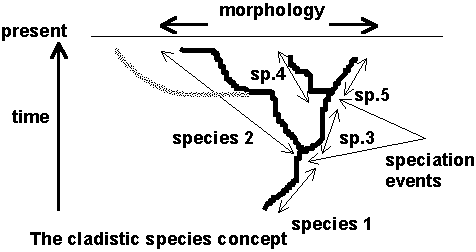
The biological species concept relies on behavioral data and emphasizes reproductive isolation between groups. The lineage species concept relies on genetic data and emphasizes distinct evolutionary trajectories between groups, which result in distinct lineages (branches on a phylogenetic tree).

According to the most widely used species definition, the biological species concept, a species is a group of organisms that can potentially interbreed, or mate, with one another to produce viable, fertile offspring. For example, when a female horse and a male donkey mate, they produce hybrid offspring called mules.

Evolution is a gradual change in the inherited traits of a population over many generations. Natural selection is a mechanism where the members of a population best suited to their environment have the best chance of surviving to pass on their genes.
Concept of Species - Morphological, Biological and Phylogenetic img 1

Taxonomy and Systematics

Learninsta presents the core concepts of Biology with high-quality research papers and topical review articles.

Taxonomy and Systematics

The word taxonomy is derived from Greek words “taxis” (arrangement) and “nomos” (rules or laws). Taxonomy is defined as as“the science dealing with the study of classification including the bases, principles, rules and procedures”.

Simpson (1961) defined Systematics as, “Scientific study of the kinds and diversity of organisms and all relationships among them”. Though there are two terms are used in an interchangeable way, they differ from each other.

Differences Between Taxonomy and Systematics

Taxonomy

Systematics

1. Discipline of classifying organisms into taxa.1. Broad field of biology that studies the diversification of species.
2. Governs the practices of naming, describing, identifying and specimen preservation.2. Governs the evolutionary history and phylogenetic relationship in addition to taxonomy.
3. Classification + Nomenclature = Taxonomy3. Taxonomy + Phylogeny = Systematics

Species
Species is the lowest of classification and shows the high level of similarities among the organisms. For example, Helianthus annuus and Helianthus tuberosus. These two species differ in their morphology. Both of them are herbs but Helianthus tuberosus is a perennial herb.

Genus
Genus consists of multiple species which have similar characters but differ from the species of another genus. Example: Helianthus, Tridax.

Family
Family comprises a number of genera which share some similarities among them. Example: Asteraceae.

Order
Order includes group of families which show less similarities among them.

Class
Class consists of group of orders which share few similarities.

Division
Division is the next level of classification that consists of number of classes. Example: Magnoliophyta.

The main difference between taxonomy and systematics is that taxonomy is involved in the classification and naming of organisms whereas systematics is involved in the determination of evolutionary relationships of organisms. This means systematics ascertain the sharing of the common ancestry by different organisms.

Systematics may be defined as the study of the kinds and diversity of organisms and the relationships among them. Taxonomy, on the other hand, is the theory and practice of identifying, describing, naming, and classifying organisms.

Biological systematics is the study of the diversification of living forms, both past and present, and the relationships among living things through time. Systematics, in other words, is used to understand the evolutionary history of life on Earth.

Systematics plays a central role in biology by providing the means for characterizing the organisms that we study. Through the production of classifications that reflect evolutionary relationships it also allows predictions and testable hypotheses.
Taxonomy and Systematics img 1