Seed Various Types and its Significance

Learninsta presents the core concepts of Biology with high-quality research papers and topical review articles.

Seed Various Types and its Significance

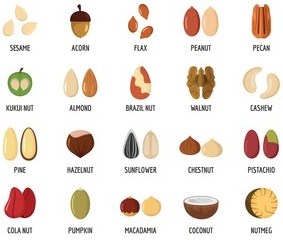
Do all fruits contain seeds? No, triploid fruits do not. The seed is a fertilized mature ovule which possess an embryonic plant, usually stores food material and has a protective coat. After fertilization, changes occur in various parts of the ovule and transforms into a seed.

Types of Seed

I. Based on the number of cotyledons two types of seeds are recognized.

(i) Dicotyledonous Seed:
Seed with two cotyledons.

(ii) Monocotyledonous Seed:
Seed with one cotyledon.

II. Based on the presence or absence of the endosperm the seed is of two types.

(i) Albuminous or Endospermous Seed:
The cotyledons are thin, membranous and mature seeds have endosperm persistent and nourishes the seedling during its early development. Example: Castor, sunflower, maize.

(ii) Ex-albuminous or Nonendospermous Seed:
Food is utilized by the developing embryo and so the mature seeds are without endosperm. In such seeds, colyledons store food and become thick and fleshy. Example: Pea, groundnut.

Significance of Seeds:

  1. The seed encloses and protects the embryo for next generation.
  2. It contains food for the development of embryo.
  3. It is a means for the dispersal of new individuals of the species.
  4. A seed is a means for perpetuation of the species. It may lie dormant during unfavorable conditions but germinates on getting suitable conditions.
  5. Seeds of various plants are used as food, both for animals and men.
  6. They are the basis of agriculture.
  7. Seeds are the products of sexual reproduction so they provide genetic variation and recombination in a plant.
    Seed Various Types and its Significance img 1

Fruits – Structure of Fruits and its Types

Learninsta presents the core concepts of Biology with high-quality research papers and topical review articles.

Fruits – Structure of Fruits and its Types

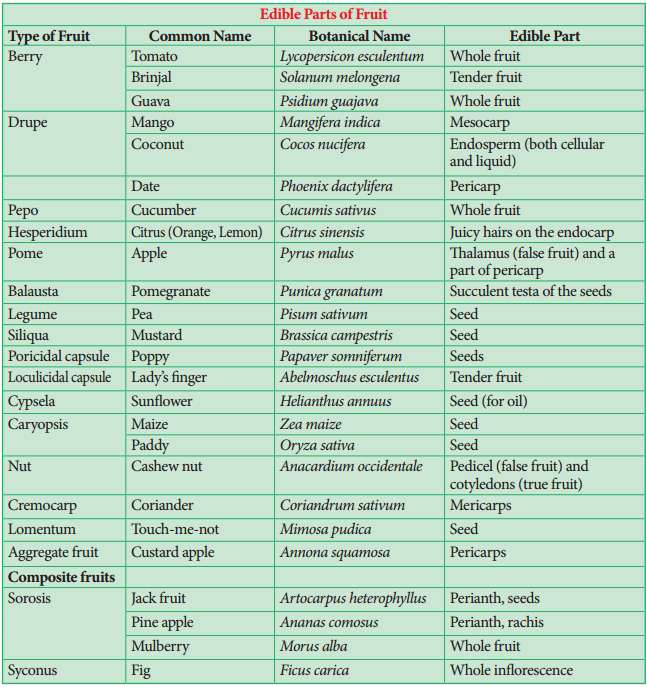
We know about several kinds of fruits, but by botanical study we will be surprised to know the types of fruits and how they are produced by plants. Fruits are the products of pollination and fertilization, usually containing seeds inside.

In common person’s perspective a fruit may be defined as an edible product of the entire gynoecium and any floral part which is sweet, juicy or fleshy, coloured, aromatic and enclosing seeds. However the fruit is a fertilized and ripened ovary. The branch of horticulture that deals with the study of fruits and their cultivation is called pomology.

Structure of Fruit

Fruit has a fruit wall. It is otherwise called pericarp. It is differentiated into outer epicarp, middle mesocarp and inner endocarp. The inner part of the fruit is occupied by the seed.

Types of Fruit

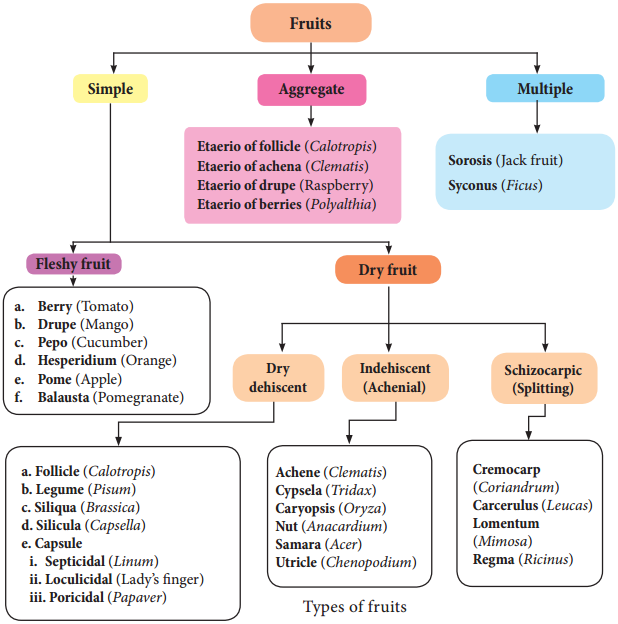
Fruits are classified into three types:

Simple Fruits
The fruits are derived from a single ovary of a flower Example: Mango, Tomato. Simple fruits are classified based on the nature of pericarp as follows.

A. Fleshy Fruit

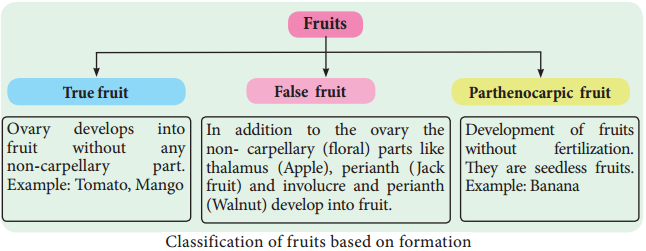
The fruits are derived from single pistil where the pericarp is fleshy, succulent and diffrentiated into epicarp, mesocarp and endocarp. It is subdivided into the following.
Fruits img 1

(a) Berry:
Fruit develops from bicarpellary or multicarpellary, syncarpous ovary. Here the epicarp is thin, the mesocarp and endocarp remain undifferentiated. They form a pulp in which the seeds are embedded. Example: Tomato, Grapes, Brinjal.

(b) Drupe:
Fruit develops from monocarpellary, superior ovary. It is usually one seeded. Pericarp is differentiated into outer skinny epicarp, fleshy and pulpy mesocarp and hard and stony endocarp around the seed. Example: Mango, Coconut.

(c) Pepo:
Fruit develops from tricarpellary inferior ovary. Pericarp turns leathery or woody which encloses, fleshy mesocarp and smooth endocarp. Example: Cucumber, Watermelon, Bottle gourd, Pumpkin.

(d) Hesperidium:
Fruit develops from multicarpellary, multilocular, syncarpous, superior ovary. The fruit wall is differentiated into leathery epicarp with oil glands, a middle firous mesocarp. The endocarp forms distinct chambers, containing juicy hairs. Example: Orange, Lemon.

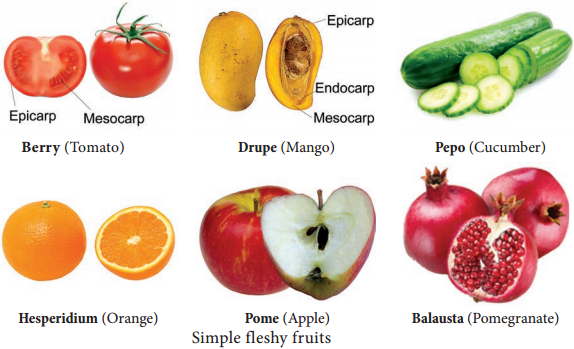
(e) Pome:
It develops from multicarpellary, syncarpous, inferior ovary. The receptacle also develops along with the ovary and becomes fleshy, enclosing the true fruit. In pome the epicarp is thin skin like and endocarp is cartilagenous. Example: Apple, Pear.
Fruits img 2

(f) Balausta:
A fleshy indehiscent fruit developing from multicarpellary, multilocular inferior ovary whose pericarp is tough and leathery. Seeds are attached irregularly with testa being the edible portion. Example: Pomegranate.

B. Dry Fruit

They develop from single ovary where the pericarp is dry and not differentiated into epicarp, mesocarp and endocarp. It is further subdivided into three types.

1. Dry Dehiscent Fruit

Pericarp is dry and splits open along the sutures to liberate seeds. They can be classified into following types.

(a) Follicle:
Fruit develops from monocarpellary, superior ovary and dehisces along one suture. Example: Calotropis.

(b) Legume or Pod:
Fruit develops from monocarpellary, superior ovary and dehisces through both dorsal and ventral sutures. Example: Pisum.

(c) Siliqua:
Fruit develops from bicarpellary, syncarpous, superior ovary initially one chambered but subsequently becomes two chambered due to the formation of false septum (replum). The fruit dehisces along two suture. Example: Brassica.

(d) Silicula:
Fruit similar to siliqua but shorter and broader. Example: Capsella.

(e) Capsule:
Fruit develops from multicarpellary, syncarpous, superior ovary. Based on the dehiscence pattern they are divided into.

(i) Septicidal:
Capsule splitting along septa and valves remaining attached to septa. Example: Aristolochia.

(ii) Loculicidal:
Capsule splitting along locules and valves remaining attached to septa. Example: Abelmoschus.

(iii) Poricidal:
Dehiscence through terminal pores. Example: Papaver.

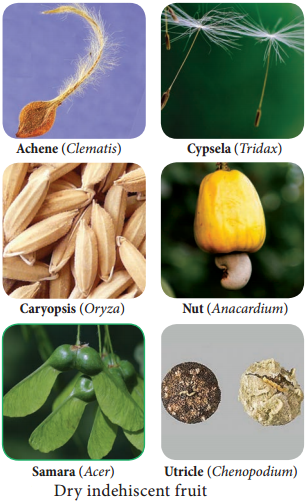
2. Dry Indehiscent Fruit

Dry fruit which does not split open at maturity. It is subdivided into.

(a) Achene:
Single seeded dry fruit developing from single carpel with superior ovary. Achenes commonly develop from apocarpous pistil, Fruit wall is free from seed coat. Example: Clematis, Delphinium.

(b) Cypsela:
Single seeded dry fruit, develops from bicarpellary, syncarpous, inferior ovary with reduced scales, hairy or feathery calyx lobes. Example: Tridax.

(c) Caryopsis:
It is a one seeded fruit which develops from a monocarpellary, superior ovary. Pericarp is inseparably fused with seed. Example: Oryza.
Fruits img 3

(d) Nut:
They develop from mulicarpellary, syncarpous, superior ovary with hard, woody or bony pericap. It is a one seeded fruit. Example: Anacardium.

(e) Samara:
A dry indehiscent, one seeded fruit in which the pericarp devlops into thin winged structure around the fruit. Example: Acer.

(f) Utricle:
They develop from bicarpellary, unilocular, syncarpus, superior ovary with pericarp loosely enclosing the seeds. Example: Chenopodium.

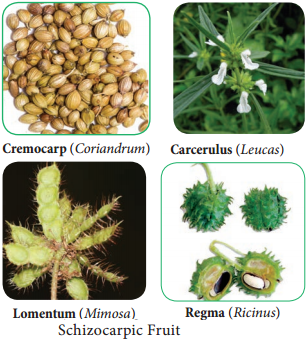
3. Schizocarpic Fruit

This fruit type is intermediate between dehiscent and indehiscent fruit. The fruit instead of dehiscing, splits into number of segments, each containing one or more seeds. They are of following types.
Fruits img 4

(a) Cremocarp:
Fruit develops from bicarpellary, syncarpous, inferior ovary and splitting into two one seeded segments known as mericarps. Example: Coriander.

(b) Carcerulus:
Fruit develops from bicarpellary, syncarpous, superior ovary and splitting into four one seeded segments known as nutlets. Example: Leucas.

(c) Lomentum:
The fruit is derived from monocarpellary, unilocular ovary. A leguminous fruit, constricted between the seeds to form a number of one seeded compartments that separate at maturity. Example: Mimosa.

(d) Regma:
They develop from tricarpellary, syncarpous, superior, trilocular ovary and splits into one­seeded cocci which remain attached to carpophore. Example: Ricinus.

Aggregate Fruits

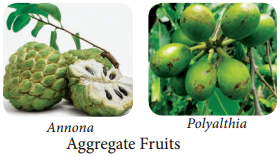
Aggregate fruits develop from a single flower having an apocarpous pistil each of the free carpel develops into a simple fruitlet. A collection of simple fruitlets makes an Aggregate fruit. An individual ovary develops into a drupe, achene, follicle or berry. An aggregate of these fruits borne by a single flower is known as an etaerio. Example: Annona, Polyalthia.
Fruits img 5

Multiple or Composite Fruit:
A Multiple or composite fruit develops from the whole inflorescence along with its peduncle on which they are borne.

(a) Sorosis:
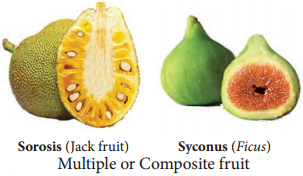
A fleshy multiple fruit which develops from a spike or spadix. The flowers fused together by their succulent perianth and at the same time the axis bearing them become fleshy or juicy and the whole inflorescence forms a compact mass. Example: Pine apple, Jack fruit.
Fruits img 6
Fruits img 7
Fruits img 8

(b) Syconus:
A multiple fruit which develops from hypanthodium inflorescence. The receptacle develops further and converts into fleshy fruit which encloses a number of true fruit or achenes which develops from female flower of hypanthodium inflorescence. Example: Ficus

Functions of Fruit

  • Edible part of the fruit is a source of food and gives energy for animals.
  • They are source of many chemicals like sugar, pectin, organic acids, vitamins and minerals.
  • The fruit protects the seeds from unfavourable climatic conditions and animals.
  • Both fleshy and dry fruits help in the dispersal of seeds to distant places.
  • In certain cases, fruit may provide nutrition to the developing seedling.
  • Fruits provide source of medicine to human.

Construction of Floral Diagram and Floral Formula

Learninsta presents the core concepts of Biology with high-quality research papers and topical review articles.

Construction of Floral Diagram and Floral Formula

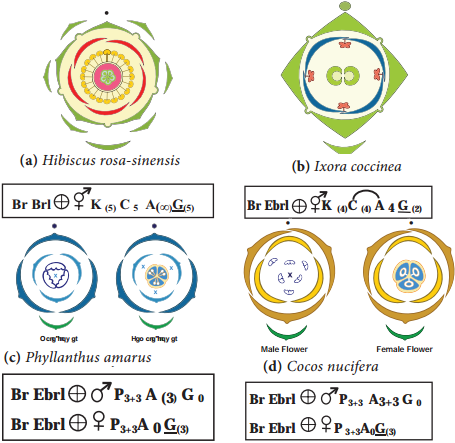
A floral formula is a simple way to explain the salient features of a flower. The floral diagram is a representation of the cross section of the flower. It represents floral whorls arranged as viewed from above. Floral diagram shows the number and arrangement of bract, bracteoles and floral parts, fusion, overlapping and placentation. The branch that bears the flower is called mother axis.

The side of the flower facing the mother axis is called posterior side. The side facing the bract is the anterior side. The members of different floral whorls are shown arranged in concentric rings.

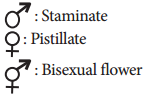
Br: Bracteate
Ebr: Ebracteate
Brl: Bracteolate
Ebrl: Ebracteolate
⊕: Actinomorphic
%: Zygomorphic

Construction of Floral Diagram and Floral Formula img 1

K: Calyx, K5 five sepals, aposepalous, K(5) five sepals synsepalous.
C: Corolla, C5 five petals, apopetalous, C(5) five petals sympetalous C(2+3) corolla bilabiate with upper lib two lobes.
A: Androecium A3 three stamens free, A2+2, Stamens 4, two whorls (didynamous) each whorl two stamens (free)

A(9)+1 
Stamens ten, two bundles (diadelphous) 9 stamens unite to form one bundle, 1 stamen form another bundle.

Construction of Floral Diagram and Floral Formula img 2
Epipetalous represented by an arc.

A0: Staminode(sterile stamen)
G. Gynoecium or pistil – G2 – Carpels two, free (apocarpous)
G(3) – Carpels three, united (syncarpous)
G0 – Pistillode (sterile carpel)

Construction of Floral Diagram and Floral Formula img 3

\(\underline{G}\) – Superior Ovary
G inferior Ovary
G- – Semi-inferior ovary
∞ – Indefinite number of units

Gynoecium – Definition, Types and its Structure

Learninsta presents the core concepts of Biology with high-quality research papers and topical review articles.

Gynoecium – Definition, Types and its Structure

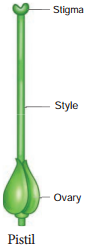
Gynoecium or pistil is the female reproductive part of the flower. A pistil consists of an expanded basal portion called the ovary, an elongated section called a style and an apical structure that receives pollen called a stigma. Ovary with stipe is called stipitate ovary.
Gynoecium img 1

Carpel:
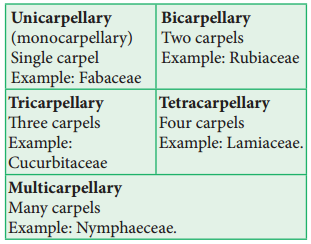
They are components of a gynoecium. Gynoecium is made of one or more carpels. Carpels may be distinct or connate.

Number of Carpel
Gynoecium img 2

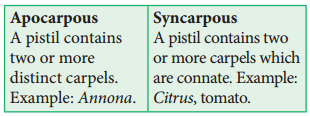
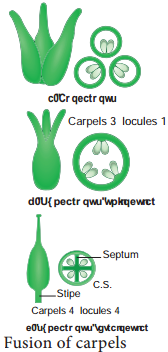
Fusion of Carpels

It is an important systematic character. Apocarpous gynoecium is generally thought to be ancestral condition in Angiosperms.
Gynoecium img 3
Gynoecium img 4

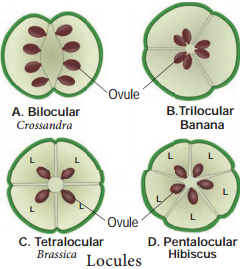
Number of Locules

Ovary bears ovules on a specialized tissue called placenta. A septum is a crosswall or partition of ovary. The walls of ovary and septa form a cavity called locule. Like that tetralocular and pentalocular ovaries are present according to the locule numbers four or fie. More than one locule ovaries are called plurilocular.
Gynoecium img 5

Extension of the Condensed Internode of the Receptacle

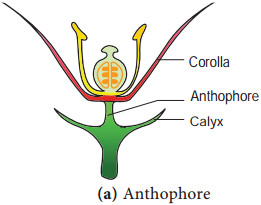
1. Anthophore:
The internodal elongation between calyx and corolla. Example: caryophyllaceae (Silene conoidea)
Gynoecium img 6

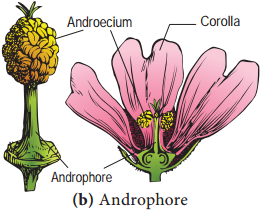
2. Androphore:
The internodal elongation between the corolla and androecium. Example: Grewia.
Gynoecium img 7

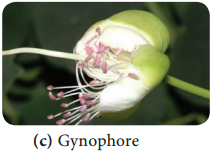
3. Gynophore:
The internodal elongation between androecium and gynoecium. Example: Capparis.
Gynoecium img 11

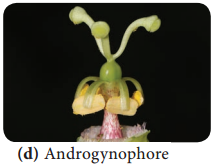
4. Gynandrophore or Androgynophore:
The unified internodal elongation between corolla and androecium and androecium and gynoecium. Example: Gynandropsis.
Gynoecium img 9

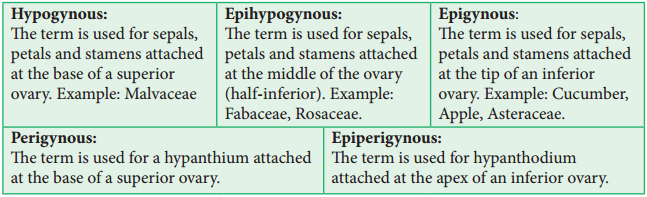
Ovary Position

The position or attachment of ovary relative to the other floral parts. It may be classified into

1. Superior Ovary:
It is the ovary with the sepals, petals and stamens attached at the base of the ovary.

2. Inferior Ovary:
It is the ovary with the sepals, petals and stamens attached at the apex of the ovary.

3. Half-inferior Ovary:
It is the ovary with the sepals, petals and stamens or hypanthium attached near the middle of the ovary.
Gynoecium img 10

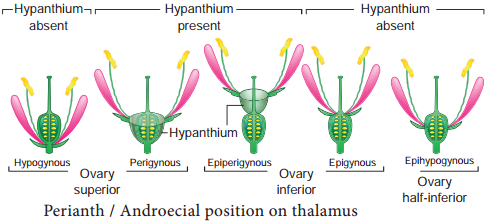
Perianth/Androecial Position on Thalamus:
It describes placement of the perianth and androecium relative to the ovary and to a hypanthium, if present (Figure 4.25).
Gynoecium img 8

Androecium – Definiton of Androecium and its Various Types

Learninsta presents the core concepts of Biology with high-quality research papers and topical review articles.

Androecium – Definiton of Androecium and its Various Types

Androecium:
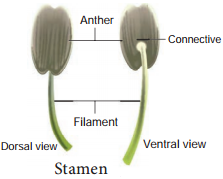
Third whorl of flower is the male reproductive part of the flower. It is composed of stamens (microsporophylls).

Each Stamen consist of 3 parts:

  • Filament
  • Anther
  • Connective

Anther:
Upper swollen part with microsporangia.

Filament:
Stalk of stamen

Connective:
Tissue connecting anther lobes with filament
Androecium img 1

Anther typically contains two compartments called thecae (singular theca). Each theca consists of two microsporangia. Two microsporangia fused to form a locule. Sterile stamens are called Staminodes. Example: Cassia. Distinct: stamens which do not fuse to one another. Free: stamens which do not fuse with other parts of flower. Apostemonous: flowers with stamens that are free and distinct.

Fusion of Stamens:
The fusion of stamens fusing among themselves or with other parts of flower. They are of two types.

  • Connation and
  • Adnation

1. Connation:
Refers to the fusion of stamens among themselves. It is of 3 types:-

  • Adelphy
  • Syngenecious
  • Synandrous

Adelphy:
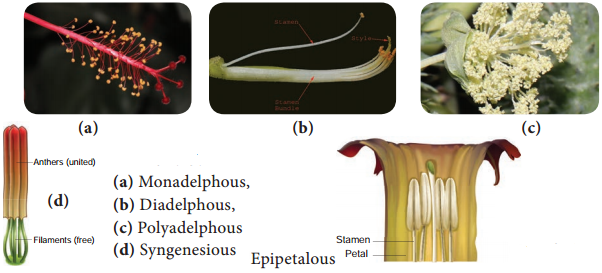
Filaments connate into one or more bundles but anthers are free. It may be the following types.

(i) Monadelphous:
Filaments of stamens connate into a single bundle. Example: Malvaceae (Chinarose, Cotton).

(ii) Diadelphous:
Filaments of stamens connate into two bundles. Example: Fabaceae (pea) and Clitoria.

(iii) Polyadelphous:
Filaments connate into many bundles. Example: Citrus, Bombax

Syngenesious:
Anthers connate, filaments free. Example: Asteraceae.

Synandrous:
Filaments and anthers are completely fused. Example: Coccinea.

2. Adnation:
Refers to the fusion of stamens with other flral parts. Epipetalous: Stamens are adnate to petals. Example: Brinjal, Datura.

a. Episepalous:
Stamens are adnate to sepals. Example: Grevillea (Silver oak)

b. Epitepalous (Epiphyllous):
Stamens are adnate to tepals. Example: Asparagus.

c. Gynostegium:
Connation product of stamens and stigma is called gynostegium. Example: Calotropis and Orchidaceae.

d. Pollinium:
Pollen grains are fused together as a single mass Example: Calotropis

Arrangement of stamens relate to length of stamens:

1. Didynamous:
Four stamens of which two with long fiaments and two with short filaments. Example: Ocimum

2. Tetradynamous:
Six stamens of which four with long filaments and two with short filaments. Example: Brassica.

3. Heterostemonous:
Stamens are of different lengths in the same flower. Example: Cassia.

Anther Types

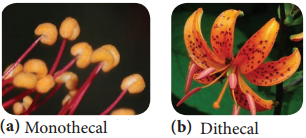
1. Monothecal:
One lobe with two microsporangia. They are kidney shaped in a cross section. Example: Malvaceae
Androecium img 2

2. Dithecal:
It is a typical type, having two lobes with four microsporangia. They are butterfly shaped in cross section. Example: Solanaceae.

Anther Attachment

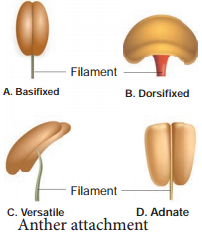
1. Basifixed:
(Innate) Base of anther is attached to the tip of filament. Example: Datura.

2. Dorsifixed:
Apex of filament is attached to the dorsal side of the anther. Example: Hibiscus.

3. Versatile:
Filament is attached to the anther at midpoint. Example: Grasses.

4. Adnate:
Filament is continued from the base to the apex of anther. Example: Nelumbo
Androecium img 3
Androecium img 4