Types of Classification and its Significance

Learninsta presents the core concepts of Biology with high-quality research papers and topical review articles.

Types of Classification and its Significance

Taxonomic entities are classified in three ways. They are artificial classification, natural classification and phylogenetic classification.

Artificial System of Classification
Types of Classification img 1

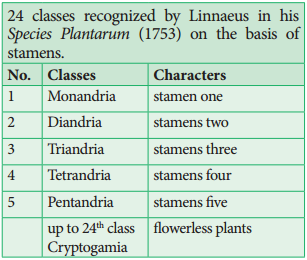
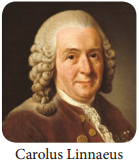
Carolus Linnaeus (1707 – 1778) was a great Swedish Botanist and said to be the “Father of Taxonomy.” He outlined an artificial system of classification in “Species Plantarum” in 1753, wherein he listed and described 7, 300 species and arranged in 24 classes mostly on the basis of number, union (adhesion and cohesion), length, and distribution of stamens. The classes were further subdivided on the basis of carpel characteristics into orders. Hence the system of classification is also known as sexual system of classification.
Types of Classification img 2

This system of classification though artificial, was continued for more than 100 years after the death of Linnaeus, due to its simplicity and easy way of identification of plants. However the system could not hold good due to the following reasons.

1. Totally unrelated plants were kept in a single group, whereas closely related plants were placed in widely separated groups.

Example:

a. Zingiberaceae of monocotyledons and Anacardiaceae of dicotyledonous were placed under the class Monandria since these possess single stamens.

b. Prunus was classified along with Cactus because of the same number of stamens. No attempts were made to classify plants based on either natural or phylogenetic relationships which exist among plant groups.

Natural System

Botanists who came after Linnaeus realised that no single character is more important than the other characters. Accordingly an approach to a natural system of classification sprouted in France. The first scheme of classification based on overall similarities was presented by Antoine Laurent de Jessieu in 1789.

Bentham and Hooker system of Classification

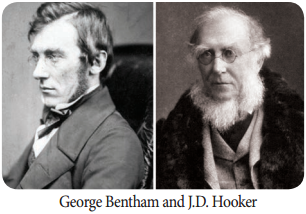
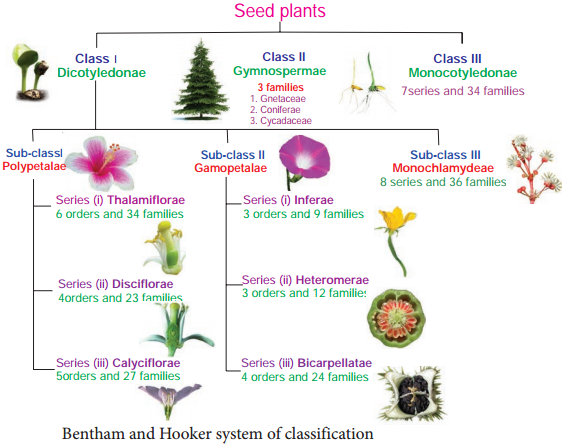
A widely followed natural system of classification considered the best was proposed by two English botanist George Bentham (1800 – 1884) and Joseph Dalton Hooker (1817 – 1911). The classification was published in a three volume work as “Genera Plantarum” (1862 – 1883) describing 202 families and 7569 genera and 97,205 species. In this system the seeded plants were classified into 3 major classes such as Dicotyledonae, Gymnospermae and Monocotyledonae.
Types of Classification img 3

Class I Dicotyledonae:
Plants contain two cotyledons in their seed, leaves with reticulate venation, tap root system and tetramerous or pentamerous flowers come under this class. It includes tree subclasses – Polypetalae, Gamopetalae and Monochlamydeae.

Sub-class 1.

Polypetalae:
Plants with free petals and dichlamydeous flowers come under polypetalae. It is further divided into three series – Thalamiflorae, Disciflorae and Calyciflorae.

Series (i) Thalamiflorae:
Plants having flowers with dome or conical shaped thalamus and superior ovary are included in this series. It includes 6 orders and 34 families.

Series (ii) Disciflorae:
Flowers having prominent disc shaped thalamus with superior ovary come under this series. It includes 4 orders and 23 families.

Series (iii) Calyciflorae:
It includes plants having flowers with cup shaped thalamus and with inferior or sometimes with half inferior ovary. Calyciflorae includes 5 orders and 27 families.

Sub-class 2.

Gamopetalae:
Plants with united petals, which are either partially or completely fused to one another and dichlamydeous are placed under Gamopetalae. It is further divided into three series – Inferae, Heteromerae and Bicarpellatae.

Series (i) Inferae:
The flowers are epigynous and with inferior ovary. Inferae includes 3 orders and 9 families.

Series (ii) Heteromerae:
The flowers are hypogynous, superior ovary and with more than two carpels. Heteromerae includes 3 orders and 12 families.

Series (iii) Bicarpellatae:
The flowers are hypogynous, superior ovary and with two carpels. Bicarpellatae includes 4 orders and 24 families.

Sub-class 3.

Monochlamydeae:
Plants with incomplete flowers either apetalous or with undifferentiated calyx and corolla are placed under Monochlamydeae. The sepals and petals are not distinguished and they are called perianth. Sometimes both the whorls are absent. Monochlamydeae includes 8 series and 36 families.

Class II Gymnospermae:
Plants that contain naked seeds come under this class. The Gymnospermae includes three families – Gnetaceae, Coniferae and Cycadaceae.

Class III Monocotyledonae:
Plants contain only one cotyledon in their seed, leaves with parallel venation, fibrous root system and trimerous flowers come under this class. The Monocotyledonae has 7 series and 34 families.

The Bentham and Hooker system of classification is still supposed to be the best system of classification. It has been widely practiced in colonial countries and herbaria of those countries were organised based on this system and is still used as a key for the identification of plants in some herbaria of the world due to the following reasons:

Description of plants is quite accurate and reliable, because it is mainly based on personal studies from actual specimens and not mere comparisons of known facts. As it is easy to follow, it is used as a key for the identification of plants in several herbaria of the world. Though it is a natural system, this system was not intended to be phylogenetic.
Types of Classification img 4

Phylogenetic System of Classification

The publication of the Origin of Species (1859) by Charles Darwin has given stimulus for the emergence of phylogenetic system of classification.

I. Adolph Engler and Karl A Prantl System of Classification

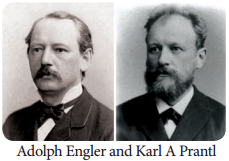
One of the earliest phylogenetic system of classification of the entire plant Kingdom was jointly proposed by two German botanists Adolph Engler ( 1844 -1930) and Karl A Prantl (1849 – 1893). They published their classification in a monumental work “Die Naturelichen Pflanzen Familien” in 23 volumes (1887 – 1915).

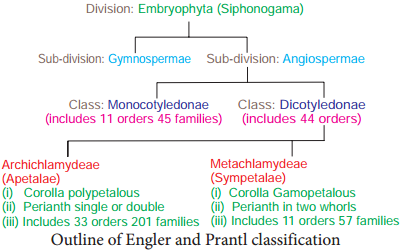
In this system of classifiation the plant kingdom was divided into 13 divisions. The first 11 divisions are Thllophytes, twelfth division is Embryophyta Asiphonogama (plants with embryos but no pollen tubes; Bryophytes and Pteridophytes) and the thirteenth division is Embryophyta Siphonogama (plants with embryos and pollen tubes) which includes seed plants.
Types of Classification img 5

II. Arthur Cronquist System of Classification Arthur Cronquist (1919 – 1992)

An eminent American taxonomist proposed phylogenetic classification of flowering plants based on a wide range of taxonomic characters including anatomical and phytochemical characters of phylogenetic importance.

He has presented his classification in 1968 in his book titled “The evolution and classification of flowering plants.” His classification is broadly based on the Principles of phylogeny that finds acceptance with major contemporary authors.

Types of Classification img 6

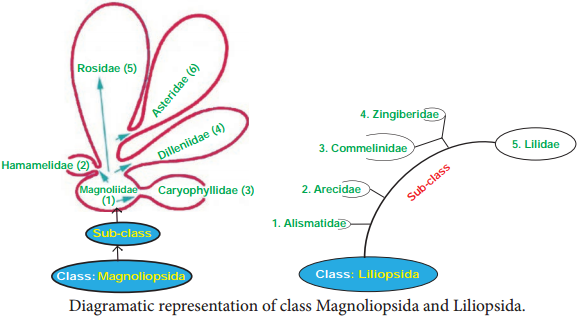
Cronquist classified the angiosperms into two main classes Magnoliopsida (=dicotyledons) and Liliopsida (=monocotyledons). There are 6 subclasses, 64 orders, 320 families and about 165,000 species in Magnoliopsida, whereas in Liliopsida there are 5 sub classes, 19 orders, 66 families and about 50,000 species.

Cronquist system of classification also could not persist for a long time because, the system is not very useful for identification and cannot be adopted in herbaria due to its high phylogenetic nature.
Types of Classification img 7

Angiosperm Phylogeny Group (APG) Classification

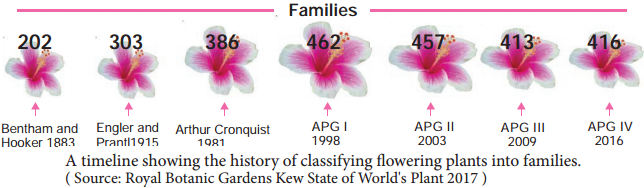
The most recent classification of flowering plants based on phylogenetic data was set in the last decade of twentieth century. Four versions of Angiosperm Phylogenetic Group classification (APG I, APG II, APG III & APG IV) have been published in 1998, 2003, 2009 and 2016 respectively.

Each version supplants the previous version. Recognition of monophyletic group based on the information received from various disciplines such as gross morphology, anatomy, embryology, palynology, karyology, phytochemistry and more strongly on molecular data with respect to DNA sequences of two chloroplast genes (atpB and rbcL) and one nuclear gene (nuclear ribosomal 18s DNA).
Types of Classification img 8

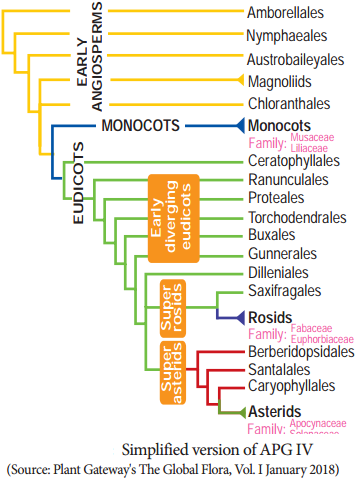
The most recent updated version, APG IV (2016) recognised 64 orders and 416 families. Of these, 416 families 259 are represented in India. The outline of APG IV classification is given below. Angiosperms are classified into three clades early angiosperms, monocots and eudicots. Early angiosperms are classified into 8 orders and 26 families (ANAclade + magnoliids + Chloranthales) Amborellales, Nymphaeale, Austrobaileyales.

  • Seeds generally always with two cotyledons.
  • Presence of ethereal oils.
  • Leaves are always simple net-veined.
  • Each floral whorls with many parts.
  • Perianth usually spirally arranged or parts in threes.
  • Stamens with broad filaments.
  • Anthers tetrasporangiate.
  • Pollen monosulcate.
  • Nectaries are rare.
  • Carpels usually free and
  • Embryo very small.

Types of Classification img 9

Monocots are classified into 11 orders and 77 families (basal monocots + lilioids + commelinids)
Types of Classification img 10

  • Seeds with single cotyledon.
  • Primary root short-lived.
  • Single adaxial prophyll.
  • Ethereal oils rarely present.
  • Mostly herbaceous, absence of vascular cambium.
  • Vascular bundles are scattered in the stem.
  • Leaf simple with parallel-veined.
  • Floral parts usually in threes.
  • Perianth often composed of tepals.
  • Pollen monosulcate.
  • Styles normally hollow and
  • Successive microsporogenesis.

Eudicots are divided into 45 orders and 313 families (early diverging eudicots + super rosids + super asterids).

  • Seeds with always two cotyledons.
  • Nodes trilacunar with three leaf traces.
  • Stomata anomocytic.
  • Ethereal oils rarely present.
  • Woody or herbaceous plants.
  • Leaves simple or compound, usually netveined.
  • Flower parts mostly in twos, fours or fives.
  • Microsporogenesis simultaneous.
  • Style solid and
  • Pollen tricolpate.

APG system is an evolving system that might undergo change periodically based on the new sets of data from various disciplines of Botany.

It is the currently accepted system across the world and followed by all the leading taxonomic institutions and practising taxonomists. However, it is yet to percolate into the Indian botanical curriculum. Classification reflects the state of our knowledge at a given point of time. It will continue to change as we acquire new information.
Need for Classification

Learninsta presents the core concepts of Biology with high-quality research papers and topical review articles.

Need for Classification

Understanding the classification of organisms can give an insight into other fields and has significant practical value. Classification helps us to know about different taxa, their phylogenetic relationship and exact position.

It helps to train the students of plant sciences with regard to the diversity of organisms and their relationship with other biological branches. It helps us understand the inter-relationship among different groups of organisms.

To understand and study the features, similarities and differences between different living organisms and how they are grouped under different categories. It helps to know the origin and evolution of organisms.

It helps in identification of new organism. Classification helps in knowing the relationship amongst different groups of organisms. The organism of past cannot be studied without a proper system of classification.

It helps to understand how the different organisms have evolved with time. It helps to understand the relationships between different groups of organisms. It forms a base for the study of other biological sciences, like biogeography.

It enables chemists to predict the properties of the elements and their compounds based on their positions in the Periodic Table, and vice versa. It becomes easier to study, understand, compare and contrast the related properties among the elements and their compounds from different groups.

The advantages of classifying organisms are as follows:

  1. Classification facilitates the identification of organisms
  2. Helps to establish the relationship among various groups of organisms
  3. Helps to study the phylogeny and evolutionary history of organisms.

Basis of Classification:
The characteristics based on which the living organisms can be classified.

Characteristic:
A distinguishing quality, trait or feature of an individual seen in all members of the same species.

There are three main types of classification-artifical, natural and phylogenetic:

  • Artificial System of Classification.
  • Natural System of Classification.
  • Phylogenetic System of Classification.

The current taxonomic system now has eight levels in its hierarchy, from lowest to highest, they are: species, genus, family, order, class, phylum, kingdom, domain.

Classification is a process related to categorization, the process in which ideas and objects are recognized, differentiated and understood. See Classification (general theory).

Grouping of elements into different classes is called periodic classification of elements. This method is requires arranging the elements that are alike and separating the elements that are unlike. It helps us understand how different elements form different compounds.

A disadvantage to classification is that many of the classifications themselves are based on subjective judgments, which may or may not be shared by everyone participating. This would lead to differences in perceived value.

The definition of classifying is categorizing something or someone into a certain group or system based on certain characteristics. An example of classifying is assigning plants or animals into a kingdom and species. An example of classifying is designating some papers as “Secret” or “Confidential.”

Given a population whose members each belong to one of a number of different sets or classes, a classification rule or classifier is a procedure by which the elements of the population set are each predicted to belong to one of the classes.

Classification of Plants

Learninsta presents the core concepts of Biology with high-quality research papers and topical review articles.

Classification of Plants

Imagine walking into a library and looking for a Harry Potter story book. As you walk into the library you notice that it is under renovation and all the books are scattered. Will it not be hard to find the exact book you are looking for? It might take hours. So you decide to come the next day when all the books are arranged according to the genres. One rack for adventure, another for Detective, Fantasy, Horror, Encyclopaedia and so on.

You automatically know Harry Potter is in the fantasy section and it takes less than ten minutes for you to find it. That is because the books have been classified and arranged according to a system. Similarly there is a vast assemblage of group of plants in the world. Is it possible to study and understand all of these? No Since it is difficult to study all these plants together, it is necessary to device some means to make this possible.

Classification is essential to biology because there is a vast diversity of organisms to sort out and compare. Unless they are organized into manageable categories it will be difficult for identification. Biological classifications are the inventions of biologists based upon the best evidence available. The scientific basis for cataloguing and retrieving information about the tremendous diversity of flora is known as classification.

Classification paves way for the arrangement of organisms into groups on the basis of their similarities, dissimilarities and relationships. The purpose of classification is to provide a systematic arrangement expressing the relationship between the organisms. Taxonomists have assigned a method of classifying organisms which are called ranks.

These taxonomical ranks are hierarchical. The scheme of classification has to be flexible, allowing newly discovered living organisms to be added where they fit best. While there are many ways to structure plant classification, one way is to group them into vascular and non-vascular plants, seed bearing and spore bearing, and angiosperms and gymnosperms. Plants can also be classified as grasses, herbaceous plants,
woody shrubs, and trees.

Classification is based on the following criteria: Plant body: Presence or absence of a well-differentiated plant body. E.g. Root, Stem and Leaves. Vascular system: Presence or absence of a vascular system for the transportation of water and other substances.

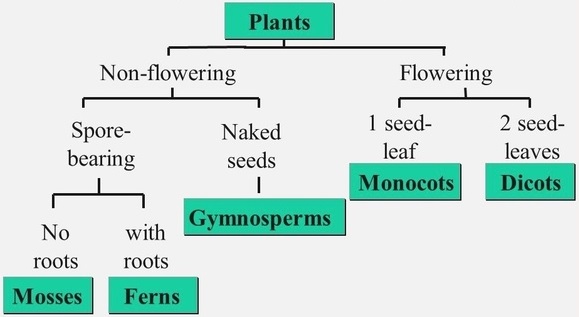
Within the plant kingdom, plants are divided into two main groups. These are flowering plants (angiosperms) and conifers, Ginkgos, and cycads (gymnosperms). The other group contains the seedless plants that reproduce by spores. It includes mosses, liverworts, horsetails, and ferns.

The major plant groups include bryophytes (mosses), pteridophytes (ferns), gymnosperms (conifers), and angiosperms (flowering, seed-bearing plants). Mosses are short plants and their leaves are usually only one cell thick. Ferns have many leaves branching out from their fronds.

Natural system of classification is that in which all natural characters of plants both vegetative and reproductive are taken in to consideration as the basic of classification principally the plants are grouped according to their related characters.

What are different types of flowers? They can be classified in many different ways: Based on presence or absence of seeds, Based on whether the plants produce flowers or not, Based on the presence of stems, leaves, and roots.
Classification of Plants img 1

Herbarium – Preparation and Uses

Learninsta presents the core concepts of Biology with high-quality research papers and topical review articles.

Herbarium – Preparation and Uses

Herbaria are store houses of preserved plant collections. Plants are preserved in the form of pressed and dried specimens mounted on a sheet of paper. Herbaria act as a centre for research and function as sources of material for systematic work.

Preparation of Herbarium Specimen

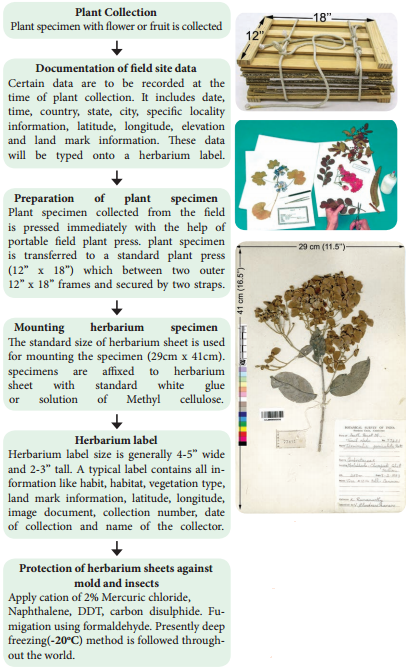
Herbarium Specimen is defined as a pressed and dried plant sample that is permanently glued or strapped to a sheet of paper along with a documentation label. Preparation of herbarium specimen includes the following steps.

  1. Plant Collection: Field collection, Liquid preserved collection, Living collection, Collection for molecular studies.
  2. Documentation of field site data
  3. Preparation of plant specimen
  4. Mounting herbarium specimen
  5. Herbarium labels
  6. Protection of herbarium sheets against mold and insects

Uses of Herbarium

  1. Herbarium provides resource material for systematic research and studies.
  2. It is a place for orderly arrangement of voucher specimens.
  3. Voucher specimen serves as a reference for comparing doubtful newly collected fresh specimens.
  4. Voucher specimens play a role in studies like floristic diversity, environmental assessment, ecological mechanisms and survey of unexplored areas.
  5. Herbarium provides opportunity for documenting biodiversity and studies related to the field of ecology and conservation biology.

Kew Herbarium

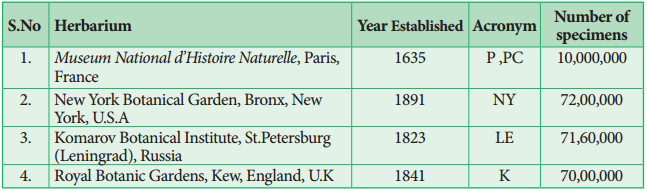
Kew Garden is situated in South West London that houses the “largest and most diverse botanical and mycological collections in the world” founded in the year 1840. Living collection includes more than 30,000 different kinds of plants.

While herbarium which is one of the largest in the world has over seven million preserved plant specimens. The library contains more than 7,50,000 volumes and the illustrations and also a collection of more than 1,75,000 prints, books, photographs, letters, manuscripts, periodicals, maps and botanical illustrations.

Preparation of Herbarium Specimen
Herbarium - Preparation and Uses img 1

International Herbarium
Herbarium - Preparation and Uses img 2

National Herbarium
Herbarium - Preparation and Uses img 3

Botanical Gardens and its Significance

Learninsta presents the core concepts of Biology with high-quality research papers and topical review articles.

Botanical Gardens and its Significance

In true sense all gardens are not botanical gardens. Botanical gardens are centres for collection of plants in their various stages of living. Gardens existed for growing ornamental plants for aesthetic value, religious and status reasons. The famous “hanging gardens” of Babylon in Mesopotamia is an example. For the purpose of science and education the first garden was maintained by Theophrastus in his public lecture hall at Athens.

First modern botanical garden was established by Luca Ghini (1490-1556) a professor of Botany at Pisa, Italy in 1544. Botanical garden contains special plant collections such as cacti, succulent, green house, shade house, tropical, alpine and exotic plants. Worldwide there are about 1800 botanical gardens and arboreta.

Role of Botanical Garden:
Botanical Gardens play the following important roles.

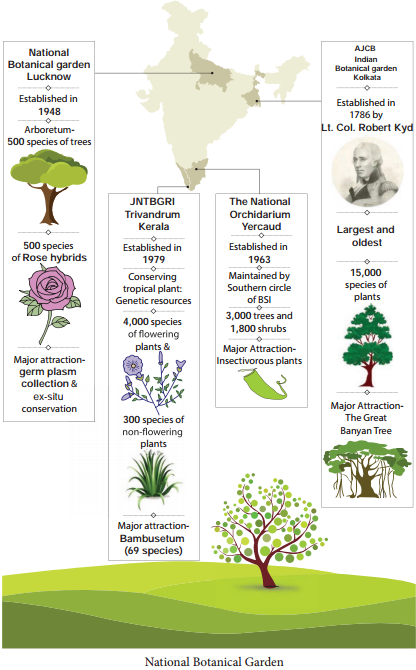
  1. Gardens with aesthetic value which attract a large number of visitors. For example, the Great Banyan Tree (Ficus benghalensis) in the Indian Botanical Garden at Kolkata.
  2. Gardens have a wide range of species and supply taxonomic material for botanical research.
  3. Garden is used for self-instruction or demonstration purposes.
  4. It can integrate information of diverse fields like Anatomy, Embryology, Phytochemistry, Cytology, Physiology and Ecology.
  5. Act as a conservation centre for diversity, rare and endangered species.
  6. It offers annual list of available species and a free exchange of seeds.
  7. Botanical garden gives information about method of propagation, sale of plant material to the general public.

Botanical Gardens img 1

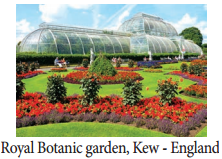
Royal Botanic garden, Kew- England
Botanical Garden img 2

Royal Botanic garden Kew – England is a non – departmental public body in the United Kingdom. It is the largest botanical garden in the world, established in 1760, but officially opened in the year 1841. Plant collections include Aquatic garden, Arboretum with 14,000 trees, Bonsai collection, Cacti collection and Carnivorous plant collection.

Botanical garden, also called botanic garden, originally, a collection of living plants designed chiefly to illustrate relationships within plant groups. A display garden that concentrates on woody plants (shrubs and trees) is often referred to as an arboretum.

How do I get official Botanical Garden status? The garden is open to the public on at least a part-time basis. The garden functions as an aesthetic display, educational display and/or site research. The garden maintains plant records.

Royal Botanic Gardens in Kew, England – known as the largest botanical garden in the world, this 300-acre garden near London is home to the world’s biggest collection of living plants.

Botanical gardens devote their resources to the study and conservation of plants, as well as making the world’s plant species diversity known to the public. These gardens also play a central role in meeting human needs and providing well-being.

These are specialised gargens which have collections of living plants for reference plant species in botanical gardens are grown for identification purposes and each plant is labelled by indicating its botanical name and family. e.g: 1. Kew (England).

Advantages. Botanical gardens devote their resources to the study and conservation of plants, as well as making the world’s plant species diversity known to the public. These gardens also play a central role in meeting human needs and providing well-being.

Botanical gardens make money based on their purpose. For example, a botanical garden may have a contract with a university or company to produce research on new plant species. If the space is being used largely for the public, patrons will pay an admission fee to tour the garden.

For the adjective meaning of or relating to botany or the cultivation of plants, botanic and botanical are both acceptable, and there is no difference between them. Botanical is more common, however, especially in modern.

Botanical is more common, however, especially in modern English. Firstly, botanical gardens can provide the new plants of economic importance to society, including ornamentals, medicinal, trees for reforestation, plants for industry, fruits, and cash crops. Next, some plants are collected for the study of adaptability, growth, and also the economic and genetic characteristics.
Botanical Gardens img 3