Epidermal Tissue System Definition and its Types

Learninsta presents the core concepts of Biology with high-quality research papers and topical review articles.

Epidermal Tissue System Definition and its Types

Introduction

Epidermal Tissue System

Is the outer most covering of plants. It is in direct contact with external environment. It consists of epidermis derived from protoderm. Epidermis is derived from two Greek words, namely ‘Epi’ and ‘Derma’. ‘Epi’ means upon and ‘Derma’ means skin.

It is made up of single layer of parenchyma cells which are arranged compactly without intercellular spaces. Although epidermis is a continuous outer layer, it is interrupted by
stomata in many plants.

Leaf Epidermis

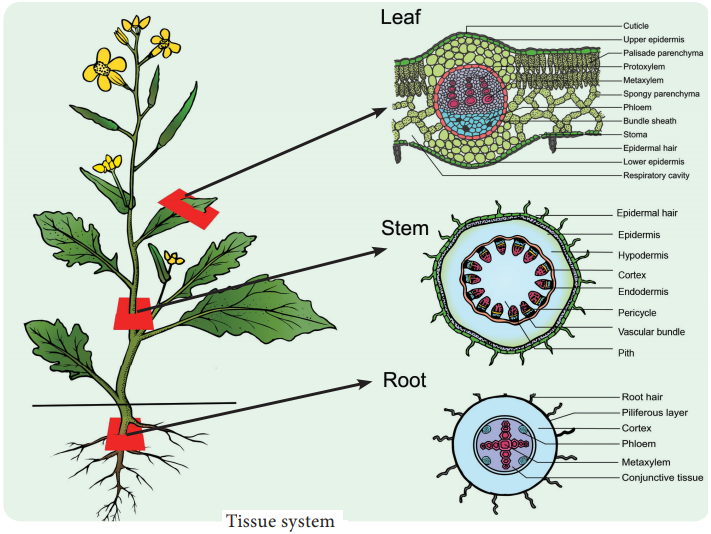
The leaf is generally dorsiventral. It has upper and lower epidermis. The epidermis is usually made up of a single layer of cells that are closely packed. Generally the cuticle on the upper epidermis is thicker than that of lower epidermis. The minute openings found on the epidermis are called stomata (singular: stoma).

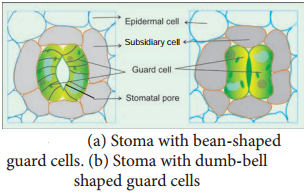
A stoma is surrounded by a pair of specialised epidermal cells called guard cells. In most dicots and monocots the guard cells are bean-shaped. While in grasses and sedges, the guard cells are dumbbell- shaped. The guard cells contain chloroplasts, whereas the other epidermal cells normally do not have them.
Epidermal Tissue System img 1

Subsidiary Cells

Stomata are minute pores surrounded by two guard cells. The stomata occur mainly in the epidermis of leaves. In some plants addition to guard cells, specialised epidermal cells are present which are distinct from other epidermal cells.

They are called Subsidiary cells. Based on the number and arrangement of subsidiary cells around the guard cells, the various types of stomata are recognised. The guard cells and subsidiary cells help in opening and closing of stomata during gaseous exchange and transpiration.

Epidermal Outgrowths

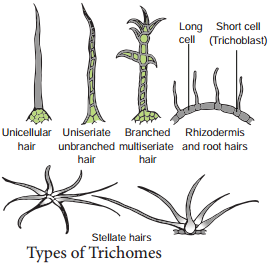
There are many types of epidermal outgrowths in stems. The unicellular or multicellular appendages that originate from the epidermal cells are called trichomes. Trichomes may be branched or unbranched and are one or more one celled thick. They assume many shapes and sizes. They may also be glandular (Example: Rose, Ocimum) or non-glandular.

Piliferous layer of the root has two types of epidermal cells, long cells and short cells. The short cells are called trichoblasts. Trichoblasts are elongate into root hairs. Epidermal hairs can also be in the form of stellate hairs (star shaped) present in plants. Example: styrax, many members of Malvaceae and Solanaceae.
Epidermal Tissue System img 2

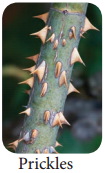
Prickles

Prickles, are one type of epidermal emergences with no vascular supply. They are stiff and sharp in appearance. (Example: Rose).
Epidermal Tissue System img 3

Functions of Epidermal Tissue System

  1. This system in the shoot checks excessive loss of water due to the presence of cuticle.
  2. Epidermis protects the underlying tissues.
  3. Stomata is involved in transpiration and gaseous exchange.
  4. Trichomes are also helpful in the dispersal of seeds and fruits, and provide protection against animals.
  5. Prickles also provide protection against animals and they also check excessive transpiration.
  6. In some rose plants they also help in climbing.
  7. Glandular hairs repel herbivorous animals.

The Tissue System Types and its Characteristics

Learninsta presents the core concepts of Biology with high-quality research papers and topical review articles.

The Tissue System Types and its Characteristics

Introduction to Tissue System, Types and Characteristics of Tissue System

As you have learnt, the plant cells are organised into tissues, in turn the tissues are organised into organs. Different organs in a plant show differences in their internal structure. This part of chapter deals with the different type of internal structure of various plant organs and its adaptations to diverse environments.

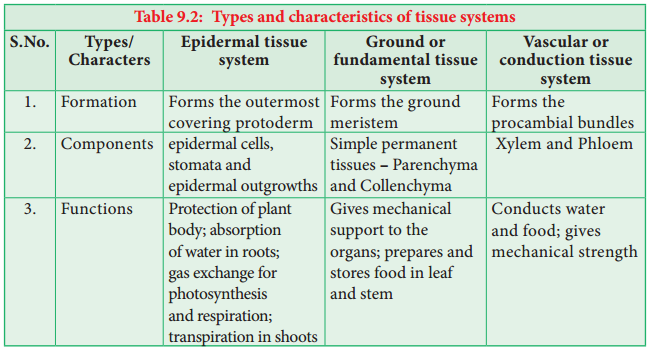
A group of tissues performing a similar function, irrespective of its position in the plant body, is called a tissue system. In 1875, German Scientist Julius Von Sachs recognized three tissue systems in the plants. They are:

  1. Epidermal tissue system (derived from protoderm)
  2. Ground tissue system (derived from ground meristem)
  3. Vascular tissue system (derived from procambium)

The Tissue System img 2

In plant anatomy, tissues are categorized broadly into three tissue systems: the epidermis, the ground tissue, and the vascular tissue.

Epidermis:
Cells forming the outer surface of the leaves and of the young plant body.

Vascular Tissue:
The primary components of vascular tissue are the xylem and phloem.

Plant cells are formed at meristems, and then develop into cell types which are grouped into tissues. Plants have only three tissue types:

  1. Dermal
  2. Ground and
  3. Vascular

Dermal tissue covers the outer surface of herbaceous plants.

There are three types of tissue systems:
Dermal, Vascular, and Ground.

The vascular system consists of complex tissues, the phloem and the xylem. The xylem and phloem together constitute vascular bundles. When xylem and phloem within a vascular bundle are arranged in an alternate manner on different radii, the arrangement is called radial. Example – roots.

Simple permanent tissues are composed of cells which are structurally and functionally similar. These tissues are made up of one type of cells. A few layers of cells beneath the epidermis are generally simple permanent tissue. Simple Permanent tissues are divided into two types.

While epidermal tissue mediates most of the interactions between a plant and its environment, ground tissue conducts the basic functions of photosynthesis, food storage, and support.

Tissues are groups of cells that have a similar structure and act together to perform a specific function. There are four different types of tissues in animals: connective, muscle, nervous, and epithelial.

  1. It protects the organs from injury or shocks
  2. It also connects many body parts such as ligament connects bones to another bones
  3. It also provides nutrition to our body such as blood also transport nutrients to many parts of the body
  4. It fights against many infectious pathogens

Plant tissue systems fall into one of two general types:
Meristematic tissue, and Permanent (or non-meristematic) tissue.

Plant tissues come in several forms: vascular, epidermal, ground, and meristematic. Each type of tissue consists of different types of cells, has different functions, and is located in different places.

Connective tissue is the most abundant tissue type in our body. It connects other cells and tissues together. It is typically found in our bones, cartilage, adipose, collagen, blood and many other areas in our body. This shows that connective tissue is very important in providing support and protection in our body.

These tissues are made up of living cells with thin cell walls which are loosely packed to accommodate the intracellular space. The cells of parenchyma permanent tissue are generally round or oval in shape. The cell wall of parenchyma is made up of cellulose and consists of vacuoles and a nucleus.

They differentiate into three main types: dermal, vascular, and ground tissue. Dermal tissue covers and protects the plant, and vascular tissue transports water, minerals, and sugars to different parts of the plant.

A tissue is an ensemble of similar cells and their extracellular matrix from the same origin that together carry out a specific function. Organs are then formed by the functional grouping together of multiple tissues.

Tissue is a group of cells that have similar structure and that function together as a unit. A nonliving material, called the intercellular matrix, fills the spaces between the cells. There are four main tissue types in the body: epithelial, connective, muscle, and nervous.
The Tissue System img 1

Permanent Tissues and its Various Types

Learninsta presents the core concepts of Biology with high-quality research papers and topical review articles.

Permanent Tissues and its Various Types

The Permanent tissues develop from apical meristem. They lose the power of cell division either permanently or temporarily. They are classified into two types:

  1. Simple permanent tissues.
  2. Complex permanent tissues.

Simple Permanent Tissues

Simple tissues are composed of one type of cells only. The cells are structurally and functionally similar. It is of three types.

  1. Parenchyma
  2. Collenchyma
  3. Sclerenchyma

Parenchyma (Gk: Para-beside; enehein-to pour)

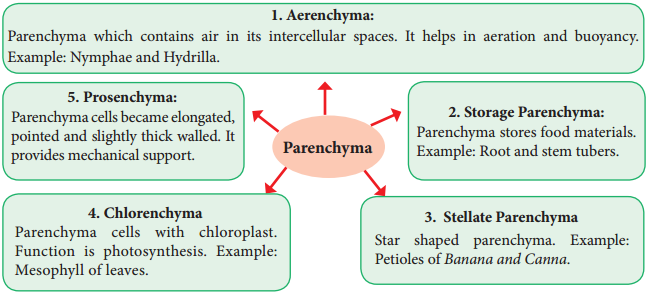
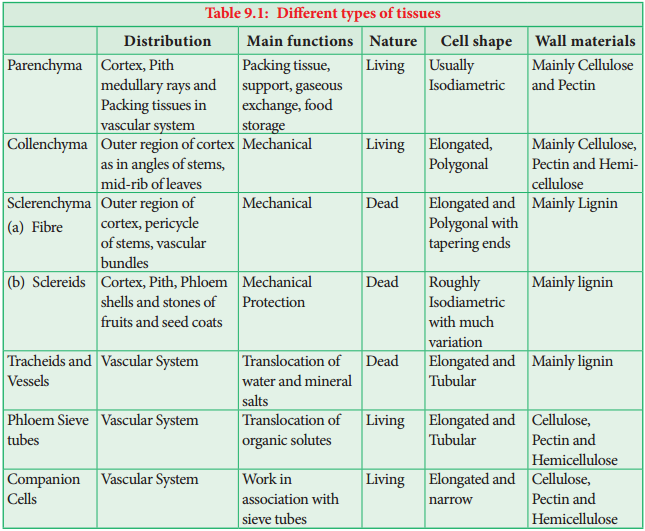
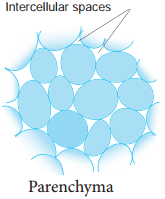
Parenchyma is generally present in all organs of the plant. It forms the ground tissue in a plant. Parenchyma is a living tissue and made up of thin walled cells. The cell wall is made up of cellulose. Parenchyma cells may be oval, polyhedral, cylindrical, irregular, elongated or armed. The tissue normally has prominent intercellular spaces and may store various types of materials like, water, air, ergastic substances.
Permanent Tissues img 1

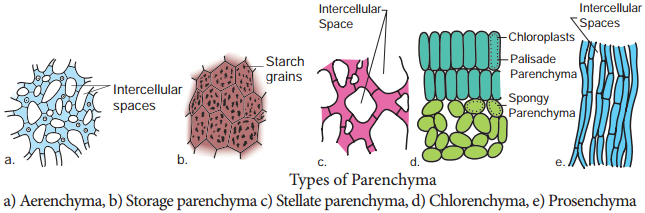
Occasionally Parenchyma cells which store resin, tannins, crystals of calcium carbonate, calcium oxalate are called idioblasts. Parenchyma is of different types and some of them are discussed as follows.
Permanent Tissues img 2
Permanent Tissues img 3

Collenchyma (Gk. Colla-glue; enchyma – an infusion)

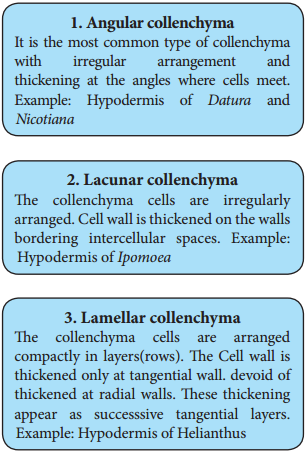
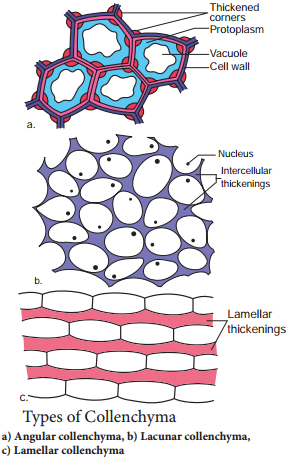
Collenchyma is a simple, living mechanical tissue. Collenchyma generally occurs in hypodermis of dicot stem. It is absent in the roots and also occurs in petioles and pedicels. The cells are elongated and appear polygonal in cross section.

The cell wall is unevenly thickened. It contains more of hemicellulose and pectin besides cellulose. It provides mechanical support and elasticity to the growing parts of the plant. Collenchyma consists of narrow cells. It has only a few small chloroplast or none. Tannin maybe present in collenchyma. Based on pattern of pectinisation of the cell wall, there are three types of collenchyma.
Permanent Tissues img 4
Permanent Tissues img 5

Sclerenchyma (Gk. Sclerous – hard: enchyma-an infusion)

The sclerenchyma is dead cell and lacks protoplasm. The cells are long or short, narrow thick walled and lignified secondary walls.
The cell walls of these cells are uniformly and strongly thickened. sclerenchymatous cells are of two types:

  1. Sclereids
  2. Fibres

Sclereids (Stone Cells)

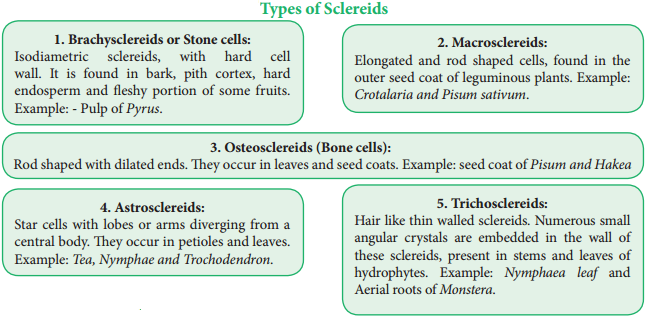
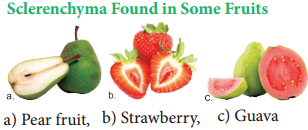
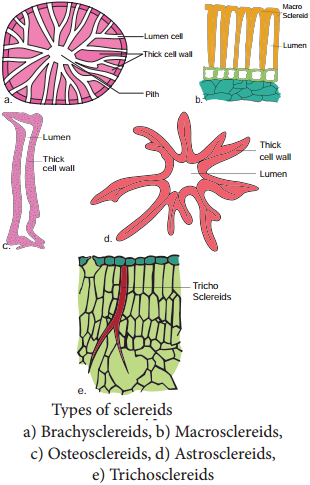
Sclereids are dead cells, usually these are isodiametric but some are elongated too. The cell wall is very thick due to lignification. Lumen is very much reduced. The pits may simple or branched. Sclereids are mechanical in function. They give hard texture to the seed coats, endosperms etc., Sclereids are classified into the following types.
Permanent Tissues img 6
Permanent Tissues img 7
Permanent Tissues img 8

Fibres

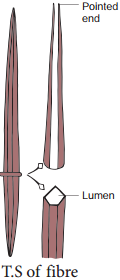
Fibres are very much elongated sclerenchyma cells with pointed tips. Fibres are dead cells and have lignified walls with narrow lumen. They have simple pits. They provide mechanical strength and protect them from the strong wind. It is also called supporting tissues. Fibres have a great commercial value in cottage and textile industries.

Fibres are of five types

1. Wood Fibres or Xylary Fibres

These fibres are associated with the secondary xylem tissue. They are also called xylary fibres. These fibres are derived from the vascular cambium. These are of two types.

  • Libriform Fibres
  • Fibre Tracheids

2. Bastfibres or Extra Xylary Fibres

These fibres are present in the phloem. Natural Bast fibres are strong and cellulosic. Fibres obtaining from the phloem or outer bark of jute, kenaf, flax and hemp plants. The so called pericyclic fibres are actually phloem fibres.
Permanent Tissues img 9

3. Surface Fibres

These fibres are produced from the surface of the plant organs. Cotton and silk cotton are the examples. They occur in the testa of seeds.

4. Mesocarp Fibres

Fibres obtained from the mesocarp of drupes like coconut.

5. Leaf Fibres

Fibres obtained from the leaf of Musa, Agave and Sensciveria.

Fibres in Our Daily Life

Economically fibres may be grouped as follows:-

1. Textile Fibres:

Fibres utilized for the manufacture of fabrics, netting and cordage etc.

Surface Fibres:
Example: Cotton

a. Surface Fibres:
Example: Cotton

b. Soft Fibres:
Example: Flax, Jute and Ramie

c. Hard Fibres:
Example: Sisal, Coconut, Pineapple, Abaca etc.

2. Brush Fibre:

Fibres utilized for the manufacture of brushes and brooms.

3. Rough Weaving Fibres:

Fibres utilized in making baskets, chairs, mats etc.

4. Paper Making Fibres:

Wood fibres utilized for paper making.

5. Filling Fibres:

Fibres used for stuffing cushions, mattresses, pillows, furniture etc. Example: Bombax and Silk cotton.

Complex Tissues

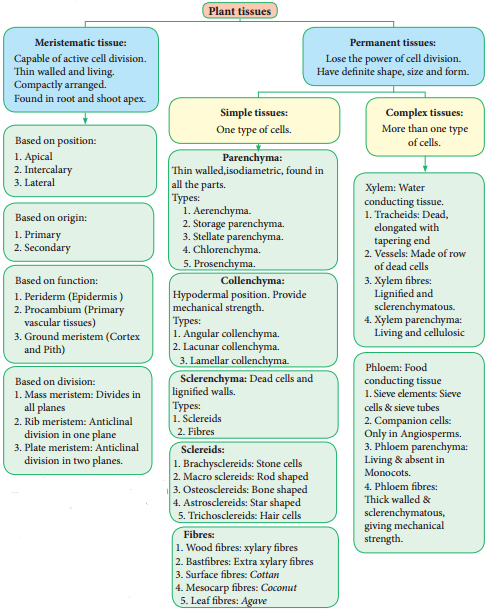
A complex tissue is a tissue with several types of cells but all of them function together as a single unit. It is of two types – xylem and phloem.

Xylem or Hadrome

The xylem is the principal water conducting tissue in a vascular plant. The term xylem was introduced by Nageli (1858) and is derived from the Gk. Xylos – wood. The xylem which is derived from Procambium is called primary xylem and the xylem which is derived from vascular cambium is called secondary xylem. Early formed primary xylem elements are called protoxylem, whereas the later formed primary xylem elements are called metaxylem.

Protoxylem lies towards the periphery and metaxylem that lies towards the centre is called Exarch. It is common in roots. Protoxylem lies towards the centre and meta xylem towards the periphery this condition is called Endarch. It is seen in stems. Protoxylem is located in the centre surrounded by the metaxylem is called Centrarch. In this type only one vascular strand is developed. Example: Selaginella sp.

Protoxylem is located in the centre surrounded by the metaxylem is called Mesarch. In this type several vascular strands are developed. Example: Ophioglossum sp

Xylem Consists of Four Types of Cells

  1. Tracheids
  2. Vessels or Trachea
  3. Xylem Parenchyma
  4. Xylem Fibres

1. Tracheids

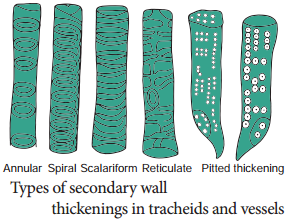
Tracheids are dead, lignified and elongated cells with tapering ends. Its lumen is broader than that of fibres. In cross section, the tracheids are polygonal. There are different types of cell wall thickenings due to the deposition of secondary wall substances.

They are annular (ring like), spiral (spring like), scalariform (ladder like) reticulate (net like) and pitted (uniformly thick except at pits). Tracheids are imperforated cells with bordered pits on their side walls. Only through this conduction takes place in Gymnosperms. They are arranged one above the other. Tracheids are chief water conducting elements in Gymnosperms and Pteridophytes. They also offer mechanical support to the plants.
Permanent Tissues img 10

2. Vessels or Trachea

Vessels are elongated tube like structure. They are dead cells formed from a row of vessel elements placed end to end. They are perforated at the end walls. Their lumen is wider than Tracheids. Due to the dissolution of entire cell wall, a single pore is formed at the perforation plate. It is called simple perforation plate, Example: Mangifera. If the perforation plate has many pores, it is called multiple perforation plate. Example Liriodendron.

The secondary wall thickening of vessels are annular, spiral, scalariform, reticulate, or pitted as in tracheids, Vessels are chief water conducting elements in Angiosperms and absent in Pteridophytes and Gymnosperms. In Gnetum of Gymnosperm, vessels occur. The main function is conduction of water, minerals and also offers mechanical strength.

3. Xylem Fibre

The fibres of sclerenchyma associated with the xylem are known as xylem fibres. Xylem fibres are dead cells and have lignified walls with narrow lumen. They cannot conduct water but being stronger provide mechanical strength. They are present in both primary and secondary xylem. Xylem fibres are also called libriform fibres.

The fibres are abundantly found in many plants. They occur in patches, in continuous bands and sometimes singly among other cells. Between fibres and normal tracheids, there are many transitional forms which are neither typical fibres nor typical tracheids. The transitional types are designated as fibretracheids. The pits of fibre-tracheids are smaller than those of vessels and typical tracheids.

4. Xylem Parernchyma

The parenchyma cells associated with the xylem are known as xylem parenchyma. These are the only living cells in xylem tissue. The cell wall is thin and made up of cellulose. Parenchyma arranged longitudinally along the long axis is called axial parenchyma Ray parenchyma is arranged in radial rows. Secondary xylem consists of both axial and ray parenchyma, Parenchyma stores food materials and also helps in conduction
of water.

Phloem to Leptome

Phloem is the food conducting complex tissues of vascular plants. The term phloem was coined by C. Nageli (1858). The Phloem which is derived from procambium is called primary phloem and the phloem which is derived from vascular cambium is called secondary phloem. Early formed primary phloem elements are called protophloem whereas the later formed primary phloem elements are called metaphloem. Protophloem is short lived. It gets crushed by the developing metaphloem.

Phloem Consists of Four Types of Cells

  1. Sieve elements
  2. Companion cells
  3. Phloem Parenchyma
  4. Phloem Fibres

1. Sieve Elements

Sieve elements are the conducting elements of the phloem. They are of two types, namely sieve cells and sieve tubes.

Sieve Cells

These are primitive type of conducting elements found in Pteridophytes and Gymnosperms. Sieve cells have sieve areas on their lateral walls only. They are not associated with companion cells.

Sieve Tubes

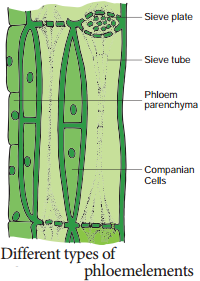
Sieve tubes are long tube like conducting elements in the phloem. These are formed from a series of cells called sieve tube elements. The sieve tube elements are arranged one above the other and form vertical sieve tube. The end wall contains a number of pores and it looks like a sieve.

So it is called as sieve plate. The sieve elements show nacreous thickenings on their lateral walls. They may possess simple or compound sieve plates. The function of sieve tubes are believed to be controlled by campanion cells.

In mature sieve tube, nucleus is absent. It contains a lining layer of cytoplasm. A special protein (P. Protein = Phloem Protein) called slime body is seen in it. In mature sieve tubes, the pores in the sieve plate are blocked by a substance called callose (callose plug). The conduction of food material takes place through cytoplasmic strands. Sieve tubes occur only in Angiosperms.
Permanent Tissues img 11

Companion Cells

The thin walled, elongated, specialized parenchyma cells, which are associated with the sieve elements, are called companion cells. These cells are living and they have cytoplasm and a prominent nucleus. They are connected to the sieve tubes through pits found in the lateral walls. Through these pits cytoplasmic connections are maintained between these elements. These cells are helpful in maintaining the pressure gradient in the sieve tubes.

Usually the nuclei of the companion cells serve for the nuclei of sieve tubes as they lack them. The companion cells are present only in Angiosperms and absent in Gymnosperms and Pteridophytes. They assist the sieve tubes in the conduction of food materials.

Phloem Parenchyma

The parenchyma cells associated with the phloem are called phloem parenchyma. These are living cells. They store starch and fats. They also contain resins and tannins in some plants. Primary phloem consists of axial parenchyma and secondary phloem consists of both axial and ray parenchyma. They are present in Pteridophytes, Gymnosperms and Dicots.

Phloem Fibres (or) Bast Fibres

The fibres of sclerenchyma associated with phloem are called phloem fibres or bast fibres. They are narrow, vertically elongated cells with very thick walls and a small lumen. Among the four phloem elements, phloem fibres are the only dead tissue. These are the strengthening as well as supporting cells.

Concept Map
Permanent Tissues img 12
Permanent Tissues img 13

Difference Between Meristematic Tissue and Permanent Tissue

Meristematic Tissue

Permanent Tissue

1. Cells Divide Repeatedly1. Do Not Divide
2.  Cells are undifferentiated2. Cells are fully differentiated
3. Cells are small and Isodiametric3. Cells are variable in shape and size
4. Intercellular spaces are absent4. Intercellular spaces are present
5. Vacuoles are absent5. Vacuoles are present
6. Cell walls are thin6. Cell walls are maybe thick or thin
7. Inorganic inclusions are absent7. Inorganic inclusions are present


Difference Between Collenchyma and Schlerenchyma

Collenchyma

Schlerenchyma

1. Living Cells1. Dead Cells
2. Contains Protoplasm2. Do not have protoplasm
3. Cell walls are cellulosic3. Cells walls are lignified
4. Thickening of cell wall is not uniform4. Thickening of cell wall is uniform
5. Keeps the plant body soft5. Keeps plant body stiff and hard
6. Sometimes it has chloroplast6. Do not have chloroplast

Difference Between Fibre and Sclereids

Fibre

Sclereids

1. Long cells1. Short cells
2. Narrow, Elongated pointed ends2. Usually short and broad
3. Occurs in bundles3. Occurs individually or in small groups
4. Commonly unbranched4. Maybe branched
5. Derived directly from meristematic tissue5. Develops from secondary sclerosis of parenchyma cells

Difference Between Tracheids and Fibres

Tracheids

Fibres

1. Not much elongated1. Very long cells
2. Possess oblique end walls2. Possess tapering end walls
3. Cell walls are not as thick as Fibres3. Cell wall are thick and lignified
4. Possess various types of thickenings4. Possess only pitted thickenings
5. Responsible for the conduction and also
mechanical support
5. Provide only mechanical support

Difference Between Sieve Cells and Sieve Tubes

Sieve Cells

Sieve Tubes

1. Have no companion cells1. Have companion cells
2. The sieve areas do not form sieve plates2. The sieve areas are confied to sieve plates
3. The sieve areas are not well differentiated3. The sieve areas are well differentiated
4. They are elongated cells and are quite
long with tapering end walls
4. They consist of vertical cells placed one above the other forming long tubes connected at the walls by sieve pores
5. The sieve are smaller and numerous5. The sieve pores are longer and fewer
6. Found in Pteridophytes and
Gymnosperms
6. Found in Angiosperms

Meristematic Tissue Definition, Characteristics and Classification

Learninsta presents the core concepts of Biology with high-quality research papers and topical review articles.

Meristematic Tissue Definition, Characteristics and Classification

Characteristics and Classification

The characters of meristematic tissues: (Gr. Meristos-Divisible)
Meristematic Tissue img 1

The term meristem was coined by C. Nageli 1858.

  • The meristematic cells are isodiametric and they may be, oval, spherical or polygonal in shape.
  • They generally have dense cytoplasm with prominent nucleus.
  • Generally the vacuoles are either small or absent.
  • Their cell wall is thin, elastic and made up of cellulose.
  • These are most actively dividing cells.
  • Meristematic cells are self-perpetuating.

Classification of Meristem

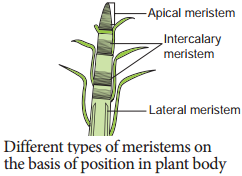
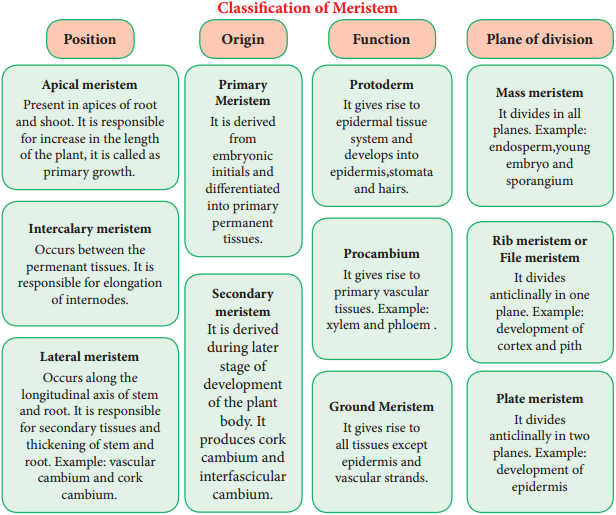
Meristem has been classified into several types on the basis of position, origin, function and division.

Theories of Meristem Organization and Function

Many anatomists illustrated the root and shoot apical meristems on the basis of number and arrangement and accordingly proposed the following theories – An extract of which is discussed below.

Shoot Apical Meristem
Apical Cell Theory

Apical cell theory is proposed by Hofmeister (1852) and supported by Nageli (1859). A single apical cell is the structural and functional unit.
Meristematic Tissue img 2

This apical cell governs the growth and development of whole plant body. It is applicable in Algae, Bryophytes and in some Pteridophytes.

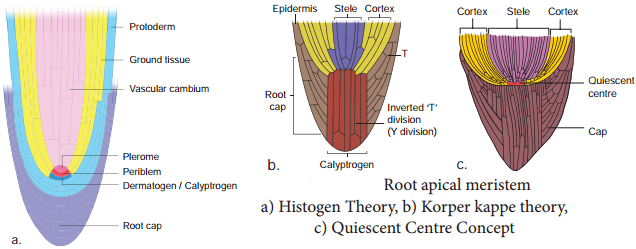
Histogen Theory

Histogen theory is proposed by Hanstein (1868) and supported by Strassburgur. The shoot apex comprises three distinct zones.

1. Dermatogen:
It is the outermost layer. It gives rise to epidermis.

2. Periblem:
It is middle layer. That gives rise to cortex.

3. Plerome:
It is innermost layer. Which gives rise to stele

Tunica Corpus Theory

Tunica corpus theory is proposed by

A. Schmidt (1924).
Two zones of tissues are found in apical meris tem.

1. The tunica:
It is the peripheral zone of shoot apex, that forms epidermis.

2. The corpus:
It is the inner zone of shoot apex,that forms cortex and stele of shoot.

Root Apical Meristem

Root apex is present opposite to the shoot apex. The roots contain root cap at their apices and the apical meristem is present below the root cap. The different theories proposed to explain root apical meristem organization are given below.

Apical Cell Theory

Apical cell theory is proposed by Nageli. The single apical cell or apical initial composes the root meristem. The apical initial is tetrahedral in shape and produces root cap from one side. The remaining three sides produce epidermis, cortex and vascular tissues. It is found in vascular cryptogams.

Histogen Theory

Histogen theory is proposed by Hanstein (1868) and supported by Strassburgur. The histogen theory as appilied to the root apical meristem speaks of four histogen in the meristem. They are respectively,
Meristematic Tissue img 3

(i) Dermatogen:
It is the outermost layer. It gives rise to root epidermis.

(ii) Periblem:
It is the middle layer. It gives rise to cortex.

(iii) Plerome:
It is innermost layer. It gives rise to stele.

(iv) Calyptrogen:
It gives rise to root cap.

Korper Kappe Theory

Korper Kappe theory is proposed by Schuepp. There are two zones in root apex – Korper and Kappe

  1. Korper zone forms the body.
  2. Kappe zone forms the cap. This theory is equivalent to tunica corpus theory of shoot apex.
  3. The two divisions are distinguished by the type of T (also called Y) divisions.
  4. Korper is characterised by inverted T divisions and kappe by straight T divisions.

Quiescent Centre Concept

Quiescent centre concept was proposed by Clowes (1961) to explain root apical meristem activity. This centre is located between root cap and differentiating cells of the roots. The apparently inactive region of cells in root promeristem is called quiescent centre. It is the site of hormone synthesis and also the ultimate source of all meristematic cells of the meristem.

Nucleic Acids Definition, Structure, Features and its Types

Learninsta presents the core concepts of Biology with high-quality research papers and topical review articles.

Nucleic Acids Definition, Structure, Features and its Types

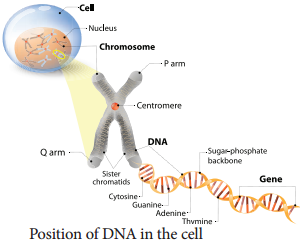
As we know DNA and RNA are the two kinds of nucleic acids. These were originally isolated from cell nucleus. They are present in all known cells and viruses with special coded genetic programme with detailed and specific instructions for each organism heredity.

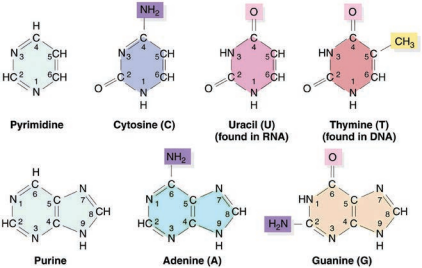
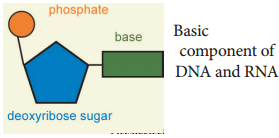
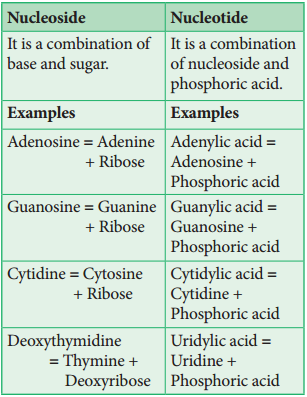
DNA and RNA are polymers of monomers called nucleotides, each of which is composed of a nitrogen base, a pentose sugar and a phosphate. A purine or a pyrimidine and a ribose or deoxyribose sugar is called nucleoside. A nitrogenous base is linked to pentose sugar through n-glycosidic linkage and forms a nucleoside.

When a phosphate group is attached to a nucleoside it is called a nucleotide. The nitrogen base is a heterocyclic compound that can be either a purine (two rings) or a pyrimidine (one ring). There are 2 types of purines – adenine (A) and guanine (G) and 3 types of pyrimidines – cytosine (C), thymine (T) and uracil (U) (Figure 8.20 and 21).
Nucleic Acids img 1
Nucleic Acids img 2

A characteristic feature that differentiates DNA from RNA is that DNA contains nitrogen bases such as Adenine, guanine, thymine (5-methyl uracil) and cytosine and the RNA contains nitrogen bases such as adenine, guanine, cytosine and uracil instead of thymine.

The nitrogen base is covalently bonded to the sugar ribose in RNA and to deoxyribose (ribose with one oxygen removed from C2) in DNA. Phosphate group is a derivative of (PO43-) phosphoric acid, and forms phosphodiester linkages with sugar molecule (Figure 8.22).
Nucleic Acids img 3

Formation of Dinucleotide and Polynucleotide

Two nucleotides join to form dinucleotide that are linked through 3′- 5′ phosphodiester linkage by condensation between phosphate groups of one with sugar of other. This is repeated many times to makepolynucleotide.
Nucleic Acids img 4

Structure of DNA

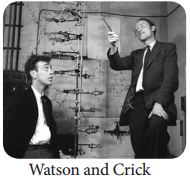
Watson and Crick shared the Nobel Prize in 1962 for their discovery, along with Maurice Wilkins, who had produced the crystallographic data supporting the model.

Rosalind Franklin (1920 – 1958) had earlier produced the first clear crystallographic evidence for a helical structure. James Watson and Francis Crick of Cavendish laboratory in Cambridge built a scale model of double helical structure of DNA which is the most prevalent form of DNA, the B-DNA. This is the secondary structure of DNA.
Nucleic Acids img 5

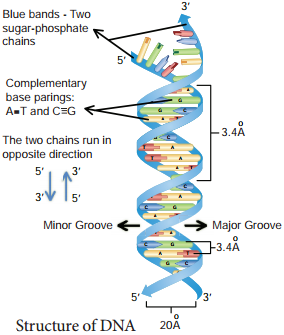
As proposed by James Watson and Francis Crick, DNA consists of right handed double helix with 2 helical polynucleotide chains that are coiled around a common axis to form right handed B form of DNA. The coils are held together by hydrogen bonds which occur between complementary pairs of nitrogenous bases. The sugar is called 2′- deoxyribose because there is no hydroxyl at position 2′. Adenine and thiamine base pairs has two hydrogen bonds while guanine and cytosine base pairs have three hydrogen bonds.

As published by Erwin Chargaff in 1949, a purine pairs with pyrimidine and vice versa. Adenine (A) always pairs with Thymine (T) by double bond and Guanine (G) always pairs with Cytosine (C) by triple bond.

Features of DNA

If one strand runs in the 5′- 3′ direction, the other runs in 3′ – 5′ direction and thus are antiparallel (they run in opposite direction). The 5′ end has the phosphate group and 3’ end has the OH group.

The angle at which the two sugars protrude from the base pairs is about 120°, for the narrow angle and 240° for the wide angle. The narrow angle between the sugars generates a minor groove and the large angle on the other edge generates major groove.

Each base is 0.34 nm apart and a complete turn of the helix comprises 3.4 nm or 10 base pairs per turn in the predominant B form of DNA.

DNA helical structure has a diameter of 20A° and a pitch of about 34 A°. X-ray crystal study of DNA takes a stack of about 10 bp to go completely around the helix (360°).

Thermodynamic stability of the helix and specificity of base pairing includes:-

  1. The hydrogen bonds between the complementary bases of the double helix
  2. Atacking interaction between bases tend to stack about each other perpendicular to the direction of helical axis.
  3. Electron cloud interactions (π – π) between the bases in the helical stacks contribute to the stability of the double helix.

The phosphodiester linkages gives an inherent polarity to the DNA helix. They form strong covalent bonds, gives the strength and stability to the polynucleotide chain.
Nucleic Acids img 6

Plectonemic Coiling:

The two strands of the DNA are wrapped around each other in a helix, making it impossible to simply move them apart without breaking the entire structure. Whereas in paranemic coiling the two strands simply lie alongside one another, making them easier to pull apart.

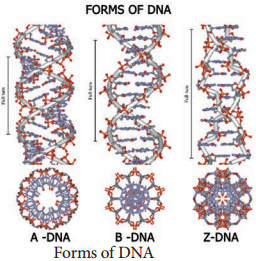
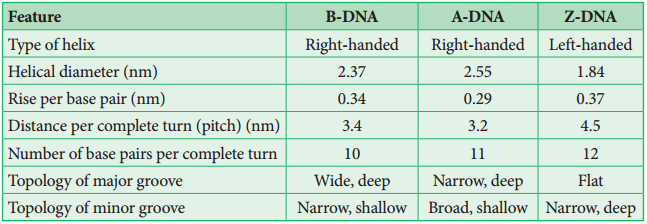
Based on the helix and the distance between each turns, the DNA is of three forms – A DNA, B DNA and Z DNA (Figure 8.27).
Nucleic Acids img 7

Ribonucleic Acid (RNA)

Ribonucleic acid (RNA) is a polymeric molecule essential in various biological roles in coding, decoding, regulation and expression of genes. RNA is single stranded and is unstable when compared to DNA.
Nucleic Acids img 8

Types of RNA

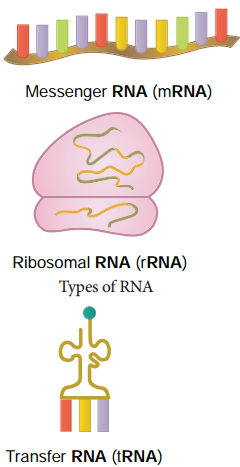
mRNA (messenger RNA):
Single stranded, carries a copy of instructions for assembling amino acids into proteins. It is very unstable and comprises 5% of total RNA polymer. Prokaryotic mRNA (Polycistronic) carry coding sequences for many polypeptides. Eukaryotic mRNA (Monocistronic) contains information for only one polypeptide.

tRNA (transfer RNA):
Translates the code from mRNA and transfers amino acids to the ribosome to build proteins. It is highly folded into an elaborate 3D structure and comprises about 15% of total RNA. It is also called as soluble RNA.

rRNA (ribosomal RNA):
Single stranded, metabolically stable, make up the two subunits of ribosomes. It constitutes 80% of the total RNA. It is a polymer with varied length from 120-3000 nucleotides and gives ribosomes their shape. Genes for rRNA are highly conserved and employed for phylogenetic studies (Figure 8.28).
Nucleic Acids img 9