Secondary Growth in Dicot Root

Learninsta presents the core concepts of Biology with high-quality research papers and topical review articles.

Secondary Growth in Dicot Root

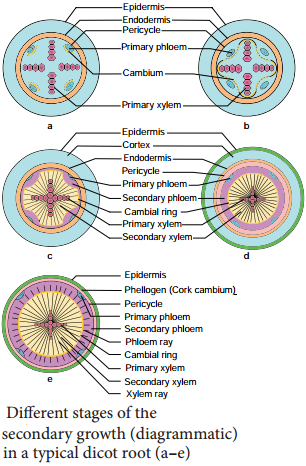
Secondary growth in dicot roots is essential to provide strength to the growing aerial parts of the plants. It is similar to that of the secondary growth in dicot stem. However, there is marked diffrence in the manner of the formation of vascular cambium.

The vascular cambium is completely secondary in origin. It originates from a combination of conjunctive tissue located just below the phloem bundles, and as a portion of pericycle tissue present above the protoxylem to form a complete and continuous wavy ring. This wavy ring later becomes circular and produces secondary xylem and secondary phloem similar to the secondary growth in stems.
Secondary Growth in Dicot Root img 1

Differences Between Secondary Growth in Dicot Stem and Root

Secondary Growth in Dicot Stem

Secondary Growth in Dicot Root

1. The cambial ring formed is circular in cross section from the beginning1. The cambial ring formed is wavy in the beginning and later becomes circular
2. The cambial ring is partially primary (fasicular cambium) and partially secondary (Interfasicular cambium) in origin2. The cambial ring is completely secondary in origin
3. Generally, periderm originates from the cortical cells (extrastelar in origin)3. Generally, periderm originates from the pericycle.(intrastealar in origin)
4. More amount of cork is produced as stem is aboveground4. Generally, less amount of cork is produced as root is underground
5. Lenticels of periderm are prominent5. Lenticels of periderm are not very prominent

Most of the dicotyledonous roots show secondary growth in thickness, similar to that of dicotyledonous stems. Certain dicotyledonous roots do not show secondary growth. The secondary vascular tissues originate as a result of the cambial activity. The phellogen gives rise to the periderm.

Secondary growth takes place in all dicotyledonous woody plants. The root increases in girth by the activity of stelar and extrastelar cambium.

This is followed by periclinal division of the cells of pericycle present against protoxylem to form multiple layers of cells, which are joined by cambial cells derived from conjunctive tissues and together they make a complete cambium ring. Thus, the correct answer is option D.

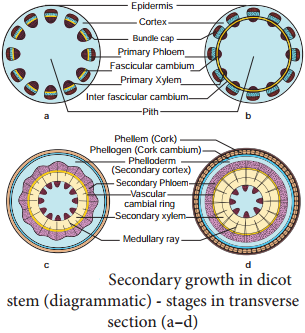
In a dicot stem, secondary growth occurs both in the stele and cortex. The process occurs simultaneously but is caused by separate strips of secondary meristem. In the stele, secondary growth is initiated by vascular cambium, while in the cortex, it is initiated by cork cambium.

In botany, secondary growth is the growth that results from cell division in the cambia or lateral meristems and that causes the stems and roots to thicken, while primary growth is growth that occurs as a result of cell division at the tips of stems and roots, causing them to elongate, and gives rise to primary tissue. There are two types of lateral tissues involved in secondary growth, namely, vascular cambium and cork cambium.

In general, monocots do not undergo secondary growth. If they do increase in girth (like palm trees and yucca plants), it does not result in the development of a secondary xylem and phloem, since monocots don’t have vascular cambium.

Difference Between the Secondary Growth in Dicot Stem and Dicot Root. The growth in thickness by the activity of secondary tissues is called secondary thickening. It involves stelar growth by the activity of vascular cambial ring and extra stelar growth by the activity of cork cambium.

Initiation of secondary growth takes place in the zone of maturation soon after the cells stop elongating there. The vascular cambium differentiates between the primary xylem and phloem in this zone and pericycle cells divide simultaneously with the procambium initials.

A process of formation of secondary tissues due to activity of vascular cambium and cork cambium for increasing thickness or girth or diameter of plant is termed as secondary growth.

Bougainvillea is a member of the Nyctaginaceae and is an example of a dicotyledonous stem which displays anomalous secondary growth. In this TS, near the centre of the stem, you will see some primary vascular bundles embedded in lignified pith parenchyma.

Secondary growth is characterized by an increase in thickness or girth of the plant, and is caused by cell division in the lateral meristem. Secondary vascular tissue is added as the plant grows, as well as a cork layer. The bark of a tree extends from the vascular cambium to the epidermis.

The increase in length of the shoot and the root is referred to as primary growth. It is the result of cell division in the shoot apical meristem. Secondary growth is characterized by an increase in thickness or girth of the plant.

The primary root grows vertically downwards into the soil. Smaller lateral roots known as the secondary roots are produced on the primary root. The secondary roots in turn produce tertiary roots. These roots grow in various directions and help in fixing the plant firmly into the soil.

Secondary growth is the growth in thickness due to the formation of secondary tissues by lateral meristems. Secondary growth does not occur in monocots because monocots do not possess vascular cambium in between the vascular bundles.

Secondary growth is the outward growth of the plant, making it thicker and wider. Secondary growth is important to woody plants because they grow much taller than other plants and need more support in their stems and roots. Lateral meristems are the dividing cells in secondary growth, and produce secondary tissues.

The process of secondary growth is controlled by the lateral meristems, and is similar in both stems and roots. Lateral meristems include the vascular cambium and, in woody plants, the cork cambium (cambium is another term for meristem).

Secondary xylem is a complex tissue that consists not only of non-living supporting and conducting cells but also of important living components (rays and axial wood parenchyma) which, with those in the secondary phloem, comprise a three-dimensional symplastic pathway through which photosynthate and other essential.

Lateral meristems are known as secondary meristems because they are responsible for secondary growth, or increase in stem girth and thickness. Meristems form anew from other cells in injured tissues and are responsible for wound healing.

Plant growth from lateral meristems such as the vascular cambium and cork cambium. This growth thickens plants and creates wood and bark (only in woody plants). Allows for taller, stronger plants, more branching and reproduction, and more conduction of fluids.

An example of a secondary meristem is the lateral meristem (e.g. cork cambium and accessory cambia). Being meristematic, the secondary meristem is comprised of undifferentiated (or partially differentiated), actively dividing cells.

The vascular cambium is responsible for increasing the diameter of stems and roots and for forming woody tissue. The cork cambium produces some of the bark. Cell division by the cambium produces cells that become secondary xylem and phloem.

In botany, secondary growth is the growth that results from cell division in the cambia or lateral meristems and that causes the stems and roots to thicken, while primary growth is growth that occurs as a result of cell division at the tips of stems and roots, causing them to elongate, and gives rise to primary tissue.

Secondary growth is the growth in thickness due to the formation of secondary tissues by lateral meristems. Secondary growth does not occur in monocots because monocots do not possess vascular cambium in between the vascular bundles.

In particular, secondary growth is substantial for constant plant growth and the remodeling of body structures.

As an important meristem involved, the vascular cambium forms a cylindrical domain below the organ surface producing tissues for long-distance transport and mechanical support: wood (xylem) and bast (phloem). Pericycle forms the boundary of stele and encloses vascular bundles and pith. It is a primary structure and is not formed as a result of secondary growth.
Secondary Growth in Dicot Stem and its Overview

Learninsta presents the core concepts of Biology with high-quality research papers and topical review articles.

Secondary Growth in Dicot Stem and its Overview

Vascular Cambium

The vascular cambium is the lateral meristem that produces the secondary vascular tissues. i.e., secondary xylem and secondary phloem.

Origin and Formation of Vascular Cambium

A strip of vascular cambium that is believed to originate from the procambium is present between xylem and phloem of the vascular bundle. This cambial strip is known as intrafascicular or fascicular cambium. In between the vascular bundles, a few parenchymatous cells of the medullary rays that are in line with the fascicular cambium become meristematic and form strips of vascular cambium. It is calledinterfascicular
cambium.

This interfascicular cambium joins with the intrafascicular cambium on both sides to form a continuous ring. It is called a vascular cambial ring. The differences between interfascicular and intrafascicular cambia are summarised below:

Intrafascicular Cambium

Interfascicular Cambium

1. Present inside the vascular bundles1. Present in between the vascular bundles
2. Originates from the procambium2. Originates from the medullary rays
3. Initially it forms a part of the primary
meristem.
3. From the beginning it forms a part of the secondary meristem

Organization of Vascular Cambium

The cells of vascular cambium do not fit into the usual description of meristems which have isodiametric cells, with a dense cytoplasm and large nuclei. While the active vascular cambium possesses cells with large central vacuole (or vacuoles) surrounded by a thin, layers of dense cytoplasm.

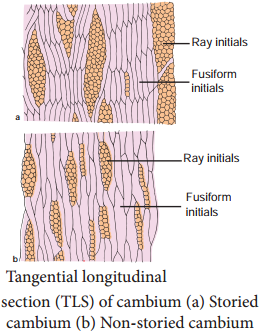
Further, the most important character of the vascular cambium is the presence of two kinds of initials, namely, fusiform initials and ray initials.

Fusiform Initials

These are vertically elongated cells. They give rise to the longitudinal or axial system of the secondary xylem (treachery elements, fires, and axial parenchyma) and phloem (sieve elements, fiers, and axial parenchyma). Based on the arrangement of the fusiform initials, two types of vascular cambium are recognized.

Storied (Stratifid cambium) and Non-Storied (Non-stratified cambium)

If the fusiform initials are arranged in horizontal tiers, with the end of the cells of one tier appearing at approximately the same level, as seen in tangential longitudinal section (TLS), it is called storied (stratified) cambium. It is the characteristic of the plants with short fusiform initials. Whereas in plants with long  fusiform initials, they strongly overlap at the ends, and this type of cambium is called non-storied (nonstartified) cambium.
Secondary Growth in Dicot Stem and its Overview img 1

Ray Initials

These are horizontally elongated cells. They give rise to the ray cells and form the elements of the radial system of secondary xylem and phloem.

Activity of Vascular Cambium

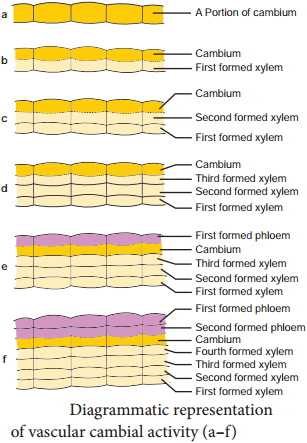
The vascular cambial ring, when active, cuts of new cells both towards the inner and outer side. The cells which are produced outward form secondary phloem and inward secondary xylem.
Secondary Growth in Dicot Stem and its Overview img 2

At places, cambium forms some narrow horizontal bands of parenchyma which passes through secondary phloem and xylem. These are the rays. Due to the continued formation of secondary xylem and phloem through vascular cambial activity, both the primary xylem and phloem get gradually crushed.

Secondary Xylem

The secondary xylem, also called wood, is formed by a relatively complex meristem, the vascular cambium, consisting of vertically (axial) elongated fusiform initials and horizontally (radially) elongated ray initials.

The axial system consists of vertical files of treachery elements, fiers, and wood parenchyma. Whereas the radial system consists of rows of parenchymatous cells oriented at right angles to the longitudinal axis of xylem elements.

The secondary xylem varies very greatly from species to species with reference to relative distribution of the different cell types, density and other properties. It is of two types.

Porous Wood or Hard Wood

Generally, the dicotyledonous wood, which has vessels is called porous wood or hard wood. Example: Morus rubra.

Non – Porous Wood or Sof Wood

Generally, the gymnosperm wood, which lacks vessels is known as non – porous wood or sof wood. Example: Pinus.

Differences between Porous Wood and Non-porous Wood

Porous wood or Hard wood, Example: Morus  

Non porous wood or soft wood, Example: Pinus

1. Common in angiosperms1. Common in gymnosperms
2. Porous because it contains vessels2. Non-porous because it does not contain vessels

Secondary Growth in Dicot Stem and its Overview img 3
Secondary Growth in Dicot Stem and its Overview img 4

Annual Rings

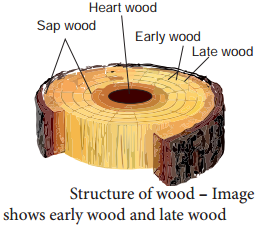
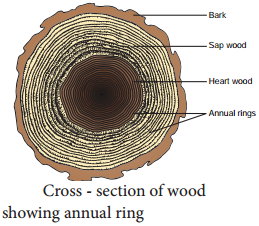
The activity of vascular cambium is under the control of many physiological and environmental factors. In temperate regions, the climatic conditions are not uniform throughout the year. In the spring season, cambium is very active and produces a large number of xylary elements having vessels/tracheids with wide lumen.

The wood formed during this season is called spring wood or early wood. The tracheary elements are fairly thin walled. In winter, the cambium is less active and forms fewer xylary elements that have narrow vessels/tracheids and this wood is called autumn wood or late wood. The treachery elements are with narrow lumen, very thick walled.

The spring wood is lighter in colour and has a lower density whereas the autumn wood is darker and has a higher density. The annual ring denotes the combination of early wood and late wood and the ring becomes evident to our eye due to the high density of late wood. Sometimes annual rings are called growth rings but it should be remembered all the growth rings are not annual. In some trees more than one growth ring is formed with in a year due to climatic changes.

Additional growth rings are developed within a year due to adverse natural calamities like drought, frost, defoliation, flood, mechanical injury and biotic factors during the middle of a growing season, which results in the formation of more than one annual ring.

Such rings are called pseudoor false – annual rings. Each annual ring corresponds to one year’s growth and on the basis of these rings, the age of a particular plant can easily be calculated. The determination of the age of a tree by counting the annual rings is called dendrochronology.

Dendroclimatology

It is a branch of dendrochronology concerned with constructing records of past climates and climatic events by analysis of tree growth characteristics, especially growth rings.
Secondary Growth in Dicot Stem and its Overview img 5

Differences Between Spring Wood and Autumn Wood

Spring wood or Early wood

Autumn wood or Late wood

1. The activity of cambium is faster1. Activity of cambium is slower
2. Produces large number of xylem elements2. Produces a fewer xylem elements
3. Xylem vessels/trachieds have wider lumen3. Xylem vessels/trachieds have narrow lumen
4. Wood is lighter in colour and has lower density4. Wood is darker in colour and has a higher density

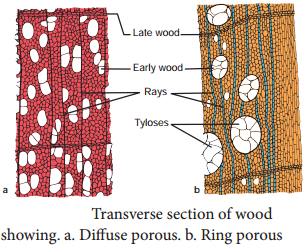
Another feature of wood related to seasonal changes is the diffuse porous and ring porous condition. On the basis of diameter of xylem vessels, two main types of angiosperm woods are recognized.

Diffuse Porous Woods

Diffuse porous woods are woods in which the vessels or pores are rather uniform in size and distribution throughout an annual ring. Example: Acer

Ring Porous Woods

The pores of the early wood are distinctly larger than those of the late wood. This rings of wide and narrow vessels occur. Example: Quercus
Secondary Growth in Dicot Stem and its Overview img 6

Differences Between Diffuse Porous Wood and Ring Porous Wood

Diffuse porous wood

Ring porous wood

1. This type of wood is formed where the
climatic conditions are uniform
1. This type of wood is formed where the
climatic conditions are not uniform
2. The vessels are more or less equal
in diameter in any annual ring
2. The vessels are wide and narrow within
any annual ring
3. The vessels are uniformly distributed
throughout the wood
3. The vessels are not uniformly distributed throughout the wood

Tyloses

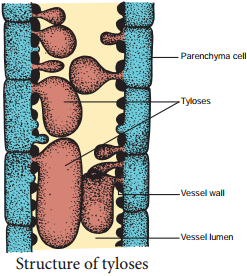
In many dicot plants, the lumen of the xylem vessels is blocked by many balloonlike ingrowths from the neighbouring parenchymatous cells. These balloon-like structures are called tyloses.
Secondary Growth in Dicot Stem and its Overview img 7

Usually, these structures are formed in secondary xylem vessels that have last their function i.e., in heart wood. In fully developed tyloses, starchy crystals, resins, gums, oils, tannins or coloured substances are found. Wood is also classifid into sap wood and heart wood.

Sap Wood and Heart Wood

Sap wood and heart wood can be distinguished in the secondary xylem. In any tree the outer part of the wood, which is paler in colour, is called sap wood or alburnum. The centre part of the wood, which is darker in colour is called heart wood or duramen.

The sap wood conducts water while the heart wood stops conducting water. As vessels of the heart wood are blocked by tyloses, water is not conducted through them. Due to the presence of tyloses and their contents the heartwood becomes coloured, dead and the hardest part of the wood.

From the economic point of view, generally the heartwood is more useful than the sapwood. The timber from the heartwood is more durable and more resistant to the attack of microorganisms and insects than the timber from sapwood.
Secondary Growth in Dicot Stem and its Overview img 8

Differences Between Sap Wood (alburnum) and Heart Wood (duramen)

Sap Wood (Alburnum)

Heart Wood (Duramen)

1. Living part of the wood1. Dead part of the wood
2. It is situated on the outer side of wood2. It is situated in the centre part of wood
3. It is pale coloured3. It is dark coloured
4. Very soft in nature4. Hard in nature
5. Tyloses are absent5. Tyloses are present
6. It is not durable and not resistant to
microorganisms
6. It is more durable and resists
microorganisms

Secondary Phloem

The vascular cambial ring produces secondary phloem or bast on the outer side of the vascular bundle. Just as the secondary xylem, the secondary phloem also has two tissue systems – the axial (vertical) and the radial (horizontal) systems derived respectively from the vertically elongated fusiform initials and horizontally elongated ray initials of vascular cambium.

While sieve elements, phloem fire, and phloem parenchyma represent the axial system, phloem rays represent the radial system. Life span of secondary phloem is less compared to secondary xylem. Secondary phloem is a living tissue that transports soluble organic compounds made during photosynthesis to various parts of plant. Some commercially important phloem or bast fires are obtained from the following plants.

  1. Flax-Linum usitatissimum
  2. Hemp-Cannabis sativa
  3. Sun hemp-Crotalaria juncea
  4. Jute-Corchorus capsularis

Periderm

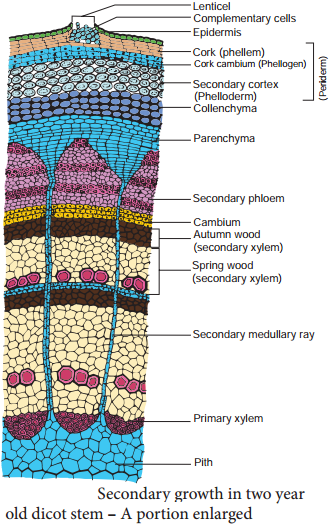
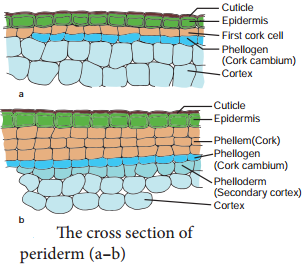
Whenever stems and roots increase in thickness by secondary growth, the periderm, a protective tissue of secondary origin replaces the epidermis and often primary cortex. The periderm consists of phellem, phellogen, and phelloderm.

Phellem (Cork)
Secondary Growth in Dicot Stem and its Overview img 9

It is the protective tissue composed of nonliving cells with suberized walls and formed centrifugally (outward) by the phellogen (cork cambium) as part of the periderm. It replaces the epidermis in older stems and roots of many seed plants. It is characterized by regularly arranged tiers and rows of cells. It is broken here and there by the presence of lenticels.

Phellogen (Cork Cambium)

It is a secondary lateral meristem. It comprises homogenous meristematic cells unlike vascular cambium. It arises from epidermis, cortex, phloem or pericycle (extrastelar in origin). Its cells divide periclinally and produce radially arranged fies of cells. The cells towards the outer side diffrentiate into phellem (cork) and those towards the inside as phelloderm (secondary cortex).

Phelloderm (Secondary Cortex)

It is a tissue resembling cortical living parenchyma produced centripetally (inward) from the phellogen as a part of the periderm of stems and roots in seed plants.

Differences Between Phellem and Phelloderm

Phellem (Cork)

Phelloderm (Secondary cortex)

1. It is formed on the outer side of
phellogen
1. It is formed on the inner side of
phellogen
2. Cells are compactly arranged in regular
tires and rows without intercellular
spaces
2. Cells are loosely arranged with
intercellular spaces
3. Protective in function3. As it contains chloroplast, it
synthesises and stores food
4. Consists of nonliving cells with
suberized walls.
4. Consists of living cells, parenchymatous
in nature and does not have suberin
5. Lenticels are present5. Lenticels are absent

Bark

The term ‘bark’ is commonly applied to all the tissues outside the vascular cambium of stem (i.e., periderm, cortex, primary phloem and secondary phloem). Bark protects the plant from parasitic fungi and insects, prevents water loss by evaporation and guards against variations of external temperature. It is an insect repellent, decay proof, fieproof and is used in obtaining drugs or spices.

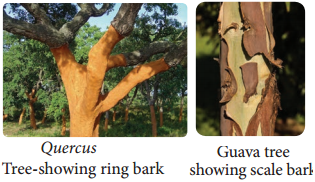
The phloem cells of the bark are involved in conduction of food while secondary cortical cells involved in storage. If the phellogen forms a complete cylinder around the stem, it gives rise to ring barks. Example: Quercus. When the bark is formed in overlapping scale like layers, it is known as scale bark. Example: Guava. While ring barks normally do not peeled off scale barks peeled off, scale barks peeled off.
Secondary Growth in Dicot Stem and its Overview img 10

Lenticel

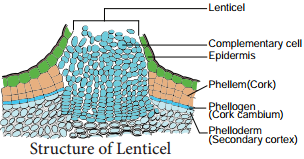
Lenticel is raised opening or pore on the epidermis or bark of stems and roots. It is formed during secondary growth in stems. When phellogen is more active in the region of lenticels, a mass of loosely arranged thin-walled parenchyma cells are formed. It is called complementary tissue or filing tissue. Lenticel is helpful in exchange of gases and transpiration called lenticular transpiration.
Secondary Growth in Dicot Stem and its Overview img 11

Comparision of Primary Structure – Dicot and Monocot Root – Stem and Leaf

Learninsta presents the core concepts of Biology with high-quality research papers and topical review articles.

Comparision of Primary Structure – Dicot and Monocot Root – Stem and Leaf

Primary Structure of Dicot Root – Bean Root

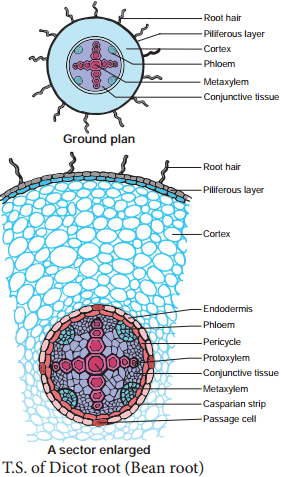
The transverse section of the dicot root (Bean) shows the following plan of arrangement of tissues from the periphery to the centre.

Piliferous Layer or Epiblema

The outermost layer of the root is called piliferous layer or epiblema. It is made up of single layer of  parenchyma cells which are arranged compactly without intercellular spaces. It is devoid of epidermal pores and cuticle. It possesses root hairs which are single celled. It absorbs water and mineral salts from the soil. The chief function of piliferous layer is protection.

Cortex

Cortex consists of only parenchyma cells. These cells are loosely arranged with intercellular spaces to make gaseous exchange easier. These cells may store food reserves. The cells are oval or rounded in shape. Sometimes they are polygonal due to mutual pressure. Though chloroplasts are absent in the cortical cells,  starch grain are stored in them. The cells also possess leucoplasts. The innermost layer of the cortex is endodermis.

Endodermis is made up of single layer of barrel shaped parenchymatous cells. Stele is completely surrounded by endodermis. The radial and the inner tangential walls of endodermal cells are thickened with suberin and lignin. This thickening was first noted by Robert Casparay in 1965. So these thickenings are called casparian strips. But these casparian strips are absent in the endodermis cells which are located opposite the protoxylem elements.

These thin-walled cells without casparian strips are called passage cells through which water and mineral salts are conducted from the cortex to the xylem elements. Water cannot pass through other endodermal cells due to the presence of casparian thickenings.

Stele

All the tissues present inside endodermis comprise the stele. It includes pericycle and vascular system.

Pericycle

Pericycle is generally a single layer of parenchymatous cells found inner to the endodermis. It is the outermost layer of the stele. Lateral roots originate from the pericycle. Thus, the lateral roots are endogenous in origin.
Comparision of Primary Structure - Dicot and Monocot Root - Stem and Leaf img 1

Vascular System

Vascular tissues are in radial arrangement. The tissue by which xylem and phloem are separated is called conjunctive tissue. In bean, the conjuctive tissue is composed of parenchyma tissue. Xylem is in exarch condition.

The number of protoxylem points is four and so the xylem is called tetrach. Each phloem patch consists of sieve tubes, companion cells and phloem parenchyma. Metaxylem vessels are generally polygonal in shape. But in monocot roots they are circular.

Primary Structure of Monocot

Root-Maize Root

The transverse section of the monocot root (maize) shows the following plan of arrangement of tissues from the periphery to the centre.

Piliferous Layer or Epiblema

The outermost layer of the root is known as piliferous layer. It consists of a single row of thin-walled parenchymatous cells without any intercellular space. Epidermal pores and cuticle are absent in the piliferous layer.

Root hairs that are found in the piliferous layers are always unicellular. They absorb water and mineral salts from the soil. Root hairs are generally short lived. The main function of piliferous layer is protection of the inner tissues.

Cortex

The cortex is homogenous. i.e. the cortex is made up of only one type of tissue called parenchyma. It consists of many layers of thin-walled parenchyma cells with lot of intercellular spaces. The function of cortical cells is storage.

Cortical cells are generally oval or rounded in shape. Chloroplasts are absent in the cortical cells, but they store starch. The cells are living and possess leucoplasts. The inner layer of the cortex is endodermis.

It is composed of single layer of barrel shaped parenchymatous cells. This forms a complete ring around the stele. There is a band like structure made of suberin and lignin present in the radial and inner tangential walls of the endodermal cells.

They are called casparian strips named after casparay who first noted the strips. The endodermal cells, which are opposite the protoxylem elements, are thin walled without casparian strips. These cells are called passage cells. Their function is to transport water and dissolved salts from the cortex to the xylem.

Water cannot pass through other endodermal cells due to casparian strips. The main function of casparian strips in the endodermal cells is to prevent the re-entry of water into the cortex once water entered the xylem tissue.

Stele

All the tissues inside the endodermis comprise the stele. This includes pericycle, vascular system and pith.

Pericycle

Pericycle is the outermost layer of the stele and lies inner to the endodermis. It consists of single layer of parenchymatous cells.

Vascular System

Vascular tissues are seen in radial arrangement. The number of protoxylem groups is many. This arrangement of xylem is called polyarch. Xylem is in exarch condition, the tissue which is present between the xylem and the phloem, is called conjunctive tissue. In maize, the conjunctive tissue is made up of sclerenchymatous tissue.

Anatomical Differences Between Dicot Root and Monocot Root

Characters

Dicot Root

Monocot Root

1. PericycleGives rise to lateral roots, phellogen and a part of vascular cambium.Gives rise to lateral roots only.
2. Vascular tissueUsually limited number of xylem and phloem strips.Usually more number of xylem and phloem strips.
3. Conjuctive tissueParenchymatous; Its cells
are differentiated into vascular cambium.
Mostly sclerenchymatous but sometimes parenchymatous. It is never differentiated in to vascular
cambium.
4. CambiumIt appears as a secondary meristem at the time of secondary growthIt is altogether absent
5. XylemUsually tetrachUsually polyarch

Pith

The central portion is occupied by a large pith. It consists of thin-walled parenchyma cells with intercellular spaces. These cells are filled with abundant starch grains.

Primary Structure of Dicot Stem (Sunflower stem)

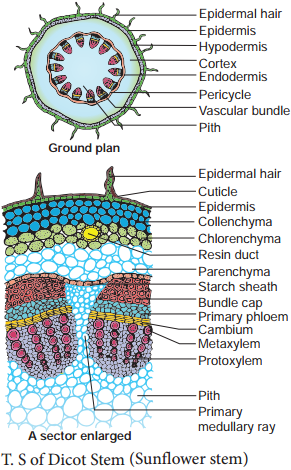
The transverse section of the dicot stem (Sunflower) shows the following plan of arrangement of tissues from the periphery to the centre.

Epidermis

It is protective in function and forms the outermost layer of the stem. It is a single layer of parenchymatous rectangular cells. The cells are compactly arranged without intercellular spaces. The outer walls of epidermal cells have a layer called cuticle.

The cuticle checks the transpiration. The cuticle is made up of waxy substance known as cutin. Stomata may be present here and there. A large number of multicellular hairs occur on the epidermis.

Cortex

Cortex lies below the epidermis. The cortex is differentiated into three zones. Below the epidermis, there are few layers of collenchyma cells. This zone is called hypodermis. It gives mechanical strength of the Stem. These cells are living and thickened at the corners.

Inner to the hypodermis, a few layers of chlorenchyma cells are present with conspicuous intercellular spaces. This region performs photosynthesis. Some resin ducts also occur here. The third zone is made up of parenchyma cells. These cells store food materials.

The innermost layer of the cortex is called endodermis. The cells of this layer are barrel shaped and arrange compactly without intercellular spaces. Since starch grains are abundant in these cells, this layer is also known a starch sheath. This layer is morphologically homologous to the endodermis found in the root. In most of the dicot stems, endodermis with casparian strips is not developed.

Stele

The central part of the stem inner to the endodermis is known as stele. It consists of pericyle, vascular bundles and pith. In dicot stem, vascular bundles are arranged in a ring around the pith. This type of stele is called eustele.

Pericycle

Pericycle is the layers of cells that occur between the endodermis and vascular bundles. In the stem of sunflower (Helianthus), a few layers of sclerenchyma cell occur in patches outside the phloem in each vascular bundle. This patch of sclerenchyma cell is called Bundle cap or Hardbast. The bundle caps and the parenchyma cells between them constitute the pericycle in the stem of sunflower.

Vascular Bundles

The vascular bundles consist of xylem, phloem and cambium. Xylem and phloem in the stem occur together and form the vascular bundles. These vascular bundles are Wedge shaped. They are arranged in the form of a ring. Each vascular bundle is conjoint, collateral, open and endarch.

Phloem

Phloem consists of sieve tubes, companion cells and phloem parenchyma. Phloem fibres are absent in the primary phloem. Phloem conducts organic food materials from the leaves to other parts of the plant body.

Cambium

Cambium consists of brick shaped and thin walled meristematic cells. It is one to four layers in thickness. These cells are capable of forming new cells during secondary growth.

Xylem

Xylem consists of xylem fibres, xylem parrenchyma vessels and tracheids. Vessels are thick walled and arranged in a few rows. Xylem conducts water and minerals from the root to the other parts of the plant body.

Pith or Medulla

The large central portion of the stem is called pith. It is composed of parenchyma cells with intercellular spaces. The pith extends between the vascular bundles. are called primary pith rays or primary medullary rays. Function of the pith is storage of food.
Comparision of Primary Structure - Dicot and Monocot Root - Stem and Leaf img 2

Primary Structure of Monocot
Stem-maize Stem
Epidermis

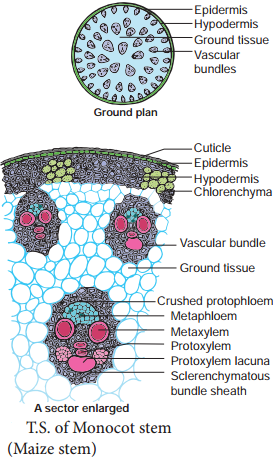
It is the outermost layer of the stem. It is made up of single layer of tightly packed parenchymatous cells. Their outer walls are covered with thick cuticle. The continuity of this layer may be broken here and there by the presence of a few stomata. There are no epidermal outgrowths.

Hypodermis

A few layer of sclerenchymatous cells lying below the epidermis constitute the hypodermis. This layer gives mechanical strength to the plant. It is interrupted here and there by chlorenchyma cells.

Ground Tissue

There is no distinction into cortex, endodermis, pericycle and pith. The entire mass of parenchyma cells lying inner to the hypodermis forms the ground tissue.
Comparision of Primary Structure - Dicot and Monocot Root - Stem and Leaf img 3

The cell wall is made up of cellulose. The cells contain reserve food material like starch. The cells of the ground tissue next to the hypodermis are smaller in size, polygonal in shape and compactly arranged. Towards the centre, the cells are loosely arranged, rounded in shape and bigger in size. The vascular bundles lie embedded in this tissue. The ground tissue stores food and performs gaseous exchange.

Vascular Bundles

Vascular bundles arescattered (atactostele) in the parenchymatous ground tissue. Each vascular bundle is surrounded by a sheath of sclerenchymatous fibres called bundle sheath. The vascular bundles are conjoint, collateral, endarch and closed.

Vascular bundles are numerous, small and closely arranged in the peripheral portion. Towards the centre, the bundles are comparatively large in size and loosely arranged. Vascular bundles are skull or oval shaped.
Comparision of Primary Structure - Dicot and Monocot Root - Stem and Leaf img 4

Phloem

The phloem in the monocot stem consists of sieve tubes and companion cells. Phloem parenchyma and phloem fibres are absent. It can be distinguished into an outer crushed protophloem and an inner metaphloem.

Xylem

Xylem vessels are arranged in the form of ’Y’ the two metaxylem vessels are located at the upper two arms and one or two protoxylem vessels at the base. In a mature bundle, the lowest protoxylem disintegrates and forms a cavity known as protoxylem lacuna.

Anatomy of a Dicot Leaf-Sunflower Leaf

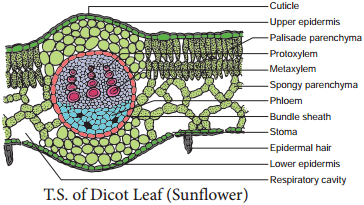
Internal structure of dictoyledonous leaves reveal epidermis, Mesophyll and vascular tissues.

Epidermis

This leaf is generally dorsiventral. It has upper and lower epidermis. The epidermis is usually made up of a single layer of cells that are closely packed. The cuticle on the upper epidermis is thicker than that of lower epidermis.

The minute openings found on the epidermis are called stomata. Stomata are more in number on the lower epidermis than on the upper epidermis. A stomata is surrounded by a pair of bean shaped cells called guard cells.

Each stoma internally opens into an air chamber. These guard cells contain chloroplasts, whereas other epidermal cells do not contain chloroplasts. The main function of the epidermis is to give protection to the inner tissue called mesosphyll. The cuticle helps to check transpiration. Stomata are used for transpiration and gas exchange.

Mesophyll

The entire tissue between the upper and lower epidermis is called the mesophyll (GK meso = in the middle, phyllome = leaf). There are two regions in the mesophyll. They are palisade parenchyma and spongy parenchyma. Palisade parenchyma cells are seen beneath the upper epidermis. It consists of vertically elongated cylindrical cells in one or more layers.

These cells are compactly arranged and are generally without intercellular spaces. Palisade parenchyma cells contain more chloroplasts than the spongy parenchyma cells. The function of palisade parenchyma is photosynthesis. Spongy parenchyma lies below the palisade parenchyma.

Spongy cells are irregularly shaped. These cells are very loosely arranged with numerous airspaces. As compared to palisade cells, the spongy cells contain lesser number of chloroplasts. Spongy cells facilitate the exchange of gases with the help of air spaces. The air space that is found next to the stomata is called respiratory cavity or substomatal cavity.

Vascular Tissues

Vascular tissues are present in the veins of leaf. Vascular bundles are conjoint, Collateral and closed. Xylem is present towards the upper epidermis, while the phloem towards the lower epidermis. Vascular bundles are surrounded by a compact layer of parenchymatous cells called bundle sheath or border parenchyma.

Xylem consists of metaxylem and protoxylem elements. Protoxylem is present towards the upper epidermis, while the phloem consists of sieve tubes, companion cells and phloem parenchyma. Phloem fibres are absent. Xylem consists of vessels and xylem parenchyma. Tracheids and xylem fibres are absent.
Comparision of Primary Structure - Dicot and Monocot Root - Stem and Leaf img 5

Anatomy of a Monocot Leaf – Grass Leaf

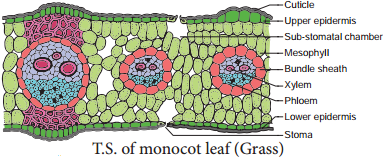
A transverse section of a grass leaf reveals the following internal structures.

Epidermis

The leaf has upper and lower epidermis. They are made up of a single layer of thin walled cells. The outer walls are covered by thick cuticle.

The number of stomata is more or less equal on both the epidermis. The stomata is surrounded by dumb – bell shaped guard cells. The guard cells-contain chloroplasts, whereas the other epidermal cells do not have them. Some special cells surround the guard cells. They are distinct from other epidermal cells. These cells are called subsidiary cells.

Some cells of upper epidermis are large and thin walled. They are called bulliform cells or motor cells. These cells are helpful for the rolling and unrolling of the leaf according to the weather change. Some of the  epidermal cells of the grass are filled with silica. They are called silica cells.

Mesophyll

The ground tissue that is present between the upper and lower epidermis of the leaf is called mesophyll. Here, the mesophyll is not differentiated into palisade and spongy parenchyma. All the mesophyll cells are nearly isodiametric and thin walled. These cells are compactly arranged with limited intercellular spaces. They contain numerous chloroplasts.

Vascular Bundles

Vascular bundles differ in size. Most of the vascular bundles are smaller in size. Large bundles occur at regular intervals. Two patches of sclerenchyma are present above and below the large vascular bundles. These sclerenchyma patches give mechanical support to the leaf. The small vascular bundles do not have such sclerenchymatous patches. Vascular bundles are conjoint, collateral and closed.

Each vascular bundle is surrounded by a parenchymatous bundle sheath. The cells of the bundle sheath generally contain starch grains. The xylem of the vascular bundle is located towards the upper epidermis and the phloem towards the lower epidermis. In C4 grasses, the bundle sheath cells are living and involve in C4 photosynthesis. This sheath is called Kranz sheath.
Comparision of Primary Structure - Dicot and Monocot Root - Stem and Leaf img 6

Vascular Tissue System

Learninsta presents the core concepts of Biology with high-quality research papers and topical review articles.

Vascular Tissue System

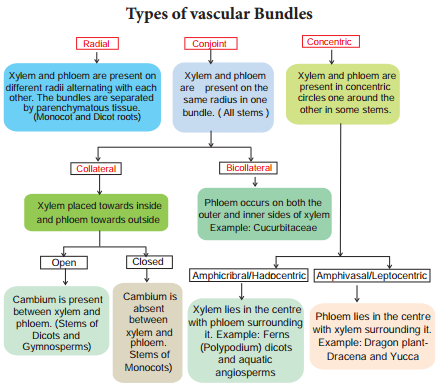
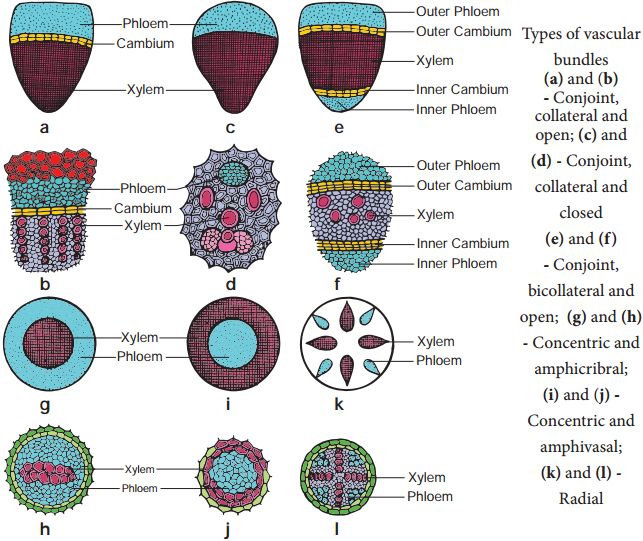
This section deals with the vascular tissue system of gymnosperms and angiosperms stems and roots. The vascular tissue system consists of xylem and phloem. The elements of xylem and phloem are always organized in groups. They are called vascular bundles.

The stems of both groups have an eustele while roots are protostele. In eustelic organization, the stele contains usually a ring of vascular bundles separated by interfascicular region or medullary ray. The structural and organizational variation in vascular bundles is shown below.

Types of Vascular Bundles
Vascular Tissue System img 1
Vascular Tissue System img 2

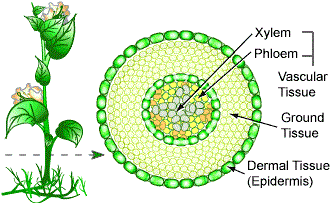
Vascular tissue is comprised of the xylem and the phloem, the main transport systems of plants. They typically occur together in vascular bundles in all plant organs, traversing roots, stems, and leaves. Xylem is responsible for the transport of water and dissolved ions from the roots upwards through the plant.

Vascular tissue transports water, minerals, and sugars to different parts of the plant. Vascular tissue is made of two specialized conducting tissues: xylem and phloem. Xylem tissue transports water and nutrients from the roots to different parts of the plant, and also plays a role in structural support in the stem.

The plant vascular system is a complicated network of conducting tissues that interconnects all organs and transports water, minerals, nutrients, organic compounds, and various signaling molecules throughout the plant body.

Vascular tissues perform essential roles in integrating the physiological (transport of water and nutrients), developmental (transport of signaling molecules) and structural (physical support) processes of higher plants.

Vascular tissues are complex conducting tissues of the plant. The main function of the tissues is transporting water, minerals, and organic compounds to different parts of the plants. The tissue is composed of two conducting systems – xylem and phloem.

Vascular tissue is comprised of the xylem and the phloem, the main transport systems of plants. They typically occur together in vascular bundles in all plant organs, traversing roots, stems, and leaves.

Vascular tissue is a complex conducting tissue, formed of more than one cell type, found in vascular plants. The primary components of vascular tissue are the xylem and phloem. These two tissues transport fluid and nutrients internally. The cells in vascular tissue are typically long and slender.

Types of Vascular plants. The vascular plants have a membrane-bound nucleus, so they are called eukaryotes. Some of the tracheophytes reproduce from seed while some reproduce from spores. There are two types of vascular plants: cryptogams and phanerogams.

With their large fronds, ferns are the most readily recognizable seedless vascular plants. They are considered the most advanced seedless vascular plants and display characteristics commonly observed in seed plants. More than 20,000 species of ferns live in environments ranging from tropics to temperate forests.

Vascular tissues in the human body have blood vessels like veins, arteries and capillaries, while avascular tissues do not. For example, muscle tissue is vascular, or vascularized. Cartilage is another type of avascular tissue.

Vascular plants include the clubmosses, horsetails, ferns, gymnosperms (including conifers) and angiosperms (flowering plants). Scientific names for the group include Tracheophyta, Tracheobionta and Equisetopsida sensu lato.

Vascular cambium is the tissue very much sensitive to mechanical injuries, such as wounding or grafting. However, it can easily regenerate under suitable conditions.

The ferns, gymnosperms, and flowering plants are all vascular plants. Because they possess vascular tissues, these plants have true stems, leaves, and roots.

Seedless vascular plants include ferns, horsetails and clubmosses. These types of plants have the same special tissue to move water and food through their stems and foliage, like other vascular plants, but they don’t produce flowers or seeds. Instead of seeds, seedless vascular plants reproduce with spores.

Connective tissues can have various levels of vascularity. Cartilage is avascular, while dense connective tissue is poorly vascularized. Others, such as bone, are richly supplied with blood vessels.

Non-vascular plants do not have a wide variety of specialized tissue types. Mosses and leafy liverworts have structures called phyllids that resemble leaves, but only consist of single sheets of cells with no internal air spaces no cuticle or stomata and no xylem or phloem.

Muscle tissue is composed of cells that have the special ability to shorten or contract in order to produce movement of the body parts. The tissue is highly cellular and is well supplied with blood vessels.

Fundamental Tissue System and its Types

Learninsta presents the core concepts of Biology with high-quality research papers and topical review articles.

Fundamental Tissue System and its Types

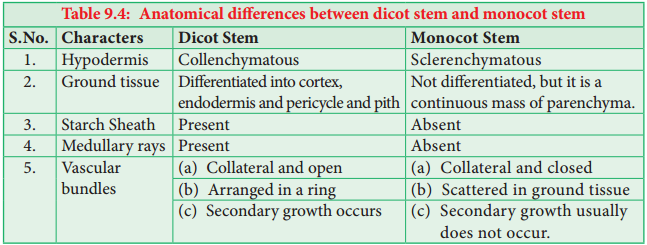
The ground or fundamental tissue system constitutes the main body of the plants. It includes all the tissues except epidermis and vascular tissues. In monocot stem, ground tissue system is a continuous mass of parenchymatous tissue in which vascular bundles are found scattered. Hence ground tissue is not differentiated into cortex, endodermis, pericycle and pith.

Generally in dicot stem, ground tissue system is differentiated into three main zones – cortex, pericycle and pith. It is classified into extrastelar ground tissue (Examples: cortex and endodermis) and intrastelar ground tissue (Examples: pericycle, medullary ray and pith).

Extrastelar Ground Tissue
The ground tissues present outside the stele is called extrastelar ground tissue. (Cortex)

Intrastelar Ground Tissue
The ground tissues present within the stele are called intrastelar ground tissues. (pericycle, medullary rays and pith).

Different Components of Ground Tissue Systems are as Follows

Hypodermis

One or two layers of continuous or discontinuous tissue present below the epidermis, is called hypodermis. It is protective in function. In dicot stem, hypodermis is generally collenchymatous, whereas in monocot stem, it is generally sclerenchymatous. In many plants collenchyma form the hypodermis.

General Cortex

The Cortex occurs between the epidermis and pericycle. Cortex is a few to many layers in thickness, In most cases, it is made up of parenchymatous tissues. Intercellular spaces may or may not be present. The cortical cells may contain non living inclusions of starch grains, oil, tannins and crystals. Its general function is storage of food as well as providing mechanical support to organs.

Endodermis

The cells of this layer are barrel shaped and arranged compactly without intercellular spaces. Endodermis is the innermost cortical layer that separates cortex from the stele.

Pericycle

Pericycle is single or few layered parenchymatous found inner to the endodermis. It is the outermost layer of the stele. Rarely thick walled sclerenchymatous. In angiosperms, pericycle gives rise to lateral roots.

Pith or Medulla

The central part of the ground tissue is known as pith or medulla. Generally this is made up of thin walled parenchyma cells with intercellular spaces. The cells in the pith generally stores starch, fatty substances, tannins, phenols, calcium oxalate crystals, etc.
Fundamental Tissue System img 1