Ascent of Sap and its Theory

Learninsta presents the core concepts of Biology with high-quality research papers and topical review articles.

Ascent of Sap and its Theory

In the last chapter, we studied about water absorption from roots to xylem in a lateral direction and here we will learn about the mechanism of distribution of water inside the plant. Like tributaries join together to form a river, millions of root hairs conduct a small amount of water and confluence in xylem, the superhighway of water conduction.

Xylem handles a large amount of water to conduct to many parts in an upward direction. The water within the xylem along with dissolved minerals from roots is called sap and its upward transport is called ascent of sap.

The Path of Ascent of Sap

There is no doubt; water travels up along the vascular tissue. But vascular tissue has two components namely Xylem and Phloem. Of these two, which is responsible for the ascent of sap? The following experiment will prove that xylem is the only element through which water moves up.

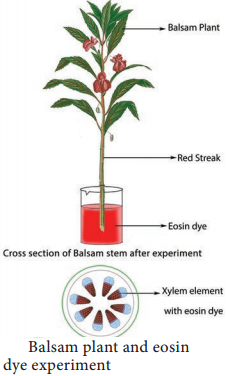
Cut a branch of balsam plant and place it in a beaker containing eosin (red colour dye) water. After some time, a red streak appears on the stem indicating the ascent of water. Remove the plant from water and cut a transverse section of the stem and observe it under the microscope. Only xylem element is coloured red, which indicates the path of water is xylem. Phloem is not colored indicating that it has no role in the ascent of sap (Figure 11.12).
Ascent of Sap img 1

Mechanism of Ascent of Sap

In ascent of sap, the biggest challenge is the force required to lift the water to the top of the tallest trees. A number of theories have been put forward to explain the mechanism of the ascent of sap. They are:-

A. Vital force theories
B. Root pressure theory, and
C. Physical force theory.

Vital Force Theories

According to vital force theories, living cells are mandatory for the ascent of sap. Based on this the following two theories derived:

1. Relay Pump Theory of Godlewski (1884)

Periodic changes in osmotic pressure of living cells of the xylem parenchyma and medullary ray act as a pump for the movement of water.

2. Pulsation Theory of J.C.Bose (1923)

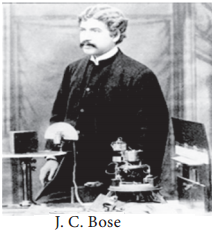
Bose invented an instrument called Crescograph, which consists of an electric probe connected to a galvanometer (Figure 11.13). When a probe is inserted into the inner cortex of the stem, the galvanometer showed high electrical activity.

Bose believed a rhythmic pulsating movement of inner cortex like a pump (similar to the beating of the heart) is responsible for the ascent of sap. He concluded that cells associated with xylem exhibit pumping action and pumps the sap laterally into xylem cells.
Ascent of Sap img 2

Objections to Vital Force Theories

(i) Strasburger (1889) and Overton (1911) experimentally proved that living cells are not mandatory for the ascent of sap. For this, the selected an old oak tree trunk which when immersed in picric acid and subjected to excessive heat killed all the living cells of the trunk. The trunk when dipped in water, the ascent of sap took place.

(ii) Pumping action of living cells should be in between two xylem elements (vertically) and not on lateral sides.

Root Pressure Theory

If a plant which is watered well is cut a few inches above the ground level, sap exudes out with some force. This is called sap exudation or bleeding. Stephen Hales, father of plant physiology observed this phenomenon and coined the term ‘Root Pressure’.

Stoking (1956) defined root pressure as “a pressure developing in the tracheary elements of the xylem as a result of metabolic activities of the root”. But the following objections have been raised against root pressure theory:

  1. Root pressure is totally absent in gymnosperms, which includes some of the tallest plants.
  2. There is no relationship between the ascent of sap and root pressure.
  3. For example, in summer, the rate of the ascent of sap is more due to transpiration in spite of the fact that root pressure is very low.
  4. On the other hand, in winter when the rate of ascent of sap is low, a high root pressure is found.
  5. Ascent of sap continues even in the absence of roots.
  6. The magnitude of root pressure is about 2atm, which can raise the water level up to few feet only, whereas the tallest trees are more than 100m high.

Physical Force Theory

Physical force theories suggest that ascent of sap takes place through the dead xylem vessel and the mechanism is entirely physical and living cells are not involved.
Ascent of Sap img 3

1. Capillary Theory

Boehm (1809) suggested that the xylem vessels work like a capillary tube. This capillarity of the vessels under normal atmospheric pressure is responsible for the ascent of sap. This theory was rejected because the magnitude of capillary force can raise water level only up to a certain height. Further, the xylem vessels are broader than the tracheid which actually conducts more water and against the capillary theory.

2. Imbibition Theory

This theory was first proposed by Unger (1876) and supported by Sachs (1878). This theory illustrates, that water is imbibed through the cell wall materials and not by the lumen. This theory was rejected based on the ringing experiment, which proved that water moves through the lumen of the cell and not by a cell wall.

3. Cohesion-tension or Cohesion and Transpiration Pull Theory

Cohesion-tension theory was originally proposed by Dixon and Jolly (1894) and again put forward by Dixon (1914, 1924). This theory is based on the following features:

(i) Strong cohesive force or tensile strength of water

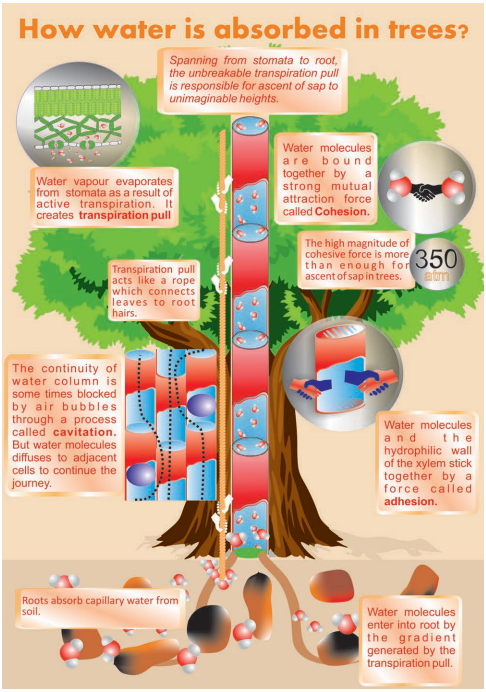
Water molecules have the strong mutual force of attraction called cohesive force due to which they cannot be easily separated from one another. Further, the attraction between a water molecule and the wall of the xylem element is called adhesion.

These cohesive and adhesive force works together to form an unbroken continuous water column in the xylem. The magnitude of the cohesive force is much high (350 atm) and is more than enough to ascent sap in the tallest trees.

(ii) Continuity of the water column in the plant

An important factor which can break the water column is the introduction of air bubbles in the xylem. Gas bubbles expanding and displacing water within the xylem element is called cavitation or embolism. However, the overall continuity of the water column remains undisturbed since water diffuses into the adjacent xylem elements for continuing ascent of sap.

(iii) Transpiration Pull or Tension in the Unbroken Water Column

The unbroken water column from leaf to root is just like a rope. If the rope is pulled from the top, the entire rope will move upward. In plants, such a pull is generated by the process of transpiration which is known as transpiration pull. Water vapour evaporates from mesophyll cells to the intercellular spaces near stomata as a result of active transpiration. The water vapours are then transpired through the stomatal pores.

Loss of water from mesophyll cells causes a decrease in water potential. So, water moves as a pull from cell to cell along the water potential gradient. This tension, generated at the top (leaf) of the unbroken water column, is transmitted downwards from petiole, stem and finally reaches the roots. The cohesion theory is the most accepted among the plant physiologists today.
Absorption of Water

Learninsta presents the core concepts of Biology with high-quality research papers and topical review articles.

Absorption of Water

Terrestrial plants have to absorb water from the soil to maintain turgidity, metabolic activities and growth. Absorption of water from soil takes place in two steps:

  1. From soil to root hairs – either actively or passively.
  2. From root hairs further transport in the lateral direction to reach xylem, the superhighway of water transport.

Water Absorbing Organs

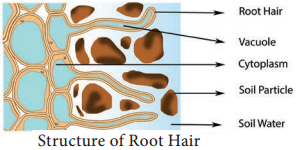
Usually, absorption of water occurs in plants through young roots. The zone of rapid water absorption is root hairs. They are delicate structures which get continuously replaced by new ones. Root hairs are unicellular extensions of epidermal cells without cuticle. Root hairs are extremely thin and numerous and they provide a large surface area for absorption (Figure 11.10).
Absorption of Water img 1

Path of Water Across Root Cells

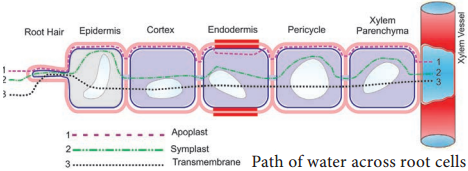
Water is first absorbed by root hair and other epidermal cells through imbibition from soil and moves radially and centripetally across the cortex, endodermis, pericycle and finally reaches xylem elements osmotically. There are three possible routes of water (Figure 11.11).
They are:-

  1. Apoplast
  2. Symplast
  3. Transmembrane route.

1. Apoplast

The apoplast (Greek: apo = away; plast = cell) consists of everything external to the plasma membrane of the living cell. The apoplast includes cell walls, extra cellular spaces and the interior of dead cells such as vessel elements and tracheids. In the apoplast pathway, water moves exclusively through the cell wall or the non living part of the plant without crossing any membrane. The apoplast is a continuous system.Absorption of Water img 2

2. Symplast

The symplast (Greek: sym = within; plast = cell) consists of the entire mass of cytosol of all the living cells in a plant, as well as the plasmodesmata, the cytoplasmic channel that interconnects them.

In the symplastic route, water has to cross plasma membrane to enter the cytoplasm of outer root cell; then it will move within adjoining cytoplasm through plasmodesmata around the vacuoles without the necessity to cross more membrane, till it reaches xylem.

3. Transmembrane Route

In transmembrane pathway water sequentially enters a cell on one side and exits from the cell on the other side. In this pathway, water crosses at least two membranes for each cell. Transport across the tonoplast is also involved.

Mechanism of Water Absorption

Kramer (1949) recognized two distinct mechanisms which independently operate in the absorption of water in plants. They are:-

  1. Active Absorption
  2. Passive Absorption

1. Active Absorption

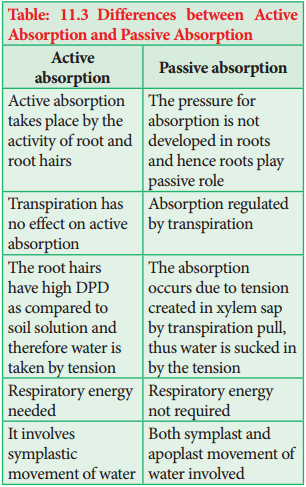
The mechanism of water absorption due to forces generated in the root itself is called active absorption. Active absorption may be osmotic or non-osmotic.
Absorption of Water img 3

(i) Osmotic Active Absorption

The theory of osmotic active absorption was postulated by Atkins (1916) and Preistley (1923). According to this theory, the first step in the absorption is soil water imbibed by cell wall of the root hair followed by osmosis. The soil water is hypotonic and cell sap is hypertonic. Therefore, soil water diffses into root hair along the concentration gradient (endosmosis).

When the root hair becomes fully turgid, it becomes hypotonic and water moves osmotically to the outer most cortical cell. In the same way, water enters into inner cortex, endodermis, pericycle and finally reaches protoxylem. As the sap reaches the protoxylem a pressure is developed known as root pressure. This theory involves the symplastic movement of water.

Objections to Osmotic Theory:

  • The cell sap concentration in xylem is not always high.
  • Root pressure is not universal in all plants especially in trees.

(ii) Non-Osmotic Active Absorption

Bennet-Clark (1936),Thmann (1951) and Kramer (1959) observed absorption of water even if the concentration of cell sap in the root hair is lower than that of the soil water. Such a movement requires an expenditure of energy released by respiration (ATP). This, there is a link between water absorption and respiration.

It is evident from the fact that when respiratory inhibitors like KCN, Chloroform are applied there is a decrease in the rate of respiration and also the rate of absorption of water.

2. Passive Absorption

In passive absorption, roots do not play any role in the absorption of water and is regulated by transpiration only. Due to transpiration, water is lost from leaf cells along with a drop in turgor pressure. It increases DPD in leaf cells and leads to withdrawal of water from adjacent xylem cells.

In xylem, a tension is developed and is transmitted downward up to root resulting in the absorption of water from the soil. In passive absorption (Table 11.3), the path of water may be symplastic or apoplastic. It accounts for about 98% of the total water uptake by plants.
Absorption of Water img 4

Plant Water Relations and its Different Issues

Learninsta presents the core concepts of Biology with high-quality research papers and topical review articles.

Plant Water Relations and its Different Issues

Water plays an essential role in the life of the plant. The availability of water influences the external and internal structures of plants as protoplasm is made of 60-80% water. Water is a universal solvent since most of the substances get dissolved in it and the high tensile strength of water molecule is helpful in the ascent of sap. Water maintains the internal temperature of the plant as well as the turgidity of the cell.

Imbibition

Colloidal systems such as gum, starch, proteins, cellulose, agar, gelatin when placed in water, will absorb a large volume of water and swell up. These substances are called imbibants and the phenomenon is imbibition.

Examples:

  1. The swelling of dry seeds
  2. The swelling of wooden windows, tables, doors due to high humidity during the rainy season.

Significance of Imbibition

  1. During germination of seeds, imbibition increases the volume of seed enormously and leads to bursting of the seed coat.
  2. It helps in the absorption of water by roots at the initial level.

Water Potential (Ψ)

The concept of water potential was introduced in 1960 by Slatyer and Taylor. Water potential is potential energy of water in a system compared to pure water when both temperature and pressure are kept the same. It is also a measure of how freely water molecules can move in a particular environment or system. Water potential is denoted by the Greek symbol Ψ (psi) and measured in Pascal (Pa).

At standard temperature, the water potential of pure water is zero. Addition of solute to pure water decreases the kinetic energy thereby decreasing the water potential. Comparatively a solution always has low water potential than pure water. In a group of cells with different water potential, a water potential gradient is generated. Water will move from higher water potential to lower water potential.

Water Potential (Ψ) Can be Determined by,

  1. Solute concentration or Solute potential (ΨS)
  2. Pressure potential (ΨP)

By correlating two factors, water potential is written as,
ΨW = ΨS + ΨP

1. Solute Potential (ΨS)

Solute potential, otherwise known as osmotic potential denotes the effect of dissolved solute on water potential. In pure water, the addition of solute reduces its free energy and lowers the water potential value from zero to negative. Thus the value of solute potential is always negative. In a solution at standard atmospheric pressure, water potential is always equal to solute potential (ΨW = ΨS).

2. Pressure Potential (ΨP)

Pressure potential is a mechanical force working against the effect of solute potential. Increased pressure potential will increase water potential and water enters cell and cells become turgid. This positive hydrostatic pressure within the cell is called Turgor pressure. Likewise, withdrawal of water from the cell decreases the water potential and the cell becomes flaccid.

3. Matric Potential (ΨM)

Matric potential represents the attraction between water and the hydrating colloid or gel-like organic molecules in the cell wall which is collectively termed as matric potential. Matric potential is also known as imbibition pressure. The matric potential is maximum (most negative value) in a dry material. Example: The swelling of soaked seeds in water.

Osmotic Pressure and Osmotic Potential

When a solution and its solvent (pure water) are separated by a semipermeable membrane, a pressure is developed in the solution, due to the presence of dissolved solutes. This is called osmotic pressure (OP). Osmotic pressure is increased with the increase of dissolved solutes in the solution.

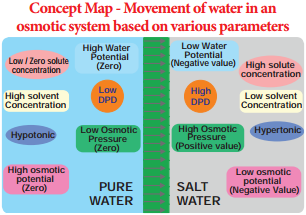
More concentrated solution (low Ψ or Hypertonic) has high osmotic pressure. Similarly, less concentrated solution (high Ψ or Hypotonic) has low osmotic pressure. The osmotic pressure of pure water is always zero and it increases with the increase of solute concentration. Thus osmotic pressure always has a positive value and it is represented as π.

Osmotic potential is defined as the ratio between the number of solute particles and the number of solvent particles in a solution. Osmotic potential and osmotic pressure are numerically equal. Osmotic potential has a negative value whereas on the other hand osmotic pressure has a positive value.

Turgor Pressure and Wall Pressure

When a plant cell is placed in pure water (hypotonic solution) the diffusion of water into the cell takes place by endosmosis. It creates a positive hydrostatic pressure on the rigid cell wall by the cell membrane. Henceforth the pressure exerted by the cell membrane towards the cell wall is Turgor Pressure (TP).

The cell wall reacts to this turgor pressure with equal and opposite force, and the counter-pressure exerted by the cell wall towards cell membrane is wall pressure (WP). Turgor pressure and wall pressure make the cell fully turgid. TP + WP = Turgid.

Diffusion Pressure Deficit (DPD) or Suction Pressure (SP)

Pure solvent (hypotonic) has higher diffusion pressure. Addition of solute in pure solvent lowers its diffusion pressure. The difference between the diffusion pressure of the solution and its solvent at a particular temperature and atmospheric pressure is called as Diffusion Pressure Deficit (DPD) termed by Meyer (1938). DPD is increased by the addition of solute into a solvent system.

Increased DPD favours endosmosis or it sucks the water from hypotonic solution; hence Renner (1935) called it as Suction pressure. It is equal to the difference of osmotic pressure and turgor pressure of a cell. The following three situations are seen in plants:

  • DPD in normal cell: DPD = OP – TP.
  • DPD in fully turgid cell: Osmotic pressure is always equal to turgor pressure in a fully turgid cell.
  • OP = TP or OP-TP =0. Hence DPD of fully turgid cell is zero.
  • DPD in flaccid cell: If the cell is in flaccid condition there is no turgor pressure or TP = 0. Hence DPD = OP.

Osmosis

Osmosis (Latin: Osmos-impulse, urge) is a special type of diffusion. It represents the movement of water or solvent molecules through a selectively permeable membrane from the place of its higher concentration (high water potential) to the place of its lower concentration (low water potential).

Types of Solutions Based on Concentration

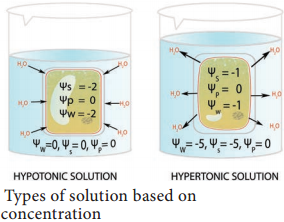
(i) Hypertonic (Hyper = High; tonic = solute):

This is a strong solution (low solvent/ high solute/ low Ψ) which attracts solvent from other solutions.

(ii) Hypotonic (Hypo = low; tonic = solute):

This is a weak solution (high solvent/ low or zero solute/ high Ψ) and it diffuses water out to other solutions (Figure 11.7).

(iii) Isotonic (Iso = identical; tonic = soute):

It refers to two solutions having same concentration. In this condition the net movement of water molecule will be zero. The term hyper, hypo and isotonic are relative terms which can be used only in comparison with another solution.
Plant Water Relations img 1

1. Types of Osmosis

Based on the direction of movement of water or solvent in an osmotic system, two types of osmosis can occur, they are Endosmosis and Exosmosis.

(i) Endosmosis:

Endosmosis is defined as the osmotic entry of solvent into a cell or a system when it is placed in a pure water or hypotonic solution. For example, dry raisins (high solute and low solvent) placed in the water, it swells up due to turgidity.

(ii) Exosmosis:

Exosmosis is defined as the osmotic withdrawal of water from a cell or system when it is placed in a hypertonic solution. Exosmosis in a plant cell leads to plasmolysis.

2. Plasmolysis (Plasma = cytoplasm; lysis = breakdown)

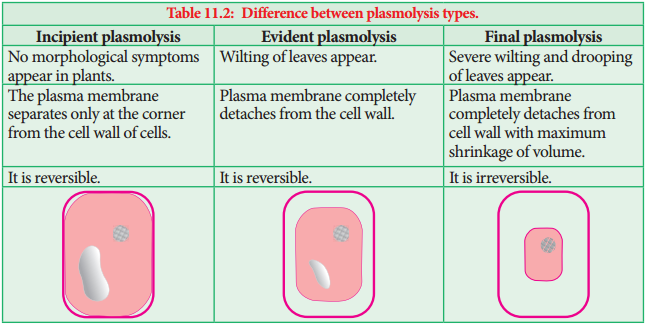
When a plant cell is kept in a hypertonic solution, water leaves the cell due to exosmosis. As a result of water loss, protoplasm shrinks and the cell membrane is pulled away from the cell wall and finally, the cell becomes flaccid.

This process is named as plasmolysis. Wilting of plants noticed under the condition of water scarcity is an indication of plasmolysis. Three types of plasmolysis occur in plants:

  • Incipient Plasmolysis
  • Evident Plasmolysis and
  • Final Plasmolysis.

Differences among them are given in table 11.2.
Plant Water Relations img 2

Significance

Plasmolysis is exhibited only by living cells and so it is used to test whether the cell is living or dead.

3. Deplasmolysis

The effect of plasmolysis can be reversed, by transferring them back into water or hypotonic solution. Due to endosmosis, the cell becomes turgid again. It regains its original shape and size. This phenomenon of the revival of the plasmolysed cell is called deplasmolysis. Example: Immersion of dry raisin in water.

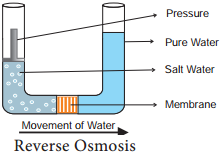
4. Reverse Osmosis

Reverse Osmosis follows the same principles of osmosis, but in the reverse direction. In this process movement of water is reversed by applying pressure to force the water against a concentration gradient of the solution. In regular osmosis, the water molecules move from the higher concentration (pure water = hypotonic) to lower concentration (salt water = hypertonic).

But in reverse osmosis, the water molecules move from the lower concentration (salt water = hypertonic) to higher concentration (pure water = hypotonic) through a selectively permeable membrane (Figure 11.9).
Plant Water Relations img 3

Uses:
Reverse osmosis is used for purification of drinking water and desalination of sea water.

Cell to Cell Transport Significance and its Types

Learninsta presents the core concepts of Biology with high-quality research papers and topical review articles.

Cell to Cell Transport Significance and its Types

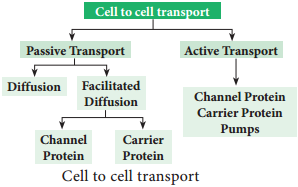
Cell to cell or short distance transport covers the limited area and consists of few cells. They are the facilitators or tributaries to the longdistance transport. The driving force for the cell to cell transport can be passive or active (Figure 11.1). The following chart illustrate the various types of cell to cell transport:
Cell to Cell Transport img 1

Passive Transport

1. Diffusion

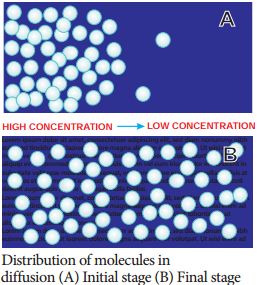
When we expose a lightened incense stick or mosquito coil or open a perfume bottle in a closed room, we can smell the odour everywhere in the room. This is due to the even distribution of perfume molecules throughout the room. This process is called diffusion. In diffusion, the movement of molecules is continuous and random in order in all directions (Figure 11.2).

Characteristics of Diffusion

  1. It is a passive process, hence no energy expenditure involved.
  2. It is independent of the living system.
  3. Diffusion is obvious in gases and liquids.
  4. Diffusion is rapid over a shorter distance but extremely slow over a longer distance.
  5. The rate of diffusion is determined by temperature, concentration gradient and relative density.

Significance of Diffusion in Plants

  1. Gaseous exchange of O2 and CO2 between the atmosphere and stomata of leaves takes place by the process of diffusion. O2 is absorbed during respiration and CO2 is absorbed during photosynthesis.
  2. In transpiration, water vapour from intercellular spaces diffuses into atmosphere through stomata by the process of diffusion.
  3. The transport of ions in mineral salts during passive absorption also takes place by this process.

2. Facilitated Diffsion

Cell membranes allow water and nonpolar molecules to permeate by simple diffusion. For transporting polar molecules such as ions, sugars, amino acids, nucleotides and many cell metabolites is not merely based on concentration gradient. It depends on,

(i) Size of Molecule:
Smaller molecules diffuse faster.

(ii) Solubility of the Molecule:
Lipid soluble substances easily and rapidly pass through the membrane. But water soluble substances are difficult to pass through the membrane. They must be facilitated to pass the membrane.

In facilitated diffusion, molecules cross the cell membrane with the help of special membrane proteins called transport proteins, without the expenditure of ATP. There are two types of transport proteins present in the cell membrane. They are channel protein and a carrier protein.

I. Channel Protein

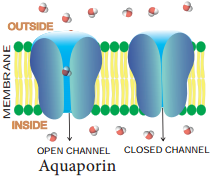
Channel protein forms a channel or tunnel in the cell membrane for the easy passage of molecules to enter the cell. The channels are either open or remain closed. They may open up for specific molecules. Some channel proteins create larger pores in the outer membrane. Examples: Porin and Aquaporin.

(i) Porin

Porin is a large transporter protein found in the outer membrane of plastids, mitochondria and bacteria which facilitates smaller molecules to pass through the membrane.

(ii) Aquaporin

Aquaporin is a water channel protein embedded in the plasma membrane. It regulates the massive amount of water transport across the membrane (Figure 11.3). Plants contain a variety of aquaporins. Over 30 types of aquaporins are known from maize. Currently, they are also recognized to transport substrates like glycerol, urea, CO2, NH3, metalloids, and Reactive Oxygen Species (ROS) in addition to water. They increase the permeability of the membrane to water. They confer drought and salt stress tolerance.
Cell to Cell Transport img 3

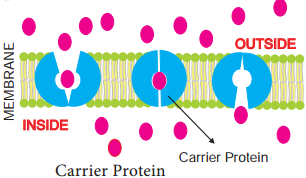
II. Carrier Protein

Carrier protein acts as a vehicle to carry molecules from outside of the membrane to inside the cell and vice versa (Figure 11.4). Due to association with molecules to be transported, the structure of carrier protein gets modified until the dissociation of the molecules.
Cell to Cell Transport img 4

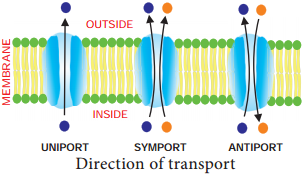
There are 3 types of carrier proteins classified on the basis of handling of molecules and direction of transport (Figure 11.5). They are:-

  1. Uniport
  2. Symport
  3. Antiport

1. Uniport:
In this molecule of a single type move across a membrane independent of other molecules in one direction.

2. Symport or Co-Transport:
The term symport is used to denote an integral membrane protein that simultaneously transports two types of molecules across the membrane in the same direction.

3. Antiport or Counter Transport:
An antiport is an integral membrane transport protein that simultaneously transports two different molecules, in opposite directions, across the membrane.
Cell to Cell Transport img 5

Active Transport

The main disadvantage of passive transport processes like diffusion is the lack of control over the transport of selective molecules. There is a possibility of harmful substances entering the cell by a concentration gradient in the diffusion process. But selective permeability of cell membrane has a great control over entry and exit of molecules.

Active transport is the entry of molecules against a concentration gradient and an uphill process and it needs energy which comes from ATP. Passive transport uses kinetic energy of molecules moving down a gradient whereas, active transport uses cellular energy to move them against a gradient.

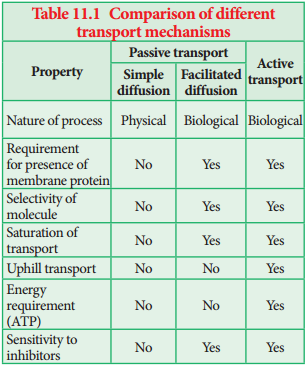
The transport proteins discussed in facilitated diffusion can also transport ions or molecules against a concentration gradient with the expenditure of cellular energy as an active process. Pumps use a source of free energy such as ATP or light to drive the thermodynamically uphill transport of ions or molecules. The pump action is an example of active transport. Example: Na+-K+-ATPase pump (Table 11.1).
Cell to Cell Transport img 6

Types of Transport

Learninsta presents the core concepts of Biology with high-quality research papers and topical review articles.

Types of Transport

Transport is the process of moving water, minerals and food to all parts of the plant body. Conducting tissues such as xylem and phloem play an important role in this. What is the need for transport? Water absorbed from roots must travel up to leaves by xylem for food preparation by photosynthesis. Likewise, food prepared from leaves has to travel to all parts of the plant including roots. Both the processes are interconnected and depend on each other.

Based on the distance travelled by water (sap) or food (solute) they are classified as:-

  1. Short Distance (Cell to cell transport) and
  2. Long Distance Transport.

1. Short-distance (Cell to Cell Transport):

Involvement of few cells, mostly in the lateral direction. They are the connecting link to xylem and phloem from root hairs or leaf tissues respectively. Examples: Diffusion, Imbibition, and Osmosis.

2. Long-Distance Transport:

Transport within the network of xylem or phloem is an example for long-distance transport. Examples: Ascent of Sap and Translocation of Solutes.

Based on energy expenditure during transport, they are classified as:-

  1. Passive Transport and
  2. Active Transport

1. Passive Transport:

It is a downhill process which utilizes physical forces like gravity and concentration. No energy expenditure is required. It includes diffusion, facilitated diffusion, imbibition, and osmosis.

2. Active Transport:

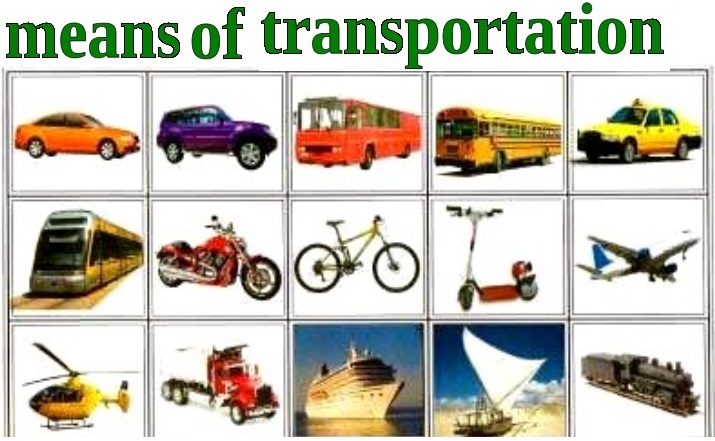
It is a biological process and it runs based on the energy obtained from respiration. It is an uphill process. The different modes of transport are air, water, and land transport, which includes Rails or railways, road and off-road transport. Other modes also exist, including pipelines, cable transport, and space transport.

Transport modes are the means of supporting the mobility of passengers and freight. They are mobile transport assets and fall into three basic types; land (road, rail, pipelines), water (shipping), and air.

Water transport is the slowest means of transport and, therefore, important for transporting the bulky raw materials which does not care of the speed of movement of commodities.

Among different modes of transport, Railways are the cheapest. Trains cover the distance in less time and comparatively, the fare is also less to other modes of transportation. Therefore, Railways is the cheapest mode of transportation.

There are two major types of cell transport: passive transport and active transport. Passive transport requires no energy. It occurs when substances move from areas of higher to lower concentration. Types of passive transport include simple diffusion, osmosis, and facilitated diffusion.

The bicycle is a tremendously efficient means of transportation. In fact cycling is more efficient than any other method of travel-including walking! The one billion bicycles in the world are a testament to its effectiveness. The engine for this efficient mode of transport is the human body.

The air travel, today, is the fastest, most comfortable and prestigious mode of transport. It has reduced distances by minimising the travel time. It is very essential for a vast country like India, where distances are large and the terrain and climatic conditions are diverse.

The cheapest means of transport for a long distance is Waterways. The amount for loading and unloading goods is much cheaper if it has to travel a long distance. If one has to travel physically to a short distance then it is advisable to take a train. Railways are both cheaper and comfortable to travel.

Modes of transport include air, land (rail and road), water, cable, pipeline and space. The field can be divided into infrastructure, vehicles and operations. Transport is important because it enables trade between people, which is essential for the development of civilizations.

The four elements of transport are:

  1. The Way
  2. The Unit of Carriage
  3. The Motive Power unit, and the Terminal

Natural ways are cheap and free, and have no maintenance costs unless we try to improve them artificially. The sea, the air, the rivers, and footpaths are all natural ways.

Transportation is the movement of goods and logistics is the management of the inward and outward transportation of goods from the manufacturer to the end user. Logistics and transportation deals with getting products and services from one location to another.

There are two major types of cell transport: passive transport and active transport. Passive transport requires no energy. It occurs when substances move from areas of higher to lower concentration. Types of passive transport include simple diffusion, osmosis, and facilitated diffusion.

The different modes of transport are air, water, and land transport, which includes Rails or railways, road and off-road transport. Other modes also exist, including pipelines, cable transport, and space transport.
Types of Transport img 1