Spectrum of Electromagnetic Radiation

Learninsta presents the core concepts of Biology with high-quality research papers and topical review articles.

Spectrum of Electromagnetic Radiation

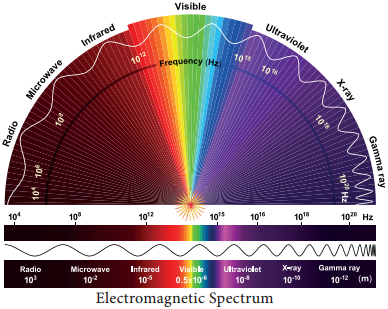
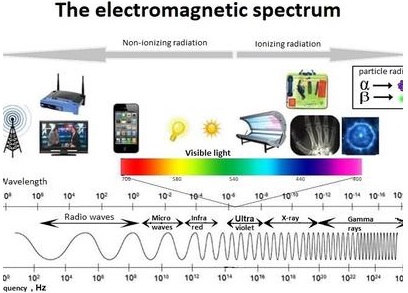
In the total electromagnetic spectrum, visible light is the smallest part. The entire life on earth depends on light and is the driving force for all organisms. Plants have natural potential to utilize solar energy directly. In the given picture electromagnetic radiation spectrum and components of visible spectrum are mentioned. The wavelength of solar radiation which reaches the earth is between 300 to 2600 nm.

The visible spectrum ranges between 390 to 763 nm (3900 å to 7630 å). The colour of the light is determined by the wavelength. Energy of the quantum is inversely proportional to wavelength. Shorter wavelength has more energy than longer wavelength. Electromagnetic spectrum consists of 7 types of radiations such as gamma rays, X rays, U-V rays, Visible light spectrum, infrared rays, electric rays and radio rays (Figure 13. 4).
Spectrum of Electromagnetic Radiation img 1

Properties of Light

  1. Light is a transverse electromagnetic wave.
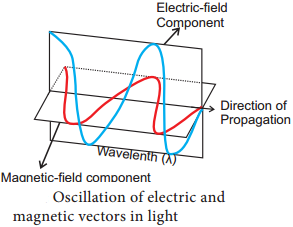
  2. It consists of oscillating electric and magnetic fields that are perpendicular to each other and perpendicular to the direction of propagation of the light.
  3. Light moves at a speed of 3 × 10⁸ ms-1
  4. Wavelength is the distance between successive crests of the wave.
  5. Light as a particle is called photon. Each photon contains an amount of energy known as quantum.
  6. The energy of a photon depends on the frequency of the light (Figure 13.5).Spectrum of Electromagnetic Radiation img 2

The entire electromagnetic spectrum, from the lowest to the highest frequency (longest to shortest wavelength), includes all radio waves (e.g., commercial radio and television, microwaves, radar), infrared radiation, visible light, ultraviolet radiation, X-rays, and gamma rays.

The EM spectrum is generally divided into seven regions, in order of decreasing wavelength and increasing energy and frequency. The common designations are: radio waves, microwaves, infrared (IR), visible light, ultraviolet (UV), X-rays and gamma rays.

The electromagnetic spectrum is a continuum of all electromagnetic waves arranged according to frequency and wavelength. The sun, earth, and other bodies radiate electromagnetic energy of varying wavelengths. Electromagnetic energy passes through space at the speed of light in the form of sinusoidal waves.

The characteristics of the electromagnetic spectrum are the propagation features and the amount of information, which signals can carry. In general, signals sent using the higher frequencies have shorter propagation distances but a higher data-carrying capacity.

Radio waves, microwaves, visible light, and x rays are all examples of electromagnetic waves that differ from each other in wavelength.

  • Longer Wavelength
  • Shorter Wavelength

Electromagnetic waves are produced by the motion of electrically charged particles. The different types of waves have different uses and functions in our everyday lives. The most important of these is visible light, which enables us to see. Radio waves have the longest wavelengths of all the electromagnetic waves. They range from around a foot long to several miles long.

“Electromagnetic spectrum” refers to the spectrum of electromagnetic radiation, and electromagnetic radiation is so named because it consists of electric and magnetic fields. In fact, light does affect charges and currents.

These observations enable astronomers to determine certain physical characteristics of objects, such as their temperature, composition and velocity. The electromagnetic spectrum consists of much more than visible light. It includes wavelengths of energy that human eyes can’t perceive.

Cell phones use antennae to transmit and receive radio waves that carry binary information. Every cell tower presides over an area of land, where it receives and transmits radio waves. When a text message is written, it is transmitted as binary code using a particular frequency of radio waves specific to that user.

Almost all of the energy available at Earth’s surface comes from the sun. The sun gets its energy from the process of nuclear fusion. This energy eventually makes its way to the outer regions of the sun and is radiated or emitted away in the form of energy, known as electromagnetic radiation.

Yes, all objects, including human bodies, emit electromagnetic radiation. The wavelength of radiation emitted depends on the temperature of the objects. Such radiation is sometimes called thermal radiation. Most of the radiation emitted by human body is in the infrared region, mainly at the wavelength of 12 micron.
Spectrum of Electromagnetic Radiation img 3

Photosynthetic Pigments

Learninsta presents the core concepts of Biology with high-quality research papers and topical review articles.

Photosynthetic Pigments

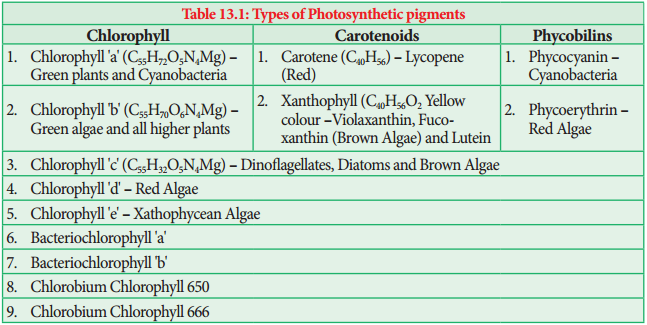
A photosynthetic pigment is a pigment that is present in chloroplasts or photosynthetic bacteria which captures the light energy necessary for photosynthesis (Table 13.1).
Photosynthetic Pigments img 1

Chlorophyll

Chlorophyll ‘a’ is the primary pigment which acts as a reaction centre and all other pigments act as accessory pigments and trap solar energy and then transfer it to chlorophyll ‘a’. Chlorophyll molecules have a tadpole like structure. It consists of Mg-Porphyrin head (Hydrophilic Head) and (Lipophilic tail) Phytol tail. The Porphyrin head consists of four pyrrol rings linked together by C-H bridges.

Each pyrrole ring comprises of four carbons and one nitrogen atom. Porphyrin ring has several side groups which alter the properties of the pigment. Different side groups are indicative of various types of chlorophyll. The Phytol tail made up of 20 carbon alcohol is attached to carbon 7 of the Pyrrole ring IV. It has a long propionic acid ester bond. Long lipophilic tail helps in anchoring chlorophyll to the lamellae.

Carotenoids

Carotenoids are yellow to orange pigments, mostly tetraterpens and these pigments absorb light strongly in the blue to violet region of visible spectrum. These pigments protect chlorophyll from photo-oxidative damage. Hence, they are called as shield pigments.

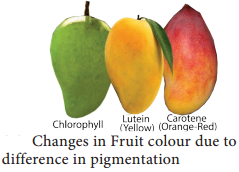
These pigments absorb light and transfer these to chlorophyll. Almost all carotenoid pigments have 40 carbon atoms. Ripening of fruits, floral colours and leaf colour change during autumn is due to Carotenoids (Carotene and Xanthophyll) (Figure 13.2).
Photosynthetic Pigments img 2

(i) Carotenes:

Orange, Red, Yellow and Brownish pigments, hydrocarbons (Lipids) and most of them are tetraterpenes (C40H56). Carotene is the most abundant Carotene in plants and it is a precursor of Vitamin A. Lycopene is the red pigment found in the fruits of tomato, red peppers and roses.

(ii) Xanthophylls:

Yellow (C40H56O2) pigments are like carotenes but contain oxygen. Lutein is responsible for yellow colour change of leaves during autumn season. Examples: Lutein, Violaxanthin and Fucoxanthin.

Phycobilins

They are proteinaceous pigments, soluble in water, and do not contain Mg and Phytol tail. They exist in two forms such as:-

  1. Phycocyanin found in cyanobacteria
  2. Phycoerythrin found in rhodophycean algae (Red algae).

Definition – Significance and Site of Photosynthesis

Learninsta presents the core concepts of Biology with high-quality research papers and topical review articles.

Definition – Significance and Site of Photosynthesis

Photosynthesis is referred as photochemical oxidation and reduction reactions carried out with the help of light, converting solar energy into chemical energy. It is the most important anabolic process. Plants and photosynthetic bacteria use simple raw materials like carbon dioxide water and with the help of light energy synthesize carbohydrates and evolve oxygen. The overall chemical equation for photosynthesis is:
Definition - Significance and Site of Photosynthesis img 1

Ruben and Kamen (1941) demonstrated six molecules of water as insufficient for the evolution of 6 molecules of O2 and modified the equation as:
Definition - Significance and Site of Photosynthesis img 2

Photosynthesis is a collection of oxidation and reduction reactions (Redox reaction).

Oxidation:
Water is oxidised into oxygen (loss of electrons).

Reduction:
CO2 is reduced into Carbohydrates (gain of electrons).

In some bacteria, oxygen is not evolved and is called as non-oxygenic and anaerobic photosynthesis. Examples: Green sulphur, Purple sulphur and green fiamentous bacteria.

Significance of Photosynthesis

  1. Photosynthetic organisms provide food for all living organisms on earth either directly or indirectly.
  2. It is the only natural process that liberates oxygen in the atmosphere and balances the oxygen level.
  3. Photosynthesis balances the oxygen and carbon cycle in nature.
  4. Fuels such as coal, petroleum and other fossil fuels are from preserved photosynthetic plants.
  5. Photosynthetic organisms are the primary producers on which all consumers depend for energy.
  6. Plants provide fodder, fire, fie wood, timber, useful medicinal products and these sources come by the act of photosynthesis.

Site of Photosynthesis

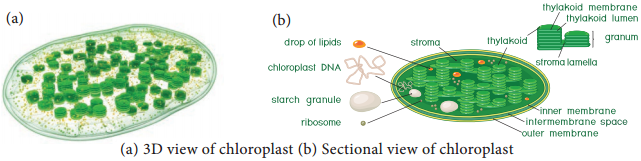
Chloroplasts are the main site of photosynthesis and both energy yielding process (Light reaction) and fixation of carbon di oxide (Dark reaction) that takes place in chloroplast. It is a double wall membrane bounded organelle, discoid or lens shaped, 4-10 µm in diameter and 1-33 µm in thickness. The membrane is a unit membrane and space between them is 100 to 200 A °. A colloidal and proteinaceous matrix called stroma is present inside.

A sac like membranous system called thylakoid or lamellae is present in stroma and they are arranged one above the other forming a stack of coin like structure called granum (plural grana). Each chloroplast contains 40 to 80 grana and each granum consists of 5 to 30 thylakoids.

Thlakoids found in granum are called grana lamellae and in stroma are called stroma lamellae. Thlakoid disc size is 0.25 to 0.8 micron in diameter. A thinner lamella called Fret membrane connects grana. Pigment system I is located on outer thylakoid membrane facing stroma and Pigment system II is located on inner membrane facing lumen of thylakoid.

Grana lamellae have both PS I and PS II whereas stroma lamellae have only PS I. Chloroplast contains 30-35 Proteins, 20-30% phospholipids, 5-10% chlorophyll, 4-5% Carotenoids, 70S ribosomes, circular DNA and starch grains.

Inner surface of lamellar membrane consists of small spherical structure called as Quantasomes. Presence of 70S ribosome and DNA gives them status of semi-autonomy and proves endosymbiotic hypothesis which says chloroplast evolved from bacteria. Thlakoid contains pigment systems which produces ATP and NADPH + H+ using solar energy. Stroma contains enzyme which reduces carbondioxide into carbohydrates. In Cyanobacteria thylakoid lies freely in cytoplasm without envelope (Figure 13.1).
Definition - Significance and Site of Photosynthesis img 3

Special Modes of Nutrition

Learninsta presents the core concepts of Biology with high-quality research papers and topical review articles.

Special Modes of Nutrition

Nutrition is the process of uptake and utilization of nutrients by living organisms. There are two main types such as autotrophic and heterotrophic nutrition. Autotrophic nutrition is further divided intophotosynthetic and chemosynthetic nutrition. Heterotrophic nutrition is further divided into saprophytic, parasitic, symbiotic and insectivorous type. In this topic you are going to learn about special mode of nutrition.

Saprophytic Mode of Nutrition in Angiosperms

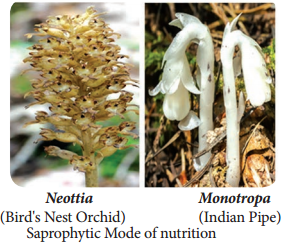
Saprophytes derive nutrients from dead and decaying matter. Bacteria and fungus are main saprophytic organisms. Some angiosperms also follow saprophytic mode of nutrition. Example: Neottia. Roots of Neottia (Bird’s Nest Orchid) associate with mycorrhizae and absorb nutrients as a saprophyte. Monotropa (Indian Pipe) grow on humus rich soil found in thick forests. It absorbs nutrient through mycorrhizal association (Figure 12.9).
Special Modes of Nutrition img 1

Parasitic Mode of Nutrition in Angiosperms

Organisms deriving their nutrient from another organism (host) and causing disease to the host are called parasites.

a. Obligate or Total parasite:
Completely depends on host for their survival and produces haustoria.

(i) Total Stem Parasite:
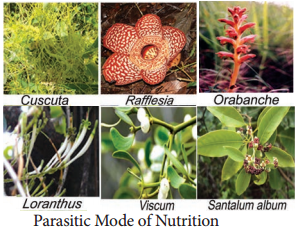
The leafless stem twine around the host and produce haustoria. Example: Cuscuta (Dodder), a rootless plant growing on Zizyphus, Citrus and so on.

(ii) Total Root Parasite:
They do not have stem axis and grow in the roots of host plants produce haustoria. Example: Rafflesia, Orobanche and Balanophora.

b. Partial Parasite:
Plants of this group contain chlorophyll and synthesize carbohydrates. Water and mineral requirements are dependent on host plant.

(i) Partial Stem Parasite:
Example: Loranthus and Viscum (Mistletoe) Loranthus grows on fig and mango trees and absorb water and minerals from xylem.

(ii) Partial Root Parasite:
Example: Santalum album (Sandal wood tree) in its juvenile stage produces haustoria which grows on roots of many plants (Figure 12.10).
Special Modes of Nutrition img 2

Symbiotic Mode of Nutrition

a. Lichens:
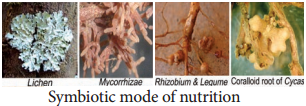
It is a mutual association of Algae and Fungi. Algae prepares food and fungi absorbs water and provides thallus structure.

b. Mycorrhizae:
Fungi associated with roots of higher plants including Gymnosperms. Example: Pinus.

c. Rhizobium and Legumes:
This symbiotic association fixes atmospheric nitrogen.

d. Cyanobacteria and Coralloid Roots:
This association is found in Cycas where Nostoc associates with its coralloid roots. (Figure 12.11).
Special Modes of Nutrition img 3

Insectivorous Mode of Nutrition

Plants which are growing in nitrogen deficient areas develop insectivorous habit to resolve nitrogen deficiency. These plants obtain nitrogen from the insects.

a. Nepenthes (Pitcher plant):
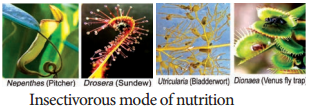
Pitcher is a modified leaf and contains digestive enzymes. Rim of the pitcher is provided with nectar glands and acts as an attractive lid. When insect is trapped, proteolytic enzymes will digest the insect.

b. Drosera (Sundew):
It consists of long club shaped leaves with tentacles that secrete sticky digestive fluid which looks like a sundew and attracts insects.

c. Utricularia (Bladder Wort):
Submerged plant in which leaf is modified into a bladder to collect insect in water.

d. Dionaea (Venus Fly Trap):
Leaf of this plant modified into a colourful trap. Two folds of lamina consist of sensitive trigger hairs and when insects touch the hairs it will close and traps the insects.(Figure 12.12).
Special Modes of Nutrition img 4

Nitrogen Cycle and Nitrogen Metabolism

Learninsta presents the core concepts of Biology with high-quality research papers and topical review articles.

Nitrogen Cycle and Nitrogen Metabolism

Nitrogen Cycle

This cycle consists of following stages:

1. Fixation of Atmospheric Nitrogen

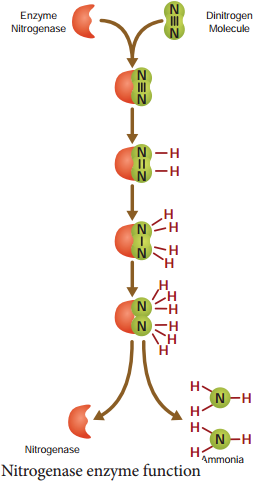
Di-nitrogen molecule from the atmosphere progressively gets reduced by addition of a pair of hydrogen atoms. Triple bond between two nitrogen atoms (N≡N) are cleaved to produce ammonia (Figure 12.7).
Nitrogen Cycle and Nitrogen Metabolism img 1

Nitrogen fixation process requires Nitrogenase enzyme complex, Minerals (Mo, Fe and S), anaerobic condition, ATP, electron and glucose 6 phosphate as H+ donor. Nitrogenase enzyme is active only in anaerobic condition.

To create this anaerobic condition a pigment known as leghaemoglobin is synthesized in the nodules which acts as oxygen scavenger and removes the oxygen. Nitrogen fixing bacteria in root nodules appears pinkish due to the presence of this leghaemoglobin pigment.

Overall Equation:
N2 + 8e + 8H+ + 16ATP → 2NH3+ + H2 + 16ADP + 16Pi

2. Nitrification

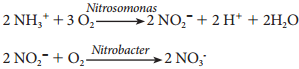
Ammonia (NH3+) is converted into Nitrite (NO2) by Nitrosomonas bacterium. Nitrite is then converted into Nitrate (NO3) by Nitrobacter bacterium. Plants are more adapted to absorb nitrate (NO3) than ammonium ions from the soil.
Nitrogen Cycle and Nitrogen Metabolism img 2

3. Nitrate Assimilation

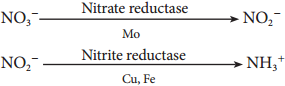
The process by which nitrate is reduced to ammonia is called nitrate assimilation and occurs during nitrogen cycle.
Nitrogen Cycle and Nitrogen Metabolism img 3

4. Ammonification

Decomposition of organic nitrogen (proteins and amino acids) from dead plants and animals into ammonia is called ammonification. Organism involved in this process are Bacillus ramosus and Bacillus vulgaris.

5. Denitrification

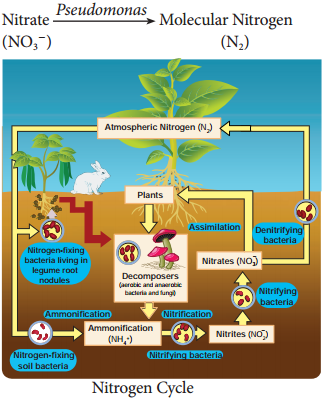
Nitrates in the soil are converted back into atmospheric nitrogen by a process called denitrification. Bacteria involved in this process are Pseudomonas, Thiobacillus and Bacillus subtilis. The overall process of nitrogen cycle is given in Figure 12.8.
Nitrogen Cycle and Nitrogen Metabolism img 4

Nitrogen Metabolism Ammonium Assimilation (Fate of Ammonia)

Ammonia is converted into amino acids by the following processes:

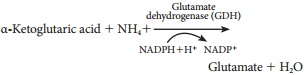
1. Reductive Amination

Glutamic acid or glutamate is formed by reaction of ammonia with α-ketoglutaric acid.
Nitrogen Cycle and Nitrogen Metabolism img 5

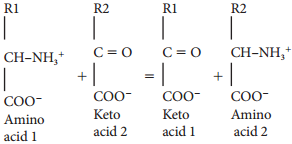
2. Transamination

Transfer of amino group (NH3+) from glutamic acid (glutamate) to keto group of keto acid. Glutamic acid is
the main amino acid from which other amino acids are synthesised by transamination. Transamination requires the enzyme transaminase and co enzyme pyridoxal phosphate (derivative of vitamin B6 – pyridoxine)
Nitrogen Cycle and Nitrogen Metabolism img 6

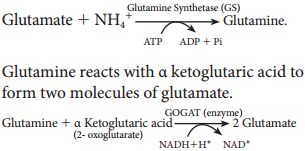
3. Catalytic Amination: (GS/GOGAT Pathway)

Glutamate amino acid combines with ammonia to form the amide glutamine.
Nitrogen Cycle and Nitrogen Metabolism img 7
(GOGAT – Glutamine – 2 – Oxoglutarate aminotransferase)