Photo – Oxidation Phase of Light Reaction

Learninsta presents the core concepts of Biology with high-quality research papers and topical review articles.

Photo – Oxidation Phase of Light Reaction

The action of photon plays a vital role in excitation of pigment molecules to release an electron. When the molecules absorb a photon, it is in excited state. When the light source turned off the high energy electrons return to their normal low energy orbitals as the excited molecule goes back to its original stable condition known as ground state.

When molecules absorb or emit light they change their electronic state. Absorption of blue light excites the chlorophyll to higher energy state than absorption of Red light, because the energy of photon is higher when their wavelength is shorter.

When the pigment molecule is in an excited state, this excitation energy is utilised for the phosphorylation. Phosphorylation takes place with the help of light generated electron and hence it is known as photophosphorylation.

Photosystem and Reaction Centre

  1. Thlakoid membrane contains Photosystem I (PS I) and Photosystem II (PS II).
  2. PS I is in unstacked region of granum facing stroma of chloroplast.
  3. PS II is found in stacked region of thylakoid membrane facing lumen of thylakoid.
  4. Each Photosystem consists of central core complex (CC) and light harvesting Complex (LHC) or Antenna molecules (Figure 13.10).
  5. The core complex consists of respective reaction centre associated with proteins, electron donors and acceptors.
  6. PS I – CC I consists of reaction centre P700 and LHC I.
  7. PS II – CC II consists of reaction centre P680 and LHC II (Table 13.2).
  8. Light Harvesting Complex consists of several chlorophylls, carotenoids and xanthophyll molecules.
  9. The main function of LHC is to harvest light energy and transfer it to their respective reaction centre.
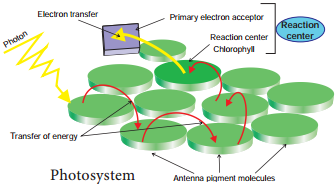
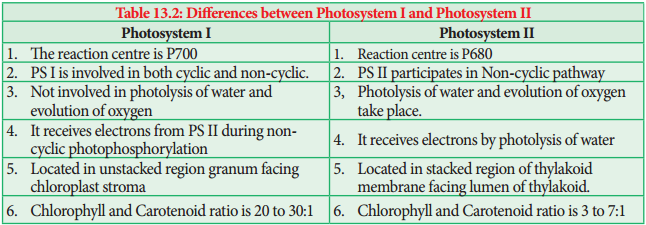
Photo - Oxidation Phase of Light Reaction img 1
Photo - Oxidation Phase of Light Reaction img 2

The action of photon plays a vital role in excitation of pigment molecules to release an electron. The action of photon plays a vital role in excitation of pigment molecules to release an electron. When the molecules absorb a photon, it is in excited state.

Photo-oxidation is a chain process incorporating a large number of chemical reactions which are subsequent to the outcome of the primary event absorption of a photon, which induces breakdown to free-radical products.

In photosynthesis, the light-dependent reactions take place on the thylakoid membranes. The four photosystems absorb light energy through pigments-primarily the chlorophylls, which are responsible for the green color of leaves. The light-dependent reactions begin in photosystem II.

The light-dependent generation of active oxygen. species is termed photooxidative stress. This can occur in two ways:

  1. The donation of energy or electrons directly to oxygen as a result of photosynthetic activity
  2. Exposure of tissues to ultraviolet irradiation.

Oxidation is defined as a process in which an electron is removed from a molecule during a chemical reaction. What happens in oxidation? During oxidation, there is a transfer of electrons.

The Light Reactions of Photosynthesis. Light is absorbed and the energy is used to drive electrons from water to generate NADPH and to drive protons across a membrane. These protons return through ATP synthase to make ATP.

This is an intrinsic feature of the regulation of photosynthetic electron transport. Photoinhibition and photooxidation only usually occur when plants are exposed to stress. Active oxygen species are part of the alarm signalling processes in plants.

Light reactions harness energy from the sun to produce chemical bonds, ATP, and NADPH. These energy-carrying molecules are made in the stroma where carbon fixation takes place. The light-independent reactions of the Calvin cycle can be organized into three basic stages: fixation, reduction, and regeneration.

Photo-oxidation means the release of electrons after absorption of a photon occurs during non-cyclic photophosphorylation. It involves an outsized number of chemical reactions.

Photolysis is an oxidative process that means the splitting of water to form oxygen, protons and electrons in the presence of light. As a result, oxygen evolution happens and the electron travels to PS-IIvia the Mn-protein.

The light-dependent reactions use light energy to make two molecules needed for the next stage of photosynthesis: the energy storage molecule ATP and the reduced electron carrier NADPH. In plants, the light reactions take place in the thylakoid membranes of organelles called chloroplasts.
Modern Concept of Photosynthesis

Learninsta presents the core concepts of Biology with high-quality research papers and topical review articles.

Modern Concept of Photosynthesis

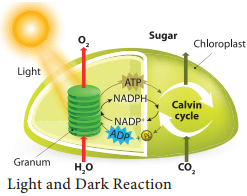
Photosynthesis is an Oxidation and Reduction process. Water is oxidised to release O2 and CO2 is reduced to form sugars. The first phase requires light and is called light reaction or Hill’s reaction.

1. Light Reaction:

It is a photochemical reaction whereas dark reaction is a thermochemical reaction. Solar energy is trapped by chlorophyll and stored in the form of chemical energy (assimilatory power) as ATP and reducing power NADPH + H+, NADPH + H+ alone are known as reducing powers. This reaction takes place in thylakoid membrane of the chloroplast. Oxygen is evolved as a result of splitting of water molecules by light.

Light reaction is discussed in two phases:

(i) Photo-Oxidation Phase:

  • Absorption of light energy.
  • Transfer of energy from accessory pigments to reaction centre.
  • Activation of Chlorophyll ‘a’ molecule.

(ii) Photo Chemical Phase:

  • Photolysis of water and oxygen evolution
  • Electron transport and synthesis of assimilatory power.

2. Dark reaction (Biosynthetic Phase):

Fixation and reduction of CO2 into carbohydrates with the help of assimilatory power produced during light reaction. This reaction does not require light and is not directly light driven. Hence, it is called as Dark reaction or CalvinBenson cycle (Figure 13.9).
Modern Concept of Photosynthesis img 1

photosynthesis, the process by which green plants and certain other organisms transform light energy into chemical energy. During photosynthesis in green plants, light energy is captured and used to convert water, carbon dioxide, and minerals into oxygen and energy-rich organic compounds.

During photosynthesis, plants take in carbon dioxide (CO2) and water (H2O) from the air and soil. This transforms the water into oxygen and the carbon dioxide into glucose. The plant then releases the oxygen back into the air, and stores energy within the glucose molecules.

Recent advances include combining photosystem complexes with hydrogenases for hydrogen production, using isolated thylakoids, photosystems on nanostructured electrodes such as gold nanoparticles, carbon nanotubes, ZnO nanoparticles for electricity generation.

The process by which green plants make their own food (like glucose) from carbon dioxide and water by using sunlight energy (in the presence of chlorophyll) is called photosynthesis.

Green plants are the main producers of food in the ecosystem. All other organisms directly or indirectly depend on green plants for food. The process of photosynthesis also helps in maintaining the balance of carbon dioxide and oxygen in the air.

The three events that occur during the process of photosynthesis are:

  1. Absorption of light energy by chlorophyll
  2. Conversion of light energy to chemical energy and splitting of water molecules into hydrogen and oxygen
  3. Reduction of carbon dioxide to carbohydrates.

Photosynthesis and respiration, both using electron flow coupled with phosphorylation, have a common origin (‘conversion hypothesis’), but photosynthesis came first. Anaerobic (nitrate or sulphate) respiration cannot have preceded photosynthesis as neither nitrate nor sulphate existed on the early earth.

It fixes and balances the amount of carbon dioxide and oxygen in the atmosphere by plants exhaling oxygen and animals and humans exhaling carbon dioxide. It helps in the synthesis of organic compounds from inorganic compounds. It provides nutrition to the plants and thus helps in their growth and development.

The first stage of photosynthesis is called the light reactions. During this stage, light is absorbed and transformed to chemical energy in the bonds of NADPH and ATP.

The Light Reactions of Photosynthesis. Light is absorbed and the energy is used to drive electrons from water to generate NADPH and to drive protons across a membrane. These protons return through ATP synthase to make ATP.

Scientists think that glycolysis evolved before the other stages of cellular respiration. This is because the other stages need oxygen, whereas glycolysis does not, and there was no oxygen in Earth’s atmosphere when life first evolved about 3.5 to 4 billion years ago.

Emerson’s Experiments and Hill’s Reaction

Learninsta presents the core concepts of Biology with high-quality research papers and topical review articles.

Emerson’s Experiments and Hill’s Reaction

Red Drop or Emerson’s First Effect

Emerson conducted experiment in Chlorella using only one wavelength of light (monochromatic light) at a time and he measured quantum yield. He plotted a graph of the quantum yield in terms of O2 evolution at various wavelengths of light. His focus was to determine at which wavelength the photochemical yield of oxygen was maximum.

He found that in the wavelength of 600 to 680 the yield was constant but suddenly dropped in the region above 680 nm (red region). The fall in the photosynthetic yield beyond red region of the spectrum is referred as Red drop or Emerson’s first effect.

Emerson’s Enhancement Effect

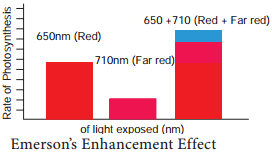
Emerson modified his first experiment by supplying shorter wavelength of light (red light) along with longer wavelength of light (far red light). He found that the monochromatic light of longer wavelength (far red light) when supplemented with shorter wavelength of light (red light) enhanced photosynthetic yield and recovered red drop. This enhancement of photosynthetic yield is referred to as Emerson’s Enhancement Effect (Figure 13.8).
Emerson's Experiments and Hill's Reaction img 1

  • Photosynthetic rate at far red light (710 nm) = 10
  • Photosynthetic rate at red light (650 nm) = 43.5
  • Photosynthetic rate at red + far red (650 + 1710 nm) = 72.5 (Enhancement effect).

Hill’s Reaction

R. Hill (1937) isolated chloroplasts and when they were illuminated in the presence of suitable electron acceptors such as ferricyanide, they were reduced to ferrocyanide and oxygen is evolved. Hill’s Reaction is now considered to be equivalent to Light Reaction.

Conclusions of Hill’s Reaction:

  1. During photosynthesis oxygen is evolved from water.
  2. Electrons for the reduction of CO2 are obtained from water.
  3. Reduced substance produced, later helps to reduce CO2
    2H2O + 2A → 2 AH2 + O2

A is the Hydrogen acceptor, the common in vitro hydrogen acceptors are ferricyanide, benzoquinone and Di Chloro Phenol Indole Phenol (DCPIP).

Absorption Spectrum and Action Spectrum

Learninsta presents the core concepts of Biology with high-quality research papers and topical review articles.

Absorption Spectrum and Action Spectrum

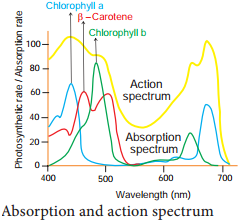
The term absorption refers to complete retention of light, without reflection or transmission. Pigments absorb different wavelengths of light. A curve obtained by plotting the amount of absorption of different wavelengths of light by a pigment is called its absorption spectrum.

  1. Chlorophyll ‘a’ and chlorophyll ‘b’ absorb quanta from blue and red region.
  2. Maximum absorption peak for different forms of chlorophyll ‘a’ is 670 to 673, 680 to 683 and 695 to 705nm.
  3. Chlorophyll ‘a’ 680 (P680) and Chlorophyll ‘a’ 700 (P700) function as trap centre for PS II and PS I respectively.

Action Spectrum

The effectiveness of different wavelength of light on photosynthesis is measured by plotting against quantum yield. The curve showing the rate of photosynthesis at different wavelengths of light is called action spectrum.

From the graph showing action spectrum, it can be concluded that maximum photosynthesis takes place in blue and red region of the spectrum. This wavelength of the spectrum is the absorption maxima for Chlorophyll (a) and Chlorophyll (b). The Action Spectrum is instrumental in the discovery of the existence of two photosystems in O2 evolving photosynthesis (Figure 13.7).
Absorption Spectrum and Action Spectrum img 1

Absorption spectrum deals with wavelengths of light absorbed by each pigment whereas the action spectrum indicates the overall rate of photosynthesis at each wavelength of light. It shows the overall rate of photosynthesis at each wavelength of light.

An absorption spectrum defines the spectrum of electromagnetic radiation, or light, plants absorb. An action spectrum defines the spectrum of electromagnetic radiation most effective for photosynthesis. In other words, it is the part of the light spectrum that does the work.

The action spectrum for photosynthesis shows which wavelengths are used by plants to create energy, while the absorption spectrum shows which wavelengths are most absorbed by a specific molecule. But other molecules play a part as well, which is why there is some difference in the absorption and action spectra.

An action spectrum is a graph of the rate of biological effectiveness plotted against wavelength of light. It shows which wavelength of light is most effectively used in a specific chemical reaction. Some reactants are able to use specific wavelengths of light more effectively to complete their reactions.

Absorption spectroscopy is employed as an analytical chemistry tool to determine the presence of a particular substance in a sample and, in many cases, to quantify the amount of the substance present. Infrared and ultraviolet-visible spectroscopy are particularly common in analytical applications.

The similarity of the action spectrum of photosynthesis and the absorption spectrum of chlorophyll tells us that chlorophylls are the most important pigments in the process. The spectra are not identical, though, because carotenoids, which absorb strongly in the blue, play a role as well.

Absorption Spectrum. Definition. The range of a pigment’s ability to absorb various wavelengths of light. A graph plotting light absorption of a pigment versus wavelength.

An action spectrum is measured by plotting a response to light such as oxygen evolution, as a function of wavelength. If the pigments used to obtain the absorption spectrum are the same as those that cause the response, the absorption and action spectra will match.

Because more absorption leads to more action, peaks in an absorption spectrum will have corresponding peaks in an action spectrum. Thus, if a pigment can be found that has an absorption spectrum that matches a process’s action spectrum, it is likely that pigment is the photoreceptor for that process.

The pattern of absorption lines in a spectrum is diagnostic of the types of atoms and molecules present, for example, in the surface layers of a star or the atmosphere of a planet. Absorption lines are seen in the spectra of the Sun and other stars.

To get an absorption spectrum, just shine white light on a sample of the material that you are interested in white light is made up of all the different wavelengths of visible light put together. In the absorption spectrum there will be gaps.

An absorption spectrum occurs when light passes through a cold, dilute gas and atoms in the gas absorb at characteristic frequencies; since the re-emitted light is unlikely to be emitted in the same direction as the absorbed photon, this gives rise to dark lines (absence of light) in the spectrum.

The action spectrum for photosynthesis is much broader than the absorption spectrum of chlorophyll a. This is because accessory pigments with different absorption spectra also present in chloroplasts broaden the spectrum of colors that can be used for photosynthesis.

Photosynthetic Unit (Quantasome)

Learninsta presents the core concepts of Biology with high-quality research papers and topical review articles.

Photosynthetic Unit (Quantasome)

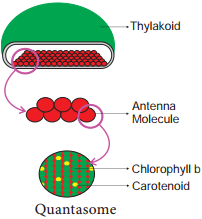
Quantasomes are the morphological expression of physiological photosynthetic units, located on the inner membrane of thylakoid lamellae. Each quantasome measures about 180 A° × 160 A° and 100 A° thickness. In 1952, Steinman observed granular structures in chloroplast lamellae under electron microscope. Later, Park and Biggins (1964) confirmed these granular structures as physiological units of photosynthesis and coined the term Quantasome.

According to them one quantasome contains about 230 chlorophyll molecules. A minimum number of chlorophyll and other accessory pigments act together in a photochemical reaction to release one oxygen or to reduce one molecule of CO2. It constitutes a photosynthetic unit. (Figure 13.6) Emerson and Arnold (1932) based on flashing light experiment found 2500 chlorophyll molecules are required to fix one molecule of CO2.
Photosynthetic Unit (Quantasome) img 1

However, the reduction or fixation of one CO2 requires 10 quanta of light and so each unit would contain 1/10 of 2500 i.e. 250 molecules. Usually 200 to 300 chlorophyll molecules are considered as a physiological unit of photosynthesis. According to Emerson 8 quanta of light are required for the release of one oxygen molecule or reduction of one Carbon dioxide molecule. The quantum yield is 1/8 or 12%.

Quantasomes are particles found in the thylakoid membrane of chloroplasts in which photosynthesis takes place. They are composed of lipids and proteins that include various photosynthetic pigments and redox carriers. For this reason they are considered to be photosynthetic units.

The photosynthetic unit is experimentally defined as the number of oxygen. molecules evolved or carbon dioxide molecules reduced per molecule of chlorophyll when the chloroplast pigments are excited by one flash of light so.

Quantasomes are particles found in a paracrystalline array of the thylakoid membrane of chloroplasts in which photosynthesis takes place. They are believed to be the structural and functional units of the chloroplast.

The cell is the smallest structural and functional unit of living organisms, which can exist on its own. Therefore, it is sometimes called the building block of life. Some organisms, such as bacteria or yeast, are unicellular consisting only of a single cell while others, for instance, mammalians, are multicellular.

Quantasomes are particles found in the thylakoid membrane of chloroplasts in which photosynthesis takes place. They occur in 2 sizes: the smaller quantasome is thought to represent the site of photosystem I, the larger to represent the site of photosystem II.

The two stages of photosynthesis: Photosynthesis takes place in two stages: light-dependent reactions and the Calvin cycle (light-independent reactions). Light-dependent reactions, which take place in the thylakoid membrane, use light energy to make ATP and NADPH.

The average minimal quantum number remains 10 (efficiency 0.1) as in many algae and typical higher plants. Most of the time the optimal efficiency depends on the availability of some far-red radiation, particularly in the blue region of the spectrum where blue light alone is rather inefficient.

Cyclic photophosphorylation can be defined as the synthesis of ATP coupled to electron transport activated by Photosystem I solely, and can therefore proceed in long-wave-length light (03BB 2265 700 nm). This proces is unaffected by the specific inhibitors of Photosystem II, such as CMU, DCMU and orthophenanthroline.

The reaction centre contains pigments such as chlorophyll and phaeophytin. These absorb light, promoting an electron to a higher energy level within the pigment. The free energy created is used to reduce an electron acceptor and is critical for the production of chemical energy during photosynthesis.

The chlorophyll molecules are grouped into antenna complexes, clusters of several hundred molecules that are anchored onto the thylakoid membrane by special proteins. Within each antenna complex is a specialized set of proteins and chlorophyll molecules that form a reaction.

As you rise from low light intensity to higher light intensity, the rate of photosynthesis will increase because there is more light available to drive the reactions of photosynthesis. At a very high intensity of light, the rate of photosynthesis would drop quickly as the light starts to damage the plant.

Chlorophyll a is the most important photosynthetic pigment because it is directly involved in the conversion of light energy (photons) to chemical energy. All other photosynthetic pigments found in the chloroplasts of higher plants are called “accessory pigments”.