Crassulacean Acid Metabolism or CAM Cycle

Learninsta presents the core concepts of Biology with high-quality research papers and topical review articles.

Crassulacean Acid Metabolism or CAM Cycle

It is one of the carbon pathways identified in succulent plants growing in semi-arid or xerophytic condition. This was first observed in crassulaceae family plants like Bryophyllum, Sedum, Kalanchoe and is the reason behind the name of this cycle. It is also noticed in plants from other families Examples: Agave, Opuntia, Pineapple and Orchids.

The stomata are closed during day and are open during night (Scotoactive). This reverse stomatal rhythm helps to conserve water loss through transpiration and will stop the fixation of CO2 during the day time. At night time CAM plants fix CO2 with the help of Phospho Enol Pyruvic acid (PEP) and produce oxalo acetic acid (OAA). Subsequently OAA is converted into malic acid like C4 cycle and gets accumulated in vacuole increasing the acidity.

During the day time stomata are closed and malic acid is decarboxylated into pyruvic acid resulting in the decrease of acidity. CO2 thus formed enters into Calvin Cycle and produces carbohydrates (Figure 13.19).
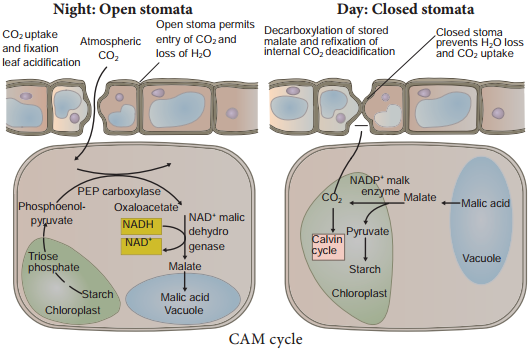
Crassulacean Acid Metabolism or CAM Cycle img 1

Significance of CAM Cycle

  1. It is advantageous for succulent plants to obtain CO2 from malic acid when stomata are closed.
  2. During day time stomata are closed and CO2 is not taken but continue their photosynthesis.
  3. Stomata are closed during the day time and help the plants to avoid transpiration and water loss.

Crassulacean acid metabolism (CAM) is a photosynthetic adaptation to periodic water supply, occurring in plants in arid regions (e.g., cacti) or in tropical epiphytes (e.g., orchids and bromeliads). CAM plants close their stomata during the day and take up CO2 at night, when the air temperature is lower.

Crassulacean acid metabolism, also known as CAM photosynthesis, is a carbon fixation pathway that evolved in some plants as an adaptation to arid conditions that allows a plant to photosynthesize during the day, but only exchange gases at night.

In CAM plants, carbon dioxide is only gathered at night, when the stomata open. Click for more detail. During the day, the malic acid is converted back to carbon dioxide. This type of photosynthesis is known as Crassulacean Acid Metabolism because of the storage of carbon dioxide at night as an acid.

Crassulacean acid metabolism (CAM) is an important elaboration of photosynthetic carbon fixation that allows chloroplast-containing cells to fix CO2 initially at night using phosphoenolpyruvate carboxylase (PEPC) in the cytosol.

Some plants that are adapted to dry environments, such as cacti and pineapples, use the crassulacean acid metabolism (CAM) pathway to minimize photorespiration. This name comes from the family of plants, the Crassulaceae, in which scientists first discovered the pathway. Image of a succulent.

Biochemical studies indicate that photorespiration consumes ATP and NADPH, the high-energy molecules made by the light reactions. Thus, photorespiration is a wasteful process because it prevents plants from using their ATP and NADPH to synthesize carbohydrates.

The CAM plants close their stomata at the time of day and open it in night. When the stomata remains closed then this will prevent the loss of water by the process of transpiration. This process also prevents the carbon dioxide gas being entering into the plant leaves.

Crassulacean acid metabolism (CAM) is a photosynthetic adaptation to periodic water supply, occurring in plants in arid regions (e.g., cacti) or in tropical epiphytes (e.g., orchids and bromeliads). CAM plants close their stomata during the day and take up CO2 at night, when the air temperature is lower.

Unlike plants in wetter environments, CAM plants absorb and store carbon dioxide through open pores in their leaves at night, when water is less likely to evaporate. During the day, the pores, also called stomata, stay closed while the plant uses sunlight to convert carbon dioxide into energy, minimizing water loss.

Without enough light, a plant cannot photosynthesise very quickly – even if there is plenty of water and carbon dioxide and a suitable temperature. Increasing the light intensity increases the rate of photosynthesis, until some other factor – a limiting factor – becomes in short supply.

But there are few plants like Peepal which gives out Oxygen at night by CAM photosynthesis which are the plants the Crassulaceae family. During daylight hours, plants take in carbon dioxide and release oxygen through photosynthesis, and at night only about half that carbon is then released through respiration.
Hatch & Slack Pathway or Cycle or Dicarboxylic Acid Pathway or Dicarboxylation Pathway

Learninsta presents the core concepts of Biology with high-quality research papers and topical review articles.

Hatch & Slack Pathway or Cycle or Dicarboxylic Acid Pathway or Dicarboxylation Pathway

Till 1965, Calvin cycle is the only pathway for CO2 fixation. But in 1965, Kortschak, Hart and Burr made observations in sugarcane and found C4 or dicarboxylic acid pathway. Malate and aspartate are the major labelled products. This observation was confirmed by Hatch & Slack in 1967.

This alternate pathway for the fixation of CO2 was found in several tropical and sub-tropical grasses and some dicots. C4 cycle is discovered in more than 1000 species. Among them 300 species belong to dicots and rest of them are monocots.

C4 plants represent about 5% of Earth’s plant biomass and 1% of its known plant species. Despite this scarcity, they account for about 30% of terrestrial carbon fixation. Increasing the proportion of C4 plants on earth could assist biosequestration of CO2 and represent an important climate change avoidance strategy.

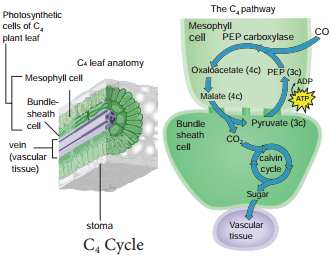
C4 pathway is completed in two phases, first phase takes place in stroma of mesophyll cells, where the CO2
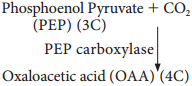
acceptor molecule is 3-Carbon compound, phosphoenol pyruvate (PEP) to form 4-carbon Oxalo acetic acid (OAA). The first product is a 4-carbon and so it is named as C4 cycle.

oxalo acetic acid is a dicarboxylic acid and hence this cycle is also known as dicarboxylic acid pathway (Figure 13.18). Carbon dioxide fixation takes place in two places one in mesophyll and another in bundle sheath cell (di carboxylation pathway).

It is the adaptation of tropical and sub tropical plants growing in warm and dry conditions. Fixation of CO2 with minimal loss is due to absence of photorespiration. C4 plants require 5 ATP and 2 NADPH + H+ to fix one molecule of CO2.
Hatch & Slack Pathway or C Cycle or Dicarboxylic Acid Pathway or Dicarboxylation Pathway img 1

Stage: I Mesophyll Cells

Oxaloacetic acid (OAA) is converted into malic acid or aspartic acid and is transported to the bundle sheath cells through plasmodesmata.
Hatch & Slack Pathway or C Cycle or Dicarboxylic Acid Pathway or Dicarboxylation Pathway img 2

Stage: II Bundle Sheath Cells

Malic acid undergoes decarboxylation and produces a 3 carbon compound Pyruvic acid and CO2. The released CO2 combines with RUBP and follows the calvin cycle and finally sugar is released to the phloem. Pyruvic acid is transported to the mesophyll cells.
Hatch & Slack Pathway or C Cycle or Dicarboxylic Acid Pathway or Dicarboxylation Pathway img 3

Significance of C4 Cycle

  1. Plants having C4 cycle are mainly of tropical and sub-tropical regions and are able to survive in environment with low CO2 concentration.
  2. C4 plants are partially adapted to drought conditions.
  3. Oxygen has no inhibitory effect on C4 cycle since PEP carboxylase is insensitive to O2.
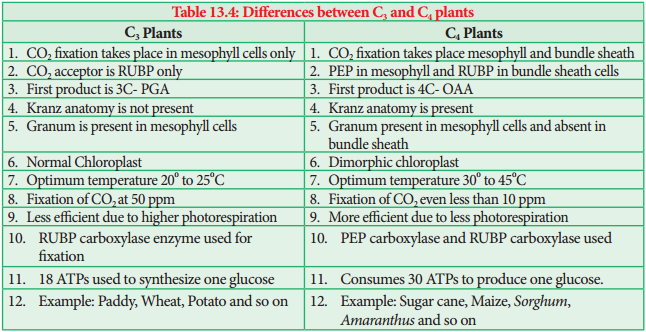
  4. Due to absence of photorespiration, CO2 Compensation Point for C4 is lower than that of C3 plants (C4 Cycle) are given in table 13.4

Hatch & Slack Pathway or C Cycle or Dicarboxylic Acid Pathway or Dicarboxylation Pathway img 4

Dark Reaction or Cycle or Biosynthetic Phase or Photosynthetic Carbon Reduction (PCR) Cycle

Learninsta presents the core concepts of Biology with high-quality research papers and topical review articles.

Dark Reaction or Cycle or Biosynthetic Phase or Photosynthetic Carbon Reduction (PCR) Cycle

Biosynthetic phase of photosynthesis utilises assimilatory powers (ATP and NADPH + H+) produced during light reaction are used to fix and reduce carbon dioxide into carbohydrates. This reaction does not require light. Therefore, it is named Dark reaction. Ribulose 1, 5 bisphosphate (RUBP) act as acceptor molecule of carbon dioxide and fix the CO2 by RUBISCO enzyme.

The first product of the pathway is a 3 – carbon compound (Phospho Glyceric Acid) and so it is also called as C3 Cycle. It takes place in the stroma of the chloroplast.

M. Melvin Calvin, A.A. Benson and their co-workers in the year 1957 found this path way of carbon fixation. Melvin Calvin was awarded Nobel Prize for this in 1961 and this pathway named after the discoverers as Calvin-Benson Cycle. Dark reaction is temperature dependent and so it is also called thermo-chemical reaction.

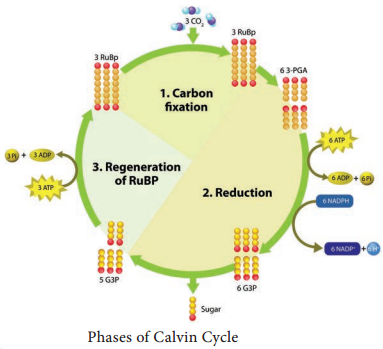
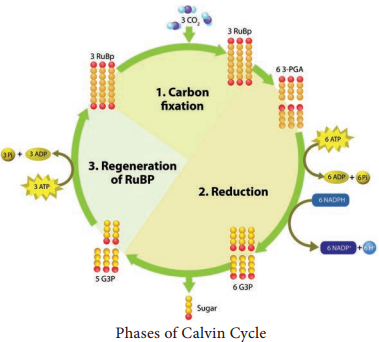
Dark reaction consists of three phases: (Figure 13.16).
Dark Reaction or Cycle or Biosynthetic Phase or Photosynthetic Carbon Reduction (PCR) Cycle img 1

  1. Carboxylation (fixation)
  2. Reduction (Glycolytic Reversal)
  3. Regeneration

Phase 1 – Carboxylation (Fixation)

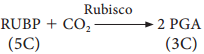
The acceptor molecule Ribulose 1, 5 Bisphosphate (RUBP) a 5 carbon compound with the help of RUBP carboxylase oxygenase (RUBISCO) enzyme accepts one molecule of carbon dioxide to form an unstable 6 carbon compound. This 6C compound is broken down into two molecules of 3-carbon compound phospho glyceric acid (PGA) (Figure 13.17).
Dark Reaction or Cycle or Biosynthetic Phase or Photosynthetic Carbon Reduction (PCR) Cycle img 2

Phase 2 – Glycolytic Reversal / Reduction

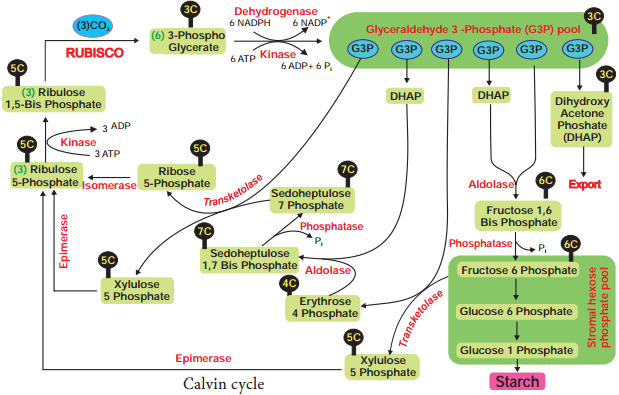
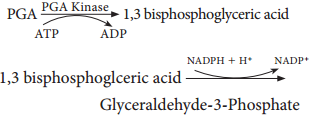
Phospho glyceric acid is phosphorylated by ATP and produces 1, 3 bis phospho glyceric acid by PGA kinase. 1, 3 bis phospho glyceric acid is reduced to glyceraldehyde 3 Phosphate (G-3-P) by using the reducing power NADPH + H+. Glyceraldehyde 3 phosphate is converted into its isomeric form di hydroxy acetone phosphate (DHAP).
Dark Reaction or Cycle or Biosynthetic Phase or Photosynthetic Carbon Reduction (PCR) Cycle img 3

Phase 3 – Regeneration

Regeneration of RUBP involves the formation of several intermediate compounds of 6-carbon, 5-carbon,4-carbon and 7- carbon skeleton. Fixation of one carbon dioxide requires 3 ATPs and 2 NADPH + H+, and for the fixation of 6 CO2 requires 18 ATPs and 12 NADPH + H+ during C3 cycle. One 6 carbon compound is the net gain to form hexose sugar.
Dark Reaction or Cycle or Biosynthetic Phase or Photosynthetic Carbon Reduction (PCR) Cycle img 4

Overall Equation for Dark Reaction:
6CO2 + 18ATP + 12NADPH + H+ → C6H12O6 + 6H2O + 18Pi + 12NADP+

Photophosphorylation

Learninsta presents the core concepts of Biology with high-quality research papers and topical review articles.

Photophosphorylation

Phosphorylation taking place during respiration is called as oxidative phosphorylation and ATP produced by the breakdown of substrate is known as substrate level phosphorylation. In this topic, we are going to learn about phosphorylation taking place in chloroplast with the help of light. During the movement of electrons through carrier molecules ATP and NADPH + H+ are produced.

Phosphorylation is the process of synthesis of ATP by the addition of inorganic phosphate to ADP. The addition of phosphate here takes place with the help of light generated electron and so it is called as photophosphorylation. It takes place in both cyclic and non-cyclic electron transport.

Cyclic Photophosphorylation

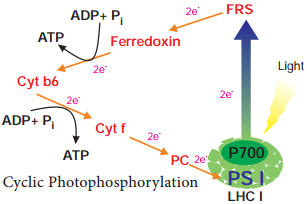
Cyclic photophosphorylation refers to the electrons ejected from the pigment system I (Photosystem I) and again cycled back to the PS I. When the photons activate P700 reaction centre photosystem II is activated. Electrons are raised to the high energy level.

The primary electron acceptor is Ferredoxin Reducing Substance (FRS) which transfers electrons to Ferredoxin (Fd), Plastoquinone (PQ), cytochrome b6-f complex, Plastocyanin (PC) and finally back to chlorophyll P700 (PS I).

During this movement of electrons Adenosine Di Phosphate (ADP) is phosphorylated, by the addition of inorganic phosphate and generates Adenosine Tri Phosphate (ATP). Cyclic electron transport produces only ATP and there is no NADPH + H+ formation.

At each step of electron transport, electron loses potential energy and is used by the transport chain to pump H+ ions across the thylakoid membrane. The proton gradient triggers ATP formation in ATP synthase enzyme situated on the thylakoid membrane.

Photosystem I need light of longer wave length (> P700 nm). It operates under low light intensity, less CO2 and under anaerobic conditions which makes it considered as earlier in evolution (Figure 13.13).
Photophosphorylation img 1

Non-Cyclic Photophosphorylation

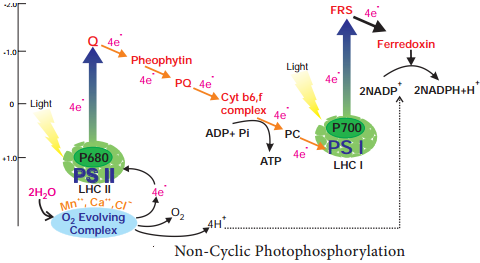
When photons are activated reaction centre of pigment system II(P680), electrons moved to the high energy level. Electrons from high energy state passes through series of electron carriers like pheophytin, plastoquinone, cytochrome complex, plastocyanin and finally accepted by PS I (P700). During this movement of electrons from PS II to PS I ATP is generated (Figure 13.16).
Photophosphorylation img 2

PS I (P700) is activated by light, electrons are moved to high energy state and accepted by electron acceptor molecule ferredoxin reducing Substance (FRS). During the downhill movement through ferredoxin, electrons are transferred to NADP+ and reduced into NADPH + H+ (H+ formed from splitting of water by light).

Electrons released from the photosystem II are not cycled back. It is used for the reduction of NADP+ into NADPH + H+. During the electron transport it generates ATP and hence this type of photophosphorylation is called non-cyclic photophosphorylation. The electron flow looks like the appearance of letter ‘Z’ and so known as Z scheme.

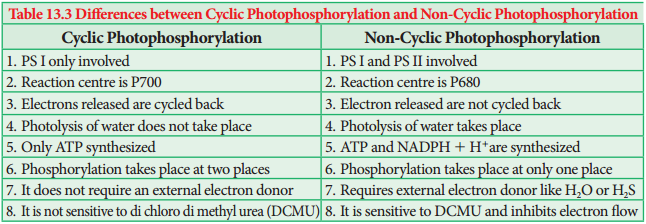
When there is availability of NADP+ for reduction and when there is splitting of water molecules both PS I and PS II are activated (Table 13.3). Non-cyclic electron transport PS I and PS II both are involved co operatively to transport electrons from water to NADP+ (Figure 13.14).
Photophosphorylation img 3
Photophosphorylation img 4

Bio Energetics of Light Reaction

  • To release one electron from pigment system it requires two quanta of light.
  • One quantum is used for transport of electron from water to PS I.
  • Second quantum is used for transport of electron from PS I to NADP+
  • Two electrons are required to generate one NADPH + H+
  • During Non-Cyclic electron transport two NADPH + H+ are produced and it requires 4 electrons.
  • Transportation of 4 electrons requires 8 quanta of light

Chemiosmotic Theory

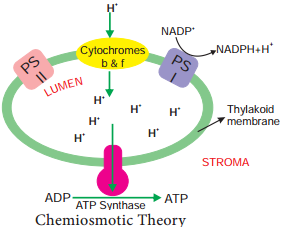
Chemiosmosis theory was proposed by P. Mitchell (1966). According to this theory electrons are transported along the membrane through PS I and PS II and connected by Cytochrome b6-f complex. The flow of electrical current is due to difference in electrochemical potential of protons across the membrane.

Splitting of water molecule takes place inside the membrane. Protons or H+ ions accumulate within the lumen of the thylakoid (H+ increase 1000 to 2000 times). As a result, proton concentration is increased inside the thylakoid lumen. These protons move across the membrane because the primary acceptor of electron is located outside the membrane.

Protons in stroma less in number and creates a proton gradient. This gradient is broken down due to the movement of proton across the membrane to the stroma through CFO of the ATP synthase enzyme. The proton motive force created inside the lumen of thylakoid or chemical gradient of H+ ion across the membrane stimulates ATP generation (Figure 13.15).
Photophosphorylation img 5

The evolution of one oxygen molecule (4 electrons required) requires 8 quanta of light. C3 plants utilise 3 ATPs and 2 NADPH + H+ to evolve one Oxygen molecule. To evolve 6 molecules of Oxygen 18 ATPs and 12 NADPH + H+ are utilised. C4 plants utilise 5 ATPs and 2 NADPH + H+ to evolve one oxygen molecule. To evolve 6 molecules of Oxygen 30 ATPs and 12 NADPH + H+ are utilised.

Photo Chemical Phase of Light Reaction

Learninsta presents the core concepts of Biology with high-quality research papers and topical review articles.

Photo Chemical Phase of Light Reaction

In this phase electrons pass through electron carrier molecules and generate assimilatory powers ATP and NADPH + H+. Splitting of water molecule generates electrons replacing electrons produced by the light.

Photolysis of Water

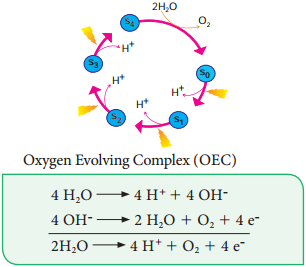
The process of Photolysis is associated with Oxygen Evolving Complex (OEC) or water splitting complex in pigment system II and is catalysed by the presence of Mn++ and Cl. When the pigment system II is active it receives light and the water molecule splits into OH ions and H+ ions. The OH ions unite to form water molecules again and release O2 and electrons (Figure 13.11).
Photo Chemical Phase of Light Reaction img 1

Electron Transport Chain of Chloroplast
Electron Transport Chain in each photosystem involves four complexes:

Core Complex (CC):
CC I in PS I the reaction centre is P700, CC II in PS II the reaction centre is P680

Light Harvesting Complex or Antenna

Complex (LHC):
Two types: LHC I in PS I and LHC II in PS II.

Cytochrome b6 f Complex:

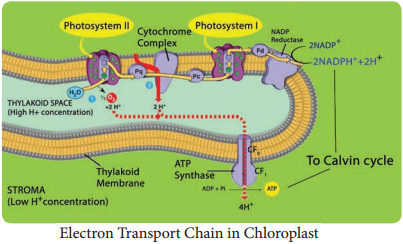
It is the non-pigmented protein complex connecting PS I and PS II. Plastoquinone (PQ) and Plastocyanin (PC) are intermediate complexes acting as mobile or shuttle electron carriers of Electron Transport Chain. PQ acts as shuttle between PS II and Cytochrome b6 – f complex and PC connects.

Cytochrome b6-f and PS I Complex

ATPase complex or Coupling Factor:
It is found in the surface of thylakoid membrane. This complex is made up of CF1 and CF0 factors. This complex utilizes energy from ETC and converts ADP and inorganic phosphate (Pi) into ATP (Figure 13.12).
Photo Chemical Phase of Light Reaction img 2