Structure of ATP

Learninsta presents the core concepts of Biology with high-quality research papers and topical review articles.

Structure of ATP

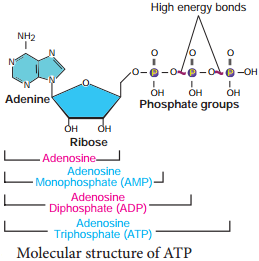
Respiration is responsible for generation of ATP. The discovery of ATP was made by Karl Lohman (1929). ATP is a nucleotide consisting of a base-adenine, a pentose sugar-ribose and three phosphate groups. Out of three phosphate groups the last two are attached by high energy rich bonds (Figure 14.3). On hydrolysis, it releases energy (7.3 K cal or 30.6 KJ/ATP) and it is found in all living cells and hence it is called universal energy currency of the cell.
Structure of ATP img 1

ATP is an instant source of energy within the cell. The energy contained in ATP is used in synthesis carbohydrates, proteins and lipids. The energy transformation concept was established by Lipman (1941).

ATP is a nucleotide that consists of three main structures: the nitrogenous base, adenine; the sugar, ribose; and a chain of three phosphate groups bound to ribose. The phosphate tail of ATP is the actual power source which the cell taps.

The structure of ATP is a nucleoside triphosphate, consisting of a nitrogenous base (adenine), a ribose sugar, and three serially bonded phosphate groups. ATP is commonly referred to as the “energy currency” of the cell, as it provides readily releasable energy in the bond between the second and third phosphate groups.

It allows the cell to store energy briefly and transport it within the cell to support endergonic chemical reactions. The structure of ATP is that of an RNA nucleotide with three phosphates attached. As ATP is used for energy, a phosphate group or two are detached, and either ADP or AMP is produced.

ATP and ADP are two types of nucleotides mainly involved in the transfer of energy between biochemical reactions in the cell. Both ATP and ADP are composed of a ribose sugar, adenosine, and phosphate groups. ATP molecule is composed of three phosphate molecules while ADP is composed of two phosphate molecules.

ATP is composed of ribose, a five-carbon sugar, three phosphate groups, and adenine, a nitrogen-containing compound (also known as a nitrogenous base).

From the perspective of biochemistry, ATP is classified as a nucleoside triphosphate, which indicates that it consists of three components: a nitrogenous base (adenine), the sugar ribose, and the triphosphate.

Give three examples of how ATP is used in organisms. ATP is used to build large molecules such as proteins, to temporarily store energy in the form of fat, and to allow for all types of cellular transport.

Its Structure. The ATP molecule is composed of three components. These phosphates are the key to the activity of ATP. ATP consists of a base, in this case adenine (red), a ribose (magenta) and a phosphate chain (blue).

All living things, plants and animals, require a continual supply of energy in order to function. The energy is used for all the processes which keep the organism alive. This special carrier of energy is the molecule adenosine triphosphate, or ATP.

The process of phosphorylating ADP to form ATP and removing a phosphate from ATP to form ADP in order to store and release energy respectively is known as the ATP cycle. The energy within an ATP molecule is stored in the phosphate bonds of the ATP. When a cell needs energy, a phosphate is removed from ATP.

Any metabolic process that requires oxygen to occur is referred to as aerobic. Humans, most other multicellular organisms, and some microorganisms require oxygen for the efficient capture of the chemical energy from food and its transformation into the cellular energy form known as ATP.

Energy is stored in the bonds joining the phosphate groups (yellow). The covalent bond holding the third phosphate group carries about 7, 300 calories of energy.

Adenosine triphosphate (ATP), energy-carrying molecule found in the cells of all living things. ATP captures chemical energy obtained from the breakdown of food molecules and releases it to fuel other cellular processes.

For example, both breathing and maintaining your heartbeat require ATP. In addition, ATP helps to synthesize fats, nerve impulses, as well as move certain molecules into or out of cells. Some organisms, such as bioluminescent jellyfish and fireflies, even use ATP to produce light.

All organisms need energy. Life depends on the transfer of energy. ATP is an important source of energy for biological processes. In photosynthesis energy is transferred to ATP in the light-dependent stage and the ATP is utilised during synthesis in the light-independent stage.

ATP is required for various biological processes in animals including; Active Transport, Secretion, Endocytosis, Synthesis and Replication of DNA and Movement.

The Adenosine triphosphate (ATP) molecule is the nucleotide known in biochemistry as the “molecular currency” of intracellular energy transfer; that is, ATP is able to store and transport chemical energy within cells. ATP also plays an important role in the synthesis of nucleic acids.

Beginning with energy sources obtained from their environment in the form of sunlight and organic food molecules, eukaryotic cells make energy-rich molecules like ATP and NADH via energy pathways including photosynthesis, glycolysis, the citric acid cycle, and oxidative phosphorylation.

The energy released by ATP is released when a phosphate group is removed from the molecule. ATP has three different phosphate groups, but the bond holding the third phosphate group is unstable and is very easily broken. Where does ADP come from? When phosphate is removed, energy is released and ATP becomes ADP.
Gaseous Exchange

Learninsta presents the core concepts of Biology with high-quality research papers and topical review articles.

Gaseous Exchange

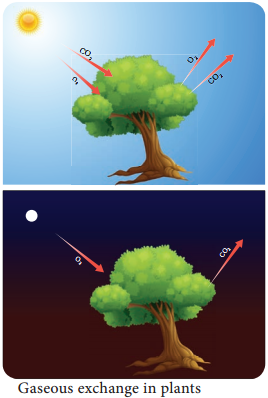
The term respiration was coined by Pepys (1966). Respiration is a biological process in which oxidation of various food substances like carbohydrates, proteins and fats take place and as a result of this, energy is produced where O2 is taken in and CO2 is liberated. The organic substances which are oxidised during respiration are called respiratory substrates.

Among these, glucose is the commonest respiratory substrate. Breaking of C-C bonds of complex organic compounds through oxidation within the cells leads to energy release. The energy released during respiration is stored in the form of ATP (Adenosine Tri Phosphate) as well as liberated heat. Respiration occurs in all the living cells of organisms. The overall process of respiration corresponds to a reversal of photosynthesis. C6H12O6 + 6O2 → 6CO2 + 6H2O + Energy (686 K cal or 2868 KJ)
(1K cal = 4.184 KJ)
Structure of ATP img 1

Depending upon the nature of respiratory substrate, Blackman divided respiration into,

  1. Floating Respiration
  2. Protoplasmic Respiration

When carbohydrate or fat or organic acid serves as respiratory substrate and it is called floating respiration. It is a common mode of respiration and does not produce any toxic product. Whereas respiration utilizing protein as a respiratory substrate, it is called protoplasmic respiration. Protoplasmic respiration is rare and it depletes structural and functional proteins of protoplasm and liberates toxic ammonia.

Compensation Point

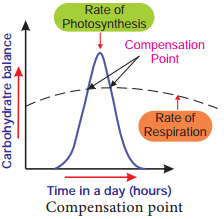
At dawn and dusk the intensity of light is low. The point at which CO2 released in respiration is exactly compensated by CO2 fixed in photosynthesis that means no net gaseous exchange takes place, it is called compensation point. At this moment, the amount of oxygen released from photosynthesis is equal to the amount of oxygen utilized in respiration.

The two common factors associated with compensation point are CO2 and light (Figure 14.2). Based on this there are two types of compensation point. They are CO2 compensation point and light compensation point. C3 plants have compensation points ranging from 40-60 ppm (parts per million) CO2 while those of C4 plants ranges from 1-5 ppm CO2.
Structure of ATP img 2

Photosynthesis in Bacteria

Learninsta presents the core concepts of Biology with high-quality research papers and topical review articles.

Photosynthesis in Bacteria

Though we study about bacterial photosynthesis as the last part, bacterial photosynthesis formed first and foremost in evolution. Bacteria does not have specialized structures like chloroplast. It has a simple type of photosynthetic apparatus called chlorosomes and chromatophores (Table 13.6). Van Neil (1930) discovered a bacterium that releases sulphur instead of oxygen during photosynthesis.

Photosynthesis in Plants

Photosynthesis in Bacteria

1. Cyclic and non-cyclic phosphorylation
takes place
1. Only cyclic phosphorylation takes place
2. Photosystem I and II involved2. Photosystem I only involved
3. Electron donor is water3. Electron donor is H<sub>2</sub>S
4. Oxygen is evolved4. Oxygen is not evolved
5. Reaction centres are P700 and P6805. Reaction centre is P<sub>870</sub>
6. Reducing agent is NADPH + H+6. Reducing agent is NADH + H+
7. PAR is 400 to 700 nm7. PAR is above 700 nm
8. Chlorophyll, carotenoid and xanthophyll8. Bacterio chlorophyll and bacterio viridin
9. Photosynthetic Apparatus – Chloroplast9. It is chlorosomes and chromatophores

Here, electron donor is hydrogen sulphide (H2S) and only one photosystem is involved (PS I) and the reaction centre is P870. Pigments present in bacteria are bacteriochlorophyll a, b, c, d, e and g and carotenoids. Photosynthetic bacteria are classified into three groups:

1.Green Sulphur Bacteria.
Example: Chlorobacterium and Chlorobium.

2. Purple Sulphur Bacteria.
Example: Thospirillum and Chromatium.

3. Purple Non-Sulphur Bacteria.
Example: Rhodopseudomonas and Rhodospirillum.
Photosynthesis in Bacteria img 1

Cyanobacteria contain chlorophyll while other forms of bacteria contain bacteriochlorophyll. Cyanobacteria perform photosynthesis using water as an electron donor in a similar manner to plants. This results in the production of oxygen and is known as oxygenic photosynthesis.

There are several groups of bacteria that undergo anoxygenic photosynthesis: green sulfur bacteria, green and red filamentous anoxygenic phototrophs (FAPs), phototrophic purple bacteria, phototrophic acidobacteria, and phototrophic heliobacteria.

There are several groups of bacteria that undergo anoxygenic photosynthesis: green sulfur bacteria, green and red filamentous anoxygenic phototrophs (FAPs), phototrophic purple bacteria, phototrophic acidobacteria, and phototrophic heliobacteria.

The main purpose of photosynthesis is to convert radiant energy from the sun into chemical energy that can be used for food. Cellular respiration is the process that occurs in the mitochondria of organisms (animals and plants) to break down sugar in the presence of oxygen to release energy in the form of ATP.

Oxygenic photosynthetic bacteria perform photosynthesis in a similar manner to plants. They contain light-harvesting pigments, absorb carbon dioxide, and release oxygen. Cyanobacteria or Cyanophyta are the only forms of oxygenic photosynthetic bacteria known to date.

An example of photosynthesis is how plants convert sugar and energy from water, air and sunlight into energy to grow. The water from the leaves evaporates through the stomata, and filling its place, entering the stomata from the air, is carbon dioxide. Plants need carbon dioxide to make food.

Algae are sometimes considered plants and sometimes considered “protists” (a grab-bag category of generally distantly related organisms that are grouped on the basis of not being animals, plants, fungi, bacteria, or archaeans).

In all phototrophic eukaryotes, photosynthesis takes place inside a chloroplast, an organelle that arose in eukaryotes by endosymbiosis of a photosynthetic bacterium (see Unique Characteristics of Eukaryotic Cells). These chloroplasts are enclosed by a double membrane with inner and outer layers.

The most influential bacteria for life on Earth are found in the soil, sediments and seas. Well known functions of these are to provide nutrients like nitrogen and phosphorus to plants as well as producing growth hormones. By decomposing dead organic matter, they contribute to soil structure and the cycles of nature.

Bacteria are classified into five groups according to their basic shapes: spherical (cocci), rod (bacilli), spiral (spirilla), comma (vibrios) or corkscrew (spirochaetes). They can exist as single cells, in pairs, chains or clusters.

Photosynthesis converts solar energy into chemical energy. Photosynthesis produces carbohydrates. Plants need sunlight, carbon dioxide, water, nutrients, and chlorophyll to complete photosynthesis. Plants use chlorophyll, water, and carbon dioxide to make sugar.

Photosynthesis is the biochemical process in which energy from sunlight is converted by plants, algae, and some bacteria into sugars, which are used by the organism as food. However, there is a least one exception: a little bacterium deep under the Pacific Ocean which manages photosynthesis without sunlight.

Cyanobacteria are oxygenic photosynthetic bacteria. They harvest the sun’s energy, absorb carbon dioxide, and emit oxygen. Like plants and algae, cyanobacteria contain chlorophyll and convert carbon dioxide to sugar through carbon fixation.

According to the diagram of photosynthesis, the process begins with three most important non-living elements: water, soil, and carbon dioxide. Plants begin making their ‘food’, which basically includes large quantities of sugars and carbohydrate, when sunlight falls on their leaves.

The reactants for photosynthesis are light energy, water, carbon dioxide and chlorophyll, while the products are glucose (sugar), oxygen and water.

Factors Affecting Photosynthesis

Learninsta presents the core concepts of Biology with high-quality research papers and topical review articles.

Factors Affecting Photosynthesis

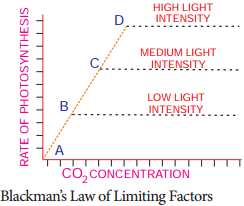
In 1860, Sachs gave three cardinal points theory explaining minimum, optimum and maximum factors that control photosynthesis. In 1905, Blackman put forth the importance of smallest factor. Blackman’s law of limiting factor is actually a modified Law proposed by Liebig’s Law of minimum. According to Blackman, “When a process is conditioned as to its rapidity by a number of separate factors, the rate of the process is limited by the pace of the lowest factor”.

To conclude in an easy way “at any given point of time the lowest factor among essentials will limit the rate of photosynthesis”. For example, when even sufficient light intensity is available, photosynthesis may be low due to low CO2 in the atmosphere.

Here, CO2 acts as a limiting factor. If CO2 is increased in the atmosphere the rate of photosynthesis also increases. Further increase in photosynthesis is possible only if the available light intensity is also increased proportionately (Figure 13.21).
Factors Affecting Photosynthesis img 1

Factors affecting photosynthesis are further grouped into External or Environmental factors and Internal factors.

I. External Factors:
Light, carbon dioxide, temperature, water, mineral and pollutants.

II. Internal Factors:
Pigments, protoplasmic factor, accumulation of carbohydrates, anatomy of leaf and hormones.

External Factors

1. Light

Energy for photosynthesis comes only from light. Photooxidation of water and excitation of pigment molecules are directly controlled by light. Stomatal movement leading to diffusion of CO2 is indirectly controlled by light.

a. Intensity of Light:

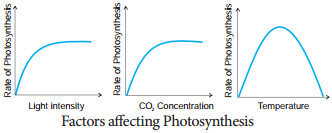
Intensity of light plays a direct role in the rate of photosynthesis. Under low intensity the photosynthetic rate is low and at higher intensity photosynthetic rate is higher. It also depends on the nature of plants. Heliophytes (Bean Plant) require higher intensity than Sciophytes (Oxalis).

b. Quantity of Light:

In plants which are exposed to light for longer duration (Long day Plants) photosynthetic rate is higher.

c. Quality of light:

Different wavelengths of light affect the rate of photosynthesis because pigment system does not absorb all the rays equally. Photosynthetic rate is maximum in blue and red light. Photosynthetically Active Radiation (PAR) is between 400 to 700 nm. Red light induces highest rate of photosynthesis and green light induces lowest rate of photosynthesis.

2. Carbon Dioxide

CO2 is found only 0.3% in the atmosphere but plays a vital role. Increase in concentration of CO2 increases the rate of photosynthesis (CO2 concentration in the atmosphere is 330 ppm). If concentration is increased beyond 500ppm, rate of photosynthesis will be affcted showing the inhibitory effect.

3. Oxygen

The rate of photosynthesis decreases when there is an increase of oxygen concentration. This Inhibitory effect of oxygen was first discovered by Warburg (1920) using green algae Chlorella.

4. Temperature

The optimum temperature for photosynthesis varies from plant to plant. Temperature is not uniform in all places. In general, the optimum temperature for photosynthesis is 25°C to 35°C. This is not applicable for all plants.

The ideal temperature for plants like Opuntia is 55°C, Lichens 25°C and Algae growing in hot spring photosynthesis is 75°C. Whether high temperature or low temperature it will close the stomata as well as inactivate the enzymes responsible for photosynthesis (Figure 13.22).
Factors Affecting Photosynthesis img 2

5. Water

Photolysis of water provides electrons and protons for the reduction of NADP, directly. Indirect roles are stomatal movement and hydration of protoplasm. During water stress, supply of NADPH + H+ is affected.

6. Minerals

Deficiency of certain minerals affect photosynthesis e.g. mineral involved in the synthesis of chlorophyll (Mg, Fe and N), Phosphorylation reactions (P), Photolysis of water (Mn and Cl), formation of plastocyanin (Cu).

7. Air pollutants

Pollutants like SO2, NO2, O3 (Ozone) and Smog affects rate of photosynthesis.

Internal Factors

1. Photosynthetic Pigments
It is an essential factor and even a small quantity is enough to carry out photosynthesis.

2. Protoplasmic Factor
Hydrated protoplasm is essential for photosynthesis. It also includes enzymes responsible for Photosynthesis.

3. Accumulation of Carbohydrates
Photosynthetic end products like carbohydrates are accumulated in cells and if translocation of carbohydrates is slow then this will affect the rate of photosynthesis.

4. Anatomy of Leaf
Thickness of cuticle and epidermis, distribution of stomata, presence or absence of Kranz anatomy and relative proportion of photosynthetic cells affect photosynthesis.

5. Hormones
Hormones like gibberellins and cytokinin increase the rate of photosynthesis.

Photorespiration or Cycle or Photosynthetic Carbon Oxidation (PCO) Cycle

Learninsta presents the core concepts of Biology with high-quality research papers and topical review articles.

Photorespiration or Cycle or Photosynthetic Carbon Oxidation (PCO) Cycle

Respiration is a continuous process for all living organisms including plants. Decker (1959) observed that rate of respiration is more in light than in dark. Photorespiration is the excess respiration taking place in photosynthetic cells due to absence of CO2 and increases of O2 (Table 13.5). This condition changes the carboxylase role of RUBISCO into oxygenase.

Photorespiration

Dark respiration

1. It takes place in photosynthetic green cells1. It takes place in all living cells
2. It takes place only in the presence of light2. It takes place all the time
3. It involves chloroplast, peroxisome and
mitochondria
3. It involves only mitochondria
4. It does not involve Glycolysis, Kreb’s Cycle, and ETS4. It involves glycolysis, Kreb’s Cycle and ETS
5. Substrate is glycolic acid5. Substrate is carbohydrates, protein or fats
6. It is not essential for survival6. Essential for survival
7. No phosphorylation and yield of ATP7. Phosphorylation produces ATP energy
8. NADH2 is oxidised to NAD+8. NAD+ is reduced to NADH2
9. Hydrogen peroxide is produced9. Hydrogen peroxide is not produced
10. End products are CO2 and PGA10. End products are CO2 and water

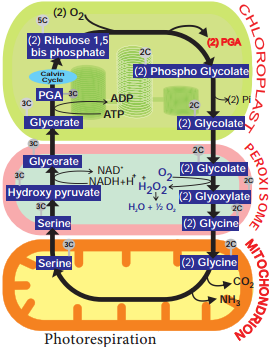
C2 Cycle takes place in chloroplast, peroxisome and mitochondria. RUBP is converted into PGA and a 2C-compound phosphoglycolate by Rubisco enzyme in chloroplast. Since the first product is a 2C-compound, this cycle is known as C2 Cycle. Phosphoglycolate by loss of phosphate becomes glycolate. Glycolate formed in chloroplast enters into peroxisome to form glyoxylate and hydrogen peroxide.

Glyoxylate is converted into glycine and transferred into mitochondria. In mitochondria, two molecules of glycine combine to form serine. Serine enters into peroxisome to form hydroxy pyruvate. Hydroxy pyruvate with help of NADH + H+ becomes glyceric acid.

Glyceric acid is cycled back to chloroplast util ising ATP and becomes Phosphoglyceric acid (PGA) and enters into the Calvin cycle (PCR cycle). Photorespiration does not yield any free energy in the form of ATP. Under certain conditions 50% of the photosynthetic potential is lost because of Photorespiration (Figure 13.20).
Photorespiration or Cycle or Photosynthetic Carbon Oxidation (PCO) Cycle img 1

Significance of Photorespiration

  1. Glycine and Serine synthesised during this process are precursors of many biomolecules like chlorophyll, proteins, nucleotides.
  2. It consumes excess NADH + H+ generated.
  3. Glycolate protects cells from Photo oxidation.

Carbon Dioxide Compensation Point

When the rate of photosynthesis equals the rate of respiration, there is no exchange of oxygen and carbon dioxide and this is called as carbon dioxide compensation point. This will happen at particular light intensity when exchange of gases becomes zero. When light is not a limiting factor and atmospheric CO2 concentration is between 50 to 100 ppm the net exchange is zero.