NCERT Solutions for Class 12 English Flamingo Chapter 6 Poets and Pancakes

Here we are providing NCERT Solutions for Class 12 English Flamingo Chapter 6 Poets and Pancakes. Students can get Class 12 English Poets and Pancakes NCERT Solutions, Questions and Answers designed by subject expert teachers.

Poets and Pancakes NCERT Solutions for Class 12 English Flamingo Chapter 6

Poets and Pancakes NCERT Text Book Questions and Answers

Poets and Pancakes Think as you read 

Question 1.
What does the writer mean by ‘the fiery misery’ of those subjected to make-up?
Answer:
The writer means the misery caused by the incandescent lights that poured out intense heat. The make-up room of the Gemini Studios had bright bulbs in the room full of large mirrors that reflected the glowing lights. Under such blazing heat make-up was done.

Question 2.
What is the example of national integration that the author refers to?
Answer:
The make-up team and also those who came and went were from different states. It was headed by a Bengali and next in hierarchy was a Maharashtrian, assisted by an Andhraite, a Madras Indian Christian, an Anglo-Burmese and other local Tamils. It was truly a gang of nationally integrated make-up men.

Question 3.
What work did the ‘office boy’ do in the Gemini Studios? Why did he join the studios? Why was he disappointed?
Answer:
The office boy applied make-up to the crowds, mixing his paint in a giant vessel and slapping it on the crowd players. He had joined the studios in the hope of becoming a star actor or a top screen writer, director or lyrics writer. He was a bit of a poet. He was disappointed as he was placed low even in the hierarchy of make-up men.

Question 4.
Why did the author appear to be doing nothing at the studios?
Answer:
The author’s job was to cut out newspaper clippings on a wide variety of subjects and store them in files. Many of these had to be written out in hand. Seeing him sitting at his desk and tearing up newspapers most people thought he had nothing to do at the studios.

Question 5.
Why was the office boy frustrated? Who did he show his anger on?
Answer:
The office boy was frustrated because his hopes of making big in the movie world failed. He vent his anger and frustration on Kothamangalam Subbu, the No. 2 in the studios, whom he held responsible for his dishonour and neglect.

Question 6.
Who was Subbu’s principal?
Answer:
S.S. Vasan, the founder of Gemini Studios, was the boss and Subbu’s Principal in the studios. Subbu had a great loyalty to him. This made him identify himself with his principal completely. He turned his entire creativity to his principal’s advantage.

Question 7.
Subbu is described as a many-sided genius. List four of his special abilities.
Answer:
Subbu was a many-sided genius. He was born a Brahmin. It is a virtue in itself as it exposed him to more affluent situations and people. Second, he had the ability to look cheerful at all times. Third, he always had work for somebody. Fourth, he had great loyalty to his principal, S.S. Vasan, the Boss.

Question 8.
Why was the legal adviser referred to as the opposite by others?
Answer:
The lawyer was the only one at the studios who wore pants, tie and sometimes a coat, unlike others who wore khadi dhoti and shirt. His job was to give support and advise on problems, but in fact he created problems. He brought the career of a brilliant actress to an end by terrorizing her. He was rightly called an illegal adviser.

Question 9.
What made the lawyer stand out from the others at Gemini Studios?
Answer:
The lawyer wore pants, a tie and sometimes a coat, while all wore khadi dhoti and white khadi shirt. He looked alone and helpless. He was a man of cold logic in a crowd of dreamers. He was a neutral man among Gandhiites and Khadiites.

Question 10.
Did the people at Gemini Studios have any particular political affiliations?
Answer:
The people at Gemini Studios wore Khadi and worshipped Gandhi, but beyond that they had no particular political interests or understanding. They only had opinions on communism, which they loathed and looked down on communists. They considered communists as heartless atheists who are devoid of emotions. They went about letting loose anarchy in the society.

Question 11.
Why was the Moral Re-Armament Army welcomed at Gemini Studios?
Answer:
The Moral Re-Armament Army was invited to stage two plays, which were more like plain homilies ‘ (sermons/lectures) for the Gemini family. It was discovered only later that the group was part of the movement countering international communism and Vasan had invited them under the influence of his political interests.

Question 12.
Name one example to show that Gemini Studios was influenced by the plays staged by MRA?
Answer:
MRA staged two plays ‘Jotham Valley’ and ‘The Forgotten Factor’. Their high quality costumes and
well made sets earned a lot of admiration. Their sunrise and sunset scene impressed them so much that all Tamil plays started reproducing the scene with a bare stage, a white background curtain and a tune playing on the flute.

Question 13.
Who was the Boss of Gemini Studios?
Answer:
Mr. S.S. Vasan, the founder of Gemini Studios was the Boss. Apart from producing films, he was an editor of a popular Tamil weekly ‘Ananda Vikatan’. He was a great admirer of scholarly people. Subbu seemed to enjoy an intimate relationship with him. Mr. Vasan is projected as a bit of showman here.

Question 14.
What caused the lack of communication between the Englishman and the people at Gemini Studios?
Answer:
The Englishman’s speech was peppered with words like ‘freedom’ and ‘democracy’ and the Gemini
family had no political interests, so they were dazed and a silent audience. Also, the Englishman’s accent was difficult to understand, because of which all communication had failed. He was basically a poet and that made no sense to the people whose life centered around a film studio.

Question 15.
Why was the Englishman’s visit referred to as unexplained mystery?
Answer:
The Englishman was a poet whose name was not familiar. In his speech he talked about the thrills and travails of an English poet, which made no sense for the simple people at Gemini Studios who had had no exposure other than films and so they were not interested. These simple people had neither taste for English poetry nor political interests. Hence, his visit is referred to as an unexplained mystery.

Question 16.
Who was the English visitor to the studios?
Answer:
The English visitor to the studios was poet Stephen Spender, editor of British periodical ‘The Encounter’.

Question 17.
How did the author discover who the English visitor to the studio was?
Answer:
The author discovered his identity by reading his name on the pages of ‘The Encounter’ in the British Council Library. He also knew about him from the paperback edition of the book The God That Failed.

Question 18.
What does The God That Failed refer to?
Answer:
The God That Failed refers to a book that was a compilation of six essays by six eminent men. It was a low priced student edition released to commemorate the 50th anniversary of the Russian Revolution. It dealt with the author’s disillusionment with communism.

Poets And Pancakes Understanding the text

Question 1.
The author has used gentle humour to point out human foibles. Pick out instances of this to show how this serves to make the piece interesting?
Answer:
‘Poets and Pancakes’ has an underlying tone of humour which is satirical and has been deployed by the author to point out human foibles. It is mainly manifested in his description of the make-up room people.

The make-up room, he says, was in a building that had once been the stables of Robert Clive. He further makes fun of the make-up team that slapped make-up. Ironically, the make-up turned any normal man into a hideous monster, far from being presentable. He also refers to the fiery misery of the actors when their make-up was done under the bright bulbs, large mirrors reflecting blazing heat. His description of Subbu’s No. 2 position in Gemini Studios, the frustration of the office boy and the opposite role played by the legal adviser in the acting career of a countryside girl are humorously dealt with but effectively bring out the flaws in the set-up.

The showmanship of the boss and what influences his guest list point out human weaknesses in a light-hearted manner. The humour is at its peak in the description of the visit of Stephen Spender. S.S. Vasan’s reading a long speech in his honour but he too knew precious little about him. Spender’s accent is highly unintelligible. Then the author’s establishing long lost brother’s relationship with the English visitor is also funny and humorous. All these slight digs at human foibles tickle in us humour.

Question 2.
Why was Kothamangaiam Subbu considered No. 2 in Gemini Studios?
Answer:
Kothamangaiam Subbu was on the attendance roll with the story department and was No. 2 at Gemini Studios not by virtue of any merit, but because he was a Brahmin with affluent exposure. He was cheerful and had a sense of loyalty that placed him close to the Boss. He was quick to delegate work to others. As if tailor-made for films, sparks of his creativity showed in his suggestions on how to create shots. He composed poetry, scripted a story and a novel. He gave direction and definition to Gemini Studios during its golden years. He performed in a subsidiary role better than the main players. He had a genuine love for his relatives and near and dear ones. His extravagant hospitality was popular among his relatives and acquaintances, probably that is why he had enemies.

Question 3.
How does the author describe the incongruity of an English poet addressing the audience at Gemini Studios?
Answer:
The Gemini Studios witnessed a surprising visit by a tall Englishman who was proclaimed to be a poet. The welcome speech by the Boss was delivered in the most general terms, which only showed that even the Boss did not know much about him. The poet talked about the thrill and travails of an English poet which made no sense to the simple people at Gemini Studios. They had no exposure other than films and so, they were not interested. Also, words like democracy and freedom that featured in his speech held no interest for them as they had no political thought or interests. Moreover, the Englishman’s accent was difficult to understand, because of which all communications failed. He was basically a poet and that made no sense to the people whose life centred round a film studio. Therefore, his visit remained an unexplained mystery for much time.

Question 4.
What do you understand about the author’s literary inclinations from the account?
Answer:
The author, Asokamitran, was entrusted with the job of maintaining the newspaper clippings of movies and other articles. Though to others, who just saw him tearing papers, he appeared to be doing nothing, the job kept the author well informed. Also, there prevailed an intellectual environment to some extent because the poets and script writers used to hang out there in the mess that served coffee any time of the day. The author would pick up fifty paisa copies of journals from the footpath and took part in the poetry writing competition. He actually read essays ‘The God Who Failed’ to know more about the poet Stephen Spender. All these are evidence that he had some literary taste.

Poets And Pancakes Extra Questions and Answers

Poets And Pancakes Short Answer Questions

Question 1.
How does the writer describe the make-up room of the Gemini Studios?
Answer:
The make-up room of the Gemini Studios had incandescent lights. It also had lights at all angles around large mirrors. Those subjected to make-up had to face bright light and a lot of heat there. It was on the upper floor of the building that was believed to have been Robert Clive’s stables.

Question 2.
Bring out the humour in the job of the make-up men.
Answer:
The make-up men came from all corners of the country and could transform any decent-looking person into a repulsive crimson coloured fiend and made people look uglier than they were in real life. They used truck loads of pancakes and locally manufactured potions and lotions to transform the looks of the actors.

Question 3.
How was the make-up room a fine example of national integration?
Answer:
Transcending all the barriers of regions, religions and castes, people from all over India came to Gemini Studios for jobs. The make-up department was headed by a Bengali, succeeded by a Maharashtrian, assisted by a Dharwar Kannadiga, an Andhra, a Madrasi, Christian and an Anglo Burmese and the usual local Tamils. Hence, the writer finds in the make-up department a perfect example of national integration.

Question 4.
Why did the author appear to do nothing in the studio?
Answer:
The author’s job in the studio was to cut newspaper dippings of all the relevant news items and articles that appeared in different newspapers and maintain a record of the same. This tearing of newspaper gave an impression that he was free and simply whiling away his time. People used to barge in his cubicle and lectured him.

Question 5.
Why was the office boy frustrated? Who did he show his anger on and how?
Answer:
The office boy had joined the studio years back. He aspired to be a top film star, or top screen writer, lyricist or director. He felt frustrated on not being able to realise his dreams and had been given a job much below his calibre and dignity. He blamed Kothamangalam Subbu for all his woes, ignominy and neglect. He often gave vent to his frustrations in the narrator’s cubicle. The narrator yearned for relief from the never-ending babble of the office boy.

Question 6.
Subbu is described as a many-sided genius. Justify.
Answer:
Kothamangalam Subbu may not have had much formal education but, by virtue of his being born as a Brahmin, he had had exposure to many affluent situations and people. He had the ability to look cheerful at all times, even after a setback. He was always full of creative ideas. Above all, he was a charitable and extravagant man and hospitable to his relations. His loyalty had put him close to his boss. But he seemed to others a sycophant and a flatterer and, probably, that was the reason he had enemies.

Question 7.
How did the lawyer unwittingly bring an end to a brief and brilliant career of a young actress?
Answer:
A talented but very temperamental actress lost her cool on the sets. The lawyer recorded her outburst and played it back, much to her embarrassment. The actress from the countryside was so terror- struck that she retreated and never got back to films. In this way, his mischief making brought an abrupt end to the brilliant actress’ career.

Question 8.
Why did the magazine, ‘The Encounter’, ring a bell in the writer’s mind?
Answer:
The writer wanted to participate in a short story writing contest organized by ‘The Encounter’, a British publication. Before sending his entry, he waited, confirm the authenticity of the periodical, so he visited the British Council Library. When the author read the editor’s name, a bell rang in his mind. It was Stephen Spender, the poet who had visited the Gemini Studios.

Question 9.
What was significant about the book which the author took from roadside?
Answer:
‘The God That failed’ was the name of the book which caught the attention of the author. It contained the essays of six eminent men, who described their journey into communism and their return from it after being disillusioned. It suddenly assumed great significance for the author as he discovered that one of the essays had been written by Stephen Spender, the poet, who had visited the studio. He now understood the reason for his having been invited.

Question 10.
What do you understand about the author’s literary inclinations from the account?
Answer:
The author was very knowledgeable young man whose job required him to pour over the newspaper all day long. His interest in creative writing and participating in story writing contests indicates his interest in literature. This interest was so keen that he read books on varied subjects and went about buying them even when he was short of money.

Question 11.
What kind of people, according to the author, are meant for prose writing?
Answer:
According to the author, prose writing is not the pursuit of a genius. It is for the patient, persistent and persevering drudge whose heart can take rejections and whose spirit to keep trying does not get killed so easily.

Question 12.
Why was Gemini Studios a favourite haunt of poets?
Answer:
Gemini Studios was a favourite haunt of poets as it had an excellent mess which supplied good coffee at all times of the day and for most part of the night. Meeting there was a satisfying entertainment. Moreover, Mr. Vasan was a great admirer of scholarly people.

Question 13.
‘Prose writing is not and cannot be the true pursuit of a genius’, says the author. Explain the statement.
Answer:
In this statement, the author says that prose writing can’t be the true pursuit of a genius because it is always rejected. A genius is not that is accepted everywhere. The author states all this with criticism that prose writing is actually meant for rejection. Prose writers are patient, persistent and persevering drudges. They can’t be down played by rejection slips. Everytime he gets a rejection slip for his manuscript, he starts making a fresh copy and sends it to another publisher with return postage.

Question 14.
‘Suddenly the book assumed tremendous significance.’ Explain the statement.
Answer:
The author bought one copy of the book ‘The God That Failed’ from the footpath. Six eminent men of letters in six separate essays describe their journey into communism and their disillusioned return. Among them one was Stephen Spender. The author at once recollected that Stephen Spender had visited Gemini Studios. He knew about the mystery of his visit now. So, the book assumed tremendous significance for him.

Question 15.
Explain the appropriateness of the title ‘Poets and Pancakes’?
Answer:
The chapter describes Gemini Studios and its functioning very clearly. Its employees are little unrecognized poets. Though they work in a film studio, the focus is on the author’s station in the Studios as a make-up boy using pancakes on crowd players, and how he failed as a poet. So, the title is appropriate.

Question 16.
How humorously does the author describe Frank Buchman’s Moral Re-Armament Army?
Answer:
The author humorously calls the Moral Re-Armament Army after someone as ‘an international circus’. Then he states that they were not very good on the trapeze. Their acquaintance with animals should have been much as animals play tricks in a circus. “But the group ate animals”, says the author their acquaintance with animals was only at the dining table.

Question 17.
What was thought of a communist by the studios people?
Answer:
According to these people, a communist was a godless man. He had no filial or conjugal love. He had compunction about killing his own parents and children. He was always out to cause and spread unrest and violence among the innocent and ignorant people.

Poets And Pancakes Long Questions and Answers

Question 1.
How does the author come to know about the periodical ‘The Encounter’?
Answer:
The Hindu published an advertisement about a short story contest organized by ‘The Encounter’. The author wanted to know about it before he spent a lot of money on postage sending his manuscript to England. So, he visited the British Council Library. There he saw many untouched copies of ‘The Encounter’. When he read the editor’s name, he felt like he had found a long lost brother. He sang as he sealed the envelope and felt that the editor would also be singing the same song when he would open the envelope. Actually the editor was the same Englishman, Stephen Spender who visited Gemini Studios long time ago.

Question 2.
‘Poets and Pancakes’ is a beautiful example of humour in its chatty and rambling style’. Comment.
Answer:
‘Poets and Pancakes’ is an account of Asokamitran’s experiences at the Gemini Studios. Asokamitran
deals with a wide variety of ideas where despite one thought leading to another, the thematic coherence is never lost. The author has adopted a chatty and rambling style. The style has a flow and the reader glides smoothly with the flow of the narrative. Asokamitran highlights human foibles and unusual behaviour with the help of subtle humour. All the characters are so life like that the reader seems to come across in real life. The subtle humour is neither superimposed nor superfluous.

Throughout the chapter humour seems to be spontaneous and interwoven. Even the choice of the title shows that Asokamitran has a flair for natural humour. He ridicules without hurting and the entire account becomes very interesting. Throughout the chapter the reader doesn’t find even the slightest trace of malice. But every now and then the author speaks with his tongue-in-cheek way and pays left-handed compliments to different characters to the great amusement of the readers.

Question 3.
What was the opinion of most of the people at the studios regarding communism?
Answer:
The people at the Gemini Studios wore Khadi dhoti and a clumsily tailored white khadi shirt. It was a crowd of dreamers and an assembly of Gandhiites and khadietes. The Congress rule meant prohibition and most employees worshipped Gandhiji but beyond that they had no admiration for political thought of any kind. They hated the term ‘communism’ as to them a communist was a godless man, incapable of love and always out to spread unrest and violence among the innocent and ignorant people.

When Frank Buchman’s Moral Re-Armament Army visited the Gemini Studios in 1952, they gave them a warm reception. Later they learnt that MRA was a counter movement to international communism and the big bosses of Madras like Mr. Vasan simply played into their hands. Later, the mystery of the visit of Stephen Spender was resolved and the writer came to know the reason of his visit and that the Boss of Gemini Studios had not been interested in Spender’s poetry but in communism. But the khadi-clad poets of Gemini Studios fell the same aversion for communism.

Question 4.
The English poet who visited Gemini Studios was as baffled as the audience. Why was that?
Answer:
When Gemini Studios prepared to welcome Stephen Spender, they did not know the identity of the
visitor. All they knew was that he was a poet from England. However, he was not one of the poets from England that they had heard of. Later they heard that he was an editor. But again he wasn’t the editor of any of the known British publications. When the gentleman arrived, the mystery’ of his identity deepened.

The Englishman left the audience dazed and silent as no one knew what he was talking about. The people of Gemini Studios led lives that least offered them the possibilities of cultivating a taste for English poetry. The English man talked of the thrills and problems of an English poet. His British accent defeated any attempt to understand what he was saying. His lecture lasted an hour but it left the people confused. The poet himself was equally baffled. He too must have felt the strangeness of his talk. His visit remained an unexplained mystery for a long time.

Question 5.
Explain the statement ‘Subbu is tailor-made for films.’
Answer:
Kothamangalam Subbu has many qualities of head and heart with a great fund of humaneness. He has the ability’ to look cheerful at all times. His loyalty to his principal is complete. He is always ready to say nice things about everything. He is resourceful. He has an inventive brain as he can create new ways and means to dramatise some difficult propositions in films. Film-making goes very easy with him. He is a poet also and has written a novel titled Thillana Mchanambal He successfully recreated the mood and manner of the Devadasis of the early 20thcentury.

He is an amazing actor and has performed better than the supposed main players. Above all. he has a heart of gold for his relatives and near and dear ones. His house is a permanent residence for them. In fact, he is tailor-made for films. He gave direction and definition to Gemini Studios during its golden years. His success in films overshadowed and dwarfed his literary achievements. He is a poet, an actor and a creative assistant roled into one.

Question 6.
What idea do you get about the narrator from the chapter ‘Poets and Pancakes’?
Answer:
Asokamitran used to work in a cubicle tearing up newspapers all the time. Most of the people thought that he did nothing. So anyone who felt so would enter his cubicle and deliver an extended lecture. He never tried to say anything in his defence. He kept himself busy with his work, without poking his nose into anyone’s affairs but he was wide awake and highly observant. He very well knew what was going on around him. He had a deep psychological insight into the human mind.

He could see through Subbu’s sycophancy, the lawyer’s smartness and the office boy’s frustration. He was very fond of books and bought books all the time even when there was paucity of money. His description of S.S. Vasan’s battling with half a dozen pedestal fans while reading his welcome address and an account of Stephen Spender’s accent are examples of his brilliant sense of humour. He was a man of cool temperament who never jumped to conclusions or pounced upon opportunities rashly. On the whole, he emerges as a responsible and conscientious man.

Question 7.
Describe Stephen Spender’s visit to Gemini Studios.
Answer:
There was a lot of speculation about Spender’s visit. Initially, everyone thought he was a poet but later they heard that he was an editor. The author describes him as a tall, very English and a serious person. It was evident from Boss’ speech that he knew very little about the visitor. When Spender addressed the gathering they were all dazed as they couldn’t understand his accent and didn’t understand what he was talking about.

Even Spender must have sensed the incongruity of being called to talk about the travails of an English poet in a film studio making simple Tamil films. His visit remained an unexpected mystery. It was only much later that Asokamitran learnt that the reason why the boss had invited Spender. Spender was disillusioned with communism and had contributed an essay in a book on communism called ‘The God That Failed’.

NCERT Solutions for Class 11 English Hornbill Chapter 7 The Adventure

Here we are providing NCERT Solutions for Class 11 English Hornbill Chapter 7 The Adventure. Students can get Class 11 English The Adventure NCERT Solutions, Questions and Answers designed by subject expert teachers.

The Adventure NCERT Solutions for Class 11 English Hornbill Chapter 7

The Adventure NCERT Text Book Questions and Answers

The Adventure Understanding the text

I. Tick the statements that are true.
Answer:
The true statements are:

  • The story’ hinges on a particular historical event.
  • The story’ tries to relate history to science.

II. Briefly explain the following statements from the text.

Question 1.
“You neither travelled to the past nor the future. You were in the present experiencing a different world. ”
Answer:
This statement is made by Rajendra Deshpande to Professor Gangadharpant Gaitonde. Here he tries to give a possible explanation to Prof Gaitonde’s unique experience in the two days following his collision with a truck. According to the speaker, Professor Gaitonde did not travel in time. In fact, he was in the present but was experiencing a different world. This statement emphasises on the idea that reality is not unique. There are many worlds and many realities. A person’s reality is based on his/her experience at a particular time at a particular place.

Question 2.
“You have passed through a fantastic experience: or more correctly, a catastrophic experience. ”
Answer:
In this statement Rajendra Deshpande tries to rationalise Professor Gaitonde’s experience of making a transition to another world. According to him, Professor Gaitonde has had a fantastic experience. Here, the word fantastic means both extraordinary and fanciful. However, he immediately finds a better word for the experience and calls it catastrophic. Now, this word is a reference to Catastrophe Theory which is a branch of mathematics and is concerned with abrupt changes. Professor Gaitonde’s experience of travelling to a parallel world without moving back or forth in time seems to be an apt example of a catastrophic experience to Rajendra Deshpande.

Question 3.
Gangadharpant could not help comparing the country he knew with what he was witnessing around him.
Answer:
This statement is made by the third person narrator of the story. Professor Gaitonde, who travels to another world in the present, witnesses a different India which is completely different from the India he has known from this childhood. The country he witnesses in the alternative world refused to surrender to the colonising powers and stood up against them.

The people of this country are more honest, more efficient, well organised and quite modem. Everything that he sees in this country poses a stark contrast to the country he lives in. This compels him to compare the country he knows so well with the country he witnesses around him.

Question 4.
“The lack of determinism in quantum theory! ”
Answer:
This statement is made by Prof Gaitonde in response to Rajendra Deshpane’s explanation of how indeterminable the behaviour of electrons is. Here he maintains that even a person like him, who is not an expert of science, knows about the lack of determinism in quantum theory. Quantum theory believes in the randomness or uncertainty of the universe. This is quite succinctly explained by Rajendra Deshpande with the example of electrons orbitting the nucleus of an atom. The electrons could move in any of the large number of specified states and could even jump from one state to another. There is no certainty of an electron’s presence in a particular state.

Question 5.
“You need some interaction to cause a transition. ”
Answer:
This statement is made by Rajendra Deshpande in response to Professor Gaintonde’s question of why he made the transition to the other world. Rajendra Deshpande says that in order to make a transition like this, one must have an interaction. By interaction, he means something that gives the transition a particular direction. In this case, the focused thought of Professor Gaitonde about the probable course of history in case the third battle of Panipat had had a different result functioned as the interaction and determined the transition for him.

The Adventure Talking about the text

Question 1.
Discuss the following statements in groups of two pairs, each pair in a group taking opposite points of view.

(i) A single event may change the course of the history of a nation.
For:

  • Events like the defeat of important leaders like Napoleon, Hitler and so on have helped construct today’s version of historic events for different nations.
  • Had one of these events not happened, chances are that history may have been entirely different.
    Similarly, this text tries to present what would have happened if the Marathas had not been defeated by the British in India.
  • The India that is constructed in the text, is heavily influenced by the Marathi kingdom, unlike the British India that we’ve known through historic events. Therefore, altering historic events can change the history of a nation.

Against:

  • It is impossible to predict if altering a single event can in reality change the course of history.
  • While this text attempts to show that, had the Marathas won the war, the British could have still taken over and created the British India that we know of.
  • All that is portrayed here is speculation, as it is impossible to go back and change historic events.

(ii) Reality is what is directly experienced through the senses.
For:

  • Gaitonde’s construction of the alternate version of history is so real that he believes he actually witnessed a different version of reality than the one we are familiar with.
  • Similarly, he is able to convince Rajendra of this reality because he has a piece of paper which contains notes of all these alternate events.
  • Both these characters believe that what they experience through the senses is real.
  • They show us that the senses construct reality for us.
  • The school of thought that believes reality is constructed through our experiences is called empiricism.

Against:

  • The lack of clarity or established proof that any of the events Gaitonde believed actually happened indicates that all of this could have just been his imagination.
  • Similarly, the piece of paper he presents as proof may have just been a work of fiction constructed by him.
  • This may also be the impact of the accident where Gaitonde’s memory may have been affected or damaged, leading him to believe in alternate realities.
  • All of the events in this story can be explained through rational thought as well.

(iii) The methods of inquiry of history, science and philosophy are similar.
For:

  • In the story we see Gaitonde, a history academic experiencing an alternate version of historical events closely connected to time, which Rajendra compares to the quantum theory in physics.
  • The method that Rajendra uses to explain the science behind this to Gaitonde is very close to how philosophers explained things, attempting to simplify complicated concepts using examples.
  • Thus we see all three disciplines closely connected in the text through their understanding of time and reality.

Against:

  • If all three disciplines were so closely connected in their methods and fields of inquiry, they wouldn’t be studied separately.
  • But because the concepts they deal with are radically different, they are studied separately.
  • Further, while the inquiry may be similar in the text, this does not imply that-all methods of inquiry used by these disciplines are similar, as the text only picks up one particular incident.
  • And this may broadly differ in these fields on other instances.

Question 2.
(i) The story is called‘The Adventure’. Compare it with the adventure described in ‘We’re Not Afraid to Die…’
Answer:
“We’re Not Afraid to Die…” narrates a family’s adventures on a boat at sea facing a terrible storm. It describes various efforts made by the parents to guide their boat to safety and presents the courage of their children while the parents panicked. “The Adventure” constructs an alternate version of reality, which is what would have happened had the Marathas defeated the British. How the Indian nation would have appeared under the influence of Indian rulers instead of the British. While the events of “We’re Not Afraid to Die.. .’’are realistic and depict encounters that may have happened around the world, the events in “The Adventure” are fictional and speculative.

(ii) Why do you think Professor Gaitonde decided never to preside over meetings again?
Answer:
In the alternate reality of India, Professor Gaitonde attempted to take the empty chair on stage that he was so accustomed to take, only to be met with hostility from the crowd, who threw eggs and tomatoes at him and ran him off stage. The impact of this incident on him is so traumatic, at what he considers his thousandth address as chair, that when he returns to his actual reality he refuses to preside over any more meetings again.

The Adventure Thinking about language

Question 1.
In which language do you think Gangadharpant and Khan Sahib talked to each other? Which language did Gangadharpant use to talk to the English receptionist?
Answer:
Since Khan Sahib is from Peshawar, he may have spoken to Gangadharpant in Hindi or Urdu. However, since Gangadharpant was speaking to the English receptionist in territory controlled by the British, one can assume he spoke to her in the English language.

Question 2.
In which language do you think Bhausahebanchi Bakhar was written?
Answer:
Since the Bhausahebanchi Bakhar describes the victory of the Marathas over the British, and appears to be a seminal book in a library in Maharashtra, the language used may have been Marathi.

Question 3.
There is mention of three communities in the story: the Marathas, the Mughals, the Anglo-Indians. Which language do you think they used within their communities and while speaking to the other groups?
Answer:
Within the community, the Marathas would have used Marathi, the Mughals Urdu, and the Anglo-Indians would’ve used English. While speaking to other groups, considering that the British had little influence over India in the alternate version of history, Marathi may have been the common language because of the influence that Marathi rulers had on the outcome of India. Urdu could also have been the common language since the Mughal rule continued in Delhi or Hindi because of the historical association of the nation with the language.
(Answers will vary)

Question 4.
Do you think that the ruled always adopt the language of the ruler?
Answer:
While the ruled may be inclined to learn the language of the ruler, history has shown us through the diversity of languages that exists across the nation that not all people solely adopt a single language being promoted. While people across the nation use a common language to speak to one another, which is the ruler or administration’s language, they also retain association with local languages used in smaller spaces like the household.
(Answers will vary)

The Adventure Working with words 

I. Tick the item that is closest in meaning to the following phrases.

  1. to take issue with—iii) to disagree .
  2. to give vent to—(i) to express
  3. to stand on one’s feet—(ii) to be independent
  4. to be wound up—(ii) to stop operating
  5. to meet one’s match—(iii) to meet someone who is equally able as oneself

II. Distinguish between the following pairs of sentences.

Question 1.
(i) He was visibly moved.
Answer:
The features on his face showed how he was emotionally affected,

(ii) He was visually impaired.
Answer:
He had trouble seeing things because of loss of vision.

Question 2.
(i) Green and black stripes were used alternately.
Answer:
Green stripes and black stripes were both used, one after the other.

(ii) Green stripes could be used or alternatively black ones.
Answer:
Either green stripes could be used everywhere or black ones in its place.

Question 3.
(i) The team played the two matches successfully.
Answer:
The team performed well in two specific matches they played

(ii) The team played two matches successively.
Answer:
The team played two consecutive matches, one followed by the other.

Question 4.
(i) The librarian spoke respectfully to the learned scholar.
Answer:
The librarian showed a sense of respect for the scholar while speaking to him.

(ii) You will find the historian and the scientist in the archaeology and natural science sections of the museum respectively.
Answer:
You will find the historian in the archaeology section and the scientist in the science section of the museum.

The Adventure Things to do

II. Look up the Internet or an encyclopedia for information on the following theories.

(i) Quantum theory
Quantum theory in physics is the study of the smallest particles in the universe found in atomic and subatomic particles. It observes the energy produced by particles like protons, neutrons and electrons where one unit is referred to as quanta, which led to the name Quantum theory. This theory was put together by the physicist Max Planck in 1900, who was later awarded the Nobel Prize.

(ii) Theory of relativity
This was established by the famous scientist Albert Einstein first in 1905. Einstein drew connections between space and time, arguing that these concepts were not fixed as previously understood by physics but fluid with possibilities of change. In the absence of a gravitational field, it was possible to convert matter into huge quantities of energy, and different bodies could experience time differently.

(iii) Big Bang theory
The Big Bang theory is a scientific explanation to the beginning of the world. According to this, the universe that we know began with a small singularity, a small and dense source of energy, which gradually expanded over time. This expanded into the stars and planets that we know of in the universe today.

(iv) Theory of evolution
The theory of evolution was given by Charles Darwin in his book On the Origin of Species in 1859. Darwin believed that all life on earth was connected to each other, and that humans evolved through a process of natural selection. Natural selection states that through a process of evolution from previous animal forms in different centuries, the human form has evolved by learning to adapt to natural habitat on the planet.

NCERT Solutions for Class 11 English Snapshots Chapter 5 Mother’s Day

Here we are providing NCERT Solutions for Class 11 English Snapshots Chapter 5 Mother’s Day. Students can get Class 11 English Mother’s Day NCERT Solutions, Questions and Answers designed by subject expert teachers.

Mother’s Day NCERT Solutions for Class 11 English Snapshots Chapter 5

Mother’s Day NCERT Text Book Questions and Answers

Question 1.
This play, written in the 1950s, is a humorous and satirical depiction of the status of the mother in the family.
(i) What are the issues it raises?
(ii) Do you think it caricatures these issues or do you think that the problems it raises are genuine? How does the play resolve the issues? Do you agree with the resolution?
Answer:
The play, written in the 1950s, is a humorous and satirical depiction of the status of the mother in the family.
It raises very poignant social issues of women, as housewives, being taken for granted by the family. The husband, son and daughter—all take the mother for granted. She gets no respite and no gratitude for all that she does. The day, she refuses to attend to them, they are outraged.

These issues are genuine, especially in a country like India where there is still a gender bias. The housewife is supposed to perform all the chores of the house as her duty. The scenario is now, however, showing some signs of change although we still have a long way to go before we achieve equality.

Question 2.
If you were to write about these issues today what are some of the incidents, examples and problems that you would think of as relevant?
Answer:
Hints-problems related to this issue:

  • mother working at a job and struggling with the housework alone
  • generation gap
  • sibling rivalry
  • marital discord in parents
  • single parent family

Question 3.
Is drama a good medium for conveying a social message? Discuss.
Answer:
The modem artist is, in the words of August Strindberg, “a lay preacher popularising the pressing questions of his time.” Millet, Meunier, Turgenev, Dostoyevsky, Emerson, Walt Whitman, Tolstoy, Ibsen, Strindberg, Hauptmann and a host of others mirror in their work as much of the spiritual and social revolt as is expressed by the most fiery speeches of the propagandist. And more important still, they compel far greater attention. Their creative genius, instilled with the spirit of sincerity and truth, strikes root where the ordinary word often falls on barren soil.

The medium mirrors every phase of life and embraces every strata of society, showing each and all, caught in the throes of the tremendous changes going on, and forced either to become part of the process or be left behind. Ibsen, Strindberg, Hauptmann, Tolstoy, Shaw, Galsworthy and the other dramatists represent the social iconoclasts of our time. They know that society has gone beyond the stage of patching up, and that man must throw off the dead weight of the past, if he is , to go free to meet the future.Drama is the dynamite which undermines superstition, shakes the social pillars, and prepares men and women for the reconstruction.

Question 4.
Read the play out in parts. Enact the play on a suitable occasion.
Answer:
The play’s title Mother’s Day indicates that a suitable occasion for it to be performed may be the 2nd Sunday in May, when Mother’s Day is most commonly celebrated. This day has been set aside every year to honour mothers and motherhood all over the world. The foundations for this day being celebrated as Mother’s Day were laid by Anna Marie Jarvis in the United States. She chose this day to honour her mother and all mothers at a church memorial ceremony in West Virginia in 1908.

However, as the play portrays how mothers are taken for granted in the family, any occasion may be suitable for a performance of this play. This is a common social issue across the Indian subcontinent and the world, mothers everywhere are taken for granted by their families’ all the time. Like the family depicted, people are often so self- involved that they forget about the amount of responsibilities shouldered by mothers. The lesson this play seeks to convey is that other members of the family must learn to share responsibilities, and not leave everything for the mother to do.

Question 5.
Discuss in groups plays or films with a strong message of social reform that you have watched.
(Answers may vary.)Sample answer:
Answer:
Some plays with a strong message of social reform include:
The Good Person of Szechwan –
This is a play written by the German playwright Bertolt Brecht. This play is about a young poor condemned Chinese woman who offers shelter to Gods who visit one evening and they bless her with money to open a business. Other people in her village who earlier shunned her then take advantage of her and oppress her, forcing her to invent an alter ego to fight against their cruelty. The play portrays the changing attitudes of people towards members of different classes, and the necessity to be strong to fight oppression in society.

The Death of a Salesman –
This play, written by the Irish playwright Arthur Miller, describes the trajectory of a salesman who focuses most of his time and energy on his career and neglects his family in the process. His son blames him for not having a role model to follow and destroying his possibilities for a stable future. After the salesman loses his job, he feels he has lost everything. This play highlights how difficult career struggles can be, and how they can destroy our lives and that we should not neglect family in the process. Both as parents and as children it is important to recognise and appreciate people close to us.

A Raisin in the Sun –
This play, written by African-American playwright Lorraine Vivian Hansberry, describes the financial struggles of an African-American family living in a poor neighbourhood in Chicago. After the family receives an inheritance each of them wishes to use this sum in different ways to better their lives. It touches upon how important staying together as a family can be during difficult circumstances. The play also portrays racial discrimination against African-Americans in America, when the family tries to move into a neighbourhood of white people they are threatened by a racist white association. The message the play leaves us with is a need for change in the way we treat each other.

Some films with a strong message of social reform include:

English Vinglish –
This Indian film is about a housewife who is taken for granted by her daughter and husband, who ridicule her for her poor English speaking skills, making her suffer from confidence issues. She starts taking classes to improve her English keeping this secret from her immediate family. Gradually this helps her become more confident and feel better about herself, changing the way her family view her. This film leaves us with the message that we should learn to appreciate everyone’s strengths and not mock people who have not received the same education we have.

The Boy in the Striped Pajamas –
This British-American film is set in World War II and describes the experiences of the Jewish people who were forced into concentration camps by Nazi soldiers. This depiction is portrayed through a friendship that develops between two 8-year-old boys who live on opposite sides of the camp – a Jewish prisoner and the son of a Nazi commander. The film ends with both of them being executed inside the gas chambers, while the commander and his Nazi soldiers desperately search for his son. This film depicts the violence of war and the cruel methods in which prisoners were made to live and disposed of.

12 Years a Slave –
This American film is based in 1841, when slavery was still legal in certain parts of the world. It describes the experiences of a free American man who is drugged and sold into slavery. The film highlights how slaves were brutally whipped and beaten by white overseers of estates and their masters. It also highlights the experiences of female slaves who were abused and exploited by these white men. This film seeks to remind us through its heart¬breaking account, how historically cruel people with power working at such plantations were towards their poor and oppressed slaves.

NCERT Solutions for Class 12 English Vistas Chapter 8 Memories of Childhood

Here we are providing NCERT Solutions for Class 12 English Vistas Chapter 8 Memories of Childhood. Students can get Class 12 English Memories of Childhood NCERT Solutions, Questions and Answers designed by subject expert teachers.

Memories of Childhood NCERT Solutions for Class 12 English Vistas Chapter 8

Memories of Childhood NCERT Text Book Questions and Answers

Memories of Childhood Reading with insight

Question 1.
The two accounts that you read above are based on two distant cultures. What is the commonality of theme found in both of them?
Answer:
Both the autobiographical extracts, based upon two distant cultures, depict the lives of two women from marginalised communities who look back at their childhood and reflect on their relationship with mainstream culture. The first account is by an American Indian woman bom in the late 19th century. The account expressed the indignations suffered by the Native Americans at the hands of Christians.

She was ardently against the oppression of Native Americans in Western culture. Though she resented this mistreatment, she still aimed at bridging the wide gap between the dominant white and Native American cultures. She did not let herself get seduced into believing that her Native American traditions were folly or sin.

As a person of mixed blood, her life could be looked upon as an example of the beauty and accomplishments that are possible if the two cultures live in cooperation.The second account is by a contemporary Tamil Dalit writer. She voiced the discrimination she faced as a Dalit. She explored the impact of the discrimination, compounded by the poverty suffered by Dalit women.

The caste system had been so deeply ingrained in the Indian psyche that institutions that ought to promote egalitarianism became the means of perpetuating caste discrimination. Both these accounts are bound by the common theme of discrimination and indignity suffered by women in marginalised communities at the hands of the supposedly superior caste or culture.

Question 2.
It may take a long time for oppression to be removed, but the seeds of rebellion are sowed early in life. Do you agree that injustice in any form cannot escape being noticed even by children?
Answer:
Children are heavily influenced and conditioned by their upbringing. The social influences that they experience from childhood are often ingrained in their subconscious, and are manifested later. Children are also perceptive and keenly aware of positive and negative influences. Rebellious children manifest the ‘seed’ of rebellion planted at some point in their lives.

A sensitive perspective provides a means for understanding how the oppression of children occurs within multiple social contexts that interrelate to produce harmful outcomes for children. Children lack power and resources and are easy targets for adult oppression. Children are exposed to different levels and types of oppression that vary depending on their age, socio-economic class, race, and the beliefs of their parents.

According to the theory of differential oppression, oppression leads to adaptive reactions by children: passive acceptance, exercise of illegitimate coercive power, manipulation of one’s peers, and retaliation. Reducing the oppressive acts of adults and alleviating the damaging circumstances that characterise the social environment of children is critical to reducing the prevalence of juvenile delinquency and other kinds of problem behaviour. The reaction of Zitkala-Sa and Bama to the injustice they perceived as children ranged from defiance, anguish, resentment, and dejection to a fierce determination to excel.

Question 3.
Bama’s experience is that of a victim of the caste system. What kind of discrimination does Zitkala-Sa’s experience depict? What are their responses to their respective situations?
Answer:
Zitkala-Sa was ill-treated and discriminated against from the beginning of her journey. Native Americans, at that time, did not associate with white people and faced discrimination because of their appearance. She felt scared and extremely uncomfortable when unable to comprehend the ways of a foreign culture. Even though she hated the way she was treated, she still had to abide by rules and orders to avoid punishment. However much she suffered at the hands of cultural and racial discrimination, she managed to work her way through and never gave in to discrimination.

Similarly, Bama remained undeterred. She was convinced that she had a role to play. And it was this conviction that made her stand up for her beliefs. She championed the economic and social hardships faced by Dalits due to the discrimination by upper-caste people. Both the writers challenged accepted social practices and did not succumb to pressure. They made their voices heard, and brought to light the indignities faced by their races; they stood by what they believed to be true.

Memories of Childhood Extra Questions and Answers

Memories of Childhood Short Answer Questions

Question 1.
Who was Gertrude Simmons?
Answer:
Gertrude Simmons was an extraordinarily talented and educated Native American woman who struggled and triumphed at a time when severe prejudice prevailed against Native American culture and women. As a writer, she adopted the pen name, Zitkala-Sa. Her works criticized traditional dogma, and her life as a Native American woman was dedicated against the evils of oppression.

Question 2.
What were the first things that upset Zitkala-Sa at school?
Answer:
The severe cold weather and the alien surroundings upset Zitkala-Sa. She was neither familiar with the language nor the strict regime of the hostel. She was perturbed by the sound of the large bell with the annoying the clatter of shoes. Her spirit pined for its lost freedom.

Question 3.
How was the attire of the girls in school different from Zitkala-Sa?
Answer:
The girls at school wore stiff shoes and closely fitted dresses. The small girls wore sleeved aprons and shingled hair. Zitkala-Sa wore soft moccasins, and had wrapped a blanket on her shoulders. She found the tight-fitting clothes rather immodest.

Question 4.
Narrate Zitkala-Sa’s embarrassment at the breakfast table.
Answer:
At the breakfast table, a small bell was tapped, and each of the pupils drew a chair from under the table. Supposing this act meant that they were to be seated, Zitkala-Sa pulled out her chair and seated herself only to realize that the rest were standing. Just as she got up, a second bell was sounded. All were seated at that, and Zitkala-Sa had to crawl back into her chair again. She then heard a man’s voice and saw all had hung their heads over their plates. She saw a pale-faced woman stare at her and dropped her eyes. With the third bell, everyone picked up their knives and forks and began eating. Zitkala-Sa wept as she was confounded by the unfamiliarity of her surroundings and practices.

Question 5.
Why was cutting of her hair the greatest blow to Zitkala-Sa?
Answer:
Zitkala-Sa had been taught by her mother that, in Native American culture, unskilled warriors who were captured had their hair shingled by the enemy. Short hair was worn by mourners, and shingled hair by cowards according to their practices. She tried to resist being shorn of her cultural values.

Question 6.
What were the sights that fascinated little Bama as she walked home from school?
Answer:
Bama enjoyed the entertaining novelties and oddities on the streets, on her way home from school. The performing monkey, the antics of the snake-charmer, the cyclist at his cycle for three days, the Maariyaata temple and the huge bell, the pongal offerings being cooked, the dried fish stall, the sweet stall, the stall selling fried snacks, the street light changing colour, and other such sights fascinated her.

Question 7.
What was that one episode that left an indelible imprint on Bama’s mind?
Answer:
Bama noticed a man holding on to a food packet by its string. Without touching it, he handed it over to the landlord. The landlord opened the parcel and began to eat the vadais. At home, her elder brother explained to how lower cast people, such as the author herself, were prohibited to touch anything of use to the upper caste people. They were believed to sully the item they touched and therefore the package was carefully carried, by its string, for the landlord who belonged to higher caste.

Question 8.
What was the bitter truth of their life that Annan told Bama?
Answer:
Annan told Bama about the caste system that subjugated Dalits in the society. He added that being bom into a lower caste community, one could never get honour or dignity or respect. It was education alone that could help them earn respect.

Memories of Childhood Long Answer Questions

Question 1.
During her first meal in the missionary school, Simmons became painfully aware of the tension between tradition and acculturation and of the great lack of understanding people had about Native American culture. Explain.
Answer:
Before the meal, the girls were lined up. The Indian girls wore stiff shoes and closely clinging dresses, which seemed immodest to the author’s traditional taste. The small girls wore short hair. Simmons walked noiselessly in her soft leather shoes. She was embarrassed as her blanket had been taken off from her shoulders. Just as they entered, the boys came in from the opposite door. She was at a loss when the rest of them prayed, and ate with fork and knife, by the summons of bells.

She noticed the pale-faced woman staring at her and felt unnerved. The writer wept, she was at a loss over the strange practices, she lacked understanding of the western way of dressing, praying and eating. For a child, a sudden change of one’s faith, cultural and aesthetic conditioning is bewildering and often traumatic. The distance between the two cultures is pronounced by the example of the episode. What the west considered barbaric in Native American was the essence and beauty of their culture which was painfully and ignorantly stripped from their personality in an attempt to acclimatize them.

Question 2.
Narrate the trauma Simmons faced as a child during the hair-cutting episode.
Answer:
Judewin, who knew a few words of English, told Gertrude Simmons that they would cut their long, heavy hair. It was a blow to her as in their culture it signified humiliation or mourning. Judewin warned her about the futility of her mission to escape the hair-cutting ritual, but the writer was prepared to struggle. To hide from the situation, she crept up the stairs into a dim, large room, and crawled under the farthest bed in the dark comer. Every time footsteps were heard, she felt terrorized.

She knew that they were searching frantically for her and soon she was dragged out and tied to a chair. She wept loudly but her hair was clipped short. With her hair lost, she lost her spirit. She had suffered a great deal of disgrace earlier and now her hair was cut like that of a coward. She moaned for her mother, but no one came to comfort her. The brutality made her feel like a beast.

Question 3.
Bama like any other child enjoyed innocent pleasures. Justify.
Answer:
The writer walked home from school each day. It was a ten-minute walk but it took her thirty minutes to complete the distance. She would loiter along, watching all the fun and games and all the entertaining new and strange things that she saw on the way. She enjoyed everything, be it the performing monkey, or the snake charmer, or the man who cycled non-stop for days or the spinning wheels. She was fascinated by the Maariyaata temple, its huge bell and the pongal offerings.

She also stopped to hear the political activists, rallying, or to watch a street play, a puppet show, or a stunt performance.Even mundane activities such as waiters cooling coffee, or people chopping onions, or the almond tree with its fruit occasionally blown down held her attention for long. The people selling edibles were equally appealing to her.

Question 4.
Only an untouchable would know the pain of being one. Discuss with reference to Bama’s episode.
OR
How does “Memories of Childhood” bring out the plight of marginalized communities in India?
Answer:
Bama felt and experienced untouchability, early in life. As a child, she noticed an elderly person walking with a small packet, holding on to the packet by its string, without touching it. He brought it to the landlord, bowed low, and extended the packet towards him. The landlord opened the parcel and began to eat the vadais. Her elder brother explained that people believed that they were upper caste and therefore prohibited people from the lower caste to touch them, believing that the act would pollute them.

On hearing that, Bama felt sad and insulted. Her mind rebelled against fetching and carrying for people who considered people such as her untouchable. It made her very angry. She wondered why the upper-caste people behaved in such a manner just because they were richer. She strongly felt that her people must never run errands for those of the upper caste people.

Poster Writing Class 11 Format, Examples, Samples, Topics

Poster Writing Class 11

♦  When and where we use posters?

Posters are used for giving information to a large group of people. A poster is not printed in a newspaper, but, like a notice, is put in a public place where many people can see it. Posters are used for giving information/publicity to cultural events. They are also used by the government, municipal authorities or NGOs to educate the common public about important issues.

This grammar section explains English Grammar in a clear and simple way. There are example sentences to show how the language is used. NCERT Solutions for Class 11 English will help you to write better answers in your Class 11 exams. Because the Solutions are solved by subject matter experts.

Poster Writing Class 11 Format, Examples, Samples, Topics

Main Features of a Poster:
(a) Layout

  • visually
  • catchy title
  • sketch or simple visuals
  • fonts of different shapes and sizes

(b) Content

  • theme/subject
  • description/details related to the theme
  • essential details, for example, date, time, venue
  • names, i.e., issuing authority, organisers

(c) Expression

  • organising and sequencing of content
  • appropriate language
  • creativity (language and design)

Posters recreate the basic moods and styles of three modes of communication, i.e., notices, advertisements, and invitations. They should, thus, be so designed so as to captivate the onlookers. To achieve this, the poster must use bold and capital letters, striking designs. Catchy phrases and slogans are the lifeline of posters.

Posters can broadly be classified into the following categories:

  • cultural show/exhibition/seminar/workshop/fair/fete etc.
  • educational and student’s activities
  • social theme/problems
  • general

Question 1.
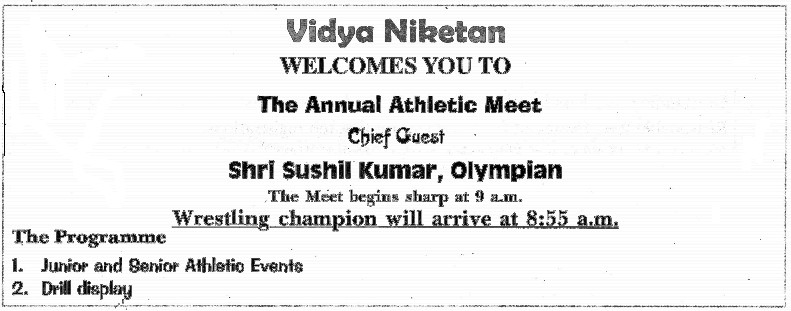
Prepare a poster to be put in the school entrance lobby announcing the Annual Athletic Meet of your school.

Answer:
Poster Writing Class 11 Format, Examples, Samples, Topics 1

Question 2.
Prepare a poster on behalf of the Municipal Authority of your city informing the citizens about how to protect themselves against mosquitoes.

Answer:
Poster Writing Class 11 Format, Examples, Samples, Topics 2

Question 3.
Prepare a poster on behalf of an NGO to be placed in various parts of the city urging the people to save trees.

Answer:
Poster Writing Class 11 Format, Examples, Samples, Topics 3

Question 4.
Prepare a poster on behalf of the Municipal Authority of your city advising citizens on ways to save water.

Answer:
Poster Writing Class 11 Format, Examples, Samples, Topics 4

Question 5.
Prepare a poster on behalf of the police advising people to protect themselves against burglars and robbers.

Answer:
Poster Writing Class 11 Format, Examples, Samples, Topics 5