NCERT Solutions for Class 11 English Hornbill Poem 3 The Voice of the Rain

Here we are providing NCERT Solutions for Class 11 English Hornbill Poem 3 The Voice of the Rain. Students can get Class 11 English The Voice of the Rain NCERT Solutions, Questions and Answers designed by subject expert teachers.

The Voice of the Rain NCERT Solutions for Class 11 English Hornbill Poem 3

The Voice of the Rain NCERT Text Book Questions and Answers

The Voice of the Rain Think it out

Question 1.
There are two voices in the poem. Who do they belong to? Which lines indicate this?
Answer:
The two voices in the poem are that of the poet or narrator and of the rain. The first two lines indicate the two speakers. The poet questions the gentle rain “And who art thou?” and much to his surprise it gives him an answer, that he translates.

Question 2.
What does the phrase “strange to tell” mean?
Answer:
The phrase “strange to tell” could suggest

  • that the poet is surprised to receive an answer from the rain,
  • the poet is surprised at the answer. It is something that he had not really given a thought to.

Question 3.
There is a parallel drawn between rain and music. Which words indicate this? Explain the similarity between the two.
Answer:
There is a similarity between rain and music; it is indicated in the last two lines of the poem. The rain takes a full circle and comes back to its creator, just like the song that originates from its birthplace and after travelling around the earth, comes back to its place of origin.

Question 4.
How is the cyclic movement of rain brought out in the poem? Compare it with what you have learnt in science.
Answer:
In the poem, the rain chalks out its course from the sea or earth to the heaven and then back. In the process, it changes form. The water cycle follows the same course—evaporation, condensation and precipitation.

Question 5.
Why are the last two lines put within brackets?
Answer:
The last two lines are put within brackets because they are not a part of the dialogue between the narrator and rain. It is the similarity that the poet establishes between a song and rain.

Question 6.
List the pairs of opposites found in the poem.
Answer:

  • rise – descend
  • changed – same
  • land – sea
  • reck’d – unreck’d
  • vaguely – formed
  • lave – droughts
  • wandering – returns
  • latent/unbom – life

II. Notice the following sentence patterns.

1. And who art thou? said I to the soft-failing shower.
2. I am the Poem of Earth, said the voice of the rain.
3. Eternal I rise
4. For song…duly with love returns Rewrite the above sentences in prose.
Answer:
Rewrite the above sentences in prose.

  1. I asked the gently falling rain, “Who are you?”
  2. The voice of the rain said, “I am the poetry of the Earth.”
  3. I ascend from the earth without end.
  4. Like the song that originates from its birthplace and after completion, travels around the earth, whether one takes heed of it or not, and then comes back to its place of origin with love.

III. Look for some more poems on the rain and see how this one is different from them.

Langston Hughes poem “April Rain Song” similarly chooses to discuss the impact of rain on life. It beautifully describes rain as “silver liquid drops” playing a sleep song on the roof. While Hughes’s poem is a celebration of rainfall, and expresses his love for rain, Whitman’s poem describes a dialogue between the poet and the rain, where rain articulates its cycle of life beginning and ending with its origin.
(Answers will vary)

NCERT Solutions for Class 12 English Flamingo Poem 1 My Mother at Sixty-six

Here we are providing NCERT Solutions for Class 12 English Flamingo Poem 1 My Mother at Sixty-six. Students can get Class 12 English My Mother at Sixty-six NCERT Solutions, Questions and Answers designed by subject expert teachers.

Indigo NCERT Solutions for Class 12 English Flamingo Poem 1

My Mother at Sixty-six NCERT Text Book Questions and Answers

My Mother at Sixty-six Think it out 

Question 1.
What do you think is the pain and the ache that the poet feels?
Answer:
The poet was driving back from her parent’s home to Cochin, and she gazed at her mother, sleeping, beside her. The poet felt agonized at the thought of her mother growing old. The realisation that her mother was inching towards death made the poet sad as she was plagued by the thought of losing her.

Question 2.
Why are the young trees described as ‘sprinting’?
Answer:
The poet, in order to distract her mind from the painful sight, looks out of the window. The trees outside her car window rushed past her as she drove ahead. On looking out from a moving vehicle, stationary objects seem to be moving in the opposite direction. Kamala Das compared the trees to young children, with boundless energy running past her window. She uses the poetic device of personification to achieve this comparison.

Question 3.
Why has the poet used the image of the merry children “spilling out of their homes”?
Answer:
The poet saw the children rushing out of their homes. The children were young and full of life, a sad contrast to her aged mother. They represented joyousness and vitality, a contrast to the ashen visage of the poet’s ageing mother. The image of the children lends a contrast to her mood.

Question 4.
Why has the mother been compared to the “late winter’s moon”?
Answer:
The ashen and pale visage of her mother led the poet to compare her mother with that of a late winter’s moon. The winter moon that had lost its luminosity and was waning is used as a simile to compare the mother’s old and pale countenance.

Question 5.
What do the parting words of the poet and her smile signify?
Answer:
The parting words of the poet and her smile signify her pain and fear of losing her mother. She tried to put on a brave front by hiding her fear behind a smile. She tried to hide her fear from her mother as she called out, “See you soon, Amma.” The smile also might mean a forced optimism which allowed her to believe that her mother might yet live for a long time

My Mother at Sixty-six Extra Questions and Answers

My Mother at Sixty-six  Short Answer Questions

Question 1.
What are the words that convey the poet’s agony?
Answer:
Looking at her mother, drained of colour, the poet realizes that her mother had grown old and weak and had come to the end of her life. The words “familiar ache” universalizes the emotion. She talks of her mother’s frailty by comparing her to a “corpse”. She desired to dispel the pain by looking out of the car window. In the end, she was unable to speak; she could only smile.

Question 2.
Explain the contrasting situations in the poem? Why does the poet do so?
Answer:
The poem throws up various contrasts to drive home the idea and fear of the mother inching close to death. First, the mother’s lifelessness in the car is contrasted to the activity outside—the trees running, the children spilling out and the airport buzzing with activity. It contrasts with the sadness and pain in the car with the euphoric mood outside. The poet uses the contrast to highlight the dissimilarity of both the situations.

Question 3.
The mood and setting in the poem comes a full cycle. Explain.
Answer:
The poet begins with a concern and grief of the mother’s lifelessness in the car. The poet then describes the energy and jubilation outside. Once again, the mood recoils into sadness and worry, at the end of the poem, when the poet talks of her mother being pale like a late winter’s moon.

My Mother at Sixty-six Value Based Question

Question 1.
The poem deals with the subtleties of human relationships. Justify.
Answer:
The poem, “My Mother at Sixty-six” revolves around the theme of advancing age and the consequent fear of loss and separation. As the poet was on the way to airport in Cochin, she was struck by the realization that her mother was old and frail, and was overwhelmed by the fear of her parent’s impending death. She observed her mother, in her twilight years, pale and waning like the winter moon.

Like any other child, she too remembered having harboured the insecurity of losing a parent that seemed to be presently unfolding in her life. Beset with sorrow and insecurity, at the end of the poem, she bid goodbye to her aged mother at the airport. The poet undergoes the universal emotions of grief and fear of losing a parent to old age and death. Kamala Das’ eloquent and poignant verse brings out the motif of transience and passing time.

Give examples from the poem of the following poetic devices.

Simile
“… face ashen like that of a corpse
…pale as a late winter’s moon”

Personification
“.. .young trees sprinting”

Metaphor
“merry children spilling out”

Irony
“The green trees racing (inanimate) while the mother like a corpse”

Contrast
“The world replete with activity contrasted with the near lifeless mother”

Tautology
“I looked again at her, wan, pale”

Repetition
“smile and smile and smile…”

NCERT Solutions for Class 12 Biology Chapter 3 Human Reproduction

NCERT Solutions for Class 12 Biology Chapter 3 Human Reproduction

These Solutions are part of NCERT Solutions for Class 12 Biology. Here we have given NCERT Solutions for Class 12 Biology Chapter 3 Human Reproduction

Question 1.
Fill in the blanks.

  1. Humans reproduce___(asexually/ sexually).
  2. Humans are ___(oviparous/ viviparous/ ovoviviparous).
  3. Fertilisation is___in humans (external/internal).
  4. Male and female gametes are___ (diploid/haploid).
  5. Zygote is___(diploid/haploid).
  6. The process of release of ovum from a mature follicle is called___
  7. Ovulation is induced by a hormone called ___
  8. The fusion of male and female gametes is called___
  9. Fertilisation takes place in ___
  10. Zygote divides to form___which is implanted in uterus.
  11. The structure which provides vascular connection between foetus and uterus is called ___

Solution:

  1. sexually;
  2. viviparous;
  3. internal;
  4. haploid;
  5. diploid;
  6. ovulation;
  7. LH;
  8. fertilisation;
  9. ampullary-isthmic junction of Fallopian tube;
  10. blastocyst;
  11. placenta

Question 2.
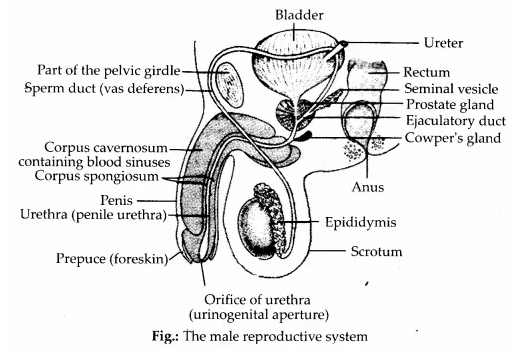
Draw a labelled diagram of male reproductive system.
Solution:
NCERT Solutions for Class 12 Biology Chapter 3 Human Reproduction Q2.1

Question 3.
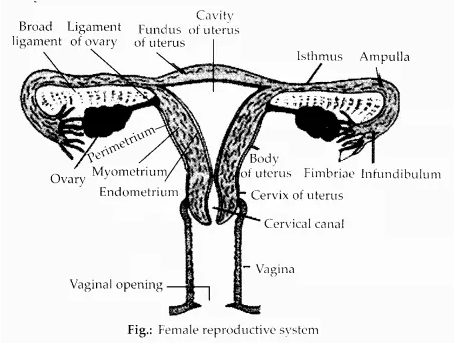
Draw a labelled diagram of female reproductive system.
Solution:
NCERT Solutions for Class 12 Biology Chapter 3 Human Reproduction Q3.1

Question 4.
Write two major functions each of testis and ovary.
Solution:
Testis:

  1. The seminiferous tubules of the testis produce sperm.
  2. The Leydig cells of testis produce hormones such as androsterone and testosterone, together called androgens.

Ovary:

  1. Produce ovum
  2. Produce ovarian hormones such as estradiol, estrone, and estriol collectively called estrogens.

Question 5.
Describe the structure of a seminiferous tubule
Solution:
Seminiferous tubules are located in the testicles, and are the specific location of meiosis, and the subsequent creation of gametes, namely spermatozoa.

The lining of seminiferous tubules called germinal epithelium contains two types of cells – primary germ ceils which undergo spermatogenesis to form spermatozoa and columnar indifferent cells (derived from coelomic epithelium) which enlarge to form Sertoli cells. Sertoli cells function as nurse cells for providing nourishment to the developing spermatozoa, phagocvtise defective sperm and secrete protein hormone inhibin (which inhibits FSH secretion).

The seminiferous tubules are situated in testicular lobules. Both ends of the tubule are connected to the central region of the testis and form a network of small ductules called the rete testis.

Question 6.
What is spermatogenesis ? Briefly describe the process of spermatogenesis.
Solution:
Spermatogenesis is the process by which male spermatogonia develop into mature male gamete, spermatozoa. It starts at puberty and usually continues uninterrupted until death, although a slight decrease can be discerned in the quantity of produced sperm with increase in age. The process of spermatogenesis includes the formation of spermatogonia from germinal epithelium (primordial germ cell) through mitosis (multiplication phase). Finally they stop undergoing mitosis, grow and become primary spermatocytes (growth phase). Each spermatocyte undergoes meiosis (maturation phase). First maturation division is reductional, and produces two secondary spermatocytes. The latter divides by equational division (second maturation division) to form four haploid spermatids. Spermatids receive nourishment from the Sertoli cells to form sperms. This step is called spermiogenesis.

During this process one spermatogonium produces four sperms having half number of chromosomes.

Question 7.
Name the hormones involved in the regulation of spermatogenesis.
Solution:
The hormones involved in the regulation of spermatogenesis are:

  • Gonadotropin-releasing hormone
  • Luteinizing hormone (LH)
  • Follicle-stimulating hormone
  • Testosterone.

Question 8.
Define spermiogenesis and spermiation.
Solution:
The transformation of spermatid into sperm is called spermiogenesis. The release of sperm from the seminiferous tubules is called spermiation.

Question 9.
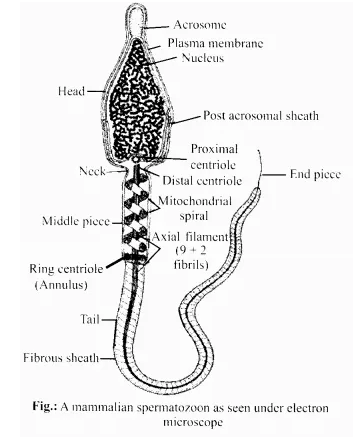
Draw a labelled diagram of sperm
Solution:
NCERT Solutions for Class 12 Biology Chapter 3 Human Reproduction Q9.1

Question 10.
What are the major components of seminal plasma?
Solution:
Secretions of prostate gland, seminal vesicle and Cowper’s gland and , sperms together constitute semen.

Question 11.
What are the major functions of male accessory ducts and glands?
Solution:
The main functions of male accessory ducts and glands are as follows:

1. Functions of accessory ducts:

  • Rete Testis: They transport sperms from seminiferous tubule to Vas efferentia.
  • Vas efferentia: Transports sperms to epdidymis.
  • Epididymis: Sperms are stored here. Maturation of sperms occurs.
  • Vas deference: Transports sperms from the epididymis to the urethra.

2. Functions of glands:

  • Prostate gland: It produces milky secretion which forms a considerable part of the semen. It makes sperm motile.
  • Bulbourethral gland: Its secretion makes the penis lubricated.
  • Seminal vesicle: It secretes mucus and watery alkaline fluid which provide energy to the sperm.

Question 12.
What is oogenesis? Give a brief account of oogenesis.
Solution:
Oogenesis is the production and growth of the ova (egg cell) in the ovary. It starts only after the female has attained puberty. The process is induced by FSH from the anterior pituitary. It leads to the growth of a single Graafian follicle in one of the two ovaries every month. The developing ovary is colonised by primordial germ cells prior to birth which differentiate into oogonia. These enlarge within the follicle under the influence of mitotic division to form primary oocyte containing diploid number of chromosomes. These undergo reductional division (1st meiotic division) to form a secondary oocyte and first polar body. The secondary oocyte proceeds with meiosis II but the division gets arrested until fertilisation occurs. The ‘egg’ is released at secondary oocyte stage under the effect of LH. A second polar body is extruded. The first polar body may also divide to form two polar bodies of equal sizes which do not take part in reproduction and ultimately degenerates. During oogenesis one oogonium produces one ovum and three polar bodies. Polar bodies containing small amount of cytoplasm helps to retain sufficient amount of cytoplasm in the ovum which is essential for the development of early embryo. Formation of polar bodies maintains the half number of chromosomes in the ovum.

Question 13.
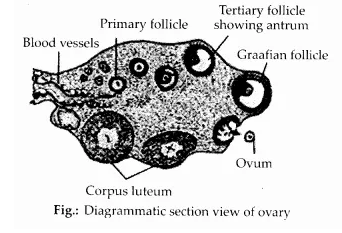
Draw a labelled diagram of a section through ovary.
Solution:
NCERT Solutions for Class 12 Biology Chapter 3 Human Reproduction Q13.1

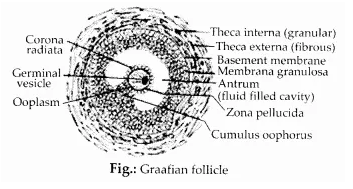
Question 14.
Draw a labelled diagram of a Graafian follicle ?
Solution:
NCERT Solutions for Class 12 Biology Chapter 3 Human Reproduction Q14.1

Question 15.
Give the functions of the following.

  1. Corpus luteum
  2. Endometrium
  3. Acrosome
  4. Sperm tail
  5. Fimbriae

Solution:
The functions of the following:

  1. Corpus luteum secretes a large amount of progesterone which is essential for the maintenance of the endometrium of the uterus.
  2. Endometrium is necessary for the implantation of the fertillised ovum, for contributing towards the making of the placenta and other events of pregnancy.
  3. Acrosome is filled with enzymes that help in dissolving the outer cover of the ovum and entry of sperm nucleus.
  4. Sperm tail facilitates motility of the sperm essential for reaching the ovum to fertilize it.
  5. Fimbriae are fingers-like projections at the mouth of fallopian tubules that help in the collection of the ovum after ovulation.

Question 16.
Identify True/False statements. Correct each false statement to make it true.

  1. Androgens are produced by Sertoli cells.
  2. Spermatozoa get nutrition from Sertoli cells.
  3. Leydig cells are found in ovary.
  4. Leydig cells synthesise androgens.
  5. Oogenesis takes place in corpus luteum.
  6. Menstrual cycle ceases during pregnancy.
  7. Presence or absence of a hymen is not a reliable indicator of virginity Or sexual experience.

Solution:

  1. False: Androgens are produced by interstitial cells or Leydig cells.
  2. True
  3. False: Leydig’s cells are found in the testes (in between the seminiferous tubules).
  4. True
  5. False: Oogenesis takes place in the ovary.
  6. True
  7. True

Question 17.
What is the menstrual cycle? Which hormones regulate the menstrual cycle?
Solution:
The recurring cycle of physiological changes in the uterus, ovaries and other sexual structures that occur from the beginning of one menstrual period through the beginning of the next is called menstrual cycle. The beginning of menstruation is called menarche. Hormones involved in the regulation of menstrual cycle are pituitary or ovarian hormones. These are LH, FSH, estrogen and progesterone.

Question 18.
What is parturition? Which hormones are involved in the induction of parturition?

Solution:

  • The process of delivering of the fully developed fetus or baby at the end of the pregnancy period through vigorous contraction of the uterus is called parturition.
  • Estrogen (amount of estrogen is more than progesterone) and oxytocin are the hormones involved in the induction of parturition.

Question 19.
In our society, women are often blamed for giving birth to daughters. Can you explain why this is not correct?
Solution:
This is not correct that women in our society are often blamed for giving birth to daughters because the sex of the baby is determined by the father, not by the mother. As we know that the chromosome pattern in the human female is XX and that in the male is XY.

Therefore, all the haploid gametes produced by the female (ova) have the sex chromosome X whereas in the male gametes (sperms) the sex chromosome could be either X or Y, hence, 50 per cent of sperms carry the X chromosome while the other 50 per cent carry the Y. After fusion of the male and female gametes the zygote would carry either XX or XY depending on whether the sperm carrying X or Y fertilised the ovum. The zygote carrying XX would develop into a female baby and XY would form a male.

Question 20.
How many eggs are released by a human ovary in a month? How many eggs do you think would have been released if the mother gave birth to identical twins? Would your answer change if the twins born were fraternal?
Solution:
Each ovary develops a number of immature eggs associated with groups of other cells called follicles. Normally, in humans, only one egg is released at one time; occasionally, two or more erupt during the menstrual cycle. The egg erupts from the ovary on the 14th to 16th day of the approximately 28 day menstrual cycle. Identical twins occur when a single egg is fertilised to form one zygote (monozygotic) which then divides into two separate embryos. And if the twins were born fraternal two eggs are released. Fraternal twins (commonly known as “non-identical twins”) usually occur when two fertilised eggs are implanted in the uterine wall at the same time. The two eggs form two zygotes, and these twins are therefore also known as dizygotic as well as “binovular” twins.

Question 21.
How many eggs do you think were released by the ovary of a female dog which gave birth to 6 puppies?
Solution:
One oogonium produces one ovum and three polar bodies. The ovum is the actual female gamete. The polar bodies take no part in reproduction and hence, soon degenerate. In human beings, ovum is released from the ovary in the secondary oocyte stage. So, six ova (eggs), were released by ovary of a female dog which gave birth to 6 puppies.

We hope the NCERT Solutions for Class 12 Biology Chapter 3 Human Reproduction help you. If you have any query regarding NCERT Solutions for Class 12 Biology Chapter 3 Human Reproduction, drop a comment below and we will get back to you at the earliest.

NCERT Solutions for Class 12 Biology Chapter 12 Biotechnology and Its Applications

NCERT Solutions for Class 12 Biology Chapter 12 Biotechnology and Its Applications

These Solutions are part of NCERT Solutions for Class 12 Biology. Here we have given NCERT Solutions for Class 12 Biology Chapter 12 Biotechnology and Its Applications

Question 1.
Crystals of Bt toxin produced by some bacteria do not kill the bacteria themselves because
(a) bacteria are resistant to the toxin
(b) toxin is immature
(c) toxin is inactive
(d) bacteria encloses toxin in a special sac.
Solution:
(c) Toxin is inactive: In bacteria, the toxin is present in an inactive form called prototoxin. This gets converted into the active form when it enters the salivary gland of insects having an alkaline medium.

Question 2.
What are transgenic bacteria? Illustrate using any one example.
Solution:
Transgenic bacteria are one that carries a transgene or a foreign gene of interest introduced using recombinant DNA technology. e. g., bacteria carrying the genes for human insulin.

In 1983, Eli Lilly an American company prepared two DNA sequences corresponding to A and B, chains of human insulin and introduced them in plasmids of E. coli to produce insulin chains. Chains A and B were produced separately, extracted and combined by creating disulfide bonds to form human insulin.

Question 3.
Compare and contrast the advantages and disadvantages of the production of genetically modified crops.
Solution:
Advantages of genetically modified crops or transgenic crops are as follows :

  • They are resistant to pests, herbicides and diseases.
  • They help to reduce post-harvest losses.
  • They enhance the nutritional value of food, e.g., a transgenic variety of rice (golden rice) is rich in vitamin A content.
  • Some transgenic plants, e.g., poplar trees are used to clean up heavy metal pollution from contaminated soil.
  • They are efficient in mineral usage and thus prevent early exhaustion of fertility of the soil.

Transgenic crops have several disadvantages also which are mentioned below:

  • Bt toxins expressed in pollen grains of transgenic crops are harmful for useful varieties of insects, e.g., honey bees and butterflies.
  • The foods produced by transgenic crops might cause toxicity and might result in allergies.
  • The bacteria present in human alimentary canal can become resistant to concerned antibiotic by taking up antibiotic resistance gene present in genetically modified food and become difficult to manage.

Question 4.
What are Cry proteins? Name an organism that produces it. How has man exploited this protein to his benefit?
Solution:
Cry proteins are a group of toxic protein which are highly poisonous to deficient types of insects. It is produced by a soil bacterium Bacillus thuringiensis. The genes controlling their formation are called cry genes eg:- Cry I Ab, Cry I Ac, Cry II Ab, The bacterium produces a protein in the crystal form of protoxin. Two cry genes have been incorporated in cotton (Bt cotton) while one has been introduced in corn (Bt corn) As a result Bt Cotton was disease resistant to bollworm and Bt corn was resistant to corn borer.

Question 5.
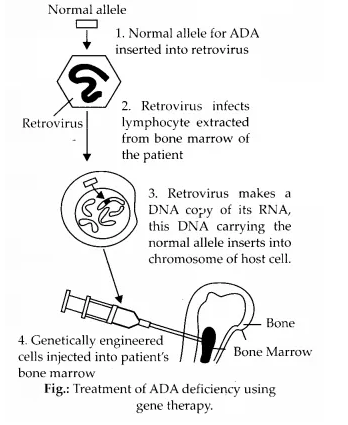
What is gene therapy? Illustrate using the example of adenosine deaminase (ADA) deficiency.
Solution:
Gene therapy is the technique of genetic engineering used to replace a faulty gene with a normal, healthy functional gene. The first clinical gene therapy was given in 1990 to a 4 years old girl with adenosine deaminase deficiency (ADA deficiency). This enzyme is very important for the immune system to function. Severe combined immunodeficiency (SCID) is caused due to a defect in the gene for the enzyme adenosine deaminase. SCID patient lacks functional T-lymphocytes and, therefore, fails to fight the infecting pathogens.
NCERT Solutions for Class 12 Biology Chapter 12 Biotechnology and Its Applications Q5.1
To perform gene therapy, lymphocytes are extracted from the patient’s bone marrow and a normal functional copy of human gene coding for ADA is introduced into these lymphocytes with the help of a retroviral vector. The cells so treated are reintroduced into the patient’s bone marrow. The lymphocytes produced by these cells contain functional ADA genes which reactivate the victim’s immune system. But, as these lymphocytes do not divide and are short-lived, so periodic infusion of genetically engineered lymphocytes is required. This problem can be overcome if stem cells are modified at an early embryonic stage.

Question 6.
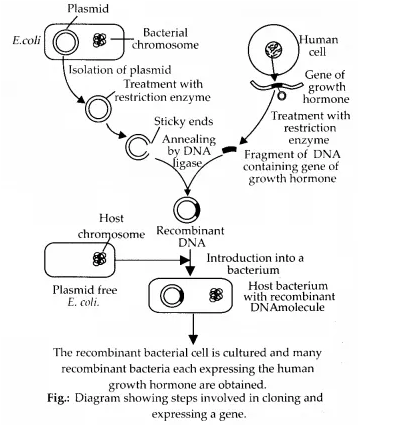
Diagrammatically represent the experimental steps in cloning and expressing a human gene (say the gene for growth hormone) into a bacterium like E.coli?
Solution:
The given diagram represents the experimental steps in cloning and expressing a human gene for growth hormone into a bacterium E. coli.
NCERT Solutions for Class 12 Biology Chapter 12 Biotechnology and Its Applications Q6.1

Question 7.
Can you suggest a method to remove oil (hydrocarbon) from seeds based on your understanding of rDNA technology and the chemistry of oil?
Solution:
rDNA technology is a technique of genetic engineering that involves combining DNA from two different sources to produce recombined or recombinant DNA (rDNA). Oils are composed of glycerol and fatty acids. Thus, to produce oil-free seeds genes coding for glycerol or fatty acids should be identified and nucleotide sequences complementary to the sequence of these genes should be inserted adjacent to these genes in the early cells of the endosperm. During transcription, these complementary sequences will produce anti-sense RNAs to the RNAs produced by glycerol or fatty acids gene and will silence these genes. As a result, oil-free seeds will be produced.

Since glycerol is a common component of all the oils whereas various fatty acids combine with glycerol to form oils, thus it will be easier if we silence the gene for glycerol synthesis.

Question 8.
Find out from the internet what is golden rice.
Solution:
Golden rice is a GM rice with increased vitamin A content.

Question 9.
Does our blood have proteases and nucleases?
Solution:
Proteases occur naturally in all organisms. These enzymes are involved in a multitude of physiological reactions from simple digestion of food proteins to highly-regulated cascades (e.g., the blood-clotting cascade, the complement system, apoptotic pathways, and the invertebrate prophenoloxidase activating cascade). Proteases present in blood serum (thrombin, plasmin, Hageman factor, etc.) play important role in blood clotting, as well as in lysis of the clots, and the action of the immune system. Other proteases are present in leukocytes (elastase, cathepsin G) and play several different roles in metabolic control. Nucleases, such as deoxyribonucleases and ribonucleases are found in the blood which helps in the degradation of exogenous deoxyribonucleic acid and ribonucleic acid circulating in the blood.

Question 10.
Consult the internet and find out how to make orally active protein pharmaceuticals. What is the major problem to be encountered?
Solution:
The problem is stomach enzymes and acids. Once you orally ingest a protein, the proteases in your stomach juices (trypsin, chymotrypsin, pepsin) will cleave the holy-hell out of your therapeutic protein and the acids will denature whatever’s left beyond all recognition. This is why proteins like insulin have to be injected.

We hope the NCERT Solutions for Class 12 Biology Chapter 12 Biotechnology and Its Applications help you. If you have any query regarding NCERT Solutions for Class 12 Biology Chapter 12 Biotechnology and Its Applications, drop a comment below and we will get back to you at the earliest.

NCERT Solutions for Class 12 English Flamingo Chapter 7 The Interview

Here we are providing NCERT Solutions for Class 12 English Flamingo Chapter 7 The Interview. Students can get Class 12 English The Interview NCERT Solutions, Questions and Answers designed by subject expert teachers.

The Interview NCERT Solutions for Class 12 English Flamingo Chapter 7

The Interview NCERT Text Book Questions and Answers

The Interview Think as you read 

Question 1.
What are some of the positive views on interviews?
Answer:
The positive views on interviews are that it is a medium of communication and a source of truth and information. Some even look at it as an art. These days we know about the celebrities and others through their interviews.

Question 2.
Why do most celebrity writers despise being interviewed?
Answer:
Most celebrity writers despise being interviewed because they look at interviews as an unwarranted intrusion into their lives. They feel that it diminishes them. They feel that they are wounded by interviews and lose a part of themselves. They consider interviews immoral and a crime, and an unwanted and unwelcome interruption in their personal life.

Question 3.
What is the belief in some primitive cultures about being photographed?
Answer:
Some primitive cultures consider taking a photographic portrait is like stealing the persons’s soul and diminishing him.

Question 4.
What do you understand by the expression ‘thumbprints on his windpipe’?
Answer:
Saul Bellow once described interviews as being like ‘thumbprints on his windpipe’. It means he treated interviews as a painful experience, as something that caught him by his windpipe, squeezed him and left indelible thumbprints on that. It also means that when the interviewer forces personal details from his interviewee, it becomes undesirable and cruel.

Question 5.
Who, in today’s world, is our chief source of information about personalities?
Answer:
The interviewer is the chief source of information in today’s world. Our most vivid impressions of our contemporaries are based on communication that comes from them. Thus, interviewers hold a position of power and influence.

The Interview Understanding the text

Question 1.
Do you think Umberto Eco likes being interviewed? Give reasons for your opinion.
Answer:
Umberto Eco does not think highly of interviewers who he thinks are a puzzled bunch of people. He has reasons for thinking so as they have often interpreted him as a novelist and clubbed him with Pen Clubs and writers, while he considers himself an academic scholar who attends academic conferences and writes novels on Sundays.

Question 2.
How does Eco find the time to write so much?
Answer:
Eco humorously states that there are a lot of empty spaces in his life. He calls them ‘interstices’. There are moments when one is waiting for the other. In that empty space, Eco laughingly states that he writes an article. Then he states that he is a professor who writes novels on Sundays.

Question 3.
What was distinctive about Eco’s academic writing style?
Answer:
Umberto’s writings have an ethical and philosophical element underlying them. His non-fictional writing work has a certain playful and personal quality about it. Even his writings for children deal with non-violence and peace. This style of writing makes reading his novels and essays interesting and being like the reading of most academic writings. His works are marked by an informal and narrative aspect.

Question 4.
Did Umberto Eco consider himself a novelist first or an academic scholar?
Answer:
Umberto identified himself with the academic community, a professor who attended academic conferences rather than meetings of Pen Clubs. In fact, he was quite unhappy that the people referred to him as a novelist.

Question 5.
What is the reason for the huge success of the novel, The Name of the Rose?
Answer:
The success of The Name of the Rose, though a mystery to the author himself, could possibly be because it offered a difficult reading experience to the kind of readers who do not want easy reading experiences and those who look at novels as a machine for generating interpretations. For the same reason, the sale of his novel was underestimated by his American publishers, while the readers actually enjoyed the difficult reading experience that was offered bv Umberto Eco by raising questions about truth and the order of the worid.

The Interview Extra Questions and Answers

The Interview Short Answer Questions

Question 1.
Why did Lewis Carroll have a horror of the interviewer?
Answer:
Lewis Carroll was said to have had a just horror of the interviewer. It was his horror of being lionized which made him thus repel would-be acquaintances, interviewers, and those seeking his autographs. So, he never consented to be interviewed.

Question 2.
How did Rudyard Kipling look at interviews?
Answer:
Rudyard Kipling condemned interviews. His wife writes in her diary that Rudyard Kipling told the reporters that he called being interviewed as immoral and a crime like an offence against any person. It merited punishment. It was cowardly and vile.

Question 3.
How were Rudyard Kipling and H.G. Wells critical of interviews yet they indulged in interviewing others or being themselves interviewed?
Answer:
Rudyard Kipling criticized interviews yet he interviewed Mark Twain. H.G. Wells referred to an interview in 1894 as an ordeal. Yet he was a fairly frequent interviewee. He also interviewed Joseph Stalin forty years later.

Question 4.
How are interviews, despite their drawbacks, useful?
Answer:
Despite their drawbacks, interviews are a supremely serviceable medium of communication. We get ‘ our most vivid impressions of our contemporaries through interviews. Denis Brain writes that almost everything of moment reaches us through interviews.

Question 5.
What, according to Umberto Eco, is the one thing he does through his various pieces of writing?
Answer:
According to Eco, he is always pursuing his ethical, philosophical interests which are non-violence and peace, through his academic work, his novels and even his books for children. He uses his spare moments constructively.

Question 6.
Umberto Eco tells Mukund that he has a secret. What is that?
Answer:
Umberto Eco tells Mukund that he has a secret to reveal. He tells him that there are empty spaces in the universe, in all the atoms. If they are removed, the universe will shrink to the size of a fist. He calls these empty spaces interstices and he writes in these interstices.

Question 7.
How, according to one of Eco’s professors in Italy, do scholars do in their research? How is Eco’s approach different?
Answer:
According to one of Eco’s professors in Italy, scholars made a lot of false hypotheses. They correct them and at the end they put the conclusion. But Eco told the story of his research and included his trials and errors. His professor allowed the publication of Eco’s dissertation as a book.

Question 8.
What did Umberto Eco learn at the age of 22 that he pursued in his novels?
Answer:
At the age of 22, Umberto Eco understood that scholarly books should be written the way he had done, that is, they should be written by telling the story of the research. He means to say that they should have the narrative technique. That’s why he started writing novels so late—at the age of 50.

Question 9.
How did Eco start writing novels?
Answer:
Eco states that he started writing novels by accident. One day, he had nothing to do, so he started writing. He felt that novels probably satisfied his taste for narration and he produced five novels, including the famous The Name of the Rose.

Question 10.
Did Umberto Eco consider himself a novelist first or an academic scholar? Discuss briefly.
Answer:
Umberto Eco considered himself an academic scholar, a university professor who wrote novels on Sundays. If somebody said that he was a novelist, that bothered him. He participated in academic conferences and not the meetings of Pen Clubs and writers. He identified himself with academic community.

Question 11.
What makes Eco’s The Name of the Rose a very serious novel?
Answer:
The Name of the Rose is a very serious novel. It is a detective story at one level but it also delves into metaphysics, theology and medieval history. Due to these reasons it was greatly received by the public.

Question 12.
What, according to Eco, puzzles journalists and publishers?
Answer:
According to Umberto Eco, journalists and publishers are puzzled when something unexpected happens. They believe that people like trash and do not like difficult reading experiences. But Eco’s novel The Name of the Rose, a serious work, sold between 10 and 15 million copies. This puzzled them.

Question 13.
What is the reason for the huge success of the novel, The Name of the Rose?
Answer:
The reason for the huge success of the novel, according to Eco, is a mystery. Nobody can predict it. He states that if he had written the novel ten years earlier or ten years later, it wouldn’t have been the same. So, the time component, its narrative technique, its aspects of metaphysics, theology and medieval history, made it a grand success.

Question 14.
Do you think Umberto Eco likes being interviewed? Give reasons for your opinion.
Answer:
I think Eco likes being interviewed. His answers to Mukund’s questions are straightforward, precise and to the point. They are never wavering. He even mentions his preferences about TV shows. While answering he gets humorous and laughs. Nowhere does he say anything that may give us this sort of glimpse that he does not like being interviewed.

Question 15.
Is Umberto’s informal style consciously adopted or natural?
Answer:
Umberto’s doctoral thesis was a story of his research and a sum of his experience, his trials and errors. The thesis was appreciated and published as a book. Umberto then developed on his taste for narration and this narrative aspect lends an informal touch to all his essays and novels. It makes his style alive and reading his works is not dry and boring like the reading of other academic works.

Question 16.
Why did Umberto take to writing novels?
Answer:
Umberto took to writing novels to satisfy his taste for narration. He did not have even a single novel to his credit, till the age of 50. One day having nothing to do, he started writing a novel. Moreover, he thought that novels have more readership and he could reach a larger audience.

Question 17.
What made Roiand Barthes frustrated? What did he want to do?
Answer:
Eco s friend Roland Barthes was an essayist. He was not satisfied fully with his scholarly essays. He yearned to do some creative writing. He remained frustrated that he was as essayist and not novelist. But, unfortunately he died before he could do so.

Question 18.
How did Umberto Eco become spectacularly famous?
Answer:
Umberto Eco had earned a good reputation in the field of semiotics or the study of signs. His scholarly works were staggeringly large and wide ranging. But his spectacular fame came to him with his novel The Name of the Rose which stormed the world and sold more than 10 million copies.

Question 19.
What sort of TV programmes does Eco watch after dinner and why?
Answer:
After dinner, Eco watches light television programmes like Miami Vice and Emergency Room. These programmes do not tax his mind and he feels relaxed after a hard, day’s work. But he cannot watch such programmes the whole day.

Question 20.
Bring out Umberto Eco’s humility and modesty as evident in the chapter.
Answer:
Umberto Eco takes success in his stride and talks about his achievements in all modesty. He very humbly gives credit to the people’s capability of appreciating difficult reading experiences. Regarding doing so many things, he tells that it a fallicious impression, but at the end of the day, he is doing the same thing.

The Interview Long Questions and Answers

Question 1.
The Interview as a communication genre is here to stay. Discuss with reference to the interview with Umberto Eco.
Answer:
The interview today is a communication genre that has come to stay. Its detractors—mostly celebrities— despise it as an intrusion into their lives. However, a good interview can be a source of truth, it is an excellent medium of communication and in the modern world our most vivid impressions of contemporaries are through interviews. It is through the interview that we learn about Eco’s diverse writings, his interest in the philosophy of non-violence and peace and his ability to put every spare moment to constructive use. At the interviewer’s prompting, he tells us why he writes scholarly works in an informal style and how he started writing novels. We realise that he is an academician at heart. He honestly talks of the success of his book as a mystery saying that it might •not have sold so well in another time.

Question 2.
How did Umberto Eco assess his style of writing in The Name of the Rose?
Answer:
Umberto Eco considered himself to be an academician who was happy writing novels on Sundays. Though he did not feel he was a novelist, he felt the novel fulfilled his desire for narration. In fact, he spoke of himself as a university professor who wrote novels on Sundays. The novel, according to him, enabled him to reach a larger audience. The Name of the Rose was a very serious novel. It was a detective story that delved into metaphysics, theology and medieval history’. It enjoyed a huge audience as, according to him, people did enjoy difficult reading experiences. Like him. many did not like easy experiences all the time. The novel deals with a period of medieval history and the publisher did not expect to sell so well in a state where nobody had studied Latin or seen a cathedral. He felt the timing was crucial. Perhaps its popularity would have been less, had it been written earlier or later. ‘

Question 3.
How do celebrity writers despise being interviewed as given in ‘The Interview’?
Answer:
Since its invention a little over 130 years ago, the interview has become commonplace journalism. Over the years, opinions about its functions, methods and merits vary considerably. Some say it is a source of truth and in practice, an art. Others despise it being an unwarranted intrusion into their lives. They feel it diminishes them. They equate it to taking a photographic portrait of somebody which in some primitive cultures mean ‘stealing the person’s soul.’ Some people feel wounded by interviews and lose part of themselves. They call it immoral, a crime and an assault. To some it is cowardly and vile or an ordeal.

Question 4.
How does Eco explain that he is convinced he is always doing the same thing?
Answer:
Umberto Eco explains to Mukund Padmanabhan in an interview that all the people have a lot of empty spaces. These he call ‘interstices’. He explains them through an example. He says that one is to come to him and is in an elevator and he is waiting for him. While waiting for the guest’s elevator to appear before him. he has already written an article. It means he writes in snatches of time. However, his creative ideas flow in his mind every time even when he is hosting his guest. Though he relaxes on Sundays, yet is very much busy to write novels. On other days he is busy with his academic work.

Question 5.
How does Mukund Padmanabhan comment on Eco’s academic writing style? What does Eco say about it?
Answer:
Mukund Padmanabhan states that Eco’s non-fictional writing, that is, his scholarly work has a certain playful and personal quality about it. It is a marked departure from a regular style. That regular style is invariably depersonalised and often dry and boring. To a question if he consciously adopted
an informal style, he cited the comments of one of the professors who examined and evaluated his first doctoral dissertation. The professor said that scholars learned a lot of a certain subject, then they made a lot of false hypotheses, then they corrected and put conclusions at the end. But Eco told the story of his research, including his trials and errors. At the age of 22, Eco understood that scholarly books should be written by telling the story of the research. His essays, therefore, have a narrative aspect. That is why, he wrote novels to satisfy his taste for narrative.

Question 6.
How does Mukund Padmanabhan impress you as an interviewer? Do you consider his interview with Umberto Eco a success?
Answer:
Mukund Padmanabhan’s interview with Umberto Eco tells about his capabilities as a successful interviewer. He does not encroach upon his privacy or embarrass him with personal questions. He does not come in-between the celebrity and the readers. His questions are well worded. His questions • draw out of him what his fans would like to know. The questions asked by Mukund cover all the aspects of his works and personality. Eco gives elaborated answers to all his questions. With every question, the interviewer withdraws to the background leaving the interviewee in the limelight. The whole interview does not appear to be an ordeal for the interviewee. In short it is crisp at the same time informal.

Question 7.
What are the opinions of some of the celebrities on interviews?
Answer:
Celebrities have often seen themselves as victims of interviews. In V.S. Naipaul’s opinion, interviews have left people wounded and part of them stolen. Lewis Carroll was in horror of the interviewer and he never consented to be interviewed. He often silenced all those who sought to interview him or ask for his autographs. Rudyard Kipling too held a very critical attitude towards interviews and disapproved of them after he was left almost wrecked by two reporters from Boston. According to his wife, since then he found interviews were vile, immoral and a crime. To H.G. Wells, being interviewed was an ordeal, while to Saul Bellow, interviews were like thumbprints on his windpipe, an extortion of personal details by an overbearing interviewer. They all seemed to be terrified of interviews.

Question 8.
How does the interview with Umberto Eco prove that the interview is the most commendable tool to elicit information about the interviewee?
Answer:
Mukund Padmanabhan from ‘The Hindu’ interviews Umberto Eco and proves that interview is the most commendable tool to elicit information about the interviewee.

Through his interview he reveals that Eco is a prolific writer and yet a man who is most modest about his achievements. He very humbly spells the secret of his varied and staggeringly voluminous works produced by him. When Mukund asks him about David Lodge’s remark that how one man can do all the things that Eco does’, Eco very modestly says it is a fallacious impression, in fact he has always been doing the same thing by pursuing the same philosophical ideas. He views himself as an academic, rather than a novelist. He admits that he has started writing novels by accident and writes novels on Sundays.