NCERT Solutions for Class 12 English Flamingo Poem 5 A Roadside Stand

Here we are providing NCERT Solutions for Class 12 English Flamingo Poem 5 A Roadside Stand. Students can get Class 12 English A Roadside Stand NCERT Solutions, Questions and Answers designed by subject expert teachers.

A Roadside Stand NCERT Solutions for Class 12 English Flamingo Poem 5

A Roadside Stand NCERT Text Book Questions and Answers

A Roadside Stand Think it out 

Question 1.
The city folk who drove through the countryside hardly paid any heed to the roadside stand or to the people who ran it. If at all they did, it was to complain. Which lines bring this out? What was their complaint about?
Answer:
The lines that bring out the irritation of the passers-by are:
Or if ever aside a moment, the out of sorts
At having the landscape marred….
They complained that the disfigured paint of the stall spoilt the beauty of the landscape, the signposts pointed the wrong way and the stalls were not maintained.

Question 2.
What was the plea of the folk who had put up the roadside stand?
Answer:
The people of the roadside stand sat in prayer that some city traffic should stop by and buy their wares so that they could make some money to improve their life beyond mere survival.

Question 3.
The government and other social service agencies appear to help the poor rural people, but actually do them no good. Pick out the words and phrases the poet uses to show their double standards.
Answer:
The poet uses the word ‘greedy good-doers, beneficent beasts of prey’ and ‘enforcing benefits that are calculated’.

Question 4.
What is the ‘childish longing’ that the poet refers to? Why is it in vain?
Answer:
The poet refers to the tireless longing of the stall owners for some car to stop by and give them an opportunity to make some money. But they wait in vain because the cars just pass by without thinking of the hope and longing of the sad faces peeping from the windows. If at all they stop, it is to ask the way or to take turn.

Question 5.
Which lines tell us about the insufferable pain that the poet feels at the thought of the plight of the rural people?
Answer:
The lines that express the poet’s insufferable pain are:
I wonder how I should like you to come to me
And offer to put me gently out of my pain.

A Roadside Stand Extra Questions and Answers

A Roadside Stand Short Answer Questions

Question 1.
What is the untold sorrow of the owners of the roadside stand?
Answer:
The untold sorrow of the roadside stand owners is that nobody pays attention to the efforts of the country folk to make some money. The city folk just pass by their stalls without helping them to maike some money. Their lives have not progressed at all as they merely earn to survive.

Question 2.
What is the poet’s complaint in the poem?
Answer:
The poet does not complain like passers-by that the landscape has been marred. He is complaining about the lack of opportunity and encouragement to these people in the countryside. He is upset about the sorrow of those who had set up the roadside stall in the hope that people would stop by and some money would tickle into their palms.

Question 3.
Why do country people ask for money?
Answer:
The country people ask for money to improve their lives. They set up stalls on (he roadside in the hope that they would make some money by selling goods of daily use and make their life better, as they had seen in movies and as had been promised by the party in power.

Question 4.
What was the news that was doing the rounds?
Answer:
There was news that the people in power were planning to move all these rural people to the city next to the theatre and the big stores. Their lives would be secured and they would not have to worry about themselves any longer. They were promised that they would soon be pulled out of their poverty.

Question 5.
How would the innocent be soothed out of their wits?
Answer:
The selfish good-doers would outwit the simple innocent people into believing that their intentions and efforts were for their improvement, while they would be seeking their own profits from the labour of these folks.

Question 6.
Why are the cars called ‘selfish’?
Answer:
The poet has used a transferred epithet here. He actually means to call the car owners selfish as they just pass by without a thought for the plight of the owners of the roadside stands and if at all they do stop, it is either to complain or to turn their car round.

Question 7.
What is the sadness that lurks near the open window there?
Answer:
The poet is referring to the disappointed faces that wait in vain at their stall windows for someone to ask for their wares and drop some money in their palm. But their hopes for a better living are belied.

Question 8.
What is the open prayer made by the country folk?
Answer:
The country folk make an open appeal to the city dwellers that they should not be selfish. They expectantly pray for the city cars to stop at their roadside stand and help them lead a better life.

Question 9.
What is the trusting sorrow? What remains unsaid?
Answer:
The country folk trust their rich brethren in the city to come to their help but they feel sad when their trust is breached by the city people through their indifference. Although the city people have said nothing but their silence speaks volumes about their cold and indifferent attitude to the rural poor, who feel hurt by it.

Question 10.
Which things irritated those passers-by who stopped at the roadside stand?
Answer:
The passers-by got irritated by the tastelessly painted roadside stand. The thought that the artless decor of the stand was in disharmony with their surroundings and it had destroyed the scenic beauty of the landscape. Even their ‘N’ and ‘S’ on the signboards was wrongly presented. They did not approve of the things offered for sale.

Question 11.
Why did the people driving along the highway think that the landscape was marred?
Answer:
The people driving along the highway objected to the tastelessly painted roadside stand. They thought that the artless decor of the stand was in disharmony with the surroundings and had destroyed the scenic beauty of the landscape. Although the shed had been recently renovated but it could never impress the city dwellers. They were always critical and felt that these unhygienically maintained roadside stands marred the beautiful mountain scene.

Question 12.
Who actually stopped near the sheds put up by the farmers at the edges of the road?
Answer:
The poet states clearly that three cars stopped but none inquired about the prices of the farmer’s produce. One car stopped to reverse and another asked the way to where it was bound. The third foolishly asked if they could sell it a gallon of gas.

Question 13.
What would be the great relief for the poet in reference to these village folks?
Answer:
The poet says loudly that he would be happy to own the great relief if the pains of these people were removed at one stroke. Obviously, he is much moved by their pathetic plight of life. He wants something to be done to improve their lives economically.

Question 14.
What hope does the poet nurture about himself when he asks that these people should be put at one stroke out of their pain?
Answer:
The poet hopes that these people are put at one stroke out of their pain. The poet wants that the authorities should come to him and offer to put him ‘gently out of my pain’. The poet identifies himself with the village folks as far as their economic conditions are concerned.

Question 15.
What is the poet’s attitude to the good-doers and why is it so?
Answer:
The poet condemns the good-doers for they actually take away the villagers’ freedoms to think for themselves. They force benefits on them which lull them into doing nothing and destroy their peace of mind and their lives. He criticizes them for exploiting the villagers for their own gains.

Question 16.
What different attitudes do the city dwellers display to the country people?
Answer:
The city dwellers are indifferent to the plight of the country people and ignore the stands selling their goods. They get irritated with them for spoiling the landscape with their wrong signboards. They also exploit them for their selfish gains by offering them hollow charity which spoils their lives.

Question 17.
On what occasions do the country people express their anger at the city elite?
Answer:
The country people get angry with the city elite when, despite having money, they do not buy any of their goods. Again when a car stops and asks for gas which they obviously do not have, but does not ask the price of what they are actually selling.

Question 18.
What do the country people want?
Answer:
The country people want a share in the wealth enjoyed by the city people which they also have a right to, so that they can improve their conditions and lead better lives just as those promised by the movies and which the government has denied them.

Question 19.
Why are the country folks disappointed?
Answer:
The country folks have put up a roadside stand to sell their wares to the city dwellers. They desperately hope to earn some city money so that they could support their lives with it. They are disappointed because the city dwellers rush away in their polished cars with their minds focused only on their destination. If ever they pause, they are rather critical in their comments. They complain that the roadside stand had marred the scenic beauty of the landscape.

Question 20.
Bring out the contrast between the urban rich and the rural poor.
Answer:
The urban rich are on the move, they are in a hurry, they are speeding looking ahead. They have no time to inquire about the goods put up by rural poor for sale. On the other hand, the rural poor are standing and pleading for help.

Question 21.
How does the poet describe the double standards of the government and other social service agencies towards the poor rural people?
Answer:
The poet is sad that the government which came into power had many promises for the wellbeing of rural poor folks. But it and other social agencies did nothing for that. These poor rural people put up their roadside stands to sell what they produce. But no passer-by buys them. The poet feels much pain at their poor plight.
NCERT Solutions for Class 11 English Hornbill Poem 4 Childhood

Here we are providing NCERT Solutions for Class 11 English Hornbill Poem 4 Childhood. Students can get Class 11 English Childhood  NCERT Solutions, Questions and Answers designed by subject expert teachers.

Childhood NCERT Solutions for Class 11 English Hornbill Poem 4

Childhood NCERT Text Book Questions and Answers

Childhood Think it out

Question 1.
Identify the stanza that talks of each of the following.
Answer:
Individuality rationalism hypocrisy
Stanza I deals with rationalism.
Stanza II deals with hypocrisy.
Stanza III deals with individuality.

Question 2.
What according to the poem is involved in the process of growing up?
Answer:
According to the poet, the process of growing up primarily means loss of innocence and simplicity. It means losing trust in people, noticing their faults and becoming more individualistic. It essentially means loss of sincerity, faith, trust and acceptance.

Question 3.
What is the poet’s feeling towards childhood?
Answer:
The poet feels that childhood is a period of innocence when one accepts people at face value and trusts ffiem. It is that time of life when one trusts others without dwelling on the insincerity in the world. It is a phase of acceptance and humility.

Question 4.
Which do you think are the most poetic lines? Why?
Answer:
The last stanza of the poem is most poetic as it summarises the poem with sensitivity and seeks solace in the fact that the virtues related with childhood are not dead and gone. However, they are just found in children who the poet still considers virtuous.

NCERT Solutions for Class 12 English Flamingo Poem 3 Keeping Quiet

Here we are providing NCERT Solutions for Class 12 English Flamingo Poem 3 Keeping Quiet. Students can get Class 12 English Keeping Quiet NCERT Solutions, Questions and Answers designed by subject expert teachers.

Keeping Quiet NCERT Solutions for Class 12 English Flamingo Poem 3

Keeping Quiet NCERT Text Book Questions and Answers

Keeping Quiet Think it out 

Question 1.
What will counting up to twelve and keeping still help us achieve?
Answer:
The poet advises his readers to count up to twelve and keep still to achieve a sense of togetherness. The poet advises on introspection by taking a break from the mundane activities of life. He compares this with the earth that seems quiet and yet nurtures so much life on it.

Question 2.
Do you think the poet advocates total inactivity and death?
Answer:
No, the poet does not advocate total inactivity and death. He feels that peace and tranquillity should*not be confused with lethargy. He compares lethargy to death itself. He wants a perceptive silence in which people are not obsessed with apparent progress. The self- introspection might also lead to less violence and destruction.

Question 3.
What is the “sadness” that the poet refers to in the poem?
Answer:
The “sadness” that the poet talks about refers to the ceaseless activity that leaves little time for self-analysis and finally leads to doom. This mindless activity leads men to destruction. They kill whales and injure themselves by chemicals or fire. He also pleads with mankind to end environmental degradation. Such activities lead to a situation that is a mere illusion of victory, but in actuality, is fatal.

Question 4.
What symbol from nature does the poet invoke to say that there can be life under apparent stillness?
Answer:
The poet invokes a powerful symbol of the Earth to educate that there can be life under apparent stillness. He says that Earth is a great teacher. In its quietness, its strong message resounds. It seems silent and yet nurtures so much life on it. The poet wants to begin his mission of giving our lives a thought. He wants us to be productive in our silence.

Keeping Quiet Extra Questions and Answers

Keeping Quiet Short Answer Questions

Question 1.
How are the first two lines different from the last two lines of the poem?
Answer:
The first two lines appeal to the reader to count till twelve and keep silent. The speaker expresses his desire for silence and peace as an answer to end mindless activity. Whereas, in the last two lines, he wants the people to begin the exercise at their own level. He moves on to initiate this activity elsewhere.

Question 2.
What is the kind of a world that Neruda dreams of?
Answer:
Neruda dreams of a calm, quiet and a peaceful world where the hallmark would be togetherness. He dreams of a world which is free of destructive activity.

Question 3.
According to the poet, silence is profound. Justify.
Answer:
According to the poet, silence is the hope for a peaceful world. Silence is opposed to lethargy as it is the time for introspection. In the present world, the poet feels that people are obsessed with seeming progress that . leads to their destruction.

Question 4.
Earth is the best teacher. Why does the poet feel so?
Answer:
The poet feels that Earth is the best teacher because it is quiet and calm, yet nurtures so much life on it. He implies that such silence is productive as serenity and tranquillity leads to progress.

Keeping Quiet Value Based Question

Question 1.
The poem “Keeping Quiet” is based on the theme of universal peace and tranquillity. Justify.
Answer:
Neruda begins the poem by urging his readers to observe a moment of stillness and silence. He longs for a moment sans communication and activity where man is at complete peace with himself and his surroundings. _ This “exotic moment” would be a moment of universal peace. He feels, humans are preoccupied with their own progress which deprives them of the true pleasure of living. They merely exist and indulge in meaningless activities like that of the fishermen harming the whales. Man through his meaningless trysts endangers the environment and his own life.

The poet thus urges people to cleanse their souls, wear clean clothes and walk peacefully in universal brotherhood. The poet however, does not want the readers to confuse tranquillity with total inactivity, which meant sluggishness and death. He urges people to be unselfish and wants them to allow a moment of silence to interject their fast-moving, useless lives. He wants people to look upon Earth as a teacher, to fulfil a greater purpose in life.

Give examples from the poem of the following poetic devices.

Personification
“face of the earth”

Synecdoche
“not move our arms so much”

Hyperbole
“victory with no survivors”

Contrasting/antithetical imagery
“wars/ walk about with their brothers in shade”


NCERT Solutions for Class 12 Biology Chapter 5 Principles of Inheritance and Variation

NCERT Solutions for Class 12 Biology Chapter 5 Principles of Inheritance and Variation

These Solutions are part of NCERT Solutions for Class 12 Biology. Here we have given NCERT Solutions for Class 12 Biology Chapter 5 Principles of Inheritance and Variation

Question 1.
Mention the advantages of selecting pea plant for experiment by Mendel.
Solution:

  1. The plant shows clear-cut contrasting characters.
  2. Hybrids are perfectly fertile.
  3. Genes for the seven contrasting characters are located on seven separate chromosomes.
  4. Easy to cultivate.
  5. The floral structure is suitable for artificial pollination.
  6. Short growth period and life cycle.
  7. Cross-pollination is easy if self-pollination is prevented.
  8. Pure breeding varieties are available

Question 2.
Differentiate between the following:

  1. Dominant and Recessive
  2. Homozygous and Heterozygous
  3. Monohybrid and Dihybrid

Solution:

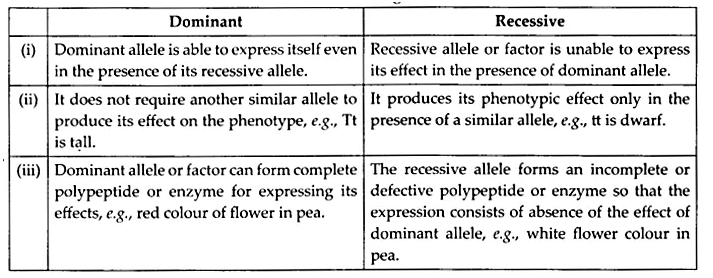
  1. Differences between dominant and recessive genes are as follows :
    NCERT Solutions for Class 12 Biology Chapter 5 Principles of Inheritance and Variation Q2.1
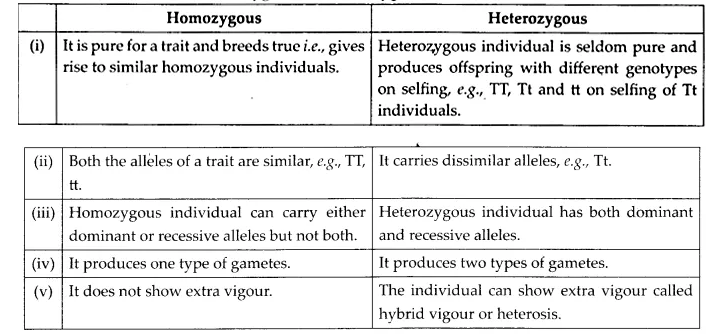
  2. Differences between homozygous and heterozygous are as follows :
    NCERT Solutions for Class 12 Biology Chapter 5 Principles of Inheritance and Variation Q2.2
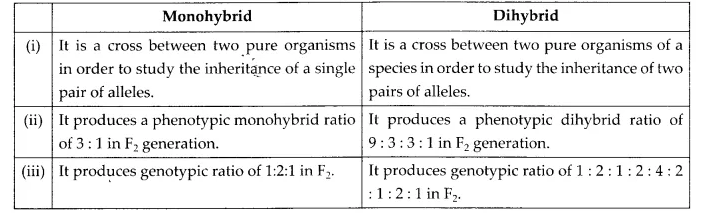
  3. Differences between monohybrid and dihybrid cross are as follows :
    NCERT Solutions for Class 12 Biology Chapter 5 Principles of Inheritance and Variation Q2.3

Question 3.
A diploid organism is heterozygous for 4 loci, how many types of gametes can be produced?
Solution:
A diploid organism heterozygous for 4 loci will have the supported genetic constitution YyRr for two characters. The alleles Y-y and R-r will be present on different 4 loci. Each parent will produce four types of gametes – YR, Yr, yR, yr.

Question 4.
Explain the law of dominance using a monohybrid cross.
Solution:
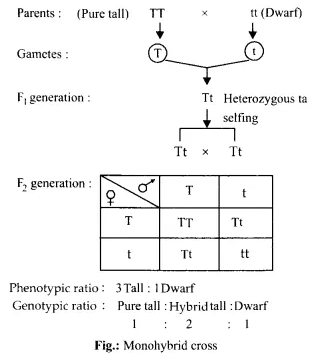
The Law of dominance states that when a pair of alleles or allelomorphs are brought together in F1 hybrid, then only one of them expresses itself, masking the expression of the other completely. Monohybrid cross was made to study the simultaneous inheritance of a single pair of Mendelian factors. The cross in which only alternate forms of a single character are taken into consideration is called a monohybrid cross. The trait which appeared in the F1 generation was called dominant and the other which did not appear in the F1 population was called recessive.
NCERT Solutions for Class 12 Biology Chapter 5 Principles of Inheritance and Variation Q4.1
Thus, when a pair of alleles are brought together in an F1 hybrid, then only one of them expresses itself masking the expression of the other completely. In the above example, in Tt – F1 hybrid (tall) only ‘T’ expresses itself so dominant, and ‘t’ is masked so recessively. Thus, this’ proves and explains the law of dominance.

Question 5.
Define and design a test-cross.
Solution:
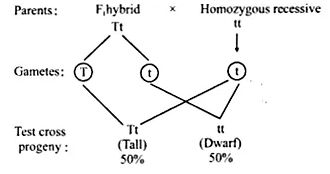
The crossing of F1 individuals having dominant phenotype with its homozygous recessive parent is called test cross. The test cross is used to determine whether the individuals exhibiting dominant character are homozygous or heterozygous.
Example: When a tall plant (TT) is crossed with the dwarf plant (tt) in the F1, generation only tall plant (Tt) appears which is then crossed with homozygous recessive (tt) in a test cross.
NCERT Solutions for Class 12 Biology Chapter 5 Principles of Inheritance and Variation Q5.1
In the given test cross between tall heterozygous F1 hybrid with dwarf homozygous recessive parent produces tall and dwarf progeny in equal proportion indicating that F : hybrids are heterozygous.

Question 6.
Using a Punnett square, work out the distribution of phenotypic features in the first filial generation after a cross between a homozygous female and a heterozygous male for a single locus.
Solution:
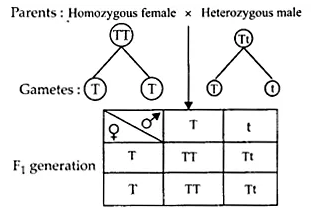
When a heterozygous male tall plant (Tt) is crossed with the homozygous dominant female tall plant (TT), we get two types of gametes in males: half with T and a half with t, and in females, we get only one type of gametes i.e., T.
NCERT Solutions for Class 12 Biology Chapter 5 Principles of Inheritance and Variation Q6.1
From the Punnett square it is seen that all the progeny in the F generation are tall (Tt), 50% homozygous tall (TT), and 50% heterozygous tall (Tt).

Question 7.
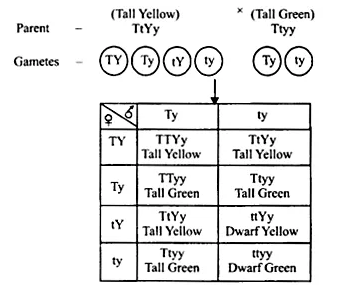
When a cross is made between a tall plant with yellow seeds (TtYy) and a tall plant with the green seed (Ttyy), what proportions of phenotype in the offspring could be expected to be

  1. tall and green
  2. dwarf and green

Solution:
NCERT Solutions for Class 12 Biology Chapter 5 Principles of Inheritance and Variation Q7.1
Phenotypes of the offsprings –
Tall Yellow : 3
Tall Green : 3
Dwarf Green: 1
Dwarf Yellow: 1
(a) Proportion of tall and green is 3/8.
(b) Proportion of dwarf and green is 1/8.

Question 8.
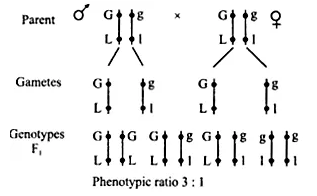
Two heterozygous parents are crossed. If the two loci are linked what would be the distribution of phenotypic features in F1 generation for a dihybrid cross?
Solution:
Two heterozygous parents (i.e. GgLl and GgLl) are crossed and the two loci are linked then the cross will be
NCERT Solutions for Class 12 Biology Chapter 5 Principles of Inheritance and Variation Q8.1
This means, if ‘G’ represent grey body (dorhinant), ‘g’ black body (recessive), ‘L’-long (dominant) and ‘I’-dwarf (recessive) then the distribution of phenotypic features in F1 generation will be 3 : 1 i.e. 3/4 will show the dominant feature, grey and long, either in homozygous (GGLL) or in heterozygous (GgLl) condition and 1/4 will show the recessive feature, black and dwarf (ggll).

Question 9.
Briefly mention the contribution of T.H. Morgan in genetics.
Solution:
TH Morgan is a Geneticist who got Nobel Prize.

  • He found fruit fly (Drosophila Melanogaster) to be an experimental material as it was easy to rear and multiply.
  • The established presence of genes over the chromosomes.
  • Principle of linkage and crossing over.
  • Discovered sex linkage and crossing over.
  • He observed mutations.
  • The developed technique of chromosome mapping,
  • Wrote the book “The theory of Gene”.

Question 10.
What is pedigree analysis? Suggest how such an analysis, can be useful.
Solution:
A record of inheritance of certain genetic traits for two or more generations presented in the form of a diagram of family tree is called pedigree. Pedigree analysis is study of pedigree for the transmission of particular trait and finding the possibility of absence or presence of that trait in homozygous or heterozygous state in a particular individual. Pedigree analysis is useful for the following:

  • It is useful for the genetic counsellors to advice intending couples about the possibility of having children with genetic defects like haemophilia, colour blindness, alkaptonuria, phenylketonuria, thalassemia, sickle cell anaemia (recessive traits), brachydactyly and syndactyly (dominant traits).
  • Pedigree analysis indicates that Mendel’s principles are also applicable to human genetics with some modifications found out later like quantitative inheritance, sex linked characters and other linkages.
  • It can indicate the origin of a trait in the ancestors, e.g., haemophilia appeared in Queen Victoria and spread in royal families of Europe through marriages.
  • It helps to know the possibility of a recessive allele to create a disorder in the progeny like thalassemia, muscular dystrophy, haemophilia.
  • It can indicate about the harm that a marriage between close relatives, may cause.
  • It helps to identify whether a particular genetic disease is due to a recessive gene or a dominant gene.
  • In certain cases it may help to identify the genotypes of offspring yet to be born.

Question 11.
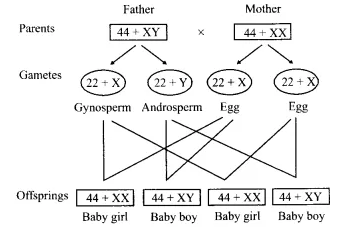
How is sex determined in human beings?
Solution:
In humans, there are 23 pairs of chromosomes. 22 pairs of these chromosomes do not take part in sex determination called autosomes. The 23rd pair determines the sex of an individual called allosome or sex chromosome. If it is XX then female, if XY then male. The presence of Y1 makes a person male. Human females produce only 1 type of gamete 22 + X. In males, it could be 22 + X or 22+ Y.
NCERT Solutions for Class 12 Biology Chapter 5 Principles of Inheritance and Variation Q11.1

Question 12.
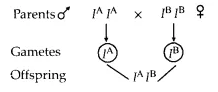
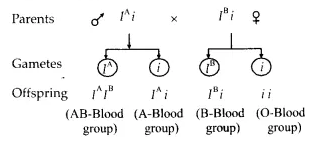
A child has blood group O. If the father has blood group A and mother blood group B, work out the genotypes of the parents and the possible genotypes of the other offsprings.
Solution:
If the father has blood group A i.e., IAIA (homozygous) and mother has blood group B i.e., IBIB (homozygous) then all the offsprings will have blood group AB (IAIB) and not blood group O.
NCERT Solutions for Class 12 Biology Chapter 5 Principles of Inheritance and Variation Q12.1
NCERT Solutions for Class 12 Biology Chapter 5 Principles of Inheritance and Variation Q12.2
Thus the genotypes of the parents of child with blood group O will be IAi and IBi There is the possibility of 3 other types of blood groups of offsprings besides O blood group offspring. They are IAi (blood group A). IBi (blood group B) and IAIB (blood group AB).

Question 13.
Explain the following terms with an example:

  1. Codominance
  2. Incomplete dominance

Solution:
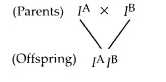
Codominance (1 : 2 : 1) — It is the phenomenon of two alleles (different forms of a Mendelian factor present on the same gene locus on homologous chromosomes) lacking dominant- recessive relationship and are able to express themselves independently when present together.

Example – AB blood group: Alleles for blood group A(IA) and blood group B(IB) are codominant so that when they come together in an individual, they produce blood group AB. It is characterized by the presence of both antigen A (from IA) and antigen B (from IB) over the surface of erythrocytes.
NCERT Solutions for Class 12 Biology Chapter 5 Principles of Inheritance and Variation Q13.1

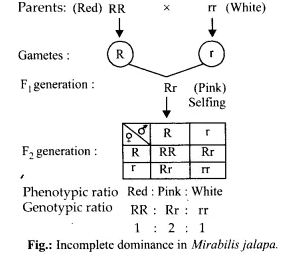
Incomplete dominance (1 : 2 : 1) – It is the phenomenon where none of the two contrasting alleles being dominant so that expression in the hybrid is intermediate between the expressions of the two alleles in the homozygous state. Fphenotypic ratio is 1 : 2 : 1, similar to genotypic ratio. Example-In Mirabilis jalapa (Four o’clock) and Antirrhinum majus (Snapdragon or dog flower), there are two types of flower colour generation are of three types- red, pink and white flowered in the ratio of 1 : 2 : 1. The pink colour apparently appears either due to the mixing of red and white colours (incomplete dominance).
NCERT Solutions for Class 12 Biology Chapter 5 Principles of Inheritance and Variation Q13.2

Question 14.
What is point mutation? Give one example.
Solution:
Point mutation is a gene mutation that arises due to a change in a single base pair of DNA.
Example: Sickle-cell anaemia.
Substitution of a single nitrogen base at the sixth codon of the β- globin chain of haemoglobin molecule causes the change in the shape of the R.B.C. from biconcave disc to the elongated shaped, structure which results in sickle cell anaemia.

Question 15.
Who had proposed the chromosomal theory of inheritance?
Solution:
Sutton and Boveri proposed the chromosomal theory of inheritance. The theory believes that chromosomes are vehicles of hereditary information that possess mendelian factors or genes and it is the chromosomes which segregate and assort independently during transmission from one generation to the next.

Question 16.
Mention any two autosomal genetic disorders with their symptoms
Solution:
Cystic fibrosis is an autosomal recessive disorder of infants, children, and young adults that is due to a recessive autosomal allele present on chromosome 7. It is common in Caucasian Northern Europeans and White North Americans. The disease gets its name from the fibrous cysts that appear in the pancreas. In 70% of cases, it is due to the deletion of three bases. It produces a defective glycoprotein. The defective glycoprotein causes the formation of thick mucus in the skin, lungs, pancreas, liver, and other secretory organs. Accumulation of thick mucus in the lungs results in obstruction of airways. Because of it, the disease was also called mucoviscoides, Mucus deposition in the pancreas blocks secretion of pancreatic juice. There is a maldigestion of food with high-fat content in the stool. The liver may undergo cirrhosis and there is impaired production of bile. Vasa deferentia of males undergo atrophy.

Huntington’s disease or Huntington’s chorea is a dominantly autosomal inherited disorder in which muscle and mental deterioration occur. There is gradual loss of motor control resulting in uncontrollable shaking and dance-like movements (chorea). The brain shrinks between 20-30% in size followed by slurring of speech, loss of memory, and hallucinations. Life expectancy averages 15 years from the onset of symptoms. This disorder does not occur till the age of 25 to 55. The defective gene is dominant autosomal, located on chromosome 4. This defective gene has 42 -100 repeats of CAG instead of 10-34 repeats in the normal gene. The frequency of this disorder is 1 in 10000 to 1 in 20000.

We hope the NCERT Solutions for Class 12 Biology Chapter 5 Principles of Inheritance and Variation help you. If you have any query regarding NCERT Solutions for Class 12 Biology Chapter 5 Principles of Inheritance and Variation, drop a comment below and we will get back to you at the earliest.

NCERT Solutions for Class 12 English Flamingo Poem 6 Aunt Jennifer’s Tigers

Here we are providing NCERT Solutions for Class 12 English Flamingo Poem 6 Aunt Jennifer’s Tigers. Students can get Class 12 English Aunt Jennifer’s Tigers NCERT Solutions, Questions and Answers designed by subject expert teachers.

Aunt Jennifer’s Tigers NCERT Solutions for Class 12 English Flamingo Poem 6

Aunt Jennifer’s Tigers NCERT Text Book Questions and Answers

Aunt Jennifer’s Tigers Think it out

Question 1.
How do “denizens” and “chivalric” add to our understanding of the tiger’s attitudes?
Answer:
Unlike their creator who sunk into the background, the tigers were described as “bright topaz denizens”. The tigers were energetic and free to “prance” or run around in the jungle, and in their creator’s imagination. The tigers were created bright, like “topaz”, and they inhabited a world that is green. The “bright topaz denizens of green” evoke a mental image of majestic tigers not bound by the whims of another being. They are in their natural environment. The tigers are conceived as inherently male, they are chivalric, hence tied to the long tradition of male authority and power. However, their “chivalric certainty” is a representation of the power envisioned by Aunt Jennifer for herself. This idea is then contrasted with Aunt Jennifer’s reality where she in turn was dominated by male superiority.

Question 2.
Why do you think Aunt Jennifer’s hands are “fluttering” through her wool in the second stanza? Why is she finding the needle so hard to pull?
Answer:
Aunt Jennifer worked with a piece of wool, stitching patterns into a tapestry. Her fingers fluttered to create the beautiful image of the tigers. She expressed her desires by creating the tigers. She found it difficult to express her feelings, repressed by the weight of marriage, gender roles, and a dominating society. “Uncle’s wedding band” is representative of the patriarchal society she lived in. The weight of the ring was not something she enjoyed as the band is described to sit ‘heavily’ on her hand and kept her from the only mode of expression she had, her needlepoint.

Question 3.
What is suggested by the image “massive weight of Uncle’s wedding band”?
Answer:
The struggle for existence in a harsh world, the deep conflicts of bondage and freedom and gender conflict is portrayed through the use of the evocative image. The genders are polarised. Aunt Jennifer was victimized by the absent Uncle, represented only by his wedding band, while he is representative of the oppression of custom and law.

Question 4.
Why is Aunt Jennifer terrified in the third stanza?
Answer:
In the last stanza, the reader is told that “the tigers in the panel she made/Will go on prancing, proud and unafraid” even after Aunt Jennifer was dead. This showed her fear. The tigers represent her spirit and how she would like to live while her hands, folded even in death, represent the reality of her life.

Question 5.
What are the ordeals Aunt Jennifer is surrounded by? Why is it significant that the poet uses the word “ringed”? What are the meanings of the word “ringed” in the poem?
Answer:
The word “ringed” has a double association. It indicates not only the ring that “sits heavily” on her hand, but the difficulties in her life that would continue to surround her.

Even in death, she is seen to conform to the patriarchal society in which she lived. The ring on her finger symbolised the weight she had to bear, dead or alive. Just as she created and controlled her needlework, society and gender roles created and controlled her.

Question 6.
Why do you think Aunt Jennifer created animals that are so different from her own character? What might the poet be suggesting, through this difference?
Answer:
Aunt Jennifer created an alternative world of freedom, one which she could not inhabit otherwise. The tigers of her creation represented her suppressed desires and her ambition. She was victimised, and stifled in marriage, by the absent figure of the Uncle, represented only by his wedding band. She escaped her reality through her creation. The poet presents an ironic image of a contrast between the common perception of animals as being brutal and of men being humane. Here, the ‘brutal’ tiger represents freedom while the ‘civilised’ man is exposed as the oppressor.

Question 7.
Interpret the symbols found in this poem.
Answer:
Adrienne Rich uses a number of similes and symbols in the poem to convey her theme. The tigers, of course, symbolise the freedom of spirit which Aunt Jennifer dreams of attaining but never achieves except in her dreams and her art. Aunt Jennifer represents of her gender rather than any one individual.

The tigers are symbolic of the true nature of the freedom that a woman’s soul represents. They also display in art the values that Aunt Jennifer must repress or displace in life: strength, assertion, fearlessness and fluidity of motion. The image of the tiger is both inspiring and destructive. And the poem’s conclusion celebrates the animal images as a kind of triumph, transcending the constraints of their maker’s life.
The word ‘ringed’ has a double connotation—indicating not only the ring that “sits heavily” on her hand, but the difficulties in her life that will continue to surround her.

Question 8.
Do you sympathise with Aunt Jennifer? What is the attitude of the poet towards Aunt Jennifer?
Answer:
As a reader, one sympathises with Aunt Jennifer. She aspired for a greater future and a greater standing for her generation. Her mind was liberated from the cloistered association with her sex, but the figure of Aunt Jennifer never got to see women standing strong and proud. In the end, Adrienne Rich showed that Aunt Jennifer represented every woman of her time. Ironically enough, she rebels using the oppressor’s own language to feel a sense of triumph. Overwhelmed by gender roles, and tom between rebellion, the need for expression, and society, Aunt Jennifer expressed her fears and desires through the exotic images of tigers, transcending her dreams and ambitions.

Aunt Jennifer’s Tigers Extra Questions and Answers

Aunt Jennifer’s Tigers Short Answer Questions

Question 1.
What are the characteristics of the tigers?
Answer:
The tigers have a striking appearance as they are described as “bright topaz”. They are energetic and prance about. They enjoy their freedom and hence run across the screen. The majestic tigers are not dictated by the whims of others. They are fearless and chivalrous. The elegant tigers are confident of themselves.

Question 2.
What do you learn about Aunt Jennifer?
Answer:
Aunt Jennifer was a weak woman with fluttering fingers. She was terrified of Uncle and found it difficult to manoeuvre the needle. Thus, implying that she was oppressed by a burdensome marriage where she was subjugated by Uncle.

Question 3.
What does Aunt Jennifer’s creation of the tigers symbolize?
Answer:
Aunt Jennifer’s creation of the tigers symbolizes her desires. Her fingers flutter to create the beautiful image of the tigers. By creating those tigers, she lets loose her inner aspirations. The wedding band sits “heavily” on her hand and keeps her from the only sense of expression she has—her needlepoint.

Question 4.
What does Aunt Jennifer’s death signify?
Answer:
In the last stanza of the poem, the poet gives us a surprisingly truthful look at the reality and the end of Aunt Jennifer and women in her position all over the world. Aunt Jennifer is a subjugated even in death; she must conform to the norms of the patriarchal society. The ring around her finger symbolizes the weight she must bear dead or alive.

Question 6.
What is the theme of the poem?
Answer:
“Aunt Jennifer’s Tigers” clearly reflects the gender struggle that women across the world are subject to. It is a feminist poem in which the poet criticizes the male-dominated world. Aunt Jennifer is left no option than to create an alternate world of freedom. Aunt Jennifer is a woman trapped by the social and cultural expectations and demands of her time.

Question 7.
Who do you think is the speaker of the poem? Why do you say so?
Answer:
The speaker of the poem is the niece; the word “Aunt” shows her relationship with the speaker. The point of view here would seem to be that of a woman, indicating that the speaker is the niece of Aunt Jennifer’s. The niece voices a woman’s struggles with expression, rebellion, and a society where power is defined as masculine. The poem deals with a woman’s representation of Aunt Jennifer’s dreams, reality and the future.

Question 8.
Interpret the following symbols found in this poem.
(a) tigers
(b) Aunt
(c) embroidery
(a) The tigers symbolize the freedom of spirit which Jennifer dreams of attaining but never achieves except in her dreams and her art.
(b) Aunt Jennifer is symbolic of women as a whole rather than one individual.
(c) Aunt Jennifer’s embroidery may exist forever as the work that she leaves behind; in life, she was nothing like the tigers in her embroidery.

Aunt Jennifer’s Tigers Value Based Question

Question 1.
How does the poet advocate gender sensitisation in the poem?
Answer:
The poem reflects the gender struggle; Adrienne Rich criticizes the male-dominated world for terrifying and oppressing women as symbolized by Aunt Jennifer, leaving her with no alternative but to create an alternate world of freedom for herself with her sewing. The embroidering of tigers on the panel, her only form of expression, underlines a woman’s struggles with expression, rebellion, and a society where power is defined as masculine. The poet depicts the pain of a woman who is living with a husband who dominates her. Her hidden, vibrant inner life is in sharp contrast to the outer image of the terrified, trapped woman.

The poem is almost a tragedy relating the plight of women trapped in an unhappy marriage. The poet makes her stance clear by using the figure of independent and fearless tigers as a telling symbol of an ideal that women like Aunt Jennifer seek to approximate. Adrienne Rich yearns for freedom and equality for all women.

Give examples from the poem of the following poetic devices.

Alliteration
“fingers fluttering”
“chivalric certainty”

Symbols
Aunt Jennifer
Tigers
Embroidery
wedding band