Photoperiodism

Learninsta presents the core concepts of Biology with high-quality research papers and topical review articles.

Photoperiodism

Trees take several years for initiation of flowering whereas an annual herb flowers within few months. Each plant requires a specific time period to complete their vegetative phase which will be followed by reproductive phase as per their internal control points through Biological Clock.

The physiological mechanisms in relation to flowering are controlled by

  1. Light period (Photoperiodism) and
  2. Temperature (Vernalization)

The physiological change on flowering due to relative length of light and darkness (photoperiod) is called Photoperiodism. The term photoperiodism was coined by Garner and Allard (1920) when they observed this in ‘Biloxi’ variety of soybean (Glycine max) and ‘Maryland mammoth’ variety of tobacco (Nicotiana tabacum).

The photoperiod required to induce flowering is called critical day length. Maryland mammoth (tobacco variety) requires 12 hours of light and cocklebur (Xanthium pensylvanicum) requires 15.05 hours of light for flowering.

1. Classification of Plants Based on Photoperiodism

(i) Long Day Plants:
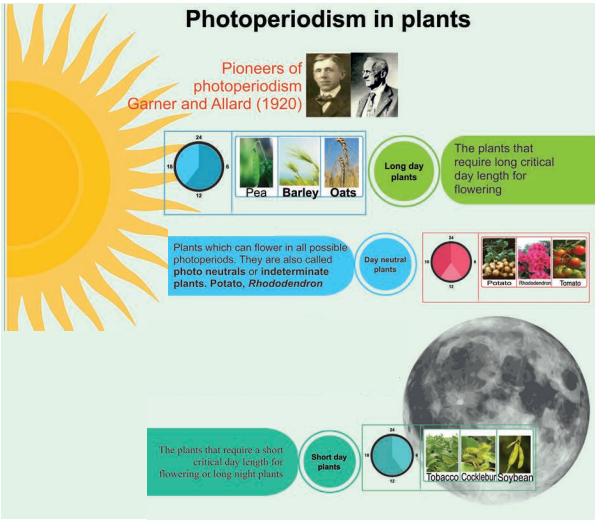
The plants that require long critical day length for flowering are called long day plants or short night plants. Example: Pea, Barley and Oats.

(ii) Short Day Plants:
The plants that require a short critical day length for flowering are called short day plants or long night plants. Example: Tobacco, Cocklebur, Soybean, Rice and Chrysanthemum.

(iii) Day Neutral Plants:
There are a number of plants which can flower in all possible photoperiods. They are also called photo neutrals or indeterminate plants. Example: Potato, Rhododendron, Tomato and Cotton.

2. Photoperiodic Induction

An appropriate photoperiod in 24 hours cycle constitutes one inductive cycle. Plants may require one or more inductive cycles for flowering. The phenomenon of conversion of leaf primordia into flower primordia under the influence of suitable inductive cycles is called photoperiodic induction. Example: Xanthium (SDP) – 1 inductive cycle and Plantago (LDP) – 25 inductive cycles.

3. Site of Photoinductive Perception

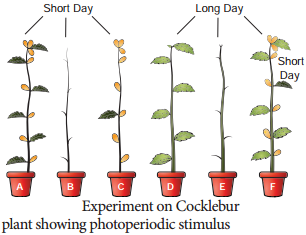
Photoperiodic stimulus is perceived by the leaves. Floral hormone is synthesised in leaves and translocated to the apical tip to promote flowering. This can be explained by a simple experiment on Cocklebur (Xanthium pensylvanicum), a short day plant. Usually Xanthium will flower under short day conditions. If the plant is defoliated and kept under short day conditions it will not flower.

Flowering will occur even when all the leaves are removed except one leaf. If a cocklebur plant is defoliated and kept under long day conditions, it will not flower. If one of its leaves is exposed to short day condition and rest are in long day condition, flowering will occur (Figure 15.10).
Photoperiodism img 1

4. Importance of Photoperiodism

  • The knowledge of photoperiodism plays an important role in hybridisation experiments.
  • Photoperiodism is an excellent example of physiological pre-conditioning that is using an external factor to induce physiological changes in the plant.

5. Phytochrome

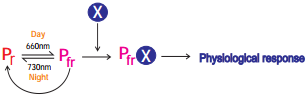
Phytochrome is a bluish biliprotein pigment responsible for the perception of light in photo physiological process. Butler et al., (1959) named this pigment and it exists in two interconvertible forms:

  • Red Light absorbing pigment which is designated as Pr and
  • Far red light absorbing pigment which is designated as Pfr. The Pr form absorbs red light in 660nm
    and changes to Pfr.

The Pfr form absorbs far red light in 730nm and changes to Pr. The Pr form is biologically inactive and it is stable whereas Pfr form is biologically active and it is very unstable. In short day plants, Pr promotes flowering and Pfr inhibits the flowering whereas in long day plants flowering is promoted by Pfr and inhibited by Pr form.
Photoperiodism img 2

Pfr is always associated with hydrophobic area of membrane systems while Pr is found in diffused state in the cytoplasm. The interconversion of the two forms of phytochrome is mainly involved in flower induction and also additionally plays a role in seed germination and changes in membrane conformation.
Photoperiodism img 3

NCERT Solutions for Class 12 Biology Chapter 14 Ecosystem

NCERT Solutions for Class 12 Biology Chapter 14 Ecosystem

These Solutions are part of NCERT Solutions for Class 12 Biology. Here we have given NCERT Solutions for Class 12 Biology Chapter 14 Ecosystem

Question 1.
Fill in the blanks
(a) Plants are called as ___ because they fix carbon dioxide.
(b) In an ecosystem dominated by trees, the pyramid (of numbers) is ___ type.
(c) In aquatic ecosystem, the limiting factor for the productivity is ___
(d) Common detritivores in our ecosystem are ____
(e) The major reservoir of carbon on earth is ___
Solution:
(a) producers
(b) inverted or spindle
(c) light
(d) saprotrophs
(e) oceans

Question 2.
Which one of the following has the largest population in a food chain?
(a) Producers
(b) Primary consumers
(c) Secondary consumers
(d) Decomposer’s
Solution:
(d) decomposer’s

Question 3.
The second trophic level in a lake is
(a) phytoplankton
(b) zooplankton
(c) benthos
(d) fishes.
Solution:
(b) zooplankton

Question 4.
Secondary producers are
(a) herbivores
(b) producers
(c) carnivores
(d) none of these
Solution:
(a) herbivores

Question 5.
What is the percentage of photosynthetically active radiation (PAR), in the incident solar radiation.
(a) 100%
(b) 50%
(c) 1 – 5%
(d) 2 – 10%
Solution:
(b) 50%

Question 6.
Distinguish between
(a) Grazing food chain and detritus food chain
(b) Upright and inverted pyramid
(c) Litter and detritus
(d) Production and decomposition
(e) Food chain and food web
(f) Primary and secondary productivity
Solution:
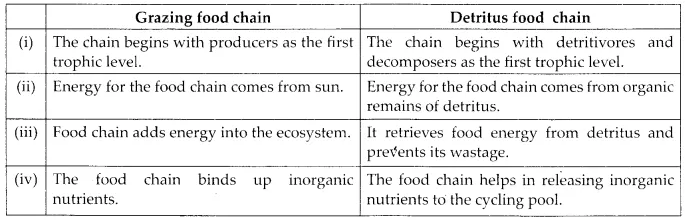
(a) Differences between grazing food chain and detritus food chain are as follows
NCERT Solutions for Class 12 Biology Chapter 14 Ecosystem 6.1

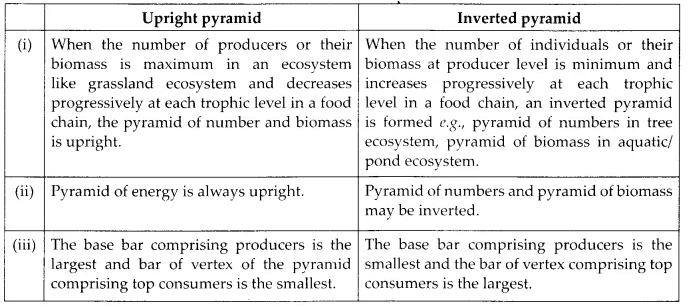
(b) Differences between upright and inverted pyramids are as follows :
NCERT Solutions for Class 12 Biology Chapter 14 Ecosystem 6.2

(c) Differences between litter and detritus are as follows :
NCERT Solutions for Class 12 Biology Chapter 14 Ecosystem 6.3

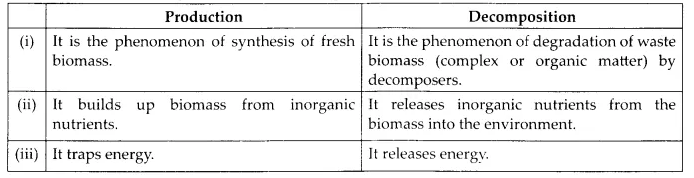
(d) Differences between production and decomposition are as follows :
NCERT Solutions for Class 12 Biology Chapter 14 Ecosystem 6.4

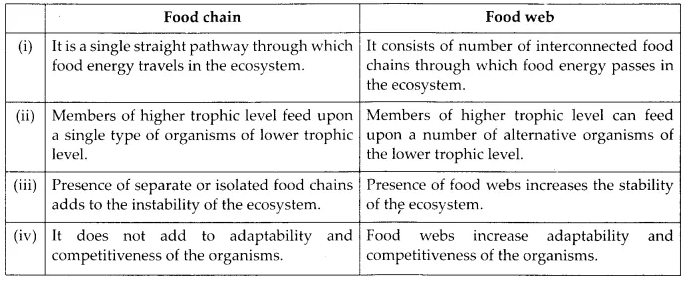
(e) Differences between food chain and food web are as follows:
NCERT Solutions for Class 12 Biology Chapter 14 Ecosystem 6.5

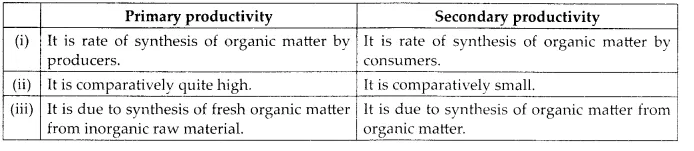
(f) Differences between primary productivity and secondary productivity are as follows :
NCERT Solutions for Class 12 Biology Chapter 14 Ecosystem 6.6

Question 7.
Describe the components of an ecosystem.
Solution:
Ecosystem: The system resulting from the interaction between organisms and their environment is called an ecosystem.
(a) Producers: Organisms, which can synthesize their own food are included under producers, e.g., Volvox, Pandorina, Oedogonium, Saggitaria, Utricularia, Azolla, Trapa, Lemna, Typha, Nymphaea etc. form the producer class of the pond ecosystem.

(b) Consumers:

  • Primary consumer: Animals, which feed on producers are included in this category e.g., Daphnia, Cyclops, Paramoecium, Amoeba, and small fishes.
  • Secondary consumers: Primary consumers also serve as food for water snakes, a few tortoises, few types of fish, etc. hence, these are carnivores.
  • Tertiary consumers: Secondary consumers also serve as food for aquatic birds like kingfishers, cranes, big fish and these together form a top-class carnivorous group and called tertiary consumers.

(c) Decomposers: All producers and consumers die and accumulate on the floor of the pond. Even the waste material and feces of these animals get accumulated on the floor of the pond. Similarly, the floor of the pond is also occupied by decomposers, which include bacteria and fungi. These decomposers decompose complex organic compounds of then- bodies into simpler forms which are finally mixed with the soil of the floor of ponds. These are again absorbed by the roots of producer plants and thus matter is recycled.

Question 8.
Define ecological pyramids and describe with examples, pyramids of number and biomass.
Solution:
An ecological pyramid is a graphic representation of an ecological parameter, as a number of individuals present in various trophic levels of a food chain with producers forming the base and top carnivores the tip. Ecological pyramids were developed by Charles Elton (1927) and are, therefore, also called Eltonian pyramids.

There are three types of ecological pyramids, namely,

  • Pyramid of numbers
  • Pyramid of biomass
  • Pyramid of energy

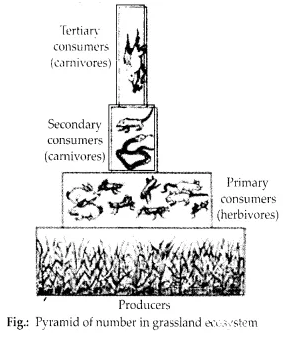
Pyramid of numbers: It is a graphic representation of the number of individuals per unit area of various trophic levels stepwise with producers at the base and top carnivores at the tip. In a grassland, the producers, which are mainly grasses, are always maximum in number. This number then shows a decrease towards the apex, as the primary consumers (herbivores) like rabbits, mice, etc. are lesser in number than the grasses; the secondary consumers, snakes, and lizards are lesser in number than the rabbits and mice. Finally, the top (tertiary) consumers hawks or other birds, are the least in number. Thus, the pyramid becomes upright.
NCERT Solutions for Class 12 Biology Chapter 14 Ecosystem 8.1

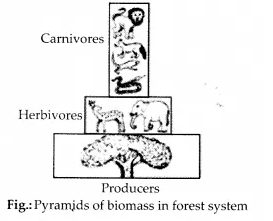
Pyramid of biomass: The amount of living organic matter (fresh and dry weight) is called biomass. Here, different trophic level of the ecosystem are arranged according to the biomass of the organisms. In grassland and forest, there is generally a gradual decrease in biomass of organisms at successive levels from the producers to the top carnivores. Thus these pyramids are upright. But in pond ecosystem, it is inverted because the biomass gradually increases from the producers to carnivores.
NCERT Solutions for Class 12 Biology Chapter 14 Ecosystem 8.2

Question 9.
What is primary productivity? Give a brief description of factors that affect primary productivity.
Solution:
The rate of biomass production is called productivity.
It is expressed in terms of g-2yr-1  or(Kcal-m-2) yr-1 to compare the productivity of ecosystems.
It can be divided into Gross Primary Productivity (GPP) and Net Primary Productivity (NFP).

Gross Primary Productivity of an ecosystem is the rate of production of organic matter during photosynthesis. A considerable amount of GPP is utilized by plants in respiration.

Gross primary productivity minus respiration losses (R), is the Net Primary Productivity (NPP). GPP – R=NPP.
Primary productivity depends on:

  • The plant species inhabiting a particular area.
  • The environmental factors.
  • Availability of nutrients.
  • Photosynthetic capacity of plants.

Question 10.
Define decomposition and describe the processes and products of decomposition.
Solution:
Decomposition is the breakdown of dead or wastes organic matter by micro-organisms. Decomposition is both physical and chemical in nature. Processes involved in decomposition are – fragmentation, catabolism & leaching.

  • Fragmentation – The process primarily due to the action of detritus feeding invertebrate (detritivores) causes it to break into smaller particles. The detritus gets pulverized when passing through the digestive tracts of animals. Due to fragmentation, the surface area of detritus particles is greatly increased.
  • Catabolism – Enzyme degradation of detritus into simpler organic substances by bacteria and fungi.
  • Leaching – The process by which nutrients, chemicals, or contaminants are dissolved & carried away by water, or are moved into a lower layer of soil.

Various inorganic and organic substances are obtained by decomposition. Inorganic substances are obtained in the process of mineralization while organic substances are obtained in humification. A dark coloured amorphous substance called humus is formed by decomposition. Humus is highly resistant to microbial action & undergoes extremely slow decomposition. It serves as a reservoir of nutrients.

Question 11.
Give an account of energy flow in an ecosystem.
Solution:
Ecosystems require a constant input of energy as every component of an ecosystem is regularly dissipating energy.

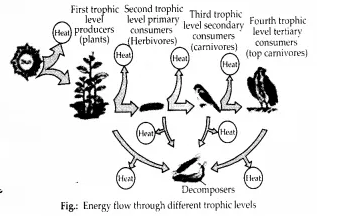
Two laws of thermodynamics govern this flow of energy. According to the first law of thermodynamics, energy can be transferred as well as transformed but is neither created nor destroyed. According to the second law of thermodynamics, every activity involving energy transformation is accompanied by the dissipation of energy. Except for deep hydrothermal ecosystems, the source of energy in all ecosystems is solar energy. 50% of the solar energy incident over the earth is present in PAR (photosynthetically active radiation).

Energy flow in an ecosystem is always unidirectional or one way, i.e., solar radiation → producers → herbivores → carnivores. It cannot pass in the reverse direction. There is a decrease in the content and flow of energy with the rise in trophic level. Only 10% of energy is transferred from one trophic level to the next.
Producer biomass (1000 K cal) → Herbivore biomass (100 K cal) → Carnivore I biomass (10 Kcal) Carnivore II biomass (1 Kcal)
NCERT Solutions for Class 12 Biology Chapter 14 Ecosystem 11.1

Question 12.
Write important features of a sedimentary cycle in an ecosystem
Solution:
Sedimentary Biogeochemical cycle:- It is the circulation of a biogeochemical between the biotic and abiotic compound of an ecosystem is a nongaseous being lithosphere or sediments of the earth. Sedimentary cycles occur in the case of phosphorus, calcium, magnesium, zinc, copper, etc.

Question 13.
Outline salient features of carbon cycling in an ecosystem.
Solution:
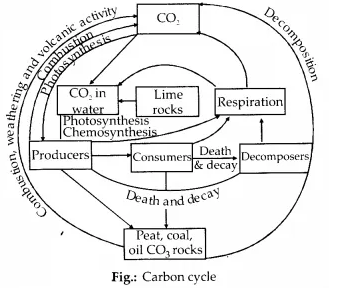
Carbon constitutes 49 percent of the dry weight of organisms and is next only to water. 71 percent of carbon is found dissolved in oceans. This ocean reservoir regulates the amount of carbon dioxide in the atmosphere. Fossil fuels also represent a reservoir of carbon. Carbon cycling occurs through the atmosphere, ocean, and living and dead organisms. 4 x 10¹³ kg of carbon is fixed in the biosphere through photosynthesis annually.

A considerable amount of carbon returns to the atmosphere as Co2 through respiratory activities of the producers and consumers. Decomposers also contribute substantially to the CO2 pool by their processing of waste materials and dead organic matter of land or oceans. Some amount of fixed carbon is lost to sediments and removed from circulation. Burning of wood, forest fire and combustion of organic matter, fossil fuels, volcanic activity are additional sources for releasing Co2 into the atmosphere.

Human activities have significantly influenced the carbon cycle. Rapid deforestation and the massive burning of fossil fuels for energy and transport have significantly increased the rate of release of carbon dioxide into the atmosphere.
NCERT Solutions for Class 12 Biology Chapter 14 Ecosystem 13.1

We hope the NCERT Solutions for Class 12 Biology Chapter 14 Ecosystem helps you. If you have any query regarding NCERT Solutions for Class 12 Biology Chapter 14 Ecosystem, drop a comment below and we will get back to you at the earliest.

NCERT Solutions for Class 12 English Flamingo Poem 2 An Elementary School Classroom in a Slum

Here we are providing NCERT Solutions for Class 12 English Flamingo Poem 2 An Elementary School Classroom in a Slum. Students can get Class 12 English An Elementary School Classroom in a Slum NCERT Solutions, Questions and Answers designed by subject expert teachers.

An Elementary School Classroom in a Slum NCERT Solutions for Class 12 English Flamingo Poem 2

An Elementary School Classroom in a Slum NCERT Text Book Questions and Answers

An Elementary School Classroom in a Slum Think it out 

Question 1.
Tick the item which best answers the following:

(a)“The tall girl with her head weighed down ” means The girl
(i) is ill and exhausted
(ii) has her head bent with shame
(iii) has untidy hair
Answer:
(i) is ill and exhausted

(b) “The paper-seeming boy, with rat’s eyes “ means The boy is
(i) sly and secretive
(ii) thin, hungry, and weak
(iii) unpleasant looking
Answer:
(ii) thin, hungry, and weak

(c) “The stunted, unlucky heir of twisted bones ” means The boy
(i) has an inherited disability
(ii) was short and bony
Answer:
(i) has an inherited disability

(d) “His eyes live in a dream, of squirrel’s game, in tree room, Other than this ” means The boy is
(i) full of hope about the future
(ii) mentally ill
(iii) distracted from the lesson
Answer:
(ii) mentally ill

(e) The children’s faces are compared to “rootless weeds ”
This means they
(i) are insecure
(ii) are ill-fed
(iii) are wasters
Answer:
(ii) are ill-fed

Question 2.
What do you think is the colour of “sour cream”? Why do you think the poet has used this expression to describe the classroom walls?
Answer:
The colour of “sour cream” is off-white or yellowish. The poet has used this expression to describe the classroom walls in order to underline the prevalent neglect. The dull colour and the suggested bitterness, echo the situation of the children.

Question 3.
The walls of the classroom are decorated with the pictures of Shakespeare, “buildings with domes”, “world maps”, and “beautiful valleys”. How do these contrast with the world of these children?
Answer:
The poet saw the lives of slum children as far removed from that which is represented in schoolbooks, maps, photographs of alpine valleys, pictures of buildings with domes and the bust of Shakespeare. The glories of the world filled the textbooks and their classroom walls but failed to liberate these children from the reality of their impoverished existence in the cramped waste of modem industrial towns. The pictures serve as a stark contrast to the lived reality of the children.

Question 4.
What does the poet want for the children of the slums? How can their lives be made to change?
Answer:
Stephen Spender, in this poem, questions the value of education in a slum. He appealed to the governors, teachers, inspectors and visitors to rescue the poor and oppressed from the “tomb” of class discrimination. The poet appeals to them to work towards the social and economic development of these children.

An Elementary School Classroom in a Slum Extra Questions and Answers

An Elementary School Classroom in a Slum Short Answer Questions

Question 1.
Describe the three deprived children as described by Spender in the poem.
Answer:
Among the three deprived children described by Spender in the poem, the first is the tall girl with a “weighed-down head” signifying that she was mentally and physically exhausted. The second is the “paper- seeming boy” with frightened eyes. He was malnourished with twisted bones. The third is an unnoticed “sweet and young” boy whose eyes “live in a dream”.

Question 2.
Mention the characteristics of the slum children.
Answer:
The slum children are described as drained of energy; pale and thin. They are undernourished and unkempt like the “rootless weeds”. They are exhausted—mentally, physically and emotionally.

Question 3.
The first three stanzas spell a scene of dejection and despair. Justify.
Answer:
In the first stanza, the poet spells a scene of dejection and despair by using words such as the “rootless”,“stunted”, “twisted”, “gnarled”, “dim” and “diseased”. The poet speaks of the children’s faces as “rootless weeds”—unwanted, ugly and parasitic. They were unkempt and exhausted, sickly lean and like rodents. They had inherited their diseased bones from their parents. Their pitiable plight is reflected by equally dim and pathetic classrooms. They were doomed to be the “slag heap” of society like useless and unwanted “rubbish”.This antithetical imagery lends a contrast between the slum children and the subjects of their learning.

Question 4.
Contrast the imagery of the slum with donations on the wall.
Answer:
The slum is described as dark and dim where the children live on slag heap. They have a foggy future. The course of life for them is a narrow street with a lead sky that encloses on them. This is in contrast to the donations on the wall. Shakespeare’s head symbolizes an enlightened mind and the cloudless bright skies and the Tyrolese valley are contrasted with the foggy environment of the slum. The donations talk both of beauty and progress, while the slum is regressive.

Question 5.
What do “sour cream walls” symbolize?
Answer:
The “sour cream walls” symbolize the unkempt walls where the paint is yellowing and has lost lustre. Metaphorically, it reflects the despondent look of the students as well as the bitter life of the slum children.

Question 6.
Who can change the lives of the slum children and how?
Answer:
An enlightened person like a governor, inspector, or visitor can transform the lives of the slum children. These educated minds can liberate the imprisoned minds of the children. The poet then visualizes liberated children running on the “gold sands” and delving into the books. Their mind will be empowered and enlightened like the sun.

Question 7.
Discuss the use of metaphors in the poem.
Answer:
The poem uses a lot of comparisons or metaphors. The “gusty waves” symbolize the energy that ought to be found in children. The image of the fog is an implied comparison with the bleak future of children; for this purpose the poet uses the words “painted with a fog” and closed down with a “lead sky”. The children live “from fog to endless night” and for them “time and space are foggy slum”. The exposure to education and liberation of the mind is compared to being shown “green fields” and allowed to run “azure on gold sands”.
Being empowered and enlightened is being like the sun.

Question 8.
The poem dwells on squalor but ends on an optimistic note. Discuss.
Answer:
The poem dwells on squalor but ends on an optimistic note. The imprisoned minds and lives will be released from their bondage when “governor, inspector, visitor” come to their rescue. They will be free from the “tomb” of class prejudice and are visualized as liberated children running on the “gold sands”, exploring the realms of knowledge. They will also be liberated from the shackles of poverty.

An Elementary School Classroom in a Slum Value Based Question

Question 1.
The poem exposes the widespread neglect of children of all nationalities, races, and ethnicities. The poet pleads for equal opportunity for education thereby appealing to the people to be more sensitive to their needs. Justify.
Answer:
The poet pleads for social justice so as to provide equal opportunity for education to children of all social strata. He pities the miserable plight of the classroom in the slum that offers little hope for change or progress for its students. The poem provides a clear, dreary depiction of the students in the classroom. The poverty and social injustice imposed upon the children causes them to be “weighed-down,” “paper-seeming,” diseased and “twisted.” Through the poignant imagery, the poet expresses his outrage at the insensitive attitude of the rich and the privileged, towards the unfortunate children of the slum school.

The poem also highlights the importance of education and how it should touch the lives of the downtrodden society. Empowered by education, these children, according to the poet, can achieve a mental prowess that will free them from futures “painted with a fog”. He views education as a means of bringing about social . change and uprooting poverty. He wishes for the divide between the rich and the poor to disappear so that no childhood is lost in the gloomy darkness of the ignorance in the slums.

Give examples from the poem of the following poetic devices.

Antithesis
Contrast between the “rootless”, “stunted”, “twisted”, “gnarled”, “dim” and “diseased” lives of the slum children with that represented in schoolbooks, maps, photographs of alpine valleys, or a bust of Shakespeare.

Repetition
(a) “Far far from rivers, capes, and stars of words.”
(b) “Break O break open ‘till they break the town.”

Simile
(a) “.. .children’s faces/Like rootless weeds”
(b) “With mended glass, like bottle bits on stones.”

Metaphor
(a) “The paper-seeming boy, with rat’s eyes.”
(b) “these windows, not this world, are world,”
(c) “future painted with fog”
(d) “A narrow street sealed in with a lead sky,”
(e) “From fog to endless night”

Irony
“Surely, Shakespeare is wicked, and the map a bad example”

Speech Writing Format CBSE Class 11 Examples, Samples, Topics

Speech Writing Format CBSE Class 11

Though speech is essentially an essay, it is significantly different. Whereas an essay or an article is read by people at a distance in time and place, a speech is delivered ‘live’ to an audience. This fact determines, to a great extent, the language and style of the composition.

A speech consists of the words spoken by a person to a gathering. The speaker could be a leader, a learned man, a man in a position of power and authority or an ordinary person, a student. The ‘address’, the language and style are determined by the occasion and the audience.

This grammar section explains English Grammar in a clear and simple way. There are example sentences to show how the language is used. NCERT Solutions for Class 11 English will help you to write better answers in your Class 11 exams. Because the Solutions are solved by subject matter experts.

Speech Writing Format CBSE Class 11 Examples, Samples, Topics

♦ Format:

(a) Address the gathering, e.g., Respected Principal, teachers, students, Good Morning.
(b) Speech in three or four paragraphs.
(c) A speech ends with Thank you. The speaker thanks the listeners for their patient hearing. Content:

♦ Content:

According to the occasion, you may include quotations. Organise the speech into introduction, main points and conclusion.

Language and style should be a mingling of the serious and conversational modes.

Question 1.
You are Mukesh/Mukta of Saket. You have been reading the news items on Nithari killings. Write a speech in 150-200 words to be given in the morning assembly, stressing the need of keeping a close vigil on the anti-social elements of the locality and taking care of young children of the area so that they don’t fall prey to bad characters.
Answer:

Crimes Against Children
by Mukta (XIA)

Respected Principal, teachers and dear friends. Good Morning. I am Mukta of Class XI. Today I would like to share my views with you on crimes against children. It is a horrifying reality with which we have to contend.

Some recent tragic events have opened our eyes to the magnitude of crimes against children. Mostly, children are kidnapped for ransom if they are from rich families, or for begging and stealing if they are from ordinary families. Cases of child abuse are growing in alarming proportions.

The most disgusting and horrifying of these cases was the one discovered at Noida, where the owner- servant team carried out dastardly crimes against children behind closed doors. Investigations are unveiling horrible acts.

In such a scenario, it is imperative that parents take good care of their children. Children should be trained not to.trust strangers.

The security of a neighbourhood depends on the alertness of the citizens. We have a tremendous responsibility towards our youngsters.

I hope my words will make you think about the matter.
Thank you

Question 2.
Children usually come to school without taking breakfast in the morning and eat junk food from the school canteen. This habit affects adversely the performance of students in academics and sports. Write a speech in 150-200 words to be given in your school assembly about ‘How Health is Affected by Lifestyle’.
Answer:

How Health is Affected by Lifestyle

Respected Principal, teachers and dear friends,

Good morning, I am Mamta of XI A, and I wish to speak to you on a very important matter. I wish to speak to you on how our health is affected by our lifestyle.

Yesterday, a class VI student fainted in the assembly. The reason was that she had not taken her breakfast of porridge, fruit and milk. She wanted noodles only with coffee!

Friends, the breakfast her mother had prepared was nutritious, it would have given her energy for the whole day. If we fill our stomach, meal after meal, with junk food, how shall we grow tall and strong? How will we get the energy for mental work?

Like food, rest is an important part of our lifestyle. My friend Roshan was unable to answer his English paper in the unit test; he was feeling sleepy. He had studied till 3 a.m. because he thought English could be studied in a few hours. Had he been regular in work and study, he would have done well, for he is very intelligent.

My last word is for my obese friends who form almost 30% of our student body. Exercise, exercise and regular exercise is the answer to your problems.

I sincerely hope you will improve your lifestyle to be healthier and stronger.

Thank You.

♦ Analysis:

  1. Notice that the speech opens with an address to the listeners. They are addressed in order of importance. Do not forget to address the student audience.
  2. Notice the conclusion. The speech ends with thanking the audience.
  3. Notice that the language and style are more conversational than that of an article.
  4. The structure of the content of a speech is very similar to that of an article/essay, i.e., having an introduction, main body and conclusion.

Question 3.
A recent survey by the Ministry of Health shows that the growing tendency of obesity among children today is caused by addiction to junk food and lack of physical exercise, and it adversely affects their learning power. Write a speech in 150-200 words to be delivered in the morning assembly of the school highlighting the importance of good health and motivating the children to eat healthy, balanced diet.
Answer:

Side Effects of Junk Food

Respected Principal, Vice Principal, teachers, and dear friends. Good morning.

I am grateful to the Principal, Dr N. Ravi, for giving me this opportunity to speak on a matter that is close to the heart of all teenagers.

As I stand here, I can see about eight to ten overweight students in each class line. Surely, they are embarrassed and have become the butt of jokes. To look fit and trim is vital for a good personality.

Friends, I want you to look at your daily routine and see what you are doing to get this bulky figure. Are you excessively fond of cold drinks, pizzas and hamburgers? Do you love to sit before TV and munch wafers and packaged chips of all brands ? Is your favorite snack during the long break everyday a spicy oily ‘samosa’ or ‘bread pakora’?

Later in the evening do you just sit indoors and work on your computer, complete your homework or watch TV ?

If the answer to these questions is ‘Yes’, you know why you have this ungainly figure. In order to be slim and athletic, you need to eat right, exercise briskly in fresh air and live a disciplined life. The food that your mother prepares is what you should consume rather than junk food.

Thank you

Question 4.
With the visual media technology overtaking the print-media, you have observed a decline in the people’s interest in reading books. You are disturbed by this excessive dependence of the young on television and computer games as the source of entertainment. Write a speech in 150-200 words for your school magazine on the “Pleasures of Reading” or “The Company of Books. ”
Answer:

The Pleasures of Reading
by ABC

Reading affords pleasure like no other activity. It is deeply fulfilling and satisfying. While reading, the reader is in direct communication with the writer, however distant he may be in time or space. The reader is fully focussed and enjoys the content as well as the beauty and power of language. Reading offers an infinite variety according to one’s taste. Knowledge, imagination and the reader’s own appreciation of the written word are some of the rewards of reading. If one is adventurous, one can venture into unknown cultures through books. For example, a reading of Tolstoy or Chekhov gives us an insight into the life of the Russians as a reading of Dickens gives us of the British, particularly of London dwellers.

Reading makes us more sensitive to human greatness as well as human suffering. A reading of Premchand’s short stories acquaints us with the strengths and weaknesses of human character. The classics of literature are eternal in their appeal.

Unfortunately, today most of us visit the celluloid version of Sharat Chandra’s ‘Devdas’ three four times, and the original printed one not even once.

Question 5.
The world that we are living in is under a great threat of extinction. Large scale pollution, deforestation and industrialization are suffocating the environment. You, as a concerned citizen, want to share the causes and effects of global warming. You would also like to give a few suggestions on how to contribute to the making of a better world. As Vivek/Vineeta Arora, Head Boy/Girl of the school, prepare a speech on this issue for the morning assembly under the heading “The Hazards of Global Warming”. (150-200 words)
Answer:

The Hazards of Global Warming

Respected Principal, teachers and dear friends,

This morning, I wish to draw your attention to the catastrophe that is slowly and surely coming towards us. I am talking about the hazards of global warming.

Some of my friends may not be aware of ‘global warming’. This term means the rise of the temperature of the atmosphere surrounding our planet. This is happening because of over industrialisation, large-scale pollution and deforestation. Hot emissions from industry and release of chemicals in the air are making the atmosphere of the earth warmer.

What are the hazards of global warming? Already, the polar ice caps have started melting. This can bring disaster to the world. Huge glaciers in the Himalayas and other mountains are shrinking. This will cause a rise in the sea level and will eventually lead to the flooding of coastal areas. Global warming will also bring about changes in the world climate. There will be excess rains, floods, unbearable heat and cold. These changes will surely bring disaster to the flora and fauna of our planet.

What can we do about this problem? The countries need to exercise discipline ajpout putting up industries. Effective measures to control pollution are needed.

Friends, I have tried to acquaint you with the problem the whole world is facing.

Thank you.

Question 6.
You are the Class Representative, Class XI of Gandhi Memorial School, Pushp Vihar. You have been asked to prepare a speech on the need to imbibe principles of truthfulness, gentleness and cooperation to counter the growing violence in today’s world. Write this speech in 150-200 words.
Answer:

Respected Principal, teachers and dear friends,

Today, I wish to speak to you on the very familiar subject of values like truthfulness, gentleness and cooperation. If we wish to counter the growing violence around us, these values are the only recourse open to us. (Develop these points).

Truthfulness – the basis of social stability – will rid society of deceit and fraud – example of Gandhiji! who could defeat the mighty British with the weapon of truth.

Gentleness – tolerance of the other colour, religion and caste, patience and compassion advocated by Buddha and Mahavir.

Cooperation – inevitable in the era of globalization.

Thank you

Question 7.
You are Rajini/Rajat Gaur. After seeing some obese children in your school, you are worried about
the craze for junk food and electronic gadgets in students. Write a speech to be read out in the morning assembly highlighting the need to have good eating habits and the benefits of outdoor activities. (Word limit: 150-200 words)
Answer:

Respected principal, teachers and dear friends. Today I am standing before you to express my views on the topic “obesity among school children”. Obesity has become a cause of concern for one and all. With the entry of companies like McDonalds, Kentucky chicken, wimpeys, Pizza Huts, etc. the concept of fast food has spread like a wild fire. More and more school children have taken to chocolates and soft drinks without worrying for colories. The result is obesity increasing by leaps and bounds among school children.

‘Junk food’ appeals to our taste buds but our digestive system repels it. Oil and extra fat harm our liver. We put on flesh and increase our weight. Fresh home cooked meals are hygenic, better and full of vitamins. Minerals can be easily digested. Our food should consist of coarse cereals, green and leafy vegetables, fruits, and pulses, etc. To keep ourselves agile, energetic and robust, we must do physical exercises, play games like football, badminton, kabbaddi, volleyball, etc.

By eating healthy food, doing regular physical activities not only our body will be healthy and toned our minds would remain active. I hope you all will give some consideration to my suggestion and try to instil it in your daily routine.

Thank you all for giving me a patient hearing.

Question 8.
Yoga is beneficial. Speak about the benefits of yoga in the morning assembly. (Word limit: 150-200)
Answer:

Respected Principal, teachers and friends, a very good morning to one and all. Today I am standing before you to express my views on the benefits of practising yoga.

Many of us perform yoga but do we know what this entails and why is it performed? Basically yoga is a means to attain balance in our body, i.e., gaining strength, increasing flexibility and attaining spirituality. Postures and asanas are an indispensable part of yoga. These are performed keeping in mind all the body parts, combining breathing practices, and include guided mediation, Yoga is a union between body and mind. In other words, we can say it is a balance between mind and helps us keep ourselves fit and fine.

Yoga has the potential to cure many diseases like respiratory problem, abdominal problem and diseases related to the nervous system. Yoga helps in releasing toxins, reduces stress and increases concentration. In short, yoga helps us keep disease-free, happy, wealthy, wise and toned up. Yoga is a never-ending process. The deeper you delve into it the more fruitfull will be the results.

I would like to end my speech on this note.

NCERT Solutions for Class 12 Biology Chapter 10 Microbes in Human Welfare

NCERT Solutions for Class 12 Biology Chapter 10 Microbes in Human Welfare

These Solutions are part of NCERT Solutions for Class 12 Biology. Here we have given NCERT Solutions for Class 12 Biology Chapter 10 Microbes in Human Welfare

Question 1.
Bacteria cannot be seen with the naked eyes, but these can be seen with the help of a microscope. If you have to carry a sample from your home to your biology laboratory to demonstrate the presence of microbes under a microscope, which sample would you carry and why?
Solution:
Curd. It is simple to carry and easily demonstrate the presence of Lactobacillus bacteria.

Question 2.
Give examples to prove that microbes release gases during metabolism.
Solution:

  • Making of dough for bread, dosa, and idli with the help of fermenting microbes. Heat expels the gases and makes the food spongy.
  • Production of biogas

Question 3.
In which food would you find lactic acid bacteria? Mention some of their useful applications.
Solution:
Curd. LAB (Lactic Acid Bacteria) produce acids that coagulate and partially digest the milk protein. LAB also play very beneficial role in the stomach to check disease-causing microbes.

Question 4.
Name some traditional Indian foods made of wheat, rice, and Bengal gram (or their products) which involve use of microbes.
Solution:
Idli, Dhokla, Dosa. Several food items such as dosa, idli, jalebi and bread are prepared by fermentation process in which one or more kinds of microbes are used.

Question 5.
In which way have microbes played a major role in controlling diseases caused by harmful bacteria?
Solution:
Microbes are very useful to combat disease-causing harmful bacteria. A number of antibiotics have been isolated from microorganisms. An antibiotic is a substance which in low concentration inhibits the growth and metabolic activity of pathogenic organisms without harming the host. Penicillin was the first antibiotic to be discovered by Alexander Fleming from fungus Penicillium notation. Antibiotics are obtained from lichens, fungi, eubacteria, and actinomycetes. Some common antibiotics and their sources are as follows :

  1. Polymyxin – Bacillus polymyxa
  2. Chloramphenicol – Streptomyces venezuelae
  3. Neomycin – Streptomyces fradiae
  4. Tetracycline (Terramycin) – Streptomyces rimosus
  5. Cephalosporin – Cephalosporium acremonium

Question 6.
Name any two species of fungus, which are used in the production of the antibiotics
Solution:
Penicillium notatum provides antibiotic penicillin and antibiotic fumagillin is obtained from Aspergillus fumigatus.

Question 7.
What is sewage? In which way can sewage be harmful to us?
Solution:
The wastewater containing large amounts of organic matter and microbes is called sewage. The sewage contains many harmful pathogens. It will pollute the natural water bodies like rivers and streams if it is released into them. This will in turn cause the spreading of many communicable diseases which are transmitted through contaminated food and water.

Question 8.
What is the key difference between primary and secondary sewage treatment?
Solution:
Primary (1°) treatment is a physical process that involves for removal of particulate as settleable particles. Secondary (2°) treatment is purely a biological treatment involving microbial oxidation.

Question 9.
Do you think microbes can also be used as a source of energy? If yes, how?
Solution:

Biogas is a mixture of gas containing methane, hydrogen sulphide and carbon dioxide. Methane is the predominant gas. It is produced by microbial activity and is used as a source of energy. The types of gases produced depend upon the types of organic materials they (microbes) use. The bacteria grow anaerobically on cellulose, produce a large amount of meth­ane along with hydrogen and carbon dioxide. These bacteria are collectively called methanogens.

One of the common methanogens is Methanobacterium. Methanogens are commonly found in sewage. They are also found in the rumen (a chamber of the compound stomach) of cattle where a large amount of cellulosic food is present. These bacteria help in the breakdown of cellu­lose and thus play a vital role in digestion (symbiotic digestion). Thus, the excreta (dung) of cattle, commonly called gobar can be used for the produc­tion of biogas and hence called gobar gas.

Question 10.
Microbes can be used to decrease the use of chemical fertilizers and pesticides. Explain how this can be accomplished.
Solution:
Due to its hazardous nature and anti-environmental effect the use of chemical fertilisers and chemical insecticides are very illegitimate. The development of biofertilisers and bioinsecticides has enabled us to reduce the use of chemical fertilisers and chemical insecticides. Microbes are very important biological agents as biofertilisers and biopesticides.
Microbes as biofertilisers

  1. Free-living nitrogen-fixing bacteria – Azotobactcr, Clostridium.
  2. Free-living nitrogen-fixing cyanobacteria – Anabaena, Nostoc.
  3. Symbiotic nitrogen-fixing bacteria – Rhizobium
  4. Symbiotic nitrogen-fixing cyanobacteria – Azolla – Anabaena
  5. Mycorrhiza – symbiotic association between fungi and roots of a higher plant.

Microbes as bio-pesticides:
Biopesticides are that biological agents that are used to control weeds, insects, and pathogens. The microorganisms used as biopesticides are viruses, bacteria, protozoa, fungi, and mites. Some of the biopesticides are being used at a commercial scale. Most important example is the soil bacterium Bacillus thuringiensis (Bt). Spores of this bacterium produce the insecticidal Cry protein. This bacterium was the first biopesticide to be used on a commercial scale in the world. Through the use of genetic engineering, the scientists have introduced the B. thuringiensis toxin gene into plants. Such plants are resistant to attack by insect pests.

Question 11.
Three water samples namely river water, untreated sewage water and secondary effluent discharged from a sewage treatment plant were subjected to BOD test. The samples were labelled A, B and C; but the laboratory attendant did not note which was which. The BOD values of the three samples A, B and C were recorded as 20mg/L, 8mg/L and 400mg/L, respectively. Which sample of the water is most polluted? Can you assign the correct label to each assuming the river water is relatively clean?
Solution:
If the BOD level of A, B and C are 20 mg/L, 8 mg/L and 400 mg/L, the /most polluted one is sample ‘C’ i.e., untreated sewage water. Sample B is the least polluted and it is river water. Sample A is secondary effluent discharged from a treatment plant.

Question 12.
Find out the name of the microbes from which Cyclosporin A (an immunosuppressive drug) and Statins (blood cholesterol-lowering agents) are obtained.
Solution:
Cyclosporin A – Trichoderma polysporum. Statin – Monascus purpureus.

Question 13.
Find out the role of microbes in the following:

  1. Single-cell protein (SCP)
  2. Soil

Solution:
1. Single-cell protein (SCP) is the protein extracted from cultivated microbial biomass. Edible mushrooms, yeast cells, and blue-green algae provide high protein resources with some medicinal effects. SCP is available in the forms of fresh cells, dry cells, tablets, or extracts.

2. The use of biological methods for controlling plant diseases and pests is called biocontrol. This method has been replaced by the indiscriminate use of chemicals used in the chemical control of pests. The chemicals used for killing pests are toxic and extremely harmful to men and domestic animals. They also pollute the environment and our crop plants.

Question 14.
Arrange the following in the decreasing order (most important first) of their importance, for the welfare of human society. Give reasons for your answer. Biogas, citric acid, penicillin and curd
Solution:
The correct order from viewpoint of human welfare should be as follows: Penicillin > biogas > citric acid > curd Penicillin is an antibiotic, which is used to combat pathogenic microorganisms. Today, we cannot imagine a world without antibiotics because antibiotics have greatly improved our capacity to treat deadly diseases such as plague, whooping cough (kali khansi), diphtheria (gal ghotu) and leprosy (kusht rog), which used to kill millions of people all over the globe. It should be given first priority.

As we are going to face a great crisis of fossil fuels in near future, biogas can be the legitimate and brilliant alternative to fossil fuels. It can be used as fuel for heating, cooking, lighting, power for irrigation and other purposes. It is considered an eco-friendly and pollution-free energy source.
Citric acid is produced through the fermentation carried out by Aspergillus niger on many carbohydrates. Citric acid is used in medicines, dyeing, mirror silvering, manufacture of ink, flavouring and preservation of food and candies.

Curd is prepared by fermentation of milk. Fermentation agents are lactic acid bacteria. Curd is more nutritious than milk as it contains a number of vitamins and organic acids.

Question 15.
How do biofertilisers enrich the fertility of the soil?
Solution:
The use of biological methods for controlling plant diseases and pests is called biocontrol. This method has been replaced by the indiscriminate use of chemicals used in the chemical control of pests. The chemicals used for killing pests are toxic and extremely harmful to men and domestic animals. They also pollute the environment and our crop plants.

We hope the NCERT Solutions for Class 12 Biology Chapter 10 Microbes in Human Welfare help you. If you have any query regarding NCERT Solutions for Class 12 Biology Chapter 10 Microbes in Human Welfare, drop a comment below and we will get back to you at the earliest.