NCERT Solutions for Class 11 English Hornbill Chapter 5 The Ailing Planet: the Green Movement’s Role

Here we are providing NCERT Solutions for Class 11 English Hornbill Chapter 5 The Ailing Planet: the Green Movement’s Role. Students can get Class 11 English The Ailing Planet: the Green Movement’s Role NCERT Solutions, Questions and Answers designed by subject expert teachers.

The Ailing Planet: the Green Movement’s Role NCERT Solutions for Class 11 English Hornbill Chapter 5

The Ailing Planet: the Green Movement’s Role NCERT Text Book Questions and Answers

The Ailing Planet: the Green Movement’s Role Understanding the text

Question 1.
Locate the lines in the text that support the title ‘The Ailing Planet’.
Answer:
(a) “The earth’s vital signs reveal a patient in declining health.”
(b) a new awareness has now dawned upon the most dangerous animal (man) in the world.”
(c) “Are we to leave our successors a scorched planet of advancing deserts, impoverished landscapes and ailing environment?”
(d) “.. .In large areas of the world, human claims on these systems are reaching an unsustainable level, a point where their productivity is being impaired.”
(e) “When this happens, fisheries collapse, forests disappear, grasslands are converted into barren wastelands, and croplands deteriorate.”
(f) “…several species of life face extinction as a result of its destruction.”
(g) “It has been well said that forests precede mankind; deserts follow.”
(h) “The world’s ancient patrimony of tropical forests is now eroding at the rate of forty to fifty million acres a year, and the growing use of dung for burning deprives the soil of an important natural fertiliser.”
(i) “The World Bank estimates that a five-fold increase in the rate of forest planting is needed to cope with the expected fuel wood demand.” “….We were saying that we are losing the forests at an acre a second, but it is much closer to an acre-and-a-half to a second.”
(j) “.. .highlighted the near catastrophic depletion of India’s forests over the last four decades.”
(k) “India, according to reliable data, is losing its forests at the rate of 3.7 million acres a year.. .The actual loss of forests is estimated to be about eight times the rate indicated by government statistics.”
(l) “A three-year study warns that the environment has deteriorated so badly that it is ‘critical’ in many of the eighty- eight countries investigated.”
(m) “For the first time in human history we see a transcending concern—the survival not just of the people but of the planet.”
(n) “The environmental problem does not necessarily signal our demise, it is our passport for the future.”

Question  2.
What does the notice ‘The world’s most dangerous animal’ at a cage in the zoo at Lusaka, Zambia, signify?
Answer:
In the zoo at Lusaka, Zambia, outside a cage there is a notice that reads, “The world’s most dangerous animal.” Inside the cage there is no animal but a mirror where one can see oneself. It is an endeavour to make humans realise how destructive they are. They are the cause of the destruction of thousands of species. We have done this by destroying their habitats. This is an attempt to make human beings introspect about their destructive deeds. It is an attempt to help us realise the wisdom of shifting from a system based on domination to one based on partnership.

Question  3.
How are the earth’s principal biological systems being depleted?
Answer:
Mr Lester R. Brown in his book, The Global Economic Prospect, points out that the earth’s four principal biological systems fisheries, forests, grasslands, and croplands form the foundation of the global economic system. In addition to supplying our food, these four systems provide virtually all the raw materials for industry.

Human claims on these systems are reaching an unsustainable level, a point where their productivity is being impaired. As a result, fisheries collapse, forests disappear, grasslands are converted into barren wastelands, and croplands deteriorate. Since tropical forests are, in the words of Dr Myers, “the powerhouses of evolution”, several species of life face extinction as a result of their destruction.

Question 4.
Why does the author aver that the growth of world population is one of the strongest factors distorting the future of human society?
Answer:
Growing population is one of the strongest factors distorting the future of human society. A three-year study using satellites and aerial photography conducted by the United Nations, warns that the environment has deteriorated so badly that it is ‘critical’ in many of the eighty-eight countries investigated. India is losing its forests at the rate of 3.7 million acres a year. The actual loss of forests is estimated to be about eight times the rate indicated by government statistics.

The Ailing Planet: the Green Movement’s Role Talking about the text

Discuss in groups of four.

Question 1.
Laws are never respected nor enforced in India.
Answer:
Article 48 A of the Constitution of India makes available that “the State shall endeavour to protect and improve the environment and to safeguard the forests and wildlife of the country”. But the cause of unending distress is the fact that laws are never respected nor imposed in India.

For example, the Constitution says that “casteism, untouchabitity and bonded labour” shall be eradicated, but this has not happened even after several years of the functioning of the Constitution. A recent report of our Parliament’s Estimates Committee has highlighted the appalling exhaustion of India’s forests over the last four decades. India is losing its forests at the rate of 3.7 million acres a year but the actual loss of forests is likely to be about eight times more than this, despite laws.

Question 2.
“Are we to leave our successors a scorched planet of advancing deserts, impoverished landscapes and an ailing environment?”
Answer:
The earth’s four principal biological systems fisheries, forests, grasslands, and croplands form the foundation of the global economic system. In large areas of the world, human claims on these systems are reaching an unsustainable level, a point where their productivity is being impaired. According to Dr Myres, the tropical forests that are the powerhouses of evolution, as they house innumerable species, are facing extinction.

It has been said that forests pave the way for man’s survival while deserts come after the annihilation of life. The world’s tropical forests are now wearing away at the rate of forty to fifty million acres a year. Expressing his concern, Mr L.K. Jha, raised this question in the first Brandt report. He felt it was unfair to leave for our future generations a seared planet with a growing number of deserts, a landscape deprived of nutrients and natural beauty.

Question 3.
“We have not inherited this earth from our forefathers; we have borrowed it from our children”.
Answer:
For the first time in human history we see an excessive worry about the survival not just of the people but also of the planet. We have begun to take a holistic view of the very passport for the future. The emerging new world vision has ushered in the Era of Responsibility. It is a holistic view, an ecological view, seeing the world is not something to be exploited for our good but as an inheritance to be preserved for future generations.

Question 4.
The problems of overpopulation that directly affect our everyday life.
Answer:
Growing population is the main factor changing the future of human society. In 1800, the population was merely one billion. Another billion was added to it by 1900. By the twentieth century the population increased by another 3.7 billion. The present world population is estimated at 5.7 billion.

Every four days, the world population increases by one million. Controlling the population growth will improve our general health. Moreover, development may not be possible if increase in numbers continues. The rich get richer, and the poor produce children, which is the cause of their poverty. It adds to the number of unemployed persons. If this is not checked, the poor will die of starvation.

The Ailing Planet: the Green Movement’s Role Thinking about language

The phrase ‘inter alia’ meaning ‘among other things’ is one of the many Latin expressions commonly used in English.
Find out what these Latin phrases mean.

  • prima facie – at first glance
  • ad hoc – done for a particular purpose and not planned in advance
  • in camera – in private; in a closed court
  • ad infinitum – endlessly
  • mutatis mutandis – including necessary changes
  • caveat – warning or proviso; request to court
  • tabula rasa – mind prior to experience; chance to start afresh

The Ailing Planet: the Green Movement’s Role Working with words

I. Locate the following phrases in the text and study their connotation.

  • gripped the imagination of – captured someone’s interest
  • dawned upon – became apparent
  • ushered in – heralded or introduced something
  • passed into current coin – invent or devise a word or phrase that is used in the present
  • passport of the future – authorisation to take us to a brighter future

II. The words ‘grip’, ‘dawn’, ‘usher’, ‘coin’, ‘passport’ have a literal as well as a figurative meaning. Write pairs of sentences using each word in the literal as well as the figurative sense.

1. grip: The baby gripped my finger with her tiny hand.

  • She would not loosen her grip on my arm.
  • The suspense in the film held me in grip throughout the two hours.
  • I found the book so gripping that I couldn’t put it down.
  • The intruder turned towards me and I was suddenly gripped by fear.
  • Rebels have tightened their grip on the city.
  • I have packed a day’s change of clothing in the grip.

2. dawn:

  • They walked all night and reached the village at dawn.
  • Gradually the truth about him dawned on us.

3. usher:

  • She ushered us into her office and offered us coffee.
  • The new legislation should usher in a host of new opportunities for school leavers
  • He works as an usher

4. coin:

  • I asked for ten pounds in 20p coins.
  • Allen Ginsberg coined the term ‘flower power’.

5. passport:

  • Many refugees have arrived at the border without passports.
  • Many students opt for business studies simply because it sounds like a passport to
    a good job.
  • Beauty alone can be a passport to success.

The Ailing Planet: the Green Movement’s Role Things to do

1. Make posters to highlight the importance of the Green Movement.
2. Maintain a record of the trees cut down and the parks demolished in your area, or any other act that violates the environment. Write to newspapers reporting on any such acts that disturb you.

32/4, Mehrauli, New Delhi
12 February 20XX
The Editor
Navyug Times
Kasturba Gandhi Marg, New Delhi-1
Subject: Malls trampling Delhi’s green belt
Dear Sir,

Part of the Aravalli range, the Delhi Ridge, is an icon of greenery and part of the capital’s heritage. But over the years, much of the Ridge has disappeared, with the most recent threat coming from swanky hotels and malls.

The Ridge is home to many endemic plant species and still remains an important visiting stop to many migratory birds as they journey onwards to other parts of the subcontinent. Moreover, it cools the hot winds from the deserts of the neighbouring state of Rajasthan before they reach the city and stashes away welcome raindrops to boost dipping groundwater levels.But over the years, much of the Ridge has disappeared under the brick and mortar that now define most Indian cities.

A worst-case scenario is on display in the Ridge area in Vasant Vihar, where trees are being cut down to build swanky hotels and malls. Such expansion that puts more soil under cement and replaces forested areas with concrete is profoundly altering the environmental landscape. The health of our natural endowments has now become the source of much anxiety and consternation amongst the residents of the area.

We remain unclear as to both the quality and the quantity of our ecological footprint and whether we have taken actions that will lead to negative short-term and long-term environmental consequences. It is essential to halt this march towards destruction of the Ridge. The Ridge forest is protected under the master plan and must remain so. Residents must actively protest against this degradation of their environment.

Yours sincerely,
(Name …)
NCERT Solutions for Class 12 English Vistas Chapter 1 The Third Level

Here we are providing NCERT Solutions for Class 12 English Vistas Chapter 1 The Third Level. Students can get Class 12 English The Third Level NCERT Solutions, Questions and Answers designed by subject expert teachers.

The Third Level NCERT Solutions for Class 12 English Vistas Chapter 1

The Third Level NCERT Text Book Questions and Answers

The Third Level Reading with insight

Question 1.
What does the third level refer to?
Answer:
The third level is the world somewhere between desire or dream and reality. It is a world of fantasy that we create for ourselves and occasionally seek to escape to. Most of the time it is a picture of the simple past of our forefathers, who, we believe were happier. It is an escapist’s world which one weaves around to be off the current-day problems, worries, anxieties and tensions.

Question 2.
Would Charley ever go back to the ticket-counter on the third level to buy tickets to Galesburg for himself and his wife?
Answer:
Time travel is a temporary relief that man seeks to escape from the rush of his present existence. It was a world of fantasy that Charley too had created. So, he exchanged all his savings for 1894 currency to buy tickets from the third level to Galesburg, Illinois. However, he could not find the third level again as it did not exist.

The Third Level Reading With Insight

Question 1.
Do you think that the third level was a medium of escape for Charley? Why?
Answer:
Life today is full of insecurity, fear and worries and time travel is man’s way of escaping from it. Occasionally, man seeks escape into the world of fantasy and his nostalgic memories, the happier • times of the past. Yes, the third level was Charley’s medium of escape from the mad rat race of modern times.

Question 2.
What do you infer from Sam’s letter to Charley?
Answer:
Sam’s letter shows man’s pining for the simple, less harassing and a happier era. He too had found respite from the hurry and worry of modern life in time travel. Sam had learnt to transport himself into the time period of his ancestors whose quality of life he considered was better than their present existence.

Question 3.
The modern world is full of insecurity, fear, war, worry and stress. What are the ways in which we attempt to overcome them?
Answer:
Man often creates in his fantasy a world which is somewhere between his desire and reality, and often seeks respite by transporting himself to it mentally. Time travel is another way of overcoming stress; we travel back in time to the past which we believe was a quieter and happier era. Nostalgic memories too are often a way of escape from the harassing present.

Question 4.
Do you see an intersection of time and space in the story?
Answer:
Yes, the story clearly shows an intersection of time and space. Firstly, the first two levels of Grand Central Station were located in the present time while the third level existed in the 1890s. Secondly Charley and his wife, Louisa, live in the present time yet Charley goes to get old currency to buy tickets to go to the Galesburg of 1894. The old architecture of the platform at the third level is different from the platform of the modern times. The archaic manner of dressing by the people and the newspaper, The World, dated June 11, 1894 also overlap with Charley’s real time world and existence. Finally, the letter that was mailed to Charley’s Grandfather on 18 July, 1894 highlights the intersection of time and space.

Question 5.
Apparent illogicality sometimes turns out to be a futuristic projection? Discuss.
Answer:
It is true that apparent illogicality sometimes turns out to be a futuristic projection. A good number of scientific inventions sounded ridiculous and absurd till some brilliant minds gave them a concrete shape. Before the Wright Brothers invented the first aeroplane, nobody could have dared to believe that man could fly. There are many other examples of inventions which were conceived in dreams but now are part of our everyday reality. All this emphasizes that fantasies of one point of time that seem illogical may turn out to be revolutionary things that change the future of the mankind. It would not be far-fetched to think about railway stations fitted with time-machine devices from one era to another. It is just a matter of time.

Question 6.
Philately helps keep the past alive. Discuss other ways in which this is done. What do you think of the human tendency to constantly move between the past, the present and the future?
Answer:
Besides philately, there are numerous other ways to keep the past alive. Collecting historical artefacts, paintings and statues in a museum, collecting and reading books, collecting stamps, first day covers, etc. are all a few ways of revisiting history.

Fond memories of the past are often kept alive through photographic collections, letters, etc. Man seeks refuge in the nostalgic memories, the happier times of the past. He transports himself to the world by travelling through time to escape the present. In fact, he is constantly moving between past for escape, and present and future.

This capacity to oscillate between the past, present and future is a great intellectual gift. This human tendency enables him to plan for the future in the present by reaping benefits from the past. Such a tendency helps in ensuring acceptance of the impact of important decisions taken at any point of time and learning from them.

Question 7.
You have read ‘Adventure’ by Jayant Narlikar in Hornbill Class XI. Compare the interweaving of fantasy and reality in the two stories.
Answer:
In ‘Adventure’ Jayant Narlikar expressed that many worlds exist simultaneously though they appear to be separated by time. He conveyed that the other world also existed and prospered with the world we are aware of.

In The Third Level, Charley, a young New York commuter wandering Grand Central Station by accident, finds a gateway that leads to the past of 1894. Charley attempts to escape the rat race by buying a one way ticket to his childhood town of Galesburg, Illinois. But circumstances forced him to postpone his plan to escape to the past.

The Third Level Extra Questions and Answers

The Third Level Short Answer Questions

Question 1.
How does the narrator describe himself? What made him take the subway from Grand Central?
Answer:
The narrator describes that he is Charley, 31. He is wearing a tan gabardine suit and a straw hat with a fancy band. One night last summer, he worked late at the office. So, he was in a hurry to be at his apartment. He took the subway from Grand Central because it was faster than the bus.

Question 2.
How does the narrator describe the first two levels of the Grand Central?
Answer:
The narrator went down the steps of the Grand Central from Vanderbilt Avenue to the first level. From there one can take trains like the twentieth century. Then he walked down another flight to the second level. From there the suburban trains leave for various destinations.

Question 3.
The narrator got lost once when he ducked into an arched doorway heading for the subway. Where did he come out?
Answer:
The narrator says that he has been in and out of Grand Central hundreds of times. He always bumps into new doorways, stairs and corridors. Once he got into a one-mile-long tunnel and came out in the Roosevelt Hotel lobby. Another time he came up in an office building on Forty-sixth street, three blocks away.

Question 4.
What does the narrator think of Grand Central? What does it symbolize?
Answer:
The narrator thinks that Grand Central is growing like a tree. It pushes out new corridors and staircases like roots. There are long tunnels under the city on their ways to Times Square and to Central Park.
The Grand Central symbolizes the labyrinth that this world is with its intricate and tangled pathways. It has always been an exit, a way to escape.

Question 5.
What strange things did the narrator see when he reached the third level of Grand Central?
Answer:
Charley noticed a difference in the way things looked at the third level of the Grand Central Station. It was smaller, with fewer ticket counters and had an old look of the 1890s with wooden booths, dim open-flame gaslights, brass spittoons and an old-style locomotive with a funnel shaped stack. Even the people’s attire was old fashioned and men had funny handle-bar mustaches and sideburns. The whole setting was in contrast to the modern times.

Question 6.
How did the man on the third level appear to the narrator?
Answer:
The narrator saw a man pulling a gold watch from his vest pocket. He snapped open the cover, glanced at his watch and frowned. He wore a derby hat, a black four-button suit with tiny lapels and had a big, black handlebar mustache.

Question 7.
What did the narrator do to make sure that he was actually at the third level of Grand Central?
Answer:
The narrator walked over to a news boy. He glanced at the stack of newspapers. It was The World and The World had not been published for years. The lead story was about President Cleveland. Later on, he confirmed from the public library files that the newspaper was dated 11th June 1894.

Question 8.
Why did the narrator turn towards the ticket windows? Why did he run back from there?
Answer:
The narrator turned towards the ticket window to buy tickets to go to Galesburg, Illinois, in the year of 1894. When Charley produced money to pay for the two tickets, the clerk stared at him as the currency did not match with the currency of that time. He accused him of trying to cheat him and threatened to hand him over to the police. The narrator turned away thinking that there was nothing nice about jail even in 1894.

Question 9.
How does the narrator describe Galesburg, Illinois?
Answer:
The narrator states that Galesburg, Illinois, is a wonderful town with big old frame houses, huge lawns and big trees. Summer evenings were twice as long. People sat out on their lawns, the men smoking cigar and talking quietly, the women waving palm-leaf fans. It means the people had lived in peace and harmony and had a lot of leisure time.

Question 10.
What did the narrator do the next day?
Answer:
The narrator withdrew his entire money from the bank. He bought old-style currency to buy two tickets to Galesburg. He got less than two hundred old-style bills for his three hundred dollars. He consoled himself for having got less money by the fact that life in 1894 Galesburg was quite cheaper as compared to the modern life.

Question 11.
How does the narrator’s psychiatrist friend react to the narrator’s statement that the third level exists?
Answer:
The narrator’s psychiatrist friend, Sam Weiner, says it is ‘a waking-dream-wish fulfilment’. He says that the narrator is unhappy and the modern world is full of insecurity, fear, war and worry. So, he wants to escape and has created an imaginary third level.

Question 12.
How did Louisa react when the narrator told his wish to go to the third level to buy tickets?
Answer:
When the narrator told Louisa about his wish she got pretty worried. She was a loving and a caring wife. She got alarmed at Charley’s claim of having been to the third level. His exchanging the currency was a cause of concern. She thought the third level to be a product of Charley’s imagination and asked him to stop looking for it. However, after some time they both started looking for the third level.

Question 13.
Why was going to the psychiatrist the obvious step? Did it help?
Answer:
Charley was convinced that there were three and not just two levels at the Grand Central Station, when all others claimed there were only two. Going to the psychiatrist was the obvious step because he wanted his opinion on whether it was insanity on his part to believe so. The psychiatrist too interpreted his delusion as a waking-dream wish fulfilment and, like his stamp collection, a temporary refuge from a world full of tensions, worries, insecurity, fear, war and envy.

Question 14.
Why could Charley not be convinced by his distractions that the third level was only a wish fulfilment?
Answer:
Charley could not be convinced that the third level was a temporary escape from reality through fantasy like stamp collection. He argued that his grandfather too was into stamp collection and he started Charley’s collection. He said that at that time people were content and lived in peaceful times and did not need to seek such refuge.

Question 15.
What happened to the narrator’s psychiatrist friend Sam Weiner? What do you deduce from it?
Answer:
One day the narrator’s psychiatrist friend Sam Weiner disappeared. He was a city boy. He always
said that he liked Galesburg very much and its sound. From this I deduce that even Sam was affected by the stress of modern living and sought temporary refuge by travelling through time.

Question 16.
Why was Charley sure that his psychiatrist friend had gone back to the year 1894 in Galesburg?
Answer:
Charley’s psychiatrist friend Sam had disappeared. One night going through his first-day covers,
Charley found one dated 1894 and with his Grandfather’s address on it. He opened and found inside a letter from Sam addressed to him. He invited him to the third level saying that it was worth it.

Question 17.
What is the first-day cover?
Answer:
At that time when a new stamp is issued, stamp collectors buy some of them and use them in order to mail envelopes to themselves and the postmark proves the date. That envelope is called the first- day cover.

Question 18.
Describe the first-day cover envelope that the narrator found among his collection.
Answer:
The first-day cover envelope was dated July 18, 1894. It was addressed to his grandfather in Galesburg. It carried a letter from Sam addressed to Charley. The stamp was a six-cent, dull brown, with a picture of President Garfield.

Question 19.
What had Sam Weiner written on the paper in the first-day cover?
Answer:
Sam Weiner had invited the narrator to the third level. It was worth it. It added that it was true, there existed the third level and he had found that. He had been there for two weeks. He could hear someone playing a piano, down the street. They were singing ‘Seeing Nelly Home’.

Question 20.
What did the narrator find about Sam Weiner when he went to the stamp and coin store?
Answer:
When the narrator went to the stamp and coin store he came to know that Sam had bought eight hundred dollars worth of old currency. That ought to set him up in a nice little hay, feed and grain business. He always wanted to do that. He didn’t want to go back to his old business. Not in Galesburg, Illinois, in 1894, Charley felt that the services of a psychiatrist would not be needed in Galesburg of 1894, his friend would be jobless there.

Question 21.
What is the evidence that Charley often sought escape through time travel?
Answer:
Charley had often bumped into new doorways, archways and stairways at the Grand Central and got lost. Once he had got into a long tunnel, about a mile long, and another time had landed in an office building on the Forty-sixth street, three blocks away. This makes it evident that Charley, often sought escape through wishful dreaming and in nostalgic memories. He often lived in a world of fantasy.

Question 22.
Discuss the irony at the end of the chapter.
Answer:
Charley had found the third level and desired to go back to the Galesburg of 1894. It is ironical that at the end, not Charley but his psychiatrist friend who had scorned his discovery, uses the third level to reach Galesburg of 1894 and tells Charley to keep looking for it.

The Third Level Long Questions and Answers

Question 1.
Describe the third level as a science fantasy?
Answer:
Science makes the impossible possible by giving a touch of realism to things that simply cannot happen in the real world under any circumstances. It explains a person’s perceptions, his difficulties and circumstances. Science fantasy has an aura of magic. In the lesson ‘The Third Level’ Charley’s fantasies are magical. He travels through time to Galesburg of 1894, the world of his childhood. He is stressed out by his modern living and takes refuge in his nostalgic memories, and at times he loses touch with reality. Such time travel is an essential element of all scientific fantasy.

Question 2.
Finney manages to not only capture the reader’s imagination, but also provides a clear example of time travel that does not confuse the reader. Discuss.
Answer:
‘The Third Level’ is a well-defined and convincing description of time travel. It can be divided into modern world and the world of the 1890s, the world of Grand Central Station of New York and the past world of Galesburg, Illinois. The narrator talks of the present world of 21st century through the references of New York Central, New York, New Haven, Hartford of Galesburg, Illinois of the 1890s in clearer terms. His visit to the third level of Grand Central and the physical description of this symbolize a flashback of the 19th century. So, the writer takes the reader in both the eras with care without confusing them. Thus, the third level is a beautiful interpretation of things through what, we call ‘the catastrophe theory’ as given in ‘The Adventure’ by Jayant Narlikar.

Question 3.
Do you think that the third level was a medium of escape for Charley? Why?
Answer:
The torture of stress, sense of insecurity and fear have made man an escapist who wants to run away from reality. He looks for a temporary refuge and starts pursuing different hobbies to divert his attention temporarily and give himself some comfort. The fast pace life has made Charley uneasy and restless. He yearned for peace and tranquillity. He turned to philately but could not find much relief. His efforts for escape resulted in his flight to the third level—a level of existence which he associated with tranquillity. His psychiatrist friend Sam, diagnosed Charley’s claim as a waking- dream wish fulfilment. Hence, the third level undoubtedly is a medium of escape for Charley.

Question 4.
What do you infer from Sam’s letter to Charley?
Answer:
Sam’s letter is a proof of his having reached the third level and of having been transported to Galesburg of 1894. The date 18th July 1894 and the content of the letter indicate that he too yearned for such an escape. Being equally insecure, he started believing in the existence of the third level and eventually found it. Galesburg always fascinated him with ample leisure and innocent happiness. He suggested to Charley and Louisa to keep on looking for it till they come across it. Sam’s letter also indicates the social life of Galesburg where people loved music, dance and socializing. But we are not sure that Sam’s letter is a mere figment of Charley’s imagination just like the third level or has he really transported to Galesburg of 1894. So, the whole idea of travel in time and multiple levels of reality is mind-boggling and so is Sam’s letter indeed.

Question 5.
The modern world is full of insecurity, fear, war, worry, tension and stress. What are the ways in which we attempt to overcome them?
Answer:
There is no doubt that the modern world is full of insecurity, fear, war, worry, tension, stress, anxiety and what not. Strangely, there is no escape from these things, yet people devise, find and invest different ways to escape from them. Some like liquor, some tranquillizers, some sleeping pills, some consult saints or seers or psychiatrists. Some daydream or listen to music or visit night parties or browse the Internet and fall down to tiredness and sleep. They awake to another day of tension and . anxiety. People like the narrator invent an imaginary world around them and get lost in it for the time being. But such a life is not for all the persons. It is for those who are a sensitive mind and look at life in a thoughtful manner, albeit, very seriously.

Question 6.
Did Sam really go to Galesburg or was it Charley’s figment of imagination?
Answer:
The third level at the Grand Central symbolizes man’s yearning to attain an ideal level of existence which is free from wars, worries, insecurities, tensions and a level which exudes calm, peace and tranquillity. Charley imagined this world briefly but could never get back to that world. His craving for such a world forced him to imagine things. He imagined that his psychiatrist friend, Sam, had succeeded in reaching there. He even saw a letter from Sam in his first-day cover collection. It was dated July 18, 1894 and posted to his grandfather’s address in Galesburg, Illinois. After this he redoubled his efforts to search the third level.

If it is only the imagination of Charley, then how do you explain Sam’s exchanging of currency at the coin shop? The fact that Sam too lived in a world of fantasy makes us understand that time travel was one way of escape for the modern man.

NCERT Solutions for Class 11 English Snapshots Chapter 7 Birth

Here we are providing NCERT Solutions for Class 11 English Snapshots Chapter 7 Birth. Students can get Class 11 English Birth NCERT Solutions, Questions and Answers designed by subject expert teachers.

Birth NCERT Solutions for Class 11 English Snapshots Chapter 7

Birth NCERT Text Book Questions and Answers

Question 1.
“I have done something; oh, God! I’ve done something real at last.” Why does Andrew say this? What does it mean?
Answer:
Andrew Manson, a graduate from a medical school, had just begun his medical practice. At almost midnight, Joe Morgan came for him, looking visibly disturbed as his wife was to deliver. Andrew accompanied him. The night was an ordeal. At half-past three, after an hour’s difficult struggle, the child was bom lifeless and the mother’s condition was failing. Impulsively, he gave the child to the nurse and turned his concentration towards Susan Morgan who lay collapsed and almost pulse-less. He struggled to restore the lifeless woman and after a few minutes of intense effort, her heartbeat became steady.

Realising that she was safe, he quickly turned for the perfectly formed, but lifeless body of the child. He inferred that this unconscious condition was caused by a lack of oxygen and an excess of carbon dioxide in the blood. He continued struggling to resuscitate the child. However, after half an hour of laborious effort, the tiny chest began heaving. The recovery was miraculous. Finally, Andrew walked out tired, but relieved at having “done something real at last.” He had put the theories, he had studied, into practice and had saved a life.

Question 2.
There lies a great difference between textbook medicine and the world of a practising physician. Discuss.
Answer:
Hints Textbook medicine

  • tough and tedious but like any other field of study
  • deals with learning and examination
  • thrust on getting a degree
  • focus on theory

Practising physician

  • responsible for lives
  • quick decisions
  • service before self
  • spirit of dedication
  • judicious application of theory

Question 3.
Do you know of any incident when someone has been brought back to life from the brink of death through medical help. Discuss medical procedures such as organ transplant and organ regeneration that are used to save human life.
Answer:
Organ Transplants

Heart, kidney and liver transplants are used when a person’s own organs are irreparably damaged, such as by a heart attack, severe kidney disease, or cirrhosis of the liver. The cornea is transplanted to cure blindness from comeal opacities. A comeal transplant will not cure any other form of blindness.

Bone marrow is transplanted to people with cancer of the blood-forming tissues, or leukaemia. The most widely practised transplants are those of kidneys and corneas, but heart and liver transplants are also routinely done. Transplants of hearts and bone marrow are mainly performed at centres that specialise in such surgery.

Autografting involves the transplanting or implanting of living tissue from one part of the body to another in order to make the tissue adhere and grow to supply a missing part. Skin and bone grafting, which involve advanced plastic surgery techniques, are prime examples of autografts; in cases of severe bums, however, the patient will receive donor skin tissue which, although temporarily valuable, will always eventually be rejected by the patient’s immune system.

In most types of transplants, the difficulties that arise are not ones of surgical technique. Instead, they are due to rejection of the new organ by the recipient’s immune system. This occurs because each person’s tissue cells bear a unique set of surface markers called HLA antigens. These substances are recognised as foreign by the recipient’s immune system, which mounts an attack against them. The success of a transplant depends on the donor and recipient having as many HLA antigens in common as possible.

Organ Regeneration

Regeneration, in biology, is the ability of a living organism to regrow a portion of its body that has been injured or lost. So far, only reptiles could regenerate on a very limited scale, for example, lizards shedding their tails. Mammals have no regenerating ability; they are more complex creatures and their ability to regenerate was lost because of complexity. Now, scientists have successfully created a miracle mouse that can regenerate amputated or badly damaged parts of its body.

The new ability can keep a mouse alive after sustaining a deadly wound. It can look unreal to you yet a mouse can regenerate not only its tail or a damaged joint, it can also restore its heart. Brain is the only organ the mouse cannot regenerate. In other words, the future holds dramatic changes in store for science if the discovery is confirmed.

Plant Growth Regulators

Learninsta presents the core concepts of Biology with high-quality research papers and topical review articles.

Plant Growth Regulators

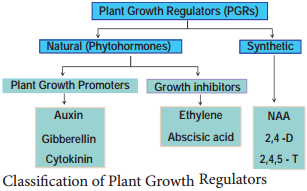
Plant Growth Regulators (chemical messenger) are defined as organic substances which are synthesized in minute quantities in one part of the plant body and transported to another part where they influence specific physiological processes. Five major groups of hormones viz., auxins, gibberellins, cytokinins, ethylene and abscisic acid are presently known to coordinate and regulate growth and development in plants.

The term phytohormones is implied to those chemical substances which are synthesized by plants and thus, naturally occurring. On the other hand, there are several manufactured chemicals which often resemble the hormones in physiological action and even in molecular structure. Recently, another two groups, the brassinosteroids and polyamines were also known to behave like hormones.

1. Plant Growth Regulators – Classification

Plant Growth Regulators are classified as natural and synthetic based on their source and a detailed flow diagram is given in Figure 15.7.
Plant Growth Regulators img 1

2. Characteristics of Phytohormones

  • Usually produced in tips of roots, stems and leaves.
  • Transfer of hormones from one place to another takes part through conductive systems.
  • They are required in trace quantities.
  • All hormones are organic in nature.
  • There are no specialized cells or organs for their secretion.
  • They are capable of influencing physiological activities leading to promotion, inhibition and modification of growth.

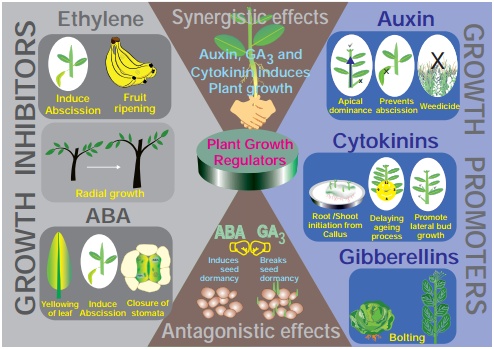
3. Synergistic and Antagonistic Effects

(i) Synergistic Effects:

The effect of one or more substance in such a way that both promote each others activity. Example: Activity of auxin and gibberellins or cytokinins.

(ii) Antagonistic Effects:

The effect of two substances in such a way that they have opposite effects on the same process. One accelerates and other inhibits. Example: ABA and gibberellins during seed or bud dormancy. ABA induces dormancy and gibberellins break it.

Auxins

1. Discovery

During 1880, Charles Darwin noted the unilateral growth and curvature of Canary grass (Phalaris canariensis) coleoptile to light. The term auxin (Greek: Auxin – to Grow) was first used by F.W. Went in 1926 using Oats (Avena) coleoptile and isolated the auxin. F.W. Went in 1928 collected auxin in agar jelly. Kogl and Haugen Smith (1931) isolated Auxin from human urine, and called it as Auxin A.

Later on in 1934, similar active substances was isolated from corn grain oil and was named as Auxin B. Kogl etal., (1934) found heteroauxin in the plant and chemically called it as Indole Acetic Acid (IAA)

2. Occurrence

Auxin is generally produced by the growing tips of the stem and root, from where they migrate to the region of the action.

3. Types of Auxin

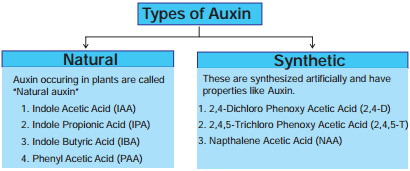
Auxins are divided into two categories Natural auxins and Synthetic auxins.
Plant Growth Regulators img 2

(i) Free Auxin

They move out of tissues as they are easily diffusible. Example: IAA.

(ii) Bound Auxin

They are not diffusible. Example: IAA.

4. Precursor

The amino acid Tryptophan is the precursor of IAA and zinc is required for its synthesis.

5. Chemical Structure

Auxin has similar chemical structure of IAA.

6. Transport in Plants

Auxin is polar in transport. It includes basipetal and acropetal transport. Basipetal means transport through phloem from shoot to root and acropetal means transport through xylem from root to shoot.

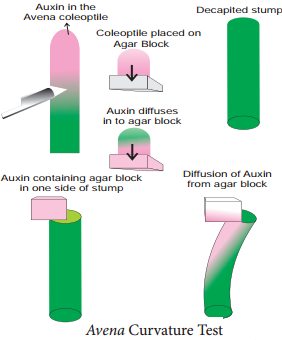
7. Bioassay (Avena Curvature Test/Went Experiment)

Bioassay means testing of substances for their activity in causing a growth response in a living plant or its part.

The procedure involves the following steps:

When the Avena seedlings have attained a height of 15 to 30 mm, about 1mm of the coleoptile tip is removed. This apical part is the source of natural auxin. The tip is now placed on agar blocks for few hours. During this period, the auxin diffuses out of these tips into the agar. The auxin containing agar block is now placed on one side of the decapitated stump of Avena coleoptile.

The auxin from the agar blocks diffuses down through coleoptile along the side to which the auxin agar block is placed. An agar block without auxin is placed on another decapitated coleoptile. Within an hour, the coleoptiles with auxin agar block bends on the opposite side where the agar block is placed.

This curvature can be measured (Figure 15.8).
Plant Growth Regulators img 3

8. Physiological Effects

  • They promote cell elongation in stem and coleoptile.
  • At higher concentrations auxins inhibit the elongation of roots but extermely lower concentrations promotes growth of root.
  • Suppression of growth in lateral bud by apical bud due to auxin produced by apical bud is termed as apical dominance.
  • Auxin prevents abscission.
  • It is used to eradicate weeds. Example: 2,4-D and 2, 4, 5-T.
  • Synthetic auxins are used in the formation of seedless fruits (Parthenocarpic fruit).
  • It is used to break the dormancy in seeds.

Gibberellins

1. Discovery

The effect of gibberellins had been known in Japan since early 1800 where certain rice plants were found to suffer from ‘Bakanae’ or foolish seedling disease. This disease was found by Kurosawa (1926) to be caused by a fungus Gibberella fujikuroi. The active substance was separated from fungus and named as gibberellin by Yabuta (1935).

These are more than 100 gibberellins reported from both fungi and higher plants. They are noted as GA1, GA2, GA3 and so on. GA3 is the first discovered gibberellin. In 1938, Yabuta and Sumiki isolated gibberellin in crystalline form. In 1955, Brain etal., gave the name gibberellic acid. In 1961, Cross etal., established its structure.

2. Occurrence

The major site of gibberellin production in plants is parts like embryo, roots and young leaves near the tip. Immature seeds are rich in gibberellins.

3. Precursors

The gibberellins are chemically related to terpenoids (natural rubber, carotenoids and steroids) formed by 5-C precursor, an Isoprenoid unit called Iso Pentenyl Pyrophosphate (IPP) through a number of intermediates. The primary precursor is acetate.

4. Chemical Structure

All gibberellins have gibbane ring structure.

5. Transport in Plants

The transport of gibberellins in plants is nonpolar. Gibberellins are translocated through phloem and also occur in xylem due to lateral movement between vascular bundles.

6. Bioassay (Dwarf Pea Assay)

Seeds of dwarf pea are allowed to germinate till the formation of the coleoptile. GA solution is applied to some seedlings. Others are kept under control. Epicotyl length is measured and as such, GA stimulating epicotyl growth can be seen.

7. Physiological Effects

  • It produces extraordinary elongation of stem caused by cell division and cell elongation.
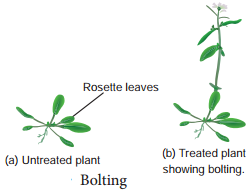
  • Rosette plants (genetic dwarfim) exhibit excessive internodal growth when they are treated with gibberellins.
  • This sudden elongation of stem followed by flowering by the application of gibberellin is called bolting (Figure 15.9).
  • Gibberellin breaks dormancy in potato tubers.
  • Many biennials usually flower during second year of their growth. For flowering in the first year it self these plants should be treated with gibberellins.
  • Formation of seedless fruits without fertilization is induced by gibberellins Example: Seedless tomato, apple and cucumber.
  • Promotes elongation of inter-node in sugarcane without decreasing sugar content.
  • Promotion of flowering in long day plants even under short day conditions.
  • It stimulates the seed germination.

Plant Growth Regulators img 4

Cytokinins (Cytos – cell, Kinesis – Division)

1. Discovery

The presence of cell division inducing substances in plants was first demonstrated by Haberlandt in 1913 in Coconut milk (liquid endosperm of coconut) which contains cell division inducing substances.

In 1954, Skoog and Miller discovered that autoclaved DNA from herring sperm stimulated cell division in tobacco pith cells. They called this cell division inducing principle as kinetin (chemical structure: 6-Furfuryl Amino Acid).

This does not occur in plants. In 1963, Letham introduced the term cytokinin. In 1964, Letham and Miller isolated and identified a new cytokinin called Zeatin from unripe grains of maize. The most widely occurring cytokinin in plants is Iso Pentenyl adenine (IPA).

2. Occurrence

Cytokinin is formed in root apex, shoot apex, buds and young fruits.

3. Precursor

Cytokinins are derivatives of the purine adenine.

4. Bioassay (Neem Cotyledon Assay)

Neem cotyledons are measured and placed in cytokinin solution as well as in ordinary water. Enlargement of cotyledons is an indication of cytokinin activity.

5. Transport in Plants

The distribution of cytokinin in plants is not as wide as those of auxin and gibberellins but found mostly in roots. Cytokinins appear to be translocated through xylem.

6. Physiological Effect

  • Cytokinin promotes cell division in the presence of auxin (IAA).
  • Cytokinin induces cell enlargement associated with IAA and gibberellins
  • Cytokinin can break the dormancy of certain light-sensitive seeds like tobacco and induces seed germination.
  • Cytokinin promotes the growth of lateral bud in the presence of apical bud.
  • Application of cytokinin delays the process of aging by nutrient mobilization. It is known as Richmond Lang effect.
  • Cytokinin
  • Increases rate protein synthesis
  • Induces the formation of inter-fascicular cambium
  • Overcomes apical dominance
  • Induces formation of new leaves, chloroplast and lateral shoots

Plants accumulate solutes very actively with the help of cytokinins.

Ethylene (Gaseous Phytohormone)

Almost all plant tissues produce ethylene gas in minute quantities.

1. Discovery

In 1924, Denny found that ethylene stimulates the ripening of lemons. In 1934, R. Gane found that ripe bananas contain abundant ethylene. In 1935, Cocken et al., identified ethylene as a natural plant hormone.
Plant Growth Regulators img 5

2. Occurance

Maximum synthesis occurs during climacteric ripening of fruits (see Box info) and tissues undergoing senescence. It is formed in almost all plant parts like roots, leaves, flowers, fruits and seeds.

3. Transport in Plants

Ethylene can easily diffuse inside the plant through intercellular spaces.

4. Precursor

It is a derivative of amino acid methionine, linolenic acid and fumaric acid.

5. Bioassay (Gas Chromatography)

Ethylene can be measured by gas chromatography. This technique helps in the detection of exact amount of ethylene from different plant tissues like lemon and orange.

6. Physiological Effects

  • Ethylene stimulates respiration and ripening in fruits.
  • It breaks the dormancy of buds, seeds and storage organs.
  • It stimulates formation of abscission zone in leaves, flowers and fruits. This makes the leaves to shed prematurely.
  • Inhibition of stem elongation (shortening the internode).
  • Growth of lateral roots and root hairs. This increases the absorption surface of the plant roots.
  • Ethylene normally reduces flowering in plants except in Pine apple and Mango.

Abscisic Acid (ABA) (Stress Phyto Hormone)

1. Discovery

In 1963, the hormone was first isolated by Addicott et al., from young cotton bolls and named as Abscission II. Eagles and Wareing during 1963-64 isolated a dormancy inducing substance from leaves of Betula and called it as dormin. In 1965, it was found by Cornsforth et al., that both dormin and abscission are chemically same compounds and called Abscisic Acid (ABA).

2. Occurrence

This hormone is found abundantly inside the chloroplast of green cells.

3. Precursors

The hormone is formed from mevalonic acid pathway or xanthophylls.

4. Transport in Plants

Abscisic acid is transported to all parts of the plant through diffsion as well as through phloem and xylem.

5. Chemical Structure

It has carotenoid structure.

6. Bioassay (Rice Coleoptile)

The inhibition of IAA induces straight growth of rice seedling coleoptiles.

7. Physiological Effects

  • It helps in reducing transpiration rate by closing stomata.
  • ABA is a powerful growth inhibitor. It causes 50% inhibition of growth in Oat coleoptile.
  • It induces bud and seed dormancy.
  • It promotes the abscission of leaves, flowers and fruits by forming abscission layers.
  • ABA plays an important role in plants during water stress and during drought conditions. It results in loss of turgor and closure of stomata.
  • In Cannabis sativa, induces male flower formation on female plants.
  • It promotes sprouting in storage organs like Potato.
  • It inhibits the shoot growth and promotes growth of root system. This character protect the plants from water stress. Hence, ABA is called as stress hormone.

Characteristics of Growth

Learninsta presents the core concepts of Biology with high-quality research papers and topical review articles.

Characteristics of Growth

  1. Growth increases in protoplasm at cellular level.
  2. Stem and roots are indeterminate in growth due to continuous cell division and is called open form of growth.
  3. The primary growth of the plant is due to the activity of apical meristem where, new cells are added to root and shoot apex causing linear growth of plant body.
  4. The secondary vascular cambium and cork cambium add new cells to cause increase in girth.
  5. Leaves, flowers and fruits are limited in growth or determinate or closed form growth.
  6. Monocarpic annual plants produce flowers only once during lifetime and dies. Example: Paddy and Bean
  7. Monocarpic perennials produce flowers only once during life time but the plants survive for many years. Example: Bamboo.
  8. Polycarpic perennials produce flowers every year during life time. Example: Coconut.

Kinetics of Growth

It is an analysis of the motion of cells or expansion.

1. Stages in Growth Rate

The total period from initial to the final stage of growth is called the grand period of growth. The total growth is plotted against time and ‘S’ shaped sigmoid curve (Grand period curve) is obtained. It consists of four phases. They are:

  1. Lag Phase
  2. Log Phase
  3. Decelerating Phase
  4. Maturation Phase

1. Lag Phase

In this phase new cells are formed from pre-existing cells slowly. It is found in the tip of the stem, root and branches. It is the initial stage of growth. In other words, growth starts from this period.

2. Log Phase or Exponential Growth

Here, the newly formed cell increases in size rapidly by deposition of cell wall material. Growth rate is maximum and reaches top because of cell division and physiological processes are quite fast. The volume of protoplasm also increases. It results in rapid growth and causes elongation of internode in the stem.

3. Decelerating Phase or Decline Phase or Slow Growth Phase

The rate of growth decreases and becomes limited owing to internal and external or both the factors because the metabolic process becomes slow.

4. Steady State Period or Maturation Phase

In this phase cell wall thickening due to new particle deposition on the inner surface of the cell wall takes place. The overall growth ceases and becomes constant. The growth rate becomes zero.

Types of Growth Rate

The increased growth per unit time is termed as growth rate. An organism or part of an organism can produce more cells through arithmetic growth or geometric growth or both.

(i) Arithmetic Growth Rate

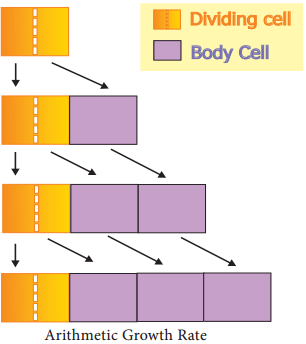
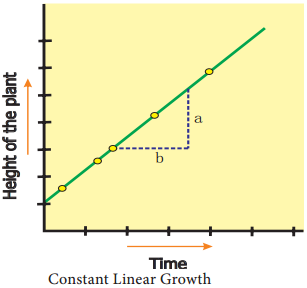
If the length of a plant organ is plotted against time, it shows a linear curve and this growth is called arithmetic growth.

  • The rate of growth is constant and it increases in an arithmetic manner.
  • Only one cell is allowed to divide between the two-resulting progeny cell.
  • One continues to divide but the other undergoes cell cycle arrest and begins to develop, differentiate and mature.
  • After each round of cell division, only a single cell remains capable of division and one new body cell forms.

For example, starting with a single cell after round 1 of cell division there is one dividing cell and one body cell. After round 2 there are two body cells, after round 3 there are three and so on (Figure 15.1).
Characteristics of Growth img 1

The plants single dividing cell would undergo one million rounds of nuclear and cellular division. If each round requires one day, this type of arithmetic increase would require one million days or 2739.7 years. This arithmetic rate is capable of producing small number of cells present in very small parts of plants. For example the hair on many leaves and stems consists of just a single row of cells produced by the division of the basal cell, the cell at the bottom of the hair next to other epidermal cells.

Hair may contain 5 to 10 cells by the division of the basal cell. So, all its cells could be produced in just fie to ten days. In the figure 15.2, on plotting the hight of the plant against time a linear curve is obtained. Mathematically it is expressed as:
Characteristics of Growth img 2

Lt = L0 + rt
Lt = length at time ‘t’
L0 = length at time zero
R = Growth Rate of Elongation Per Unit

(ii) Geometric Growth Rate:

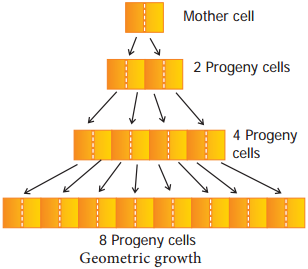
This growth occurs in many higher plants and plant organs and is measured in size or weight. In plant growth, geometric cell division results if all cells of an organism or tissue are active mitotically. Example: Round three in the given figure 15.3, produces 8 cells as 23 = 8 and after round 20 there are 220 = 1,048,576 cells.

The large plant or animal parts are produced this way. In fact, it is common in animals but rare in plants except when they are young and small. Exponential growth curve can be expressed as,
Characteristics of Growth img 3

W1 = W0ert
W1 = Final size (weight, height and number)
W0 = Initial size at the beginning of the period
r = Growth rate
t = Time of growth
e = Base of the natural logarithms

Here ‘r’ is the relative growth rate and also a measure of the ability of the plant to produce new plant material, referred to as efficiency index. Hence, the final size of W1 depends on the initial size W0.

(iii) Arithmetic and Geometric Growth of Embryo

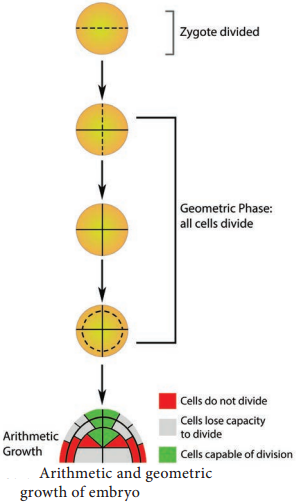
Plants often grow by a combination of arithmetic and geometric growth patterns. A young embryonic plant grows geometrically and cell division becomes restricted to certain cells at the tips of roots and shoots. After this point, growth is of the slower arithmetic type, but some of the new cells that are produced can develop into their mature condition and begin carrying out specialized types of metabolism (Figure 15.4). Plants are thus a mixture of older, mature cells and young, dividing cells.
Characteristics of Growth img 4

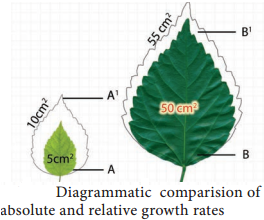
Quantitative comparisons between the growth of living system can also be made in two ways and is explained in the table 1. In figure 15.5, two leaves A and B are drawn at a particular time. Then A1 and B1 are drawn after a given time. A 1 and B1 = Area of leaves at a particular time. A1 and B1 = Area of leaves after a given time.

(A1 – A) and (B1 – B) represents an absolute increase in area in the given time. Leaf A increases from 5 cm2 to 10 cm2; 5 cm2 in a given time. Leaf B increases from 50 cm2 to 55 cm2; 5 cm2 in a given time. Hence, both leaves A and B increase their area by 5 cm2 in a given time. This is absolute growth. Relative growth is faster in leaf A because of initial small size. It decreases with time.
Characteristics of Growth img 5