General Trends In Properties Of P -Block Elements

Find free online chemistry topics covering a broad range of concepts from research institutes around the world.

General Trends In Properties Of P -Block Elements

We already learnt that the properties of elements largely depends on their electronic configuration, size,  ionisation enthalpy, electronegativity etc. Let us discuss the general trend in such properties of various p-block elements.

Electronic Configuration and Oxidation State:

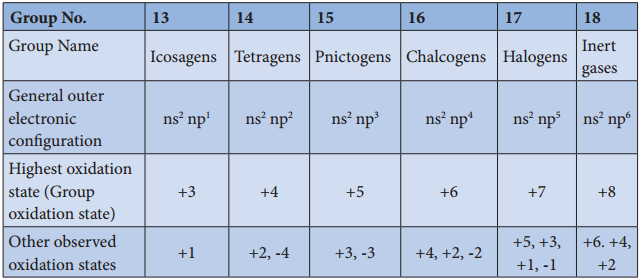
The p-block elements have a general electronic configuration of ns2, np1-6. The elements of each group have similar outer shell electronic configuration and differ only in the value of n (principal quantum number). The elements of group 18 (inert gases) have completely filled p orbitals, hence they are more stable and have least reactivity.

The elements of this block show variable oxidation state and their highest oxidation state (group oxidation state) is equal to the total number of valance electrons present in them. Unlike s-block elements which show only positive oxidation state, some of the p-block elements show negative oxidation states also.

The halogens have a strong tendency to gain an electron to give a stable halide ion with completely filled electronic configuration and hence – 1 oxidation state is more common in halogens. Similarly, the other elements belonging to pnictogen and chalcogen groups also show negative oxidation states.

General Electronic Configurations and Oxidation States of P-Block Elements
General Trends in Properties of P-Block Elements img 1

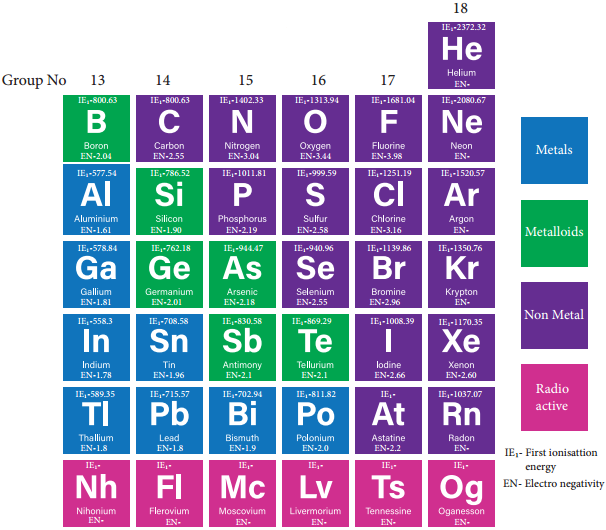
The tendency of an element to form a cation by loosing electrons is known as electropositive or metallic character. This character depends on the ionisation energy. Generally on descending a group the ionisation energy decreases and hence the metallic character increases.

Figure 2.1 P-Block Elements With Their Ionisation Enthalpies, Electronegativity and Metallic Nature.
General Trends in Properties of P-Block Elements img 2

In p-block, the elements present in lower left part are metals while the elements in the upper right part are non metals. Elements of group 13 have metallic character except the first element boron which is a metalloid, having properties intermediate between the metal and nonmetals. The atomic radius of boron is very small and it has relatively high nuclear charge and these properties are responsible for its nonmetallic character.

In the subsequent groups the non-metallic character increases. In group 14 elements, carbon is a nonmetal while silicon and germanium are metalloids. In group 15, nitrogen and phosphorus are non metals and arsenic & antimony are metalloids. In group 16, oxygen, sulphur and selenium are non metals and tellurium is a metalloid. All the elements of group 17 and 18 are non metals.

Ionisation Enthalpy:

We have already learnt that as we move down a group, generally there is a steady decrease in ionisation enthalpy of elements due to increase in their atomic radius. In p-block elements, there are some minor deviations to this general trend. In group 13, from boron to aluminium the ionisation enthalpy decreases as expected. But from aluminium to thallium there is only a marginal difference.

This is due to the presence of inner d and f-electrons which has poor shielding effect compared to s and p-electrons. As a result, the effective nuclear charge on the valance electrons increases. A similar trend is also observed in group 14.

The remaining groups (15 to 18) follow the general trend. In these groups, the ionisation enthalpy decreases, as we move down the group. Here, poor shielding effect of d- and f-electrons are overcome by the increased shielding effect of the additional p-electrons. The ionisation enthalpy of elements in successive groups is higher than the corresponding elements of the previous group as expected.

Electronegativity

As we move down the 13th group, the electronegativity first decreases from boron to aluminium and then marginally increases for Gallium, there after there is no appreciable change. Similar trend is also observed in 14th group as well. In other groups, as we move down the group, the electro negativity decreases. This observed trend can be correlated with their atomic radius.

Anomalous Properties of the First Elements:

In p-block elements, the first member of each group differs from the other elements of the corresponding group. The following factors are responsible for this anomalous behaviour.

  1. Small size of the first member
  2. High ionisation enthalpy and high electronegativity
  3. Absence of d orbitals in their valance shell

The first member of the group 13, boron is a metalloid while others are reactive metals. Moreover, boron shows diagonal relationship with silicon of group 14. The oxides of boron and silicon are similar in their acidic nature. Both boron and silicon form covalent hydrides that can be easily hydrolysed. Similarly, except boron trifluoride, halides of both elements are readily hydrolysed.

In group 14, the first element carbon is strictly a nonmetal while other elements are metalloids (silicon & germanium) or metals (tin & lead). Unlike other elements of the group carbon can form multiple bonds such as C=C, C=O etc. Carbon has a greater tendency to form a chain of bonds with itself or with other atoms which is known as catenation. There is considerable decrease in catenation property down the group (C>>Si>Ge≈Sn>Pb).

In group 15 also the first element nitrogen differs from the rest of the elements of the group. Like carbon, the nitrogen can from multiple bonds (N=N, C=N, N=O etc…). Nitrogen is a diatomic gas unlike the other members of the group. Similarly in group 16, the first element, oxygen also exists as a diatomic gas in that group. Due to its high electronegativity it forms hydrogen bonds.

The first element of group 17, flourine the most electronegative element, also behaves quiet differently compared to the rest of the members of group. Like oxygen it also forms hydrogen bonds. It shows only -1 oxidation state while the other halogens have +1, +3, +5 and +7 oxidation states in addition to -1 state. The flourine is the strongest oxidising agent and the most reactive element among the halogens.

Inert Pair Effect:

We have already learnt that the alkali and alkaline earth metals have an oxidation state of +1 and +2 respectively, corresponding to the total number of electrons present in them. Similarly, the elements of p block also show the oxidation states corresponding to the maximum number of valence electrons (group oxidation state).

In addition they also show variable oxidation state. In case of the heavier post-transition elements belonging to the groups (13 to 16), the most stable oxidation state is two less than the group oxidation state and there is a reluctance to exhibit the group oxidation state.

Let us consider group 13 elements. As we move from boron to heavier elements, there is an increasing tendency to have +1 oxidation state, rather than the group oxidation state, +3. For example Al+3 is more stable than Al+1 while Tl+1 is more stable than Tl+3. Aluminium (III) chloride is stable whereas thallium (III) chloride is highly unstable and disproportionates to thallium (I) chloride and chlorine gas.

This shows that in thallium the stable lower oxidation state corresponds to the loss of np electrons only and not ns electrons. Thus in heavier posttransition metals, the outer s electrons (ns) have a tendency to remain inert and show reluctance to take part in the bonding, which is known as inert pair effect. This effect is also observed in groups 14, 15 and 16.

Allotropism in P-Block Elements:

Some elements exist in more than one crystalline or molecular forms in the same physical state. For example, carbon exists as diamond and graphite. This phenomenon is called allotropism (in greek ‘allos’ means another and ‘trope’ means change) and the different forms of an element are called allotropes. Many p-block elements show allotropism and some of the common allotropes are listed in the table.

Table 2.2 : Some of common allotropes of p-block elements

Element

Most Common Allotropes

BoronAmorphous boron, α-rhombohedral boron, β-rhombohedral boron, γ-orthorhombic boron, α-tetragonal boron, β-tetragonal boron
CarbonDiamond, Graphite, Graphene, Fullerenes, Carbon nanotubes
SiliconAmorphous Silicon, Crystalline Silicon
Germaniumα-germanium, β-germanium
TinGrey tin, white tin, rhombic tin, sigma tin
PhosphorusWhite phosphorus, Red phosphorus, Scarlet phosphorus, Violet phosphorus, Black phosphorus.
ArsenicYellow arsenic, gray arsenic & Black arsenic
AnitimonyBlue-white antimony, Yellow, Black
OxygenDioxygen, ozone
SulphurRhombus sulphur, monoclinic sulphur
SeleniumRed selenium, Gray selenium, Black selenium, Monoclinic selenium
TelluriumAmorphous & Crystalline

Applications Of Metals

Find free online Chemistry Topics covering a broad range of concepts from research institutes around the world.

Applications Of Metals

Applications of Al

Aluminium is the most abundant metal and is a good conductor of electricity and heat. It also resists corrosion. The following are some of its applications.

Many heat exchangers/sinks and our day to day cooking vessels are made of aluminium.

It is used as wraps (aluminium foils) and is used in packing materials for food items.

Aluminium is not very strong, However , its alloys with copper, manganese, magnesium and silicon are light weight and strong and they are used in design of aeroplanes and other forms of transport.

As Aluminium shows high resistance to corrosion, it is used in the design of chemical reactors, medical equipments, refrigeration units and gas pipelines.

Aluminium is a good electrical conductor and cheap, hence used in electrical overhead electric cables with steel core for strength.

Applications of Zn

Metallic zinc is used in galvanising metals such as iron and steel structures to protect them from rusting and corrosion. Zinc is also used to produce die-castings in the automobile, electrical and hardware industries.

Zinc oxide is used in the manufacture of many products such as paints, rubber, cosmetics, pharmaceuticals, plastics, inks, batteries, textiles and electrical equipment. Zinc sulphide is used in making luminous paints, florescent lights and x-ray screens.

Brass an alloy of zinc is used in water valves and communication equipment as it is highly resistant to corrosion.

Applications of Fe

Iron is one of the most useful metals and its alloys are used everywhere including bridges, electricity pylons, bicycle chains, cutting tools and rifle barrels. Cast iron is used to make pipes, valves and pumps stoves etc. Magnets can be made from iron and its alloys and compounds.

An important alloy of iron is stainless steel, and it is very resistant to corrosion. It is used in architecture, bearings, cutlery, surgical instruments and jewellery. Nickel steel is used for making cables, automobiles and aeroplane parts. Chrome steels are used for maufacturing cutting tools and crushing machines.

Applications of Cu

Copper is the first metal used by the human and extended use of its alloy bronze resulted in a new era,’Bronze age’. Copper is used for making coins and ornaments along with gold and other metals. Copper and its alloys are used for making wires, water pipes and other electrical parts.

Applications of Au

Gold, one of the expensive and precious metals. It is used for coinage, and has been used as standard for monetary systems in some countries.

It is used extensively in jewellery in its alloy form with copper. It is also used in electroplating to cover other metals with a thin layer of gold which are used in watches, artificial limb joints, cheap jewellery, dental filings and electrical connectors. Gold nanoparticles are also used for increasing the efficiency of solar cells and also used an catalysts.

Refining Process

Find free online Chemistry Topics covering a broad range of concepts from research institutes around the world.

Refining Process

Generally the metal extracted from its ore contains some impurities such as unreacted oxide ore, other metals, nonmetals etc. Removal of such impurities associated with the isolated crude metal is called refiing process. In this section, let us discuss some of the common refining methods.

Distillation

This method is employed for low boiling volatile metals like zinc (boiling point 1180 K) and mercury (630 K). In this method, the impure metal is heated to evaporate and the vapours are condensed to get pure metal.

Liquation

This method, is employed to remove the impurities with high melting points from metals having relatively low melting points such as tin (Sn; mp = 904 K), lead (Pb; mp = 600 K), mercury (Hg; mp = 234 K), and bismuth (Bi; mp = 545 K). In this process, the crude metal is heated to form fusible liquid and allowed to flow on a sloping surface.

The impure metal is placed on sloping hearth of a reverberatory furnace and it is heated just above the melting point of the metal in the absence of air, the molten pure metal flows down and the impurities are left behind. The molten metal is collected and solidified.

Electrolytic Refining:

The crude metal is refined by electrolysis. It is carried out in an electrolytic cell containing aqueous solution of the salts of the metal of interest. The rods of impure metal are used as anode and thin strips of pure metal are used as cathode.

The metal of interest dissolves from the anode, pass into the solution while the same amount of metal ions from the solution will be deposited at the cathode. During electrolysis, the less electropositive impurities in the anode, settle down at the bottom and are removed as anode mud.

Let us understand this process by considering electrolytic refiing of silver as an example.

Cathode: Pure silver
Anode: Impure silver rods
Electrolyte: Acidified aqueous solution of silver nitrate.

When a current is passed through the electrodes the following reactions will take place

Reaction at anode Ag(s) → Ag+ (aq) + 1e
Reaction at cathode Ag+ (aq) + 1e → Ag(s)

During electrolysis, at the anode the silver atoms lose electrons and enter the solution. The positively charged silver cations migrate towards the cathode and get discharged by gaining electrons and deposited on the cathode. Other metals such as copper, zinc etc.,can also be refined by this process in a similar manner.

Zone Refining

This method is based on the principles of fractional crystallisation. When an impure metal is melted and allowed to solidify, the impurities will prefer to be in the molten region. i.e. impurities are more soluble in the melt than in the solid state metal.

In this process the impure metal is taken in the form of a rod. One end of the rod is heated using a mobile induction heater which results in melting of the metal on that portion of the rod. When the heater is slowly moved to the other end the pure metal crystallises while the impurities will move on to the adjacent molten zone formed due to the movement of the heater. As the heater moves further away, the molten zone containing impurities also moves along with it.

The process is repeated several times by moving the heater in the same direction again and again to achieve the desired purity level. This process is carried out in an inert gas atmosphere to prevent the oxidation of metals. Elements such as germanium (Ge), silicon (Si) and galium (Ga) that are used as semiconductor are refined using this process.

Vapour Phase Method

In this method, the metal is treated with a suitable reagent which can form a volatile compound with the metal. Then the volatile compound is decomposed to give the pure metal. We can understand this method by considering the following process.

Mond Process for Refining Nickel:

The impure nickel is heated in a stream of carbon monoxide at around 350 K. The nickel reacts with the CO to form a highly volatile nickel tetracarbonyl. The solid impurities are left behind.

Ni (s) + 4 CO (g) → [Ni(CO)4] (g)

On heating the nickel tetracarbonyl around 460 K, the complex decomposes to give pure metal.

[Ni(CO)4] (g) → Ni (s) + 4 CO (g)

Van-Arkel Method for Refining Zirconium/Titanium:

This method is based on the thermal decomposition of metal compounds which lead to the formation of pure metals. Titanium and zirconium can be purified using this method. For example, the impure titanium metal is heated in an evacuated vessel with iodine at a temperature of 550 K to form the volatile titanium tetra iodide. (TiI4). The impurities are left behind, as they do not react with iodine.

Occurrence of Metals img 10

The volatile titanium tetraiodide vapour is passed over a tungsten filament at a temperature aroud 1800 K. The titanium tetraiodide is decomposed and pure titanium is deposited on the filament. The iodine is reused.

Occurrence of Metals img 11

Electrochemical Principle Of Metallurgy

Find free online Chemistry Topics covering a broad range of concepts from research institutes around the world.

Electrochemical Principle Of Metallurgy

Similar to thermodynamic principles, electrochemical principles also find applications in metallurgical process. The reduction of oxides of active metals such as sodium, potassium etc., by carbon is thermodynamically not feasible.

Such metals are extracted from their ores by using electrochemical methods. In this technique, the metal salts are taken in a fused form or in solution form. The metal ion present can be reduced by treating it with some suitable reducing agent or by electrolysis.

Gibbs free energy change for the electrolysis process is given by the following expression

ΔG° = -nFE°

Where n is number of electrons involved in the reduction process, F is the Faraday and E° is the electrode potential of the redox couple.

If E° is positive then the ΔG is negative and the reduction is spontaneous and hence a redox reaction is planned in such a way that the e.m.f of the net redox reaction is positive. When a more reactive metal is added to the solution containing the relatively less reactive metal ions, the more reactive metal will go into the solution. For example,

Cu (s) + 2Ag+ (aq) → Cu2+ (aq) + 2Ag (s)
Cu2+ (aq) + Zn (s) → Cu(s) + Zn2+ (aq)

Electrochemial Extraction of Aluminium – Hall – Heroult Process:

In this method, electrolysis is carried out in an iron tank lined with carbon which acts as a cathode. The carbon blocks immersed in the electrolyte act as a anode. A 20% solution of alumina, obtained from the bauxite ore is mixed with molten cryolite and is taken in the electrolysis chamber.

About 10% calcium chloride is also added to the solution. Here calcium chloride helps to lower the melting point of the mixture. The fused mixture is maintained at a temperature of above 1270 K. The chemical reactions involved in this process are as follows.

Ionisaiton of alumina Al2O3 → 2Al3+ + 3O2-
Reaction at cathode 2Al3+ (melt) + 6e → 2Al (l)
Reaction at anode 6O2- (melt) → 3O2 + 12e

Since carbon acts as anode the following reaction also takes place on it.

C(s) + O2- (melt) → CO + 2e
C(s) + 2O2- (melt) → CO2 + 4e

Due to the above two reactions, anodes are slowly consumed during the electrolysis. The pure aluminium is formed at the cathode and settles at the bottom. The net electrolysis reaction can be written as follows.

4Al3+ (melt) + 6O2- (melt) + 3C (s) → 4Al (l) + 3CO2 (g)

Thermodynamic Principle of Metallurgy

Find free online Chemistry Topics covering a broad range of concepts from research institutes around the world.

Thermodynamic Principle of Metallurgy

As we discussed, the extraction of metals from their oxides can be carried out by using different reducing agents. For example, consider the reduction of a metal oxide MxOy. \(\frac{2}{y}\)MxOy (s) → \(\frac{2x}{y}\)M (s) + O2 (g) ………. (1)

The above reduction may be carried out with carbon. In this case, the reducing agent carbon may be oxidised to either CO or CO2.

C + O2 → CO2 (g) …………. (2)
2C + O2 → 2CO (g) ……………. (3)

If carbon monoxide is used as a reducing agent, it is oxidised to CO2 as follows,

2CO + O2 → 2CO2 (g) ………………. (4)

A suitable reducing agent is selected based on the thermodynamic considerations. We know that for a spontaneous reaction, the change in free energy (ΔG) should be negative. Therefore, thermodynamically, the reduction of metal oxide [equation (1)] with a given reducing agent [Equation (2), (3) or (4)] can occur if the free energy change for the coupled reaction. [Equations (1) & (2), (1) & (3) or (1) & (4)] is negative. Hence, the reducing agent is selected in such a way that it provides a large negative ΔG value for the coupled reaction.

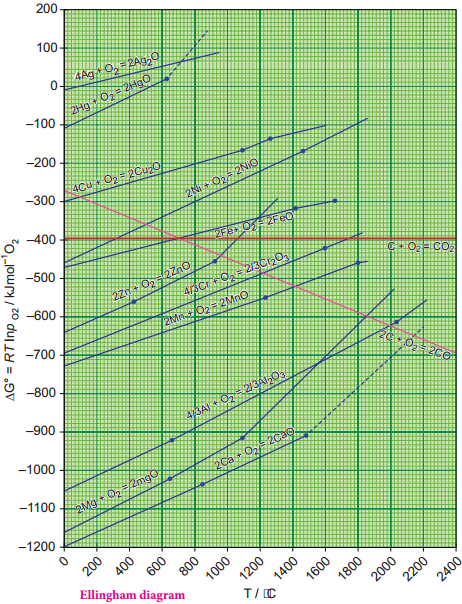
Ellingham Diagram

Occurrence of Metals img 12

The change in Gibbs free energy (ΔG) for a reaction is given by the expression.
ΔG = ΔH – TΔS ………….. (1)

where, ΔH is the enthalpy change, T the temperature in kelvin and ΔS the entropy change. For an equilibrium process, ΔG° can be calculated using the equilibrium constant by the following expression
ΔG° = – RT lnKP

Harold Ellingham used the above relationship to calculate the ΔG° values at various temperatures for the reduction of metal oxides by treating the reduction as an equilibrium process.

He has drawn a plot by considering the temperature in the x-axis and the standard free energy change for the formation of metal oxide in y-axis. The resultant plot is a straight line with ΔS as slope and ΔH as y-intercept. The graphical representation of variation of the standard Gibbs free energy of reaction for the formation of various metal oxides with temperature is called Ellingham diagram.

Observations from the Ellingham Diagram

1. For most of the metal oxide formation, the slope is positive. It can be explained as follows. Oxygen gas is consumed during the formation of metal oxides which results in the decrease in randomness. Hence, ΔS becomes negative and it makes the term, TΔS positive in the straight line equation.

2. The graph for the formation of carbon monoxide is a straight line with negative slope. In this case ΔS is positive as 2 moles of CO gas is formed by the consumption of one mole of oxygen gas. It indicates that CO is more stable at higher temperature.

3. As the temperature increases, generally ΔG value for the formation of the metal oxide become less negative and becomes zero at a particular temperature. Below this temperature, ΔG is negative and the oxide is stable and above this temperature ΔG is positive. This general trend suggests that metal oxides become less stable at higher temperature and their decomposition becomes easier.

4. There is a sudden change in the slope at a particular temperature for some metal oxides like MgO, HgO. This is due to the phase transition (melting or evaporation).

Applications of the Ellingham Diagram:

Ellingham diagram helps us to select a suitable reducing agent and appropriate temperature range for reduction. The reduction of a metal oxide to its metal can be considered as a competition between the element used for reduction and the metal to combine with oxygen.

If the metal oxide is more stable, then oxygen remains with the metal and if the oxide of element used for reduction is more stable, then the oxygen from the metal oxide combines with elements used for the reduction. From the Ellingham diagram, we can infer the relative stability of different metal oxides at a given temperature.

1. Ellingham diagram for the formation of Ag2O and HgO is at upper part of the diagram and their decomposition temperatures are 600 and 700 K respectively. It indicates that these oxides are unstable at moderate temperatures and will decompose on heating even in the absence of a reducing agent.

2. Ellingham diagram is used to predict thermodynamic feasibility of reduction of oxides of one metal by another metal. Any metal can reduce the oxides of other metals that are located above it in the diagram. For example, in the Ellignham diagram, for the formation of chromium oxide lies above that of the aluminium, meaning that Al2O3 is more stable than Cr2O3.

Hence aluminium can be used as a reducing agent for the reduction of chromic oxide. However, it cannot be used to reduce the oxides of magnesium and calcium which occupy lower position than aluminium oxide.

3. The carbon line cuts across the lines of many metal oxides and hence it can reduce all those metal oxides at sufficiently high temperature. Let us analyse the thermodynamically favourable conditions for the reduction of iron oxide by carbon.

Ellingham diagram for the formation of FeO and CO intersects around 1000 K. Below this temperature the carbon line lies above the iron line which indicates that FeO is more stable than CO and hence at this temperature range, the reduction is not thermodynamically feasible. However, above 1000 K carbon line lies below the iron line and hence, we can use coke as reducing agent above this temperature. The following free energy calculation also confim that the reduction is thermodynamically favoured.

From the Ellingham Diagram at 1500 K,

2Fe (s) + O2 (g) → 2FeO (g) ΔG1 = – 350 kJ mol-1 ……………. (1)
2C (s) + O2 (g) → 2CO (g) ΔG2 = – 480 kJ mol-1 …………….. (2)

Reverse the reaction (1)

2FeO (s) → 2Fe (s) + O2 (g) – ΔG1 = + 350 kJ mol-1 …………….. (3)

Now couple the reactions (2) and (3)

2FeO (s) + 2C → 2Fe (l, s) + 2CO (g) ΔG3 = – 130 kJ mol-1 …………….. (4)

The standard free energy change for the reduction of one mole of FeO is, ΔG3/2 = – 65 kJ mol-1

Limitations of Ellingham Diagram

1. Ellingham diagram is constructed based only on thermodynamic considerations. It gives information about the thermodynamic feasibility of a reaction. It does not tell anything about the rate of the reaction. More over, it does not give any idea about the possibility of other reactions that might be taking place.

2. The interpretation of ΔG is based on the assumption that the reactants are in equilibrium with the products which is not always true.