Group 17 (Halogen Group) Elements

Find free online Chemistry Topics covering a broad range of concepts from research institutes around the world.

Group 17 (Halogen Group) Elements

Chlorine

Occurrence:

The halogens are present in combined form as they are highly reactive. The main source of flourine is fluorspar or fluorite. The other ores of flourine are cryolite, fluroapatite. The main source of chlorine is sodium chloride from sea water. Bromides and iodides also occur in sea water.

Physical Properties:

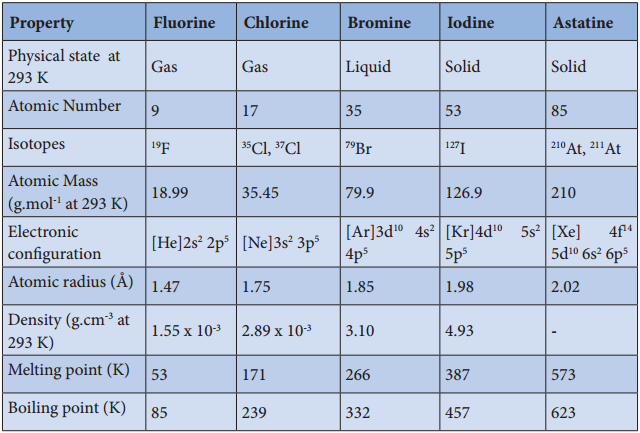
The common physical properties of the group 17 elements are listed in the table.

Physical Properties of Group 17 Elements
Group 17 (Halogen Group) Elements img 1

Properties:

Chlorine is highly reactive hence it doesn’t occur free in nature. It is usually distributed as various metal chlorides. The most important chloride is sodium chloride which occurs in sea water.

Preparation:

Chlorine is prepared by the action of conc. sulphuric acid on chlorides in presence of manganese dioxide.

4NaCl + MnO2 + 4H2SO4 → Cl2 + MnCl2 + 4NaHSO4 + 2H2O

It can also be prepared by oxidising hydrochloric acid using various oxidising agents such as manganese dioxide, lead dioxide, potassium permanganate or dichromate.

PbO2 + 4HCl → PbCl2 + 2H2O + Cl2
MnO2 + 4HCl → MnCl2 + 2H2O + Cl2
2KMnO4 + 16HCl → 2KCl + 2MnCl2 + 8H2O + 5Cl2
K2Cr2O7 + 14HCl → 2KCl + 2CrCl3 + 7H2O + 3Cl2

When bleaching powder is treated with mineral acids chlorine is liberated

CaOCl2 + 2HCl → CaCl2 + H2O + Cl3
CaOCl2 + H2SO4 → CaSO4 + H2O + Cl2

Manufacture of Chlorine:

Chlorine is manufactured by the electrolysis of brine in electrolytic process or by oxidation of HCl by air in Deacon’s process.

Electrolytic Process:

When a solution of brine (NaCl) is electrolysed, Na+ and Cl ions are formed. Na+ ion reacts with
OH ions of water and forms sodium hydroxide. Hydrogen and chlorine are liberated as gases.

Group 17 (Halogen Group) Elements img 2

Deacon’s Process:

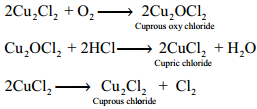
In this process a mixture of air and hydrochloric acid is passed up a chamber containing a number of shelves, pumice stones soaked in cuprous chloride are placed. Hot gases at about 723 K are passed through a jacket that surrounds the chamber.

Group 17 (Halogen Group) Elements img 3

The chlorine obtained by this method is dilute and is employed for the manufacture of bleaching powder. The catalysed reaction is given below,
Group 17 (Halogen Group) Elements img 4

Physical Properties:

Chlorine is a greenish yellow gas with a pungent irritating odour. It produces headache when inhaled even in small quantities whereas inhalation of large quantities could be fatal. It is 2.5 times heavier than air. Chlorine is soluble in water and its solution is referred as chlorine water. It deposits greenish yellow crystals of chlorine hydrate (Cl2.8H2O). It can be converted into liquid (Boiling point – 34.6°C) and yellow crystalline solid (Melting point – 102°C).

Chemical Properties:

Action with metals and non-metals:

It reacts with metals and non metals to give the corresponding chlorides.

2Na + Cl2 → 2NaCl
2Fe + 3Cl2 → 2FeCl3
2Al + 3Cl2 → 2AlCl3
Cu + Cl2 → CuCl2
H2 + Cl2 → 2HCl; ∆H = – 44kCal
2B + 3Cl2 → 2BCl3

Group 17 (Halogen Group) Elements img 5

P4 + 6Cl2 → 4PCl3
2As + 3Cl2 → 2AsCl3
2Sb + 3Cl2 → 2SbCl3

Affinity for Hydrogen:

When burnt with turpentine it forms carbon and hydrochloric acid.

C10H16 + 8Cl2 → 10C + 16HCl

It forms dioxygen when reacting with water in presence of sunlight. When chlorine in water is exposed to sunlight it loses its colour and smell as the chlorine is converted into hydrochloric acid.

2Cl2 + 2H2O → O2 + 4HCl

Chlorine reacts with ammonia to give ammonium chloride and other products as shown below:
With excess ammonia,

2NH3 + 3Cl2 → N2 + 6HCl
6HCl + 6H3 → 6NH4Cl

Overall Reaction
8NH3 + 3Cl2 → N2 + 6NH4Cl

With excess chlorine,
NH3 + 3Cl2 → NCl3 + 3HCl
3HCl + 3NH3 → 3NH4Cl

Overall Reaction
4NH3 + 3Cl2 → NCl3 + 3HCl
3HCl + 3HCl3 → 3NH4Cl

Chlorine oxidises hydrogen sulphide to sulphur and liberates bromine and iodine from iodides and bromides. However, it doesn’t oxidise fluorides.

H2S + Cl2 → 2HCl + S
Cl2 + 2KBr → 2KCl + Br2
Cl2 + 2KI → 2KCl + I2

Reaction with Alkali:

Chlorine reacts with cold dilute alkali to give chloride and hypochlorite while with hot concentrated alkali chlorides and chlorates are formed.

Cl2 + H2O → HCl + HOCl
HCl + NaOH → NaCl + H2O
HOCl + NaOH → NaOCl + H2O

Group 17 (Halogen Group) Elements img 6

(Cl2 + H2O → HCl + HOCl) × 3
(HCl + NaOH → NaCl + H2O) × 3
(HOCl + NaOH → NaOCl + H2O) × 3
3NaOCl → NaClO3 + 2NaCl

Group 17 (Halogen Group) Elements img 7

Oxidising and Bleaching Action:

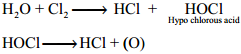
Chlorine is a strong oxidising and bleaching agent because of the nascent oxygen.
Group 17 (Halogen Group) Elements img 8

Colouring matter + Nascent oxygen → Colourless oxidation product

The bleaching of chlorine is permanent. It oxidises ferrous salts to ferric, sulphites to sulphates and hydrogen sulphide to sulphur.

2FeCl2 + Cl2 → 2FeCl3
Cl2 + H2O → HCl + HOCl
2FeSO4 + H2SO4 + HOCl → Fe2(SO4)3 + HCl + H2O

Group 17 (Halogen Group) Elements img 9

Cl2 + H2O → HCl + HOCl
Na2SO3 + HOCl → Na2SO4 + HCl

Overall Reaction
Na2SO3 + H2O + Cl2 → CaOCl2 + H2O

Preparation of Bleaching Powder:

Bleaching powder is produced by passing chlorine gas through dry slaked lime (calcium hydroxide).
Ca(OH)2 + Cl2 → CaOCl2 + H2O

Displacement Redox Reactions:

Chlorine displaces bromine from bromides and iodine from iodide salts.

Cl2 + 2KBr → 2KCl + Br2
Cl2 + 2KI → 2KCl + I2

Formation of Addition Compounds:

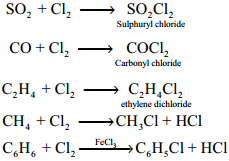
Chlorine forms addition products with sulphur dioxide, carbon monoixde and ethylene. It forms substituted products with alkanes/arenes.
Group 17 (Halogen Group) Elements img 10

Uses of Chlorine:

It is used in

  1. Purification of drinking water
  2. Bleaching of cotton textiles, paper and rayon
  3. Extraction of gold and platinum

Hydrochloric Acid:

Laboratory Preparation:

It is prepared by the action of sodium chloride and concentrated sulphuric acid.

NaCl + H2SO4 → NaHSO4 + HCl
NaHSO4 + NaCl → Na2SO4 + HCl

Dry hydrochloric acid is obtained by passing the gas through conc. sulphuric acid.

Properties:

Hydrogen chloride is a colourless, pungent smelling gas, easily liquefied to a colourless liquid (boiling point 189K) and frozen into a white crystalline solid (melting point 159K). It is extremely soluble in water.

HCl (g) + H2O (l) → H3O+ + Cl

Chemical Properties:

Like all acids it liberates hydrogen gas from metals and carbon dioxide from carbonate and bicarbonate salts.

Zn + 2HCl → ZnCl2 + H2
Mg + 2HCl → MgCl2 + H2
Na2CO3 + 2HCl → 2NaCl + CO2 + H2
CaCO3 + 2HCl → CaCl2 + CO2 + H2
NaHCO3 + 2HCl → 2NaCl + CO2 + H2O

It liberates sulphur dioxide from sodium sulphite

Na2SO3 + 2HCl → 2NaCl + H2O + SO2

When three parts of concentrated hydrochloric acid and one part of concentrated nitric acid are mixed, Aquaregia (Royal water) is obtained. This is used for dissolving gold, platinum etc.

Au + 4H+ + NO3 + 4Cl → AuCl4 + NO + 2H2O
3Pt + 16H+ + 4NO3 + 18Cl → 3[PtCl6]2- + 4NO + 8H2O

Uses of Hydrochloric Acid:

  1. Hydrochloric acid is used for the manufacture of chlorine, ammonium chloride, glucose from corn starch etc.,
  2. It is used in the extraction of glue from bone and also for purification of bone black

Trends in Physical and Chemical Properties of Hydrogen Halides:

Preparation:

Direct combination is a useful means of preparing hydrogen chloride. The reaction between hydrogen and flourine is violent while the reaction between hydrogen and bromine or hydrogen and iodine are reversible and don’t produce pure forms.

Displacement Reactions:

Concentrated sulphuric acid displaces hydrogen chloride from ionic chlorides. At higher temperatures the hydrogen sulphate formed react with further ionic chloride. Displacement can be used for the preparation of hydrogen flourides from ionic flourides. Hydrogen bromide and hydrogen iodide are oxidised by concentrated sulphuric acid and can’t be prepared in this method.

Hydrolysis of Phosphorus Trihalides:

Gaseous hydrogen halides are produced when water is added in drops to phosphorus tri halides except phosphorus triflouride.

PX3 + 3H2O → H3PO3 + 3HX

Hydrogen bromide may be obtained by adding bromine dropwise to a paste of red phosphorous and water while hydrogen iodide is conveniently produced by adding water dropwise to a mixture of red phosphorous and iodine.

2P + 3X2 → 2PX3
2PX3 + 3H2O → H3PO3 + 3HX (where X = Br or I)

Any halogen vapours which escapes with the hydrogen halide is removed by passing the gases through a column of moist red phosphorous.

From Covalent Hydrides:

Halogens are reduced to hydrogen halides by hydrogen sulphide.

H2S + X2 → 2HX + S

Hydrogen chloride is obtained as a by-product of the reactions between hydrocarbon of halogens.

General Properties:

In line with the decreasing bond dissociation enthalpy, the thermal stability of hydrogen halides decreases from flouride to iodide. For example, Hydrogen iodide decomposes at 400° C while hydrogen flouride and hydrogen chloride are stable at this temperature.

At room temperature, hydrogen halides are gases but hydrogen flouride can be readily liquefied. The gases are colourless but, with moist air gives white fumes due to the production of droplets of hydrohalic acid. In HF, due to the presence of strong hydrogen bond it has high melting and boiling points. This effect is absent in other hydrogen halides.

HF

HClHBr

HI

Bond dissociation enthalphy (kJ mol-1)+562+431+366+299
% of ionic character4317137

Acidic Properties:

The hydrogen halides are extremely soluble in water due to the ionisation.

HX + H2O → H3O+ + X
(X – F, Cl, Br, or I)

Solutions of hydrogen halides are therefore acidic and known as hydrohalic acids. Hydrochloric, hydrobromic and hydroiodic acids are almost completely ionised and are therefore strong acids but HF is a weak acid i.e. 0.1mM solution is only 10% ionised, but in 5M and 15M solution HF is stronger acid due to the equilibrium.

HF + H2O ⇄ H3O+ + F
HF + F ⇄ HF2

At high concentration, the equilibrium involves the removal of flouride ions is important. Since it affects the dissociation of hydrogen flouride and increases and hydrogen ion concentration Several stable salts NaHF2, KHF2 and NH4HF2 are known. The other hydrogen halides do not form hydrogen dihalides.

Hydrohalic acid shows typical acidic properties. They form salts with acids, bases and reacts with metals to give hydrogen. Moist hydroflouric acid (not dry) rapidly react with silica and glass.

SiO2 + 4HF → SiF4 + 2H2O
Na2SiO3 + 6HF → Na2SiF6 + 3H2O

Oxidation:

Hydrogen iodide is readily oxidised to iodine hence it is a reducing agent.

2HI ⇄ 2H+ + I2 + 2e

Acidic solution of iodides is readily oxidised. A positive result is shown by liberation of iodine which gives a blue-black colouration with starch.

Hydrogen bromide is more difficult to oxidise than HI. HBr reduces slowly H2SO4 into SO2

2HBr + H2SO4 → 2H2O + Br2 + SO2

But hydrogen iodide and ionic iodides are rapidly reduced by H2SO4 into H2S and not into SO2.

8HI + H2SO4 → 4H2O + 4I2 + H2S

Reducing property of hydrogen iodide can be also explained by using its reaction with alcohols into ethane. It converts nitric acid into nitrous acid and dinitrogen dioxide into ammonium.

Hydrogen chloride is unaffected by concentrated sulphuric acid but affected by only strong oxidising agents like MnO2, potassium permanganate or potassium chloride.

To summarize the trend,

Property

Order

Reactivity of hydrogenDecreases from fluorine to iodine
StabilityDecreases from HF to HI
Volatility of the hydridesHF < HI < HBr < HCl
Thermal StabilityHF > HI > HBr > HCl
Boiling PointHCl < HBr < HI
Acid strengthIncreases from HF to HI

Inter Halogen Compounds:

Each halogen combines with other halogens to form a series of compounds called inter halogen compounds. In the given table of inter halogen compounds a given compound A is less electronegative than B.
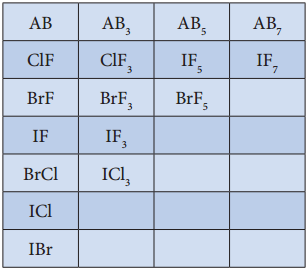
Group 17 (Halogen Group) Elements img 11

Properties of Inter Halogen Compounds:

  1. The central atom will be the larger one
  2. It can be formed only between two halogen and not more than two halogens
  3. Fluorine can’t act as a central metal atom being the smallest one
  4. Due to high electronegativity with small size florine helps the central atom to attain high coordination number
  5. They can undergo the auto ionization.
  6. They are strong oxidising agents

2 ICI ⇄ I+ + ICI2
2 ICI ⇄ ICI+2 + ICI4

Reaction with Alkali:

When heated with the alkalis, larger halogen form oxyhalogens and the smaller forms halide.
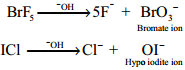
Group 17 (Halogen Group) Elements img 12

Structure of Inter Halogen Compounds:

The structures of different type of interhalogen compunds can be easily explained using VSEPR theory. The details are given below.
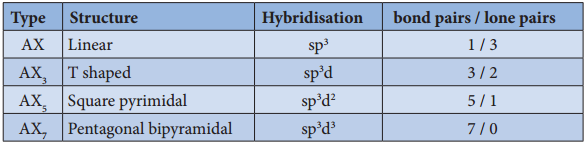
Group 17 (Halogen Group) Elements img 13

Oxides of Halogen

Fluorine reacts readily with oxygen and forms difluorine oxide (F2O) and diflourine dioxide (F2O2) where
it has a – 1 oxidation state. Other halogens do not react with oxygen readily. But the following oxides can be prepared by some indirect methods. Except flourine all the other halogens have positive oxidation states.
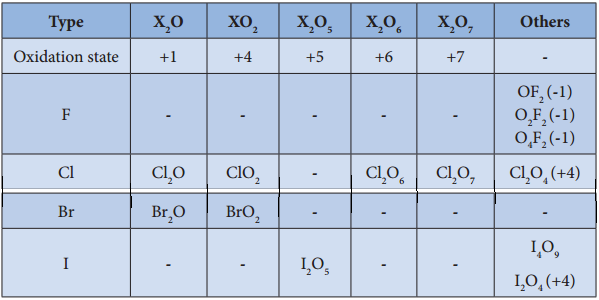
Group 17 (Halogen Group) Elements img 14

Oxoacids of Halogens:

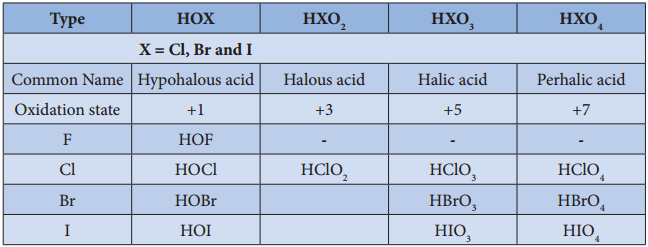
Chlorine forms four types of oxoacids namely hypochlorus acid, chlorous acid, chloric acid and perchloric acid. Bromine and iodine forms the similar acids except halous acid. However, flourine only forms hypofulric acid. The oxidizing power oxo acids follows the order:

HOX > HXO3 > HXO3 > HXO4
Group 17 (Halogen Group) Elements img 15

Oxygen Preparation and its Properties

Find free online Chemistry Topics covering a broad range of concepts from research institutes around the world.

Oxygen Preparation and its Properties

Preparation

The atmosphere and water contain 23% and 83% by mass of oxygen respectively. Most of the world’s rock contain combined oxygen. Industrially oxygen is obtained by fractional distillation of liquefied air. In the laboratory, oxygen is prepared by one of the following methods.

The decomposition of hydrogen peroxide in the presence of catalyst (MnO2) or by oxidation with potassium permanganate.

2H2O2 ⇄ 2H2O + O2
5H2O2 + 2MnO4 + 6H+ → 5O2 + 8H2O + 2Mn2+

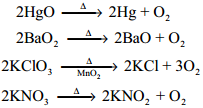
The thermal decomposition of certain metallic oxides or oxoanions gives oxygen.

Oxygen Preparation and its Properties img 1

Properties

Under ordinary condition oxygen exists as a diatomic gas. Oxygen is paramagnetic. Like nitrogen and flourine, oxygen form strong hydrogen bonds. Oxygen exists in two allotropic forms namely dioxygen (O2) and ozone or trioxygen (O3).

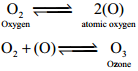
Although negligible amounts of ozone occurs at sea level it is formed in the upper atmosphere by the action of ultraviolet light. In the laboratory ozone is prepared by passing electrical discharge through oxygen. At a potential of 20,000 V about 10% of oxygen is converted into ozone it gives a mixture known as ozonised oxygen. Pure ozone is obtained as a pale blue gas by the fractional distillation of liquefied ozonised oxygen.

Oxygen Preparation and its Properties img 2

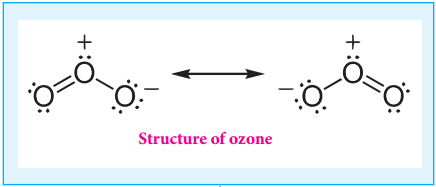
Oxygen Preparation and its Properties img 3

The ozone molecule has a bent shape and symmetrical with delocalised bonding between the oxygen atoms.

Chemical Properties

The chemical properties of oxygen and ozone differ vastly. Oxygen combines with many metals and non-metals to form oxides. With some elements such as s-block elements combination of oxygen occurs at room temperature.

Some of less reactive metals react when powdered finely and made to react exothermically with oxygen at room temperature but a lump of metal is unaffected under same condition. These finely divided metals are known as pyrophoric and when set the powder on fie, heat is liberated during a reaction.

On the other hand ozone is a powerful oxidising agent and it reacts with many substances under conditions where oxygen will not react. For example, it oxidises potassium iodide to iodine. This reaction is quantitative and can be used for estimation of ozone.

O3 + 2KI + H2O → 2KOH + O2I2

Ozone is commonly used for oxidation of organic compounds. In acidic solution ozone exceeds the oxidising power of flourine and atomic oxygen. The rate of decomposition of ozone drops sharply in alkaline solution.

Uses:

  1. Oxygen is one of the essential component for the survival of living organisms.
  2. It is used in welding (oxyacetylene welding)
  3. Liquid oxygen is used as fuel in rockets etc

Allotrophic forms of Sulphur

Sulphur exists in crystalline as well as amorphous allotrophic forms. The crystalline form includes rhombic sulphur (α sulphur) and monoclinic sulphur (β sulphur). Amorphous allotropic form includes plastic sulphur (γ sulphur), milk of sulphur and colloidal sulphur.

Rhombic sulphur also known as α sulphur, is the only thermodynamically stable allotropic form at ordinary temperature and pressure. The crystals have a characteristic yellow colour and composed of S8 molecules. When heated slowly above 96°C, it converts into monoclinic sulphur.

Upon cooling below 96°C the β form converts back to α form. Monoclinic sulphur also contains S8 molecules in addition to small amount of S6 molecules. It exists as a long needle like prism and is also called as prismatic sulphur. It is stable between 96°C – 119°C and slowly changes into rhombic sulphur.

When molten sulphur is poured into cold water a yellow rubbery ribbon of plastic sulphur is produced. They are very soft and can be stretched easily. On standing (cooling slowly) it slowly becomes hard and changes to stable rhombic sulphur.

Sulphur also exists in liquid and gaseous states. At around 140°C the monoclinic sulphur melts to form mobile pale yellow liquid called λ sulphur. The vapour over the liquid sulphur consists of 90% of S8, S7 & S6 and small amount of mixture of S2, S3, S4, S5 molecules.

Sulphur Dioxide

Preparation

From Sulphur

A large-scale production of sulphur dioxide is done by burning sulphur in air. About 6-8% of sulphur is oxidised to SO3.

S + O2 → SO2
2S + 3O2 → 2SO3

From Sulphides

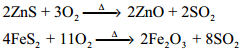
When sulphide ores such as galena (PbS), zinc blende (ZnS) are roasted in air, sulphur dioxide is liberated. Large amounts of sulphur dioxide required for manufacturing of sulphuric acid and other industrial purpose is prepared by this method.

Oxygen Preparation and its Properties img 4

Laboratory Preparation

Sulphur dioxide is prepared in the laboratory treating a metal or metal sulphite with sulphuric acid

Cu + 2H2SO4 → CuSO4 + SO2 + 2H2O
SO32- + 2H+ → H2O + SO2

Properties

Sulphur dioxide gas is found in volcanic eruptions. A large amount of sulphur dioxide gas is released into atmosphere from power plants using coal and oil and copper melting plants. It is a colourless gas with a suffocating odour. It is highly soluble in water and it is 2.2 times heavier than air. Sulphur dioxide can be liquefied (boiling point 263 K) at 2.5 atmospheric pressure and 288 K.

Chemical Properties

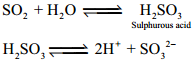
Sulphur dioxide is an acidic oxide. It dissolves in water to give sulphurous acid.

Oxygen Preparation and its Properties img 5

Reaction with Sodium Hydroxide and Sodium Carbonate

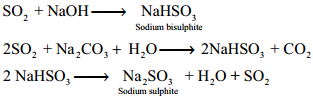
Sulphur dioxide reacts with sodium hydroxide and sodium carbonate to form sodium bisulphite and sodium sulphite respectively.

Oxygen Preparation and its Properties img 6

Oxidising Property

Sulphur dioxide, oxidises hydrogen sulphide to sulphur and magnesium to magnesium oxide.

2H2S + SO2 → 3S + 2H2O
2Mg + SO2 → 2MgO + S

Reducing Property

As it can readily be oxidised, it acts as a reducing agent. It reduces chlorine into hydrochloric acid.
SO2 + 2H2O + Cl2 → H2SO4 + 2HCl

It also reduces potassium permanganate and dichromate to Mn2+ and Cr3+ respectively.

2KMnO4 + 5SO2 + 2H2O → K2SO4 + 2MnSO4 + 2H2SO4
K2Cr2O7 + 3SO2 + H2SO4 → K2SO4 + Cr2(SO4)3 + H2O

Reaction with Oxygen

Sulphur dioxide is oxidised to sulphur trioxide upon heating with oxygen at high temperature. This reaction is used for the manufacture of sulphuric acid by contact process.

Oxygen Preparation and its Properties img 7

Bleaching Action of Sulphur Dioxide

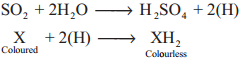
In presence of water, sulphur dioxide bleaches coloured wool, silk, sponges and straw into colourless due to its reducing property.

Oxygen Preparation and its Properties img 8

However, the bleached product (colourless) is allowed to stand in air, it is reoxidised by atmospheric oxygen to its original colour. Hence bleaching action of sulphur dioxide is temporary.

Uses:

  1. Sulphur dioxide is used in bleaching hair, silk, wool etc.
  2. It can be used for disinfecting crops and plants in agriculture.

Structure of Sulphur Dioxide

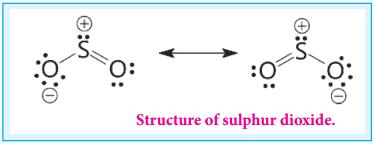
In sulphur dioxide, sulphur atom undergoes sp2 hybridisation. A double bond arises between S and O is due to pπ – dπ overlapping.

Oxygen Preparation and its Properties img 9

Sulphuric Acid: (H2SO4)

Preparation:

Sulphuric acid can be manufactured by lead chamber process, cascade process or contact process. Here we discuss the contact process.

Manufacture of Sulphuric Acid by Contact Process:

The contact process involves the following steps.

(i) Initially sulphur dioxide is produced by burning sulphur or iron pyrites in oxygen/air.

S + O2 → SO2
4FeS2 + 11O2 → 2Fe2O3 + 8SO2

(ii) Sulphur dioxide formed is oxidised to sulphur trioxide by air in the presence of a catalyst such as V2O5 or
platinised asbestos.

(iii) The sulphur trioxide is absorbed in concentrated sulphuric acid and produces oleum (H2S2O7). The oleum is converted into sulphuric acid by diluting it with water.

Oxygen Preparation and its Properties img 10

To maximise the yield the plant is operated at 2 bar pressure and 720 K. The sulphuric acid obtained in this process is over 96% pure.

Physical Properties:

Pure sulphuric acid is a colourless, viscous liquid (Density: 1.84 g/mL at 298 K). High boiling point and viscosity of sulphuric acid is due to the association of molecules together through hydrogen bonding.

The acid freezes at 283.4 K and boils at 590 K. It is highly soluble in water and has strong affinity towards water and hence it can be used as a dehydrating agent. When dissolved in water, it forms mono (H2SO4.H2O) and dihydrates (H2SO4.2H2O) and the reaction is exothermic.

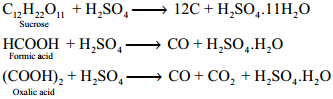
The dehydrating property can also be illustrated by its reaction with organic compounds such as sugar, oxalic acid and formic acid.

Oxygen Preparation and its Properties img 11

Chemical Properties:

Sulphuric acid is highly reactive. It can act as strong acid and an oxidising agent.

Decomposition:

Sulphuric acid is stable, however, it decomposes at high temperatures to sulphur trioxide.

H2SO4 → H2O + SO3

Acidic Nature:

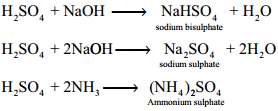
It is a strong dibasic acid. Hence it forms two types of salts namely sulphates and bisulphates.

Oxygen Preparation and its Properties img 12

Oxidising Property:

Sulphuric acid is an oxidising agent as it produces nascent oxygen as shown below.

Oxygen Preparation and its Properties img 13

Sulphuric acid oxidises elements such as carbon, sulphur and phosphorus. It also oxidises bromide and iodide to bromine and iodine respectively.

C + 2H2SO4 → 2SO2 + 2H2O + CO2
S + 2H2SO4 → 3SO2 + 2H2O
P4 + 10H2SO4 → 4H3PO4 + 10SO2 + 4H2O
H2S + H2SO4 → SO2 + 2H2O + S
H2SO4 + 2HI → SO2 + 2H2O + I2
H2SO4 + 2HBr → SO2 + 2H2O + Br2

Reaction with Metals:

Sulphuric acid reacts with metals and gives different product depending on the reactants and reacting condition.

Dilute sulphuric acid reacts with metals like tin, aluminium, zinc to give corresponding sulphates.

Zn + H2SO4 → ZnSO4 + H2
2Al + 3H2SO4 → Al2(SO4)3 + 3H2

Hot concentrated sulphuric acid reacts with copper and lead to give the respective sulphates as shown below.

Cu + 2H2SO4 → CuSO4 + 2H2O + SO2
Pb + 2H2SO4 → PbSO4 + 2H2O + SO2

Sulphuric acid doesn’t react with noble metals like gold, silver and platinum.

Reaction with Salts:

It reacts with different metal salts to give metal sulphates and bisulphates.

KCl + H2SO4 → KHSO4 + HCl
KNO3 + H2SO4 → KHSO4 + HNO3
Na2CO3 + H2SO4 → Na2SO4 + H2O + CO2
2NaBr + 3H2SO4 → 2NaHSO4 + 2H2O + Br2 + SO2

Reaction with Organic Compounds:

It reacts organic compounds such as benzene to give sulphonic acids.

Oxygen Preparation and its Properties img 14

Uses of Sulphuric Acid:

  1. Sulphuric acid is used in the manufacture of fertilisers, ammonium sulphate and super phosphates and other chemicals such as hydrochloric acid, nitric acid etc.
  2. It is used as a drying agent and also used in the preparation of pigments, explosives etc.

Test for Sulphate/Sulphuric Acid:

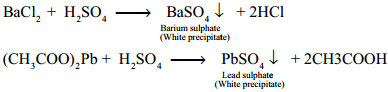
Dilute solution of sulphuric acid/aqueous solution of sulphates gives white precipitate (barium sulphate) with barium chloride solution. It can also be detected using lead acetate solution. Here a white precipitate of lead sulphate is obtained.

Oxygen Preparation and its Properties img 15

Structure of Oxoacids of Sulphur:

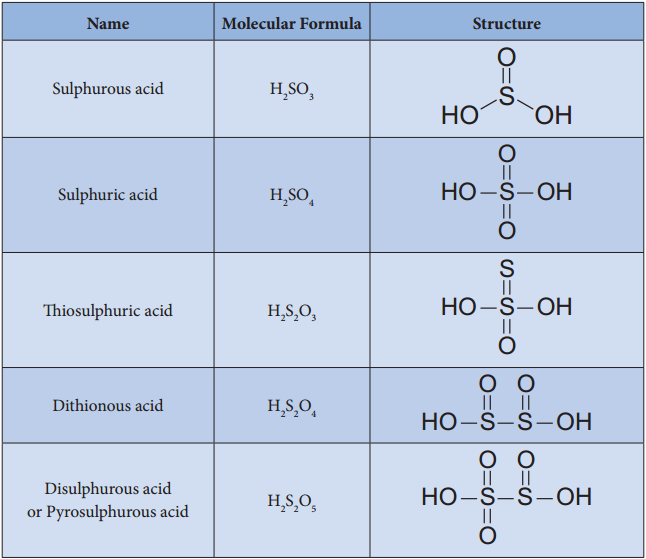
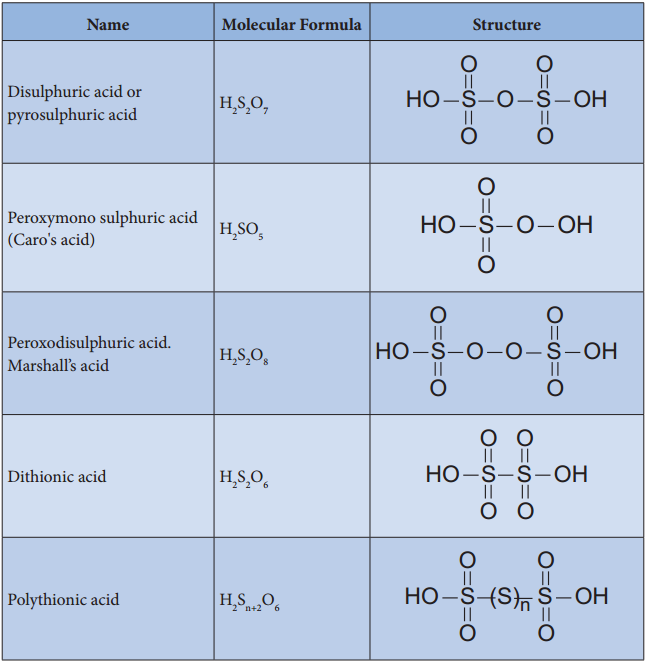
Sulphur forms many oxoacids. The most important one is sulphuric acid. Some acids like sulphurous and dithionic acids are known in the form of their salts only since the free acids are unstable and cannot be isolated. Various oxo acids of sulphur with their structures are given below.

Oxygen Preparation and its Properties img 16

Oxygen Preparation and its Properties img 17

Group 15 (Nitrogen Group) Elements

Find free online Chemistry Topics covering a broad range of concepts from research institutes around the world.

Group 15 (Nitrogen Group) Elements

Occurrence:

About 78% of earth atmosphere contains dinitorgen (N2) gas. It is also present in earth crust as sodium nitrate (Chile saltpetre) and potassium nitrate (Indian saltpetre). The 11th most abundant element phosphorus, exists as phosphate (fluroapatite, chloroapatite and hydroxyapatite). The other elements arsenic, antimony and bismuth are present as sulphides and are not very abundant.

Physical Properties:

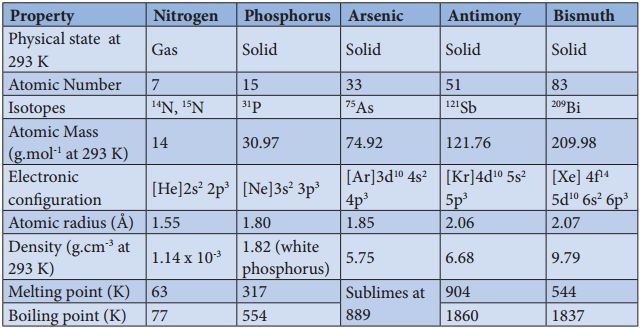
Some of the physical properties of the group 15 elements are listed below

Table 3.1 Physical Properties of Group 15 Elements

Group 15 (Nitrogen Group) Elements img 1

Nitrogen:

Preparation:

Nitrogen, the principal gas of atmosphere (78% by volume) is separated industrially from liquid air by fractional distillation

Pure nitrogen gas can be obtained by the thermal decomposition of sodium azide about 575 K

2NaN3 → 2 Na + 3Na2

It can also be obtained by oxidising ammonia using bromine water

8NH3 + 3Br2 → 6NH4Br + N2

Properties

Nitrogen gas is rather inert. Terrestrial nitrogen contains 14.5% and 0.4% of nitrogen-14 and nitrogen-15 respectively. The later is used for isotopic labelling. The chemically inert character of nitrogen is largely due to high bonding energy of the molecules 225 cal mol-1 (946 kJ mol-1).

Interestingly the triply bonded species is notable for its less reactivity in comparison with other iso-electronic triply bonded systems such as -C≡C-, C≡O, X-C≡N, X-N≡C, -C≡C-, and -C≡N. These groups can act as donor where as dinitrogen cannot. However, it can form complexes with metal (M ← N≡N) like CO to a less extent.

The only reaction of nitrogen at room temperature is with lithium forming Li3N. With other elements, nitrogen combines only at elevated temperatures. Group 2 metals and T forms ionic nitrides.

6Li + N2 → 2Li3N

Group 15 (Nitrogen Group) Elements img 2

Direct reaction with hydrogen gives ammonia. This reaction is favoured by high pressures and at optimum temperature in presence of iron catalyst. This reaction is the basis of Haber’s process for the synthesis of ammonia.

\(\frac{1}{2}\)N2 + \(\frac{3}{2}\)H2 ⇄ NH3
∆Hf = -46.2 kJ mol-1

With oxygen, nitrogen produces nitrous oxide at high temperatures. Even at 3473 K nitrous oxide yield is only 4.4%.

2N2 + O2 → 2N2O

Uses of Nitrogen

  1. Nitrogen is used for the manufacture of ammonia, nitric acid and calcium cyanamide etc.
  2. Liquid nitrogen is used for producing low temperature required in cryosurgery, and so in biological preservation.

Ammonia (NH3)

Preparation:

Ammonia is formed by the hydrolysis of urea.
NH2CONH2 + H2O → 2NH3 + CO2

Ammonia is prepared in the laboratory by heating an ammonium salt with a base.

2NH4+ + OH → 2NH3 + H2O
2NH4Cl + CaO → CaCl2 + 2NH3 + H2O

It can also be prepared by heating a metal nitrides such as magnesium nitride with water.

Mg3N2 + 6H2O → 3Mg(OH)2 + 2NH3

It is industrially manufactured by passing nitrogen and hydrogen over iron catalyst a small amount of K2O and Al2O3 is also used to increase the rate of attainment of equilibrium) at 750 K at 200 atm pressure. In the actual process the hydrogen required is obtained from water gas and nitrogen from fractional distillation of liquid air.

Properties

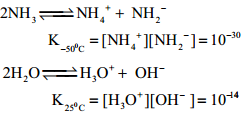
Ammonia is a pungent smelling gas and is lighter than air. It can readily liquefied by at about 9 atmospheric pressure. The liquid boils at – 38.4°C and freezes at – 77° C. Liquid ammonia resembles water in its physical properties. i.e. it is highly associated through strong hydrogen bonding. Ammonia is extremely soluble in water (702 Volume in 1 Volume of water) at 20°C and 760mm pressure.

At low temperatures two soluble hydrate NH3.H2O and 2NH3.H2O are isolated. In these molecules ammonia and water are linked by hydrogen bonds. In aqueous solutions also ammonia may be hydrated in a similar manner and we call the same as (NH3.H2O)

NH3 + H2O ⇄ NH4+ + OH

The dielectric constant of ammonia is considerably high to make it a fairly good ionising solvent like water.

Group 15 (Nitrogen Group) Elements img 3

Chemical Properties

Action of Heat:

Above 500°C ammonia decomposes into its elements. The decomposition may be accelerated by metallic catalysts like Nickel, Iron. Almost complete dissociation occurs on continuous sparking.

Group 15 (Nitrogen Group) Elements img 4

Reaction with Air/Oxygen:

Ammonia does not burn in air but burns freely in free oxygen with a yellowish flame to give nitrogen and steam.

4NH3 + 3O2 ⇄ N2 + 6H2O

In presence of catalyst like platinum, it burns to produce nitric oxide. This process is used for the manufacture of nitric acid and is known as ostwalds process.

4NH3 + 5O2 ⇄ 4NO + 6H2O

Reducing Property:

Ammonia acts as a reducing agent. It reduces the metal oxides to metal when passed over heated metallic oxide.

3PbO + 2NH3 → 3Pb + N2 + 3H2O

Reaction with Acids:

When treated with acids it forms ammonium salts. This reaction shows that the affinity of ammonia for proton is greater than that of water.

Reaction with Chlorine and Chlorides:

Ammonia reacts with chlorine and chlorides to give ammonium chloride as a final product. The reactions are different under different conditions as given below.

With excess ammonia

2 NH3 + 3 Cl2 → N2 + 6 HCl
6 HCl + 6 NH3 → 6 NH4Cl

Group 15 (Nitrogen Group) Elements img 5

With excess of chlorine ammonia reacts to give nitrogen trichloride, an explosive substance.

2NH3 + 6Cl2 → 2NCl3 + 6HCl
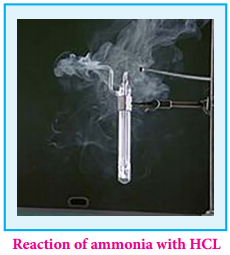
2NH3(g) + HCl(g) → NH4Cl(s)

Formation of Amides and Nitrides:

With strong electro positive metals such as sodium, ammonia forms amides while it forms nitrides with metals like magnesium.

2Na + 2NH3 → 2NaNH2 + H2
3Mg + 2NH3 → Mg3N2 + 3H2

With Metallic Salts:

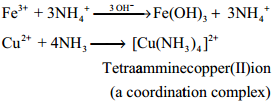
Ammonia reacts with metallic salts to give metal hydroxides (in case of Fe) or forming complexes (in case Cu)

Group 15 (Nitrogen Group) Elements img 6

Formation of Amines:

Ammonia forms ammonated compounds by ion dipole attraction. Eg. [CaCl2.8NH3]. In this, the negative ends of ammonia dipole is attracted to Ca2+ ion.

It can also act as a ligand and form coordination compounds such as [Co(NH3)6]3+, [Ag(NH3)2]+. For example when excess ammonia is added to aqueous solution copper sulphate a deep blue colour compound [Cu(NH3)4]2+ is formed.

Structure of Ammonia

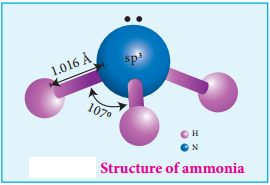
Ammonia molecule is pyramidal in shape N-H bond distance is 1.016 Å and H-H bond distance is 1.645 Å with a bond angle 107°. The structure of ammonia may be regarded as a tetrahedral with one lone pair of electrons in one tetrahedral position hence it has a pyramidal shape as shown in the figure.

Group 15 (Nitrogen Group) Elements img 7

Nitric Acid

Preparation

Nitric acid is prepared by heating equal amounts of potassium or sodium nitrate with concentrated sulphuric acid.

KNO3 + H2SO4 → KHSO4 + HNO3

The temperature is kept as low as possible to avoid decomposition of nitric acid. The acid condenses to a fuming liquid which is coloured brown by the presence of a little nitrogen dioxide which is formed due to the decomposition of nitric acid.

4HNO3 → 4NO2 + 2H2O + O2

Commercial Method of Preparation

Nitric acid prepared in large scales using Ostwald’s process. In this method ammonia from Haber’s process is mixed about 10 times of air. This mixture is preheated and passed into the catalyst chamber where they come in contact with platinum gauze.

The temperature rises to about 1275 K and the metallic gauze brings about the rapid catalytic oxidation of ammonia resulting in the formation of NO, which then oxidised to nitrogen dioxide.

4NH3 + 5O2 → 4NO + 6H2O + 120kJ
2NO + O2 → 2NO2

The nitrogen dioxide produced is passed through a series of adsorption towers. It reacts with water to give nitric acid. Nitric oxide formed is bleached by blowing air.

3NO2 + H2O → 2HNO3 + NO

Properties

Pure nitric acid is colourless. It boils at 86°C. The acid is completely miscible with water forming a constant boiling mixture (98% HNO3, Boiling point 120.5 °C). Fuming nitric acid contains oxides of nitrogen. It decomposes on exposure to sunlight or on being heated, into nitrogen dioxide, water and oxygen.

4HNO3 → 4NO2 + 2H2O + O2

Due to this reaction pure acid or its concentrated solution becomes yellow on standing. In most of the reactions, nitric acid acts as an oxidising agent. Hence the oxidation state changes from + 5 to a lower one. It doesn’t yield hydrogen in its reaction with metals. Nitric acid can act as an acid, an oxidizing agent and an nitrating agent.

As an Acid:

Like other acids it reacts with bases and basic oxides to form salts and water

ZnO + 2HNO3 → Zn(NO3)2 + H2O
3FeO + 10HNO3 → 3Fe(NO3)3 + NO + 5H2O

As an Oxidising Agent:

The nonmetals like carbon, sulphur, phosphorus and iodine are oxidised by nitric acid.

C + 4HNO3 → 2H2O + 4NO2 + CO2
S + 2HNO3 → H2SO4 + 2NO
P4 + 20HNO3 → 4H3PO4 + 4H2O + 20NO2
3I2 + 10HNO3 → 6HIO3 + 10NO + 2H2O
HNO3 + F2 → HF + NO3F
3H2S + 2HNO3 → 3S + 2NO + 4H2O

As an Nitrating Agent:

In organic compounds replacement of a – H atom with – NO2 is often referred as nitration. For example.

Group 15 (Nitrogen Group) Elements img 8

Nitration takes place due to the formation of nitronium ion

HNO3 + H2SO4 → NO2+ + H2O + HSO4

Action of Nitric Acid on Metals

All metals with the exception of gold, platinum, rhodium, iridium and tantalum reacts with nitric acid. Nitric acid oxidises the metals. Some metals such as aluminium, iron, cobalt, nickel and chromium are rendered passive in concentrated acid due to the formation of a layer of their oxides on the metal surface, which prevents the nitric acid from reacting with pure metal.

With weak electropositive metals like tin, arsenic, antimony, tungsten and molybdenum, nitric acid gives metal oxides in which the metal is in the higher oxidation state and the acid is reduced to a lower oxidation state. The most common products evolved when nitric acid reacts with a metal are gases NO2, NO and H2O. Occasionally N2, NH2OH and NH3 are also formed.

Group 15 (Nitrogen Group) Elements img 9

The reactions of metals with nitric acid are explained in 3 steps as follows:

Primary Reaction:
Metal nitrate is formed with the release of nascent hydrogen

M + HNO3 → MNO3 + (H)

Secondary Reaction:

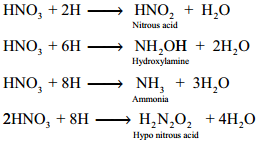
Nascent hydrogen produces the reduction products of nitric acid.

Group 15 (Nitrogen Group) Elements img 10

Tertiary Reaction:

The secondary products either decompose or react to give final products

Decomposition of the Secondary:

Group 15 (Nitrogen Group) Elements img 11

Reaction of Secondary Products:

HNO2 + NH3 → N2 + 2H2O
HNO2 + NH2OH → N2O + 2H2O
HNO2 + HNO3 → 2NO2 + H2O

Examples:

Copper reacts with nitric acid in the following manner

3Cu + 6HNO3 → 3Cu(NO3)2 + 6(H)
6(H) + 3HNO3 → 3HNO2 + 3H2O
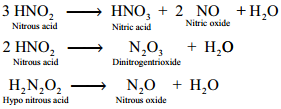
3HNO2 → HNO3 + 2NO + H2O

Overall Reaction
3Cu + 8HNO3 → 3Cu(NO3)2 + 2NO + 4H2O

The concentrated acid has a tendency to form nitrogen dioxide

Cu + 4HNO3 → Cu(NO3)2 + 2NO2 + 2H2O

Magnesium reacts with nitric acid in the following way

4Mg + 8HNO3 → 4Mg(NO3)2 + 8[H]
HNO3 + 8H → NH3 + 3H2O
HNO3 + NH3 → NH4NO3

Overall Reaction
4Mg + 10HNO → 4Mg(NO3)2 + N2O + 5H2O

If the acid is diluted we get N2O

4Mg + 10HNO3 → 4Mg(NO3)2 + N2O + 5H2O

Uses of Nitric Acid:

  1. Nitric acid is used as a oxidising agent and in the preparation of aquaregia.
  2. Salts of nitric acid are used in photography (AgNO3) and gunpowder for firearms. (NaNO3)

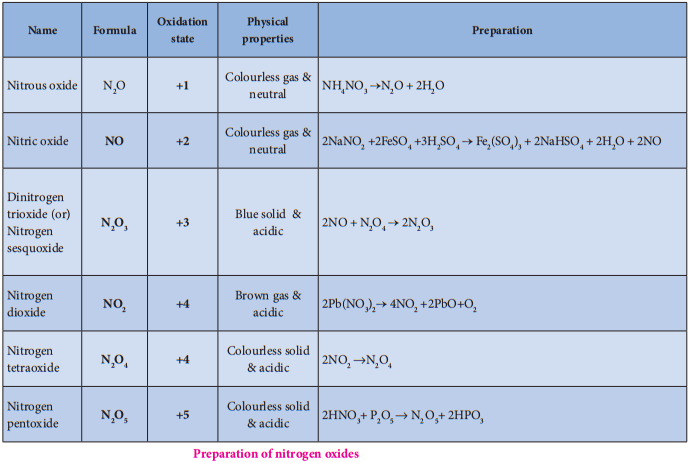
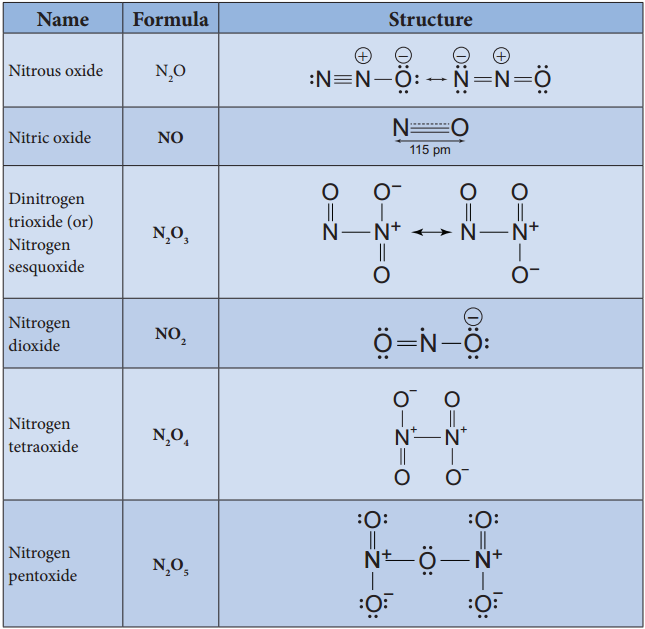
Oxides and Oxoacids of Nitrogen

Group 15 (Nitrogen Group) Elements img 12

Structures of Oxides of Nitrogen:

Group 15 (Nitrogen Group) Elements img 13

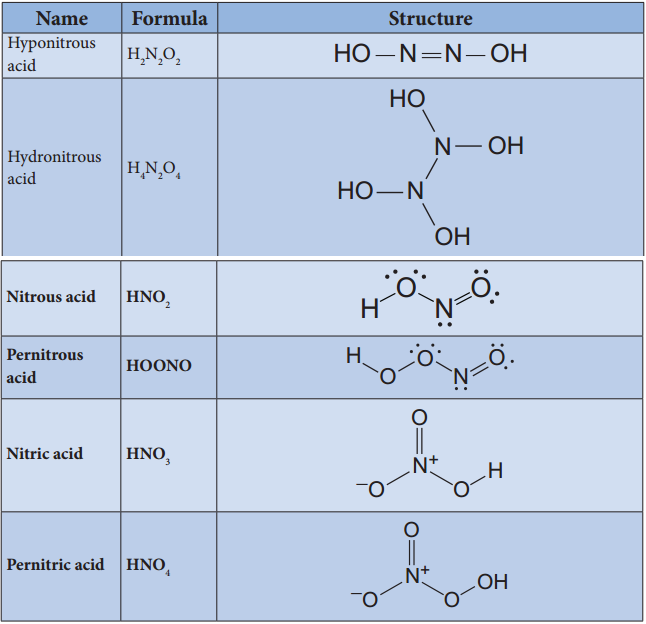
Structures of Oxoacids of Nitrogen:

Group 15 (Nitrogen Group) Elements img 14

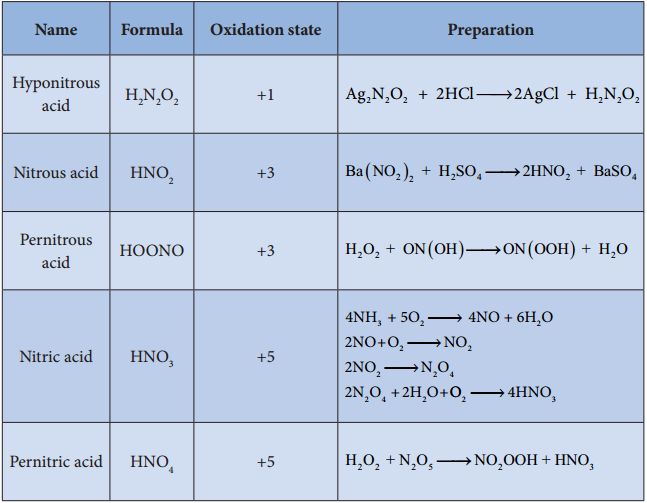
Preparation of Oxoacids of Nitrogen:

Name Formula Oxidation state Preparation

Group 15 (Nitrogen Group) Elements img 15

Allotropic Forms of Phosphorus:

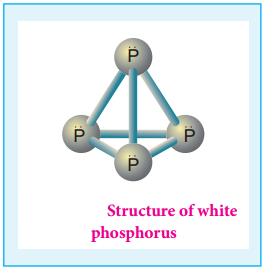
Phosphorus has several allotropic modification of which the three forms namely white, red and black phosphorus are most common. The freshly prepared white phosphorus is colourless but becomes pale yellow due to formation of a layer of red phosphorus upon standing.

Hence it is also known as yellow phosphorus. It is poisonous in nature and has a characteristic garlic smell. It glows in the dark due to oxidation which is called phosphorescence. Its ignition temperature is very low and hence it undergoes spontaneous combustion in air at room temperature to give P2O5.

Group 15 (Nitrogen Group) Elements img 16

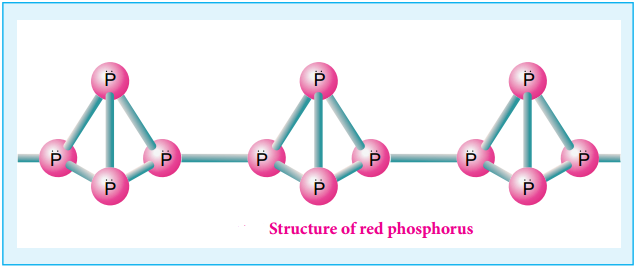
The white phosphorus can be changed into red phosphorus by heating it to 420°C in the absence of air and light. Unlike white phosphorus it is not poisonous and does not show Phosphorescence. It also does not ignite at low temperatures. The red phosphorus can be converted back into white phosphorus by boiling it in an inert atmosphere and condensing the vapour under water.

The phosphorus has a layer structure and also acts as a semiconductor. The four atoms in phosphorus have polymeric structure with chains of P4 linked tetrahedrally. Unlike nitrogen P≡P is less stable than P-P single bonds. Hence, phosphorus atoms are linked through single bonds rather than triple bonds. In addition to the above two more allotropes namely scarlet and violet phosphorus are also known for phosphorus.

Group 15 (Nitrogen Group) Elements img 17

Properties of Phosphorus:

Phosphorus is highly reactive and has the following important chemical properties

Reaction with Oxygen:

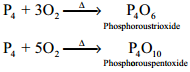
Yellow phosphorus readily catches fire in air giving dense white fumes of phosphorus pentoxide. Red phosphorus also reacts with oxygen on heating to give phosphorus trioxide or phosphorus pentoxide.

Group 15 (Nitrogen Group) Elements img 18

Reaction with Chlorine:

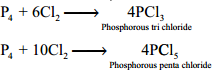
Phosphorus reacts with chlorine to form tri and penta chloride. Yellow phosphorus reacts violently at room temperature, while red phosphorus reacts on heating.

Group 15 (Nitrogen Group) Elements img 19

Reaction with Alkali:

Yellow phosphorus reacts with alkali on boiling in an inert atmosphere liberating phosphine. Here phosphorus act as reducing agent.

Group 15 (Nitrogen Group) Elements img 20

Reaction with Nitric Acid:

When phosphorus is treated with conc. nitric acid it is oxidised to phosphoric acid. This reaction is catalysed by iodine crystals.

Group 15 (Nitrogen Group) Elements img 21

Reaction with Metals:

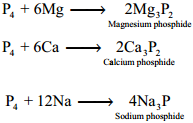
Phosphorus reacts with metals like Ca and Mg to give phosphides. Metals like sodium and potassium react with phosphorus vigorously.

Group 15 (Nitrogen Group) Elements img 22

Uses of Phosphorus:

  1. The red phosphorus is used in the match boxes
  2. It is also used for the production of certain alloys such as phosphor bronze

Phosphine (PH3)

Phosphine is the most important hydride of phosphorus

Preparation:

Phosphine is prepared by action of sodium hydroxide with white phosphorus in an inert atmosphere of carbon dioxide or hydrogen.

Group 15 (Nitrogen Group) Elements img 23

Phosphine is freed from phosphine dihydride (P2H4) by passing through a freezing mixture. The dihydride
condenses while phosphine does not.

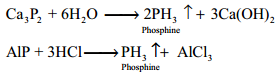
Phosphine can also prepared by the hydrolysis of metallic phosphides with water or dilute mineral acids.

Group 15 (Nitrogen Group) Elements img 24

Phosphine is prepared in pure form by heating phosphorous acid.

Group 15 (Nitrogen Group) Elements img 25

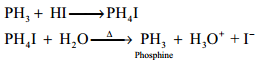
A pure sample of phosphine is prepared by heating phosphonium iodide with caustic soda solution.

Group 15 (Nitrogen Group) Elements img 26

Physical Properties:

It is colourless, poisonous gas with rotten fish smell. It is slightly soluble in water and is neutral to litmus test. It condenses to a colourless liquid at 188 K and freezes to a solid at 139.5 K.

Chemical Properties:

Thermal Stability:

Phosphine decomposes into its elements when heated in absence of air at 317 K or when electric current is passed through it.

Group 15 (Nitrogen Group) Elements img 27

Combustion:

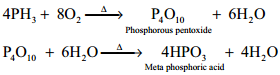
When phosphine is heated with air or oxygen it burns to give meta phosphoric acid.

Group 15 (Nitrogen Group) Elements img 28

Basic Nature:

Phosphine is weakly basic and forms phosphonium salts with halogen acids.

Group 15 (Nitrogen Group) Elements img 29

It reacts with halogens to give phosphorus penta halides.

PH3 + 4Cl2 → PCl5 + 3HCl

Reducing Property:

Phosphine precipitates some metal from their salt solutions.

3AgNO3 + PH3 → Ag3P + 3HNO3

It forms coordination compounds with lewis acids such as boron trichloride.

Group 15 (Nitrogen Group) Elements img 30

Structure:

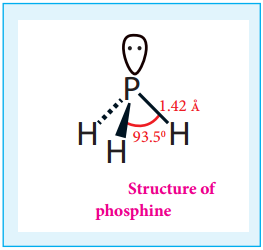
In phosphine, phosphorus shows sp3 hybridisation. Three orbitals are occupied by bond pair and fourth corner is occupied by lone pair of electrons. Hence, bond angle is reduced to 93.5°. Phosphine has a pyramidal shape.

Uses of Phosphine:

Phosphine is used for producing smoke screen as it gives large smoke. In a ship, a pierced container with a mixture of calcium carbide and calcium phosphide, liberates phosphine and acetylene when thrown into sea. The liberated phosphine catches fire and ignites acetylene. These burning gases serves as a signal to the approaching ships. This is known as Holmes signal.

Group 15 (Nitrogen Group) Elements img 31

Phosphorous Trichloride and Pentachloride:

Phosphorous Trichloride:

Preparation:

When a slow stream of chlorine is passed over white phosphorus, phosphorous trichloride is formed. It can also be obtained by treating white phosphorus with thionyl chloride.

P4 + 8SOCl2 → 4PCl3 + 4SO2 + 2S2Cl2

Properties

When phosphorous trichloride is hydrolysed with cold water it gives phosphorous acid.

PCl3 + 3H2O → H3PO3 + 3HCl

This reaction involves the coordination of a water molecule using a vacant 3d orbital on the phosphorous atom following by elimination of HCl which is similar to hydrolysis of SiCl4.

PCl3 + H2O → PCl3.H2O → P(OH)Cl2 + HCl

This reaction is followed by two more steps to give P(OH)3 or H3PO3.

HPOCl2 + H2O → H2PO2Cl + HCl
H2PO2Cl + H2O → H2PHO3 + HCl

Similar reactions occurs with other molecules that contains alcohols and carboxylic acids.

3C2H5OH + PCl3 → 3C2H5Cl + H3PO3
3C2H5COOH + PCl3 → 3C2H5COCl + H3PO4

Uses of Phosphorus Trichloride:

Phosphorus trichloride is used as a chlorinating agent and for the preparation of H3PO3.

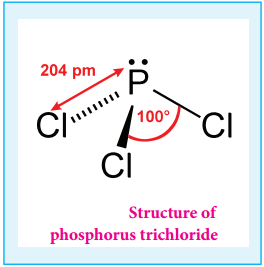
Group 15 (Nitrogen Group) Elements img 32

Phosphorous Pentachloride:

Preparation

When PCl3 is treated with excess chlorine, phosphorous pentachloride is obtained.

PCl3 + Cl2 → PCl5

Chemical Properties

On heating phosphorous pentachloride, it decomposes into phosphorus trichloride and chlorine.

Group 15 (Nitrogen Group) Elements img 33

Phosphorous pentachloride reacts with water to give phosphoryl chloride and orthophosphoric acid.

PCl5 + H2O → POCl3 + 2HCl
POCl3 + 3H2O → H3PO4 + 3HCl

Overall Reaction
PCl5 + 4H2O → H3PO4 + 5HCl

Phosphorous pentachloride reacts with metal to give metal chlorides. It also chlorinates organic compounds similar to phosphorus trichloride.

2Ag + PCl5 → 2 AgCl + PCl3
Sn + 2PCl5 → SnCl4 + 2PCl3
C2H5OH + PCl5 → C2H5Cl + HCl + POCl3
C2H5COOH + PCl5 → C2H5COCl + HCl + POCl3

Uses of Phosphorus Pentachloride

Phosphorous pentachloride is a chlorinating agent and is useful for replacing hydroxyl groups by chlorine atom.

Structure of Oxides and Oxoacids of Phosphorus

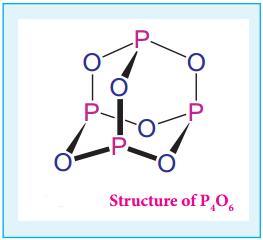
Phosphorous forms phosphorous trioxide, phosphorous tetra oxide and phosphorous pentaoxides. In phosphorous trioxide four phosphorous atoms lie at the corners of a tetrahedron and six oxygen atoms along the edges. The P-O bond distance is 165.6 pm which is shorter than the single bond distance of P-O (184 pm) due to pπ-dπ bonding and results in considerable double bond character.

Group 15 (Nitrogen Group) Elements img 34

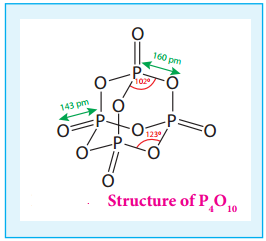
In P4O10 each P atoms form three bonds to oxygen atom and also an additional coordinate bond with an
oxygen atom.

Terminal P-O bond length is 143 pm, which is less than the expected single bond distance. This may be due to lateral overlap of filled p orbitals of an oxygen atom with empty d orbital on phosphorous.

Group 15 (Nitrogen Group) Elements img 35

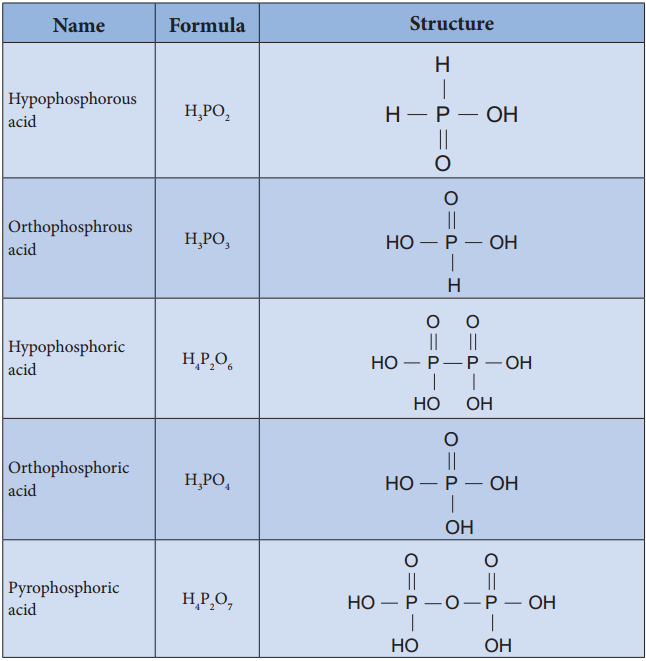
Oxoacids of Phosphorous-Structure:

Group 15 (Nitrogen Group) Elements img 36

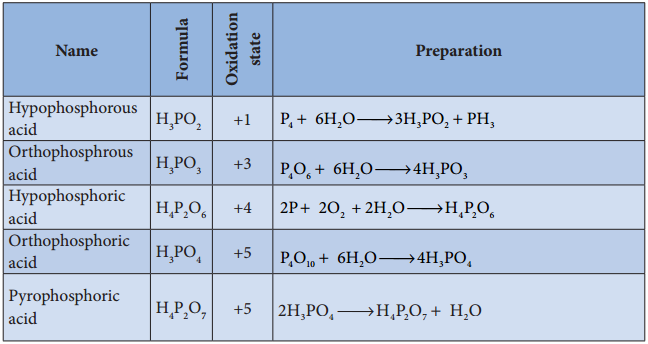
Oxoacids of Phosphorus-Preparation:

Group 15 (Nitrogen Group) Elements img 37

Group 16 (Oxygen group) Elements:

Occurrence:

Elements belonging group 16 are called chalgogens or ore forming elements as most of the ores are oxides or sulphides. First element oxygen, the most abundant element, exists in both as dioxygen in air (above 20% by weight as well as volume) and in combined form as oxides.

Oxygen and sulphur makes up about 46.6% & 0.034 & of earth crust by weight respectively. Sulphur exists as sulphates (gypsum, epsom etc…) and sulphide (galena, Zinc blende etc…). It is also present in the volcanic ashes. The other elements of this groups are scarce and are often found as selenides, tellurides etc along with
sulphide ores.

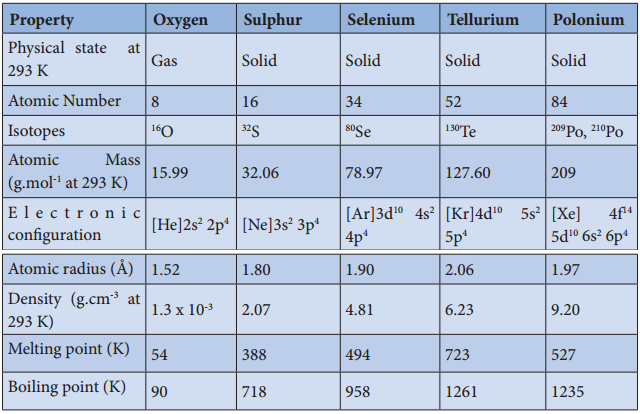
Physical Properties:

The common physical properties of the group 16 elements are listed in the Table.

Table 3.2 Physical Properties of Group 16 Elements

Group 15 (Nitrogen Group) Elements img 38

Group 14 (Carbon Group) Elements

Find free online Chemistry Topics covering a broad range of concepts from research institutes around the world.

Group 14 (Carbon Group) Elements

Occurrence:

Carbon is found in the native form as graphite. Coal, crude oil and carbonate rocks such as calcite, magnesite etc contains large quantities of carbon in its combined form with other elements. Silicon occurs as silica (sand and quartz crystal). Silicate minerals and clay are other important sources for silicon.

Physical Properties:

Some of the physical properties of the group 14 elements are listed below

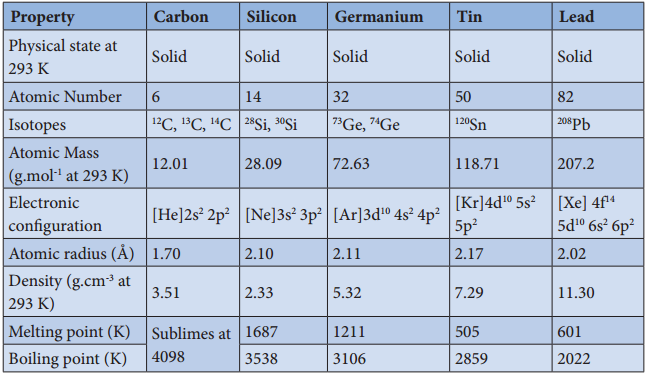
Table 2.4 Physical properties of group 14 elements

General Trends in Properties of P-Block Elements img 24

Tendency for Catenation

Catenation is an ability of an element to form chain of atoms. The following conditions are necessary for catenation.

  • The valency of element is greater than or equal to two
  • Element should have an ability to bond with itself
  • The self bond must be as strong as its bond with other elements
  • Kinetic inertness of catenated compound towards other molecules.

Carbon possesses all the above properties and forms a wide range of compounds with itself and with other elements such as H, O, N, S and halogens.
General Trends in Properties of P-Block Elements img 25

Allotropes of Carbon

Carbon exists in many allotropic forms. Graphite and diamond are the most common allotropes. Other important allotropes are graphene, fullerenes and carbon nanotubes.

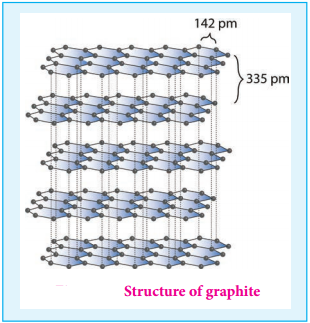
Graphite is the most stable allotropic form of carbon at normal temperature and pressure. It is soft and conducts electricity. It is composed of flat two dimensional sheets of carbon atoms. Each sheet is a hexagonal net of sp2 hybridised carbon atoms with a C-C bond length of 1.41 Å which is close to the C-C bond distance in benzene (1.40 Å). Each carbon atom forms three σ bonds with three neighbouring carbon atoms using three of its valence electrons and the fourth electron present in the unhybridised p orbital forms a π-bond.

These π electrons are delocalised over the entire sheet which is responsible for its electrical conductivity. The successive carbon sheets are held together by weak vander Waals forces. The distance between successive sheet is 3.40 Å. It is used as a lubricant either on its own or as a graphited oil.

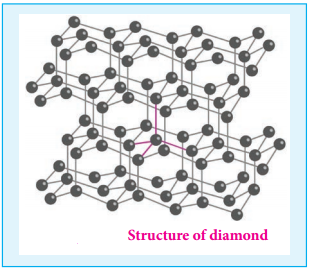
Unlike graphite the other allotrope diamond is very hard. The carbon atoms in diamond are sp3 hybridised and bonded to four neighbouring carbon atoms by σ bonds with a C-C bond length of 1.54 Å. This results in a tetrahedral arrangement around each carbon atom that extends to the entire lattice as shown in figure 2.5. Since all four valance electrons of carbon are involved in bonding there is no free electrons for conductivity. Being the hardest element, it used for sharpening hard tools, cutting glasses, making bores and rock drilling.

General Trends in Properties of P-Block Elements img 26

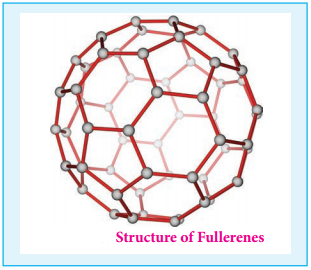
Fullerenes are newly synthesised allotropes of carbon. Unlike graphite and diamond, these allotropes are discrete molecules such as C32, C50, C60, C70, C76 etc. These molecules have cage like structures as shown in the figure. The C60 molecules have a soccer ball like structure and is called buckminster fullerene or buckyballs.

General Trends in Properties of P-Block Elements img 27

It has a fused ring structure consists of 20 six membered rings and 12 five membered rings. Each carbon atom is sp2 hybridised and forms three σ bonds & a delocalised π bond giving aromatic character to these molecules. The C-C bond distance is 1.44 Å and C = C distance 1.38 Å.

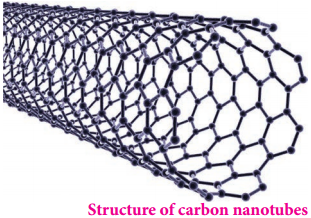
Carbon nanotubes, another recently discovered allotropes, have graphite like tubes with fullerene ends. Along the axis, these nanotubes are stronger than steel and conduct electricity. These have many applications in nanoscale electronics, catalysis, polymers and medicine.

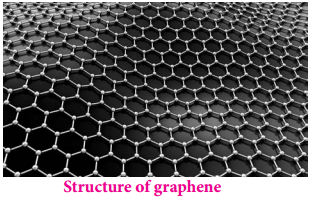
Another allotrophic form of carbon is graphene. It has a single planar sheet of sp2 hybridised carbon atoms that are densely packed in a honeycomb crystal lattice.

General Trends in Properties of P-Block Elements img 28

Carbon Monoxide [CO]:

Preparation:

Carbon monoxide can be prepared by the reaction of carbon with limited amount of oxygen.

2C + O2 → 2CO

On industrial scale carbon monoxide is produced by the reaction of carbon with air. The carbon monoxide formed will contain nitrogen gas also and the mixture of nitrogen and carbon monoxide is called producer gas.

General Trends in Properties of P-Block Elements img 29

The producer gas is then passed through a solution of copper(I)chloride under pressure which results in the formation of CuCl(CO).2H2O. At reduced pressures this solution releases the pure carbon monoxide. Pure carbon monoxide is prepared by warming methanoic acid with concentrated sulphuric acid which acts as a dehydrating agent.

HCOOH + H2SO4 → CO + H2SO4.H2O

Properties

  • It is a colourless, odourless, and poisonous gas. It is slightly soluble in water.
  • It burns in air with a blue flame forming carbon dioxide.

2CO + O2 → 2CO2

When carbon monoxide is treated with chlorine in presence of light or charcoal, it forms a poisonous gas carbonyl chloride, which is also known as phosgene. It is used in the synthesis of isocyanates.

CO + Cl2 → COCl2

Carbon monoxide acts as a strong reducing agent.

3CO + Fe2 O3 → 2Fe + 3CO2

Under high temperature and pressure a mixture of carbon monoxide and hydrogen (synthetic gas or syn gas) gives methanol.

CO + 2H2 → CH3OH

In oxo process, ethene is mixed with carbon monoxide and hydrogen gas to produce propanal.

CO + C2H4 + H4 → CH3CH2CHO

Fischer Tropsch Synthesis:

The reaction of carbon monoxide with hydrogen at a pressure of less than 50 atm using metal catalysts at 500 – 700 K yields saturated and unsaturated hydrocarbons.

nCO + (2n+1)H2 → CnH(2n+2) + nH2O
nCO + 2nH2 → CnH2n + nH2O

Carbon monoxide forms numerous complex compounds with transition metals in which the transition meal is in zero oxidation state. These compounds are obtained by heating the metal with carbon monoxide.

Eg. Nickel tetracarbonyl [Ni(CO)4], Iron pentacarbonyl [Fe(CO)5], Chromium hexacarbonyl [Cr(CO)6].

Structure:

It has a linear structure. In carbon monoxide, three electron pairs are shared between carbon and oxygen. The bonding can be explained using molecular orbital theory as discussed in XI standard. The C-O bond distance is 1.128Å. The structure can be considered as the resonance hybrid of the following two canonical forms.

General Trends in Properties of P-Block Elements img 30

Uses of Carbon Monoxide:

  1. Equimolar mixture of hydrogen and carbon monoxide – water gas and the mixture of carbon monoxide and nitrogen – producer gas are important industrial fuels.
  2. Carbon monoxide is a good reducing agent and can reduce many metal oxides to metals.
  3. Carbon monoixde is an important ligand and forms carbonyl compound with transition metals.

Carbon Dioxide:

Carbon dioxide occurs in nature in free state as well as in the combined state. It is a constituent of air (0.03%). It occurs in rock as calcium carbonate and magnesium carbonate.

Production

On industrial scale it is produced by burning coke in excess of air.
C + O2 → CO2 ∆H = – 394 kJ mol-1

Calcination of lime produces carbon dioxide as by product.
CaCO3 → CaO + CO2

Carbon dioxide is prepared in laboratory by the action of dilute hydrochloric acid on metal carbonates.
CaCO3 + 2HCl → CaCl2 + H2O + CO2

Properties

It is a colourless, nonflammable gas and is heavier than air. Its critical temperature is 31° C and can be readily liquefied.

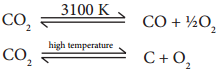
Carbon dioxide is a very stable compound. Even at 3100 K only 76% decomposes to form carbon monoxide and oxygen. At still higher temperature it decomposes into carbon and oxygen.

General Trends in Properties of P-Block Elements img 31

Oxidising Behaviour:

At elevated temperatures, it acts as a strong oxidising agent. For example,
CO2 + 2Mg → 2MgO + C

Water Gas Equilibrium:

The equilibrium involved in the reaction between carbon dioxide and hydrogen, has many industrial applications and is called water gas equilibrium.

General Trends in Properties of P-Block Elements img 32

Acidic Behaviour:

The aqueous solution of carbon dioxide is slightly acidic as it forms carbonic acid.

CO2 + H2O ⇄ H2CO3 ⇄ H+ + HCO3

Structure of Carbon Dioxide

Carbon dioxide has a linear structure with equal bond distance for the both C-O bonds. In this molecule there is two C-O sigma bond. In addition there is 3c-4e bond covering all the three atoms.

General Trends in Properties of P-Block Elements img 33

Uses of Carbon Dioxide

  1. Carbon dioxide is used to produce an inert atomosphere for chemical processing.
  2. Biologically, it is important for photosynthesis.
  3. It is also used as fie extinguisher and as a propellent gas.
  4. It is used in the production of carbonated beverages and in the production of foam.

Silicon Tetrachloride:

Preparation:

Silicon tetrachloride can be prepared by passing dry chlorine over an intimate mixture of silica and carbon by heating to 1675 K in a porcelain tube

SiO2 + 2C + 2Cl2 → SiCl4 + 2CO

On commercial scale, reaction of silicon with hydrogen chloride gas occurs above 600 K

Si + 4HCl → SiCl4 + 2H2

Properties:

Silicon tetrachloride is a colourless fuming liquid and it freezes at – 70°C. In moist air, silicon tetrachloride is hydrolysed with water to give silica and hydrochloric acid.

SiCl4 + 2H2O → 4HCl + SiO2

When silicon tetrachloride is hydrolysed with moist ether, linear perchloro siloxanes are formed [Cl-(Si Cl2O)nSiCl3 where n = 1 – 6.

Alcoholysis

The chloride ion in silicon tetrachloride can be substituted by nucleophile such as OH, OR, etc using suitable reagents. For example, it forms silicic esters with alcohols.

General Trends in Properties of P-Block Elements img 34

Ammonialysis

Similarly silicon tetrachloride undergoes ammonialysis to form chlorosilazanes.

General Trends in Properties of P-Block Elements img 35

Uses:

  1. Silicon tetrachloride is used in the production of semiconducting silicon.
  2. It is used as a starting material in the synthesis of silica gel, silicic esters, a binder for ceramic materials.

Silcones:

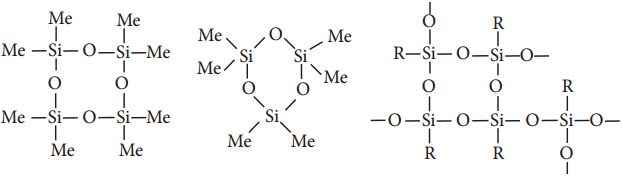
Silicones or poly siloxanes are organo silicon polymers with general empirical formula (R2SiO). Since their empirical formula is similar to that of ketone (R2CO), they were named “silicones”. These silicones may be linear or cross linked. Because of their very high thermal stability they are called high – temperature polymers.

Preparation:

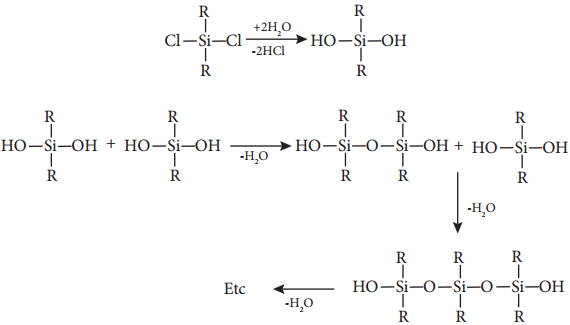
Generally silicones are prepared by the hydrolysis of dialkyldichlorosilanes (R2SiCl2) or diaryldichlorosilanes
Ar2SiCl2, which are prepared by passing vapours of RCl or ArCl over silicon at 570 K with copper as a catalyst.

General Trends in Properties of P-Block Elements img 36

The hydrolysis of dialkylchloro silanes R2SiCl2 yields to a straight chain polymer which grown from both the sides

General Trends in Properties of P-Block Elements img 37

The hydrolysis of monoalkylchloro silanes RSiCl3 yields to a very complex cross linked polymer. Linear silicones can be converted into cyclic or ring silicones when water molecules is removed from the terminal – OH groups.

General Trends in Properties of P-Block Elements img 38

Types of Silicones:

(i) Liner Silicones:

They are obtained by the hydrolysis and subsequent condensation of dialkyl or diaryl silicon chlorides.

(a) Silicone Rubbers:

These silicones are bridged together by methylene or similar groups.

(b) Silicone Resins:

They are obtained by blending silicones with organic resins such as acrylic esters.

(ii) Cyclic Silicones

These are obtained by the hydrolysis of R2SiCl2.

(iii) Cross linked Silicones

They are obtained by hydrolysis of RSiCl3

Properties

The extent of cross linking and nature of alkyl group determine the nature of polymer. They range from oily liquids to rubber like solids. All silicones are water repellent. This property arises due to the presence of organic side groups that surrounds the silicon which makes the molecule looks like an alkane.

They are also thermal and electrical insulators. Chemically they are inert. Lower silicones are oily liquids whereas higher silicones with long chain structure are waxy solids. The viscosity of silicon oil remains constant and doesn’t change with temperature and they don’t thicken during winter.

Uses:

  1. Silicones are used for low temperature lubrication and in vacuum pumps, high temperature oil baths etc
  2. They are used for making water proofing clothes
  3. They are used as insulting material in electrical motor and other appliances
  4. They are mixed with paints and enamels to make them resistant towards high temperature, sunlight, dampness and chemicals.

Silicates

The mineral which contains silicon and oxygen in tetrahedral [SiO4]2- units linked together in different patterns are called silicates. Nearly 95% of the earth crust is composed of silicate minerals and silica. The glass and ceramic industries are based on the chemistry silicates.

Types of Silicates:

Silicates are classified into various types based on the way in which the tetrahedral units, [SiO4]4- are
linked together.

General Trends in Properties of P-Block Elements img 39

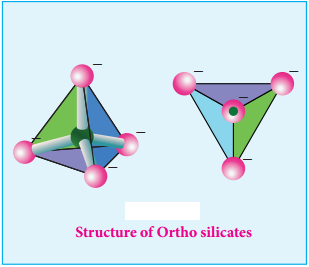
Ortho Silicates (Neso Silicates):

The simplest silicates which contain discrete [SiO4]4- tetrahedral units are called ortho silicates or
neso silicates.

Examples:

Phenacite – Be2SiO4 (Be2+ ions are tetrahedrally surrounded by O2- ions), Olivine – (Fe/Mg)2SiO4 (Fe2+ and Mg2+ cations are octahedrally surrounded by O2- ions).

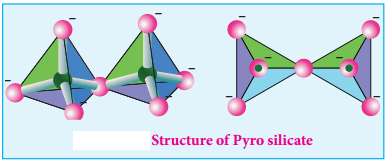
Pyro Silicate (or) Soro Silicates:

Silicates which contain [Si2O7]6- ions are called pyro silicates (or) Soro silicates. They are formed by joining two [SiO4]4- tetrahedral units by sharing one oxygen atom at one corner (one oxygen is removed while joining). Example: Thortveitite – Sc2Si2O7

General Trends in Properties of P-Block Elements img 40

Cyclic Silicates (or Ring Silicates)

Silicates which contain (SiO3)n2n- which are formed by linking three or more tetrahedral SiO42- units cyclically are called cyclic silicates. Each silicate unit shares two of its oxygen atoms with other units.

Example: Beryl [Be3Al2 (SiO3)6] (an aluminosilicate with each aluminium is surrounded by 6 oxygen atoms octahedrally)

Inosilicates:

Silicates which contain ‘n’ number of silicate units linked by sharing two or more oxygen atoms are called inosilicates. They are further classified as chain silicates and double chain silicates.

Chain Silicates (or Pyroxenes):

These silicates contain [(SiO3)n]2n- ions formed by linking ‘n’ number of tetrahedral [SiO4]4- units linearly. Each silicate unit shares two of its oxygen atoms with other units. Example: Spodumene – LiAl(SiO3)2.

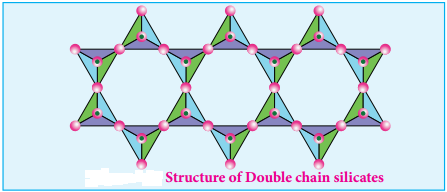
Double Chain Silicates (or Amphiboles):

These silicates contains [Si4O11]n6n- ions. In these silicates there are two different types of tetrahedra:

  • These sharing 3 vertices
  • Those sharing only 2 vertices.

Examples:

1. Asbestos:

These are fibrous and noncombustible silicates. Therefore they are used for thermal insulation material, brake linings, construction material and filters. Asbestos being carcinogenic silicates, their applications are restricted.

General Trends in Properties of P-Block Elements img 41

Sheet or Phyllo Silicates

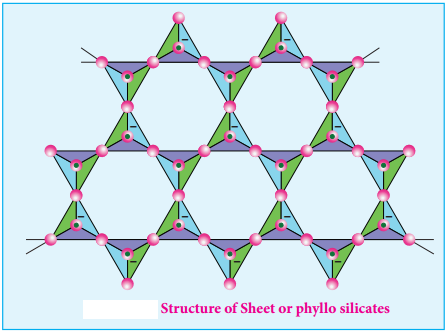
Silicates which contain (Si2O5)n2n- are called sheet or phyllo silicates. In these, Each [SiO4]4- tetrahedron unit shares three oxygen atoms with others and thus by forming twodimensional sheets. These sheets silicates form layered structures in which silicate sheets are stacked over each other. The attractive forces between these layers are very weak, hence they can be cleaved easily just like graphite.

Example: Talc, Mica etc.

General Trends in Properties of P-Block Elements img 42

Three Dimensional Silicates (or Tecto Silicates):

Silicates in which all the oxygen atoms of [SiO4]2- tetrahedra are shared with other tetrahedra to form three-dimensional network are called three dimensional or tecto silicates. They have general formula (SiO2)n.

Examples: Quartz

These tecto silicates can be converted into three dimensional aluminosilicates by replacing [SiO4]4- units
by [AlO4]5- units. Eg. Feldspar, Zeolites etc.,

Zeolites:

Zeolites are three-dimensional crystalline solids containing aluminium, silicon, and oxygen in their regular three dimensional framework. They are hydrated sodium alumino silicates with general formula Na2O.(Al2O3).x(SiO2).yH2O (x=2 to 10; y=2 to 6).

Zeolites have porous structure in which the monovalent sodium ions and water molecules are loosely held. The Si and Al atoms are tetrahedrally coordinated with each other through shared oxygen atoms. Zeolites are similar to clay minerals but they differ in their crystalline structure.

Zeolites have a three dimensional crystalline structure looks like a honeycomb consisting of a network of interconnected tunnels and cages. Water molecules moves freely in and out of these pores but the zeolite framework remains rigid.

Another special aspect of this structure is that the pore/channel sizes are nearly uniform, allowing the crystal to act as a molecular sieve. We have already discussed in XI standard, the removal of permanent hardness of water using zeolites.

Group 13 (Boron Group) Elements

Find free online Chemistry Topics covering a broad range of concepts from research institutes around the world.

Group 13 (Boron Group) Elements

The boron occurs mostly as borates and its important ores are borax – Na2[B4O5(OH)4].8H2O and kernite – Na2[B4O5(OH)4].2H2O. Aluminium is the most abundant metal and occurs as oxides and also found in aluminosilicate rocks. Commercially it is extracted from its chief ore, bauxite (Al2O3.2H2O). The other elements of this group occur only in trace amounts. The other elements Ga, In and Tl occur as their sulphides.

Physical Properties:

Some of the physical properties of the group 13 elements are listed below

Table 2.3 Physical properties of group 13 elements

Element

Most Common Allotropes

BoronAmorphous boron, α-rhombohedral boron, β-rhombohedral boron, γ-orthorhombic boron, α-tetragonal boron, β-tetragonal boron
CarbonDiamond, Graphite, Graphene, Fullerenes, Carbon nanotubes
SiliconAmorphous Silicon, Crystalline Silicon
Germaniumα-germanium, β-germanium
TinGrey tin, white tin, rhombic tin, sigma tin
PhosphorusWhite phosphorus, Red phosphorus, Scarlet phosphorus, Violet phosphorus, Black phosphorus.
ArsenicYellow arsenic, gray arsenic & Black arsenic
AnitimonyBlue-white antimony, Yellow, Black
OxygenDioxygen, ozone
SulphurRhombus sulphur, monoclinic sulphur
SeleniumRed selenium, Gray selenium, Black selenium, Monoclinic selenium
TelluriumAmorphous & Crystalline

Chemical Properties of Boron:

Boron is the only nonmetal in this group and is less reactive. However, it shows reactivity at higher temperatures. Many of its compounds are electron deficient and has unusual type of covalent bonding which is due to its small size, high ionisation energy and similarity in electronegativity with carbon and hydrogen.

Formation of Metal Borides:

Many metals except alkali metals form borides with a general formula MxBy (x ranging upto 11 and y ranging upto 66 or higher) Direct combination of metals with boron:

Direct Combination of Metals With Boron:

General Trends in Properties of P-Block Elements img 3

Reduction of Boron Trihalides:

Reduction of borontrichloride with a metal assisted by dihydrogen gives metal borides.

General Trends in Properties of P-Block Elements img 4

Formation of Hydrides:

Boron does not react directly with hydrogen. However, it forms a variety of hydrides called boranes. The simplest borane is diborane – B2H6. Other larger boranes can be prepared from diborane. Treatment of gaseous boron triflouride with sodium hydride around 450 K gives diborane. To prevent subsequent pyrolysis, the product diborane is trapped immediately.

General Trends in Properties of P-Block Elements img 5

Formation of Boron Trihalides:

Boron combines with halogen to form boron trihalides at high temperatures.

General Trends in Properties of P-Block Elements img 6

Formation of Boron Nitride:

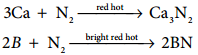
Boron burns with dinitrogen at high temperatures to form boron nitride.

General Trends in Properties of P-Block Elements img 7

Formation of Oxides:

When boron is heated with oxygen around 900 K, it forms its oxide.

General Trends in Properties of P-Block Elements img 8

Reaction with Acids and Alkali:

Halo acids have no reaction with boron. However, boron reacts with oxidising acids such as sulphuric acid and nitric acids and forms boric acid.

2B + 3H2SO4 → 2H3BO3 + 3SO2
B + 3HNO3 → H3BO3 + 3NO2

Boron reacts with fused sodium hydroxide and forms sodium borate.

2B + 6NaOH → 2Na2BO3 + 3H2

Uses of Boron:

  1. Boron has the capacity to absorb neutrons. Hence, its isotope 10B5 is used as moderator in nuclear reactors.
  2. Amorphous boron is used as a rocket fuel igniter.
  3. Boron is essential for the cell walls of plants.
  4. Compounds of boron have many applications. For example eye drops, antiseptics, washing powders etc contains boric acid and borax. In the manufacture of Pyrex glass, boric oxide is used.

Borax [Na2B4O7.10H2O]:

Preparation:

Borax is a sodium salt of tetraboric acid. It is obtained from colemanite ore by boiling its solution with sodium carbonate.

General Trends in Properties of P-Block Elements img 9

Borax is normally formulated as Na2B4O7.10H2O. But it contains, tetranuclear units [B4O5. (OH)4]2-. This form is known as prismatic form. Borax also exists two other forms namely, jeweller or octahderal borax (Na2B4O7.5H2O) and borax glass (Na2B4O7).

Properties

Borax is basic in nature and its solution in hot-water is alkaline as it dissociates into boric acid and sodium hydroxide.

Na2B4O7 + 7H2O → 4H3BO3 + 2NaOH

On heating it forms a transparent borax beads.

General Trends in Properties of P-Block Elements img 10

Borax reacts with acids to form sparingly soluble boric acid.

Na2B4O7 + 2HCl + 5H2O → 4H3BO3 + 2NaCl
Na2B4O7 + H2SO4 + 5H2O → 4H3BO3 + Na2SO4

When treated with ammonium chloride it forms boron nitride.

Na2B4O7 + 2NH4Cl → 2NaCl + 2BN + B2O3 + 4H2O

Uses of Borax:

  1. Borax is used for the identifiation of coloured metal ions
  2. In the manufacture optical and borosilicate glass, enamels and glazes for pottery
  3. It is also used as a flx in metallurgy and also acts as a preservative

Boric Acid [H3BO3 or B(OH)3]:

Preparation:

Boric acid can be extracted from borax and colemanite.

Na2B4O7 + H2SO4 → 4H3BO3 + Na2SO4
Ca2B6O11 + 11H2O + 4SO2 → 2Ca(HSO3)2 + 6H3BO3

Properties:

Boric acid is a colourless transparent crystal. It is a very weak monobasic acid and, it accepts hydroxyl ion rather than donating proton.

B(OH)3 + 2H2O ⇄ H3O+ + [B(OH)4]

It reacts with sodium hydroxide to form sodium metaborate and sodium tetraborate.

H3BO3 + NaOH → NaBO2 + 2H2O
4H3BO3 + 2NaOH → Na2B4O7 + 7H2O

Action of Heat:

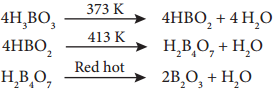
Boric acid when heated at 373 K gives metaboric acid and at 413 K, it gives tetraboric acid. When heated at red hot, it gives boric anhydride which is a glassy mass.

General Trends in Properties of P-Block Elements img 11

Action of Ammonia

Fusion of urea with B(OH)3, in an atmosphere of ammonia at 800 – 1200 K gives boron nitride.

General Trends in Properties of P-Block Elements img 12

Ethyl Borate Test

When boric acid or borate salt is heated with ethyl alcohol in presence of conc. sulphuric acid, an ester, triethylborate is formed. The vapour of this ester burns with a green edged flame and this reaction is used to identify the presence of borate.

General Trends in Properties of P-Block Elements img 13

Note:

The trialkyl borate on reaction with sodium hydride in tetrahydrofuran to form a coordination compound Na[BH(OR)3], which acts as a powerful reducing agent.

Formation of Boron Triflouride:

Boric acid reacts with calcium flouride in presence of conc. sulphuric acid and gives boron triflouride.

3CaF2 + 3H2SO4 + 2 B(OH3) → 3CaSO4 + 2BF3 + 6H2O

Boric acid when heated with soda ash it gives borax

Na2CO3 + 4B(OH)3 → Na2B4O7 + CO2 + 6H2O

Structure of Boric Acid:

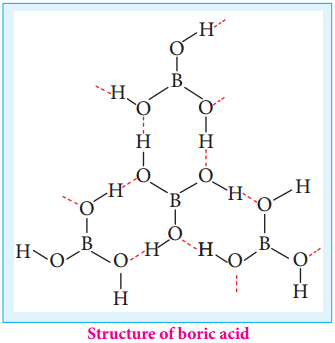
Boric acid has a two dimensional layered structure. It consists of [BO3]3- unit and these are linked to each other by hydrogen bonds as shown in the Figure 2.2.

Uses of Boric Acid:

  1. Boric acid is used in the manufacture of pottery glases, enamels and pigments.
  2. It is used as an antiseptic and as an eye lotion.
  3. It is also used as a food preservative.

General Trends in Properties of P-Block Elements img 14

Diborane

Preparation:

As discussed earlier diborane can be prepared by the action of metal hydride with boron. This method is used for the industrial production. Diborane can also be obtained in small quantities by the reaction of iodine with sodium borohydride in diglyme.

2NaBH4 + I2 → B2H6 + 2NaI + H2

On heating magnesium boride with HCl a mixture of volatile boranes are obtained.

2Mg3B2 + 12HCl → 6MgCl2 + B4H10 + H2
B4H10 + H2 → 2B2H6

Properties:

Boranes are colourless diamagnetic compounds with low thermal stability. Diborane is a gas at room temperature with sweet smell and it is extremely toxic. It is also highly reactive.

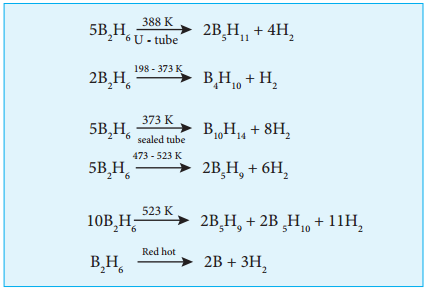
At high temperatures it forms higher boranes liberating hydrogen.

General Trends in Properties of P-Block Elements img 15

Diboranes reacts with water and alkali to give boric acid and metaborates respectively.

B2H6 + 6H2O → 2H3BO3 + 6H2
B2H6 + 2NaOH + 2H2O → 2NaBO2 + 6H2

Action of Air:

At room temperature pure diborane does not react with air or oxygen but in impure form it gives B2O3 along
with large amount of heat.

B2H6 + 3O2 → B2O3 + 3H2O
∆H = – 2165 KJ mol2-

Diborane reacts with methyl alcohol to give trimethyl Borate.

B2H6 + 6CH3OH → 2B(OCH3)3 + 6H2

Hydroboration:

Diborane adds on to alkenes and alkynes in ether solvent at room temperature. This reaction is called hydroboration and is highly used in synthetic organic chemistry, especially for anti Markovnikov addition.

B2H6 + 6RCH = CHR → 2(RCH2 – CHR)3B

Reaction with Ionic Hydrides

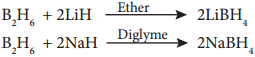
When treated with metal hydrides it forms metal borohydrides

General Trends in Properties of P-Block Elements img 16

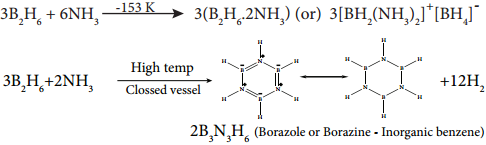
Reaction with Ammonia:

When treated with excess ammonia at low temperatures diborane gives diboranediammonate. On heating at higher temperatures it gives borazole.

General Trends in Properties of P-Block Elements img 17

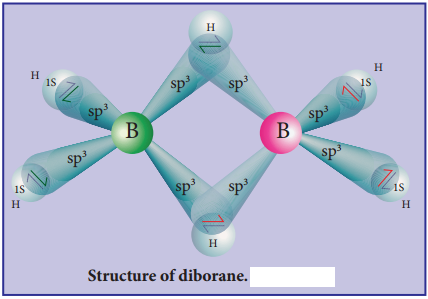
Structure of Diborane:

In diborane two BH2 units are linked by two bridged hydrogens. Therefore, it has eight B-H bonds. However, diborane has only 12 valance electrons and are not sufficient to form normal covalent bonds. The four terminal B-H bonds are normal covalent bonds (two centre – two electron bond or 2c-2e bond).

The remaining four electrons have to be used for the bridged bonds. i.e. two three centred B-H-B bonds utilise two electrons each. Hence, these bonds are three centre-two electron bonds (3c-2e). The bridging hydrogen atoms are in a plane as shown in the figure 2.3. In diborane, the boron is sp3 hybridised.

General Trends in Properties of P-Block Elements img 18

Three of the four sp3 hybridised orbitals contains single electron and the fourth orbital is empty. Two of the half filled hybridised orbitals of each boron overlap with the 1s orbitals of two hydrogens to form four terminal 2c-2e bonds, leaving one empty and one half filled hybridised orbitals on each boron. The Three centre – two electron bonds), B-H-B bond formation involves overlapping the half filled hybridised orbital of one boron, the empty hybridised orbital of the other boron and the half filled 1s orbital of hydrogen.

Uses of Diborane:

  1. Diborane is used as a high energy fuel for propellant
  2. It is used as a reducing agent in organic chemistry
  3. It is used in welding torches

Boron Triflouride:

Preparation:

Boron triflouride is obtained by the treatment of calcium fluoride with boron trioxide in presence of conc. sulphuric acid.

General Trends in Properties of P-Block Elements img 19

It can also be obtained by treating boron trioxide with carbon and fluorine.

B2O3 + 3C + 3F2 → 2BF3 + 3CO

In the laboratory pure BF3 is prepared by the thermal decomposition of benzene diazonium tetrafloro borate.

General Trends in Properties of P-Block Elements img 20

Properties:

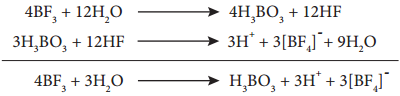
Boron triflouride has a planar geometry. It is an electron deficient compound and accepts electron pairs to form coordinate covalent bonds. They form complex of the type [BX4]2-.

BF3 + NH3 → F3B ← NH3
BF3 + H2O → F3B ← OH3

On hydrolysis, boric acid is obtained. This then gets converted into Hydro floroboric acid.

General Trends in Properties of P-Block Elements img 21

Uses of Boron Triflouride:

  1. Boron trifloride is used for preparing HBF4, a catalyst in organic chemistry
  2. It is also used as a flourinating reagent.

Aluminium Chloride:

Preparation:

When aluminium metal or aluminium hydroxide is treated with hydrochloric acid, aluminium trichloride is formed. The reaction mixture is evaporated to obtain hydrated aluminium chloride.

2Al + 6HCl → 2AlCl3 + 3H2
Al(OH)3 + 3HCl → AlCl3 + 3H2O

McAfee Process:

Aluminium chloride is obtained by heating a mixture of alumina and coke in a current of chlorine.

2Al2O3 + 3C + 6Cl2 → 4AlCl3 + 3CO2

On industrial scale it is prepared by chlorinating aluminium around 1000 K

General Trends in Properties of P-Block Elements img 22

Properties:

Anhydrous aluminium chloride is a colourless, hygroscopic substance. An aqueous solution of aluminium chloride is acidic in nature. It also produces hydrogen chloride fumes in moist air.

AlCl3 + 3H2O → Al(OH)3 + 3HCl

With ammonium hydroxide it forms aluminium hydroxide.

AlCl3 + 3NH4OH → Al(OH)3 + 3NH4Cl

With excess of sodium hydroxide it produces metal aluminate

AlCl3 + 4NaOH → NaAlO2 + 2H2O + 3NaCl

It behaves like a Lewis acid and forms addition compounds with ammonia, phosphine and carbonylchloride etc… Eg. AlCl3.6NH3.

Uses of Aluminium Chloride:

  1. Anhydrous aluminium chloride is used as a catalyst in Friedels Craft reactions
  2. It is used for the manufacture of petrol by cracking the mineral oils.
  3. It is used as a catalyst in the manufacture on dyes, drugs and perfumes.

Alums:

The name alum is given to the double salt of potassium aluminium sulphate [K2SO4.Al2(SO4)3.24.H2O]. Now a days it is used for all the double salts with MSO4.M2(SO4)3. 24H2O, where M’ is univalent metal ion or [NH4]+ and M is trivalent metal ion.

Examples:

Potash alum [K2SO4.Al2(SO4)3.24.H2O]; Sodium alum [Na2SO4.Al2(SO4)3. 24.H2O], Ammonium alum [(NH4)2(SO4)3.24.H2O], Chrome alum [K2SO4.Cr2(SO4)3.24.H2O]. Alums in general are more soluble in hot water than in cold water and in solutions they exhibit the properties of constituent ions.

Preparation:

The alunite the alum stone is the naturally occurring form and it is K2SO4. Al2(SO4)3. 4Al(OH)3. When alum stone is treated with excess of sulphuric acid, the aluminium hydroxide is converted to aluminium sulphate. A calculated quantity of potassium sulphate is added and the solution is crystallised to generate potash alum. It is purified by recrystallisation.

K2SO4.Al2(SO4)3.4Al(OH)3 + 6H2SO4 → K2SO4 + 3Al2(SO4)3 + 12H2O
K2SO4 + Al2(SO4)3 + 24 H2O → K2SO4.Al2(SO4)3. 24 H2O

Properties

Potash alum is a white crystalline solid it is soluble in water and insoluble in alcohol. The aqueous solution is acidic due to the hydrolysis of aluminium sulphate it melts at 365 K on heating. At 475 K loses water of hydration and swells up. The swollen mass is known as burnt alum. Heating to red hot it decomposes into potassium sulphate, alumina and sulphur trioxide.

General Trends in Properties of P-Block Elements img 23

Potash alum forms aluminium hydroxide when treated with ammonium hydroxide.

K2SO4.Al2(SO4)3.24 H2O + 6NH4OH → K2SO4 + 3(NH4)2SO4 + 24 H2O + 2Al(OH)3

Uses of Alum:

  1. It is used for purification of water
  2. It is also used for water proofing and textiles
  3. It is used in dyeing, paper and leather tanning industries
  4. It is employed as a styptic agent to arrest bleeding.