Preposition Exercises for Class 6 CBSE With Answers

Preposition Exercises for Class 6

Definition: A preposition is a word placed before a noun or a pronoun to show in what relation the person or thing denoted by it stands in regard to something else.

A preposition can be defined as a word that shows a relation between a noun or a pronoun with some other words in a sentence.

This grammar section explains English Grammar in a clear and simple way. There are example sentences to show how the language is used. You can also visit the most accurate and elaborate NCERT Solutions for Class 6 English. Every question of the textbook has been answered here.

Preposition Exercises for Class 6 CBSE With Answers Pdf

For example:

  • I shall wait at the school gate.
  • The book is on the table.
  • He pointed to the tree.
LocationTimeMovement
aboveafteragainst
behindbeforealong
belowbydown
besideduringfrom
betweenfrominto
byonoff
inpaston
insidesinceonto
nearthroughout of
ontotoward
overuntilup
throughuponupon
I am in the pool.We will meet after swimming lessonsI am getting out of the pool

The preposition can be studied in the following parts.

  1. Prepositions for time
  2. Prepositions for place
  3.  Prepositions for direction

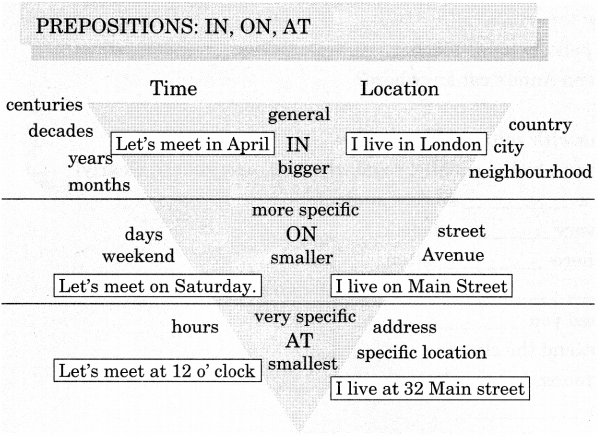
1. Prepositions for time
Preposition Exercises for Class 6 CBSE With Answers 1

We use many different prepositions for talking about time. Here we are looking at: in, on, at, by, during and for –

PrepositionsUsesExample
InMonths, Seasons, Years, Centuries, Times of day, Longer periods of timeIn January/ in April, in spring/ in winter, in 1984 / in 2015, in the 20th century, in the morning / in the evening, in the past / in the 1990s / in the holidays
AtClock times, Festivals, Exceptionsat 7.30 a.m. / at 5 o’clock, at Christmas / at Easter, at night / at the weekend
OnDays of the week, Days + parts of days, Dates, Special daysOn Monday, On Tuesday afternoon / on Saturday mornings, on November 22nd, On my birthday on New Year’s Eve
ByUltimate timeby 14th February., by Monday
ForTime Phrasefor two years, for an hour
DuringSpecific periodduring the vacation, during the day
aroundin a circle, NearAround the table, around 50 euros

2. Prepositions for place
Prepositions can be used to show where something is located place. Here we are looking at: in, at, on, between, among, into, and besides.

PrepositionUsesExamples
InCountries, cities, town, and place having some boundaryIn Nottingham/ in Germany, in park street in hall/ in school, in the mirror, in the car, in the picture, in the world.
Atshows an exact position or particular placeat the entrance, at the bus stop, at the table, at a concert, at the party, at university, at work.
Onthings, something is in a position above something else and touching it.on the wall, on the River cam, on the desk, on his face, on the left, on the first floor, on trains/ on the bus / on a plane, on TV/ on the radio
BetweenSpace which separates two places, people or objectsMeeting between the directors, between the children, between Chile and Argen­tina
AmongUsed for more than two persons or thingsAmong all the students, among these boys
IntoMovement of someone from one position or place to anotherInto the river, into the castle, into the garden
besidesStands for in addition toBesides his mother, besides the self
acrossfrom one side to the otheracross the road
downfrom higher to lowerdown the blind.
overon the surface ofThe plane flew over the Atlantic. She put a sheet over the furniture.
underbeneath, belowWater flows under the bridge.

3. Preposition for direction
Some preposition shows where something is going. They are called prepositions of direction.

Examples:

  • She went to the library.
  • He ran away when he felt that someone was coming towards him.
  • The dog is jumping through the loop.
  • I need to go out tonight.
  • I ordered a sandwich with a drink.
  • We sat next to each other.

Preposition Exercises Practice Examples for Class 6 CBSE

Exercise-1
Read the statements given below and tick the correct option:

Question 1.
They went to the Agra bus.
(a) of
(b) in
(c) by
(d) from
Answer
(c) by

Question 2.
She jumped the river.
(a) on
(b) in
(c) into
(d) to
Answer
(c) into

Question 3.
Compare Gandhi Karl Marx.
(a) to
(b) with
(c) over
(d) in
Answer
(b) with

Question 4.
Ram was engrossed …. his studies.
(a) on
(b) with
(c) in
(d) over
Answer
(c) in

Question 5.
I presented him ….a beautiful watch.
(a) in
(b) for
(c) with
(d) on
Answer
(c) with

Question 6.
What are doing … coming Sunday?
(a) on
(b) from
(c) in
(d) to
Answer
(a) on

Question 7.
I will finish this work . today evening.
(a) from
(b) by
(c) on
(d) into
Answer
(b) by

Question 8.
People have siesta lunchtime.
(a) on
(b) in
(c) to
(d) at
Answer
(d) at

Question 9.
I’ll arrive sometime …. 8 and 9 am;
(a) next to
(b) in
(c) between
(d) on
Answer
(c) between

Question 10.
They should be ready to go 20 minutes.
(a) to
(b) in
(c) on
(d) at
Answer
(b) in

Exercise-2

Fill in the blanks with appropriate prepositions.
1. He was accused ____________ theft. (for, of, to)
2. Look ____________ the flowers. (at, in, up)
3. Are you a teacher ____________ this school? (in, on, with)
4. Compare your answers ____________ your partner. (after, between, with)
5. I come ____________ a big family. (with, from, into)
6. He tried to open the tin ____________ a knife. (up, to , with)
7. Palak’s birthday is ____________ 15 January. (in, on, at)
8. He should be here ____________ now. (to, by, for)
9. Gandhiji lived ____________ the English rule. (during, at, before)
10. I was born ____________ October 16th. (in, at, on)
Answer
1. of
2. at
3. in
4. with
5. from
6. with
7. on
8. by
9. during
10. on

Correct the following sentences:
1. Leena sat down Sid and Anuj.
2. The restaurant is at the river.
3. She pulled on the blind.
4. I bought this book to you.
5. The pen is up the drawer.
6. The plate is at the table.
7. She put a sheet for the furniture.
8. The Seine flows between Paris.
9. On the way of the station.
10. I put an egg at the kitchen table.
Answer
1. Leena sat between Sid and Anuj.
2. The restaurant is by the river.
3. She pulled down the blind.
4. I bought this book for you.
5. The pen is in the drawer.
6. The plate is on the table.
7. She put a sheet over the furniture.
8. The Seine flows through Paris.
9. On the way to the station.
10. I put an egg on the kitchen table.

Exercise-4
Fill in the blanks with the suitable prepositions.
1. She always read newspapers the morning.
2. There is a party t the club house.
3. The garbage truck comes Wednesday.
4. Walter is not mean; he is just very careful money.
5. Do you get well your sister?
6. Do you go – bed late every night?
7. The Class start 15:30 the afternoon.
8. I wish my daughter was interested learning foreign languages.
Answer
1. In
2. at
3. On
4. with
5. on, with
6. to
7. at, in
8. in

Internal assessment

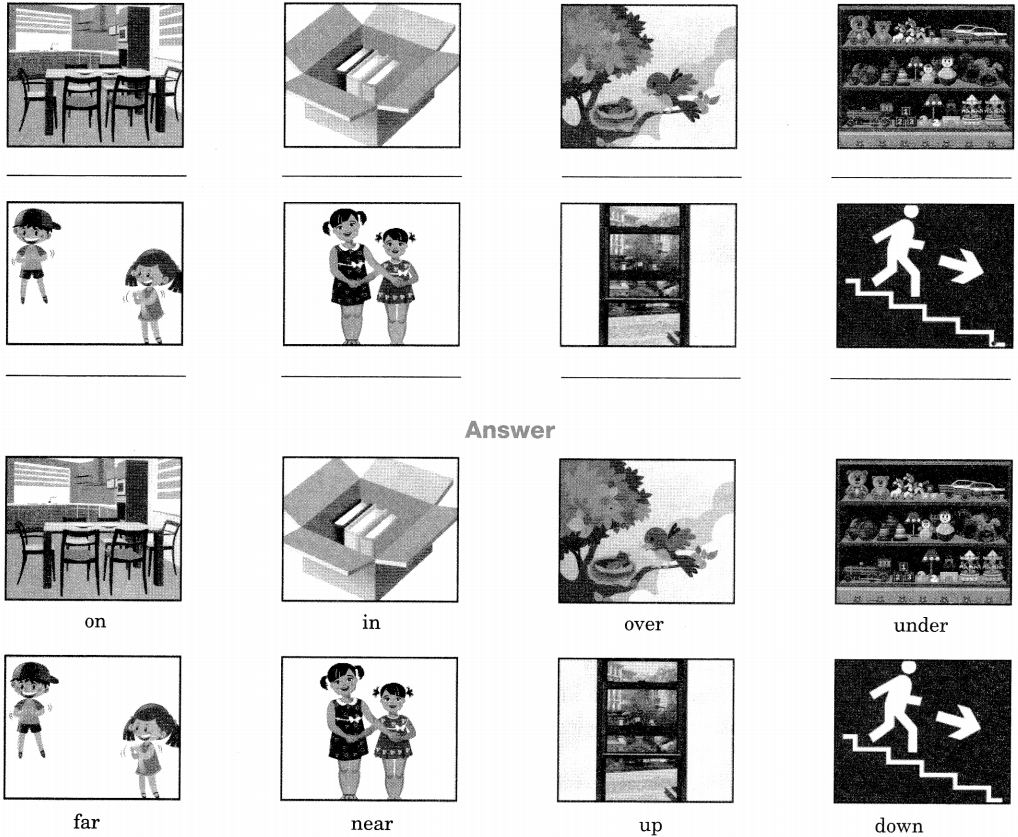
Fill in the blanks below the boxes with suitable prepositions.
Preposition Exercises for Class 6 CBSE With Answers

Preposition Exercises Practice Examples for Class 6 CBSE

Question 1.
Identify all prepositions in the following sentences:
After flying for many hours, we finally got off the airplane. We walked out the exit and went to the baggage claim area. There were hundreds of different bags on the conveyor belt. I almost picked up the wrong one because it looked like mine.
(i) __________:
(ii) __________:
(iii) __________:
(iv) __________:
(v) __________:

Question 2.
Complete with at, in, on
(i) ___ night
(ii) ___ 1996
(iii) ___ Christmas Day
(iv) ___ Tuesday
(v) ___ the 15th century
(vi) ___ 17.30
(vii) ___ May
(viii) ___ weekends
(ix) ___ the morning
(x) ___ summer

Choose the correct option
1. (a) We often go at holiday in summer
(b) We often go on holiday to summer
(c) We often go on holiday in summer
(d) We often go on holiday at summer

2. (a) James isn’t here in the moment
(b) James isn’t here to the moment
(c) James isn’t here on the moment
(d) James isn’t here at the moment

3. (a) Are you coming on Tuesday morning?
(b) Are you coming at Tuesday morning?
(c) Are you coming in Tuesday morning?
(d) Are you coming to Tuesday morning?

4. (a) I play tennis in the weekend
(b) I play tennis at the weekend
(c) I play tennis on the weekend
(d) I play tennis to the weekend

5. (a) We have lunch in midday.
(b) We have lunch at midday.
(c) We have lunch on midday.
(d) We have lunch to midday.

Fill in the blanks using these prepositions: (at, with, for, in, to)
1. I went the play my friend last night.
2. I bought my son a bicycle his birthday.
3. My sister sat with my mom the bus.
4. The doctor will see you two o’ clock.
Conjunctions Exercises for Class 7 CBSE With Answers

Conjunctions Exercises for Class 7

A conjunction is a part of speech that is used to connect words, phrases, clauses, or sentences. Conjunctions are considered to be invariable grammar particles, and they may or may not stand between items they conjoin.

This grammar section explains English Grammar in a clear and simple way. There are example sentences to show how the language is used. You can also visit the most accurate and elaborate NCERT Solutions for Class 7 English. Every question of the textbook has been answered here.

Conjunctions Exercises for Class 7 CBSE With Answers Pdf

A word like though and in spite of, are called linking words or conjunctions.
Conjunctions like when, while, as soon as, before, until, since etc link with time.
Examples:

  • Wait here until I come. (= up to the time I come)
  • As soon as she’d got the message, she went home, (immediately after she’d got the message)

If unless and in case are used to express a condition.
Examples:

  • We won’t catch the flight unless we hurry.
  • Student should carry two pens in case one of them runs out.

But, although/ even though, in spite of/despite are used to express the idea of contact.
Examples:

  • She went to school despite being unwell.
  • He failed the exam even though he had done well.

Because and because of are used to show the reason for something.
So is used to express the result of something.
Examples:

  • He didn’t go to office because he was ill (because + statement)
  • He didn’t go to office because of illness, (because of + noun)
  • She didn’t study hard, so she failed the examination, (so + statement)

To, in order to and so that are used to express the purpose of the action.
Examples:

  • We go to school to learn new things.
  • They migrated to the city in order to enjoy more facilities.
  • She is learning japanese so that she can live and work in japan.
  • He wrote to his father so that he could borrow some money.

Both for and to can be used to show the purpose of a thing.
Examples:

  • This knife is only for cutting vegetables, (for + gerund)
  • The knife is used to cut vegetables only, (to + base from of verb)

Correlative Conjunction
These are paired conjunctions which join words, phrases or clauses which have reciprocal or complementary relationship.
The most commonly used correlative conjunctions are as follows
Either or
Neither nor
Whether or
Both and
Not only but also
Examples:

  • Neither Kishor nor Meena passed the exam.
  • Give me either a cup or a glass.
  • Both red and yellow are attractive colours.
  • I like neither tea nor coffee.
  • He will be either in the room or in the hall.
  • Mannu can speak not only English but also French.

Some Other Paired Conjunctions

  1. And–Too: He is an actor and a performer too.
  2. Such–As: Only such men as these make progress in life.
  3. Too–to: He is too tired to walk.
  4. So–That: He is so tired that he can’t walk.
  5. Although (Though)–Yet: Though he is spendthrift yet he bought an expensive watch.
  6. So–As: He is not so wise as his brother is.
  7. As–As:He is as close fisted as his brother.
  8. As–So:As you sow so shall you reap.
  9. Lest–should:Work hard lest you should fail.
  10. No Sooner than: No sooner than the rain started, the street drains began to overflow.

Conjunctions Exercises Solved Examples for Class 7 CBSE

Question 1.
Choose the correct conjunction.
(i) I did my best to pass my English exam yet / so I failed.
(ii) I will get my car service and/ for there is something wrong with the brakes.
(iii) The suspect went to the airport and/yet tried to use a license that had his brother’s identification on it or /but he got caught.
(iv) Nobody expected Sam to get the job nor / so did I.
(v) We can go to a changing restaurant or/and a Mexican, I don’t really mind.
Answer:
(i) yet
(ii) for
(iii) and/ but
(iv) nor
(v) or

Question 2.
Join the sentences using conjunctions.
(i) She is ill. She is cheerful.
(ii) We decided to go out. It was raining.
(iii) The piper played. The children danced.
(iv) James worked hard. His brother is lazy.
(v) I went to the shop. I bought some vegetables.
Answer:
(i) She is ill but she is cheerful.
(ii) Though it was raining we decided to go out.
(iii) The piper played and the children danced.
(iv) James works hard whereas his brother is lazy.
(v) I went to the shop and bought some vegetables.

Conjunctions Exercises Practice Examples for Class 7 CBSE

1. Daddy Longlegs, a book by Jean Webster, is in the form of letters. Here is as an extract from a letter. Cross out the wrong conjunctions and write the correct ones. The first letter of the correct conjunctions have been given as clues.

1. The farm gets more but more entertaining. I rode on hay and
2. wagon yesterday. We’ve oceans of little baby chickens because of a
3. ducks and turkeys but guinea fowls. You must be mad to a
4. live in a city so you can live on a form. It is my daily business to hunt w
5. the eggs. I fell off a beam in the barn loft yesterday, either I was trying w
6. to crawl over to a nest because the black hen has stolen. t
7. Some of the farmers around here have a separator after web
8. don’t care for these new-fashioned ideas. We’ve six calves, but I’ve chosen the names for all of them. a

2. Connect the following sentences using correct connector.

1. “Our old friends dropped in last Saturday. We took them out to lunch, (then, next) went shopping with them,”Babita told Lata.
2. Suchitra had not heard from her cousin overseas for a long time, (finally, later) she decided to write him a letter.
3. The offenders were arrested by the police, (after, subsequently) they were imprisoned for a week.
4. (Until, After) a good night’s sleep, we woke up refreshed and ready to continue our journey.
5. She would not divulge any information (until, later) she felt she could trust us.
6. She gets up early every morning, she does some Yoga exercises, (then, before) She sits down to have breakfast.
7. (After, Before) the government forces could recover from the attack, the enemy launched yet another attack.
8. To be a good teacher, (next, first) you must have a lot of patience.
9. The boys pitched their tents, (finally, then) They built a campfire.
10. “To get to my place, (until, first) take bus number 10 to the 1st terminal; (after, then) take bus number 3 which will drop you right in front of my house,” Jaya explained to her friend.

Editing Exercises for Class 6 CBSE With Answers

Editing Exercises for Class 6

This grammar section explains English Grammar in a clear and simple way. There are example sentences to show how the language is used. You can also visit the most accurate and elaborate NCERT Solutions for Class 6 English. Every question of the textbook has been answered here.

Editing Exercises for Class 6 CBSE With Answers PDF

Editing Solved Exercise With Answers for Class 6 CBSE

Question 1.
In the passage given below, there is an error in each line which has been underlined. Write the correct word in the space provided.

Everyone knew about Vitamins. _____________
There is Vitamin A, B, C, D and E. _____________
But also few people are aware _____________
that there is Vitamin K, T, H and _____________
U. Vitamin K help the liver to _____________
functioning properly. Vitamin T helps _____________
to treating some diseases. Vitamin _____________
H is also great useful. It is also _____________
calls biotin. Lastly, Vitamin U heals _____________
the bodies of ulcers. _____________

Question 2.
Edit the following passage by replacing the incorrect word with the correct one.

A. About a year 1900, a small, dark-haired boy(a)_________________
name Charles Chaplin was often seen(b)_________________
waiting outside the back entrance(c)_________________
of London theatres. He looks thin and(d)_________________
hungry but his blue eyes was determined.(e)_________________
He could sing or dance. His parents(f)_________________
were music hall performers but(g)_________________
he has been born into the life of the theatre.(h)_________________

Answer:
(a) a year – the year
(b) name – named
(c) entrance – entrances
(d) looks – looked
(e) was – were
(f) or – and
(g) but – and
(h) has – had

Editing Practice Exercises for Class 6 CBSE

Question 1.
Read the following passage. There is one error in each line which has been underlined. Write the correction for this error in the space provided.

Children are fond to coconut. It is the a. _____________
biggest of all the nuts, and are indeed a wonderful b. _____________
fruit. It grows on a tall palm tree and is find c. _____________
in tropical countries round a seashore. The d. _____________
name was given to it at the Portuguese because, e. _____________
with the three marks and eye-spots at the end, it looked something like a monkey’s face, and ‘coco’ f. _____________
is a Portuguese word for a bugbear or a distorted marks. _____________

Pronoun Exercises for Class 8 CBSE With Answers

Pronoun Exercises for Class 8 CBSE With Answers Q1.1

A pronoun is a word that takes the place of a common noun or a proper noun. There are different kinds of pronouns.

A pronoun is a word which is used in place of noun. They are used to make sentences less cumbersome and less repetitive. Like a noun, a pronoun can be singular or plural and refer to people as well as things. Examples: he, she, it, they, we etc.

Pronoun Exercises for Class 8 CBSE With Answers Pdf

This grammar section explains English Grammar in a clear and simple way. There are example sentences to show how the language is used. NCERT Solutions for Class 8 English will help you to write better answers in your Class 10 exams. Because the Solutions are solved by subject matter experts.

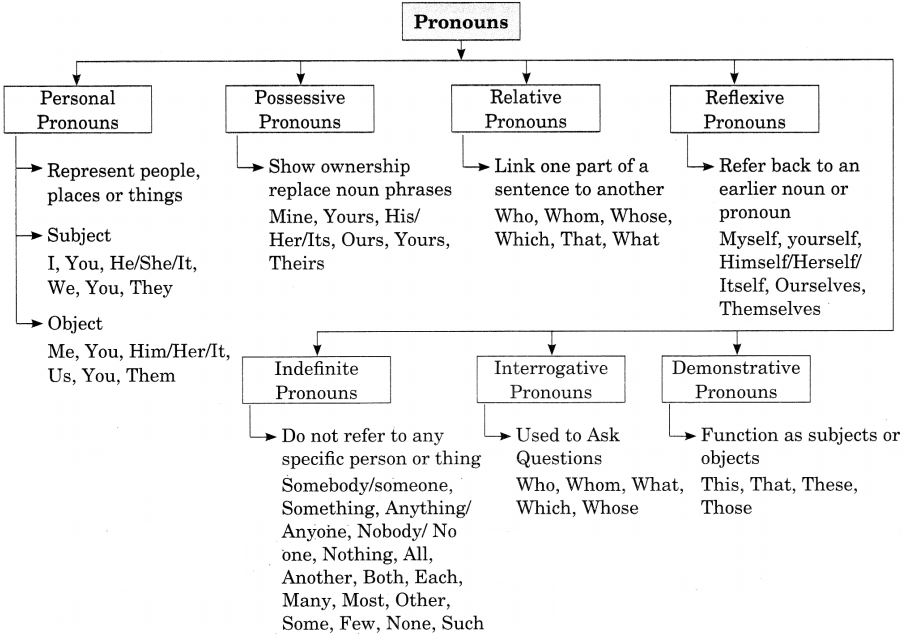
Pronoun Chart
Pronoun Exercises for Class 8 CBSE With Answers Q2.1

Pronoun Rules
There are a few important rules for using pronouns. As you read through these rules and the examples in the next section, Noticehow the pronoun rules are followed. Soon you’ll see that pronouns are easy to work with.

  • Subject pronouns may be used to begin sentences. For example: We did a great job.
  • Subject pronouns may also be used to rename the subject. For example: It was she who decided we should go to Hawaii.
  • Indefinite pronouns don’t have antecedents. They are capable of standing on their own. For example: no one likes the sound of fingernails on a chalkboard.
  • Object pronouns are used as direct objects, indirect objects, and objects of prepositions. These include: you, me, him, her, us, them, and it. For example: David talked to her about the mistake.
  • Possessive pronouns show ownership. They do not need apostrophes. For example: The cat washed its whiskers.

Interrogative Pronouns
We use interrogative pronouns to ask questions. An interrogative pronoun represents the thing that we do not know (what we are asking the question about.)

The main interrogative pronouns are who, whom, what, which and whose.
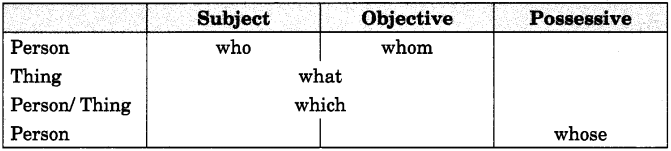
Study the chart to find out how the interrogative pronouns are used.
Pronoun Exercises for Class 8 CBSE With Answers Q3.1

Who is attending the conference on Friday?
Who has made these beautiful paintings?
Whom are you writing to?
Of whom are you speaking?
What is the colour of a flamingo?
Which of these books do you want?
Which is your favourite city?
I have found a pen. Whose is it?

Reflexive Pronouns
We use reflexive pronouns when the subject and the object of a sentence or a clause is the same.

The reflexive pronouns end in -self (singular)
or -selves (plural). I saw myself in the mirror.
Why do you blame yourself? The cat licked itself clean.
Jaya sent herself a copy of the email.
The candidate gave a glowing account of himself.
We can take care of ourselves.
I cannot believe you did all the work yourselves.
The children gave themselves a round of applause.

Emphatic pronouns
Emphatic pronouns have the same form as reflexive pronouns but they do not function as the object of a sentence or a clause. Instead they are used to emphasise the subject.

I made the dolls’ house myself.
Did you read the document yourself?
The locality wasn’t bad but the house itself was awful.
He recommended the book though he hadn’t read it himself.
She spoke to me herself. (Or, she herself spoke to me.)
We did all the works ourselves.
You yourselves wanted to attend the programme.
The organisation themselves offered to help the refugees.

Relative Pronouns
A relative pronoun introduces a relative (or adjective) clause. It refers back to the subject in the main clause.

The relative pronoun are who, whom, that, which, whoever, whomever.
The person who called me last evening is your teacher.
The lady whom you were talking to is the CEO of my company.
The boy whose arm is broken is my friend.
The building that the corporation wants to demolish is not occupied.
The police inspected the car which had been smashed in the accident.
Please deliver to parcel to whoever is at home.
Whomever he met, he made friends with.

Indefinite Pronouns
An indefinite pronoun does not refer to any specific person, animal or thing.

Some commonly used indefinite pronouns are another, any, one, none, anybody/anyone, everybody, everyone, nobody/ no one, somebody/someone, anything, everything, nothing, something, both, some, many and others are used as plural indefinite pronouns.

Indefinite pronouns are usually singular.
A singular indefinite pronoun takes a singular verb, and any personal pronoun used in the sentence to refer the indefinite pronoun must agree with it in number.
Nobody came to see our play. It was rather sad.
She looked in the container for some flour, but there was none.
Everybody is going home for the holidays except me.
The thieves took everything in the electronics shop.

Distributive Pronouns
Distributive pronouns refer to persons or things individually in a pair or in a group.

Each refer to individuals in a group:
Either and neither refer to individuals in a pair.
A distributive pronoun is always singular and should be followed by a singular noun and verb.
There mere fifty participants. Each was given a certificate.
They are professional tennis players. Each has his own trainer.
Tina and you have won the award jointly.
Either can accept the award.

Pronoun Exercises Solved Examples for Class 8 CBSE

Question 1.
Correct the following sentences:
(i) Which are you playing with?
(ii) Where do you want to see?
(iii) Whose did you talk to?
(iv) What book did you borrow, this or that.
(v) Which is wrong with you.
(vi) Who did you like to drink?
(vii) What is your dress maker?
(viii) Who skirt are you wearing?
(ix) Who makes tea sweet?
(x) Who did you talk?
(xi) What is she looking?
(xii) What do you take care?
(xiii) Whom was he running?
(xiv) What do you work?
(xv) What do you want to sit?
(xvi) What book is yours, this or that?
(xvii) What do you want to play?
(xviii) He gave his book his wife.
(xix) What is your carpenter?
(xx) Who do you find in this picture?
Answer:
(i) what
(ii) what
(iii) who
(iv) which
(v) what
(vi) what
(vii) who
(viii) which
(ix) what
(x) talk to
(xi) looking at,
(xii) care of
(xiii) running after
(xiv) work with
(xv) sit on
(xvi) which
(xvii) play with
(xviii) to his
(xix) who
(xx) what

Question 2.
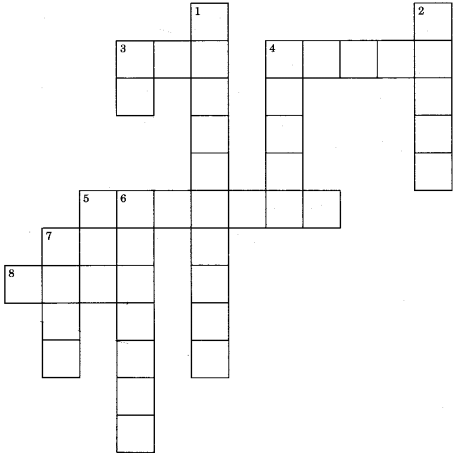
Complete the crossword below.
Pronoun Exercises for Class 8 CBSE With Answers Q4.1
Across
3. The person ___________ called me last Evening is your teacher.
4. The Police inspected the car ___________ had been smashed in the accident.
5. Please deliver the parcel to ___________ is at home.
8. The lady ___________ you were talking to is the CEO of the company:

Down
1. You are making a fool of ___________.
2. These Bags are made of cloth ___________ are made of leather.
3. ___________ are in class seven.
4. The boy ___________ arm is broken is my friend.
6. He ___________ wanted to buy this game.
7. The building ___________ the corporation wants to demolish is not occupied.
Answer:
1. whom
2. who
3. whose
4. that
5. which
6. whenever
7. yourselves
8. himself
9. we
10. These

Pronoun Exercises Practice Examples for Class 8 CBSE

Question 1.
Fill in the blanks with appropriate personal pronouns to complete the passage.
Every afternoon, as ___________ were coming from school, the children used to go and play in the Giant’s garden.

___________ were coming Iron was a large lovely garden, with soft green grass. Here and there over the grass stood beautiful flowers like stars, and there were twelve peach-trees that in the spring-time broke out into dedicate blossoms of pink and in the autumn bore rich fruit. The birds sat on the trees and sang so sweetly that the children used to stop their games in order to listen to ___________ are here!” ___________ cried to each other.

One day the Giant came back. ___________ had been to visit his friend the Cornish ogre, and had stayed with ___________ for seven years. After the seven years were over ___________ had said all that he had to say, and ___________ determined to return to his own castle. When ___________ arrived he saw the children playing in the garden.

“What ___________ you doing here?” ___________ cried in a very gruff voice, and the children ran away. “My own garden is for ___________ alone,“ said the Giant; canyone can understand that, and ___________ will allow nobody to play in ___________ but myself.” So ___________ built a high wall all round and put up a notice ___________ board: Trespassers will be prosecuted.

Question 2.
Identify the type of pronoun
(i) We are going on vacation.
(ii) Don’t tell me that you can’t go with us.
(iii) Anybody who says it won’t be fun has no clue what they are talking about.
(iv) These are terribly steep stairs.
(v) We ran into each other at the mall.
(vi) I’m not sure which is worse: rain or snow.
(vii) It is one of the nicest Italian restaurants in town.
(viii) Richard stared at himself in the mirror.
(ix) The laundry isn’t going to do itself.
(x) Someone spilled orange juice all over the countertop!

Story Writing Class 10 Format, Examples, Topics, Exercises

Story Writing Class 10

Story writing is an art. It is the oldest form of written composition. It is a work of imagination that is written in easily understandable grammatical structure. a short story is meant to be read in a single sitting and therefore it should be as direct and brief as possible.

This grammar section explains English Grammar in a clear and simple way. There are example sentences to show how the language is used. NCERT Solutions for Class 10 English will help you to write better answers in your Class 10 exams. Because the Solutions are solved by subject matter experts.

Story Writing Class 10 Format, Examples, Topics, Exercises

A short story is a fictional work of prose that is much shorter in length than a novel. Edgar Allan Poe, in his essay ‘The Philosophy of Composition,’ said that a short story should be read in one sitting.

A short story usually focuses on one plot, one main character (with a few additional minor characters), and one central theme (whereas a novel can tackle multiple plots and themes, with a variety of prominent characters). Short stories contain underlying themes or motifs that teach students to draw broader conclusions from the material and encourage them to think on a wider level about interconnected issues and themes that run throughout the material?

Story Writing Solved Examples With Answers For Class 10 CBSE

Question 1.
Write a short story with the help of the following outline:

Tortoise and hare – good friends – tortoise – known for his slow speed – hare has fast speed – makes fun of tortoise – challenges him – referee selected – race starts – hare overconfident – takes a nap – tortoise wins.

Answer:
Once there lived a tortoise and a hare in a forest. They were good friends. The tortoise was known for his slow speed. The hare was proud of his speed and he often made fun of the tortoise’s slow speed.

One day the tortoise challenged the hare to a race. The hare agreed and a horse was selected as the referee. The race started and the overconfident hare ran fast and attained a lead in the initial stage. The hare now felt like taking a short nap as he believed that he could overtake the slow tortoise any time and reach the target. The hare slept. When the hare woke up he realized that he had overslept.

He began to run fast to overtake the tortoise who slowly and steadily was reaching the target. The tortoise reached the target before the hare could do so and won the race. The moral of the story: ‘Slow and steady wins the race.

Question 2.
Write a short story based on the following outline:

two cats – hungry – a loaf of bread – can’t divide – each greedy – wants more – a clever monkey – offered to help – bit by bit – rate the bread – his fee – bread finished – cats foolish – still hungry.

Answer:

Equal Share

Once upon a time there lived two cats in a village. One day they were hungry; they searched for food but could not find anything to eat. Soon they spotted a loaf of bread on the road. Each of them was greedy and wanted to eat the bigger portion of the bread leaving the smaller portion to the other. They were arguing as to who should get the bigger share of the bread. A monkey who was passing by was amused when he heard the two cats fighting with each other. He was clever. He offered to help the cats solve their problem and the cats also agreed to it. He bit a small portion of the bread and ate it. He then bit a portion of the larger portion to equalize it. He kept on repeating this act till only a small portion was left behind. He ate that piece also saying that it was his fees. The two cats stood dumbstruck having realized their folly and remained hungry that day.

Question 3.
You are Jyoti/Jaydeep. Your younger brother was badly hurt on the evening of Diwali and had to be hospitalized. Narrate your experience in the form of a story, with an appropriate title.
Answer:

Diwali Evening Fiasco

Diwali is a festival of lights. Diwali evening glitters the autumn with delights of young children. It brings joys and happiness with the blessings of Goodess Lakshmi. Children burst crackers on this day. Elders also keep themselves busy to decorate their houses for Diwali celebration. My younger brother Jaydeep’s joy knew no bounds on the evening of Diwali last October. Diwali is a festival of lights. Children burst crackers on this day. So, Jaydeep bought a lot of crackers. Many friends came to meet him. Everybody asked him to accompany them. He said, “I am waiting for Tiku and Monu. They will bring two baskets full of crackers. We will enjoy bursting crackers on the Diwali evening in our parlour.”

Tiku and Monu reached in time with two big baskets full of crackers. Some crazy boys were bursting chemical bomb–crackers. They started bursting bomb–crackers incessantly. The atmosphere got so much smoky that nothing was visible. Suddenly, one cried loudly, “I can’t see anything, I am almost blind, Who’s there? Save me, save me,” Tiku and Monu found it’s my brother terribly injured. They informed me instantly. I took him by an ambulance to the emergency department in the nearest hospital. The hospital authorities were very cooperative. They admitted my brother then and there. My brother’s life was saved, but Jaydeep lost his one eye for ever.

Question 4.
Complete the following story. Give a suitable title to the story. [Delhi 2019)

Bunya was a foolish boy, who liked to be given plenty of attention and was always seeking it. He was a woodcutter and would go deep into the jungle to cut trees. One day he wanted to do an act of mischief. He shouted at the top of his voice, “There’s a tiger, there’s a tiger.”………………………………………………………………………………………………………………………………………………………………………………………….

Answer:

A Foolish Woodcutter Boy

Once there lived a poor woodcutter boy, named Bunya, near a wood. He lost his father in his childhood. As he was foolish enough to do his duty, so he liked to be given plenty of attention as to perform his duties. As he was an orphan he was always at his wits’ end and did foolish things. He was a woodcutter and would go deep into the jungle to cut trees. One day he wanted to do a mischief. He shouted at the top of his voice, “There’s a tiger, there’s a tiger.” Many villagers came rushing to his aid. But on reaching they found Bunya laughing at how easily they got duped.

It amused Bunya very much and he repeated his act. The villagers once again turned up to his aid but found out that Bunya was joking again. The villagers got irritated and vowed never to be made fun of by Bunya again. After a few days Bunya was cutting woods when he saw a tiger. He screamed and screamed for help but no one turned up for his help. Everybody thought that he was trying to fool them again but when Bunya’s mother raised the alarm that it was 8 at night and he hadn’t returned, they set out in his search only to find Bunya’s bones. The tiger roared, “Never tell a lie”.

Question 5.
Complete the following story. Some lines are given to help you start.

Lala, the grocer, was very greedy. He would mix stones in pulses and coloured sand in spices and sell them to the poor villagers. The villagers complained to him but he turned a deaf ear as his was the only grocery store in the village. …………………. …………………………………………………………………………………………………………………………………………………………………………………………………………………………………

Answer:

Greedy Grocer

There lived a greedy grocer in Lalarampura village in Madhya Pradesh. His name was Lala Prasad. In the whole village it was the only grocery shop. So, poor villagers had to buy all the daily necessaries such as pulses, spices, rice, etc. from his shop. But Lala was a dishonest grocer. He would mix stones in pulses and rice, and coloured sand in spices and sell them with unfair prices to the poor villagers. The poor villagers lived from hand to mouth. All the villagers complained to him but he turned a deaf ear to their pleas. The villagers decided to take action against him and complained to the village panchayat.

The panchayat asked him to serve good quality items to the people which he did for a few days but soon fell back to his old ways. One day his son fell very ill and he was compelled to go to the next village to buy medicine. He brought medicine from the next village unaware that the man who sold the medicine was just as dishonest. He gave his son the medicine and found him getting worse. All the villagers prayed for the young boy and one of the villagers telegrammed his brother in town for the required medicine.

His son soon recovered and Lala learnt that the medicine was tampered with by the seller. He understood the gravity of his sin and vowed to be honest from then on.

Question 6.
Complete the following story. Some lines are given to help you start.

Suraj was a very foolish man. He had no common sense and was often seen doing the silliest of things. He earned his livelihood by cutting wood.

Answer:

A Great Fool’s foolishness

Once there lived a young woodcutter on the outskirts of a forest. His name was Suraj Gandiv. The villagers, dearly called him Suraj. He earned his living by cutting wood from the nearest forest. He had no common sense. He was often involved in doing the silliest of things. He earned his livelihood by cutting wood. He cut wood from the nearby forest and was often tired of carrying it from the forest to the village. So he decided to cut the banyan tree at the edge of the forest. He wanted to save money so that he could get married to his beloved Chanda.

Lost in dreams, he began to cut the tree. He cut all the branches of the tree save one, the one on whose edge he was sitting. So he decided to cut off the last branch too and merrily began sawing the branch. He thought the villagers were jealous of him. So when he had given the final blow to the branch he fell down and broke his ribs. His marriage was postponed by a year. After his recovery, during this time he worked very hard and amassed a lot of money. The next year all the villagers attended his wedding. Suraj is no more foolish after that mishap.

Question 7.
Complete the following story. Some lines are given to help you start.

Mr. Shah lived in a posh residential complex. The residential complex had a huge tree at the centre of it. It was a peepal tree. The residents hung swings on it, fed the birds and the squirrels that resided in it. One day a builder decided to chop it off and build a swimming pool in its place. The residents protested but the builder convinced them that the swimming pool would look better. Only Mr. Shah was not convinced ………………………………………………………………………………………………………………………………………………………….

Answer:
Mr. Shah lived in a posh residential complex. The residential complex had a huge tree at the centre of it. It was a tall peepal tree. The residents hung and swings on it, fed the birds and squirrels that resided in it. One day a builder decided to chop it off and build a swimming pool in its place. The residents protested but the builder convinced them that the swimming pool would look better. Only Mr. Shah was not convinced because he was a great lover of trees and supported biological diversity.

ched to the tree for its branches reached his window and many a happy time he spent watching the creatures that resided on it. He prayed that something should happen to prevent chopped off. Just at the moment he heard a scream from his neighbour’s daughter Sweety, he rushed to his window to see her caught between the branches. Sweety was soon rescued and was declared to be in a safe condition with a few minor wounds.

Sweety had slipped through the railing and if it wasn’t for the tree she would have died, Sweety’s dad was the builder himself and decided not to chop off the tree anymore. Mr. Shah thanked God for listening to his prayers and also prayed to all “Save Trees, Save Lives.”

Question 8.
Complete the following story. Some lines are given to help you start.

Last week I went to market on bicycle to buy some books. I placed my bicycle outside the shop.

Answer:
Last week I went to market to buy some books on my bicycle. I placed the bicycle outside the shop. I asked for the spices mother had wanted, paid for them and turned back. To my surprise a squirrel was sitting gaily on the seat of my bicycle. I stood quietly for five minutes, watching the squirrel. It was very amusing to watch the squirrel trying to bite its tail; it soon sensed my presence and looked up to find me staring at it.

I took out a carrot from the shopping bag I had in my hand and offered it to the squirrel that started nibbling it immediately. It did not scamper away but to my utmost surprise jumped on to my shoulders. I felt proud that it chose me as a friend and resolved to keep it as a pet. But I forgot it was somebody’s pet. Just as I sat on the bicycle the shopkeeper came outside his shop looking for some Tony which was the pet’s nick name.

The squirrel jumped from my shoulders to the shopkeeper who fondly patted him and remarked that Tony had kept him company for three years and it was one of the members of his family. I was very disappointed at the prospect of losing Tony but was happy that Tony had a very loving and kind master.

Question 9.
Complete the following story. Some lines are given to help you start.

Yesterday I was going to school. On the way I saw a child in the middle of the road. A car was coming at full speed. …………………..
…………………………………………………………………………………………………………………………………………………………………………………………………………………………………..

Answer:
Yesterday I was going to school. On the way I saw a child in the middle of the road. A car was coming at full speed. I was screaming to the top of my voice. The traffic police noticed it too and signalled the car to stop. The car halted with a screech and a lady darted towards the child and picked her up in her arms. The lady looked very relieved. She went up to the traffic police and thanked him for saving her baby’s life.

The traffic police repeatedly warned the lady not to bring the child when she went for shopping. Particularly, women these days are crazy to bring their children while going for shopping. She narrated the traffic police that while she was busy buying vegetables, the child had slipped away unnoticed. She had been looking for the child frantically then suddenly she spotted him in the middle of the road.

The traffic police reproached her for her carelessness and asked her to be more cautious in future. She should be aware of the traffic rules and act accordingly. For her part, it is an unpardonable offence to harass the police in the context of losing a child, though she may be a parent. She promised that she would never let the child out of her sight whenever she was out of house.

Question 10.
Complete the following story. Some lines are given to help you start.

Once there was an old man. He had four sons. They always quarrelled with one another. ………………………………………………………………
……………………………………………………………………………………………………………………………………………………………………………………………………………………………..

Answer:
Once there was an old man. He had four grown–up sons. They always quarrelled with one another and vehement. Despite coaxing and pleading, the four brothers refused to reform and be cordial with each other. The quarrels turned serious when the brothers threatened to kill one another. The father was at a loss and decided to teach them a lesson. He purchased a bear. He showered the creature with love and provided a trainer who taught the bear to dance.

The sons were surprised, perplexed and became jealous of the bear. They were planning how they could drive away the animal. They decided to kill the bear, but could not agree on a single plan of action. While one felt that the bear should be poisoned, the other wanted the bear driven out. A third wanted to leave him in the zoo, and the fourth wanted to kill the trainer. A huge quarrel broke out. On learning what his sons were planning, the father was aghast.

He told them that it was a cruel act to kill a pet animal. He was about to send for the police to arrest them for cruelty to animals when the sons realized their stupidity. They were repentant and begged to be pardoned. After extracting a promise of good behaviour and brotherly affection, the father forgave them. The family came together once again.

Question 11.
Complete the following story. Some lines are given to help you start.

One day a dog found a piece of meat. He reached the bank of the river. ………………………………………………………………………………….
……………………………………………………………………………………………………………………………………………………………………………………………………………………

Answer:
One day a dog found a piece of meat. He joyfully reached the bank of the river. He knew that the other dogs in the neighborhood were keen to have a slice of the meal but he was in no mood to