Class 7 Geography Chapter 10 Extra Questions and Answers Life in the Deserts

Life in the Deserts Class 7 Geography Chapter 10 Extra Questions and Answers Social Science CBSE Pdf free download are part of Extra Questions for Class 7 Social Science. Here we have given NCERT Extra Questions for Class 7 Social Science SST Geography Chapter 10 Life in the Deserts.

You can also practice NCERT Solutions for Class 7 Geography Chapter 10 Questions and Answers on LearnInsta.com.

Class 7 Geography Chapter 10 Extra Questions and Answers Life in the Deserts

Life in the Deserts Class 7 Extra Questions and Answer Geography Chapter 10 Very Short Answers Type

Question 1.
Which is the essential component for habitation?
Answer:
Water is an essential component of life. It is very difficult to live on the places where there is no water.

Question 2.
Name the world’s largest desert.
Answer:
Sahara is the world’s largest desert.

Question 3.
Where is Sahara desert located?
Answer:
Sahara desert covers a large part of North Africa.

Question 4.
What area is covered by the Sahara desert?
Answer:
It has an area of around 8.54 million s km.

Question 5.
How many countries are touched by the Sahara desert? Mention there names.
Answer:
The Sahara desert touches 11 countries. These are Algeria, Chad, Egypt, Libya, Mali, Mauritania, Morocco, Niger, Sudan, Tunisia and Western Sahara.

Question 6.
Name the vegetation found in the Sahara desert.
Answer:
Cactus, date palms and acacia etc., are vegetation found in the Sahara desert. In some places there are oasis-green islands with date palms surrounding them.

Question 7.
Name the animals found in the Sahara desert.
Answer:
Camels, hyenas, jackals, foxes, scorpions, many varieties of snakes and lizards are the prominent animal species living there.

Question 8.
Name the nomadic tribes living in the Sahara desert.
Answer:
The Bedounis and Tuaregs are nomadic tribes live in the Sahara desert.

Question 9.
Name the places where settled population is found.
Answer:
The oasis in the Sahara and the Nile Valley in Egypt supports settled population.

Question 10.
What is grown by the people of Sahara desert?
Answer:
The people grow date palms, rice, wheat, barley and beans and Egyptian cotton which is famous worldwide.

Question 11.
Name the minerals found in the Sahara desert.
Answer:
In the Sahara desert oil, iron, phosphorus, manganese and uranium are found.

Question 12.
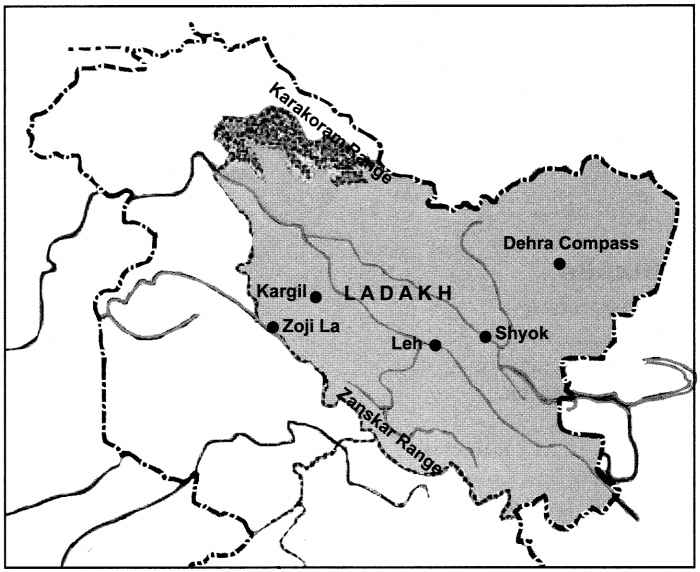
Name the capital of Ladakh.
Answer:
Leh is the capital of Ladakh.

Life in the Deserts Class 7 Extra Questions and Answer Geography Chapter 10 Short Answers Type

Question 1.
Which areas are called desert?
Answer:
Some places are very hot as fire while some are very cold as ice. These are the desert areas of the world. Depending on the temperatures, these may be hot desert or cold deserts.

Question 2.
What is found besides the vast stretches of sands in the Sahara desert?
Answer:
Besides the vast stretches of sands, there are also gravel plains and elevated plateaus with bare rocky surface. These rocky surfaces may be more than 2500m high at some places.

Question 3.
Describe the climate of the Sahara desert.
Answer:
The climate of the Sahara desert is scorching hot and parch dry. It has a short rainy season. Days are unbelievable hot, it may be as high as 50°C while nights may be freezing cold with temperatures nearing 0°C.

Life in the Deserts Class 7 Extra Questions and Answer Geography Chapter 10 Long Answers Type

Question 1.
Write a short note on Sahara desert.
Answer:
Sahara is the world’s largest desert. Sahara desert covers a large part of North Africa. It has an area of around 8.54 million s km. The Sahara desert touches 11 countries. These are Algeria, Chad, Egypt, Libya, Mali, Mauritania, Morocco, Niger, Sudan, Tunisia and Western Sahara. Besides the vast stretches of sands, there are also gravel plains and elevated plateaus with bare rocky surface. These rocky surfaces may be more than 2500 m high at some places.

The climate of the Sahara desert is scorching hot and parch dry. It has a short rainy season. Days are unbelievable hot, it may be as high as 50°C while nights may be freezing cold with temperatures nearing 0°C. Cactus, date palms and acacia etc., are vegetation found in the Sahara desert.

In some places there are oasis-green islands with date palms surrounding them. Camels, hyenas, jackals, foxes, scorpions, many varieties of snakes and lizards are the prominent animal species living there.

Question 2.
Write a short note on cold desert of Ladakh.
Answer:
Ladakh is a cold desert lying in the Great Himalayas, on the eastern side of Jammu and Kashmir. The Karakoram Range in the north and the Zanskar mountains in the south enclose it. River Indus and Gangri glacier are found in Ladakh.

The altitude (height) in Ladakh varies from about 3000 m in Kargil to more than 8,000 m in the Karakoram. Due to its high altitude, the climate is extremely cold and dry. The day temperatures in summer are just above 0°C and the night temperatures well below -30°C. There is little rainfall, as low as 10 cm every year.

Question 3.
Describe about the vegetation and animals found in Ladakh.
Answer:
Due to high aridity in Ladakh, the vegetation is sparse. There are scanty patches of grasses and shrubs for animals to graze. Groves of willows and poplars are seen in the valleys. Fruit trees such as apples, apricots and walnuts are found during the summers. Robins, redstarts, Tibetan snow-cock, raven and hoopoe are found commonly.

The animals of Ladakh are wild goats, wild sheep, yak and special kinds of dogs. Yak’s milk is used to make cheese and butter. The hair of the sheep and goat is used to make woolens. In the summer season the people are busy cultivating barley, potatoes, peas, beans and turnip.

Picture Based Questions Class 7 Geography Chapter 10 Life in the Deserts

Question 1.
On an outline map of India, show Ladakh desert.
Answer:
Class 7 Geography Chapter 10 Extra Questions and Answers Life in the Deserts

Class 7 Civics Chapter 8 Extra Questions and Answers A Shirt in the Market

A Shirt in the Market Class 7 Civics Chapter 8 Extra Questions and Answers Social Science CBSE Pdf free download are part of Extra Questions for Class 7 Social Science. Here we have given NCERT Extra Questions for Class 7 Social Science SST Civics Chapter 8 A Shirt in the Market.

You can also practice NCERT Solutions for Class 7 Civics Chapter 8 Questions and Answers on LearnInsta.com.

Class 7 Civics Chapter 8 Extra Questions and Answers A Shirt in the Market

A Shirt in the Market Class 7 Extra Questions and Answer Civics Chapter 8 Very Short Answers Type

Question 1.
Who was Swapna?
Answer:
Swapna was a small farmer in Kumool, Andhra Pradesh who grows cotton on her small piece of land. She supplied cotton to the trader.

Question 2.
Why did Swapna take loan from the local trader?
Answer:
Swapna took loan from the local trader for seeds, fertilizers and pesticides.

Question 3.
How much time is consumed in growing cotton?
Answer:
It takes four months to grow the cotton.

Question 4.
What inputs are required in cultivation of cotton?
Answer:
Cultivation of cotton requires high levels of inputs as fertilizers and pesticides and the farmers have to incur heavy expenses on account of these.

Question 5.
Why do traders pay cotton growers a low price?
Answer:
Cotton growers take loans from traders for growing the cotton. They have to sell the finished material to such traders. Therefore, traders pay cotton growers a low price.

Question 6.
Describe about Erode’s bi-weekly cloth market.
Answer:
Erode’s bi-weekly cloth market in Tamil Nadu is one of the largest cloth markets in the world. A large variety of cloth is sold in this market. Clothes are made by weavers in the villages around and also brought here for sale.

Question 7.
In what respects is the cotton trader a powerful man in the village?
Answer:
Traders supply loan to peasants and take all the cotton for further sale.

Question 8.
What does a merchant do with the prepared cloth?
Answer:
At the cloth market, the merchants sell the cloth to the garment factories. In this way, the market works more in favour of the merchants.

Question 9.
What are the items produced in the looms?
Answer:
A variety of sarees, towels, shirts, ladies dress material and bed-sheets are produced in these looms.

Question 10.
What is a ginning mill?
Answer:
It is a factory where seeds are removed from cotton bolls. The cotton is pressed into bales to be sent for spinning into thread.

Question 11.
Who is an exporter?
Answer:
A person who sells goods abroad is an exporter.

A Shirt in the Market Class 7 Extra Questions and Answer Civics Chapter 8 Short Answers Type

Question 1.
How do the merchants prepare clothes?
Answer:
Weavers bring cloth that has been made on order from the merchant. These merchants supply cloth on order to garment manufacturers and exporters around country. They purchase the yam and give instructions to the weavers about the kind of cloth that is to be made. Weavers get the yam from the merchants and supply them the cloth.

Question 2.
What are the advantages to the weavers when they work with merchants?
Answer:
This arrangement has two advantages. The weavers do not have to spend their money on purchase of yam. Secondly, the weavers know from the outset what cloth they should make and how much of it is to be woven.

Question 3.
How are the weavers in the grip of the local trader?
Answer:
Weavers are required to invest a lot of money to buy looms. The weavers invest their savings or borrow money at high-interest rates. One loom cost is around 20,000/- and they require atleast two looms. These looms cannot be operated alone and hence their family members work together. They earn about 3,500/¬per month. Thus the weavers are always in the grip of the local trader.

Question 4.
What do you understand about putting-out system?
Answer:
In the putting-out system the merchant supplies the raw material and receives the finished product. It is prevalent in the weaving industry in most regions of India. Weavers are paid very little by the merchant under the putting-out system.

Question 5.
Describe in brief the status of workers working in factory?
Answer:
In the garment factory many workers work. Most of these workers are employed on a temporary basis. Whenever, the employer feels that a worker is not needed, the worker can be asked to leave. Workers’ wages are fixed according to their skills. In most of the cases women are employed as helpers for thread cutting, buttoning, ironing and packaging. These jobs have the lowest wages.

A Shirt in the Market Class 7 Extra Questions and Answer Civics Chapter 8 Long Answers Type

Question 1.
Describe the role of weaver’s cooperatives to reduce the dependence on the merchant.
Answer:
Weaver’s cooperatives are one way to reduce the dependence on the merchant and to earn a higher income for the weavers. In a cooperative, people with common interests come together and work for their mutual benefit.

In a weaver’s cooperative, the weavers form a group and take up certain activities collectively. They produce yarn from the yam dealer and distribute it among the weavers. The cooperative also does the marketing. So, the role of the merchant is reduced, and weavers get a fair price on the cloth.

Class 6 Civics Chapter 2 Extra Questions and Answers Diversity and Discrimination

Diversity and Discrimination Class 6 Civics Chapter 2 Extra Questions and Answers Social Science CBSE Pdf free download are part of Extra Questions for Class 6 Social Science. Here we have given NCERT Extra Questions for Class 6 Social Science SST Civics Chapter 2 Diversity and Discrimination.

You can also practice NCERT Solutions for Class 6 Civics Chapter 2 Questions and Answers on LearnInsta.com.

Class 6 Civics Chapter 2 Extra Questions and Answers Diversity and Discrimination

Diversity and Discrimination Class 6 Extra Questions and Answer Civics Chapter 2 Very Short Answers Type

Question 1.
What is influenced by geography and history?
Answer:
The language, food, clothing etc., all of these are influenced both by the geography and history.

Question 2.
How many languages are spoken in the world?
Answer:
More than 16000 languages are spoken in the world.

Question 3.
How many major religions are there in the world?
Answer:
There are 8 major religions in the world.

Question 4.
How many dance forms are there in the world?
Answer:
More than 100 dance forms are in the world.

Question 5.
What is the reason for discrimination?
Answer:
Discrimination can take place because of several reasons such as religion, caste, work, language, region, status, culture, country etc.

Question 6.
How many people live in villages?
Answer:
More than 50% of all Indians live in villages.

Question 7.
What is meant by Dalit?
Answer:
Dalit means those who have been broken. The government refers to this group of people as Scheduled Castes (SC).

Question 8.
Who is the father of the Indian Constitution?
Answer:
Dr Bhim Rao Ambedkar is considered the father of the Indian Constitution.

Question 9.
Name the best known leader of the Dalit.
Answer:
The best known leader of the Dalits is Dr Ambedkar who fought for the rights of the Dalit community.

Question 10.
Who fought against inequalities?
Answer:
Dalits, women, tribal and peasants fought against the inequalities alongwith from the British rule.

Diversity and Discrimination Class 6 Extra Questions and Answer Civics Chapter 2 Short Answers Type

Question 1.
What do we feel for the people who look like us?
Answer:
We feel safe and secure with people who look, talk, dress and think like us. People also form certain attitudes and opinions about others who are not like them.

Question 2.
What is Prejudice? Describe the term prejudice.
Answer:
To judge other people negatively or see them as inferior is prejudice. We can be prejudiced about many things: people’s religious beliefs, the colour of their skin, the region they come from, the accent they speak in, the clothes they wear etc. Sometimes our prejudice about others is so strong that we don’t want to associate with them, even act in ways that hurt them. Discrimination happens when people act on their prejudices or stereotypes.

Question 3.
What do you understand about Stereotype?
Answer:
When we fix people into one image, we create a stereotype. When people say that those who belong to a particular country, religion, sex, race or economic background are stingy, lazy, and criminal or brave, they are using stereotypes. Many times, discrimination happens on the ground of prejudices or stereotypes.

Question 4.
Describe about the city life.
Answer:
City life can be summarized as follows:

  • City life is very easy. People of cities enjoy good roads, transport, electricity, schools, health facilities etc.
  • Most of the people of city are working. They have their own business or working in the offices.
  • Smooth development occurred in cities because government offices and business hubs are situated there.
  • In many families, women also join the job.
  • They spend more time at the workplace and thus, spend very little time with family members.

Question 5.
What did Dalits peasants and tribals fight for?
Answer:
Many Dalits organized themselves to gain entry into temples, women demanded for right to education, peasants and tribals fought to release themselves from the grasp of the moneylenders.

Question 6.
What was important vision set out in the Constitution of India?
Answer:
Our leaders set out a vision and goals in the constitution to ensure that all the people of India are considered equal. This is seen as key value that unites us all as Indians.

Diversity and Discrimination Class 6 Extra Questions and Answer Civics Chapter 2 Long Answers Type

Question 1.
What is a common stereotype in Muslims girls about the education? Discuss.
Answer:
A common stereotype about Muslims is that they are not interested in educating girls and therefore do not send girls to school.

Whereas, studies have now shown that poverty amongst Muslims is an important reason for dropping out of school. It is very difficult for the poor people that they spend money on the girl child when they are struggling for the fulfillment of their basic needs. Efforts should be made to reach education upto the poor families irrespective of their belief.

There are many Muslim families who have shown their interest in sending girls to school. Therefore, a common stereotype thinking that Muslims do not show interest in taking education, is not an absolute fact.

Question 2.
Give the features of rural people.
Answer:
Rural population is a huge population in India and there is much more diversity between the villages situated one edge to another edge. Their costumes, traditions, living habits, behavior are varied; although features of rural people can be summarized as under:

  1. They are often laborious and gentle;
  2. Life of the rural areas is not easy. Many villages of India are still suffering from the scarcity of drinking water, electricity, roads, transport, health, education facilities etc.
  3. They care a little bit about their health;
  4. Most of the people of villages are backward and are depending on agriculture for their livelihood.
  5. Most of them are not educated or they are little bit educated;
  6. In many cases, women are also working in the fields.
  7. Rural families spend 12 to 14 hours in the fields in peak harvesting and plantation season.

Class 6 Geography Chapter 3 Extra Questions and Answers Motions of the Earth

Motions of the Earth Class 6 Geography Chapter 3 Extra Questions and Answers Social Science CBSE Pdf free download are part of Extra Questions for Class 6 Social Science. Here we have given NCERT Extra Questions for Class 6 Social Science SST Geography Chapter 3 Motions of the Earth.

You can also practice NCERT Solutions for Class 6 Geography Chapter 3 Questions and Answers on LearnInsta.com.

Class 6 Geography Chapter 3 Extra Questions and Answers Motions of the Earth

Motions of the Earth Class 6 Extra Questions and Answer Geography Chapter 3 Very Short Answers Type

Question 1.
State the number of motions of the Earth.
Answer:
The Earth has two types of motions.

Question 2.
Name of motions of the Earth.
Answer:
These are rotation and revolution.

Question 3.
What do you mean by rotation of the Earth?
Answer:
Rotation is the movement of the Earth on its axis.

Question 4.
How many hours are taken by Earth to complete one rotation?
Answer:
It takes about 24 hours to complete one rotation.

Question 5.
On which imaginary point does the Earth rotate?
Answer:
On its axis.

Question 6.
What is resulted by the rotation on axis by the Earth?
Answer:
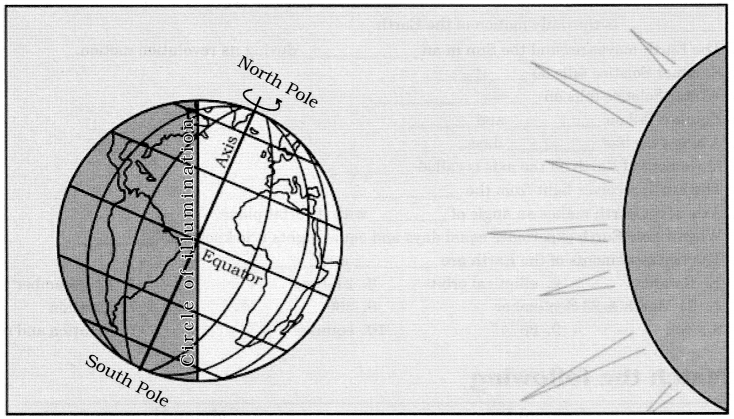
Due to the rotation of axis, day and night are formed.

Question 7.
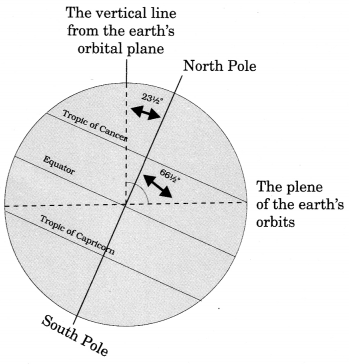
What angle does axis of the Earth make with its orbital plane?
Answer:
The axis of the Earth makes an angle of 66 1/2° with its orbit plane.

Question 8.
What do you mean by revolution of the Earth?
Answer:
Revolution is movement of the Earth around the Sim in a fixed path or orbit.

Question 9.
How much time is taken to complete the cycle in revolution?
Answer:
It takes 365 1/4 days (one year) to complete it.

Question 10.
What results occur due to the revolution movement?
Answer:
Due to the revolution movement, seasons are changed.

Question 11.
Who gives the light to the Earth?
Answer:
The Sun gives light to the Earth.

Question 12.
Why does only half portion of the Earth get light in a time?
Answer:
Due to the spherical shape of the Earth, it receives only half portion at a time.

Question 13.
What is circle of illumination?
Answer:
The circle that divides the day from night on the globe is called the ‘circle of illumination’.

Question 14.
What do you understand about the ‘Earth day’?
Answer:
The period of rotation is known as the ‘Earth day’

Question 15.
Give the names of seasons in a year.
Answer:
There are 4 seasons in a year – summer, winter, spring and autumn.

Question 16.
What do you understand about ‘equinox’?
Answer:
When the whole earth experiences equal day and night, the position is called ‘equinox’.

Question 17.
When does equinox fall?
Answer:
On 21 March and 23 September.

Question 18.
What do you mean about Summer Solstice?
Answer:
When the northern Hemisphere has the longest day and the shortest night it is called Summer Solstice. It occurs on 21 June.

Question 19.
What do you mean by Winter Solstice?
Answer:
When the southern Hemisphere has the longest day and the shortest night it is called Winter Solstice. It occurs on 22 December.

Motions of the Earth Class 6 Extra Questions and Answer Geography Chapter 3 Long Answers Type

Question 1.
How is a leap year formed?
Answer:
Actually, the Earth takes 365 Vi days to revolve around the Sun. It means 6 hours excess in every year and these 6 hours makes 1 day in 4 years. After every 4 years, 1 day is added in the month of February. Thus, every fourth year, February is of 29 days instead of 28 days. Such a year with 366 days is called a leap year.

Question 2.
What would happen if the Earth did not rotate?
Answer:
If the Earth stops to rotate, the portion of the Earth which is facing the Sun would always experience day and would be hot, while the other half would remain in darkness and be freezing cold all the time. Life would not have been possible in such extreme conditions of hot and cold.

Question 3.
Christmas in Australia is celebrated in the summer season. Explain.
Answer:
In all over the world, Christmas days is celebrated on 25 December in each year. Australia falls under southern hemisphere. In the month of December, the Tropic of Capricorn receives the direct rays of the Sun and the South Pole tilts towards it. Thus, it is summer in the Southern Hemisphere at this time and hence Australia celebrates Christmas in summer season.

Question 4.
How does leap year occur? Calculate.
Answer:
The year in which 1 day exceeds to the normal year’s 365 days. Thus, the year which has 366 days is called a leap year. The revolution movement takes 365 V4 days (one year and 6 hrs) to revolve around the Sun. These 6 hours saved every year and make 1 day in 4 years. This 1 day is added to the month of February. Thus, every fourth year, February is of 29 days instead of 28 days. Such a year with 366 days is called a leap year.

Picture Based Questions Class 6 Geography Chapter 3 Motions of the Earth

Study the picture and answer the question.

Question 1.
Indicate through picture: inclination of the Earth’s axis and the orbital plane
Answer:
Class 6 Geography Chapter 3 Extra Questions and Answers Motions of the Earth 1

Question 2.
Indicate through picture: day and night on the Earth due to rotation.
Answer:
Class 6 Geography Chapter 3 Extra Questions and Answers Motions of the Earth 2

Class 6 History Chapter 4 Extra Questions and Answers In the Earliest Cities

In the Earliest Cities Class 6 History Chapter 4 Extra Questions and Answers Social Science CBSE Pdf free download are part of Extra Questions for Class 6 Social Science. Here we have given NCERT Extra Questions for Class 6 Social Science SST History Chapter 4 In the Earliest Cities.

You can also practice NCERT Solutions for Class 6 History Chapter 4 Questions and Answers on LearnInsta.com.

Class 6 History Chapter 4 Extra Questions and Answers In the Earliest Cities

In the Earliest Cities Class 6 Extra Questions and Answer History Chapter 3 Very Short Answers Type

Question 1.
Where is Harappa situated in present-day?
Answer:
At Present, Harappa is situated in Pakistan.

Question 2.
When was the first time railway lines was laid down in Punjab?
Answer:
About 150 years ago.

Question 3.
What material was used for the making the walls of Harappa?
Answer:
Ready-made high-quality bricks were used in the walls of Harappa.

Question 4.
What did archaeologists realize about the Harappa?
Answer:
Archaeologists realized that Harappa is one of the oldest cities in the subcontinent.

Question 5.
When were Harappan cities developed?
Answer:
Harappan cities were developed about 4700 years ago.

Question 6.
Where were Harappan cities found, gives the names of places.
Answer:
Harappan cities were found in the Punjab and Sind in Pakistan, Gujarat, Rajasthan, Haryana and in Punjab (India).

Question 7.
In how many parts Harappan cities have been divided into?
Answer:
These have been divided into two or more parts.

Question 8.
What was the west part called?
Answer:
West part was known as “citadel”. This part was smaller but higher.

Question 9.
How was eastern part described?
Answer:
It was larger but lower.

Question 10.
What was used in the walls of cities?
Answer:
Baked bricks were used in the walls of the Harappan cities.

Question 11.
What was the pattern adopted in the use of bricks and why?
Answer:
In the use of bricks, interlocking pattern was adopted and because of interlocking pattern, the walls were strong.

Question 12.
In which city was the special tank (Great Bath) found?
Answer:
A special tank which is called the Great Bath was found in Mohenjodaro.

Question 13.
What was the use of tank found in Mohenjodaro?
Answer:
The tank found in Mohenjodaro was perhaps used by the important people and they took a dip on the special occasions.

Question 14.
Where were sacrifices performed?
Answer:
In Lothal and Kalibangan sacrifices may have been performed.

Question 15.
Where did we find elaborated storehouses?
Answer:
Some cities like Mohenjodaro, Harappa and Lothal had elaborate storehouses.

Question 16.
Who planned the Harappan cities?
Answer:
It was likely that rulers planned the city.

Question 17.
Why were people sent to distant places and who sent them?
Answer:
People were sent to distant places to get metal, precious stones and other things. Rulers sent them for their own purposes.

Question 18.
Rulers kept the most valuable objects. Give their names.
Answer:
Rulers have kept the most valuable objects such as ornaments of gold and silver or beautiful beads for themselves.

Question 19.
Who was ‘scribes’?
Answer:
The people who knew the writing and helped prepare the seals and likely wrote on other materials were known as ‘scribes’.

Question 20.
What did they made from bronze and copper?
Answer:
They made tools, weapons, vessels etc., from bronze and copper.

Question 21.
What was the use of gold and silver?
Answer:
Both were considered as precious metals and used to make ornaments and vessels.

Question 22.
What were the things that made the archaeologists surprised?
Answer:
In the Harappan cities, beads, weights and blades were found which surprised the archaeologists.

Question 23.
How were the Harappan pots?
Answer:
The pots were baked earthen with beautiful black designs.

Question 24.
How were the stone weights made of ?
Answer:
Stone weights were made of chert-a kind of stone.

Question 25.
What do you understand about ‘carnelian’?
Answer:
Carnelian was a beautiful stone and was used to make beads.

Question 26.
What was used to spin the thread?
Answer:
Spindle whorls were used to spin the thread.

Question 27.
What were the uses of Faience?
Answer:
Faience was used to make beads, bangles, earrings and small vessels etc.

Question 28.
What was the colour of faience?
Answer:
It was blue or sea green.

Question 29.
How was Faience made?
Answer:
Gum was used to shape sand or powdered quartz into an object.

Question 30.
What are raw materials?
Answer:
Raw materials are substances that are either found naturally or produced by farmers or herders.

Question 31.
From which state the Harappan brought copper?
Answer:
Present day Rajasthan.

Question 32.
Which states provided the Harappans with precious stones?
Answer:
Gujarat, Afghanistan and Iran (presently).

Question 33.
Where did the Harappans get gold from?
Answer:
Present-day Karnataka.

In the Earliest Cities Class 6 Extra Questions and Answer History Chapter 4 Short Answers Type

Question 1.
What unique objects were found in almost all the cities of Harappa by the archaeologists? Answer:
Archaeologists found unique objects in almost all the cities. They are:

  1. red pottery painted with designs in blacks
  2. stone weights,
  3. seals,
  4. special beads,
  5. copper tools and
  6. long stone blades.

Question 2.
How were houses planned in cities?
Answer:
Generally, houses were either one or two storeys high with rooms built around courtyard. Most houses had separate bathing area and some had wells to supply water and had covered drains.

Question 3.
What were the raw materials that made the things found in the Harappan cities?
Answer:
The things found in the Harappan cities were made up of:

  • Stone
  • Shell
  • Metal.

Question 4.
Give the name of metals found in the Harappan cities.
Answer:
Metals found in the Harappan cities were:

  1. Copper
  2. Bronze
  3. Gold and
  4. Silver

Question 5.
Where was Cotton grown? What were the evidences found by the archaeologists?
Answer:
Cotton was grown probably at Mehrgarh. Actual pieces of cloth were found attached to the lid of a silver vase and some copper objects at Mohenjodaro.

Question 6.
What was used in making the seals and what was found special in seals?
Answer:
The Harappans made seals on stone. These were generally rectangular and had usually an animal carved on them with a script in form of signs which are still not known exactly what they mean.

Question 7.
Who were called specialist?
Answer:
A person who is trained to do only one work such as cutting stone or polishing beads or carving seals.

Question 8.
Make a list of raw materials produced by the farmers.
Answer:
Farmers in our country are great producers of edible items:

  1. Sugar cane produced sugar and gur
  2. Tea leave produced tea
  3. Cotton produced thread
  4. Bamboo produced basket, furniture and many more household items of bamboo.
  5. Soya bean/Palm oil produced edible oil etc.
  6. Spices
  7. Grains etc.

Question 9.
Do you know from where gold, bronze, copper and precious stones were brought by the Harappans?
Answer:
Yes, the Harappans probably got copper from Rajasthan, bronze may have been brought from Afghanistan and Iran, Gold from Karnataka and precious stones from Gujarat, Iran and Afghanistan. (All places are stated as per present location)

Question 10.
Write a short note on Lothal.
Answer:
Lothal was a city on the banks of the tributary of the Sabarmati in Gujarat. It was a centre for making stone, shell and metal objects. A storehouse and fire altars were also found in the city.

Question 11.
What objects were buried with the king in the Pyramids?
Answer:
Food and drink, clothes, ornaments, utensils, musical instruments, weapons and animals etc., were buried with king in the Pyramids.

In the Earliest Cities Class 6 Extra Questions and Answer History Chapter 4 Long Answers Type

Question 1.
What was special about the Harappan cities?
Answer:
Many of these cities were divided into two or more parts. Number one was the west part which was smaller but higher. Archaeologists described this as the ‘citadel’. Number two was the east part which was larger but lower. Around each part, baked bricks were used. Bricks were so well-made that they have lasted for thousands of years. The bricks were laid in an interlocking pattern that made the walls strong.

Question 2.
What do you know about Mohenjodaro?
Answer:
Mohenjodaro was a city which comes under the Harappan cities. In Mohenjodaro, there was a very special tank which is called the Great Bath. This Great Bath was made up of bricks and bricks were coated with plaster and tank was made water-tight with a layer of natural tar. Stairs were used for bathing. Water in the tank was probably brought in from well and water was drained out after use. Perhaps, important people took a dip in this tank on special occasions.

Question 3.
Were houses, drains and streets planned?
Answer:
The evidences which were obtained from these cities referred that the houses, drains and streets were probably planned. Houses were either one or two-storeyed with rooms built around courtyard. There were separate bathing areas. Likewise, each drain had a gentle slope so that water could flow through it.

Question 4.
How were the beads made?
Answer:
Beads were made of carnelian, a beautiful red stone. The stone was cut, shaped and polished and finally a hole was bored through the centre so that string could be passed through it. Thus, garlands of beads were made and used.

Question 5.
How were the goods carried from one place to another?
Answer:
In the Harappan cities, a cart toy has been found which is just like the bullock cart used in present time. There were two wheels in it which were connected to each other with an axle and sides of base are supported by sticks. Thus, archaeologists considered that this cart would have been used for carrying the goods.

Question 6.
How were plants grown in the Harappan cities?
Answer:
The earth was dug for turning the soil and planting the seeds by the use of plough. There was not heavy rainfall and thus water was stored and used for irrigation. The Harappans grew wheat, barley, pulses, peas, rice, sesame, linseed and mustard.

Question 7.
State the reasons which could have been possible behind the end of the Harappan Civilization.
Answer:
Around 3900 years ago, the Harappan Civilization suddenly seems to end up. People stopped living in many of the cities. Writing, seals and weights were no longer used. Raw materials brought from long distances became rare. In Mohenjodaro, we find that garbage piled up on the streets, the drainage system broke down. Why did all this happen? The reasons are not clear. The following reasons may be behind the ending up of the Harappan Civilization:

  • Some suggest that the rivers dried up.
  • Some suggest that there was deforestation.
  • In some areas, there were floods.
  • The rulers might have lost control.
  • The people moved into newer, smaller settlements etc.

But none of these reasons can explain the end of all the cities. Flooding or a river drying up would have had an effect in only some areas.

Question 8.
Write a short note on Pyramids found in Egypt.
Answer:
Around 5000 years ago, kings ruled over Egypt. They had armies and these were used to collect precious metals and stones. They also built huge tombs, known as pyramids. When kings died, the bodies were preserved and buried in these pyramids. These carefully preserved bodies are known as ‘mummies’. A large number of objects were also buried with them.

Picture Based Questions Class 6 History Chapter 4 In the Earliest Cities

Question 1.
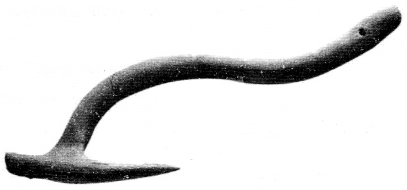
Look at the picture given below. Please state its use in earlier time. Are we presently using something like this?
Class 6 History Chapter 4 Extra Questions and Answers In the Earliest Cities 1
Answer:
In the picture, a plough has been shown, which was found in the Harappan cities. This is a toy, but archaeologists believe that this was used in digging and turning the soil for the purpose of planting of seeds. Presently, our farmers in villages also use plough for the same purpose. It appears that present-day ploughs have been developed from the Harappan plough.

Question 2.
Look at the pictures given below and write about the picture.
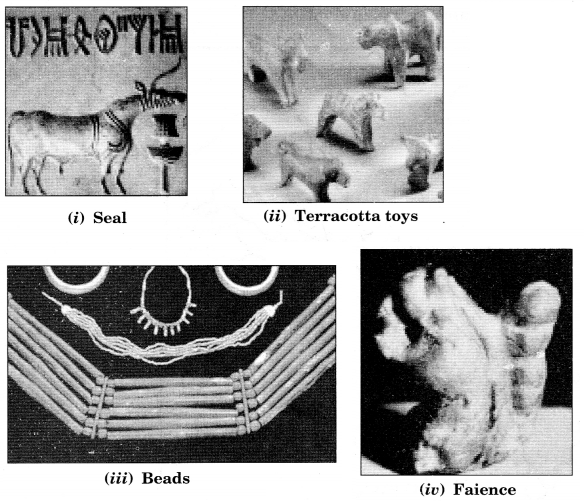
Class 6 History Chapter 4 Extra Questions and Answers In the Earliest Cities 2
Answer:
Picture (i):
The object is a seal and found in the Harappan cities. This seal contains script and picture of animal. Script is still unreadable. This seal was used to stamp bags or packets containing goods that were sent from one place to another. Mouth of the bag was tied and a layer of wet clay was applied on knot and seal was pressed on it. Sealing on any object assured about safety of goods. Today also we seal the goods, articles, parcels etc.

Picture (ii):
Shown objects in the picture are terracotta toys and found in the Harappan cities. These were made by baking the clay after making the designs on the clay. All terracotta toys are animals of that time which refer that the Harappan people were closely concerned with animals. Perhaps the Harappan children played with these toys. In present day, we also find Terracotta things. Many type of decorative vessels, articles, animals, birds etc., are available in the market.

Picture (iii):
Shown objects in the picture are ornaments such as garland, earring etc., made by beads and these were found in the Harappan cities. Many of the beads were made of carnelian, a beautiful red stone. The stone was cut, shaped, polished and finally a hole was bored through the centre so that a string could be passed through it. These type of the ornaments are available in the present market too and these are very much liked by the women particularly outsiders.

Picture (iv):
An artificial object faience has been shown in the picture. Faience was used to make beads, bangles, earrings and tiny vessels.

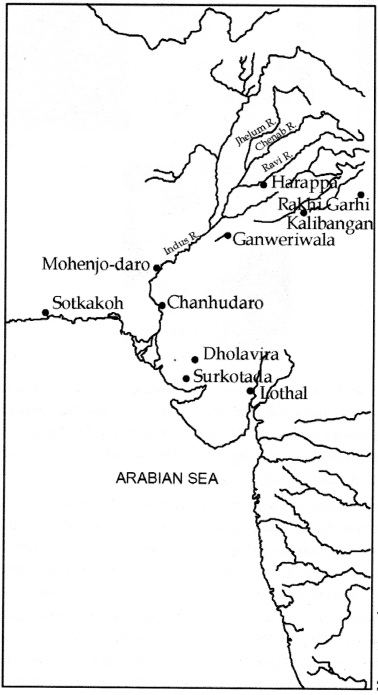
Map-Based Questions Class 6 History Chapter 4 In the Earliest Cities

Question 1.
Show the places of the Harappan Civilization on a Map of India
Answer:
Class 6 History Chapter 4 Extra Questions and Answers In the Earliest Cities 3