Class 6 Civics Chapter 5 Extra Questions and Answers Key Panchayati raj

Key Panchayati raj Class 6 Civics Chapter 5 Extra Questions and Answers Social Science CBSE Pdf free download are part of Extra Questions for Class 6 Social Science. Here we have given NCERT Extra Questions for Class 6 Social Science SST Civics Chapter 5 Key Panchayati raj.

You can also practice NCERT Solutions for Class 6 Civics Chapter 5 Questions and Answers on LearnInsta.com.

Class 6 Civics Chapter 5 Extra Questions and Answers Key Panchayati raj

Key Panchayati raj Class 6 Extra Questions and Answer Civics Chapter 5 Very Short Answers Type

Question 1.
How many villages can be included in the Gram Sabha?
Answer:
The Gram Sabha could be only one village or a few villages.

Question 2.
What is ward?
Answer:
Every village Panchayat is divided into small wards.

Question 3.
Who is the Panch?
Answer:
Ward members are elected from each ward. These members are called Panch.

Question 4.
What do you understand about the Panchayat President?
Answer:
The Gram Sabha members elect a Sarpanch who is also called Panchayat President.

Question 5.
How is a Gram Panchayat formed?
Answer:
Panch and Sarpanch together form the Gram Panchayat.

Question 6.
Who is Secretary?
Answer:
Each Panchayat has a Secretary appointed by government and works with the Gram Sabha.

Question 7.
What is the main work of the Gram Panchayat?
Answer:
Its main task is to implement development programmes for all villages that come under it.

Question 8.
Who approves the work of the Gram Panchayat?
Answer:
The work of the Gram Panchayat has to be approved by the Gram Sabha.

Question 9.
Who is responsible for calling meeting of the Gram Sabha and keeping the records of the proceedings?
Answer:
Panchayat Secretary.

Question 10.
Do all states have similar Panchayat system?
Answer:
No, each state in the country has its own laws with regard to the Panchayat.

Question 11.
What is the main thought behind Panchayati Raj system?
Answer:
The idea of Panchayati Raj system is to provide more and more space for people to participate and raise their voices.

Key Panchayati raj Class 6 Extra Questions and Answer Civics Chapter 5 Short Answers Type

Question 1.
How many levels are provisioned in the Panchayati Raj system? Give their name.
Answer:
The Panchayati Raj system has three levels:

  • One, the Gram Sabha at Gram level
  • Two, Block level which is called the Panchayat Samiti,
  • Three, the Zila Parishad, at District level

Question 2.
What are the functions of the Zila Parishad?
Answer:
The Zila Parishad makes development plan at district level. It also provides funds for makins roads, parks, streets, street lights etc.

Question 3.
How does the Gram Sabha work?
Answer:
The Gram Sabha makes various committees for its smooth functioning. These committees consist of the members. These members prepare work plan/ programmes and submit before the Gram Sabha. Viable programmes/ Plans are approved by the Gram Sabha. The various committees may be as construction committee, education committee, development committee etc.

Key Panchayati raj Class 6 Extra Questions and Answer Civics Chapter 5 Long Answers Type

Question 1.
How does the Gram Sabha work?
Answer:
For performing many works, the Gram Sabha form committees like construction and development committees, education committee, women and child development committee, poverty elimination committee etc. These committees include some members of the Gram Sabha and some from the Gram Panchayat who work together to carry out specific tasks.

Question 2.
What do you understand about the Panchayati Raj system?
Answer:
The Panchayati Raj system is a process through which people participate in their own government. This is a three tier system-at Village level, at Block level and at District level.

The Panchayati Raj system was adopted by the Government of India which was based on recommendation of a committee headed by Balwant Rai Mehta. First of all Gandhiji advocated the thoughts the Panchayati Raj system. Rajasthan was the first State who implemented this system in the state.

Question 3.
What is difference between the Gram Sabha and Gram Panchayat?
Answer:
Difference between the Gram Sabha and Gram Panchayat are as under:

Gram SabhaGram Panchayat
(i) This consists of all the adults of the village.This is an executive body made of Sarpanch and Panch.
(ii) All the voters are members of the Gram Sabha.Sarpanch and Panch are members of the Gram Panchayat.
(iii) It is a permanent body of the village.Elected for a period of 5 years only.
(iv) It approves the various plans/programmes for village.It spends the money on approved plans/ programmes.

Class 6 Geography Chapter 7 Extra Questions and Answers Our Country India

Our Country India Class 6 Geography Chapter 7 Extra Questions and Answers Social Science CBSE Pdf free download are part of Extra Questions for Class 6 Social Science. Here we have given NCERT Extra Questions for Class 6 Social Science SST Geography Chapter 7 Our Country India.

You can also practice NCERT Solutions for Class 6 Geography Chapter 7 Questions and Answers on LearnInsta.com.

Class 6 Geography Chapter 7 Extra Questions and Answers Our Country India

Our Country India Class 6 Extra Questions and Answer Geography Chapter 7 Very Short Answers Type

Question 1.
State the location of the Himalaya and the seas bounded to India.
Answer:
India is bounded by the lofty Himalayas in the north, Arabian Sea in the west, Bay of Bengal in the east and Indian Ocean in the south.

Question 2.
How much is area of India?
Answer:
India has an area of about 3.28 million sq. km.

Question 3.
What is distance between Kashmir to Kanyakumari?
Answer:
The distance between Kashmir to Kanyakumari (north to south) is about 3,200 km.

Question 4.
What is distance from east corner to west corner?
Answer:
East to West (Arunachal Pradesh to Kuchchh) is about 2,900 km.

Question 5.
What contributes to India’s diversity?
Answer:
India has a diversity of landforms, climate, vegetation, wildlife, language, culture etc.

Question 6.
Which country has the largest population over the world?
Answer:
China.

Question 7.
India is most populous country of the world after China, (second)

Question 8.
In which hemisphere is India located?
Answer:
India is located in the northern hemisphere.

Question 9.
Mention the expansion of India from south to north on latitudes.
Answer:
From south to north, main land of India extends between 8°4 ‘N and 37°6’N latitudes.

Question 10.
From west to east, India extends between and longitudes.
Answer:
68°7’E and 97°25’E

Question 11.
How much earlier does the Sun rise in the east than in the west?
Answer:
The Sun rises two hours earlier in the east (Arunachal Pradesh) than in the west (Gujarat).

Question 12.
Which longitude has been taken as the Standard Meridian of India?
Answer:
82°30’E longitude has been taken as the Standard Meridian of India.

Question 13.
Name of our island neighbours.
Answer:
Our island neighbours are – Sri Lanka and Maldives.

Question 14.
What do you mean by Palk Strait?
Answer:
Sri Lanka is separated from India by the Palk Strait.

Question 15.
How many States and Union Territories does India has?
Answer:
For administrative purposes, India is divided into 29 States and 7 Union Territories.

Question 16.
What is the Capital of India?
Answer:
Delhi is the Capital of India.

Question 17.
Which State is the largest in terms of area?
Answer:
In terms of area, Rajasthan is the largest state.

Question 18.
Which state is the smallest, in term of area?
Answer:
Goa is a smallest state.

Question 19.
On which basis have states been formed?
Answer:
States have been formed mainly on the basis of languages.

Question 20.
In how many parallel ranges are the Himalayan mountains divided?
Answer:
The Himalayan mountains are divided into three main parallel ranges.

Question 21.
What is Himadri?
Answer:
The northernmost range of the Himalaya is the Great Himalaya or Himadri.

Question 22.
What is the southernmost range of the Himalaya called?
Answer:
The ‘Shiwalik’ is the southernmost range.

Question 23.
What is peninsula?
Answer:
The peninsula is a piece of land that is surrounded by water on three sides.

Question 24.
How do western coastal plains look like?
Answer:
The western coastal plains are very narrow.

Question 25.
How do eastern coastal plains look like?
Answer:
The eastern Coastal plains are much broader.

Question 26.
Name of rivers flowing east and draining into Bay of Bengal.
Answer:
Mahanadi, Godavari, Krishna and Kaveri are east flowing rivers and drain into the Bay of Bengal.

Question 27.
In which Sea is Lakshadweep Island located?
Answer:
Lakshadweep Island is located in the Arabian Sea.

Question 28.
In which sea is Andman and the Nicobar Islands located?
Answer:
In Bay of Bengal.

Our Country India Class 6 Extra Questions and Answer Geography Chapter 7 Short Answers Type

Question 1.
Give the names of countries that share land boundaries with India.
Answer:
There are seven countries that share land boundaries with India. Their names are – Myanmar, Bhutan, Nepal, Tibet, China, Pakistan and Afghanistan.

Question 2.
Write few lines about Northern Indian plains?
Answer:
In the south of the Himalayas lie the Northern Indian plains. These are generally level and flat. The land here is fertile for cultivation and has high concentration of population.

Question 3.
Where is the Great Indian Desert located? How is it?
Answer:
In the western part of India lies the Great Indian Desert. It is dry, hot and sandy stretch of land. It has very little vegetation.

Question 4.
Describe the Peninsular Plateau lying in the south of northern plains in India?
Answer:
To the south of northern plains, lies the Peninsular Plateau. It is triangular in shape. This is a region with numerous hill ranges and valleys. On the border of it, oldest range of the world, Aravali hills are situated. The Vindhyas and the Satpuras are the important ranges. The rivers Narmada and Tapti flow through these ranges and drain into the Arabian Sea.

Question 5.
What do you mean by Corals and how do Coral Islands form?
Answer:
Corals are skeletons of tiny marine animals called Polyps. When the living polyps die, their skeletons are left. Other polyps grow on top of the hard skeleton which grows higher and higher, thus forming the coral islands.

Question 6.
What do you mean by Alluvial deposits?
Answer:
These are very fine soils, brought by rivers and deposited in the river basins.

Question 7.
Define the Tributary.
Answer:
A river or stream which contributes its water to a main river by discharging it into main river from either side.

Question 8.
What do you understand about Peninsular Plateaus? Describe it.
Answer:
Peninsular Plateau: “It is a piece of land that is surrounded by water on three sides.” To the south of northern plains lies the Peninsular Plateau. It is triangular in shape. This is a region with numerous hill ranges and valleys.

On the border of it, oldest range of the world, Aravali hills are situated. The Vindhyas and the Satpuras are the important ranges. The rivers Narmada and Tapti flow through these ranges and drain into Arabian Sea. On the west of plateau lie Western Ghats and on the east lie the Eastern Ghats.

Our Country India Class 6 Extra Questions and Answer Geography Chapter 7 Long Answers Type

Question 1.
Distinguish between Western Ghats and Eastern Ghats.
Answer:
Western Ghats and Eastern Ghats can be distinguished as under:
table

Question 2.
Describe the parallel range of the Himalayan Mountains.
Answer:
The Himalayan Mountains are divided into three main parallel ranges:

  1. Great Himalayas: It is northernmost range of the Himalayas. This range is also called Himadri. In this range, Mr. Everest, the world’s highest peak is located.
  2. Middle Himalaya: This part is located in the south of Himadri. Many popular hill stations are situated here. Other popular hill stations situated in this range are Shimla, Manali, Kullu etc.
  3. Shiwalik: The Shiwalik is the Southernmost range.

Question 3.
What do you understand about physical division? Describe them.
Answer:
Physical divisions are mainly Indian mountains, plateaus, plains, coasts and islands. These are the heads which cover almost all the physical aspect which make an easy study as whole.

(i) The Himalayas: The northernmost part is the Great Himalaya or Himadri. Middle Himalaya lies to the south of Himadri. Many popular hill stations are situated here. The ‘Shiwalik’ is the southernmost range.

(ii) Northern Plains: In the south of the Himalayas, lie the Northern Indian plains. These are generally level and flat. Land here is fertile for cultivation and high concentration of population.

(iii) Great Indian Desert: In the western part of India, lies the Great Indian Desert. In this region, rainfall is very poor. It is dry, hot and sandy stretch of land. It has very little vegetation.

(iv) Peninsular Plateau: To the south of northern plains lies the Peninsular Plateau. It is triangular in shape. This is a region with numerous hill ranges and valleys. On the border of it, oldest range of the world, Aravali hills are situated.

The Vindhyas and the Satpuras are the important ranges. The rivers Narmada and Tapti flow through these ranges and drain into Arabian Sea. On the west of plateau lie Western Ghats and on the east lie the Eastern Ghats.

(v) The coastal plains: The coastal plains lie to the west of the Western Ghats and the east of the Eastern Ghats. The western coastal plains are narrow while the eastern coastal plains are much broader.

(vi) Islands: Two groups of islands are integral part of the country. Lakshadweep Islands are located in the Arabian Sea and Andaman & Nicobar Islands in the Bay of Bengal.

Question 4.
Give the name of States and Union Territories of India along with their Capitals?
Answer:
Please insert details given at page No. 66 of Textbook

Picture Based Questions Class 6 Geography Chapter 7 Our Country India

Question 1.
On the outline map of India locate the countries that share land boundaries with India:
Answer:
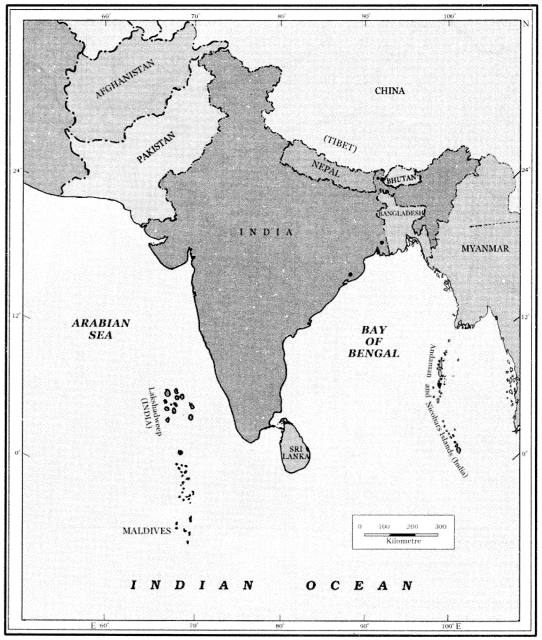
Class 6 Geography Chapter 7 Extra Questions and Answers Our Country India 1

Question 2.
Locate the following states on the map of India:
(i) Sikkim
(ii) Manipur
(iii) Kerala
(iv) West Bengal
(v) Meghalaya
(vi) Himachal Pradesh
(vii) Odisha
(viii) Jammu and Kashmir
(ix) Maharashtra
(x) Punjab
Answer:
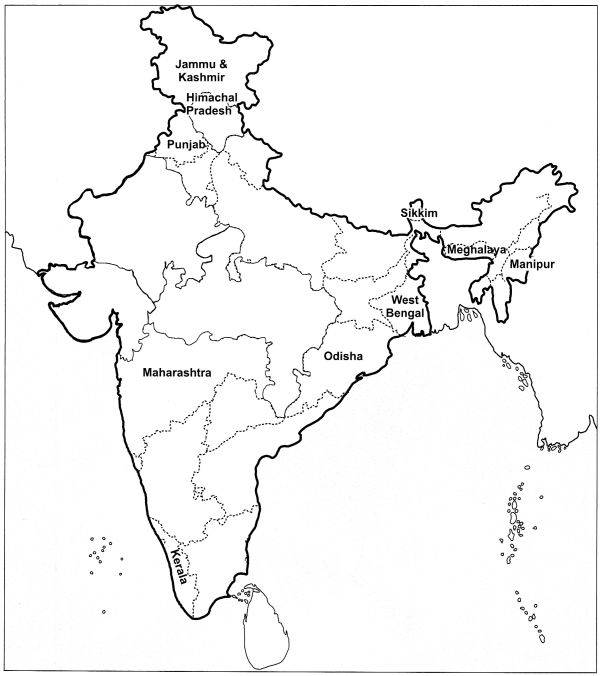
Class 6 Geography Chapter 7 Extra Questions and Answers Our Country India 2

Question 3.
Locate the following on the map of India.
(a) The largest state on the basis of area
(b) The smallest state
(c) The state whose capital is Bengaluru
(d) The state whose capital is Aizawl
(e) Country’s capital
(f) The islands lying to the southeast of the Indian mainland in Bay of Bengal.
Answer:
(a) Rajasthan
(b) Goa
(c) Karnataka
(d) Mizoram
(e) Delhi
(f) Andaman and Nicobar Islands
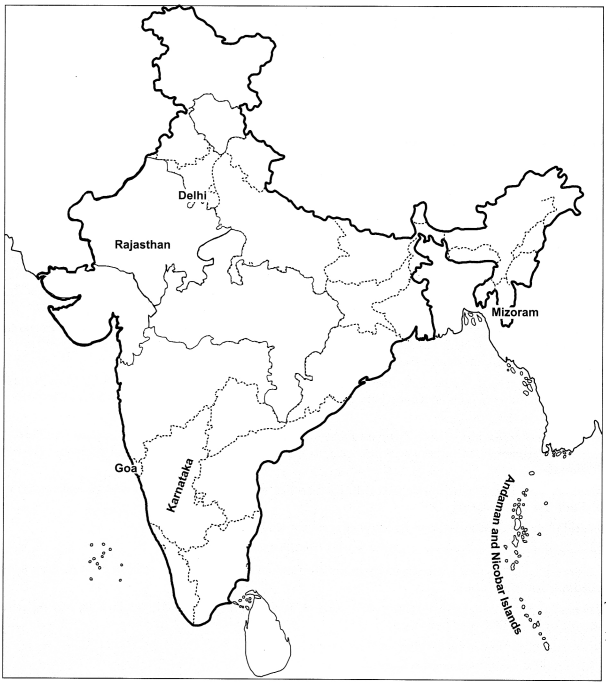
Class 6 Geography Chapter 7 Extra Questions and Answers Our Country India 3

Class 7 Geography Chapter 5 Extra Questions and Answers Water

Water Class 7 Geography Chapter 5 Extra Questions and Answers Social Science CBSE Pdf free download are part of Extra Questions for Class 7 Social Science. Here we have given NCERT Extra Questions for Class 7 Social Science SST Geography Chapter 5 Water.

You can also practice NCERT Solutions for Class 7 Geography Chapter 5 Questions and Answers on LearnInsta.com.

Class 7 Geography Chapter 5 Extra Questions and Answers Water

Water Class 7 Extra Questions and Answer Geography Chapter 5 Very Short Answers Type

Question 1.
How are the clouds formed?
Answer:
The sun’s heat causes evaporation of water vapour. When the water vapour cools down, it condenses and forms clouds.

Question 2.
What do you understand about water cycle?
Answer:
The process by which water continually changes its form and circulates between oceans, atmosphere and land is known as the water cycle.

Question 3.
What are the msgor sources of fresh water?
Answer:
The major sources of fresh water are the rivers, ponds, springs and glaciers.

Question 4.
Why are the oceans salty or saline?
Answer:
The water of the ocean is salty or saline because it contains large amount of dissolved salts.

Question 5.
What amount of ocean water is found on the earth?
Answer:
Ocean water is 97.3% of total water available on the earth.

Question 6.
What are the waves?
Answer:
When the water on the surface of the ocean rises and falls alternately, they are called waves.

Question 7.
How are waves formed?
Answer:
Waves are formed when gentle winds scrape across the ocean surface. The stronger the wind blows, the bigger the waves becomes.

Question 8.
What is terrarium?
Answer:
Terrarium is an artificial enclosure for keeping small house plants.

Question 9.
Where is salty water found?
Answer:
Salty water is found in oceans.

Question 10.
What is the reason of ocean water being salty?
Answer:
The ocean water contains large amount of dissolved salt. Thus, the ocean water is salty.

Question 11.
What is salinity?
Answer:
Salinity is the amount of salt in grams present in 1000 grams of water.

Question 12.
What is tide?
Answer:
The rhythmic rise and fall of ocean water twice in a day is called a tide.

Question 13.
What causes tides?
Answer:
The strong gravitational pull exerted by the sun and the moon on the earth’s surface causes the tides.

Question 14.
How are the high tides formed?
Answer:
The water of the earth closer to the moon gets pulled under the influence of the moon’s gravitational force and causes high tide.

Question 15.
How are high tides useful?
Answer:
High tides are useful because these help in navigation, fishing and also to generate the electricity.

Water Class 7 Extra Questions and Answer Geography Chapter 5 Short Answers Type

Question 1.
What is tide? Describe high and low tides.
Answer:
The rhythmic rise and fall of ocean water twice in a day is called a tide. When water covers much of the shore by rising to its highest level it is called high tide. It is low tide when water falls to its lowest level and recedes from the shore.

Question 2.
How do the ocean currents influence us?
Answer:
The ocean currents influence us because of influencing the temperature conditions of the area. The areas where the warm and cold currents meet provide the best fishing grounds of the world. Apart from this, where warm and cold currents meet provide foggy weather making navigation difficult.

Question 3.
What is Tsunami? Describe.
Answer:
Tsunami is tidal waves. In the sea storm when the winds blowing at very high speed form huge waves, tsunami is created. An earthquake, a volcanic eruption or underwater landslides can shift large amounts of ocean water. As a result huge tidal waves are formed that may be as high as 15 m.

Question 4.
State the broad categorization of ocean movements.
Answer:
The movements that occur in ocean can be broadly categorized as:

  1. waves
  2. tides and
  3. currents.

Water Class 7 Extra Questions and Answer Geography Chapter 5 Long Answers Type

Question 1.
How do tides originate?
Answer:
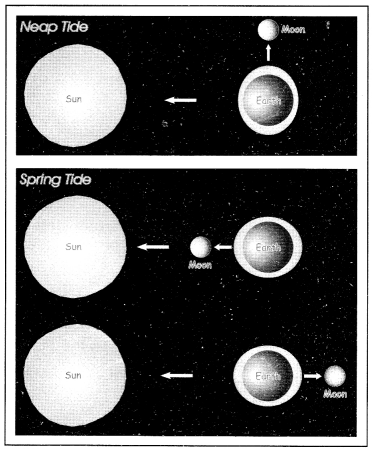
The strong gravitational pull exerted by the sun and the moon on the earth’s surface causes the tides. During the full moon and new moon days, the sun, the moon and the earth are in the same line and the tides are the highest. These tides are called spring tides.

When the moon is in its first and last quarter, the ocean waters get drawn in diagonally opposite direction by the gravitational pull of sun and earth resulting in low tides. These tides are called neap tides.

Question 2.
What are ocean currents? Describe warm and cold currents.
Answer:
Ocean currents are streams of water flowing constantly on the ocean surface in definite directions. The ocean currents may be warm or cold. Generally the warm ocean currents originate near the equator and move towards the poles. The cold currents carry water from polar or higher latitudes to tropical or lower latitudes. The ocean current influences the temperature conditions of the area.

Warm currents bring about warm temperatures over land surface. The areas where the warm and cold currents meet provide the best fishing grounds of world. The areas where a warm and cold current meet also experience foggy weather making it difficult for navigation.

Question 3.
What are Spring and Neap tides? Describe briefly withdrawing.
Answer:
During the full moon and new moon days, the sun, the moon and the earth are in the same line and the tides are the highest. These tides are called spring tides.
Class 7 Geography Chapter 5 Extra Questions and Answers Water
When the moon is in its first and last quarter, the ocean waters get drawn in diagonally opposite direction by the gravitational pull of sun and earth resulting in low tides. These tides are called neap tides.

Class 7 Geography Chapter 6 Extra Questions and Answers Natural Vegetation and Wild Life

Natural Vegetation and Wild Life Class 7 Geography Chapter 6 Extra Questions and Answers Social Science CBSE Pdf free download are part of Extra Questions for Class 7 Social Science. Here we have given NCERT Extra Questions for Class 7 Social Science SST Geography Chapter 6 Natural Vegetation and Wild Life.

You can also practice NCERT Solutions for Class 7 Geography Chapter 6 Questions and Answers on LearnInsta.com.

Class 7 Geography Chapter 6 Extra Questions and Answers Natural Vegetation and Wild Life

Natural Vegetation and Wild Life Class 7 Extra Questions and Answer Geography Chapter 6 Very Short Answers Type

Question 1.
What changes occur when we go to the higher places?
Answer:
As we go higher and higher places, we can see the changes in the landform and natural vegetation.

Question 2.
Which types of plants are found on higher places?
Answer:
On the higher places we find tall trees with thin pointed leaves and cone-shaped canopies which are called coniferous trees on the mountain slopes.

Question 3.
Where are shrubs found?
Answer:
Shrubs are found in the dry regions.

Question 4.
Name the trees found in the Tropical deciduous forests.
Answer:
Sal, teak, neem and shisham.

Question 5.
Where are Savannah grasslands found?
Answer:
Savannah grasslands are found in East Africa.

Question 6.
Name some animals found in polar regions.
Answer:
Polar bear, snow foxes, seal, walruses etc., are animals found in polar regions.

Question 7.
On what does growth of Vegetation depend?
Answer:
The growth of vegetation depends on temperature and moisture. It also depends on factors like slope and thickness of soil.

Question 8.
What is another name of Tropical Evergreen Forest ?
Answer:
Tropical Evergreen Forest is also called tropical rainforests.

Question 9.
Mention the special feature of Tropical Evergreen Forest.
Answer:
These are thick forests occurring in the regions near the equator and close to the tropics.

Question 10.
Where are Tropical Evergreen Forests found?
Answer:
Tropical Evergreen Forests are found in the regions which are hot and receive heavy rainfall throughout the year.

Question 11.
Why are Tropical Evergreen Forests called Evergreen Forest?
Answer:
As there is no particular dry season, the trees do not shed their leaves. This is the reason they are called evergreen.

Question 12.
What is the special feature of Tropical Evergreen Forests?
Answer:
These are dense and do not allow the sunlight even in the day time.

Question 13.
Name some trees of the Tropical Evergreen Forests?
Answer:
In the Tropical Evergreen Forests, are found hardwood trees like rosewood, ebony, mahogany etc.

Question 14.
Which forests are called the monsoon forests?
Answer:
Tropical Deciduous Forests are called the monsoon forests.

Question 15.
Where are Tropical Deciduous Forests found?
Answer:
These are found in the large part of India, northern Australia and in Central America.

Question 16.
Give the special features of Tropical Deciduous Forests?
Answer:
These regions experience seasonal changes. Trees shed their leaves in the dry season to conserve water.

Question 17.
Give the name of trees found in the Tropical Deciduous Forests region?
Answer:
Sal, teak, neem and shisham are trees found in these regions.

Question 18.
Where are Temperate Evergreen Forests located?
Answer:
Temperate Evergreen Forests are located in the mid-latitudinal coastal region. These are found in south-east USA, South China and in south-east Brazil.

Question 19.
Give the name of trees found in Temperate Evergreen Forests region?
Answer:
They comprise both hard and soft wood trees like oak, pine, eucalyptus etc .

Question 20.
Where are Temperate Deciduous Forests situated?
Answer:
Temperate Deciduous Forests are found in the north-eastern part of USA, China, New Zealand, Chile and also found in the coastal regions of Western Europe. These are found towards higher latitudes.

Question 21.
Name the trees, animals and birds found in Temperate Deciduous Forests region.
Answer:
The common trees are oak, ash, beech, etc. Deer, foxes, wolves are the animals commonly found. Birds like pheasants, monals are also found here.

Question 22.
Where are Mediterranean vegetation found?
Answer:
The west and south-west margins of the continents have Mediterranean vegetation. It is mostly found in the areas around the Mediterranean Sea in Europe, Africa and Asia. These regions are marked for hot dry summers and mild rainy winters.

Question 23.
Name the fruits found in Mediterranean vegetation.
Answer:
Citrus fruits such as oranges, figs, olives and grapes are commonly cultivated.

Question 24.
Where are Coniferous Forests found?
Answer:
Coniferous Forests are found in the higher latitudes of Northern hemisphere. These are also called as Taiga.

Natural Vegetation and Wild Life Class 7 Extra Questions and Answer Geography Chapter 6 Short Answers Type

Question 1.
Name types of natural vegetation classified into broader categories.
Answer:
Natural vegetation is generally classified into three broad categories:

  1. Forests
  2. Grasslands
  3. Shurbs.

Question 2.
What are Tropical Deciduous Forests?
Answer:
Tropical Deciduous Forests are the monsoon forests that are found in the large part of India, northern Australia and in Central America. These regions experience seasonal changes. Trees shed their leaves in the dry season to conserve water. Sal, teak, neem and shisham are trees found in these regions.

Question 3.
Briefly describe about the Temperate Evergreen Forests?
Answer:
Temperate Evergreen Forests are located in the mid-latitudinal coastal region. These are found in south-east USA, South China and in South-east Brazil. They comprise both hard and soft wood trees like oak, pine, eucalyptus etc.

Question 4.
Where are Temperate Deciduous Forests found? Briefly describe.
Answer:
Temperate Deciduous Forests are found in the north-eastern part of USA, China, New Zealand, Chile and also found in the coastal regions of Western Europe. These are found towards higher latitudes.

The trees shed their leaves in the dry season. The common trees are oak, ash, beech, etc. Deer, foxes, wolves are the animals commonly found. Birds like pheasants, monals are also found here.

Question 5.
Where is Mediterranean vegetation found? Name the fruits found in this region.
Answer:
The west and south west margins of the continent have Mediterranean vegetation. It is mostly found in the areas around the Mediterranean Sea in Europe, Africa and Asia. These regions are marked for hot dry summers and mild rainy winters. Citrus fruits such as oranges, figs, olives and grapes are com¬monly cultivated here.

Question 6.
Mention the major features of Coniferous Forests.
Answer:
Coniferous Forests are found in the higher latitudes of northern hemisphere. These are also called as Taiga. The trees found here are tall, softwood evergreen trees. Silver fox, mink, polar bear are the common animals found here.

Question 7.
Name different types of forests.
Answer:
Different types of forests are:

  1. Tropical evergreen
  2. Tropic deciduous
  3. Temperate evergreen
  4. Temperate deciduous
  5. Mediterranean vegetation
  6. Coniferous forests

Question 8.
Name different types of Grasslands.
Answer:
Different types of grasslands are:
(i) Tropical grasslands
(ii) Temperate grasslands
(iii) Throny bushes

Natural Vegetation and Wild Life Class 7 Extra Questions and Answer Geography Chapter 6 Long Answers Type

Question 1.
Write a short note on Tropical Evergreen Forests.
Answer:
Tropical Evergreen Forest is also called tropical rainforests. These are thick forests which occur in the regions near the equator and close to the tropics.

Tropical Evergreen Forests are found in the regions which are hot and receive heavy rainfall throughout the year. As there is no particular dry season, the trees do not shed its leaves. This is the reason they are called evergreen. These are dense and do not allow the sunlight even in the day time. Hardwood trees like rosewood, ebony, mahogany are common here.

Question 2.
Describe different types of grasslands.
Answer:
(i) Tropical grasslands: These occur on either side of the equator and extend till the tropics. This vegetation grows in the areas of moderate to low amount of rainfall. The grass can grow very tall, about 3 to 4 metres in height. Savannah grasslands of Africa are of this type. Elephants, zebras, giraffes, deers, leopards are common in tropical grasslands.

(ii) Temperate grasslands: These are found in the mid-latitudinal zones and in the interior part of the continents. Wild buffaloes, bisons, antelopes are common in the temperate region.

(iii) Thorny bushes: These are found in the dry desert-like regions. These are located on the western margins of the continents.

Question 3.
Distinguish between Tropical Evergreen Forests and Tropical Deciduous Forests.
Answer:
table

Picture Based Questions Class 7 Geography Chapter 6 Natural Vegetation and Wild Life

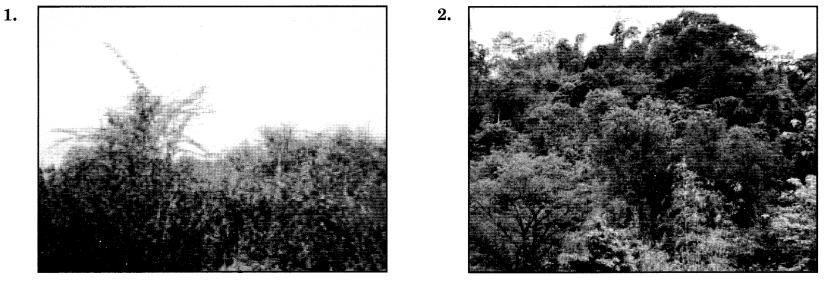
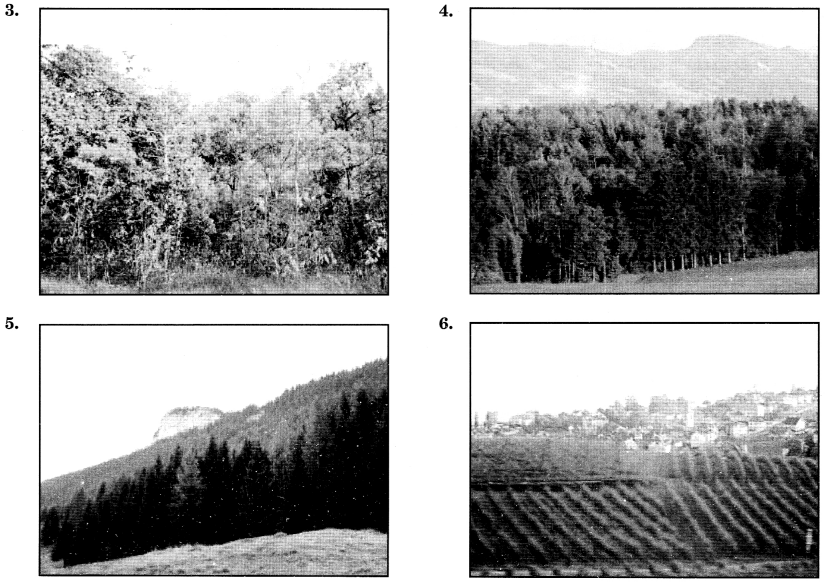
1. Identify the pictures given below:
Class 7 Geography Chapter 6 Extra Questions and Answers Natural Vegetation and Wild Life 1
Class 7 Geography Chapter 6 Extra Questions and Answers Natural Vegetation and Wild Life 2

Answer:

  1. Thorny shrubs
  2. Tropical Evergreen Forest
  3. Tropical Deciduous Forest
  4. A Temperate Evergreen Forest
  5. Temperate Deciduous
  6. Mediterranean Vegetation
  7. Coniferous Forests.

Class 6 Civics Chapter 3 Extra Questions and Answers What is Government

What is Government Class 6 Civics Chapter 3 Extra Questions and Answers Social Science CBSE Pdf free download are part of Extra Questions for Class 6 Social Science. Here we have given NCERT Extra Questions for Class 6 Social Science SST Civics Chapter 3 What is Government.

You can also practice NCERT Solutions for Class 6 Civics Chapter 3 Questions and Answers on LearnInsta.com.

Class 6 Civics Chapter 3 Extra Questions and Answers What is Government

What is Government Class 6 Extra Questions and Answer Civics Chapter 3 Very Short Answers Type

Question 1.
Why does country need a government?
Answer:
Country needs a government to make decisions and to execute them.

Question 2.
Who implements the decisions of the government?
Answer:
Government needs some amount of organizations for implementation of its decisions.

Question 3.
Who helps in implementation of government decisions?
Answer:
Various organizations help in implementation of government’s decisions.

Question 4.
Name the types of governments.
Answer:
There are two type of Government – first democratic and second monarchy.

Question 5.
Who gives power to the government in democratic system?
Answer:
In a democratic government, people give the power to the government.

Question 6.
What does government use the power for?
Answer:
Government use the power for making the decisions and their implementation.

Question 7.
How is the democratic government chosen?
Answer:
The members are elected through the elections at different levels.

Question 8.
What do you understand about the monarchy system?
Answer:
In the monarchy system of Government, King or Queen enjoys the power. King or Queen finds power through inheritance.

Question 9.
Who has power in monarchy system?
Answer:
King or Queen has power in monarchy system.

Question 10.
What do you mean by the term ‘suffrage’?
Answer:
The term ‘suffrage’ usually means right to vote.

Question 11.
When did American and UK women get the right to vote?
Answer:
American women got right to vote in 1920 while women of UK in 1928.

Question 12.
Who had right to vote before independence of India?
Answer:
In India, before its independence, only a small minority was allowed to vote.

Question 13.
Who strongly demanded that all adults have the right to vote?
Answer:
Gandhiji.

Question 14.
Name the journal published by Gandhiji.
Answer:
“Young India’.

What is Government Class 6 Extra Questions and Answer Civics Chapter 3 Short Answers Type

Question 1.
Make a list of areas which are integral part of government.
Answer:
Government has a wide range of work such as:

  1. social welfare, service and developmental works;
  2. Establishment of the social security;
  3. Protecting the boundaries of the country and
  4. Maintaining peaceful relations among various religions, traditions, customs etc., as well as with other countries.

Question 2.
What are the different levels of government?
Answer:
The government works at different levels¬>- Local level,

  • State-level and
  • National level

Question 3.
Who struggled for getting right of vote in Europe and USA?
Answer:
All over Europe and USA women and the poor have had to fight for participation in government. Women’s struggle to vote got strengthened during the First World War.

Question 4.
What do you understand by representative democracies.
Answer:
In the representative democracy, like India, the people who are eligible for voting, participate in the selection of their representatives by the election when they cast the vote. These elected representatives make the rules and laws in the Assembly as per requirement of its public. Hence, public make the rules through its representatives.

Question 5.
Which practice was felt unfair by Gandhiji?
Answer:
Before independence of India, only a small minority was allowed to vote. Thus, minority determined the fate of the majority. This practice was felt unfair by Gandhiji. He ensured involvement of all people in the process.

Question 6.
What was the demand of Gandhiji on the issue of voting?
Answer:
Gandhiji demanded that all people of India, who are adults, should be given the right to vote, whether they are rich or poor, educated or illiterate.

What is Government Class 6 Extra Questions and Answer Civics Chapter 3 Long Answers Type

Question 1.
How are the decisions taken in the monarchy system?
Answer:
In monarchy, King or Queen has the power to make decisions and run the government. The monarch may have a small group of people to discuss matters with but the final decision-making power remains with the monarch. Unlike in a democracy, kings and queens do not have to explain their actions or defend the decisions they take.

Question 2.
What do you understand by ‘universal adult franchise’?
Answer:
In India, before Independence, only a small minority was allowed to vote and they therefore came together to determine the fate of the majority. Several people including Gandhiji were shocked at the unfairness of this practice and demanded that all adults have the right to vote. This is known as universal adult franchise.

Question 3.
Describe about the democratic governments.
Answer:
Democratic governments means a government which is elected by the people through votes. In fact, democratic government is representative democracy. The people elect their representatives for a fixed period and send them into the assemblies for making the rules and laws for various purposes.

In some countries, which have limited its population, rules are passed by the consent of the general public, but in India it is not possible due to the huge population and more expenditures. In India, once public elects, the representatives have the power to express their view on behalf of general public. Secondly, in a democratic government, it is believed that all power is in the hand of public. Hence, the representatives are liable to the public.

In a democratic government transparency is ensured in its works, so that public funds could be utilized properly. The democratic government has a detailed constitution and the government abides by the constitution in all the circumstances.

Question 4.
For women. How did the unfair stereotype scenario change?
Answer:
Earlier, it was thought that women couldn’t do every work. It was considered that they are physically and mentally weak and do not have capacity to take decisions. During the war, many men were away fighting, and because of this, women began organizing and managing different kinds of work.

When people saw this, they began to wonder why they had created so many unfair stereotypes about women and what they were capable of doing. So, women began to be seen as being equally capable of making decisions.