Class 7 Civics Chapter 9 Extra Questions and Answers Struggles for Equality

Struggles for Equality Class 7 Civics Chapter 9 Extra Questions and Answers Social Science CBSE Pdf free download are part of Extra Questions for Class 7 Social Science. Here we have given NCERT Extra Questions for Class 7 Social Science SST Civics Chapter 9 Struggles for Equality.

You can also practice NCERT Solutions for Class 7 Civics Chapter 9 Questions and Answers on LearnInsta.com.

Class 7 Civics Chapter 9 Extra Questions and Answers Struggles for Equality

Struggles for Equality Class 7 Extra Questions and Answer Civics Chapter 9 Very Short Answers Type

Question 1.
What is the provision in our Constitution for equality?
Answer:
The Indian constitution recognizes all Indians as equal before the law and states. No person can be discriminated on any ground.

Question 2.
What do you understand about equal right to vote?
Answer:
All adults in India have the equal right to vote during elections and this power has been used by people to elect or replace their representatives. The vote of one person is as good as that of another.

Question 3.
What are the key reasons for inequality?
Answer:
Poverty, lack of resources and discrimination are the key reasons that many people’s lives in India are highly unequal.

Question 4.
Why do Dalit, Adivasi and Muslim girls drop out from school in large number?
Answer:
Dalit, Adivasi and Muslim girls drop out of school in large numbers. This is a combined outcome of poverty, social discrimination and the lack of their artists’ good quality school facilities for these communities.

Question 5.
Who fights against inequality?
Answer:
In each community and in society there are some respectable people who fight of equality. They may be well-respected because they treat all persons with dignity and are, therefore, trusted and play an important role to resolve issues in the community.

Question 6.
What do you understand about creative expression?
Answer:
When the voice of inequality, discrimination etc., are raised through creative means such as pen, or artists’ voice, or thejr ability to dance it is called ‘creative expression’.

Question 7.
Which communities face discrimination in India?
Answer:
Minorities, women, dalits and adivasis face discrimination.

Question 8.
Where is Tehri dam situated?
Answer:
It is situated in Uttarakhand.

Question 9.
When was Tawa Dam built?
Answer:
It was built between 1958 and 1978.

Question 10.
How many villages were affected from Tehri dam?
Answer:
About 100 villages.

Question 11.
How do poor face inequality?
Answer:
Poverty and lack of resources continue to be the key reason for so many people’s lives to be unequal.

Struggles for Equality Class 7 Extra Questions and Answer Civics Chapter 9 Short Answers Type

Question 1.
How do the people form cooperatives?
Answer:
In India, there are several struggles in which people have come together to fight for issues that they believe are important. There are many such struggles such as those among beedi workers, fisher-folk, agricultural labourers, slum dwellers and each group is struggling for justice in its own way. Many times they form cooperatives or other collective ways by which people can have more control over resources.

Question 2.
How are the people forced to displace?
Answer:
In the villages adjoining the forest areas, when sanctuaries for animals are constructed many poor:
people are displaced and people are forced to go and build new homes and new lives. In urban areas, bastis in which poor people live are often displaced to the areas located outside of the city. Displaced poor people are severely disrupted.

Question 3.
Where is dam built? How does a dam affect the dwellers?
Answer:
A dam is built across a river at sites where one can collect a lot of water. Dam submerges vast areas of land and life of many persons is badly affected. They have to leave their living places. As an example- the Tehri dam, Uttarakhand submerged old Tehri town and 100 villages. Nearly one lakh people were displaced from the construction of Tehri dam.

Question 4.
What are the issues that affect the poor’s and marginalized communities?
Answer:
The issues affecting poor’s and marginalized communities are:

  1. the privatization of health and other services in the country;
  2. the increasing control of business houses on the media;
  3. the low value given to women and their work;
  4. the low earning made by small farmers etc.

Struggles for Equality Class 7 Extra Questions and Answer Civics Chapter 9 Long Answers Type

Question 1.
Write a short note on Tawa Matsya Sangh.
There are several organizations across the country fighting for the rights of the displaced. Tawa Matsya Sangh-a federation of Fisherworker’s cooperative-an organization fighting for the rights of the displaced forest dwellers of the Satpura forest in Madhya Pradesh. The Tawa, originating in the Mahadeo hills of Chindwara district, flows through Betul, before joining the Narmada in Hoshangabad.

The Tawa dam began to be built in 1958 and was completed in 1978. It submerged large areas of forest and agricultural land. People of 33 villages were displaced. Some of the displaced people settled around the reservoir and apart from their meagre farms found a livelihood in fishing.

Question 2.
Describe important works done by Tawa Matsya Sangh.
Answer:
In 1994, the government gave the rights for fishing in the Tawa reservoir to private contractors. These contractors got cheap labour from outside. The villagers stood united and decided to set up an organization to protect their livelihood rights. Thus, they formed Tawa Matsya Sangh (TMS). And after long struggles they were granted right to fishing for their livelihood by the Madhya Pradesh government in 1996.

For the upliftment of the needs of fishermen, Tawa Matsya Sangh played a great role to make them able to increase their earning substantially. The Sangh arranges for fair price, transport, selling in a market where they get a good price, loans to fishermen for repair and the buying of new nets etc. Thus, the fishermen have started to earn three times more than they earned earlier.

Question 3.
How do writers, singers, dancers and artists fight against inequality?
Answer:
There are two ways to fight against inequality. The first way is to participate in protest movements and the others might use their pen, or their voice, or their ability to dance to draw attention to issues of inequality.

Writers, singers, dancers and artists have also been very active in the fight against inequality. The second ways is called ‘creative expression’. By writing, the issue can be published in the newspapers and periodicals and may draw attention of the authorities as well as masses.
Class 7 History Chapter 3 Extra Questions and Answers The Delhi Sultans

The Delhi Sultans Class 7 History Chapter 3 Extra Questions and Answers Social Science CBSE Pdf free download are part of Extra Questions for Class 7 Social Science. Here we have given NCERT Extra Questions for Class 7 Social Science SST History Chapter 3 The Delhi Sultans.

You can also practice NCERT Solutions for Class 7 History Chapter 3 Questions and Answers on LearnInsta.com.

Class 7 History Chapter 3 Extra Questions and Answers The Delhi Sultans

The Delhi Sultans Class 7 Extra Questions and Answer History Chapter 3 Very Short Answers Type

Question 1.
When did Delhi became an important city?
Answer:
Delhi became an important city only in the 12th century.

Question 2.
Under whose regime, Delhi first became the Capital?
Answer:
Delhi first became the capital of a kingdom under the Tomara Rajputs.

Question 3.
When did Delhi became an important commercial centre?
Answer:
Under Tomaras and Chauhans Delhi became an important commercial centre.

Question 4.
What do you understand by the word ‘dehliwal’?
Answer:
Making coins by melting was called dehliwal which were in the wide circulation.

Question 5.
When was the Delhi Sultanate founded?
Answer:
In the beginning of the 13th century Delhi Sultanate was founded.

Question 6.
Which language was the administrative language of the Delhi Sultanates?
Answer:
The administrative language of the Delhi Sultanates was Persian.

Question 7.
Who was Raziyya and when did Raziyya become Sultan?
Answer:
Raziyya was daughter of Iltutmish, who was Sultan of Delhi. Raziyya became Sultan of Delhi in 1236.

Question 8.
When was Raziyya removed from the throne?
Answer:
She was removed from the throne in 1240.

Question 9.
Who was Rudramadevi?
Answer:
Rudramadevi was queen of Kakatiya dynasty of Warangal.

Question 10.
Who was Queen Didda?
Answer:
Queen Didda was ruler in Kashmir between 980-1003.

Question 11.
From where did the word Didda derived?
Answer:
The word ‘Didda’ came from “didi” or “elder sister”.

Question 12.
What was captured by army of Sultans?
Answer:
Sultanate army captured elephants, horses and slaves and carried away precious metals.

Question 13.
Name the first mosque built in Delhi and when?
Answer:
Quwwat al-Islam was the first mosque built in Delhi during the last decade of the 12th century.

Question 14.
When was Begumpuri mosque built?
Answer:
Begumpuri mosque was built in the regime of Muhammad Tughluq.

Question 15.
In whose regime, Moth ki Masjid was built?
Answer:
Moth ki Masjid was built in the reign of Sikandar Lodi by his minister.

Question 16.
When was mosque of Jamali Kamali built?
Answer:
Mosque of Jamali Kamali was built in the late 1520.

Question 17.
Who was Ziauddin Bami?
Answer:
Ziauddin Barani (1285-1357) was a Muslim political thinker of the Delhi Sultanate during Muhammad bin Tughluq and Firuz Shah’s reign.

Question 18.
What did Sultan’s administrators do?
Answer:
The Sultan’s administrators measured the land and kept careful accounts.

Question 19.
Who was Ibn Battuta?
Answer:
Ibn Battuta was a traveller from Morocco, Africa who visited India in 14th century.

The Delhi Sultans Class 7 Extra Questions and Answer History Chapter 3 Short Answers Type

Question 1.
What was written by Minhaj-i-Siraj about Raziyya Sultan?
Answer:
Minhaj-i-Siraj recognized that she was more able and qualified than all her brothers. But he was not comfortable at having a queen as ruler. Nor were the nobles happy at her attempts to rule independently.

Question 2.
What was the first expansion during the period?
Answer:
In the first expansion, forests were cleared (internal frontier) in the Ganga-Yamuna doab and hunter-gatherers and pastoralists expelled from their habitat. These lands were given to peasants and agriculture was encouraged. New fortresses, garrison towns and towns were established to protect trade routes and to promote regional trade.

Question 3.
What occurred in second expansion of the Sultanate?
Answer:
The second expansion occurred along the “external frontier” of the Sultanate. Military expeditions into southern India were started during the reign of Alauddin Khalji and culminated with Muhammad Tughluq.

Question 4.
What do you understand about ‘bandagan’?
Answer:
The early Delhi Sultans especially Iltutmish favoured their special slaves purchased for military service, called ‘bandagan’ in Persian. They were carefully trained to become most important political offices in the kingdom. They were totally dependent upon their master, the Sultan could trust and rely upon them. The Khaljis and Tughluqs continued to use “bandagan’.

Question 5.
What do you understand about ‘Clients’?
Answer:
Someone who is under the protection of another is called ‘Client’. They were often raised to high political positions. They were appointed as generals and governors.

Question 6.
What was the special recruitment process during the reign of Sultan Muhammad Tughluq?
Answer:
He appointed a wine distiller, a barber, a cook and two gardeners to high administrative posts which was criticized by Barani, who was a Muslim political thinker of the Delhi Sultanate, as a sign of the Sultan’s loss of political judgment and his incapacity to rule.

Question 7.
Why were the accountants appointed by the Sultans?
Answer:
Accountants were appointed by the Sultans to check the amount of revenue collected by the muqtis. Care was taken that the muqti collected only the taxes prescribed by the state and that he kept the required number of soldiers.

Question 8.
Write the types of taxes imposed during Sultanate period.
Answer:
There were three types of taxes:

  1. on cultivation called ‘kharaj’ and amounting to about 50% of the peasant’s produce
  2. on cattle and
  3. on houses.

Question 9.
Who was Genghis Khan?
Answer:
Genghis Khan was a Mongol who attacked on the Delhi Sultanate during the reign of Alauddin Khalji and in the early years of Muhammad Tughluq’s rule.

The Delhi Sultans Class 7 Extra Questions and Answer History Chapter 3 Long Answers Type

Question 1.
Describe about the mosque and its worth in Muslims.
Answer:
A mosque is called a masjid in Arabic. Mosque is a place where Muslims prostrate in reverence to Allah. In a “congregational mosque” (masjid-i-jami or jama masjid) Muslims read their prayers together.

Members of the congregation choose the most respected, learned male as their leader (imam) for the rituals of prayer. He also delivers the sermon (lecture) which is called khutba during the Friday prayer. During prayer, Muslims stand facing Mecca. In India this to the west and is called the ‘qibla’.

Question 2.
What claims were made by the Delhi Sultans regarding building of mosques?
Answer:
The Delhi Sultans built several mosques in cities all over the subcontinent. These demonstrated their claims to be protectors of Islam and Muslims. Mosques also helped to create the sense of a community of believers who shared a belief system and a code of conduct. It was necessary to reinforce this idea of a community because Muslims came from a variety of backgrounds.

Question 3.
Describe words – iqta, iqtadar, muqti.
Answer:
The Khalji and Tughluq monarchs appointed military commanders as governors of territories. Lands were called iqta and their holder was called ‘iqtadar’ or ‘muqti’. The duty of the muqtis was to lead military campaigns and maintain law and order in their iqtas. The muqtis collected the revenues of their assignments as salary. They paid their soldiers from these revenues.

Question 4.
Write a short note on Sher Shah Suri.
Answer:
Sher Shah Suri (1540-1545) started his career as the manager of small territory for his uncle in Bihar and eventually challenged and defeated the Mughal emperor Humayun. Sher Shah captured Delhi and established his own dynasty. Although the Suri dynasty ruled only for 15 years (1540-1555), it introduced an administration that borrowed elements from Alauddin Khalji and made them more efficient. Sher Shah’s administration became the model followed by the great emperor Akbar when he consolidated the Mughal Empire.

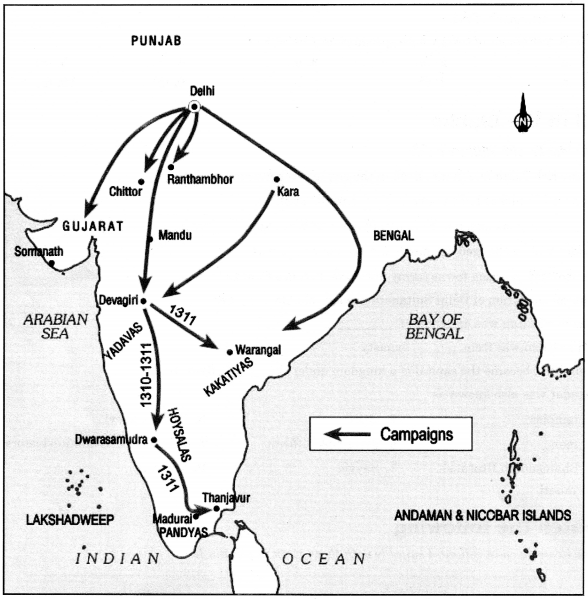
Map-Based Questions Class 7 History Chapter 3 The Delhi Sultans

Question 1.
Show the campaign of Alauddin Khalji’s into south India.
Answer:
Class 7 History Chapter 3 Extra Questions and Answers The Delhi Sultans

Class 6 Geography Chapter 6 Extra Questions and Answers Major Landforms of the Earth

Major Landforms of the Earth Class 6 Geography Chapter 6 Extra Questions and Answers Social Science CBSE Pdf free download are part of Extra Questions for Class 6 Social Science. Here we have given NCERT Extra Questions for Class 6 Social Science SST Geography Chapter 6 Major Landforms of the Earth.

You can also practice NCERT Solutions for Class 6 Geography Chapter 6 Questions and Answers on LearnInsta.com.

Class 6 Geography Chapter 6 Extra Questions and Answers Major Landforms of the Earth

Major Landforms of the Earth Class 6 Extra Questions and Answer Geography Chapter 6 Very Short Answers Type

Question 1.
How is the surface of Earth?
Answer:
The surface of the Earth is infinite variety of landforms.

Question 2.
What is Erosion?
Answer:
The wearing away of the Earth’s surface is called ‘erosion’. The surface is being lowered by the process of erosion.

Question 3.
What is Deposition?
Answer:
The surface of Earth is rebuilt by the process of‘deposition’.

Question 4.
What are the reasons of erosion and deposition?
Answer:
Erosion and deposition are carried out by running water, ice and wind.

Question 5.
What are glaciers?
Answer:
In some mountains, there are permanently frozen rivers of ice. They are called ‘glaciers’.

Question 6.
Why do less people live in the mountain areas? .
Answer:
Less people live in the mountain areas because of harsh climate.

Question 7.
Why is less land available for farming in the mountain areas?
Answer:
Less land is available for farming because of steep slopes.

Question 8.
What do you mean by word ‘range’?
Answer:
Mountains arranged in a line is known as range.

Question 9.
Are all mountains similar?
Answer:
No, all mountains are not similar. Mountains vary in their heights and shape and also may differ on their nature of formation.

Question 10.
Name the types of mountains.
Answer:
There are three types of mountains, which are:

  1. Fold Mountains
  2. Block Mountains
  3. Volcanic Mountains.

Question 11.
How are Block mountains created?
Answer:
Block Mountains are created when large areas are broken and displaced vertically.

Question 12.
What do you mean by ‘horsts’ and ‘graben’?
Answer:
In the formation of Block Mountains, the uplifted blocks are termed as horsts’ and lower blocks are called ‘graben’.

Question 13.
How are Volcanic mountains formed?
Answer:
Volcanic mountains are formed due to volcanic activity.

Question 14.
Name the oldest plateau of India.
Answer:
It is Deccan plateau.

Major Landforms of the Earth Class 6 Extra Questions and Answer Geography Chapter 6 Short Answers Type

Question 1.
How is the surface of the Earth?
Answer:
The surface of the Earth is not the same everywhere. The Earth has an infinite variety of landforms. Some parts of the lithosphere may be rugged and some flat.

Question 2.
How are the landforms made?
Answer:
Landforms are a result of two processes. The ‘internal process’ leads to the upliftment and sinking of the Earth’s surface. Second, the external process is the continuous wearing down and rebuilding of the land surface.

Question 3.
Define the term erosion and deposition.
Answer:
Erosion and Deposition: The wearing away of the Earth’s surface is called ‘erosion’. The surface is being lowered by the process of erosion and rebuilt by the process of‘deposition’.

Question 4.
What do you mean by internal process and external process?
Answer:
Landforms are a result of two processes. The ‘internal process’ leads to the upliftment and sinking of the Earth’s surface. Second, the external process is the continuous wearing down and rebuilding of the land surface.

Question 5.
What are plateau? Write few lines about it.
Answer:
A plateau is an elevated flat land. It is a flat-topped table land standing above the surrounding area. A plateau may have one or more sides with steep slopes. These may be young or old, hundred metres to several thousand metres. The ‘Tibet plateau’ is the highest plateau in the world. Plateaus are very useful because they are rich in mineral deposits.

Question 6.
How the plains formed?
Answer:
The process of formation of plains is a long process. Most of the plains are formed by rivers and their tributaries. In this process, the rivers flow down the slopes of mountains and erode them. They carry forward the eroded material. They deposit their load consisting of stones, and silt along their courses and in their valleys. These deposits form plains.

Major Landforms of the Earth Class 6 Extra Questions and Answer Geography Chapter 6 Long Answers Type

Question 1.
Describe major landforms.
Answer:
The major landforms are mountains, plateaus and plains. Details are given as under:
(i) Mountains: Mountain is natural elevation of the Earth surface. The mountains may have a small peak and a broad base. Less people live in the mountain areas because of harsh climate. Less land is available for farming because of steep slopes. Mountains may vary in their heights and shape. There are three types of mountains:

  1. Fold Mountains
  2. Block Mountains
  3. the Volcanic Mountains.

Fold mountains are formed due to the processes of erosion. Block mountains are created when large areas are broken and displaced vertically. Volcanic mountains are formed due to volcanic activity. Mountains are very useful.

(ii) Plateau: A plateau is an elevated flat land. It is a flat-topped table land standing above the surrounding area. A plateau may have one or more sides with steep slopes. These may be young or old, hundred metres to several thousand metres. The Tibet plateau is the highest plateau in the world. Plateaus are very useful because they are rich in mineral deposits.

(iii) Plains: Plains are large stretches of flat land. Most of the plains are formed by rivers and their tributaries. Some of the largest plains made by the rivers are found in Asia and North America. Generally, the plains are very fertile, easy to transport. Thus, these are thickly populated regions of the world. In Asia, plains are formed by the Ganga and the Brahmaputra in India and the Yangtze in China. Plain areas are useful for habitation.

Question 2.
Write a short note on the use of plateau.
Answer:
Plateaus are very useful. These are rich in mineral deposits. As a result, many of the mining areas in the world are located in the plateau areas. The African plateau is famous for gold and diamond mining.

In India huge reserves of iron, coal and manganese are found in the Chhotanagpur plateau. Plateaus’ lava are rich in black soil that are fertile and good for cultivation. Many plateaus have scenic spots and are of great attraction to tourists.

Question 3.
How are the mountains useful?
Answer:
Yes, mountains are very useful. The utility of the mountains can be summarized as under:

  1. These are storehouse of water.
  2. Many rivers have their source in the glaciers in the mountains.
  3. Reservoirs are made and the water is harnessed for the use of people.
  4. Mountains provides water for irrigation
  5. Provides water for generation of hydroelectricity.
  6. Mountains have a rich variety of flora and fauna. These provide fuel, fodder, shelter and other products like gum, raisins etc.
  7. Mountains provide an idyllic site for tourists etc.

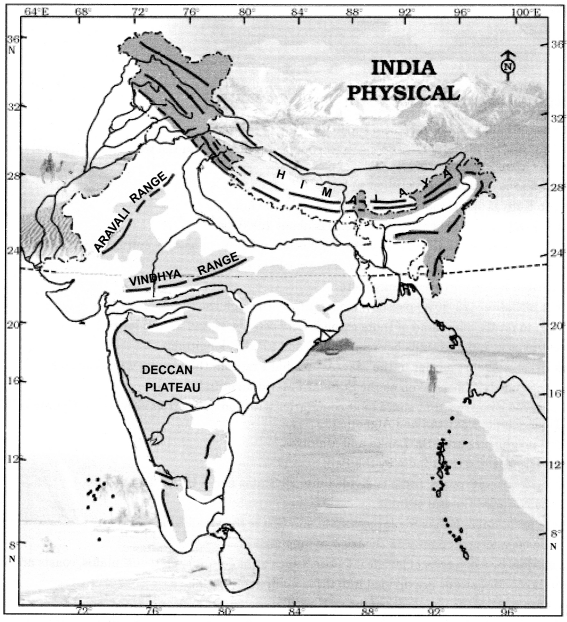
Picture Based Questions Class 6 Geography Chapter 6 Major Landforms of the Earth

Question 1.
Find out where are the following situated in the map.

  1. Himalaya Mt.
  2. Vindhya Range
  3. Aravali Range
  4. Deccan Plateau

Answer:
Class 6 Geography Chapter 6 Extra Questions and Answers Major Landforms of the Earth

Class 6 History Chapter 8 Extra Questions and Answers Ashoka, The Emperor Who Gave Up War

Ashoka, The Emperor Who Gave Up War Class 6 History Chapter 8 Extra Questions and Answers Social Science CBSE Pdf free download are part of Extra Questions for Class 6 Social Science. Here we have given NCERT Extra Questions for Class 6 Social Science SST History Chapter 8 Ashoka, The Emperor Who Gave Up War.

You can also practice NCERT Solutions for Class 6 History Chapter 8 Questions and Answers on LearnInsta.com.

Class 6 History Chapter 8 Extra Questions and Answers Ashoka, The Emperor Who Gave Up War

Ashoka, The Emperor Who Gave Up War Class 6 Extra Questions and Answer History Chapter 8 Very Short Answers Type

Question 1.
When was Maury an Empire founded?
Answer:
About 2300 years ago.

Question 2.
Who was the founder of the Mauryan Empire?
Answer:
Chandragupta Maurya was the founder of the Mauryan Empire.

Question 3.
Who provided support to Chandragupta?
Answer:
A wise man named Chanakya or Kautilya supported Chandragupta.

Question 4.
Name the book written by Chanakya.
Answer:
Chanakya wrote a book called the Arthashastra.

Question 5.
Name the capital of the Mauryan Empire.
Answer:
It was Pataliputra.

Question 6.
Which city was called gateway to the north-west?
Answer:
Taxila was called gateway to the north-west.

Question 7.
What do you understand about ‘dynasty’?
Answer:
When members of the same family become rulers one after another, the family is often called a dynasty.

Question 8.
Which area was in direct control of the Emperor?
Answer:
The area around Pataliputra was under the direct control of the emperor.

Question 9.
Why did the officials punish the people?
Answer:
Officials punished the people who disobeyed the ruler’s orders.

Question 10.
Name the provincial capital of the Mauryan Empire?
Answer:
Taxila and Ujjain were the provincial capitals.

Question 11.
What do you understand about ‘Tribute’?
Answer:
Tribute was unlike tax and it was collected as and when it was possible from people who gave a variety, of things, more or less willingly.

Question 12.
Who was Megasthenes?
Answer:
Megasthenes was an ambassador who was sent to the court of Chandragupta by the Greek ruler Seleucus Nicator.

Question 13.
How many towers were there in Pataliputra as per Megasthenes?
Answer:
In Pataliputra, there were 570 towers.

Question 14.
Name the countries to which the messengers were sent to spread the ideas of dhamma.
Answer:
The messengers were sent to Syria, Egypt, Greece and Sri Lanka.

Ashoka, The Emperor Who Gave Up War Class 6 Extra Questions and Answer History Chapter 8 Short Answers Type

Question 1.
Name the rulers of the Mauryan dynasty?
Answer:
The first ruler and founder of the Mauryan Empire was Chandragupta Maurya, after Chandragupta
his son Bindusara became emperor and after Bindusara, his son Ashoka was the ruler of the Mauryan dynasty.

Question 2.
Why was it important to control roads and rivers for the Mauryan Empire?
Answer:
There were vast areas between the provincial capitals. The Mauryas tried to control roads and rivers, which were important for transportation and to collect whatever resources were available as tax and tribute.

Question 3.
What was written by Megasthenes about Pataliputra?
Answer:
About Pataliputra, he wrote:
“Pataliputra is a large and beautiful city; it is surrounded by a massive wall. It has 570 towers and 64 gates. The houses of two and three storeys are built of wood and mud brick. The king’s palace is also of wood, and decorated with stone carvings. It is surrounded with gardens and enclosures for keeping birds.

Question 4.
What was Ashoka’s dhamma?
Answer:
Ashoka’s dhamma did not involve worship of a god, or performance of a sacrifice. He felt that just as a father tries to teach his children, he had a duty to instruct his subjects.

Question 5.
What was the duty of dhamma mahamattas?
Answer:
Dhamma mahamattas were appointed for the teaching of the people in the regime of Ashoka. They went from place to place teaching people about dhamma.

Question 6.
Which work of Ashoka indicates that he was a humanitarian?
Answer:
He built roads, dug wells and built rest houses etc. Apart from these works, his most humanitarian works were arrangement for medical treatment not only for the human beings but also for the animals.

Ashoka, The Emperor Who Gave Up War Class 6 Extra Questions and Answer History Chapter 8 Long Answers Type

Question 1.
What was written by Megasthenes about the Emperor?
Answer:
Megasthenes wrote that:
“The occasions on which the emperor appears in public are celebrated with grand royal processions. He is carried in a golden palanquin. His guards ride elephants decorated with gold and silver. Some of the guards carry trees on which live birds, including a flock of trained parrots, circle about the head of the emperor.

The king is normally surrounded by armed women. He is afraid that someone may try to kill him. He has special servants to taste the food before he eats. He never sleeps in the same bedroom for two nights.”

Question 2.
How did Ashoka become a great emperor?
Answer:
Ashoka became a great emperor because he was a wise and kind person and he had done many work for the welfare of general public. First time, Something was arranged for the treatment of the ill people. He also made arrangements for the treatment of animals. He tried to take his message to the people through inscriptions. He also tried to sort out the matter of conflicts. The most important work done by Ashoka was to give up the war after winning the Kalinga.

Question 3.
What was the message given by Ashoka for the betterment of society?
Answer:
People performed a variety of rituals when they fell ill, children got married, children were bom or when they started journey. Ashoka thought that rituals were not useful. People should observe other practices, these are:

  • Being gentle with slaves and servants.
  • Respecting one’s elders.
  • Treating all creatures with compassion.
  • Giving gifts to brahmins and monks.
  • It is both wrong to praise one’s own religion or criticize another’s.

Each one should respect the other’s religion. If one praises one’s own religion while criticizing another’s, one is actually doing greater harm to one’s own religion. Therefore, one should try to understand the main ideas of another’s religion and respect it.

Question 4.
Why did Ashoka give up wars after winning Kalinga?
Or
Why did Ashoka adopt dhamma?
Answer:
In this regard, Ashoka wrote in his inscriptions that he saw about 1.5 lakh people were captured and more than one lakh were killed in Kalinga war, this filled him with sorrow. The people who were kind to their relatives and friends died or lost their loved ones. That is why, he was sad and decided to observe dhamma. He decided on no war for winning.

Picture Based Questions Class 6 History Chapter 8 Ashoka, The Emperor Who Gave Up War

Class 6 History Chapter 8 Extra Questions and Answers Ash oka, The Emperor Who Gave Up War 1
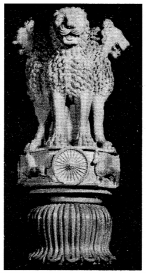
(a) Do you know what is this picture is called?
(b) From where is it taken?
(c) What is importance of this?
Answer:
(a) This is known as emblem
(b) This has been taken from a massive stone pillar situated at Sarnath near to the Varanasi, Uttar Pradesh. This is an upper part of stone wherein four lions are made.
(c) This is adopted as a national symbol. Government of India is using this as Logo. This symbol is used on stamp papers, letter heads of Members of Parliament, President and Vice President of India and many more dignitaries and on each Indian currency whether it is in form of papers or coins.

Map-Based Questions Class 6 History Chapter 8 Ashoka, The Emperor Who Gave Up War

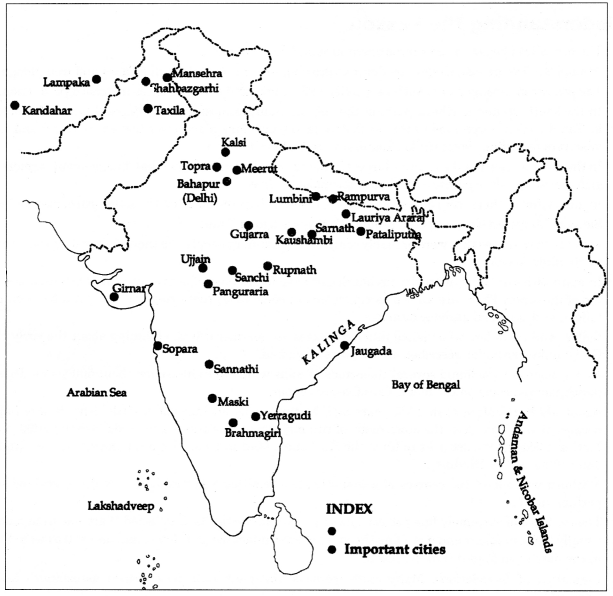
1. Find out following principal cities of Mauryan Empire on the Map.
(i) Pataliputra
(ii) Ujjain
(iii) Taxila

2. Find out following places where inscriptions were found
(i) Sarnath
(ii) Sanchi
(iii) Brahmagiri
Answer:
Class 6 History Chapter 8 Extra Questions and Answers Ash oka, The Emperor Who Gave Up War 2

Class 6 Geography Chapter 4 Extra Questions and Answers Maps

Maps Class 6 Geography Chapter 4 Extra Questions and Answers Social Science CBSE Pdf free download are part of Extra Questions for Class 6 Social Science. Here we have given NCERT Extra Questions for Class 6 Social Science SST Geography Chapter 4 Maps.

You can also practice NCERT Solutions for Class 6 Geography Chapter 4 Questions and Answers on LearnInsta.com.

Class 6 Geography Chapter 4 Extra Questions and Answers Maps

Maps Class 6 Extra Questions and Answer Geography Chapter 4 Very Short Answers Type

Question 1.
What is a map?
Answer:
A map is a representation or a drawing of the Earth’s surface or a part of it drawn on a flat surface according to a scale.

Question 2.
What is Atlas?
Answer:
A collection of many maps in the form of book is called an Atlas.

Question 3.
Name the types of maps.
Answer:
Maps are of different types such as Physical Maps, Political Maps, Thematic Maps.

Question 4.
Name the components of maps.
Answer:
There are three component of maps- (i) distance (ii) direction and (iii) symbol

Question 5.
Why is scale needed in the map formation?
Answer:
A scale is needed to represent a large distance in a small distance on paper.

Question 6.
What is scale?
Answer:
Scale is the ratio between the actual distance and the distance shown on the map.

Question 7.
What are the Direction Maps?
Answer:
Direction maps help us to find out a place.

Question 8.
What are four major directions?
Answer:
There are four major directions – North, South, East and West. .

Question 9.
What do you know about cardinal points?
Answer:
Major directions – North, South, East and West are called cardinal points.

Question 10.
Give the name of intermediate directions.
Answer:
Intermediate directions are – North-East(NE), South-East(SE), South-West (SW), and North-West (NW).

Question 11.
What is compass?
Answer:
Compass is a magnetic instrument. It is used to find out directions.

Question 12.
What are conventional symbols?
Answer:
There is an international agreement regarding use of the symbols on maps. Symbols, fixed through International agreement, are called conventional symbols.

Question 13.
Why do we use colours on the maps?
Answer:
Different colours are used on the map for presenting different things or objects.

Question 14.
What is a sketch?
Answer:
Sketch is a drawing mainly based on memory and spot observation and not according to scale.

Question 15.
What is a plan?
Answer:
Plan is a drawing of a small area on a large scale.

Maps Class 6 Extra Questions and Answer Geography Chapter 4 Very Short Answers Type

Question 1.
How are maps useful for us?
Answer:
Maps are useful to us for various purposes. One map shows a small area and a few facts. Another map may contain as many facts as a big book. The purposes can be summarized as under:

  1. Showing mountains, plateaus, plains, rivers, oceans etc.
  2. Showing cities, towns and villages, states, countries etc.
  3. Showing roads, rainfall, forests, industries etc.

Question 2.
What do you understand about Small Scale Maps?
Answer:
When large areas like continents or countries are to be shown on a paper, then we use a small scale and it is called a small scale map. In the small scale map, we use large distances like hundreds of km in some cm. or mm.

Question 3.
What do you mean by Large Scale Maps?
Answer:
When a small area like village or town is to be shown on paper, then we use a large scale and it is called large scale map. In the large scale map we use distance of metres in some cm. or mm.

Question 4.
What is compass and how does it work?
Answer:
Compass is a magnetic instrument. We can find out the direction of a place with the help of a compass. It is used to find out directions. It has a magnetic needle which always points towards north-south direction.

Question 5.
Why are symbols used?
Answer:
Everything or every object cannot be represented on the paper. For this purpose, symbols are used. Symbol contains letters, shades, colours, pictures, lines etc.

Question 6.
What are conventional symbols?
Answer:
Maps have a universal language that can be understood by all. There is an international agreement regarding the use of these symbols. These are called conventional symbols.

Question 7.
What are the uses of colours in the maps?
Answer:
Various colours are used in the map for presenting things or objects. For example, blue is used for showing water bodies, brown for mountain, yellow for plateau and green for plains.

Maps Class 6 Extra Questions and Answer Geography Chapter 4 Long Answers Type

Question 1.
Describe different types of Maps.
Answer:
The maps are used for various purposes. One map shows a small area and a few facts. Another map may contain as many facts as a big book. When many maps are put together we get an Atlas. There are different types of maps; some of them are described below:

  1. Physical Maps or Relief maps: The Maps showing natural features of the Earth such as mountains, plateaus, plains, rivers, oceans etc., are called physical or relief maps.
  2. Political Maps: Maps showing cities, countries, states, towns and villages with their boundaries are called political maps.
  3. Thematic Maps: Some maps focus on specific information such as roads, maps, rainfall maps, maps showing distribution of forests, industries etc., Eire known as thematic maps.

Question 2.
What are the components of Maps? Describe them.
Answer:
There are three components of Maps:
(i) Distance: Distance is an important component for those maps which are drawn to show the distance between the places. The actual distance between the places or objects can be measured by the map. To show the actual distance on the paper is a sensitive work and hence it is done very carefully. In this process, we choose a scale.

Suppose, we have to show distance between the Government School and Hospital of a village; distance between both is 500 metres. We will have to opt for a scale, that may be 200 metres = 1 cm. Therefore, the distance on map will be shown 2.5 cm. When there are large areas such as hundreds of km or thousands of km, we will have to choose a scale. Suppose, 100 km = 1 cm or 1mm etc. The scale is chosen in view of map’s size.

(ii) Direction: Direction is also an important component for the maps. The accurate directions make the maps useful which is made for the same purpose. On the upper right comer of the maps symbol of arrow marked with the letter ‘N’ is represented. There are four major directions-North, South, East and West. These are called cardinal points. Other four intermediate directions are – North- East(NE), South-East(SE), South-West (SW), and North-West (NW). These intermediate directions help us to locate any place more accurately.

(iii) Symbols: Third important component of maps is symbol. It is not possible to show each and every thing on the maps, hence many things or objects or places are shown with the help of symbols. We can show Railway Line, Roads, Boundary, Rivers, Temples, Post office, Police Station, Settlements, Graveyard, forest areas, trees, grass etc., with the help of symbols.

One of the important features of the maps is that the maps have universal language that can be understood by all. There is an international agreement regarding the use of these symbols. These are called conventional symbols.

Picture Based Questions Class 6 Geography Chapter 4 Maps

Class 6 Geography Chapter 4 Extra Questions and Answers Maps 1Question 1.
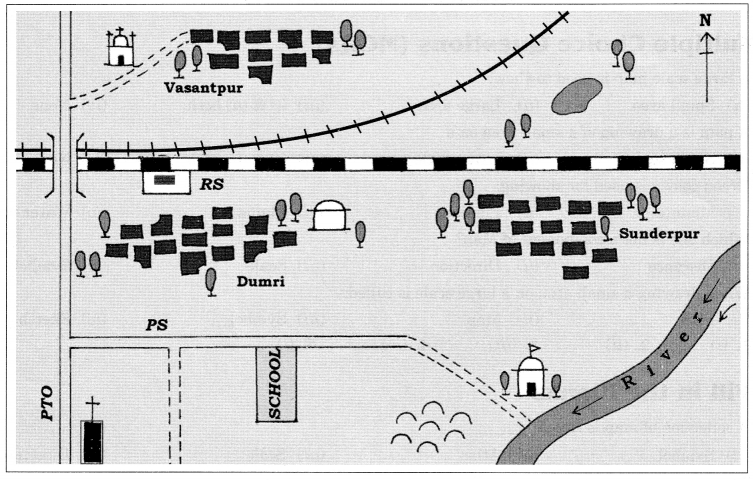
Look at the Picture given above and find out.
(i) In which direction is the river flowing?
(ii) What Kind of road passes by the side of village Dumri?
(iii) On what type of railway line is Sunderpur situated?
(iv) On which side of railway bridge is the police station situated?
(v) On which side of railway line do the following lie?
(a) Chhatri
(b) Church
(c) Pond
(d) Mosque
(e) River
(f) Post and Telegraph office
(g) Graveyard

Answer:
(i) The river is flowing eastern to southern side.
(ii) Metalled Road
(iii) Broad guage
(iv) North side
(v) (a) South
(b) South
(c) North to the Broad gauge and south to the Metre gauge
(d) North
(e) South
(f) South
(g) South

Question 2.
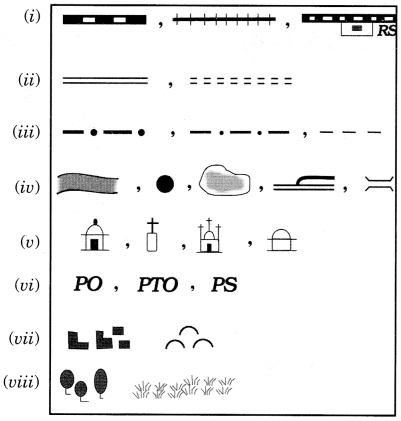
Look the picture carefully given below and find out:
Class 6 Geography Chapter 4 Extra Questions and Answers Maps 2
(ii) Roads
(iii) Boundary
(iv) River, Well, Tank, Canal, Bridge
(v) Temple, Church, Mosque, Chhatri
(vi) Post Office, Post and Telegraph Office, Police Station
(vii) Settlement, Graveyard
(viii) Trees, Grass

Broad gauge, Metre Guage, Railway sation
Metalled, Unmetalled
International, State, District