Class 7 History Chapter 6 Extra Questions and Answers Towns, Traders, and Craftsperson

Towns, Traders, and Craftsperson Class 7 History Chapter 6 Extra Questions and Answers Social Science CBSE Pdf free download are part of Extra Questions for Class 7 Social Science. Here we have given NCERT Extra Questions for Class 7 Social Science SST History Chapter 6 Towns, Traders, and Craftsperson.

You can also practice NCERT Solutions for Class 7 History Chapter 6 Questions and Answers on LearnInsta.com.

Class 7 History Chapter 6 Extra Questions and Answers Towns, Traders, and Craftsperson

Towns, Traders, and Craftsperson Class 7 Extra Questions and Answer History Chapter 6 Very Short Answers Type

Question 1.
Why was Thanjavur famous?
Answer:
Thanjavur was famous because it was capital of the Cholas dynasty.

Question 2.
Name the river which was flowed near Thanjavur.
Answer:
Kaveri river flowed near the town Thanjavur.

Question 3.
Who built Raj arajeshvara temple?
Answer:
Rajarajeshvara temple built by King Rajaraja Chola.

Question 4.
Name the activities held by the king in the towns.
Answer:
Kings held court in mandaps, issuing orders to their subordinates. There are also barracks for the army.

Question 5.
What were the market activities in towns?
Answer:
The towns were bustling with markets selling grains, spices, cloth and jewellery.

Question 6.
How did water get supplied in the town?
Answer:
Water was supplied in the town from wells and tanks.

Question 7.
Name the places which were famous for producing cloth.
Answer:
Thanjavur and the nearby town Uraiyur were famous for producing cloth.

Question 8.
What was the use of clothes in the temples?
Answer:
The cloth was used in the temples as flags.

Question 9.
Which kind of cotton was used by the kings?
Answer:
Fine cotton was used by the kings.

Question 10.
What do you mean by the ‘pattern of urbanization’?
Answer:
Pattern of urbanization is a process by which cities are developed.

Question 11.
Why were temples built by the kings?
Answer:
Kings built temples to demonstrate their devotion to various deities.

Question 12.
Name the capital of the Chauhan reign.
Answer:
Ajmer was the capital of the Chauhan reign.

Question 13.
Who was Khwaja Muinuddin Chishti?
Answer:
Khwaja Muinuddin Chishti was a famous Sufi Saint settled in Ajmer.

Question 14.
Name the communities which were included in the Gujarati traders.
Answer:
Gujarati traders, included the communities of Hindu Baniyas and Muslim Bohras.

Question 15.
What did Gujarati traders use to sell?
Answer:
They sold textiles and spices.

Question 16.
Which spices were grown in the tropical climates?
Answer:
Spices such as pepper, cinnamon, nutmeg, dried ginger etc., grown in tropical climates.

Question 17.
Why were craftspersons of Bidar so famous?
Answer:
The craftspersons of Bidar were so famed for their inlay work in copper and silver.

Question 18.
What is Bidri?
Answer:
Inlay work on metal of‘Bidar’ craftspersons is called ‘Bidri’.

Question 19.
When did Hampi fall into ruin?
Answer:
Hampi fell into ruin following the defeat of Vijayanagara in 1565 by the Deccani Sultans.

Question 20.
Name the city which was gateway for trade with West Asia via the Gulf of Ormuz.
Answer:
Surat was the gateway for trade with West Asia via the Gulf of Ormuz.

Question 21.
Which city was called the gate to Mecca, and why?
Answer:
Surat was called gate to Mecca because many pilgrims used this place to visit Mecca.

Question 22.
What were the facilities available in Surat?
Answer:
There were rest-houses, magnificent buildings and innumerable pleasure parks.

Question 23.
Who had banking houses at Surat?
Answer:
The Kathiawad seths or mahajans had huge banking houses at Surat.

Question 24.
What was importance of Hundis in Surat?
Answer:
Surat hundis were honoured in the far-off markets of Cairo in Egypt, Basra in Iraq and Antwerp in Belgium.

Question 25.
When did Surat begin to decline?
Answer:
Surat began to decline towards the end of the 17th century.

Towns, Traders, and Craftsperson Class 7 Extra Questions and Answer History Chapter 6 Short Answers Type

Question 1.
What were the functions of the medieval town?
Answer:
Medieval town combined several functions-they were administrative centres, temple towns, as well as centres of commercial activities and craft production.

Question 2.
Why did the Kings donate land and money to the temples?
Answer:
Kings donated land and money to the temples to carry out elaborate rituals, feed pilgrims and priests and celebrate festivals.

Question 3.
How were temple towns grown?
Answer:
Temple authorities used their wealth to finance trade and banking. Gradually a large number of priests, workers, artisans, traders etc., settled near the temple to cater to its needs and those of the pilgrims and thus grew temple towns.

Question 4.
Which cities or towns were developed around the temples?
Answer:
Bhillasvamin (Madhya Pradesh), Somnath (Gujarat), Kanchipuram, Tiruvannamalai and Madurai (Tamil Nadu), Tirupati (Andhra Pradesh), Vrindavan (Uttar Pradesh) etc., towns were developed around the temples.

Question 5.
What do you understand by ‘temple towns’?
Answer:
Temple towns are settlements where towns are famous for existence of temple. In these towns people mainly gather to demonstrate their devotion.

Question 6.
Why did samanta or zamindars build the temples?
Answer:
Samanta or zamindars built the temples to charge taxes on traders, artisans and articles of trade and sometimes ‘donated’ the ‘right’ to collect these taxes to local temples, which had been built by them-selves.

Question 7.
In which form were the taxes collected during the period? Name some of the items which were covered under tax.
Answer:
Taxes were collected in kind or in cash. Taxes were levied on sugar and jaggery, dyes, thread, cotton, on coconuts, salt, butter, seasame oil, on cloth, metal goods, distillers, cattle fodder and on loads of grain.

Question 8.
What items were brought by Gujarati traders?
Answer:
Gujarati traders brought:

  • Gold and ivory from Africa and
  • Spices, tin, Chinese blue pottery and silver from Southeast Asia and China.

Question 9.
What were the works performed by the Vishwakarma community?
Answer:
The Vishwakarma community, consisting of goldsmiths, bronzesmiths, blacksmiths, masons and carpenters were essential to the construction of buildings of temples, palaces, big buildings, tanks and reservoirs.

Question 10.
Name the works performed by the weavers.
Answer:
Weavers such as the Saliyar or Kaikkolars perfomed cloth making like cotton cleaning, spinning and dyeing and became specialized and independent crafts.

Question 11.
What was main feature of Surat port at that time?
Answer:
In 17th century there were many factories and warehouses at Surat. On an average a hundred ships of different countries could be found at the port at any time.

Question 12.
Describe the cotton textiles in Surat during 17th century.
Answer:
In the Surat, there were several retail and wholesale shops selling cotton textiles. The textiles of Surat were famous for their gold lace borders (zari) and had a market in West Asia, Africa and Europe.

Question 13.
What attracted the Europeans?
Answer:
Spices such as pepper, cinnamon, nutmeg, dried ginger etc., became an important part of European cooking and they were also attracted towards cotton cloth.

Question 14.
What were the reasons for decline of Surat?
Answer:
This was because of two main reasons:

  • The loss of markets and productivity because of the decline of the Mughal Empire
  • Headquarters of East India Company shifted to Bombay.

Rulers and Buildings Class 7 Extra Questions and Answer History Chapter 6 Long Answers Type

Question 1.
Write a note on Hampi including its construction, commercial and cultural activities.
Answer:
Hampi is located in the Krishna-Tungabhadra basin, which formed the nucleus of the Vijayanagara Empire, founded in 1336. It is a well-fortified city. No mortar or cementing agent was used in the construction of these walls and technique followed was to wedge them together by interlocking.

Hampi was a busy place with commercial and cultural activities. Moors (Muslim merchants), Chettis and European traders joined the markets of Hampi.

Devadasis performed before the deity, royalty and masses in the Virupaksha (a form of Shiva) temple. The Mahanavami festival (now known as Navaratri) was one of the most important festivals celebrated at Hampi. King also participated in the Mahanavami festival and received guests and accepted tribute from subordinate chiefs.

Question 2.
How were the large villages developed in towns?
Answer:
Gradually, the large villages developed in towns. Once a big temple or Saint etc., was established, the devotees started together and stay there. The priest, workers, artisans, handicraftsmen, flower sellers, traders etc., settled near the temple to cater the needs of devotees or pilgrims. Thus, gradually towns were developed.

Question 3.
Write a short note on Masulipatnam.
Answer:
The town of Masulipatnam lay on the delta of the Krishna river. In the 17th century, it was a centre of intense activity. Both the Dutch and English East India Companies attempted to control Masulipatnam as it became the most important port on the Andhra coast.

The fort at Masulipatnam was built by the Dutch. Various trading groups-the Golconda nobles, Persian Merchants, Telugu Komati Chettis, and European traders made the city populous and prosperous.

Question 4.
What was importance of craftspersons in building the temples?
Answer:
The craftspersons of Bidar were so famed for their inlay work in copper and silver that it came to be called Bidri. The Panchalas or Vishwakarma community, consisting of goldsmiths, bronze-smiths, blacksmiths, masons and carpenters, were essential to the building of temples.

The also played an important role in the construction of palaces, big buildings, tanks and reservoirs. Similarly, weavers such as the Saliyar or Kaikkolars emerged as prosperous communities, making donations to temples.

Question 5.
Describe the activities which were performed at Surat.
Answer:
Surat (Gujarat) was the emporium of western trade during the Mughal period along with Cambay |(Khambat) and somewhat later, Ahmedabad. Surat was the gateway for trade with West Asia via the Gulf of Ormuz. Surat has also been called the gate to Mecca because many pilgrims used this place for sailing to Mecca.

In the Surat city, there was cosmopolitan culture and people of all castes and creeds lived there. In 17th century, there were many factories and warehouses at Surat. On an average a hundred ships of different countries could be found at the port at any time.

In the Surat, there were several retail and wholesale shops selling cotton textiles. The textiles of Surat were famous for their gold lace borders (zari) and had a market in West Asia, Africa and Europe. There were rest-houses, magnificent buildings and innumerable pleasure parks.

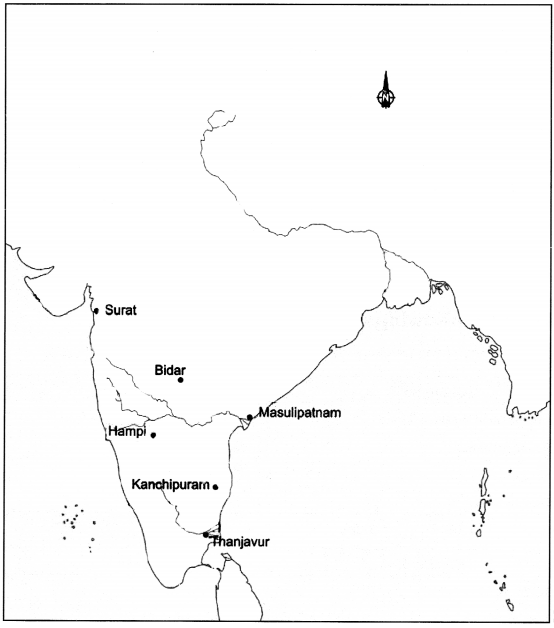
Map-Based Questions Class 7 History Chapter 6 Towns, Traders, and Craftsperson

Question 1.
Indicate the following places in the map:

  1. Masulipatnam
  2. Hampi
  3. Surat
  4. Bidar
  5. Thanjavur
  6. Kanchipuram

Answer:
Class 7 History Chapter 6 Extra Questions and Answers Towns, Traders, and Craftsperson

Class 6 Geography Chapter 1 Extra Questions and Answers The Earth in the Solar System

The Earth in the Solar System Class 6 Geography Chapter 1 Extra Questions and Answers Social Science CBSE Pdf free download are part of Extra Questions for Class 6 Social Science. Here we have given NCERT Extra Questions for Class 6 Social Science SST Geography Chapter 1 The Earth in the Solar System.

You can also practice NCERT Solutions for Class 6 Geography Chapter 1 Questions and Answers on LearnInsta.com.

Class 6 Geography Chapter 1 Extra Questions and Answers The Earth in the Solar System

The Earth in the Solar System Class 6 Extra Questions and Answer Geography Chapter 1 Very Short Answers Type

Question 1.
Why can’t we see all the objects in the sky?
Answer:
We can not see all the objects in the sky because the Sun does not allow us to see all the objects because of its bright light.

Question 2.
What are celestial bodies?
Answer:
Celestial bodies are those objects which are shining in the sky.

Question 3.
What is the nature of celestial bodies?
Answer:
Some may be big or hot.

Question 4.
What are stars?
Answer:
Those celestial bodies having their own heat and light, which they emit in large amounts. These celestial bodies are called stars.

Question 5.
Why can’t heat or light of many stars be felt?
Answer:
Countless stars are very very far from us, so we do not feel their heat or light.

Question 6.
What are constellations?
Answer:
Different groups of stars form different patterns. These are called constellations.

Question 7.
What do you understand about Saptarishi?
Answer:
One of the most easily recognizable constellations is the small bear of Saptarishi (seven sages). It is a group of seven stars.

Question 8.
What do you mean by Pole Star?
Answer:
The North Star indicates the north direction. It is also called the Pole Star.

Question 9.
What are planets?
Answer:
Some celestial bodies do not have their own heat and light. They are lit by the light of the stars. Such bodies are called planets.

Question 10.
How many planets look like the Earth? From where do they get heat and light?
Answer:
There are eight other planets like the Earth that get heat and light from the Sun.

Question 11.
Who is the head of the solar family?
Answer:
The Sun is the head of the solar family?

Question 12.
What is the ultimate source of heat and light for the solar system?
Answer:
The Sun.

Question 13.
Which is recently located planet?
Answer:
The Pluto was recently located in 2006.

Question 14.
Which planet is called ‘dwarf planet?”
Answer:
The Pluto is called ‘dwarf planet’.

Question 15.
Which planet is called Blue Planet?
Answer:
The Earth is called Blue Planet.

Question 16.
How much water is on the Earth?
Answer:
2/3rd surface of Earth is covered by water.

Question 17.
Name of planet having maximum number of moons.
Answer:
Saturn is the planet having maximum number of moons. The total number of moons is 18.

The Earth in the Solar System Class 6 Extra Questions and Answer Geography Chapter 1 Short Answers Type

Question 1.
What is North Star?
Answer:
In ancient time, people looked for direction by the help of stars. North star always remains in the same position in the sky and that is above the north pole.

Question 2.
Why does the moon not support life?
Answer:
The moon does not have favourable condition for the life. There is neither water nor oxygen. In the day time, it is very hot, while at night, it become very cool. These conditions are not favourable for life. Hence, moon does not support life.

Question 3.
Differentiate between a Meteoroid and a Meteorite.
Answer:
Meteoroid starts to bum when it comes in the contact of the Earth’s atmosphere. A flash of light is produced due to the burning. Meteorite is not completely burnt when it falls on the Earth and creates a hollow which is called a meteorite.

Question 4.
What is a Galaxy?
Answer:
This is a huge system of stars. The white glowing path of stars across the sky is called the Milky Way Galaxy. Galaxy has millions of stars which are very close to one another. This is called ‘Akash Ganga’ in Hindi.

The Earth in the Solar System Class 6 Extra Questions and Answer Geography Chapter 1 Long Answers Type

Question 1.
Prepare a chart indicating planets, how these planets make up one orbit around the Sun, one spin on axis and number of moons on it.
Answer:

Name of the PlanetHow they are made upOne orbit around SunOne spin on-axisNo. of moon
MercuryRocks88 days59 days
Venus69 69255 days243 days
Earth69 69365 days1 day1
Mars(9 (9687 days1 day2
JupiterGases and liquids11 yrs & 11 months9 Hrs, 56 Min16
Saturn(9 6929 yrs 5 months10 Hrs, 40 Min18
Uranus69 6984 yrs17 hrs, 14 Min17
Neptune69 69164 yrs16 hrs 7 Min.8

Class 6 History Chapter 11 Extra Questions and Answers New Empires and Kingdoms

New Empires and Kingdoms Class 6 History Chapter 11 Extra Questions and Answers Social Science CBSE Pdf free download are part of Extra Questions for Class 6 Social Science. Here we have given NCERT Extra Questions for Class 6 Social Science SST History Chapter 11 New Empires and Kingdoms.

You can also practice NCERT Solutions for Class 6 History Chapter 11 Questions and Answers on LearnInsta.com.

Class 6 History Chapter 11 Extra Questions and Answers New Empires and Kingdoms

New Empires and Kingdoms Class 6 Extra Questions and Answer History Chapter 11 Very Short Answers Type

Question 1.
Who was Samudragupta?
Answer:
Samudragupta was a famous ruler of dynasty known as the Guptas around 1700 years ago.

Question 2.
Who was the founder of the Gupta dynasty?
Answer:
Chandragupta Maurya was the founder of Gupta dynasty.

Question 3.
Name the title which was used by the Gupta dynasty.
Answer:
They were known as Maharaj-adhiraja.

Question 4.
Who was Harishena?
Answer:
Harishena was poet and a minister in the court of Samudragupta.

Question 5.
Which were important centres of the Gupta’s regime?
Answer:
Prayaga, Ujjain and Pataliputra were important centres of the Gupta rulers.

Question 6.
What is new name of Prayag?
Answer:
Allahabad is new name of Prayag.

Question 7.
What do you know about mother and father of Samudragupta?
Answer:
Samudragupta’s mother’s name was Kumara Devi. She belonged to the Lichchhavi gana. His father’s name was Chandragupta, who was first ruler of the Gupta dynasty.

Question 8.
Who was Kalidasa?
Answer:
Kalidasa was a poet and was in the court of Chandragupta II.

Question 9.
Who was Aryabhata?
Answer:
Aryabhata was a famous astronomer and was in the court of Chandragupta II.

Question 10.
Who was Banbhatta?
Answer:
Banbhatta was a poet of Harshavardhana’s court.

Question 11.
Give the name of book written by Banbhatta.
Answer:
Banbhatta wrote a famous book called Harshacharita.

Question 12.
In which court did Xuan Zang spend a lot of time?
Answer:
Xuan Zang spent a lot of time in the court of Harshavardhana.

Question 13.
Which were dynasties in the South India?
Answer:
During the same period, in south India there were most important ruling dynasties—the Pallavas and Chalukyas.

Question 14.
Which was the capital of the Pallavas?
Answer:
Kanchipuram was the capital of the Pallavas.

Question 15.
Who was the best known Chalukya ruler?
Answer:
The best known Chalukya ruler was Pulakeshin-II.

Question 16.
Name the Chalukyas capital. Why was the capital famous?
Answer:
The Chalaukyas capital was Aihole. The capital was an important trading centre and a religious centre with a number of temples.

Question 17.
Where was reign of the Chalukyas situated?
Answer:
It was centered around the Raichur Doab, between the rivers Krishna and Tungabhadra.

Question 18.
Which dynasties raided one another?
Answer:
The Pallavas and Chalukyas frequently raided one another.

Question 19.
What do you understand about hereditary post?
Answer:
In the regime of some ruler, some important administrative posts were now hereditary. This means that sons succeeded fathers to these posts.

Question 20.
What was the Chief judicial officer called?
Answer:
He was called maha-danda-nayaka.

Question 21.
What was the Minister of war and peace called?
Answer:
He was called sandhi-vigrahika.

Question 22.
What was given by the king to the samantas for providing troops?
Answer:
The King provided lands to the samantas.

Question 23.
Which was the language used by the King and brahmins in regime of Guptas?
Answer:
As written by Kalidasa that king and most Brahmins used Sanskrit.

Question 24.
What do you understand about ‘ur* assembly?
Answer:
The W was a village assembly found in areas where the land owners were not brahmins.

Question 25.
What was ‘nagram’?
Answer:
‘Nagram’ was an organization of merchants.

New Empires and Kingdoms Class 6 Extra Questions and Answer History Chapter 11 Short Answers Type

Question 1.
Write a short note on new kind of army of this period.
Answer:
There were military leaders who provided the king with troops whenever he needed them. They were not paid regular salaries. Instead, some of them received grants of land. They collected revenue from the land and used this to maintain soldiers and horses, provide equipment for warfare. These men were known as samantas.

Question 2.
What was the system adopted by the Pallava rulers?
Answer:
In the Pallavas ruling, there were many local assemblies of Brahmin land owners. Assemblies functioned through sub-committees. These looked after irrigation, agricultural operations, making roads, local temples, etc.

Question 3.
How did the Islam come in India?
Answer:
Within a hundred years, Islam spread to north Africa, Spain, Iran and India. Arab sailors, who were already familiar with the coastal settlements of the subcontinent, brought the new religion with them. Arabs soldiers conquered Sind about 1300 years ago.

Question 4.
Describe the livelihood of Arabian people.
Answer:
Arab merchants and sailors played an important role in the sea trade between India and Europe. They lived in Arabia and were Bedouins, pastoral tribes depending mainly on camels as hardly any animal could survive in the desert.

New Empires and Kingdoms Class 6 Extra Questions and Answer History Chapter 11 Long Answers Type

Question 1.
Write a short note on the untouchability existing in the society as stated by the Fa Xian.
Answer:
The Chinese pilgrim Fa Xian noticed that there were problems existing for those who were treated as untouchables by the high and mighty. Untouchables were expected to live on the outskirts of the city. If such a man entered in a town or a market place, he/she was required to strike a piece of wood, in order to keep himself separate. People hearing this sound, knew what it meant and avoided touching him.

Question 2.
Write a short note on the teaching of Islam.
Answer:
Around 1400 years ago, Prophet Muhammad introduced a new religion, Islam, in Arabia. Islam was a religion that laid stress on the equality and unity of all. No one is supreme, but Allah, who is only one supreme God. No one has partnership with Allah. Neither he takes birth and nor dies. Anyone cannot see him but no one is out of reach of Allah.

Holy Quran is the book of Islam. As per Islam, the Muslims who believe in Islamic teaching, are devout, patient and constant, humble, gives charity to the poor or needy, who fast in love of Allah, guard their chastity, engage much in Allah’s remembrance and follow the path of Prophet etc., for them Allah prepared forgiveness and great rewards. Islamic teachings are very much broad which cover almost whole life activities.

Question 3.
Write a note on assemblies and their functions in the southern kingdoms.
Answer:
We find descriptions from inscriptions about the Pallavas regime. These assemblies included the ‘sabha’. Sabha was an assembly of Brahmin land owners. This assembly functions with the help of sub-committees. These sub-committees look into the work of irrigation, agriculture, road making, temple making etc. The ‘ur’ were assemblies at village level.

The ‘ur’ was in the areas where landowners were not Brahmins. An another type of assembly was in existence that was called nagaram, which was organization of merchants that were also controlled by rich and powerful landowners and merchants. No doubt, these assemblies played an important role in strengthening the kingdom.

Question 4.
Give the genealogies of the Gupta dynasty.
Answer:
The evidence of genealogy of the Gupta dynasty is found from an inscription. One prashasti mentions Samudragupta’s great grandfather, father and mother. His mother’s name was Kumara Devi. She belonged to the Lichchhavi gana.

His father Chandragupta was the ruler who adopted title of maharaj- adhiraj. His grandfather simply used maharaja. His son was Chandragupta-II who led to western India.

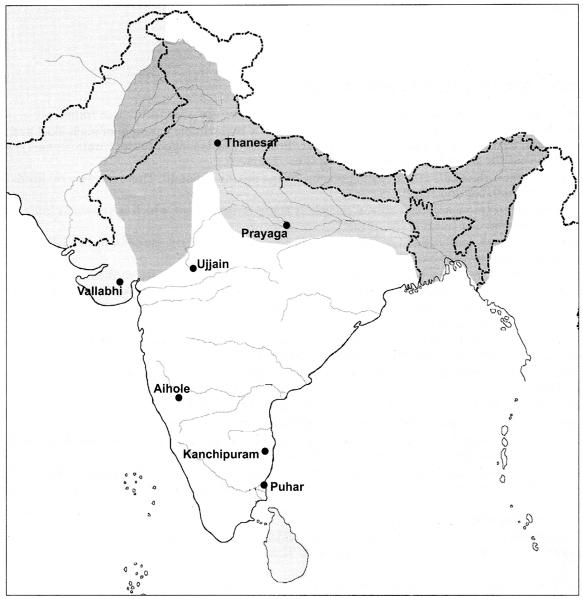
Map-Based Questions Class 6 History Chapter 11 Traders, Kings and Pilgrims

Question 1.
Indicate following locations in the map:
(a) Thanesar
(b) Kanchipuram
(c) Puhar
(d) Vallabhi
(e) Prayaga
(f) Ujjain
(g) Aihole
Answer:
Class 6 History Chapter 11 Extra Questions and Answers New Empires and Kingdoms

Class 6 Civics Chapter 1 Extra Questions and Answers Understanding Diversity

Understanding Diversity Class 6 Civics Chapter 1 Extra Questions and Answers Social Science CBSE Pdf free download are part of Extra Questions for Class 6 Social Science. Here we have given NCERT Extra Questions for Class 6 Social Science SST Civics Chapter 1 Understanding Diversity.

You can also practice NCERT Solutions for Class 6 Civics Chapter 1 Questions and Answers on LearnInsta.com.

Class 6 Civics Chapter 1 Extra Questions and Answers Understanding Diversity

Understanding Diversity Class 6 Extra Questions and Answer Civics Chapter 1 Very Short Answers Type

Question 1.
What do you mean by the word ‘diversity5?
Answer:
The people are dissimilar in various aspects like language, colour, height, food habits, clothes, living styles, customs, religions, regions, interest, culture, practices etc. This dissimilarity is called diversity.

Question 2.
Are we all similar?
Answer:
No, all are not similar. There are many differences existing in the society.

Question 3.
How is India a country of diversity?
Answer:
Languages, foods, festivals, religions, culture, customs are different. In this way, India is a country of diversities.

Question 4.
What are constant reminders of our rich traditions?
Answer:
Songs and symbols.

Question 5.
Give an example of diversity in India.
Answer:
The people of India, living in different parts, speak different languages.

Question 7.
Give one example of difference between Kerala and Ladakh.
Answer:
Kerala is a spices producer state while the Ladakh is sheep rearing region.

Question 8.
Which are the religions practised in Ladakh?
Answer:
Islam and Buddhism are practised in Ladakh.

Question 9.
Which are the religions practised in Kerala?
Answer:
Judism, Islam, Christianity, Hinduism and Buddhism are practised in Kerala.

Question 10.
What do you think Indian diversity is useful or harmful?
Answer:
Diversity of India is very useful for us. This diversity is beauty of India.

Question 11.
Who fought against the British rule?
Answer:
Men and women belonging from different regions, languages, religions, culture fought together
against the British rule.

Question 12.
Who wrote our National Anthem?
Answer:
National Anthem was written by Rabindranath Tagore.

Question 13.
Who wrote the book “The Discovery of India”?
Answer:
“The Discovery of India” was written by our first Prime Minister Pt. Jawaharlal Nehru.

Question 14.
Where is Ladakh situated?
Answer:
Ladakh is situated in eastern part of Jammu and Kashmir.

Question 15.
What do you mean by ‘Kesar Saga’.
Answer:
This is the local version of the Tibetan national epic sung by both Muslims and Buddhists of Ladakh.

Question 16.
Where is Kerala situated?
Answer:
Kerala is state in the south-west comer of India. It is surrounded by the sea on one side and hills on the other.

Question 17.
What do you understand about ‘cheena-vala’?
Answer:
The fishing nets used in Kerala look exactly like the Chinese fishing net and are called ‘cheena-vala’.

Question 18.
How were the songs and flags used during the freedom struggle?
Answer:
They were used as a symbol of protest against the British by people.

Question 19.
What is the similarity between Kerala and Ladakh?
Answer:
Both regions were influenced by Chinese and Arab traders.

Understanding Diversity Class 6 Extra Questions and Answer Civics Chapter 1 Short Answers Type

Question 1.
Which types of differences occur in the people?
Answer:
The people may be different on the basis of language, colour, height, food habits, clothes, living styles, customs, religions, regions, interest, culture, practices etc.

Question 2.
How does diversity exist in India?
Answer:
India is a country of much diversity. People of India speak different languages, have various types of food, celebrate different festivals, and practise different religions. Apart from it, we do many things that are similar.

Question 3.
What are the reasons for existing diversity in India?
Answer:
For a long time, people travelled from one place to another place for various reasons such as-trade, employment, droughts, wars, natural calamities etc. Due to the migration of people from one place to other places, their languages, food, music, customs, traditions become a mix of the new and old culture and from them came something new and different.

Question 4.
What was the thought of the British men?
Answer:
The British thought that they could divide Indians because of Indians’ diversity. But the Indians showed how they could be different and yet be united in their battle against the British.

Question 5.
Why is the sheep rearing special in Ladakh region?
Answer:
Sheep rearing is special in Ladakh region because they produce pashmina wool. This wool is prized and pashmina shawls cost a lot of money. People also eat meat and use milk of sheep.

Understanding Diversity Class 6 Extra Questions and Answer Civics Chapter 1 Long Answers Type

Question 1.
Describe historical and geographical factors influencing the diversity of Ladakh.
Answer:
Ladakh is a desert in the mountains in the eastern part of Jammu and Kashmir. Very little agriculture is possible here since this region does not receive any rain and is covered in snow for a large part of the year.

People rear sheep in the region. Pashmina wool, meat and milk of sheep is used there. Other reared cattle are goats, cows and dzos. Pashmina is a great demanded and valued product of this region and thus traders are attracted. It was considered a good trade route as it had many passes. Caravans passed through these route and carried textiles and spices, raw silk and carpets.

Buddhism reached Tibet via Ladakh. Ladakh is also called little Tibet. Significant Muslim population is here. Ladakh has a very rich tradition of songs and poems. Local versions of the Tibetan national epic the “Kesar Saga”is performed and sung by both Muslims and Buddhists.

Question 2.
Describe diversity of Kerala.
Answer:
Kerala is surrounded by the sea at one side and hills on the other. It is the spices that made this region an attractive place for traders. Jewish and Arab traders were the first to come here. Arab traders came and settled here.

The Apostle of Christ came here nearly 2000 years ago and he is credited with bringing Christianity of India. Ibn Battuta who travelled here about 700 years ago, wrote that the Muslims were a highly respected community.

Vasco da Gama landed with his ship here. Because of all these various historical influences, people in Kerala practice different religions such as Judaism, Islam, Christianity, Hinduism and Buddhism.

The fishing net used by the people of Kerala called cheena-vala etc., and these words came from China. The fertile land and climate are suited for growing rice and a majority of people here eat rice, fish and vegetables.

Question 3.
Mention how history and geography are often tied in the cultural life of a region. Describe in the view of Kerala and Ladakh.
Answer:
While Kerala and Ladakh are quite different in terms of their geographical features, the history of both regions has seen similar cultural influences. Both regions were influenced by Chinese and Arab traders.

It was the geography of Kerala which allowed for the cultivation of spices and the special geographical location of Ladakh and its wool that drew traders to these regions. Thus history and geography are often tied in the cultural life of a region.

Class 6 Civics Chapter 6 Extra Questions and Answers Rural Administration

Rural Administration Class 6 Civics Chapter 6 Extra Questions and Answers Social Science CBSE Pdf free download are part of Extra Questions for Class 6 Social Science. Here we have given NCERT Extra Questions for Class 6 Social Science SST Civics Chapter 6 Rural Administration.

You can also practice NCERT Solutions for Class 6 Civics Chapter 6 Questions and Answers on LearnInsta.com.

Class 6 Civics Chapter 6 Extra Questions and Answers Rural Administration

Rural Administration Class 6 Extra Questions and Answer Civics Chapter 6 Very Short Answers Type

Question 1.
Who maintains law and order in the area?
Answer:
Law and order is maintained by the concerned Police Station.

Question 2.
Which matters can be informed to the Police Station?
Answer:
People in that area can report cases or inform the police about any theft, accident, injury, fight etc.

Question 3.
What is the responsibility of a Police Station?
Answer:
It is the responsibility of the Police Station to enquire, to investigate and take action on the cases within its area.

Question 4.
What is FIR?
Answer:
FIR stands for First Information Report. FIR is a written complaint registered in the Police Station.

Question 5.
What are the other names of Patwari?
Answer:
The Patwari is known by different names in different states such as Lekhpal, Kanungo, Karamchari or Village Officer etc.

Question 6.
Who supervises work of Patwaris’?
Answer:
Senior officials in the department supervise the Patwari’s work such as, SDM, Tehsildar and Naib- Tehsildar etc.

Question 7.
Who is the head of Tehsil?
Answer:
Tehsildar is the head of Tehsil.

Question 8.
Which department is responsible for the maintenance of land records of villages?
Answer:
Tehsil is responsible for maintenance of land records of villages.

Question 9.
Who is SHO?
Answer:
SHO is the head of Police Station. SHO stands Station House Officer.

Question 10.
Which two issues have been raised in the book?
Answer:
Maintaining law and order and maintenance of land records.

Rural Administration Class 6 Extra Questions and Answer Civics Chapter 6 Short Answers Type

Question 1.
What are the main work of Patwari?
Answer:
Main works of Patwari are:

  1. Maintaining the details of map of the village.
  2. Measuring agricultural fields.
  3. Maintaining the records of lands.
  4. Collection of land revenue from the farmers and
  5. Providing information to the government about the crops grown in the concerned area is the work of Patwari.

Question 2.
What do you know about ‘’Hindu Succession Amendment Act, 2005”?
Answer:
According to the new law, “Hindu Succession Amendment Act, 2005” lands are divided equally among sons, daughters and their mother. The same law will apply to all states and union territories of the country.

Question 3.
Make a list of the public services in the village.
Answer:
The following public services are required in the village:

  1. The milk society
  2. The fair price shop
  3. The bank
  4. The police station
  5. Agricultural Society for seeds and fertilizer
  6. Post office
  7. Anganwadi
  8. Government School
  9. Government Hospital
  10. Farmers’ Khasra-Khatuni Centre

Question 4.
Describe new laws made for women empowerment.
Answer:
Government of India has introduced “Hindu Succession Amendment Act, 2005”. In the new law sons, daughters and their mothers can get an equal share in the land. The same law will apply to all states and union territories of the country.

The Hindu woman’s limited estate is abolished by the Act. Any property possessed by a Hindu female is to be held by her as her absolute property and she is given full power to deal with it and dispose it off by will as she likes. Parts of this Act were amended in 2005 by the Hindu Succession (Amendment) Act, 2005.

Rural Administration Class 6 Extra Questions and Answer Civics Chapter 6 Long Answers Type

Question 1.
Describe functions of police.
Answer:
The functions of the police Eire:
(a) To maintain law and order;
(b) To uphold and enforce the law impartially, and to protect life, liberty, property, human rights, and dignity of the members of the public;
(c) To protect internal security, to prevent and control terrorist activities, militant activities and other situations affecting internal security;
(d) To protect public properties including roads, railways, bridges, vital installations and establishments etc.
(e) To prevent crimes,
(f) To investigate and register all complaints and cognizable offences;
(h) To create and maintain a feeling of security in the community and as far as possible prevent conflicts and promote peace;
(i) To provide, as first responders, all possible help to people in situations arising out of natural or man-made disasters, and to provide active assistance to other agencies in relief and rehabilitation measures;
(j) To facilitate orderly movement of people and vehicles, and to control and regulate traffic on roads and highways.
(k) To collect intelligence relating matters affecting public peace, and all kind of crimes including social offences, communalism, extremism, terrorism.
(l) To take charge, as a police officer on duty, of all unclaimed property and take action for their safe custody and disposal in accordance with the procedure prescribed.
(m) To train, motivate and ensure welfare of police personnel.

Question 2.
Write a short note on Farmer’s requirements?
Answer:
Farmers are very important for each country. They produce grain which whole country eats. Farmers and their land are associated to each others. Their all activities are dependent on the land, whether they grow crops or rear cattle. Therefore, all their requirements are related to the lands. Some of them can be listed as below:

  1. They require records of their lands
  2. They require a handsome price of their produces
  3. They require warehouses for storing the grains and other produces
  4. They require fertilizers and seeds
  5. They require milk dairy; etc.