Class 8 Civics Chapter 3 Extra Questions and Answers Why Do We Need a Parliament

Why Do We Need a Parliament Class 8 Civics Chapter 3 Extra Questions and Answers Social Science CBSE Pdf free download are part of Extra Questions for Class 8 Social Science. Here we have given NCERT Extra Questions for Class 8 Social Science SST Civics Chapter 3 Why Do We Need a Parliament.

You can also practice NCERT Solutions for Class 8 Civics Chapter 3 Questions and Answers on LearnInsta.com.

Class 8 Civics Chapter 3 Extra Questions and Answers Why Do We Need a Parliament

Why Do We Need a Parliament Class 8 Extra Questions and Answer Civics Chapter 3 Very Short Answers Type

Question 1.
When did India become independent?
Answer:
On 15th August 1947.

Question 2.
Which is the most important symbol of Indian democracy and a key feature of the Constitution?
Answer:
The Parliament is an important symbol and key feature of Indian democracy.

Question 3.
What is Universal Adult Franchise?
Answer:
It means that all Adult Citizens of the country have the right to vote.

Question 4.
In how many years is the Lok Sabha elected?
Answer:
Once in every 5 years.

Question 5.
How many elected members are there in Lok Sabha?
Answer:
543 elected members.

Question 6.
Who selects ministers to work with him/her to implement decisions?
Answer:
The Prime Minister selects ministers.

Question 7.
Which is the very important way through which the Parliament controls the executive? Answer:
During Question Hour MPs can elicit information about the working of the government.

Question 8.
How are the marginalized given adequate representation?
Answer:
By reserving the seats in the Parliament, the marginalized are given adequate representation.

Question 9.
What does the term coalition means in general?
Answer:
Coalition is a temporary alliance of groups of parties.

Question 10.
How many elected and nominated members are there in Rajya Sabha?
Answer:
There are 233 elected and 12 nominated members in Rajya Sabha.

Question 11.
What does the Parliament enables the citizen of India to?
Answer:
Parliament enables citizens of India to participate in decision making and control the govt.

Question 12.
What is considered as the most important symbol of the Indian democracy?
Answer:
Parliament is the most important symbol of Indian democracy.

Question 13.
Which act was seen as the graye danger during British rule in India?
Answer:
Criticising the British government was a grave danger at that time.

Question 14.
Which act allowed some elected representation?
Answer:
Govt of India Act 1909, allowed for some elected representation.

Question 15.
How can we say that Parliament in our system has immense powers?
Answer:
Parliament in our system has immense powers because it is the representative of the people.

Question 16.
Who together make’s up the Parliament?
Answer:
The MP’s together makes up the Parliament.

Question 17.
What all does the Parliament consists of in India?
Answer:
Parliament consists of the President, Rajya Sabha and Lok Sabha in India.

Question 18.
What is the main eligibility for the political party to form the govt.?
Answer:
They must have majority of elected MP’s.

Question 19.
What is one of the most important functions of the Lok Sabha?
Answer:
One of the most important functions of the Lok Sabha is to select the executive.

Question 20.
Define the term Approval.
Answer:
It meant to give one’s consent to and be favorable towards something.

Why Do We Need a Parliament Class 8 Extra Questions and Answer Civics Chapter 3 Short Answers Type

Question 1.
Define the term ‘Approval’ in the context of this chapter and in general.
Answer:
Approval means to give one’s consent to and be favorable towards something. In the context of this chapter, it refers to the formal consent (through elected representatives) that Parliament has as well as the fact that it needs to continue to enjoy the people’s trust.

Question 2.
How are the marginalized group of people get an adequate representation in Parliament and how does Parliament now have more and more people from different backgrounds?
Answer:
The Parliament now has more and more people from different backgrounds. For eg. there are more rural members and also members from many regional parties. Groups and people that were non-unrepresented are beginning to get elected to the Parliament. There has also been an increase in political participation from the Dalit and backward castes and the minorities. It has been observed that representative democracy cannot produce a perfect reflection of society.

There is a realization that when interests and experiences separate us it is important to ensure that communities that have been historically marginalized are given adequate representation. With this mindset, some seats are reserved in the Parliament for SCs and STs. This has been done so that MPs elected from these constituencies will be familiar with and can represent Dalit and Adivasi interests in the Parliament.

Question 3.
Briefly describe the function Rajya Sabha in the working of the Parliament?
Answer:
The Rajya Sabha functions primarily as the representative of the States of India in the Parliament. The Rajya Sabha can also civiliate legislation and a bill is required to pass through the Rajya Sabha in order to become a law. It, therefore has an important role to reviewing and altering (if needed) the laws initiated by the Lok Sabha.

The members of the Rajya Sabha are elected by the elected members of the Legislative Assembles of various States. There are 233 elected plus 12 nominated members in Rajya Sabha among them 12 are nominated by the President.

Question 4.
Which is one of the most important functions of the Lok Sabha? Who are the executives?
Answer:
One of the most important functions of the Lok Sabha is to select the executive. The executive is a group of persons who work together to implement the laws made by Parliament. This executive is often what we have in mind when use the term Government.

Question 5.
Who is the Prime Minister in India and what is the prime function of ministers selected by him from his party?
Answer:
The Prime Minister of India is the leader of the ruling party in the Lok Sabha. From the MPs, who belong to his party, the Prime Minister selects ministers to work with him to implement decisions. These ministers take charge of different areas of government functioning like health, education, finance, etc.

Why Do We Need a Parliament Class 8 Extra Questions and Answer Civics Chapter 3 Long Answers Type

Question 1.
How does the Parliament control, guide and inform the government?
Answer:
The Parliament while in session, begins with a question hour. The question hour is an important mechanism through which MPs can elicit information about the working of the government. This is a very important way through which the Parliament controls the executive.

By asking questions the government is alerted to its shortcomings, and also comes to know the opinion of the people through their representatives in the Parliament i.e. the MPs. Asking questions is a crucial task for every MP.

Opposition parties play a critical role in the healthy functioning of a democracy. They highlight drawbacks in various policies and programmes of the government and mobilise popular support for their own policies. The government gets valuable feedback and is kept on its toes by the questions asked by the MPs.

In addition, in all matters dealing with finances, Parliaments’ approval is crucial for the government. This is one of the several ways in which the Parliament controls, guides, and informs the government.

The MPs are representatives of the people and have a central role in controlling guiding and informing the Parliament and this is a key aspect of the functioning of Indian democracy.

Question 2.
How is the National government selected and how does the Parliament perform this function of selecting the National government?
Answer:
The Parliament in India consists of the President, the Rajya Sabha and the Lok Sabha. After the Lok Sabha elections, a list is prepared showing how many MPs belong to each political party. For a political party to form the government, they must have a majority of the elected MPs.

Since there are 543 elected and nominated members in the Lok Sabha, to have a majority a party should have at least half the number, i.e., 272 members or more. The Opposition in Parliament is formed by all the political parties that oppose the majority party/coalition formed. The largest among these parties is called the Opposition party.

One of the most important functions of the Lok Sabha is to select the executive. They are the groups of persons who work together to implement the laws made by the Parliament. The Prime Minister is the leader of the ruling party in the Lok Sabha. From the MPs belonging to his party, the Prime Minister selects ministers to work with and to implement decisions.

The ministers then take up the charge of different areas of government functioning. Often when the single party does not get majority the different parties which are interested in similar concerns join and form a coalition government.

The Rajya Sabha functions primarily as the representative of the states of India in the Parliament. The Rajya Sabha can also initiate legislation and a bill is required to pass through the Rajya Sabha in order to become a law. It, therefore, has an important role of reviewing and altering the laws initiated by the Lok Sabha.

The members of the R.S. are elected by the elected members of the Legislative Assemblies of various States. There are 233 elected members plus 12 members nominated by the President.

Picture Based Questions Class 8 Civics Chapter 3 Why Do We Need a Parliament

Look at the picture given below and answer the following questions:
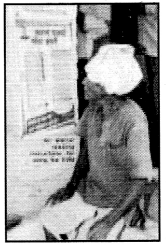
Class 8 Civics Chapter 3 Extra Questions and Answers Why Do We Need a Parliament 1
Question:
1. What does the picture show?
2. Around how much trees were saved after the use of EVM’s in 2004?
Answer:
1. It shows voter reading instructions on how to use an EVM (i.e. Electronic Voting Machine).
2. The use of EVM in 2004 saved around 1,50,000 trees.
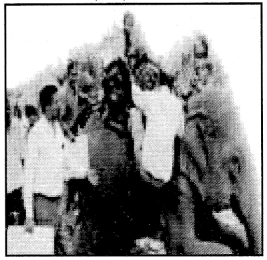
Class 8 Civics Chapter 3 Extra Questions and Answers Why Do We Need a Parliament 2
1. What does the picture show?
2. Is it that much necessary to carry polling material in such conditions?
Answer:
1. It shows the election staff using an elephant to carry polling material and EVM’s to polling stations located in difficult terrain.
2. Yes.
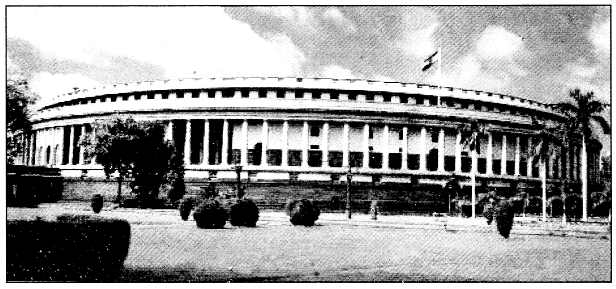
Class 8 Civics Chapter 3 Extra Questions and Answers Why Do We Need a Parliament 3
1. What does the picture show?
2. Which is known as the supreme law-making institution?
3. How many houses are there in the Parliament? Name them.
Answer:
1. The picture shows the Parliament of India (Sansal).
2. The Parliament of India (Sansad) is the supreme law-making institution.
3. It has 2 houses

  • The Rajya Sabha
  • The Lok Sabha.

Map-Based Questions Class 8 Civics Chapter 3 Why Do We Need a Parliament

Look at the map given below and answer the following Questions

Question 1.
On an outline Map of India shows the following:

  1. The state where your currently live and from where your known to had elected there Parliamentary representatives.
  2. Represent the state where the prime minister office (PMO) is situated.

Answer:
Delhi
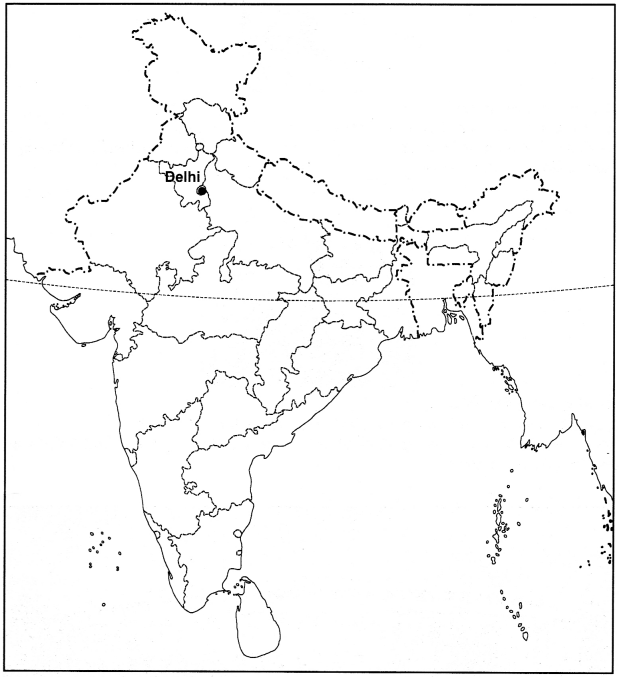
Class 8 Civics Chapter 3 Extra Questions and Answers Why Do We Need a Parliament 4

Class 8 Civics Chapter 2 Extra Questions and Answers Understanding Secularism

Understanding Secularism Class 8 Civics Chapter 2 Extra Questions and Answers Social Science CBSE Pdf free download are part of Extra Questions for Class 8 Social Science. Here we have given NCERT Extra Questions for Class 8 Social Science SST Civics Chapter 2 Understanding Secularism.

You can also practice NCERT Solutions for Class 8 Civics Chapter 2 Questions and Answers on LearnInsta.com.

Class 8 Civics Chapter 2 Extra Questions and Answers Understanding Secularism

Understanding Secularism Class 8 Extra Questions and Answer Civics Chapter 2 Very Short Answers Type

Question 1.
Which country passed a law banning students from wearing any conspicuous religious or political sign or symbols?
Answer:
France passed this law.

Question 2.
When did the France face a shortage of workers?
Answer:
In the 1960’s France had faced a shortage of worker.

Question 3.
What has been granted by the Indian Constitution for the religious communities regarding institution?
Answer:
The Indian Constitution grants the right to religious communities to set up their own schools and college.

Question 4.
What can be the seen as the government policy of treating all religions equal in regard to government schools?
Answer:
The celebration of religious festival within the school is prohibited.

Question 5.
State any one of the objectives that ensures that Indian Constitution mandates Indian State to be secular.
Answer:
One religious community does not dominate another.

Question 6.
What is secularism in Indian context?
Answer:
India adopted a strategy separating the power of religion and the power of State, which is called secularism.

Question 7.
What does Indian constitutions bans completely?
Answer:
Indian constitution bans untouchability.

Question 8.
What type of strict separation exists in USA?
Answer:
There is a strict separation between religion and state in the USA.

Question 9.
Define Coercion.
Answer:
It means to force someone to do something. It also refers to the force used by a legal authority like state.

Question 10.
What does secularism refers to in this chapter?
Answer:
Secularism refers to the separation of religion from the state.

Question 11.
What is mandatory for Indian state in respect to Indian secularism and its mentioning in the Indian constitution.
Answer:
It is mandatory for the Indian state to be secular.

Question 12.
What restriction are put on the government schools in way to make India a proper secular state?
Answer:
They are restricted to promote any religions either in morning prayer or through religions celebration.

Question 13.
On what type of other strategy does the Indian secularism works.
Answer:
Indian secularism also works on the strategy of non-interference.

Question 14.
Give the best example of exception made by the state for particular religious communities in order to respect the sentiments of all religious and not interfere with religious practices.
Answer:
Example is A Sikh while riding bike can wear Pugri (turban) instead of helmet.

Question 15.
By whom were the Jews persecuted?
Answer:
They were persecuted by Hitler in Germany.

Question 16.
In which year does the France passed the law banning wearing of any conspicious religious or political signs?
Answer:
In 2004

Question 17.
How does the children in government school of USA have to begin their school day?
Answer:
In USA the most children in the government schools have to begin their school day reciting 6 pledge of Allegiance.

Question 18.
Which community is taken or granted exception from wearing helmets in India?
Answer:
Sikh community.

Understanding Secularism Class 8 Extra Questions and Answer Civics Chapter 2 Short Answers Type

Question 1.
How is the Indian State a secular State and what has it actually adopted to prevent religious domination?
Answer:
India is a secular State and it works in various ways to prevent religious domination. The Indian Constitution guarantees Fundamental Rights that are based on the secular principles. Indian Constitution intervened in Hindu religious practices in order to abolish untouchability.

In Indian secularism though the State is not strictly separate from religion and it does maintain a principled distance vis-a-ui religion. This is how religious domination is prevented.

Question 2.
According to Ist amendment of the US Constitution what does it prohibit?
Answer:
The first amendment of the US Constitution prohibits the legislature from making laws “respecting an establishment of religion” or that “prohibit the free exercise of religion”. The meaning of word establishment is that the legislature cannot declare any religion as the official religion nor can they give preference to one religion as the official religion.

Question 3.
How does Indian State prevent the religious dominations by using the strategy of distancing itself from religion?
Answer:
The Indian State works in various ways to prevent domination and one of the way is by using a strategy of distancing itself from religion. The Indian State is not ruled by a religious group and nor does it support any one religion.

In India government spaces like law courts, police stations, government, schools and offices are not suppressed to display or promote any one religion.

Question 4.
What does the examples from the history provides us or shows us?
Answer:
Examples from the history provide us or shows us how there was discrimination, exclusion and persecution on the ground of religion.

Question 5.
What will be the consequences of the time if majority religious groups will have access to state power?
Answer:
If majority religious groups have the access to state power, they misuse their power against other religions. The majority could quite easily prevent minorities from practising their religions, can create tyranny and violate the Fundamental Rights.

Understanding Secularism Class 8 Extra Questions and Answer Civics Chapter 2 Long Answers Type

Question 1.
How does the Indian Constitution mandate the Indian State to be secular?
Answer:
The Indian Constitution mandates that the Indian State should be secular. According to the Constitution, only a secular State can realize its objectives to ensure the following:

  1. That one religious community does not dominate another.
  2. The some members do not dominate other members of the same religious community.
  3. That the State does not enforce any particular religion not does it take away the religious freedom of individuals.

Following the Indian Constitution.

  1. The Indian State works in various way to prevent the above domination.
  2. First it was strategy of distancing itself from religion.
  3. Second the Indian secularism works to prevent the domination through a strategy of non-interference.
  4. Third way in which Indian secularism works to prevent domination is through a strategy of intervention.

Question 2.
Explain what all had happened in France starting from February 2004 till the expulsion of girls from their school for wearing headscarves?
Answer:
In February 2004, France passed a law banning students from wearing any conspicuous religious or political signs or symbols such as the Islamic headscarf, the Jewish skullcap, or large Christian crosses. This law has encountered a lot of resistance from immigrants who are mainly from the former French colonies of Algeria, Tunisia, and Morocco.

In the 1960’s, France had faced a shortage of workers and, therefore, had provided visas for these immigrants to come and work in the country. The daughters of these immigrants often wear headscarves while attending school. However, with the passing of this new law, they have been expelled from their school for wearing headscarves.

Picture Based Questions Class 8 Civics Chapter 2 Understanding Secularism

Look at the picture given below and answer the following questions:
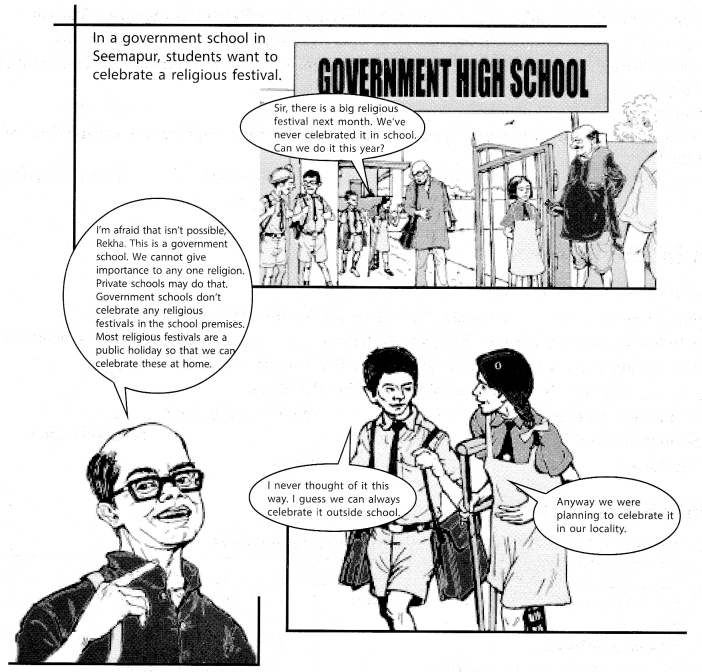
Class 8 Civics Chapter 2 Extra Questions and Answers Understanding Secularism 11. What was the question asked by Rekha from her teacher of the government school?
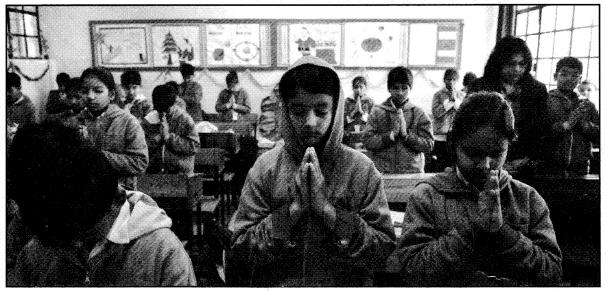
2. In which area is the above government school is situated?
3. What was the explanation given by sir when he said no for the celebration of festival in government school?
Answer:
1. She asked that “there is a big religious festival next month. We’ve never celebrated it in school can we do it this year”.
2. Seemapur.
3. According to him, government schools cannot give importance to anyone religion private school may do that but govt, schools don’t celebrate any religious festivals in the school premises.
Class 8 Civics Chapter 2 Extra Questions and Answers Understanding Secularism 2
1. Which words does the ‘Pledge of Allegiance’ includes.
2. What does the above picture shows.
Answer:
1. This pledge includes the words “under God”.
2. The picture shows about the students taking the “Pledge of Allegiance’ in a govt, school in the USA

How, When and Where Class 8 Extra Questions Social Science History Chapter 1

How, When and Where Class 8 Extra Questions and Answers Social Science History Chapter 1 CBSE Pdf free download are part of Extra Questions for Class 8 Social Science. Here we have given NCERT Extra Questions for Class 8 Social Science SST History Chapter 1 How, When and Where.

You can also practice NCERT Solutions for Class 8 History Chapter 1 Questions and Answers on LearnInsta.com.

How, When and Where Class 8 Extra Questions and Answers Social Science History Chapter 1

How, When and Where Class 8 Extra Questions Very Short Answer Type

Question 1.
Whom did Robert Clive ask to produce the maps of Hindustan?
Answer:
Rennel was asked to produce the maps of Hindustan by Robert Clive.

Question 2.
Who was given the title of ‘Duke of Connaught’?
Answer:
Third son of Queen Victoria – Prince Arthur was given the title.

Question 3.
Who was the Ist Governor-General of the British in India?
Answer:
Warren Hastings was the Ist Governor-General of the British in India.

Question 4.
What was the name of the three-volume work published by James Mill?
Answer:
The name of the three-volume work published by James Mill was ‘A History of British India’.

Question 5.
What does the Census operations consist of?
Answer:
Census operation consists of the detailed records of the number of people in all provinces in India, information on castes, religions and occupations of the people at that time.

Question 6.
What is history?
Answer:
History is about finding of things that were in the past and it also narrates how the things have changed.

Question 7.
What was felt by Mill about the caste and religion?
Answer:
About the in Indian caste and religious system Mill was felt there was religious intolerance, caste taboos and superstitious belief.

Question 8.
What are the forces of modernity?
Answer:
Science, reason, democracy, liberty and equality.

Question 9.
What all were absent under British rule.
Answer:
Equality, freedom and liberty were absent under British rule.

Question 10.
In which century did the printing got spread?
Answer:
By the middle of 19th century.

Question 11.
Which practice became important under colonial administration?
Answer:
The Practice of Surveying.

How, When and Where Class 8 Extra Questions Short Answer Type

Question 1.
Moving away from the British classification, how did historians usually divide the history of India?
Answer:
When we move away from the British classification, historians usually divided the Indian history into three categories that are:

  1. Ancient
  2. Medieval
  3. Modern

Question 2.
What were the sources used by historians in writing the History at the time of the British rule?
Answer:
The historians used the following sources in writing the history:

  1. The official records of the British administration.
  2. The letters and documents that were preserved carefully.
  3. Records being preserved from the administration offices.
  4. Letters and memory that were kept in the archives.

Question 3.
Why can’t we get to know easily and accurately about history of people who were not literate?
Answer:
Sources that were produced by those who were literate have no experience of what the tribals, peasants, the workers of mines or the poors on street liked, so we cannot get to know easily and accurately about the history of people who were not literate at the time.

Question 4.
What is Modernity and its forces?
Answer:
Modern period in west was related to the growth of the modernity and it focuses are science, reason, democracy, liberty and equality.

How, When and Where Class 8 Extra Questions Long Answer Type

Question 1.
Why are Dates important in History? And what was there in history written by the British Historians?
Answer:
In History, the dates are really important because the dates focuses on a particular set of events and changes that took place during a particular period of time.

The History that was written by the British historians in India had considered the rule of Ist Governor-General, Warren Hastings which extended till last Viceroy, Lord Mountbatten. In brief, we can say that the British historians wrote only those points which were important to them and have only glorified their deeds and events in their historical accounts.

Question 2.
Who was James Mill, and how did he divide the History India? In what sense did he take Asian Society and Indian society?
Answer:
James Mill was a Scottish economist and a political philosopher, who had published a massive three-volume work i.e. “A History of British India. James Mill divided the history of India in three periods – Hindus, Muslims and British. Mill thought that the Asian Society was at a lower level of civilization than that of Europe. According to him before the rule of the British, the Indian Society was ruled by Hindu and Muslim despots and religious intolerance, caste taboos and superstition were spread.

Question 3.
What is the problem behind the classification of History into Ancient, Medieval and Modem?
Answer:
The problem behind the classification is that the periodization has been borrowed from the west where the Modern Period was associated with the growth of all the forces of modernity – science, reason, democracy, liberty and equality. Medieval was used to define society where there was absence of modern forces. So this was unacceptable as British rule was the period in which all liberty, equality, freedom were taken from Indians.

Picture Based Questions Class 8 History Chapter 1 How, When and Where

Look at the picture given below and answer the following questions:
How, When and Where Class 8 Extra Questions Social Science History Chapter 1
Question:
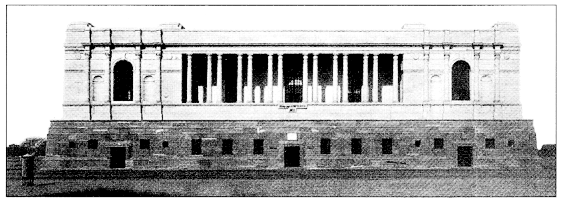
1. What does the picture describes?
2. When was the building made?
3. How is it related to British Rule.
Answer:
1. The picture is a building called ‘National Archives in India’.
2. The Building was made in 1920’s.
3. The Building reflects the importance of this institution in relation to British.

Class 8 Civics Chapter 8 Extra Questions and Answers Confronting Marginalisation

Confronting Marginalisation Class 8 Civics Chapter 8 Extra Questions and Answers Social Science CBSE Pdf free download are part of Extra Questions for Class 8 Social Science. Here we have given NCERT Extra Questions for Class 8 Social Science SST Civics Chapter 8 Confronting Marginalisation.

You can also practice NCERT Solutions for Class 8 Civics Chapter 8 Questions and Answers on LearnInsta.com.

Class 8 Civics Chapter 8 Extra Questions and Answers Confronting Marginalisation

Confronting Marginalisation Class 8 Extra Questions and Answer Civics Chapter 8 Very Short Answers Type

Question 1.
Define the term linguist.
Answer:
Linguist is someone who knows and studies several languages.

Question 2.
What was main aim behind establishing Hindu College in Benaras in 1791?
Answer:
Hindu College was established to encourage the study of ancient Sanskrit texts that would be useful for the administration of the country.

Question 3.
What is meant by an Orientalist?
Answer:
Orientalists were those who were having scholarly knowledge of the language and culture of Asia.

Question 4.
How did Thomas Babington Macaulay see India?
Answer:
He saw India as an uncivilized country that needed to be civilized.

Question 5.
Why was the English Education Act introduced and in which year?
Answer:
Following Macaulay’s minute, the English Education Act of 1835 was introduced.

Question 6.
Who toured the districts of Bengal and Bihar in 1830’s?
Answer:
In 1830’s William Adam, a Scottish missionary toured the districts of Bengal and Bihar.

Question 7.
When did the Company decide about improving the system of vernacular education?
Answer:
After 1854, the Company decided to improve the system of vernacular education.

Question 8.
Name the institution established by Rabindranath Tagore.
Answer:
‘Santiniketan’ was established by Rabindranath Tagore in 1901.

Question 9.
Who was William John.
Answer:
William Jones was appointed as Junior Judge at the supreme court of company.

Question 10.
Which languages were learnt by William Jones?
Answer:
Greek, Latin, French and English.

Question 11.
By whom was the Asiatic society of Bengal was setup?
Answer:
By William Jones.

Question 12.
From whom did William Johns learnt Sanskrit language?
Answer:
The Pandits.

Question 13.
In which year was Madarsa setup in Calcutta?
Answer:
In 1781.

Question 14.
When was the Hindu college Benaras was established?
Answer:
In 1791.

Question 15.
Who emphasized on teaching of English language in manner of civilizing, changing the taste values and cultures of the Indians?
Answer:
Lord Macaulay.

Question 16.
When was the English Education act introduced?
Answer:
In 1835.

Question 17.
Who was William Carey.
Answer:
William Carey was a Scottish missionary.

Confronting Marginalisation Class 8 Extra Questions and Answer Civics Chapter 8 Short Answers Type

Question 1.
In what sense does Gandhiji and Tagore’s thoughts were similar and different about western education?
Answer:
In many senses Tagore’s and Gandhiji’s thoughts about western education were similar. There were several differences too. Gandhiji was highly critical of western education, civilization and its worship of machines and technology. But Tagore wanted to combine elements of modern western civilisation with the best within Indian tradition. Tagore emphasized on the needs to teach science and technology along with art, music and dance.

Question 2.
Why did Tagore hate going to school in his school days?
Answer:
He found school suffocating and oppressive. The school appeared like a prison to him as he could never do what he felt like doing. And the experience of Tagore’s school days in Calcutta shook his ideas of education. These were reasons why he hated going to school in his school days.

Question 3.
What did Mahatma Gandhi say about western education?
Answer:
Mahatma Gandhi said that western education focused on reading and writing rather than oral knowledge. It valued textbooks rather than practical knowledge. He argued that education ought to develop a person’s mind and soul. Literacy or simple learning to read and write by itself did not count as education.

Question 4.
What consequences were there of the new rules and routine over the earlier pathshala students who accepted the British rules?
Answer:
In the earlier system of Pathshala, students from poor peasant families had been able to go to pathshalas as the timetable was flexible before adoption of rules of the British government. The discipline of the new system demanded regular attendance, even during harvest time when children of poor families had to work in the fields. Inability to attend school came to be seen as indiscipline, as evidence of the lack of desire to learn.

Question 5.
What did James Mill declare while attacking the orientalists?
Answer:
James Mill attacked the orientalists and declared that the British should not make efforts to teach what the natives wanted or respected, in order to please them. The aim of education ought to be to teach what was useful and practical. So Indians should be made familiar with the scientific and technical advancements that the west had made, rather than with the poetry and sacred literature of the orientals.

Confronting Marginalisation Class 8 Extra Questions and Answer Civics Chapter 8 Long Answers Type

Question 1.
In view of Mahatma Gandhi why was practical knowledge very much essential for development of person’s mind and soul?
Answer:
Mahatma Gandhi believed that western education focused on reading and writing rather than lived experiences and practical knowledge. He argued that education ought to develop a person’s mind and soul. Literacy – or simply learning to read and write by itself did not count as education.

People had to work with their hands, learn a craft, and know-how different things operated. This would develop their mind and their capacity to understand. This is why Mahatma Gandhi believed that practical knowledge was very much essential for development of person’s mind and soul.

Question 2.
Explain the William Adam’s report produced on the progress of education in vernacular schools.
Answer:
William Adam had been asked by the Company to report on the progress of education in vernacular schools. The report Adam produced was interesting.

Adam found that there were over 1 lakh pathshalas in Bengal and Bihar. These were small institutions with no more than 20 students each. But the total number of children being taught in these pathshalas was considerable over 20 lakh. These institutions were set up by wealthy people, or the local community. At times they were started by a teacher (guru).

The system of education was flexible. Adam discovered that this flexible system was suited to local needs. For instance, classes were not held during harvest time when rural children often worked in the fields. The pathshala started once again when the crops had been cut and stored. This meant that even children of peasant families could study.

Question 3.
Explain Wood’s Despatch. What was mentioned in its provision?
Answer:
In 1854, the Court of Directors of the East India Company in London sent an educational despatch to the Governor-General in India, issued by Charles Wood, the president of the Board of Control of the Company. It has come to be known as Wood’s Despatch.

  1. It emphasized once again on the practical benefits of system of European learning.
  2. One of the practical uses the Despatch pointed to was economic European learning.
  3. It said, it would enable Indians to recognize the advantages that flow from the expansion of trade and commerce.
  4. Wood’s Despatch argued that European learning would improve the moral character of Indians.
  5. It would make them truthful and honest and would supply the Company with civil servants who could be trusted and depended upon.
  6. The literature of East was believed to be full of errors and also couldn’t instill in the people a sense of duty and a commitment to work nor could it develop the skill required for administration.

Picture Based Questions Class 8 Civics Chapter 8 Confronting Marginalisation

Look at the picture given below and answer the following questions:

Question:
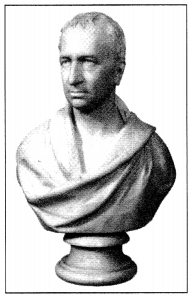
1. Who was Henry Thomas Cookbook?
Class 8 Civics Chapter 8 Extra Questions and Answers Confronting Marginalisation 1
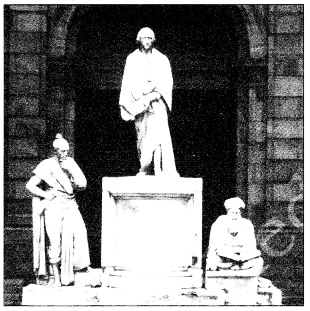
2. Whom does the monument belong to?
Class 8 Civics Chapter 8 Extra Questions and Answers Confronting Marginalisation 2
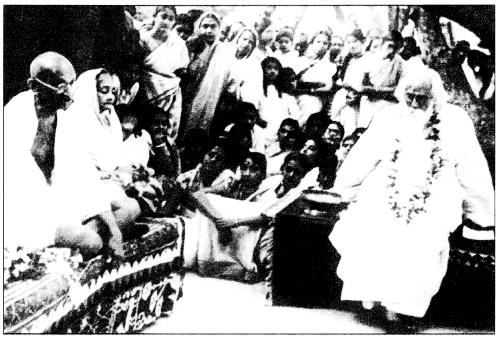
3. Along with whom is Mahatma Gandhi sitting with.
Class 8 Civics Chapter 8 Extra Questions and Answers Confronting Marginalisation 3
4. What does the picture show?
Class 8 Civics Chapter 8 Extra Questions and Answers Confronting Marginalisation 4
Answer:

  1. He was a scholar of Sanskrit and ancient sacred writings of Hinduism.
  2. Monument belongs to Warren Hastings.
  3. He is sitting with Kasturba Gandhi and Rabindranath Tagore.
  4. The picture shows a class in progress in Santiniketan in the 1930s.

Class 8 Civics Chapter 5 Extra Questions and Answers Judiciary

Judiciary Class 8 Civics Chapter 5 Extra Questions and Answers Social Science CBSE Pdf free download are part of Extra Questions for Class 8 Social Science. Here we have given NCERT Extra Questions for Class 8 Social Science SST Civics Chapter 5 Judiciary.

You can also practice NCERT Solutions for Class 8 Civics Chapter 5 Questions and Answers on LearnInsta.com.

Class 8 Civics Chapter 5 Extra Questions and Answers Judiciary

Judiciary Class 8 Extra Questions and Answer Civics Chapter 5 Very Short Answers Type

Question 1.
What is the present location of Supreme Court of India?
Answer:
Supreme Court of India is presently located at Tilak Marg, New Delhi.

Question 2.
When did the Supreme Court devise the mechanism of PIL?
Answer:
The Supreme Court devised the mechanism of Public Interest Litigation in 1980.

Question 3.
State the levels of court in our country.
Answr:
There are three different levels of courts in our country.

Question 4.
What is meant by the term ‘Acquit?
Answer:
This refers to the court declaring that a person is not guilty of the crime which he/she was tried for by the court.

Question 5.
Write few example of the criminal law.
Answer:
Theft, harassing a woman to bring more dowry, murder, etc.

Question 6.
What is the full form of PIL?
Answer:
Public Interest Litigation.

Question 7.
What is the full form of FIR?
Answer:
First Investigation Report.

Question 8.
Name the three Presidency cities in which High Courts were first established.
Answer:
High Courts were first established in the three Presidency cities of Calcutta, Bombay and
Madras in 1862.

Question 9.
Is Indian judiciary is dependent or independent?
Answer:
Indian Judiciary is independent.

Question 10.
Write any one aspect of the independent judiciary.
Answer:
The main aspect of Independent Judiciary is no influence of others.

Question 11.
How many levels of court are there in India?
Answer:
There are 3 different level of courts in the country.

Question 12.
Which court is at the open level?
Answer:
The Supreme court of India.

Question 13.
Which is the Apex Court of any state?
Answer:
The High court of that state.

Question 14.
What is the meaning of integrated judicial system in respect to India?
Answer:
It means that the decisions made by higher courts are binding on the lower courts.

Question 15.
Where does a person can appeal if they believe that decisions are made by the lower court is not just?
Answer:
A person can appeal to a higher court if they believe that the judgement passed by the lower court is not just.

Question 16.
What is meant by compensation?
Answer:
This refers to the money given to make amends for an injury or loss.

Question 17.
In which year was the PIL mechanism was devised by the Supreme court?
Answer:
In 1980.

Question 18.
Which law deals with conduct or acts that the law defined as offences?
Answer:
Criminal law.

Question 19.
When was the Supreme court was established in India?
Answer:
The Supreme court was established on 26th Jan 1950 the day India became a Republic.

Question 20.
What dopes FIR stands for?
Answer:
It stands for First investigation report.

Judiciary Class 8 Extra Questions and Answer Civics Chapter 5 Short Answers Type

Question 1.
State the basic difference b/w criminal law and civil law.
Answer:
The basic difference is:
Criminal law: Deals with conduct or acts that the law defines as offences. For example, theft, harassing a woman to bring more dowry, murder.
Civil law: Deals with any harm or injury to rights of individuals. For example, disputes relating to sale of land, purchase of goods, rent matters, divorce cases.

Question 2.
How does the Supreme Court ensure the protection of Fundamental Rights.
Answer:
Independence of judiciary allows the court to ensure the proper functioning of executive and legislature. It also plays a crucial role in protecting the Fundamental Rights of citizens because anyone can approach the courts if they believe that their rights have been violated.

Question 3.
What role does separation of power play in making independence of judiciary successful? Answer:
One of the aspect of this independence is the separation of power which is the key feature of the Constitution and this means that other branches of the state like the legislature and the executive – cannot interfere in the work of the judiciary. The courts are not under the government and do not act on their behalf.

Question 4.
What happened in the case ‘Paschim Banga Khet Mazdoor Samity vs State of West Bengal’
(1996)?
Hakim Sheikh, an agricultural labourer, who fell from a running train and injured himself and whose condition got worse because several hospitals refused to admit him.

On this Supreme Court directed the West Bengal government to pay him compensation for the loss suffered as well as to come up with a blueprint for primary health care with particular reference to treatment of patients during an emergency.

Question 5.
What is Judicial Review?
Answer:
As the final interpreter of the Constitution, the judiciary also has the power to strike down particular laws passed by the Parliament if it believes that these are a violation of the basic structure of the Constitution. This is called Judicial Review.

Judiciary Class 8 Extra Questions and Answer Civics Chapter 5 Long Answers Type

Question 1.
What type of issues are handled by the courts of India. Describe work of judiciary in brief.
Answer:
Courts in India take decisions on a very large number of issues. They can decide whether teacher can beat a student, or about the sharing of river water between states, or they can punish people for particular crimes. The work of the judiciary can be divided into the following:

  1. Dispute Resolution: The judicial system provides a mechanism for resolving disputes between citizens, between citizens and the government, between two state governments and between the centre and state governments.
  2. Judicial Review: As final interpreter of the Constitution, the judiciary also has the power to strike down particular laws passed by the Parliament if it believes that these laws are a violation of the basic structure of the Constitution. This is called the Judicial Review.
  3. Upholding the law and Enforcing Fundamental Rights: Every citizen of India can approach the Supreme Court or High Court if they believe that their Fundamental Rights have been violated.