Notice Writing Class 11 Format, Examples, Topics, Exercises

Notice Writing Class 11

This grammar section explains English Grammar in a clear and simple way. There are example sentences to show how the language is used. NCERT Solutions for Class 11 English will help you to write better answers in your Class 11 exams. Because the Solutions are solved by subject matter experts.

Notice Writing Class 11 Format, Examples, Topics, Exercises

A notice is a form of written or printed information that can be in the form of an official statement of public importance or a warning in advance, or it can also be used to give information to a segment of people or people at large. The basic purpose is to disseminate information related to various issues or occasions. It is written in a simple and formal language and is always brief and to the point. Notices are given generally in newspapers, magazines, or displayed publicly on the notice board of an organisation. A notice can also be given in the newspaper as an advertisement mainly meant to inform a large number of people, it must be clear and brief. It is more or less like a circular but the major difference is that a circular reaches through a messenger while a notice is displayed either on a noticeboard or in a newspaper column.

The main characteristics of notice writing are:

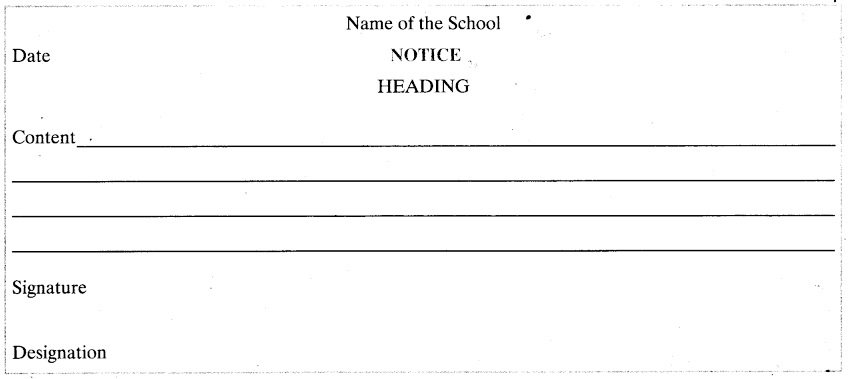
Notice Writing Format
This includes the word “NOTICE”, date, heading, writer’s name, and designation.

Content:
The content answers the questions ‘what’, ‘where’, ‘when’, ‘how’ etc.

Expression:
This relates to the overall organisation and relevance of the content as well as grammatical accuracy and fluency. An agenda notice includes a detailed list of items or schema of the meeting or the programme.

Points to remember:

  • the purpose should be to inform
  • it should have a heading
  • it should be brief and precise
  • it should give all the required information, in a simple language
  • the name and designation of the issuing authority should be mentioned
  • it should be written in the third person
  • it should have a date
  • it should look attractive and the word limit should be adhered to

Notice Writing Class 12 Format, Examples, Topics, Exercises

Question 1.
Draft a notice in not more than 50-words for your school notice board, informing the students about the sale of old sports goods of your school. You are Rohini/Rohan the secretary of the sports club of Alka Public School, Indira Nagar Faridabad. [NCT 2018]

Answer:

Alka Public School, Indira Nagar, Faridabad

20.04.20XX

Notice
Sale.

The Sports Department is offering old sports equipment for sale to the students of the school Cricket, tennis, badminton, table tennis, football, basketball and hockey is available.Sale will be held on Sunday 28-04-20XX from 10 am to 1 pm. Students should bring their identity cards.

Rohan
Secretary, Sports Club.

Question 2.
As Secretary of the Activity Club of your school, draft a notice for the school noticeboard, informing students of the Inter-class Quiz contest being organised by the school. You are Nafisa/Pankaj. [Word limit: 50] [NCT 2017]

Answer:

St. Teresa Secondary School, Lucknow

13 August 20XX

Notice
Inter-class Quiz Contest

The annual Inter-Class Quiz will be held on 4th September at two levels – classes 7 & 8 and 9 & 10. The teams will be selected on the basis of the preliminary written tests.

Those interested should give their names to the undersigned by 8 August 20XX.

Nafisa Rehman
Secretary
Activity Club

Question 3.
You are Amit/Anita, Head Boy/Head Girl of your school. You are organising a career counselling session for class XI and XII students of your school. Write a notice giving details to be displayed on your noticeboard in about 50 words. [NCT 2016]

Answer:

Gandhi Senior Secondary School, Rohini, Delhi

28 July 20XX

Notice
Career Counselling Session

The students of classes 11 and 12 are hereby informed that a career counselling session has been organized for them on 4 August 20XX from 11 a.m. to 1 p.m.

Science students will proceed to the Auditorium and commerce students to Lecture Theatre No. 1 at 10:45 a.m.

Attendance is compulsory.
Amit Pandey
Head Boy

Question 4.
You are Man/Mani, secretary of the History Club of K.V. Sr. Sec. School, Badodhra. Draft a notice in not more than 50 words informing the students of class XI and XII about a proposed tour to Rajasthan during the coming summer vacations. [NO 2015]

Answer:

K.Y Senior Secondary School, Badodhra

5 April 20XX

Notice
Rajasthan Tour 

This is to inform the students of classes 11 and 12 of a trip to Rajasthan from 12 to 17 May 20XX. The trip will cover Jaipur, Udaipur, Jaisalmer and Bikaner.

Those who wish to join the trip should submit written permission from their parents and a draft for ₹ 3000 latest by 12 April 20XX to the Vice Principal.

Mani
Secretary, History Club

Question 5.
You are Amit/Amita, Head Boy/Girl of your school (Zenith Public School). Write a notice for your school noticeboard requesting entries from students for Britannia Quiz Contest to be held in your School. [NCT 2014]

Answer:

Zenith Public School, Agra

20 February 20xx

Notice
Selection for Quiz Contest

The students of classes from 9 to 12 may give their names for participating in Britannia Quiz Contest to be held on 25 March 20XX.

The applicants should have participated in the inter-house Quiz Contest. The selection will be held on 28 February 20XX.

R.K. Singh
Vice Principal

Question 6.
As the Principal of DAV, Mausam Vihar, Delhi, write a notice informing the students about the special coaching in cricket, basketball, and tennis during the summer vacation. (50 words) [NCT 2019]

Answer:

DAV, Mausam Vihar, Delhi

20-April 20XX

Notice
Sports Coaching During Summer Vacation

This is to inform all the students of the six-week coaching programme in cricket, basketball, and tennis starting from 16 May 20XX at 6:30 a.m. every morning.

State-level coaches will be conducting the sessions. A nominal fee of 200 per game will be charged. Those interested should contact Mr. S.R. Vyas, HOD, Physical Education for further details.

R.V. Sharma
Principal

Question 7.
As the librarian of your school, write a notice in about 50 words informing the students of the penalty for losing or damaging the books issued to them.

Answer:

New Age School, Rohini

10 July 20XX

Notice
Penalty For Losing or Damaging the Books

This is to inform all the students that
(i) a fine of ? 2 per day will be charged if a book is not returned on the due date;
(ii) the library card will be withdrawn if the returned book is found tom or damaged; :
(iii) The full price will be recovered from the student if a book is lost.

Shalini Singh
Librarian

Question 8.
As the Principal, write a notice in about 50 words informing the prefects, monitors, and other discipline in-charge students of a Leadership Training Camp being organised by the school.

Answer:

A.P.J. School, Vasant Kunj

10 April 20xx

Notice
Leadership Training Camp

A leadership training camp is being organised on 15 April 20XX from 9:00 a.m. to 1:00 p.m. All: prefects, class monitors, bus and line monitors shall attend this camp.

The programme will include the following:
Leadership Training Workshop – 9 : 00 a.m. to 11 : 00 a.m.
Refreshment Break – 11 :00 a.m. to 11 : 30 a.m.
Question and Answer Session with Experts – 11 : 30 a.m. to 12 : 00 p.m.

S.K. Gulati
Principal

Question 9.
As the head of the Physical Education Department, write a notice in about 50 words informing the students about the selection of athletes for the coming Zonal Athletic meet.

Answer:

Bal Bharti Public School, Noida

10 April 20xx

Notice
Selection of Athletes for Zonal Athletic Meet

This is to inform the students of classes 5 to 8 that the selection of the athletes for the coming zonal athletic meet for sub-juniors and juniors will be done as per the timetable given below.

15 April 20XX (Sub-Junior events)

100 m and 200 m races, long jump, swimming: 7:00 a.m. to 9:30 a.m.

17 April 20XX (Junior events)

100 m 200 m, 4 x 100 m relay race, long jump, high jump, swimming: 7:00 a.m. to 9:00 a.m.

B S Batra
Head, Physical Education Department

Question 10.
As the Director, Primary Section, write a notice in about 50 words for the children announcing the programme for the Children’s Day.

Answer:

Ramjas School, R.K. Puram

2 November 20XX

Notice
Children’s Day Programme

The school is arranging a special programme for you on Children’s Day, i.e. November 14. You can come in fancy dress and win a prize. There will be games for you. Kindly give the circular to your parents so that they can dress you beautifully for the Fancy Dress Competition.

Do not bring your books on November 14.

Monisha Mohanty
Director
Primary School

Carbon and its Compounds Class 10 Extra Questions with Answers Science Chapter 4

In this page, we are providing Carbon and its Compounds Class 10 Extra Questions and Answers Science Chapter 4 pdf download. NCERT Extra Questions for Class 10 Science Chapter 4 Carbon and its Compounds with Answers will help to score more marks in your CBSE Board Exams.

Class 10 Science Chapter 4 Extra Questions and Answers Carbon and its Compounds

Extra Questions for Class 10 Science Chapter 4 Carbon and its Compounds with Answers Solutions

Extra Questions for Class 10 Science Chapter 4 Very Short Answer Type

Question 1.
Draw the electron dot notation of O2 molecule.
Answer:
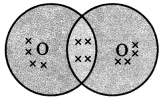
Carbon and its Compounds Class 10 Extra Questions with Answers Science Chapter 4, 1

Question 2.
Name a molecule that has triple bond.
Answer:
Nitrogen (N2).

Question 3.
Name the hardest substance which is an allotrope of carbon.
Answer:
Diamond.

Question 4.
Name the allotrope of carbon which have the structure of C-60.
Answer:
Fullerenes.

5. Name the unique ability of carbon to form bonds with other atoms of carbon.
Answer:
Catenation.

Question 6.
Mention the two characteristic features seen in carbon.
Answer:
Tetravalency and catenation.

Question 7.
Name the first organic compound synthesised by Wohler.
Answer:
Urea.

Question 8.
Write the general molecular formula of alkane series.
Answer:
CnH2n+2

Question 9.
Write the IUPAC name of the following compound:
CH3CH2CH2CH2—C ≡ C—H
Answer:
Hex-1-yne.

Hex adder calculator is an effcient tool for adding two hex values. Similarly, Hex calculator can easily calculate two given values.

Question 10.
Identify the functional group present in the following compound:
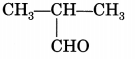
Carbon and its Compounds Class 10 Extra Questions with Answers Science Chapter 4, 2
Answer:
Aldehyde.

Question 11.
How many covalent bonds are there in a molecule of ethane, C2H6?
Answer:
Seven (7)
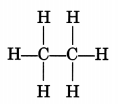
Carbon and its Compounds Class 10 Extra Questions with Answers Science Chapter 4, 3

Question 12.
Draw the structure of the hexanal molecule, C5H11CHO.
Answer:
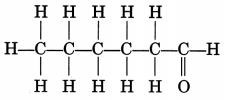
Carbon and its Compounds Class 10 Extra Questions with Answers Science Chapter 4, 4

Question 13.
Write the name and formula of the 2nd member of homologous series having general formula CnH2n.  [CBSE 2015]
Answer:
CnH2n : Alkene
2nd member = C3H6 (propene)

Question 14.
Write the molecular formula of an alkyne containing 10 atoms of hydrogen.
Answer:
C6H10.

Question 15.
Why is ethanoic acid known as glacial acetic acid?
Answer:
Acetic acid freezes at 290 K to form crystals which look like glaciers, so pure ethanoic acid is known as glacial acetic acid.

Question 16.
Which property of ethanol makes it suitable for preparing medicines such as tincture iodine, cough syrup and other tonics?
Answer:
Ethanol is a good solvent.

Question 17.
What is the function of cone. H2SO4 in the formation of ethene from ethanol?
Answer:
Dehydrating agent

Question 18.
Name the alcohol which is an active ingredient of all alcoholic drinks.
Answer:
Ethanol or ethyl alcohol (C2H5OH)

Question 19.
Which two of the following compounds could belong to the same homologous series?
C2H6O2, C2H6O, C3H28, CH4O
Answer:
CH4O and C2H6O (General formula CnH2n+1. OH)

Question 20.
Which of the following molecule is called buckminsterfullerene?
C90, C60, C70, C120
Answer:
C60.

Question 21.
Name the gas evolved when sodium carbonate and bicarbonate is added to ethanoic acid.
Answer:
Carbon dioxide (CO2)

Question 22.
Among CH4, C2H6 and C4H10 which is expected to show isomerism?
Answer:
C4H10.

Question 23.
Write the structural formula of a saturated hydrocarbon whose molecule contains three atoms of carbon.
Answer:
C3H8.

Question 24.
A neutral organic compound is warmed with some ethanoic acid and a little cone. H2SO4. Vapours having sweet smell or fruity smell are observed. Identify the functional group present in the organic compound.
Answer:
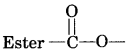
Carbon and its Compounds Class 10 Extra Questions with Answers Science Chapter 4, 5

Question 25.
Name the oxidising agent which can oxidise ethanol to ethanoic acid.
Answer:
Alkaline potassium permanganate (KMnO4/KOH) or acidified potassium dichromate (K2Cr2O7/H2SO4).

Question 26.
Write the formula and name of next homologue of CH3COCH3.
Answer:
CH3CH2COCH3, Butanone.

Question 27.
Why do alkanes burn with a blue flame?
Answer:
Alkanes generally burn with a blue flame or clean flame because the combustion is complete and no unbumt carbon particles are released.

Question 28.
Draw the structure of an unsaturated cyclic compound having six carbon atoms. Also draw its electron dot structure. (Cyclohexene)
Answer:
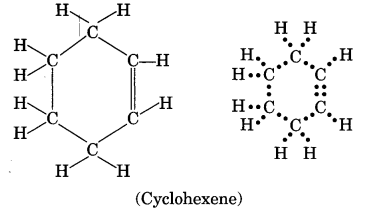
Carbon and its Compounds Class 10 Extra Questions with Answers Science Chapter 4, 6

Question 29.
How do the melting and boiling points of the hydrocarbons change with increase in molar mass?
Answer:
Intermolecular forces of attraction increases due to increase in molar mass, hence the melting and boiling points increase.

Extra Questions for Class 10 Science Chapter 4 Short Answer Type I

Question 1.
Draw the electron dot structure of ethyne and also draw its structural formula.   [NCERT Exemplar]
Answer:
Ethyne, C2H2
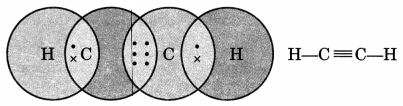
Carbon and its Compounds Class 10 Extra Questions with Answers Science Chapter 4, 7

Question 2.
Name the functional groups present in the following compounds:
(a) CH3 CO CH2 CH2 CH2 CH3
(b) CH3 CH2 CH2 COOH
(c) CH3 CH2 OH   (NCERT Exemplar)
Answer:
(a) Ketone
(b) Carboxylic acid
(c) Aldehyde
(d) Alcohol

Question 3.
Which of the following hydrocarbons can undergo addition reactions:
C2H6, C4H10, C3H6, C3H4, CH4, C2H2, C4H8
Answer:
C3H6, C3H4, C2H2 and C4H8 because these compounds are unsaturated organic compounds and hence can undergo addition reactions.

Question 4.
Draw the electron dot structure of O2 and N2 molecules.
Answer:
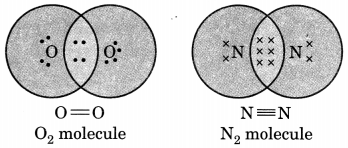
Carbon and its Compounds Class 10 Extra Questions with Answers Science Chapter 4, 8

Question 5.
Give the general formula of alkanes. Write the name, structural formula and physical state of the compound containing:
(i) 3-carbon atoms
(ii) 8-carbon atoms.
Answer:
(a) General formula of alkanes is CnH2n+2
n = 1, 2, 3…
(i) Propane, CH3—CH2—CH3
or
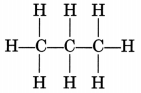
Carbon and its Compounds Class 10 Extra Questions with Answers Science Chapter 4, 9
Propane is a gas.

(ii) CH3—CH2—CH2—CH2—CH2—CH2—CH2—CH3
or
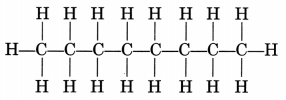
Carbon and its Compounds Class 10 Extra Questions with Answers Science Chapter 4, 10
Octane is a liquid

Question 6.
Why does carbon form compounds mainly by covalent bonding?
Answer:
Carbon atoms have 4 valence electrons in their valence shell, it needs to gain or lose 4 electrons to attain the noble gas configuration.

(i) It could gain four electrons forming C4- anion. But it would be difficult for the nucleus with six protons to hold on to ten electrons.

(ii) It could lose four electrons forming C4+ cation. But it would require a large amount of energy to remove four electrons from its outermost shell.
Therefore, carbon shares its valence electrons to complete its octet with other atoms to form covalent bonds.

Question 7.
List the common physical properties of carbon compounds.
Answer:

  • They have covalent bonds between their atoms therefore they do not form ions. So they are poor conductors of electric current.
  • These compounds have low melting and low boiling points.
  • They are generally insoluble in water but soluble in the organic solvents like ether, carbon- tetrachloride, etc.

Question 8.
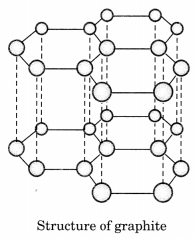
Draw the structures of diamond and graphite.
Answer:
In diamond, each carbon atom is bonded to four other carbon atoms forming a rigid three dimensional structure.

In graphite, each carbon atom is bonded to three other carbon atoms in the same plane giving a hexagonal array. One of these bonds is a double bond.
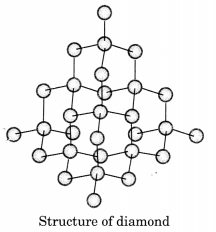
Carbon and its Compounds Class 10 Extra Questions with Answers Science Chapter 4, 11
Carbon and its Compounds Class 10 Extra Questions with Answers Science Chapter 4, 12

Question 9.
Write the general IUPAC names of alcohol, carboxylic acid, aldehyde and ketone.
Answer:

CompoundGeneral IUPAC name
AlcoholAlkanol
Carboxylic acidAlkanoic acid
AldetjydeAlkanal
KetoneAlkanone

Question 10.
Ethane , Ethene, Ethanoic acid, Ethyne, Ethanol
From the box given above, name:
(i) The compound with —OH as a part of its structure.
(ii) The compound with —COOH as a part of its structure.
(iii) Gas used in welding.
(iv) Homologue of the homologous series with general formula CnH2n+2.
Answer:
(i) Ethanol
(ii) Ethanoic acid
(iii) Ethyne
(iv) Ethane

Question 11.
Give two uses each of methyl alcohol and ethyl alcohol.
Answer:
Uses of ethyl alcohol:

  • It is used in the manufacture of dyes, perfumes, antiseptics, etc.
  • It is used in alcoholic drinks.

Uses of methyl alcohol:

  • It is used as a solvent
  • It is used as an antifreeze

Question 12.
List two main points of difference between organic and inorganic compound.
Answer:
Organic compounds:

  1. They are made up of few elements (C, H, O, N, S) through covalent bonds.
  2. They are combustible.

Inorganic compounds:

  1. They are made up of all the known elements, which involve ionic bond.
  2. They are generally non-combustible.

Question 13.
What are substitution reactions? Justify your answer with a suitable example.
Answer:
A chemical reaction in which atom(s) or group of atoms of an organic compound is/are replaced by other atom(s) or group of atoms without any change in the rest of the molecule is called a substitution reaction.
For example,
CH4 + Cl2 → CH3Cl + HCl
In this chemical reaction Cl atom substitutes one hydrogen atom from methane.

Question 14.
Give any four uses of ethanoic acid.
Answer:

  1. Ethanoic acid is used in making synthetic vinegar.
  2. Ethanoic acid is used as a reagent in chemistry laboratory.
  3. Ethanoic acid is used for making dyes, perfumes and esters.
  4. Ehanoic acid is used for coagulating rubber from latex and casein from milk.

Question 15.
List four differences between soaps and detergents.
Answer:
Soaps:

  1. Soaps are sodium salts of higher fatty acids.
  2. Biodegradable.
  3. Soaps cannot be used in acidic medium.
  4. Soaps cannot be used in hard water.

Synthetic Detergents:

  1. Detergents are sodium alkyl sulphates or sodium alkyl benzene sulphonates with alkyl group having more than ten carbon atoms.
  2. Non-biodegradable.
  3. They can be used in acidic medium.
  4. Detergents can be used even in hard water.

Extra Questions for Class 10 Science Chapter 4 Short Answer Type II

Question 1.
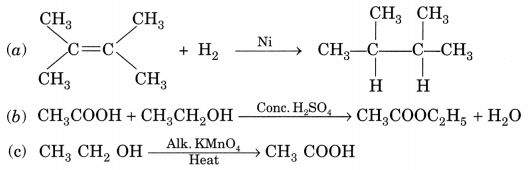
What is the role of metal or reagents written on arrow’s in the given chemical reactions?
Carbon and its Compounds Class 10 Extra Questions with Answers Science Chapter 4, 13
[NCERT Exemplar]
Answer:
(a) Ni acts as a catalyst.
(b) Concentrated H2SO4 acts as a catalyst.
(c) Alkaline KMnO4 acts as an oxidising agent.

Question 2.
The molecular formula of an organic compound X is C2H4O2 which has vinegar like smell.
(i) Identify the compound.
(ii) Write its chemical formula and name.
(iii) What happens when sodium bicarbonate is added into it?
Answer:
(i) The organic compound X is acetic acid.
(ii) Chemical formula: CH3COOH
IUPAC name: Ethanoic acid
(iii) Ethanoic acid produces effervescence with sodium bicarbonate liberating carbon dioxide gas.

Carbon and its Compounds Class 10 Extra Questions with Answers Science Chapter 4, 14

Question 3.
Write one chemical equation to represent each of the following types of reactions of organic substances.
(a) Esterification
(b) Saponification
(c) Substitution   [CBSE 2011]
Answer:
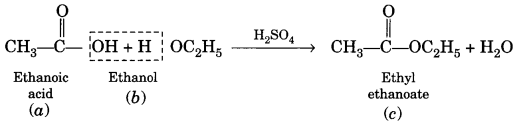
(a) Esterification. Ethanol reacts with ethanoic acid on warming in presence of a few drops of conc. H2SO4 to form a sweet smelling ester, ethyl ethanoate.

Carbon and its Compounds Class 10 Extra Questions with Answers Science Chapter 4, 15

(b) Saponification. The alkaline hydrolysis of esters is known as saponification as this reaction is used for the preparation of soaps.

Carbon and its Compounds Class 10 Extra Questions with Answers Science Chapter 4, 16

(c) Substitution. The reaction, in which one (or more) hydrogen atoms of a hydrocarbon are replaced by some other atoms, is called substitution reaction.

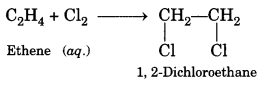
Carbon and its Compounds Class 10 Extra Questions with Answers Science Chapter 4, 17

4. Write chemical equations for what happens when
(a) Sodium metal is added to ethanoic acid
(b) Solid sodium carbonate is added to ethanoic acid
(c) Ethanoic acid reacts with a dilute solution of sodium hydroxide.
Answer:
(a) 2Na + 2CH3COOH → 2CH3COONa + H2(g)
(b) Na2CO3 + 2CH3COOH → 2CH3COONa + CO2 (g)+ H2O
(c) CH3COOH + NaOH → CH3COONa + H2O

Question 5.
Name the oxidising agent used for the conversion of ethanol to ethanoic acid. Distinguish between ethanol and ethanoic acid on the basis of (i) litmus test, (ii) reaction with sodium hydrogen carbonate.
Answer:
Alkaline KMnO4 or acidified potassium dichromate (K2Cr2O7) are used for the conversion of ethanol to ethanoic acid.
Ethanol:

  • Ethanol has no effect on red or blue litmus solution.
  • No gas evolved when ethanol is treated with sodium hydrogen carbonate.

Ethanoic acid:

  • Ethanoic acid turns blue litmus solution red.
  • Ethanoic acid reacts with sodium hydrogen carbonate to evolve carbon dioxide along with the formation of salt and water.
    CH3COOH + NaHCO3 → CH3COONa + CO2 + H2O

Question 6.
(a) Differentiate between alkanes and alkenes. Name and draw the structure of one member of each.  [CBSE 2013]
(b) Alkanes generally burn with clean flame. Why?
Answer:
Alkanes:

  1. An alkane is a hydrocarbon in which the carbon atoms are connected by only single covalent bond.
  2. General formula of alkane is CnH2n+2.
  3. The simplest alkane is methane (CH4).
    Carbon and its Compounds Class 10 Extra Questions with Answers Science Chapter 4, 18
  4. Alkanes generally burn in air with a blue and non-sooty flame.
  5. Alkanes undergo substitution reactions.
  6. Alkanes do not decolourise red brown colour of bromine water.

alkenes:

  1. An alkene is an unsaturated hydrocarbon in which the two carbon atoms are connected by a double bond.
  2. General formula of alkene is CnH2n.
  3. The simplest alkene is ethene (C2H4).
    Carbon and its Compounds Class 10 Extra Questions with Answers Science Chapter 4, 19
  4. Alkenes burn in air with a yellow and sooty flame.
  5. Alkenes undergo addition reactions.
  6. Alkenes decolourise bromine water.

(b) Alkanes burn in air with a blue and non-sooty flame because the percentage of carbon in the alkane is comparatively low which gets oxidised completely by oxygen present in air.

Question 7.
What happens when
(а) ethanol is burnt in air?
(b) ethanol is heated with excess cone. H2SO4 at 443 K?
(c) a piece of sodium is dropped into ethanol?  [CBSE 2013]
Answer:
(a) C2H5OH + 3O2 → 2CO2 + 3H2O + Heat + Light

Carbon and its Compounds Class 10 Extra Questions with Answers Science Chapter 4, 20
(c) 2C2H5OH + 2Na → 2C2H5ONa + H2(g)

Question 8.
What is meant by homologous series of carbon compounds? Write the general formula of
(i) alkenes, and
(ii) alkynes. Draw the structures of the first member of each series to show the bonding between the two carbon atoms.   [CBSE 2014]
Answer:
Homologous series:
A series of carbon compounds in which the same functional group substitutes for hydrogen on a carbon chain is called a homologous series. There is a difference of –CH2 in the molecular formulae of two nearest compounds of a homologous series. Each such series has same general molecular formula and has a general scientific name. There is a difference of 14 u (unified mass) in the molecular masses of two nearest compounds of a series.

Members of homologous series of aldehydes:
H – CHO Methanal
CH3 – CHO Ethanal
C2H5 – CHO Propanal

General formula:
(i) Alkenes, CnH2n
(ii) Alkynes, CnH2n-2

Structure:

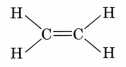
  • The first member of alkenes is ethene and its structure is
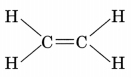
    Carbon and its Compounds Class 10 Extra Questions with Answers Science Chapter 4, 21
  • The first member of alkynes is ethyne and its structure is H—C ≡ C—H

Question 9.
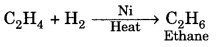
With the help of an example, explain the process of hydrogenation.
Mention the essential conditions for the reaction and state the change in physical property with the formation of the product.   [CBSE 2015]
Answer:
Process of hydrogenation:
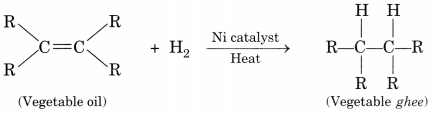
Carbon and its Compounds Class 10 Extra Questions with Answers Science Chapter 4, 22

The addition of hydrogen to an unsaturated hydrocarbon to obtain a saturated hydrocarbon is called hydrogenation.

Essential conditions for the reaction are:

  • Presence of an unsaturated hydrocarbon.
  • Presence of a catalyst such as nickel (Ni) or palladium.

Changes observed:

  • Change observed in the physical property is the change of unsaturated compound from the liquid state to saturated compound in the solid state.
  • The boiling or melting points of a product is increased.

Question 10.
The list of some organic compounds is given below:
Ethanol, ethane, methanol, methane, ethyne, ethene
From the above list, name a compound:
(i) formed by the dehydration of ethanol by conc. H2SO4.
(ii) which will give red precipitate with ammoniacal cuprous chloride solutions,
(iii) which forms ethanoic acid on oxidation with KMnO4.
(iv ) which has vapour density 14 and decolourises pink alkaline potassium permanganate.
(v) which forms chloroform on halogenation in the presence of sunlight.
(vi) which decolourises bromine solution in carbon tetrachloride.
Answer:
(i) Ethene
(ii) Ethyne
(iii) Ethanol
(iv) Ethene
(v) Methane
(vi) Ethene

Question 11.
The molecule of alkene family are represented by a general formula CnH2n. Now answer the following:
(i) What do n and 2n signify?
(ii) What is the name of alkene when n = 4?
(iii) What is the molecular formula of alkene when n = 6?
(iv) What is the molecular formula of the alkene if there are six H-atoms in it?
(v) What is the molecular formula and structural formula of the first member of the alkene family?
(vi) Write the molecular formulae of lower and higher homologues of an alkene which contains four carbon atoms.
Answer:
(i) n indicates number of carbon atoms and 2n indicates number of hydrogen atoms.
(ii) Butene
(iii) C6H12
(iv) C3H6
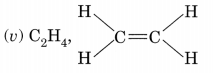
Carbon and its Compounds Class 10 Extra Questions with Answers Science Chapter 4, 23
(vi) Lower homologue —C3H16, Higher homologue – C5H10

Question 12.
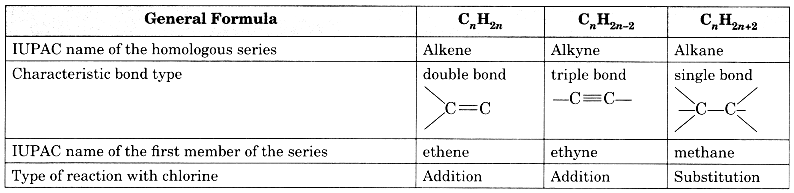
Copy and complete the following table which relates to three homologous series of hydrocarbons:

Carbon and its Compounds Class 10 Extra Questions with Answers Science Chapter 4, 24
Answer:
Carbon and its Compounds Class 10 Extra Questions with Answers Science Chapter 4, 25

Extra Questions for Class 10 Science Chapter 4 Long Answer Type

Question 1.
Write the names of the following compounds:(a) Pentanoic acid (c) Heptanal (e) Methyl ethanoate
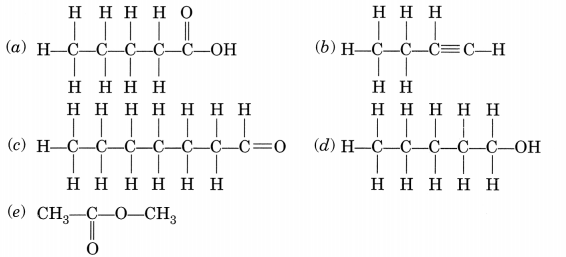
Carbon and its Compounds Class 10 Extra Questions with Answers Science Chapter 4, 26
Answer:
(a) Pentanoic acid
(b) But-l-yne or Butyne
(c) Heptanal
(d) Pentanol
(e) Methyl ethanoate

Question 2.
(а) What are hydrocarbons? Give examples.
(b) Give the structural differences between saturated and unsaturated hydrocarbons with two examples
(c) What is a functional group? Give examples of four different functional groups. [NCERT Exemplar]
Answer:
(a) Hydrocarbons are compounds of carbon and hydrogen. For example, ethane, ethene, benzene, etc.

(b) Saturated compounds are saturated by means of number of bonds or they contains only single bonds. For example,
CH3—CH3 (ethane), CH3CH2CH3 (propane)
Unsaturated hydrocarbon contains multiple bonds (C=C or C≡C)
For example, CH≡CH (ethyne) and CH2=CH2 (ethene).

(c) Functional group is an atom or group of atoms which imparts certain characteristic properties to the organic compound.

Question 3.
(a) Distinguish between esterification and saponification reactions of organic compounds.
(b) With a labelled diagram describe an activity to show the formation of an ester.
Answer:
(a) Esterification:
When carboxylic acid reacts with alcohol in the presence of a little concentrated sulphuric acid to form ester, the reaction is called esterification.

Carbon and its Compounds Class 10 Extra Questions with Answers Science Chapter 4, 27

Saponification:
When an ester is heated with sodium hydroxide solution then the esters get hydrolysed to form alcohol and sodium salt of carboxylic acid. This alkaline hydrolysis of esters is known as saponification as it is used in the preparation of soap.

Carbon and its Compounds Class 10 Extra Questions with Answers Science Chapter 4, 28

(b) Activity to show the formation of an ester:

  1. 1 ml ethanol and 1 mL glacial acetic acid along with a few drops of concentrated sulphuric acid are taken in a test tube.
  2. The mixture is allowed to warm in a water-bath for at least five minutes.
  3. The hot mixture of the test tube is poured into a beaker containing 20-50 ml of water.
  4. A sweet smelling substance called ester is formed.
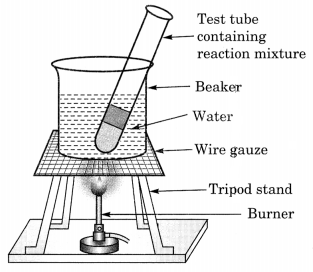
 

Carbon and its Compounds Class 10 Extra Questions with Answers Science Chapter 4, 29

Question 4.
List in tabular form three physical and two chemical properties on the basis of which ethanol and ethanoic acid can be differentiated.   (CBSE 2012)
Answer:
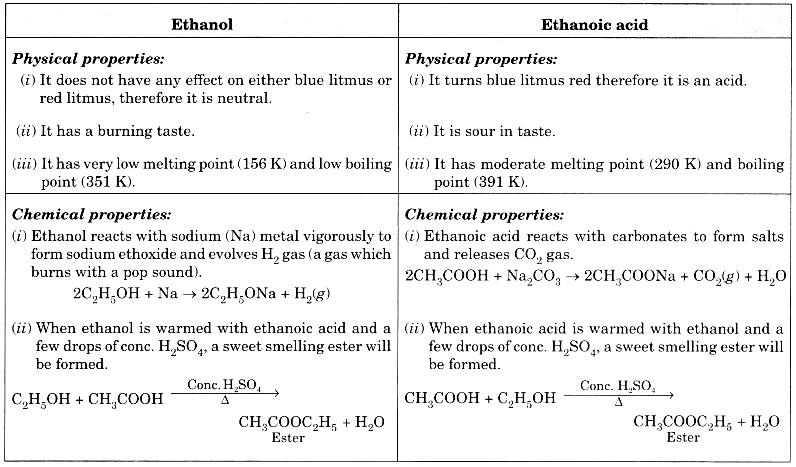
Carbon and its Compounds Class 10 Extra Questions with Answers Science Chapter 4, 30

Question 5.
Give one example each of:
1. Cracking
2. Hydrogenation
3. Dehydration
4. Substitution reaction
5. Addition reaction.
Answer:
1. Cracking

Carbon and its Compounds Class 10 Extra Questions with Answers Science Chapter 4, 31

2. Hydrogenation
Carbon and its Compounds Class 10 Extra Questions with Answers Science Chapter 4, 32

3. Dehydration
Carbon and its Compounds Class 10 Extra Questions with Answers Science Chapter 4, 33

4. Substitution reaction
Carbon and its Compounds Class 10 Extra Questions with Answers Science Chapter 4, 34

5. Addition reaction
Carbon and its Compounds Class 10 Extra Questions with Answers Science Chapter 4, 35

Carbon and its Compounds HOTS Questions With Answers

Question 1.
A compound X is formed by the reaction of a carboxylic acid C2H4O2 and an alcohol in presence of a few drops of H2SO4. The alcohol on oxidation with alkaline KMnO4 followed by acidification gives the same carboxylic acid as used in this reaction. Give the names and structures of (a) carboxylic acid, (b) alcohol and (c) the compound X. Also write the reaction.   (NCERT Exemplar)
Answer:
The available information suggests that the alcohol which gives the same carboxylic acid upon oxidation has two carbon atoms. It is therefore ethanol (C2H5OH). The structures of the different compounds are:
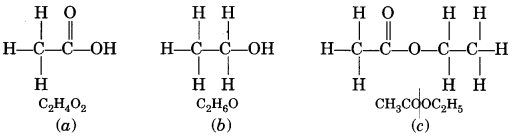
Carbon and its Compounds Class 10 Extra Questions with Answers Science Chapter 4, 36
Carbon and its Compounds Class 10 Extra Questions with Answers Science Chapter 4, 37

Question 2.
Carbon, Group (14) element in the Periodic Table, is known to form compounds with many elements.
Write an example of a compound formed with
(a) chlorine (Group 17 of Periodic Table)
(b) oxygen (Group 16 of Periodic Table)  (NCERT Exemplar)
Answer:
(a) Carbon tetrachloride (CCl4)
(b) Carbon dioxide (CO2)

Question 3.
A salt X is formed and a gas is evolved when ethanoic acid reacts with sodium hydrogen carbonate. Name the salt X and the gas evolved. Describe an activity and draw the diagram of the apparatus to prove that the evolved gas is the one which you have named. Also, write chemical equation of the reaction involved.   (NCERT Exemplar)
Answer:

Carbon and its Compounds Class 10 Extra Questions with Answers Science Chapter 4, 38
X is sodium ethanoate. Gas evolved is carbon dioxide (CO2).
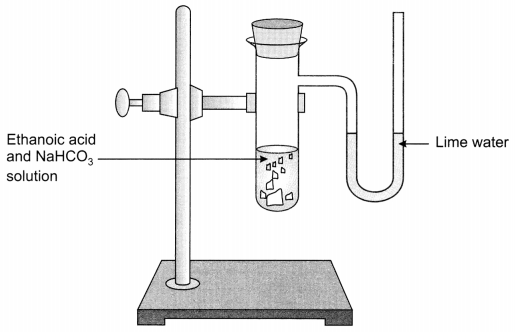
Carbon and its Compounds Class 10 Extra Questions with Answers Science Chapter 4, 39

Activity:

  1. Take sodium hydrogen carbonate in a test tube and add 2 ml ethanoic acid in it.
  2. Carbon dioxide gas is evolved with brisk effervescence.
  3. Pass the gas through lime water, it will turn milky. This shows that the gas evolved is carbon dioxide (CO2).

Question 4.
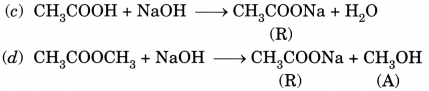
A compound C (molecular formula, C2H4O2) reacts with Na metal to form a compound R and evolves a gas which bums with a pop up sound. Compound C on treatment with an alcohol A in presence of an acid forms a sweet smelling compound S (molecular formula, C3H6O2). On addition of NaOH to C, it also gives R and water. S on treatment with NaOH solution gives back R and A.
Identify C, R, A, S and write down the reactions involved.   (NCERT Exemplar)
Answer:
C – Ethanoic acid
R – Sodium salt of ethanoic acid (sodium acetate) and gas evolved is hydrogen
A – Methanol
S – Ester (Methyl acetate)
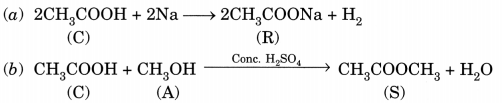
Carbon and its Compounds Class 10 Extra Questions with Answers Science Chapter 4, 40
Carbon and its Compounds Class 10 Extra Questions with Answers Science Chapter 4, 41

Question 5.
Look at figure given on the next page and answer the following questions:
(a) What change would you observe in calcium hydroxide solution taken in test tube B?
(b) Write the reaction involved in test tubes A and B respectively.
(c) If ethanol is given instead of ethanoic acid, would you expect the same change?
(d) How can a solution of lime water be prepared in the laboratory?   (NCERT Exemplar)
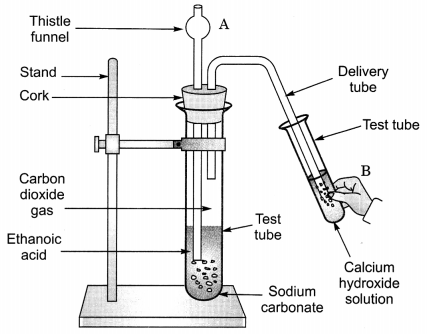
Carbon and its Compounds Class 10 Extra Questions with Answers Science Chapter 4, 42
Answer:
(a) It will become milky.

(b) In test tube A, ethanoic acid react with sodium carbonate to form sodium ethanoate along with carbon dioxide. The gas is evolved accompanied by brisk effervescence.
CH3COOH + Na2CO3 → CH3COONa + CO2 + H2O

In test tube B, calcium hydroxide reacts with carbon dioxide to form a milky solution of calcium carbonate.
Ca(OH)2 + CO2 → CaCO3 + H2O

(c) No, it would be different. No chemical reaction is possible between ethanol and sodium carbonate.

(d) Lime water is prepared by keeping a suspension of calcium hydroxide overnight in a beaker. The solution is decanted and is transferred to another beaker. It contains traces of calcium hydroxide and is called lime water.

Question 6.
An organic compound A on heating with concentrated H2SO4 forms a compound B which on addition of one mole of hydrogen in presence of Ni forms a compound C. One mole of compound C on combustion forms two moles of CO2 and 3 moles of H2O. Identify the compounds A, B and C and write the chemical equations of the reactions involved.  (NCERT Exemplar)
Answer:
Since compound C gives 2 moles of CO2 and 3 moles of H2O, it shows that it has the molecular formula C2H6 (ethane). C is obtained by the addition of one mole of hydrogen to compound B, so the molecular formula of B should be C2H4 (ethene). Compound B is obtained by heating compound A with concentrated H2SO4 which shows it to be an alcohol. So compound A could be C2H5OH (Ethanol).
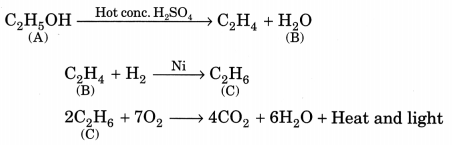
Carbon and its Compounds Class 10 Extra Questions with Answers Science Chapter 4, 43

Extra Questions for Class 10 Science Chapter 4 Value Based Questions

Question 1.
Ethanol is one of the most important industrial chemicals. It is used in medicine, to synthesise many important compounds and as an excellent solvent.
However, inspite of its benefits it causes many social problems. If a person drinks alcohol regularly, he becomes an alcoholic. Alcohol is non-toxic but it produces physiological effects disturbing brain activity. These persons are also a threat to the lives of others.
(a) Give three reasons in favour and three reasons against ‘alcohol-free world’.
(b) ‘Alcohol drinking should not be portrayed on media’. Give valid reasons to justify.
(c) As a student what initiative would you take in the concern of “We should condemn drinking alcohol”,
Answer:
(a) In favour of‘Alcohol-free world’:

  • Alcohol drinking lowers inhibitions which leads to increased violence and crime in the society.
  • A liver disease ‘cirrhosis’ caused by alcohol can lead to death.
  • Drunken driving leads to increased road accidents.

Against ‘Alcohol-free world’:

  • Alcohol is used for making some medicines like cough syrups, tincture iodine, some tonics, etc.
  • Mixed with petrol, it is now being used as a fuel for light vehicles.
  • It is used for making antifreeze material for cooling engines of vehicles.

(b) ‘Alcohol drinking should not be portrayed on media’ because young people and children are greatly influenced by the media.

(c) Initiatives taken by a student to create awareness about drinking alcohol could be:

  • By writing slogan
  • Through debates
  • By writing articles
  • By role plays/skits

Question 2.
Intake of small quantity of methanol can be lethal. Comment.  (NCERT Exemplar)
Answer:
Methanol is oxidised to methanal in the liver. Methanal reacts with the component of the cells. It causes the protoplasm to coagulate. It also affect the optic nerve, due to which it causes blindness.

RD Sharma Class 10 Solutions Chapter 2 Polynomials MCQS

RD Sharma Class 10 Solutions Chapter 2 Polynomials MCQS

These Solutions are part of RD Sharma Class 10 Solutions. Here we have given RD Sharma Class 10 Solutions Chapter 2 Polynomials MCQS. You must go through NCERT Solutions for Class 10 Maths to get better score in CBSE Board exams along with RS Aggarwal Class 10 Solutions.

Mark the correct alternative in each of the following :
Question 1.
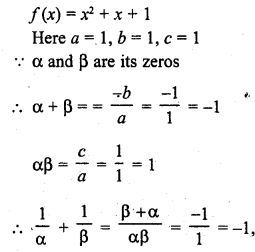
If α, β are the zeros of the polynomial f(x) = x2 + x + 1, then \(\frac { 1 }{ \alpha } +\frac { 1 }{ \beta }\) =
(a) 1
(b) -1
(c) 0
(d) None of these
Solution:
(b)
RD Sharma Class 10 Solutions Chapter 2 Polynomials MCQS 1

Polynomial Root calculator. Welcome to our step-by-step math solver! Solve · Simplify · Factor

Question 2.
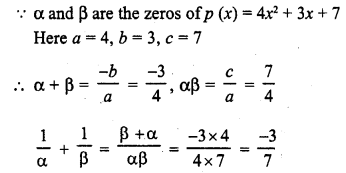
If α, β are the zeros of the polynomial p(x) = 4x2 + 3x + 7, then \(\frac { 1 }{ \alpha } +\frac { 1 }{ \beta }\) is equal to
(a) \(\frac { 7 }{ 3 }\)
(b) – \(\frac { 7 }{ 3 }\)
(c) \(\frac { 3 }{ 7 }\)
(d) – \(\frac { 3 }{ 7 }\)
Solution:
(d)
RD Sharma Class 10 Solutions Chapter 2 Polynomials MCQS 2

Question 3.
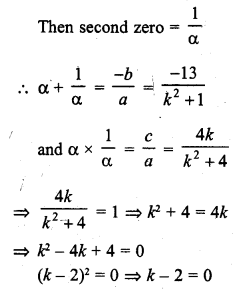
If one zero of the polynomial f(x) = (k2 + 4) x2 + 13x + 4k is reciprocal of the other, then k =
(a) 2
(b) -2
(c) 1
(d) -1
Solution:
(a) f (x) = (k2 + 4) x2 + 13x + 4k
Here a = k2 + 4, b = 13, c = 4k
One zero is reciprocal of the other
Let first zero = α
RD Sharma Class 10 Solutions Chapter 2 Polynomials MCQS 3
k = 2

Question 4.
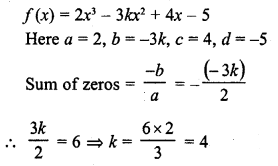
If the sum of the zeros of the polynomial f(x) = 2x3 – 3kx2 + 4x – 5 is 6, then value of k is
(a) 2
(b) 4
(c) -2
(d) -4
Solution:
(b)
RD Sharma Class 10 Solutions Chapter 2 Polynomials MCQS 4

Question 5.
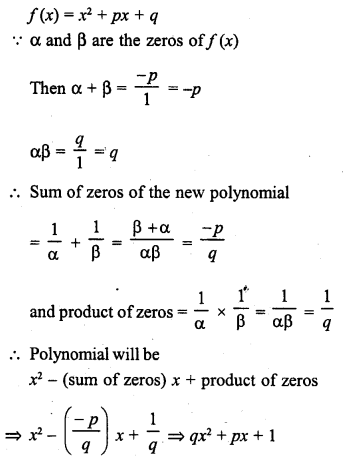
If α and β are the zeros of the polynomial f(x) = x2 + px + q, then a polynomial having α and β is its zeros is
(a) x2 + qx + p
(b) x2 – px + q
(c) qx2 + px + 1
(d) px2 + qx + 1
Solution:
(c)
RD Sharma Class 10 Solutions Chapter 2 Polynomials MCQS 5

Question 6.
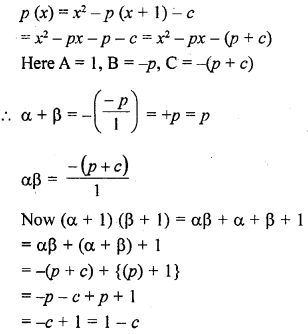
If α, β are the zeros of polynomial f(x) = x2 – p (x + 1) – c, then (α + 1) (β + 1) =
(a) c – 1
(b) 1 – c
(c) c
(d) 1 + c
Solution:
(b)
RD Sharma Class 10 Solutions Chapter 2 Polynomials MCQS 6

Question 7.
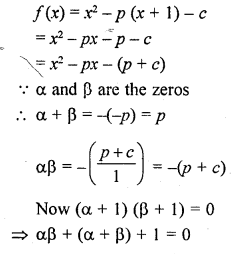
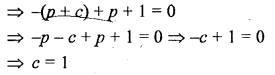
If α, β are the zeros of the polynomial f(x) = x2 – p(x + 1) – c such that (α + 1) (β + 1) = 0, then c =
(a) 1
(b) 0
(c) -1
(d) 2
Solution:
(a)
RD Sharma Class 10 Solutions Chapter 2 Polynomials MCQS 7
RD Sharma Class 10 Solutions Chapter 2 Polynomials MCQS 8

Question 8.
If f(x) = ax2 + bx + c has no real zeros and a + b + c < 0, then
(a) c = 0
(b) c > 0
(c) c < 0
(d) None of these
Solution:
(d) f(x) = ax2 + bx + c
Zeros are not real
b2 – 4ac < 0 ….(i)
but a + b + c < 0
b < – (a + c)
Squaring both sides b2 < (a + c)2
=> (a + c)2 – 4ac < 0 {From (i)}
=> (a – c)2 < 0
=> a – c < 0
=> a < c

Question 9.
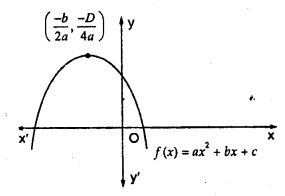
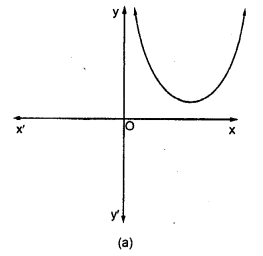
If the diagram in figure shows the graph of the polynomial f(x) = ax2 + bx + c, then
(a) a > 0, b < 0 and c > 0
(b) a < 0, b < 0 and c < 0
(c) a < 0, b > 0 and c > 0
(d) a < 0, b > 0 and c < 0
RD Sharma Class 10 Solutions Chapter 2 Polynomials MCQS 9
Solution:
(a) Curve ax2 + bx + c intersects x-axis at two points and curve is upward.
a > 0, b < 0 and c> 0

Question 10.
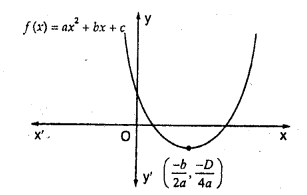
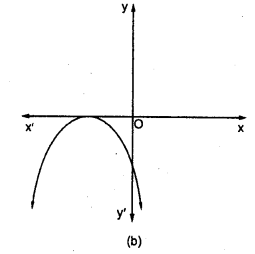
Figure shows the graph of the polynomial f(x) = ax2 + bx + c for which
(a) a < 0, b > 0 and c > 0
(b) a < 0, b < 0 and c > 0
(c) a < 0, b < 0 and c < 0
(d) a > 0, b > 0 and c < 0
RD Sharma Class 10 Solutions Chapter 2 Polynomials MCQS 10
Solution:
(b) Curve ax2 + bx + c intersects x-axis at two points and curve is downward.
a < 0, b < 0 and c > 0

Question 11.
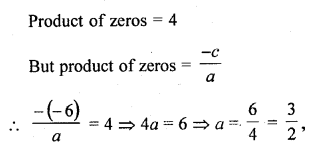
If the product of zeros of the polynomial f(x) = ax3 – 6x2 + 11x – 6 is 4, then a =
(a) \(\frac { 3 }{ 2 }\)
(b) – \(\frac { 3 }{ 2 }\)
(c) \(\frac { 2 }{ 3 }\)
(d) – \(\frac { 2 }{ 3 }\)
Solution:
(a) f(x) = ax3 – 6x2 + 11x – 6
RD Sharma Class 10 Solutions Chapter 2 Polynomials MCQS 11

Question 12.
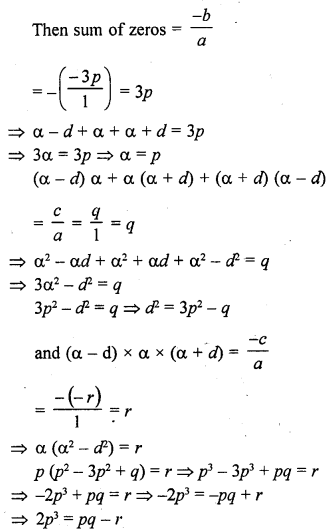
If zeros of the polynomial f(x) = x3 – 3px2 + qx – r are in AP, then
(a) 2p3 = pq – r
(b) 2p3 = pq + r
(c) p3 = pq – r
(d) None of these
Solution:
(a) f(x) = x3 – 3px2 + qx – r
Here a = 1, b = -3p, c = q, d= -r
Zeros are in AP
Let the zeros be α – d, α, α + d
RD Sharma Class 10 Solutions Chapter 2 Polynomials MCQS 12

Question 13.
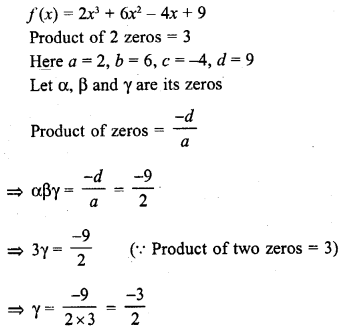
If the product of two zeros of the polynomial f(x) = 2x3 + 6x2 – 4x + 9 is 3, then its third zero is
(a) \(\frac { 3 }{ 2 }\)
(b) – \(\frac { 3 }{ 2 }\)
(c) \(\frac { 9 }{ 2 }\)
(d) – \(\frac { 9 }{ 2 }\)
Solution:
(b)
RD Sharma Class 10 Solutions Chapter 2 Polynomials MCQS 13

Question 14.
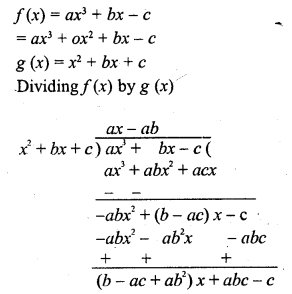
If the polynomial f(x) = ax2 + bx – c is divisible by the polynomial g(x) = ax2 + bx + c, then ab =
(a) 1
(b) \(\frac { 1 }{ c }\)
(c) – 1
(d) – \(\frac { 1 }{ c }\)
Solution:
(a)
RD Sharma Class 10 Solutions Chapter 2 Polynomials MCQS 14
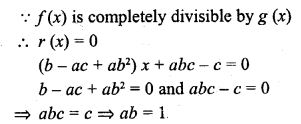
RD Sharma Class 10 Solutions Chapter 2 Polynomials MCQS 15

Question 15.
In Q. No. 14, ac =
(a) b
(b) 2b
(c) 2b2
(d) -2b
Solution:
(b) In the previous questions
Remainder = 0
(b – ac + ab2) = 0
b + ab2 = ac
=> ac = b (1 + ab) = b (1 + 1) = 2b

Question 16.
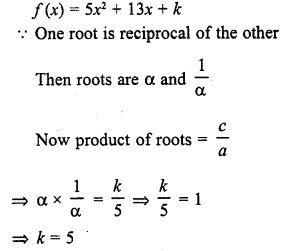
If one root of the polynomial f(x) = 5x2 + 13x + k is reciprocal of the other, then the value of k is
(a) 0
(b) 5
(c) \(\frac { 1 }{ 6 }\)
(d) 6
Solution:
(b)
RD Sharma Class 10 Solutions Chapter 2 Polynomials MCQS 16

Question 17.
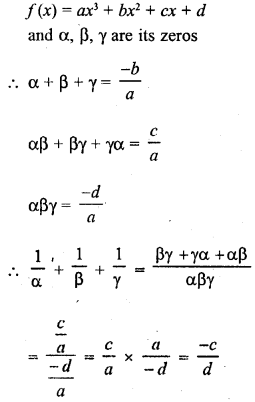
If α, β, γ are the zeros of the polynomial f(x) = ax3 + bx2 + cx + d, then \(\frac { 1 }{ \alpha } +\frac { 1 }{ \beta } +\frac { 1 }{ \gamma }\) =
(a) – \(\frac { b }{ d }\)
(b) \(\frac { c }{ d }\)
(c) – \(\frac { c }{ d }\)
(d) \(\frac { c }{ a }\)
Solution:
(c)
RD Sharma Class 10 Solutions Chapter 2 Polynomials MCQS 17

Question 18.
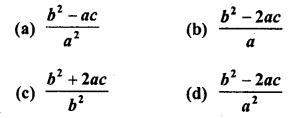
If α, β, γ are the zeros of the polynomial f(x) = ax3 + bx2 + cx + d, then α2 + β2 + γ2 =
RD Sharma Class 10 Solutions Chapter 2 Polynomials MCQS 18
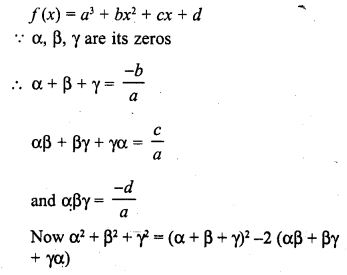
Solution:
(d)
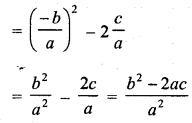
RD Sharma Class 10 Solutions Chapter 2 Polynomials MCQS 19
RD Sharma Class 10 Solutions Chapter 2 Polynomials MCQS 20

Question 19.
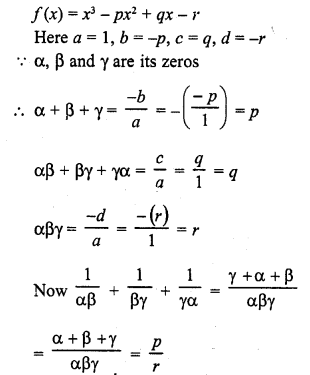
If α, β, γ are the zeros of the polynomial f(x) = x3 – px2 + qx – r, then \(\frac { 1 }{ \alpha \beta } +\frac { 1 }{ \beta \gamma } +\frac { 1 }{ \gamma \alpha }\) =
(a) \(\frac { r }{ p }\)
(b) \(\frac { p }{ r }\)
(c) – \(\frac { p }{ r }\)
(d) – \(\frac { r }{ p }\)
Solution:
(b)
RD Sharma Class 10 Solutions Chapter 2 Polynomials MCQS 21

Question 20.
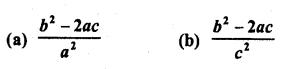
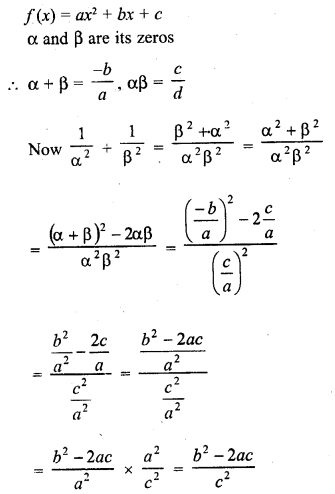
If α, β are the zeros of the polynomial f(x) = ax2 + bx + c, then \(\frac { 1 }{ { \alpha }^{ 2 } } +\frac { 1 }{ { \beta }^{ 2 } }\) =
RD Sharma Class 10 Solutions Chapter 2 Polynomials MCQS 22
RD Sharma Class 10 Solutions Chapter 2 Polynomials MCQS 23
Solution:
(b)
RD Sharma Class 10 Solutions Chapter 2 Polynomials MCQS 24

Question 21.
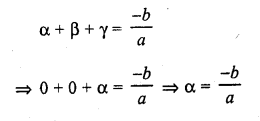
If two of the zeros of the cubic polynomial ax3 + bx2 + cx + d are each equal to zero, then the third zero is
(a) \(\frac { -d }{ a }\)
(b) \(\frac { c }{ a }\)
(c) \(\frac { -b }{ a }\)
(d) \(\frac { b }{ a }\)
Solution:
(c) Two of the zeros of the cubic polynomial ax3 + bx2 + cx + d are each equal to zero
Let α, β and γ are its zeros, then
RD Sharma Class 10 Solutions Chapter 2 Polynomials MCQS 25
Third zero will be \(\frac { -b }{ a }\)

Question 22.
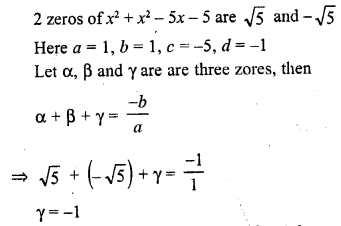
If two zeros of x3 + x2 – 5x – 5 are √5 and – √5 then its third zero is
(a) 1
(b) -1
(c) 2
(d) -2
Solution:
(b)
RD Sharma Class 10 Solutions Chapter 2 Polynomials MCQS 26

Question 23.
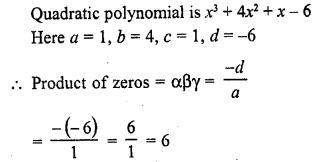
The product of the zeros of x3 + 4x2 + x – 6 is
(a) – 4
(b) 4
(c) 6
(d) – 6
Solution:
(c)
RD Sharma Class 10 Solutions Chapter 2 Polynomials MCQS 27

Question 24.
What should be added to the polynomial x2 – 5x + 4, so that 3 is the zero of the resulting polynomial ?
(a) 1
(b) 2
(c) 4
(d) 5
Solution:
(b) 3 is the zero of the polynomial f(x) = x2 – 5x + 4
x – 3 is a factor of f(x)
Now f(3) = (3)2 – 5 x 3 + 4 = 9 – 15 + 4 = 13 – 15 = -2
-2 is to be subtracting or 2 is added

Question 25.
What should be subtracted to the polynomial x2 – 16x + 30, so that 15 is the zero of the resulting polynomial ?
(a) 30
(b) 14
(b) 15
(d) 16
Solution:
(c) 15 is the zero of polynomial f(x) = x2 – 16x + 30
Then f(15) = 0
f(15) = (15)2 – 16 x 15 + 30 = 225 – 240 + 30 = 255 – 240 = 15
15 is to be subtracted

Question 26.
A quadratic polynomial, the sum of whose zeroes is 0 and one zero is 3, is
(a) x2 – 9
(b) x2 + 9
(c) x2 + 3
(d) x2 – 3
Solution:
(a) In a quadratic polynomial
Let α and β be its zeros
and α + β = 0
and one zero = 3
3 + β = 0 ⇒ β = -3 .
Second zero = -3
Quadratic polynomial will be
(x – 3) (x + 3) ⇒ x2 – 9

Question 27.
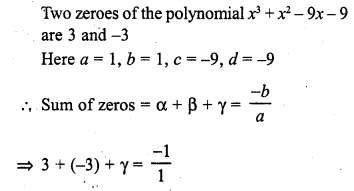
If two zeroes of the polynomial x3 + x2 – 9x – 9 are 3 and -3, then its third zero is
(a) -1
(b) 1
(c) -9
(d) 9
Solution:
(a)
RD Sharma Class 10 Solutions Chapter 2 Polynomials MCQS 28
=> γ = -1
Third zero = -1

Question 28.
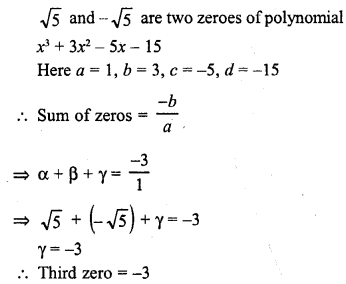
If √5 and – √5 are two zeroes of the polynomial x3 + 3x2 – 5x – 15, then its third zero is
(a) 3
(b) – 3
(c) 5
(d) – 5
Solution:
(b)
RD Sharma Class 10 Solutions Chapter 2 Polynomials MCQS 29

Question 29.
If x + 2 is a factor x2 + ax + 2b and a + b = 4, then
(a) a = 1, b = 3
(b) a = 3, b = 1
(c) a = -1, b = 5
(d) a = 5, b = -1
Solution:
(b) x + 2 is a factor of x2 + ax + 2b and a + b = 4
x + 2 is one of the factor
x = – 2 is its one zero
f(-2) = 0
=> (-2)2 + a (-2) + 2b = 0
=> 4 – 2a + 2b = 0
=> 2a – 2b = 4
=> a – b = 2
But a + b = 4
Adding we get, 2a = 6 => a = 3
and a + b = 4 => 3 + b = 4 => b = 4 – 3 = 1
a = 3, b = 1

Question 30.
The polynomial which when divided by – x2 + x – 1 gives a quotient x – 2 and remainder 3, is
(a) x3 – 3x2 + 3x – 5
(b) – x3 – 3x2 – 3x – 5
(c) – x3 + 3x2 – 3x + 5
(d) x3 – 3x2 – 3x + 5
Solution:
(c) Divisor = – x2 + x – 1, Quotient = x – 2 and
Remainder = 3, Therefore
Polynomial = Divisor x Quotient+Remainder
= (-x2 + x – 1) (x – 2) + 3
= – x3 + x2 – x + 2x2 – 2x + 2 + 3
= – x3 + 3x2 – 3x + 5

Question 31.
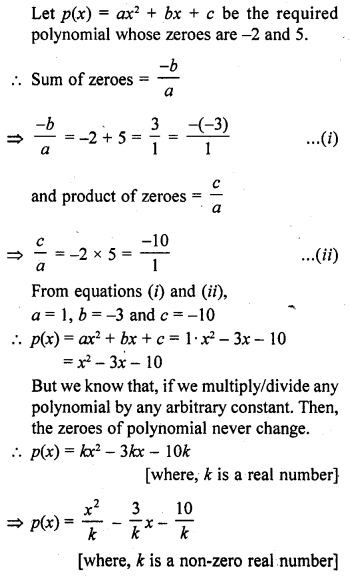
The number of polynomials having zeroes -2 and 5 is
(a) 1
(b) 2
(c) 3
(d) more than 3
Solution:
(d)
RD Sharma Class 10 Solutions Chapter 2 Polynomials MCQS 30
Hence, the required number of polynomials are infinite i.e., more than 3.

Question 32.
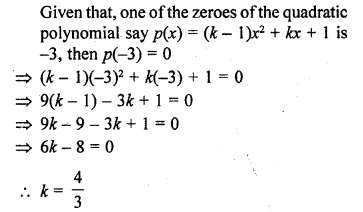
If one of the zeroes of the quadratic polynomial (k – 1)x2 + kx + 1 is -3, then the value of k is
(a) \(\frac { 4 }{ 3 }\)
(b) – \(\frac { 4 }{ 3 }\)
(c) \(\frac { 2 }{ 3 }\)
(d) – \(\frac { 2 }{ 3 }\)
Solution:
(a)
RD Sharma Class 10 Solutions Chapter 2 Polynomials MCQS 31

Question 33.
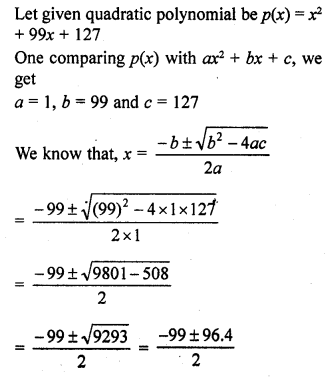
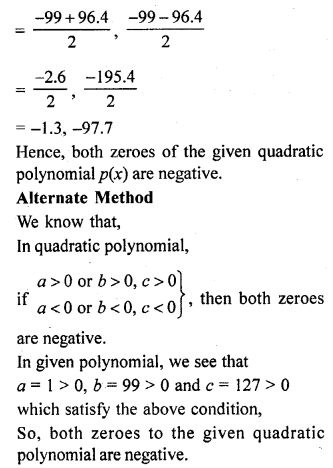
The zeroes of the quadratic polynomial x2 + 99x + 127 are
(a) both positive
(b) both negative
(c) both equal
(d) one positive and one negative
Solution:
(b)
RD Sharma Class 10 Solutions Chapter 2 Polynomials MCQS 32
RD Sharma Class 10 Solutions Chapter 2 Polynomials MCQS 33

Question 34.
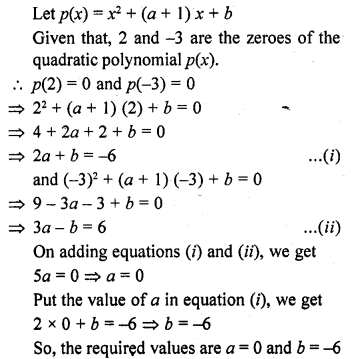
If the zeroes of the quadratic polynomial x2 + (a + 1) x + b are 2 and -3, then
(a) a = -7, b = -1
(b) a = 5, b = -1
(c) a = 2, b = -6
(d) a = 0, b = -6
Solution:
(d)
RD Sharma Class 10 Solutions Chapter 2 Polynomials MCQS 34

Question 35.
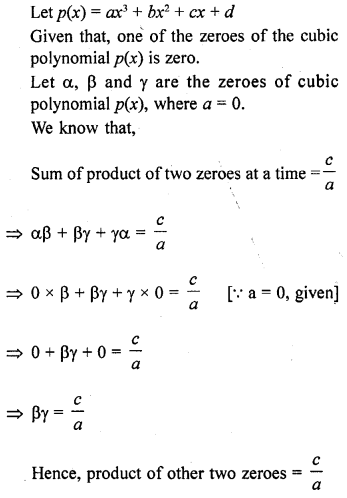
Given that one of the zeroes of the cubic polynomial ax3 + bx2 + cx + d is zero, the product of the other two zeroes is
(a) – \(\frac { c }{ a }\)
(b) \(\frac { c }{ a }\)
(c) 0
(d) – \(\frac { b }{ a }\)
Solution:
(b)
RD Sharma Class 10 Solutions Chapter 2 Polynomials MCQS 35

Question 36.
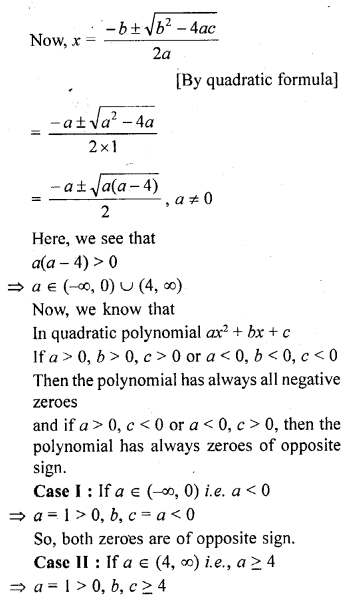
The zeroes of the quadratic polynomial x2 + ax + a, a ≠ 0,
(a) cannot both be positive
(b) cannot both be negative
(c) area always unequal
(d) are always equal
Solution:
(a) Let p(x) = x2 + ax + a, a ≠ 0
On comparing p(x) with ax2 + bx + c, we get
a = 1, b = a and c = a
RD Sharma Class 10 Solutions Chapter 2 Polynomials MCQS 36
So, both zeroes are negative.
Hence, in any case zeroes of the given quadratic polynomial cannot both the positive.

Question 37.
If one of the zeroes of the cubic polynomial x3 + ax2 + bx + c is -1, then the product of other two zeroes is
(a) b – a + 1
(b) b – a – 1
(c) a – b + 1
(d) a – b – 1
Solution:
(a)
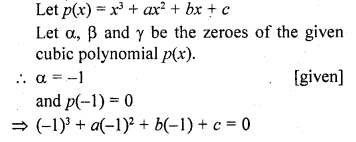
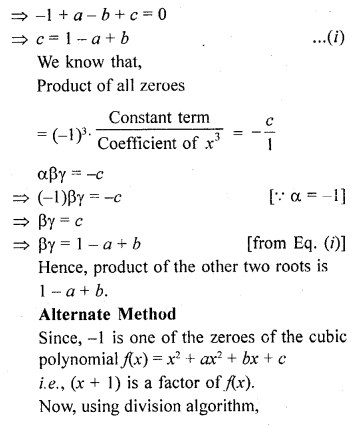
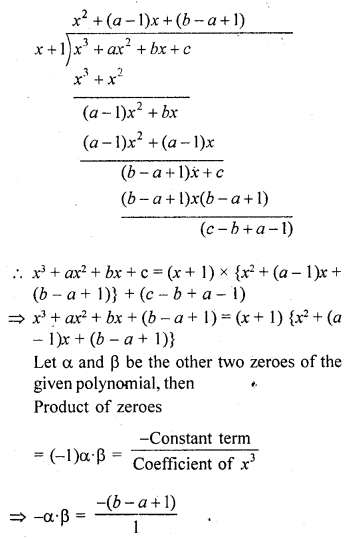
RD Sharma Class 10 Solutions Chapter 2 Polynomials MCQS 37
RD Sharma Class 10 Solutions Chapter 2 Polynomials MCQS 38
RD Sharma Class 10 Solutions Chapter 2 Polynomials MCQS 39
=> α β = -a + b + 1
Hence, the required product of other two roots is (-a + b + 1)

Question 38.
Given that two of the zeroes of the cubic polynomial ax3 + bx2 + cx + d are 0, the third zero is
(a) – \(\frac { b }{ a }\)
(b) \(\frac { b }{ a }\)
(c) \(\frac { c }{ a }\)
(d) – \(\frac { d }{ a }\)
Solution:
(a) Two of the zeroes of the cubic polynomial
ax3 + bx2 + cx + d = 0, 0
Let the third zero be d
Then, use the relation between zeroes and coefficient of polynomial, we have
d + 0 + 0 = – \(\frac { b }{ a }\)
⇒ d = – \(\frac { b }{ a }\)

Question 39.
If one zero of the quadratic polynomial x2 + 3x + k is 2, then the value of k is
(a) 10
(b) -10
(c) 5
(d) -5
Solution:
(b) Let the given quadratic polynomial be P(x) = x2 + 3x + k
It is given that one of its zeros is 2
P(2) = 0
=> (2)2 + 3(2) + k = 0 => 4 + 6 + k = 0
=> k + 10 = 0 => k = -10

Question 40.
If the zeroes of the quadratic polynomial ax2 + bx + c, c ≠ 0 are equal, then
(a) c and a have opposite signs
(b) c and b have opposite signs
(c) c and a have the same sign
(d) c and b have the same sign
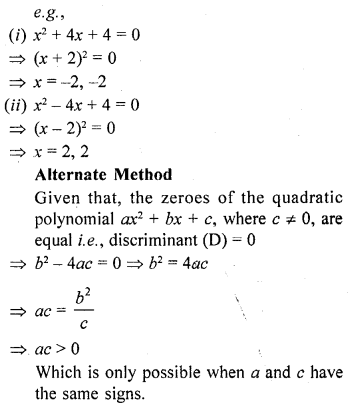
Solution:
(c) The zeroes of the given quadratic polynomial ax2 + bx + c, c ≠ 0 are equal. If coefficient of x2 and constant term have the same sign
i.e., c and a have the same sign. While b i.e., coefficient of x can be positive/negative but not zero.
RD Sharma Class 10 Solutions Chapter 2 Polynomials MCQS 40

Question 41.
If one of the zeroes of a quadratic polynomial of the form x2 + ax + b is the negative of the other, then it
(a) has no linear term and constant term is negative.
(b) has no linear term and the constant term is positive.
(c) can have a linear term but the constant term is negative.
(d) can have a linear term but the constant term is positive.
Solution:
(a)
RD Sharma Class 10 Solutions Chapter 2 Polynomials MCQS 41
Given that, one of the zeroes of a quadratic polynomial p(x) is negative of the other.
αβ < 0
So, b < 0 [from Eq. (i)]
Hence, b should be negative Put a = 0, then,
p(x) = x2 + b = 0 => x2 = – b
=> x = ± √-b [ b < 0]
Hence, if one of the zeroes of quadratic polynomial p(x) is the negative of the other, then it has no linear term i.e., a = 0 and the constant term is negative i.e., b < 0. Alternate Method Let f(x) = x2 + ax + b and by given condition the zeroes are a and -a. Sum of the zeroes = α – α = a => a = 0
f(x) = x2 + b, which cannot be linear and product of zeroes = α (-α) = b
=> – α2 = b
which is possible when, b < 0.
Hence, it has no linear term and the constant tenn is negative.

Question 42.
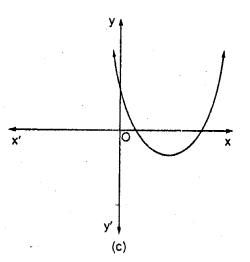
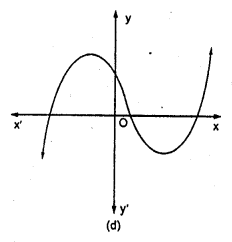
Which of the following is not the graph of a quadratic polynomial?
RD Sharma Class 10 Solutions Chapter 2 Polynomials MCQS 42
RD Sharma Class 10 Solutions Chapter 2 Polynomials MCQS 43
RD Sharma Class 10 Solutions Chapter 2 Polynomials MCQS 44
RD Sharma Class 10 Solutions Chapter 2 Polynomials MCQS 45
Solution:
(d) For any quadratic polynomial ax2+ bx + c, a 0, the graph of the corresponding equation y = ax2 + bx + c has one of the two shapes either open upwards like ∪ or open downwards like ∩ depending on whether a > 0 or a < 0. These curves are called parabolas. So, option (d) cannot be possible.
Also, the curve of a quadratic polynomial crosses the X-axis on at most two points but in option (d) the curve crosses the X-axis on the three points, so it does not represent the quadratic polynomial.

Hope given RD Sharma Class 10 Solutions Chapter 2 Polynomials MCQS are helpful to complete your math homework.

If you have any doubts, please comment below. Learn Insta try to provide online math tutoring for you.

NCERT Solutions for Class 12 English Vistas Chapter 4 The Enemy

Here we are providing NCERT Solutions for Class 12 English Vistas Chapter 4 The Enemy. Students can get Class 12 English The Enemy NCERT Solutions, Questions and Answers designed by subject expert teachers.

The Enemy NCERT Solutions for Class 12 English Vistas Chapter 4

The Enemy NCERT Text Book Questions and Answers

The Enemy Reading with insight

Question 1.
There are moments in life when we have to make hard choices between our roles as private individuals and citizens with a sense of national loyalty. Discuss with reference to the story you have just read.
Answer:
A conflict of interest arises in a situation when someone in a position of trust, such as a doctor, has competing interests. Such competing interests can make it difficult to fulfill his or her duties impartially. A conflict of interest can create a situation of conflict, like in the story when a white American soldier falls into the hands of a Japanese physician, in enemy territory during the Second World War. The Japanese physician, Sadao, disliked the whites and struggled with issues of loyalty, duty, and racism. As a Japanese national, it was his duty to hand over the escaped prisoner to the police, while as a doctor, it was his duty to save his life.

Sadao risked his safety and saved an enemy. He feared the consequences of harbouring an enemy. Subconsciously, he overcame his dislike for Americans and addressed the soldier as “my friend”. He, then, helped the soldier escape.

The character of Sadao can be aligned to that of a hero for his qualities of bravery, helpfulness, and professional competence. He, like a real hero, stood up for what he believed and cared less for repercussions. One definitely admires him for saving the soldier’s life like a true hero.

Class 12 English Vistas Chapter 4 Question Answer help to score more marks in your CBSE Examination.

Question 2.
Dr. Sadao was compelled by his duty as a doctor to help the enemy soldier. What made Hana, his wife, sympathetic to him in the face of open defiance from the domestic staff?
Answer:
When Sadao and Hana saw the prisoner of war, they were confronted with a dilemma, but the doctor in Sadao knew he had to save him. Hana, too, knew that if they left the American there, he would certainly die. She could not put him back in the sea. In the bedroom, Hana covered him with a flowered silk quilt and also washed him when Yumi refused. She also helped Sadao operate on the American. She was afraid lest the servants report them, yet she had the courage to assist her husband in saving the American’s life. When the soldier regained consciousness, he was terrified, but Hana reassured him.

Hana’s pride and self-respect held her back even when her servants deserted her. The servants felt, that their master’s stay in America had tempered his attitude towards the Americans. Though Hana comes across as patriotic, advising her husband to give up the prisoner, her sympathy and humanity towards the wounded ‘enemy’ raises her beyond petty parochialism.

Question 3.
How would you explain the reluctance of the solider to leave the shelter of the doctor’s home even when he couldn’t stay there without risk to the doctor and to himself?
Answer:
As the American, Tom, recovered from his wound, he was weak and trusted Sadao to save his life. Though Sadao does not gracefully accept the gratitude the wounded soldier offered him, he was attentive as a doctor and eager for his patient to recover. However, Sadao was also concerned for his safety, and asked Tom to leave at his earliest. Though Sadao was momentarily tempted by the General’s offer to arrange for the prisoner to be secretly assassinated, the doctor showed unrest and finally arranged for the prisoner to escape.

Tom understood that he posed a risk to the doctor’s family and his own self, but he was reluctant to leave. He felt safe at the doctor’s and admitted that he was the finest Japanese he came across. Fear of arrest and death led him to seek shelter with Sadao and his family. In this story, Tom bonds with the Japanese family as fellow humans, who have looked after him, and looked up to them as his saviour. The mutual hatred, that their respective country festered in them, fell away at the time of crisis.

Question 4.
What explains the attitude of the ruthless General in the matter of the enemy soldier? Was it human consideration, lack of national loyalty, dereliction of duty, or simply self-absorption?
Answer:
The General was a highly self-absorbed man. He had kept the doctor in the country primarily because he needed medical attention. He decided to get rid of the soldier, quietly, to save the doctor from facing the consequences. When Sadao told him about the successful operation of the American, the General was happy because that was a reassurance of Sadao’s professional skill. His self-absorption came to the forefront when he wondered aloud what would happen if Sadao were condemned to death when he required his medical attention. He conspired to get the soldier killed by his private assassins, to ensure his own safety, rather than Sadao’s.

Later, when Sadao informed the General about Tom’s escape, a week after his emergency operation, the General admitted that he had promised to get him killed but during his suffering, he “thought of nothing but myself (himself), and forgot my (his) promise”. He was only concerned about if the matter was publicised and required assurance from the doctor that he would certify for his honesty.

Question 5.
While hatred against the enemy race is justifiable, especially during wartime, what makes a human being rise above narrow prejudices?
Answer:
Sadao had grown up believing that the Japanese were a superior race. He also disliked Americans as his own experience in America had not been pleasant. He had faced racial bias. He thought Americans were full of prejudice. Despite this, he couldn’t let the young American soldier bleed to death. While his logic and reasoning revolted against saving his ‘enemy’, his inherent humanity won over. Humanity and compassion often tide over hatred and prejudice.

Sadao was a fine example of how his patriotic and parochial attitude acted as a constant voice of conscience. He, however, was led by the superior feelings of compassion and humanity. As a doctor, he valued his promise to help any fellow human and he failed to compromise on his personal and professional ethics.

Question 6.
Do you think that the doctor’s final solution to the problem was the best possible one in the circumstances?
Answer:
Yes, it was.

  • He was duty bound as a doctor to save lives.
  • Political enemies are not personal enemies.
  • Tom was a young soldier who was merely doing his duty.
  • Compassion is a natural instinct.

OR

No, it wasn’t.

  • The foremost duty is towards one’s motherland.
  • The soldier would have recovered and continued his job of killing Sadao’s people.
  • Harbouring an enemy soldier is an offence.
  • After doing his duty as a doctor, he could have easily handed over the soldier to the authorities.

Question 7.
Does the story remind you of “Birth” by A J Cronin that you read in the Snapshots last year? What are the similarities?
Answer:
“The Enemy” is about an American-trained Japanese surgeon, working in Japan during Second World War, who saves an American POW first by operating on him and then by helping him escape. Sadao realized that the white man in the US navy uniform had a bullet wound. He was in a dilemma for a moment but the doctor in him took over and he treated the bullet wound and saved the soldier.

In “Birth”, A J Cronin deals with medical ethics through the protagonist, Andrew Manson. It brings out that medicine is not merely a business whose goal is to enrich its practitioners materially, the essence of being a doctor is the use of one’s senses, knowledge, and experience to reduce suffering and improve people’s lives. Manson overlooks the disappointment caused to him by his relationship, and seeks tremendous satisfaction in saving a mother and child.

Both the stories underline the medical ethics—a doctor’s responsibility to the patient is of the greatest importance. In light of this, both Sadao and Andrew are true to their profession and their duty as doctors.

The Enemy Extra Questions and Answers

The Enemy Short Answer Questions

Question 1.
What were Dr Sadao Hoki’s memories about his house?
Answer:
Dr Sadao Hoki had very pleasant memories about his house that was built on a spot in the Japanese coast. As a little boy he had often played on the beach. The low, square stone house was set upon rocks well above a narrow beach that was outlined with bent pines. As a boy Sadao had climbed the pines, supporting himself on his bare feet, as he had seen men do in the South Seas when they climbed for coconuts.

Question 2.
What was his father’s advice to Dr Sadao?
Answer:
Dr Sadao Hoki’s father had taken him often to the islands of those seas, and told him that the islands were the stepping stones to the future for Japan. The future was limitless and it depended on what one made it.

Question 3.
Why had Dr Sadao not been sent abroad with the troops?
Answer:
Sadao had become famous not only as a surgeon but as a scientist. He was kept back to tend to the old General, lest he needed an operation. Sadao was required to stay back in the capacity of a doctor.

Question 4.
Where had Dr Sadao first met his wife? What had been his initial reaction?
Answer:
Dr Sadao had met Hana, presently his wife, in America, at an American professor’s house. They were invited by the couple as foreign students. Sadao had waited before falling in love, until he was sure she was Japanese. His father would never have received her unless she proved to be a Japanese, pure of race.

Question 5.
How did Dr Sadao discover the American soldier?
Answer:
Standing on the porch of their house, Dr Sadao and his wife saw a man flung up, out of the ocean, by a breaker. He staggered a few steps, his body outlined against the mist. Sadao and Hana saw him on his hands and knees, crawling. Then they saw him fall on his face and lie there. It was only when they rushed to rescue him that they realized that he was an American.

Question 6.
What was Dr Sadao’s first reaction? What was the dilemma?
Answer:
Dr Sadao and his wife, Hana, thought of putting the injured soldier back in the sea; they were scared of being marked as someone who was sheltering an enemy. But they also realized that if they turned him over as a prisoner, he would certainly die. They stared at the stranger with repulsion, but eventually decided to carry him into the house.

Question 7.
How was the servants’ reaction different from that of Sadao?
Answer:
The two servants, employed by Sadao, were frightened. The old gardener, felt that his master should not shelter and treat a white man. Yumi also refused to wash a white man. The servants were defiant and made their displeasure evident. They even threatened to leave till their masters turned away the white man.

Question 8.
What was the American prisoner’s first reaction on regaining consciousness? How did Hana reassure him?
Answer:
When the wounded soldier awoke, he was weak, and his blue eyes were terrified when he perceived where he was. Hana felt compelled to apologize. She begged him not to be afraid. She knelt and fed him gently with the porcelain spoon. He ate unwillingly.

Question 9.
Why had the messenger in official uniform come to Sadao’s place? What was their reaction?
Answer:
The messenger had come to summon Dr Sadao as the old General was in pain. The Hokis were terrified as they wrongly guessed that they were being officially summoned for sheltering an American prisoner.

Question 10.
What was the General’s reaction to Sadao’s saving the enemy?
Answer:
The General was happy, much to Sadao’s surprise, as the General felt that his success at saving the prisoner made him all the more indispensable to himself. He felt the doctor could save anyone as he was extremely skilled. The self-centred General felt safe and reassured in Dr Sadao’s care.

Question 11.
What was the General’s plan to do away with the soldier?
Answer:
The General suggested that it would be best if he could be quietly killed, by someone who did not know him. For this, he planned to send his private assassins to the doctor’s house at night. He wanted the doctor to leave the outer partition of the white man’s room open, to provide an easy access to the soldier.

Question 12.
How did Sadao finally get rid of the prisoner?
Answer:
Sadao put the prisoner on a boat with food and extra clothing. He advised the prisoner to row to a little island not far from the coast. Nobody lived on it. He advised the American to lie low till he saw a Korean fishing boat pass by. Tom followed his instructions and Sadao was glad to see that his prisoner was gone within a few days of helping him escape to the island.

The Enemy Long Answer Question

Question 1.
Dr Sadao was a dutiful son who had not disappointed his father. Justify.
Answer:
When Sadao was a little boy, his father showed him the islands not far from the shore and told him that those islands were the “stepping-stones to the future of Japan”. Listening attentively to all that his father said, Sadao realized that his education was the most important thing in the world to his father. At twenty-two, he was sent to America to study surgery and medicine and he returned at thirty not only as a famous surgeon, but as an accomplished scientist. Since he was working on an important medical discovery, he was not sent abroad with the troops. The old General, too, trusted Sadao’s skill more than any other doctor. He had become a sought-after surgeon, thereby fulfilling his father’s wishes.

Question 2.
How did Sadao and Hana come across the American solider? How did they send him off?
Answer:
The American soldier came into the lives of the Japanese couple quite suddenly, one day. Sadao and Hana saw from their house, overlooking the beach, a man crawling out of the ocean, on his hands and knees who fell on his face and lay there. They rushed out to help him thinking it was a fisherman. It was only on coming closer that they saw the man was badly hurt. He had a gunshot wound and his clothes were wet rags. They turned his head and saw he was a white man whose gunshot wound had reopened. Looking at the “US Navy” insignia on his tattered uniform, they realized that he was a prisoner of war.

The “enemy’s” exit from the couple’s lives was equally dramatic. After Sadao confided in the General about the American in his house, the General said that he would send his private assassins to his house to kill the white man. Though Sadao waited for three nights, the assassins did not turn up. Unable to live in such tension, Sadao suggested to the American that he would put him in a boat at night, with food and extra clothes in it, and Tom could row it to the little island not far from the coast. This plan was executed and it was the last that Sadao and his family saw of him.

Question 3.
Describe Sadao and Hana’s chance meeting which turned into a very fruitful relationship.
Answer:
Sadao had met Hana by chance at the American professor’s house while both of them were students in America. Professor Harley and his wife had been kind people who wanted to do entertain their few foreign students. On one such occasion, Sadao had met Hana, a new student, there. They had not married, in haste, while in America. On the contrary, Sadao and Hana had waited for the completion of their studies and their love to mature. After finishing their studies, Sadao and Hana returned to Japan. After his father had seen her, and had realized that she too valued traditional Japanese values, the marriage was arranged in the old Japanese way, although Sadao and Hana had talked everything over before. They were perfectly happy and Sadao thought about how lucky he was that he had met her.

Question 4.
Why did the servants in Sadao’s family not approve of Sadao and Hana’s decisions?
Answer:
When Sadao and Hana got the wounded American home, they were apprehensive about the reaction of the servants. They decided to explain to the servants that they would hand the man to the police as soon as he recovered. The two servants were frightened hearing about the wounded American soldier. They felt that Sadao ought not to treat the wounds of a white man. The old gardener felt that the white man ought to die.

If he was saved; he would take revenge on them. When the American needed to be washed, Hana called Yumi for help she refused to wash a white man and Hana had to do it herself. Sadao operated on the man and saved his life. But the servants disapproved of their actions. They felt that since Hana and Sadao had been in America for a long time, they had forgotten to think of their own country first. They felt that the soldier should have been left to die. On the seventh day after the wounded soldier’s arrival, the servants left.

Question 5.
Why did the servants leave? Were they justified? Give reasons.
Answer:
The servants were frightened when they learnt about the white man’s presence in the house. They felt it was wrong for Sadao to heal the wounds of a white man. They could not understand when Sadao, who had been trained not to let a man die if he could help, agreed that Americans were their enemies, but treated him nevertheless. The old gardener felt that the white man ought to die. If he were saved; he would take revenge on them. Yumi refused to wash a white man. She was sad that Sadao and Hana did not think of their children who would suffer if their father was punished as a traitor. The cook said that it was Sadao’s pride in his skill that made him save the American soldier. As the days passed, the servants were as polite as ever, but their eyes were cold. But, on the seventh day, they left.
The servants were not justified because compassion and love are fundamental to all human beings. It was unethical to let a human die if he could be saved. The enemy should be first treated as a human. Man-made barriers like political enmity need not always translate into a personal one.
OR

Servants’ actions can be justified because harbouring an enemy is an offence or a crime. Unfettered by education, they simply followed the dictates of their society and country. They also feared for their lives, and their instinct of self-preservation made them unwillingly abandon the household.

Question 6.
Do you think the General was a self-centred man? Justify your answer.
Answer:
General was a self-centred man. In spite of a war, Sadao was kept in Japan to tend to the old General, lest he needed an operation. General Takima beat his wife cruelly but no one talked about that after he fought a victorious battle in Manchuria. Hana believed that if a man could be so cruel to a woman in his power, he would be worse to an enemy. When Sadao visited the General, he told him about the white man at his place. The General, instead of reacting furiously, felt reassured that Sadao could save anyone.

He wanted to save the . doctor more than ever as he might require his services. He suggested that he would send two of his private assassins to the doctor’s house at night. They would also take the soldier’s body away. However, no action was taken for three nights after that. On the fourth day, Sadao put Tom on a boat with provisions and told him to row to the island nearby. He later learnt that although the General had promised to send assassins, he had forgotten to send them in his anxiety about his own health.

Question 7.
Discuss Sadao’s feelings for the Americans.
Answer:
The wounded soldier brought back memories of his time in America. Sadao recalled the other white men he had known in America. He thought of the professor at whose house he had met Hana. He remembered his old teacher of anatomy and his fat landlady. He recalled how difficult it had been to find a place to live in America because he was a Japanese. The Americans were full of prejudice. It had been tough to live with such antagonistic feelings. As a Japanese, he had believed that he was superior to Americans.

He had hated the ignorant and dirty old woman who had agreed to rent him a room in her miserable house. She had taken care of him when he was sick. He had tried to be grateful to her but it proved difficult for him. He thought she was disgusting, even though she was kind to him. But then, white people were disgusting to Sadao. Then he remembered the young, tired face of his prisoner. It had been white and disgusting and he wondered why he could not kill him.

Question 8.
What was the dilemma that Sadao faced when he found the injured American soldier? How did he resolve it in “The Enemy”?
Answer:
The two main principles of medical ethics state “A physician shall, while caring for a patient, regard responsibility to the patient as paramount” and “A physician shall support access to medical care for all people”. In light of this, Sadao’s primary duty as a doctor was to help his patient without caring for his identity. He had to struggle between loyalty to his country and his training as a doctor to save a life. He instinctively chose the latter. Though rationality told him to hand over the prisoner to the police, humanitarian feelings and professional ethics made him act otherwise.

Sadao, who had grown up believing that the Japanese were a superior race, had not had a pleasant experience in America because he was a Japanese. The Americans were full of prejudices. He had found it tough to live with such feelings. Also, his socio-cultural values made it even more difficult for him to accept the Americans. But he could not let the young American soldier bleed to death. Neither could he kill him himself. While operating on him, he had called him “my friend” and had for the moment forgotten that he was his enemy. His instinctive sympathy to a suffering being conflicted with his duty as a loyal Japanese.

Question 9.
Discuss the message in Pearl S. Buck’s in “The Enemy”.
Answer:
Human beings have the ability to reason. However, thoughtful consideration is not always used in determining actions which are driven by motivation. What complicates the decision, at times, is how a person may have contradicting motives due to his internal conflicts.
Sadao, a Japanese surgeon, lived in Japan during the Second World War with his wife Hana and the servants. Earlier, he had spent several years in the United States during medical school where he had experienced cultural prejudice and bias first hand. He did have a few positive experiences including those with his teacher and landlady, but most Americans had not welcomed him.

Despite this, he put his life in jeopardy to save an American prisoner of war. Pearl S. Buck shows how humanitarian considerations override man-made barriers of rationality and culture. Man’s affinity, despite cultural prejudices, is instinctive.

Question 10.
There are moments in life when we have to make hard choices between our roles as private individuals and as citizens with a sense of national loyalty. Discuss with reference to the story you have just read.
Answer:
Sometimes a conflict of interest between duty and loyalty can create an appearance of impropriety. A white American soldier falls into the hands of a Japanese physician during World War II in enemy territory. The Japanese physician, Sadao, who dislikes whites struggles with issues of loyalty, duty, wartime medicine and racism.

However, Sadao risks his safety and saves the enemy. Although he fears the consequences for harbouring an enemy, he addresses the soldier as “my friend” after successfully saving him. Once the American soldier recovers, Sadao helps him escape. While Sadao does not come across as a “nationalist”, he can be viewed as a hero for his qualities such as bravery, helpfulness, and professional competence. Like a real hero . he stands up for what he believes in, and does not restrict himself for fear of repercussions. He is admirable for saving the American soldier’s life.

NCERT Solutions for Class 8 Sanskrit Chapter 4 सदैव पुरतो निधेहि चरणम्

We have given detailed NCERT Solutions for Class 8 Sanskrit Ruchira Chapter 4 सदैव पुरतो निधेहि चरणम् Questions and Answers come in handy for quickly completing your homework.

NCERT Solutions for Class 8 Sanskrit Ruchira Chapter 4 सदैव पुरतो निधेहि चरणम्

Class 8 Sanskrit Chapter 4 सदैव पुरतो निधेहि चरणम् Textbook Questions and Answers

1. पाठे दत्तं गीतं सस्वरं गायत।
(पाठ में दिए गए गीत को स्वर के साथ गाओ)

2. अधोलिखितानां प्रश्नानाम् उत्तराणि एकपदेन लिखत –
(निम्नलिखित प्रश्नों के उत्तर एकपद में लिखो)

(क) स्वकीयं साधनं किं भवति?
उत्तराणि:
बलम्।

(ख) पथि के विषमाः प्रखराः?
उत्तराणि:
पाषाणाः।

(ग) सततं किं करणीयम्?
उत्तराणि:
ध्येयस्मरणम्।

(घ) एतस्य गीतस्य रचयिता कः?
उत्तराणि:
श्रीधरभास्कर वर्णेकरः।

(ङ) सः कीदृशः कविः मन्यते?
उत्तराणि:
राष्ट्रवादी।

NCERT Solutions for Class 8 Sanskrit Chapter 4 सदैव पुरतो निधेहि चरणम् are helpfull score more marks in Exams.

3. मञ्जूषातः क्रियापदानि चित्वा रिक्तस्थानानि पूरयत
(मञ्जूषा से क्रियापदों का चयन करके रिक्तस्थानों की पूर्ति करो)

मञ्जूषा- निधेहि विधेहि जहीहि देहि भज चल कुरु

यथा-त्वं पुरतः चरणं निधेहि

(क) त्वं विद्यालयं …………… |
उत्तराणि:
त्वं विद्यालयं चल

(ख) राष्ट्रे अनुरक्तिं …………… |
उत्तराणि:
राष्ट्रे अनुरक्ति विधेहि

(ग) मह्यं जलं …………… |
उत्तराणि:
मह्यं जलं देहि

(घ) मूढ ! …………… धनागमतृष्णाम्।
उत्तराणि:
मूढ ! जहीहि धनागमतृष्णाम् ।

(ङ) …………………. गोविन्दम्।
उत्तराणि:
भज गोविन्दम्।

(च) सततं ध्येयस्मरणं…………… |
उत्तराणि:
सततं ध्येयस्मरणं कुरु

4. (अ) उचितकथनानां समक्षम् ‘आम्’, अनुचितकथनानां समक्षं ‘न’ इति लिखत
(उचित कथनों के सामने ‘आम्’ तथा अनुचित कथनों के सामने ‘न’ ऐसा लिखो)

NCERT Solutions for Class 8 Sanskrit Chapter 4 सदैव पुरतो निधेहि चरणम् 1
उत्तराणि:
NCERT Solutions for Class 8 Sanskrit Chapter 4 सदैव पुरतो निधेहि चरणम् 2

(आ) वाक्यरचनया अर्थभेदं स्पष्टीकुरुत
(वाक्य रचना के द्वारा अर्थ भेद स्पष्ट करो)

परितः – पुरतः
नगः – नागः
आरोहणम् – अवरोहणम्
विषमाः – समाः
उत्तराणि:
(क) परितः (चारों ओर) – ग्रामं परितः जलम् अस्ति।
पुरतः (सामने) – विद्यालयस्य पुरतः उद्यानम् अस्ति।

(ख) नगः (पर्वत) – हिमालयः महान् नगः अस्ति।
नागः (सर्प) – अत्र एकः नागः तिष्ठति।

(ग) आरोहणम् (चढ़ना) – पर्वतारोहणं दुष्करम् अस्ति।
अवरोहणम् (उतरना) – पर्वताद् अवरोहणं सुकरम् अस्ति।

(घ) विषमाः (असमान) – मार्गे विषमाः पाषाणाः तिष्ठन्ति/सन्ति।
समाः (समान) – राजमार्गाः प्रायः समाः भवन्ति।

5. मञ्जूषातः अव्ययपदानि चित्वा रिक्तस्थानानि पूरयत
(मञ्जूषा से अव्यय पदों का चयन करके रिक्तस्थानों को पूरा करो)

मञ्जूषा- एव खलु तथा परितः पुरतः सदा विना

(क) विद्यालयस्य ………………………………. एकम् उद्यानम् अस्ति।
उत्तराणि:
विद्यालयस्य पुरतः एकम् उद्यानम् अस्ति।

(ख) सत्यम् …………. जयते।
उत्तराणि:
सत्यम् एव जयते।

(ग) किं भवान् स्नानं कृतवान् ……………………
उत्तराणि:
किं भवान् स्नानं कृतवान् खलु?

(घ) सः यथा चिन्तयति ……………. आचरति।
उत्तराणि:
सः यथा चिन्तयति तथा आचरति ।

(ङ) ग्रामं ……………. वृक्षाः सन्ति।
उत्तराणि:
ग्रामं परितः वृक्षाः सन्ति ।

(च) विद्यां … जीवनं वृथा।
उत्तराणि:
विद्यां विना जीवनं वृथा।

(छ)…………. भगवन्तं भज।
उत्तराणि:
सदा भगवन्तं भज।

6. विलोमपदानि योजयत
(विलोम पदों का मिलान करो)

पुरतः – विरक्तिः
स्वकीयम् – आगमनम्
भीतिः – पृष्ठतः
अनुरक्तिः – परकीयम्
गमनम् – साहसः
उत्तराणि:
शब्दः – विलोमशब्दः
पुरतः – पृष्ठतः।
स्वकीयम् – परकीयम्।
भीतिः – साहसः।
अनुरक्तिः – विरक्तिः ।
गमनम् – आगमनम्।

7. (अ) लट्लकारपदेभ्यः लोट-विधिलिङ्लकारपदानां निर्माणं कुरुत
(लट् लकार के पदों से लोट् और विधिलिङ् लकार के पदों का निर्माण करो)

NCERT Solutions for Class 8 Sanskrit Chapter 4 सदैव पुरतो निधेहि चरणम् 3
उत्तराणि:
NCERT Solutions for Class 8 Sanskrit Chapter 4 सदैव पुरतो निधेहि चरणम् 4

(आ) अधोलिखितानि पदानि निर्देशानुसारं परिवर्तयत
(निम्नलिखित पदों में निर्देशानुसार परिवर्तन करो)

यथा- गिरिशिखर (सप्तमी-एकवचने) – गिरिशिखरे
पथिन् – (सप्तमी-एकवचने) – ………………
राष्ट्र (चतुर्थी-एकवचने) – ………………
पाषाण (सप्तमी-एकवचने) – ………………
यान (द्वितीया-बहुवचने) – ………………
शक्ति (प्रथमा-एकवचने) – ………………
पशु (सप्तमी-बहुवचने) – ………………
उत्तराणि:
(क) पथि/पथिनि
(ख) राष्ट्राय
(घ) यानानि
(ङ) शक्तिः
(ग) पाषाणे
(च) पशुषु।

Class 8 Sanskrit Chapter 4 सदैव पुरतो निधेहि चरणम् Additional Important Questions and Answers

अधोलिखितं श्लोकं पठित्वा निर्देशानुसारं प्रश्नान् उत्तरत –

(क) जहीहि भीतिं भज भज शक्तिम्।
विधेहि राष्ट्रे तथाऽनुरक्तिम्॥
कुरु कुरु सततं ध्येय-स्मरणम्।
सदैव पुरतो निधेहि चरणम्॥

I. एकपदेन उत्तरत

(i) कां जहीहि?
उत्तराणि:
भीतिम्।

(ii) किम् सदैव पुरतः निधेहि?
उत्तराणि:
चरणम्।

II. पूर्णवाक्येन उत्तरत

(i) कस्मिन् अनुरक्तिं विधेहि?
उत्तराणि:
राष्ट्रे अनुरक्तिं विधेहि।

III. निर्देशानुसारम् प्रदत्तविकल्पेभ्यः उचितं उत्तरं चित्वा लिखत –

(i) ‘सदैव’ इति पदस्य सन्धिविच्छेदं किम्?
(क) सद + एव
(ख) सदा + एव
(ग) सदा + ऐव
(घ) सद् + एव
उत्तराणि:
(घ) सद् + एव

(ii) ‘राष्ट्र’ इत्यस्मिन् पदे का विभक्तिः ?
(क) द्वितीया
(ख) चतुर्थी
(ग) सप्तमी
(घ) प्रथमा
उत्तराणि:
(ग) सप्तमी

समुचितपदेन रिक्तस्थानानि पूरयत येन कथनानां भावः स्पष्टो भवेत् –

गिरिशिखरे ननु निजनिकेतनम्।
विनैव यानं नगारोहणम्।

भावः-……….. शिखरे स्वकीयं ……….. भवतु । ……… विना एव ……….. आरोहणं करोतु।
उत्तराणि:
पर्वतानां शिखरे स्वकीयं गृहं भवतु। यानं विना एव पर्वतेषु आरोहणं करोतु ।

अधोलिखितेषु भावार्थेषु समुचितभावार्थं लिखत

(क) सदैव पुरतो निधेहि चरणम्।
भावार्थाः
(i) सदैव चरणं प्रक्षालय।
(ii) सदैव चरणं न निधेहि।
(iii) सदैव अग्रे गच्छतु।
उत्तराणि:
(iii) सदैव अग्रे गच्छतु।

अधोलिखितेषु शुद्धकथनं (✓ ) चिह्नन, अशुद्धकथनं ( ✗) चिह्नन अङ्कयत

(क) पथि पाषाणा विषमाः प्रखराः।
(i) मार्गे विषमाः तीक्ष्णाश्च पाषाणाः सन्ति।
(ii) मागे विपणः पाषाणाः तीव्राः भवन्ति।
उत्तराणि:
(i) मार्गे विषमाः तीक्ष्णाश्च पाषाणाः सन्ति। (✓)
(ii) मार्गे विषमाः पाषाणाः तीव्राः भवन्ति। (✗)

अधोलिखितस्य श्लोकस्य अन्वयं लिखत –

पथि पाषाणा विषमाः प्रखराः।
हिंस्राः पशवः परितो घोराः।।
सुदुष्करं खलु यद्यपि गमनम्।
उत्तराणि:
अन्वयः-पथि विषमाः प्रखराः पाषाणाः। परितः घोराः हिंस्राः पशवः। यद्यपि गमनं खलु सुदुष्करम्।।

अधोलिखितस्य श्लोकस्य अन्वयं रिक्तस्थानपूर्तिद्वारा लिखत –

(क) कुरु कुरु सततं ध्येय-स्मरणम्।
सदैव पुरतो निधेहि चरणम्।

अन्वयः-ध्येय ………………. सततं ………। ……… पुरतः ……………… निधेहि।
उत्तराणि:
ध्येय स्मरणं सततं कुरु कुरु । सदैव पुरतः चरणं निधेहि।

अधोलिखितवाक्येषु स्थूलपदानि आधृत्य प्रश्ननिर्माणं कुरुत –

(i) भीतिं जहीहि।
(क) किम्
(ख) काम्
(ग) कम्
(घ) का
उत्तराणि:
काम् जहीहि?

(ii) पथि पाषाणाः सन्ति।
(क) कस्मिन्
(ख) कुतः
(ग) कुत्र
(घ) कति
उत्तराणि:
कुत्र पाषाणाः सन्ति?

(iii) पुरतः चरणं निधेहि।
(क) कानि
(ख) किम्
(ग) के
(घ) कम्
उत्तराणि:
पुरतः किम् निधेहि?

अधोलिखितानां शब्दानां वाक्येषु प्रयोगं कुरुत –

पथि, परितः, घोरः
उत्तराणि:
(i) पथि = मार्गे।
पथि एकः सर्पः तिष्ठति।

(ii) परितः = सर्वतः।
ग्रामं परितः जलं वर्तते।

(iii) घोरः = भयानकः।
वने घोरः व्याघ्रः वसति।

अधोलिखितानां शब्दानां समक्षं दत्तैः अर्थैः सह मेलनं कुरुत –

शब्दाः – अर्थाः
(i) पथि – अवश्यम्
(ii) घोरः – पर्वतः
(iii) प्रखरः – भयम्
(iv) भीतिः – मार्गे
(v) नगः – भयङ्करः
(vi) ननु – तीक्ष्णः
उत्तराणि:
(i) पथि – मार्गे
(ii) घोरः – भयङ्करः
(iii) प्रखरः – तीक्ष्णः
(iv) भीतिः – भयम्
(v) नगः –
(vi) ननु – अवश्यम्

1. अधोलिखितं श्लोकं पठित्वा प्रश्नान् उत्तरत –

पथि पाषाणाः विषमाः प्रखराः।
हिंस्राः पशवः परितो घोराः।।
सुदुष्करं खलु यद्यपि गमनम्।
सदैव पुरतो निधेहि चरणम्।।

(i) एकपदेन उत्तरत
विषमाः प्रखराः च पाषाणाः कुत्र सन्ति?
(क) पथि
(ख) पथिन्
(ग) पथिने
(घ) पथिनः
उत्तराणि:
(क) पथि

(ii) पूर्णवाक्येन उत्तरत –
गमनं दुष्करन् सति किं करणीयम्?
उत्तराणि:
गमनं सुदुष्करं सति सदैव पुरतः चरणं निधेहि।

(iii) ‘घोराः हिंस्राः’ इति कस्य पदस्य विशेषणं?
(क) पशु
(ख) पाषाणाः
(ग) जीवाः
(घ) पशवः
उत्तराणि:
(घ) पशवः

(iv) ‘अग्रे’ इति अर्थे श्लोके किं पदं प्रयुक्तं?
(क) यद्यपि
(ख) पुरतः
(ग) खलु
(घ) सदैव
उत्तराणि
(ख) पुरतः

2. रेखांकितपदानि आधृत्य प्रश्ननिर्माणं क्रियताम्।

(i) राष्ट्रे अनुरक्तिं विधेहि।
(क) किं
(ख) के
(ग) कस्मिन्
(घ) का
उत्तराणि:
(ग) कस्मिन्

(ii) निजनिकेतनं गिरिशिखरे स्यात्।
(क) कुत्र
(ख) के
(ग) किं
(घ) कः
उत्तराणि:
(क) कुत्र

(iii) गमनं सुदुष्करं अस्ति।
(क) किं
(ख) कम्
(ग) कीदृशं
(घ) कीदृशः
उत्तराणि:
(ग) कीदृशं।

3. ‘विधेहि’ अस्मिन् क्रियापदे कः लकार:?
(क) लट
(ख) लृट्
(ग) लोट
(घ) विधिलिङ्
उत्तराणि:
(ग) लोट

4. ‘पर्वत’ इति पदस्य उचितं अर्थं किम् अस्ति?
(क) प्रखरः
(ख) नागः
(ग) नगः
(घ) पुरतः
उत्तराणि:
(ग) नगः

5. ‘त्यागं कुर्यात्’ इत्यर्थे श्लोके किं क्रियापदं प्रयुक्तं?
(क) कुरु
(ख) निधेहि
(ग) विधेहि
(घ) जहीहि
उत्तराणि:
(घ) जहीहि

6. निम्नलिखितपदेषु किं अव्ययपदं न अस्ति?
(क) सततं
(ख) भज
(ग) परितः
(घ) सदैव
उत्तराणि:
(ख) भज

7. ‘पथि’ इत्यत्र का विभक्तिः ?
(क) तृतीया
(ख) द्वितीया
(ग) प्रथमा
(घ) सप्तमी
उत्तराणि:
(घ) सप्तमी

8. किं क्रियापदं लोट्लकारस्य न वर्तते?
(क) भज
(ख) कुरु
(ग) विधेहि
(घ) त्यजति
उत्तराणि:
(घ) त्यजति

9. ‘अहिंसकाः’ इत्यस्य पदस्य विलोमपदं किं?
(क) विषमाः
(ख) हिंस्राः
(ग) प्रखराः
(घ) घोराः
उत्तराणि:
(ख) हिंस्राः

10. ‘चल्’ धातु विधिलिङि प्रथमपुरुषे, एकवचने किं रूपं भविष्यति?
(क) चलन्तु
(ख) चलेत्
(ग) चलेयुः
(घ) चलेताम्
उत्तराणि:
(ख) चलेत्