MCQ Questions for Class 11 Maths Chapter 7 Permutations and Combinations with Answers

Check the below NCERT MCQ Questions for Class 11 Maths Chapter 7 Permutations and Combinations with Answers Pdf free download. MCQ Questions for Class 11 Maths with Answers were prepared based on the latest exam pattern. We have provided Permutations and Combinations Class 11 Maths MCQs Questions with Answers to help students understand the concept very well. https://mcqquestions.guru/mcq-questions-for-class-11-maths-chapter-7/

Permutations and Combinations Class 11 MCQs Questions with Answers

MCQ Questions On Permutation And Combination Class 11 Question 1.
There are 12 points in a plane out of which 5 are collinear. The number of triangles formed by the points as vertices is
(a) 185
(b) 210
(c) 220
(d) 175

Answer

Answer: (b) 210
Hint:
Total number of triangles that can be formed with 12 points (if none of them are collinear)
= 12C3
(this is because we can select any three points and form the triangle if they are not collinear)
With collinear points, we cannot make any triangle (as they are in straight line).
Here 5 points are collinear. Therefore we need to subtract 5C3 triangles from the above count.
Hence, required number of triangles = 12C35C3 = 220 – 10 = 210


Permutation And Combination Class 11 MCQ Question 2.
The number of combination of n distinct objects taken r at a time be x is given by
(a) n/2Cr
(b) n/2Cr/2
(c) nCr/2
(d) nCr

Answer

Answer: (d) nCr
Hint:
The number of combination of n distinct objects taken r at a time be x is given by
nCr = n!/{(n – r)! × r!}
Let the number of combination of n distinct objects taken r at a time be x.
Now consider one of these n ways. There are e objects in this selection which can be arranged in r! ways.
So, each of the x combinations gives rise to r! permutations. So, x combinations will give rise to x×(r!).
Consequently, the number of permutations of n things, taken r at a time is x×(r!) and it is equal to nPr
So, x×(r!) = nPr
⇒ x×(r!) = n!/(n – r)!
⇒ x = n!/{(n – r)! × r!}
nCr = n!/{(n – r)! × r!}


MCQ On Permutation And Combination Class 11 Question 3.
Four dice are rolled. The number of possible outcomes in which at least one dice show 2 is
(a) 1296
(b) 671
(c) 625
(d) 585

Answer

Answer: (b) 671
Hint:
No. of ways in which any number appearing in one dice = 6
No. of ways in which 2 appear in one dice = 1
No. of ways in which 2 does not appear in one dice = 5
There are 4 dice.
Getting 2 in at least one dice = Getting any number in all the 4 dice – Getting not 2 in any of the 4 dice.
= (6×6×6×6) – (5×5×5×5)
= 1296 – 625
= 671


Permutation And Combination MCQ Question 4.
If repetition of the digits is allowed, then the number of even natural numbers having three digits is
(a) 250
(b) 350
(c) 450
(d) 550

Answer

Answer: (c) 450
Hint:
In a 3 digit number, 1st place can be filled in 5 different ways with (0, 2, 4, 6, 8)
10th place can be filled in 10 different ways.
100th place can be filled in 9 different ways.
So, the total number of ways = 5 × 10 × 9 = 450


MCQ On Permutation And Combination Question 5.
The number of ways in which 8 distinct toys can be distributed among 5 children is
(a) 58
(b) 85
(c) 8P5
(d) 5P5

Answer

Answer: (a) 58
Hint:
Total number of toys = 8
Total number of children = 5
Now, each toy can be distributed in 5 ways.
So, total number of ways = 5 × 5 × 5 × 5 × 5 × 5 × 5 × 5
= 58


Permutation And Combination MCQ Class 11 Question 6.
The value of P(n, n – 1) is
(a) n
(b) 2n
(c) n!
(d) 2n!

Answer

Answer: (c) n!
Hint:
Given,
Given, P(n, n – 1)
= n!/{(n – (n – 1)}
= n!/(n – n + 1)}
= n!
So, P(n, n – 1) = n!


Class 11 Maths Chapter 7 MCQ With Answers Question 7.
In how many ways can 4 different balls be distributed among 5 different boxes when any box can have any number of balls?
(a) 54 – 1
(b) 54
(c) 45 – 1
(d) 45

Answer

Answer: (b) 54
Hint:
Here, both balls and boxes are different.
Now, 1st ball can be placed into any of the 5 boxes.
2nd ball can be placed into any of the 5 boxes.
3rd ball can be placed into any of the 5 boxes.
4th ball can be placed into any of the 5 boxes.
So, the required number of ways = 5 × 5 × 5 × 5 = 54


Permutations And Combinations MCQ Question 8.
The number of ways of painting the faces of a cube with six different colors is
(a) 1
(b) 6
(c) 6!
(d) None of these

Answer

Answer: (a) 1
Hint:
Since the number of faces is same as the number of colors,
therefore the number of ways of painting them is 1


MCQ Of Chapter 7 Maths Class 11 Question 9.
Out of 5 apples, 10 mangoes and 13 oranges, any 15 fruits are to be distributed among 2 persons. Then the total number of ways of distribution is
(a) 1800
(b) 1080
(c) 1008
(d) 8001

Answer

Answer: (c) 1008
Hint:
Given there are 5 apples, 10 mangoes and 13 oranges.
Let x1 is for apple, x2 is for mango and x3 is for orange.
Now, first we have to select total 15 fruits out of them.
x1 + x2 + x3 = 15 (where 0 ⇐ x1 ⇐ 5, 0 ⇐ x2 ⇐ 10, 0 ⇐ x3 ⇐ 13)
= (x0 + x1 + x2 +………+ x5)×(x0 + x1 + x2 +………+ x110)×(x0 + x1 + x2 +………+ x13)
= {(1- x6)/(1 – x)}×{(1- x11)/(1 – x)}×{(1- x14)/(1 – x)}
= {(1- x6)×(1- x11)×{(1- x14)}/(1 – x)³
= {(1- x6)×(1- x11)×{(1- x14)} × ∑3+r+1Cr × xr
= {(1- x11 – x6 + x17)×{(1- x14)} × ∑3+r+1Cr × xr
= {(1- x11 – x6 + x17 – x14 + x25 + x20 – x31)} × ∑2+rCr × xr
= 1 × ∑2+rCr × xr – x11 × ∑2+rCr × xr – x6 × ∑2+rCr × xr + x17 × ∑2+rCr × xr – x14 × ∑2+rCr × xr + x25 × ∑2+rCr × xr + x20 × ∑2+rCr × xr – x31 × ∑2+rCr × xr
= ∑2+rCr × xr – ∑2+rCr × xr+11 – ∑2+rCr × xr+6 + ∑2+rCr × xr+17 – ∑2+rCr × xr+14 + ∑2+rCr × xr+25 + ∑2+rCr × xr+20 – ∑2+rCr × xr+25
Now we have to find co-efficeient of x15
= 2+15C152+4C42+9C92+1C1 (rest all terms have greater than x15, so its coefficients are 0)
= 17C156C411C93C1
= 17C26C211C23C1
= {(17×16)/2} – {(6×5)/2} – {(11×10)/2} – 3
= (17×8) – (3×5) – (11×5) – 3
= 136 – 15 – 55 – 3
= 136 – 73
= 63
Again we have to distribute 15 fruits between 2 persons.
So x1 + x2 = 15
= 2-1+15C15
= 16C15
= 16C1
= 16
Now total number of ways of distribution = 16 × 63 = 1008


Permutation And Combination MCQs With Answers Question 10.
6 men and 4 women are to be seated in a row so that no two women sit together. The number of ways they can be seated is
(a) 604800
(b) 17280
(c) 120960
(d) 518400

Answer

Answer: (a) 604800
Hint:
6 men can be sit as
× M × M × M × M × M × M ×
Now, there are 7 spaces and 4 women can be sit as 7P4 = 7P3 = 7!/3! = (7 × 6 × 5 × 4 × 3!)/3!
= 7 × 6 × 5 × 4 = 840
Now, total number of arrangement = 6! × 840
= 720 × 840
= 604800


MCQ Of Permutation And Combination Class 11 Question 11.
The number of ways can the letters of the word ASSASSINATION be arranged so that all the S are together is
(a) 152100
(b) 1512
(c) 15120
(d) 151200

Answer

Answer: (d) 151200
Hint:
Given word is : ASSASSINATION
Total number of words = 13
Number of A : 3
Number of S : 4
Number of I : 2
Number of N : 2
Number of T : 1
Number of O : 1
Now all S are taken together. So it forms a single letter.
Now total number of words = 10
Now number of ways so that all S are together = 10!/(3!×2!×2!)
= (10×9×8×7×6×5×4×3!)/(3! × 2×2)
= (10×9×8×7×6×5×4)/(2×2)
= 10×9×8×7×6×5
= 151200
So total number of ways = 151200


MCQs On Permutation And Combination Question 12.
If repetition of the digits is allowed, then the number of even natural numbers having three digits is
(a) 250
(b) 350
(c) 450
(d) 550

Answer

Answer: (c) 450
Hint:
In a 3 digit number, 1st place can be filled in 5 different ways with (0, 2, 4, 6, 8)
10th place can be filled in 10 different ways.
100th place can be filled in 9 different ways.
So, the total number of ways = 5 × 10 × 9 = 450


MCQs On Permutations And Combinations Class 11 Question 13.
Let Tn denote the number of triangles which can be formed using the vertices of a regular polygon on n sides. If Tn+1 – Tn = 21, then n equals
(a) 5
(b) 7
(c) 6
(d) 4

Answer

Answer: (b) 7
Hint:
The number of triangles that can be formed using the vertices of a regular polygon = nC3
Given, Tn+1 – Tn = 21
n+1C3nC3 = 21
nC2 + nC3nC3 = 21 {since n+1Cr = nCr-1 + nCr}
nC2 = 21
⇒ n(n – 1)/2 = 21
⇒ n(n – 1) = 21×2
⇒ n² – n = 42
⇒ n² – n – 42 = 0
⇒ (n – 7)×(n + 6) = 0
⇒ n = 7, -6
Since n can not be negative,
So, n = 7


Permutations And Combinations MCQ Class 11 Question 14.
How many ways are here to arrange the letters in the word GARDEN with the vowels in alphabetical order?
(a) 120
(b) 240
(c) 360
(d) 480

Answer

Answer: (c) 360
Hint:
Given word is GARDEN.
Total number of ways in which all letters can be arranged in alphabetical order = 6!
There are 2 vowels in the word GARDEN A and E.
So, the total number of ways in which these two vowels can be arranged = 2!
Hence, required number of ways = 6!/2! = 720/2 = 360


Permutations And Combinations Class 11 MCQ Questions Question 15.
How many factors are 25 × 36 × 52 are perfect squares
(a) 24
(b) 12
(c) 16
(d) 22

Answer

Answer: (a) 24
Hint:
Any factors of 25 × 36 × 52 which is a perfect square will be of the form 2a × 3b × 5c
where a can be 0 or 2 or 4, So there are 3 ways
b can be 0 or 2 or 4 or 6, So there are 4 ways
a can be 0 or 2, So there are 2 ways
So, the required number of factors = 3 × 4 × 2 = 24


Permutation And Combination Class 11 Extra Questions With Answers Question 16.
A student is to answer 10 out of 13 questions in an examination such that he must choose at least 4 from the first five questions. The number of choices available to him is
(a) 40
(b) 196
(c) 280
(d) 346

Answer

Answer: (b) 196
Hint:
There are two cases
1. When 4 is selected from the first 5 and rest 6 from remaining 8
Total arrangement = 5C4 × 8C6
= 5C1 × 8C2
= 5 × (8×7)/(2×1)
= 5 × 4 × 7
= 140
2. When all 5 is selected from the first 5 and rest 5 from remaining 8
Total arrangement = 5C5 × 8C5
= 1 × 8C3
= (8×7×6)/(3×2×1)
= 8×7
= 56
Now, total number of choices available = 140 + 56 = 196


Permutation And Combination MCQs With Answers Pdf Question 17.
Four dice are rolled. The number of possible outcomes in which at least one dice show 2 is
(a) 1296
(b) 671
(c) 625
(d) 585

Answer

Answer: (b) 671
Hint:
No. of ways in which any number appearing in one dice = 6
No. of ways in which 2 appear in one dice = 1
No. of ways in which 2 does not appear in one dice = 5
There are 4 dice.
Getting 2 in at least one dice = Getting any number in all the 4 dice – Getting not 2 in any of the 4 dice.
= (6×6×6×6) – (5×5×5×5)
= 1296 – 625
= 671


Question 18.
In how many ways in which 8 students can be sated in a line is
(a) 40230
(b) 40320
(c) 5040
(d) 50400

Answer

Answer: (b) 40320
Hint:
The number of ways in which 8 students can be sated in a line = 8P8
= 8!
= 40320


Question 19.
The number of squares that can be formed on a chess board is
(a) 64
(b) 160
(c) 224
(d) 204

Answer

Answer: (d) 204
Hint:
A chess board contains 9 lines horizontal and 9 lines perpendicular to them.
To obtain a square, we select 2 lines from each set lying at equal distance and this equal
distance may be 1, 2, 3, …… 8 units, which will be the length of the corresponding square.
Now, two lines from either set lying at 1 unit distance can be selected in 8C1 = 8 ways.
Hence, the number of squares with 1 unit side = 8²
Similarly, the number of squares with 2, 3, ….. 8 unit side will be 7², 6², …… 1²
Hence, total number of square = 8² + 7² + ……+ 1² = 204


Question 20.
How many 3-letter words with or without meaning, can be formed out of the letters of the word, LOGARITHMS, if repetition of letters is not allowed
(a) 720
(b) 420
(c) none of these
(d) 5040

Answer

Answer: (a) 720
Hint:
The word LOGARITHMS has 10 different letters.
Hence, the number of 3-letter words(with or without meaning) formed by using these letters
= 10P3
= 10 ×9 ×8
= 720


We hope the given NCERT MCQ Questions for Class 11 Maths Chapter 7 Permutations and Combinations with Answers Pdf free download will help you. If you have any queries regarding CBSE Class 11 Maths Permutations and Combinations MCQs Multiple Choice Questions with Answers, drop a comment below and we will get back to you soon.
MCQ Questions for Class 11 Maths Chapter 6 Linear Inequalities with Answers

Check the below NCERT MCQ Questions for Class 11 Maths Chapter 6 Linear Inequalities with Answers Pdf free download. MCQ Questions for Class 11 Maths with Answers were prepared based on the latest exam pattern. We have provided Linear Inequalities Class 11 Maths MCQs Questions with Answers to help students understand the concept very well. https://mcqquestions.guru/mcq-questions-for-class-11-maths-chapter-6/

Linear Inequalities Class 11 MCQs Questions with Answers

Linear Inequalities Class 11 MCQ Question 1.
Sum of two rational numbers is ______ number.
(a) rational
(b) irrational
(c) Integer
(d) Both 1, 2 and 3

Answer

Answer: (a) rational
Hint:
The sum of two rational numbers is a rational number.
Ex: Let two rational numbers are 1/2 and 1/3
Now, 1/2 + 1/3 = 5/6 which is a rational number.


MCQ On Linear Inequalities Class 11 Question 2.
If x² = -4 then the value of x is
(a) (-2, 2)
(b) (-2, ∞)
(c) (2, ∞)
(d) No solution

Answer

Answer: (d) No solution
Hint:
Given, x² = -4
Since LHS ≥ 0 and RHS < 0
So, No solution is possible.


Class 11 Maths Chapter 6 MCQ With Answers Question 3.
Solve: (x + 1)² + (x² + 3x + 2)² = 0
(a) x = -1, -2
(b) x = -1
(c) x = -2
(d) None of these

Answer

Answer: (b) x = -1
Hint:
Given, (x + 1)² + (x² + 3x + 2)² = 0
This is true when each term is equal to zero simultaneously,
So, (x + 1)² = 0 and (x² + 3x + 2)² = 0
⇒ x + 1 = 0 and x² + 3x + 2 = 0
⇒ x = -1, and x = -1, -2
Now, the common solution is x = -1
So, solution of the equation is x = -1


Linear Inequalities Objective Questions Class 11 Question 4.
If (x + 3)/(x – 2) > 1/2 then x lies in the interval
(a) (-8, ∞)
(b) (8, ∞)
(c) (∞, -8)
(d) (∞, 8)

Answer

Answer: (a) (-8, ∞)
Hint:
Given,
(x + 3)/(x – 2) > 1/2
⇒ 2(x + 3) > x – 2
⇒ 2x + 6 > x – 2
⇒ 2x – x > -2 – 6
⇒ x > -8
⇒ x ∈ (-8, ∞)


Linear Inequalities MCQ Questions Question 5.
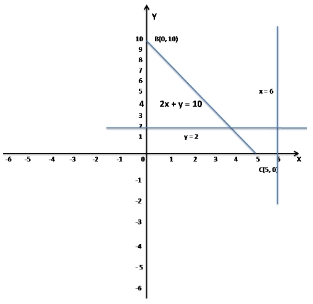
The region of the XOY-plane represented by the inequalities x ≥ 6, y ≥ 2, 2x + y ≤ 10 is
(a) unbounded
(b) a polygon
(c) none of these
(d) exterior of a triangle

Answer

Answer: (c) none of these
Hint:
Given inequalities x ≥ 6, y ≥ 2, 2x + y ≤ 10
Now take x = 6, y = 2 and 2x + y = 10
when x = 0, y = 10
when y = 0, x = 5
So, the points are A(6, 2), B(0, 10) and C(5, 0)
MCQ Questions for Class 11 Maths Chapter 6 Linear Inequalities with Answers 1
So, the region of the XOY-plane represented by the inequalities x ≥ 6, y ≥ 2, 2x + y ≤ 10 is not defined.


MCQ Of Chapter 6 Maths Class 11 Question 6.
The interval in which f(x) = (x – 1) × (x – 2) × (x – 3) is negative is
(a) x > 2
(b) 2 < x and x < 1
(c) 2 < x < 1 and x < 3
(d) 2 < x < 3 and x < 1

Answer

Answer: (d) 2 < x < 3 and x < 1
Hint:
Given, f(x) = (x – 1) × (x – 2) × (x – 3) has all factors with odd powers.
So, put them zero
i.e. x – 1 = 0, x – 2 = 0, x – 3 = 0
⇒ x = 1, 2, 3
Now, f(x) < 0 when 2 < x < 3 and x < 1


MCQ Of Linear Inequalities Class 11 Question 7.
If -2 < 2x – 1 < 2 then the value of x lies in the interval
(a) (1/2, 3/2)
(b) (-1/2, 3/2)
(c) (3/2, 1/2)
(d) (3/2, -1/2)

Answer

Answer: (b) (-1/2, 3/2)
Hint:
Given, -2 < 2x – 1 < 2
⇒ -2 + 1 < 2x < 2 + 1
⇒ -1 < 2x < 3
⇒ -1/2 < x < 3/2
⇒ x ∈(-1/2, 3/2)


Linear Inequalities Class 11 MCQ Questions Question 8.
The solution of the inequality |x – 1| < 2 is
(a) (1, ∞)
(b) (-1, 3)
(c) (1, -3)
(d) (∞, 1)

Answer

Answer: (b) (-1, 3)
Hint:
Given, |x – 1| < 2
⇒ -2 < x – 1 < 2
⇒ -2 + 1 < x < 2 + 1
⇒ -1 < x < 3
⇒ x ∈ (-1, 3)


Linear Inequalities Class 11 MCQ Pdf Question 9.
If | x − 1| > 5, then
(a) x∈(−∞, −4)∪(6, ∞]
(b) x∈[6, ∞)
(c) x∈(6, ∞)
(d) x∈(−∞, −4)∪(6, ∞)

Answer

Answer: (d) x∈(−∞, −4)∪(6, ∞)
Hint:
Given |x−1| >5
Case 1:
(x – 1) > 5
⇒ x > 6
⇒ x ∈ (6,∞)
Case 2:
-(x – 1) > 5
⇒ -x + 1 > 5
⇒ -x > 4
⇒ x < -4
⇒ x ∈ (−∞, −4)
So the range of x is (−∞, −4)∪(6, ∞)


MCQ Questions On Linear Inequalities Class 11 Question 10.
The solution of |2/(x – 4)| > 1 where x ≠ 4 is
(a) (2, 6)
(b) (2, 4) ∪ (4, 6)
(c) (2, 4) ∪ (4, ∞)
(d) (-∞, 4) ∪ (4, 6)

Answer

Answer: (b) (2, 4) ∪ (4, 6)
Hint:
Given, |2/(x – 4)| > 1
⇒ 2/|x – 4| > 1
⇒ 2 > |x – 4|
⇒ |x – 4| < 2
⇒ -2 < x – 4 < 2
⇒ -2 + 4 < x < 2 + 4
⇒ 2 < x < 6
⇒ x ∈ (2, 6) , where x ≠ 4
⇒ x ∈ (2, 4) ∪ (4, 6)


Linear Inequalities MCQs Pdf Question 11.
If (|x| – 1)/(|x| – 2) ‎≥ 0, x ∈ R, x ‎± 2 then the interval of x is
(a) (-∞, -2) ∪ [-1, 1]
(b) [-1, 1] ∪ (2, ∞)
(c) (-∞, -2) ∪ (2, ∞)
(d) (-∞, -2) ∪ [-1, 1] ∪ (2, ∞)

Answer

Answer: (d) (-∞, -2) ∪ [-1, 1] ∪ (2, ∞)
Hint:
Given, (|x| – 1)/(|x| – 2) ‎≥ 0
Let y = |x|
So, (y – 1)/(y – 2) ‎≥ 0
⇒ y ≤ 1 or y > 2
⇒ |x| ≤ 1 or |x| > 2
⇒ (-1 ≤ x ≤ 1) or (x < -2 or x > 2)
⇒ x ∈ [-1, 1] ∪ (-∞, -2) ∪ (2, ∞)
Hence the solution set is:
x ∈ (-∞, -2) ∪ [-1, 1] ∪ (2, ∞)


Class 11 Linear Inequalities MCQ Question 12.
The solution of the -12 < (4 -3x)/(-5) < 2 is
(a) 56/3 < x < 14/3
(b) -56/3 < x < -14/3
(c) 56/3 < x < -14/3
(d) -56/3 < x < 14/3

Answer

Answer: (d) -56/3 < x < 14/3
Hint:
Given inequality is :
-12 < (4 -3x)/(-5) < 2
⇒ -2 < (4-3x)/5 < 12
⇒ -2 × 5 < 4 – 3x < 12 × 5
⇒ -10 < 4 – 3x < 60
⇒ -10 – 4 < -3x < 60-4
⇒ -14 < -3x < 56
⇒ -56 < 3x < 14
⇒ -56/3 < x < 14/3


Inequalities MCQ Questions Question 13.
If x² = -4 then the value of x is
(a) (-2, 2)
(b) (-2, ∞)
(c) (2, ∞)
(d) No solution

Answer

Answer: (d) No solution
Hint:
Given, x² = -4
Since LHS ≥ 0 and RHS < 0
So, No solution is possible.


Question 14.
Solve: |x – 3| < 5
(a) (2, 8)
(b) (-2, 8)
(c) (8, 2)
(d) (8, -2)

Answer

Answer: (b) (-2, 8)
Hint:
Given, |x – 3| < 5
⇒ -5 < (x – 3) < 5
⇒ -5 + 3 < x < 5 + 3
⇒ -2 < x < 8
⇒ x ∈ (-2, 8)


Question 15.
The graph of the inequations x ≥ 0, y ≥ 0, 3x + 4y ≤ 12 is
(a) none of these
(b) interior of a triangle including the points on the sides
(c) in the 2nd quadrant
(d) exterior of a triangle

Answer

Answer: (b) interior of a triangle including the points on the sides
Hint:
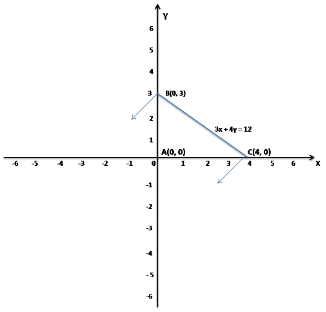
Given inequalities x ≥ 0, y ≥ 0, 3x + 4y ≤ 12
Now take x = 0, y = 0 and 3x + 4y = 12
when x = 0, y = 3
when y = 0, x = 4
So, the points are A(0, 0), B(0, 3) and C(4, 0)
MCQ Questions for Class 11 Maths Chapter 6 Linear Inequalities with Answers 2
So, the graph of the inequations x ≥ 0, y ≥ 0, 3x + 4y ≤ 12 is interior of a triangle including the points on the sides.


Question 16.
If |x| < 5 then the value of x lies in the interval
(a) (-∞, -5)
(b) (∞, 5)
(c) (-5, ∞)
(d) (-5, 5)

Answer

Answer: (d) (-5, 5)
Hint:
Given, |x| < 5
It means that x is the number which is at distance less than 5 from 0
Hence, -5 < x < 5
⇒ x ∈ (-5, 5)


Question 17.
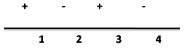
Solve: f(x) = {(x – 1)×(2 – x)}/(x – 3) ≥ 0
(a) (-∞, 1] ∪ (2, ∞)
(b) (-∞, 1] ∪ (2, 3)
(c) (-∞, 1] ∪ (3, ∞)
(d) None of these

Answer

Answer: (b) (-∞, 1] ∪ (2, 3)
Hint:
Given, f(x) = {(x – 1)×(2 – x)}/(x – 3) ≥ 0
or f(x) = -{(x – 1)×(2 – x)}/(x – 3)
which gives x – 3 ≠ 0
⇒ x ≠ 3
MCQ Questions for Class 11 Maths Chapter 6 Linear Inequalities with Answers 3
Using number line rule as shown in the figure,
which gives f(x) ≥ 0 when x ≤ 1 or 2 ≤ x < 3
i.e. x ∈ (-∞, 1] ∪ (2, 3)


Question 18.
If x² = 4 then the value of x is
(a) -2
(b) 2
(c) -2, 2
(d) None of these

Answer

Answer: (c) -2, 2
Hint:
Given, x² = 4
⇒ x² – 4 = 0
⇒ (x – 2)×(x + 2) = 0
⇒ x = -2, 2


Question 19.
The solution of the 15 < 3(x – 2)/5 < 0 is
(a) 27 < x < 2
(b) 27 < x < -2
(c) -27 < x < 2
(d) -27 < x < -2

Answer

Answer: (a) 27 < x < 2
Hint:
Given inequality is:
15 < 3(x-2)/5 < 0
⇒ 15 × 5 < 3(x-2) < 0 × 5
⇒ 75 < 3(x-2) < 0
⇒ 75/3 < x-2 < 0
⇒ 25 < x-2 < 0
⇒ 25 +2 < x <0+2
⇒ 27 < x < 2


Question 20.
Solve: 1 ≤ |x – 1| ≤ 3
(a) [-2, 0]
(b) [2, 4]
(c) [-2, 0] ∪ [2, 4]
(d) None of these

Answer

Answer: (c) [-2, 0] ∪ [2, 4]
Hint:
Given, 1 ≤ |x – 1| ≤ 3
⇒ -3 ≤ (x – 1) ≤ -1 or 1 ≤ (x – 1) ≤ 3
i.e. the distance covered is between 1 unit to 3 units
⇒ -2 ≤ x ≤ 0 or 2 ≤ x ≤ 4
Hence, the solution set of the given inequality is
x ∈ [-2, 0] ∪ [2, 4]


We hope the given NCERT MCQ Questions for Class 11 Maths Chapter 6 Linear Inequalities with Answers Pdf free download will help you. If you have any queries regarding CBSE Class 11 Maths Linear Inequalities MCQs Multiple Choice Questions with Answers, drop a comment below and we will get back to you soon.
MCQ Questions for Class 10 Maths Chapter 2 Polynomials with Answers

Check the below NCERT MCQ Questions for Class 10 Maths Chapter 2 Polynomials with Answers Pdf free download. MCQ Questions for Class 10 Maths with Answers were prepared based on the latest exam pattern. We have provided Polynomials Class 10 Maths MCQs Questions with Answers to help students understand the concept very well. https://mcqquestions.guru/mcq-questions-for-class-10-maths-chapter-2/

Students can also refer to NCERT Solutions for Class 10 Maths Chapter 2 Polynomials for better exam preparation and score more marks.

Polynomials Class 10 MCQs Questions with Answers

Question 1.
The maximum number of zeroes that a polynomial of degree 4 can have is
(a) One
(b) Two
(c) Three
(d) Four

Answer

Answer: (d) Four


Question 2.
The graph of the polynomial p(x) = 3x – 2 is a straight line which intersects the x-axis at exactly one point namely
(a) (\(\frac{-2}{3}\), 0)
(b) (0, \(\frac{-2}{3}\))
(c) (\(\frac{2}{3}\), 0)
(d) \(\frac{2}{3}\), \(\frac{-2}{3}\)

Answer

Answer: (c) (\(\frac{2}{3}\), 0)


Question 3.
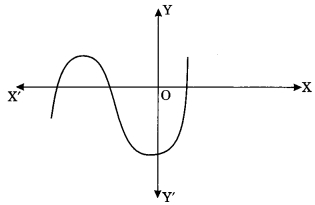
In fig. given below, the number of zeroes of the polynomial f(x) is
MCQ Questions for Class 10 Maths Chapter 2 Polynomials with Answers
(a) 1
(b) 2
(c) 3
(d) None

Answer

Answer: (c) 3


Question 4.
The graph of the polynomial ax² + bx + c is an upward parabola if
(a) a > 0
(b) a < 0
(b) a = 0
(d) None

Answer

Answer: (a) a > 0


Question 5.
The graph of the polynomial ax² + bx + c is a downward parabola if
(a) a > 0
(b) a < 0
(c) a = 0
(d) a = 1

Answer

Answer: (b) a < 0


Question 6.
A polynomial of degree 3 is called
(a) a linear polynomial
(b) a quadratic polynomial
(c) a cubic polynomial
(d) a biquadratic polynomial

Answer

Answer: (c) a cubic polynomial


Question 7.
If α, β are the zeroes of the polynomial x² – 16, then αβ(α + β) is
(a) 0
(b) 4
(c) -4
(d) 16

Answer

Answer: (a) 0


Question 8.
If α and \(\frac{1}{α}\) are the zeroes of the polynomial ax² + bx + c, then value of c is
(a) 0
(b) a
(c) -a
(d) 1

Answer

Answer: (b) a


Question 9.
Zeroes of the polynomial x² – 11 are
(a) ±\(\sqrt{17}\)
(b) ±\(\sqrt{3}\)
(c) 0
(d) None

Answer

Answer: (a) ±\(\sqrt{17}\)


Question 10.
If α, β, γ are the zeroes of the cubic polynomial ax³ + bx² + cx + d then α + β + γ is equal
(a) \(\frac{-b}{a}\)
(b) \(\frac{b}{a}\)
(c) \(\frac{c}{a}\)
(d) \(\frac{d}{a}\)

Answer

Answer: (a) \(\frac{-b}{a}\)


Question 11.
If α, β, γ are the zeroes of the cubic polynomial ax³ + bx² + cx + d then αβ + βγ + αγ is equal to
(a) \(\frac{-b}{a}\)
(b) \(\frac{b}{a}\)
(c) \(\frac{c}{a}\)
(d) \(\frac{d}{a}\)

Answer

Answer: (c) \(\frac{c}{a}\)


Question 12.
If the zeroes of the polynomial x³ – 3x² + x – 1 are \(\frac{s}{t}\), s and st then value of s is
(a) 1
(b) -1
(c) 2
(d) -3

Answer

Answer: (a) 1


Question 13.
If the sum of the zeroes of the polynomial f(x) = 2x³ – 3kx² + 4x – 5 is 6, then the value of k is
(a) 2
(b) 4
(c) -2
(d) -4

Answer

Answer: (b) 4


Question 14.
If a polynomial of degree 4 is divided by quadratic polynomial, the degree of the remainder is
(a) ≤ 1
(b) ≥ 1
(c) 2
(d) 4

Answer

Answer: (a) ≤ 1


Question 15.
If a – b, a and a + b are zeroes of the polynomial fix) = 2x³ – 6x² + 5x – 7, then value of a is
(a) 1
(b) 2
(c) -5
(d) 7

Answer

Answer: (a) 1


Question 16.
Dividend is equal to
(a) divisor × quotient + remainder
(b) divisior × quotient
(c) divisior × quotient – remainder
(d) divisor × quotient × remainder

Answer

Answer: (a) divisor × quotient + remainder


Question 17.
A quadratic polynomial whose sum of the zeroes is 2 and product is 1 is given by
(a) x² – 2x + 1
(b) x² + 2x + 1
(c) x² + 2x – 1
(d) x² – 2x – 1

Answer

Answer: (a) x² – 2x + 1


Question 18.
If one of the zeroes of a quadratic polynomial ax² + bx + c is 0, then the other zero is
(a) \(\frac{-b}{a}\)
(b) 0
(c) \(\frac{b}{a}\)
(d) \(\frac{-c}{a}\)

Answer

Answer: (a) \(\frac{-b}{a}\)


Question 19.
The sum and the product of the zeroes of polynomial 6x² – 5 respectively are
(a) 0, \(\frac{-6}{5}\)
(b) 0, \(\frac{6}{5}\)
(c) 0, \(\frac{5}{6}\)
(d) 0, \(\frac{-5}{6}\)

Answer

Answer: (d) 0, \(\frac{-5}{6}\)


Question 20.
What should be subtracted from x³ – 2x² + 4x + 1 to get 1?
(a) x³ – 2x² + 4x
(b) x³ – 2x² + 4 + 1
(c) -1
(d) 1

Answer

Answer: (a) x³ – 2x² + 4x


We hope the given NCERT MCQ Questions for Class 10 Maths Chapter 2 Polynomials with Answers Pdf free download will help you. If you have any queries regarding Polynomials CBSE Class 10 Maths MCQs Multiple Choice Questions with Answers, drop a comment below and we will get back to you soon.
MCQ Questions for Class 10 Maths Chapter 1 Real Numbers with Answers

Check the below NCERT MCQ Questions for Class 10 Maths Chapter 1 Real Numbers with Answers Pdf free download. MCQ Questions for Class 10 Maths with Answers were prepared based on the latest exam pattern. We have provided Real Numbers Class 10 Maths MCQs Questions with Answers to help students understand the concept very well. https://mcqquestions.guru/mcq-questions-for-class-10-maths-chapter-1/

Students can also refer to NCERT Solutions for Class 10 Maths Chapter 1 Real Numbers for better exam preparation and score more marks.

Real Numbers Class 10 MCQs Questions with Answers

Question 1.
For any positive integer a and b, there exist unique integers q and r such that a = 3q + r, where r must satisfy.
(a) 0 ≤ r < 3
(b) 1 < r < 3
(c) 0 < r < 3
(d) 0 < r ≤ 3

Answer

Answer: (a) 0 ≤ r < 3


Question 2.
The values of x and y is the given figure are
MCQ Questions for Class 10 Maths Chapter 1 Real Numbers with Answers
(a) x + 10, y = 14
(b) x = 21, y = 84
(c) x = 21, y = 25
(d) x = 10, y = 40

Answer

Answer: (b) x = 21, y = 84


Question 3.
If HCF (a, b) = 12 and a × b = 1800 then LCM (a, b) is
(a) 3600
(b) 900
(c) 150
(d) 90

Answer

Answer: (c) 150


Question 4.
If mn = 32, where m and n are positive integers, then the value of (n)mn is
(a) 9765625
(b) 9775625
(c) 9785625
(d) 9865625

Answer

Answer: (a) 9765625


Question 5.
If (\(\frac{9}{7}\))3 × (\(\frac{49}{81}\))2x-6 = (\(\frac{7}{9}\))9 then value of x is
(a) 12
(b) 9
(c) 8
(d) 6

Answer

Answer: (d) 6


Question 6.
The decimal expansion of \(\frac{17}{8}\) will terminate after how many places of decimals?
(a) 1
(b) 2
(c) 3
(d) will not terminate

Answer

Answer: (c) 3


Question 7.
The decimal expansion of n is
(a) terminating
(b) non-terminating and non-recurring
(c) non-terminating and recurring
(d) does not exist.

Answer

Answer: (b) non-terminating and non-recurring


Question 8.
If HCF of 55 and 99 is expressible in the form 55 m – 99, then the value of m:
(a) 4
(b) 2
(c) 1
(d) 3

Answer

Answer: (b) 2


Question 9.
Given that LCM of (91, 26) = 182 then HCF (91, 26) is
(a) 13
(b) 26
(c) 7
(d) 9

Answer

Answer: (a) 13


Question 10.
The decimal expansion of number \(\frac{441}{2^2×5^3×7}\) is
(a) A terminating decimal
(b) Non-terminating but repeating
(c) Non-terminate non repeating
(d) terminating after two places of decimal

Answer

Answer: (a) A terminating decimal


Question 11.
If A = 2n + 13, B = n + 7 where n is a natural number then HCF of A and B
(a) 2
(b) 1
(c) 3
(d) 4

Answer

Answer: (b) 1


Question 12.
(-1)n + (-1)8n = 0 when n is
(a) any positive integer
(b) any odd natural number
(c) any even numeral number
(d) any negative integer

Answer

Answer: (b) any odd natural number


Question 13.
If the LCM of 12 and 42 is 10 m + 4 then the value of m is
(a) 50
(b) 8
(c) \(\frac{1}{5}\)
(d) l

Answer

Answer: (b) 8


Question 14.
The decimal expansion of the rational number \(\frac{6243}{2^2×5^4}\) will terminate after
(a) 4 places of decimal
(b) 3 places of decimal
(c) 2 places of decimal
(d) 1 place of decimal

Answer

Answer: (a) 4 places of decimal


Question 15.
n² – 1 is divisible by 8, if n is
(a) an integer
(b) a natural number
(c) an odd natural number
(d) an even natural number

Answer

Answer: (c) an odd natural number


Question 16.
If n is a natural number, then exactly one of numbers n, n + 2 and n + 1 must be a multiple of
(a) 2
(b) 3
(c) 5
(d) 7

Answer

Answer: (b) 3


Question 17.
The rational number between 72 and 73 is
(a) \(\frac{6}{5}\)
(b) \(\frac{3}{4}\)
(c) \(\frac{3}{2}\)
(d) \(\frac{4}{5}\)

Answer

Answer: (c) \(\frac{3}{2}\)


Question 18.
If a and 6 are two positive numbers and H and L are their HCF and LCM respectively. Then
(a) a × b = H × L
(b) a = b × H
(c) a = \(\frac{b×L}{H}\)
(d) H = \(\frac{L}{a×b}\)

Answer

Answer: (a) a × b = H × L


Question 19.
LCM of 2³ × 3² and 2² × 3³ is
(a) 2³
(b) 3³
(c) 2³ × 3³
(d) 2² × 3²

Answer

Answer: (c) 2³ × 3³


Question 20.
The LCM of 2.5, 0.5 and 0.175 is
(a) 2.5
(b) 5
(c) 7.5
(d) 0.875

Answer

Answer: (d) 0.875


We hope the given NCERT MCQ Questions for Class 10 Maths Chapter 1 Real Numbers with Answers Pdf free download will help you. If you have any queries regarding Real Numbers CBSE Class 10 Maths MCQs Multiple Choice Questions with Answers, drop a comment below and we will get back to you soon.
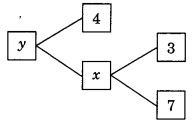
MCQ Questions for Class 9 Sanskrit Chapter 8 लौहतुला with Answers

Check the below NCERT MCQ Questions for Class 9 Sanskrit Chapter 8 लौहतुला with Answers Pdf free download. MCQ Questions for Class 9 Sanskrit with Answers were prepared based on the latest exam pattern. We have provided लौहतुला Class 9 Sanskrit MCQs Questions with Answers to help students understand the concept very well. https://mcqquestions.guru/mcq-questions-for-class-9-sanskrit-chapter-8/

Students can also read NCERT Solutions for Class 9 Sanskrit Chapter 8 Questions and Answers at LearnInsta. Here all questions are solved with a detailed explanation, It will help to score more marks in your examinations.

निम्नवाक्येषु रेखाङ्कित पदानां स्थानेषु प्रश्नवाचक पदं लिखत

Question 1.
लौहघटिता पूर्वपुरुषोपार्जिता तुलासीत्।
(क) कीदृशा
(ख) कीदृशी
(ग) कीदृशम्
(घ) का

Answer

Answer: (ख) कीदृशी


Question 2.
सः श्रेष्ठिनो गृहे रक्षित्वा विदेशं अगच्छत्।
(क) केन
(ख) कस्य
(ग) कम्
(घ) कः

Answer

Answer: (ख) कस्य


Question 3.
त्वदीया तुला मूषकैः भक्षिता।
(क) केन
(ख) कया
(ग) कैः
(घ) काभ्याम्।

Answer

Answer: (ग) कैः


Question 4.
संसारे किञ्चिदपि शाश्वतं नास्ति।
(क) किम्
(ख) कीदृशम्
(ग) कम्
(घ) कः

Answer

Answer: (ख) कीदृशम्


Question 5.
संसारे किञ्चिदपि शाश्वतं नास्ति।
(क) कुत्र
(ख) कीदृशम्
(ग) के
(घ) किम्

Answer

Answer: (क) कुत्र


Question 6.
वणिक्शिशुः अभ्यागतेन सह प्रस्थितः।
(क) केन
(ख) कः
(ग) कम्
(घ) कस्य

Answer

Answer: (क) केन


Question 7.
तत् द्वारं बृहत् शिलया आच्छाद्य आगतः।
(क) केन
(ख) कया
(ग) कस्या
(घ) का

Answer

Answer: (ख) कया


Question 8.
सः शिशुं गिरिगुहायां प्रक्षिप्य आगतः।
(क) कया
(ख) कस्याः
(ग) कस्याम्
(घ) काम्

Answer

Answer: (ग) कस्याम्


Question 9.
वणिक्पुत्रः सत्वरं गृहं आगतः।
(क) कम्
(ख) किम्
(ग) कुत्र
(घ) कदा

Answer

Answer: (ग) कुत्र


Question 10.
मम शिशुः त्वया सह नदीं गतः।
(क) कम्
(ख) कस्या
(ग) केन
(घ) किम्

Answer

Answer: (ग) केन


Question 11.
क्वचित् श्येनो बालं हर्तुम् समर्थोऽस्ति।
(क) को
(ख) कः
(ग) के
(घ) कान्

Answer

Answer: (ख) कः


Question 12.
श्रेष्ठी तारस्वरेण उवाच।।
(क) की
(ख) का
(ग) कः
(घ) कीहशः

Answer

Answer: (ग) कः


Question 13.
तौ विवदमानौ राजकुलं गतौ।
(क) कम्
(ख) को
(ग) के
(घ) कः

Answer

Answer: (ख) को


गद्यांशम् पठित्वा प्रश्नानाम् उत्तराणि लिखत

आसीत् कस्मिंश्चिद् अधिष्ठाने जीर्णधनो नाम वणिक्पुत्रः। स च विभवक्षयात् देशान्तरं गन्तुमिच्छन् व्यचिन्तयत्
यत्र देशेऽथवा स्थाने भोगा भुक्ताः स्ववीर्यतः।
तस्मिन् विभवहीनो यो वसेत् स पुरुषाधमः॥
तस्य च गृहे लौहघटिता पूर्वपुरुषोपार्जिता तुला आसीत्। तां च कस्यचित् श्रेष्ठिनो गृहे निक्षेपभूतां कृत्वा देशान्तरं प्रस्थितः। ततः सुचिरं कालं देशान्तरं यथेच्छया भ्रान्त्वा पुनः स्वपुरम् आगत्य तं श्रेष्ठिनम् अवदत्- “भोः श्रेष्ठिन्! दीयतां मे सा निक्षेपतुला।” सोऽवदत्-“भोः! नास्ति सा, त्वदीया तुला मूषकैः भक्षिता” इति।

जीर्णधनः अवदत्-“भोः श्रेष्ठिन्! नास्ति दोषस्ते, यदि मूषकैः भक्षिता। ईदृशः एव अयं संसारः। न किञ्चिदत्र शाश्वतमस्ति। परमहं नद्यां स्नानार्थं गमिष्यामि। तत् त्वम आत्मीयं एनं शिशुं धनदेवनामानं मया सह स्नानोपकरणहस्तं प्रेषय” इति।

Question 1.
वणिक्पुत्रस्य नाम किम् आसीत्?

Answer

Answer: जीर्णधनः


Question 2.
लौहघटिता तुला कीदृशी आसीत्।

Answer

Answer: पूर्वपुरुषोपार्जिता


Question 3.
जीर्णधनः कुत्र प्रस्थितः?

Answer

Answer: देशान्तरम्।


Question 4.
वाणिवपुत्रः स्वपुरमागत्य श्रेष्ठिनम् किम् अवदत्?

Answer

Answer: वणिक्पुत्रः स्वपुरमागत्य श्रेष्ठिनम् अवदत्- “भोः श्रेष्ठिन्! दीयतां मे सा निक्षेपतुला।”


Question 5.
श्रेष्ठी किम् अवदत्?

Answer

Answer: श्रेष्ठी अवदत् “भोः। नास्ति सा, त्वदीया तुला मूषकैः भक्षिता” इति।


Question 6.
अत्र “जीर्णधनः” इति कर्तृपदस्य क्रियापदं किम्?

Answer

Answer: आसीत्


Question 7.
अस्मिन् अनुच्छेदे ‘कालं’ इति पदस्य विशेषणपदं किम् अत्र?

Answer

Answer: सुचिरं


Question 8.
अशाश्वतं’ इति पदस्य विपर्यय पदम् किम् अत्र?

Answer

Answer: शाश्वतं


Question 9.
अनुच्छेदे ‘अस्ति’ इति क्रियापदस्य विपर्ययपदं किम् प्रयुक्तम्?

Answer

Answer: आसीत्


स श्रेष्ठी स्वपुत्रम् अवदत्-“वत्स! पितृव्योऽयं तव, स्नानार्थं यास्यति, तद् अनेन साकं गच्छ” इति। अथासौ श्रेष्ठिपुत्रः धनदेवः स्नानोपकरणमादाय प्रहृष्टमनाः तेन अभ्यागतेन सह प्रस्थितः। तथानुष्ठिते स वणिक् स्नात्वा तं शिशुं गिरिगुहायां प्रक्षिप्य, तद्वारं बृहत् शिलया आच्छाद्य सत्त्वरं गृहमागतः। सः श्रेष्ठी पृष्टवान्-“भोः! अभ्यागत! कथ्यतां कुत्र मे शिशुः यः त्वया सह नदीं गतः”? इति। स अवदत्-“तव पुत्रः नदीतटात् श्येनेन हृतः” इति। श्रेष्ठी अवदत्- “मिथ्यावादिन्! किं क्वचित् श्येनो बालं हर्तुं शक्नोति? तत् समर्पय मे सुतम् अन्यथा राजकुले निवेदयिष्यामि।” इति। सोऽकथयत्-“भोः सत्यवादिन्! यथा श्येनो बालं न नयति, तथा मूषका अपि लौहघटितां तुला न भक्षयन्ति। तदर्पय मे तुलाम्, यदि दारकेण प्रयोजनम्।” इति।

Question 1.
वणिक्शिशुः कीदृशं मनः तेन सह प्रस्थितः?

Answer

Answer: (प्रसन्नमनः) प्रहृष्टमनाः


Question 2.
लौहघटितातुला केन खादिता?

Answer

Answer: मूषकैः


Question 3.
तेन सह कः प्रस्थितः?

Answer

Answer: वणिक्शिशुः


Question 4.
वणिक्पुत्रः किम् कृत्वा गृहमागतः?

Answer

Answer: वणिक्पुत्रः स्नात्वा तं शिशुं (वणिक्शिशु) गिरिगुहायां प्रक्षिप्य, तद्द्वारं बृहत् शिलया आच्छाद्य सत्वरं गृहम् आगतः।


Question 5.
श्रेष्ठी स्वपुत्रम् किम् उवाच?

Answer

Answer: श्रेष्ठी स्वपुत्रमुवाच-“वत्स! पितृव्योऽयं तव, स्नानार्थं यास्यति, तद् गम्यताम् अनेन साकम्।


Question 6.
अत्र ‘मिथ्यावादिन्’ इति पदस्य विपर्ययपदं किम् प्रयुक्तम्?

Answer

Answer: सत्यवादिन्,


Question 7.
‘भक्षयन्ति’ इति क्रियापदस्य कर्तृपदं किम् अस्मिन् अनुच्छेदे?

Answer

Answer: मूषकाः


Question 8.
अत्र गद्यांशे ‘शीघ्रम्’ इति पदस्य पर्यायपदं किम् प्रयुक्तम्?

Answer

Answer: सत्वरम्


Question 9.
‘पुत्रम्’ इत्यर्थे किं पदं प्रयुक्तम् अत्र?

Answer

Answer: सुतम्


एवं विवदमानौ तौ द्वावपि राजकुलं गतौ। तत्र श्रेष्ठी तारस्वरेण अवदत्- “भोः! वञ्चितोऽहम्! वञ्चितोऽहम्! अब्रह्मण्यम्! अनेन चौरेण मम शिशुः अपहृतः” इति। अथ धर्माधिकारिणः तम् अवदन्-“भोः! समर्प्यतां श्रेष्ठिसुतः’। सोऽवदत्- “किं करोमि? पश्यतो मे नदीतटात् श्येनेन शिशुः अपहृतः’। इति। तच्छ्रुत्वा ते अवदन्-भोः! भवता सत्यं नाभिहितम्-किं श्येनः शिशुं हर्तुं समर्थो भवति? सोऽवदत्-भोः भोः! श्रूयतां मद्वचः
तुलां लौहसहस्रस्य यत्र खादन्ति मूषकाः।
राजन्तत्र हरेच्छ्येनो बालकं, नात्र संशयः॥
ते अपृच्छन्- “कथमेतत्”।
ततः स श्रेष्ठी सभ्यानामग्रे आदितः सर्वं वृत्तान्तं न्यवेदयत्। ततः न्यायाधिकारिणः विहस्य तौ द्वावपि सम्बोध्य तुला-शिशुप्रदानेन तोषितवन्तः।

Question 1.
राजकुलं कौ गतौ?

Answer

Answer: द्वावपि


Question 2.
श्रेष्ठी कीदृशेन स्वरेण प्रोवाच?

Answer

Answer: तारस्वरेण


Question 3.
किं कुर्वाणौ तौ द्वावपि राजकुलं गतौ?

Answer

Answer: विवदमानौ।


Question 4.
श्रेष्ठी तारस्वरेण किम् उवाच?

Answer

Answer: श्रेष्ठी तारस्वरेण उवाच- “भोः! अब्रह्मण्यम्! अब्रह्मण्यम्! अनेन चौरेण मम शिशुिः अपहृतः” इति।


Question 5.
अत्र किं संशयः न अस्ति?

Answer

Answer: यत्र लौहसहस्रस्य तुलाम् मूषकाः खादन्ति तत्र श्येनः अपि बालकम् हरेत् अत्र संशयः न अस्ति।


Question 6.
सर्व’ इति पदस्य विशेष्य पदं किम् अत्र?

Answer

Answer: वृत्तान्तम्


Question 7.
गद्यांशे अत्र “सन्तोषितौ” इति क्रियापदस्य कर्तृपदं किम्?

Answer

Answer: तौ


Question 8.
“प्रारम्भतः” इति पदस्य पर्यायपदं किम अस्मिन् अनुच्छेदे?

Answer

Answer: आदितः


Question 9.
अत्र “उच्चस्वरेण” इति अर्थे किम् पदं प्रयुक्तम्?

Answer

Answer: तारस्वरेण।


अन्वय लेखनम्

यत्र देशेऽथवा स्थाने भोगा भुक्ताः स्ववीर्यतः।
तस्मिन् विभवहीनो यो वसेत् स पुरुषाधमः॥

अन्वय- यत्र (i) …………….. अथवा (ii) ……………. स्ववीर्यतः भोगाः (iii) ……….. (iv) ………….. यः वसेत् स पुरुषाधमः।
मञ्जूषा- विभवहीनः, स्थाने, देशे, भुक्ता

Answer

Answer:
(i) देशे
(ii) स्थाने
(iii) भुक्ताः
(iv) विभवहीनः।


तुला लौहसहस्रस्य यत्र खादन्ति मूषकाः।
राजन्तत्र हरेच्छ्येनो बालकं, नात्र संशयः॥

अन्वय- राजन्! (i) ………….. लौहसहस्रस्य (ii) ……………. मूषकाः (iii) …………… तत्र (iv) ……………. बालकम् हरेत् अत्र संशयः न।
मञ्जूषा- तुलाम्, यत्र, श्येनः, खादन्ति

Answer

Answer:
(i) यत्र
(ii) तुलाम्
(iii) खादन्ति
(iv) श्येनः।


निम्न श्लोकनि पठित्वा भावलेखनम्

यत्र देशेऽथवा स्थाने भोगा भुक्ताः स्ववीर्यतः
तस्मिन् विभवहीनो यो वसेत स पुरुषाधमः॥

अस्य भावोऽस्ति- यत्र देशे (i) ……………….. स्थाने (ii) …………… भोगाः भुक्ताः (iii) ……………. यः विभवहीनः (iv) …………….. सः पुरुषः अधमः।।
मञ्जूषा- वसेत्, स्ववीर्यतः, अथवा, तस्मिन्

Answer

Answer:
(i) अथवा
(ii) स्ववीर्यतः
(iii) तस्मिन्
(iv) वसेत्।


तुलां लौहसहस्रस्य यत्र खादति मूषकाः।
राजन्तत्र हरेच्छ्येनो बालकं नात्र संशयः॥

अस्य भावोऽस्ति- (i) ………….. यत्र (ii) ……………. तुलां (iii) …………… खादन्ति तत्र श्येनः (iv) …………… हरेत् अत्र संशयः न।।
मञ्जूषा- बालकम्, मूषकाः, लौहसहस्रस्य, राजन्।

Answer

Answer:
(i) राजन्
(ii) लौहसहस्रस्य
(iii) मूषकाः
(iv) बालकम्।


निम्नवाक्यानि घटनाक्रमानुसारं पुनर्लिखत

1. (i) भोः! नास्ति सा, त्वदीया तुला मूषकैर्भक्षिता इति।
(ii) सः एकदा विदेशं गच्छन् अचिन्तयत्।
(iii) कस्मिंश्चिद् अधिष्ठाने जीर्णधनः नामकः वाणिक्पुत्रः आसीत्।
(iv) धनिकः नृपस्य समीपं न्यायार्थम् अगच्छत्।
(v) भोः श्रेष्ठिन्! दीयतां मे सा निक्षेपतुला।
(vi) इमाम् लौहतुलां श्रेष्ठिनः गृहे निक्षिप्य गच्छामि।
(vii) कथं श्येनः पुत्रं नेतुं समर्थोऽस्ति।
(viii) अस्य पुत्रस्य अपहरणं श्येनेन कृतम्।

Answer

Answer:
(i) कस्मिंश्चिद् अधिष्ठाने जीर्णधनः नामकः वाणिवपुत्रः आसीत्।
(ii) सः एकदा विदेशं गच्छन् अचिन्तयत्।
(iii) इमाम् लौहतुलां श्रेष्ठिनः गृहे निक्षिप्य गच्छामि।
(iv) भोः श्रेष्ठिन्! दीयतां मे सा निक्षेपतुला।
(v) भोः! नास्ति सा, त्वदीया तुला मूषकैर्भक्षिता इति।
(vi) कथं श्येनः पुत्रं नेतुं समर्थोऽस्ति।
(vii) धनिकः नृपस्य समीपं न्यायार्थम् अगच्छत्।
(viii) अस्य पुत्रस्य अपहरणं श्येनेन कृतम्।


2. (i) तव तुलां मूषकाः खादिताः।
(ii) न्यायाधीशस्य आज्ञया धनिकः तस्य तुलाम् अयच्छत्।
(iii) न्यायाधीशः जीर्णधनस्य वार्ता श्रुत्वा अवदत्-‘कथमेतत् भवितुं शक्नोति’?
(iv) तव पुत्रं श्येनः नीतवान्।
(v) जीर्णधनः सर्वां वार्ता कथयति।
(vi) एकदा एकः जीर्णधनः नाम वाणिवपुत्रः न्वयसत्।
(vii) सः स्वलौहतुलां धनिकस्य समीपं निक्षिप्य विदेशम् अगच्छत्।
(viii) जीर्णधनः स्नानार्थं धनिकस्य पुत्रं नीत्वा नदीम् अगच्छत्।

Answer

Answer:
(i) एकदा एकः जीर्णधनः नाम वाणिवपुत्रः न्वयसत्।
(ii) सः स्वलौहतुलां धनिकस्य समीपं निक्षिप्य विदेशम् अगच्छत्।
(iii) तव तुलां मूषकाः खादिताः।
(iv) जीर्णधनः स्नानार्थं धनिकस्य पुत्रं नीत्वा नदीम् अगच्छत्।
(v) तव पुत्रं श्येनः नीतवान्।
(vi) न्यायाधीशः जीर्णधनस्य वार्तां श्रुत्वा अवदत्-‘कथमेतत् भवितुं शक्नोति’?
(vii) जीर्णधनः सर्वां वार्ता कथयति।
(viii) न्यायाधीशस्य आज्ञया धनिकः तस्य तुलाम् अयच्छत्।


‘क’ स्तम्भे लिखितानां पदानां पर्यायाः ‘ख’ स्तम्भे लिखिताः। तान् यथासमक्षं योजयत्

‘क’ स्तम्भः – “ख’ स्तम्भः
(i) अधिष्ठाने – एतादृशः
(ii) निक्षेपः – धनाभावात्
(iii) ईदृशः – देहि
(iv) विभवक्षयात् – प्रारम्भतः
(v) समर्पय – बोधयित्वा
(vi) आदितः – हसित्वा
(vii) संबोध्य – न्यासः
(viii) विहस्य – स्थाने

Answer

Answer:
(i) स्थाने
(ii) न्यासः
(iii) एतादृशः
(iv) धनाभावात्
(v) देहि
(vi) प्रारम्भतः
(vii) बोधयित्वा
(viii) हसित्वा


‘क’ स्तम्भे विशेषणानि ‘ख’ स्तम्भे विशेष्याणि दत्तानि। तानि समुचित योजयत

‘क’ स्तम्भः – ‘ख’ स्तम्भः
(i) सुचिरे – तुलाम्
(ii) कस्मिंश्चित् – वृत्तान्तम्
(iii) लौहघटिताम् – पुरुषः
(iv) सर्वं – तौ
(v) अधमः – अधिष्ठाने
(vi) विवादमानौ – काले

Answer

Answer:
(i) काले
(ii) अधिष्ठाने
(iii) तुलाम्
(iv) वृत्तान्तम्
(v) पुरुषः
(vi) तौ


निम्न पदानाम् दत्तेषु विपर्ययपदेषु शुद्धं विपर्ययं सह मेलनं कुरुत’

पदानि – विपर्ययाः
(i) गन्तुम् – मदीया
(ii) सत्यवादिन्! – पुरुषाधमः
(iii) अस्ति – अपर्य
(iv) गृहाण – श्रेष्ठिन्!
(v) त्वदीया – आदितः
(vi) सत्वरम् – आसीत्
(vii) दु:खितमनाः – मिथ्यावादिन्!
(viii) पुरुष श्रेष्ठः – चिरम्
(ix) अन्ततः – प्रहष्टमनाः
(x) भिक्षुक! – आगन्तुम्

Answer

Answer:
(i) आगन्तुम्
(ii) मिथ्यावादिन्!
(iii) आसीत्
(iv) अपर्य
(v) मदीया
(vi) चिरम्
(vii) प्रहष्टमनाः
(viii) पुरुषाधमः
(ix) आदितः
(x) श्रेष्ठिन्!।


We hope the given NCERT MCQ Questions for Class 9 Sanskrit Chapter 8 लौहतुला with Answers Pdf free download will help you. If you have any queries regarding CBSE Class 9 Sanskrit लौहतुला MCQs Multiple Choice Questions with Answers, drop a comment below and we will get back to you soon.