MCQ Questions for Class 12 Geography Chapter 3 Population Composition with Answers

Check the below NCERT MCQ Questions for Class 12 Geography Chapter 3 Population Composition with Answers Pdf free download. MCQ Questions for Class 12 Geography with Answers were prepared based on the latest exam pattern. We have provided Population Composition Class 12 Geography MCQs Questions with Answers to help students understand the concept very well. https://mcqquestions.guru/mcq-questions-for-class-12-geography-chapter-3-part-a/

Population Composition Class 12 MCQs Questions with Answers

Population Composition Class 12 MCQ Question 1.
Which attribute does not distinguish people?
(A) Age
(B) Sex
(C) Occupation
(D) Industries

Answer

Answer: (D) Industries


Population Composition MCQ Chapter 3 Question 2.
The average world sex ratio is:
(A) 970
(B) 980
(C) 990
(D) 995

Answer

Answer: (C) 990


Class 12 Geography Chapter 3 MCQ Question 3.
The lowest sex ratio is found in:
(A) Egypt
(B) Qatar
(C) Kuwait
(D) Iran

Answer

Answer: (B) Qatar


MCQ Of Population Composition Class 12 Question 4.
Favourable sex ratio is found in how many countries.
(A) 109
(B) 119
(C) 129
(D) 139

Answer

Answer: (D) 139


MCQ Questions For Class 12 Geography Chapter 3 Question 5.
In how many countries, unfavourable sex ratio is found?
(A) 52
(B) 62
(C) 72
(D) 82

Answer

Answer: (C) 72


Population Composition MCQ Class 12 Chapter 3 Question 6.
In European countries, a deficit of males is due to:
(A) Low Birth Rate
(B) High Death Rate
(C) Better status of women
(D) Better status of men

Answer

Answer: (C) Better status of women


Class 12 Geography Population Composition MCQ Question 7.
In which continent, low sex ratio is found:
(A) Europe
(B) Asia
(C) North America
(D) Australia

Answer

Answer: (B) Asia


Class 12 Geography Chapter 3 Population Composition MCQ Question 8.
The aging population has aged more than:
(A) 40 years
(B) 45 years
(C) 50 years
(D) 60 years

Answer

Answer: (D) 60 years


Geography Class 12 Chapter 3 MCQ Question 9.
Expanding population Pyranrd Shows.
(A) Wide Base
(B) Narrow Base
(C) Developed economy
(D) Uniform width.

Answer

Answer: (A) Wide Base


MCQ On Population Composition Class 12 Question 10.
Which type of age-sex pyramid is of Australia?
(A) Expanding
(B) Constant
(C) Declining
(D) Negative

Answer

Answer: (B) Constant


Class 12 Population Composition MCQ Question 11.
Which one of the following has caused the sex ratio of the United Arab Emirates to be low.
(A) Selective migration of working population
(B) High birth rate of males
(C) Low birth rate of females
(D) High out-migration of females.

Answer

Answer: (D) High out-migration of females.


Population Composition MCQs Chapter 3 Question 12.
Which one of the following figures represents the working-age group of the population?
(A) 15 to 65 years
(B) 15 to 66 years
(C) 15 to 64 years
(D) 15 to 59 years.

Answer

Answer: (D) 15 to 59 years.


Population Composition Class 12 MCQs Question 13.
Which one of the following countries has the highest sex ratio in the world?
(A) Latvia
(B) Japan
(C) the United Arab Emirates
(D) France.

Answer

Answer: (A) Latvia


We hope the given NCERT MCQ Questions for Class 12 Geography Chapter 3 Population Composition with Answers Pdf free download will help you. If you have any queries regarding CBSE Class 12 Geography Population Composition MCQs Multiple Choice Questions with Answers, drop a comment below and we will get back to you soon.

MCQ Questions for Class 12 Geography Chapter 2 The World Population: Distribution, Density and Growth

The World Population: Distribution, Density and Growth Class 12 MCQs Questions with Answers

The World Population Distribution Density And Growth MCQ Question 1.

refers to the way in which the population is spaced out all over the world.

(A) Density of population
(B) Population distribution
(C) Population expansion
(D) Population explosion
Answer:
(B) Population distribution

The World Population Class 12 MCQ Chapter 2 Question 2.

What is considered as the most important factor for life?

(A) Electricity
(B) Animals
(C) Water
(D) Society
Answer:
(C) Water

MCQ Questions for Class 12 Geography Chapter 2 The World Population: Distribution, Density and Growth

Explanation:
All the living things (plants and animals) need water to live.

Class 12 Geography Chapter 2 MCQ Question 3.

The Arctic region and the Antarctica continent are situated near:

(A) The Sahara Desert
(B) The North and South Poles
(C) Amazon Basin
(D) the Equator
Answer:
(B) The North and South Poles

Explanation:
The Arctic encompasses a vast frozen ocean around the North Pole. Antarctica is a frozen continent anchored by the South Pole and surrounded by vast open oceans.

The World Population Distribution Density And Growth Class 12 MCQ Question 4.

The population of the world is:

(A) Equally distributed
(B) Sparsely distributed
(C) Unevenly distributed
(D) Haphazardly distributed
Answer:
(C) Unevenly distributed

Explanation:
Geographical, cultural, economical and social factors influence spatial distribution of population.

World Population Distribution Density And Growth MCQ Chapter 2 Question 5.

If the population decreases between two points of time, it is known as:

(A) neutral growth of population
(B) positive growth of population
(C) negative growth of population
(D) negligible growth of population
Answer:
(C) negative growth of population

MCQ Questions for Class 12 Geography Chapter 2 The World Population: Distribution, Density and Growth

Explanation:
A negative growth rate would mean a population size gets smaller, reducing 1 the number of people inhabiting that country.

World Population Class 12 MCQ Chapter 2 Question 6.

Those factors which make the place of destination seem more attractive than the place of origin are known as:

(A) push factors
(B) pull factors
(C) migration factors
(D) immigration factor
Answer:
(B) pull factors

Explanation:
Pull factors are positive aspects that attract people to move to a place e.g. good employment opportunities, better facilities,  education and medical facilities.

MCQ Questions For Class 12 Geography Chapter 2 Question 7.

(Bi/P) x 1000 =

(A) Crude Birth Rate
(B) Negative Birth Rate
(C) Positive Birth Rate
(D) Zero Birth Rate
Answer:
(A) Crude Birth Rate

Explanation:
It is important to calculate crude birth rate because it is a useful indicator in studies of population around the world.

MCQ Questions for Class 12 Geography Chapter 2 The World Population: Distribution, Density and Growth

Class 12 Geography Chapter 2 The World Population MCQ Question 8.

Those factors which make the place of origin seem less attractive are known as:

(A) pull factors
(B) push factors
(C) immigration factors
(D) Economic factors
Answer:
(B) push factors

Explanation:
Freedom from political oppression, conflicts, chaos and war are some of the push factors that force people to leave their place of origin.

Geography Class 12 Chapter 2 MCQ Question 9.

World population exploded in the eighteenth century after the:

(A) World War I
(B) World War II
(C) Civil War
(D) Industrial Revolution
Answer:
(D) Industrial Revolution

Explanation:
With industrialization, if improvements in medical knowledge and public health, together with a more regular food supply, brought about a drastic reduction § in the death rate but no corresponding decline in the birth rate. The result was a population explosion.

MCQ Questions for Class 12 Geography Chapter 2 The World Population: Distribution, Density and Growth

The World Population MCQ Chapter 2 Question 10.

The growth of population is low in:

(A) developed countries
(B) third world countries
(C) developing countries
(D) Highly industrialized countries
Answer:
(A) developed countries

Explanation:
Developed countries tend to have a lower fertility rate due to lifestyle choices associated with economic affluence, leading to  low growth of population.

MCQ Of The World Population Class 12 Question 11.

The consumption of resources on a faster rate is known as:

(A) development of resources
(B) depletion of resources
(C) declining of resources
(D) mis- muster of resources
Answer:
(B) depletion of resources

The World Population MCQ Class 12 Question 12.

Agrarian society depends on agriculture as the:

(A) primary means of subsistence
(B) neutral means of subsistence
(C) secondary means of subsistence
(D) None of the Above
Answer:
(A) primary means of subsistence

Explanation:
Agrarian society can be defined as a society where a majority of its population derives its income from agriculture and related activities.

MCQ Questions for Class 12 Geography Chapter 2 The World Population: Distribution, Density and Growth

Geography Chapter 2 Class 12 MCQ Question 13.

The first stage of the Demographic Transition Theory has:

(A) high fertility and low mortality
(B) high fertility and high mortality
(C) low fertility and low mortality
(D) None of the Above
Answer:
(B) high fertility and high mortality

Explanation:
During this stage, the population is stable, with both high birth rates and high death rates.

World Population MCQ Class 12 Question 14.

In the second stage of Demographic Transition Theory:

(A) fertility remains low
(B) fertility remains high
(C) fertility remains stagnant
(D) Fertility plays no major role
Answer:
(A) fertility remains low

Explanation:
The total population of a country in Second stage rises because births outnumber deaths.

Chapter 2 Geography Class 12 MCQ Question 15.

Spacing or preventing the birth of children is known as:

(A) home planning
(B) office planning
(C) family planning
(D) family prevention
Answer:
(C) family planning

MCQ Questions for Class 12 Geography Chapter 2 The World Population: Distribution, Density and Growth

The World Population Distribution Density And Growth MCQs Question 16.

Which continent has population?

(A) America
(B) Africa
(C) Australia
(d) Asia
Answer:
(B) Africa

Explanation: Africa has the highest growth rate g of population due to several factors, including the rising life expectancy and the high fertility rates registered on the continent.

Geography Chapter 2 MCQ Class 12 Question 17.

Which country in the world has the lowest growth rate of population ?

(A) Lebnon
(B) Iraq
(C) Iran
(D) Syria
Answer:
(D) Syria

Explanation:
Due to the Syrian Civil Wap the Syrian population decreased.

Question 18.

Arrange the countries in ascending order of their population:

(i) China
(ii) USA
(iii) India
(iv) Indonesia

(A) (i),(ii),(iii),(iv)
(B) (iv),(ii),(iii),(i)
(C) (iii),(iv),(i),(ii)
(D) (iv),(iii),(ii),(i)
Answer:
(B) (iv),(ii),(iii),(i)

Explanation:
The presence of industries, various social facilities, improved infrastructure and high fertility rate makes China the most populous country in the world.

Question 19.

How is density of population of a region calculated ?

(A) Density of Population = Population/Area
(B) Density of Population = Population of the country
(C) Density of Population = Decreasing population
(D) None of the Above
Answer:
(A) Density of Population = Population/Area

MCQ Questions for Class 12 Geography Chapter 2 The World Population: Distribution, Density and Growth

Question 20.

The change in number of inhabitants of a territory during a specific period of time is known as :

(A) positive growth rate
(B) negative growth rate
(C) population growth
(D) density of population growth
Answer:
(C) population growth

Explanation:
Population growth is the increase in the number of people in a population.

Question 21.

Birth rate, death rate and migration are components of:

(A) population change
(B) population unrest
(C) population ration
(D) population control
Answer:
(A) population change

Explanation:
Population change is simply the change in the number of people in a specified area during a specific time period. It is based on three fundamental
factors: birth rate, death rate, immigration.

Question 22.

The movement of people from one place to another within the country or to a foreign country is termed as:

(A) population movement
(B) population disturbance
(C) migration
(D) immigration
Answer:
(C) migration

Explanation:
Migration is the permanent change of residence by an individual or group.

MCQ Questions for Class 12 Geography Chapter 2 The World Population: Distribution, Density and Growth

Question 23.

When the birth rate is more than the death rate between two points of time it is known as:

(A) negative growth rate
(B) positive growth rate
(C) change in population graph
(D) None of the Above
Answer:
(B) positive growth rate

Explanation:
When the population growth rate is positive, per capita income growth is positive it is known as positive growth rate.

Question 24.

The expanding world trade during the sixteenth and seventeenth century, set the stage for:

(A) Outbreak of pandemic
(B) rapid population growth
(C) drastic drop on population growth
(D) unrest all across the globe
Answer:
(B) rapid population growth

Explanation:
Trade liberaliza tion and expansion generated the income effect that increased the population growth.

MCQ Questions for Class 12 Geography Chapter 2 The World Population: Distribution, Density and Growth

Question 25.

Which of the following factor helped in the reduction of birth rate and provided a stage for accelerated population growth? 0

(A) Technological advancement
(B) Conflicts and wars
(C) emergence of world power
(D) Introduction of birth control policies
Answer:
(A) Technological advancement

Explanation: Technological advances helped in lowering the fertility by stimulating the growth of the marginal cost of children and reducing the marginal benefit of children, while changing the reproductive attitude from favouring a greater number of children to favouring a lower number of children.

Question 26.

The population of non- industrial countries are normally:

(A) high
(B) low
(C) stable
(D) None of the Above
Answer:
(C) stable

Explanation:
The populations of nonindustrial countries are normally stable (and low) because high birth rates are matched by high death rates.

Question 27.

Since doubling time is based on a population’s ,………….. it can also vary over time.

(A) annual growth rate
(B) annual death rate
(C) outbreak of catastrophe
(D) government’s policies
Answer:
(A) annual growth rate

Explanation:
Growth rate is the increasing rate of the number of people in a population and doubling time is the amount of time it takes for a quantity to double in size or value. Thus, the relationship is that doubling time depends on growth rate.

Question 28.

The effect of overpopulation can be:

(A) Increase in economic development
(B) Increase in demands of basic amenities
(C) Better education facilities
(D) More help from the government
Answer:
(B) Increase in demands of basic amenities

Explanation:
Overpopulation will cause additional strains on resources. More people means an increased demand for food, water, housing and other resources.

MCQ Questions for Class 12 Geography Chapter 2 The World Population: Distribution, Density and Growth

Question 29.

Arrange the four stages of demographic transition in the correct order:

(i) Pre- industrial stage
(ii) Urbanizing/industrializing
(iii) Mature industrial
(iv) Post-industrial
OPTIONS:
(A) (i),(ii),(iii),(iv)
(B) (iv),(ii),(iii),(i)
(C) (iii),(iv),(i),(ii)
(D) (ii),(i),(iii),(iv)
Answer:
(A) (i),(ii),(iii),(iv)

Question 30.

The evolution of the population profile of a country, region or other defined geographical area over time is known as :

(A) demographic cycle
(B) demographic evolution
(C) demographic digression
(D) none of the Above
Answer:
(A) demographic cycle

Explanation:
The demographic cycle is one of the most important factors for predicting economic prosperity and performance of a country.

Question 31.

As per 2019, Life expectancy in Japan was the highest with close to:

(A) 65 years
(B) 75 years
(C) 85years
(D) 95 years
Answer:
(C) 85vears

MCQ Questions for Class 12 Geography Chapter 2 The World Population: Distribution, Density and Growth

Question 32.
Which country has the highest mortality rate as per 2019? R
(A) LTkraine
(B) Bulgaria
(C) Romania
(D) Croatia
Answer:
(B) Bulgaria

Explanation:
The mortality rate in Bulgaria is high due to diseases of the cardiovascular system, non- infectious and cancer diseases.

Question 33.

Which one of the following is not a fact?

(A) Human population increased more than ten times during the past 5(10 years.
(B) It took 1 years for the population to rise from 5 billion to 6 billion
(C) Population growth is high in the first stage of demographic transition.
(D) Population growth is high in developing nations.
Answer:
(C) Population growth is high in the first stage of demographic transition.

Explanation:
During the first stage the population is stable, with both high birth rates and high death rates, The death rates are high
because there is increased disease, minimal medical care, poor sanitation, and limited food supplies.

Assertion and Reason Based MCQs

Directions: In the following questions, A statement of Assertion (A) is followed by a statement of Reason (R). Mark the correct choice as:
(A) Both A and R are true and R is the correct explanation of A.
(B) Both A and R are true but R is NOT the correct explanation of A.
(C) A is true but R is false.
(D) A is false and R is true.

Question 1.

Assertion (A): The people of a country are its real wealth.
Reason (R): Itis they, who are the actual resources and make use of the country’s other resources and decide its policies.

Answer:
(A) Both A and R are true and R is the correct explanation of A.

Explanation:
Ultimately a country is known by 1 the people living over there.

MCQ Questions for Class 12 Geography Chapter 2 The World Population: Distribution, Density and Growth

Question 2.

Assertion (A): The population of the world is unevenly distributed.
Reason (R): Asia has many places where people are few and few place where people are very many.

Answer:
(B) Both A and R are true but R is NOT the correct explanation of A.

Explanation:
Geographical, cultural, economical and social factors influence spatial distribution of population. Since these factors vary across our planet, we have an uneven distribution of population in the world. Geographical factors like soil, climate, topography, water influence the population of an area.

Question 3.

Assertion (A): Each unit of land has limited capacity to support people living on it.
Reason (R): It is necessary to understand the ratio between the numbers of people to the size of land.

Answer:
(A) Both A and R are true and R is the correct explanation of A.

Explanation: The ways in which people have organized themselves in space at any given time represent the sum of all of the advances they have made to their overall geographical area.

Question 4.

Assertion (A): Death rate plays an active role in population change.
Reason (R): Population growth occurs not only by increasing births rate but also due to decreasing death rate.

Answer:
(A) Both A and R are true and R is the correct explanation of A.

Explanation:
The population of the world or 1 I the particular place does not remain the same. Death decreases the population.

Question 5.

Assertion (A): The 10 most populous countries of the world contribute about 60 per cent of the world’s population.
Reason (R): Out of these 10 countries, 6 are located in Asia.

Answer:
(B) Both A and R are true but R is NOT the correct explanation of A.

MCQ Questions for Class 12 Geography Chapter 2 The World Population: Distribution, Density and Growth

Explanation:
The 10 most populous countries of the world contribute about 60 per cent of the world’s population as they are rich in natural resources, have fertile soil, accessible land and favourable climate.

Question 6.

Assertion (A): Each unit of land has limited capacity to support people living on it.
Reason (R): Hence, it is necessary to understand the ratio between the numbers of people to the size of land.

Answer:
(B) Both A and R are true but R is NOT the correct explanation of A.

Explanation:
Each unit of land has limited j capacity to support people living on it because j water, food, shelter and resources in each unit a limited.

Question 7.

Assertion (A): People prefer living on flat plains and gentle slopes.
Reason (R): This is because such areas are favourable for the production of crops and to build roads and industries.

Answer:
(A) Both A and R are true and R is the correct explanation of A.

Explanation:
This is because plains are favourable for growing crops, setting up industries and for developing the transport system.

Question 8.

Assertion (A): The mountainous and hilly areas hinder the development of transport network and hence initially do not favour agricultural and industrial development.
Reason (R): So, these areas tend to be highly populated.

Answer:
(C) A is true but R is false.

Explanation:
The steep topography makes it difficult and expensive to build houses, establish factories, build roads and grow vegetation. The low temperatures also make it difficult for many to live there.

Question 9.

Assertion (A): Mediterranean regions were inhabited from early periods in history
Reason (R): This is due to their pleasant climate.

Answer:
(A) Both A and R are true and R is the correct explanation of A.

Explanation:
Mediterranean regions were inhabited from early periods in history due to their pleasant climate, fertile soil and privileged geographical location of the Mediterranean area between 3 continents helped it flourish.

Question 10.

Assertion (A): Areas with mineral deposits attract industries.
Reason (R): Mining and industrial activities generate employment.

Answer:
(B) Both A and R are true but R is NOT the correct explanation of A.

Explanation:
Areas with mineral deposits play a major role in the industrial growth of a nation and its people at large. It generates revenue, encourages development and employees a large number of people.

MCQ Questions for Class 12 Geography Chapter 2 The World Population: Distribution, Density and Growth

Question 11.

Assertion (A): Cities offer better employment opportunities, educational and medical facilities, better means of transport and communication.

Reason (R): It leads to rural torural migration and cities grow in size.
Answer:
(C) A is true but R is false.

Explanation:
Decline in income from agriculture, lack of alternative job, declining j local economy, and denied access to basic facilities leads to rural to urban migration and cities grow in size.

Question 12.

Assertion (A): The Kobe-Osaka region of Japan is thickly populated
Reason (R): This is because of the presence of a number of industries.

Answer:
(A) Both A and R are true and R is the correct explanation of A.

Explanation:
The Kobe-Osaka region of Japan is thickly populated because of the presence of a number of industries like:- electronics, pharmaceutical, machinery, device, chemical, food, and construction industries. It is the second most populated region in Japan.

Question 13.

Assertion (A): Some places attract more people because they have religious or cultural significance.
Reason (R): In the same way – people tend to move away from places where there is social and political unrest.

Answer:
(B) Both A and R are true but R is NOT the correct explanation of A.

Explanation:
People may choose to move for a variety of reasons, such as employment opportunities, to escape a violent conflict, environmental factors, educational purposes, or to reunite with family. Others feel they must leave because of poverty, political unrest, gang violence and the discrimination they face in daily life.

MCQ Questions for Class 12 Geography Chapter 2 The World Population: Distribution, Density and Growth

Question 14.

Assertion (A): Death rate plays an active role in population change.
Reason (R): Population growth occurs not only by increasing births rate but also due to decreasing death rate.

Answer:
(B) Both A and R are true but R is NOT the correct explanation of A.

Explanation:
Natural decrease occurs when death rate is greater than birth rate.

Question 15.

Assertion (A): When people move from one place to another, the place they move from is called the Place of Origin.
Reason (R): The place of origin shows a decrease in population while the population increases in the place of destination.

Answer:
(B) Both A and R are true but R is NOT the correct explanation of A.

Explanation:
Economic, political, cultural, or environmental reasons force people to move away from the place of origin.

Question 16.

Assertion (A): A small increase in population is desirable in a growing economy.
Reason (R): However, population growth beyond a certain level creates no problems.

Answer:
(C) A is true but R is false.

Explanation:
Higher population growth rates would clearly lead to higher economic growth rates.

Case-Based MCQs

I. Read the case study given below and answer the questions that follow:
The people of a country are its real wealth. It is they who make use of the country’s resources and decide its policies. Ultimately a country is known by its people. It is important to know how many women and men a country has, how many children are born each year, how many people die and how? Whether they live in cities or villages, can they read or write and what work do they do? The world at the beginning of 21st century recorded the presence of over 6 billion population. The population of the world is unevenly distributed. The remark of George B. Gressey about the population of Asia that “Asia has many places where people are few and few places where people are very many” is true about the pattern of population distribution of the world also.

Question 1.

What is the real wealth of a country?

(A) Government
(B) People
(C) Educational institutes
(D) Economy
Answer:
(B) People

Question 2.

Why is it important to know how many women and men a country has, how many children are born each year, how many people die?

(A) For planning purpose
(B) For push factors
(C) For pull factors
(D) For preparing military strength
Answer:
(A) For planning purpose

Explanation:
Population data helps to plan how many schools, clinics, hospitals and jobs a country needs.

MCQ Questions for Class 12 Geography Chapter 2 The World Population: Distribution, Density and Growth

Question 3.

The knowledge of how many women and men a country has, how many children are born each year, how many people die and how is known as:

(A) Density data
(B) Population data
(C) Sensex data
(D) None of the above
Answer:
(B) Population data

Explanation:
Population data can be used for planning purposes.

Question 4.

The world at the beginning of 21st century recorded the presence of over …………….. population.

(A) 6 billion
(B) 8 billion
(C) 10 million
(D) 6 million
Answer:
(A) 6 billion

II. Read the case study given below and answer the questions that follow:
There are three components of population change – births, deaths and migration. Death rate plays an active role in population change. Population growth occurs not only by increasing births rate but also due to decreasing death rate. Crude Death Rate (CDR) is a simple method of measuring mortality of any area. CDR is expressed in terms of number of deaths in a particular year per thousand of population in a particular region. By and large mortality rates are affected by the region’s demographic structure, social advancement and levels of its economic development.

Question 1.

Name the three components of population change.

(A) Migration, economy, education
(B) Migration, birth rate, death rate
(C) Migration, industries, agriculture
(D) None of the Above
Answer:
(B) Migration, birth rate, death rate

Explanation:
The difference between live births and deaths and the difference between the number of people moving into an area and the number of people moving out defines the population change.

Question 2.

……………. plays an active role in population change.

(A) Birth rate
(B) Death rate
(C) Accidents
(D) Immigration
Answer:
(B) Death rate

MCQ Questions for Class 12 Geography Chapter 2 The World Population: Distribution, Density and Growth

Explanation:
Natural decrease in population occurs when death rate is greater than birth rate. Natural increase in population occurs when the death rate is low

Question 3.

Which method is used for measuring the mortality of an area?

(A) Crude Birth Rate
(B) Crude Death Rate
(C) Population Index
(D) None of the above
Answer:
(B) Crude Death Rate

Explanation:
The crude death rate is the number of deaths per 1000 people in a year in relation to the total population. It is a simple method to measure the death rate because it j takes only the data of total mid-year population f and total deaths.

Question 4.

Name two factors that affect the mortality rate.

(A) Economic development, death rate
(B) Demographic structure, economic growth
(C) Social advancement, birth rate
(D) Social advancement, demographic structure
Answer:
(D) Social advancement, demographic structure

III. Read the case study given below and answer the questions that follow:
A small increase in population is desirable in a growing economy. However, population growth beyond a certain level leads to problems. Of these the depletion of resources is the most serious. Population decline is also a matter of concern. It indicates that resources that had supported a population earlier are now insufficient to maintain the population. The deadly HIV/ AIDS epidemics in Africa and some parts of the Commonwealth of Independent States (CIS) and Asia have pushed up death rates and reduced average life expectancy. This has slowed down population growth.

Question 1.

What is the correlation between population economy?

(A) High population growth leads to high economic growth
(B) High population growth leads to limited economic growth
(C) Less population growth leads to exponential economic growth (D) None of the Above
Answer:
(B) High population growth leads to limited economic growth

Explanation:
The quantity, quality, structure, distribution, and movement of a population can help or hinder the rate of economic development.

Question 2.

Population decline is a matter of …………..

(A) happiness
(B) concern
(C) economic growth
(D) push factors
Answer:
(B) concern

Explanation:
Declining population means slower economic growth.

MCQ Questions for Class 12 Geography Chapter 2 The World Population: Distribution, Density and Growth

Question 3.

……………. is an estimate of the average number of additional years that a person of a given age can expect to live.

(A) Average life span
(B) Average death span
(C) Average life expectancy
(D) Average death expectancy
Answer:
(C) Average life expectancy

Question 4.

The increase in the number of individuals in a population is known as:

(A) Population growth
(B) Population stability
(C) Population blast
(D) None of the Above
Answer:
(A) Population growth

Explanation:
Population growth depends on 1 the rate of natural increase, or the fertility rate 1 minus the mortality rate, and net migration.

IV. Study the given graph carefully and answer the following questions :
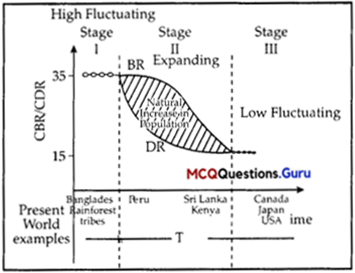
The World Population Distribution Density And Growth MCQ

Question 1.

How does the natural increase in population occur, as per the graph?

(A) Birth Rate – Death Rate
(B) Death Rate + Birth Rate
(C) Growth Rate – Birth Rate
(D) Birth Rate + Migration
Answer:
(B) Death Rate + Birth Rate

Explanation:
The difference between the birth rate and the death rate of a country or place is causes the natural increase.

Question 2.

What does the transition from high fluctuating stage to low fluctuating stage indicate?

(A) Shift from Urban Industrial economy to Rural Agrarian economy
(B) Shift from Rural Agrarian economy to Urban Industrial economy
(C) Low Birth and Death Rate to High Birth and Death Rate
(D) Migration from Urban to Rural areas
Answer:
(B) Shift from Rural Agrarian economy to Urban Industrial economy

MCQ Questions for Class 12 Geography Chapter 2 The World Population: Distribution, Density and Growth

Question 3.

From the given graph, what condition can you infer about the developing countries?

(A) High Birth Rate and High Death Rate
(B) Low Birth rate and Low Death rate
(C) High Birth Rate and Low Birth Rate
(D) Low Birth Rate and High Death Rate
Answer:
(C) High Birth Rate and Low Birth Rate

Explanation:
The social structure, religious beliefs, economic prosperity and urbanisation within each country leads to high birth rates and low birth rates in developing countries.

Question 4.

In which stage of Demographic Transition, population explosion took place :

(A) Stage I
(B) Stage II
(C) Stage III
(D) Post Stage III
Answer:
(B) Stage II

Explanation:
Stage II is characterized by a rapid decrease in a country’s death rate while the birth rate remains high. The fall in the death rate is due to drastic improvement in the medical facilities, vaccinations, etc.

V. Study the given graph carefully and answer the following questions :
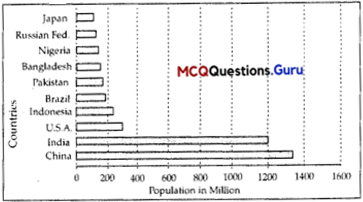
The World Population Class 12 MCQ Chapter 2

Question 1.

Identify the Asian country with the maximum population.

(A) India
(B) China
(C) Pakistan
(D) USA
Answer:
(B) China

Explanation:
The rise of industry and large scale agriculture and many other factors has lead China to have maximum population.

Question 2.

Why is Japan’s population decreasing?

(A) No pull factors
(B) Terrorism
(C) Government policies
(D) Low fertility rate
Answer:
(D) Low fertility rate

Explanation:
Japan’s overall population is shrinking due to low fertility rates and the aging population is rapidly increasing.

MCQ Questions for Class 12 Geography Chapter 2 The World Population: Distribution, Density and Growth

Question 3.

Why is Brazil sparsely populated?

(A) Due to climate
(B) Due to drug mafia
(C) Due to less land availability
(D) None of the Above
Answer:
(A) Due to climate

Explanation:
Brazil is very sparsely populated due to the climate of the area. The country suffers from frequent droughts.

Question 4.

Why is Asia the most populous continent?

(A) No contact with Western world
(B) Dictatorship
(C) No emigration allowed
(D) Rich in natural resources
Answer:
(D) Rich in natural resources .

Explanation:
Asia is rich in natural resources such as petroleum, forests, fish, water, rice, copper and silver.

VI. Study the given graph carefully and answer the following Questions:
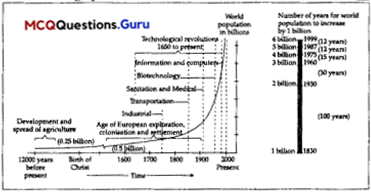
Class 12 Geography Chapter 2 MCQ

Question 1.

Which of these periods closely represents the European explorations?

(A) 1 CE to 1600 CE
(B) 1500 CE to 1700 CE
(C) 1520 CE to 1900 CE
(D) 1650 CE to 1950 CE
Answer:
(C) 1520 CE to 1900 CE

Question 2.

In how many years did world population increase from 4 billion to 5 billion?

(A) 12 years
(B) 15 years
(C) 30 years
(D) 100 years
Answer:
(A) 12 years

Explanation:
The world population increased due to better nutrition, higher birth rates, and lower mortality.

MCQ Questions for Class 12 Geography Chapter 2 The World Population: Distribution, Density and Growth

Question 3.

What is the speciality of the period 1650 CE to present?

(A) Development and spread of agriculture
(B) Colonialization
(C) Technological revolutions
(D) Transportation
Answer:
(C) Technological revolutions

Question 4.

What was the approximate population of the world in 1600s?

(A) 0.25 billion
(B) 0.5 billion
(C) 0.75 billion
(D) 1 billion
Answer:
(B) 0.5 billion

Explanation:
New crops that had come from the Americas to Asia and Europe during the 16th century contributed to population growth on these continents. The indigenous populations of the Americas, however, were decimated by diseases brought by European colonizers.

MCQ Questions for Class 12 Geography with Answers

MCQ Questions for Class 12 Biology Chapter 14 Ecosystem with Answers

Check the below NCERT MCQ Questions for Class 12 Biology Chapter 14 Ecosystem with Answers Pdf free download. MCQ Questions for Class 12 Biology with Answers were prepared based on the latest exam pattern. We have provided Ecosystem Class 12 Biology MCQs Questions with Answers to help students understand the concept very well. https://mcqquestions.guru/mcq-questions-for-class-12-biology-chapter-14/

Ecosystem Class 12 MCQs Questions with Answers

Ecosystem Class 12 MCQ Chapter 14 Question 1.
Who introduced term Ecosystem?
(a) Leaneous
(b) Reiter
(c) Odum
(d) Aristle

Answer

Answer: (b) Reiter


MCQ On Ecosystem Class 12 Chapter 14 Question 2.
Soil developed from sedimented rock:
(a) Force Science
(b) Edaphology
(c) Pedogenesis
(d) All of these

Answer

Answer: (c) Pedogenesis


Ecosystem MCQ Chapter 14 Class 12 Question 3.
Best soil for plant growth is:
(a) Grit
(b) Sandy
(c) Soily
(d) Clay

Answer

Answer: (d) Clay


Question 4.
Soil particle determine the character of:
(a) Organisation
(b) Biomass
(c) Area capacity
(d) Soil plants

Answer

Answer: (a) Organisation


Question 5.
Plant roots soil water is:
(a) Cellular water
(b) Surface water
(c) Humidity water
(d) Gravitational water

Answer

Answer: (d) Gravitational water


Question 6.
Exchange of water in submerged plant:
(a) Stomata
(b) Normal surface
(c) Hydathode
(d) Lenticel

Answer

Answer: (b) Normal surface


Question 7.
Submerged Rooted Hydrophyte are:
(a) Uticularia
(b) Prapa
(c) Nymphea
(d) Vallisnaria

Answer

Answer: (d) Vallisnaria


Question 8.
Water co-deficient contains:
(a) Large thin walled cells
(b) Large-vacuoles
(c) Membrane
(d) All of these

Answer

Answer: (c) Membrane


Question 9.
Xerophyte Contains:
(a) Deep roots
(b) Sunken stomata
(c) Thick cuticle
(d) All of these

Answer

Answer: (d) All of these


Question 10.
Small extremite animals of tropicalregion:
(a) Allen’s law
(b) Bergmen’s law
(c) Dollo’s law
(d) Cope’s law

Answer

Answer: (d) Cope’s law


Question 11.
Hibernation of some animals:
(a) Regular
(b) Periodic
(c) Suddenly
(d) Temporary

Answer

Answer: (a) Regular


Question 12.
Physical and chemical properties of soil studied by :
(a) Climatic factor
(b) Biotic factor
(c) Soil factor
(d) Topographic factor

Answer

Answer: (b) Biotic factor


Question 13.
Identity the Hetero Organism:
(a) Pistia
(b) Hydrilla
(c) Vallisnaria
(d) Casurina

Answer

Answer: (c) Vallisnaria


Question 14.
That animal who can bear one third loss of water of one third body weight is:
(a) Necturus
(b) Camel
(c) Wall Lizzard
(d) Kyton

Answer

Answer: (b) Camel


Question 15.
Root hair absent in:
(a) Hydrophyte
(b) Halophyte
(c) Mesophyte
(d) Heliophyte

Answer

Answer: (a) Hydrophyte


Question 16.
A water co-efficient Mesophyte is:
(a) Cappais
(b) Agave
(c) Acacia
(d) Hemeris

Answer

Answer: (b) Agave


Question 17.
Gravitated carried soil is:
(a) Alluvial
(b) Muddy
(c) Glacier
(d) Compound

Answer

Answer: (d) Compound


Question 18.
Kanha National Park is famous for:
(a) For Birds
(b) For Tendua
(c) For Tiger
(d) For Crocodile

Answer

Answer: (b) For Tendua


Question 19.
During food chain the maximum energy is stored in :
(a) Producers
(b) Decomposers
(c) Herbivoures
(d) Camivourse

Answer

Answer: (a) Producers


Question 20.
The average efficiency of energy transfer from herbivoure to carnivorce level is :
(a) 5%
(b) 10%
(c) 20%
(d) 30%

Answer

Answer: (b) 10%


Question 21.
Ecological pyramids were first devised by:
(a) Charles Eltom
(b) R. Hesse
(c) R.A. Lindemann
(d) Justus von Liebig

Answer

Answer: (a) Charles Eltom


Question 22.
Which of the following ecosystem has highest gross primary productivity:
(a) Grassland
(b) Coral reefs
(c) Mangrooves
(d) Rainforests

Answer

Answer: (b) Coral reefs


Question 23.
In the phosphorus cycle, weathring makes phosophate available first to:
(a) Producers
(b) Decomposers
(c) Consumers
(d) None of these

Answer

Answer: (a) Producers


Question 24.
Which types of the following pyramid are never inverted?
(a) Pyramid of energy
(b) Pyramid of biomass
(c) Pyramid of number
(d) Pyramid of dry biomass

Answer

Answer: (a) Pyramid of energy


Question 25.
Biosphere means:
(a) Atmosphere
(b) Lithosphere and ionosphered
(c) Atmosphere, lithosphere and hydrosphere
(d) Hydrosphere lithosphere and ionsophere

Answer

Answer: (c) Atmosphere, lithosphere and hydrosphere


Question 26.
Best type of pyramid which is always true is:
(a) Pyramid or energy
(b) Pyramid of Biomass
(c) Pyramid of number
(d) Both (a) and (c)

Answer

Answer: (a) Pyramid or energy


Question 27.
Decomposers are:
(a) Autotrophs
(b) Autohetrotrophs
(c) Organotrophs
(d) Heterotrophs

Answer

Answer: (d) Heterotrophs


Question 28.
The largest ecosystem is :
(a) Forest ecosystem
(b) Marine ecosystem
(c) Pond ecosystem
(d) Grassland ecosystem

Answer

Answer: (b) Marine ecosystem


Question 29.
More than 70 of world freshwater is contain in:
(a) Antarctica
(b) Glaciers and mountains
(c) Greenland
(d) Polar ice

Answer

Answer: (c) Greenland


Question 30.
Which one of the following pair is mismatched?
(a) Prairies-Epiphytes
(b) Tundra-Permafrost
(c) Savannaha-Acacia trees
(d) Coniferous forests-Evergreen trees)

Answer

Answer: (a) Prairies-Epiphytes


Question 31.
Which of the following is the most stable ecosystem?
(a) Mountain
(b) Desert
(c) Forest
(d) Ocean

Answer

Answer: (b) Desert


Question 32.
Primary succession occurs in :
(a) Primary succession occurs
(b) Previously unoccupied area
(c) Both of the above
(d) None of these

Answer

Answer: (b) Previously unoccupied area


Question 33.
Which one of the following is not used for construction of ecological pyramid?
(a) Dry weight
(b) Number of individuals
(c) Rate of energy flow
(d) Fresh weight

Answer

Answer: (a) Dry weight


Question 34.
What is the main cause of extinction of some species in tropical forests?
(a) Deforestation
(b) Afforestation
(c) Pollution
(d) Soil erosion

Answer

Answer: (a) Deforestation


Question 35.
Ecology deals with:
(a) The arth and plants
(b) The relationship between organisms and their environment
(c) Economical growth of poor people
(d) The life under sea

Answer

Answer: (b) The relationship between organisms and their environment


Question 36.
Shola forests are found in :
(a) Eastern Coast of Orissa
(b) North East Himalayas
(c) Western Ghats (Kerala)
(d) Decian Plateau

Answer

Answer: (c) Western Ghats (Kerala)


We hope the given NCERT MCQ Questions for Class 12 Biology Chapter 14 Ecosystem with Answers Pdf free download will help you. If you have any queries regarding Ecosystem CBSE Class 12 Biology MCQs Multiple Choice Questions with Answers, drop a comment below and we will get back to you soon.

MCQ Questions for Class 12 Biology Chapter 13 Organisms and Populations

Organisms and Populations Class 12 MCQ Questions With Answers

Class 12 Biology Chapter 13 MCQ Questions Question 1.

Which of the following forest plants controls the light conditions at the ground?

(A) Climbers
(B) Shrubs
(C) Tall trees
(D) Herbs
Answer:
(C) Tall trees

Explanation :
In a forest ecosystem, light is an important abiotic component that controls a number of life processes in organisms. In forest, its intensity duration and quality at ground is controlled by tall trees.

MCQ On Organism And Population Class 12 Question 2.

According to Allen’s rule, the mammals from colder climates have

(A) shorter ears and longer limbs
(B) longer ears and shorter limbs
(C) longer ears and longer limbs
(D) shorter ears and shorter limbs
Answer:
(D) shorter ears and shorter limbs

Explanation :
Snails undergo aestivation to avoid summers.

MCQ Questions for Class 12 Biology Chapter 13 Organisms and Populations

Organism And Population MCQ Class 12 Question  3.

Snails escape from stressful time in summers by

(A) Hibernation
(B) Aestivation.
(C) Diapause
(D) Homeostasis
Answer:
(B) Aestivation.

Explanation :
Snails undergo aestivation to I avoid summers.

Organism And Population Class 12 MCQ Question 4.

Autecology is the

(A) relation of a population to its environment.
(C) relation of a community to its environment.
(D) relation of a biome to its environment.
Answer:
(B) relation of an individual to its environment.

Explanation :
Autecology is the study of interre lationship of the organisms of a species to biotic or abiotic environment.

Organisms And Population Class 12 MCQ Question 5.

Biosphere is

(A) a component in the ecosystem.
(B) composed of the plants present in the soil.
(C) life in the outer space.
(D) composed of all living organisms present on earth which interact with the physical environment.
Answer:
(D) composed of all living organisms present on earth which interact with the physical environment.

Explanation:
Biosphere, one of the four layers that surround the Earth, is composed of all living organisms present on earth which interact with their physical environment. It is collectively used for all the ecosystems of world.

MCQ Questions for Class 12 Biology Chapter 13 Organisms and Populations

Organisms And Population MCQ With Answers Question 6.

Which one of the following organisms reproduces sexually only once in its life time?

(A) Banana plant
(B) Mango
(C) Tomato
(D) Eucalyptus
Answer:
(A) Banana plant

Explanation :
Banana plant is the largest herbaceous flowering plant. It is a monocarpic plant which reproduces sexually only once in its life lime. Monocarpic plants are those plants which flower only once in their life and die after flowering and fruiting. These plants are generally annual (wheat, rice) or biennials (like carrot and radish).

Organisms And Populations MCQ Chapter 13 Question 7.

Ecological niche is

(A) the surface area of the ocean.
(B) an ecologically adapted zone.
(C) the physical position and functional role of a species within the community.
(D) formed of all plants and animals living at the bottom of a lake.
Answer:
(C) the physical position and functional role of a species within the community.

Explanation :
Ecological niche is ecologically adapted zone, that is, the particular place of habitat occupied by individual of a species within its ecosystem. Ecological niche have specific characteristics, such as availability of nutrients, temperature, terrain, sunlight, and predators, which influences how populations affect and are affected by resources and enemies.

MCQ Questions for Class 12 Biology Chapter 13 Organisms and Populations

MCQ Of Organism And Population Class 12 Question 8.

Ecotone is

(A) a polluted area.
(B) the bottom of a lake.
(C) a zone of transition between two communities.
(D) a zone of developing community.
Answer:
(C) a zone of transition between two communities.

Explanation :
Ecotone is a transition zone between two communities. The adjacent biotic (natural) communities generally do not possess a fine demarcation line between them, Therefore, the adjacent of two communities is represented bv population of both the communities, and this transition zone between two communities is referred as ecotone.

MCQs Of Biology Class 12 Chapter 13 Question 9.

Salt concentration (salinity) of the sea measured in parts per thousand is

(A) 10-15
(B) 30-70
(C) 0-5
(D) 30- 35
Answer:
(D) 30- 35

Explanation :
The salinity (measured in parts per thousand) is less than in land water, 30-35 in sea water and > 100 in some hvpersaline water bodies like lagoons. After temperature, water is an important abiotic factor which has a great influence on the life of an organism. In an oceanic ecosvstem, organisms face many waters related problems like pH, salinity of water. The salinity (salt concentration) of sea is measured in parts per thousand units. It is about 30-35 ppt.

Organisms And Population MCQ Class 12 Question 10.

What will happen to a well growing herbaceous plant in the forest if it is transplanted outside the forest in a park?

(A) It will grow normally.
(B) It will grow well because it is planted in the same locality.
(C) It may not survive because of change in its microclimate.
(D) It grows very well because the plant gets more sunlight.
Answer:
(C) It may not survive because of change in its microclimate.

Explanation :
In forest ecosystem tall trees of forest plants controls the light condition, that is, intensity duration and quality of light at the ground. A well growing herbaceous plant in forest receive less intensity duration and quality of light, but when it is transplanted in a park outside its natural habitat, the light will be received uninterrupted. So, due to change in its microclimate, it may not survive.

MCQ Questions for Class 12 Biology Chapter 13 Organisms and Populations

Question 11.

A population has more young individuals compared to the older individuals. What would be the status of the population after some years?

(A) It will decline
(B) It will stabilize
(C) It will increase
(D) It will first decline and then stabilize
Answer:
(C) It will increase

Explanation :
Variations in number of individuals in a population is expressed as population density and population size. A IS population of more young individuals than older individuals will show positive growth in future (after some vrs), i.e., it will increase after some time.

Question 12.

If a population of 50 Paramecium present in a pool increases to 150 after an hour, what would be the growth rate of population?

(A) 50 per hour
(B) 200 per hour
(C) 5 per hour
(D) 100 per hour
Answer:
(D) 100 per hour

Explanation :
Biotic potential is the natural capacity of a population to multip lyincrease at its maximum rate under favourable environmental conditions. Population of P&ramecium show 100 per hour growth, two individuals are produced by one.

Question 13.

What would be the per cent growth or birth rate per individual per hour for the same population mentioned in the previous question (Question 12)?

(A) 100
(B) 200
(C) 50
(D) 150
Answer:
(B) 200

Explanation :
Growth rate is 200% as one organism is producing two individuals at a time.

Question 14.

Which of the following would necessarily decrease the density of a population in a given habitat?

(A) Natality > mortality
(B) Immigration > emigration
(C) Mortality and emigration
(D) Natality and immigration
Answer:
(C) Mortality and emigration

Explanation :
Mortality and emigration would necessarily decrease the density of a population in a given habitat due to loss of individual result from mortality (deaths) and emigration.

Question 15.

A protozoan reproduces by binary fission. What will be the number of protozoans in its population after six generations?

(A) 128
(B) 24
(C) 64
(D) 32
Answer:
(C) 64

Explanation :
Binary fission is a mode of asexual reproduction in protozoan through which it produces two offsprings from parent individuals. So,
In 1st generation: there are 2 protozoans were:
In 2nd generation : there are 2×2 = 4 protozoans
In 3rd generation : there are 4×2 = 8 protozoans
In 4th generation: there are total 16 protozoans were:
In 5th generation: there are total 32 protozoans
In 6th generation: there are 64 protozoans were:
Thus, the population of protozoans will be 64, after six generations.

MCQ Questions for Class 12 Biology Chapter 13 Organisms and Populations

Question 16.

Amensalism is an association between two species where

(A) one species is harmed and other is benefitted.
(B) one species is harmed and other is unaffected.
(C) one species is benefitted and other is unaffected.
(D) both the species are harmed.
Answer:
(C) one species is benefitted and other is unaffected.

Explanation :
Amensalism is an association between two organisms in which one species is benefitted or unaffected while the other organism is destroyed or inhibited.

Question 17.

Lichens are the associations of

(A) bacteria and fungus
(B) algae and bacterium
(C) fungus and algae
(D) fungus and virus
Answer:
(C) fungus and algae

Explanation :
Lichens is an organism that is formed by the symbiotic association of a fungus and an alga or cyanobacterium. It occurs as crusty patches or bushy growths on tree trunks, bare ground, etc. and represents a positive (beneficial) interaction between two different species.

Question 18.

Select the statement which explains best parasitism.

(A) One organism is benefited
(B) Both the organisms are benefited
(C) One organism is benefited, other is not affected
(D) One organism is benefited, other is affected
Answer:
(D) One organism is benefited, other is affected

Explanation :
Parasitism is an interaction between two species in which one species (parasite) derives benefit while the other species (host) is harmed. For example, ticks and lice (parasites) present on the human body represent this interaction where in the parasites receive benefit (as they derive nourishment by feeding on the blood of humans). On the other hand, these parasites reduce host fitness and cause harm to the human body.

Question 19.

Which of the following is a partial root parasite?

(A) Sandal wood
(B) Mistletoe
(C) Orobanche
(D) Ganoderma
Answer:
(A) Sandal wood

Explanation :
Sandalwood tree (Santalum album) is an example of partial root parasite. It grows on the roots of Dalbergia, Albizzia and Eucalyptus. he sucking roots ol the plants attack the roots of the host trees and from them nutrients are absorbed. Mistletoe (Vbaim) is considered as hemiparasite which derives a part of nourishment from host plant. Orobanche is an obligate holoparasite which attack strategic food crops, such as legumes and vegetables, Ganoderma mushrooms are. known as king of herbs for its wonderful . medicinal properties. They are commonly known as reishi mushrooms. They are widely distributed, shelf-like or knob-like fungi that feed either as saprobes on dead wood or as parasites on the live wood of hardwood trees.

MCQ Questions for Class 12 Biology Chapter 13 Organisms and Populations

Question 20.

What parameters are used for tiger census in our country’s national parks sanctuaries?

(A) Pug marks only
(B) Pugmarks and faecal pellets
(C) Faecal pellets only
(D) Actual headcounts
Answer:
(B) Pugmarks and faecal pellets


Assertion and Reason Based MCQs

Directions: In the following questions a statement of assertion (A) is followed by a statement of reason (R). Mark the correct choice as :

(A) Both assertion (A) and reason (R) are true and reason (R) is the correct explanation of assertion
(B) Both assertion (A) and reason (R) are true but reason (R) is not the correct explanation of assertion (A).
(C) Assertion (A) is true but reason (R) is false.
(D) Assertion (A) is false but reason (R) is true.

Question 1.

Assertion (A): Ecology is concerned with four levels of biological organisation.
Reason (R): Organisms, populations, communities and biomes are four levels of biological organisation.

Answer:
(A) Both assertion (A) and reason (R) are true and reason (R) is the correct explanation of assertion

Explanation :
Ecology include six level of organizalion that are organism, population, communiLy, ecosystem, biosphere and biome.

Question 2.

Assertion (A): Different habitats had different physical and chemical conditions.
Reason (R): Physicochemical (abiotic) components characterize the habitat of an organism.

Answer:
(B) Both assertion (A) and reason (R) are true but reason (R) is not the correct explanation of assertion (A).

Explanation :
Habitat is governed by the both abiotic and biotic components.

Question 3.

Assertion (A) : Small animals are rarely found in polar regions.
Reason (R): Heat loss or heat gain is a function of surface area. Large surface area great loss of heat.

Answer:
(A) Both assertion (A) and reason (R) are true and reason (R) is the correct explanation of assertion

Explanation :
Small animals have a large sur-face area with respect to their volume, so they lose body heat fast if it is cold outside, small animals are rarely found in polar regions.

Question 4.

Assertion (A): A community with more species is more stable than that with less species.
Reason(R): More the number of species, lesser the variation in

Answer:
(B) Both assertion (A) and reason (R) are true but reason (R) is not the correct explanation of assertion (A).

Explanation :
Communities with more species tend to be more stable than those with less species because they are able to resist occasional disturbance . David Tilman’s long term experiments showed the plots with more species, experience less year to year variation in total biomass.

MCQ Questions for Class 12 Biology Chapter 13 Organisms and Populations

Question 5.

Assertion (A): Many freshwater animals cannot live for long in seawater.
Reason (R): Freshwater animals face osmotic problems in seawater.

Answer:
(A) Both assertion (A) and reason (R) are true and reason (R) is the correct explanation of assertion

Explanation :
When freshwater animals move into sea, water continuously moves out of the animal’s body through the process of osmosis.

Question 6.

Assertion (A): The term interbreeding implies sexual reproduction.
Reason (R): Interbreeding result in variation among species.

Answer:
(A) Both assertion (A) and reason (R) are true and reason (R) is the correct explanation of assertion

Explanation :
Interbreeding implies sexual reproduction which involve the fusion of two gametes of different species which bring variation among the species.

Question 7.

Assertion (A): Population has certain attributes which an individual organism does not have.
Reason (R): Population is a group of people living in a well-defined area, at a particular time.

Answer:
(B) Both assertion (A) and reason (R) are true but reason (R) is not the correct explanation of assertion (A).

Explanation :
Population is a group of people therefore it’s attributes are different from an individual organism.

Question 8.

Assertion (A): Natality contributes to the increase in population density.
Reason (R): Natality refers to the number of births during a given period in the population which is

Answer:
(A) Both assertion (A) and reason (R) are true and reason (R) is the correct explanation of assertion

Question 9.

Assertion (A): Clownfish maintains a commensalism relation with the sea anemone.
Reason (R): In this interaction, one species benefits and the other is neither harmed nor benefited.

Answer:
(A) Both assertion (A) and reason (R) are true and reason (R) is the correct explanation of assertion

Explanation :
Clownfish maintain a commensalism relation with the sea anemone. In this interaction, one species benefits and  the other is neither harmed nor benefited. Sea anemone has stinging tentacles that provide protection to Clownfish from predators. The sea anemone does not appear to derive any benefit from the down fish.

Question 10.

Assertion (A): The human population represents the logistic growth curve.
Reason (R): When the resources are limited leading to competition between individuals and survival of fittest, the population tends to grow in a logistic manner.

Answer:
(A) Both assertion (A) and reason (R) are true and reason (R) is the correct explanation of assertion

Explanation :
The human population represents the logistic growth curve as the numbers of human beings are increasing rapidly but available resources are not increasing at the same pace. Such a growth pattern is not sustainable because at one point the human popu¬lation would reach a place where there would not be enough resources for everyone.

Case-Based MCQs

Attempt any four sub-parts from each question. Each sub-part carries 1 mark.

I. Read the following text and answer the following questions on the basis of the same:
Growth of a population with time shows specific and predictable patterns. Two types of growth pattern of population are exponential and logistic growth. When resources in the habitat are unlimited each spedes has the ability to realize fully its innate potential to grow in number. Then the population grows in exponential fashion. When the resources are limited growth curve shows an initial slow rate and then it accelerates and finally slows giving the growth curve which is sigmoid.

Question 1.

Identify the incorrect statement:

(A) Exponential growth occurs in organism such as lemmings.
(B) Logistic growth is more realistic.
(C) Exponential growth has two phases lag and log.
(D) In logistic growth, population passes well beyond the carrying capadty of ecosystem.

Answer:
(D) In logistic growth, population passes well beyond the carrying capadty of ecosystem.

Explanation :

In logistic growth population seldom grows beyond the carrying capacity of ecosystem.

MCQ Questions for Class 12 Biology Chapter 13 Organisms and Populations

Question 2.

Identify the correct equation that represents the exponential population growth curve:

(A) dN/dt = IN
(B) dN/dt = rN (K-N/K)
(C) Nt =N0ert
(D) Both (A) and (C)

Explanation :
If any species is flourishing under unlimited resources, it would reach exponential growth which can be depicted by equation: dN/dt =rN Where, N= population density at time t; r = intrinsic rate of natural increase. If we derive the integral form of the exponen-tial growth equation, it can be written as: Nt
=N ert Where,Where Nt, = population density after time t; N0is population density at time zero; r = intrinsic rate of natural increase; is the base of natural logarithm.

Question 3.

The equations correctly represents Verhulst-Pearl logistic growth is:

(A) dN/dt = rN(K-N)/K
(B) dN/dt = rN/K
(C) dN/dt = N(K-N)/K
(D) dN/dt = r(K-N)/K
Answer:
(A) dN/dt = rN(K-N)/K

Explanation :
The equations correctly repreI sents Verhulst-Pearl logistic growth is dN/dt = I rN(K-N)/K

Question 4.

The population growth is generally described by the following equation: dN/dt = rN(K-N)/K What does ‘r’ represent in the given equation?

(A) Population density at time
(B) Intrinsic rate of natural increase
(C) Carrying capacity
(D) The base of natural logarithm
Answer:
(B) Intrinsic rate of natural increase

Explanation:
‘r’ represents Intrinsic rale of naural increase.

Question 5.

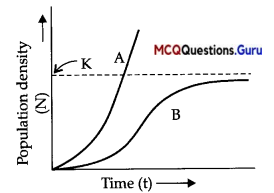
Study the population growth curves (A and B) in the given graph and select the incorrect statement:

Class 12 Biology Chapter 13 MCQ Questions

(A) Curve ‘A’ shows exponential growth, represented by equation dN/dt=rN
(B) Curve ‘B’ shows logistic growth, represented by equation dN/dt = r(K-N)/K
(C) Exponential growth curve is considered as more realistic than the logistic growth curve
(D) Curve ‘A’ can also be represented by equation Nt = N0ert
Answer:
(C) Exponential growth curve is considered as more realistic than the logistic growth curve

Explanation :
Since resources of growth for most animal populations are finite and become limiting sooner or later, so the logistic growth model is considered as more realistic.

II. Read the following text and answer the following questions on the basis of the same :
All biomes of the earth constitute the earth’s ecosystem. All flora and fauna occur in the lithosphere, atmosphere and hydrosphere along with their environments. Air, water, soil, biota, temperature and light are the major environmental factors that directly affect the flora and fauna in different geological areas of the earth.

MCQ Questions for Class 12 Biology Chapter 13 Organisms and Populations

Question 1.

Climate of an area depends upon:

(A) Altitude of the area
(B) Latitude of the area
(C) Topography
(D) Both (A) and (B).
Answer:
(D) Both (A) and (B).

Explanation :
The altitude of an area can impact like climate that are mostly rainy and have low temperature while the altitude of an area impact the ultimate with respect to equator and poles.

Question 2.

Hydrological cycle is concerned with :

(A) Lithosphere
(B) Hydrosphere
(C) Atmosphere
(D) All of these.

Explanation :
Lithosphere is concerned with land, hydrosphere with water bodies and atmosphere is concerned of space. Hydrological cycle circulates in all these three subsystem.

Question 3.

Soil aeration is inversely proportional to :

(A) Soil pore spaces
(B) Diameter of soil particles
(C) Water holding capacity of soil
(D) None of the above.
Answer:
(C) Water holding capacity of soil

Explanation:
More will be the water holding capacity soil, less will be the air spaces less soil aeration.

MCQ Questions for Class 12 Biology Chapter 13 Organisms and Populations

Question 4.

Edaphology is concerned with study of :

(A) Soil
(B) Climate
(C) Biota
(D) Topography
Answer:
(A) Soil

Explanation :
Edaphology is the study of soil useful for plant growth.

Directions: In the following questions a statement of Assertion (A) is followed by a statement of reason (R). Mark the correct choice as :

(A) Both Assertion (A) and reason (R) are true and reason (R) is the correct explanation of Assertion (A).
(B) Both Assertion (A) and reason (R) are true but reason (R) is not the correct explanation of Assertion (A).
(C) Assertion (A) is true but reason (R) is false.
(D) Assertion (A) is false but reason (R) is true.

Question 5.

Assertion (A): Some organisms like Salmon are known as Euryhaline.
Reason (R): Euryhalines can tolerate a wide range of salinities.

Answer:
(B) Both Assertion (A) and reason (R) are true but reason (R) is not the correct explanation of Assertion (A).

Explanation :
Euryhaline animals like salmon can adopt wide range of selinity as they are found in areas where river and sea meets.

III. Population is a group of individuals of a single species living in a given area. It includes spatial arrangement, genetic variation and the dynamics including natality, mortality, biotic potential, carrying capacity, etc. Population structure includes features as density, abundance, spacing, genetic variations. The genetic structure reveals genetic variations and population size.

MCQ Questions for Class 12 Biology Chapter 13 Organisms and Populations

Question 1.

——— is the study of the ecology of population.

(A) Autocology
(B) Demecology
(C) Endaphology
(D) None of the above
Answer:
(B) Demecology

Explanation:
Autocology is the study of species ecology and Edaphology is the study of soil.

Question 2.

——— spedes inhabit different geographical areas. Allopatric.

(A) Sympatic
(B) Allopatric
(C) Both (A) and (B)
(D) None of these
Answer:
(B) Allopatric

Explanation :
Allopatric is the evolving of separate species from an arrcestrol population.

Question 3.

Increase in population does not increase in :

(A) Health facilities
(B) Unemployment
(C) Food resources
(D) Per capita income.
Answer:
(B) Unemployment

Explanation :

Unemployment is the unavailability of suitable job can be overcome by developing skill an creating opportunity. So, it does not impacted by increase in population.

MCQ Questions for Class 12 Biology Chapter 13 Organisms and Populations

Question 4.

Which Indian state has the least population growth?

(A) Kerala
(B) U.E
(C) A.P.
(D) Assam.
Answer:
(A) Kerala

Explanation :
Kerala has the least population growth, which has the highest population growth.

MCQ Questions for Class 12 Biology Chapter 13 Organisms and Populations

Question 5.

There is more competition for survival between :

(A) Different animals of same niche
(B) Same animals of same niche
(C) Different animals of different niche
(D) Same animals of different niche.
Answer:
(B) Same animals of same niche

Explanation :
Same animals under the niche have limited food resources. So, same animals would have same food habits and there is more competition for survival.

MCQ Questions for Class 12 Biology with Answers

MCQ Questions for Class 12 Biology Chapter 12 Biotechnology and its Applications

Biotechnology and its Applications Class 12 MCQ Questions With Answers

MCQs Of Biology Class 12 Chapter 12 Question 1.

What triggers activation of protoxin to active Bt toxin of Bacillus thuringiensis in bollworm?

(A) Body temperature
(B) Moist surface of midgut
(C) Alkaline ph of gut
(D) Acidic ph of stomach
Answer:
(C) Alkaline ph of gut

Explanation :
Bt toxin protein exists as inactive protoxins but once an insect ingest the inactive toxin, it is converted into an active form due to the alkaline pH of the gut which solubilise the crystals.

MCQ Questions for Class 12 Biology Chapter 12 Biotechnology and its Applications

Biotechnology And its Applications Class 12 MCQ Question 2.

Which of the following is commonly used as a vector for introducing a DNA fragment in human lymphocytes?

(A) Retrovirus
(B) pBR 322
(C) 1 Phage
(D) Ti plasmid
Answer:
(A) Retrovirus

Explanation :
Retrovirus is commonly used as a vector for introducing a DNA fragment in human lymphocytes.

MCQ Questions for Class 12 Biology Chapter 12 Biotechnology and its Applications

Class 12 Biology Chapter 12 MCQ Question 3.

The first human hormone produced by recombinant DNA technology is:

(A) Insulin
(B) Estrogen
(C) Thyroxine
(D) Progesterone
Ans.
(A) Insulin

Explanation :
In 1983, Eli Lily an American company prepared two DNA sequences corresponding to A and B chains of human it insulin and introduced them in plasmids of to produce insulin chains. The chains A and B were produced separately, extracted and combined by creating disulfide bonds to form human insulin.

MCQ On Biotechnology And its Applications Pdf Chapter 12 Question 4.

Bt cotton is not

(A) a genetically modified (GM) plant.
(B) insect resistant.
(C) a bacterial gene expressing system.
(D) resistant to all pesticides.
Answer:
(D) resistant to all pesticides.

Explanation:
Bt cotton is a genetically modified (GM) plant which is resistant to insects. These plants are produced by the insertion of one or more genes from a common soil bacterium, Bacillus thuringiensis. These genes encode for the production of insecticidal proteins, and thus, genetically transformed plants produce one or more toxins as they grow.

Biotechnology And its Applications MCQ Chapter 12 Question 5.

C-peptide of human insulin is

(A) a part of mature insulin molecule.
(B) responsible for formation of disulphide bridges.
(C) removed during maturation of pro-insulin to insulin.
(D) responsible for its biological activity.
Ans.
(C) removed during maturation of pro-insulin to insulin.

Explanation :
Insulin and C-pcptide arc linked when first made by the pancreas. C-peptide is removed from the pancreatic beta-cells during cleavage of insulin from proinsulin.

MCQ Questions for Class 12 Biology Chapter 12 Biotechnology and its Applications

Biotechnology And its Applications MCQ With Answers Question 6.

A pro-toxin is

(A) a primitive toxin
(B) a denatured toxin
(C) toxin produced by protozoa
(D) inactive toxin
Answer:
(D) inactive toxin

Explanation :
Bt toxin protein exist as inactive protoxins but once an insect ingests the inactive toxin, it is converted into an active form of toxin due to the alkaline pH of the gut which solubilize the crystals.

MCQ On Biotechnology And its Applications Class 12 Question 7.

Golden rice is

(A) a variety of rice grown along the yellow river in China.
(B) long-stored rice having yellow colour tint.
(C) transgenic rice having gene for pcarotene .
(D) wild variety of rice with yellow coloured grains.
Answer:
(C) transgenic rice having gene for pcarotene .

Explanation :
Golden Rice is a new type of rice that contains betacarotene (provitamin A), which is converted into vitamin A as needed by the body and gives the grain its golden colour. It is developed through genetic engineering and produces two new enzymes that complete the beta carotene expression in the rice grain.

Biotechnology And its Application MCQ Class 12 Chapter 12 Question 8.

Crystals of Bt toxin produced by some bacteria do not kill the bacteria themselves because

(A) bacteria are resistant to the toxin.
(B) toxin is immature.
(C) toxin is inactive.
(D) bacteria enclose toxin in a special sac.
Answer:
(C) toxin is inactive.

Explanation :
Crystals of Bt toxin produced by some bacteria do not kill the bacteria themselves because toxin is inactive.

MCQ Questions for Class 12 Biology Chapter 12 Biotechnology and its Applications

MCQ Of Biotechnology And its Application Class 12 Question 9.

A probe which is a molecule used to locate specific sequences in a mixture of DNA or RNA molecules could be

(A) a single stranded RNA
(B) a single stranded DNA
(C) either RNA or DNA
(D) can be ss-DNA but not ss RNA
Answer:
(C) either RNA or DNA

Explanation :
A single stranded DNA or RNA, ” lagged with a radioactive molecule (probe) is allowed to hybridise to its complementary” DNA in a clone of cells followed by detection using autoradiography.

MCQs On Biotechnology And its Applications Class 12 Question 10.

The site of production of ADA in the body is

(A) bone marrow
(B) lymphocytes
(C) blood plasma
(D) monocytes
Answer:
(B) lymphocytes

Explanation :
The first clinical gene therapy was given in 1990 to a 4-year old girl with adenosine deaminase (ADA) deficiency. This enzyme is crucial for the immune system to function. The disorder is caused due to the deletion of the gene for adenosine deaminase. In some children ADA deficiency can be cured by bone marrow transplant lation.

MCQ Questions for Class 12 Biology Chapter 12 Biotechnology and its Applications

Biotechnology And its Applications MCQs Class 12 Chapter 12 Question 11.

Use of bio-resources by multinational companies and organizations without authorisation from the concerned country and its people is called

(A) Bio-infringement
(B) Bioexploitation
(C) Biodegradation
(D) Biopiracy
Answer:
(D) Biopiracy

Explanation :
Some organisations and multinational companies exploit or get patent for the biological resources of other nations without proper authorization from the concerned countries and this is called biopiracy.

MCQ Questions On Biotechnology And its Applications Chapter 12 Question 12.

Maximum number of existing transgenic animals is of

(A) Mice
(B) Cow
(C) Pig
(D) Fish
Answer:
(A) Mice

Explanation :
Over 95% of all existing trans genic animals are mice.

Question 13.

Which body of the Government of India regulates GM research and safety of introducing GM organisms for public services.

(A) Bio-safety committee
(B) Indian council of Agricultural Research
(C) Genetic Engineering Approval committee
(D) Research Committee on Genetic Manipulation.
Answer:
(C) Genetic Engineering Approval committee

Explanation :
Indian government has set up an organisation. Genetic engineering approval committee (GEAC) which makes decisions regarding validity of CM research and its use for public utility.

MCQ Questions for Class 12 Biology Chapter 12 Biotechnology and its Applications

Question 14.

α-1 antitrypsin is

(A) an antacid.
(B) an enzyme
(C) used to treat arthritis
(D) used to treat emphysema
Answer:
(D) used to treat emphysema

Explanation :
Transgenic animals that produce useful biological prod ucls can be created by the g introduction of the portion of DNA (or genes) which codes for a particular product such as human protein (a-1-antitrypsin) used to treat emphysema.

Question 15.

Choose the correct option regarding Retrovirus

(A) an RNA virus that can synthesise DNA during infection.
(B) a DNA virus that can synthesise RNA during infection.
(C) a ss DNA virus.
(D) a dsRNA virus.
Ans.
(A) an RNA virus that can synthesise DNA during infection.

Explanation :
A retrovirus is RNA virus which is capable to synthesise DNA during infection.

Question 16

is a first transgenic cow.

(A) Dolly
(B) Molly
(C) Shelly
(D) Rosie
Answer:
(D) Rosie

Explanation:
In 1997, Rosie, the first transgenic cow produced human protein-enriched milk (2.4 gm per litre).

Question 17.

GEAC stands for

(A) Genome Engineering Action Committee.
(B) Ground Environment Action Committee.
(C) Genetic Engineering Approval Committee.
(D) Genetic and Environment Approval committee.
Answer:
(D) Genetic and Environment Approval committee.

Explanation :
The Indian Government has set up organisations such as GEAC (Genetic Engineering Approval Committee), which will make decisions regarding the validity of GM research and the safety of introducing GM organisms for public services.

Question 18.

The polio vaccine was tested on :

(A) Mice
(B) Monkey
(C) Rabbit
(D) Dog
Answer:
(A) Mice

Explanation :

Transgenic mice are being devel¬oped and used in testing the safety of vaccines before they are used for humAnswer:The polio vaccine was tested in mice.

MCQ Questions for Class 12 Biology Chapter 12 Biotechnology and its Applications

Question 19.

Transgenic animals are

(A) Animals whose DNA is manipulated to possess and express an extra (foreign) gene
(B) Animals whose RNA is manipulated to possess and express an extra (foreign) gene
(C) Animals whose both DNA and RNA are manipulated to possess and express an extra (foreign) gene.
(D) None of the above
Ans.
(A) Animals whose DNA is manipulated to possess and express an extra (foreign) gene

Explanation :
Transgenic animals are animals whose DNA is manipulated to possess and express an extra (foreign) gene e.g. Rosie – transgenic cow.

Question 20.

India has ………. varieties of Basmati rice.

(A) 30
(B) 29
(C) 12
(D) 27 0
Ans.
(D) 27 0

Explanation :
India has 27 varieties of Basmati rice.

Assertion and Reason Based MCQs

Directions: In the following questions a statement of assertion (A) is followed by a statement of reason (R). Mark the correct choice as.:
(A) Both assertion (A) and reason (R) are true and reason (R) is the correct explanation of assertion
(B) Both assertion (A) and reason (R) are true but reason (R) is not the correct explanation of assertion (A).
(C) Assertion (A) is true but reason (R) is false.
(D) Assertion (A) is false but reason (R) is true.

Question 1.

Assertion (A): Norman E. Borlaug was the father of “Green revolution”.
Reason (R): Green revolution is the period when there is significant increase in agricultural productivity of grains (specially wheat and rice).

Answer:
(A) Both assertion (A) and reason (R) are true and reason (R) is the correct explanation of assertion

Question 2.

Assertion (A): ‘BE in Bt toxin represent Bacillus thuringiensis.
Reason (R): ‘Bt’ toxin is produced by a virus.

Answer:
(A) Both assertion (A) and reason (R) are true and reason (R) is the correct explanation of assertion

Explanation :
Assertion (A) is true, but reason (R) is wrong as Bt toxin is produced by a bacterium called Bacillus thuringiensis. fiS

Question 3.

Assertion (A): Genetically modification make crops more tolerant to abiotic stress (cold, drought, etc.)
Reason (R): Genetically Modified Organisms (GMO) genes have been altered by manipulation.

Answer:
(A) Both assertion (A) and reason (R) are true and reason (R) is the correct explanation of assertion

Question 4.

Assertion (A): Ti plasmid (tumor-inducing plasmid) of Agrobacterium tumefaciens is used as a cloning vector.
Reason (R): Ti plasmid integrates a segment of its DNA, termed T-DNA into the chromosomal DNA of its host plant cells.

Answer:
(C) Assertion (A) is true but reason (R) is false.

Explanation:
The Ti plasmid (tumour-inducing plasmid) of Agrobacterium tumefaciens has been modified (does not cause tumour) and used as a cloning vector. The Ti plasmid integrates a segment of its DNA, termed T-DNA into the chromosomal DNA of its host plant cells.

MCQ Questions for Class 12 Biology Chapter 12 Biotechnology and its Applications

Question 5.

Assertion (A): The inactive form of toxic proteins are advantageous to the bacteria producing it.
Reason( R): Low concentration of a bacteria or virus, even at a time when the symptoms of the disease are not visible, can be detected.

Answer:
(B) Both assertion (A) and reason (R) are true but reason (R) is not the correct explanation of assertion (A).

Explanation :
Many proteins including certain toxins are secreted in their inactive form. They get activated, only when exposed to a specific trigger (pi L, temperature, etc.). It is advanta geous to the bacLerin producing it because the bacterium does not gel killed due to the action of protein. Low concentration of a bacteria or virus, even aL a time when the symptoms of Lhe disease are not visible, can be detected by amplification of their nucleic acid bv PGR methods.

Question 6.

Assertion (A): Transgenic animals had their DNA manipulated.
Reason (R): 95% of all existing transgenic animals are mice.

Answer:
(B) Both assertion (A) and reason (R) are true but reason (R) is not the correct explanation of assertion (A).

Explanation :
Transgenic animals originates from recombinant DNA.

Question 7.

Assertion (A): GEAC will decide the safety of introducing GM organism for public use.
Reason (R): Genetic modifications of organisms may have opposite results when introduced into the ecosystem.

Answer:
(A) Both assertion (A) and reason (R) are true and reason (R) is the correct explanation of assertion

Question 8.

Assertion (A): Transgenic mice are being used to test the safety of the polio vaccine.
Reason (R): It could replace the use of monkeys to test the safety of batches of the vaccine.

Answer:
(A) Both assertion (A) and reason (R) are true and reason (R) is the correct explanation of assertion

Question 9.

Assertion (A): Rosie was the first transgenic cow.
Reason (R): It contained human alpha lactalbumin.

Answer:
(B) Both assertion (A) and reason (R) are true but reason (R) is not the correct explanation of assertion (A).

Explanation :
Transgenic animals are animals whose genes are altered by manipulation (recombinant DNA technology). Rosie was the first transgenic cow. The milk produced by it was protein rich. It contained human alpha lactalbumin. This milk was nutritionally richer and balanced as compared to that of normal cow.

Question 10.

Assertion (A): An American company is allowed the company to sell a ‘neW variety of Basmati rice.
Reason (R) : Indian Basmati was crossed with semidwarf varieties and claimed as a novelty.

Answer:
(B) Both assertion (A) and reason (R) are true but reason (R) is not the correct explanation of assertion (A).

Explanation :
In 1997, an American company got patent rights on Basmati rice through the Patent and Trademark Office. This allowed 1 the company to sell a ‘new’ variety of Basmati r, which had actually been derived from Indian farmer’s varieties. Indian Basmati was crossed with semi-dwarf varieties and claimed as a novelty.

MCQ Questions for Class 12 Biology Chapter 12 Biotechnology and its Applications

Case-Based MCQs

Attempt any four sub-parts from each question. Each sub-part carries 1 mark.

I. Read the following and answer questions from Question 1. to Question 5. given below:
Plants having foreign genes in their genome through genetic engineering are called transgenic plants. Genes can be incorporated either through a vector or through direct introduction of DNA. Bt cotton is a genetically modified organism which is pest resistant. It contains gene cry Ac and cry II Ab of Bacillus thuringiensis. It is used to control lepidopterans, coleopterans and dipterAnswer:Bt cotton can resist cotton bollworm and produce higher yields. Cry gene produces cry protein or Bt toxin. It is an endotoxin which remains as protoxin in plants and converted to active toxin after getting ingested by the insects. Alkaline pH of the insect gut solubilizes the protein crystals, the activated toxin creates pores to the mid guts wall of the insects which cause them to death.

Question 1.

What is true about Bt cotton crops?

(A) They are fungal resistant
(B) They are insect resistant
(C) They are drought resistant
(D) All of these
Answer:
(D) All of these

Explanation :
Bt cotton crops arefungal resistant, insect resistant and drought resistant.

Question 2.

Cotton bollworms are killed by the protein encoded by the gene

(A) cry I Ac
(B) cry I Ab
(C) cry II Ab
(D) both A and C
Answer:
(D) both A and C

Explanation :
Bt cotton is a genetically modified organism which is pest resistant. contains gene cry I Ac and cry II Ab of Bacillus thuringiensis. It is used to control lepidopterans, coleopterans and dipterAnswer:Bt cotton can resisL cotton bollworm and produce higher yields.

Question 3.

Identify which of the following is not an advantage of GM crops?

(A) GM plants enhance nutritional value of food.
(B) GM plants are more tolerant to abiotic stresses.
(C) GM plants have helped to reduce post-harvest losses.
(D) GM plants can cause gene transfer to non-target plant species.
Answer:
(D) GM plants can cause gene transfer to non-target plant species.

Explanation:
The advantage of GM plants are they enhance nutritional value of food, are more tolerant to abiotic stresses, have helped to reduce post-harvest losses.

Question 4.

Bacillus thuringiensis is a

(A) airborne bacteria
(B) soil-borne fungus
(C) soil-borne bacteria
(D) foodborne bacteria
Answer:
(B) soil-borne fungus

Explanation :
Bt is a microbe naturally found in soil. It makes proteins that are toxic to immature insects (larvae). There are many types of Bt. Each targets different insect groups.

Question 5.

Some strains of Bacillus thurin giensis can kill certain insects such as

(A) lepidopterans
(B) scorpion
(C) fruit fly
(D) dragonfly
Answer:
(A) lepidopterans

Explanation :
Lepidopterans are an order of insects consisting of moths and butterflies. Some insects of this order can be killed by the bacteria Bacillus thuringiensis.

II. Read the following text and answer the following questions on the basis of the same:
Transgenic animals have their DNA manipulated to possess and express an extra gene. The genome of these animals has been changed and they can carry genes from other species. The first transgenic sheep was Tracy. The reason behind producing these transgenic animals are for specific economic trait, some are produced as disease models (animals genetically manipulated to exhibit disease symptoms so that effective treatment can be studied).

MCQ Questions for Class 12 Biology Chapter 12 Biotechnology and its Applications

Question 1.

were the first mammals to be transgenic animals.

(A) Sheep
(B) Mice
(C) Fruit flies
(D) None of these
Answer:
(B) Mice

Explanation :
The first transgenic animal were mice created by Rudolf Jaenisch.

Question 2.

95% transgenic animals are :

(A) Mice
(B) Cat
(C) Dog
(D) Sheep
Answer:
(A) Mice

Explanation :
Mice were the first transgenic animal and they high successful rate of transformation among the mammals.

Question 3.

1st cloned animal is:

(A) Rat
(B) Rabbit
(C) Pig
(D) Sheep.
Answer:
(D) Sheep.

Explanation :
Dolly sheep was the first cloned animal from the somatic cell.

Question 4.

The 1st transgenic cow is:

(A) Mosie
(B) Rosie
(C) Dosie
(D) Cowsie.
Answer:
(B) Rosie

Explanation:
The Rosie was she first transgenic cow created in 1997 that consist of human alpha lactalbumin gene.

MCQ Questions for Class 12 Biology Chapter 12 Biotechnology and its Applications

Directions: In the following questions a statement of assertion (A) is followed by a statement of reason (R). Mark the correct choice as :
(A) Both assertion (A) and reason (R) are true and reason (R) is the correct explanation of assertion (A).
(B) Both assertion (A) and reason (R) are true but reason (R) is not the correct explanation of assertion (A).
(C) Assertion (A) is true but reason (R) is false.
(D) Assertion (A) is false but reason (R) is true.

Question 5.

Assertion (A): Dolly, was the first mammal to be cloned from an udder cell.
Reason (R): To create, Dolly the Finn Dorset ewe, Ian Wilmut and Keith Campbell used aid from three mothers.

Answer:
(A) Both assertion (A) and reason (R) are true and reason (R) is the correct explanation of assertion (A).

Explanatiim :
Dolly was cloned from somatic cell taken from mammary gland.

III. Biotechnology can be defined as the use of biological processes in industry and technology. During the past three decades biotechnology has gained attention due to the gene cloning process. Biotechnological applications are playing important role in agriculture. They are used in agro-chemical based agriculture, in organic farming, genetically engineered crop-based agriculture. The green revolution is the milestone or result of these biotechnological processes.

Question 1.

has been called the “Father of Green Revolution.”

(A) Dr. Verghese Kurien
(B) Norman E. Borlaug
(C) Sam Pitroda
(D) Dr. Arun Krishnan
Answer:
(B) Norman E. Borlaug

Explanation :
Father of white revolution – Dr. Verghese Kurien Father of yellow revolution – Sam Pitroda Father of blue revolution – Dr. Arun Krishnan

Question 2.

GEAC stands for.

(A) Genetic Extension Approval Committee
(B) Genetic Engineering Approval Committee
(C) Genetic Engineering Approval Committee
(D) None of the above
Answer:
(B) Genetic Engineering Approval Committee

MCQ Questions for Class 12 Biology Chapter 12 Biotechnology and its Applications

Question 3.

When does ‘Bt’ in BT toxin represent?

(A) Bioterrorism
(B) Blue tooth toxin
(C) Bleeding toxin
(D) Bacillus thuringiensis
Ans.
(D) Bacillus thuringiensis

Explanation :
Bt represent the bacteria Bacillus thuringiensis that makes toxic protein for some insects.

Question 4.

Which among the following may be considered as an application of biotechnology?

(A) Energy production
(B) Waste treatment
(C) Bioremediation
(D) All of these.
Answer:
(D) All of these.

Explanation :
Biotechnology the production of modified products from jfipgqnic compounds, plants and animals for human welfare in waste treatment bioremediation and energy production.

Directions: In the following questions a statement of assertion (A) is followed by a statement of reason (R). Mark the correct choice as :
(A) Both assertion (A) and reason (R) are true and reason (R) is the correct explanation of assertion (A).
(B) Both assertion (A) and reason (R) are true but reason (R) is not the correct explanation of assertion (A).
(C) Assertion (A) is true but reason (R) is false.
(D) Assertion (A) is false but reason (R) is true.

MCQ Questions for Class 12 Biology Chapter 12 Biotechnology and its Applications

Question 5.

Assertion (A): Bt toxin is crystals contain insecticidal protein.
Reason (R): B. thruingiensis forms these protein crystals continuously during their growth period.

Answer:
(C) Assertion (A) is true but reason (R) is false.

Explanation:
B. thuringiensis form protein crystals during a particular phase of their growth.

MCQ Questions for Class 12 Biology with Answers