MCQ Questions for Class 10 Sanskrit Chapter 1 शुचिपर्यावरणम् with Answers

Check the below NCERT MCQ Questions for Class 10 Sanskrit Chapter 1 शुचिपर्यावरणम् with Answers Pdf free download. MCQ Questions for Class 10 Sanskrit with Answers were prepared based on the latest exam pattern. We have provided शुचिपर्यावरणम् Class 10 Sanskrit MCQs Questions with Answers to help students understand the concept very well.

Students can also read NCERT Solutions for Class 10 Sanskrit Chapter 1 Questions and Answers at LearnInsta. Here all questions are solved with a detailed explanation, It will help to score more marks in your examinations.

अधोलिखित कथनेषु रेखांकितपदानि आधृत्य प्रश्ननिर्माणं क्रियाताम्

Question 1.
मानव जीवनाय शुचि-पर्यावरणं आवश्यकम् भवति।
(i) कीदृशम्
(ii) क:
(iii) कम्
(iv) कुत्र

Answer

Answer: (i) कीदृशम्


Question 2.
महानगरमध्ये कालायसचक्रम् अनिशं चलति।
(i) केन
(ii) क:
(iii) कुत्र
(iv) कम्

Answer

Answer: (iii) कुत्र


Question 3.
चक्रम् सदा वक्रम् भ्रमति।
(i) कः
(ii) केन
(iii) कीदृशम्
(iv) कुत्र

Answer

Answer: (iii) कीदृशम्


Question 4.
अमुना दुर्दान्तैः अशनैः जनग्रसनम् न स्यात्।
(i) कः
(ii) केन
(iii) केषाम्
(iv) कुत्र

Answer

Answer: (ii) केन


Question 5.
शतं शकटीयानम् धूम्र मुञ्चति।
(i) केन
(ii) कः
(iii) कति
(iv) केषाम्

Answer

Answer: (iii) कति


Question 6.
यामानां पक्तयः अनन्ताः कठिनं संसरणम् भवति।
(i) कः
(ii) केषाम्
(iii) कुत्र
(iv) कम्

Answer

Answer: (ii) केषाम्


Question 7.
वायुमण्डलं अत्यधिकं दूषितं जातम्।
(i) केषाम्
(ii) कीदृशम्
(iii) कः
(iv) कम्

Answer

Answer: (ii) कीदृशम्


Question 8.
प्रकृत्याः सन्निधौ वास्तविकं सुखं विद्यते।
(i) कः
(ii) कस्याः
(iii) केषाम्
(iv) कः

Answer

Answer: (ii) कस्याः


Question 9.
उद्याने पक्षिणां कलरवं चेतः प्रसादयति।
(i) केषाम्
(ii) कः
(iii) कम्
(iv) कुत्र

Answer

Answer: (i) केषाम्


Question 10.
पाषाणीसभ्यतायां लतातरुगुल्माः प्रस्तरतले पिष्टाः सन्ति।
(i) के
(ii) कः
(iii) केषाम्
(iv) कुत्र

Answer

Answer: (i) के


Question 11.
शकटीयानम् कज्जलमालिनं धूमं मुञ्चति।
(i) किम्
(ii) कम्
(iii) कीदृशम्
(iv) कथम्

Answer

Answer: (iii) कीदृशम्


Question 12.
प्रस्तरतले लतातरुगुल्मा पिष्टाः न भवन्तु।
(i) के
(ii) कुत्र
(iii) किम्
(iv) केन

Answer

Answer: (ii) कुत्र


Question 13.
महानगरेषु, वाहनानाम् अनन्ताः पङक्तयः धावन्ति।
(i) केषु
(ii) कस्मै
(iii) के
(iv) किम्

Answer

Answer: (i) केषु


Question 14.
शकटीयानम् कज्जलमलिनं धूम मुञ्चति।
(i) कम्
(ii) किम्
(iii) कथम्
(iv) कानि

Answer

Answer: (ii) किम्


Question 15.
कविः मानवस्य जीवनस्य कामनां करोति।
(i) कथम्
(ii) केन
(iii) कस्मै
(iv) कस्य

Answer

Answer: (iv) कस्य


अधोलिखितं पद्यांशं पाठित्वा प्रदत्तान प्रश्नान् उत्तरत

(क) दुर्वहमत्र जीवितं जातं प्रकृतिरेव शरणम्।
शुचि-पर्यावरणम्॥
महानगरमध्ये चलदनिशं कालायसचक्रम्।
मनः शोषयत् तनुः पेषयद् भ्रमति सदा वक्रम्॥
दुर्दान्तैर्दशनैरमुना स्यान्नैव जनग्रसनम्। शुचि …।।

Question 1.
चक्रम कीदृशम् चलति?

Answer

Answer: वक्रम्


Question 2.
अस्माकम् शरणम् किम्?

Answer

Answer: प्रकृतिः


Question 3.
अत्र जीवितं कथं जातम्?

Answer

Answer: दुर्वहम्


Question 4.
चक्रम् वक्रम् कदा चलति?

Answer

Answer: मनः शोषयत् तनुः पेषयद् कालायसचक्रम् सदा वक्रम् चलति।


Question 5.
अमुना दुर्दान्तैः दशनैः किं न स्यात्?

Answer

Answer: अमुना दुर्दान्तैः दशनैः जनग्रसनं नस्यार


Question 6.
“अहर्निशम्” इति पदस्य पर्यायपदं पद्यांशे किम्?

Answer

Answer: अनिशम्


Question 7.
“सरलैः” इति पदस्य विपर्यय पदं पद्यांशे किम

Answer

Answer: दुर्दान्तैः


Question 8.
“पर्यावरणम्” इति पदस्य विशेषणपदं किम्?

Answer

Answer: शुचि


Question 9.
‘सदा वक्रम् भ्रमति’ अत्र क्रियापदं किम्?

Answer

Answer: भ्रमति


(ख) कज्जलमलिनं धूमं मुञ्चति शतशकटीयानम्।
वाष्पयानमाला संधावति वितरन्ती ध्वानम्॥
यानानां पङ्क्तयो ह्यनन्ताः कठिनं संसरणम्। शुचि …॥

Question 1.
किं कज्जलमलिनं धूमं मुञ्चति? (पप) वाष्पयानमाला कि कुर्वन्ती संधावति?

Answer

Answer: शतशकटीयानम्


Question 2.
वाष्पयानमाला किं वितरन्ती अस्ति?

Answer

Answer: ध्वानम्


Question 3.
संसरणम् कठिनम् किमर्थम् भवति?

Answer

Answer: अनन्ताः यानानां पंक्तयः अतः संसरणम् कठिनम् भवति।


Question 4.
शतशकटीयानम् किं करोति?

Answer

Answer: शतशकटीयानम् कज्जलमलिनं धूमं मुञ्चति।


Question 5.
‘शतशकटीयानम्’ कर्तृपदस्य क्रियापदं किम्?

Answer

Answer: मुञ्चति


Question 6.
अनंताः’ इति पदस्ये विशेष्यपदं किम्?

Answer

Answer: पक्तयः


Question 7.
‘चलनम्’ इति क्रियापदस्य पर्यायपदं किम्?

Answer

Answer: संसरणम्


Question 8.
श्लोके ‘सरलम्’ इति पदस्य कः विपर्ययः आगतः?

Answer

Answer: कठिनम्


(ग) वायुमण्डलं भृशं दूषितं न हि निर्मलं जलम्।
कुत्सितवस्तुमिश्रितं भक्ष्यं समलं धरातलम्॥
करणीयं बहिरन्तर्जगति तु बहु शुद्धीकरणम्। शुचि …॥

Question 1.
जलम् कीदृशम् अस्ति?

Answer

Answer: निर्मलम्


Question 2.
भृशं दूषितम् किम् अस्ति?

Answer

Answer: वायुमण्डलम्


Question 3.
कुत्सितवस्तु मिश्रितं किम्?

Answer

Answer: धरातलम्


Question 4.
मनुष्यैः किं करणीयम्?

Answer

Answer: मनुष्यैः बहिरन्तर्जगति तु बहु शुद्धीकरणम् करणीयम्।


Question 5.
धरातलं कीदृशं जातम्?

Answer

Answer: समलं धरातलम् जातम्।


Question 6.
‘दूषितम्’ इति पदस्य विपर्ययपदं श्लोके किम्?

Answer

Answer: निर्मलम्


Question 7.
‘वायुमण्डलम्’ इति पदस्य विशेषणपदं किम्?

Answer

Answer: दूषितम्


Question 8.
‘करणीयम्’ इति क्रियापदस्य कर्तृपदं किम्?

Answer

Answer: शुद्धीकरणम्


Question 9.
श्लोके ‘अत्यधिकम्’ इति पदस्य कः पर्यायः आगतः?

Answer

Answer: भृशम्


(घ) कञ्चित् कालं नय मामस्मान्नगराद् बहुदूरम्।
प्रपश्यामि ग्रामान्ते निर्झर-नदी-पयःपूरम्।।
एकान्ते कान्तारे क्षणमपि मे स्यात् सञ्चरणम्। शुचि …॥

Question 1.
कविः कस्मात् दूरं गच्छति?

Answer

Answer: नगरात्


Question 2.
कीदृशे कान्तारे सः क्षणमपि संरचरण कर्तुम् इच्छति।

Answer

Answer: एकान्ते


Question 3.
ग्रामान्ते निर्झर-नदी कीदृशं भवति?

Answer

Answer: पयः पूरम्


Question 4.
ग्रामान्ते सः किम् द्रष्टुम् इच्छति?

Answer

Answer: ग्रामान्ते सः निर्झर-नदी-पयः पूरम् द्रष्टुम् इच्छति।


Question 5.
एकान्ते कान्तारे मे किं स्यात्?

Answer

Answer: एकान्ते कान्तारे मे क्षणमपि सञ्चरणं स्यात्।


Question 6.
‘अतिसमीपम्’ इति पदस्य विपर्ययपदम् किम्?

Answer

Answer: बहुदूरम


Question 7.
कान्तारे’ इति पदस्य विशेषणपदं किम्?

Answer

Answer: एकान्ते


Question 8.
‘जलम्’ इति पदस्य पर्यायपदं किम्?

Answer

Answer: पयः


Question 9.
श्लोके ‘सञ्चरणम्’ इति कर्तृपदस्य क्रियापदं किम्?

Answer

Answer: स्यात्


(ङ) हरिततरूणां ललितलतानां माला रमणीया।
कुसुमावलिः समीरचालिता स्यान्मे वरणीया॥
नवमालिका रसालं मिलिता रुचिरं संगमनम्। शुचि …॥

Question 1.
कीदृशानां वृक्षाणां माला रमणीया भवेत्?

Answer

Answer: हरितानाम्


Question 2.
लतानाम् माला कीदृशी भवेत्?

Answer

Answer: रमणीया


Question 3.
संगमनम् कीदृशं भवेत्?

Answer

Answer: रुचिरम्


Question 4.
केन चलिता कुसुमावलिः वरणीया स्यात्?

Answer

Answer: समीरेण चालिता कुसमावलिः वरणीया स्यात्।


Question 5.
नवमालिका संगमनं कीदृशम्?

Answer

Answer: नवमालिका रुचिरं संगमनम्।


Question 6.
‘रमणीया’ इति विशेषणपदस्य विशेष्यपदं श्लोके किम्?

Answer

Answer: माला


Question 7.
श्लोके ‘चालिता’ इति क्रिया पदस्य कर्तृपदं किम्?

Answer

Answer: समीरेण


Question 8.
अत्र ‘आम्रम्’ इति पदस्य पर्यायपदं किम्?

Answer

Answer: रसालम्


Question 9.
श्लोके ‘दुर्गमनम्’ इति क: विपर्ययः?

Answer

Answer: संगमनम्


(च) अयि चल बन्धो! खगकुलकलरव गुञ्जितवनदेशम्।
पुर-कलरव सम्भ्रमितजनेभ्यो धृतसुखसन्देशम्॥
चाकचिक्यजालं नो कुर्याज्जीवितरसहरणम्। शुचि …॥

Question 1.
कविः कीदृशम् सन्देशम् दातुम् इच्छति?

Answer

Answer: धृतसुखम्


Question 2.
कविः कुत्र चलितुम् इच्छति?

Answer

Answer: खगकुलकलरवदेशम्


Question 3.
कविः कं सम्बोधयति?

Answer

Answer: बंधुवर


Question 4.
किम् जीवितम् रसं न हरेत्?

Answer

Answer: नगराणाम् चाकचिक्यजालं जीवितम् रसं न हरेत्।


Question 5.
पुर-कलरव सम्भ्रमित जनेभ्यः सुखसन्देशं कुत्र प्राप्नोति?

Answer

Answer: पुर-कलरव सम्भ्रमित जनेभ्यः सुखसन्देशं खगकुलकलरव गुञ्जितवनदेशे प्राप्नोति।


Question 6.
‘ग्राम’ इति पदस्य विपर्ययपदं किम्?

Answer

Answer: पुर


Question 7.
‘चल’ इति क्रियापदस्य कर्तृपदं किम्?

Answer

Answer: बन्धो


Question 8.
‘चाकचिक्यजालं’ इति कर्तृपदस्य क्रियापदं किम्?

Answer

Answer: कुर्यात्


Question 9.
श्लोके ‘नगर’ इति पदस्य कः पर्यायः आगतः?

Answer

Answer: पुर


(छ) प्रस्तरतले लतातरुगुल्मा नो भवन्तु पिष्टा।
पाषाणी सभ्यता निसर्गे स्यान्न समाविष्टा॥
मानवाय जीवनं कामये नो जीवन्मरणम्। शुचि …॥

Question 1.
लतातरुगुल्माः कुत्र न पिष्टा:भवन्तु?

Answer

Answer: प्रस्तरतले


Question 2.
पाषाणी सभ्यता कुत्र समविष्टा न स्यात्?

Answer

Answer: निसर्गे


Question 3.
कविः किं न कामयते?

Answer

Answer: जीवन्मरणम्


Question 4.
कविः कस्य कामनां करोति?

Answer

Answer: कविः मानवाय जीवनस्य कामना करोति।


Question 5.
प्रस्तरे तले के न भवन्तु?

Answer

Answer: प्रस्तरतले लतातरुगुल्माः प्रियः न भवन्तु।


Question 6.
‘सभ्यता’ इति पदस्य विशेषणपदं किम्?

Answer

Answer: पाषाणी


Question 7.
‘अहम्’ इति कर्तृपदस्य क्रियापदं किम?

Answer

Answer: कामये


Question 8.
जीवन्मरणं’ इति पदस्य विपर्ययपदं किम् प्रयुक्तम्?

Answer

Answer: जीवनम्


Question 9.
‘पाषाणीसभ्यता निसर्गे न स्यात्’। अत्र कर्तृपदं किम्?

Answer

Answer: पाषाणीसभ्यता


अधोलिखितानां श्लोकानाम् अन्वये रिक्तस्थानपूर्तिः

(क) दुर्वहमत्र जीवितं जातं प्रकृतिरेव शरणम्।
शुचि-पर्यावरणम्॥
महानगरमध्ये चलदनिशं कालायसचक्रम्।
मनः शोषयत् तनुः पेषयद् भ्रमति सदा वक्रम्॥
दुर्दान्तैर्दशनैरमुना स्यान्नैव जनग्रसनम् ॥शुचि …..॥

अन्वयः- अत्र जीवितं (i) …………….. जातं प्रकृतिः एवं शरणम् शुचि-पर्यावरणम् (एव शरणम्) (ii) …………….. मध्ये कालाय सचक्रम् अनिशं चलत् मनः (iii) …………….. तनुः प्रेक्षेयद् सदा वक्रम भ्रमति अमुना दुर्दान्तैः (iv) ……………. जनग्रसनम् न एवं स्यात् ।।1।।
मञ्जूषा- दशनैः, दुर्वहम्, शोषयत्, महानगर

Answer

Answer:
(i) दुर्वहम्
(ii) महानगर
(iii) शोषयत्
(iv) दशनैः


(ख) कज्जलमलिनं धूमं मुञ्चति शतशकटीयानम्।
वाष्पयानमाला संधावति वितरन्ती ध्वानम्॥
यानानां पङ्क्तयो ह्यनन्ताः कठिनं संसरणम् ॥शुचि…॥

अन्वयः- (अद्यत्वे देशे) शतशकटीयानम् (i) ……………….. धूमं मुञ्चति, वाष्पयानमाला (ii) ……………… वितरन्ती संधाावति। यानानां (iii) ………………. पङ्क्तयः हि (येन) (iv) …………… संसरणम्।
मञ्जूषा- कठिनं, कज्जलमलिनं, ध्वानम्, अनन्ताः

Answer

Answer:
(i) कज्जलमलिनं
(ii) ध्वानम्
(iii) अनन्ताः
(iv) कठिन


(ग) वायुमण्डलं भृशं दूषितं न हि निर्मलं जलम्।
कुत्सितवस्तुमिश्रितं भक्ष्यं समलं धरातलम्॥
करणीयं बहिरन्तर्जगति तु बहु शुद्धीकरणम् ॥ शुचि…॥

अन्वयः- (अद्य) वायुमण्डलं (1) ………….. दूषितं, निर्मलं जलम् हि न, (ii) ……………. कुत्सित वस्तु मिश्रितं समलं (iii) …………… अर्न्तजगति तु (iv) …………….. करणीयं बहु शुद्धीकरणम्।।
मञ्जूषा- भक्ष्यं, भृशं, धरातलम्, निर्मलं

Answer

Answer:
(i) भृशं
(ii) भक्ष्यं
(iii) धरातलम्
(iv) निर्मलं


(घ) कञ्चित् कालं नय मामस्मान्नगराव् बहुदूरम्।
प्रपश्यामि ग्रामान्ते निर्झर-नदी-पयःपूरम्॥
एकान्ते कान्तारे क्षणमपि मे स्यात् सञ्चरणम्॥ शुचि….॥

अन्वयः- कञ्चित् कालं माम् (i) …………….. नगरात् बहु दूरम् नय। ग्रामान्ते (अहम्) (ii) …………… नदी-पयः पूरम् प्रापश्यामि। (iii) ……………. कान्तारे में क्षणम् अपि (iv) …………… स्यात्। मञ्जूषा- सञ्चरणम्, अस्मात्, एकान्ते, निर्झर

Answer

Answer:
(i) अस्मात्
(ii) निर्झर
(iii) एकान्ते
(iv) सञ्चरणम्


(ङ) हरिततरूणां ललितलतानां माला रमणीया।
कुसुमावलिः समीरचालिता स्यान्मे वरणीया॥
नवमालिका रसालं मिलिता रुचिरं संगमनम्। शुचि…॥

अन्वयः- हरित तरूणाम् ललित (i) ……………. रमणीया माला (ii) …………….. चालिता कुसमावलिः मे वरणीया स्यात् (iii) …………… नवमालिका (iv) ……………. संगमनम् मिलिता।
मञ्जूषा- रुचिरं, लतानां, रसालं, समीर

Answer

Answer:
(i) लतानां
(ii) समीर
(iii) रसालं
(iv) रुचिरं


(च) अयि चल बन्धो! खगकुलकलरव गुञ्जितवनदेशम्।
पुर-कलरव सम्भ्रमितजनेभ्यो धृतसुखसन्देशम्॥
चाकचिक्यजालं नो कुर्याज्जीवितरसहरणम् ॥ शुचि…॥

अन्वयः- बन्धो! खगकुल (i) …………… गुञ्जितवनदेशम् (ii) …………….. पुर-कलरव सम्भ्रमित (iii) ……………. धृत सुख सन्देशम्। चाकचिक्यजालं जीवित (iv) ……………… हरणम् न कुर्यात्।
मञ्जूषा- जनेभ्यः, कलरव, रस, चल

Answer

Answer:
(i) कलरव
(ii) चल
(iii) जनेभ्यः
(iv) रस


(छ) प्रस्तरतले लतातरुगुल्मा नो भवन्तु पिष्टा।
पाषाणी सभ्यता निसर्गे स्यान्न समाविष्टा॥
मानवाय जीवनं कामये नो जीवन्मरणम्। शुचि…॥

अन्वयः- लतातरु गुल्माः (i) ………………… न पिष्टाः भवन्तु। (ii) ………………. पाषाणी सभ्यता (iii) ………………. स्यात्। (अहम्) मानवाय (iv) …………….. कामये जीवन्मरणम् न।
मञ्जुषा- जीवन, प्रस्तरतले, निसर्गे, समाविष्टा|

Answer

Answer:
(i) प्रस्तरतले
(ii) निसर्गे
(iii) समाविष्टा
(iv) जीवनं


श्लोकक्रमानुसारं वाक्यानि पुनः लेखनीयानि

(अ) (क) अमुना दुर्दान्तैः दशनौः जनग्रसनम् न स्यात्।
(ख) महानगरेषु कालायसचक्रम् अहर्निशम् चलति।
(ग) चक्रम सर्वदा वक्रम् भ्रमति।
(घ) अधुना प्रकृतिरेव शरणम् गन्तव्यम्।
(ङ) अस्मिन् संसारे जीवितं कठिनं अस्ति।
(च) अस्मभ्यम्-पर्यावरणम् आवश्यकम्।
(छ) चक्रम् मनः शोषयति तनुः च पेषयति।
(ज) शुचि-पर्यावरणम् आवश्यकम् अस्ति।

Answer

Answer:
(क) अस्मिन् संसारे जीवितं कठिनं अस्ति।
(ख) महानगरेषु कालायसचक्रम् अहर्निशम् चलति।
(ग) चक्रम् मनः शोषयति तनुः च पेषयति।
(घ) चक्रम सर्वदा वक्रम् भ्रमति।
(ङ) अमुना दुर्दान्तैः दशनैः जनग्रसनम् न स्यात्।
(च) अधुना प्रकृतिरेव शरणम् गन्तव्यम्।
(छ) अस्मभ्यम्-पर्यावरणम् आवश्यकम्।
(ज) शुचि-पर्यावरम् आवश्यकम् अस्ति।


(आ) (क) शुचि-पर्यावरणम् आवश्यकम् अस्ति।
(ख) वायु-प्रदूषणम् भवति।
(ग) शकटीयानम् धूमं मुञ्चति।
(घ) महानगरेषु वाहनानाम् अन्नताः पङक्तयः धावन्ति।
(ङ) पर्यावरणम् प्रदूषितम् भवति।
(च) शतशकटीयानम् कज्जलमलिनं धूमं मुञ्चति।
(छ) महानगरेषु चलनम् कठिनम् भवति।
(ज) वाष्पयानमाला ध्वानम् वितरन्ती सधावति।

Answer

Answer:
(क) शकटीयानम् धूम मुञ्चति।
(ख) शतशकटीयानम् कज्जलमलिनं धूम मुञ्चति।
(ग) वाष्पयानमाला ध्वानम् वितरन्ती सधावति।
(घ) महानगरेषु वाहनानाम् अन्नताः पङक्तयः धावन्ति।
(ङ) वायु-प्रदूषणम् भवति।
(च) महानगनेषु चलनम् कठिनम् भवति।
(छ) पर्यावरणम् प्रदूषितम् भवति।
(ज) शुचि-पर्यावरणम् आवश्यकम् अस्ति।


समुचितानि पर्यायपदानि मेलनं कुरुतखण्ड

‘क’ खण्ड – ‘ख’ खण्ड
(क) जीतितम् – सुन्दरी
(ख) दुर्वहम् – पुष्पपक्तिः
(ग) तनुः – वायुः
(घ) वृक्षाणाम् – वरणीया
(ङ) रमणीया – त्यजति
(च) कुसमावलिः – अत्यधिकम्
(छ) चयनीया – कुटिलम्
(ज) समीरः – जीवनम्
(झ) चाकचिक्यजालम् – शरीरम्
(ञ) रसालम् – दुष्करम्
(ट) मुञ्चति – तरुणाम्
(ठ) वक्रम् – कृत्रिमप्रभावपूर्णजगत्
(ड) भक्ष्यम् – आम्रम्
(ढ) संसरणम् – मलेनयुक्तम्
(ण) भृषम् – सञ्चलनम्
(त) समलम् – खाद्यपदार्थ
(थ) शुचिः – मनसि
(द) यानानाम् – इच्छामि
(ध) धरातलम् – अवलोकयामि
(न) अन्तर्जगति – नहि
(प) बहु – वने
(फ) प्रपश्यामि – पवित्रम्
(ब) कान्तारे – मित्र
(भ) बन्धु – वाहनानाम्
(म) नो – पृथ्वी
(य) कामये – अत्यधिकम्

Answer

Answer:
(क) जीवनम्
(ख) दुष्करम्
(ग) शरीरम्
(घ) तरुणाम्
(ङ) सुन्दरी
(च) पुष्पपक्तिः
(छ) वरणीया
(ज) वायुः
(झ) कृत्रिमप्रभावपूर्ण जगत्
(ञ) आम्रम्
(ट) त्यजति
(ठ) कुटिलम्
(ड) खाद्यपदार्थ
(ढ) सञ्चलनम्
(ण) अत्यधिकम्
(त) मलेन युक्तम्
(थ) पवित्रम्
(द) वाहनानाम्
(ध) पृथ्वी
(न) मनसि
(प) अत्यधिकम्
(फ) अवलोकयामि
(ब) वने
(भ) मित्र
(म) नहि
(य) इच्छामि


‘क’ स्तम्भे विशेषणपदं लिखितम् ‘ख’ स्तम्भे पुनः विशेष्यपदम्। तयोः मेलनं कुरुत

‘क’ स्तम्भ – ‘ख’ स्तम्भ
(क) शुचि – (i) दशनः
(ख) दुर्दान्तः – (ii) वायुमण्डलम्
(ग) दूषितम् – (iii) कान्तरे
(घ) निर्मलं – (iv) पर्यावरणम्
(ङ) समलं – (v) धरातलम्
(च) एकान्ते – (vi) धुमं
(छ) मलिनं – (vii) पक्तयः
(ज) अनंताः – (viii) जलम्

Answer

Answer:
(क) शुचि – (iv) पर्यावरणम्
(ख) दुर्दान्तः – (i) दशनः
(ग) दूषितम् – (ii) वायुमण्डलम्
(घ) निर्मलं – (viii) जलम्
(ङ) समलं – (v) धरातलम्
(च) एकान्ते – (iii) कान्तरे
(छ) मलिनं – (vi) धुमं
(ज) अनंताः – (vii) पक्तयः


निम्न ‘क’ वर्गीय पदायं ‘ख’ वर्गीय पदेषु विपर्यायपदानि चीयताम्

‘क’ पदानि – ‘ख’ विपर्यायपदानि
(क) निर्मलम् – अदुर्दान्तैः
(ख) भक्ष्यम् – निर्मलम्
(ग) बहु – ग्रहणति
(घ) करणीयम् – एकम्
(ङ) नगरात् – अन्ताः
(च) बहुदूरम् – सरलम्
(छ) कान्तारे – अकरणीयम्
(ज) रमणीया – ग्रामात्
(झ) रुचिरम् – समीपम्
(ञ) बन्धो! – नगरे
(ट) कुर्यात् – अरमणीया
(ठ) जीवितम् – मलम्
(ड) सभ्यता – अभक्ष्यम्
(ढ) मानवाय – यम
(ण) भृषम् – अरुचिरम्
(त) दूषितम् – शत्रो!
(थ) शुचि – अकुर्यात्
(द) वक्रम् – मरणम्
(ध) दुर्दान्तः – असभ्यता
(न) मलिनम् – दानवाय
(प) मुञ्चति – न्यूनम्
(फ) शतम् – अदूषितम्
(ब) अनन्ताः – अशुचि
(भ) कठिनम् – सरलम्

Answer

Answer:
(क) मलम्
(ख) अभक्ष्यम्
(ग) न्यून
(घ) अकरणीयम्
(ङ) ग्रामात्
(च) समीपम्
(छ) नगरे
(ज) अरमणीया
(झ) अरुचिरम्
(ञ) शत्रो!
(ट) अकुर्यात्
(ठ) मरणम्
(ड) असभ्यता
(ढ) दानवाय
(ण) न्यूनम्
(त) अदूषितम्
(थ) अशुचि
(द) सरलम्
(ध) अदुर्दान्तैः
(न) निर्मलम्
(प) ग्रहणति
(फ) एकम्
(ब) अन्ताः
(भ) सरलम्


We hope the given NCERT MCQ Questions for Class 10 Sanskrit Chapter 1 शुचिपर्यावरणम् with Answers Pdf free download will help you. If you have any queries regarding CBSE Class 10 Sanskrit शुचिपर्यावरणम् MCQs Multiple Choice Questions with Answers, drop a comment below and we will get back to you soon.
MCQ Questions for Class 9 Sanskrit Chapter 12 वाडमनःप्राणस्वरूपम् with Answers

Check the below NCERT MCQ Questions for Class 9 Sanskrit Chapter 12 वाडमनःप्राणस्वरूपम् with Answers Pdf free download. MCQ Questions for Class 9 Sanskrit with Answers were prepared based on the latest exam pattern. We have provided वाडमनःप्राणस्वरूपम् Class 9 Sanskrit MCQs Questions with Answers to help students understand the concept very well.

Students can also read NCERT Solutions for Class 9 Sanskrit Chapter 12 Questions and Answers at LearnInsta. Here all questions are solved with a detailed explanation, It will help to score more marks in your examinations.

निम्नवाक्येषु रेखाकित पदानाम् स्थानेषु प्रश्नवाचकं पदं लिखत

Question 1.
मथ्यमानस्य दघ्नः अणिमा ऊर्ध्वं समुदीषति।।
(क) कस्य
(ख) किम्
(ग) कम्
(घ) कुत्र

Answer

Answer: (घ) कुत्र


Question 2.
भवता घृतोत्पत्तिरहस्यम् व्याख्यातम्।
(क) कम्
(ख) किम्
(ग) केन
(घ) कीदृशम्

Answer

Answer: (ख) किम्


Question 3.
आरुणिम् उपगम्य श्वेतकेतुः अभिवादयति।
(क) किम्
(ख) कम्
(ग) कः
(घ) के

Answer

Answer: (ख) कम्


Question 4.
श्वेतकेतुः वाग्विषये पृच्छति।
(क) कस्य
(ख) किम्
(ग) कः
(घ) कीदृशः

Answer

Answer: (ग) कः


Question 5.
अशितस्यान्नस्य यः अणिष्ठः तत् मनः।
(क) किम्
(ख) कः
(ग) कस्य
(घ) कम्

Answer

Answer: (ग) कस्य


Question 6.
पीतानाम् अपां यः अणिष्ठः सः प्राणः।
(क) किम्
(ख) कीदृशाणाम्
(ग) कम्
(घ) काम्

Answer

Answer: (ख) कीदृशाणाम्


Question 7.
अशितस्य तेजसा योऽणिष्ठः सा वाक्।
(क) कीदृशः
(ख) कः
(ग) कस्य
(घ) केन

Answer

Answer: (क) कीदृशः


Question 8.
अहम् भूयोऽपि श्रोतुमिच्छामि।
(क) कथम्
(ख) कतिवारम्
(ग) कदा
(घ) कः

Answer

Answer: (ख) कतिवारम्


Question 9.
एतत् सर्वम् हृदयेन अवधारय।
(क) कथम
(ख) किम्
(ग) केन
(घ) कम्

Answer

Answer: (ग) केन


Question 10.
मानवः यादृशं अन्नं गृह्णाति तादृशं तस्य चित्तादिकं भवति।
(क) कः
(ख) कम्
(ग) कथम्
(घ) किम्

Answer

Answer: (क) कः


Question 11.
मानवः यादृशं अन्नं गृह्णाति तादृशं तस्य चित्तादिकं भवति।
(क) कीदृशम्
(ख) क़म्
(ग) किम्
(घ) कः

Answer

Answer: (क) कीदृशम्


Question 12.
मनः अन्नमयं भवति।
(क) कस्य
(ख) कः
(ग) किम्
(घ) केषाम्

Answer

Answer: (ग) किम्


Question 13.
प्राणः अपोमयः भवति।
(क) कः
(ख) कीदृशः
(ग) कस्य
(घ) किम्

Answer

Answer: (ख) कीदृशः


Question 14.
वाक् तेजोमयी भवति।
(क) का
(ख) कः
(ग) कथम्
(घ) कदा

Answer

Answer: (क) का


Question 15.
मनः अन्नमयं भवति।
(क) केषाम्
(ख) कस्य
(ग) केन
(घ) कीदृशम्

Answer

Answer: (घ) कीदृशम्


Question 16.
प्राणः अपोमयः भवति।
(क) कथम्
(ख) कदा
(ग) कः
(घ) केन

Answer

Answer: (ग) कः


Question 17.
वाक् तेजोमयी भवति।
(क) कस्य
(ख) कीदृशी
(ग) कस्य
(घ) किम्

Answer

Answer: (ख) कीदृशी


निम्नलिखितम् संवादं पठित्वा तदाधारितानां प्रश्नानाम् उत्तराणि लिखत

श्वेतकेतुः – भगवन्! श्वेतकेतुरहं वन्दे।
आरुपिणः – वत्स! चिरञ्जीव।
श्वेतकेतुः – भगवन्! किञ्चित्प्रष्टुमिच्छामि।
आरुणिः – वत्स! किमद्य त्वया प्रष्टव्यमस्ति?
श्वेतकेतुः – भगवन्! ज्ञातुम् इच्छामि यत् किमिदं मनः?
आरुणिः – वत्स! अशितस्यान्नस्य योऽणिष्ठः तन्मनः।

Question 1.
कः प्रश्न प्रष्टुम् इच्छति?

Answer

Answer: श्वेतकेतुः


Question 2.
श्वेतकेतुः कस्मात् प्रश्नं पृच्छति?

Answer

Answer: आरुणेः


Question 3.
अन्नस्य कीदृशः भागः मनः?

Answer

Answer: अणिष्ठः


Question 4.
श्वेतकेतुः कम् प्रणामम् करोति?

Answer

Answer: श्वेतकेतुः आरुणिम् प्रणामम् करोति।


Question 5.
मनः किम् अस्ति?

Answer

Answer: अशितस्यान्नस्य योऽणिष्ठः तन्मनः।


Question 6.
‘तत् मनः’ अत्र विशेषणपदं किम्?

Answer

Answer: तत्


Question 7.
‘अहम् वन्दे’ अत्र ‘अहम्’ पदं कस्मै प्रयुक्तम्?

Answer

Answer: श्वेतकेतवे


Question 8.
‘किञ्चित् प्रष्टुम् इच्छामि’ अत्र ‘इच्छामि’ क्रियापदस्य कर्ता कः?

Answer

Answer: श्वेकेतुः (अहम्)


Question 9.
‘भक्षितस्य’ इति पदस्य अर्थे गद्यांशे किं पदं प्रयुक्तम्?

Answer

Answer: अशितस्य।


श्वेतकेतुः – कश्च प्राणः?
आरुणिः – पीतानाम् अपां योऽणिष्ठः स प्राणः।
श्वेतकेतुः – भगवन्! का इयं वाक्?
आरुणिः – वत्स! अशितस्य तेजसा योऽणिष्ठः सा वाक्। सौम्य! मनः अन्नमयं, प्राणः आपोमयः वाक् च तेजोमयी भवति इत्यप्यवधार्यम्।
श्वेतकेतुः – भगवन्! भूय एव मां विज्ञापयतु।
आरुणिः – सौम्य! सावधानं शृणु! मथ्यमानस्य दनः योऽणिमा, स ऊर्ध्वः समुदीषति। तत्सर्पिः भवति।
श्वेतकेतुः – भगवन्! भवता घृतोत्पत्तिरहस्यम् व्याख्यातम्। भूयोऽपि श्रोतुमिच्छामि।
आरुणिः – एवमेव सौम्य! अश्यमानस्य अन्नस्य योऽणिमा, स ऊर्ध्वः समुदीषति। तन्मनो भवति। अवगतं न वा?

Question 1.
घृतोत्पत्तिरहस्यम् कः वदति?

Answer

Answer: आरुणिः


Question 2.
अपाम् अरिष्टः भागः कः भवतिः

Answer

Answer: प्राणः


Question 3.
श्वेतकेतुः कस्य शिष्यः आसीत्?

Answer

Answer: आरुणेः


Question 4.
सर्पिः किम् भवति?

Answer

Answer: मथ्यमानस्य दनः योऽणिमा, स ऊर्ध्वः समुदीषति। तत्सर्पिः भवति।


Question 5.
वाक्, प्राणः मनश्च कीदृशानि भवन्ति?

Answer

Answer: वाक् तेजोमयी, प्राणः आपोमयः मनः अन्नमयं च भवति।


Question 6.
‘उपरि’ इति पदस्य अर्थे किम् पदम् संवादे प्रयुक्तम्?

Answer

Answer: ऊर्ध्वः


Question 7.
‘वक्तुम्’ इति पदस्य संवादे विपर्ययपदं किं प्रयुक्तम्?

Answer

Answer: श्रोतुम्


Question 8.
‘सौम्य’ इति पदम् कस्मै प्रयुक्तम्?

Answer

Answer: श्वेतकेतवे


Question 9.
‘केयं वाक्’ अत्र विशेषणपदं किम् प्रयुक्तम्?

Answer

Answer: इयम्


श्वेतकेतुः – सम्यगवगतं भगवन्!।
आरुणिः – वत्स! पीयमानानाम् अपां योऽणिमा स ऊर्ध्वः समुदीषति स एव प्राणो भवति।
श्वेतकेतुः – भगवन्! वाचमपि विज्ञापयतु।
आरुणिः – सौम्य! अश्यमानस्य तेजसो योऽणिमा, स ऊर्ध्वः समुदीषति। सा खलु वाग्भवति। वत्स! उपदेशान्ते भूयोऽपि त्वां विज्ञापयितुमिच्छामि यत् अन्नमयं भवति मनः, आपोमयो भवति प्राणाः तेजोमयी च भवति वागिति। किञ्च यादृशमन्नादिकं गृह्णाति मानवस्तादृशमेव तस्य चित्तादिकं भवतीति मदुपदेशसारः। वत्स! एतत्सर्वं हृदयेन अवधारय।
श्वेतकेतुः – यदाज्ञापयति भगवन्। एष प्रणमामि।
आरुणिः – वत्स! चिरञ्जीव। तेजस्वि नौ अधीतम् अस्तु (आवयोः अधीतम् तेजस्वि अस्तु)।

Question 1.
कः सम्यक् अवगच्छति?

Answer

Answer: श्वेतकेतुः


Question 2.
चिरञ्जीव! इति कः कथयति?

Answer

Answer: आरुणिः


Question 3.
श्वेतकेतुः कं प्रणमति?

Answer

Answer: आरुणिम्


Question 4.
आरुणेः उपदेशस्य सारः किम् अस्ति?

Answer

Answer: आरुणेः उपदेशस्य सारः अस्ति यत् मनुष्यः यादृशम् अन्नादिकं गृह्णाति तादृशमेव तस्य चित्तादिकं भवति।


Question 5.
मनः कीदृशं भवति?

Answer

Answer: अन्नमयं मनः भवति।


Question 6.
अत्र ‘प्रणमामि’ इति क्रियापदस्य कर्ता कः?

Answer

Answer: श्वेतकेतुः (अहम्)


Question 7.
‘पठितम्’ इति पदस्य पर्यायपदं संवादे किम्?

Answer

Answer: अधीतम्


Question 8.
‘भवतीति मदुपदेशसारः’ अत्र ‘मत्’ पदम् कस्मै प्रयुक्तम्?

Answer

Answer: आरुणये


Question 9.
अनुच्छेदे ‘अधः’ इत्यस्य पदस्य कः विपर्ययः आगतः?

Answer

Answer: ऊर्ध्वः


‘अ’ वर्गस्य पर्यायपदानि ‘ब’ वर्गेण दत्तैः पदैः सह यथायोग्यं योजयत

‘अ’ वर्गः – ‘ब’ वर्गः
1. अपाम् – भक्ष्यमाणस्य
2. अपोमयः – उत्तमरीत्या
3. अवधार्यम् – घृतम्
4. भूयोऽपि – प्रणमामि
5. वाक् – लघिष्ठः
6. अवगतम् – जलानाम्
7. ऊर्ध्व – पुनरपि
8. अस्यमानस्य – अवागच्छम्
9. सम्यक् – जलमयः
10. सर्पिः – उपरि
11. वन्दे – अवगन्तव्यम्
12. प्रष्टव्यम् – वाणी
13. अणिष्ठः – प्रष्टुम् योग्यम्
14. तेजोमयः – समुत्तिष्ठति
15. विज्ञापयतु – तेजोयुक्तम्
16. उपदेशान्ते – आवयोः
17. श्रोतुम् – अग्निमयः
18. समुदीषति – प्रबोधयतु
19. तेजस्वि – प्रवचनान्ते
20. नौ – आकर्णयितुम्

Answer

Answer:
1. जलानाम्
2. जलमयः
3. अवगन्तव्यम्
4. पुनरपि
5. वाणी
6. अवागच्छम्
7. उपरि
8. भक्ष्यमाणस्य
9. उत्तमरीत्या
10. घृतम्
11. प्रणमामि
12. प्रष्टुम् योग्यम्
13. लघिष्ठः
14. अग्निमयः
15. प्रबोधयतु
16. प्रवचनान्ते
17. आकर्णयितुम्
18. समुत्तिष्ठति
19. तेजोयुक्तम्
20. आवयोः।


निम्नवाक्यानि घटनाक्रमानुसारं पुनर्लिखत

1. (i) भगवन् मनः किं भवति?
(ii) अशितस्य तेजसः यः अणिष्ठः भागः भवति सा वाक् अस्ति।
(iii) अनेन शिष्यः सन्तुष्टः भूत्वा तं प्रणमति।
(iv) श्वेतकेतुः नाम शिष्यः गुरुम् आरुणिं प्रश्नं पृच्छति।
(v) भगवन् प्राणः कः?
(vi) गुरुः वदति यत् अशितस्य अन्नस्य यः अणिष्ठः भागः तत् मनः भवति।
(vii) गुरुः अकथयत्-पीतानाम् अपां यः अणिष्ठः भागः सः प्राणः भवति।
(viii) पुनः श्वेतकेतुः वदति यत् वाक् काऽस्ति?

Answer

Answer:
(i) श्वेतकेतुः नाम शिष्यः गुरुम् आरुणिं प्रश्नं पृच्छति।
(ii) भगवन् मनः किं भवति?
(iii) गुरुः वदति यत् अशितस्य अन्नस्य यः अणिष्ठः भागः तत् मनः भवति।
(iv) भगवन् प्राणः कः?
(v) गुरुः अकथयत्-पीतानाम् अपां यः अणिष्ठः भागः सः प्राणः भवति।
(vi) पुनः श्वेतकेतुः वदति यत् वाक् काऽस्ति?
(vii) अशितस्य तेजसः यः अणिष्ठः भागः भवति सा वाक् अस्ति।
(viii) अनेन शिष्यः सन्तुष्टः भूत्वा तं प्रणमति।


2. (i) गुरुः आरुणिः वदति-पीयमानानाम् अपाम् यः अणिमा ऊर्ध्वः समुदीषति स एव प्राणः भवति।
(ii) वत्स! अश्यमानस्य तेजसः च अणिमा भागः ऊर्ध्वः उद्गच्छति सा एव वाक् भवति।
(iii) गुरुः कथयति-सौम्य! आश्यमानस्य अन्नस्य यः अणिमा अंशः सः एव मनः भवति।
(iv) गुरोः आरुणेः प्रियः शिष्यः श्वेतकेतुः आसीत्।
(v) पुनः शिष्यः पृच्छति-गुरुवर! प्राणश्च कः?
(vi) भगवन् मनः किमस्ति?
(vii) भगवन्! कथयतु भवान् यत् वाक् च कः कथ्यते?
(viii) सः गुरुम् उपगम्य मनसः, प्राणस्य वाचः च विषये प्रश्नानि पृच्छति।

Answer

Answer:
(i) गुरोः आरुणे: प्रियः शिष्यः श्वेतकेतुः आसीत्।
(ii) स: गुरुम् उपगम्य मनसः, प्राणस्य वाचः च विषये प्रश्नानि पृच्छति।
(iii) भगवन् मनः किमस्ति?
(iv) गुरुः कथयति-सौम्य! आश्यमानस्य अन्नस्य यः अणिमा अंशः सः एव मनः भवति।
(v) पुनः शिष्यः पृच्छति-गुरुवर! प्राणश्च कः?
(vi) गुरुः आरुणिः वदति-पीयमानानाम् अपाम् यः अणिमा ऊर्ध्वः समुदीषति स एव प्राणः भवति।
(vii) भगवन्! कथयतु भवान् यत् वाक् च कः कथ्यते?
(viii) वत्स! अश्यमानस्य तेजसः च अणिमा भागः ऊर्ध्वः उद्गच्छति सा एव वाक् भवति।


‘क’ स्तम्भे विशेषणानि ‘ख’ स्तम्भे विशेष्याणि दत्तानि। तानि समुचित योजयत

‘क’ स्तम्भः – ‘ख’ स्तम्भः
1. इदम् – रहस्यम्
2. यः – वाक्
3. व्याख्यातम् – मनः
4. सा – प्राणः
5. अन्नमयम् – वाणी
6. अपोमयः – मनः
7. तेजोमयी – अणिष्ठः
8. अन्नमयम् – मनः

Answer

Answer:
1. मन:
2. अणिष्ठः
3. रहस्यम्
4. वाक्
5. मनः
6. प्राणः
7. वाणी
8. मनः


‘अ’ वर्गस्य विपर्ययपदानि ‘ब’ वर्गे दत्तैः पदैः सह मेलयत

‘अ’ वर्गः – ‘ब’ वर्गः
1. श्रोतुम् – असम्यक्
2. रहस्यम् – अवधीतम्
3. अन्ते – सर्वम्
4. सौम्यः – अधः
5. सम्यक् – वक्तुम्
6. भूयः – लघिष्ठः
7. ऊर्ध्वम् – प्राकटम्
8. अनवधीतम् – आरम्भे
9. किञ्चित् – चञ्चलः
10. गरिष्ठः – एकवारम्

Answer

Answer:
1. वक्तुम्
2. प्राकटम्
3. आरम्भे
4. चञ्चलः
5. असम्यक्
6. एकवारम्
7. अधः
8. अवधीतम्
9. सर्वम्
10. लघिष्ठः।


We hope the given NCERT MCQ Questions for Class 9 Sanskrit Chapter 12 वाडमनःप्राणस्वरूपम् with Answers Pdf free download will help you. If you have any queries regarding CBSE Class 9 Sanskrit वाडमनःप्राणस्वरूपम् MCQs Multiple Choice Questions with Answers, drop a comment below and we will get back to you soon.
Physics MCQs for Class 12 with Answers Chapter 14 Semiconductor Electronics: Materials, Devices and Simple Circuits

Free PDF Download of CBSE Physics Multiple Choice Questions for Class 12 with Answers Chapter 14 Semiconductor Electronics: Materials, Devices and Simple Circuits. Physics MCQs for Class 12 Chapter Wise with Answers PDF Download was Prepared Based on Latest Exam Pattern. Students can solve NCERT Class 12 Physics Semiconductor Electronics: Materials, Devices and Simple Circuits MCQs Pdf with Answers to know their preparation level.

Semiconductor Electronics: Materials, Devices and Simple Circuits Class 12 Physics MCQs Pdf

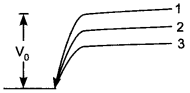
Class 12 Physics MCQ Question 1. In the given figure V0 is the potential barrier across a p-n junction, when no battery is cdnnected across the junction. [NCERT Exemplar]

Physics MCQs for Class 12 with Answers Chapter 14 Semiconductor Electronics Materials, Devices and Simple Circuits 3
(a) 1 and 3 both correspond to forward bias of junction.

(b) 3 corresponds to forward bias of junction and 1 corresponds to reverse bias of junction.
(c) 1 corresponds to forward bias and 3 corresponds to reverse bias of junction.
(d) 3 and 1 both correspond to reverse bias of junction.

Answer/Explanation

Answer: b
Explanation:
(b) Height of potential barrier is decreases when p-n junction is forward bias.


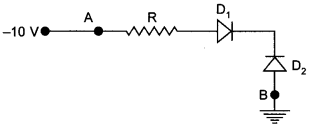
Physics MCQs Pdf Question 2. In figure given, assuming the diodes to be ideal [NCERT Exemplar]
Physics MCQs for Class 12 with Answers Chapter 14 Semiconductor Electronics Materials, Devices and Simple Circuits 4
(a) D1 is forward biased and D2 is reverse biased and hence current flows from A to B.
(b) D2 is forward biased and D1 is reverse biased and hence no current flows from B to A and vice versa.
(c) D1 and D2 are both forward biased and hence current flows from A to B.
(d) D1 and D2 are both reverse biased and hence no current flows from A to B and vice versa.

Answer/Explanation

Answer: b
Explaination:
(b) Explanation:
10 V is the lower voltage in the circuit. Now p side of the p-n junction diode D1 is connected to lower voltage and n- side of D1 to higher voltage , thus D1, is reverse biased. In D2 p-side of p-n junction diode is at higher potential and n-side is at lower potential, therefore D2 is forward biased. Hence current flows through junction from B to A.


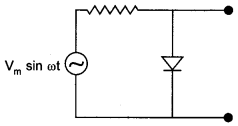
3. The output of the given circuit in figure is given below. [NCERT Exemplar]
Physics MCQs for Class 12 with Answers Chapter 14 Semiconductor Electronics Materials, Devices and Simple Circuits 5
(a) would be zero at all times.
(b) would be like a half-wave rectifier with positive cycles in output.
(c) would be like a half-wave rectifier with negative cycles in output.
(d) would be like that of a full-wave rectifier.

Answer/Explanation

Answer: c
Explaination:
(c) Explanation:
When the diode is forward biased, the resistance of pn junction diode will be low then current in the circuit is maximum. In this situation, a maximum potential difference will appear across resistance connected in a series of circuit. This result into zero


Semiconductor Numericals Class 12 Question 4. Electrical conductivity of a semiconductor
(a) decreases with the rise in its temperature.
(b) increases with the rise in its temperature.
(c) does not change with the rise in its temperature.
(d) first increases and then decreases with the rise in its temperature

Answer/Explanation

Answer:
Explaination:
(b) With temperature rise, the conductivity of semiconductor increases.


5. The forbidden energy band gap in conductors, semiconductors and insulators are EG1,EG2 and EG3 respectively. The relation among them is
(a) EG1 = EG2 = EG3
(b) EG1 < EG2 < EG3
(c) EG1 > EG2 > EG3
(d) EG1 < EG2 > EG3

Answer/Explanation

Answer:
Explaination:
(b) In insulators, the forbidden energy gap is very large, in case of semiconductor it is moderate and in conductors the energy . gap is zero.


MCQ Physics Class 12 Question 6. In an insulator, the forbidden energy gap between the valence band and the conduction band is of the order of __________ .

Answer/Explanation

Answer:
Explaination: 5 eV


Semiconductor Class 12 Question 7. A n-type semiconductor is
(a) negatively charged.
(b) positively charged.
(c) neutral.
(d) none of these

Answer/Explanation

Answer: c
Explaination:
(c) n-type semiconductors are neutral because neutral atoms are added during doping.


8. In the half-wave rectifier circuit shown. Which one of the following waveforms is true for VCD the output across C and D?
Physics MCQ Questions for Class 12 Pdf Download

Answer/Explanation

Answer: b
Explaination:
(b) Half wave rectifier rectifies only the half cycle of the input ac signal and it blocks the other half.


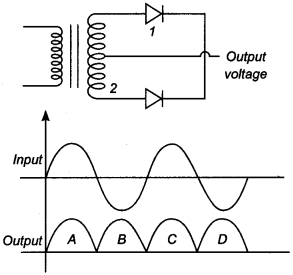
9. A full-wave rectifier circuit along with the input and output voltages is shown in the figure The contribution to output voltage from diode 2 is
Physics MCQs for Class 12 with Answers Chapter 14 Semiconductor Electronics Materials, Devices and Simple Circuits 7
(a) A, C
(b) B, D
(c) B, C
(d) A, D

Answer/Explanation

Answer: b
Explaination:
(b) In the positive half cycle of input ac signal diode D1 is forward biased and D2 is reverse biased so in the output voltage signal, A and C are due to D1. In negative half cycle of input ac signal, D2 conducts, hence output signals B and D are due to D2


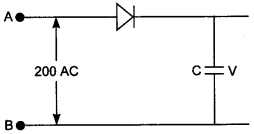
10. A 220 V AC supply is connected between points A and B (figure). What will be the potential difference V across the capacitor? [NCERT Exemplar]
Physics MCQs for Class 12 with Answers Chapter 14 Semiconductor Electronics Materials, Devices and Simple Circuits 8
(a) 200 V
(b) 110 V
(c) 0 V
(d) 220√2 V

Answer/Explanation

Answer: d
Explaination:
(d) As p-n junction diode will conduct during positive half cycle only and during negative half cycle diode is reverse biased. During this diode will not give any output. So potential difference across the capacitor C = peak voltage of the given AC voltage.
Vo=Vrms√2 = 200√2 V.


MCQ Semiconductor Physics Question 11. In the circuit shown in figure below, if the diode forward voltage drop is 0.3 V, the voltage difference between A and B is [NCERT Exemplar]
Physics MCQs for Class 12 with Answers Chapter 14 Semiconductor Electronics Materials, Devices and Simple Circuits 9
(a) 1.3 V
(b) 2.3 V
(c) 0
(d) 0.5 V

Answer/Explanation

Answer: b
Explaination:
(b) Suppose the potential difference be¬ tween A and B is VAB.
Then,VAB – 0.3
= [(r1 + r2)103] × (0.2 × 10-3) [∵ VAB=ir]
= [(5 + 5)103] × (0.2 × 10-3)
= 10 × 103 × 0.2 × 10-3 = 2
⇒ VAB = 2 + 0.3 = 2.3V


12. When an electric field is applied across a semicoriductor [NCERT Exemplar]
(a) holes move from lower energy level to higher energy level in the conduction band.
(b) electrons move from higher energy level to lower energy level in the conduction band.
(c) holes in the valence band move from higher energy level to lower energy level.
(d) holes in the valence band move from lower energy level to higher energy level.

Answer/Explanation

Answer: c
Explaination:
(c) When electric field is applied across a semiconductor, the electrons in the con-duction band move from lower energy level to higher energy level. While the holes in valence band move from higher energy level to lower energy level, where they will be having more energy.


13. At absolute zero, Si acts as a
(a) metal
(b) semiconductor
(c) insulator
(d) none of these

Answer

Answer: c


14. In good conducrors of electricity the type of bonding that exist is
(a) Van der Walls
(b) covalent
(c) ionic
(d) metallic

Answer

Answer: d


15. The manifestation of band structure in solids is due to
(a) Heisenberg uncertainty priniciple
(b) Pauli’s exclusion principle
(c) Bohr’s correspondence principle
(d) Boltzmann law

Answer

Answer: b


16. The probability of electrons to be found in the conduction band of an intrinsic semiconductor of finite temperature
(a) increases exponentially with increasing band gaP
(b) decreases exponentially with increasing band gap
(c) decreases with increasing temperature.
(d) is independent of the temperature and band gap

Answer

Answer: b


17. In an n-type silicon, which of the following statements is true.
(a) Electrons are majority carriers and trivalent atoms are the dopants’
(b) Electrons are minority carriers and pentava- lent atoms are the dopants.
(c) Holes are minority carriers and pentavalent atoms are the dopants.
(d) Holes are majority carriers and trivalent atoms are the dopants.

Answer

Answer: c


18. If a small amount of antimony is added to germanium crystal
(a) its resistance is increased
(b) it becomes a p-type semiconductor
(c) there will be more free electrons than holes in the semiconductor,
(d) none of these.

Answer

Answer: c


Semiconductor Electronics Question 19. The dominant mechanism for motion of charge carriers in forward and reverse biased silicon p-n junction are
(a) drift in forward bias, diffusion in reverse bias
(b) diffusion in forward bias, drift in reverse bias
(c) diffusion in both forward and reverse bias
(d) drift in both forward and reverse bias

Answer

Answer: b


20. In an unbiased p-n junction, holes diffuse from the p-region to n-region because
(a) free electrons in the n-region attract them
(b) they move across the junction by the potential difference
(c) hole concentration in p-region is more as compared to u-region.
(d) all of these

Answer

Answer: c


21. Region without free electrons and holes in a p-n junction is
(a) n-region
(b) p-region
(c) depletion region
(d) none of these

Answer

Answer: c


22. Which of the following statements is incorrect for the depletion region of a diode?
(a) There the mobile charges exist.
(b) Equal number of holes and electrons exist, making the region neutral.
(c) Recombination of holes and electrons has taken place.
(d) None of these

Answer

Answer: a


23. Potential barrier developed in a junction diode opposes the flow of
(a) minority carrier in both regions only
(b) majority carriers only
(c) electrons in p region
(d) holes in p region

Answer

Answer: b


24. The breakdown in a reverse biased p-n junction diode is more likely to occur due to
(a) large velocity of the minority charge carriers if the doping concentration is small
(b) large velocity of the minority charge carriers if the doping concentration is large
(c) strong electric field in a depletion region if the doping concentration is small
(d) none of these

Answer

Answer: b


25. What happens during regulation action of a Zener diode?
(a) The current through the series resistance (Rs) changes.
(b) The resistance offered by the Zener changes.
(c) The Zener resistance is constant.
(d) Both (a) and (b)

Answer

Answer: d


26. A zener diode is specified as having a breakdown voltage of 9.1 V, with a maximum power dissipation of 364 mW. What is the maximum current the diode can handle?
(a) 40 mA
(b) 60 mA
(c) 50 mA
(d) 45 mA

Answer

Answer: a


27. In a half wave rectifier circuit operating from 50 Hz mains frequency, the fundamental frequency in the ripple would be
(a) 25 Hz
(b) 50 Hz
(c) 70.7 Hz
(d) 100 Hz

Answer

Answer: b


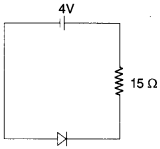
28. In the circuit shown if current for the diode is 20 μA, the potential difference across the diode is
Physics MCQs for Class 12 with Answers Chapter 14 Semiconductor Electronics Materials, Devices and Simple Circuits 1
(a) 2 V
(b) 4.5 V
(c) 4 V
(d) 2.5 V

Answer

Answer: c


29. Carbon, silicon and germanium have four valence electrons each. These are characterised by valence and conduction bands separated by energy band gap respectively equal to (E^)c, (Eg)Si and (Eg)Ge. Which of the following statements is true?
(a) (Eg)Si < (Eg)Ge < (Eg)C
(b) (Eg)C< (Eg)Ge < (Eg)Si
(c) (Eg)C < (Eg)Si < (Eg)Ge
(d) (Eg)C = (Eg)Si < (Eg)Ge

Answer

Answer: c


30. If the energy of a photon of sodium light (A = 589 nm) equals the band gap of semiconductor, the minimum energy required to create hole electron pair
(a) 1.1 eV
(b) 2.1 eV
(c) 3.2 eV
(d) 1.5 eV

Answer

Answer: b


31. If in a n-type semiconductor when all donor states are filled, then the net charge density in the donor states becomes
(a) 1
(b) > 1
(c) < 1, but not zero
(d) zero

Answer

Answer: b


Physics MCQs for Class 11 with Answers Pdf Question 32. The circuit has two oppositely connected ideal diodes in parallel. What is the current flowing in the circuit?
Physics MCQs for Class 12 with Answers Chapter 14 Semiconductor Electronics Materials, Devices and Simple Circuits 2
(a) 2.0 A
(b) 1.33 A
(c) 1.73 A
(d) 2.31 A

Answer

Answer: c


33. The conductivity of a semiconductor increases with increase in temperature, because
(a) number density of free current carriers increases.
(b) relaxation time increases.
(c) both number density of carriers and relaxation time increase.
(d) number density of carriers increases, relaxation time decreases but effect of decrease in relaxation time is much less than increase in number density. [NCERT Exemplar]

Answer

Answer: d


34. What happens during regulation action of a Zener diode? [NCERT Exemplar]
(a) The current in and voltage across the Zener remains fixed.
(b) The current through the series resistance (Rs) does not change.
(c) The Zener resistance is constant.
(d) The resistance offered by the Zener changes.

Answer

Answer: d


35. Silicon is a semiconductor. If a small amount of As is added to it, then its electrical conductivity _________ .

Answer/Explanation

Answer:
Explaination: increases


36. When the electrical conductivity of a semiconductor is due to the breaking of its covalent bonds, then the semiconductor is said to be ___________ .

Answer/Explanation

Answer:
Explaination: intrinsic


37. Why are the elemental dopants mainly taken from 13th and 15th group, for doping Silicon or Germanium?

Answer/Explanation

Answer:
Explaination:
The dopant has to be such that it does not distort the original pure semiconductor lattice. So that the sizes of the dopant and the semiconductor atoms should be nearly the same.


38. What is a hole? What is its physical significance?

Answer/Explanation

Answer:
Explaination:
Hole is the vacancy of electron in valence band. The vacancy with the hole behaves as an apparent free particle with effective positive charge.


39. Name one impurity each, which when added, to pure Si, produces
(i) n-type, and
(ii)p-type semiconductor.

Answer/Explanation

Answer:
Explaination:
(i) for n-type, arsenic.
(ii) for p-type, Indium.


40. Why is the conductivity of n-type semi-conductor greater than that of the p-type semi-conductor even when both of these have same level of doping?

Answer/Explanation

Answer:
Explaination:
In n-type semiconductor charge carriers are electrons and mobility of electrons is more than that of holes.


41. Name two factors on which electrical conductivity of a pure semiconductor at a given temperature depends.

Answer/Explanation

Answer:
Explaination:
(i) Band gap
(ii) Biasing.


42. What is an ideal diode?

Answer/Explanation

Answer:
Explaination:
It is a p-n junction diode which offer zero resistance in forward biasing and infinite re-sistance in reverse biasing, i.e. current flows through it in one direction only.


43. What happens to the width of depletion layer of ap-n junction when it is
(i) forward biased,
(ii) reverse biased? [AI2011]

Answer/Explanation

Answer:
Explaination:
(i) The width of depletion layer decreases.
(ii) The width of depletion layer increases.


44. What do you understand by a dynamic resistance of p-n junction diode.

Answer/Explanation

Answer:
Explaination:
Dynamic resistance is the ratio of a small change in voltage ΔV to a small change in current ΔI, i.e.\(\frac{\Delta V}{\Delta I}\).


45. Name the junction diode whose I – V characteristics are drawn below. [Delhi 2017]

Answer/Explanation

Answer:
Explaination: Solar cell.


46. State the reason, why GaAs is most commonly used in making of a solar cell.

Answer/Explanation

Answer:
Explaination: It has higher absorption coefficient.


47. Name the type of biasing of a p-n junction diode so that the junction offers very high resistance.

Answer/Explanation

Answer:
Explaination: Reverse biasing.


48. What is internal field emission?

Answer/Explanation

Answer:
Explaination:
The emission of electrons from the host atoms present in the p-n junction due to the high electric field is known as internal field emission or field ionisation.


Semiconductor Class Question 49. Why is a typical solar cell drawn in fourth quadrant?

Answer/Explanation

Answer:
Explanation:
I – V characteristics of solar cell is drawn in the fourth quadrant because a solar cell does not draw current but supplies the same to the load.


50. Why are materials like CdS or CdSe (Eg ~ 2.4 eV) not used for the fabrication of a solar cell?

Answer/Explanation

Answer:
Explaination:
Materials like CdS or CdSe (Eg ~ 2.4 eV) are not used because they will use only the high energy component of the solar energy for photo-conversion and a significant part of energy will be of no use.


We hope the given Physics MCQs for Class 12 with Answers Chapter 13 Semiconductor Electronics: Materials, Devices and Simple Circuits will help you. If you have any query regarding CBSE Class 12 Physics Semiconductor Electronics: Materials, Devices and Simple Circuits MCQs Pdf, drop a comment below and we will get back to you at the earliest.

Physics MCQs for Class 12 with Answers Chapter 13 Nuclei

Free PDF Download of CBSE Physics Multiple Choice Questions for Class 12 with Answers Chapter 13 Nuclei. Physics MCQs for Class 12 Chapter Wise with Answers PDF Download was Prepared Based on Latest Exam Pattern. Students can solve NCERT Class 12 Physics Nuclei MCQs Pdf with Answers to know their preparation level.

Nuclei Class 12 Physics MCQs Pdf

Atoms and Nuclei Class 12 MCQ Question 1. When a β-particle is emitted from a nucleus then its neutron-proton ratio
(a) increases
(b) decreases
(c) remains unchanged.
(d) may increase or decrease depending upon the nucleus.

Answer/Explanation

Answer: b
Explaination:
(b) In P-decay neutron converts to proton with emission of electron and neutrino.


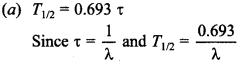
Physics MCQs with Answers for Class 12 Question 2. The relation between half-life T1/2 of a radioactive sample and its mean life x is
Physics MCQ Questions For Class 12 Pdf Download

Answer/Explanation

Answer: a
Explaination:
Physics MCQ Questions for Class 12 Pdf


3. The quantity which is not conserved in a nuclear reaction is
(a) momentum.
(b) charge.
(c) mass.
(d) none of these.

Answer/Explanation

Answer: c
Explaination: (c) Energy equivalent to mass detect is released.


4. The half-life of a radioactive nucleus is 3 hours. In 9 hours, its activity will be reduced to a factor of
Physics MCQs for Class 12 Chapter wise with Answers Pdf

Answer/Explanation

CBSE Class 12 Physics MCQs with Answer: d
Explaination:
Physics MCQs for Class 12 with Answers Chapter 13 Nuclei 15


MCQs Of Physics 2nd Year with Answers Chapter 13 Question 5. A radioactive element has half-life period 1600 years. After 6400 years what amount will remain?
Physics MCQs for Class 12 with Answers Chapter 13 Nuclei 8

Answer/Explanation

Answer: b
Explaination:
Physics MCQs for Class 12 with Answers Chapter 13 Nuclei 16


Class 12 Physics MCQs Pdf Question 6. Ratio of the radii of the nuclei with mass numbers 8 and 27 would be
Physics MCQs for Class 12 with Answers Chapter 13 Nuclei 9

Answer/Explanation

Answer: c
Explaination:
Physics MCQs for Class 12 with Answers Chapter 13 Nuclei 17


7. A radioactive nucleus emits a beta particle. The parent and daughter nuclei are
(a) isotopes
(b) isotones
(c) isomers
(d) isobars

Answer/Explanation

Answer: d
Explaination:
(d) Isobars have the same atomic mass but 1 different atomic number.


Physics MCQs for Class 11 Chapter wise Pdf Question 8. In the disintegration series
Physics MCQs for Class 12 with Answers Chapter 13 Nuclei 11
the values of Z and A respectively will be
(a) 92, 236
(b) 88, 230
(c) 90, 234
(d) 91, 234

Answer/Explanation

Answer: d
Explaination:
Physics MCQs for Class 12 with Answers Chapter 13 Nuclei 18


CBSE Class 12 Physics MCQ Pdf Question 9. A nucleus \(_{Z}^{\mathbf{A}} \mathbf{X}\) emits an α-particle. The resultant nucleus emits a β-particle. The respective atomic and mass numbers of the daughter nucleus will be
(a) Z – 3, A – 4
(b) Z – 1, A – 4
(c) Z – 2, A – 4
(d) Z, A – 2

Answer/Explanation

Answer: b
Explaination:
Physics MCQs for Class 12 with Answers Chapter 13 Nuclei 19


10. In the nuclear reaction
Physics MCQs for Class 12 with Answers Chapter 13 Nuclei 12
What does X stand for?
(a) Electron
(b) Proton
(c) Neutron
(d) Neutrino

Answer/Explanation

Answer: d
Explaination:
(d) By conservation of mass A = 0, and by conservation of charge Z = 0, Hence X is neutrino.


11. The set which represent the isotope, isobar, and isotone respectively is
Physics MCQs for Class 12 with Answers Chapter 13 Nuclei

Answer

Answer: d


12. The mass number of iron nucleus is 56 the nuclear density is
(a) 2.29 × 10¹⁶ kg m-3
(b) 2.29 × 10¹⁷ kg m-3
(c) 2.29 × 10¹⁸ kg m-3
(d) 2.29 × 10¹⁵ kg m-3

Answer

Answer: b


13. Order of magnitude of density of uranium nucleus is
(a) 1020 kg m-3
(b) 1017 kg m-3
(c) 1014 kg m-3
(d) 1011 kg m-3

Answer

Answer: b


14. The radius of a spherical nucleus as measured by electron scattering is 3.6 fm. What is the mass number of the nucleus most likely to be?
(a) 27
(b) 40
(c) 56
(d) 120

Answer

Answer: a


15. The half life of a radioactive susbtance is 30 days. What is the time taken to disintegrate to 3/4th of its original mass?
(a) 30 days
(b) 15 days
(c) 60 days
(d) 90 days

Answer

Answer: c


16. The number of beta particles emitted by a radioactive substance is twice the number of alpha particles emitted by it. The resulting daughter is an
(a) isomer of parent
(b) isotone of parent
(c) isotope of parent
(d) isobar of parent

Answer

Answer: c


17. During negative β-decay, an antineutrino is also emitted along with the emitted electron. Then,
(a) only linear momentum will be conserved
(b) total linear momentum and total angular momentum but not total energy will be conserved
(c) total linear momentum, and total energy but not total angular momentum will conserved
(d) total linear momentum, total angular momentum and total energy will be conserved

Answer

Answer: d


18. Consider α and β particles and γ-rays each having an energy of 0.5 MeV. In the increasing order of penetrating power, the radiation are respectively
(a) α, β, γ
(b) α, γ, β
(c) β, γ, α
(d) γ β, α

Answer

Answer: a


19. An electron emitted in beta radiation originates from
(a) inner orbits of atom
(b) free electrons existing in the nuclei
(c) decay of a neutron in a nuclei
(d) photon escaping from the nucleus

Answer

Answer: c


20. Complete the series 6He → e + 6Li +
(a) neutrino
(b) antineutrino
(c) proton
(d) neutron

Answer

Answer: b


21. An element A decays into an element C by a two step process A → B+ 2He4 and B → C + 2e. Then,
(a) A and C are isotopes
(b) A and C are isobars
(c) B and C are isotopes
(d) A and B are isobars

Answer

Answer: a


22. The equation 41 1H+ → 24He2+ + 2e + 26 MeV
represents
(a) β-decay
(b) γ-decay
(c) fusion
(d) fission

Answer

Answer: c


23. Light energy emitted by star is due to
(a) breaking of nuclei
(b) joining of nuclei
(c) burning of nuclei
(d) reflection of solar light

Answer

Answer: b


24. In nuclear reaction, there is conservation of
(a) mass only
(b) energy only
(c) momentum only
(d) mass, energy and momentum

Answer

Answer: d


25. In nuclear reactors, the control rods are made of
(a) cadmium
(b) graphite
(c) krypton
(d) plutonium

Answer

Answer: a


26. Suppose we consider a large number of containers each containing initially 10000 atoms of a radioactive material with a half-life of 1 year. After 1 year, [NCERT Exemplar]
(a) all the containers will have 5000 atoms of the material.
(b) all the containers will contain the same number of atoms of the material but that number will only be approximately 5000.
(c) the containers will in general have different numbers of the atoms of the material but their average will be close to 5000.
(d) none of the containers can have more than 5000 atoms.

Answer

Answer:c


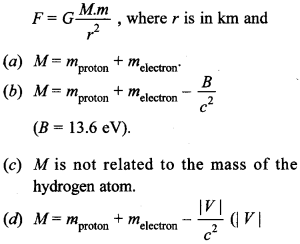
27. Jhe gravitational force between a H-atom and another particle of mass m will be given by Newton’s law: [NCERT Exemplar]
Physics MCQs for Class 12 with Answers Chapter 13 Nuclei 2
= magnitude of the potential energy of electron in the H-atom).

Answer

Answer: b


28. When a nucleus in an atom undergoes a radioactive decay, the electronic energy levels of the atom [NCERT Exemplar]
(a) do not change for any type of radioactivity.
(b) change for α and β radioactivity but not for γ-radioactivity.
(c) change for α-radioactivity but not for others.
(d) change for β-radioactivity but not for others.

Answer

Answer: b


29. Mx and My denote the atomic masses of the parent and the daughter nuclei respectively in a radioactive decay. The Q-value for a β decay is Q1 and that for a β+ decay is Q2 If me denotes the mass of an electron, then which of the following statements is correct? [NCERT Exemplar]
Physics MCQs for Class 12 with Answers Chapter 13 Nuclei 3

Answer

Answer: a


30. Tritium is an isotope of hydrogen whose nucleus Triton contains 2 neutrons and 1 proton. Free neutrons decay into p + \(\bar{e}+\bar{v}\). If one of the neutrons in Triton decays, it would transform into He3 nucleus. This does not happen. This is because [NCERT Exemplar]
(a) Triton energy is less than that of a He3\ nucleus.
(b) the electron created in the beta decay process cannot remain in the nucleus.
(c) both the neutrons in triton have to decay simultaneously resulting in a nucleus with 3 protons, which is not a He3 nucleus.
(d) because free neutrons decay due to external perturbations which is absent in a triton nucleus.

Answer

Answer: a


31. Heavy stable nuclei have more neutrons than protons. This is because of the fact that [NCERT Exemplar]
(a) neutrons are heavier than protons.
(b) electrostatic force between protons are repulsive.
(c) neutrons decay into protons through beta decay.
(d) nuclear forces between neutrons are weaker than that between protons.

Answer

Answer: b


32. Samples of two radioactive nuclides A and B are taken λA and λB are the disintegration constants of A and B respectively. In which of the following cases, the two samples can simultaneously have the same decay rate at any time?
(a) Initial rate of decay of A is twice the » initial rate of decay of B and λA = λB.
(b) Initial rate of decay of A is less than the initial rate of decay of B and λA < λB.
(c) Initial rate of decay of B is twice the initial rate of decay of A and λA > λB.
(d) Initial rate of decay of B is same as the rate of decay of A at t = 2h and λB = λA.

Answer

Answer: d


33. The variation of decay rate of two radioactive samples A and B with time is shown in figure. Which of the following statements are true?
Physics MCQs for Class 12 with Answers Chapter 13 Nuclei 4
(a) Decay constant of A is greater than that of B, hence A always decays faster than B.
(b) Decay constant of B is greater than that of A but its decay rate is always smaller than that of A.
(c) Decay constant of A is equal to that ofB.
(d) Decay constant of B is smaller than that of A but still its decay rate becomes equal to that of A at a later instant.

Answer

Answer: d


34. Radioactivity is the phenomenon associated with
(a) decay of nucleus.
(b) production of radio waves.
(c) transmission of radio waves.
(d) reception of radio waves.

Answer

Answer: a


35. Which of the following are not emitted by radioactive substances?
(a) Electrons
(b) Protons
(c) Gamma rays
(d) Helium nuclei

Answer

Answer: b


36. In an α-decay
(a) the parent and daughter nuclei have some number of protons.
(b) the daughter nucleus has one proton more than parent nucleus.
(c) the daughter nucleus has two protons less than parent nucleus.
(d) the daughter nucleus has two nucleus more than parent nucleus.

Answer

Answer: c


37. When a radioactive nucleus emits a (β-particle, the mass number of the atom:
(a) increases by one.
(b) remains the same.
(c) decreases by one.
(d) decreases by four.

Answer

Answer: b


38. In a β-decay
(a) the parent and daughter nuclei have the same number of protons.
(b) the daughter nucleus has one proton less than parent nucleus.
(c) the daughter nucleus has one proton more than the parent nucleus.
(d) the daughter nucleus has one neutron more than the parent nucleus.

Answer

Answer: c


39. P-rays emitted by a radioactive material are
(a) electromagnetic radiations.
(b) electrons orbiting around the nucleus.
(c) neutral particles.
(d) charged particles emitted by nucleus.

Answer

Answer: d


40. During a mean life of a radioactive element the fraction that disintegrates is
Physics MCQs for Class 12 with Answers Chapter 13 Nuclei 6

Answer

Answer: c


41. γ-rays are originated from
(a) nucleus.
(b) outermost shell of nucleus.
(c) innermost shell of nucleus.
(d) outermost shell of atom.

Answer

Answer: a


42. Binding energy per nucleon of a stable nucleus is
(a) 8 eV
(b) 8 KeV
(c) 8 MeV
(d) 8 BeV

Answer

Answer: c


43. Sun’s radiant energy is due to
(a) nuclear fission.
(b) nuclear fusion.
(c) photoelectric effect.
(d) spontaneous radioactive decay.

Answer

Answer: b


44. Average binding energy is maximum for
(a) C12
(b) Fe56
(c) U235
(d) Po210

Answer

Answer: b


45. A nucleus undergoes γ-decay due to
(a) excess of protons.
(b) excess of neutrons.
(c) large mass.
(d) its excited state.

Answer

Answer: d


46. The decay constant of a radioactive substance is X. Its half-life and mean life, respectively are
Physics MCQs for Class 12 with Answers Chapter 13 Nuclei 10

Answer

Answer: b


47. Neutrino is a particle, which is chargeless and has spin.

Answer/Explanation

Answer:
Explaination: ±\(\frac{1}{2}\)


48. Isotones have the same number of _________ .

Answer/Explanation

Answer:
Explaination: neutrons


49. Packing fraction of a nucleus is its _________ its per nucleon.

Answer/Explanation

Answer:
Explaination: mass defect


50. How is the radius of a nucleus related to its mass number? [Panchkula 2019] [AI2011C]

Answer/Explanation

Answer:
Explaination:
The radius if of a nucleus of mass number A is related as if = R0A1/3, where R0 is a constant.


51. Two nuclei have mass numbers in the ratio 27 : 125. What is the ratio of their nuclear radii?

Answer/Explanation

Answer:
Explaination:
Physics MCQs for Class 12 with Answers Chapter 13 Nuclei 20


52. Two nuclei have mass numbers in the ratio 2 : 5. What is the ratio of their nuclear densities?

Answer/Explanation

Answer:
Explaination:
Nuclear density is independent of mass number. So, the ratio will be 1 : 1.


53. What is the relation between the binding energy per nucleon and stability of a nucleus?

Answer/Explanation

Answer:
Explaination:
The larger the binding energy per nucleon, the more stable is the nucleus.


54. Write any two characteristic properties of nuclear force. [Chennai-2019] [AI 2012,13]

Answer/Explanation

Answer:
Explaination:
The following are the two characteristic properties:
(i) Nuclear force is a short range force.
(ii) Nuclear forces show the saturation effect.


55. How is the mean life of a radioactive sample related to its half-life? [Foreign 2011]

Answer/Explanation

Answer:
Explaination:
Physics MCQs for Class 12 with Answers Chapter 13 Nuclei 21


56. Define the activity of a given radioactive substance. Write its SI unit.

Answer/Explanation

Answer:
Explaination:
The rate of disintegration or count rate of sample of radioactive material is called activity. The SI unit of activity is becquerel (Bq).


57. The radioactive isotope D decays according to the sequence
Physics MCQs for Class 12 with Answers Chapter 13 Nuclei 13
If the mass number and atomic number of D2 are 176 and 71 respectively, what is
(i) the mass number
(ii) atomic number of D?

Answer/Explanation

Answer:
Explaination:
Physics MCQs for Class 12 with Answers Chapter 13 Nuclei 22
(i) Mass number of D = 180
(ii) Atomic number of D = 72


58. A nucleus \(_{n} X^{m}\) emits one a-particle and one β-particle. What is the mass number and atomic number of the product nucleus?

Answer/Explanation

Answer:
Explaination:
Physics MCQs for Class 12 with Answers Chapter 13 Nuclei 23
Hence, the mass number of product is m – 4, and the atomic number of product is n – 1.


59. In both β and β+ decay processes, the mass number of a nucleus remains same, whereas the atomic number Z increases by one in β decay and decreases by one in β+ decay. Explain, giving reason. [Foreign 2014]

Answer/Explanation

Answer:
Explaination:
In β decay, one neutron inside the nucleus decays into one proton and one electron (β). The proton remains inside the nucleus and the electron is ejected out.
Physics MCQs for Class 12 with Answers Chapter 13 Nuclei 24
In β+ decay, the conversion of proton into neutron and position (β+) takes place.
Physics MCQs for Class 12 with Answers Chapter 13 Nuclei 25


60. Which nucleus has greater mean life, A or B?

Answer/Explanation

Answer:
Explaination:
Physics MCQs for Class 12 with Answers Chapter 13 Nuclei 26
Since, slope of A is more than slope of B.
Therefore, X is high and mean life e = \(\frac{1}{\lambda}\) for A is small.
Physics MCQs for Class 12 with Answers Chapter 13 Nuclei 27


61. Why is a free neutron unstable but a free proton is a stable particle?

Answer/Explanation

Answer:
Explaination:
A free neutron is unstable outside the nucleus with an average life of 1000 s. It decays into a proton and emits a β particle, i.e.
Physics MCQs for Class 12 with Answers Chapter 13 Nuclei 28


62. A neutron strikes a nucleus of \(_{5}^{\mathbf{10}} \mathbf{B}\) and emits an alpha particle. Write down the nuclear reaction for it.

Answer/Explanation

Answer:
Explaination:
Physics MCQs for Class 12 with Answers Chapter 13 Nuclei 29


63. Write the necessary condition required for fusion reaction.

Answer/Explanation

Answer:
Explaination:
(i) Nuclear fusion will occur when the kinetic energy of colliding nuclei is enough to overcome the strong electrostatic forces of repulsion between the protons. For this, high temperature is required.
(ii) The density of nuclei should also be very high to increase the number of collisions.


64. Out of \(_{14}^{30} X ;_{3}^{6} Y \text { and }_{40} Z^{130}\), which is more likely to undergo the nuclear fusion?

Answer/Explanation

Answer:
Explaination:
A lighter unstable nucleus \(_{3}^{\mathbf{6}} \mathbf{Y}\) can undergo the nuclear fusion.


65. What is the effect of temperature on radioactivity?

Answer/Explanation

Answer:
Explaination:
No effect. Radioactivity is independent of temperature.


66. What is the difference between an electron and a β-particle?

Answer/Explanation

Answer:
Explaination:
An electron resides outside the nucleus, whereas β-particle is an electron like particle of nuclear origin.


67. What is the source of stellar energy?

Answer/Explanation

Answer:
Explaination: Nuclear fusion reactions.


68. Four nuclei of an element fuse together to form a heavier nucleus. If the process is accompanied by the release of energy, which of the two—the parent or the daughter nucleus would have a higher binding energy/ nucleons? [CBSE 2018]

Answer/Explanation

Answer:
Explaination: Daughter nucleus.


69. You are given two nuelei \(_{3}^{7} X \text { and }_{3}^{4} Y\), which one of the two is likely to be more stable? Give reason.

Answer/Explanation

Answer:
Explaination: \(_{3}^{\mathbf{7}} \mathbf{X}\) is more stable, as it contains more neutrons than protons.


70. The \(_{10}^{\mathbf{23}} \mathbf{Ne}\) decays by β emission into \(_{11}^{\mathbf{23}} \mathbf{Na}\). Write down the β decay equation.

Answer/Explanation

Answer:
Explaination:
Physics MCQs for Class 12 with Answers Chapter 13 Nuclei 30


We hope the given Physics MCQs for Class 12 with Answers Chapter 13 Nuclei will help you. If you have any query regarding CBSE Class 12 Physics Nuclei MCQs Pdf, drop a comment below and we will get back to you at the earliest.

Physics MCQs for Class 12 with Answers Chapter 12 Atoms

Free PDF Download of CBSE Physics Multiple Choice Questions for Class 12 with Answers Chapter 12 Atoms. Physics MCQs for Class 12 Chapter Wise with Answers PDF Download was Prepared Based on Latest Exam Pattern. Students can solve NCERT Class 12 Physics Atoms MCQs Pdf with Answers to know their preparation level.

Atoms Class 12 Physics MCQs Pdf

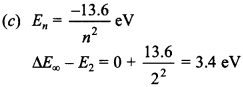
1. If 13.6 eV energy is required to ionise the hydrogen atom, then energy required to remove an electron from n = 2 is
(a) 10.2 eV
(b) 0 eV
(c) 3.4 eV
(d) 6.8 eV.

Answer/Explanation

Answer: c
Explaination:
Physics MCQs for Class 12 with Answers Chapter 12 Atoms 8


2. In Bohr’s model of an atom which of the following is an integral multiple of \(\frac{h}{2 \pi}\)?
(a) Kinetic energy
(b) Radius of an atom
(c) Potential energy
(d) Angular momentum

Answer/Explanation

Answer:
Explaination:
(d) Angular momentum L = mvr = \(\frac{n h}{2 \pi}\)


3. In Bohr’s model, the atomic radius of the first orbit is rQ. Then, the radius of the third orbit is
(a) r0/9
(b) r0
(c) 9r0
(d) 3r0

Answer/Explanation

Answer: c
Explaination:
rn = rn
∴ r3 = 9r0


4. The K.E. of the electron in an orbit of radius r in hydrogen atom is proportional to
Physics MCQs for Class 12 with Answers Chapter 12 Atoms 3

Answer/Explanation

Answer: b
Explaination:
(b) \(\frac{e^{2}}{2 r}\), Scince K.E = \(\frac{k e^{2}}{2 r}\)


5. The ratio between Bohr radii is
(a) 1 : 2 : 3
(b) 2 : 4 : 6
(c) 1 : 4 : 9
(d) 1 : 3 : 5

Answer/Explanation

Answer: c
Explaination:
(c) 1 : 4 : 9, In Bohr’s atomic model, rn


6. The longest wavelength in Balmer series of hydrogen spectrum will be
(a) 6557 Å
(b) 1216 Å
(c) 4800 Å
(d) 5600 Å

Answer/Explanation

Answer: a
Explaination:
(a) 6557 Å
For longest wavelength in Balmer series n1 = 2 and n2 = 3
Physics MCQs for Class 12 with Answers Chapter 12 Atoms 10


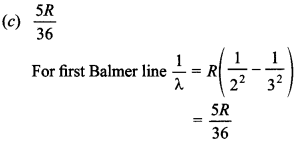
7. In terms of Rydberg constant R, the wave number of the first Balmer line is
(a) R
(b) 3R
(c) \(\frac{5 R}{36}\)
(d) \(\frac{8 R}{9}\)

Answer/Explanation

Answer: c
Explaination:
Physics MCQs for Class 12 with Answers Chapter 12 Atoms 11


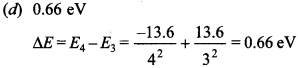
8. The ionisation energy of hydrogen atom is 13.6 eV. Following Bohr’s theory the energy corresponding to a transition between 3rd and 4th orbits is
(a) 3.40 eV
(b) 1.51 eV
(c) 0.85 eV
(d) 0.66 eV

Answer/Explanation

Answer: d
Explaination:
Physics MCQs for Class 12 with Answers Chapter 12 Atoms 12


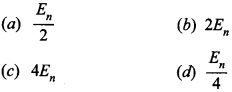
9. The energy of hydrogen atom in the nth orbit is En, then the energy in the nth orbit of single ionised helium atom is
Physics MCQs for Class 12 with Answers Chapter 12 Atoms 6

Answer/Explanation

Answer: c
Explaination:
(c) As energy E ∝ Z²
For hydrogen atom Z = 1,
for Helium Z = 2
EHe = 4En.


10. On moving up in the energy states of a H-like atom, the energy difference between two consecutive energy states
(a) decreases.
(b) increases.
(c) first decreases then increases.
(d) first increases then decreases.

Answer/Explanation

Answer: a
Explaination:
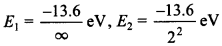
(a) As, En = \(\frac{-13.6}{n^{2}}\)


11. The transition of electron from n = 4, 5, 6, ………. to n = 3 corresponds to
(a) Lyman series
(b) Balmer series
(c) Paschen series
(d) Brackettseries

Answer/Explanation

Answer: c
Explaination:
(c) In transition from n1 = 3 and n2 = 4, 5, 6,….
Infrared radiation of Paschen spectral is emitted.


12. As per Bohr model, the minimum energy (in eV) required to remove an electron from the ground state of double ionized Li atom (Z = 3) is
(a) 1.51 eV
(b) 13.6 eV
(c) 40.8 eV
(d) 122.4 eV

Answer/Explanation

Answer: d
Explaination:
(d) Since energy of electron in nth state of hydrogen like atom is
Physics MCQs for Class 12 with Answers Chapter 12 Atoms 13


13. Which of the following spectral series in hydrogen atom gives spectral line of 4860 A?
(a) Lyman
(b) Balmer
(c) Paschen
(d) Brackett

Answer/Explanation

Answer: b
Explaination:
(b) Since spectral line of wavelength 4860 A
lies in the visible region of the spectrum which is Balmer series of the spectrum.


14. In terms of Rydberg constant R, the shortest wavelength in Balmer series of hydrogen atom spectrum will have wavelength
Physics MCQs for Class 12 with Answers Chapter 12 Atoms 7

Answer/Explanation

Answer: b
Explaination:
(b) For shortest wavelength n1 =∞, n2 = 2
Physics MCQs for Class 12 with Answers Chapter 12 Atoms 14


15. The first model of atom in 1898 was proposed by
(a) Ernst Rutherford
(b) Albert Einstein
(c) J.J. Thomson
(d) Niels Bohr

Answer

Answer: c


16. In Geiger-Marsden scattering experiment, the trajectory traced by an a-particle depends on
(a) number of collision
(b) number of scattered a-particles
(c) impact parameter
(d) none of these

Answer

Answer: c


17. In the Geiger-Marsden scattering experiment the number of scattered particles detected are maximum and minimum at the scattering angles respectively at
(a) 0° and 180°
(b) 180° and 0°
(c) 90° and 180°
(d) 45° and 90°

Answer

Answer: a


18. In the Geiger-Marsden scattering experiment, is case of head-on collision the impact parameter should be
(a) maximum
(b) minimum
(c) infinite
(d) zero

Answer

Answer: a


19. Rutherford’s experiments suggested that the size of the nucleus is about
(a) 10-14 m to 10-12 m
(b) 10-15 m to 10-13 m
(c) 10-15 m to 10-14 m
(d) 10-15 m to 10-12 m

Answer

Answer: c


20. Which of the following spectral series falls within the visible range of electromagnetic radiation?
(a) Lyman series
(b) Balmer series
(c) Paschen seriee
(d) Pfund series

Answer

Answer: b


21. The first spectral series was discovered by
(a) Balmer
(b) Lyman
(c) Paschen
(d) Pfund

Answer

Answer: a


22. Which of the following postulates of the Bohr model led to the quantization of energy of the hydrogen atom?
(a) The electron goes around the nucleus in circular orbits.
(b) The angular momentum of the electron can only be an integral multiple of h/2π.
(c) The magnitude of the linear momentum of the electron is quantized.
(d) Quantization of energy is itself a postulate of the Bohr model.

Answer

Answer: b


23. The Bohr model of atoms
(a) assumes that the angular momentum of elec-trons is quantized.
(b) uses Einstein’s photoelectric equation.
(c) predicts continuous emission spectra for at-oms.
(d) predicts the same emission spectra for all types of atoms.

Answer

Answer: a


24. If tt is the orbit number of the electron in a hydrogen atom, the correct statement among the following is
(a) electron energy increases as n increases.
(b) hydrogen emits infrared rays for the electron transition from n = to n = 1
(c) electron energy is zero for n = 1 (<0 electron energy varies as n2.

Answer

Answer: a


25. If the radius of inner most electronic orbit of a hydrogen atom is 5.3 * 10~n m, then the radii of n = 2 orbits is
(a) 1.12 Å
(b) 2.12 Å
(c) 3.22 Å
(d) 4.54 Å

Answer

Answer: b


26. The diagram shows the energy levels for an electron in a certain atom. Which transition shown represents the emission of a photon with the most energy?
Physics MCQs for Class 12 with Answers Chapter 12 Atoms 1
(a) I
(b) II
(c) III
(d) IV

Answer

Answer: c


27. In a hydrogen atom, the radius of nth Bohr orbit is rn. The graph between log(rn/r1) and log n will be
Physics MCQs for Class 12 with Answers Chapter 12 Atoms 2

Answer

Answer: a


28. The transition from the state n = 5 to n = 1 in a hydrogen atom results in UV radiation. Infrared radiation will be obtained in the transition
(a) 2 → 1
(b) 3 → 2
(c) 4 → 3
(d) 6 → 2

Answer

Answer: c


29. The hydrogen atom can give spectral lines in the Lyman, Balmer and Paschen series. Which of the following statement is correct?
(a) Lyman series is in the infrared region.
(b) Balmer series is in the visible region.
(c) Paschen series is in the visible region.
(d) Balmer series is in the ultraviolet region.

Answer

Answer: b


30. Which of the relation is correct between time period and number of orbits while an electron is resolving in an orbit?
Physics MCQs for Class 12 with Answers Chapter 12 Atoms 4

Answer

Answer: c


31. Energy of an electron in the second orbit of hydrogen atom is E and the energy of electron in 3rd orbit of He will be
Physics MCQs for Class 12 with Answers Chapter 12 Atoms 5

Answer/Explanation

Answer: b
Explaination:
Physics MCQs for Class 12 with Answers Chapter 12 Atoms 9


32. The spectral lines in the Brackett series arise due to transition of electron in hydrogen atom from higher orbits to the orbit with
(a) n = 1
(b) n = 2
(c) n = 3
(d) n = 4

Answer

Answer: d


33. Taking the Bohr radius as a0 = 53 pm, the radius of Li++ ion in its ground state, on the basis of Bohr’s model, will be about [NCERT Exemplar]
(a) 53 pm
(b) 27 pm
(c) 18 pm
(d) 13 pm

Answer

Answer: c


34. The simple Bohr model cannot be directly applied to calculate the energy levels of an atom with many electrons. This is because [NCERT Exemplar]
(a) of the electrons not being subject to a central force.
(b) of the electrons colliding with each other.
(c) of screening effects.
(d) the force between the nucleus and an electron will no longer be given by Coulomb’s law.

Answer

Answer: a


35. For the ground state, the electron in the H-atom has an angular momentum = h, according to the simple Bohr model. Angular momentum is a vector and hence there will be infinitely many orbits with the vector pointing in all possible directions. In actuality, this is not true, [NCERT Exemplar]
(a) because Bohr model gives incorrect values of angular momentum.
(b) because only one of these would have a minimum energy.
(c) angular momentum must be in the direction of spin of electron.
(d) because electrons go around only in horizontal orbits.

Answer

Answer: a


36. 02 molecule consists of two oxygen atoms. In the molecule, nuclear force between the nuclei of the two atoms [NCERT Exemplar]
(a) is not important because nuclear forces are short-ranged.
(b) is as important as electrostatic force for binding the two atoms.
(c) cancels the repulsive electrostatic force between the nuclei.
(d) is not important because oxygen nucleus has equal number of neutrons and protons.

Answer

Answer: a


37. Two H atoms in the ground state collide inelastically. The maximum amount by which their combined kinetic energy is reduced is [NCERT Exemplar]
(a) 10.20 eV
(b) 20.40 eV
(c) 13.6 eV
(d) 27.2 eV

Answer

Answer: a


38. A set of atoms in an excited state decays. [NCERT Exemplar]
(a) in general to any of the states with lower energy.
(b) into a lower state only when excited by an external electric field.
(c) all together simultaneously into a lower state.
(d) to emit photons only when they collide.

Answer

Answer: a


39. An ionised H-molecule consists of an electron and two protons. The protons are separated by a small distance of the order of angstrom. In the ground state, [NCERT Exemplar]
(a) the electron would move in circular orbits.
(b) the energy would be (2)4 times that of a H-atom.
(c) the electrons, orbit would go around the protons.
(d) the molecule will soon decay in a proton and a H-atom.

Answer

Answer: c


40. The Balmer series for the H-atom can be observed
(a) if we measure the frequencies of light emitted when an excited atom falls to the ground state.
(b) if we measure the frequencies of light emitted due to transitions between excited states and the first excited state.
(c) in any transition in a H-atom.
(d) as a sequence of frequencies with the lower frequencies getting closely packed.

Answer

Answer: b


41. Let \(E_{n}=\frac{-1}{8 \varepsilon_{0}^{2}} \frac{m e^{4}}{n^{2} h^{2}}\) be the energy of the nth level of H-atom. If all the H-atoms are in the ground state and radiation of frequency (E2 – E1)/h falls on it,
(a) it will not be absorbed at all.
(b) some of atoms will move to the first excited state.
(c) all atoms will be excited to the n = 2 state.
(d) all atoms will make a transition to the n = 3 state.

Answer

Answer: d


42. The Bohr model of an atom
(a) assumes that the angular momentum of electrons is quantised.
(b) uses Einstein’s potoelectric equation.
(c) predicts continuous emission spectra for atoms,
(d) predicts the same emission spectra for all types of atoms.

Answer

Answer: a


43. For ionising an exicited hydrogan atom, the energy required (in eV) will be
(a) a little less than 13.6 eV
(b) 13.6 eV
(c) more than 13.6 eV
(d) 3.4 or less

Answer/Explanation

Answer: d
Explaination:
(d) As the energy of the electron is – -3.4 eV in first excited state and magnitude is less for higher excited state.


44. The electrons in the Bohr’s orbit have
(a) K.E. greater than P.E.
(b) P.E. greater than K.E.
(c) the same values
(d) none of these

Answer/Explanation

Answer: a
Explaination:
Physics MCQs for Class 12 with Answers Chapter 12 Atoms 15


45. The binding energy of a H-atom, considering an electron moving around a fixed nuclei (proton), is
\(B=-\frac{m e^{4}}{8 n^{2} \varepsilon_{0}^{2} h^{2}}\). (m = electron mass)
If one decides to work in a frame of reference where the electron is at rest, the proton would be moving arround it. By similar arguments, the binding energy would be
\(B=-\frac{M e^{4}}{8 n^{2} \varepsilon_{0}^{2} h^{2}}\)(M= proton mass)
This last expression is not correct because [NCERT Exemplar]
(a) n would not be integral.
(b) Bohr-quantisation applies only to electron.
(c) the frame in which the electron is at rest is not inertial.
(d) the motion of the proton would not be in circular orbits, even approximately.

Answer

Answer: c


46. Consider aiming a beam of free electrons towards free protons. When they scatter, an electron and a proton cannot combine to produce a H-atom,
(a) because of energy loss.
(b) without simultaneously releasing energy in the from of radiation.
(c) because of momentum conservation.
(d) because of angular momentum conservation.

Answer

Answer: b


47. The Bohr model for the spectra of a H-atom
(a) will be applicable to hydrogen in the molecular from.
(b) will not be applicable as it is for a He- atom.
(c) is valid only at room temperature.
(d) predicts continuous as well as discrete spectral lines.

Answer

Answer: b


48. Non-radiating electron orbits in an atom are called __________ orbits.

Answer/Explanation

Answer:
Explaination: stationary


49. At distance of closest approach, kinetic energy of a-particle is __________ .

Answer/Explanation

Answer:
Explaination: zero


50. The centripetal force required for revolution of electron in an orbit is provided by __________ between the electron and the nucleus.

Answer/Explanation

Answer:
Explaination: electrostatic attraction


51. __________ is the perpendicular distance of the velocity vector of the a-particle from the centre of the nucleus.

Answer/Explanation

Answer:
Explaination: Impact parameter


52. The number of waves, contained in unit length of the medium is called __________ .

Answer/Explanation

Answer:
Explaination: wave number


53. Angular momentum and energy of an electron in an atom is __________ .

Answer/Explanation

Answer:
Explaination: quantised.


54. Number of possible spectral lines emitted on dexcitation of electron from energy level n to ground state is equal to __________ .

Answer/Explanation

Answer:
Explaination: \(\frac{n(n-1)}{2}\)


55. In the Rutherford scattering experiment, die distance of closest approach for an a-particle is dQ. If an a-particle is replaced by a proton, how much kinetic energy in comparison to a-particle will it require to have the same distance of closest approach d0?

Answer/Explanation

Answer:
Explaination:
At distance of closest approach, the K.E. with the charged particle is converted into electrostatic P.E.
As q is half with a proton in comparison to a-particle, for same d, energy E has to be made half.
Physics MCQs for Class 12 with Answers Chapter 12 Atoms 16


56. What is the ratio of radii of the orbits corresponding to first excited state and ground state in a hydrogen atom?

Answer/Explanation

Answer:
Explaination:
Physics MCQs for Class 12 with Answers Chapter 12 Atoms 17


57. Write the expression for Bohr’s radius in hydrogen atom.

Answer/Explanation

Answer:
Explaination:
Bohr’s radius in hydrogen atom,
Physics MCQs for Class 12 with Answers Chapter 12 Atoms 18


58. Find the ratio of energies of photons produced due to transition of an electron of hydrogen atom from its
(i) second permitted energy level to the first level, and
(ii) the highest permitted energy level to the first permitted level.

Answer/Explanation

Answer:
Explaination:
Physics MCQs for Class 12 with Answers Chapter 12 Atoms 19


59. What is the distance of closest approach?

Answer/Explanation

Answer:
Explaination:
The minimum distance up to which an energetic a-particle travelling directly towards a nucleus can reach.


60. An electron in a hydrogen atom is revolving round a positively charged nucleus. Which two physical quantities explain the orbit of an electron?

Answer/Explanation

Answer:
Explaination:
Two physical quantities are:
(i) angular momentum, and
(ii) total energy of electron.


61. What will happen if an electron instead of revolving becomes stationary in H-atom?

Answer/Explanation

Answer:
Explaination:
Then the electrostatic field of the nucleus will attract the electron into the nucleus itself.


62. Calculate the speed of electron revolving around the nucleus of a hydrogen atom in order that it may not be pulled into the nucleus by electrostatic attraction.

Answer/Explanation

Answer:
Explaination:
It is only possible when the centripetal force is equal to electrostatic force of attraction.
Physics MCQs for Class 12 with Answers Chapter 12 Atoms 20


63. What is the value of ionization energy for a hydrogen atom?

Answer/Explanation

Answer:
Explaination: 13.6


We hope the given Physics MCQs for Class 12 with Answers Chapter 12 Atoms will help you. If you have any query regarding CBSE Class 12 Physics Atoms MCQs Pdf, drop a comment below and we will get back to you at the earliest.