The World Population: Distribution, Density and Growth Class 12 Important Extra Questions Geography Chapter 2

Here we are providing Class 12 Geography Important Extra Questions and Answers Chapter 2 The World Population: Distribution, Density and Growth. Geography Class 12 Important Questions are the best resource for students which helps in class 12 board exams.

Class 12 Geography Chapter 2 Important Extra Questions The World Population: Distribution, Density and Growth

The World Population: Distribution, Density and Growth Important Extra Questions Very Short Answer Type

Question 1.
What was the world population at the beginning of 21st century ?
Answer:
Over 6 billion.

Question 2.
Which two elements help us to understand demographic characteristics of an area ?
Answer:
(i) Population Distribution
(ii) Density of Population.

Question 3.
How is density of population calculated ?
Answer:
Density of Population \(=\frac{\text { Population }}{\text { Area }}\)

Question 4.
Name a mineral belt in Africa which has dense population ?
Answer:
Katanga—Zambia Copper belt.

Question 5.
Which Industrial Region of Japan is densely populated ?
Answer:
Kobe-Osaka Region.

Question 6.
What is the present rate of growth of world population ?
Answer:
1.2 percent.

Question 7.
How many times, has the world population increased during last 500 years ?
Answer:
10 Times.

Question 8.
What is the proportion of Indian population in world population ?
Answer:
There is one Indian after every six persons.

Question 9.
How much population is found in ten most populated countries of the world ?
Answer:
60 percent.

Question 10.
What is the average density of population in the world ?
Answer:
53.7 persons per sq. km.

Question 11.
Name the country with highest density of population in the world ?
Answer:
Macao SAR, (China)-19,509.9 persons per sq. km. (2011 data)

Question 12.
Which continent has the highest growth rate of population in the world ?
Answer:
Africa.

Question 13.
Differentiate between growth and development. (CBSE 2018)
Answer:
Growth is a quantitative change and development is a qualitative change.

Question 14.
What are immigrants ?
Answer:
Migrants who move into a new place are called immigrants.

Question 15.
What are emigrants ?
Answer:
Migrants who move out of a place are called emigrants.

Question 16.
Which country has the lowest growth rate of population in Asia (1995-2000) ?
Answer:
Japan.

Question 17.
Define positive growth of population.
Answer:
When birth rate is more than the death rate between two points of time is called positive growth of population.

Question 18.
Name the most densely populated region of North America. (C.B.S.E.2013)
Answer:
North Eastern part of U.S.A.

Question 19.
Give the meaning of negative growth of population.
Answer:
When the birth rate falls below the death rate.

The World Population: Distribution, Density and Growth Important Extra Questions Short Answer Type

Question 1.
“The population of the world is unevenly distributed’. Explain with two examples. (C.B.S.E. 2017 Set-I)
Answer:
The population of the world has an uneven pattern of distribution
(i) About 90% of the world population live in 10% area of the world
(ii) 10 most populous countries have about 60% of world population. Like G.B. Cressey, we can say ‘world has many places where people are few and few places where people are very many”.

Question 2.
What do you mean by density of population ? How is it calculated ?
Answer:
Density of population is a man-land ratio. It is a ratio between the number of people to the area of the land. It is expressed in persons per sq. km.
Density of population \(=\frac{\text { Number of people }}{\text { Area of land }}\)

Question 3.
How does availability of water affect density of population ? Give two examples.
Answer:
People prefer to live in areas where fresh water is easily available. Water is used for domestic purposes, crops, cattle, industries and navigation,

  • River valleys are densely populated areas such as Ganga valley.
  • Earliest civilisations developed in Nile valley and Indus valley.

Question 4.
Why are mountains sparsely populated ? Explain giving two examples.
Answer:
Hilly areas are sparsely populated areas. These hinder the development of agriculture and transport. These do not favour settlements and industries. So mountain areas of Himalayas are sparsely populated. Rocky and Andes mountains have low density of population.

Question 5.
Why are mineral belts densely populated ? Give reasons.
Answer:
Mineral areas attract industries. These also generate employment. Skilled and semi-skilled workers move to these areas. So these become densely populated. Katanga Zambia copper belt in Africa and Singhbhum in Jharkhand (India) are densely populated.

Question 6.
What do you mean by Population Growth ? State its three impacts on a region. (C.B.S.E. 2013)
Answer:
Change of population in a period of time in an area means growth of population, It may be positive as well as negative. Population growth affects

  • Economic development
  • Social uplift
  • Cultural development.

Question 7.
What is crude birth rate ? What are its effects ? (C.B.S.E. 2013)
Answer:
Crude birth rate (CBR) is expressed as number of live births in a year per thousand of women.
It is calculated as \(\mathrm{CBR}=\frac{\mathbf{B} 1}{\mathbf{P}} \times \mathbf{1 0 0 0}\)
CBR Crude B1 = live births
P = Mid year population

Effects: (i) It affects change of population
(ii) Increasing birth rate shows a positive growth of population.

Question 8.
What is Crude Death Rate ? What are its effects ?
Answer:
Crude death rate (CDR) is expressed as number of deaths in a year per thousand of population changer.
CDR is calculated as CDR = \(\frac{\mathbf{D}}{\mathbf{P}}\) x 1000
CDR = Crude Death Rate
D = Number of deaths
P = Mid year population

Effects.
(i) It affects mortality rates, and level of economic development.
(ii) An increasing death rate shows a negative growth of population.

Question 9.
How much density of population is found in densely populated areas, moderately populated areas and sparsely populated areas ? Give two examples of each type.
Answer:
The distribution of population is uneven on the earth. Some areas are crowded and some areas are empty.
1. Densely Populated areas. In these areas density of population is more than 200 persons per sq. km. These are N.E. part of U.S.A, N.W. part, of Europe, South, South-East and East Asia.

2. Moderately populated areas. These areas have density of population of 11 to 50 persons per sq. km. These areas are Western China, Southern, India, Norway, Sweden, etc.

3. Sparsely populated areas. These areas have density of 1-10 person per sq. km. These areas are Tundra, hot and cold deserts, dense forests.

Question 10.
What is growth of population ? Name its types. How will you calculate the growth of population for India for the 1991-2000 decade ?
Answer:
Growth of population. Change of population in particular area between two points of time is known as growth of population. It is calculated on the basis of difference between birth rate and death rate.

Population growth %
\(=\frac{\text { Natural increase (Births – Deaths) }}{\text { Average Population }} \times 100\)
Average Population
Take the case of India; the population of India in 1991 = 84.63 crore.
The Population of India in 2001 = 102.70 crore
Difference = 18.07 crore.
Growth rate =\(\frac{18.07 \text { crore }}{93.67 \text { crore }}\) x 100 = 1.93%
Growth of population is classified as of three types.

(a) Natural growth of population. This is the population difference between births are deaths in a particular region between two points of time.
Natural growth = Births – Death.
Actual growth of population = Births – Deaths + in migration – out migration.

(b) Positive growth of population. This happens when birth rate is more than death rate or when people migrate to a region.

(c) Negative growth of population. This happens when death rate is more than birth rate or people migrate to other countries.

Question 11.
What do you mean by density of population ? What are its types ?
Or
Distinguish between Arithmetic and Physiological density.
Answer:
Population Density. It refers to a ratio between population and land area in a country.
Types of population density.
(i) The arithmetic population density. In this the number of people is divided by the total land area. It is the simplest method to understand the degree of concentration of population. Although density ignores differences in population distribution within a country or region taken, it is still a better method to compare population characteristics of the countries. For example, in 2011, the United States population density was relatively low, about 34.1 persons per sq. km while United Kingdom had a population density of 259.4 persons per sq. km.

(ii) Physiological or nutritional density. It is a more refined method of calculating man-land ratio. It is a ratio between total population and total cultivated area or crop land. In developing countries where subsistence agriculture remains the most important economic activity, physiological density reflects the intensity of agriculture.

In nearly all the populous developing countries in Asia-including India, Indonesia, Pakistan and Bangladesh, there is less than one acre (0.4 hectare) of cropland per person. Exactly, in India 1 hectare of cultivated or cropland supports 5 persons. In China, each hectare of cropland supports 12 persons, while in USA it is only 1.5 persons per hectare.

Question 12.
Write a note on Doubling time of world population.
Answer:
Doubling Time of World Population.
Another way of comparing population growth rates is by calculating the time it takes for a population to double using the current annual growth rate. The time taken by the World Population as a whole has been given below.

There is great variation among regions in doubling its population. But the time of doubling is reducing fast. It took a minion years for the population to attain one billion but it took only 12 years to rise from 5 Billion to 6 Billion.

Doubling time of world population

PeriodPopulationTime in which population doubles
10,000 BCE5 million…………
1650 CE500 million1500 years
1850 CE1000 million200 years
1930 CE2000 million80 years
1975 CE4000 million45 years
20127000 million37 years
20449000 million (projected figure)…………..

Question 13.
Distinguish between growth of population and growth rate of population ? Give examples.
Answer:

Growth of populationGrowth rate of population
1. It is measured as Absolute number.

2. In India growth of population in 2011 decade is (121.0 crore — 102.7 crore) = 18.3 crores.

3. It affects development of a region.

1. It is expressed in percentage.

2. The growth rate of population for 2001 – 11 decade is 17.3%.

3 It affects demographic attributes of a region.

Question 14.
Distinguish between positive growth of population and negative growth of population. Give examples. (Sample Paper 2018-19)
Answer:

Positive growth of populationNegative growth of population
1. When birth rate exceeds death rate.

2. It is increase in population.

3. It helps in utilising resources.

1. When death rate exceeds birth rate.

2. It is decrease in population.

3. It leads to declining resource use

The World Population: Distribution, Density and Growth Important Extra Questions Long Answer Type

Question 1.
Describe the main facts about world’s population. Describe the distribution of population on the earth. (Sample Paper 2018-19)
Or
Why the Monsoon Asia and N.W. Europe are two most densely populated parts of the world ?
Or
Why are the arid, frigid, humid and mountainous parts of the world sparsely populated ?
Or
“90 percent of the world population lives in about 10 percent of its total land area, whereas remaining 10 percent population resides in the 90 percent of its land areas”. Support the statement with suitable examples. (C.B.S.E. Delhi 2017)
Answer:
Man is the pivotal point in Human Geography. So the distribution of population on the earth’s surface is of special significance to geographers. The distribution of population is very uneven on the surface of the earth. The rapid growth of population is another striking feature. Some universal factors influence the pattern of distribution of population
.
Main Facts :
(i) The world population has increased fourteen-times i.e. from 50 crores in 1650 to 700 crores in 2000 during the period of 350 years.

(ii) At the present rate of growth, the present population will be 1000 crores by the year 2050.

(iii) It is estimated that about 700 crore people live on the earth’s surface on an area of 14.5 crore sq. kms.

(iv) The average density of population is 48 persons per sq. km. for the whole world.

(v) Asia has the largest population of about 400 crores.

(vi) China is the largest populated country in the world. It has a population of 139 crores.

(vii) Bangladesh with 1203(2014) persons per sq. kilometre has the highest density of population of the world. Macau (China) has the highest density of population 22,134(2013) persons per sq. km.

(viii) About 90% of population occupies only 10% of the land.

(ix) The Northern continents have about 90% of population of the world. About 75% population is found between tropic of cancer and 70°N. The Southern hemisphere has only 10% population.

(x) About half of the population of the world is found in between 20°N and 40°N latitudes. About 4/5th population of the world is found between 20°N to 60°N latitudes.

Distribution of Population. The distribution of world’s population is very irregular and ill balanced. Most of the areas are empty. Densely populated areas are few. About 50% of the population of the world lives on 5% land area of the world. While 50% land area is occupied by only 5% population.
Geography Class 12 Important Questions Chapter 2 The World Population Distribution, Density and Growth 1
World Population

ContinentTotal Population (Millions) 2914Density of Population, 2011 (per sq. km.)
Asia435196.4
Europe74172.9
Africa113636.7
South America61822.8
North America35322.9
Oceania394.5
Antarctica0.0040.0003
World7,23853.7

1. Areas of High Density. These areas have a density of population of more than 200 persons per sq. kilometre. The high density of population is found in two areas :
(а) Agricultural Areas. Eastern and Southern Asia.
(b) Industrial Areas. North-West Europe and North-East U.S.A.

(A) Agricultural Monsoon Areas. Eastern Asia includes China, Japan, Korea, the Philippines and Taiwan. Southern Asia includes India, Pakistan, Sri Lanka, Bangladesh and Indonesia. Asia is the largest area of high population density. China has about 1/6 population of the world. The fertile valleys of

Hwang-Ho, Yangtze, Indo-Gangetic Plain, the rice- howl of Irrawaddy Delta, Kwanto plain and Volcanic islands of Java support almost half the human race. Factors favouring high density :

  • Hot-wet monsoon climate.
  • Two to three crops of rice a year.
  • Fertile river-valleys and deltas.
  • Irrigation facilities.
  • Industrial development in Japan.
  • Huge Mineral resources.

(B) North West Europe and North East U.SA. In Western Europe dense population is found along 50°N latitudes, from English Channel to Ukraine region. 50°N latitude is known as the axis of population of Europe. Great Britain, Ruhr Valley (Germany), Po-Delta (Italy), Paris Basin (France) and Moscow-Ukraine regions are densely populated areas. In North America the Atlantic coast, St. Lawrence Valley and the Great Lakes region are densely populated areas. The high density of population is mainly due to manufacturing.

Population of Some Leading Countries

CountryPopulation (millions) (mid-2014)Density of Population per sq. km. (2013)
China1364145
India1296421
C.I.S.27513
U.S.A.97135
Japan127349
Brazil20324
Pakistan194236
Indonesia251138
Bangladesh1581203
Nigeria177191

Factors favouring high density :

  • Industrial development.
  • Cool-temperate climate.
  • Development of trade and trade routes.
  • Rich mineral resources.
  • Coastal location.
  • Mixed farming.
  • Large scale urbanisation.
  • High standard of living.

2. Areas of Moderate Density. These areas have a density of population between 25 to 200 persons per sq. kilometre.

  • Prairies of North America.
  • Western Africa
  • Eastern Europe
  • North-East Brazil and Central Chile.
  • Deccan Plateau, Indo-China, Central China in Asia.
  • Eastern Australia.

Factors favouring moderate density :

  • These areas are found on the margins of densely populated areas.
  • Large-scale commercial farming requires a few labourers in these areas.
  • Some areas have developed mining and support moderate population.
  • Some of the hilly areas don’t support large population.
  • In some sparsely populated areas, the plantation crops and dairy farming have been introduced. It has increased the density of population.

3. Areas of Low Density. These areas have a density less than 25 persons per sq. kilometre. About half the land area of the world has a density of only 2 to 3 persons per sq. kilometre. These are almost empty lands. These include high mountains, deserts, dense forests and polar areas.

  • High Mountains. These include the Himalayas, the Rockies, the Andes, the Tibet Plateau and mountains of Central Asia.
  • Deserts. These include the Sahara, Kalahari, Atacama, Gobi desert and Western Australia.
  • Dense Forests. These include the equatorial forest of Amazon and Zaire basin.
  • Polar Areas. These include Tundra, Alaska, Greenland and Antarctica.

Factors for low density. These areas have unfavourable conditions for human settlement. People have to face many hardships. These are called the regions of everlasting difficulties.

  • Lack of level-land.
  • Stony and sandy soils.
  • Very cold climate.
  • Short-growing season.
  • Permanent frost in Polar areas.
  • Lack of means of transportation.
  • Lack of minerals and industries.
  • Unhealthy climate due to fatal disease.

Question 2.
Describe the growth of world population, its determinants and spatial distribution of population growth in the world.
Answer:
Population Growth. Growth of population means change of size of population in a particular area during a given period. It can be positive as well as negative. Land resources cannot be increased much. So positive growth of population cannot go on for a long time. The main cause of population growth is that the birth rate is higher than death rate. It is also called natural growth of population. It is calculated on the basis of difference between birth rate and death rate. It is calculated with the help of following rule.
Population growth % \(=\frac{\text { Natural increase (Births – Deaths) }}{\text { Average Population }} \times 100\)

Determinants of Population Growth Rate.
The following are the three main determinants of population growth:
(i) Birthrate
(ii) Death rate
(iii) Mobility of population (Migration)

(i) Birth rate. In developing countries, there is high birth rate (Nearly 40 per 1000). So, these countries have a higher population growth rate than that of developed countries. On the other hand, due to low birth rate in developed countries, the rate of growth of population is low.
Geography Class 12 Important Questions Chapter 2 The World Population Distribution, Density and Growth 2

(ii) Death rate. High death rate does not allow population to grow rapidly. When the birth rate is higher than death rate, the population growth rate is high. On the other hand, both birth rate and death rate are low, the population growth rate is low.

(iii) Mobility of population. The migration of population also effects growth rate. During 1880-1920, about 4 crore people settled in U.S.A. and Canada. It not only resulted in higher growth rate in U.S.A. and Canada; but also a lower growth rate in European countries.

Spatial distribution of population growth rate in world.

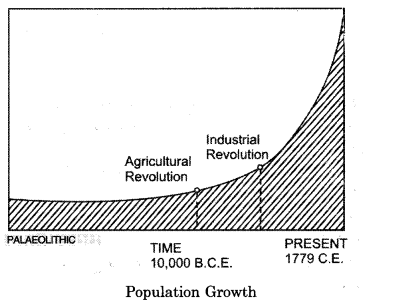
It has been estimated that in Pre-historic period (8000 B.C.E.), the total population was only 5 million. Large areas were uninhabited. Agricultural revolution led to growth of population upto 1000 million till Industrial revolution in 1850. The period was a slow long term increase in population. Faster population growth came with Industrial revolution. The urban population increased. The standard of living also increased.

It is clear that population growth rate is high in developing countries, while developed countries have a low population growth. Africa has the highest growth rate, while Europe is getting negative growth of population due to decrease in population.

The growth rate of population is not same in all the countries. These countries can be grouped into four divisions :

1. Regions with very high growth rate. This group includes continents where growth rate is about 3 per cent. It includes Africa, Central America, South and West Asia, South America.

2. Regions with high growth rate. This group includes areas where growth rate is 2 to 2.9 percent. It
Geography Class 12 Important Questions Chapter 2 The World Population Distribution, Density and Growth 3

includes some parts of South America, Eastern Asia, Australia.

3. Regions with moderate growth rate. This group includes countries where growth rate is between 1-1.9 per cent. It includes South America, Carribbean Region, Asia.

4. Regions with low growth rate. This group includes countries where growth rate is less than 1 per cent. It includes North America, Europe, Russia, Japan and New Zealand.

Question 3.
Define migration. What are its causes ? What are its types ?
Answer:
Migration : Migration is the third component of population change. It is an effort to achieve better balance between population and resources. It is the permanent or semi-permanent change of a person’s place of residence. Migration is probably a more important element in determining population structure and change in an area than fertility and mortality.

Types of migration. Pattern of migration may be rural to rural, rural to urban, urban to urban, interregional and international, etc.
(i) Seasonal migration. On a time scale, migration may be temporary or permanent. Temporary movement may take the form of seasonal migration. It may be of agricultural workers to meet a demand during labour-intensive agricultural seasons, migration which is a movement of people between places for a period of more than one season but less than a lifetime may be important.

(ii) International migration refer to movement of people between countries and continents. It plays an important role in changing population patterns over relatively short periods. In recent decades, international migration has again increased. For most of the people, voluntary migration offers improved economic or other opportunities.

A significant number of people, on the other hand, have to move to other countries as refugees due to civil war, political unrest or environmental degradation, which is less common. At the beginning of the 21st century, the UN estimated that about 120 million people world-wide, were living outside their native countries, including about 15 million refugees.

(iii) Internal migration is an even more widespread demographic process. It involves hundreds of millions of people leaving the countryside for cities, or from overcrowded to other regions offering better opportunities. The movement of rural population to the growing urban cities is caused by push and pull factors.

The adverse conditions operating in rural areas including poverty, unemployment, poor facilities of education, health, recreation and other services push the population to seek a living elsewhere while pull factors are the attractions of the city or destination areas. They include high wages, cheap land, better living conditions and opportunities for economic advancement. As a result, people migrate to the towns and cities, which in turn, have given rise to a large number of slums among them.

(iv) Rural migration. The movement of population also takes place between one rural tract and the other, particularly in the agricultural countries of the world. Such migration takes from crowded areas of low per capita agricultural productivity to areas of new developments.

The World Population: Distribution, Density and Growth Important Extra Questions HOTS

Question 1.
Explain the views of Thomas Malthus regarding population control.
Answer:
Thomas Malthus in his theory (1793) stated that :
(i) Number of people would increase faster than food supply.
(ii) Any further increase would result in a population crash caused by famine, disease and war.
(iii) Preventive checks are better than physical checks.
(iv) Rapid population increase be controlled for the sustainability of resources.

Question 2.
“Technological advancement helped in the reduction of birth rates, but population growth remained high.” Justify the statement. (Outside Delhi 2019)
Answer:
Technological advancement helped in the reduction of birth rates but population growth remaind high due to –
(1) Steam engine provided mechanised energy of wind and water which replaced human energy. This increased industrial and agricultural productivity.
(2) Vaccination against epidemics and other diseases, improvement in health services contributed rapid fall in death rates.
(3) Improvement is sanitation facilities also beneficial for humans.

Map Skills

Question 1.
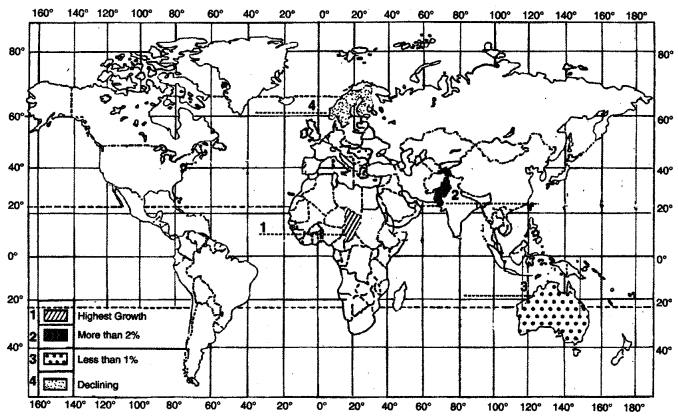
Four Geographical features are shown on the outline political map of the world. Identify these and write their names on the dotted lines given in the map.
Answer:
Geography Class 12 Important Questions Chapter 2 The World Population Distribution, Density and Growth 4
Answer:
1—Chad
2—Pakistan
3—Australia
4—Scandinavian countries

Through the Eyes of Travellers Class 12 Important Extra Questions History Chapter 5

Here we are providing Class 12 History Important Extra Questions and Answers Chapter 5 Through the Eyes of Travellers: Perceptions of Society. Class 12 History Important Questions are the best resource for students which helps in class 12 board exams.

Class 12 History Chapter 5 Important Extra Questions Through the Eyes of Travellers: Perceptions of Society

Through the Eyes of Travellers Important Extra Questions Very Short Answer Type

Question 1.
When and where was Al-Biruni born?
Answer:
Al Biruni was born in 973 AD, in Khwarizm in present-day Uzbekistan.

Question 2.
What did Al-Biruni do when he spent many years in India?
Answer:
Al-Biruni spent many years in the company of brahmana, priests and scholars, learning Sanskrit and studying religious and philosophical texts.

Question 3.
Name the book written by Al-Biruni.
Answer:
Al-Biruni wrote the ‘Kitab-ul-Hind’.

Question 4.
Name the book written by Ibn Battuta.
Answer:
Rihla, in the Arabic language, was written by Ibn-Battuta.

Question 5.
When did Ibn-Battuta visit Mecca ?
Answer:
In 1332-33 CE.

Question 6.
Who was known as the inveterate traveller?
Answer:
Ibn Battuta was known as the inveterate traveller.

Question 7.
Who was Duarte Barbosa?
Answer:
He was a Portuguese writer who created a detailed account of trade and society in south India.

Question 8.
Who was Francois Bernier?
Answer:
He was a French man, a doctor, political philosophers and historian who remained in India for 12 years between 1656-1668 CE.

Question 9.
Who gave a detailed description of the Caste system in India?
Answer:
Al-Biruni.

Question 10.
Who disapproved the nation of pollution?
Answer:
Al-Biruni.

Question 11.
Who described Delhi as a vast city with a great population?
Answer:
Ibn-Battuta.

Question 12.
With which purpose did the people travel? Write any four objectives.
Answer:
The people used to travel:

  1.  In search of work.
  2.  To escape from natural disasters.
  3.  To satisfy their sense of adventure.
  4. With multi-purpose objectives as traders, merchants, soldiers, priests and pilgrims.

Question 13.
Where did Al-Biruni live? How did he reach Ghazni?
Answer:
Al-Biruni lived in Khwarizm in present-day Uzbekistan. Ghazni’s Sultan Mahmud attacked Khwarizm in 1017 C.E. and took back many poets and scholars to Ghazni. Al-Biruni was one of them.

Question 14.
Give any two characteristics of the writings of Al-Biruni.
Answer:

  1. Al-Biruni wrote in the Arabic language.
  2. He adopted a critical approach in his writings. In each chapter, he began with a question. Then he gave a detailed description. He concluded with a comparison with other culture.

Question 15.
“Al-Biruni was capable of translating different texts in other languages.” Give example.
Answer:
Al-Biruni was well-versed in many languages which is why he was capable of translating different texts in other languages. He translated many Sanskrit texts in the Arabic language including the grammar of Patanjali. He even translated accounts of a Greek mathematician for his Brahmana friends.

Question 16.
How did Al-Biruni know about the works of the Greek philosophers?
Answer:
Al-Biruni did not know the Greek language. Even then he was familiar with the works of the Greek philosophers. He had read their translations in Arabic.

Question 17.
Name the book written by Ibn-Battuta. What was his observation about female slaves in the sub-continent? (C.B.S.E. 2009 (O.D.))
Answer:
Ibn-Battuta’s book was entitled ‘Rihla’. According to it, the slaves were engaged to do domestic work. He wrote in his book that not only male slaves but the Sultan also employed female slaves to keep a watch on his nobles.

Question 18.
Give a brief introduction of Francois Bernier. How long did he remain in India? (C.B.S.E. 2011 (D))
Answer:
Francois Bernier was a French traveller. He himself was a doctor, political philosopher and a historian. He remained in India for 12 years from 1656 till 1668 C.E. and was closely associated with the Mughal court.

Question 19.
Mention any two characteristics of the cities in the Indian sub-continent, as described by Ibn-Battuta. (C.B.S.E. 2011 (O.D.))
Answer:
According to Ibn-Battuta:

  • Indian cities were very prosperous.
  • Indian cities were densely populated.

Through the Eyes of Travellers Important Extra Questions Short Answer Type

Question 1.
Briefly describe the life sketch of Al-Biruni.
Answer:
Al-Biruni was born in 973 C.E., in Khwarizm in present-day Uzbekistan. Khwarizm was an important centre of education. Al-Biruni received the best available education over there and was well versed in many languages including Syrian, Persian, Hebrew and Sanskrit. Although he was not aware of the Greek language he was completely familiar with the works of Plato and other Greek philosophers.

He read their works through their Arabic translations. Mahmud of Ghazni attacked Khwarizm in 101 C.E. and took back many scholars and poets to his capital. Al-Biruni was one of them. He came over there as a hostage but gradually developed a liking for the city. He spent the rest of his life over there and died at the age of 70.

Question 2.
The travels of Ibn-Battuta were arduous and hazardous. Why was he called an inveterate traveller?
Answer:
Ibn-Battuta has beautifully written about the new cultures, peoples, beliefs and values in India. He travelled to India in the fourteenth century. It was the time when travel was more arduous and hazardous than it is today. Ibn-Battuta travelled from Multan to Delhi in forty days.

He completed his travel from Sindh to Delhi in about fifty days. Besides travelling was also more insecure. Ibn- Battuta was attacked by robbers many a time. So he preferred to travel along with other companions. But it was not a guarantee of any safety. Many of his companions had lost their lives on the way. He himself was badly wounded.

A Persistent Traveller. Ibn-Battuta was an inveterate traveller. Before coming to India in 1332—33 CE, he had made pilgrimage trips to Mecca besides travelling extensively in Syria, Iraq, Persia, Yemen and Oman. On his return, the ruler of Morocco ordered him to record all his stories.

Question 3.
According to Al-Biruni, what were the barriers that obstructed his understanding?
Or
Explain briefly the barriers, felt by Al-Biruni, in understanding what he observed in India. (C.B.S.E. 2010 (D))
Answer:
Al-Biruni was aware of the problems that he could face during his travel. He felt that many barriers obstructed his understanding. These barriers can be studied as under :

  1. The first barrier was that of the language. He found a lot of difference between Sanskrit and Arabic or Persian. He found it hard to translate ideas and concepts of one language into another.
  2. Secondly, he found a lot of difference in religious beliefs and practices.
  3. The third barrier was the self-absorption and insularity of the local population.

Question 4.
Which four social categories of ancient Persia were described by Al-Biruni? What he actually wanted to express?
Answer:
Al-Biruni tried to explain the caste system in comparison with its parallels in other societies. He wrote that four social categories were recognised in ancient Persia and these were:-

  1. Knights and princes.
  2. Monks, fire priests and lawyers.
  3. Physicians, astronomers and other scientists.
  4. Peasants and artisans were:

Actually, he wanted to express that these social categories were not unique to India. He also expressed that all humans are treated equally in Islam and they differ only in their observance piety.

Question 5.
Which norm of caste-system was not approved by Al-Biruni and why? What does he say about the rigidity of the caste system?
Or
Explain Al-Biruni’s descriptions of the caste system in India. (C.B.S.E. 2009 (O.D.))
Or
Explain Al-Biruni’s description of the caste system. (C.B.S.E. 2010 (D))
Or
‘The conception of social pollution intrinsic to the caste system was contrary to the law of nature.” Examine Al-Biruni’s statement on the Indian caste system. (C.B.S.E. 2013 (O.D.))
Or
State the inherent problems faced by Al-Beruni in the task of understanding
Indian social and Brahmanical practices. Mention any two sources that provided him with the support. (C.B.S.E. 2016 (D))
Answer:
Al-Biruni had explained the caste system of India. He did not consider it unique as such social divisions were prevalent in ancient Persia. He accepted the Brahmanical description of the caste system. But he did not accept the notion of pollution and stated that the state of impurity does not remain forever. It soon regains its original condition of purity. The sun cleanses the air. The salt in the sea prevents the water from being polluted. But he finds social pollution as contrary to the laws of nature.

Thus, we see that Al-Biruni’s description of the caste system was deeply influenced by his study of normative Sanskrit books and the views of BrahmAnswer: However, he did not find the system as rigid. For example, the categories like antyaja (born outside the system) provided inexpensive labour to both peasants and Zamindars. Though such classes were socially oppressed, yet they were included in the economic network.

Question 6.
From the descriptions of Ibn-Battuta, what glimpse we find about the agricultural economy of the village and trade and commerce of the sub-continent?
Or
Explain how the prosperity of towns has been explained by the historians on the basis of Ibn- Battuta’s observations. C.B.S.E. 2010 (O.D.))
Answer:
Ibn-Battuta had no interest in describing the prosperity of the cities. But the historians have used his description to argue that the prosperity of the cities depended on the agricultural economy of the villages. According to Ibn-Battuta, Indian agriculture was quite productive. Its reason was the fertility of the land. It was easy for the farmers to grow two crops in a year.

Ibn- Battuta also saw that the sub-continent was part of a global network of communication. The Indian goods were in great demand in Central and South-East Asia. It was profitable to both artisans and merchants. There was a great demand in India for cotton cloths, soft muslin, silk brocade and satin. Ibn-Battuta tells us that some kinds of muslin were so costly that only the rich could afford to buy them.

In other words, the cities of the sub-continent provided exciting opportunities to those who had necessary drive, skill and resources. All the cities had colourful markets having a wide variety of goods. The bazaars were the main places of economic transactions. They were also the hub of social and cultural activities. In fact, the sub-continent was well-integrated with inter- Asian networks at trade and commerce.

Question 7.
Which features of the postal system of the medieval period were given by Ibn-Battuta? How traders were benefitted from this system?
Or
“India had a unique system of communication during the fourteenth century.” Examine the statement of Ibn-e-Batuta. (C.B.S.E. 2017 (O.D.))
Answer:
The state took special steps to encourage merchants. Inns and rest houses were built on almost all the trading routes. Ibn-Battuta was amazed by observing the postal system. Merchants were not only able to send information to a long-distance but also to dispatch goods required at short notice. The postal system was so efficient that while it took 50 days for traders to reach Delhi from Sindh but the news, reports of spies would reach the king in only 5 days.

Question 8.
“Bernier wanted to express India inferior to the western world.” Elucidate the statement.
Answer:
Bernier’s work ‘Travels in the Mughal Empire’ is marked by detailed observations, critical insights and reflects. His account contains discussions trying to keep the Mughal history within the universal framework. He continually compared the Mughal age India with contemporary Europe and generally stressed on the superiority of Europe. His representation of Indian work was on the model of binary opposition in which India is expressed as the inverse of Europe. He also described the differences which he saw so that India could be expressed inferior to the western world.

Question 9.
Why did Bernier consider crown ownership of land as disastrous?
Or
According to Bernier, “Crown ownership of land had disastrous consequences for the state and the I society.” Justify the statement. (C.B.S.E. 2009 (O.D.))
Or
Mention Bernier’s views about private property and crown ownership of land. (C.B.S.E. 2011 (O.D.))
Or
Examine why Bernier was against the idea of crown ownership of land in ‘.Mughal India. (C.B.S.E. 2017 (D.))
Answer:
According to Bernier, the Mughal India did not have private ownership of land. He believed that private property had many virtues. But he regarded the crown ownership of land as harmful to both the state and its people. In the Mughal Empire, the emperor owned all the land. He distributed this land among his nobles. Bernier felt that this principle had disastrous consequences for the economy as well as society.

Because of the crown ownership of land, the landholders could not pass their land to their children. Besides they could not make any long-term investment to sustain and increase production. The crown ownership of land also prevented the emergence of an improved class of landlords as in Western Europe. It had ruined the agriculture and increased oppression of the peasantry. It brought a continuous decline in the living standard of all sections of society. That is why Bernier considered crown ownership of land as disastrous.

Question 10.
How was the Mughal Empire viewed by Francois Bernier? Do Mughal governmental documents justify it?
Answer:
Francois Bernier wrote a book entitled ‘Travels In the Mughal Empire.’ He considered the Mughal rule
as inferior to that of Europe. During the Mughal rule, Indian society had masses of impoverished people. The rich and powerful people were in a minority. There were poorest of the poor and the richest of the rich. There was no middle class in India. This is how Bernier described India during the Mughal rule. The Mughal king was the king of beggars and barbarians. All the cities and towns were in shambles. They were contaminated with polluted air. All the fields were full of bushes and marshes because of the crown ownership of land.

However, there was no Mughal official document to show that the state was the sole owner of the land. For example, Abul Fazl, the official chronicler of Akbar in the 16th century, describes the land revenue as “remunerations of sovereignty”. Many European travellers believed that the king claimed revenue as he provided protection to his subjects. He did not take any rent on land as many scholars believe. In reality, it was neither rent nor a land tax. It was in fact a tax on the crop.

Question 11.
Which type of contrary views about arts and artisans in the Mughal empire is given by Bernier?
Or
Explain the views of Bernier about a more complex social reality of the Mughal empire. (C.B.S.E. 2010 (O.D.))
Answer:
Bernier’s description expresses the Mughal empire as tyrannical but it also indicates a more complex social reality. For example, he wrote that artisans were not encouraged to improve the quality of their products as their profits were appropriated by the State. That is why there was a continuous decline in the level of production. On the other hand, he also wrote that great quantities of precious metals have flowed into India from the world because manufacturers exported in exchange for gold and silver. He also accepted the existence of a prosperous trading community which was engaged in the long-distance exchange.

Question 12.
What were Bernier’s views about of 17th-century cities? Why his description is oversimplified?
Answer:
Around 15% population in the 17th century lived in towns. This ratio was more than the ratio of the urban population of Europe. Then he described Mughal towns as ‘camp towns’ which he meant by those towns which were dependent upon imperial camps for their existence.

He believed that these towns came into existence when the imperial court moved in and declined very quickly when it moved out. He also wrote that they did not have viable social and economic foundations and they were dependent upon imperial patronage.

But this thing is oversimplified as all kinds of towns existed at that time like manufacturing towns, trading towns, port towns, sacred or religious centres, pilgrimage towns, etc. Prosperous trading communities and professional classes were indicators of their existence.

Question 13.
Give a brief description of the merchant communities and other urban groups in Mughal India.
Answer:
Merchants were mutually associated through strong communities or kin ties and were organised through their caste and occupational institutions. These groups in western India were known as Mahajan and their head was known as Seth. In urban centres like Ahmedabad, all the Mahajans were collectively represented by the chief of the merchant community called Nazareth.

Other urban groups included professional classes like teachers (Mulla or Pandit), physicians (hakim or vaid), musicians, architects, painters, etc. Some of them depended upon imperial patronage, some of them lived by serving other patrons and the rest of them served common masses in crowded markets.

Question 14.
What were the views of European travellers and writers about the condition of women in the medieval period?
Or
Explain how the accounts of Ibn, Battuta and Bernier provide us with tantalizing glimpses of the life of Indian ’ women during the 16th and 17th century (C.B.S.E. 2013 (D))
Answer:
All the contemporary Europen travellers and writers had ‘written about the treatment of women which according to them was a crucial point of difference between western and eastern societies. That’s why Bernier specifically mentioned in detail about the inhuman practice of Sati.

Life of women was circled around a few other things as well except the practice of Sati. Their labour was important for both agriculture and non-agriculture production. Women of merchant families were also often engaged in commercial activities and sometimes took mercantile disputes to the court of law. Therefore, it hardly seems that women were only confined to four walls of their homes.

Question 15.
Explain in the real intentions of Buchanan’s journey to India. (CIB.S.E. 2009 (D))
Answer:
Francis Buchanan came to India in 1794. He was a physician and served in the Bengal Medical Service till 1815. He also served as a surgeon to Lord Wellesly, the Governor-General of India for a few years.

But on the request of the Bengal Government, he undertook detailed surveys of the areas under the control of East India Company. He had become an employee of the East India Company.

Buchanan was a keen observer of things. Wherever he went, he saw the stones and rocks. He also observed the different strata and layers of soil. He searched for minerals and invaluable stones. He also recorded the sites where iron-ore, mica, granite and saltpetre were available. He carefully noted the local practices of salt¬making and non-ore mining.

Through the Eyes of Travellers Important Extra Questions Long Answer Type

Question 1.
Give information about Francois Bernier and other writers who visited India after 1500 C.E.
Answer:
The Portuguese came to India after 1500 C.E. They wrote a lot about the social customs and religious practices of India. Roberto Nobili even translated many Indian books into European languages.

Duarte Barftosa. He was a famous Portuguese writer. He gave a detailed account of pf trade and society in south Indian. But after 1600 C.E., a lot of Dutch, English and French travellers came to India.

Jean-Baptiste Tavernier. He was a French jeweller. He had visited India at least six times. He was fascinated with the trading conditions in India. He compared India to Iran and the Ottoman Empire.
Manucci. He was an Italian doctor. He felt so impressed with India that he settled here and never went back to Europe.

Francois Bernier. He was a Frenchman. He was a doctor as well as a historian and a political philosopher. He had come to the Mughal Empire in search of opportunities. He remained in India for twelve years, i.e., from 1656 to 1668. He was a physician to Prince Dara Shukoh, the eldest son of Emperor Shah Jahan. So he was closely associated with the Mughal court. As he was an intellectual and scientist, he also remained associated with Danishmand Khan, an Armenian noble at the Mughal court.

Comparing East and West. Bernier had visited many parts of India. He wrote accounts of what he saw in these parts of India. He compared his knowledge about India with the situation in Europe. He dedicated all his important writings to Louis XTV, the King of France. Most of his writings are in the form of letters written to ministers and influential officials. He painted the situation in India as bleak in comparison to the development in Europe. However his assessment was not very accurate but his works became very popular. They were translated into English, Dutch, German and Italian. Between 1670 and 1725 C.E., his work was reprinted eight times in French and three times in English.

Question 2.
Explain giving examples of how the accounts of foreign travellers help in reconstructing the history of India from the 10th to 17th century.
Answer:

  1. Most of the foreign travellers came from a diverse social environment.
  2. The local writers remained indifferent towards them.
  3. They compared the Indian environment and social scenario with the outside world.
  4. They laid more stress on those things or statements in their descriptions which looked queer and strange to them. This fact made their description interesting and lively.
  5. Their descriptions threw light on the contemporary proceedings of the royal court, religious beliefs and the features of architecture and sculpture. It helps in the writing of history.

Important Foreign Travellers

The three most important foreign travellers who visited India during the Middle Ages were Al-Biruni, Ibn-Battuta and Bernier.

(a) Al-Biruni.
1. The detailed description by Al-Biruni is found in his ‘Kitab-ul-Hind’ which provides information about the contemporary religion, philosophy and science. His description is very simple and straight¬forward.

2. Al-Biruni explained that the caste system was not only the characteristic of the Indian society but also of many other societies of the world. In other words, the caste system was prevalent in many countries of the world.

(b) Ibn-Battuta.
1. Ibn-Battuta wrote a book entitled ‘Rihla’. In this book, he declined a beautiful picture of his experiences that he had gathered during his various visits and travels. From his book, we come to know a lot about various aspects of social values and new culture.

2. Ibn-Battuta found paan and coconut very strange. So he made a special mention of them.

3. He also wrote about the cities of India and an efficient postal system.

(c) Francois Bernier.

  1. Bernier wrote a book entitled, ‘Travels in Mughal Empire’.
  2. Like the books of Al-Biruni and Ibn-Battuta, the book of Bernier is a gist of his experiences.
  3. He especially compared the condition of India with that of Europe. He found the life of the people of India is worst in comparison to the life found in Europe.
  4. In all his descriptions, he criticises the control of the state over all the land. He considers it responsible for the miserable condition of Indian agriculture and the farmers.

Through the Eyes of Travellers Important Extra Questions HOTS

Question 1.
Why were travels more difficult and risky in the 14th century? Give any two reasons.
Answer:

  1. There was a hazard of robbers on long journeys.
  2. The travellers could feel home-sick and also fall ill.

Question 2.
‘Ibn-Battuta was an inveterate traveller.’ Give an example.
Answer:
Ibn-Battuta was neither afraid of anything nor did he get tired. He travelled extensively for several years through northern Africa, western Asia, many parts of central Asia, Indian sub-continent and far off places in China. That is why he was known as an inveterate traveller.

Question 3.
Who was Jean-Baptiste Tavernier?
Answer:
Jean Baptiste Tavernier was a French jeweller. He had visited India six times. He was especially impressed by the trade activities in India. He compared India with Iran and the Ottoman Empire.

Question 4.
What was the idea of oriental despotism of the French philosopher Montesquieu? What was the base of this idea?
Answer:
The idea of oriental despotism states that rulers in Asia enjoyed absolute authority over their subjects and the subjects were kept in conditions of subjugation and poverty. The base of this idea was that all the land belonged to the king.

Question 5.
H0w had Bernier described a complex social reality of the artisan, under the Mughals? Give any one reason. (C.B.S.E. 2011 (D)) .
Answer:
Bernier wrote that artisans under Mughals were hardly encouraged to make their product better because their profit was appropriated by the state. That is why there was a continuous decline in the level of production. On the other hand, he wrote that the world’s precious metals were flown into India as manufactures exported in exchange for gold and silver.

Question 6.
“Ibn-Battuta was full of excitement to know about the unfamiliar.” Give reasons in favour of the statement.
Answer:
When Ibn-Battuta arrived in India in the 14th century, the whole of the sub-continent was part of a global network of communication. This communication network stretched from China in the east and North¬western Africa and Europe in the west. Ibn-Battuta himself extensively travelled in these regions. During his journeys, he observed sacred places, spent time with scholars and rulers and even remained on the post of Qazi.

He also enjoyed the cosmopolitan culture of urban centres where people used to speak Arabic, Persian, Turkish and other languages and exchanged ideas, information, stories, etc. These include stories of men noted for their piety, kings, general masses and people of all categories. If anything was unfamiliar in those stories, it was particularly highlighted so that the readers or listeners must be impressed by that. Ibn-Battuta very interestingly described the coconut and the paan. His readers were very much unfamiliar with these two things.

Question 7.
“Bernier’s accounts influenced western theorists from the 18th century. Give arguments to support the statement.
Or
“Bernier’s description of imperial land ownership influenced western theorists like French philosopher Montesquieu and German Karl Marx.” Justify it with suitable arguments. (C.B.S.E. 2013 (D))
Answer:
1. The descriptions of Bernier had a deep impact on many western thinkers. For example, Montesquieu, the French philosopher, used the descriptions of Bernier to develop his idea of oriental despotism. In other words, Montesquieu stated that the rulers in Asia enjoyed absolute authority over their subjects. All the people lived in subjugation and poverty. All the land belonged to the king and there was no private property.

2. Karl Marx further developed this idea as the Asiatic mode of production. He stated that the surplus was taken by the state in India. This led to the emergence of society having a large number of autonomous and egalitarian village communities. The imperial court also respected their autonomy. It was considered as a stagnant system.

Question 8.
Why did travellers, who came to India, sometimes took social inequalities for granted as a natural state of affairs? Explain. (C.B.S.E. 2009 (D)))
Answer:
Travellers, who came to India, sometimes took social inequalities like a caste system for granted because they did not consider it unique. For example, Al-Biruni had explained the caste system in India. He did not consider it unique as such social divisions were prevalent in ancient Persia. He even accepted the Brahmanical description of the caste system. But he did not accept the notion of pollution as social pollution was contrary to the laws of nature. Actually, he tried to explain the caste system in comparison with its parallels in other societies. But he also expressed that all humans are treated equally in Islam and they differ only in their observance piety.

Through the Eyes of Travellers Important Extra Questions Source-Based

Read the following passages and answer the questions that follow :

Question 1.
Music in the Market

Read Ibn Battuta’s description of Daulatabad: In Daulatabad there is a market place for male and female singers, which is known as Taraba. It is one of the greatest and most beautiful bazaars. It has numerous shops and every shop has a door which leads to the house of the owner… The shops are decorated with carpets and at the centre of a shop, there is a swing on which sits the female singer. She is decked with all kinds of finery and her female attendants swing her. In the middle of the market place, there stands a large cupola, which is carpeted and decorated and in which the chief of the musicians takes his place every Thursday after the dawn prayers, accompanied by his servants. and slaves. The female singers come in successive crowds, sing before him and dance until dusk after which he withdraws. In this bazaar, there are mosques for offering prayers… One of the Hindu rulers …. alighted at the cupola every time he passed by this market place, and the female singers would sing before him. Even some Muslim rulers did the same.
(i) From where has this excerpt been taken?
Answer:
This excerpt has been derived from Ibn Battuta’s description of Allahabad.

(ii) What was Taraba? Discuss its three features.
Answer:
(ii) Tarabad was a market place for male and female singers in Daulatabad.

Answer:

(a) It was one of the greatest and most beautiful bazaars.
(b) It had many shops which were decorated with carpets.
(c) There was a swing in the centre of the shop. The female singer sat on it. Her attendants swing her.

(iii) After the prayers, what programme was carried out on Thursday in a large cupola which existed in the middle of the market place?
Answer:
(iii) After the dawn prayers on every Thursday, the chief of the musicians sat in a cupola near the market place. Then the female singers came in successive crowds and sang and danced before him till it was dusk or the evening time. Then they left the place.

(iv) How was the Hindu ruler welcomed when he visited cupola in the market place?
Answer:
The female singers welcomed the ruler by singing songs when he reached the cupola.

Question 2.
The Bird leaves its Nest

This is an excerpt from the Rihla :

My departure from Tangier, my birthplace, took place on Thursday… I set out alone, having neither fellow-traveller nor caravan whose party I might join, but swayed by an overmastering impulse with me and a desire long-cherished in my bosom to visit these illustrious sanctuaries. So I braced my resolution to quit all my dear ones, female and male and forsook my home as birds forsake their nests My age at that time was twenty-two years. Ibn Battuta returned home in 1354, about 30 years after he had set out.
(i) What is Rihla?
Answer:
‘Rihla’ is an account of travels, written in Arabic, by Ibn Battuta. It gives a detailed description of the social and cultural life in the fourteenth century.

(ii) Why did Ibn Battuta set out of his house all alone? How old was he at that time?
Answer:
He set out alone as he had a keen desire to visit illustrious sanctuaries. Besides, he was quite experienced in travelling as he had already gone to Mecca, Syria, Iraq, Persia, Yemen, Oman and a few trading ports of South Africa. He was then just 22 years old.

(iii) Why did he compare himself with the birds?
Answer:
He compared himself to the birds as he felt as free as the birds. The birds leave their nests to see new places. Similarly, he had left all his friends and relatives to know about new places.

(iv) When did he return to his home? How old was he at the time of his return?
Answer:
He returned home in 1354. At that time he was 32 years old.

Question 3.
Education and Entertainment

This is what Ibn Juzayy, who was deputed to write what Ibn Battuta dictated said in his introduction

A gracious direction was transmitted (by the ruler) that he (Ibn Battuta) should dictate an account of the cities which he had seen in his r travel, and of the interesting events which had clung to his memory, and that he should speak of those whom he had met, of the rulers of countries, of their distinguished men of learning, and their pious saints. Accordingly, he dictated upon these subjects a narrative which gave entertainment to the mind and delight to the ears and eyes, with a variety of curious particulars by the exposition of which he gave edification and of marvellous things, by referring to which he aroused interest.
(i) Who was Ibn Juzayy?
Answer:
Ibn Juzayy was deputed to write what Ibu
Battuta dictated.

(ii) What instructions were given by the king to Ibn Battuta?
Answer:
The ruler asked Ibn Battuta to dictate an account of the cities that he had visited during his travel. He also asked Battuta to record the interesting events besides his meetings with rulers, distinguished learned men and pious saints of other countries.

(iii) What was the impact of the narrative of Ibn Battuta on the author?
Answer:
The narrative of Ibn Battuta entertained the mind of the author. It also delighted his ears and eyes.

(iv) From where had Ibn Battuta come? Which places or regions he visited? Tell anyone problem that he faced during his travel?
Answer:
Ibn Battuta had come from Morocco. He had visited North Africa, West Asia, Central Asia and China. He had to face many highway robbers during his travels.

Question 4.
Nuts like a Mali’s Head

The following is how Ibn Battuta described the coconut :

These trees are among the most peculiar trees in kind and most astonishing inhabit. They look exactly like date-palms, without any difference between them except that the one produces nuts as its fruits and the other produces dates. The nut of a coconut tree resembles a man’s head, for in it are what look like two eyes and a mouth, and the inside of it when it is green looks like the brain and attached to it is a fibre which looks like hair. They make from these cords with which they sew up ships instead of (using) iron nails, and they (also) make from it cables for vessels.
(i) Why has Ibn, Battuta described coconut?
Answer:
Ibn Battuta described the coconut because it looked peculiar and astonishing.

(ii) What similarity and dissimilarity did he find in the coconut and date-palm trees?
Answer:
(a) The coconut tree exactly looks like the date-palm. There is no difference between the two if been looked at.
(b) The dissimilarity between the two is quite evident. The coconut tree produces nuts as its fruits whereas the date-palm produces dates.

(iii) How has he compared the coconut to a man’s head?
Answer:
According to Ibn Battuta, the nut of a coconut tree resembles a man’s head. It has two eyes and a mouth when it is green, its inner part looks like the brain. It has also fibre which looks like hair.

(iv) According to Ibn Battuta, for what purpose are the fibres used by the people? Write two points.
Answer:
(a) The fibre was used to make cords
which were used to sew up the ships instead of iron-nails.
(b) It was used to make cables for vessels.

Question 5.
Travelling with the Mughal Army

Bernier often travelled with the army. This is an excerpt from his description of the army’s march to Kashmir :
I am expected to keep two good Turkoman horses, and I also take with me a powerful Persian camel and driver, a groom for my horses, a cook and a servant to go before my horse with a flask of water in his hand, according to the custom of the country. I am also provided with every useful article, such as a tent of moderate size, a carpet, a portable bed made of four very strong but light canes, a pillow, a mattress, round leather table-cloths used at meals, some few napkins of dyed cloth, three small bags with culinary utensils which are all placed in a large bag, and this bag is again carried in a very capacious and strong double sack or net made of leather thongs.

This double sack likewise contains the provisions, linen and wearing apparel, both of master and servants. I have taken care to lay in a stock of excellent rice for five or six days’ consumption, of sweet biscuits flavoured with anise (a herb), of limes and sugar. Nor have I forgotten a linen bag with its small iron hook for the purpose of suspending and draining dahi or curds; nothing being considered so refreshing in this country as lemonade and dahi.
(i) Who was Bernier? Whom did he dedicate his most famous creation?
Answer:

Bernier was a French traveller. He remained in India for twelve years, that is, from 1656 to 1668. He was closely associated with the Mughal court. He was a physician to Prince Dara Shukoh, the eldest son of Emperor Shah Jahan. He dedicated his major writing to Louis XIV, the King of France.

(ii) What was expected of him?
Answer:
Bernier was a French traveller. He remained in India for twelve years, that is, from 1656 to 1668. He was closely associated with the Mughal court. He was a physician to Prince Dara Shukoh, the eldest son of Emperor Shah Jahan. He dedicated his major writing to Louis XIV, the King of France.

(iii) Except food material, what else was he given? Name any eight things.
Answer:
He was expected to. see two good Turkoman horses.
(a) A powerful Persian camel and driver.
(b) A groom for his horses.
(c) A cook.
(d) A servant
(e) A tent of moderate size.
(f) A carpet.
(g) A caned portable bed. ‘
(h) A pillow and a mattress.

(iv) Name any four things given to him to eat.
Answer:
(a) Excellent Rice.
(b) Sweet biscuits Kavaured with anise.
(c) Limes. ‘
(d) Sugar.

Question 6.
Al-Biruni’s Objectives

Al-Biruni described his work as a help to those who want to discuss religious questions with them (the Hindus), and as a repertory of information to those who want to associate with them. ’
(i) When and where was Al-Biruni born?
Answer:
Al-Biruni was born in 973 at Khwarizm which is these days in Uzbekistan.

(ii) Name the book written by him.
Answer:
He wrote “Kitab-ul-Hind”.

(iii) With which objectives did he write?
Answer:
(a) He wanted to help those who were eager
to discuss religious questions with the Hindus.
(b) He accumulated information for those who wanted to associate with the Hindus.

(iv) Name the two books translated by him. In which language were these translated?
Answer:
Al-Biruni translated Patanjali’s work on grammar into Arabic. He also translated the works of Euclid into Sanskrit. Euclid was a Greek mathematician.

Question 7.
On Horse and on Foot

This is how Ibn Battuta described the postal system :

In India, the postal system is of two kinds: The horse-post called ‘ulu’ is run by royal horses stationed at a distance of every four miles. The foot-post has three stations permit. It is called ‘Dawa’, that is, one-third of a mile Now, at every third of a mile there is a well-populated village, outside which are three pavilions in which sit men with girded loins ready to start. Each of them carries a rod, two cubits in length with copper bells at the top.

When the courier starts from the city, he holds the letter in one hand and the rod with its bells on the other; and he runs as fast as he can. When the men in the pavilion hear the ringing of the bell they get ready. As soon as the courier reaches them one of them takes the letter from his hand and runs at the top speed shaking the rod all the while until he reaches the next Dawa. And the same process continues till the letter reaches its destination. This foot-person is quicker than the horse-post, and often it is used to transport the fruits of Khurasan which are much desired in India.
(i)Name two kinds of the postal system.
Answer:
There were two kinds of postal systems – the horse postal system and the postal system on foot.

(ii) Explain how the foot post worked.
Answer:
In the postal service on foot, there were three stages. They were called the Dawa. It was one-third part of a mile. There was a village with a dense population at a distance of every three-mile. There were three centres outside it. The people used to sit in these centres to start their work. Each one of them had a long rod having copper bells at its top. Whenever a messenger started his journey, he held the letter in one land and this rod with copper bells in the other hand. He would run very fast. The people sitting in the camps at once got ready when they heard the sound of the bells. As soon as the messenger reached the camp, one of the people would take the letter and run away at full speed shaking the rod. This process continued till the letter reached its destination.

(iii) Why does Ibn-Battuta think that the postal system in India was efficient?
Answer:
According to Ibn Battuta, the journey from Sindh to Delhi was completed in fifty days. On the other hand, all the information given by the detectives reached the king within five days. Ibn Battuta was quite amazed at their efficiency of the postal system. This system was also used to send information to traders who went too far off places.

(iv) How did the State encourage merchants in the 14th century?
Answer:
In the 14th century, the state took special steps to encourage the traders. For example, al the trade routes had serais and rest houses.

Human Geography: Nature and Scope Class 12 Important Extra Questions Geography Chapter 1

Here we are providing Class 12 Geography Important Extra Questions and Answers Chapter 1 Human Geography: Nature and Scope. Geography Class 12 Important Questions are the best resource for students which helps in class 12 board exams.

Class 12 Geography Chapter 1 Important Extra Questions Human Geography: Nature and Scope

Human Geography: Nature and Scope Important Extra Questions Very Short Answer Type

Question 1.
Name two major components of earth.
Answer:
Physical environment and life forms.

Question 2.
What is the core concern of Geography as a discipline ?
Answer:
To understand the earth as home of man.

Question 3.
Who first used the term Geography ?
Answer:
Eratosthenes a Greek geographer who lived in Alexandria during 276-192 B.C.E.

Question 4.
What does world idiographic mean ?
Answer:
Descriptive.

Question 5.
Name the elements of physical environment.
Answer:
Landforms, soils, climate, water, natural vegetation, flora and fauna.

Question 6.
Name the elements of human (cultural) environment.
Answer:
Houses, villages, cities, rail-road net works, industries, farms, ports.

Question 7.
Why is physical environment called ‘Mother Nature’ ?
Answer:
In primitive societies, nature is a powerful force, worshipped, revered and conserved. People depend on nature for resources which sustain them.

Question 8.
Analyse the ‘behavioural’ school of thought. (Outside Delhi 2019)
Answer:
This is an approach to human geography that examines human’s behaviour by using a disaggregate approach. This is a branch of human science.

Human Geography: Nature and Scope Important Extra Questions Short Answer Type

Question 1.
What is Geography ? State three characteristics of study of Geography.
Answer:
(1) Geography is an areal or spatial science.
(2) The word geography is derived from two Greek words (Ge = earth and graphe ~ description).
(3) Hence Geography is the description of earth’s surface.

Question 2.
Why is Geography often called the ‘mother of all Sciences’ ? Give three reasons.
Answer:
An inter-disciplinary subject. Geography is truly global in nature. It studies all the natural and human phenomena. So it has to gather knowledge from all other subjects. So it is called ‘mother of all Sciences’.

Question 3.
Why is Geography known as ‘body of knowledge’ ? Give three aspects.
Answer:
(i) In ancient times, the aim of geography was to collect all general information concerning the earth. This knowledge was based on travels by traders, travellers, settlers and conquerors.

(ii) Geography included the knowledge about the shape and size of earth, latitude, longitude, solar system etc.

(iii) The subject of Geography gathered much knowledge from other subjects. Therefore, it is known as body of knowledge.

Question 4.
‘Geography is a physical science as well as a social science.’ Discuss.
Answer:
Geography is a science of synthesis. It represents the total picture of an area by studying the physical and human aspects of an area. Physics, chemistry, botany etc. (Physical sciences) are used to study the natural environment. The social science helps to study the human activities such as agriculture, settlements etc. Therefore, Geography like the physical sciences and social sciences is included in both the groups.

Question 5.
Explain the aim of Human Geography. Explain its three aspects.
Answer:
(i) Human Geography aims at the study of human and natural resources of a region so that these resources can be used for the progress and welfare of the people.
(ii) It studies the effects of environment on human groups.
(iii) It studies the modifications made by man in Environment. In this way, the main aim of Human Geography is to study the interactive relationship between man, environment and economic activities.

Question 6.
“Man occupies the central position in Human Geography.” Discuss.
Answer:
The set of surroundings in which man lives and works is called environment.
(i) Man is an active geographical agent.
(ii) Man uses soil resources to produce food for himself. He also gets food from fishing, cattle rearing, sheep rearing.
(iii) He develops water power from waterfalls along rivers. Coal is used to generate power for industries. So man occupies the central position. All the physical and cultural activities revolve around man.

Question 7.
‘Man is a slave of nature.’ I Discuss with two examples.
Answer:
There is a close relationship between man and nature. Physical elements of nature such as land, climate, soil, minerals, water and vegetation influence mode of life of human groups, economic activities and social life of people. Nature determines the work and life of man. This concept is called Determinism.
(i) According to Ratzal, ‘Man is the product of environment’ or it can be said, ‘Man is a slave of nature. ’
Man and nature work together. So it has been rightly said, Man in nature.’
(ii) According to Vidal de la Blache, ‘Nature provides the stage and it is for man to act on it. ’

Question 8.
What do you mean by Neo-.determinism ? (C.B.S.E 2011)
Answer:
Neo-determinism. Although the nature has offered humans a lot of scope for development, it does also set the ultimate limits, crossing of which would mean a point of no return. Hence, the possibilistic approach invited criticism from many of the contemporary thinkers. Griffith Taylor, while criticizing the possibilism, put forward the concept of neo-determinism.

He stressed that a geographer’s role is essentially that of an advisor and not to interpret the nature’s plans. It is a Madhyam Marg between determinism and possibilism. It is called stop and go determinism. It means that possibilities can be created within the limits which do not damage the environment.

Question 9.
How has the free run developed economies damaged the environment ? Give five examples. .
Answer:
Possibilism means that there is a condition of absolute freedom. It means human beings can conquer nature freely for their development purposes. Thus there is a free run without accidents. But the free run developed economies has damaged the environment in the following ways :—

  • Green house effect
  • Ozone layer depletion
  • Global warming
  • Receding glaciers
  • Degrading lands.

Question 10.
Which are the three core points of the definition of human geography given by Ellen C. Semple ?
Answer:
According to Ellen C. Semple, “Human geography is the study of the changing relationship between unresting man and the unstable earth.”
Three core points :
The three core points in this definition are :

  • Inter-relationship of human societies and earth surfaces.
  • Human-environment relationship is dynamic.
  • Human progress is adopted to nature.

Question 11.
Explain the concept of environmental determinism with suitable examples. (C.B.S.E. 2009, Delhi 2019)
Answer:
Determinism. It refers to the point of view supporting environmental control on human action. Accordingly, history, culture, life-style and stage of development of a social group, society or nation are largely governed by the physical factors, (like terrain, climate, fauna and flora) of environment. The determinists generally consider human as a passive agent.

Different views :
(i) Thus attempt was made by the Greek and Roman scholars including Hippocrates, Aristotle, Herodotus and Starabo.

(ii) The works of scholars, such as Al-Masudi, Al-Idrisi and Ibn-Khaldun, Kant, Humbolt, Ritter and Ratzel continued upto the early 20th century

(iii) This concept grew widespread particularly in the United States from the writing of E.C. Semple and Ellsworth Huntington.

Question 12.
Explain the concept of possibilism with suitable examples. (C.B.S.E. 2009, 2013, Delhi 2019) I
Answer:
Possibilism. The idea that human beings are controlled by nature was rejected and other geographers who stressed the fact that human beings were free to choose. When humans are seen as an active force rather than a passive being, the approach is that of possibilism.

Different Views :
(i) Lucian Febvre, the first to use the world possibilism, wrote that “There are no necessities, but everywhere possibilities; and man as master of these possibilities is the judge of their use.”

(ii) It was Vidal de la Blache who advocated and developed systematically the school of possibilism. He opined that the life-styles of people are the product of physical, historical and social influences. This concept became the basic philosophy of the school of possibilism.

(iii) It was realized that the cultural context and technological advancement of humans determined how they will use the environment.

Question 13.
What do you mean by Dualism in Geography ? Give three examples. What is the meaning of words nomothetic and ideographic ?
Answer:

  • There is a wide-range debate whether geography should be studied with a regional or systematic approach. This is called dualism. Nomothetic means law making while ideographic means descriptive.
  • Whether geographical phenomena be interpreted theoretically or through historic institutional approach.
  • There exists dichotomy between physical and human geography.

Question 14.
“Physical environment has been greatly modified by human beings, it has also, in turn impacted human lives.” Explain the statement. (Delhi 2019)
Answer:
Physical environment consists of the physical or material phenomena such as climate, surface configuration and drainage and natural resources such as soils/minerals/water and forests. Physical environment has been greatly modified by humans and has also in trun impacted human fives.

Humans modify the environment ot suit their different needs to meet fife’s necessities. In the process, the bring technology and knowledge to bear on physical environment. Because of this alteretions of humans have brought economic prosperity to some areas and at some other areas created environmental crisis.

Question 15.
Who gave the term stop and go determinism.
Answer:
Griffith Taylor gave the term stop and go determinism which reflects a middle path between ideas of environmental determinism and possibilism.

Question 16.
Define Human Geography according to Paul Vidal de la Blache. Which new idea is contained in it ?
Answer:
According to Paul de la Blache “Human Geography is a conception resulting from a more synthetic knowledge of the physical laws governing our earth and of the relations between the living things which inhibit it.” This definition offers a new conception. It studies the relationship between earth and human beings. Elements of Physical environment and elements of cultural environment interact with each other.

Question 17.
Distinguish between Physical environment and Cultural environment. Give three points.
Answer:

Physical EnvironmentCultural Environment
1. Physical environment includes Physical Conditions.

2. It includes soils, minerals, water and forests.

3. It is studied by Physical Sciences.

1. Cultural environment includes man-made features.

2. It includes population, human settlements, agriculture etc.

3. It is studied by Social Sciences.

Question 18.
Distinguish between Determinism and Possibilism.
Answer:

DeterminismPossibilism
1. It means that environment         determines human activities.

2.According to this nature is all powerful and man is the child of environment.

3. Ratzal and Ellsworth Huntington  has supported this school of thought.

1. It means that man can modify environment to his needs.

2. According to this, it is possible to conquer nature.

3. Vidal de la Blache and L. Febvre supported this school of thought.

Question 19.
Distinguish between the Regional Geography and Systematic Geography.
Answer:

Regional GeographySystematic Geography.
1. It is an integrated study of geographical features of an area.

2.  Each geographical factor of a region is examined separately.

3.  Each region is studied in its total setting.

4. This study implies the demarcation of regions.

1.  It is the detailed study of a single geographical factor of an area.

2.  The climate of the world is studied an a whole.

3.  It studies the geographical facts in an individual manner.

4. The regions are recognised over the whole globe.

Question 20.
Distinguish between Positivism and Humanism.
Answer:

Positivism Humanism.
1. It is a new approach used in mid-fifties.

2. It leads to Behavioral approach.

3. It includes human powers.

1. It is a new approach used in mid ninties.

2. It leads to welfare approach.

3. It includes the human agency, consciousness and creativity.

Human Geography: Nature and Scope Important Extra Questions Long Answer Type

Question 1.
What do you mean by Human Geography ? Describe the different definitions given by different Geographers.
Answer:
Man-An active agent. Man is a geographical agent on this earth. Man is an active part of environment. Man utilises the natural resources to meet his basic needs of food, shelter and clothing. Man is not a slave of nature, but modifies it to meet its survival. Sometimes man adjusts himself according to the natural environment.

Due to variation in environment, variations are found in life style of people in different regions. Food, clothing, shelter, customs, traditions, socio-economic conditions, religion, faith, skill, efficiency directly or indirectly influence environment.

Definition of Human Geography : Many cultural features result due to inter-relationship between man and nature. These include settlements, towns, roads, industries, buildings etc. Thus Human Geography deals with the areal differentiation and organisation of human activities within physical environment.

Human Geography thus studies, on regional basis, the different human groups and their influences along with functional relations. The definition of human geography has changed with times. None of the definitions of human geography is universally accepted.

1. The German Geographer, Fredric Ratzal is called the father of modem Human Geography According to Ratzal, ‘ ‘Human Geography is related to Environment which is the sum total of physical conditions. ’ ’

2. According to E.C. Semple, “Human Geography is a study of the changing relationship between the unresting man and the unstable earth. ’’
3. According to Vidal de La Blache, ‘‘Human Geography is a study of inter-relationship of Earth and man. ’’

4. According to Brunhes, “Human Geography is the study of all those facts in which human activity plays a part.”

5. According to Ellseworth Huntington, “Human Geography may be defined as the study of natural distribution of relationships between geographical environment and human activities.”

6. According to D. H. Davis, “Human Geography is a study of the relationship between natural environment and human activities. ’ ’

7. According to White and Renner, “Human Geography is primarily human ecology and the study of human society in relation to the earth background.”

8. According to Dickens and Pits, “Human Geography is looked upon the study of man and his works.”

Question 2.
Describe the nature and scope of Human Geography.
Answer:
Nature of Human Geography. Human Geography aims to study the regional variations of human life on the earth. Great variations are found in colour, efficiency, livelihood, customs, religions, socio-economic conditions of different human groups living in different regions.

These are directly or indirectly influenced by physical environment. The interactive relationship between man and environment results in a cultural landscape. According to Finch and Trewortha, man and his cultural activities are the subject matter of Human Geography. In this, Human Geography studies the functional relationship between population, natural resources and cultural landscape.

In this context, Vidal de la Blache states, “Human Geography is the study of human influence on his occupation. It analyses the process of Environmental Adjustment, regional adaptation and spatial organisation. Man is an active agent, but it is not a part of environment.

Man creates a cultural landscape by modifying the environment. In this way, human geography studies the forces of physical environment like solar energy, gravity and other processes. Similarly human geography studies the forces of cultural activities. So study of Human Geography is essential for the study of Economic, Demographic and Historical Sciences.

Scope of Human Geography :

Human Geography has a wide scope. But there is a lot of difference in views of different scholars. Human Geography is a regional study of variation in mode of life of different human groups. The subject matter of human geography is nature and distribution of interrelationship between man and geographical environment.

Scope of Human Geography :

  • The population and the capacity of a region.
  • Natural resources of the region.
  • Cultural patterns of the region.
  • Man-Environment Adjustment in a region.
  • Temporal Development.

Question 3.
Describe the main branches of Human Geography.
Answer:
Human Geography. Human Geography studies the influence of environment on human life. Man tries to modify his environment and creates man-made or cultural features. These features include agriculture, towns, settlements, means of transportation etc.

The study of these man-made features is called Human Geography. Human Geography is inter-disciplinary in nature. It develops close interface with other sister disciplines in social sciences. Human Geography may be divided into following main branches :

1. Cultural Geography. (Social Geography) :
This branch deals with the cultural aspects of different human groups. The cultural aspects include the following aspects :

  • Shelter
  • Food
  • Clothing
  • Skills
  • Tools
  • Language
  • Religion
  • Social organisation.

Some Geographers prefer to call it Social Geography. It includes many sub branches as :

  • Behavioural Geography
  • Geography of social well being
  • Geography of leisure
  • Gender Geography
  • Medical Geography.

2. Economic Geography. Economic Geography studies the economic activities of man. It studies the distribution and utilisation of resources of the earth. It is a study of products in the form of their production, consumption and exchange. Its sub-branches are :

  • Geography of Resources
  • Geography of Agriculture
  • Geography of Industries
  • Geography of Marketing
  • Geography of Tourism ‘
  • Geography of International trade.

3. Population Geography. Population Geography deals with the study of biological and cultural characteristics of human groups. It studies the distribution of population, death rate, birth rate, age, sex composition, literacy, rural and urban settlements. It is called demography also.

4. Historical Geography. Historical Geography studies the geographical development of an area from time to time in the past. It helps us in understanding the region as it is at present.

5. Political Geography. It analyses the political and administrative decisions in different political units. It is concerned with boundaries, capitals, local government, international politics and regional planning. It has sub-branches of Electoral Geography and Military Geography.

6. Urban Geography. It deals with urban studies and planning.

7. Settlement Geography. It studies urban and rural settlement.

Human Geography: Nature and Scope Important Extra Questions HOTS

Question 1.
Describe human geography and associated discipline of social science.
Answer:
Human Geography and Sister Disciplines of Social Sciences
Geography Class 12 Important Questions Chapter 1 Human Geography Nature and Scope 1
Geography Class 12 Important Questions Chapter 1 Human Geography Nature and Scope 2

Thinkers, Beliefs and Buildings Class 12 Important Extra Questions History Chapter 4

Here we are providing Class 12 History Important Extra Questions and Answers Chapter 4 Thinkers, Beliefs and Buildings: Cultural Developments. Class 12 History Important Questions are the best resource for students which helps in class 12 board exams.

Class 12 History Chapter 4 Important Extra Questions Thinkers, Beliefs and Buildings: Cultural Developments

Thinkers, Beliefs, and Buildings Important Extra Questions Very Short Answer Type

Question 1.
Name the Begum of Bhopal who provided manely for the preservation of Sachi Stupa?
Answer:
Shahjehan Begum and her successor Sultan Jahan Begum.

Question 2.
Which thinkers emerged in the world during the mid-first millennium BCE?
Answer:
Zarathustra in Iran, Kong Zi in China, Socrates, Plato, and Aristotle in Greece, and Mahavira and Gautam Budha in India.

Question 3.
When was Rigveda compiled?
Answer:
Between C. 1500 and 1000 BCE.

Question 4.
What is Rigveda consist of?
Answer:
Rigveda consists of hymns in praise of many deities such as Indra and Soma.

Question 5.
Who performed rajasuya and Ashvamedha sacrifices?
Answer:
They were performed by Chiefs and Kings with the help of Brahmins.

Question 6.
What is meant by Kutagarashala?
Answer:
A hut with a pointed roof.

Question 7.
Who questioned the authority of the Vedas?
Answer:
Mahavira and the Buddha questioned the authority of the Vedas.

Question 8.
Who started Jainism?
Answer:
Rishabdev was the first Tirthankar and Mahavira was the 24th Tirthankar of Jainism.

Question 9.
Name the religious texts of Jainism.
Answer:
Angas are the religious texts of Jainism.

Question 10.
Where did Buddhism spread?
Answer:
India, China, Korea, Japan, Sri Lanka, Myanmar, Thailand, and Indonesia.

Question 11.
What was the name given to Buddha at the time of his birth?
Answer:
Siddhartha.

Question 12.
Who was called the Enlightened One?
Answer:
Gautama Buddha was called the Enlightened one.

Question 13.
What is the world according to Buddhist philosophy?
Answer:
The world is transient and constantly changing.

Question 14.
What was Sangha?
Answer:
Sangha was an organization of monks of Buddhism who became teachers of Dhamma.

Question 15.
What names were given to males and females who entered Sanghas?
Answer:
Bhikkhus and Bhikkhunis.

Question 16.
Except for Sanchi, where was another stupa of Buddhism?
Answer:
At Amravati.

Question 17.
Which sources are used by historians to reconstruct the exciting world of ideas and believes from 600 B.C.E. up to 600 C.E.?
Answer:

  • Buddhist, Jaina, and Brahmanical texts.
  • Large and impressive body of material remains including monuments and inscriptions.

Question 18.
Where is the stupa of Sanchi situated? Explain any one of its features.
Answer:
The Sanchi stupa is a wonderful ancient building in the state of Bhopal. It is situated in a village named Sanchi Kanakhera. This village is on the top of a hill. In fact, the stupa is nearly twenty miles north-east of Bhopal and looks like a crown.

Question 19.
What was the daily routine of the Buddhist monks?
Answer:

  • The Buddhist monks led a simple life.
  • They depended on offerings and alms. They kept only a bowl with them to accept food.

Question 20.
Why did Siddhartha adopt the path of Sanyas or renunciation?
Answer:
Having seen an old man, a sick man, and a dead man, Siddhartha (Buddha) realized that this world was a home of sorrows and sufferings. He realized that the decay and destruction of the human body was inevitable. However, he felt relieved when he saw a homeless mendicant. He decided that he would also adopt the same path. So, he left his palace and set out in search of truth and enlightenment.

Question 21.
How was the internal functioning of the Buddhist sangha?
Or
Mention the internal functioning of the Buddhist sanghas. (C.B.S.E. 2010 (O.D.))
Answer:
The internal functioning of the Buddhist sangha was based on the traditions of ganas and sanghas. According to this, the consensus was arrived at through mutual discussions. If they were unable to reach a consensus then decisions were taken by a vote on the subject.

Question 22.
In the primitive times, what places were considered sacred by the people? Give three points.
Answer: From the earliest times, people regarded those places as sacred that had the following features:

  1. The sites with special trees.
  2. The sites with unique rocks.
  3. The sites having awe-inspiring beauty.

Question 23.
What are stupas?
Answer:
The stupas are the sacred mounds associated with Buddha. It is a Sanskrit word, which means a heap. It is a simple semi-circular mound of Earth. Later on, it was called anda.

Question 24.
Name any two features of the stupa at Amaravati.
Answer:

  1. The stupa at Amaravati was the largest and the most magnificent stupa of the Buddhists.
  2. It had high gateways and beautiful statues.

Question 25.
What is meant by Hagiography?
Answer:
Hagiography is a biography of a saint or religious leader. It generally praises the saint’s achievement and may not always be literally accurate. They are important because they tell us about the beliefs of the followers of that particular tradition.

Question 26.
What type of thinking did archaeologist H.H. Cole had about the shifting of ancient monuments?
Answer:
Cole was totally against taking away ancient monuments. He considered this loot as suicidal. He was of the view that museums should have plaster-caste facsimiles of the sculpture whereas the originals should remain at their actual place.

Question 27.
When was the stupa of Sanchi discovered? What was the condition of its gateways at that time?
Answer:
Stupa of Sanchi has discovered in 1818 C.E. It had four gateways. Three of these gateways were in good condition but the fourth gateway was lying scattered at its actual place.

Question 28.
What differences of opinions were there among the historians regarding the sculpture of a woman surrounded by the lotuses and the elephants found at Sanchi?
Answer:
Some historians believed that this is the figure of Maya, the mother of Buddha, while some identify her with a popular goddess, Gaja Lakshmi. Gaja Lakshmi was the goddess of good fortune who is associated with elephants.

Question 29.
Define garbhagriha and Shikhar.
Answer:
Garbhagriha: It was an early temple (small square room) where the image of the deity was kept. Worshippers entered from its single doorway to offer worship to the image.

Shikhar: A tall structure built over the central shrine was known as Shikhar.

Question 30.
What were Upanishads? Which ideas were found in them to show that people were curious?
Answer:
Upanishads were texts of deep ideas associated with life, death, and almighty. They tell us that people were curious about the meaning of life, the possibility of life after death and rebirth. They also wanted to know what is the relation between rebirth and past actions.

Question 31.
How Buddha’s and Mahavira’s ideas about trials and tribulations of worldly existence were in contrast to that of Brahmanical ideas?
Answer:
According to Brahmanism, an individual’s existence was determined by his or her birth in a specific caste or gender. His trials and tribulations were associated with it. On contrary to it, Buddha and Mahavira suggested that men and women themselves should try to attain liberation from trials and tribulations of worldly existence.

Question 32.
Who were Tirthankaras?
Answer:
According to Jaina traditions, there were twenty-three other teachers, before Mahavira, which were known as Tirthankaras. It literally means those who guide individuals across the river of existence.

Question 33.
How did Buddha attain true enlightenment?
Answer:
Buddha left pleasures of life at a young age in search of true enlightenment. He wandered about for years and kept discussing with different thinkers. In the end, he himself decided to find his way. He meditated for several days under a Banyan tree at Bodh Gaya. In the end, he attained enlightenment and came to be known as the Buddha.

Question 34.
Who was Vardhman Mahavira? How was he enlightened?
Answer:
Vardhman Mahavira was the most important teacher of Jainism. He was a Kshatriya prince. He was related to the Licchavi clan of Vajji sangha. He left his home at the age of 30, started to live in forests, and meditated for 12 years. Then, he got enlightened.

Question 35.
What do you mean by the concept of Trideva’s or three deities in Hinduism?
Answer:
The meaning of Trideva in Hinduism is by three deities out of which the first one is the creator, the second one is the sustainer and the third one is the destroyer. These three are the natural rules of the whole universe. Brahma is the creator of the universe, Vishnu takes care of it and Mahesha is the destroyer of evil.

Question 36.
Why did European scholars consider the images of the Buddha and Bodhisattvas as the best examples of Indian art of sculptures?
Answer:
Buddha and Bodhisatta images were very much similar to Greek images. European scholars were very much familiar with Greek traditions which is why they considered these images as the best example of the Indian art of sculpture.

Question 37.
Why Buddhism became popular?
Answer:

  • Buddhism was a simple religion that had no place for superstitions and other rituals.
  • Buddhism was propagated in the Prakrit language used by common masses.
  • Many kings became patrons of Buddhism.
  • Buddhist Bhikkhus were individuals with great character.

Question 38.
Who was Ajivikas?
Answer:
Ajivikas were the supporters of materialism. They started fatalism in Buddhism and were given financial help by Ashoka the Great.

Question 39.
Mention how, according to Jainism, one can free himself from the cycle of Karma. (C.B.S.E. 2010 (O.D.))
Answer:
According to Jainism, the cycle of birth and rebirth is shaped through Karma. If one is to escape this cycle of Karma, one must practice asceticism and penance. It is only possible if one renounces the world. So, one has to live in a monastery to attain salvation.

Question 40.
Mention any four social groups from which the followers of Buddha came. (C.B.S.E. 2010 (D))
Answer:

  1. Kings
  2. Wealthy men
  3. Grihapatis
  4. Humbler folk: workers, slaves, craftspeople.

Question 41.
Mention the contents of Jatakas. What do they depict? (C.B.S.E. 2010 (D))
Answer:
Jatakas contain several animal stories. These were used as symbols of human attributes. Actually, Jatakas are the stories of earlier birth (Boddhitsava) of Mahatma Buddha.

Question 42.
Mention any two ways through which the Gandatindu Jatakas describe the political relations between the King and his subjects. (C.B.S.E. 2013 (D))
Answer:

  1. The story indicates that the relations between the King and his subjects could often be strained due to the demand for high taxes from them.
  2. Escaping into the forest by the subjects remained an option as reflected in the Tataka story.

Thinkers, Beliefs, and Buildings Important Extra Questions Short Answer

Question 1.
Where were the most ancient buildings located in Bhopal state? How was the eastern gateway of the stupa of Sanchi saved from being taken away?
Answer:
The most wonderful and ancient buildings are at Sanchi Kanakhera, a small village under the brow of a hill some 20 miles north-east of Bhopal.

Europeans, in the nineteenth century, were very much interested in the Sanchi Stupa. The Eastern gateway of this stupa was in very good condition and was the center of special attraction for foreigners. The French wanted to preserve it in a museum in France. That is why they sought permission from Shahjehan Begum. For a while, the Englishmen also made such efforts. However, fortunately, both the English and the French were satisfied with its plaster-cast copies. In this way, originals remained at the site.

Question 2.
Why the mid-first millennium. B.C.E. is regarded as the turning point in the world’s history?
Or
“The mid-first millennium B.C.E. is often regarded as the turning point in ^ the world history.” Justify the statement. (C.B.S.E. 2011, 2016 (D) (OD))
Answer:
The mid-first millennium B.C.E. is regarded as a turning point in the world’s history as it saw the emergence of many thinkers in different parts of the world. Thinkers like Zarathustra in Iran, Kong Zi in China, Socrates, Plato and Aristotle in Greece, and Mahavira and Buddha in India emerged in this age.

They tried to understand the mysteries of existence and the relation between human beings and cosmic order. This was the time when new kingdoms were emerging in Ganga valley. Social and economic life was changing. All these thinkers were trying to understand these developments as well.

Question 3.
“Around 6th century B.C.E., any particular sect could grow and shrink over time.” Elucidate the statement by giving a proper reason.
Answer:
There is a mention of 64 sects or schools of thought in the contemporary Buddhist texts. We get a glimpse of lively discussions and debates from these texts. We come to know that the teachers traveled from one place to another, trying to convince each other and the common masses about the validity of their philosophy and the way in which they understood the world.

These debates generally took place in the Kutagarashala (a hut with pointed roof) or in groves where traveling teachers stayed. If any teacher or philosopher succeeded in convincing one of his rivals then the followers of his rival became his disciples. That is why, with time, support for a particular sect could grow and shrink over time.

Question 4.
Give a brief description of the teachings of Buddhism.
Or
Explain briefly the teachings of the Buddha. (C.B.S.E. 2008 (D))
Or
Describe briefly the teachings of Mahatma Buddha. (C.B.S.E. 2009 (O.D.))
Or
Describe the teachings of the Buddha. (C.B.S.E. 2011 (D))
Or
“Buddha laid stress on right conduct and values.” In the light of the above message, explain his teachings on life. (C.B.S.E. 2014 (£)))
Or
Explain the main teachings of Buddha. (C.B.S.E. 2018)
Or
“Describe the teachings of Buddha and development of Buddhist ideas and practices by the first century C.E. (C.B.S.E. 2019 (O.D.))
Answer:
The main teachings of the Buddha areas

  1. The world is transient. It is constantly changing. It is also without any soul. There is nothing eternal or permanent in it.
  2. Sorrow is intrinsic to human existence. Human beings can get rid of all worldly troubles by following the path of moderation between severe penance and self-indulgence.
  3. The existence of God-whether it is or not-was irrelevant in the earliest forms of Buddhism.
  4. Buddha believed that the decay and the destruction of the human body were inevitable.
  5. Buddha believed that the social world was the creation of humans were: It had no divine origin. So, he advised kings and chapatis to be humane and ethical. Buddha emphasized that the individual effort could transform social relations.
  6. Buddha believed that righteous action was the means to escape the cycle of re-birth.
  7. According to the Buddha, the salvation or the attainment of self-realization (Nibbana) could be possible if a person ended his ego and desires.
  8. The Buddha advised all his followers to be their own lamps. They must work out their own salvation or liberation.

Question 5.
“The symbols used in the sculpture at Sanchi emerged out of popular traditions.” Give examples.
Answer:
Many sculptures at Sanchi were not inspired by Buddhist ideas. For example, there are many fine depictions of animals. These animals included elephants, horses, monkeys, and cattle. Most of these animals were carved to create lively scenes to draw maximum viewers. They were used as symbols of human attributes. For example, elephants signified strength and wisdom.

Then, there is another motif in which a woman is surrounded by lotuses and elephants. The animals are sprinkling water on her. They seem to perform an abhisheka or consecration. Some historians consider this woman as Maya, the mother of Buddha. However, a few other historians consider this woman as a symbol of Gajalakshmi, the goddess of good fortune. Then, there are many pillars that depict a serpent. James Fergusson, a modern art historian, considered Sanchi to be a center of tree and serpent worship. In other words, most of the symbols were derived from popular traditions.

Question 6.
What was the Bodh Sangha? Discuss its characteristics.
Answer:
Buddha became very popular and many people became his disciples. So, Buddha founded a Sangha, which was an organization of monks. These monks served as teachers of Dhamma. They lived a simple life. They possessed only the essential things, which were required for their survival. For example, they kept only a bowl to receive food once a day. They lived on alms. So, they were known as bhikkhus.

1. Admission of women in the sangha: Earlier only men were allowed to join the Sangha. Later on, the women were allowed admission to the sangha. It could be possible because of the persuasion of Ananda, one of the dearest disciples of Buddha. Mahaparajapati Gotami, the foster-mother of Buddha, was the first woman who was admitted to the Sangha as a bhikkhuni. Many women became teachers of Dhamma. They became this or respected women as they had attained liberation.

2. Equal status for all: The followers of the Buddha came from many social groups. They included wealthy and strongmen like the kings and Brihaspati. Many of his followers were from the humble folk such as workers, slaves, and craft people. So, all the members were regarded as equal in the Sangha. All had to shed their earlier identities on becoming bhikkhus and bhikkhunis.

3. The functioning of the sangha: The sanghas were based on the traditions of ganas and sanghas. Discussions were held but all decisions were taken after reaching the consensus. In case there was no consensus, the decisions were taken on the basis of votes.

Question 7.
Why is the sixth century B.C.E. considered very important in Indian history?
Or
Give two reasons why the sixth century B.C.E. is often regarded as a major turning point in early Indian history. (C.B.S.E. 2008 (D))
Or
Why is the sixth century B.C.E. often regarded as a major turning point in early Indian history?
(C.B.S.E. 2015 (D))
Answer:
The 6th century B.C.E. is considered the most important in the history of India on account of the following reasons :
1. The Vedic tradition lost its grip in the sixth century B.C.E. There was the importance of meditation because of the increasing significance of Upanishads. People were curious to find new ways of seeking nirvana or salvation or self-realization. Consequently, many new philosophical ideas emerged in society.

2. Due to the emergence of new philosophical ideas, many new religious communities took birth. They were about 62 in number. Out of these, Jainism and Buddhism influenced the people the most. As a result, there was a change in the nature of Indian society.

3. Jainism and Buddhism emphasized meditation and self-control. Their views were synonyms to the views expressed in the Upanishads. So, the philosophy of the Upanishads became quite popular.

Question 8.
Give reasons for the emergence of new religious sects during sixth-century B.C.E.
Answer:
Many new religious sects emerged in North-Eastern India during the sixth century B.C.E. Following were their main reasons for emergence :

1. Complexity in Vedic religion: Earlier, Vedic religion was very simple but gradually its rule became very complex. So, people wanted to have a simple religion.

2. Caste system and untouchability: Shudras were badly hated by the upper three castes. This lower class of society wanted to have another religion, which could give them their rightful place

3. Difficult language: All the famous texts of Vedic religion were in the Sanskrit language. General masses were unable to understand this language.

4. Birth of great men: Two great men were born in the sixth century B.C.E.—Mahavir and Mahatama Buddha. They brought some reforms in Hinduism and presented in a new form. However their teachings took form of two new religions, which became very popular as Jainism and Buddhism.

Question 9.
What was the impact of Jainism on Indian society ?
Or
Explain the most important idea of Jainism and its impact on Indian thinking. (C.B.S.E. 2008 (D))
Answer:
The most important idea of Jainism is that the whole of the world is animated. All stones, rocks and water have life.

Impact on Indian thinking: Jainism had great impacts on the Indian society. Jainism denounced the caste system. As a result, the caste system started to decline. When Brahmanas observed the popularity of simple rules of this sect, they also left the customs of animal sacrifice, rituals and other evils. As a result, Vedic religion again came into a simple form. Jainism gave stress on non-violence.

That is why its followers became vegetarian and left eating the flesh of animals. Jainas built great temples and Maths in memory of their Tirthankars. Jaina temple of Dilwara, Jaina temple of Mt. Abu, Ellora caves, and Jaina temples of Khajuraho are the finest examples of this art. This religion helped in making the progress of literature of many languages like Kannada, Hindi, Gujarati, and Marathi.

Question 10.
What was the impact of Buddhism on Indian society?
Answer:

  1. Moral of people become very high. They left many bad habits like lying, theft, criticism of anyone, etc.
  2. The eating habits of people changed drastically. People adopted the concept of non-violence and left eating flesh completely. They become vegetarian after adopting this religion.
  3. Many stupas, Maths, viharas were built because of Buddhism. All these are the finest examples of architecture of that age.
  4.  Many texts, related to the teachings and life of Mahatama Buddha were written. As a result, the Indian literature developed to a great extent.
  5. Buddhism influenced the state-policies of many kings. For example, Ashoka, under the influence of Buddhism, made an objective of his life-the welfare of the public. In the same way, Kanishka and Harsha also did a lot for the welfare of the public.

Question 11.
Why Jainism was less popular in comparison with Buddhism?
Answer:
There were some of the reasons for Jainism being less popular in comparison with Buddhism and these were :

  1. Jainism gave stress to asceticism and penance in which one has to live for many days without eating or drinking anything. Common people were not been able to live such a hard life.
  2. Followers of Jainism hardly gave stress on spreading its teachings.
  3. The concept of non-violence given by this religion took a very strict form.
  4. Like Buddhism, Jainism hardly got any help or protection from the state
  5. The principles of Buddhism were more simple than that of Jainism. That is why more and more people joined Buddhism and Jainism lost its importance.

Question 12.
Write a note on Gautama Buddha.
Or
Describe how Buddha’s first journey into the outside world transformed his life. (C.B.S.E. 2008 (D))
Answer:
Gautama Buddha was born in 566 B.C.E., at Kapilvastu. His childhood name was Siddhartha. His father’s name was Shudhdhodhan and his mother’s name was Mahamaya. His mother died after few days of his birth. His father built a beautiful palace for him but he never liked anything. So, his father married him to princess Yashodhara. Even a son was born to them but still, he was not happy.

He was deeply anguished when he saw an old man, a sick man, and a corpse. He wanted to know the reasons for these sorrows, so he left the palace and set out in search of his own truth. He meditated for six years and finally attained enlightenment. After this, he comes to be known as the Buddha. He delivered his first sermon at Sarnath near Benaras. Here, five persons became his followers. Later on, his followers increased rapidly. He attained the Mahanirvana at Kusinagara at the age of eighty years.

Question 13.
Describe the similarities between Jainism and Buddhism.
Answer:
Following were the main similarities between Jainism and Buddhism :

  • The founders of both religions were Kshatriya Prince. Both of them left their houses and meditated a lot. In this way, they both were enlightened.
  • Both the religions emerged in the form of reaction to Hinduism. Both Lord Mahavira and the Buddha opposed the prevailing evils of Hinduism and kept very simple rules of religion in front of the public. That is why the teachings of both took the form of different religions.
  • Both the religions gave stress on non-violence. According to them, giving physical or mental pain to any living being is a sin.
  • Both the religions denounced the caste system. According to them, no one is inferior or superior on the basis of caste.

Question 14.
What were the dissimilarities between Jainism and Buddhism?
Answer:
Following were the main dissimilarities between Jainism and Buddhism.
1. Both religions have different methods of adopting non-violence. According to Buddhism, we should not physically or mentally hurt any living being. But Jainism took a very strict form of non-violence. According to it, hurting any living non-living being is against non-violence.

2. Both religions have different views regarding the methods to be adopted for achieving salvation. According to Buddhism, one should follow Eight Fold Path to attain Nibbana. On the other side, Jainism believed in strict meditation to achieve salvation.

3. Both religions have different religious texts. Popular texts of Buddhism are Tripatak’ and ‘Jatakas’. But popular texts of Jainism are ‘Ang’ and ‘Upang’.

4. Buddhism greatly spread in foreign countries and even today one-third of the world’s population follow this religion. But Jainism is confined only within the limits of India.

Question 15.
Write a note on Bhagvatism.
Answer:
Pragmatism is a form of Vaishnavism. The top-most deity of this sect was the son of Devki, Vasudev Krishna. This sect spread to a very large area till the second century B.C.E. An inscription found at Vidisha district of Madhya Pradesh revealed that one Greek ambassador in India, Heliyodrus was the follower of Lord Krishna. Few inscriptions found in Maharashtra, Rajasthan, and Uttar Pradesh mention that Bhagavatism also spread over there. From this, it is clear that, like Buddhism, Bhagavatism also attracted foreigners. The philosophy of this sect is mentioned in the ‘Bhagavat Gita’.

Question 16.
Discuss the contribution of Buddha and Jain communities in Indian art and literature.
Answer:
In Indian art and literature, the followers of Buddhism and Jainism adopted Prakrit, which was a language of the common people. Both the communities composed their literature in this language. As a result, the Prakrit language became very rich and prosperous. It gave birth to many regional languages. Out of these, Shaurseni, which helped in the genesis of Marathi, is worth mentioning.

The Jains composed many of their important works in the Upbransh language. They also prepared their first grammar in this language. However, most of the Jain literature is in the manuscript. It is unpublished. There are many such manuscripts in Jain monasteries at Gujarat and Rajasthan.

In the Middle Ages, the Jains made abundant use of the Sanskrit language. They wrote many books in this language. They also played a great role in the development of the Kannada language. They also composed many books in the Kannad language.

Like the Buddhists, the Jains were also not worshippers of the idols in the early stages. But later on, they started worshipping statues of the Tirthankars. They also got built large statues. They were erected mainly in Gujarat, Rajasthan, and Madhya Pradesh. The Jains played a praiseworthy role in the art and sculpture of the Middle Ages.

Question 17.
What were the reasons for the popularity of Buddhism?
Or
Describe the causes of the spread of Buddhism.
Or
“Buddhism grow rapidly both during the lifetime of the Buddha and also after his death.” Justify the statement. (C.B.S.E. 2010 (D))
Or
Explain briefly the causes of the rapid growth of Buddhism during and also after the lifetime of Buddha. (C.B.S.E. 2010 (O.D))
Answer:
Buddhism originated in sixth-century B.C.E. This religion became very popular rapidly because of the following reason:

  1. Teachings of Buddhism were very simple. Even common masses were able to understand them easily.
  2. Mahatama Buddha gave his teachings in the language of the common masses. As a result, a number of people started to follow Buddha.
  3. Mahatama Buddha severely denounced the caste system. As a result, many lower caste people adopted this religion.
  4. People were very much impressed by the good character of Buddhist monks. As a result, they became followers of Buddhism.
  5. Buddhism got protection from many great kings like Ashoka and Harsha. Buddhism not only spread in India but abroad as well because of the efforts of its patrons.

Question 18.
Describe similarities and diss¬imilarities between Hinduism and Buddhism.
Answer:
Similarities:

  1. Both the religions believed in Karma theory and accepted that an individual takes birth again and again because of his Karmas or actions.
  2. Both the religions believed in morality, truth, and simple life.
  3. The main objective of both religions is to attain Nibbana or salvation.
  4. Both religions give stress on the sense of tolerance.

Dissimilarities:

  1. Hinduism believed in the authority of God and worship by considering it as all-powerful. But Buddhism is mum about God.
  2. Buddhism, like Hinduism, did not accept caste discrimination, the importance of Brahmans and Sanskrit, the superiority of Vedas, etc.
  3. Hinduism believed that Nibbana could be attained through yajnas, sacrifice, prayer, and other rituals. But Buddhism hardly believed in these things.
  4. Buddhism gives enough stress on non-violence and is against eating other animals. But Hinduism hardly gives too much stress on non-violence.

Question 19.
“Except sculptures, paintings were a very important source of understanding the past.” Elucidate the statement by giving an example of paintings of Ajanta.
Answer:
Stone sculptures survive for quite a long time. That is why they are most easily available to historians were: But other means of communication, like paintings, were also used in the past. Those paintings which have survived best are on the walls of caves. Out of those, paintings from Ajanta (Maharashtra) are the most famous.

The paintings of Ajanta depict stories from the Jatakas. These include a depiction of courtly life, processions, men and women at work and festivals. The technique of shading was used by the artists to give a three-dimensional quality. Some of the paintings looked extremely naturalistic.

Question 20.
Describe the growth of temple architecture in the early Indian period.
Or
Describe the main features of early temples. How did the chief sculpture of Kailash Temple at Ellora express his amazement after its completion? (C.B.S.E. 2009 (D))
Or
Describe the main features of temple architecture in early India. (C.B.S.E. Sample Paper 2011)
Or
Describe briefly the features of early temples made during the period when stupas were built in Sanchi. (C.B.S.E. 2011 (D))
Answer:
In the early period, the central points of development in the temple sculpture were as under:

  1. The temples came into existence almost at the same time when the stupas were developed at Sanchi.
  2. The early temples were in the form of a small square room which was called the Garbhagriha. It had a single doorway through which the worshippers entered the temple to worship the images of gods or goddesses.
  3. A tall structure was gradually built over the central shrine. It was called Shikhara.
  4. The walls of the temples were often decorated with beautiful sculptures.
  5. Some of these temples were hollowed out of huge rocks, they looked like artificial caves. In the 8th century, the temple of Kailashnatha was the culminated form of such temples. It was developed by cutting the whole hill.

The chief sculptor of the Kailash Temple of Ellora expressed his amazement after his completion with these words, “Oh, how did I make it!”

Question 21.
What were the main characteristics of Bhakti?
Answer:
Bhakti meant deep devotion towards any god or goddess. The tradition of Bhakti became quite popular after the Mauryan period. Its features were as follows:

  1. Those who followed the path of Bhakti believed in pretensions. They emphasized individual worship with deep devotion.
  2. Those who followed the path of Bhakti believed that the worship should be true. God appears in the form in which the devotee wants to see him. The god or goddess can also be in human form. They can even exist in the form of a lion, a tree, r any other shape. As society accepted this view, the sculptors started making beautiful statues.
  3. The gods and goddesses were given special respect. Their idols were installed in the temples.
  4. The tradition of Bhakti inspired expression through pictorial art, sculpture,and craft.
  5. The path of Bhakti was open for all whether the rich or the poor, the men or the women, the upper caste or the lower caste.

Question 22.
Explain what happened to the Amaravati Stupa and why? (B.S.E. 2008 (O.D.))
Or
Explain why the Stupa at Sanchi survived but not at Amaravati. (C.B.S.E. 2018)
Answer:
Amaravati Stupa was discovered all of a sudden. It was the most beautiful and largest stupa of the Buddhists. In 1854, the Commissioner of Guntur (Andhra Pradesh) visited the Stupa of Amaravati. He took many statues and idols of this place to Madras. In that decade, many stones of Amaravati were taken to different places.

Some of the stones reached the Asiatic Society of Bengal at Calcutta. Many of them reached Indian Offices at Madras. A few ones were even taken to London. Many statues of Amaravati adored the gardens of the British officials. In reality, every new official of this region carried away the stones and idols on the plea that their predecessors had also done so. As a result of this, the Stupa of Amaravati was shattered.

In the case of Sanchi, it was well preserved by the Begums of Bhopal along with the British. They gave away a lot of money to preserve Sanchi but this did not happen in the case of Amaravati.

Question 23.
Explain how in the case of Vaishnavism, cults developed around the various avatars of the deity. (C.B.S.E. 2009 (D))
Answer:
In the case of Vaishnavism, cults developed around the different avatars of the deity. Within this tradition, ten avatars were recognized. These ten avatars were the forms that the deity was believed to have taken to save the world from the disordered destruction. It was so because the world was dominated by evil forms of different times. It is also likely that these different avatars were popular in different parts of the country. Recognizing every local deity as a form of Vishnu was one way of creating a more unified religious tradition.

Question 24.
Describe briefly the early Stupas at Sanchi and Bharhut. (C.B.S.E. 2009 (D))
Answer:
The Sanchi Stupa is the most wonderful ancient building in the state of Bhopal, It is situated in a village named Sanchi. Kanakhera. This village is on the top of a hill. In fact, the stupa is nearly twenty miles north-east of Bhopal and looks, like a crown. The Stupa at Sanchi is the best-preserved monument. It is a wonderful sculpture and has been an important center of Buddhism. Its discovery has changed our perception of the early time of Buddhism.

Question 25.
Critically examine why the stupa at Sanchi survived while Amaravati stupa did not. (C.B.S.E. 2010 (O.D.))
Answer:
Archaeologist H.M. Cole believed that museums should have plaster-case facsimiles of sculpture, whereas the originals should remain where they had been found. Unfortunately, Cole was unable to convince the authorities about Amaravati but his plea for in-Site preservation was adopted in the case of Sanchi. As a result, Sanchi survived but Amaravati did not.

Perhaps Amaravati was discovered before scholars understood the value of the find and realized how critical it was to preserve things where they had been found instead of removing them from the site.

Sanchi was discovered in 1818. At that time, three of its gateways were still standing. The fourth gateway was lying on the spot where it had fallen. The mound was in good condition

Then it was suggested that the gateway be taken to either London or Paris. But due to a number of reasons, Sanchi was kept as it was and so it stands. On contrary to it, mahachaitya at Amaravati is now only a little mound, whose glory has been lost.
Answer:
According to Buddhist teachings, the greatest aim of man’s life is to attain Nibbana (Nirvana). Nibbana literally means the extinction of desire. In other words, the end of the desire leads to the end of human suffering. It is also a state of peace and tranquility that a man can attain. It can be achieved by following the Eight-fold Path. According to Buddhist tradition, his last words to his followers were, “Be lamps unto yourselves as all of you must work out your own liberation.”

Question 27.
Describe how Buddha’s teachings have been reconstructed ‘ from the stories of Sutta Pitaka. (C.B.S.E. 2011 (O.D.))
Answer:
Sutta Pitaka is an important text of Buddhism. The Buddha’s teachings have been reconstructed from the stories found mainly in the Sutta Pitaka. Although few stories describe his miraculous powers, others suggest that the Buddha tried to convince people through reason and persuasion rather than through displays of supernatural power.

For example, when grief-stricken women whose child had died came to Buddha. He gently convinced her about the inevitability of death rather than bring her son back to life. These stories were narrated in the language spoken by ordinary people so that these could be easily understood.

Question 28.
Describe the ideas of the Buddha and Lord Mahavira on the authority of Vedas. (C.B.S.E. 2011 (O.D.))
Answer:
Buddha and Lord Mahavira were respectively the founders of Buddhism and Jainism. Both raised questions about the authority of the Vedas. They suggested that men and women themselves could try to attain liberation from the trials and tribulations of worldly existence. This was in marked contrast to the Brahmanical position, wherein, individual’s existence was thought to be determined by his or her birth in a specific caste or gender.

According to Buddhist tradition, his last words to his followers were, “Be lamps unto yourselves as all of you must work out your own liberation”. Both the Buddha and Lord Mahavira opposed animal sacrifice and the performing of yajnas.

Question 29.
Explain how the ideas of Puranic Hinduism developed in different ways within the tradition. (C.B.S.E. 2013 (O.D.))
Or
Describe the factors that led to the growth of Puranic Hinduism in India during the 6th century B.C.E. (C.B.S.E. 2014 (O.D.))
Answer:
Puranic Hinduism originated from the notion of a Saviour. Two traditions were part of Hinduism- Vaishnavism, and Shaivism. Vishnu was the principal deity in Vaishnav tradition and Lord Shiva was regarded as the chief God in Shaivism. In both traditions, special emphasis was laid on the worship of a specific deity. In this type of worship, the bond between the devotee and God was seen as one of love and devotion. It is called Bhakti.

Incarnation or Avtarism: Various cults were developed around various avatars of Vishnu in Vaishnavism. Ten avatars were recognized in this tradition. It has been believed that whenever the world is threatened by disorder and destruction because of the dominance of evil forces, the deity takes avatars to save the world in different forms. Probably different avatars were popular in different parts of the country. All the local deities were recognized as a form of Vishnu and Vaishnavism became a more unified religious tradition.

Question 30.
‘Righteous action is the means to escape from the cycle of rebirth and philosophy of life. (C.B.S.E. 2013 (D))
Answer:
The Buddha emphasized individual agency and righteous action as the means to escape from the cycle of rebirth and attain self-realization and Nibbana (nirvana), literally the extinguishing of the ego and desire-and thus end the cycle of suffering for those who renounced the world. According to Buddhist tradition, his last words to his followers were: “Be lamps unto yourself as all of you must work out your own liberation.”

Thinkers, Beliefs, and Buildings Important Extra Questions Long Answer Type

Question 1.
Describe the Tirthankaras of Jainism. Discuss their main teachings about Jainism.
Answer:
Jainism has 24 Tirthankaras. It had the following most important Tirthankaras :
1. Rishabhnath. He was the first Tirthankara of Jainism. According to tradition, he was a king. He left his throne for his son named Bharat.

2. Pasharvnath. He was the 23rd Tirthankara of Jainism. He was the son of Ashavsen, the King of Kashi. He renounced the world at the age of thirty. He attained true enlightenment after a deep meditation for only three months. He spent the rest of his life as a Dharam Guru. He attained Nibbana at the age of a hundred.

3. Vardhman Mahavir. He was the 24th and the last Tirthankara of Jainism. He was born at Vaishali in the 6th century B.C.E. His childhood name was Vardhman. The name of his father was Siddharth and the name of his mother was Trishala. He was married to Yashodhara when he was quite young and was blessed with a son. He left his house at the age of thirty and practiced penance for many years. He attained enlightenment at the age of forty-two. He spent the rest of his life preaching religion. He attained Nibbana at the age of seventy-two.

Teachings of Jainism and Tirathankars. The religion that the Tirathankars preached came to be known as Jainism. The main teachings of this religion are as follows :

  1. Tri-Ratna. According to Jainism, the ultimate aim of human life is the attainment of Nirvana or salvation. There are three means to attain this nirvana—pure knowledge, pure character, and pure philosophy. These three principles of Jainism are known as the Tri-ratan.
  2. Belief in Penance. The followers of Jainism believed in asceticism and penance. They gave more and more torture to their bodies. They believed that salvation could be achieved by giving more and more pain to the human body.
  3. Non-Violence. Jainism has emphasized ahimsa or non-violence in life. The followers of this religion believed that all things of this world are animate. So they considered it a sin to cause any injury to any human being, animal, plant, or insect.
  4. No Faith in God. The followers of Jainism do not believe in God though they accept its existence. They worship their Tirathankars in place of God.
  5. No Faith in the Vedas. The disciples of Jainism do not consider the Vedas as having divine knowledge. They do not consider the means of salvation mentioned in the Vedas as important. They believed that yajnas were futile.
  6. Belief in Soul. The followers of Jainism accept the existence of the soul. According to them, the soul is immortal. Though it is in the body, yet it is distinct and different from the body.
  7. No Faith in Caste System. The followers of Jainism do not believe in Casteism. According to them, all people are equal. No one can be high or low on the basis of caste.
  8. Belief in the Theory of Karma. According to Jainism, the cycle of birth and re-birth is shaped through Karma. The next birth depends on the deeds done in the present life. So we should perform good deeds.
  9. Attainment of Salvation. According to Jainism, salvation means that the soul should be free from the bond of Karmas. When the cycle of Karma ends, the individual attains salvation.
  10. Emphasis on Righteous Conduct. Mahavir inspired all his disciples and followers to lead a high world life. He advised all to beware of anger, greed, jealousy, theft, and unethical deeds.

Question 2.
How were the Stupas discovered? Comment on their export citing examples of the Stupas at Amaravati and Sanchi.
Answer:
The Stupa of Amaravati was found all of a sudden. In 1796, a local Raja wanted to build a temple. He stumbled upon the ruins of the Stupa at Amaravati. He decided to use the stone. Then he thought that there might be a treasure buried in that hill-like place. After many years, this site was visited by Colin Mackenzie, a British official. He found many pieces of sculpture. He made detailed drawings of them. But all his reports remained unpublished.

Walter Elliot, the Commissioner of Guntur (Andhra Pradesh) visited Amaravati in 1854. He collected many sculpture panes and took them away to Madras. These sculpture panes were later on known as the Elliot Marbles as they were named after his name. He also discovered the remains of the western gateway. He concluded that the structure at Amaravati was very large and magnificent.

In the 1850s, some of the slabs from Amaravati were taken to the Asiatic Society of Bengal at Calcutta. Some other slabs were taken to the India office in Madras. A few others were taken to London. These slabs of sculpture adorned the gardens of a few British administrators. In fact, whenever a new official came in the area, he removed a few sculptures from the site on the plea that earlier officials had done the same.

Export of the Stupas at Sanchi and Amaravati

A few archaeologists had a different view about the export of Stupas at Sanchi and Amaravati. According to H.H. Cole, “It seems to be a suicidal and indefensible policy to allow the country to be looted of original works of ancient art.” He believed that the original pieces of sculpture should not be dislocated. Rather all the museums should have plaster cast facsimiles of the sculpture. However, Cole failed to convince the officials about the importance of Amaravati. But his views about Sanchi were accepted. Hence, the Stupa at Sanchi survived whereas the Stupa at Amaravati could not.

Why did Sanchi survive whereas Amaravati did not?
Answer:
Amaravati was discovered earlier than Sanchi. But the scholars at that time could not realize the importance of preserving such monuments. They did not understand that these things should have been preserved where they had been found. They should not have been removed from the site.

Sanchi was discovered in 1818. At that time, three of its four gates were intact. They still stood in a good condition. The fourth gateway had fallen down. The entire mound was in good condition. No doubt some people suggested that the gateway should be taken either to Paris or London. But at last, Sanchi was kept as it was. On the other hand, the mahachaitya at Amaravati became an insignificant little mound. It had lost much of its past glory.

Question 3.
How did Puranic Hinduism grow? Give its main features.
Or
Explain how the ideas of Puranic Hinduism developed in different ways within the tradition. (C.B.S.E. 2013 (O.D.))
Answer:
Puranic Hinduism originated from the notion of a Saviour. Two traditions were part of Hinduism-Vaishnavism and Shaivism. Vishnu was the principal deity in Vaishnav tradition and Lord Shiva was regarded as the chief God in Shaivism. In both traditions, special emphasis was laid on the worship of a specific deity. In this type of worship, the bond between the devotee and God was seen as one of love and devotion. It is called Bhakti.

Incarnation or Avtarism: Various cults were developed around various avatars of Vishnu in Vaishnavism. Ten avatars were recognized in this tradition. It has been believed that whenever the world is threatened by disorder and destruction because of the dominance of evil forces, the deity takes avatar to save the world in different forms. Probably different avatars were popular in different parts of the country. All the local deities were recognized as a form of Vishnu and Vaishnavism became a more unified religious tradition.

Sculptures: Some of the avatars represented in sculptures of other deities were also made. Shiva was represented by the ‘Linga’ but he was also represented in human form in many sculptures. All these representations of deities were based on a complex set of ideas. Their attributes and symbols were depicted from their headdresses, ornaments, and weapons or auspicious objects the deities hold in their hands, how they are seated, etc.

Stories of Puranas: In order to understand the meaning of these sculptures, historians have to be familiar with the stories associated with them. Some stories are found even in the most of the stories of Puranas were developed through mutual contracts of people. Priests, merchants, common men, and women used to move from one place to another and used to exchange their beliefs and ideas. For example, Vasudeva-Krishna was an important deity of the Mathura region. But during many centuries, his worship spread to different parts of the country as well.

Question 4.
How Buddhist texts were prepared and preserved?
Or
Explain how the Buddhist texts give a glimpse of discussion and debates among people of different schools of thought. (C.B.S.E. 2011 (D))
Answer:
Buddha used to give teachings through debate and discussion. Men, women, and children attended these discussions and discussed what they heard. None of his teachings were written down during his lifetime. After his death, his followers called a council of elders at Vaishali. This council compiled all of his teachings. These compilations were known as Tripitaka which literally means the three baskets to hold different types of texts. Firstly they were transmitted orally and then written and classified according to their subject matter and length.

Tripitaka: Three pitakas are inlcuded in Tripitaka-Vinay Pitaka, Sutta Pitaka and Abhidhamma pitaka.

  • Vinay Pitaka is the collection of rules and regulations for those who joined the Sangha or monastic order.
  • Buddha’s teachings were included in Sutta Pitaka.
  • Philosophical matters are dealt with in Abhidhamma Pitaka.
    Each Pitaka consists of many individual texts. Later on, Buddhist scholars wrote commentaries on these texts.

Mahavamsa and Dipavamsa: When Buddhism spread to new lands like Sri Lanka, other texts like Mahavamsa and Dipavamsa were written. These texts contain regional histories of Buddhism. Some of these texts had biographies of Buddha. Most of the oldest texts were in the Pali language but later on, texts were also written in the Sanskrit language.

Preserving Buddhist text: When Buddhism spread to east Asian countries, then many pilgrims like Fa Xian and Xuan Zang traveled from China to India. They took many texts to their country where they were translated by many scholars. Indian Buddhist teachers also traveled to different countries.

They carried Buddhist texts with them to disseminate the teachings of Buddha. For many centuries, these manuscripts were preserved in monasteries of different parts of Asia. Scholars also prepared modem translations from Pali, Sanskrit, Chinese, and Tibetan texts.

Question 5.
Explain the structural and sculptural features of the Sanchi Stupa. (C.B.S.E. 2015 (D))
Answer:
Sanchi Stupa is considered among the best-preserved monuments of the time. It is one of the most important centre of early Buddhism.

The Structure of Stupas

The Stupa is a Sanskrit word meaning a heap. It is a simple semi-circular mound of earth. Later on, it was also called as anda. Slowly and steadily, its structure became complex because an attempt was made to balance the round and square shapes. Above the anda, it had the harmonica, a balcony-like structure. This balcony represented the abode of the gods. Near the harmonica, was a mast called the Yashti. It was often surmounted by a Chhatri or an umbrella. Around the mound, there was a railing.

It separated the sacred place from the secular world. The Stupas at Sanchi and Bharhut have stone railings. This railing was like bamboo or wooden fence. It had four gateways, which were richly carved and installed in four cardinal points. The worshippers mostly entered through the eastern gateway. They walked around the mound in a clockwise direction keeping the mound on right imitating the sun’s course through the sky.

The Sculpture of Sanchi Stupa

The sculpture depicts a rural scene, with thatched huts and trees. The sculpture at Sanchi identifies it as a scene from the Vessantara Jataka. This is a story about a generous prince who gave away everything to a Brahmana and went to live in the forest with his wife and children. Early sculptors did not show Buddha in human form but as symbols.

  • The empty seat was meant to indicate the meditation of the Buddha.
  • The stupa was meant to represent the mahaparinibbana.
  • Another symbol was the wheel, which indicated the first sermon of the Buddha, delivered at Sarnath.

Some of the sculptures at Sanchi were not directly inspired by Buddhist ideas. These include beautiful women swinging from the edge of the gateway, holding onto a tree. According to a popular belief, she is a representation of Shalabhanjika in Sanskrit.

This woman’s touch caused trees to flower and bear fruit. This auspicious symbol was used for the decoration of the stupa. Shalabhanjika motif suggests that many people who turned to Buddhism enriched it with their own pre-Buddhist and non-Buddhist beliefs, practices, and ideas. At Sanchi Stupa, many animals are carved into lively scenes derived from Jataka tales. These animals have human attributes. For example, an elephant denotes strength and wisdom.

The motif of Gajalakshmi or Maya-a a woman surrounded by lotuses and elephants sprinkling water on her as if performing abhisheka. She is regarded as the goddess of fortune. Other motifs include that of serpent worship derived from other popular traditions.

Question 6.
How did Sutta-Pitaka reconstruct the philosophy of ‘ Buddhism? Mention about Buddhist Tipitaka. (C.B.S.E. 2015 (O.D.))
Answer:
Sutta Pitaka is an important text of Buddhism. The Buddha’s teachings have been reconstructed from the stories found mainly in the Sutta Pitaka. Although few stories describe his miraculous powers, others suggest that the Buddha tried to convince people through reason and persuasion rather than through displays of supernatural power. For example, when a grief-stricken woman whose child had died came to Buddha.

He gently convinced her about the inevitability of death rather than bring her back to life. These stories were narrated in the language spoken by ordinary people so that these could be easily understood. According to Buddhist philosophy, the world is transient (anicca) and constantly changing; it is also soulless (anatta) as there is nothing permanent or eternal in it. Within this transient world, sorrow (dukkha) is intrinsic to human existence.

Humans can rise above the worldly troubles between severe penance and self-indulgence.

Buddha regarded the social world as the creation of humans rather than of divine origin. He advised kings and chapatis to be humane and ethical. Social relations can be transformed at the individual level.

The Buddha emphasized individual agency and righteous action as a means to escape from the cycle of birth and rebirth and attain self-realization and Nibbana, to remove ego and desire and end the cycle of suffering and resource the world.

Buddha used to give teachings through debate and discussion. Men, women, and children attended these discussions and discussed what they heard. None of his teachings were written down during his lifetime. After his death, his followers called a council of elders at Vaishali. This council compiled all of his teachings.

These compilations were known as Tripitaka which literally means the three baskets to hold different types of texts. Firstly they were transmitted orally and then written and classified according to their subject matter and length.

Tripitaka or Tipitaka: Threepitakas are included in Tripitaka – Vinay Pitaka, Sutta Pitaka and Abhidhamma Pitaka.

  • Vinaya Pitaka is the collection of rules and regulations for those who joined the Sangha or monastic order.
  • Buddha’s teachings were included in Sutta Pitaka.
  • Philosophical matters are dealt with in Abhidhamma Pitaka.

Each Pitaka consists of many individual texts. Later on, Buddhist scholars wrote commentaries on these texts.

Thinkers, Beliefs, and Buildings Important Extra Questions HOTS

Question 1.
Distinguish between fatalists and materialists.
Answer:
Fatalists belonged to the Ajivika tradition. According to them, everything in life was pre-destined and could not be changed. Pleasure and pain cannot be changed in the course of life. They can neither be lessened nor increased. On the other hand, the materialists belonged to the Lokayat tradition. They considered the talk of gifts and donations as a doctrine of fools. They considered all such things as an empty lie. So, they did not believe in alms, sacrifice, or offerings. They wanted to enjoy life to the maximum and had no belief in the next world.

Question 2.
According to Buddhist philosophy, what is this world?
Answer:
According to Buddhist philosophy, the world is transient. It is constantly changing. It is soulless. It has nothing permanent and eternal. It is mortal.

Question 3.
According to the Buddhist tradition, what is the meaning of Nirvana?
Answer:
According to the Buddhist tradition, Nirvana means an escape from the cycle of birth and rebirth. It means attainment of self-realization. Literally, it signifies the extinguishing of ego and desire. It means the end of the cycle of suffering for those who renounce the world.

Question 4.
Who were Chaityas?
Answer:
The word ‘Chaitya’ has been derived from the word ‘Chita’. The Hindi word ‘Chita’ meant a funeral pyre and by extension a funerary mound. In the Buddhist literature, Chaityas were those sacred places that were associated with the life of Buddha. For example, the Buddhists consider Lumbini, Bodh Gaya, Sarnath, and Kushinagar as the Chaityas.

Question 5.
List any two points of difference between Mahayana and Hinayana.
Answer:

  1. Hinayana was the traditional form of Buddhism whereas Mahayana was its modern form.
  2. The Hinayana tradition followed the path of old, respected teachers. That is why it was called Theravada. However, Mahayana had a new way of thinking.
  3. Literally, the Mahayana meant the ‘great vehicle’ whereas the Hinayana meant the ‘lesser vehicle’.

Question 6.
What new questions the philosophers of Vedic tradition and outside were thinking in the 6th century B.C.E.?
Or
Explain the importance of new questions and debates that began from the sixth century B.C.E. regarding Vedic traditions and practices of sacrifices. (C.B.S.E. 2008 (O.D.))
Answer:
The Upanishads are the texts of the Vedic tradition. They are the store-houses of many new ideas. They show that the people were curious to know the meaning of life. They were also eager to know about the possibility of life after death and rebirth. The issues of rebirth and the past deeds were hotly debated.

All the Vedic thinkers were concerned to understand and express the nature of the ultimate reality. A few thinkers outside the Vedic tradition were also raising the question of whether the ultimate reality was single or plural. The people had also started speculating the significance of the sacrificial tradition. Hence, there was an emergence of a thoughtful environment.

Question 7.
What was the method of the symbol of Buddha sculptures? Why was it difficult to understand these symbols?
Answer:
Many early sculptors showed the presence of Buddha through symbols instead of showing him in the human form. For example, the empty seat became the symbol of the meditation of Buddha. The symbol of the wheel was also used quite frequently.

This symbol stood for the first sermon of the Buddha, delivered at Sarnath. Actually, such sculptures cannot be understood very easily. For example, the tree does not stand just for a tree but it symbolizes an event in the life of the Buddha. To understand such symbols, it is necessary for historians to understand the traditions of those who produced these works of art.

Question 8.
Many rituals, religious beliefs and practices were not recorded in a permanently visible form as monuments or sculptures or even paintings.” Critically examine the statement. (C.B.S.E. 2012 (O.D.))
Answer:
Many rituals, religious beliefs, and practices were not recorded in a permanent, visible form as monuments or sculptures, or even paintings. These included daily practices, as well as those associated with special occasions. Many communities and people may not have felt the need for keeping lasting records, even as they may have had vibrant traditions of religious activities and philosophical ideas.

Actually, people do like to preserve or record those things which are visible. They don’t want to record those things which are not visible and that’s why rituals and religious beliefs and even practices remain no more with the passage of time.

Question 9.
“The notion of a savior was not unique to Buddhism.” Comment. (C.B.S.E. 2012 (O.D.))
Answer:
The notion of a savior was not unique to Buddhism. We find the same ideas being developed in different ways within a tradition that we now consider a part of Hinduism. In the case of Vaishnavism, cults developed around the various avatars or incarnations of the deity.

Ten avatars were recognized within the tradition. These were forms that the deity was believed to have assumed to save the world whenever it was threatened by disorder and destruction by evil forces. It is likely that different avatars were popular in different parts of the country. Recognizing each of these local deities as a form of Vishnu was one way of creating a mere unified religious tradition.

Question 10.
Is it easy to understand visual traditions? Which methods were used by European scholars to understand our visual traditions?
Or
Why did the 19th-century European scholars find it difficult to understand the Indian sculpture in ancient times? How did they try to solve the problem? (C.B.S.E. 2008 (O.D.))
Answer:
We have had a glimpse of rich visual traditions, stone architectures, sculptures, and paintings. A lot has been destroyed and lost over the centuries. Even then what remains has been preserved and conveys a sense of the visions of the artists who created these spectacular works. But it is not easy to understand what they wanted to convey. We cannot completely understand the fact that what these images meant to people who saw them and worshipped them.

Efforts of the European Scholars: When the European scholars saw a few sculptures of Gods and Goddesses in the 19th century, they were not been able to understand the background and importance of these sculptures. Sometimes they were horrified by grotesque figures with multiple arms and heads or with a combination of human and animal forms.
Many times they even hated these sculptures. But still, they made the following efforts to understand those grotesque figures:

Comparison with Greek Tradition: Scholars compared these figures with a familiar tradition. This tradition was the art tradition of ancient Greece. While they hardly considered Indian sculptures as superior like Greek sculptures, even then they were encouraged by the discovered images of Buddha and Bodhisattvas. These sculptures were found mainly from northern western cities like Taxila and Peshawar. These regions were ruled over by Indo-Greek rulers in the second-century H.C.F. These sculptures were closest to Greek statues. Because these scholars were very much influenced by Greek art of sculptures, that is why they considered the statues of Buddha and Bodhisattvas as the best
examples of Indian art.

From Familiar to make Sense of Unfamiliar:

In order to understand this art, they chose a very simple method and that was to understand unfamiliar
things on the basis of familiar things.

Art historians generally collect information from written texts to understand the context and importance of any statue. While this is certainly a far more effective strategy than comparing Indian images with Greek status. But it was not always easy to use. One of the most interesting examples of this is the famous sculpture along a huge rock surface in Mahabalipuram (Tamil Nadu).

A vivid description of any story is given in the statues. But which story is it? Art historians search through Puranas to it. But still they contradictory views. are of the view that depicts the descent of the Ganga river. They are of the view that the natural cleft through the center of the rock surface might represent the river. This story is narrated in epics and Puranas. Other scholars are of the view that it represents a story of Arjuna doing penance on the banks of the river to acquire arms. Its description is given in Mahabharata. They are
pointing to the central figure of an ascetic.

Thinkers, Beliefs, and Buildings Important Extra Questions Source-Based

Read the following passages and answer the questions that follow :
Question 1.
A Prayer to Agni

Here are two verses from the Rigveda invoking Agni, the god of fire, often identified with the sacrificial fire, into which offerings were made so as to reach the other deities:
Bring, O strong one, this sacrifice of ours to the gods, O wise one, as a liberal giver. Bestow on us, O priest, abundant food. Agni, obtain, by sacrificing, mighty wealth for us. Procure, O Agni. forever to him who prays to
you (the gift of nourishment, the wonderful cow. May a son be ours, offspring that continues our line

Verses such as these were composed in a special kind of Sanskrit, known as Vedic Sanskrit. They were taught orally to men belonging to priestly families.
(i) From where have these verses been taken? Who has been invoked in them?
Answer:
These verses have been taken from the Rigveda. They have invoked the god of Agni.

(ii) What has the god of Agni been prayed for?
Answer:
The following prayers have been made to the god of Agni :
(a) To take the sacrifice to the gods.
(b) To give blessings liberally.
(c) To seek abundant food in life.
(d) To seek wealth and prosperity.
(e) To be blessed with a son and a cow.
(f) To seek proper nourishment.

(iii) What is Rigveda? What was Vedic culture?
Answer:
The Rigveda describes the early Vedic tradition. It was compiled between C. 1500 and 1000 B.C.E. It has hymns in praise of Agni, Indra, and Soma. These hymns were sung when Yajnas were performed and sacrifices were made to pray for cattle, sons, good health, and long life.

(iv) With the passage of time, what changes came in the tradition of Yajna (Sacrifice)?
Answer:
Earlier sacrifices were performed collectively. But later on, they were performed by the heads of households who prayed for the well-being of all the members of the family. The kings and the rich landlords performed elaborate sacrifices such as the Rajasua and Ashvamedha.

Question 2.
Verses from the Upanishads

Here are two verses from the Chhandogya Upanishad, a text composed in Sanskrit c. sixth Century B.C.E. :

The Nature of the Self

This self of mine within the heart is smaller than paddy or barley or mustard or millet or the kernel of a seed of millet. This self of mine within the heart is greater than the earth, greater than the intermediate space, greater than heaven, greater than these worlds.

The True Sacrifice
This one (the wind) that blows, this is surely a sacrifice.
While moving, it sanctifies all this; therefore it is indeed a sacrifice.
(i) From where have these verses been taken? When were they composed?
Answer:
These verses have been taken from a Sanskrit book entitled “Chhandogya Upanishad”. They were composed in sixth-century B.C.E.

(ii) In these verses, what has been said about the nature of the soul and true Yajna?
Answer:
According to these verses, the nature of the soul is strange. It resides in the human heart. It is smaller than paddy or barley or a mustard seed. But in reality, it is greater than the earth, bigger than space, and larger than heaven.
Similarly, these verses tell us that the blowing of wind is a true Yajna. When the wind blows, it sanctifies everyone. A Yajna also purifies. So the wind is a true Yajna.

(iii) What do we know from the ideology given in the Upanishads?
Answer:
The ideology of the Upanishads is that a man’s rebirth depends on his past actions. He always wants to know the ultimate reality. Besides, there were many people who realized the significance of the sacrificial tradition.

Question 3.
Fatalists and Materialists

Here is an excerpt from the Sutta Pitaka, describing a conversation between king Ajatasattu, the ruler of Magadha, and the Buddha :

On one occasion King Ajatasattu visited the Buddha and described what another teacher, named Makkhali Gosala, had told him:

“Though the wise should hope, by this virtue …. by this penance I will gain karma… and the fool should by the same means hope to gradually rid himself of his karma, neither of them can do it. Pleasure and pain, measured out as they were, cannot be altered in the course of samsara (transmigration). It can neither be lessened nor increased … just as a ball of string will when thrown unwind to its full length, so fool and wise alike will take their course and make an end of sorrow.”

And this is what a philosopher named Ajita Kesakambalin taught:

“There is no such thing, O king, as alms or sacrifice, or offerings… there is no such thing as this world or the next …

A human being is made up of four elements. When he dies the earthy in him returns to the earth, the fluid to water, the heat to fire, the windy to air, and his senses pass into space…

The talk of gifts is a doctrine of fools, an empty lie … fools and wise alike are cut off and perish. They do not survive after death.”

The first teacher belonged to the tradition of the Ajivikas. They have often been described as fatalists; those who believe that everything is predetermined. The second teacher belonged to the tradition of the Lokayatas, usually described as materialists. Texts from these traditions have not survived, so we know about them only from the works of other traditions.
(i) From where has this excerpt been taken? What does it describe?
Answer:
This excerpt has been taken from the ‘Sutta Pitaka’: It describes a conversation between Ajatasattu, the ruler of Magadha, and the Buddha.

(ii) What were the views of Makkhali Gosala about joy and sorrow?
Answer:
According to Makkhali Gosala, pleasure and pain are a part of life. They cannot be altered in the course of human or worldly life. They can neither be lessened nor increased.

(iii) What sermon had Ajita Kesakambalin given to Ajatashatru ?
Answer:
Ajita Kesakambalin told Ajatashatru that there is no such thing as alms or sacrifice or offerings. There is also no such thing as this world or that world. A human being is made up of four elements. When he dies, he mixes with the earth. The fluid in him goes to the water and the heat goes to the fire. The windy part of the body goes to the air. After death, his senses pass into space. No one can survive death. Whether a fool or a wise – all have to die one day.

(iv) To which tradition has associated the relationship between the Fatalists and the Materialists?
Answer:
The Fatalists belong to the Ajivika tradition whereas the materialists belong to the tradition of the Lokayatas. The Fatalists believe that everything is pre-destined but not much is known about the materialists.

Question 4.
The World Beyond the Palace

Just as the Buddha’s teachings were compiled by his followers, the teachings of Mahavira were also recorded by his disciples. These were often in the form of stories, which could appeal to ordinary people. Here is one example, from a Prakrit text known as the Uttaradhyayana Sutta, describing how a queen named Kamalavati tried to persuade her husband to renounce the world.

If the whole world and all its treasures were yours, you would not be satisfied, nor would all this be able to save you. When you die, 0 kings and leave all things behind, dhamma alone, and nothing else will save you. As a bird dislikes the cage, so do I dislike (the world). I shall live as a nun without offspring, without desire, without the love of gain, and without hatred … Those who have enjoyed pleasures and renounced them, move about like the wind and go wherever they please, unchecked like birds in their flight…

Leave your large kingdom … abandon what pleases the senses, be without attachment and property, then practice severe penance, being firm of energy…
(i) Name the book from which this excerpt has been taken. In which language has the book been written?
Answer:
This excerpt has been taken from the book ‘Uttaradhyayana Sutta’. It was written in the Prakrit language.

(ii) What are things a queen named Kamalavati said to persuade the king to renounce the world?
Answer:
To persuade her husband to renounce the world, Kamalavati said the following things:
(a) The worldly treasures cannot make a man feel satisfied. They can also not save anyone.
(b) A man leaves all things behind after his death.
(c) Only dhamma (religion) and nothing else, can save a man.
(d) A bird does not like its cage. Similarly, a man should not like this world.
(e) By renouncing pleasures, a man can become as free as the wind or a bird. He can go wherever he pleases.

(iii) Discuss the main principles of Jainism
Answer:
The main principles of Jainism are :
(a) The entire world is animated. Even stones, rocks, and water have life.
(b) No one should cause any injury to anyone. Non-injury to human beings, animals, plants
and insects is the central principle of Jainism.
(c) The cycle of birth and rebirth is shaped through Karma. If one has to get rid of the cycle of Karma, he must adopt asceticism and penance.
(d) All should take five vows: to abstain from killing or violence, to speak the truth, to avoid stealing, to observe celibacy, and to discard the possession of the property.

Question 5.
Buddhism in Practice

This is an excerpt from the Sutta Pitaka, and contains the advice given by the Buddha to a wealthy householder named Sigala :

In five ways should a master look after his servants and employees….by assigning them to work according to their strength, by supplying them with food and wages, by tending them in sickness; by sharing delicacies with them and by granting leave at times…

In five ways should the clansmen look after the needs of samanas (those who have renounced the world) and Brahmanas: by affection in act and speech and mind, by keeping open house to them and supplying their worldly needs.

There are similar instructions to Sigala about how to behave with his parents, teacher, and wife.
(i) From where has this excerpt been taken? In it, who is being advised by the Buddha?
Answer:
This excerpt has been taken from ‘Sutta Pitaka’. Herein the Buddha is giving advice to Sigala, a wealthy householder.

(ii) According to Buddha, how should a master look after his servants and employees in the five ways?
Answer:
According to Buddha, a master should look after his servants and employees in the following five manners :
(a) By assigning them to work according to their capacity and strength.
(b) By supplying them with food and wages.
(c) By serving them during their sickness.
(d) By sharing delicacies with them.
(e) By granting leave at times.

(iii) How should the clansmen look after the needs of Samanas and the Brahmanas?
Answer:
The clansmen should look after the needs of Samanas (those who have renounced the world i.e. tyagis) and Brahmanas in the following manner:
(a) By showing love in acts.
(b) By showing affection in speech.
(c) By showing regard in mind.
(d) By keeping the doors open for them.
(e) By fulfilling their worldly needs.

Question 6.
The Therigatha

This unique Buddhist text, part of the Sutta Pitaka, is a collection of verses composed by bhikkhunis. It provides an insight into women’s social and spiritual experiences. Punna, a dasi or slave woman, went to the river each morning to fetch water for her master’s household. There she would daily see a Brahmana performing bathing rituals. One morning she spoke to him. The following are ♦ verses composed by Punna, recording her conversation with the Brahmana :

I am a water carrier :
Even in the cold
I have always gone down to the water
frightened of punishment
Or the angry words of high-class women.
So what are you afraid of Brahmana,
That makes you go down to the water (Though) your limbs shake with the bitter cold?

The Brahmana replied :
I am doing good to prevent evil; anyone young or old who has done something bad is freed by washing in water.
Punna said :
Whoever told you
You are freed from evil by washing in the water ?…
In that case, all the frogs and turtles Would go to heaven, and so would the water snakes and crocodiles!
(Instead) Don’t do that thing, the fear of which leads you to the water.
Stop now Brahmana!
Save your skin from the cold …
(i) From where has this excerpt been taken? What has been compiled in it?
Answer:

(ii) Who was Punna? Which ritual of the Brahmana was satirized by her?
Answer:
This excerpt has been taken from ‘Sutta Pitaka’. This Buddhist text has a collection of verses composed by bhikkhunis.

(iii) What did she ask from the Brahmana? What was the reply of the Brahmana?
Answer:
Punna was a dasi or a slave. Every day she went to the river in the morning. She brought water for her master’s household. She satirized the ritual of bath performed by a Brahamana.

(iv) How did she advise the Brahmana not to do any bad deed?
Answer:
Punna told the Brahmana that a bath in water cannot make anyone good and pious. Had it been so, all the frogs, crocodiles, and turtles would have gone to heaven. She advised the Brahmana to save himself from the fear that was threatening him.

Question 7.
Rules for Monks and Nuns

These are some of the rules laid down in the Vinaya Pitaka:

When a new felt (blanket/rug) has been made by a bhikkhu, it is to be kept for (at least) six years. If after less than six years he should have another new felt (blanket/rug) made regardless of whether or not he has disposed of the first, then-unless he has been authorized by the bhikkhus-it is to be forfeited and confessed.

In case a bhikkhu arriving at a family residence is presented with cakes or cooked grain-meal, he may accept two or three bowlfuls if he so desires. If he should accept more than that, it is to be confessed. Having accepted the two or three bowlfuls and having taken them from there, he is to share them among the bhikkhus. This is the proper course here.

Should any bhikkhu, having set out bedding in I a lodging belonging to the sangha or having I had it set out-and then on departing neither. put it away nor have it put away or should he go without taking leave, it is to be confessed.

(i) Name any two Buddhist texts in which the rules, for the monks have been laid down.
Answer:
The rules for Buddhist monks and nuns were laid
down in the ‘Vinaya Pitaka! and ‘Sutta Pitaka’.

(ii) Why were these rules framed?
Answer:
Rules were made for the bhikkhus and bhikkhunis and they were supposed to live a pure life because they used to teach the people. A teacher must lead the people by becoming a role model for the people.

(iii) What was the sangha? Explain.
Answer:
The followers of Buddhism started to grow rapidly. That is why Buddha founded an organization of monks who too became teachers of dhamma. This organization was known as ‘Sangha’.

(iv) State any three rules mentioned in the passage, for the bhikkhus. (C.B.S.E. 2013 (O.D.))
Answer:
(a) When a bhikkhu made a new blanket, he must keep it for at least 6 years, before the blanket was taken away from him. This blanket was forfeited even though he had disposed of his first blanket.
(b) Every bhikkhu belonging to a Sangha had to set out his bedding in a lodging. It was considered a crime not to set out the bedding before departure.
(c) In case a bhikkhu arriving at a family residence is presented with cakes or cooked grain meal, he may accept two or three bowlfuls if he so desires.

Question 8.
Why were Stupas Built?

This is an excerpt from the Mahaparinibbana Sutta, part of the Sutta Pitaka :

As the Buddha lay dying, Ananda asked him: “What are we to do Lord, with the remains of the Tathagata (another name for the Buddha ?”

The Buddha replied: “Hinder not yourselves Ananda by honoring the remains of the Tathagata. Be zealous, be intent on your own good.”

But when pressed further, the Buddha said: “At the four crossroads they should erect a stupa (Pali for stupa) to the Tathagata. And whosoever shall there place garlands or perfume …. or make a salutation there, or become in its presence calm of heart, that shall long be to them for a profit and joy.”
(i) From which chapter has this excerpt been taken? It is a part of which book?
Answer:
This excerpt has been taken from the ‘Mahaparinibbana Sutta’. It was a part of the “Sutta Pitaka.”

(ii) What are the Stupas? Who advised Ananda to build the Stupa?
Answer:
The Stupas were the sacred places. They preserved the relics of the Buddha such as his bodily remains or the objects used by him. All these things were buried in the stupas.

(iii) Who was Tathagata? What had he told about the importance of the Stupa?
Answer:
Tathagata was another name for the Buddha. He told Ananda that the honor of his worldly remains was not important. He laid stress on the importance of one’s good deeds. The stupas should be erected on the holy places. If anybody placed garlands or perfume or saluted them, he will not only get peace of mind but also profit and joy.

(iv) Name any three places where the Stupas have been built.
Answer:
The stupas were built in many places. The most important stupas existed at Bharhut, Sanchi, and Sarnath.
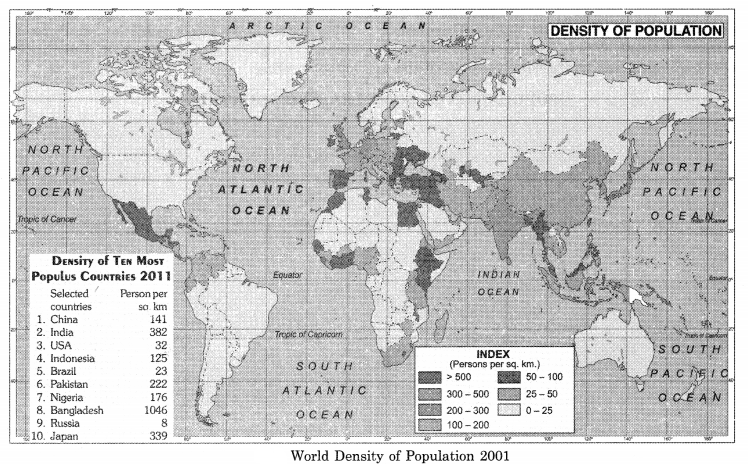
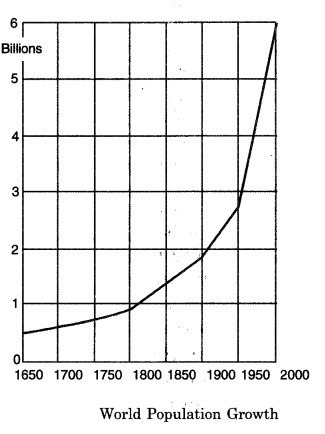
1 Mark Questions for History Class 12 Chapter 15 Framing the Constitution: The Beginning of a New Era

Here we are providing 1 Mark Questions for History Class 12 Chapter 15 Framing the Constitution: The Beginning of a New Era are the best resource for students which helps in class 12 board exams.

One Mark Questions for History Class 12 Chapter 15 Framing the Constitution: The Beginning of a New Era

Question 1.
When was the Indian Constitution framed?
Answer:
Between 9 Dec. 1946 and 26 Nov. 1949 A.D.

Question 2.
Who was the President of the Constituent assembly?
Answer:
Dr. Rajendra Prasad.

Question 3.
Who was the Chairman of Drafting Committee?
Answer:
Dr. B.R. Ambedkar.

Question 4.
How many ttiembers of the Constituent Assembly were there?
Answer:
389.

Question 5.
How many members remained in the Constituent Assembly after the partition of India?
Answer:
299.

Question 6.
Who gave objective resolution of the Constituent Assembly?
Answer:
Jawaharlal Nehru.

Question 7.
Under whose recommendation, the Constituent Assembly was formed?
Answer:
Under the recommendation of the Cabinet Mission.

Question 8.
Who was the Constitutional Advisor of the Government of India?
Answer:
B.N. Rau.

Question 9.
Who was the Chief Draughtsman of the Indian Constitution?
Answer:
S.N. Mukherjee.

Question 10.
Name the official language of India.
Answer:
Hindi.

Question 11.
When was the Indian Constitution framed ? When was it enforced ?
Answer:
The Indian Constitution was framed from December, 1946 to November, 1949 and was enforced on 26 January 1950.

Question 12.
Discuss the significance of the Indian Constitution. Give any two points.
Answer:
(i) It wanted to heal the wounds of the past.
(ii) It enabled people belonging to different classes, castes and communities to share a new political experience by coming together to each other.
(iii) It strengthened democratic institutions in the country.

Question 13.
What were the demands of low-caste people and linguistic minorities at the time of making the Indian Constitution ?
Answer:
(i) The low-caste people demanded an end to ill-treatment by the upper-caste people.
(ii) They also demanded reservation of separate seats, on the basis of their population, in legislatures, government departments and local bodies.
(iii) The linguistic minorities demanded freedom of speech in their respective mother-tongue. They also demanded redistribution of provinces on linguistic basis.

Question 14.
Name any six leaders who played an important role in the Constituent Assembly.
Answer:
(i) Pt. Jawaharlal Nehru
(ii) Sardar Patel
(iii) Dr. Rajendra Prasad
(iv) Dr. B.R. Ambedkar
(v) K.M. Munshi
(vi) Alladi Krishnaswami Aiyar

Question 15.
Who was the President of the Constituent Assembly ? Who was the Chairman of its Drafting Committee ?
Answer:
(i) Dr. Rajendra Prasad was the President of the Constituent Assembly.
(ii) Dr. B.R. Ambedkar was the Chairman of the Drafting Committee of the Constituent Assembly.

Question 16.
In the 19th century, what efforts were made by the social reformers for social justice and what efforts were made by communists and socialists for economic justice ? Give one point each.
Answer:
(i) The social reformers opposed child- marriage and supported widow-remarriage.
(ii) The communists and the socialists brought all labourers and peasants together. In other words, they organised them.

Question 17.
What provisions were made in the Constitution to make the Centre more strong ? Give any three arguments.
Answer:
(i) More subjects were included in the union list.
(ii) The Union Government has control over many minerals and important industries.
(iii) Article 356 empowers the centre to take over the state administration on the recommendation of the Governor.

Question 18.
What argument was given against Hindi being made a national language ?
Answer:
The people in South India were strongly opposed to Hindi. They viewed every propaganda for Hindi as cutting the very root of the provincial languages.

Question 19.
Which two features of the Indian Constitution had substantial agreement ?
Answer:
(i) Granting the right to vote to every adult citizen of India. It was called the Universal Adult Franchise.
(ii) Emphasis on secularism. It is the soul of the Indian Constitution.

Question 20.
In what way was the right of vote to every adult Indian a unique provision ?
Answer:
The right of vote to every adult citizen of India is a unique feature of the Indian Constitution. The people in the United States and the United Kingdom got this right after a long struggle. But the Indians got it during the framing of the Constitution.

Question 21.
What Fundamental Rights enshrined in the Indian Constitution ensure religious freedom ?
Answer:
They are as follows :
(i) Right to Equality
(ii) Right to Freedom of Religion
(iii) Cultural and Educational Rights.

Question 22.
Mention any two arguments given by Balakrishna Sharma for greater power to the Centre. (C.B.S.E. 2013 (O.D.))
Answer:
Bal Krishna Sharma stated that only a strong centre can make plans for the interest of the country, can provide requisite resources, can establish proper order and can save the country from foreign invasion.

Question 23.
Why is ‘Objectives Resolution5 of Nehru considered a momentous resolution ? Give any two reasons. (C.B.S.E. 2013 (D.))
Answer:
(i) It proclaimed India as an ‘Independent, Sovereign Republic’.
(ii) It guaranteed its citizens justice, equality and freedom.

Question 24.
How were the discussions in the Constituent Assembly influenced by the opinions expressed by the public ? State any two examples. (C.B.S.E. 2013 (O.D.))
Answer:
(i) Calcutta based All India Varnashrama Swarajya Sangh suggested that our Constitution should enshrine principles as given in ancient Hindu books.
(ii) Some people proposed the abattoirs should be closed and slaughter should be prohibited.

Question 25.
Mention how the provisions of the Government of India Act, 1935 were incorporated in the Indian Constitution by the Assembly members.
(C.B.S.E. 2013 (O.D.))
Answer:
Government of India Act, 1935 had a provision of strong and united centre. This provision was incorporated in the Indian Constitution by the Assembly members and they gave a very strong centre to the country.