An Imperial Capital: Vijayanagara Class 12 Important Extra Questions History Chapter 7

Here we are providing Class 12 History Important Extra Questions and Answers Chapter 7 An Imperial Capital: Vijayanagara. Class 12 History Important Questions are the best resource for students which helps in class 12 board exams.

Class 12 History Chapter 7 Important Extra Questions An Imperial Capital: Vijayanagara

An Imperial Capital: Vijayanagara Important Extra Questions Very Short Answer Type

Question 1.
Who founded the ruins of Hampi?
Answer:
Colonel Colin MacKenzie founded the ruins of Hampi.

Question 2.
Who founded the Vijayanagara Empire in 1336 C.E.?
Answer:
Two brothers Harihara and Bukka founded the Vijayanagara empire in 1336 A.D.

Question 3.
Which European company arrived on the Indian scene in 1498 A.D.?
Answer:
The Portugues.

Question 4.
Who was the most powerful ruler of the Vijayanagara Empire?
Answer:
Krishnadeva Raya.

Question 5.
When did Krishnadeva Raya die?
Answer:
In 1529 A.D.

Question 6.
Between whom the battle of Rakshasi- Tangadi was fought?
Answer:
Between Vijayanagara and the combined forces of Bijapur Ahmadnagar and Golconda.

Question 7.
Name the major political innovation of the Vijayanagara empire.
Answer:
The system of Amara-Nayakas.

Question 8.
Who were the Amara-Nayakas?
Answer:
They were the military commanders who were given territories to govern by the Raya or the Kings.

Question 9.
What is Mahanavami dibba?
Answer:
It was the massive platform rising from a base of about 11,000 feet to a height of 40 feet.

Question 10.
Where did kings meet advisers?
Answer:
At Lotus Mahal.

Question 11.
Which temple was used by the King and his family?
Answer:
Hazara Rama Temple.

Question 12.
When and by whom was the ‘ Vijayanagara Empire founded? Also, explain its expansion.
Or
Who founded the Vijayanagara ‘.Empire in 1336 C.E.? (C.B.S.E. 2013 (D))
Answer:
Two brothers namely Harihara and Bukka laid the foundation of the Vijayanagara Empire in 1336 C.E. It stretched from the river Krishna in the north to the extreme south of the peninsula.

Question 13.
Name different dynasties that ruled over Vijayanagara.
Answer:

  1. Sangam dynasty
  2. Saluva dynasty
  3. Tuluva dynasty
  4. Aravind dynasty.

Question 14.
What was the period of rule by Krishna Deva Raya? Which two cities of Bahmani Kingdom were controlled by him?
Answer:
Krishna Deva Raya ruled from 1509 to 1529 C.E. He had controlled both Gulbarga and Bidar.

Question 15. Between whom was the battle of Talikota (Rakshasi Tangadi) fought? Name the Kingdom defeated in this battle.
Or
What was the battle of ‘Rakshasi Tangadi’ (Talikota)? (C.B.S.E. 2013 (O.D.))
Or
Examine the outcome of the battle of Rakshasi – Tangadi (Talikota). (C.B.S.E. 2017 (O.D.))
Answer:
The battle of Talikota was fought in 1565 C.E. between the organization of Sultans of Deccan and ruler of Vijayanagara Sadashiva Raya. The Kingdom of Vijayanagara was defeated in this battle.

Question 16.
How did the name Hampi (another name for Vijayanagara) come into use? When and who discovered its ruins?
Answer:
Hampi was another name for Vijayanagara. This name was derived from the local mother goddess named Pampadevi. The ruins of Hampi were discovered in 1800 C.E. by Colonel Colin Mackenzie, an engineer, and antiquarian. In fact, Colin Mackenzie was an employee of the English East India Company.

Question 17.
Who was Amara-Nayakas? Identify any two works done by them.
Or
Who were the Amara-Nayakas under the Rayas in Vijayanagara? What did they do? (C.B.S.E. 2009 (D))
Answer:
Amara-Nayakas were the military commanders of Vijayanagara. They performed the following works :

  • They collected taxes and other dues from peasants, traders, and craft persons.
  • They provided an effective fighting force to the rulers of Vijayanagara.

Question 18.
Give any two features of Mahanavami Dibba of Vijayanagara.
Answer:

  1. Mahanavami Dibba is a massive platform located on one of the highest points in the city. It supported a wooden structure as well.
  2. The base of the platform is covered with relief carvings.

Question 19.
Mention any two ceremonies performed on the occasion of Mahanavmi Dibba. (C.B.S.E. 2010 (O.D.))
Answer:

  1. Worship of the image
  2. Worship of the State horse

Question 20.
Mention the two most striking features about the geographical location of Vijayanagara. (C.B.S.E. 2010 (D))
Answer:

  1. The most striking feature about the location of Vijayanagara is the natural basin formed by the river Tungabhadra which flows in a northeasterly direction.
  2. The huge fortification was another major feature of Vijayanagara.

Question 21.
Mention the rituals associated with Mahanavmi Dibba, situated in the Royal Centre of Vijayanagar. (C.B.S.E. 2010 (D))
Answer:

  • Worship of the image
  • Worship of the State horse
  • The sacrifice of buffaloes and other animals.

Question 22.
What was the Battle of ‘Rakshasi Tangadi’ (Talikota)? How was this battle responsible for the decline of Vijayanagara?
Answer:
The Battle of Talikota was fought in 1565 C.E. between the combined forces of the Deccan Sultans and the ruler of Vijayanagara Sadashiva Raya. In this battle Vijayanagara was defeated which led to the decline of Vijayanagara.

Question 23.
Which dynasty did Krishna Deva Raya belong to? Mention any one of his expansion and consolidation (C.B.S.E. 2013 (D))
Answer:
Krishna Deva Raya belonged to the Tuluva dynasty. Till 1512 C.E. he took control over the areas between Tungabhadra and Krishna river. Then he suppressed the rulers of Orissa (Odisha).

An Imperial Capital: Vijayanagara Important Extra Questions Short Answer Type

Question 1.
Give a brief description of ceremonies and special attractions related to Mahanavami Dibba of the city of Vijayanagara.
Answer:
Rituals associated with this structure probably coincided with Mahanavami of the ten-day Hindu festival during the months of September and October, known variously as Dushera in northern India, Durga Pooja in Bengal and Navaratri in peninsular India. The rulers of Vijayanagara displayed their power, prestige and sovereignty on this occasion.

Main ceremonies associated with this occasion were the worship of the image, worship of the State horse, the sacrifice of buffaloes and other animals, etc.

Main attractions of this occasion were

  1. Dances,
  2. Wrestling matches,
  3. Procession of caparison horses, elephants and chariots and soldiers,
  4. Ritual presentation by Nayaks and the subordinate kings before the king and his guests to mark the occasion. These ceremonies had great symbolic meaning. King used to inspect his army and armies of the Nayaks in a grand ceremony in an open field on the last day of the festival. Nayaks, on this occasion, used to bring rich gifts and stipulated tribute for the king.

Question 2.
Comment on the Lotus Mahal and Hazara Ram Temple of Vijayanagara.
Or
Give a brief description of Lotus Mahal, situated in the Royal Centre in the Vijayanagara empire. (C.B.S.E. 2010 (O.D.))
Answer:
Lotus Mahal: The royal centre of Vijayanagara had a very beautiful building. It was named as the Lotus Mahal by a British traveller in the nineteenth century. It seems to be a romantic name. However, it is still not clear to many historians what the building was used for. Mackenzie considered it to be a council chamber, a place where the king used to meet his advisers.

Hazara Rama Temple: This temple had a spectacular architecture. It was probably used only by the king and his family. No image has been found in this temple. But it had sculpted panels on the walls. These included the scenes from the Ramayana on the inner walls.

Question 3.
For what purpose were the halls of the Virupaksha temple used? What were the features of the chariot streets that existed in the temple complexes?
Or
How were the halls in Virupaksha Temple used? Mention any two purposes, (C.B.S.E. 2009 (O.D.))
Or
“The Virupaksha Temple developed as significant architectural, religions and cultural centre.” Explain the statement with suitable examples. (C.B.S.E. 2019 (D))
Answer:
The Virupaksha Temple was built in the ninth-tenth centuries. It had a hall in front of the main shrine. This hall was constructed by Krishna Deva Raya to mark his accession to the throne. Such halls were used for a variety of purposes. In some of these halls, the images of gods were placed. In a few other halls, special programmes of music, dance and drama were held. Few other halls were used to celebrate the marriages of deities. In some other halls, the swings of the deities were installed.

The chariot streets extended from the temple gopuram in a straight line. They were paved with slabs of stone. They had lines of pillared pavilions wherein the merchants set up their shops.

Question 4.
Who were Nayakas and Amara-Nayakas? Describe their role in the administration of Vijayanagara.
Answer:
Nayakas and Amara-Nayakas were the military chiefs and military commanders respectively of Vijayanagara kingdom.

Role of Nayakas and Amara-Nayakas in Administration:

Nayaks: Nayakas generally controlled the forts and had armed supporters with them. They moved from one place to another and were sometimes accompanied by peasants in search of fertile land. They generally spoke Telugu and Kannada languages. Many Nayakas surrendered to the authority of the rulers of Vijayanagara. But they often rebelled and had to be suppressed by military actions.

Amara-Nayakas: The Amara-Nayakas were military commanders. They were given territories by Rayas to govern. They used to collect taxes and other dues from peasants, craftspersons and traders. They used to keep some portion of the revenue with them for their personal use and for maintaining a fixed number of horses and elephants.

They used to submit the rest of the revenue in the state treasury. Their contingents used to provide military help to Vijayanagara rulers if any need arose. Through their help, rulers controlled the whole of the southern peninsula. Some portion of revenue was spent on temple and maintenance of the means of irrigation.

Question 5.
Explain the reasons for the decline of the Vijayanagara Empire.
Answer:
The following are the reasons for the decline of the Vijayanagara Empire :

  1. All the power of the state was vested in the hands of the king. The people had no role in the administration of the state. So they did not help the king at the time of crisis.
  2. The successors of Krishna Deva Raya were troubled by rebellious Nayakas or military chiefs. These rebellions weakened the position of the king.
  3. All the successors of Krishna Deva Raya were very weak. They had to fight many wars against the Deccan Sultanates. All these harmed the Vijayanagara Empire.
  4. There was an alliance of the Sultanates against Vijayanagara.
  5. The central control had shifted to another ruling lineage, that of the Aravidu in the 17th century.
  6. In 1565 C.E., Rama Raya, the Chief Minister of Vijayanagara, fought a war against the combined armies of Bijapur, Ahmadnagar and Golconda at Talikota. He lost this war and was also killed. After his defeat, the victorious armies ransacked the whole city of Vijayanagara and the city was totally abandoned within a year.

Question 6.
Explain the administration of the rulers of Vijayanagara.
Answer:
The main features of the administration of Vijayanagara were as follows :

  1. The chief of the central administration in Vijayanagara was the king. He held all the powers of administration. There was also a provision of the council to help the king.
  2. The state of Vijayanagara was divided into 200 provinces. The chief of the province was called the Prantpati who belonged to the royal family and at times too powerful and wealthy families.
  3. For the convenience of the Prantpatis, every province was divided into districts and the districts were divided into Parganas which were further divided into villages.
  4. There was a provision for a powerful army for the protection of the state. It had horses and soldiers.
  5. The chief judge of the state was the king himself. In provinces, the Prantpati or subedar delivered justice. The punishments were very severe.
  6. The land revenue was the main source of income of the state. The farmers had to pay 1/6 to l/4th of the produce of the crop as the land revenue. The economic condition of the farmers was good. They enjoyed all the comforts of life.

Question 7.
Explain how Krishan Deva ‘Raya’s death affected the Vijayanagar empire. (C.B.S.E. 2008 (D))
Or
“Strain began to show within the imperial structure following Krishna Deva Raya’s death in 1529.” Critically •
examine the statement. (C.B.S.E. 2011 (O.D.))
Or
Why did strain begin to show within; ‘ the imperial structure after the death • of Krishna Deva Raya in 1529? (C.B.S.E. 2012 (O.D.))
Or
Why did the imperial power of Vijayanagara decline after the death of Krishna Deva Raya?
Answer:
After the death of Krishna Deva Raya in 1529, the royal structure witnessed tensions. The royal inheritors had to face opposition from rebellious heroes and commanders. As a result, the control of Aravidu Dynasty was established over Vijayanagara by 1524 C.E. It held its control over the royal authority till the 17th century. Even during this period, the relations between the rulers of Vijayanagara and the Sultans of the Deccan remained strained because they nurtured ambitions which vacillated balance between the two times and again.

At last, friendship was established between the rulers of Vijayanagara and the Sultans of the Deccan. In 1565, the army of Vijayanagara, under the leadership of Prime Minister Rama Raya fought at Talikota. Here it was defeated by the armies of the Sultans of Bijapur, Ahmednagar and Golconda. The victorious soldiers attacked Vijayanagara and plundered it. The city was completely destroyed in a few years. Now the centre of empire moved towards the East. Here, the Aravidu Dynasty ruled from Penunkonda and after it Chandragiri near Tirupati.

Question 8.
Describe the significance of temple building in the Sacred Centre of Vijayanagara. (C.B.S.E. 2010 (O.D.))
Answer:
Temple building in the region had a long history going back to dynasties like Chalukyas, Pallavas, Cholas and Hoysalas. Rulers generally encouraged temple building to associate themselves with the divine. Often the deity was implicitly or explicitly identified with the king. Temples also functioned as centres of learning. Rulers often granted land or money for the maintenance of temples. As a result, temples developed as important social, religious, cultural and economic centres. For rulers, construction, repair and maintenance of temples were important means of winning support and recognition for their power, wealth and piety.

It is quite possible that the choice of Vijayanagara site was encouraged by the existence of the shrines of Virupaksha and Pampadevi. In fact, the Vijayanagara kings claimed to rule on behalf of the god Virupaksha.

Many new elements were innovated in temple building. These include making of large structures. These structures were symbols of royal authority.

Question 9.
Describe briefly what the buildings that survived tell us about the way, spaces were organised and used in Vijayanagara.
Answer:
Buildings which survived tell us about the way spaces were organised and used in Vijayanagara. For example, we can assess the defence requirements and military preparedness of a city by studying its fortifications. Buildings also tell us about the spread of ideas and cultural influences if we compare them with buildings in other places. They convey ideas which the builders or their patrons wished to project. They are often suffused with symbols which are a product of their cultural context. These we can understand when we combine information from other sources like literature, inscriptions and popular traditions.

Question 10.
Explain briefly any five striking features about the location of Vijayanagara. (C.B.S.E. 2012 (O.D))
Answer:

  1. The natural basin formed by the river Tungabhadra which flows in a northeasterly direction.
  2. The surrounding landscape is characterised by stunning granite hills that seem to form a girdle around the city.
  3. A number of streams and rivers flow down from these rocky outcrops.
  4. In almost all cases embankments were built along these streams to create reservoirs of varying sizes.
  5. As this is one of the aridest zones of the peninsula, elaborate arrangements had to be made to store rainwater and conduct it to the city.

Question 11.
“The rulers of Vijayanagara innovated and developed new traditions in the Virupaksha Temple”. Elaborate. (C.B.S.E. 2015 (D))
Answer:

  1. The site of Vijayanagara was inspired by the existence of the shrines of Virupaksha and Pampadevi. The Vijayanagara kings claimed to rule on behalf of the god Virupaksha.
  2. All royal orders were signed in the name of “Shri Virupaksha” usually in Kannada script.
  3. Rulers also indicated their close links with the gods by using the title ‘Hindu Suratrana’. It was a Sanskritisation of the Arabic term Sultan, meaning Hindu Sultan or King.
  4. Royal portrait sculpture was displayed in temples, and the king’s visits to temples were treated as important state occasions on which he was accompanied by the important Nayakas of the empire.

An Imperial Capital: Vijayanagara Important Extra Questions Long Answer Type

Question 1.
Give a brief description of emergence and destruction of the Vijayanagara empire.
Answer:
Members of ruling lineage and military commanders were among the claimants of power of the Vijayanagara empire.
Initial Three Dynasties: The first dynasty that ruled over Vijayanagara was Sangama dynasty. This dynasty ruled till 1485 C.E. They were supplanted by the Saluvas, who were the military commanders. They remained in power till 1503 C.E. and were replaced by Tuluvas. Krishna Deva Raya was the most famous ruler of the Tuluva dynasty.

The main feature of the rule of Krishna Deva Raya was his expansion and consolidation. Till 1512 C.E. he took control over the areas between Tungabhadra and Krishna river (Raichur Doab). Then he suppressed the rulers of Orissa. He also defeated the Sultan of Bijapur in 1520 C.E. Although the kingdom always remained in the state of military preparedness still it flourished under the atmosphere of peace and prosperity. Krishna Deva is also credited with the construction of few splendid temples and impressive gopurams in many important temples. He also founded a suburban town of Nagalapuram after the name of his mother.

Aravind Dynasty and Decline of Vijayanagara Empire: Strains came in the imperial structure after the death of Krishna Deva Raya in 1529 C.E. His successors had to face the challenge of rebel Nayaks or Commanders. In the end, the centre came under the control of Aravidu dynasty in 1542 C.E. This dynasty remained in power till 17th century. During this period, like earlier one, alignments kept on shifting due to military ambitions of Vijayanagara rulers and Deccan Sultanates.

These ambitions led to an alliance of Deccan Sultanates against the Vijayanagara. In 1565 C.E., the chief minister of Vijayanagara, Rama Raya, led the army against the Sultanates army in the battle of Rakshasi-Tangradi. There his forces were routed by the combined forces of Bijapur, Ahmadnagar and Golconda. Afterwards, the city was plundered by the victorious army. Within a few years, this city was totally abandoned. Now the entire focus of the empire was shifted to the east where the Aravidu dynasty ruled from Penukonda and later from Chandragiri.

Question 2.
What was the role of Nayakas and Amara-Nayakas in the administration of Vijayanagara?
Or
Explain how the Amara-Nayakas system was a major political innovation of the Vijayanagara Empire? (C.B.S.E. 2011 (O.D.)), (2015, (D))
Or
“Arnar Nayakas system was a major political innovation of Vijayanagara empire,” Justify. (C.B.S.E. 2014 (O.D.))
Or
Why was Amar Nayakas system considered as a major political innovation of the Vijayanagara empire? Explain. (C.B.S.E. 2019 (Comp.))
Answer:
The Nayakas and the Amara-Nayakas exercised considerable power in the Vijayanagara Empire.

Nayakas: They were the military chiefs in the Vijayanagara Empire and usually controlled forts. They had armed supporters and often moved from one area to another. In many cases, they were accompanied by peasants who looked for fertile land for their settlement. They were called Nayakas as their role was quite significant. They usually spoke in Telugu or Kannada language. They were mostly submissive to the authority of the kings of Vijayanagara. But sometimes they also rose in rebellion and had to be controlled by military action.

Amara-Nayakas: The Amara-Nayakas were a major political innovation of the rulers of the Vijayanagara Empire. They were the military commanders who governed the territories given by the kings of Vijayanagara. They collected taxes and other dues from peasants, traders and craft-persons in their areas. A part of the revenue was kept for their personal use and maintaining their horses and elephants. They provided an effective fighting force to the rulers of Vijayanagara. They also kept some of the collected revenue for the maintenance of temples and irrigation works.

The Royal Control over the Amara-Nayakas: At times when Nayakas and Amara-Nayakas revolted, the kings asserted their control on them and made them submit to the royal authority. The kings adopted the following means to control them :

  • They transferred Amara-Nayakas from one place to another.
  • They accepted an annual tribute from the Amara-Nayakas.
  • All the Amara-Nayakas had to appear in the royal court personally. They had to present gifts to the king to express their loyalty.

Question 3.
Discuss the water resources, fortification and roads of Vijayanagara.
Or
Explain how the fortification and roads in the city of Vijayanagara were unique and impressive.
Or
Explain the striking features about the location of Vijayanagara, its water resources and its fortification. (C.B.S.E. 2011 (O.D.))
Or
Explain why Abdur Razzaq, a Persian Ambassador, was greatly impressed by the fortification of Vijayanagara Empire during the 15th century. (C.B.S.E. 2013 (D))
Or
“Domingo Paes and Abdur Razzaq I were highly impressed with the fortification of the Vijayanagara empire.” Justify the statement. (C.B.S.E. 2014, 2019 (D))
Or
Highlight any four aspects observed by Abdur Razzak on the fortification of the Vijayanagara Empire. (C.B.S.E. 2016 (D))
Or
Explain the significance of enclosing of agricultural land within the fortified area of the city of Vijayanagara. (C.B.S.E. 2019 (O.D.))
Answer:
Water Resources: To fulfil their water requirements, the rulers of Vijayanagara, built reservoirs of varying sizes. As this city was in the aridest zones of the peninsula, the rulers made elaborate arrangements to store rainwater and take it to the city. They built a very large tank in the early years of the fifteenth century.

It is now called Kamalapuram Tank. This water not only irrigated the fields but also served the royal centre. The water of the river Tungabhadra was also fully utilised. Besides, there was the Hiriya Canal which drew water from a dam across the Tungabhadra river. This canal, built by kings of the Sangama Dynasty irrigated the cultivated valley.

Fortifications: Different parts of the city of Vijayanagara were enclosed with the great fortress walls. There were seven lines of forts which not only encircled the city of Vijayanagara but also its agricultural land and forests. The outer-most wall linked the hills surrounding the city. This wall was built with wedge-shaped blocks of stone. They fixed well into each other and did not require mortar or any cementing agent. The inner portion of the walls was of earth packed with rubble.

This fortification enclosed agricultural tracts like cultivated fields, gardens and forests. The modern archaeologists have found evidence of an agricultural tract between the sacred centre and the urban core. To irrigate this tract, there was an elaborate canal system which drew water from the Tungabhadra.

The agricultural tracts were incorporated within the fortified area with a purpose. In the medieval periods, sieges were laid to starve the defenders into submission. These sieges could last even for months and years. So the rulers built large granaries within the fortified areas. Therefore the rulers of Vijayanagara adopted an elaborate strategy to protect their agricultural belt.

However, the second line of fortification surrounded the inner core of the urban complex and the third line of fortification went round the royal centre. There were well-guarded gates to enter the fort which led to the major roads. They had distinctive architectural features. There was an arch on the gateway and a dome over the gate.

Roads: The roads linked different parts of the city of Vijayanagara. They also led out of the city, went through the whole valley and avoided rocky terrain. Many important roads started from temple gateways and were lined by bazaars.

Question 4.
Explain the main features of the Sacred Centre.
Answer:
The site of Vijayanagara was inspired by the shrines of Virupaksha and Pampadevi. The northern end of the city touched the banks of the Tungabhadra. It was a rocky and hilly area. According to a local tradition, the kingdoms of Bali and Sugriva, mentioned in the Ramayana, existed in these hills. There is another tradition that Pampadevi, the local mother goddess, did penance in these hills in order to marry Virupaksha, the guardian deity of the kingdom. The marriage is annually celebrated in the Virupaksha temple. Besides, there were Jaina temples in the pre- Vijayanagara period. In other words, this area was associated with many sacred traditions. Hence it is called the Sacred Centre.

The very choice of the site of Vijayanagara was inspired by these sacred traditions and temples. The kings of Vijayanagara claimed to rule on behalf of the god, Virupaksha. They signed all royal orders as ‘Shri Virupaksha’. They often signed in the Kannad script. However, the rulers of Vijayanagara not only developed but also innovated the earlier traditions. They displayed royal portrait sculpture in the temples. The visit of the kings to temples was treated as an important occasion. So he was accompanied by Important Nayakas.

Question 5.
Give a brief description of the rule of Krishna Deva Raya.
Or
“Krishna Deva Raya’s rule was characterised by expansion and consolidation.” Justify the statement on the bases of evidence. (C.B.S.E. 2011 (D))
Or
Highlight the contribution of Krishnadeva Raya in the expansion of the Vijayanagara Empire. (C.B.S.E. 2016 (D))
Or
Why the Krishna Deva Raya considered as the greatest ruler of the Vijayanagara Empire? Explain. (C.B.S.E. 2019 (Comp.))
Answer:
There prevailed chaos in the Vijayanagara Kingdom after the death of Deva Raya II. Gradually the old Sangam Dynasty came to an end. Under these circumstances, Krishna Deva Raya founded the Tuluva Dynasty and himself began to rule over Vijayanagara. He ruled from 1509 till 1529 C.E. Following were his main achievements:

Expansion of the Kingdom: Krishna Deva Raya had to compete with old enemies of Vijayanagara, i.e., successors of the Bahmani Kingdom and Orissa. After fighting many battles for seven years, he forced Orissa to return the conquered areas of Vijayanagara up to Krishna river. Then he consolidated his position and began his earlier battle for Tungabhadra Doab. As a result, two of his enemies, Orissa and Bijapur, came in an alliance with each other. Krishna Deva had also made enough preparations and attacked Raipur and Mudhkal.

Sultan of Bijapur lost in the battle in 1520 C.E. Krishna Deva forced him to move back beyond Krishna river. Then his army reached Belgium. He conquered Bijapur and plundered the whole city and also destroyed Gulbarga. In this way, during the reign of Krishna Deva Raya, the Vijayanagara kingdom became one of the strongest kingdoms of Deccan.

Great Architect and Scholar: Krishna Deva Raya himself was a great scholar. He built a new suburban town near Vijayanagara and built a large tank which was used for irrigation purposes. He was a very good scholar of Telugu and Sanskrit. Out of a number of texts written by him, only a book on politics in Telugu and a Sanskrit play is available these days. A new era of Telugu literature began during his reign and scholars started to write in Telugu instead of translating from Sanskrit. He was very fond of poetry and used to patronage Telugu as well as Kannada and Tamil poets.

Good Administrator: Many foreign travellers like Barbosa, Paes and Fernao Nuniz wrote about his good administration and prosperity of the kingdom during his reign. One of the major achievements of Krishna Deva Raya was the emergence of a sense of tolerance as everyone was free to move anywhere. No one was asked about his religion and was free to adopt one’s religious practices. Barbosa also praised Krishna Deva Raya for his justice and equality in the kingdom.

In the end, it is clear that Krishna Deva Raya was the greatest of all the rulers of the Vijayanagara Kingdom.

Question 6.
Describe the administrative system of the Vijayanagara Kingdom.
Answer:
The administrative system of the Vijayanagara Kingdom is given below :

  1. King: Head of the central administration in Vijayanagara was himself the king. He had unlimited powers and rights. He had made a system of the council of ministers for his help. But its only function was to provide advice to the king.
  2. Council of Ministers: A system of the council of ministers was made to give help and advice to the king. It included the ministers, purohita, military commander, etc. All of these were appointed by the king himself.
  3. Provincial Administration: Vijayanagara was divided into 200 provinces. Every province was administered by a Prantpati (Governor) and these were either related with the royal family or were powerful nobles. They were also appointed by the king himself.
  4.  Local Administration: While keeping in mind the convenience of administration, every province was divided into districts. The district was further divided into Parganas and it was further divided into villages. Administration of the village was given to gram panchayat. Major officer of all these institutions was known as Iyengar.
  5. Military Organisation: Vijayanagara was engaged in constant conflict with Bahmani SultAnswer: As a result, local rulers had to give special attention to their military organisation. Military of Vijayanagara kingdom was of two types-provincial military and central army. The army included elephants, horses and infantry. Cavalry was a major part of the army.
  6. Judicial System: King himself used to perform the function of Chief Justice in the Vijayanagara kingdom. Iyengar in villages, prantpati in provinces used to perform this work. Very strict punishments were there. Punishment of amputating the limb of the body was given for serious crimes but people were only fined for minor crimes.
  7. Land Revenue System: King himself was the owner of the whole of the land in the Vijayanagara kingdom. He used to divide this land to the landlord who used to further divide among farmers. Farmers had to pay 1/ 6th or l/4th of produce to the landlord as land revenue. The economic condition of farmers was the very good end they had every available comfort in life.

Question 7.
Explain the social and economic conditions of Vijayanagara.
Answer:
The social and economic condition of Vijayanagara is as follows :
Social Condition :
1.Respect for Brahnlans: The Brahmans were greatly respected in the state of Vijayanagara. They attained a supreme position in the state. Even when they committed a crime, they were not given the punishment of death. They led a pious life and were vegetarians were: They never touched meat and wine. They were an ideal and role model for others.

2. Place of Women: The women were given a lot of respect in Vijayanagara. They could even get higher education. They had no purdah system. They were also educated in warfare and fine arts.

3. Malpractices: The society of Vijayanagara had many malpractices. The animals were sacrificed to please gods and goddesses. The practice of Sati was very popular in society. Even the Telugu women were buried alive after the deaths of their husbands. Besides, there was an evil of prostitution. Deva Raya II had twelve thousand queens. He had married three thousand queens on the condition that they would perform Sati after his death.

Economic Condition: The economic condition of Vijayanagara was prosperous. Its land was fertile and there was enough trading activity. The rulers of Vijayanagara had good relations with the Portuguese. There was trading of Arabian horses. The sea coasts of Vijayanagara had many ports. Calicut was a famous sea-port during those days. It was used to trade with Burma, China, Iran, Arabia, Portugal and South Africa.

It was used to export cloth, rice, sugar, iron and spices and import horses, elephants, copper, silk and diamond jewellery. The merchants had established their trade centres. There was a currency of gold and silver. It facilitated the exchange of goods. Besides the trade, there was great progress in industry and agriculture. The main occupation of the people was weaving cloth, mining of minerals and to prepare metal goods.

Question 8.
In which circumstances was Vijayanagara kingdom founded? Who were its famous rulers and to which dynasties did they belong?
Or
Describe the stages by which the Vijayanagara empire was built. (C.B.S.E. 2008 (O.D.))
Answer:
Vijayanagara was founded in 1336 C.E. Its founders were two brothers called Harihara and Bukka Raya. They founded a city called Vijayanagara on the banks of river Tungabhadra. Gradually, this city was transformed into the large Hindu Kingdom. This kingdom was ruled over by three dynasties:

  1. Sangama dynasty
  2. Saluva dynasty
  3. Tuluva dynasty

Rulers: Some of the famous rulers of Vijayanagara kingdom are given below:

  1. Harihara I: Harihara I himself founded the Vijayanagara with the help of his brother Bukka Raya. He belonged to Sangama dynasty. He expanded the frontiers of his kingdom from Krishna river till Kaveri river and from eastern ghats till western ghats.
  2. Bakka Raya I: After Harihara I, Bukka Raya became the next king. He also belonged to Sangama dynasty. He beautified the city of Vijayanagara and fought wars with Bahmani rulers.
  3. Harihara II and Devaraya II: These two were the last famous rulers of Sangama dynasty. Devaraya appointed Muslims in his army. He greatly increased the prestige of Vijayanagara.
  4. Krishna Deva Raya: Krishna Deva Raya was the most famous ruler of Tuluva dynasty. He ruled from 1509 till 1530 C.E. First of all, he suppressed the revolts of Nayakas. Then he conquered the region of Raichur Doab. Under his reign, the prestige of Vijayanagara spread everywhere.
  5. Sadashiv Raya: He was the last ruler of Tuluva dynasty. During his reign, rulers of Ahmadnagar, Bijapur, Golconda and Bidar made an alliance and attacked Vijayanagara. Army of Vijayanagara was defeated in 1565 C.E. in the battle of Talikota. The victorious army sacked the city of Vijayanagara and conquered its area. In this way, Vijayanagara kingdom completely came to an end.

Question 9.
Explain the importance of the Sacred Centre in Vijayanagara with special emphasis on Gopurams and Mandapas. (C.B.S.E. 2008 (D))
Answer:
The rulers of Vijayanagara incorporated many new elements in the establishment of temples.

1. They include extensive structures. These structures stood for royal authority. The best examples of these structures were Rai Gopuram and State Entrance Gates. The minarets of Central Devalayas seemed quite tiny before these Entrance Gates. One could, from a long distance, visualise the existence of a temple from these minarets which also reminded of the royal authority. In fact, the rulers of Vijayanagara were competent to provide means, technology and technique to build such huge structures.

2. Another main characteristic of these temples was big porches, long pillars and vast spaces. These porches were made around all the sides of the temples.

3. Hundreds of years were spent in the construction of the Virupaksha temple. Many carved stones depict that many of the temples were built in the 9th and the 10th centuries. But there was a great expansion in the construction of many temples after the establishment of the Vijayanagara empire.

There was a great porch in front of the main temple. It was built by Krishna Dev Raya regarding his coronation. It was decorated with beautifully engraved pillars. Krishna Deva Raya is also credited with the construction of Eastern Gopuram. It meant that the Central Devalaya was confined to a limited part of the whole complex.

4. The temple had many conference halls which were used for different purposes. Some meeting halls had idols of gods and goddesses so that they may have a glimpse of music, dance and plays. Another conference hall was used to enjoy festive marriages of gods and goddesses. In many other halls, the gods and goddesses were placed on the swings. There were special idols for such purposes which were different from those placed in the Central Devalayas.

Another famous devotional place is the Vitthala Temple. The main god of this temple was Vitthala. He was the incarnation of Vishnu who is mostly worshipped in Maharashtra. The worship of this god was started in Karnataka by the rulers of Vijayanagara. It symbolised the emergence of empirical culture. Like other temples, this temple also had many conference halls. It also had a beautiful temple which was in the shape of a chariot.

5. Another characteristic of the temple premises was that they had chariot lanes. They were in straight lines just as in the temple of Gopuram. They had a floor made of stone. On both sides, it had a pillared porch. The traders set up their shops in these porches. Some of the north-facing Gopurams were built by the local heroes.

6. Besides the establishment of temples, the kingdom had fortifications, water-reservoirs, canals and roads. The architects made use of Islamic architecture in the erection of pillars and tombs. Thus, an Indo-Islamic style developed in the field of architecture.

Question 10.
Describe the main features of the temples of Vijayanagara. (C.B.S.E. 2008 (O.D.))
Answer:
The city of Vijayanagara was developed on the banks of the Tungabhadra river. Its northern part was mountainous. According to local beliefs, these mountains belonged to the Ramayana period. They saved the Kingdom of Sughreev. There are a few other beliefs among the local people. Some believe that the local deity Pampa Devi had meditated amidst these mountains to marry Virupaksha. The patron of Virupaksha were Gods. He was considered a form of Lord Shiva. Till today their marriage is celebrated with great pomp and show in the Virupaksha Temple. These mountains of Vijayanagara also have an ancient Jain Temple. In fact, this city is associated with many religious beliefs.

The region has a long history of temple construction. It goes up to the extent of Pallav, Chalukya, Hoysala and Chaul Dynasties. The rulers constructed temples to seek divine blessings. The god was directly or indirectly linked to the king. These temples also served as educational centres. The rulers donated land or money for these temples. Thus, the temples became important religious, social, cultural and economic centres. The rulers had abundant resources to make and maintain these temples.

There were many new innovations in the domain of temple construction. They had huge structures. These structures were the symbol of royal authority. The best examples of these structures included gopurams and Royal Entrance Gate. Due to these huge entrance gate, the minarets of the Central Devalayas seemed quite small. These minarets show the existence of temples from the very distance. They also reminded about the royal authority which had resources, skill and technology to construct them. These temples also had mandapas and Porches with long pillars.

Question 11.
Outline the distinctive features of the Virupaksha temple and the Vitthala temple in the Royal Centre of Vijayanagara Empire. (C.B.S.E. 2017 (D.))
Answer:
The city of Vijayanagara was developed on the banks of the Tungabhadra river. Its northern part was mountainous. According to local beliefs, these mountains belonged to the Ramayana period. They saved the Kingdom of Sughreev. There are a few other beliefs among the local people. Some believe that the local deity Pampa Devi had meditated amidst these mountains to marry Virupaksha. The patron of Virupaksha were Gods. He was considered a form of Lord Shiva. Till today their marriage is celebrated with great pomp and show in the Virupaksha Temple. These mountains of Vijayanagara also have an ancient Jain Temple. In fact, this city is associated with many religious beliefs.

The region has a long history of temple construction, It goes up to the extend of Pallav Chalukya, Hoysala and Chaul Dynasties. The rulers constructed temples to seek divine blessings. The god was directly or indirectly linked to the king. These temples also served as educational centres. The rulers donated land or money for these temples. Thus, the temples became important religious, social, cultural and economic centres. The rulers had abundant resources to make and maintain these temples.

There were many new innovations to the domain to temple construction. They had huge structures. These structures were the symbol of royal authority. The best examples of these structures included gopurams and Royal Entrance Gate. Due to these huge entrance gate, the minarets of the Central Devalayas seemed quite small. These minerals show the existence of temples from the very distance. They also reminded about to royal authority which had resources, skill and technology to construct them. These temples also had mandapas and Porches with long pillars.

The Virupaksha Temple was built in the ninth- tenth centuries. It had a hall in front of the main shrine. This hall was constructed by Krishna Deva Raya to mark his accession to the throne. Such halls were used for a variety of purposes. In some of these halls, the images of gods were placed. In a few other halls, special programmes of music, dance and drama were held. Few other halls were used to celebrate the marriages of parties. In some other halls, the swings of the deities were installed.

The chariot streets extended from the temple Gopuram in a straight line. They were served with slabs of stone. They had lines of pillared pavilions wherein the merchants set up their shops.

An Imperial Capital: Vijayanagara Important Extra Questions HOTS

Question 1.
Mention any two features about the location of the city of Vijayanagara. (C.B.S.E. 2009 (O.D.))
Answer:

  1. Vijayanagara had an impressive fortification. This fortification enclosed agricultural tracts, like cultivated fields, gardens and houses.
  2. The second line of fortification encircled the inner core of the urban complex whereas the third fortification surrounded the royal centre.

Question 2.
Who was Colin Mackenzie? On which things was his initial information on Hampi based?
Answer:
Colin Mackenzie was an engineer and antiquarian. He prepared the first survey of Hampi. His initial information about this city was based on the memories of priests of the Virupaksha temple and the Shrine of Pampadevi.

Question 3.
Which policy did rulers of Vijayanagara adopt to control Amara-Nayakas? Did this policy succeed?
Answer:
The rulers of Vijayanagara controlled the Amara-Nayakas by adopting the following policy :

  1. The king transferred Amara-Nayakas from one place to another.
  2. The kings got an annual tribute from them. All the Amara-Nayakas had to personally appear in the royal court to offer gifts and express their loyalty for the king.

However, this policy did not succeed. By the 17th century, many Amara-Nayakas had established their own independent states. This hastened the collapse of the Vijayanagara Empire.

Question 4.
What was the importance of Kamala- Puram Tank?
Answer:
Kamalapuram tank was one of the most important tanks of Vijayanagara. Water from this tank was not only used to irrigate nearby fields but its water was also taken to the royal centre through a channel.

Question 5.
Explain any two features that were imbibed in the temple architecture under the rulers of Vijayanagara.
Or
Mention two characteristic features of the temple complexes in Vijayanagara. (C.B.S.E. 2010 (O.D.))
Answer:

  1. The temples had large establishments. They had gopurams and royal gateways.
  2. The temples also had mandaps, pavilions besides long and pillared corridors. These corridors often ran around the shrines.

Question 6.
Who founded the Vijayanagara Empire in 1336 C.E.? Mention any one reason for their competition with contemporary rulers. (C.B.S.E. 2013 (D))
Answer:
Two brothers namely Harihara and Bukka Raya laid the foundation of the Vijayanagara Empire in 1336. One reason for their competition with contemporary rulers was to control the fertile river valleys and the resources generated by lucrative overseas trade.

Question 7.
Describe which factor was mainly responsible for the destruction of Vijayanagara.
Answer:
Although armies of Sultan were mainly responsible for the destruction of Vijayanagara city, even in spite of the religious differences, relations between Rayas and the Sultans were not always hostile. For example, Krishna Deva Raya supported some of the claimants of power in Sultanates and took pride in obtaining the title of ‘Establisher of the Yavana kingdom.

In the same way, after the death of Krishna Deva Raya, Sultan of Bijapur also intervened to resolve succession disputes in Vijayanagara. Actually, both Vijayanagara kings and Sultanates were been to ensure the stability of each other. As Rama Raya tried to play off one Sultan against the other but it led the Sultans to combine together. They defeated Rama Raya in a decisive battle.

Question 8.
Describe the various efforts made by the scholars to produce the wealth of information of Vijayanagara after Mackenzie’s time. (C.B.S.E. 2008 (D))
Answer:
To get information about the Vijayanagara, initial efforts were made by Mackenzie. Thereafter, stone-edicts and travel descriptions were added to it. This place came under the control of Archaeological Survey of India and Karnataka Antique Museum in the 20th century. In 1976 C.E., Hampi was accepted as a place of national importance. Thereafter, on the basis of the information and edicts available, a detailed programme was chalked out to explore the remnants of Vijayanagara.

For about 20 years, a dozen scholars of the world gathered every information and conserved it. The preparation of an outline map of the area is part of this project. In the first phase, the whole of the area was divided into 25 square parts. Every part was given a letter from an alphabet to name it. Then they were further divided into different sub-parts. The smaller parts were further divided into a single unit.

All these surveys were made after thorough scrutiny and a lot of hard work. It led to the study of thousands of structures of small devotional places, residence and big temples. The details about them were also penned down. With these works, the roads, paths and bazaars of Vijayanagara can be enlivened. Their position has been determined on the basis of pillars and porches.

Question 9.
Why was Vitthala temple of the Vijayanagara unique? (C.B.S.E. 2015 (O.D.))
Or
Why was the Vitthala temple of Vijayanagara considered unique and interesting? Explain with examples. (C.B.S.E. 2019 (O.D.))
Answer:
In Vijayanagara famous devotional place is Vitthala Temple. The main god of this temple is Vitthala. He is the incarnation of Vishnu worshipped in Maharashtra. The worship of this god was started in Karnataka by the rulers of Vijayanagara. It symbolised the emergence of imperial culture. Like other temples, this temple has many conference halls. It has also a beautiful temple which is in the shape of a chariot.

Another characteristic of the temple premises is that there are chariot streets. They are in straight lines just as in the temple of Gopuram. The streets are paved with stone slabs and lined with pillared paviliAnswer: The traders set up their shops in this paviliAnswer: Some of the unique Gopurams were built by the local Nayaks.

An Imperial Capital: Vijayanagara Important Extra Questions Source-Based

Read the following passages and answer the questions that follow :

Question 1.
The Bazaar

Paes gives a vivid description of the bazaar: Going forward, you have a broad and beautiful
street In this street live many merchants,
and there you will find all sorts of rubies, and diamonds, and emeralds, and pearls, and seed- pearls, and cloths, and every other sort of thing there is on earth and that you may wish to buy. Then you have there every evening a fair where they sell many common horses and nags, and also many citrons, and limes, and oranges, and grapes, and every other kind of garden stuff, and wood; you have all in this street.

More generally, he described the city as being “the best provided city in the world” with the markets “stocked with provisions such as rice, wheat, grains, Indian corn and a certain amount of barley and beans, moong, pulses and horse-gram” all of which were cheaply and abundantly available. According to Fernao Nuniz, the Vijayanagara markets were “overflowing with an abundance of fruits, grapes and oranges, limes, pomegranates, jackfruit and mangoes and all very cheap.”

Meat too was sold in abundance in the marketplaces. Nuniz describes “mutton, pork, venison, partridges, hares, doves, quail and all kinds of birds, sparrows, rats and cats and lizards” as being sold in the market of Bisnaga (Vijayanagara).
(i) In which city was this bazaar found?
Answer:
This bazaar was in Vijayanagara.

(ii) Where did it exist? According to Paes, what can be purchased from there? Name any six things.
Answer:
It was situated on a broad and beautiful street. It had all kinds of things such as rubies, diamonds, emeralds, pearls, seed-pearls and cloth. One could also find common horses, citrons, limes, oranges and grapes. They had every kind of wood and garden-stuff.

(iii) According to Fernao Nuniz, what were the features of the bazaars of Vijaya¬nagara?
Answer:
According to Fernao Nuniz, the markets of Vijaynagara had an abundance of fruits, grapes, oranges, limes, pomegranates and mangoes. All these things were sold at cheap rates. The meat was also available. It included mutton, pork, venison, partridges, hares, doves and quails. It also had all kinds of birds, sparrows, rats, cats and lizards.

Question 2.
A Sprawling City

This is an excerpt from Domingo Paes’s description of Vijayanagara:

The size of this city I do not write here, because it cannot all be seen from any one spot, but I climbed a hill whence I could see a great part of it; I could not see it all because it lies between several ranges of hills. What I saw from thence seemed to be as large as Rome, and very beautiful to the sight; there are many groves of trees within it, in the gardens of the houses, and many conduits of water which flow into the midst of it, and in places there are lakes; and the king has close to his palace a palm-grove and other rich fruit-bearing trees.
(i) From where has this excerpt been taken?
Answer:
This excerpt has been taken from Domingo Paes’s description of Vijayanagara.

(ii) Where did the writer see Vijayanagara? Why could he not see it completely?
Answer:
The author saw the city of Vijayanagara from a hill. He climbed the hill so that he might see most of the city. However, he could not see it completely as it lay between several ranges of hills.

(iii) How did he like that part of the city which he saw?
Answer:
Whatever the author had seen in the city of Vijayanagara, he liked it very much. He found that it was a very big city, as large as Rome. It had many groves of trees. It had also many gardens and lakes. Besides many conduits of water flowed in the city. There were many palms and other fruit-bearing trees near the palace of the king.

(iv) Why did the writer not see the size of the city of Vijayanagara?
Answer:
The writer could not guess the size of the city as it was not visible from any one spot. First of all, it was a very big city, as big as Rome. Secondly, a wide range of hills hindered the full view of the city.

Question 3.
Kings and Traders

Krishnadeva Raya (ruled 1509-29), the famous ruler of Vijayanagara, composed a work on statecraft in Telugu known as the Amuktamalyada. About traders he wrote :

A king should improve the harbours of his country and so encourage its commerce that horses, elephants, precious gems, sandalwood, pearls and other articles are freely imported…

He should arrange that the foreign sailors who land in his country on account of storms, illness and exhaustion are looked after in a suitable manner….. Make the merchants of distant foreign countries who import elephants and good horses are attached to yourself by providing them with the daily audience, presents and allowing decent profits. Then those articles will never go to your enemies.
(i) Explain why a king should improve the harbours of his kingdom?
Answer:
A king should improve the harbours of his kingdom to encourage its commerce, import-export, etc. He should make arrangements for proper care for foreign sailors who land in his country.

(ii) Explain why the foreign sailors, who land in his country for various reasons, should be looked after in a suitable manner.
Answer:
Foreign sailors should be looked after in a suitable manner because they help in maintaining foreign trade. This trade can allow decent profits for the state with which state can become prosperous. It can also help in arranging elephants and good horses for the army.

(iii) Examine the consequences of such an attitude towards the sailors. (C.B.S.E. 2010 (D))
Answer:
One of the major consequence of such an attitude towards the sailors is that the valuable items like gems, pearls and other articles will never go to your enemies.

Question 4.
Colin Mackenzie

Born in 1754, Colin Mackenzie became famous as an engineer, surveyor and cartographer. In 1815, he was appointed the first Surveyor General of India, a post he held till his death in 1821. He embarked on collecting local histories and surveying k y historic sites in order to better understand India’s past and make the governance of the colony easier. He says that “it struggled long under the miseries of bad management … before the South came under the benign influence of the British government”. By studying Vijayanagara, Mackenzie believed that the East India Company could gain “much useful information on many of these institutions, laws and customs whose influence still prevails among the various Tribes of Natives forming the general mass of the population to this day.”
(i) Who was Colin Mackenzie? Give his introduction.
Answer:
Colin Mackenzie was an engineer and antiquarian. He was an employee of the East India Company. He prepared the first survey of the Hampi. His initial information about the city was based on the memories of priests of the Virupaksha temple and the shrine of Pampadevi.

(ii) Mention what Mackenzie did to make the governance of the colony easier.
Answer:
He collected local histories and surveyed historic sites in order to get a better understanding of India’s past. It helped to make the governance of the colony easier.

(iii) According to him, what benefits would the East India Company gain after studying Vijayanagara? Explain in brief. (C.B.S.E. 2013 (O.D.))
Answer:
According to him, the East India Company could gain much useful information on many of these institutions, laws and customs whose influence still prevails among the various tribes of natives. These natives form the general mass of the population. It can help the East India Company in ruling the country in a better way.

Question 5.
How Tanks were Built?

About a tank constructed in Vijayanagara, Paes wrote:

The king made a tank… at the mouth of two hills so that all the water which comes from either one side or the other collects there, and, besides this, water comes to it from more than three leagues (approximately 15 kilometres) by pipes which run along with the lower parts of the range outside. This water is brought from a lake which itself overflows into a little river. The tank has three large pillars handsomely carved with figures; these connect above with certain pipes by which they get water when they have to irrigate their gardens and rice-fields. In order to make this tank the said king broke down a hill… In the tank I saw so many people at work that there must have been fifteen or twenty thousand men, looking like ants …
(i) Explain briefly where the tank was constructed.
Answer:
The tank was built at the mouth of two hills.

(ii) Explain briefly the sources of water for the tanks.
Answer:
(a) The water could have come from either of the two hills.
(b) The water reservoir was built where the two mountains met. It helped in the accumulation of water from whichever hill it came. Besides, water was brought from a distance through pipes.

(iii) Explain briefly the advantages of constructing tanks. (C.B.S.E. 2010 (O.D.))
Answer:
Water was supplied from the reservoir to Hampinagar. Except this, water was used to irrigate their gardens and rice fields.
Primary Activities Class 12 Important Extra Questions Geography Chapter 5

Here we are providing Class 12 Geography Important Extra Questions and Answers Chapter 5 Primary Activities. Geography Class 12 Important Questions are the best resource for students which helps in class 12 board exams.

Class 12 Geography Chapter 5 Important Extra Questions Primary Activities

Primary Activities Important Extra Questions Very Short Answer Type

Question 1.
What are economic activities ?
Answer:
Activities which generate income are called economic activities.

Question 2.
Name any four primary activities ?
Answer:
Hunting, fishing, forestry and agriculture.

Question 3.
Name two activities of, the 1 earliest man. (C.B.S.E. 2011)
Answer:
Hunting and gathering.

Question 4.
What is Chickle ?
Answer:
It is made from the milky juice of zapota tree.

Question 5.
Name the tree whose bark is used for quinine.
Answer:
Cinchona.

Question 6.
Name three products obtained from gathering for commercial uses.
Answer:
Quinine, Rubber, Balata and Gum.

Question 7.
Which animals are reared in Sahara ?
Answer:
Sheep, Goats and Camel.

Question 8.
Which animals are reared in mountainous and Tundra regions ?
Answer:
Yak in Tibet, Llamas in Andes and Reindeer in Tundra.

Question 9.
Which tribes practise seasonal Transhumance in Himalayas ?
Answer:
Gujjars, Bakarwals, Gaddis and Bhotiyqs.

Question 10.
Who introduced plantation agriculture ?
Answer:
It was introduced by Europeans in colonies.

Primary Activities Important Extra Questions Short Answer Type

Question 1.
What are economic activities ? How are these grouped into different types ? (C.B.S.E. 2015)
Answer:
Man adopts some activities for his livelihood. Human activities which generate income are called economic activities. These are, broadly grouped into following types :
(a) Primary
(b) Secondary
(c) Tertiary
(d) Quarternary.

Question 2.
What were the two sources of sustenance of earliest man ?
Answer:
The earliest human beings depended on environment sustenance. Environment provided two foods:
(a) Animals which he hunted.
(b) Edible plants which he gathered from forests.

Question 3.
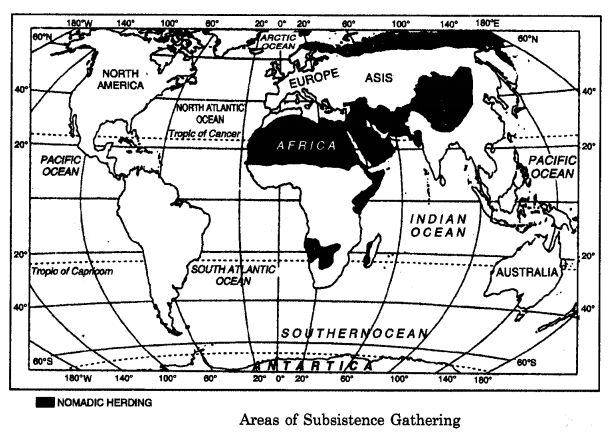
Name three areas where gathering is still practised.
Answer:
Gathering is practised in :

  • High latitude zone of Canada, Northern Eurasia and Southern Chile.
  • Low latitude zone of Amazon Basin and tropical Africa.
  • Northern Australia and interior parts of S.E. Asia.

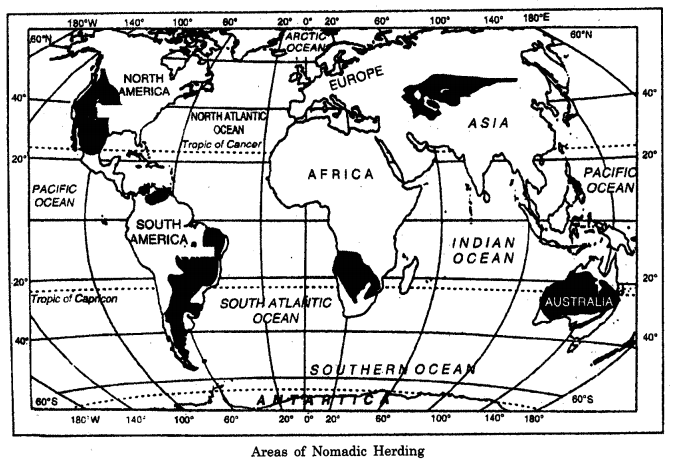
Question 4.
What is Nomadic Herding ? How ; do they meet their basic needs ? (C.B.S.E. 2011)
Answer:
Nomadic herding is a primitive subsistence activity. People move from one place to another along with their livestock in search of grass and water. These animals provide clothing, shelter, tools and transport.

Question 5.
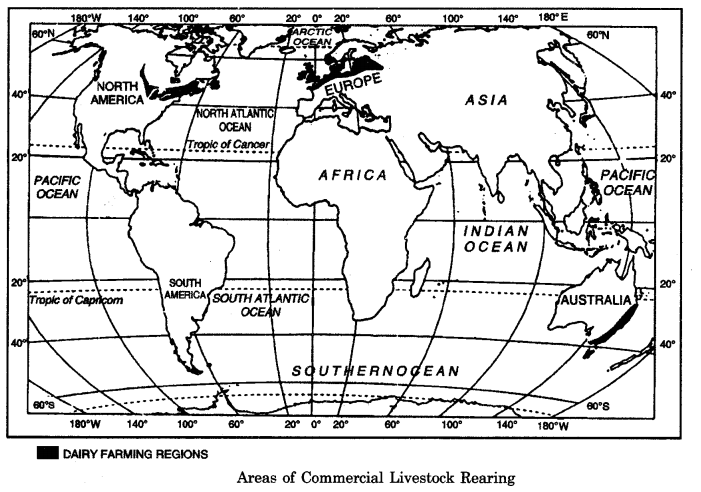
Mention any two main regions of commercial dairy farming.
Answer:
Two main region of commercial farming are:

  • North-West Europe region (Denmark and Netherlands)
  • North-East American region (USA and Canada)
  • Temperate grasslands Australia and Newzeland.

Question 6.
What is Commercial grazing ? What are its characteristics ?
Answer:
Commercial grazing is a large scale organised livestock farming. Sheep, cattle, goats and horses provide meat, wool, hide and skin.
(i) It is capital intensive and organised on scientific basis.
(ii) Livestock is reared on ranches.
(iii) Main emphasis is on breeding, genetic improvement, disease control and health care.
(iv) Products are exported to world markets.

Question 7.
Name some important plantation crops.
Answer:
Important plantation crops are tea, coffee, cocoa, rubber, cotton, oil palm, sugarcane, bananas and pineapple.

Question 8.
What do you mean by ‘Bush fallow’ ?
Answer:
Bush fallow is the other name given to shifting cultivation. The forests are cleared by cutting or by burning the bushes and trees. The land cleared is used for cultivation of crops. It is known as ‘Slash and Burn’ or ‘Bush fallow’ agriculture.

Question 9.
What do you mean by ‘Jhumming’ ?
Answer:
It is a type of shifting cultivation practised in hilly regions of N.E. India. In the states of Assam, Meghalaya, Manipur, Tripura, Nagaland and Mizoram, the primitive tribes follow Jhumming. They cut down trees, clear the undergrowth and burn the field of wood and shrubs. After some years when the fertility of this land is reduced, new areas are cleared for cultivation of crops in the same manner.

Question 10.
“Dairy farming has developed due to urbanisation.” Explain with examples. (C.B.S.E. 2013)
Or
Mention any two regions of commercial dairy farming. (C.B.S.E. Outside Delhi 2017)
Answer:
Dairy farming is developed near urban centres. It is located near industrial and commercial towns which provide a market for dairy products. It is closely related to urbanisation. There is a great demand for milk products in towns due to increasing population. In Europe, N.E. American region and temperate grass lands Australia and New Zealand most of dairy centres are organised near big towns.

Question 11.
What is the importance of ‘dairy farming’ ? Why is it mainly practised near urban and industrial centres of the world ? Explain any two reasons. (C.B.S.E. 2011)
Answer:
Dairy farming is the most advanced and efficient type of rearing of milch animals. Cattles are kept to provide milk. Milk is used to form many products like butter, cheese, condensed milk, etc.
It is practised mainly near urban and industrial centres due to the following reasons :
(i) These provide neighbourhood market for fresh milk and dairy products.
(ii) These provide means of transportation, refrigeration, pasteurization and preservation processes.

Question 12.
“Extensive agriculture is generally done by machines.” Why ?
Answer:
Extensive agriculture is large scale farming on large holdings with the help of machines. These areas have low population density. Man-land ratio is high and labour is costly. Therefore, it is necessary to use large farm machinery for extensive farming.

Question 13.
On what factors does mining depend ?
Or
State the two groups of factors which affect the profitability of mining. (C.B.S.E. Outside Delhi 2017)
Answer:
Factors Affecting Mining Activity
The profitability of mining operations thus, depends on two main factors :
(i) Physical factors include the size, grade and the mode of occurrence of the deposits.
(ii) Economic factors such as the demand for the mineral, technology available and used, capital to develop infrastructure and the labour and transport costs.

Question 14.
Distinguish between open cast mining and underground mining.
Or
Describe any three features of open-cast mining. (C.B.S.E. Outside Delhi Set-Ill 2017)
Answer:
Open cast Mining
Depending on the mode of occurrence and the nature of the ore, mining is of two types : Surface and Underground mining. The surface mining also known as open-cast mining. It is the easiest and the cheapest way of mining minerals that occur close to the surface. Overhead costs such as safety precautions and equipment is relatively low in this method. The output is both large and rapid.

Underground Mining
When the ore lies deep below the surface, underground mining method (shaft method) has to be used. In this method, vertical shafts have to be sunk, from where underground galleries radiate to reach the minerals. Minerals are extracted and transported to the surface through these passages. It requires specially designed lifts, drills, haulage vehicles, ventilation system for safe and efficient movement of people and material. This method is risky. Poisonous gases, fires, floods and caving can lead to fatal accidents.

Question 15.
Mention any six characteristics of plantation agriculture. (C.B.S.E. 2009)
Answer:
Characteristics of Plantation Agriculture :
(i) Plantation farms are generally large (more than 40 hectares) and known as estates or plantations.
(ii) The European skill, organisation and large capital are used on plantations.
(iiii) These use scientific methods of cultivation and a single crop specialisation.
(iv) Local or migrated labour is used on plantation such as Negroes in the cotton belt of U.S.A. and Tamils in tea plantations of Sri Lanka. The plantation system depends on the exploitation of cheap labour.
(v) It aims at high yield, high quality production and a large output for export.
(vi) Plantations are located in coastal areas with developed network of roads, railways, harbours and navigable rivers.

Question 16.
Mention any six char- I acteristics of ‘commercial livestock rearing’ in the world. (C.B.S.E. 2009, 2014)
Answer :
Main characteristics :

  • It is capital intensive and is organised on scientific basis.
  • Livestock is reared on large farms called ranches.
  • Main emphasis is on breeding, genetic improvement, disease control and health care.
  • The products like meat, wool, hides and skins are exported.
  • It is a commercial form of grazing.
  • It is practised in temperate and tropical grasslands where fodder crops are also grown.

Question 17.
What are primary activities ? Why are these dependent on environment ? Give some examples.
Answer:
The primary activities are those activities in which man obtains products directly from nature. These are directly dependent upon environment as these refer to utilisation of earth’s resources such as land, water, vegetation, building materials and minerals.
Examples : These include hunting and gathering, pastoral activities, fishing, forestry, agriculture and mining.

Question 18.
‘Primitive Societies depended on wild animals’ Explain with examples.
Answer:
(i) The people located in very cold and extremely hot climate survived on hunting. They used primitive tools made of stones, twigs or arrows. So the number of animals killed was limited.
(ii) The people in coastal areas still catch fish. Fishing has experienced modernisation due to technological progress. Many species now have become extinct.

Question 19.
What is primitive subsistence or shifting farming ? Describe its different types. (C.B.S.E. Delhi 2017)
Answer:
Primitive Subsistence farming or Shifting Agriculture. Shifting agriculture is practised by many primitive tribes of forests in tropics. People keep on shifting from one part of the forest to another. A patch of land is cleared through fire. It is cultivated for a short period. When the fertility of the soil is exhausted, the fields are abandoned. New areas are cleared. This is also called ‘slash-and-burn’ agriculture.

The cultivated patches are small. Tool like stick and hoe are primitive. Yields are low. Loss of fertility is a great problem. Areas and Crops. Fields are scattered; Primitive tools are used; Rice, millets, yams, beans and cassava are grown. Jhumming in N.E. States of India (Nagaland), Milpa in Central America, Ladang in Indonesia and Malaysia are the popular names given to shifting agriculutre.

Question 20.
What is intensive subsistence farming ? Describe its two types.(C.B.S.E. 2011)
Or
Classify intensive subsistence agriculture into two categories practised in the world. How are they different from each other? Exlain. (C.B.S.E. Outside Delhi 2017)
Answer:
Intensive subsistence farming is practised in densely populated area of Monsoon region. In it, large labour is applied to small farms to obtain high yield, and to produce many crops a year.

(i) Intensive subsistence agriculture dominated by wet paddy cultivation. This type of agriculture is characterised by dominance of the rice crop. Land holdings are very small due to the high density of population. Farmers work with the help of family labour leading to intensive use of land.

Use of machinery is limited and most of the agricultural operations are done by manual labour. Farm yard manure is used to maintain the fertility of the soil. In this type of agriculture, the yield per unit area is high but per labour productivity is low.

(ii) Intensive subsidence agriculture dominated by crops other than paddy. It is not practical to grow paddy in many parts of monsoon Asia. Wheat, soyabean, barley and sorghum are grown in northern China, Manchuria, North Korea and North Japan. In India, wheat is grown in the western parts of the Indo-Gangetic plains.

Question 21.
Write notes on :
(a) Market gardening
(b) Truck farming
(c) Flower culture
(d) Fruit culture (CBSE 2014)
Answer:
Horticulture. The specialised cultivation of fruit and vegetables and flowers solely for the urban markets is known as horticulture.

Area. It is well developed in the densely populated industrial and urban centres where demand is large. The main areas are N.W. Europe and N.E. parts of U.S.A.

Types of Horticulture :
(a) Market Gardening.
Vegetables are grown in sub-urban areas to meet the daily demand. London, Moscow and California are important centres.

(b) Truck Farming. Areas having favourable climate and so it grows fruits and vegetables for distant markets. It involves movement by trucks and is thus known as truck farming. California is the greatest vegetable growing state.

(c) Flower Culture. Netherlands specializes in the cultivation of spring flowers such as Tulips which are flown to all the major cities of Europe.

(d) Fruit Culture. In warm and sunny climate a variety of fruits are grown such as mangoes, apples, oranges, grapes, bananas, etc. Mangoes are exported from India to foreign markets of Russia, Middle East and Southern continents supply fruit in winter.

Question 22.
Differentiate between co-operative farming and collective farming stating any five points of distinction. (CBSE 2016)
Or
Define the term ‘Co-operative farmings.(Out side Delhi 2011)
Or
What is the basic principle of Collective farming ? (Outside Delhi 2019)
Answer:
Co-operative Farming
(i) A group of farmers form a co-operative society by pooling in their resources voluntarily for more efficient and profitable farming.

(ii) Individual farms remain intact and farming is a matter of cooperative initiative.

(iii) Co-operative societies help farmers, to procure all important inputs of farming, sell the products at the most favourable terms and help in processing of quality products at cheaper rates.

(iv) Co-operative movement originated over a century ago and has been successful in many western European countries like Denmark, Netherlands, Belgium, Sweden, Italy etc.

(v) In Denmark, the movement has been so successful that practically every farmer is a member of a co-operative.

Collective Farming
(i) Collective farming or the model of Kolkhoz was introduced in erstwhile Soviet Union to improve the inefficiency of the previous methods of agriculture and to boost agricultural production for self-sufficiency.

(ii) The farmers pool in all their resources like land, livestock and labour.

(iii) However, they are allowed to retain very small plots to grow crops in order to meet their daily requirements.

(iv) Yearly targets are set by the government and the produce is also sold to the state at fixed prices. Produce in excess of the fixed amount is distributed among the members or sold in the market.

(a) The farmers have to pay taxes on the farm produces, hired machinery, etc. Members are paid according to the nature of the work allotted to them by the farm management.

Question 23.
Explain any five characteristics ‘ of extensive ‘commercial grain cultivation’ practised in the World. (CBSE 2014)
Answer:
(i) It is practised in Temperate grasslands.
(ii) Wheat is the main crop grown.
(iii) The size of farm is very large.
(iv) Mechanised agriculture is practised.
(v) Yield per hectare is low.
(vi) Field per person is high.

Question 24.
Define the term “mixed farming9. Explain any four characteristics of mixed farming practised in the world.
(CBSE – 2014)
Answer:
Mixed farming involves the growing of crops and raising of livestock on the same farm. Cattle rearing, poultry farming, and dairy farming are also practised.

Characteristics :

  • Wheat, barley, oat and fodder crops are grown.
  • It involves high capital expenditure and machinery.
  • It makes extensive use of chemical fertilisers.
  • Crop rotation and inter-cropping is practised to retain soil fertility.

Question 25.
Distinguish between the following :
Or
Describe any five characteristics of ‘subsistence agriculture’ practised in the world. (Delhi 2019)
(i) Subsistence and Commercial Agriculture.
(ii) Intensive and Extensive Agriculture.
Answer:
(i) Subsistence Agriculture and Commercial Agriculture

Subsistence AgricultureCommercial Agriculture
1. Subsist ence a griculture is the type of farming in which crops are grown for local consumption.

2. Sedentary agriculture and intensive agriculture are its main types.

3. It is practised in densely populated areas of monsoon region like India. China. Indonesia. Bangladesh, etc.

4. Rice is the main crop in S E. Asia. Other cereals are grown in dry areas.

5. Size of the land holding is small.

6. Simple implements, with large human labour, are used.

7. Green manures and fertilizers are used to increase the fertility

1. Commercial agriculture includes the growing of crops for market.

2. Plantation farming and extensive farming are its main types.

3. It is practised in sparsely populated areas of temperate grasslands.
Tropical regions have plantations. Mixed farming and dairy farming in Europe are other forms of it.

4. Wheat is grown in temperate regions. Tea, coffee, sugarcane are grown in tropical region.

5. Size of the land holding is large.

6. Lt is highly mechanised farming.

7. Chemical fertilizers are widely used.

(ii) Intensive and Extensive Agriculture (CBSE Output Delhi 2017)

Intensive AgricultureExtensive Agriculture
1. Intensive agriculture means the application of large amount of labour and capital to small fields to obtain high yield per unit area of land and to produce many crops a year.

2. It is carried on in densely populated areas like China. India. N.W. Europe etc. where availability of per capita land is low.

3. It is practised in old world countries and is known as oriental agriculture also.

4. It is of two types. In wet areas, it is intensive subsistence dominated by wet paddy. In other areas, it is dominated by other food crops.

5. The size of land holdings is small.

6. Much human labour is used. Machinery is not so widely used.

7. Livestock farming is little developed due 1o poor pastures.

1. Extensive agriculture means highly mechanised farming on large holdings, employing little labour to get a large total yield. But it is a capital intensive farming.

2. It is best developed in sparsely populated areas like Steppes, Prairies, the Pampas and Downs (Temperate Grasslands) where large land holdings are available.

3. It is a new development and is carried out- in new world countries.

4. It has a marked speci-alisation of wheat monoculture. It is a type of plantation agriculture in mid-latitudes

5. The size of land holdings is very large (16,000 Hectares).

6. It is highly mechanised farming. A small labour force is used.

7. Livestock farming supplements agriculture due to availability of grasslands.

Primary Activities Important Extra Questions Long Answer Type

Question 1.
(a) What is Gathering ? What are its main characteristics ?
(b) In which areas, is it still practised ?
(c) What products are gathered from it ?
(d) Examine the future of gathering in the world.
Or
Why has gathering little chance of becoming important at the global land? Explain one reason. (C.B.S.E. Set-III outside 2017)
Or
Gathering and hunting are the primitive economic activities meant for the subsistance of tribal societies, but in modern times gathering is market oriented and has become commercial. Examine the statement. (C.B.S.E. 2018)
Answer:
Gathering is one of the oldest activity of man. Man survived on edible plants gathered from forests to meet food requirements.
(а) Characteristics.

  • It is practised in regions with harsh climatic conditions
  • It involves primitive societies who extract both plants and animals to satisfy their needs for food, shelter and clothing.
  • This type of activity requires a small amount of capital investment.
  • It operates at very low level of technology.
  • The yield per person is very low and little or no surplus is produced.

(b) Areas. Gathering is practised in :

  • high latitude zones which include northern Canada, northern Eurasia and southern Chile.
  • Low latitude zones such as the Amazon Basin, tropical Africa, Northern fringe of Australia and the interior parts of Southeast Asia.

(c) Products
In modern times some gathering is market oriented and has become commercial.

  • Gatherers collect valuable plants such as leaves, barks of trees and medicinal plants and after simple processing sell the products in the market.
  • They use various parts of the plants, for example, the bark is used for quinine, tanin extract and cork
  • leaves supply materials for beverages, drugs, cosmetics, fibres, thatch and fabrics; nuts for food and oils and tree trunk yield rubber, balata, gums and resins.

(d) Future of gathering
Gathering has little chance of becoming important at the global level. Products of such an activity cannot compete in the world market. Synthetic products often of better quality and at lower prices have replaced many items.
Geography Class 12 Important Questions Chapter 5 Primary Activities 1

Question 2.
Describe the main features of Pastoral nomadism and the areas associated with it.
Answer:
Pastoralism. The domestication of animals was one of the early steps in the development of civilisation. People living in different climatic conditions selected and domesticated animals found in those regions e.g. cattle and horses in the grasslands, sheep and reindeer in the tundra regions, camel in the tropical deserts, and llama and yak in the high altitudes of the Andes and the Himalayas respectively.

These animals were the chief sources of milk, meat, wool and hides. In the tropical and temperate grasslands of the world, livestock, herding and rearing constitutes as pastoral nomadism.

Pastoral nomadism. It is a subsistence activity depending on animals. Since these people do not live a settled life, they are called nomads. Each nomadic community occupies a well-defined territory. The animals depend entirely on natural vegetation.

Cattle are reared in grasslands receiving more rain and having soft and long grasses. Sheep are reared in low rainfall areas with short grasses. Goats are common in the rugged terrain with scanty grasses. There are six widely distributed species reared by pastoral nomads : sheep, goats, camels, cattle, horses and donkeys.

Transhumance. In some parts of the world, the movement of herders follows the change in seasons. For example, in the mountainous regions such as the Himalayas, Gujars, Bakarwals, Gaddis and Bhotiyas migrate from the plains to the mountains in summers and from mountains to the plains in winters. Similarly, in the tundra region, the nomadic herders move from south to north in summers and from north to south in winters. Such seasonal migration of people with their animals is known as transhumance.

Areas. Pastoral nomadism is associated with seven distinct areas—high latitude sub-Arctic, Eurasian Steppe, mountainous south-west Asia. Saharan and Arabian deserts, sub-Saharan Savannas, the Andes and the Asian high altitude plateaus. These may broadly be grouped under three broad regions.

(i) Sahara, the largest region extends over nearly 13,000 km., from the Sahel and Sahara in Africa to Mongolia and Central China.
(ii) Tundra, the second region includes the southern border of the tundra region in Eurasia.
(iii) S.W. Africa, the third region comprises of south-west Africa. These areas are either too hot and dry or too cold. Today, nomadic herding supports only 15 to 20 million people in the world.
Geography Class 12 Important Questions Chapter 5 Primary Activities 2

Question 3.
Describe the development of commercial grazing in different types of grasslands.
Answer:
Commercial Grazing. Commercial grazing is a large scale domestication of animals, on permanent ranches, with scientific methods and fodder crops. It is practised in temperate grasslands. These areas with moderate rain, mild temperature and large surplus land favour the commercial form of grazing. Cattle are kept to produce the products of meat, wool, dairy products for export.

(a) Temperate Grasslands
(i) Prairies. The Prairies grasslands of North America have many large ranches. Better breeds of cattle like Hereford, Friesian and Jersey cow are kept. Merino sheep are grazed on Edward and Mexico plateau. Cattle are fattened on corn for sending to slaughter houses. It is said in the U.S.A., ‘corn goes to market on hoofs’.

(ii) Pampas. S.E. South America includes the grazing lands of Pampas, Patagonia, Uruguay and southern Brazil. The Pampas with 50 to 100 cms rain, cool climate, Alfa-Alfa grass have helped commercial grazing of cattle for beef and wool. Uruguay and Brazil with green grasses are leading exporters of cattle products.

(iii) Australia. Temperate grasslands of Australia include ‘Downs’ grasslands over large areas of Victoria, N.S. Wales, and South Australia. Australia is the leading commercial grazing country of the world. Natural pastures, cool climate, artesian wells, large ranches favour commercial grazing.

(iv) New Zealand. The economic development of New Zealand depends upon sheep and cattle grazing. New Zealand is the leading exporter of beef, wool, butter. Sheep and dairy cattle are kept on small farms.

(v) South Africa. The veld region of South Africa plateau is a region of temperate grasslands. Sheep and Angora goats are grazed for beef and wool.

Geography Class 12 Important Questions Chapter 5 Primary Activities 3

Question 4.
What is plantation Agriculture ? What are its characteristics ? Name the areas and crops grown there.
Or
Describe any five features of plantation agriculture practised in different regions of the world? (C.B.S.E. Delhi 2017, Delhi 2019)
Answer:
Plantation Agriculture :
Plantation agriculture is a large scale specialised commercial farm of a single cash crop on estates or plantations. Some of the main crops are rubber, oil palm, cotton, tea, cocoa, bananas, pineapples, coffee and sugarcane. The plantations were established by the Europeans during the colonial period in tropics.

Areas. Plantations are found in many parts of tropical regions of Asia, Africa and America.
(i) West Indies, Cuba and Jamaica.
(ii) Guinea and west coast of Africa.
(iii) India, Sri Lanka, Malaysia and Indonesia, Phillipines.

Characteristics :
(i) Plantation farms are generally large (more than 40 hectares) and known as estates or plantations.
(ii) The European skill, organisation and large capital are used on plantations. These use scientific methods of cultivation and a single crop specialisation.
(iii) Local or migrated labour is used on plantation such as Negroes in cotton belt of the U.S.A. and Tamils in tea plantations of Sri Lanka. The plantation system depends on the exploitation of cheap labour.
(iv) It aims at high yields, high quality production and a large output for export.
(v) Plantations are located in coastal areas with developed network of roads, railways, harbours and navigable rivers.

Areas :
(a) Most of the estates are owned by Europeans. British companies own rubber plantations of Malaysia, Tea estates of India and Sri Lanka and Banana plantations in West Indies.
(b) The French established cocoa and coffee plantation in west Africa.
(c) The British established sugarcane and banana plantations in West Indies.
(d) Spanish and Americans established coconut and sugarcane plantation in Phillipines.

Question 5.
Write detailed notes on :
Or
(a) Compare the features of Mixed farming and Diary farming in five points? (Sample Paper 2018-19)
(a) Mixed Farming
(b) Dairy Farming
Answer:
(a) Mixed Farming: Mixed farming involves the growing of crops and raising of animals on the same farm. Besides cultivation, other subsidiary occupations like cattle rearing, poultry farming, dairy farming etc. are practised.

Livestock is fed on fodder crops in winter. In summer, cattle graze on pastures. Many factors have favoured the development of mixed farming :

  • Urban and industrial population.
  • Facilities of transport.
  • Nearness to market.
  • Certain rainfall.
  • Intensive methods.

Areas. It is practised in highly developed parts of the world. Mixed farming is found through- out Europe, Eastern and Northern America, Pampas, S.E. Australia, New Zealand and South Africa. Characteristics :
(i) This type of farming is highly intensive, scientific and specialised.
(ii) Mixed farms are moderate in size.
(iii) It represents truly mixed economy because crops and livestocks are equally integrated.
(iv) Cereals are grown with other crops practising crop rotation, inter cropping and crop-combination.
(v) Mixed farming is characterised by high capital expenditure on machinery and farm building.
(vi) Chemical fertilizers are extensively used to maintain the fertility of the soils.
(vii) The labour is skilled and expert in farming.

(viii) Mixed farming has threefold advantages:

  • It protects the farmers against the risk of poor prices, crop failure and diseases.
  • Labour is evenly spread throughout the year.
  • Soil fertility is maintained by crop rotation.

(ix) Livestock is fed on fodder crop, pastures and other crops.
(x) The farmers have a higher standard of living.

(b) Dairy Farming: Dairy farming is an advanced type of farming. Cattle are kept to produce milk. Milk is a highly nutritious food. Milk is used to form many products like butter, cheese, condensed milk, etc. Dairy cattle include many breeds of cows and buffaloes.

Geographical factors favouring dairy farming :

  • A cool-temperate climate
  • Moderate temperatures
  • Sufficient rainfall
  • Rich pastures
  • Nearness to markets
  • Skilled labour
  • Capital
  • Developed means of transport.
  • Technical knowledge.

Modern methods of refrigeration, cold storage, milking and preparing dairy products need technical and scientific knowledge.

Major Dairy Regions. The major dairy regions of the world are found in the cool-temperate regions of the world.

1. N.W. Europe. This dairy region extends from Atlanic coast to Moscow for a distance of 3000 kms. This industry is highly developed in Denmark and the Netherlands. Denmark has 9000 co-operative societies engaged in dairy farming.

2. N.E. American Region. This dairy region extends from Atlantic coast to great lakes of North America. The U.S.A. and Canada are among the leading dairy countries of the world. St. Lawrence valley and Wisconsin states are the main area of dairy region.

3. Australia-New Zealand (Tasmania) Region. New Zealand and Australia have well developed dairy farming. Cattle are reared in North Iceland, Tasmania, Queensland and New South Wales. New Zealand is the largest exporter of butter and cheese in the world.

Primary Activities Important Extra Questions HOTS

Question 1.
Large scale mechanised grain cultivation results in low yield per acre, but High yield per man.” Discuss.
Answer:
Extensive agriculture is practised in temperate grasslands. It is a large scale mechanised farming on large farms. It results in low yield per acre but high yield per man.

(i) Wheat is the main cereal grown. The average yield is 20 Bushels per acre. It is low as compared to yield of wheat in countries having intensive cultivation, for example in Belgium it is 60 Bushels per acre.

(ii) The farms are highly mechanised. A single machine can do the work of 50 to 100 labourers. Labour force is small and the yield per man is high.

(iii) It is practised in sparsely populated areas. Therefore production per man is high.

(iv) The size of the farms is very large. The methods are not intensive. The total output is large but the yield per acre is low.

Human Development Class 12 Important Extra Questions Geography Chapter 4

Here we are providing Class 12 Geography Important Extra Questions and Answers Chapter 4 Human Development. Geography Class 12 Important Questions are the best resource for students which helps in class 12 board exams.

Class 12 Geography Chapter 4 Important Extra Questions Human Development

Human Development Important Extra Questions Very Short Answer Type

Question 1.
Name the two South-Asian economists who first put forward the idea of human development.
Answer:
Mahabub-Ul-Haq and Amartya sen.

Question 2.
Who created Human Development index ?
Answer:
A Pakistani economist Dr. Mahabub-ul-Haq in 1990.

Question 3.
What criterion was used to measure development ? (C.B.S.E. 2013)
Answer:
Economic growth and Education.

Question 4.
Name four pillars of Human development. (C.B.S.E. 2014)
Answer:
(i) Equity
(ii) Sustainability
(iii) Productivity
(iv) Empowerment.

Question 5.
What are two requirements for empowerment ?
Answer:
Good governance and people oriented policies.

Question 6.
What is the measure of access to resources ?
Answer:
Purchasing power.

Question 7.
Expand ILO.
Answer:
International Labour Organisation.

Question 8.
Expand UNDP.
Answer:
United Nation Development Programme.

Question 9.
Expand GNH.
Answer:
Gross National Happiness.

Question 10.
Which country introduced Gross National Happiness ?
Answer:
Bhutan.

Human Development Important Extra Questions Short Answer Type

Question 1.
What is development ? State its three aspects.
Answer:
Development means a qualitative change. It includes three aspects :
(а) Quality of life of people
(b) Opportunities
(c) Freedom of people.

Question 2.
Describe the concept of Human development as described by Dr. Haq.
Answer:
Dr. Haq described that Human development enlarges peopl’s choices and improves their lives. People are central to all development. The choices keep on changing. It is to create conditions where people can live meaningful lives. People must be healthy, be able to develop their talents, and be free to achieve their goals.

Question 3.
What was the main objective of development according to Prof. Amartya Sen ?
Answer:
He saw an increase in freedom as the main objective of development. It is the most effective way of bringing about development. Social and political institutions increase freedom.

Question 4.
Distinguish between growth and development. (C.B.S.E. 2013, Delhi 2019)
Answer:
Growth and development refers to changes that take place over a period of the growth; quantitative and value neutral. It is positive or negative. It shows increase or decrease.

Development means a qualitative change. It always has a positive value. Development means increase in the existing conditions. Development occurs when positive growth takes place.

Question 5.
What are the attributes of a meaningful life ?
Answer:
A meaningful life is not just a long one. It must be a life with some purpose such as :
(а) People must be healthy
(b) People must be able to develop their talents
(c) They must participate in society activities
(d) People must be free to achieve their goals.

Question 6.
What does the term Equity mean ? What are the problems for it ?
Answer:
Equity means making equal access to opportunities available to every body. The opportunities available to people must be equal. But there are some problems, such as :
(a) Gender discrimination
(b) Race discrimination
(c) Variable income
(d) Caste

Question 7.
What is sustainability ? Name three types of resources which must be used for sustainability.
Answer:
Sustainability means continuity in the availability of opportunities. Each generation must have
the same opportunities. For this, the resources should not be miused. The following resources must be used :
(a) Environmental
(b) Financial
(c) Human

Question 8.
What is productivity ? How can it be enriched ?
Answer:
Productivity means human labour productivity in terms of human work. It can be enriched by :
(i) By building capabilities in people
(ii) By increasing their knowledge
(ii) By providing better health facilities
(iv) By increasing effciency.

Question 9.
What is empowerment ? How can people be empowered ?
Answer:
Empowerment means to have power to make choices. People can be empowered by :
(i) By increasing freedom
(ii) By increasing capabilities
(iii) By good governance
(iv) By people oriented policies

Question 10.
Name the four important approaches for studying human development.
Answer:
(i) The Income approach
(ii) The Welfare approach
(iii) Minimum Needs approach
(iv) Capabilities approach.

Question 11.
On which key areas is HDI based ? What is the range of HDI Score ?
Answer:
HDI is based on following key areas :
(a) Health
(b) Education
(c) Access to Resources. HDI score ranks 0 to 1.

Question 12.
What is Gross National Happiness ? What are its important aspects ? (C.B.S.E. 2014)
Or
“The Gross National Happiness is the measure of the country is Progress.”Evaluate the statement. (Out Side Delhi 2019)
Answer:
Bhutan is the only country in the world to proclaim GNH as the measure of human development. It means material progress cannot come at the cost of happiness. GNH encourages us to think of the spiritual, non-material and qualitative aspects of the development.

Human Development Important Extra Questions Long Answer Type

Question 1.
What do you mean by ‘Human Development’ ? Explain its concept.
Or
“The size of a territory and per capital” income are not directly related to human development.” Support the statement with examples.
Answer:
Human Development. Development is a dynamic concept. It is a process of growth and realisation of potential utilising resources into full use. Its main purpose is to raise the economic growth. The purpose of development is to create an environment in which no child goes without education, where no human being is denied health care and where all people can develop their potential capacities.

Human Development Indicators.
The World Bank provides every year the world development report. It provides data of production, consumption, demand, energy, capital trade, population growth, health, education of some 186 countries. This report is based on some indicators. The three basic components of human development are

  • Longevity
  • Knowledge
  • Standard of living.

India ranks 134th in the world while Norway ranks First.

The following are the main indicators of human development:
(i) Life expectancy at Birth
(ii) Literacy
(iii) Per capita income
(iv) Demographic characteristics such as infant mortality rate, natural increase rate, the age structure.

(i) Life expectancy at Birth.
Life expectancy at birth is the average number of years that a newborn baby is expected to live. The average life expectancy of the world is 65 years. North America with an average age of 77 years has the highest life expectancy; while Africa has the lowest life expectancy rate of 54 years. The developed countries with high level of nutrition, education, medical care and standard of living have high life expectancy rate.

(ii) Literacy. The literacy is an important and reliable indicator of socio-cultural, economic and cultural development of a country. Literacy is essential for eradicating poverty. The ability to read and write influences demographic features such as fertility, mortality, occupations etc. In developed countries, the literacy rate is above 90 percent. While in developing countries it is less than 60 percent.

(iii) Per Capita Income. GDP and GNP showing the per capita income of a country is an important indicator of human resource development. The higher the per capita income, the more developed the country is. Workers in developed countries earn more than that in developing countries. In many countries of Europe the GDP is over 20,000 $ per year as compared to $ 100 of many countries of Africa and Asia. The GDP of developing countries indicates the low out-put of goods and services.

(iv) Demographic Characteristics. The demographic characteristics of a country are influenced by the economy of a country. These differ in developed and developing countries.

(a) The infant mortality rate is high in developing countries. People are not able to provide food and medicines.

(b) Natural increase rate (The difference between crude birth rate and death rate) is high in developing countries. It places a pressure on economy. In countries of Africa, the crude birth rate is as high as 40 per 1000 while in developed countries it is as low as 10.

(c) The age structure is also different in developed and developing countries. Developing countries have a high percentage of dependent population (i.e. children). But the over all percentage of dependent population is lower in developed countries.

Question 2.
Name the four pillars of development. Describe impact of each giving examples. (C.B.S.E. 2011)
Or
What is human development? Analyse the four pillars of human development? (C.B.S.E. Delhi 2017 Set-I) (C.B.S.E.Delhi 2017)
Answer:
The four Pillars of Human Development:
Just as any building is supported by pillars, the idea of human development is supported by the concepts of
(i) equity
(ii) sustainability
(iii) productivity and
(iv) empowerment.

1. Equity : Equity refers to making equal access to opportunities available to everybody. Tire opportunities available to people must be equal irrespective of their gender, race, income and in the Indian case, caste. Example. In India, a large number of women and persons belonging to socially and economically backward groups drop out of school. They do not have access to knowledge.

2. Sustainability means continuity in the availability of opportunities. To have sustainable human development, each generation must have the same opportunities. All environmental, financial and human resources must be used keeping in mind the future. Misuse of any of these resources will lead to fewer opportunities for future generations. Example : To sustain future, the importance of sending girls to school be realised.

3. Productivity : Productivity here means human labour productivity or productivity in terms of human work. Such productivity must be constantly enriched by building capabilities in people. Ultimately, it is people who are the real wealth of nations. Therefore, efforts to increase their knowledge, or provide better health facilities ultimately leads to better work efficiency.

4. Empowerment : Empowerment means to have the power to make choices. Such power comes from increasing freedom and capability. Good governance and people-oriented policies are required to empower people. The empowerment of socially and economically disadvantaged groups is of special importance.

Question 3.
Name the different approaches to Human Development. Describe each.
Or
Explain three characteristics of welfare approach of human development. (Sample Paper 2018-19)
Answer:
Approaches to Human Development
There are many ways of looking at the problem of human development.
Some of the important approaches are:
(a) The income approach
(b) The welfare approach
(c) Minimum needs approach; and
(d) Capabilities apprroach.

Measuring Human Development

The human development index (HDI) ranks the countries based on their performance in the key areas of health, education and access to resources. These ranking are based on a score between 0 to 1 that a country earns from its record in the key areas of human development

Indicators of HDI

  • Life expectancy at Birth to assess health
  • Adult literacy rate to access to knowledge
  • Access to Resources to assess purchasing power

Each of these dimensions is given a weightage of 1/3. The human development index is a sum total of the weights assigned to all these dimensions. The closer a score is to one, the greater is the level of human development. Therefore, a score of 0.983 would be considered very high while 0.268 would mean a very low level of human development.

(a) Income Approach : This is one of the oldest approaches to human development. Human development is seen as being linked to income. The idea is that the level of income reflects the level of freedom an individual enjoys. Higher the level of income, the higher is the level of human development.

(b) Welfare approach : This approach looks at human beings as beneficiaries or targets of all development activities. The approach argues for higher government expenditure on edcuation, health, social and secondary amenities. People are not participants in development but only passive recipients. The government is responsible for increasing levels of human development by maximising expenditure on welfare.

(c) Basic needs approach : This appraoch was initially proposed by the International Labour Organisation (ILO). Six basic needs i.e. health, education, food, water supply, sanitation, and housing were identified. The questions of human choices is ignored and the emphasis is on the provision of basic needs of defined sections.

(d) Capability approach : This approach is associated with Prof. Amartya Sen. Building human capabilities in the areas of health, education and access to resources is the key to increasing human development.

Question 4.
Describe the distribution of HDI countries with High index value, Medium Index value and Low index value.
Or
What is meant by human development? Classify countries into four groups on the basis of the human development scores earned by them. Explan one feature of each group. (C.B.S.E Outside Delhi Set-II 2017)
Answer:
Size of a country and per capita income are not directly related to human development. Often smaller countries and poorer countries have been ranked higher. For example Sri Lanka (92) has a higher rank than India (136). Countries can be grouped into three categories :

LevelScore in development
Index
Number of
countries
Highabove 0.847
Medium0 5 to 0.799100
LowBelow 0.637

(A) Countries with High index value Countries with high HDI are those which have a score of 0.8. According to the Human Development Report of 2014, this group includes 47 countries.

Top Ten Countries with High Value Index, 2014

SI. No.CountrySI. No.Country
1.Norway6.Germany
2.Australia7.New Zealand
3.Switzerland8.Canada
4.Netherlands9.Singapore
5.United States10.Denmark

Reasons :
(i) Education and healthcare is an important government priority
(ii) Countries with higher human development are those where a lot of investment in the social sector has taken place.
(iii) Good governance
(iv) The degree of social diversity in these countries is not very high
(v) Many of the countries with a high human development score are located in Europe and represent the industrialised western world.

(B) Countries with Medium Index Value : Countries with medium levels of human development form the largest group. There are a total of 100 countries in this group.

Reasons
(1) Most of these are countries which have emerged as developing countries.
(2) Some countries from this group were former colonies.
(3) Many others have emerged after the break up of the erstwhile Soviet Union in 1990.
(4) Many of these countries have been rapidly improving their human development score by adopting more people-oriented policies and reducing social discrimination.
(5) Most of these countries have a much higher social diversity than the countries with higher human development scores.
(6) Many in this group have faced political instability and social uprisings at some points of time in their recent history.

(C) Countries with Low Index Value : As many as 37 countries record low levels of human development.

Reasons.
(1) A large proportion of these are small countries.
(2) These have been going through political turmoil and social instability in the form of civil war, famine or a high incidence of diseases. There is an urgent need to address the human development requirements of this group through well thought out policies.
(3) Some Statements are misleading that low level is due to culture or religion or community.
(4) Places with low levels of human development tend to spend more on defence rather than social sectors. This shows that these countries tend to be located in areas of political instability and have not been able to initiate accelerated economic development.

Human Development Important Extra Questions HOTS

Question 1.
‘Equity is one of the most important pillers of human development’. Explain any three human values that are required to give equal access to opportunities to every body.
Answer:
The idea of human development is supported by the pile of equity, sustainability, Productivity and empowerment. Equity refers to making equal access to opportunities available to the people. The human values provide equal access to the opportunity to everybody, irrespective of the following:

  • Gender of the people
  • Race of the people
  • Income of the people

Sustainability means continuity in the availability of opportunities. Productivity means human labour productivity. People are the real wealth of the nation. Empowerment means to have the power to make choices.

Bhakti-Sufi Traditions Class 12 Important Extra Questions History Chapter 6

Here we are providing Class 12 History Important Extra Questions and Answers Chapter 6 Bhakti-Sufi Traditions: Changes in Religious Beliefs and Devotional. Class 12 History Important Questions are the best resource for students which helps in class 12 board exams.

Class 12 History Chapter 6 Important Extra Questions Bhakti-Sufi Traditions: Changes in Religious Beliefs and Devotional

Bhakti-Sufi Traditions Important Extra Questions Very Short Answer Type

Question 1.
Name the principal deity followed at Puri, Orissa.
Answer:
Jagannatha, a form of Lord Vishnu.

Question 2.
Who were Alvars?
Answer:
Alvars were those who immersed in the devotion of Lord Vishnu.

Question 3.
Who were Nayanars?
Answer:
Devotes of Lord Shiva was called Nayanars. Question 4. Name a composition written by Alvars. Answer: Nalayira Divyapradandham.

Question 5.
Name a woman devotee each of Alvars and Nayanars?
Answer:
Andal (Alvar) and Karaikkal Ammaiyar (Nayanar).

Question 6.
Who was Virashaivas?
Answer:
The followers of Basavanna in Karnataka were called Virashaivas or Lingayats.

Question 7.
Who challenged the idea of caste and the pollution attributed to certain groups by Brahmanas?
Answer:
Lingayats.

Question 8.
Who conquered Sindh in 711 A.D.?
Answer:
Muhammad Qasim, an Arab General Conquered Sindh in 711 A.D.

Question 9.
Who were Ulamas?
Answer:
Religious scholars of Muslims were called Ulamas. They guided the rulers to rule according to the Sharia.

Question 10.
Which branch of the Ismailis developed new modes of communication, dissemination ideas derived from the Quran?
Answer:
The Khojahs.

Question 11.
What is Ziyarat?
Answer:
The practice of visiting the tomb shrine of Sufi Shaikh was called Ziyarat.

Question 12.
Who composed Padmavat?
Answer:
Malik Muhammad Jayasi composed Padmavat.

Question 13.
Who preserved the Kabir Bijak?
Answer:
The Kabirpanth preserved the Kabir Bijak in Varanasi.

Question 14.
What was the most striking feature of sculpture as well as of texts of the phase of 8th to 18th century?
Answer:
Probably the most striking feature of sculpture as well as of texts was the increasing visibility of different gods and goddesses. This indicates toward continuation and extension of worship of major deities, i.e., Vishnu, Shiva, and the Goddess. Each of these deities was visualized in a number of forms.

Question 15.
Who were the Jogis?
Answer:
The Jogis were the disciples of Gorakh Nath and Aughur Nath. They were very popular in North India and influenced the Sufi saints.

Question 16.
Who brought up Saint Kabir and what are his followers known as?
Answer:
Saint Kabir was brought-up by a weaver Niru and his wife Nima. Followers of Kabir are known as Kabirpanthi.

Question 17.
What is the position of Bhakti in Indian tradition?
Answer:
Bhakti is considered as a part of devotion in Indian tradition. One can attain God through this. Lord Krishna himself told about this in Bhagwat Gita.

Question 18.
Name the two Sufi Shaikhs during the period of Delhi Sultanate.
Answer:
During the period of Delhi Sultanate, there were two Shaikhs namely Khwaja Muinuddin Chishti and Shaikh Nizamuddin Auliya.

Question 19.
Why did the Nayanar saints express their opposition towards Jainism and Buddhism?
Answer:
The compositions of the Nayanars were marked for their opposition to Buddhism and Jainism. The historians believe that this hostility was due to competition for seeking royal patronage. The Nayanars were inspired by this feeling.

Question 20.
Explain two religious beliefs and behaviors of Lingayats.
Answer:

  1. Lingayats believed that once, a devotee dies, he will be united with Shiva and will not return to this world.
  2. They do not practice funeral rites instead they ceremonially bury their dead.

Question 21.
Why and which changes came in the status of Brahmanas in North India in the 13th century?
Answer:
During the last years of the 12th century, Brahmanas had a very important place in Rajput kingdoms and they performed a number of secular and ritual functions. No one tried to challenge their position directly. But when Turks established Delhi Sultanate in the 13th century, this condition changed. This undermined the power of many Rajput kingdoms and the Brahmanas associated with these kingdoms.

Question 22.
What do you mean by Zimmi?
Or
Give the meaning of Zirnrna. Who was Zimmis? (C.B.S.E. 2011 (O.D.))
Answer:
The word ‘Zimmi’ was derived from the Arabic word ‘Zimma’ which meant ‘protection’. In other words, the Zimmis were the protected people. They were non-Muslims and included Hindus, Jains, Jews, and Christians were: They lived under Muslim rulership and paid a tax called ‘Jizya’. So they were entitled to protection by the Muslims.

Question 23.
By giving examples clarify that Muslim rulers often adopted a fairly flexible policy towards their subjects.
Answer:
There is no denying the fact that Muslim rulers often adopted a fairly flexible policy towards their subjects. For example, many rulers gave land grants and tax exemptions to Jaina, Hindu, Christian, Zoroastrian, and Jewish religious institutions. They also expressed their respect and devotion towards non- Muslim religious leaders. These grants were given by rulers like Akbar, Aurangzeb, etc.

Question 24.
Who were Mlechchhas?
Answer:
‘Mlechchha’ word is used for migrating communities. This name indicates that they did not believe and observe the norms of caste, society and spoke those languages which were not derived from Sanskrit.

Question 25.
Write two rituals of initiation into ‘Silsila’.
Answer:
There were special rituals of initiation into Silsila and these were:

  1. One has to take an oath of allegiance.
  2. He should wear a patched garment and shave his hair.

Question 26.
Where was the dargah of Shaikh Nizam-ud-din Aulia situated? What was the feature of its open kitchen (langar)?
Answer:
Dargah of Shaikh Nizam-ud-din Aulia was situated on the banks of the river Yamuna in Ghiyaspur, on the outskirts of the then city of Delhi. The main feature of its open kitchen was that it was run on unasked-for charity or ‘future’.

Question 27.
Name those three poets or historians who visited Shaikh Nizam-ud-din and wrote about the Shaikh?
Answer:
Amir Hasan Sijzi, Amir Khusro, and the court historian Ziya-ud-din Barani were poets or historians who visited Shaikh Nizam-ud-din Aulia and wrote about the Shaikh.

Question 28.
Name four practices adopted by Shaikh Nizam-ud-din Auliya which represent that he tried to assimilate love traditions.
Answer:

  1. Bowing before the Shaikh.
  2. Offering water to visitors.
  3. Shaving the heads of inmates.
  4. Yogic exercise.

Question 29.
What are Kabir’s Ulatbansi compositions?
Answer:
The Ulatbansi compositions of Kabir are intrinsically upside-down sayings. They are written in a form in which everyday meanings are inverted. They express difficulty in capturing the nature of the ultimate reality. They express Kabir’s mystical experiences.

Question 30.
Name two compositions of Kabir which convey a sense of Kabir’s mystical experiences.
Answer:
Kabir’s compositions like “the lotus which blooms without flower” and the “fire raging in the ocean” convey a sense of Kabir’s mystical experiences.

Question 31.
What is written about the religion of Kabir in Vaishnav traditions? Who was his Guru?
Answer:
Hagiographies within the Vaishnava tradition suggest that Kabir was born a Hindu (Kabirdas) but was brought up by a poor Muslim family who belonged to the weaver community. Vaishnava traditions also suggest that Kabir was initiated into Bhakti by a Guru Ramananda.

Question 32.
Who was Mirabai? Discuss any of her two works.
Answer:
Mirabai was the most famous poetess of the Bhakti tradition. She composed many bhajans in praise of Lord Krishna whom she considered as her lover. Her songs are very popular in Gujarat and Rajasthan. She was against the caste system and stood in defiance of the norms of the caste society.

Question 33.
Mention the two earliest Bhakti Movements of Tamil Nadu, giving the main difference between them. (C.B.S.E. 2011 0))
Answer:
The two earliest Bhakti Movements of Tamil Nadu were started under Alvars and Nayanars. Alvars were disciples of Vishnu and Nayanars were disciples of Lord Shiva.

Question 34.
Name the two women poet-saints of Tamil Nadu. Whom did they ‘ worship? (C.B.S.E. 2011 (D))
Answer:
Andal and Karaikkal Ammaiyar were the two women poet-saints of Tamil Nadu. Andal was the devotee of Vishnu and Karaikkal was the devotee of Lord Shiva.

Question 35.
Mention two features of the protest movement started by Nayanars and Alvars? (C.B.S.E. 2011 (D))
Or
Point out similarities between Lingayats and Nayanars. (CJ.S.K 2008, 2016 (O.D.))
Answer:

  1. Both Alvars and Nayanars started a movement of protest against the caste system and the dominance of Brahmanas.
  2. They even opposed Buddhism and Jainism.

Question 36.
Kabir Bijak and Kabir Granthavali are two distinct but overlapping traditions. How are they preserved? (C.B.S.E. 2015 (O.D.))
Answer:
The Kabir Bijak has been preserved by the Kabirpanth in Varanasi and elsewhere in Uttar Pradesh. The Kabir Granthavali is associated with Dadupanth in Rajasthan. Many of his compositions are found in the Adi Granth Sahib.

Question 37.
“The message of Guru Nanak Devji was based on divinity.” Mention any two aspects of it.
Answer:

  1. According to Guru Nanak Devji, there is no gender or form of the ‘Absolute’ or rab.
  2. He proposed a simple way to connect to the Divine by remembering and repeating the Divine Name expressing his ideas through hymns called ‘Shabad in Punjabi’.

Bhakti-Sufi Traditions Important Extra Questions Short Answer Type

Question 1.
Give a brief description of the new sources of history from the 8th to 18th centuries.
Answer:
The period from the 8th to 18th century witnessed many new sources of history. They include compositions of the poet-saints. Most of these poet-saints expressed themselves orally. They used regional languages which were often used by ordinary people. Their compositions were a set to music and were compiled by their disciples or devotees who sometimes modified their original message to fit in different political, social, and cultural contexts.

The historians also use the hagiographies or biographies of these saints. All these sources provide us an insight into the dynamic and diverse lives of these path-breaking poet-saints.

Question 2.
Explain the main features of the early Bhakti Tradition.
Answer:
The early traditions of Bhakti had the following features:

  1. The poet-saints emerged as leaders having a large number of devotees. They initiated the tradition of the Bhakti movement.
  2. They broke the orthodox Brahmanical framework by accommodating and acknowledging women and the people belonging to the lower castes.
  3. The Bhakti tradition also had a lot of diversity.
  4. The Bhakti tradition is classified into two categories: Saguna and Nirguna. Saguna means the worship of Specific deities such as Vishnu, Shiva and their incarnational forms like the goddess or Devi. It emphasized the attributes of deities. On the other hand, the Nirguna Bhakti was the worship of an abstract form of God. It was worship with attributes.

Question 3.
Who were Alvar and Nayanar; saints? Briefly describe their activities.
Or
Who were Alvars and Nayanars? In which language did they sing? (C.B.S.E. 2008 {O.D.))
Or
Who were Alvars and Nayanars ? (C.B.S.E. 2014 (O.D.))
Answer:
Alvar and Nayanar saints were Bhakti saints of Tamil Nadu. Early Bhakti movements were led by them. Alvars were the Bhakts of Vishnu and Nayanars were worshippers of Shiva. They traveled from one place to another singing hymns in Tamil in praise of their respective gods.

During their travels, Alvars and Nayanars declared few sacred places as the abode of their respective deities. Later on, large temples were constructed on these places and they became centers of pilgrimage. Hymns of saint-poets were sung in these temples at the time of temple rituals. Images of these saints were also worshipped in these temples.

Some historians believe that Alvar and Nayanar saints raised their voices against the caste system and the dominance of Brahmanas. This thing seems true to a certain extent because Bhakti saints belonged to diverse groups like Brahmanas, artisans, peasants, etc.

Compositions of Alvar and Nayanar saints were sometimes indicated by the claim that they were as important as the four Vedas. For example, one of the important anthologies of compositions of Alvars, the Nalayira Divyaprabandham was described as the Tamil Veda. In this way, it has been claimed that this text was as significant as the four Vedas.

Question 4.
How women’s devotion was associated with Bhakti tradition? Give example.
Answer:
Probably the most important feature of Bhakti tradition was the presence of women. For example, the compositions of an Alvar woman Andal were sung widely and are sung even today. Andal considered herself as the beloved of Lord Vishnu and expressed her love to her deity in the form of verses. Another woman devotee of Lord Shiva, Karaikkal Ammaiyar took the path of extreme asceticism to attain her objective. Her compositions were preserved in Nayanar traditions. These women renounced their social duties, even then they did not become members of any alternative system. The lifestyle and compositions of these women challenged the patriarchal norms of the society.

Question 5.
What were the five pillars or basic principles of Islam?
Or
Explain the features of Islamic religion which contributed to its spread through the sub-continent. (C.B.S.E. 2013 (D))
Answer:
All the followers of Islam accepted the five pillars of faith. They are as under:

  1. There is one God, that is, Allah. Prophet
    Mohammad is the messenger (Shahada) of Allah. Quran is the order of Allah.
  2. A true follower of Islam should offer prayers five times a day. It is called Namaz.
  3. He should give alms (Zakat) to the poor.
  4. He should keep fast during the month of Ramzan (Sawn).
  5. He should go on a pilgrimage to Mecca at least once in his life.

Question 6.
Discuss the main features of Mosques.
Or
Mention any two universal architectural features of the Mosque. (C.B.S.E. 2010 (D))
Answer:
Mosque has been considered as the basis of the Islamic way of life. It had a very simple structure. It had an open compound and pillars on all sides. The roof stood on all these pillars. In the middle of the compound, there was a pond where the devotees could bathe before offering Namaz. It had a big hall towards its West.

As it faces the side of Mecca, it tells which side a Muslim should sit to recite Namaz. It had a pulpit on the right side where the Imam sat to deliver his lecture. The mosque also had a minaret from which a loud call was given. In the mosque where Muslims assembled to offer Namaz on the day of Zumma, it was called the Zaami Mosque.

Question 7.
Discuss the similarities in Sufi and Bhakti traditions.
Answer:
The emerging places of Sufi and Bhakti movements were different but the ideologies of both these movements had many similarities. They can be discussed as follows :

  1. Humanism: Both the movements considered an individual as the main subject. They advised all human beings to live in peace and harmony.
  2. Monotheism: Both the movements believed in one God. The Sufis stated that God is one and we are all his children. The saints of the Bhakti movement also sang hymns in praise of God.
  3. Love for Mankind: The saints of the Sufi and Bhakti movement advised all their followers to love human beings. Love for human beings leads to love for God.
  4. Praise for Guru: Both Sufi saints and Bhakats have eulogized Guru in their hymns. The only difference is that the Sufis term their Guru as Pir.
  5. Tolerance: The Sufi saints and Bhakats advised all the Hindus and the Muslims to be tolerant. They should live unitedly.
  6. Similarity Between Sufis or Bhakats and Mystics: There was a great similarity between Sufis or Bhakats and mystics regarding nature, God, soul, and other things.

Question 8.
Why do you think that the traditions of Guru Nanak remain significant even in the 21st century?
Answer:
Keeping in mind the following points, we can say that the traditions established by Guru Nanak Dev Ji are quite important even in the 21st century.

  1. His teachings were very simple and straight forward. They are relevant even today.
  2. He repudiated distinction on the basis of caste. He did not consider anyone high or low on the basis of one’s caste.
  3. He considered human service, mutual love, and fraternity as the true religion.
  4. He opposed idol-worship, yajnas, and religious ceremonies.
  5. His Bani is still a source of inspiration for all the people. It shows a true religious path to all the people.

Question 9.
Briefly describe the development of the Bhakti movement in Bengal.
Answer:
A movement of Krishna Bhakti began in Bengal. Its earliest preachers were Vidyapati Thakur and Chandidas. But the most famous preacher of Krishna Bhakti was Chaitanya (1485-1533 C.E.). He was born in a Brahman family. People used to worship him by considering him as an incarnation of Krishna.

He adopted Sanyasa and went over to Orissa from Bengal. There he spent two decades in the worship of Lord Jagannatha. A number of people of different religions came under his influence and became followers of Krishna. Many top officials of Bengal were also included in it.

Question 10.
Briefly describe the emergence of Sikhism.
Answer:
Guru Nanak Dev Ji was the founder of Sikhism. He was born in 1469 C.E. in a village called Talwandi in Punjab (now in Pakistan). Now this place is known as Nankana Sahib. Right from his childhood, he liked to live in the company of saints. He also traveled widely and spread the message of one God. Both Hindus and Muslims were included among his followers.

There were nine more Guru Sahibs after Guru Nanak Dev Ji. All of them contributed greatly to the development of Sikhism. The second Guru, Angad Dev Ji introduced the Gurmukhi script. The fourth Guru, Ram Dass Ji initiated the process of making a Sarovar in Amritsar which still exists over there. Harimandar Sahib was constructed in that Sarovar. Guru Arjan Dev Ji gave the sacred text ‘Adi Granth Sahib’ to the Sikhs. The last Guru, Gobind Singh Ji founded Khalsa Panth and changed the Sikhs into Saint-Soldiers who were always ready to sacrifice their lives for the protection of their religion.

Question 11. What were the main objectives of the Bhakti Movement?
Or
What were the reasons for the emergence of the Bhakti Movement?
Answer:
Following were the main objectives of the Bhakti Movement :

  1. A number of dogmatisms became a part of Hinduism. People became very superstitious. They started to believe in idol worship, sacrifices, magic, etc. So the main objective of the Bhakti movement was to remove all these evil practices.
  2. The caste system became very rigid in Hinduism. People of lower castes were hated by the upper caste. Lower castes started to adopt Islam and Hinduism came in danger. Preachers of the Bhakti Movement wanted to save Hinduism from this sort of danger.
  3. Muslims also forced Hindus to convert to Islam. It led to an increase in mutual conflicts among them. Therefore, Bhakti Movement originated to remove mutual differences. There was another major objective of the Bhakti Movement and that was to encourage religious harmony within the country.

Question 12.
Discuss teachings of the Sufi tradition.
Answer:
The teachings of the Sufi tradition were as follows :

  1. The Sufi saints preached that God is one. As God is one, we are all his children. God is not Rama, Krishna or Muhammad. They are all great men but not God.
  2. The Sufi saints preached that those who wanted to attain God should love human beings. God loves those who love other human beings.
  3. According to Sufi saints, a man becomes high not by his religion but by his deeds. If an untouchable performs a good deed, he will be considered as high.
  4. The Sufis state that all religions are the same because the purpose of all religions is to attain God.
  5. The Sufi saints and Bhakats gave more importance to peace and non-violence. They gave an exalted position of Guru arid Pir.

Question 13.
Discuss the contribution of Amir Khusrau in the fields of music and literature.
Answer:
Amir Khusrau was a literary person of the Persian language and was a great supporter of Hindi (Hindavi). He loved India and gave the status of Aristotle to Indian Brahmanas. He was born at Patiala in 1252 C.E. He gave more importance to this country in comparison with heaven. Following is given his contribution in the fields of music and literature :

  1. Khusrau composed many anthologies which include the historical Premakhyan. He used all the forms of poetry and then formed a new Persian form which was later on called as Sabak-e-Hindi or Indian form of poetry.
  2. Amir Khusrau gave a unique form to the Chishti Sama by introducing the qaul, a hymn sung at the opening or closing of qawwali. Qawwals at the shrine of Shaikh Nizam-ud-din Auliya always started their recital with the qaul.
  3. Amir Khusrau was himself a great musician and took part in many religious Sabhas. These Sabhas were organized by Sufi saint Shaikh Nizam- ud-din Auliya. It has been said that Amir Khusrau died on the second day after the death of Shaikh Nizam-ud-din Auliya.

Question 14.
Explain the development of regional languages in the Sultanate period.
Answer:

  1. Regional languages developed to a great extent during the Sultanate period. Bhakat Saints of the whole of the country preaching in these languages. These languages took the form of present languages with the passage of time.
  2.  Brij, Awadhi, Punjabi, Gujarati, Bangla, Kannada, Telugu, and Tamil of this period took the form of certain languages.
  3. Persian was the language of. the state. As a result, Indian languages certainly were influenced by this language. Many words of Persian became part of Indian languages.
  4. The Urdu language originated in this age due to a mixture of Persian-Hindi languages.
  5. Many Sanskrit texts were translated into regional languages during the Sultanate period.

Question 15.
Describe the development of music in the Sultanate period.
Answer:
During the Sultanate period, a mixed form of both Indian and Iranian style of music was developed. With the Turkish advent in India, many Iranian ragas were mixed into Indian ragas. Development of music took place in Khanqahs (hospice of Sufis). Many regional kings patronaged the music. Music was one of the major parts of the daily life of their palaces.

Amir Khusrau was one of the greatest musicians of this age who was given the title of ‘Nayak’. He helped in the development of many Iranian-Arabian ragas like Emaan, Gora, Sanam, etc. He also helped in increase in the practice of Sitar and even of the Tabla as well. Sultan of Jaunpur, Hussain Sharki was a great lover of music. One Sufi saint Pir Bodhan resided in his kingdom who was also known as a very good musician. Raja Man Singh of Gwalior was also a music lover. Lodhi rulers also patronaged music.

Question 16.
Throw light on the different aspects of the Virashaiva tradition of Karnataka.
Or
Discuss any five religious beliefs or principles of Lingayats.
Or
Who were Lingayats? Mention one idea that they challenged. (C.B.S.E. 2008 (O.D.))
Or
Who were Lingayats? Explain their contribution in the social and religious fields with special reference to a caste system. (C.B.S.E. 2010 (D))
Or
Mention the two ideas of the Brahmanical system challenged by the Lingayats. (C.B.S.E. 2012 (D))
Or
The Lingayats disappointed certain practices of the Dharmashastras. Give any two such practices. (C.B.S.E. 2015 (O.D.))
Answer:
A new movement emerged in Karnataka in the twelfth century. It was initiated by Basavanna, a Brahmana. He was earlier a Jaina and a minister in the court of Chalukya King. He had many followers who were called Virashaivas or the heroes of Shiva. They were also called Lingayats, that is, wearers of the linga.

The Beliefs or Principles of Lingayats: The Lingayats were an important community. They believed in the following principles :

  1. They worshipped Shiva in his manifestation as a linga. They usually wore a small linga in a silver case. They hung it over, their left shoulder.
  2. They believed that they would be united with Shiva after their death. After their meeting with Shiva, they would never return to this world.
  3. They did not practice the funeral rites like cremation. They ceremonially buried their dead.
  4. They did not believe in the caste system.
  5. They attributed pollution to certain groups of Brahmanas.
  6.  They repudiated the theory of rebirth.
  7. They encouraged post-puberty marriage and the re-marriage of widows.

Question 17.
What was the basis of the names of different communities in India?
Answer:
We generally take the terms like Hindu and Muslim for granted for religious communities. But these terms hardly prevailed for a long time. Historians studying Sanskrit texts and inscriptions dating between the 8th and 14th centuries indicate the fact that the term Muslim was virtually never used anywhere. Instead of this, people were mostly classified in terms of the region from which they come.

For example, Turkish Muslims were designated as ‘Turushka’. In the same way, people from Tajikistan were called Tajika and people from Persia were called Parashika. Sometimes, terms used for other people were applied to the new migrants. For example, the Turks and Afghans were called Shakas and Yavanas (a term used for Greek people).

Another general term was used for these migrant communities and that was Mlechchha. This term indicates that they did not observe the rules of caste society and generally used those languages which were not derived from Sanskrit.

Question 18.
How did Islam gain a place in Deccan?
Answer:
A different genre of Sufi poetry was composed in and around the city of Bijapur in Karnataka. These were the short poems written in Dakhani (a variant of Urdu). They were composed of Chishti saints living in this region during the 17th and 18th centuries. These poems were probably sung by women while doing household works like grinding grain and spinning. Some of the compositions were in the form of Lurinama and Shadinama.

Probably Sufis of this region was influenced by the already existing Bhakti traditions. Kannada vachanas of the Lingayats and the Marathi abhangs of Sants of Pandharpur also inspired that. It is through this medium that Islam gradually gained a place in the Deccan.

Question 19.
Discuss the controversy about the birth and Guru of Kabir.
Answer:
Kabir was a famous poet-saint. He was born in a Hindu family but was brought up by a Muslim family. He was a Hindu by birth. His name was Kabirdas. In the Arabic language, the word ‘Kabir’ means great. But Kabir was nourished in a Muslim family belonging to the community of weavers.

Kabir had a guru named Ramananda. He becomes a bhakta because of the influence of his guru on him.

However, he did not use the word guru or satguru for any individual. Many historians feel that Kabir and Ramananda could not be contemporaries. It could be possible only if Kabir had a very long life. So the tradition of their being contemporaries cannot be accepted.

Question 20.
Write a note on Mirabai.
Or
Explain how the biography of the saint poetess Mirabai has been reconstructed. How did she defy the norms of society? (C.B.S.E. 2010 (O.D.))
Answer:
Mirabai is considered the best-known woman poet within the Bhakti tradition. Her biographies have been reconstructed on the basis of bhajans sung by her. These bhajans were transmitted orally for centuries. Mirabai was a Rajput princess of Merta in Marwar. She was married against her wishes to a prince of the Sisodia clan of Mewar. She defied the order of her husband and refused to take the traditional responsibilities of a wife and mother. She recognized Krishna, the avatar of Vishnu, as her husband.

Class 12 History Important Questions Chapter 6 Bhakti-Sufi Traditions 1

Her in-laws tried to poison her but she left the palace and started to live as a wandering singer. She composed a number of songs full of intense expressions of emotions. Mira also defied the norms of a caste-based society. It is said that after rejecting the comforts of the palace, she had donned the white robes of a widow or the saffron robe of the renouncer.

Although she did not attract a number of followers and neither she found a sect but she remained a source of inspiration for centuries. Songs sung by Mirabai are still sung by people even today especially by poor people of Gujarat and Rajasthan.

Question 21.
Explain the teachings of Guru Nanak Dev Ji. Did he wish to establish a new religion? (C.B.S.E. 2009 (D))
Answer:
Following were the teachings of Guru Nanak Dev Ji :

  1. His teachings were very simple and straightforward. They are relevant even today.
  2. He repudiated distinction on the basis of caste. He did not consider anyone high or low on the basis of one’s caste.
  3. He considered human service, mutual love, and fraternity as the true religion.
  4. He opposed idol worship, yajnas, and religious ceremonies.
  5. His Bani is still a source of inspiration for all the people. It shows a true religious path to all the people.

Guru Nanak Dev Ji had organized his followers into a community. He fixed the rules for community worship. He gave his Guru Gaddi to one of his followers Guru Angad Dev Ji. But it seems that Guru Nanak Dev Ji never wanted to establish a new religion. He wanted that his followers must be organized but after his death, his followers organized themselves into an organization with a different identity.

Question 22.
“Sufism evolved as a reaction to the growing materialism of the caliphate as a religion and political institution.” Elucidate. (C.B.S.E. 2018)
Answer:

  1. Sufism turned to asceticism and mysticism to protest against materialism.
  2. The laid emphasis on seeking salvation through intense devotion and lane for God.
  3. They were critical of the definitions and scholastic method of interpreting the Qur’an adopted by theology answer:
  4. The Sufis began to organize communities around the hospice or Khanqah controlled by a teaching master known as a sheik, pir, or murshid.

Bhakti-Sufi Traditions Important Extra Questions Long Answer Type

Question 1.
How was the religious ferment in North India? How dominance of Brahmanas was reduced over there?
Answer:
Rulers of North India constructed temples and deities like Vishnu and Shiva were worshipped over there. But historians did not found anything resembling the compositions of Alvar and Nayanar saints till the 14th century in North India. In this regard, some scholars are of the view that during this period, many Rajput kingdoms came into existence in North India. Brahmanas had an important place in all the Rajput kingdoms and they performed secular and religious functions.

Out of Brahmanical Structure: At the same time, other religious leaders were gaining ground that did not function within the traditional Brahmanical framework. These leaders include Naths, Jogis, and Siddhas. Many of them belonged to artisan groups including weavers. Their importance was also increasing with the development of organized craft production. Demand for this production increased with the emergence of new urban centers and with the spread of long-distance trade with western and Central Asia.

The decline in the dominance of Brahmanas: Many new religious leaders challenged the authority of Vedas and gave their ideas in the language of the common masses. Gradually, these languages developed over the centuries into the ones used today. Although these leaders were popular, they were unable to win over the support of the ruling elites. At the same time, Turks came to India and established Delhi Sultanate in the 13th century.

With the establishment of the Delhi Sultanate, the importance of Rajput Kingdoms and Brahmanas, associated with them, declined to a great extent. These changes also influenced our culture and religion. The advent of the Sufis in India was an important part of such developments.

Question 2.
How did India become a part of the Islamic world? How rulers who had faith in Islam, maintained a balance with their subjects?
Answer:
Arab merchants frequently came along the parts of the western coast in the first millennium C.E. During the same period, people from Central Asia came to the sub-continent and settled in the north-western parts. With the advent of Islam and from the 7th century onwards, these regions became a part of that world which is often termed as the Islamic world.

Establishment of Islamic Authority: In 711 C.E., an Arab General Muhammad Bin Qasim conquered Sindh and annexed to the domains of Caliph. Later on (around the 13th century) Turks and Afghans established the Delhi Sultanate. Gradually, Sultanate spread in Deccan and other parts of the subcontinent. The religion of most of the rulers in most of the regions was Islam. This situation remained till the establishment of the Mughal empire in the 16th century. Many regional kingdoms emerged in the 18th century and most of them had faith in Islam.

Maintaining balance with Subjects: Theoretically, Muslim rulers were supposed to be guided by the Ulemas. It was expected from Ulemas that they could ensure that they ruled according to the Sharia. But the situation in the subcontinent was complicated because a large section of the population did not subscribe to Islam.

In this context, Zimmi, which means protected category, was developed. Zimmi word was used for the people who followed revealed scriptures like Jews and Christians living in the regions of Islamic rulers. These people paid a tax called Jizya. In lieu of that, they gained the right of protection by Muslim rulers. Hindus in India were also included among Zimmis. That is why rulers like Mughals regarded themselves as emperors of Muslims and of all peoples.

Actually, rulers generally adopted a fairly flexible policy towards their subjects. For example, many rulers gave land grants and tax exemptions to Jainas, Hindus, Zoroastrians, Christians, and Jewish religious institutions. They also expressed their respect toward non-Muslim religious leaders. These grants were given by many Mughal rulers including Akbar, Aurangzeb, etc.

Question 3.
How did Islam become popular in India?
Answer:
The changes that took place at the emergence of Islam were not confined to only the ruling class. In fact, they spread in the whole sub-continent. They affected different strata of social life such as the peasants, artisans, warriors and merchants. Those who adopted Islam accepted the following five pillars of the faith :

  1. There is only one God i.e., Allah. Prophet Muhammad is the messenger of Allah.
  2. Namaz should be offered five times a day.
  3. Alms (Zakat) should be given to the needy.
  4. Fasts should be kept in the month of Ramzan.
  5. All Muslims should make the pilgrimage to Mecca (Hajj) at least once in their lives.

However, these universal principles were over-shadowed by various diversities. In practice, there
were sectarian affiliations. There were differences between Shias and Sunnis. For example, the Khojahs, a branch of the Ismailis (a sect of Shia) developed new modes of communication. They spread the ideas of the Quran through their literary works.

Another reason for the popularity of Islam was that Arab Muslim traders who settled along the Malabar coast in Kerala adopted Malayalam which was a local language. They also adopted local customs.

Question 4.
Give a brief description of the development of the Sufi idea and the organization of Khanqahs and Silsilas.
Or
“Sufism evolved as a reaction to the growing materialism of the caliphate as a religious and political institution.” Elucidate. (C.B.S.E. 2018)
Answer:
Sufism became a well-developed movement in the eleventh century. It led to the publication of literature on Quranic studies and Sufi practices. The word Sufi is derived from suf, meaning wool. It shows the coarse woolen clothes worn by Sufis. Some people derive this word from ‘safe’ which meant purity. It may also have been derived from ‘stuff’ which signified the platform outside the mosque of the Prophet. The followers of the Prophet assembled near this platform to learn about the faith. The Sufis began to organize communities around Khanqah. These Khanqahs were controlled by Shaikh who was a pir, or murshid, or the teaching master.

  • The Sufis rejected the intellectual explanation of the Quran given by conservative religious leaders.
  • They emphasized that the path of salvation lay in the devotion to God and obedience to his will.
  • They stated that Prophet Muhammad was the Insaan-e-Quamil and therefore we should follow his ideals and teachings.
  • They interpreted Quran on the basis of their personal experiences.

In other words, Khanqahs established rules for spiritual conduct. But in the 12th century, salsas began to crystallize in different parts of the Islamic world. The word ‘silsila’ literally meant a chain. It signified a continuous link between the master and the disciple. It helped in transmitting spiritual power and blessings to the devotees. Those who joined silsila took an oath of allegiance. They wore a patched garment and shaved their head.

When the Shaikh died, a tomb-shrine was built in his honor. This dargah soon became the center of devotion for all his followers. This encouraged the practice of pilgrimage or ziyarat. People visited such dargahs either on a death anniversary or marriage. In other words, the Shaikh was revered as Wali.

Question 5.
Discuss the activities of Chishti Silsila in the sub-continent on the basis of Khanqah of Shaikh Nizam-ud-din Auliya.
Answer:
Chishtis was the most influential among Sufi communities that came over to India at the end of the 12th century. It was so because they not only adapted themselves to the local environment but they also adopted many things of Indian bhakti tradition.

Khanqah of Shaikh Nizam-ud-din Auliya: Khanqah was the central point of social life. We can understand this thing by the Khanqah of Shaikh Nizam-ud-din Auliya (14th century). It was situated on the banks of river Yamuna in Ghiyaspur, on the outskirts of then Delhi. A number of small rooms and a big hall (Jama’at Khana) were there wherein inmates and visitors used to live.

Inmates included the family of the Shaikh, his attendants, and disciples. Shaikh used to live in a small room on the roof where he used to meet visitors in the morning and evening. A veranda was surrounded by the courtyard and a boundary wall ran around the complex of Khanqah. Once people of the neighboring areas took shelter in Khanqah at the time of the Mongol invasion.

There was an open kitchen (Langar) which was run on future (unasked-for charity) right from the morning till late night. People from all walks of life including slaves, soldiers, merchants, singers, travelers, poets, rich and poor, Hindu Jogis and qalandars came over here to seek discipleship, amulets for healing, and the intercession of the Shaikh in different matters. Some other visitors included Amir Hasan Sijzi, poets like Amir Khusrau, and court historians like Ziya-ud-din Barani. All of these wrote about the Shaikh.

Bowing before the Shaikh, offering water to visitors, shaving the heads of initiates, and yogic exercises indicated that efforts were made to assimilate local traditions.

Shaikh Nizam-ud-din also appointed his spiritual successors and deputed them to establish hospices or Khanqahs in different parts of the sub-continent. In this way, the teachings, practices, organization, and fame of Shaikh spread rapidly all over. People started to turn to his shrine and shrines of his spiritual ancestors as pilgrims.

Question 6.
Explain giving examples of the connection between the State and the Bhakti tradition and the State and the Sufi tradition.
Or
Identify the relationship between Sufis and the State Jainism, the eighth to the eighteenth century. (C.B.S.E. 2017 (O.D.))
Answer:
Relation Between State and Bhakti Tradition :

1. The initial Bhakti movement was launched under the leadership of Alvars and Nayanars i.e., the Shiva Bhaktas. The Alvars were the disciples of Lord Vishnu whereas the Nayanars were the devotees of Lord Shiva. They settled at one place and roamed in the nearby areas. They recited hymns in praise of their idol in the Tamil language.

2. During their travels, the Alvars and Nayanars declared some sacred places as the abode of then- respective deities. Later on, large temples were constructed on these places which became the centers of pilgrimage.

3. The central point of the Tamil devotional creations was their opposition to Buddhism and Jainism. This feeling of opposition is more distinct in the creation of the saints belonging to the Nayanar saints. According to the historians, the main reason for their opposition was that there was a competition between different religious communities to seek state patronage.

4. The powerful Chola rulers supported the Brahmanical and Bhakti traditions. They donated land for the construction of temples dedicated to Lord Vishnu and Lord Shiva.

5. The vast and imposing temples of Lord Shiva in Chidambaram, Thanjavur, and Gangaikonda Cholapuram were built with the help of the Chola rulers.

6. The Alvar and Nayanar saints were honored by the Valley peasants. Even the rulers tried to seek their help and patronage. For example, the Chola rulers claimed to get divine support. They also got built vast and magnificent temples to expose their grandeur and authority. These temples had statues made of stone and metal.

7. An edict of 945 C.E. mentioned that a Chola ruler Parantak-I got built the metal statues of Saint poet Sambandar and Sundar. He got them installed in the Shiva temple.

8. The temples of North India especially emphasize the worship of Vishnu and Shiva. All these temples were basically built with the help of the rulers.

The relation between Sufi Saints and State

1. Major characteristic of the Chishti community was its simple and disciplined life. They emphasized remaining away from the mundane authority. But it did not mean to keep aloof from the political power. The Chishtis accepted all the donations made by the royal rulers. However, they themselves never demanded such gifts or donations. The Sultans gave Khanqahs land in a donation. Many trusts were set up regarding grants, gifts, and donations.

2. The Chishtis accepted donations both in cash and kind. But they never accumulated donations. They spent them on immediate requirements like food, clothes, living quarters, and ritual necessities. It enhanced the moral authority of the Shaikhs who attracted people from all walks of life. They became very popular as they possessed piety, scholarship, miraculous powers, and royal patronage. That is why all the rulers tried to secure their support.

3. The Sultans knew that most of their subjects did not follow Islam. So when the Turks set up the Delhi Sultanate, they rejected the wish of the Ulema to impose Shariat as state law. They expected opposition from their subjects as the majority of them were non-Muslims. They depended on the Sufis who derived their authority directly from God. They did not depend on jurists to interpret the Shariat.

4. There are many examples of conflict between the Sultans and the Sufis. Both wanted to assert their authority. Both emphasized the prostration and kissing of the feet. Because of the moral authority of the Chishtis, the kings often wanted their tombs to be in the vicinity of Sufi shrines. On the other hand, the Sufi Shaikhs were also addressed with high- sounding titles.

For example, the disciples of Nizam- ud-din Auliya addressed him as Sultan-ul-Mashaikh which meant Sultan amongst Shaikhs. The other Sufis like Suhrawardi (under the Delhi Sultans) and Naqashbandi (under the Mughals) were also associated with a state. But their association was different from those of the Chishtis. The Sufis accepted courtly offices whereas the Chishtis never accepted them.

Question 7.
Give main features of poetry of Saint
Explain the significance of Kabir’s poems and the traditions he drew to describe the ultimate reality. (C.B.S.E. 2009 (O.D.))
Or
How did Kabir describe the ultimate reality through his poems? (C.B.S.E. 2010 (D))
Answer:
Kabir occupies an important place among poet-saints. Historians have studied his life and his age on the basis of his poetry and biographies which were written later on.

A. Three Traditions: Verses of Kabir are compiled into three distinct but overlapping traditions.

  1. The First one is Kabir Bijak which is preserved by Kabirpanth in Varanasi and elsewhere in Uttar Pradesh.
  2. The second is Kabir Granthavali which is associated with the Dadupanth in Rajasthan.
  3. Except these, many of his compositions are found in the ‘Adi Granth Sahib Ji.’

B. Different Languages and Dialects: Compositions of Kabir are available in many languages and dialects. Few of these are composed in the special language of nirguna poets, the sant bhasha. Some compositions which are known as ulatbansi (upside down sayings) are written in such a way that everyday meanings are inverted. These compositions express the difficulties of capturing the nature of the ultimate reality in words. Expressions like “the lotus which blooms without flower” or the “fire raging in the ocean” express the message of Kabir’s mystical experiences.

C. Different Names of the Ultimate Reality: Kabir gave different names of the ultimate reality. In Islam, these include Allah, Hazrat, Khuda, and Pir. He also used terms taken from Vedantic traditions like a lakh (the unseen), Nirankari (formless), Brahmana, Atman, etc. Other terms with mystical connotations like Shabda (sound) or Shunya (emptiness) were taken from the yogic traditions.

Question 8.
Explain the development of the Bhakti Movement.
Or
Explain the basic principles or main ideas of the Bhakti community.
Or
Discuss the development of the Bhakti Movement. Also, discuss the basic principles or views of the Bhakti communities.
Answer:
The Bhakti Movement developed in South India from the 7th to 12th century. During this period, the Shaiva Nayanars and Vaishnava Alvars stated that the way to salvation or Mukti lays in devotion to God. They wrote in the local languages. They exhorted the people to forget differences on the basis of caste. They advised them to get closer to each other. One thing that needs to be mentioned here is that the Bhakti Movement of South India reached North India after a gap of many years.

The reason for this long time was that the languages of the South did not prove helpful in the spread of this movement in the North. Here, only Sanskrit could be a popular language. Whatever may be the reason for the late arrival of the Bhakti Movement in the North, one thing is quite clear that many saints and thinkers brought the Bhakti philosophy to North India.

Basic Tenets or Principles: The following are the basic principles of the Bhakti Movement:

1. Oneness of God: The propounders of the Bhakti Movement stated that God is one. He cannot be divided. Ram or Rahim are the two names of one God. So we should worship one God.

2. Importance of God: According to initiators of the Bhakti Movement, God is all-pervasive and almighty. He is present in every particle of the world.

3. True Devotion: The propounders of the Bhakti Movement emphasized true devotion to God. They stated that God becomes happy with true devotion and not external show. The true devotion to God leads to Mukti or salvation. So the people should give up religious malpractices.

4. Disbelief in Caste System: All the preachers of the Bhakti Movement opposed the caste system. They stated that for God, no one was big or small. God treats all alike… He considers everyone as equal. So the caste-based discriminations are futile.

5. Greatness of Guru: The saint-preachers have given the supreme place to the guru. They believed that God cannot be achieved without a true guru.

6. Opposition to Idc Worship: The protagonists of the Bhakti Movement severely opposed the idol-worship. Kabir and Namdev played a significant role in this task. Even Guru Nanak Dev stated that only the fools worship idols of stone.

7. No Belief in Rituals: The initiators of the Bhakti Movement repudiated false customs and futile rituals. They stated that nobody could become a saint by wearing saffron clothes or getting his head shaved. The true devotion to God lies in the pure mind.

Question 9.
Discuss in brief the famous saints of the Bhakti Movement.
Answer:
During the Middle Ages, many saints were born in different parts of India. A few important saints of this time were Ramanuja, Ramananda, Kabir, Ravidas, Guru Nanak Dev Ji, and Chaitanya.

Ramanuja: Saint Ramanuja was a great preacher of the Vaishnava sect in South India. He was a Tamil Brahmana who advised all his disciples to worship Vishnu. He opposed the caste system.

Ramananda: He was born in a Brahmana family in Prayag (Allahabad). He was a devotee of Ram in the 14th century. He was a follower of Raghvananda. He advised all his disciples to worship both Rama and Sita. He bitterly criticized the blind faiths prevalent in Indian society. He was the first Bhakat-reformer who admitted the women in his sect.

Kabir: He was the main preacher of the Bhakti Movement. He was born in a poor family of weavers. So he could not get high education and adopted the profession of a weaver. He was a follower of Ramananda. He gave the message that God is one and all should live in mutual fraternity. He criticized idol-worship, caste-system, child marriage, and the practice of Sati. The couplets of Kabir have been included in Shri Guru Granth Sahib.

Guru Nanak Dev Ji: Guru Nanak Dev Ji was a prominent saint of the Bhakti Movement. He advised all his followers to worship one God. He emphasized Naam-Smaran (remembering the name of God). He stated that God is formless, all-pervasive, and all-powerful.

Namdev: He was the most famous saint of Maharashtra. He gave the message to all his disciples that God is formless, all-pervasive, and all-powerful. He inspired everyone to lead a pious life. He strongly opposed the caste system, idol worship, pilgrimage, yajna, sacrifice, and fast. His hymns have been incorporated in Shri Guru Granth Sahib.

Guru Ravi Das Ji: He was born in Benaras. He believed in the oneness of God and told all the people that God is present everywhere. He lives in the hearts of all. He emphasized the recital of God’s name and the purity of mind. He repudiated idol-worship, pilgrimage, fast, and casteism. Being impressed within true devotion towards God, many people became his disciples.

Chaitanya: He was a great saint of the Bhakti Movement. He was born in village Nadia in Bengal in the year 1486. He believed in the worship of God whom he called Krishna. He criticized the caste system and gave the message of mutual love and fraternity. He started the tradition of Kirtan. He preached the Vaishnava sect in Bengal, Assam, and Orissa.

Question 10.
Explain the variety of sources used by historians to reconstruct histories of religious traditions. (C.B.S.E. 2010 (O.D.))
Answer:
Historians use a variety of sources to reconstruct histories of religious traditions:

1. Major sources till the middle of the first-century are religious buildings which include stupas, monasteries, temples. These buildings are the symbols of any specific religious beliefs and practices. Reconstruction of other religious beliefs of this age could be made on the basis of textual traditions like the Puranas. Except these, few other religious beliefs are also there which are only faintly visible in textual and visual records.

2. New literary sources from the 8th to 18th centuries include the compositions of poet-saints. Most of these compositions expressed themselves orally in the regional languages used by ordinary people. Most of these compositions set to music. Generations of devotees ended to elaborate on the original message and occasionally modified or even abandoned some of the ideas that appeared problematic or irrelevant in different political, social, or cultural contexts.

3. The most striking feature of this phase is the increasing visibility of a wide range of gods and goddesses in sculpture as well as in texts. At one level, it indicates the continued and even extended worship of the major deities-Vishnu, Shiva, and the goddess each of whom was visualized in a variety of forms.

4. According to historians, at least two processes were at work. The first process was disseminating Brahmanical ideas. This is exemplified by the composition, compilation, and preservation of puranic texts. These texts were in simple Sanskrit verse. Another process at work of this age was that the Brahmanas accepting and awarding the beliefs and practices of women, Shudras, and other social categories.

Bhakti-Sufi Traditions Important Extra Questions HOTS

Question 1.
Why there was sometimes a situation of conflict among Vedic traditions and Tantric practices?
Answer:
Followers of Vedic traditions often condemned practices that went beyond the closely regulated contact with the divine through the performance of precisely chanted mantras or sacrifices. On the other hand, those who were engaged in Tantric practices frequently ignored the authority of the Vedas. That is why there was sometimes a situation of conflict among them.

Question 2.
What was the difference between the Saint movement and Vaishnav Bhakti movement?
Answer:
Saint movement: Those Bhakts who were against the human avatars of God or were against the idol worship were known as Saints. They believed in the worship of a formless God.

Vaishnav Bhakti: Those Bhakts who believed in human avatars of Lord Vishnu like Rama and Krishna and their worship were known as Vaishnavs. They also believed in idol worship.

Question 3.
What was the social structure of Alvar and Nayanar saints?
Answer:
The Alvar and Nayanar were saints of southern India. Alvars believed in the worship of Lord Vishnu and Nayanars believed in the worship of Lord Shiva.

Question 4.
Theoretically, who guided the Muslim rulers? Why were they not able to do that?
Answer:
Theoretically, Muslim rulers were to be guided by the Ulema. It was expected from Ulama to ensure that rulers must rule according to Sharia (Islamic laws). But Muslim rulers were unable to do that because a large portion of the population did not subscribe to Islam.

Question 5.
Why is the tradition of Ziyarat called urs?
Or
Explain the term Ziyarat. Give its purpose. (C.B.S.E. 2012 (O.D.))
Answer:
Ziyarat means a pilgrimage to tombs of Sufi saints. In other words, it means to seek the Sufi’s spiritual grace, that is, Barakat. When the Shaikh died, his tomb-shrine (dargah) became a center, of pilgrimage or devotion for his followers. So, Ziyarat meant the pilgrimage to the tomb on the death anniversary of the saint. On the other hand, urs meant marriage. It signified the union of his soul with God. The purpose of both is the same. Therefore, Ziyarat is also known as urs.

Question 6.
Why do thousands of devotees visit dargahs of Muslim saints? (C.B.S.E. 2008 (O.D.))
Answer:
Thousands of devotees or pilgrims visit the dargahs of Muslim saints to seek their spiritual blessings or grace. It is called Ziyaret. It is prevalent in all Muslim countries. These visits take them away from the materialistic society. They provide solace in the realm of asceticism.

Question 7.
What was the reaction of Tamil Bhakti hymns towards Buddhism and Jainism? What was the reaction of this competition?
Answer:
One of the major themes of Tamil Bhakti hymns was their opposition towards Buddhism and Jainism. This voice of opposition can particularly be seen in the hymns of Nayanar saints. Historians gave the reason for this opposition that there was a competition between these religious communities to attain royal patronage.

Even then it is clear that powerful Chola rulers gave their support to Brahmanical and Bhakti traditions. They gave land grants to build Vishnu and Shiva temples. The most magnificent Shiva temples of Chidambaram, Thanjavur and Gangaikonda- Chola Puram were constructed with the help of Chola rulers. A number of bronze sculptures of Shiva were also produced in this age. In the end, we can say that the philosophy of Nayanar saints became an inspiration for all artisans were:

Question 8.
Describe practices associated with Chastity Silsila of the Sufis.
Or
In the late 12th century, the Chishtis adapted to the local environment and adopted features of Indian devotional tradition. Explain. (C.B.S.E. 2017 (D.)
Answer:

  • They believed in worshipping God through Mehfils of spiritual music. They remembered God and evoked his presence by reciting the Zikr and through Sama.
  • They gave more importance to ziyarat and qawwalis to evoke divine ecstasy. Through these devices, they sought the spiritual blessings of the saints.
  • They established Khanqahs at different places.
  • They started Langar (common kitchen) where people from all the groups used to partake.
  • Sufi saints appointed their spiritual successors to preach and spread their teachings.
  • They adopted local traditions like bowing heads in front of Shaikh and offering water to the people.

Question 9.
Give examples of differences and conflicts between religious beliefs and practices during the 8th century and 18th century.
Or
Explain the textual traditions regarding religious beliefs. (C.B.S.E. 2009 (D))
Answer:
There were conflicts during the 8th and 18th centuries between different methods of worship, to attain state grants, and to gain a place anywhere.

Following examples could be given in this regard :

1. Worship of Goddess: Forms of worship of goddess were often classified as Tantric. Tantric practices were widespread in many parts of the sub¬continent. These practices were open for both men and women.
Except this, within the ritual context, differences of castes and classes were often ignored. Many of these ideas were also influenced by Shaivism and Buddhism, especially in the northern, eastern, and southern parts of the sub-continent. All these beliefs and practices were classified in the form of Hindu rituals.

2. Differences in Vedic and Puranic Traditions: These differences would become clear if we would compare Vedic and Puranic traditions. Deities like Agni, Indra, and Soma had completely lost their importance during the Vedic age. They are rarely visible in textual or visual representations.

But we can see a glimpse of Vishnu, Shiva, and the goddess in Vedic mantras since probably their Puranic form was changed. However, even after these discrepancies, the Vedas continued to be regarded as authoritative.

3. Situation of Conflict: There were sometimes conflicting situations as well. Followers of Vedic tradition generally condemned those practices which went beyond the closely regulated contact with the divine through a performance of precisely chanted mantras. On the other hand, there were people who were engaged in tantric practices. They often ignored the authority of the Vedas. Except this, devotees often tried to project their respective deity, Shiva or Vishnu, as supreme. Relations with other traditions like Jainism or Buddhism were often fraught with tension. Even then there were fewer chances of open conflict. An example of Bhakti tradition could be given in this regard.

4. Bhakti Tradition: Bhakti tradition included the devotion ranged from the routine worship of deities within temples to ecstatic adoration when devotees could attain a state of trance. The singing and chanting of devotional compositions were a part of this type of worship. It was particularly applicable on Vaishnava and Shiva sects.

Bhakti-Sufi Traditions Important Extra Questions Source-Based

Read the following passages and answer the questions that follow :

Question 1.
A Church in Khambat

This is an excerpt from a Farman (imperial order) issued by Akbar in 1598 :

Whereas it reached our eminent and holy notice that the padres (fathers) of the Holy Society of Jesus wish to build a house of prayer (church) in the city of Kambayat (Khambat, in Gujarat); therefore an exalted mandate is being issued, that the dignitaries of the city of Kambayat should in no case stand in their way but should allow them to build a church so that they may engage themselves in their own worship. It is necessary that the order of the Emperor should be obeyed in every way.
(i) From where has this excerpt been taken?
Answer:
This excerpt has been taken from a Farman (imperial order) issued by Akbar in 1598.

(ii) What message did Akbar convey to the people of Gujarat through this order?
Answer:
Through this Farman, Akbar ordered the people of Gujarat to allow the construction of a church at Khambat by padres (fathers) of the Holy Society of Jesus. He ordered the people of Gujarat not to stand in the way of the construction of a church.

(iii) Which aspect of the religious nature of Akbar does this order indicate?
Answer:
This order indicates Akbar’s policy of religious toleration. We come to know that Akbar used to give equal respect to all religions.

(iv) Who were the people from whom Akbar anticipated opposition to his order?
Answer:
Akbar anticipated opposition to his order from non-ChristiAnswer:

Question 2.
Reverence for the Jogi

Here is an excerpt from a letter written by Aurangzeb to a Jogi in 1661-62 :

The possessor of the sublime station, Shiv Murat, Guru Anand Nath Jio!

May our Reverence remain in peace and happiness ever under the protection of Sri Shiv Jio!

…. A piece of cloth for the cloak and a sum of twenty-five rupees which have been sent as an offering will reach (Your Reverence) Your Reverence may write to us whenever there is any service which can be rendered by us.
(i) From where has this excerpt been taken?
Answer:
This excerpt has been taken from a letter
addressed to a Jogi by Aurangzeb. This letter was written in 1661-62.

(ii) What was the name of the Jogi? Which diety did he worship?
Answer:
The name of the Jogi was Guru Anand Nath. He worshipped Lord Shiva.

(iii) Discuss the attitude of the king towards the Jogi.
Answer:
The king expressed his deep devotion towards the Jogi. He sent an offering comprising of a piece of cloth for the cloak and a sum of twenty-five rupees to the Jogi. He requested the Jogi to write whenever he needed any service to be rendered by the king.

(iv) Which aspect of Aurangzeb’s religious attitude does this excerpt indicate?
Answer:
This excerpt shows the attitude of Aurangzeb towards other religions.

Question 3.
Declining a Royal Gift

This excerpt from a Sufi text describes the proceedings at Shaikh Nizam-ud-din Auliya’s hospice in 1313 :

(the author, Amir Hasan Sijzi) had the good fortune of kissing his (Shaikh Nizam-ud-din Auliya’s) feet At this time a local ruler had sent him the deed of ownership of two gardens and much land, along with the provisions and tools for their maintenance. The ruler has also made it clear that he was relinquishing all his rights to both the gardens and land. The master had not accepted that gift. Instead, he had lamented. “What have I to do with gardens and fields and lands? None of our spiritual masters had engaged in such activity.”

Then he told an appropriate story: “ Sultan Ghiyas-ud-din, who at that time was still known as Ulugh Khan, came to visit Shaikh Farid-ud-din (and) offered some money and ownership deeds for four villages to the Shaikh, the money is for the benefit of the dervishes (Sufis), and the land for his use. Smiling, Shaikh-al-Islam (Farid-ud-din) said ‘Give me the money. I will dispense it to the dervishes. But as for those land deeds, keep them. There are many who long for them. Give them away to such persons.”
(i) From where has this excerpt been taken? Which incident is described in it?
Answer:
This excerpt has been taken from a Sufi text. It describes an event that occurred in the Khanqah of Shaikh Nizam-ud-din Auliya in 1313.

(ii) What had a local ruler sent to Shaikh Sahib? What is the name of Shaikh Sahib?
Answer:
A local ruler had sent a deed of ownership to two gardens and much land to the Shaikh Sahib. He had also sent the provisions and tools for their maintenance. The name of Shaikh Sahib was Nizam-ud-din Auliya.

(iii) Why does Amir Hasan Sijzi say that he was fortunate?
Answer:
Amir Hasan Sijzi considered himself fortunate because he was blessed with an opportunity of kissing the feet of Shaikh Nizam-ud-din Auliya.

(iv) How did Shaikh Farid-ud-din and Shaikh- al-Islam indicate their selflessness?
Answer:
One day Sultan Ghiyas-ud-din, who was known as Ulugh Khan, went to see Shaikh Farid-ud-din. He offered some money and ownership deeds for four villages to the Shaikh. These things were for the benefit of the dervishes (Sufis). Seeing these things Shaikh-al-Islam (Farid-ud-din) smiled. He asked the Sultan to give him only the money so that he may distribute it among the dervishes. But he did not accept the land deeds. He suggested the Sultan to give these to those who needed them. This shows the self-lessness of the Shaikh.

Question 4.
The One Lord

Here is a composition attributed to Kabir: Tell me, brother, how can there be
No one lord of the world but two?
Who led you so astray?
God is called by many names :
Names like Allah, Ram, Karim,
Keshav, Hari, and Hazrat.
Gold may be shaped into rings and bangles. Isn’t it gold all the same?
Distinctions are only words
we invent …
Kabir says they are both mistaken.
Neither can find the only
Ram. One kills the goat, the other cows,
They waste their lives in disputation.
(i) Who composed the given verse?
Answer:
The given composition is attributed to Kabir.

(ii) According to Kabir, how many lords of the world are there? By which names do we call them? From where has these names been taken?
Answer:
According to Kabir, there is only one lord of the world. The people call him by various names such as Allah, Ram, Karim, Keshava, Hari, and Hazrat. All these names have been given by the man.

(iii) According to Kabir, why cannot both the Hindus and the Muslims attain God?
Answer:
According to Kabir, neither Hindus nor Muslims can attain god as they are mistaken and live in disputation. If the Hindus kill the goats, the Muslims kill the cows.

(iv) Write any two other teachings of Kabir.
Answer:
(a) He opposed idol-worship.
(b) He did not believe in caste discriminat¬ions.

Question 5.
The Pilgrimage of Mughal Princess Jahanara-1643

The following is an excerpt from Jahanara’s biography of Shaikh Muin-ud-din Chisti, titled Munis al Arwah (The Confidant of Spirits) :

After praising the one God …. this lowly faqir (humble soul) Jahanara went from the capital Agra in the company of my great father (Emperor Shah Jahan) towards the pure region of incomparable Ajmer I was committed to this idea, that every day in every station I would perform two cycles of optional prayer.

For several days… I did not sleep on a
leopard skin at night, I did not extend my feet in the direction of the blessed sanctuary of the revered saving master, and I did not turn me On Thursday, the fourth of the blessed month of Ramzan, I attained the happiness of pilgrimage to the illuminated and the perfumed tomb …. With an hour of daylight remaining, I went to the holy sanctuary and rubbed my pale face with the dust of that threshold. From the doorway to the blessed tomb I went barefoot, kissing the ground. Having entered the dome, I went around the light-filled tomb of my master seven times Finally with my own hand I put the finest quality of it on the perfumed tomb of the revered one, and having taken off the rose scarf that I had on my head, I placed it on the top of the blessed tomb…
(i) How does Jahanara show her devotion to the Shaikh? Answer by giving examples.
Answer:
Jahanara did not sleep on the skin of the tiger for many days. She did not spread her feet towards the dargah of the Shaikh. She even did not turn her back towards the dargah. When she had reached the dargah, she evinced deep respect towards the Shaikh.

(ii) Why did the Dargah attract a lot of devotees?
Answer:
All the wishes were fulfilled if ever the devotees asked for something at the Dargah. That is why the dargah was a center of attraction for all the devotees. Besides, it was quite popular on account of the faith and good demeanor of the Shaikh, the great spiritual heritage, and the patronage provided by the guests.

(iii) How do we know that Akbar also had great regard for the Saint?
Answer:
Akbar had visited the dargah of the Shaikh fourteen times. Many a time he visited this holy place twice or thrice a year. He observed this tradition till 1580. He donated and offered a huge amount to this dargah during all his visits. In 1568, he had presented a big cauldron so that the food for the pilgrims may be prepared. He had also built a mosque in the compound of the dargah.

(iv) What other activities were part of the Ziyarat or ‘Pilgrimage’.
Answer:
Dance and Music were a part of the worship. They were especially used when the qawwals recited their mystical devotional songs.

Population Composition Class 12 Important Extra Questions Geography Chapter 3

Here we are providing Class 12 Geography Important Extra Questions and Answers Chapter 3 Population Composition. Geography Class 12 Important Questions are the best resource for students which helps in class 12 board exams.

Class 12 Geography Chapter 3 Important Extra Questions Population Composition

Population Composition Important Extra Questions Very Short Answer Type

Question 1.
When is sex ratio unfavourable ?
Answer:
When number of men is more than number of women.

Question 2.
What is the average world sex ratio ?
Answer:
990 females per 1000 males.

Question 3.
In which country, is the highest sex ratio found ?
Answer:
In Estonia—1190 females per 1000 males.

Question 4.
In which country, is the lowest sex ratio found ? (CJ3.S.E. 2011)
Answer:
In Qatar—303 females per 1000 males.

Question 5.
In how many countries (according to U.N.O.), the sex ratio is favourable ?
Answer:
139 countries.

Question 6.
In how many countries (according to U.N.O.), the sex ratio is unfavourable ?
Ans.
72 countries.

Question 7.
What is age structure ?
Or
Define the term ‘Age structure’. (Delhi 2019)
Answer:
Age structure represents the number of people of different age groups.

Question 8.
Which diagram shows age-sex structure ?
Answer:
A population pyramid.

Question 9.
Which country’s population shows a constant Pyramid ?
Answer:
Australia.

Question 10.
Which country shows a declining pyramid ?
Answer:
Japan.

Population Composition Important Extra Questions Short Answer Type

Question 1.
What is the main characteristic of people of a country ? What are the distinguishing attributes of people ?
Answer:
People of India are diverse and unique in many respects. People can be distinguished by their age, sex and their place of residence. Other distinguishing attributes of the population are :

  • occupation
  • education
  • life expectancy.

Question 2.
What is sex ratio ? How is it calculated in India ? (C.B.S.E. 2013)
Answer:
The ratio between the number of women and men in the population is called the sex ratio. It is number of females per 1000 males. In India the sex ratio is worked out using the formula.
sex Ratio = \(\frac{\text { Female Population }}{\text { Male Population }} \times 1000 \)

Question 3.
Why Japan has a declining population Pyramid ?
Answer:
Japan’s pyramid has a narrow base and it tapers topward. It shows low birth and low death rates. The population growth is zero or negative.

Question 4.
What are the characteristics of population in developed countries ?
Answer:
(i) Share of older people is large.
(ii) Population in higher age group has increased due to increased life expectancy.
(iii) The proportion of children has declined due to reduction in birth rates.

Question 5.
Describe the Ageing Population.
Answer:
This is the process by which the older population share becomes proportionally larger. This is a new phenomena of 20th century. Population in higher age groups in most of the developed countries has increased because of increased life expectancy.

Question 6.
Describe the distribution of world pattern of sex ratio.
Answer:

  • On an average, the world population reflects a sex ratio of 990 females per 1000 males.
  • The highest sex ratio in the world has been recorded in Latvia which is 1187 females per 1000 males.
  • The lowest sex ratio occurs in Qatar which is 320 females per 1000 males.
  • The sex ratio is favourable for females in 139 countries of the world.
  • It is unfavourable sex ratio for females in 72 countries listed by the United Nations.
  • In general, Asia has a low sex ratio. Countries like China, India, Saudi Arabia, Pakistan, Afghanistan have a lower sex ratio.
  • On the other extreme is greater part of Europe (including Russia) where males are in minority.

Question 7.
What is meant by literacy rate ? Why is there a wide variation in the literacy rate among different countries of the world ?
Answer:
Literacy rate is the percentage of people above 7 years age who can read and write in their everyday life. Literacy rate is different in different countries due to different levels of economic development, urbanisation and standard of living.

Question 8.
Describe the characteristics of world population as revealed by the age structure.
Answer:
(i) World population is more youthful with about 36% population in age group below 15 years. In developed countries, it is 23 per cent while in developing countries, it is 40 per cent. This is an unproductive group.
(ii) The adult age group (15-59 years) is higher in number and is a productive group.
(iii) Aged people (above 60 years) increase with increase in population.

Question 9.
Discuss the factors responsible for imbalance in the sex-ratio found in different parts of the world.
Answer:

  • In developing countries, infant mortality is higher among males than females.
  • In developed countries, male mortality is higher than females.
  • Migration of males or females also affects sex ratio.
  • In developing countries, male migration from villages to towns also affects sex-ratio.

Question 10.
Explain the inter-relationship between population and development.
Answer:
Since Malthus’ projection, the study of population and development has become important. A further growth of population, puts pressure on land for food production. Large population is a negative factor in development. However, it depends upon its quality. Growth of population creates an imbalance in population and resources.

Other factors like technology also affects this balance. Thus, development depends upon a set of social, economic, technological and political conditions. A new concept of Human Development Index (HDI) has been introduced to assess it.

Question 11.
Write a short note on literacy in the world.
Or
‘The proportion of literate population of a country is an indicator of its socioeconomic development.” Evaluate the statement. (Outside Delhi 2019)
Answer:
Literacy is an index of socio-economic development of an area. It reflects quality of populations. There is a wide variation over the world in the literacy rates which denotes the percentage of people aged 7 and above who can, with understanding, both read and write a short, simple statement in their everyday life.

Major factors affecting this rate are

  • levels of economic development
  • urbanisation and
  • standard of living
  • social status of females
  • availability of educational facilities and
  • the policies of the government.

Level of economic development is both a cause and a consequence of literacy.

The developed and urban economies reflect higher literacy rate and higher standards of education. Low levels of literacy and education indicate rural-farm economies.

Population Composition Important Extra Questions Long Answer Type

Question 1.
Write a note on Age-Sex structure in the world.
Answer:
Age Composition. The composition of population according to age or sex is called age and sex structure. It is fundamental to understand demographic characteristics. People are grouped according to age groups. The age is written in round number. The differences in age groups create economic disparities in the world.

Importance. Age composition unfolds many mysteries of population and affects long range future results. It helps to determine the labour force of a region and its efficiency. It estimates the needs and employment of a region. It helps to know the dependent population. It helps to know the future growth of population of a region.

Determinants of Age Structure
The following elements are the main determinants of age structure :

  • Fertility
  • Mortality
  • Migration.

Distribution of age groups

1. Young age group. It includes the population below 15 years. In developing countries, 40% of population consists of young population; whereas this percentage is about 20 per cent in developed countries.

2. Adult group. It includes the population between 15-64 years age. It is the productive population group. In developed countries, this group is 60% and it is 35% in developing countries.

3. The Old age group. It includes the population above 65 years age. In developed countries, this group is 10 to 12%. It is only 4% in developing countries. In India, old age group is 8%. This is dependent population.

Question 2.
What do you mean by age-sex Pyramid ? Describe the different types of age-sex Pyramids.
Answer:
Age-Sex Pyramid (Imp)
Or
What is age structure? Interpret with example. (C.B.S.E. Delhi 2017)

The age-sex structure of a population refers to the number of females and males in different age groups. A population pyramid is used to show the age-sex structure of the population.

The shape of the population pyramid reflects the characteristics of the population. The left side shows the percentage of males, while the right side shows the percentage of women in each age group.

Different types of age-sex Pyramid

(1) Expanding Populations. This is a triangular shaped pyramid with a wide base and is typical of less developed or under-developed countries. These have a larger population in the lower age groups due to high birth rates.
Examples. The Pyramids for Bangladesh, Mexico and Nigeria.
Geography Class 12 Important Questions Chapter 3 Population Composition 1

(2) Constant Population. It is bell shaped structure and taper towards the top. This shows that the birth and death rates are almost equal, leading to a near constant population. Example. Australia’s age-sex pyramid.
Geography Class 12 Important Questions Chapter 3 Population Composition 2

(3) Declining Pyramid. It has a narrow base and a tapered top showing low birth and death rates. The population growth in developed countries is usually zero or negative.
Example. Pyramid of Japan.
Geography Class 12 Important Questions Chapter 3 Population Composition 3

Question 3.
Describe the different types of Human occupations.
Answer:
Human activities. Man adopts some ways to make a livelihood. He may be engaged in certain economic activities. These activities are called human occupations. These human occupations are considerably influenced by physical conditions. Lumbering is carried on in Taiga forests. Sheeps are reared in temperate grasslands. Agriculture is the mainstay of people in tropical lowlands.

Cultural conditions help in the choice of occupations. Man adapts his occupations according to his needs and cultural development. Religion, education, social systems, technical knowledge and the standard of living also influences human occupations. The economic activities can be divided into four groups :

(i) Primary Activities. These activities are directly related to physical conditions. Man obtains products directly from nature through these activities. The primary activities include, gathering, hunting, fishing, lumbering, mining, cattle-rearing and agriculture.

(ii) Secondary Activities. In secondary activities, man changes the form of raw materials. This increases the value and utility of products. Manufacturing, dairy farming and commercial fishing are secondary activities.

(iii) Tertiary Activities. Tertiary activities include all services and occupations. These are used for exchange and distribution of products. These include transport and trade.

(iv) Quarternary Activities. Some high services which indirectly influence the human activities are included in Quarternary Activities. Some high services like Education, Research, Medical services, Administrative, Defence, etc. are included in Quarternary Services.

Population Composition Important Extra Questions HOTS

Question 1.
In which area a deficit of males is found ? Give two reasons.
Answer:
In Europe (including Russia) males are in minority. There is a deficit of males in European countries.
(i) This is due to better status of women.
(ii) There is an excessive male-dominated out-migration to other countries.

Question 2.
“In western countries of the world, males outnumber females in rural areas and females outnumber the males in urban areas.” Evaluate the statement. (Outside Delhi 2019)
Answer:
The population of the world is divided into two groups – Rural population and Urban population. This division is necessary as the rural and urban lifestyles are different from each other. In western countries of the world, males outnumber females in rural areas and females outnumber the males in urban areas.

In countries such as Nepal, Pakistan and India the case is reverse. The excess of female population is urban areas of U.S.A., Canada and Europe is the result of influx of females from rural areas to avail the great jobs. In these developed countries farming is also mechanised and remains a male occupation.

By contrast in Asian Urban areas sex ratio remains male dominated because of the pre dominance of male migration. In countries like India, female participation in farming activity in rural areas is quite high. Shortage of housing, high living cost, lack of security, etc. discourage women to migrate from rural to urban areas.